Cybec 21st Century Australian Composers’ Showcase
Saturday 24 January at 6:30pm
Iwaki Auditorium, ABC Southbank Centre
Artists
Melbourne Symphony Orchestra
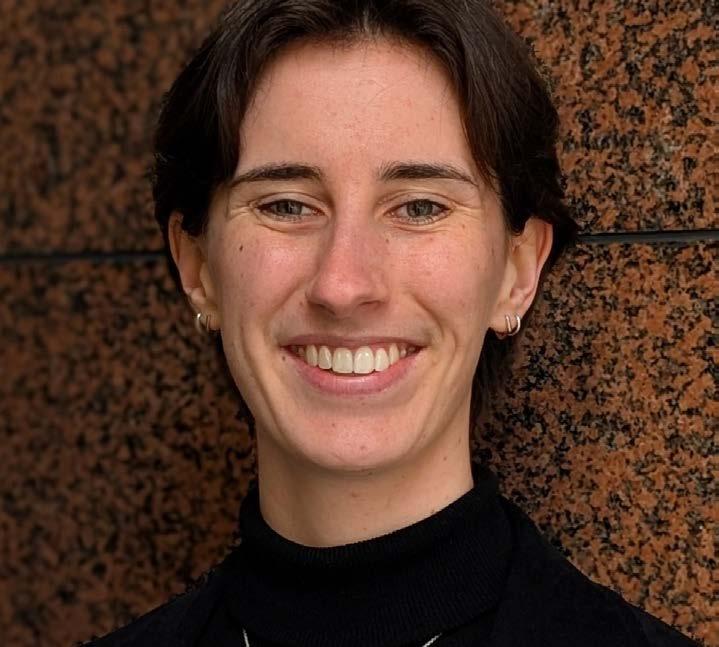
Nathaniel Griffiths conductor and host
Program
Madeleine Hammond Stellify* [10’]
Georgina Bowden Catalyst* [8’]
Lucy Blomfield The Door in the Wall* [9’]
Alexander Maltas Towards the door we never opened* [8’]
* World premiere of an MSO commission
Deborah Cheetham Fraillon’s musical Acknowledgement of Country, Long Time Living Here, will be played in an arrangement for string quartet.
This concert will be live streamed to YouTube. youtube.com/theMSOrchestra
Cybec Foundation generously provides support for the 21st Century Australian Composers’ Program
Music and Ideas is supported by the City of Melbourne
Production support provided by MSO Major Partner, CVP
Running time: 1 hour without interval. Timings listed are approximate.
Nathaniel Griffiths conductor
Australian-born Nathaniel Griffiths is enjoying a flourishing freelance conducting career. As the Australian Ballet’s 2025 Robert and Elizabeth Albert Conducting Fellow, he conducted performances of Johann Inger’s Carmen and The Sleeping Beauty, and made his Sydney Opera House debut in Kenneth Macmillan’s Manon. Last season also saw him conduct the Queensland Ballet and the Queensland Symphony Orchestra. In 2024 he gave debut performances with the Melbourne, Queensland and Tasmanian symphony orchestras, as well as the Queensland Ballet. Following his success the 2023 New Zealand AssistantConductor-in-Residence, he also conducted the Auckland Philharmonia, including conducting recording sessions for the animated film Plankton: The Movie.
Passionate about opera, he assisted on numerous opera productions at the Queensland Conservatorium, making his opera debut in 2021 in a performance of Kurt Weill’s Street Scene. More recently, he conducted the premiere of the full orchestration of Lucy Mulgan’s Red! with the Auckland Philharmonia as part of their Summer School in 2024.
Nathaniel Griffiths is a graduate of the Queensland Conservatorium, where he studied with Johannes Fritzsch, and he was a participant in the Australian Conducting Academy (2023–24).
The Composers and their Music
Madeleine Hammond (born 2001)
Stellify
In Greek mythology, it’s believed that when a hero falls, their legacy is inscribed in the stars, immortalising them in the night sky. Stellify is a sonic depiction of that transformation and transcendence.
You’ll hear the hero, personified by the French horn, in the opening fanfare; here, the drama in the brass and percussion is reinforced by a driving march-like ostinato. Then – in the cascading of the harp, trilling woodwinds and strings, and soaring brass lines – you hear the goddess sing. In this divine state, cupids play in a back-and-forth between the shimmering strings and woodwinds.
Over the heartbeat of the bass drum, dissonance and drama intensify as the mighty hero falls. The agility and lyricism of the horn is on display in a cadenza – the gradual transformation and ascension of hero to star. In an epic triumph, the initial motif returns with vigour and valour.
In a transition into the otherworldly, you will hear the hero’s transcendence as they are stellified – literally placed among the stars. Here, the harp plays ascending passages as familiar motifs return, particularly in the cello, violin, and oboe. In the final moments, the goddess sings again and the hero gleams in the night sky.
The earliest surviving use of ‘stellify’ comes from Geoffrey Chaucer (c.1348), referring to the transformation of a person or thing into a star or constellation, to place among the stars.
MADELEINE HAMMOND is a Perth-based composer with an honours degree in Composition from the University of Western Australia Conservatorium of Music and a Master of Teaching (Secondary Education) degree in Music and English. She has composed for ensembles such as the Australian Youth Orchestra’s National Music Camp tutor ensemble, the Australian Women’s Wind Band Composition Award, the UWA Conservatorium of Music Wind Orchestra, and the Choral Collective’s Voyces and Vanguard Consort.
In addition to composing, Hammond is a keen trumpeter, playing regularly with WA Brass, and her passion for the trumpet extends to the classroom, where she has worked as a brass tutor. She is also an emerging conductor who was a scholar in the Perth Symphony Orchestra’s Women on the Podium program (2023–2025) and with cellist Noah Lawrence she was the 2025 Co-Chair of the Australian Youth Orchestra’s Youth Committee – a vocal advocate for the AYO’s vision and empowering young musicians.
Georgina Bowden (born 1989)
Catalyst
Catalyst is based around the dissection of a bass drum sound, splitting its constituent overtone pitches and timbres through the orchestra. The crux of the process and its sound is the idea of progressive separation and unification. What begins as a bass drum riff is echoed back in the orchestra, before being split and distorted through prominent registers within the bass drum sound, ultimately with the original overtone chord being slowly revealed, dispersed through every instrument.
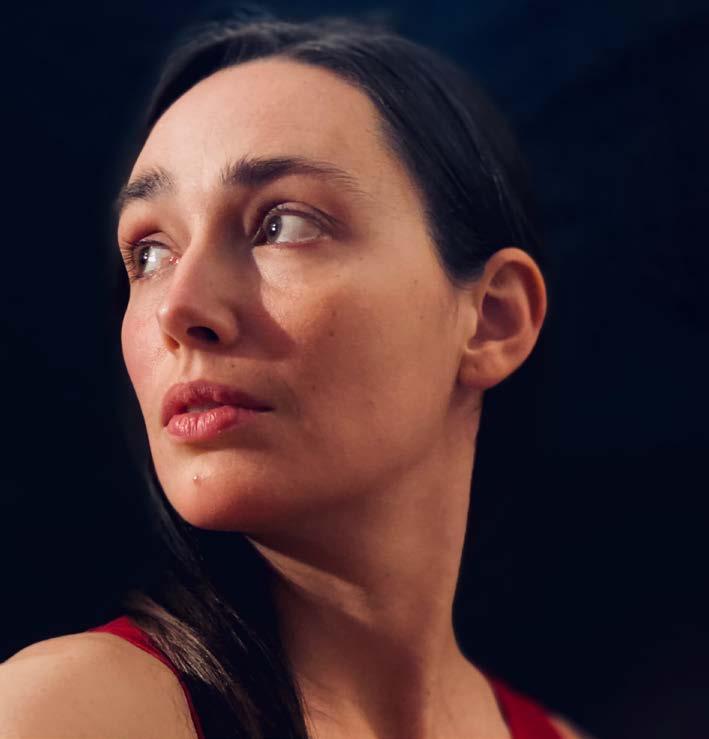
GEORGINA BOWDEN is a composer, visual artist and multidisciplinary creator living in Adelaide. Drawing on the musical, spatial and sensory experiences of her training in Composition and Architecture, she transforms concepts from sciences, arts and politics into visceral music. Her music has been performed in Europe and Australia, most recently in the Adelaide Symphony Orchestra’s multimedia concert at the Light Room Adelaide, Ensemble Musikfabrik’s studio in Cologne, and Hannover New Music’s Zeitlupe series. In 2025 she also composed for Ensemble Offspring’s Hatched Academy program.
Lucy Blomfield (born 2001)
The Door in the Wall
Inspired by HG Wells’ 1906 short story of the same name, The Door in the Wall explores the nature of the mysterious door and the impossible world that lies behind it.
The work opens with intertwining woodwind melodies that slowly entangle and unwind, evoking the first glimpse of the door. A recurring motif, an expansion from a single note into a four-note cluster and subsequent contraction, embodies the pull of the door and draws the protagonist and listener toward it.
As the piece unfolds, the brass emerge, propelling the work toward a driving percussion duet, coloured with interruptions from the rest of the ensemble. This intensifies, building to a climactic statement of the full ‘door’ motif in the brass, accompanied by surging wind and string figures: a glimpse into this ‘translucent reality’ that the protagonist experienced as a child and painfully passed by ever since.
The music subsides into a stillness leading to a final section that is reflective yet unresolved, empathising with Wells’ protagonist who is left betrayed by the door. The listener is left to question whether the door was ever truly there or if it were merely an imagined world.
LUCY BLOMFIELD is a Sydney-based composer, singer and educator working on Wallumedegal and Gadigal lands and passionate about contributing to and promoting the contemporary Australian music scene. She is a PhD candidate at the Sydney Conservatorium of Music, where she also completed her Bachelor of Composition (Honours) degree, studying under Damien Ricketson, Paul Stanhope and Liza Lim.
In recent years Blomfield has had works commissioned by the Divisi Chamber Ensemble, Caesura Ensemble, Choir of Trinity College, Melbourne, and St Stephen’s Uniting Church, Sydney. In 2023 she was awarded the Helen Channon Memorial Prize for a composition for choir and organ and won the annual Sydney Conservatorium of Music orchestral composition reading. Her works have been premiered by the University of Houston, St Paul’s College Chapel Choir (Sydney University) and the Sydney Conservatorium’s New Music Ensemble, Choir and Chamber Choir.
Lucy Blomfield is an alto chorister in the Choir of St James’ King Street and also performs regularly with various other vocal ensembles, as well tutoring at the Sydney Conservatorium.
Alexander Maltas (born 2003)
Towards the door we never opened
Time is all encompassing, omnipresent and omnipotent – this is the central idea in TS Eliot’s ‘Burnt Norton’, the first poem in his Four Quartets. Eliot explores this somewhat confronting idea through a barrage of images, one of which is a door, an auspicious door that we are never to open. ‘What is behind this door?’ is not Eliot’s intended question. Instead, he is asking us, the audience, to consider alternate methods of perceiving time, alternate experiences of temporality (how we perceive time).
Towards the door we never opened explores the idea of omnipresence, of ultimate consumption and of alternate temporality through a somewhat loose spectral approach. The work begins with an oboe multiphonic: our point of genesis (another central idea in Eliot’s poem). This multiphonic (in which the oboe effectively plays a chord) contains the entire musical possibilities of the work.
Three alternate explorations of the same material are presented: a delicate extrapolation of sonorities; a chaotic yet rich faster section; and a cold and calculated precise musical entity. The work is cyclical, that is, it returns to its point of genesis traversing the previous material in reverse order. This return begins only after expressing all three of these explorations and after reaching the point of reflection, the oboe multiphonic. Great structural care has been taken to ensure that this multiphonic provides the genesis of the work, demarcates the structural point of reflection, and signals the conclusion of the work. The multiphonic, therefore, behaves as time: it is all encompassing, has ultimate influence of the musical material, and is present in all that exists within this piece.
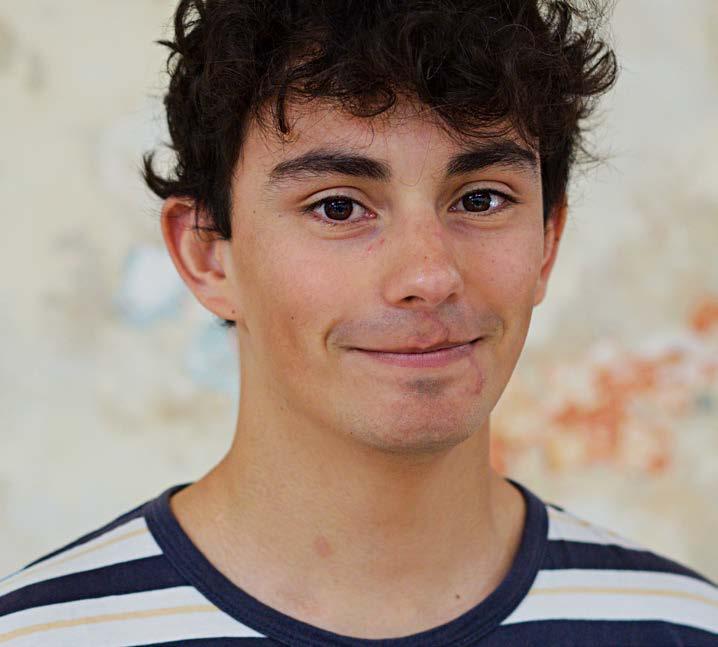
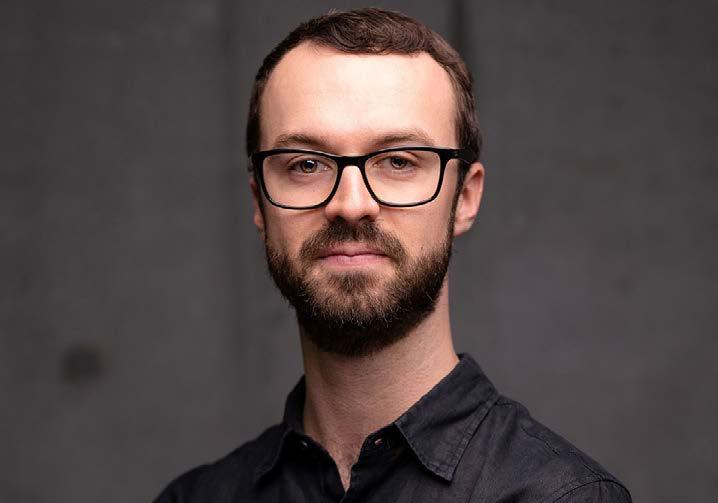
ALEXANDER MALTAS is a Sydney-based composer who holds a first-class honours degree in Composition from the Sydney Conservatorium of Music. As a student, his work featured heavily in the Sydney Conservatorium’s annual concert programming, with premieres presented by the New Music Ensemble and the Wind Symphony, and in 2024 he was selected for the inaugural Conservatorium Winter School with Liza Lim and the Sydney Symphony Fellows. That year he was also a participant in Ensemble Offspring’s Hatched Academy.
Alexander Maltas has been commissioned by the Parliament of NSW and has written for the Sydney Youth Orchestras. He is a current composition student of Jack Symonds and in 2026 he will work with and write for Ensemble Offspring and Sydney Chamber Opera.
PHOTO: JARED UNDERWOOD
Cybec 21st Century Australian Composers’ Program
Widely regarded as one of Australia’s leading professional development opportunities for emerging Australian composers, the Cybec 21st Century Australian Composers’ Program offers participants individual mentoring by a preeminent Australian composer together with a commission for a 10-minute work.
Each year, four participants are selected and the resulting works are performed by the MSO in a public showcase event, after which one composer is named Cybec Young Composer in Residence and commissioned to write further works for the subsequent MSO season.
The program creates important career pathways for emerging composers and over the past 23 years, more than 90 Australians have had works commissioned and performed by the MSO.
Since its inception in 2003, the Cybec Foundation has generously funded these programs, as well as the First Nations Composer in Residence and Assistant Conductor roles, as part of its support for the orchestra’s Artist Development Programs. Recent Cybec Young Composers in Residence include Klearhos Murphy (2025) and Andrew Aronowicz (2026).
In addition to the support of the Cybec Foundation, the 2025 Cybec 21st Century Composers’ Program was made possible with the guidance and support of lead mentor and MSO 2025 Composer in Residence Liza Lim, and leading Australian composers Matthew Hindson, Cathy Milliken and Fiona Hill, as well as the MSO library team and musicians.