Welcome from the Melbourne Symphony Orchestra
On behalf of the Melbourne Symphony Orchestra, it is my great pleasure to welcome the Shanghai Symphony Orchestra to Melbourne.
This visit represents far more than a single performance. It reflects the enduring ability of music to connect people across cultures, histories, and geographies – and through artistic collaboration to create genuine camaraderie. We are honoured to host one of Asia’s most distinguished orchestras here at Hamer Hall, and to share this experience with audiences in our city.
This year also marks the MSO’s 120th anniversary – a milestone that belongs not only to our Orchestra, but to the community that has supported, shaped and sustained it for generations. Moments like tonight remind us that orchestras play an important role beyond performance alone. They serve as cultural bridges, bringing people together and fostering dialogue through creativity and shared experience.
Melbourne has long been a city defined by its diversity and openness to the world, and cultural exchange through music has always been part of that story. Occasions like this – where we welcome leading orchestras from around the world –strengthen those connections, allowing artists and audiences alike to experience new perspectives while celebrating what we have in common.
We are deeply grateful to the musicians of the Shanghai Symphony Orchestra, to Maestro Long Yu, and to pianist Serena Wang for sharing their artistry with us this evening. We also acknowledge the leadership and wider team of the Shanghai Symphony Orchestra, whose vision and commitment have made this tour possible.
I hope tonight’s performance provides inspiration, discovery and enjoyment for everyone here. Thank you for being part of this special occasion.
Edgar Myer MSO Chair
Message from the President of the Shanghai Symphony Orchestra
Dear Friends
Fifty-one years ago, the Shanghai Symphony Orchestra set foot on Australian soil for the first time. Now, half a century later, we return to embark on a tour across Australia, New Zealand and Singapore, performing in Melbourne’s Hamer Hall, the Sydney Opera House Concert Hall, Auckland Town Hall, and the Concert Hall at Esplanade in Singapore.
As China’s oldest and most representative symphony orchestra, under the baton of Music Director Long Yu, the SSO is guided by the vision of ‘Music Connecting Worlds’.
Together with pianist Serena Wang, here in Melbourne we present the vibrant charm of contemporary Chinese musical culture through these remarkable works: the culinary-inspired rhythms of Elliot Leung’s Chinese Kitchen: A Feast of Flavours, the Eastern philosophical essence of Qigang Chen’s Er Huang for
piano and orchestra, and the romantic passion of Rachmaninoff’s Second Symphony.
We extend our sincere gratitude to the China National Arts Fund and the Shanghai Cultural Development Foundation for their invaluable support of this tour. We also wish to express our special appreciation to the Shanghai Symphony Orchestra International Advisory Board for their steadfast commitment and enduring support of the orchestra’s key initiatives over the years. Furthermore, we thank our long-term partners: China Eastern Airlines for their generous support of our travels, and China Pacific Insurance and China UnionPay for value backing to this tour.
May we share, enjoy and cherish the music we bring together!
Fedina Zhou President, Shanghai Symphony Orchestra
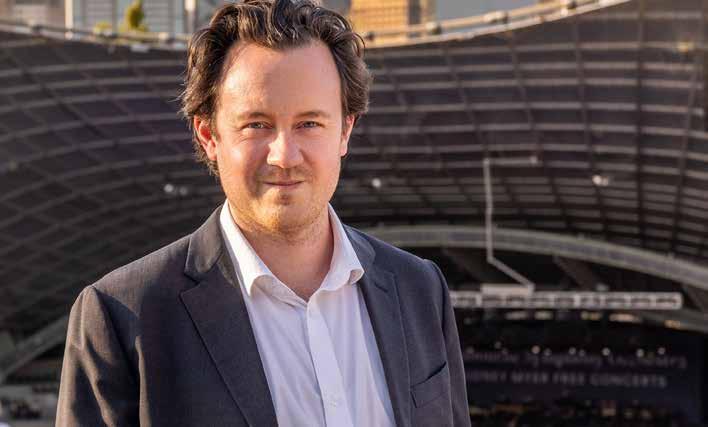
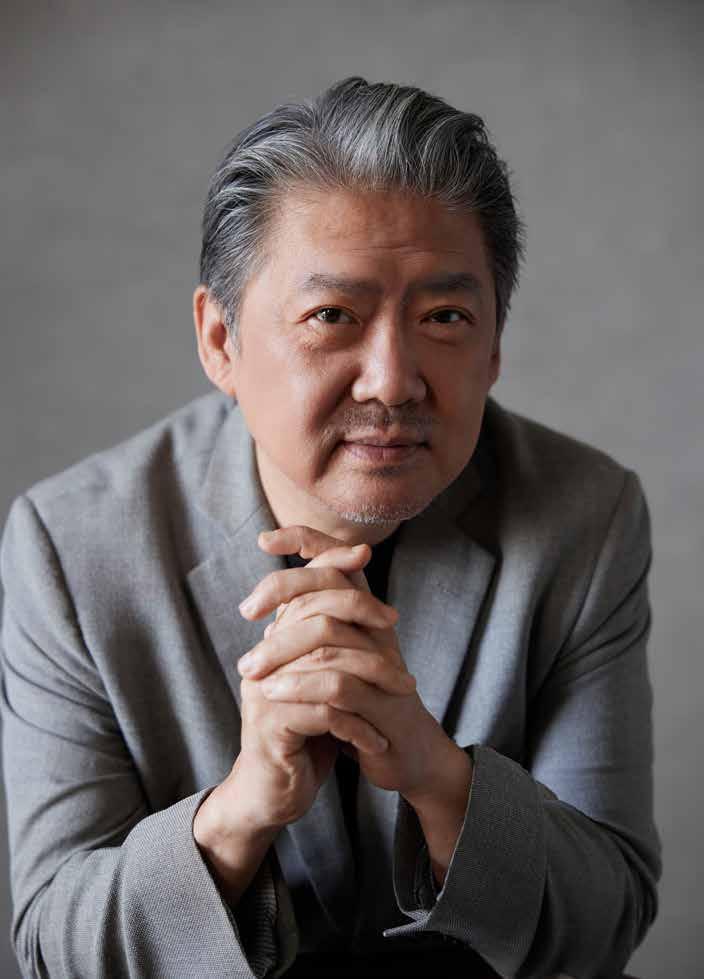
Long Yu conductor
Music Director, Shanghai Symphony Orchestra
PHOTO:
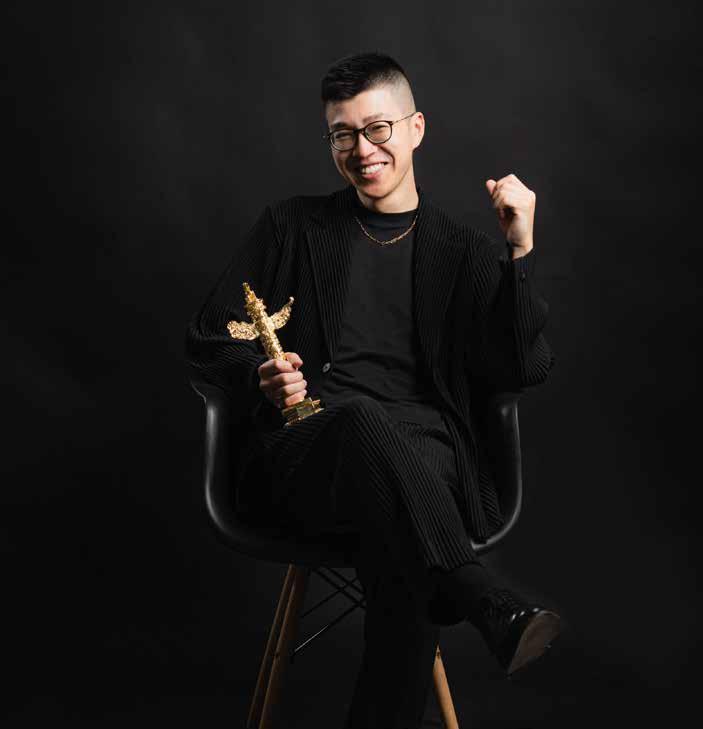
Hailed by The New York Times as ‘the most powerful figure in China’s classical music scene,’ the conductor and impresario Long Yu has devoted his illustrious career to steering China’s growing connection to classical music. He currently holds the top position in the country’s most prominent orchestras: Artistic Director of the China Philharmonic Orchestra in Beijing and Music Director of the Shanghai Symphony Orchestra. He is also Principal Guest Conductor of the Hong Kong Philharmonic Orchestra, co-director of Shanghai’s Music in the Summer Air festival, and Chair of the Artistic Committee of the Beijing Music Festival. He is currently Vice President of the China Musicians Association and Chairman of its League of China Orchestras.
One of many career highlights, in 2005 Long Yu led the China Philharmonic Orchestra on a 40-day international tour in 22 cities throughout North America and Europe. He also conducted the CPO in the first Chinese orchestral performance at the Vatican’s Paul VI Auditorium in 2008, and at the BBC Proms in the Royal Albert Hall in London in 2014.
Since taking the reins of the Shanghai Symphony Orchestra in 2009, he has led the orchestra on a tour of the United States and Europe, with performances at the BBC Proms and in the Amsterdam Concertgebouw as well as the Edinburgh, Lucerne and Ravinia festivals. In 2018, he became the first Chinese conductor to sign an exclusive relationship with Deutsche Grammophon, leading to the releases of Orff: Carmina Burana – Live From the Forbidden City (2019), Gateways (2019), The Song of the Earth (2021), Aaron Zigman: Émigré (2024) and LONG YU Complete Recordings on Deutsche Grammophon (2024).
As Music Director of the Guangzhou Symphony Orchestra (2003–2023), Long Yu expanded the orchestra’s repertoire,
educational mission and touring – visiting Europe, the US, Africa and the Middle East, as well as Australia. After 20 years at the helm, he is now Honorary Music Director for Life and Chair of the Artistic Committee of GSO and YMCG (Youth Music Culture The Greater Bay Area).
Also a towering figure on the international stage, Long Yu has conducted many highly acclaimed orchestras, including the New York Philharmonic, Chicago Symphony Orchestra, Philadelphia Orchestra, Los Angeles Philharmonic, Montreal Symphony Orchestra, Orchestre de Paris, Bamberg Symphony Orchestra, Hamburg State Opera, Berlin Radio Symphony Orchestra, Munich Philharmonic, NDR Elbphilharmonie Orchestra, BBC Symphony Orchestra, Philharmonia Orchestra, Tokyo Philharmonic, and the Singapore and Sydney symphony orchestras.
He has received numerous prestigious awards and recognitions, including the 2010 Person of the Year in the Arts Field, the 2013 China Arts Award, an Honorary Academician from the Central Conservatory of Music and the Arts Patronage Award of the Montblanc Cultural Foundation; Chevalier dans L’Ordre des Arts et des Lettres; L’onorificenza di Commendatore dell’Ordine al Merito, from the Italian government; Légion d’Honneur, France’s highest order of merit; the Global Citizen Award from the Atlantic Council; and the Samuel Simons Sanford Award from the Yale School of Music.
In 2016, Long Yu was elected a Foreign Honorary Member of the American Academy of Arts and Sciences and awarded the Order of Merit of the Federal Republic of Germany, and in 2018, he received an Honorary Doctorate from the Hong Kong Academy for Performing Arts
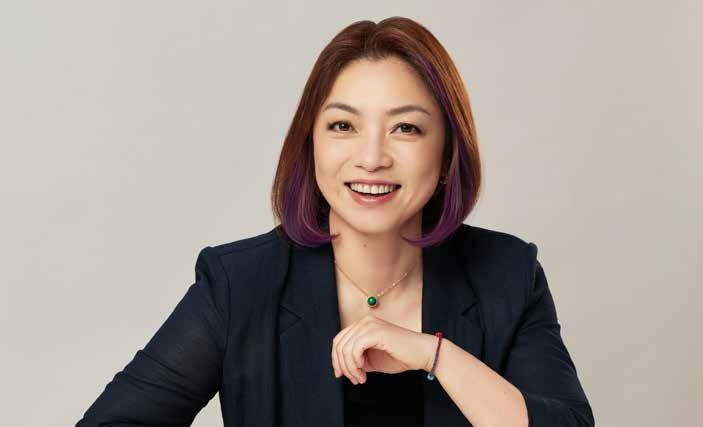
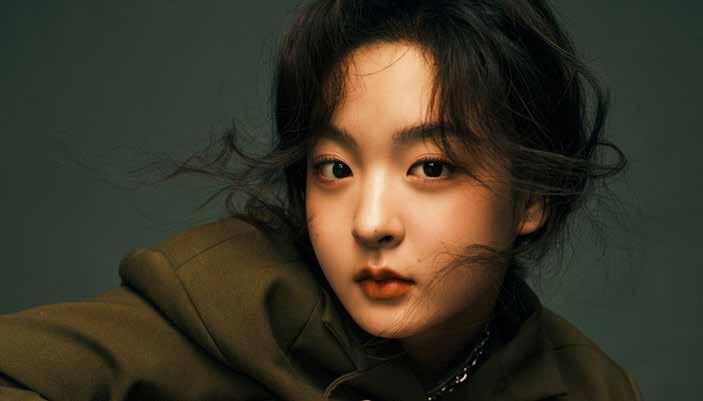
Serena Wang piano
Born in San Francisco, Serena Wang (Wang Yalun) began her piano studies at the age of four. She has performed with major orchestras and conductors throughout China and the United States, appearing with the China Philharmonic Orchestra, Shanghai Symphony Orchestra, New York Philharmonic, London Philharmonia, Israel Philharmonic, Hong Kong Philharmonic Orchestra and Vancouver Symphony Orchestra, among others. Conductors she has worked with include Yu Long, Zubin Mehta, Charles Dutoit, Gustavo Rivero Weber and Zhang Guoyong.
In recent seasons she has appeared with the New York Philharmonic as part of their 2024 Lunar New Year celebration concert. She was invited back to the Shanghai Symphony Orchestra to play Shostakovich’s Piano Concerto No.1, and to the Hong Kong Philharmonic Orchestra to play Rachmaninoff’s Rhapsody on a Theme of Paganini. Last month, she made
her Wigmore Hall debut in concert with violinist Ning Feng, and in January she played the closing concert of the Hong Kong Chamber Music Festival presented by Premiere Performances
Serena made her first recording with Channel Classics at the age of nine, featuring works by Mozart, Chopin, Shostakovich and Tan Dun. She is an avid chamber music musician and loves to perform with vocalists.
Serena Wang’s formal training began at age six with the eminent professor Zhaoyi Dan, followed by studies under the guidance of Meng-Chieh Liu and Yoheved Kaplinsky. As an undergraduate at the Juilliard School and now the Curtis Institute of Music (since 2024), she studies with Robert McDonald.
This is Serena Wang’s Australasian debut.
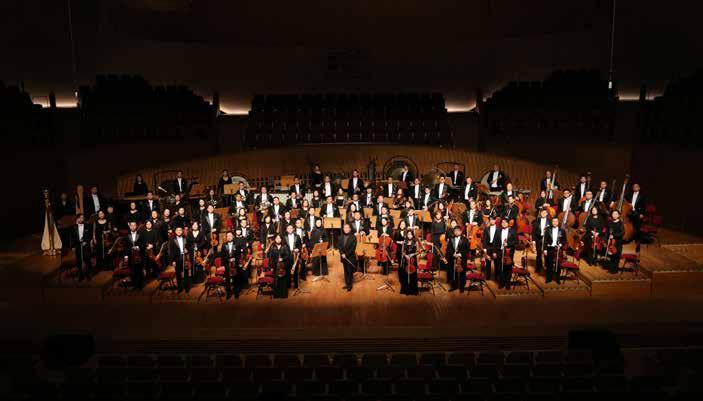
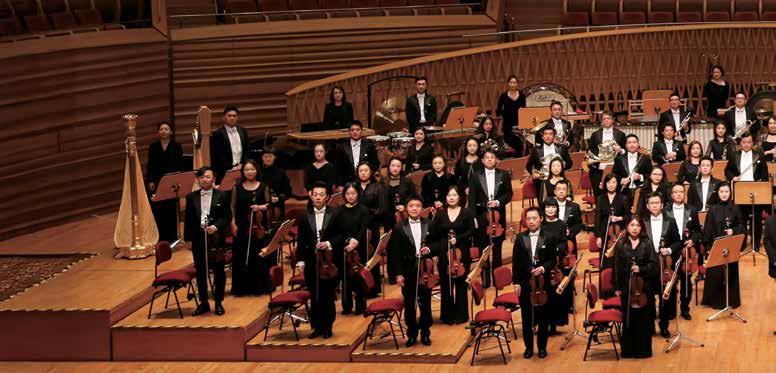
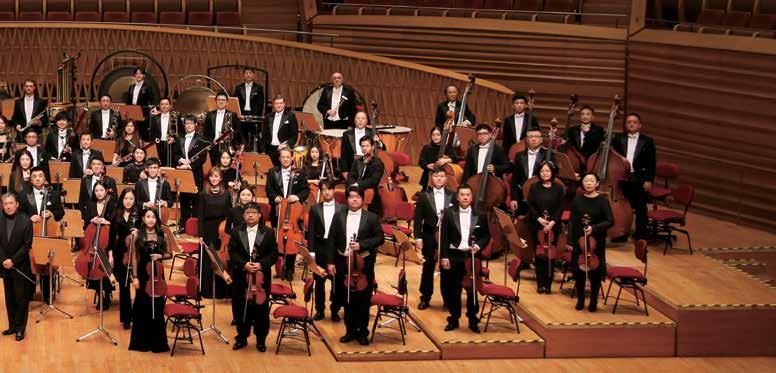
With origins dating to the Shanghai Public Band (1879), the Shanghai Symphony Orchestra is Asia’s oldest symphony orchestra. Renamed the Shanghai Municipal Orchestra in 1922 and adopting its present name in 1956, the SSO has long embodied Shanghai’s cosmopolitan character, pioneering Chinese symphonic music and serving as a cultural bridge between East and West.
The SSO has systematically introduced Western repertoire to China while nurturing generations of local musicians. The orchestra has championed seminal Chinese works – from Huang Tsu’s In Memoriam and the Butterfly Lovers violin concerto to the symphonies of Zhu Jian’er and The Map by Tan Dun as well as his Oscar-winning score for Crouching Tiger, Hidden Dragon – tracing the evolution of Chinese orchestral music onto the world stage.
A leading commissioner of new music, the Shanghai Symphony Orchestra premieres and performs contemporary works that blend Chinese cultural themes with global perspectives, such as Qigang Chen’s Instants d’un Opéra de Pékin, Ye Xiaogang’s Dunhuang and Zhao Lin’s A Thousand Li of Rivers and Mountains. The orchestra also engages in groundbreaking international collaborations, including co-commissions with the New York Philharmonic: One Sweet Morning (2008) and The Émigré (2023).
The opening in 2014 of the Shanghai Symphony Hall (subsequently renamed Jaguar Shanghai Symphony Hall in 2021) realised an integrated ‘orchestra-hall’ model, elevating artistic production and audience experience.
The SSO performs with renowned artists such as Zubin Mehta, Riccardo Muti, Paavo Järvi, Joshua Bell and Lang Lang, and with ensembles including the Jazz at Lincoln Center Orchestra. It also nurtures future talent through the Shanghai Orchestra Academy, the Shanghai Isaac Stern International Violin Competition and public education programs.
The SSO has toured extensively since the 1970s; in 1990 it made its Carnegie Hall debut and in 2004 it was the first Chinese symphony orchestra to perform in the Berlin Philharmonie. More recent highlights have included a 12-concert North American tour, a joint concert with the New York Philharmonic, and debut appearances at the Lucerne Festival, BBC Proms and Edinburgh International Festival.
The SSO made history as the first Chinese orchestra with an exclusive Deutsche Grammophon partnership, releasing acclaimed albums such as Gateways and The Song of the Earth. In 2024, it became Apple Music Classical’s Greater China partner and last year it launched the SSO Digital Hall, expanding its role from performer to global cultural communicator.
Fedina ZHOU President
QU Yue Vice President
WANG Ying Vice President
WANG Siyo Vice President
Doug HE Vice President
First Violins
Yoonso CHO
GAO Tianyang
HUANG Na
LI Wenting
LIU Lei
MA Qianyi
PAN Yi
SHI Zhenyu
SU Ting
SUN Lanyue
TIAN Junjun
WANG Chunhao
WANG Wei
XIONG Yu
YU Renchao
ZHANG Yanan
ZHENG Tao
Second Violins
MIAO Lejun Principal
ZHU Minjia Principal
DU Yi Associate Principal
CHEN Yi
HUANG Hong
Long YU Music Director
CHEN Zieyang
Honorary Director
SUN Yifan
Conductor In Residence
HUANG Yilu
LI Xia
LIU Sha
LIU Yingjia
LUO Chang
WANG Nana
WANG Yun
WU Aolie
XU Yujie
YANG Can
YEN Tochia
YIN Yuefeng
ZHOU Yanni
Violas
BA Tong Principal
SHI Zhenli Associate Principal
CAO Yibo Associate Principal
CHEN Yue
GUO Weiqi
LI Xiang
MA Ke
QIAO Dan
SUN Zehao
WANG Bochun
LIU Min Concertmaster
MA Junyi Concertmaster
ZHANG Songjie
Associate Concertmaster
LEE Hsuehhung
Associate Concertmaster
WANG Guan
WANG Lin
YU Haifeng
ZHANG Siyuan
Cellos
HUANG Beixing Principal
ZHU Lin Principal
CHEN Shaojun Associate Principal
CHEN Xihui
HU Cunyuan
HUANG Yunyan
JHAO Changhong
LIU Yuching
LU Jinhu
XU Jiajia
ZHAO Liyuan
ZHENG Shuyi
ZHOU Runqing
Double Basses
ZHANG Ming Principal
QIAN Bowen Principal
QI Jiandong
QU Xudong
SHEN Yunxuan
WANG Xiaorui
WU Jinrong
YU Han
ZHANG Kaixuan
ZHU Shunhua
Flutes
Bartolomeo AUDISIO
Principal
HUNG Chienchun Principal
ZHANG Zejing (doubling piccolo)
LIU Lin (doubling piccolo)
Oboes
ZHANG Xin Principal
MAN Jingyi Associate Principal
SUN Zizhuo Associate Principal
CHEN Yiling (doubling cor anglais)
SHENG Zhongyuan (doubling cor anglais)
Clarinets
WU Yuru Associate Principal
LI Dake (doubling E-flat clarinet, bass clarinet)
Minhye JO (doubling E-flat clarinet, bass clarinet)
Colin LIU (guest)
CHEN Hsinju (guest)
Bassoons
CHAN Tingyuen Principal
CHENG Min Principal
CHEN Juichieh
Associate Principal
HU Yu (doubling contrabassoon)
LAN Yingchieh (doubling contrabassoon)
Horns
GUO Zhongbao Principal
Peter SOLOMON Principal
Eitaro SAKAMOTO Associate Principal
SHI Jieliang
ZHONG Zhuoning
CHU Yiyu
SONG Zijun
Trumpets
XIA Fei Principal
YAO Tianhao
Associate Principal
LI Xiaonan
WANG Zhen
Trombones
HAO Jie Principal
LIN Chiahsien
Associate Principal
ZHANG Huaming Associate Principal
CAO Chensen (doubling bass trombone)
QIU Jiahui (bass trombone)
Tuba
Alexander FILIPPOV
Timpani
Enrico CALINI Principal Percussion
GU Kai Associate Principal & Head of Section
ZHENG Wei
Associate Principal
FANG Qi (doubling keyboard)
FU Yifei
SHI Chunli
WANG Kang
ZHANG Xinru
Harps
SUN Zhiyang (doubling keyboard)
CHEN Lei (doubling keyboard)
About the music
Elliot Leung (born 1995)
Selections from Chinese Kitchen: A Feast of Flavours
Deep Fried River Prawns
Buddha Jumps Over the Wall Vegetables in Soup
Deep-Fried Sesame Balls
Chinese Kitchen: A Feast of Flavours is a symphonic exploration of iconic traditional Chinese cuisines. Commissioned by the Shanghai Symphony Orchestra, it was first performed in 2024 in celebration of the SSO’s 145th anniversary. At the premiere, composer Elliot Leung told journalists that he’d structured the work as a ‘small-big piece’, comprising many short movements. ‘I want to create something similar to a tasting experience,’ he explained, ‘because people today enjoy music differently from the previous generations.’ For this concert the SSO has chosen a ‘tasting plate’ of four movements.
The complete work features ten highly characteristic dishes (including one tea beverage), with musical interpretations of their taste, appearance, texture, cooking process and cultural origins. Transforming ‘memories of the palate’ into ‘resonance for the ears’, it transcends mere gustatory imagery, offering listeners a multisensory ‘flavour symphony’.
The cooking process of Deep Fried River Prawns unfolds as a sonic adventure, in which the brass and percussion sections transform the intensity of ‘oil-blasting’ into pulsating rhythms. This vibrant, dance-like movement propels listeners into the heart of the kitchen, positioning them before the sizzling wok. Here, the rhythmic energy mirrors the prawns’ lively dance in the oil –their arcs captured in staccato notes and shimmering cymbals.
Buddha Jumps over the Wall, a luxurious soup symbolising Fujian’s culinary heritage. Its rich, layered melody mirrors the slow-simmered depth of mountain delicacies and seafood suspended in a viscous, collagen-rich broth. When unsealed, its aroma fills the neighbourhood – a scent that evokes the uniqueness of one’s hometown. From the first sip’s fresh-mellow notes to the final sip’s lingering warmth in the stomach, the soup’s complexity leaves an unforgettable impression.
Vegetables are an essential cornerstone of every feast. The opening notes of Vegetables in Soup rise like steam from a simmering broth, as emerald leaves swirl in the liquid – a vivid tableau of freshness. The music transcends mere flavour, evoking the labour and dedication of those who cultivate these ingredients: each leaf carries the warmth of a farmer’s hands and the morning dew that clings to the fields.
Deep Fried Sesame Balls, revives the ‘deep-frying’ motif, resonating with sweettoothed audiences. The creamy, crispy texture and aromatic sesame paste unfurl across the score, as thematic elements surge and evolve. The movement builds to a climactic coda – a triumphant flourish that closes this gastronomic symphony with decadent brilliance.
Chinese Kitchen: A Feast of Flavours is not only a symphony of Chinese cuisine but a tribute to Chinese cultural memory and the Chinese people’s love for life.
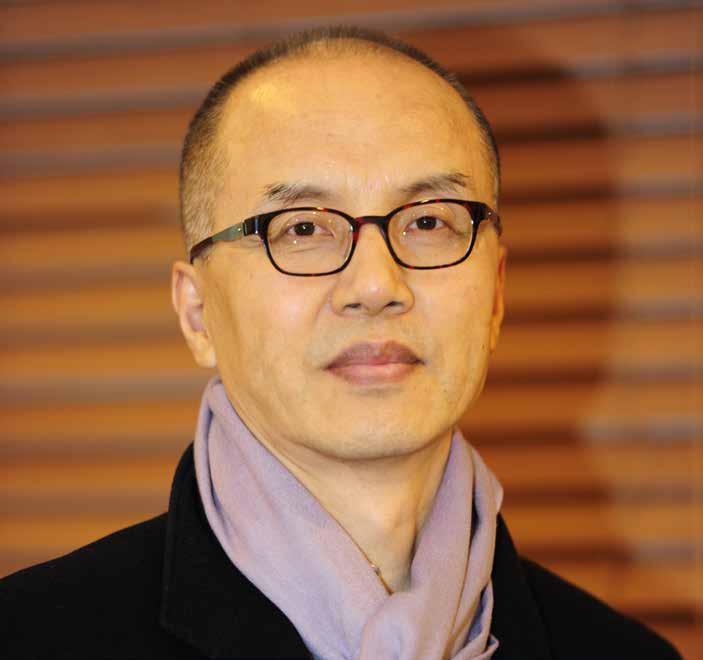
Born in Hong Kong in 1995, ELLIOT LEUNG has emerged as a distinctive voice in classical and film music with his musical storytelling style. He made history in 2023 as the youngest winner of the Huabiao Award for Outstanding Music with his score to The Battle at Lake Changjin. His accolades also include being named in the Forbes ‘30 Under 30’ list (2022) and receiving four ASCAP Awards.
Leung’s compositions span orchestral, film and game music with works such as: Lunar Overture (New York Philharmonic), Symphony No.1 The Metaverse (Hong
Kong Philharmonic; Sony Classical), Wuxia – In Commemoration of Jin Yong’s 100th Birth Anniversary (commissioned by the Shanghai Symphony Orchestra, Chendu Symphony Orchestra and Hangzhou Philharmonic Orchestra), Chinese Kitchen: A Feast of Flavours (Shanghai Symphony Orchestra), and Tree (commissioned by the Shanghai Symphony Orchestra and Shanghai Botanical Garden). His notable film scores include Operation Red Sea and Freelance, while his game credits include Honour of Kings and Six Days in Fallujah.
Qigang Chen (born 1951)
Er Huang for piano and orchestra
Serena Wang, piano
Er Huang is one of the two main musical styles of Peking opera (the other being Xipi), originating from the low, soft and melancholic folk tunes of Hubei province. The composer Jiang Wenye first incorporated this style into piano music when he quoted an Er Huang melody enriched with chromatic elements in Erhu in the Afternoon from 16 Bagatelles, Op. 8. And in Chen Qigang’s earlier piano work, Instants d’un Opéra de Pékin, another
Er Huang melody is used as the second theme, creating a dream-like effect.
Having grown up in Beijing, Chen has always considered Peking opera an indispensable part of his life. Elements of Peking opera can be found in many of his works, including his ballet based on Raise the Red Lantern and the orchestral suite
Iris dévoilée, as well as his piano piece
Er Huang. He once said:
These Peking opera tunes are memories of my family and social life. People of my generation in Beijing are very familiar with them. But now they are gradually disappearing, as the daily life of young people is influenced by Western popular
culture. Therefore, I feel an urgent loss of sense when using these melodies. Traditional Chinese music is highly distinctive. Making full use of Chinese musical elements – which form the musical language I know best and feel most comfortable with – has become my primary means of expression.
The musical language of Chen’s Er Huang is simple and clear, allowing the audience to directly perceive the composer’s genuine emotions. ‘Er Huang is a simple and sincere piece,’ says Chen, ‘representing my second attempt at writing for the piano. Although both works incorporate elements of Peking opera, Instants d’un Opéra de Pékin is passionate, while Er Huang is tranquil. True music is like a tree – its outcome is unpredictable. Before I start composing, I only sense a mood, a distant, hazy feeling, within which I discover the Peking opera melodies I know.’
The music begins with an Er Huang theme presented by the piano soloist, who is instructed to be ‘very calm, as if meditating’. Each phrase repeats with gradually softer dynamics, ‘like an echo played by another pianist’. The theme and its emotional power grow through the romantic interweaving of piano and orchestra. After a series of intense variations, the music reaches its climax. The coda returns to the tranquillity of the opening, and the longing theme is once again heard on the piano.
Er Huang was commissioned by Carnegie Hall, New York, and first performed there on 28 October 2009 with soloist Lang Lang and Michael Tilson Thomas conducting the Juilliard Orchestra.
QIGANG CHEN was born in Shanghai, and in his youth he studied composition at the Central Conservatory of Music in Beijing under Luo Zhongrong. In 1984 he had the opportunity to travel to France and spent four years in Paris as one of Olivier Messiaen’s last students. Chen found the ‘detail and nuance’ of French composers Debussy and Ravel very similar to his own style, and Messiaen would prove to be a major influence. Chen remained in France, becoming a French citizen in 1992.
He has received numerous prizes and accolades, including the Chevalier de l’Ordre des arts et des lettres (awarded by the French government in 2013). In 2008, he was the music director of the Olympic opening ceremony in Beijing, and among his major works is the 2003 ballet Épouses et concubines (Wives and Concubines), an adaptation of the 1991 film Raise the Red Lantern, and Reflet d’un temps disparu (Reflections on a Time Past) for cello and orchestra, which was premiered by Yo-Yo Ma and the Orchestre National de France in 1996.
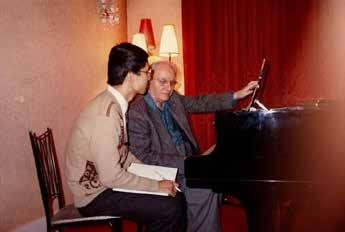
Qigang Chen with Olivier Messiaen
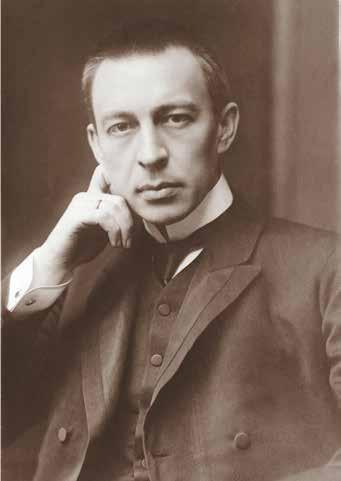
Sergei Rachmaninoff (1873–1943)
Symphony No. 2 in E minor, Op. 27
I Largo – Allegro moderato
II Allegro molto
III Adagio
IV Allegro vivace
This fervent, warm-hearted symphony has never been out of fashion with the public that loves Rachmaninoff’s music, but between the two world wars, perhaps until the 1970s, its emotional grandeur was mistrusted by many critics. It was also, for many years, the usual practice to perform it with disfiguring cuts. (Nowadays it is nearly always performed complete, though usually without the repeat of the exposition in the first movement.)
The symphony is now established as one of the most popular of all Russian orchestral works. Max Harrison’s words about musical fashion seem particularly apt: ‘Composers great and less great win their place in music history through having ideas of their own, and as time passes it counts for little whether these were cast in an advanced or traditional language.’
The circumstances of the symphony’s composition are unremarkable: between 1906 and 1909 Rachmaninoff and his family spent much of each year in Dresden, where there was time to compose in peace, where he could hear fine performances in the city’s opera house, and where the concerts of the Leipzig Gewandhaus Orchestra were only a short journey away. These Dresden years were his most consistently fruitful as a composer: his First Piano Sonata and the
What tune is that?
tone poem The Isle of the Dead are among the works that date from this productive period.
A secretive composer at the best of times, he was particularly reluctant to discuss his work on this symphony with colleagues. The premiere of his Symphony No. 1 in 1897 was a fiasco so shattering to Rachmaninoff that he composed almost nothing for three years. He was now cautious about its successor, and before he had finished orchestrating it in the first months of 1907 he told friends that it was a repulsive work, that he was already sick of it, and that he did not know how to write symphonies anyway. But its first performances, which Rachmaninoff conducted himself, were great successes, and the work was awarded a major Russian composition prize in 1908.
The Second is Rachmaninoff’s only symphony to date from the years of his full-blown Romantic style, the period which might be said to end with the growing astringency evident in the EtudesTableaux, Op. 39, and with his flight from Russia shortly thereafter. At roughly 65 minutes, Rachmaninoff’s Second is as expansive as the symphonies of his contemporaries Mahler and Elgar, but it is not of their kin – it is more direct in its expressive ambitions, throwing itself without reservation into each successive emotion. Although it has the emotional extravagance of the big Richard Strauss tone poems, this symphony declares less interest in their contrapuntal virtuosity. Rachmaninoff’s counterpoint is concerned primarily with establishing a fitting context for a wealth of melodic writing; and formally, there is none of the radical
The opening gesture of the Adagio of the Second Symphony was borrowed by songwriter Eric Carmen for his 1975 hit ‘Never Gonna Fall in Love Again’ – it made it to No. 11 on the charts.
compression with which Sibelius was experimenting. In the boldness of its profile and intensity of feeling, this symphony is the work of a profoundly original mind.
In one important characteristic, the Second is typical of its time – it is, like the symphonies of Bruckner, Mahler and Elgar, post-Wagnerian in its time-scale and ambitions, particularly in its frequent changes of key within movements, the long span of its melodies, the way Rachmaninoff creates harmonic tension by refusing to return to established keys at expected moments, and the use of motto themes to bind the individual movements together. Yet, structurally, the symphony is quite conventional: a first movement in sonata form (complete with a slow introduction); a scherzo and trio; and, following the Adagio, a vigorous finale of well-bred Classical proportions.
Its orchestration, too, is classically inclined. ‘The weight of the argument is given to the strings’ is a phrase used repeatedly by annotators to describe Rachmaninoff’s scoring of the Second Symphony, but this remark disguises the sensitivity with which the string voicings are placed. There is much expressive, high writing for the violas, particularly in the first movement; the wealth of warm divisi writing for the violins is one of the symphony’s hallmarks; and the colours of the low strings vary with remarkable sensitivity.
It is the cellos and basses we hear first, in the quiet opening bars of the Largo introduction. This is our initial encounter with the symphony’s three inter-related motto themes, and when the Allegro proper begins, we see that the movement’s main theme – a yearning, winding idea given to the violins – has been derived from the third of these.
There is also a short, suave second subject for oboes and clarinets, which is
answered and extended by the strings. The development begins with brief solos for violin and clarinet – reminiscences of the movement’s main theme – that emerge between fragmentary orchestral quotations and transformations of the other themes we have already heard. The atmosphere becomes seriously tempestuous before we reach the recapitulation. The movement ends with a force and power very different from the dark brooding with which it began.
The physical energy of the scherzo is a bright light after the shifting orchestral perspectives of the opening movement. In the middle of its festivities, a clarinet solo leads us to one of Rachmaninoff’s glowing Romantic melodies, written in characteristic step-wise fashion, and stretching itself luxuriantly across 23 bars of music before we return to the scherzo music proper.
Rachmaninoff then pauses before announcing the beginning of the trio with a startling tutti exclamation. A vivid fugue,
in which the movement’s main theme is passed fleetingly around the whole orchestra, leads to a restatement of all the major scherzo material until, in the coda, the jaunty atmosphere is interrupted by solemn brass chantings of the symphony’s second motto theme, after which the movement seems to slither off into its own dark corner.
The glorious Adagio is indebted to Tchaikovsky, but at times it sounds like a Russian meditation on the world of Wagner’s Tristan und Isolde. This is Rachmaninoff the composer and conductor of operas, and here is perhaps the greatest love duet never written for the stage. The movement begins mid-phrase, almost as if we are eavesdropping, with the violins playing what we think will be the movement’s main tune. It is, in fact, the last phrase of the melody we are about to hear: one of Rachmaninoff’s greatest creations, a long, sinuous clarinet solo, captivating in its ingenuity and length, floating on a bed of shifting, weaving harmonies. The violins then take up the theme we ‘overheard’ at the Adagio’s opening, before the cor anglais and oboe adopt an equally ‘vocal’, interrogative theme. At this point we are engulfed in a richly ambiguous, Tristan-esque world, with floating harmonies and key relationships. After a passionate climax, the dream continues with beautiful solos for violin, horn, flute, oboe and clarinet. The movement ends tranquilly.
The finale immediately establishes an atmosphere of frenetic jollity; indeed, the fizzing triplets given to bassoons, flutes, clarinets and strings seem to mimic the sound of laughter. Was Rachmaninoff ever again this unbuttoned? The mood soon becomes conspiratorial, however, as a march theme is announced by the brass. Then the main theme returns, before ascending stratospherically in preparation for a new melody of great lyrical beauty, given to the strings (minus the double basses) to play as a kind of impassioned
chorale against throbbing triplets by the wind and brass. Then themes from previous movements are recalled before we reach a remarkable passage in which, gradually, the whole orchestra creates a vortex of scales, evoking the bell sounds so frequently heard in this composer. The exhilarating conclusion gives great and embracing prominence to the finale’s second theme, before racing to its shining, emphatic coda.
When this symphony was new, music critic Philip Hale declared that its early popularity revealed ‘a weakness in its composition’, and that one day the work would be ‘buried snugly in the great cemetery of orchestral compositions’. The increasing popularity of Rachmaninoff’s Symphony No. 2 since the 1970s is a victory for the broad commonwealth of music-lovers over the small, influential critical fraternity who once declared it obvious and naïve. It might even be a signal that a concern for human feeling is the primary value most audiences seek in music old and new.
Adapted from a note by Phillip Sametz © 1996/2007
Rachmaninoff’s Symphony No. 2 was composed in 1906–08. The premiere took place on 8 February 1908 (26 January OS) in St Petersburg, with the composer conducting the Russian Symphony Society Orchestra.
The earliest recorded performance by the Shanghai Symphony Orchestra was on 22 December 1984, conducted by Lin Kechang. The most recent was on 22 February 2025, conducted by Long Yu.