


Additions to teachers’ badges this year allow for emergency calls with just a push of a button.
By Muhammad Adnan Staff Writer
As safety technology becomes more common in schools, Kingwood Park High School has implemented a new emergency button system designed to improve response times and communication during critical situations. The handheld device, now used by teachers across campus, provides two emergency levels that connect staff directly with administrators or authorities.

an emergency that will notify administration and or the authorities fairly instantly,” Brain said.
Teachers are required to wear IDs each day at school. The new addition to their badges includes a button to press in emergency situations. Photo by Tricia Darcy.
“It’ll work on our whole campus, all the way out to the baseball field,” Brain said. “It’ll work on any Humble ISD property, even Turner Stadium.”
be left in hot or cold cars.
Despite her early worries, Danielson said she has had no issues with the system.
“I’ve never accidentally pressed it. I haven’t lost it,”
While Danielson has never needed to use the button, she explained that she understands the value of having it because of past experiences in her classroom.
Assistant Principal Gary Brain explained that the system was introduced as part of a district-wide safety initiative.
“It’s a system that we can use in
He added that the button includes two functions: one for personal or localized emergencies such as classroom fights, student issues, or medical concerns and another for more serious threats, including a weapon on campus.
The device works across the entire Kingwood Park campus and more.
Teachers have mixed initial reactions but generally see its value. History teacher Jennifer Danielson said her first concern was accidentally triggering the device.
“My first impression was, I am going to hit this button on accident,” she said.
Danielson also worried about losing it after learning that the buttons are “mini computers” that cannot
As the system rolls out across Humble ISD, staff members hope the technology will help ensure faster, safer responses when emergencies occur.
“I have had, many years in the past, fights in my classroom,” she said. “So I think the most helpful thing would be to have it for the local emergencies like a fight in the classroom or a student who is having a medical alert. That way somebody can come to me as opposed to me trying to send a student to go get somebody.”
By Jack Coffey Staff Writer
The holiday season is known around the world as a time for giving, The Silver Stars dance team embrace this tradition as they participate in a community outreach event for veteran families, “Wreaths Across America,” which takes place annually at the Houston National Cemetery
“Wreaths across America is a national event that takes place across veteran cemeteries every year,” Silver Stars coach Cyndi Vaughn said. “Anyone can join and donate or buy a wreath for their loved ones.”
This year’s event took place on Dec. 13. More than two million volunteers and supporters were expected to remember and honor fallen veterans at more than 5,200 participating locations in all 50 states, at sea and abroad.
Vaughn, whose veteran father passed away last year, heard of the event from a friend. Her father is buried at the Houston National Cemetery.
“It’s good for families in the community
and a great service hour opportunity for our officers,” Vaughn said.
For the active members of the dance team, it serves as a sobering experience
“It was really nice,” said sophomore Callie Silva, who participated in the event last year with the Silver Stars. “I felt I was more connected with the community and with our veterans.”
For the underclassmen, it serves as an introduction to the selfless values the Silver Stars try to instill.
“It’s just volunteer work,” freshman Lauren Pool said. “There is no reward or anything, but it’s a good opportunity to help people and bond as a team. I just wanted to go out and help.”
Community outreach is a foundational tenet of Silver Stars.
“It’s very personal – the ceremony and what it represents – because Ms. Vaughn’s dad is also honored there,” senior Caroline Martin said. “I think it brings us together as a team and helps to show the big picture of all the people who served and sacrificed for us to be here.”


By Eleanor Durand Staff Writer
Members of the International Thespian Society went to Corpus Christi for the Texas Thespian Festival in November. Twelve of the students who attended the four-day festival became national qualifiers for various categories in acting or tech.
To nationally qualify, each participant had to prepare something called an IE, which is either a handmade project, a presentation or some sort of live performance. As they presented, they were given a specific score, which determined whether or not they qualify.
State thespian officer Emerson Harris, a senior, participated in the contrasting monologues category.
“My first monologue was a monologue that I had performed for a one-act play competition, so I already had it pretty well memorized,” she said. “My second monologue was picked out of the
script library in the classroom. When I first performed it, it made everyone laugh while I jokingly read through it.”
Before the students presented, the festival days were filled with various theater workshops spanning from ballroom dancing to kung-fu.
“During Thespians, I took a lot of dance workshops,” senior Sarah Orth said, “because it’s my last year of doing theater and I don’t plan on taking it elsewhere. So I just wanted to work on what I still plan to do, which is dancing.”
Although most of the trip is having fun with friends and learning new skills, the preparation and workload can be very stressful.
Orth, who participated in improv and costume design, had a lot to prepare. She ultimately qualified in both categories for nationals.
“I did costume design,” Orth said, “and I don’t think people recognize how much research goes into it. It’s also a lot of creativity that you need to pull and renderings and setting things up. It’s a
lot to do.”
Harris also suffered from a lot of stress during the festival, because of her duties as a state officer.
“My days were filled with preparing for presentations and workshops,” Harris said. “Before my IE, I had been working at the interviews that morning and going over my presentation slides with other state thespian officers. So I had been a little stressed about both presenting my IE and presenting my workshop.”
Everyone who attended worked hard for this festival, and it’s something that all thespians look forward to during the fall. It’s a time to make memories, be with friends, improve various theatrical skills and appreciate the arts.
“This is my favorite high school trip I will ever take,” Harris said. “I will tell everyone to go a thousand times over. Those will be the best four days of my life. Seeing it end was really bittersweet, but I’m grateful for everything that the Texas Thespian Festival has given me anyways.”
Contrasting monologues
Ashley Montelongo
Maggie Spara
Emerson Harris
Ada Stokes
All-Star Improv
Sarah Orth
Costume Design
Charlotte Terrell
Sarah Orth
Solo Musical
Amara Amadi
Solo Musical Dance
Emmaleah Range
Stage Management
Maebeth Potter
Prop Construction
William Higgins
Scenic Design
Jack Coffey
By Paisley Thomas Opinions Editor
Tiny Homes is spreading the Christmas spirit this year to veterans by donating clothes and toiletries. NHS and HOSA are donating to the ever-growing Tiny Home community that currently consists of 17 houses built by Kingwood Park, Summer Creek, and Kingwood.
Architecture teacher Missi Taylor wanted to give back this season as her students build the program’s ninth tiny home.
“I just think it’s a good way to give back to the community and give back to the veterans who served for us, for our freedom – to allow us to be able to live the way we live,” Taylor said, “So if there’s anything we can do for them, I think we should.”
When Tiny Homes first started, Taylor never expected it to have such an impact on her students and the community. When she first started, she took her students to a symposium where they helped kids learn how to build tiny homes for the community and, most importantly, how to interact with homeless people.
“We actually got to talk with someone who was formerly homeless, and he just said that it’s so nice when someone actually makes eye contact with you and asks you how your day is going,” Taylor said. “You don’t have to give me any money, but it’s treat-

ing me like a human again.”
Taylor tries her best to give back in any way that she can and encourage her students to do the same. Seniors Sarah Du Preez and Austin Whittington couldn’t imagine what they would be doing without the program.
“Not only does it impact me, because it’s going to help me with college and stuff, it impacts everyone around me,” interior design

Scan the QR code to help give back to veterans during the holiday season.

tecture would be something she wanted to do but after her first class everything fell into place for her.
“I thought it was the automotive course but then I took my first class, I was like, ‘Oh my gosh. Architecture is what I want to do,’” Du Preez said. “Everything in my life connected together. This has always been what I wanted to do. How could I not see it?”
captain Du Preez said. “It impacts the veterans, like, just these good things in the community.”
During a site visit to the current homes at Langetree Retreat and Eco Center in Liberty, Du Preez was able to ask the veterans what they would like to see in the new home and how she could incorporate new things for them to be the most comfortable.
Du Preez never expected archi-
For construction manager Whittington, building was always something he enjoyed doing even from a young age. He knew that’s what we wanted to do. Being involved in this program helped him grow even more connected to it. Whittington had no idea how impactful it would turn out to be.
“It started with three students who had a dream of being able to build a house at school,” Whittington said. “Now it’s turned into a year-round thing where every year we get to build a new one.”


Yearbook editors Peyton Smithson and Ella Hickman listen to feedback from Gloria Shields instructor Becky Tate during an intensive yearbook planning session in Dallas in July. Hickman also attended the same workshop in 2024 to help plan the yearbook that finished in fourth place in this year’s national competition. Photo by Megan Ortiz.
By Shawn Chaney Staff Writer
Yearbook and newspaper staff members flew to Nashville for the JEA/ NSPA Fall National High School Journalism Convention at the Gaylord Convention Center from Nov. 13-16.
“The highlight of it is when they come back and bring something they found from another program that they can add into ours or some find new career paths and things they want to do,” journalism adviser Megan Ortiz said.
The students walked away from the convention with 16 honors and made school history with the yearbook getting a program-high fourth place in the Best of Show (225-276 pages) contest.
“We also won some writing awards, photography awards and design awards, so it just kind of shows the diversity of things kids are learning in the program,” Megan Ortiz said.
Junior Sydney Ortiz won the title of National High School Writer of the Year for her portfolio of writing pieces from the 2024-25
The newspaper and yearbook staff won 16 awards at the national convention in Nashville. Some of the awards included the following:
Individual Awards from published work
- Sydney Ortiz, 1st - Writer of the Year
- Sydney Ortiz, 1st - Feature Story
- Chloe Sales, 2nd - Broadcast Feature
- Tricia Darcy, 5th - Feature Photo
- Tricia Darcy, 9th - News Design
school year.
Her portfolio ranged from pieces about the devastation of Hurricane Beryl to the unbreakable bond formed between two sisters after one survived a near-fatal car crash. Sydney Ortiz is the first high school journalist from the Greater Houston area to win national Writer of the Year since the award’s inception.
“She puts a lot of pressure on herself and has really high standards, and so to see her win the award she most wanted and worked for was exciting,” Megan Ortiz said. “It’s just nice when a kid’s hard work is validated outside of our school and on such a large stage.”
On top of winning Writer of the Year, Sydney Ortiz was the
On-Site Competition Results
- Sydney Ortiz, Superior - Feature Photo
- Ella Hickman, Excellent - Yearbook Design
- Peyton Smithson, Excellent - Lit Mag: Photo
- Tricia Darcy, Excellent - Photo Portfolio
only student at the convention awarded a full scholarship to The School of the New York Times for two weeks over the summer (worth more than $7,700) in New York City. At this academy, she plans to study Political Reporting.
“I made a goal to win Writer of the Year when I was in seventh grade because I saw my sister win Photojournalist of the Year,” she said of her sister Maya, who was named NSPA Photojournalist of the Year in 2021 and 2022. “I saw that and made it my goal for five years to get that, so I was really excited.”
Yearbook editor junior Ella Hickman is on the yearbook staff and works hard to make
sure the yearbook looks great at the end of the year. She has attended multiple state and national conventions and workshops.
This one was special, however, after she heard the 2025 yearbook she helped plan from start to finish earned such a high honor.
“I was honestly really surprised because I didn’t think the book would’ve placed as high as it did,” Hickman said. “Honestly, I didn’t even think we would rank because of how rushed last year’s yearbook was and how much we had to work on it from home.”
Megan Ortiz said the convention and the trip are important aspects of her journalism class. It allows her students to learn from other great minds, strengthen bonds among their classmates and serve as motivation for them to work even harder in the future.
“I can tell kids they do a really good job, but when they actually get it on a plaque or they get it on paper from somebody else, it just kind of boosts their confidence even more,” Megan Ortiz said. “It gives them a little extra motivation and encouragement that all the hard work pays off.”

Chef Anthony Chevalier always dreaded a cancer diagnosis, because the disease had plagued his family for years. One year ago, his fear was confirmed.
ABy Cameron Minatrea, Sports Editor
nthony Chevalier had
already
been driving for an hour and a half, and he knew it was time to face his problem.
In fairness, there was no reason to be out for so long. He had a healthy family – a wife, two kids – and a nice property he bought five years ago. He wasn’t worried about what would be in his home. Instead, he was scared of what he was bringing to it.
He was scared because an hour and a half before he drove away from the hospital, he contacted his wife with his doctor and informed her that he was diagnosed with stage 4 prostate cancer.
So he took his car from The Woodlands all the way to his home in Cleveland. He was unsure of how the cancer would affect his family. He knew that to get better it would take months of treatments, days of tiredness and immeasurable amounts of pain.
“It literally felt like a sucker punch,” Chevalier said. “I felt like my whole world was crumbling.”
But if he let the thought of the affliction destroy him, it would only make it worse. He was deter-
mined not to let himself become defeated.
THAT DIDN’T TAKE LONG
The diagnosis came on a Friday in January 2025. That following Monday, he was already back to teaching. Because he was going to start his chemo treatments, he informed his classes of his condition. He did it for his safety.
“My doctor told me that once I started chemo, COVID could possibly kill me because it kills your
immune system,” Chevalier said. “I wanted them to be aware of what was going on with me, and I definitely didn’t want them to be exposed to COVID and bring it back to me.”
Even with the chance coming to school could be lethal, Chevalier still showed up to work every day that he could. School acted as a distraction, preventing him from dwelling on his chemo and treatments.
“There were some days where I knew I should’ve stayed home, but it was better for me to come to work,” Chevalier said. “Being home everyday, knowing I had cancer, it was just too much for me to deal with.”
Chevalier underwent chemotherapy treatments every three weeks, and it was exhausting. He felt constantly nauseous, and it was hard to muster up the energy to walk. He spent most of his time on his sofa when he was home and in his chair at work.
To make it worse, the cancer spread from the prostate to his bones. On top of the effects from his chemo treatments, Chevalier now felt pain throughout his entire body.
“At one point it was all over – in my back, in my chest,” Chevalier said. “I was using a cane at one point because my legs hurt so bad.”
During his second chemo treatment in late February, he was given a bone supplement alongside his chemo. The pain was the most unbearable he’s ever felt.
“The two combined, it put me in so much pain,” Chevalier said. “I cried that day. A middle-aged man that cried because his body was in so much pain. At that point, I was at my lowest.”
As intimidating as Stage 4 and the pain can sound, there was still hope.
“He initially told me I had Stage 4, and when he told me that, it hit me really hard and I thought ‘Could I survive this?’” Chevalier said. “But the beauty of it was it hadn’t spread to my vital organs, so it was 100% curable.”

Alongside losing his hair and toenails, Chevalier lost one of his most beloved things. He lost his ability to taste.
He first discovered it when his wife cooked a bacon sandwich one morning, and he couldn’t smell it. Worried about his senses, he quickly took a bite and couldn’t taste one of his favorite meals.
He was devastated.
said. “Certain smells would make me nauseous, but I didn’t want to stop them from cooking. I didn’t want them to feel neglected because I was sick.”

“ There were some days I knew I should have stayed home, but it was better for me to come to work. Being home everyday, knowing I had cancer, it was just too much for me to deal with.
For Chevalier’s whole life, his passion for cooking fueled him from day to day, but now cancer had taken more from him. It was not only affecting his family but now his career. Nonetheless, if he could show up to work then he knew he had to help students cook – no matter how he felt.
“
chef Anthony Chevalier
“It felt awkward because that was my profession,” Chevalier
His sense of smell and taste were gone, but he couldn’t let that keep him out of the kitchen.
During the 2023-2024 school year, a new kitchen had been built for Kingwood Park’s culinary program, and the school needed someone to teach the class. Chevalier had already been running a catering program, where he served many members and organizations around the Greater Houston area. His professional experience made him a perfect candidate for the job. Not only was he responsible for
teaching students about certain cooking, cutting and cleaning techniques, he also led the Culinary 1 and 2 students through catering events. The program became well known for serving institutions and companies around the community.
Chevalier was credited for his leadership. He was able to help teach the students how to operate in a professional culinary environment. However, just a year into his tenure, he had to rely upon those same students to help him make it to the end of the events.
”We did a couple events near the end of the year, and during the outdoor events, they really picked up the pace,” Chevalier said. “The thing about chemo, it sucks all the energy out of you, but we all worked together to get through it. They were really there for me.”
Senior Anthony Henry was in his second year of the program when Chevalier was undergoing cancer treatments. When his teacher needed him to lead, Henry stepped up.
“I was being a leader, not by telling people what to do, but I was doing it myself,” Henry said. “I did become more verbal, and I learned how to use my voice as well.”
CHEVALIER, continued on page 8
CHEVALIER, continued from page 7
The more that the constant sickness and treatments took a toll on him, the more support he received from others around him.
Paraprofessional Tiffany May found out about his health problems in January. She had previously dealt with cancer herself, so when she was assigned to assist him in class, she embraced her new role.
“I was just there to help them with whatever he needed,” May said. “His job was to teach, my job was to help. He’s a great teacher. He’s a great instructor. I cook a lot, so I got to be there with him, which was exciting for me.”
May’s assistance helped keep Chevalier in the classroom, allowing him to take needed breaks whenever he lost energy. Other members of the school’s staff supported Chevalier by stopping by and checking up on him, and they helped motivate him when days felt long. The energy he received was enough to keep his spirits up.
Through it all, however, he received the most support from his family – his wife of 38 years and his two grown children.
Chevalier always dreaded the thought of cancer. Not only did he have family that suffered from it, but he had also lost family from it.
“I always felt like it was going to get me because my father died from colon cancer,” Chevalier said.
Chevalier was only 24 when his father passed away at the age of 55. The loss had a major effect on his family. They grew closer together, but the affliction continued to spread.
His older brother, Fred Chevalier, was diagnosed with prostate cancer when he was 41, the same kind of cancer that Chevalier was diagnosed with at 62. Fred Chevalier was given a life expectancy of three to five years. He is now 69.
“He’s lived for 28 years, surpassing how long they thought he would live. It gave me hope,” Chevalier said. “It gave us an opportunity to bond. Talking about it everyday, you know, supporting each other, it made our family so much closer.”
While Chevalier relied on his faith as well, he credits his wife for being his “rock.” No matter how drained or depressed he felt, she was by his side.
“That woman is a saint in my life,” Chevalier said. “We’ve been married for 38 years, and

ever since I found out about my cancer, we’ve bonded even more.”
Chevalier finally won on Aug. 5. He received a letter in the mail, and it confirmed he had beaten cancer.
For someone who is labeled “cancer free,” it is often a tradition to ring the bell at the doctor’s office. When Chevalier went to his appointment at Memorial Hermann in Humble, he finally rang the bell.
After all the treatments, after the long days where all he could think about was laying down and resting, he finally felt a part of him come back.
He knew that the effects wouldn’t go away overnight. He would still feel fatigue day to day from medication, and his taste buds would forever be affected.
Still, Chevalier got in his car and drove straight home. This time, he didn’t take a longer route. He wasn’t bringing his family bad news, but instead the opposite.
Chevalier is forever changed; but in that moment, he felt like himself once more.

By Marin Tippy Staff Writer
Little kids are often inspired by TV shows. They end up saying that they want to be a superhero or an astronaut. But for senior Bella Shotts, Disney Junior’s Doc McStuffins sparked her dream to care for animals.
“I asked my mom what job took care of animals, and she told me it was a veterinarian,” Shotts said.
It’s only natural that Bella joined FFA when she was a freshman. She first heard about the program when she was in sixth grade because her older sister raised a lamb.
“Whenever my sister went into FFA, I, loved her animal,” Shotts said.
Now in her fourth year of FFA, just like her sister, Shotts raises a lamb, plus chickens too.
Shotts wants to attend Tarleton State University in Stephenville, Texas, and go into the “pre-vet” program. FFA has helped her in her career-decision process.
“[FFA] helps me prepare for these goals by teaching me leadership skills like public speaking and communication,” Shotts said. “It’s also helped me grow in my knowledge of animals, and I know more breeds than I came into KPark with.”
FFA broadly covers all aspects of possible careers in the agricultural

field. This has helped Shotts discover that she specifically wants to be a large animal veterinarian. She wants to care for farm animals like pigs, sheep and goats. Even though being FFA president takes up hours of class time each week, she knew that’s what she wanted to do. Ever since being a “green hand,” Shotts has always been very active in the FFA program.
“I decided [to run] because I knew that I had a little bit of leadership in me, and I wanted to help our chapter grow and just keep on pursuing, like, accomplishments in the FFA organization,” Shotts said. She always makes sure that her officers have their scripts ready and are all prepared for their monthly meetings. She also makes sure everyone is ready for pen and animal selection, as well as
mentoring and leading new members of FFA. Outside of school, she makes sure that her animals are fed and cared for. This is especially impressive considering how chickens are a lot of work, which is something that many people don’t know, and that selling chickens can be very hard.
While Shotts’s sister first got her involved in FFA, it’s her teacher Genevieve Ubnoskye who has had the biggest impact on her career goals.
“Ms. Ubi has shown me what it is to be a woman in FFA,” Shotts said. “She is definitely a mentor for me.”
Ubnoskye has loved teaching Shotts and looks forward to following her chase her dream career.
“It actually makes me feel humbled and blessed because that’s the one thing that you want as a teacher is for a student to feel that way about you because that means that you affected their life in a positive way,” Ubnoskye said. “That’s why I became an ag teacher to begin with. I know that she’s going to be successful at no matter what she does because she’s just such a hard worker and she tries so hard. So I know that in six to eight years, I will see her as a large animal vet and I know that she’ll be successful at doing that.”
By Marien Martinez Staff Writer
FFA had a busy November as 21 students competed in the Leadership Development competitions. Agriculture Science teacher Genevieve Ubnoskye, who has been involved in FFA for 37 years, said this year’s competition stood out in a big and different way.
“We had two of our teams advance to Area – Public Relations
and Senior FFA Creed,” Ubnoskye said. “Last year, we didn’t have any teams advance from district to Area. We had very dedicated teams this year.”
The two groups put together strong showings at Area as well.
“They did not advance to state, but they were proud of the work that they had done and I was equally as proud of them,” Ubnoskye said.
Even though the competition ran smoothly, there was one stressful
moment during it. The Public Relations team brought a TV to use for their presentation, but once they arrived at C.E. King High School, it stopped working.
“Luckily, they had a TV in the room where the competition was and we were able to put our presentation on there,” Ubnoskye said.
Katie Tims, who is the vice president and has been in FFA all four years of high school, competed in Public Relations along with
teammates Cate Fowler, Bryleigh Romig and Ashlyn Stadelbacher.
“We presented to judges about FFA and about what it is,” Tims said.
The other student to advance was Breanna Muller in Senior Creed.
“The look on their faces when they found out they were moving to the next level,” Ubnoskye said. “It was an emotional day.”


Sign up for Journalism or Photojournalism on Course Selection Day to start the adventures! For returners, apply for the staff you think is the best fit! Contact adviser Megan Ortiz in Room 1504 with questions.


By Danielle Nalley Staff Writer
Senior Tia Thompson doesn’t understand why some parents don’t allow their children to get jobs. She found freedom and a respect for workers that she didn’t have before.
“I think especially people in restaurants, waiters, people that host, I treat them extra nice because I know that they’re working off of tips,” said Thompson, who has been a server at two restaurants in the past. “They’re working off of being there for eight hours, it’s just a nightmare.”
Thompson, who got a job as soon as she turned 14, likes working a few times a week for quick cash and for a way to have financial freedom to do what she likes.
Initially, working as a server at Papa Murphy’s in Utah, Thompson quickly learned that despite her age it didn’t give coworkers the right to walk over her. She also learned time management and not going beyond her capabilities.
“You’re easy to be taken advantage of because you’re usually willing to do anything because you’re a teenager,” Thompson said. “Learning how to deal with being treated unfairly early and not taking it to heart is helpful.”
Thompson shows this by only working once or twice a week and trying to keep her schedule towards the weekends so the week is left for homework and chores. Thompson agrees that making sure her job doesn’t overtake parts

of her life is important to keeping a healthy work balance to avoid burn out.
In Texas, it is illegal to employ a child under 16 except under specific circumstances, according to the Texas Workforce Commission.
According to the Utah Legislature, however, minors in Utah who are 14 years old or older may work in a wide variety of nonhazardous occupations.
After she moved, Thompson took an entire year to find a new job in Texas until finally landing

a job at the Zumies in Deerbrook Mall. Her experience in years prior gave her a step up.
The plan changed as soon as the Trader Joe’s in Kingwood released job applications though. For Thompson, it wasn’t a question of applying but getting accepted.
The job was highly sought after because of the hourly pay, benefits, and convenience to teens. Trader Joe’s pays $14 an hour to start and employees receive a 7% increase each year. That is almost 50% more than minimum wage in
Texas, which currently is $7.25. Because of so much previous work experience, Trader Joe’s hired Thompson. She is a shipmate, which is a position for employees under 18. It includes bagging groceries and maintenance. She started working two shifts every week in The Woodlands to prepare for opening.
“I feel like I’m finally [getting paid] fairly good but at every other job I’ve had it’s been rough,” said Thompson.


Working at a fast food establishment is a popular choice among teens. With the extra money comes long days and challenges though.

By Marie Wakefield Staff Writer
There are around five million fast food workers in the United States. Past estimates suggest around 30 percent of those workers are teenagers.

Junior Brianna Jedrzynski is one such employee. She works at Sonic, a mere five minute drive from Kingwood Park for up to 32 hours a week. She started working when she was 16 years old and needed to pay for her own car insurance and expenses. Sonic seemed to be the perfect fit.
“It’s one of the only places hiring so young because a lot of places want me to be like 18 or older,” Jedrzynski said. “And it’s just good to have a job where you can have some extra money for college and AP classes, that sort of

Average salary per hour of fast food workers in Texas.
Source: Indeed.com
salaries to other minimum wage jobs. In Texas, the legal minimum wage is $7.50 an hour, but the median hourly wage for fast food in Houston is $12.74.
Junior Bryce Hickman started working at What-A-Burger to get a more consistent job, after working with his dad’s landscaping company Redzone Concrete since he was 8. He now works primarily as a fry chef.

Percent of the fast food workforce are teenagers.
Source: Center for Economic and Policy Research
employee to cover for her or get a write up. This is simple when she knows when she’s unavailable due to her involvement in Student Council and Culinary Arts, but sometimes unforeseen events can pop up.
“For instance, when I’m sick, I can’t say two weeks in advance,” Gamble said. “So it’s either I find someone to cover the shift or whoop de do, it’s a bummer for me.”

common motivator for teens to seek employment,
restaurants often
“They were the first place to give me an interview and they weren’t paying too bad,” Hickman said. “So I just picked them.”
Initially, one of the hardest things was adjusting to the consistency of the schedule that comes with shift-divided jobs. For junior Karma Gamble, who works at Freddy’s, having less control over her schedule is a new reality.
“The managers set a certain schedule,” Gamble said. “And they tell you the days that you’re working [which is] based off of your availability when you have the interview.”
If she can’t make her shift, Gamble must submit a notice two weeks in advance and get another
For Jedrzynski, it can sometimes feel like a lot to handle. She is involved in hospital clinicals for health science and aspires to be a nurse. Academically, she is taking Dual Credit US History and OnRamps Biology. The days when she has a two-hour clinical rotation at the hospital, her regular classes, homework and a shift at work, it can be exhausting. But it’s also necessary.
“[When I have clinicals,] my body’s a bit more tired,” Jedrzynski said. “And if I work that same day, then it sucks, but I get it done. I’m fine. I make it work.”
Jedrzynski remembers several customers whose orders bordered

Percent of working teens have jobs in fast food.
Source:
National Restaurant Association
By Sydney Ortiz
on compulsiveness. Some customers ask for jalapenos and pickles in their drinks. One woman in particular asked for exactly 27 pieces of ice.
“This woman, she rings in, she says to me, ‘Oh, I want a Coke with 27 pieces of ice,’” Jedrzynski said. “And I was like, ‘Oh, so like light ice?’ She’s like, ‘No, 27 pieces of ice.’ I don’t ring it in as 27 pieces of ice... I was like, ‘Oh, just give her a little bit of ice. It will be okay.’”
Jedrzynski thought she was done with the customer, but a few moments later another worker came in and told her the customer needed a new drink.
“This woman is having a whole screaming fit over the fact that her Coke has more than 27 pieces, it had 41,” Jedrzynski said. “[The second time,] I personally counted them one by one, gloved up, picked them up by hand, and then she was happier.”
Customers also have come in aggressively. When a man’s card was rejected, he reacted angrily and told her not to make him get out of his car.
“He literally starts threatening me,” Jedrzynski said. “He’s like,
you’re trying to steal from me. So I told him, ‘Oh, I’m sorry about this. I’ll go get my manager.’”
Jedrzynski told her manager, and he went to handle it.
“I see him go to this car and he’s like talking to the dude and eventually gets to yelling,” Jedrzynski said. “But eventually, [my manager] comes back in, the guy is going, we got the money – with a $10 tip at that.”
Gamble said customers are the hardest part about working in the fast food industry
“In some cases, they get mad about things that you can’t control or like the price of things,” Gamble said. “Or if something gets done wrong in the back, but you’re just handing it to them.”
Kingwood Park substitute coordinator Sara Walsh started working in fast food when she was 15 years old as a party manager and mascot for her local McDonald’s.
“They used to have birthday parties in the ball pit play area,” Walsh said. “So I was the birthday party girl. And then I also had to wear the Grimace suit sometimes, like that big purple guy. Occasionally, I’d have to go out by the road and wave at people as Grimace.”
When Walsh turned 16, she could legally handle food and started working in the kitchen and behind the counter.
Walsh says the lessons she learned from working in the fast paced and often demanding environment taught her life lessons and have given her skills she continues to utilize on a daily basis, especially with time management and dealing with bosses.
“Your boss, your managers make a difference in your work life,” Walsh said. “It’s very important because they could make your day miserable or they could make it better.”


By Tricia Darcy Editor-in-Chief
Senior Bryce Gerbasich came home from coaching a youth sports camp over the summer excited to tell his older sister, Katie, everything that happened. His face lit up when he shared stories each day.
The youth camp at United City helped fuel what is one of Bryce’s passions and goals for the future – coaching. The two-sport athlete and state qualifying pole vaulter, found a love for football even before coaching at the camp. He plays the game and he studies the game every chance he gets.
“I would argue he’s probably the smartest football player I’ve ever spoken to,” senior Cooper Wolocko said. “I know he talks
about growing up, he would always play Madden. Just playing any kind of football game against him is so frustrating because he’s actually a genius. He talks about wanting to be a coach when he grows up and I think that he’ll flourish in that.”
Bryce’s own football journey started in the Kingwood Football League, but he became more serious about the sport once he joined the team his freshman year.
During his freshman and sophomore years, Bryce played quarterback on the sub-varsity level. He enjoyed being the one in control of the ball.
His knowledge of the game led to success. JV even went undefeated his sophomore year with him at quarterback. But Bryce knew his
quarterback days might be over when he joined varsity because of the team’s depth at the position.
That early experience leading the offense helped him when he moved to different positions for his junior and senior years.
“I think that it makes him smarter in his route running,” wide receivers coach David Feliciano said. “He knows how hard it is for a quarterback to throw an accurate ball. So he doesn’t really give them a hard time if they threw him a ball that was on the ground or if they threw him a ball where he’s running into contact. He just tries to make the play.”
Initially, Bryce was uncertain about making the switch to defense as a junior, but he was willing to
play any position.
Using his knowledge from playing offense, Bryce learned how to quickly read an offensive line.
“When you’re a quarterback, you’re taught to kind of read the safeties and then make adjustments to the play based off of that,” Katie Gerbasich said. “Then he learned how to play safety and so then he got to see the flip side of ‘Oh, now I need to read the quarterback’s eyes and read XYZ.’”
As soon as the football season ended, Bryce shifted gears quickly to pole vault, an event he started practicing in seventh grade.
Bryce spent much of last season focused on pole vault, however, he also went to sprint practice every day to help on the relay teams. The
workload eventually took a toll on him.
Leading up to the District Meet, Bryce sustained a calf strain making jumping more difficult. Bryce shortened his pole vault approach and temporarily stopped competing in the 4x100 and 4x200, in hopes of healing quick enough to perform well in the postseason.
“He has a lot of grit and determination,” said boys track coach James Higham. “I know it probably didn’t feel the best, but he gutted it out. He really wanted the opportunity to go jump in Austin and jump at the State Meet.”
The focus on rehab helped Bryce get through the District and Area Meets. With a jump of 15 feet at the Region Meet, he qualified for the State Meet last April. At State, Bryce finished seventh out of nine jumpers.
Bryce left disappointed, but he was motivated going into his senior year.
“There was a lot of pressure and I was really nervous and I kind of just wasn’t expecting it,” Bryce said. “There were a lot of seniors competing, so being one of the only juniors, I kind of wasn’t as worried about how I did that year. It was more just like experiencing the moment and taking it all in.”
When State ended, Bryce returned to the football field where conversations about switching back to offense started. However, with sophomore Jon Pavlatos set to be the starting quarterback, Bryce wanted to contribute more.
“It was kind of hard knowing that I was athletic enough to where I should be on the field and not just be sitting as a backup quarterback,” Bryce said.
Bryce shined at receiver early and spent the spring adjusting to the new position, while also working on playing quarterback again.
During one of the scrimmages, a defender rolled over his ankle, forcing Bryce to be put in a boot and sidelined for multiple weeks. This didn’t stop the senior from missing any of the practices though.
“He was still there to learn the position, even though he couldn’t participate for a couple weeks,” his


helped the team finish the season with a 5-5 overall record.
By the start of his senior year, Bryce was ready for a little of everything. He was a starting receiver, but he also prepared to be the team’s backup quarterback and kicker.
“I just wanted to do what I could to help us win and be on the field as much as I possibly could,” Bryce said. “It didn’t really matter where that was.”
While Bryce was on the field, he did as much as possible on offense. He had 353 receiving yards and four touchdowns this season. He also kicked seven times and punted three times.
Bryce’s offensive contributions
“Bryce has a tremendous understanding of [wide receiver] because he’s still the backup quarterback, if we need him to come in,” football coach Clayton Maple said. “He still has that working knowledge of everything about our offense, not just his position. I mean, I think he can really tell everybody what to do receiver-wise on every play. It’s a huge asset.”
With the football season now over, Bryce is ready to focus on qualifying for State in the pole vault. In his free time, he is back to watching and studying football every chance he gets.
“His intelligence about sports is insane to me,” said his sister Katie,
a
to the
a junior at Clemson University. “He came to Clemson to see me, and he was watching the college game, and he was so locked in on warm ups and all these things. Then he would make comments to me that I didn’t even notice, and I’ve been watching these games for three years.”
Bryce’s athletic ability and work ethic have made him versatile and successful in both of his sports. Those who have worked with him have no doubt that he will keep finding success in whatever direction he chooses.
“He’s a very hard worker,” Higham said. “You know, whether it’s football or whether it’s track or whether it’s ping pong, he’s a competitor. He gets after it and he wants to do his best.”
After months of rehabbing a season-ending baseball injury, Nicholds has worked his way into a starting role on the basketball team.
By Caleb Kazeem Staff Writer
When Trey Nicholds collided with teammates
Ethan Brain and Caine Naramore on a bunt coverage drill early last spring, a broken wrist ended his baseball season. It kept him sidelined from summer basketball as well.
But injuries and health complications have never slowed Nicholds. When Nicholds was born, he was diagnosed with bladder exstrophy, a stomach disease that caused him to have 12 surgeries throughout his childhood and left him without a belly button.
“The doctor said I should never play sports,” Nicholds said. “Now with all of the surgeries I had, I know how to go through adversity and then what it feels like when people think you can’t do it, but you know that you can. Now I am a two-sport varsity athlete.”
The wrist was just another challenge for Nicholds to overcome. He immediately followed his doctor’s orders for rehab and worked his way into a starting role on the varsity basketball squad.
His determination impressed basketball coach Jeffrey Hamilton, and so has Nicholds’ leadership skills.
“Trey is a leader on the floor as he’s one of the toughest kids I’ve ever coached,” Hamilton said. “He shows up every day with a great attitude and ready to work; he’s a true leader by example. He is loved by all his teammates, has a great personality, is always smiling and positive, and an awesome young man.”
Being able to balance two sports at once is a challenge most athletes cannot handle, especially ones in sports that are that close

together. But Nicholds’ commitment to both sports has left Hamilton in awe.
“Being a dual-sport athlete is extremely hard, but I have been so impressed with Trey and his ability/commitment to both programs,” Hamilton said.
“I’ve literally seen Trey play multiple baseball games as well as multiple basketball games in the same day.”
“
played basketball with Nicholds since Creekwood Middle School, said he admires how respectful Nicholds is and his kindness towards everybody.
“He will always have your back no matter what,” Carter Hamilton said. “Trey’s always happy and smiling. Even when he’s playing bad, he’s cheering on the team.”
junior Trey Nicholds “ The doctors said I should never play sports. Now with all the surgeries I had, I know how to go through adversity and what it feels like when people think you can’t do it, but you know you can.
Hamilton has built a relationship with Nicholds over time and has been able to not only see him on the court, but he has also seen his character off the court. Nicholds is friends with Hamilton’s sons Carter and Cole.
Junior Carter Hamilton, who has
With the team chemistry that Nicholds brings and physicality on defense, the team hopes he can help lead the team back to the playoffs.
Last year, the team lost in the bi-district round to Montgomery 65-61. The boys have made the playoffs for the
past five years, but the team has not made it past bi-district since 2022 when the Panthers reached the Regional Semifinals before losing to Katy Paetow, 63-43. This year’s team returns only three players from the previous season. Even though the squad has new faces throughout its roster, Nicholds said he believes the team will still complete its goals.
“We were more skilled last year,” Nicholds said. “But this year we are way more disciplined and have the ability to win a district championship.”
Overall, basketball has been a comfort spot for Nicholds since he was a young boy. From winning a youth championship game to being the starting post player on varsity, basketball has always been home for him.
“My favorite part about basketball is my family,” Nicholds said. “I love the environment and amazing atmosphere of the program.”


U.S.
Sydney
laughs with Sydney Ortiz, age 5, about how they have the same name in 2014. Ortiz met Leroux after Leroux’s NWSL game against the Houston Dash on July 30, 2014. Leroux was Ortiz’s favorite player growing up.

SPORTS COLUMN s BY SYDNEY ORTIZ
My jaw dropped as I stood in the cafeteria of my elementary school in St. Charles, Mo.
A few seconds prior, one of my third grade classmates had just yelled across the lunch line in my direction telling me how much the Los Angeles Dodgers sucked.
He insulted my favorite team. A team I had just traveled 800 miles to watch play two games against the Astros in the World Series at Minute Maid Park. A team I cried over the year before as I watched the Cubs eliminate them in the 2016 NLCS. A team that had power over 8-yearold me from March to October.
After I attempted to defend my favorite team to him, he started acting like I – a girl – would never and could never understand baseball like he does.
It didn’t matter that the first song sung to me after I was born was “Take Me Out to the Ballgame.” It didn’t matter I attended the 2015
Baseball Hall of Fame induction ceremony, meeting Craig Biggio, Jeff Bagwell and more. It didn’t matter I went to the Astros’ Spring Training in 2014, or that I was always watching and keeping my own scorebook for baseball games I watched on TV.
I tried to change his mind on the Dodgers, but I realized it wasn’t worth my time to try to fix a stubborn 8-year-old.
Little has changed over the years. I am constantly underestimated on my ability to understand and enjoy Major League Baseball as a girl.
Over the summer, I was telling a friend how much I loved following baseball. His first instinct was to quiz me. He asked me if I knew what a balk was or if I could name every player in the Dodgers’ starting lineup? Answer after answer wasn’t good enough for him.
I’ve been called “delusional” for my takes, solely because I am passionate and confident in my opinions and knowledge of baseball,
especially when it comes to the Dodgers.
It seems like no matter the research I’ve done or the amount of games I have watched, it’s hard for people to comprehend that a girl is able to have an educated conversation about a specific team or league. They clearly haven’t heard of Alyssa Nakken, who became the first full-time female coach in MLB history with the San Francisco Giants in 2020. They obviously don’t know Kim Ng, who spent four years as the general manager for the Marlins from 2020-24 – the first woman GM for a men’s team in North America. And they have never listened to Jenny Cavnar call an A’s game after she became the first woman to serve as a team’s lead play-by-play announcer in 2024.
As I’ve gotten older I’ve become more interested in different sports leagues that are dominated by male faces such as the NBA and NFL. And I still get the same weird faces and
quizzes, so they can “verify” I am allowed to have an opinion.
I also follow the WNBA and NWSL, but I’ve never been challenged on my knowledge of those leagues. I’ve never had to prove myself to be a fan of a “league for women.”
Why I am constantly told I can only be educated on sports leagues my gender plays in will never make sense to me. Sports are universal and no matter who you are or where you are from, you can follow along with a game you love. That is what is so special about sports. They unite more than just the people you see in your local communities.
I love sharing my love for sports with all my friends who will listen. I don’t mansplain or shame them for not understanding. I make connections to things that will help them find an interest. And when I find the rare friends who love talking sports with me without diminishing me, it’s the best conversations ever.

Senior Tristan Rodriguez started the year with 10 straight wins as he chases his fourth district title.
By Rayden DeSouza Staff Writer
At the age of 5, Tristan Rodriguez’s dad got him into wrestling. Success came quickly as Rodriguez learned the sport. Just after his 7th birthday, Rodriguez won the Houston Nationals Open Tournament in the D1 50 lbs weight class.
“It was the highlight of my young years,” Rodriguez said.
He eventually took a break from wrestling, but Rodriguez got back into it as a freshman on varsity. Again, success followed him. At the end of his freshman year, Rodriguez won his first district champion title in the 126 lb weight class.
Rodriguez went on to wrestle in two other weight classes. As a

sophomore, he won a district title in the 132 lb weight class. He won districts in the 144 lb weight class as a junior. The three-time district champion is now chasing a fourth
title in hopes of being the first boy in Kingwood Park history to win four district championships.
In his junior year, Rodriguez suffered a severe ankle sprain forcing him to sit out for multiple matches. Despite that, Rodriguez returned to wrestle in the district meet.
“I came out stronger and better after it, but it was definitely a hard one,” Rodriguez said.
Rodriguez said he does feel pressure to succeed this year as he competes in the 157 lb weight class.
“Number one [goal] is to stay healthy and be able to compete all year,” said coach Jeff Knight, of this year’s goals for Rodriguez.
“Winning a fourth District Title, Regional Champion and placing at State are all extremely hard but achievable goals.”
Senior Elijah Lester said Rodriguez stands out on the team because of his mentality.
“No matter if it’s like someone’s twice the size of him or not, he just goes and gets it done,” Lester said.
Rodriguez said he spent much of the offseason working on building up his cardio, strength and technique.
“[He leads] by example by how hard he competes and prepares for his matches,” Knight said. “This year he has also stepped up as a leader and does a great job working with our younger wrestlers on technique.”
Rodriguez is still considering wrestling in college, but his primary goal for now is to meet his senior season goals.
“I hope to end it on a good note, have no regrets and lift my teammates up and myself up – and hopefully maybe go to college,” he said.
In a program rich with district, region and state champions over the years, Rodriguez is helping continue a legacy of success as he chases his fourth district title.
“It would establish him as one of the best to compete at Kingwood Park,” Knight said.
By Caleb Kazeem Staff Writer
To look for a fresh start and meet new people, juniors Allison and Melanie Fixmer transferred from Kingwood High School to Kingwood Park.
The varsity swimmers have been swimming since they were 6 years old.
“I really lock in,” Allison said. “When I’m swimming, everything else kind of goes away.”
The girls said transferring has been great for both.
“The people (at Kingwood Park) are so much nicer,” Allison said. “Not saying the people at Kingwood weren’t nice, it’s just a different type of nice.”
Girls swim coach John Dissinger said he has seen great improvement and effort since the girls came to Kingwood Park. He said the girls often lead their lanes, and

Dissinger looks forward to seeing what’s ahead for them in the pool.
Dissinger said something that stood out to him was the girls are
seen at all the team’s community service events, spending free time together to help other people.
“They are just great human be-
ings,” Dissinger said. “Kind to all and super hard workers.”
Although both of the girls swim, they are in different types of events. Allison swims quicker, more speed-based events. Melanie swims longer events. The girls make sure they support each other in each meet.
“(Allison) is always there for me,” Melanie said. “We cheer each other on when we can.”
Allison often focuses on the 50 and 100 free, while Melanie swims the 200 and 500 free. Through all the success the girls have had together in swimming, both make sure they keep a strong relationship through the sport.
The girls use each other as motivators to push them through all the troubles.
“It’s like I have a swim buddy,” Allison said. “Somebody I can stick with.”
By Rocco Huerta and Tricia Darcy
With baseball and soccer preparing to start their seasons soon, athletes are dealing with weather extremes.
On the last day of school before Thanksgiving break, it was a high of 88 degrees in Kingwood. Nine days later on Dec. 1, the high was 45 degrees.
“I really hate [the cold] because it makes your body much more tight and you’re really stiff,” baseball player, senior Griffin Resendez said. “And when you play baseball, you need to be loose and let your body flow.”
The girls soccer team has faced similar challenges, especially recently with the drop in temperature. Because of the soccer season schedule, soccer teams will face both intense heat and extreme cold.
The heat in Texas that is experienced throughout most of the soccer season is especially intense when playing on turf.
“We play games in 28 degrees with light flurries and we play games in 90 degrees in humidity,” head girls soccer coach Jess White said. “So the girls have to be ready for anything.”
While most athletes dislike playing in cold weather, on the soccer field, senior Santiago Cruz embraces the chill though.
“So for most players, they prefer playing in the cold because they feel like they could run more because it’s like less energy that you’re using,” Cruz said. “Because when it’s hot outside, especially on the turf, it’s terrible. It’s literally impossible to play. So when it’s cold outside, it feels like you have more energy.”
Resendez has found the opposite true. When it gets cold, Resendez

said it’s a challenge to stay focused and not want to quit.
“When it’s cold and you’re going hard, it’s not fun,” Resendez said.
“So I feel like [it’s hard] staying
mentally focused and just being locked in. It’s not fun to be outside in the cold because I feel like it just brings everybody’s mood down.”
By Shawn Chaney

When orchestra group photo day arrived, I had absolutely no idea how to tie my bow tie. Thankfully, orchestra director Evan Farmer came into the orchestra theory room and saw me struggling, looking like I was working with two left hands. He tied it for me right before the picture, and while he was tying it, I asked a question.
A few weeks earlier, I had heard about the Christmas Club. As a first-year orchestra student, I was very intrigued and pondered joining for a while. The idea of playing Christmas music in a club with friends and players who are way better than me sounded very fun. While Mr. Farmer tied my tie, I finally worked up the nerve to ask him if he thought I would be able to handle Christmas Club. He said I should definitely go. Since then, I’ve gone to every single Christmas Club meeting and seen many familiar and welcoming faces. A majority of the music played in the club is intended for highly skilled players, such as those in chamber or sinfonia orchestras. Because of the difficulty of these pieces, I’ve had to rely on friends who are in way higher orchestras for help during the club. Most of the help that I’ve needed has revolved around quicker rhythms, certain symbols and really high or really low notes that we haven’t even covered yet in my orchestra class. The friends that I rely on the most to point me in the right direction are sophomores Lily Story (sinfonia) and Piper Christiansen (chamber), who are in my beginner orchestra class, trying new instruments.
Going into the club, I knew I would be the only beginner in it, and that all the music that they would be playing would be out of my league, but I still wanted to commit to it. Many of the words I hear from the conductor, and the unfamiliar symbols scattered all over the sheet music, seem like complete nonsense to me. But I still show up before school on Thursdays and after school on Tuesdays, and try my best to fit in. So, I try my best and practice at home when I can, and I’m not tied up in other things, such as writing and photography for the school newspaper or babysitting. At times, I find myself lowering my viola from playing position after just a few measures into a piece. Sometimes I’ll shadow bow just the rhythm and not worry about the fingerings to at least try to keep up the illusion that I know what I’m doing, but usually I still can’t even keep up with that much.
Many things have made me glad to participate in the club. One highlight was right after the meeting on Oct. 28, when the orchestra president, senior Ian Ferguson, offered me an officer position in the orchestra. I was really interested in becoming an officer because I love being able to help with things behind the scenes, which is what we do before and after events like concerts and parties. It’s crazy to think that I only took orchestra for the fine arts credit.
My favorite part of Christmas Club is the culture and community, just like Orchestra as a whole. I love how easily I can get help with everything. Students from all grades and orchestras are more than willing to help me; some are even kind enough to help me with my chemistry homework. My fellow violists have been the biggest help in my orchestra journey so far.
Trader Joe’s. New stores in Kingwood never looked any better.
“Wicked: For Good.” Thanksgiving break was changed: For good.
Getting jobs. Almost Christmas season, and I’m Santa!
“Stranger Things” season finale. It’s all everyone’s talking about for a reason.
Sweater season. Love getting cozy next to a fire.
Pizza line. Even if it’s greasy, it’s food. I’ll be running to that line anytime.
New fashion trends. It’s always fun to switch up your style.
Finishing schoolwork early. Going home with no homework? Yes!!
Digital cameras. A way to capture memories without using PCD’s.
Starbucks Christmas menu. It’s worth the hype!
Sweat Sets. Totally chic.
Sales. Love it when things are actually affordable.
Nike techs. We wear quarter zips and drink matcha now.
Last-minute presents. Better start going to 5 Below NOW.
Missing work. Why does one zero drop my grade by a million?
No more late arrival. Can the weeks get any longer?
No deodorant. No, the crystal one doesn’t work.
6-7. It’s been 6-7 months. Let it die.
Slow walkers. We have places to be and people to see.
The weather. I’m literally shivering in my boots.
Classroom temperature. How is it 100 degrees in one class and 0 in another? That should be impossible.
Applying for jobs. They never respond, and when they do it’s a no!
Walking in the rain. Wet, cold and I almost fell.
College Football Playoffs. Getting to watch your favorite teams win. Until they don’t…
By Samantha Fajardo

By Marie Wakefield

I’m going to order a scan for prediabetes.”
My doctor told me casually, her eyes glued to the computer screen that housed all my information in the patient room of Texas Children’s Pediatrics Clinic during my yearly wellness checkup.
“Wait, what?”
“Your BMI is in the higher range, so we want to check for that. Just in case.”
My eyebrows were probably raised to the ceilings at that point as she rattled on about “standard procedure.” As were, apparently…my obesity levels?
Me, unhealthy? Me, overweight? Me, a varsity swimmer who trained for up to four hours a day? Who had competed in state and national level competitions for my sport? Who, on occasion, flexed my biceps in the mirror with a decided measure of pride?
Yet, I was considered, in the eyes of the medical community, overweight and so unhealthy I needed to be scanned for a condition that usually affected obese and sedentary teens with other health problems. Based off of what? My “BMI,” whatever that was?!
I got into my car after the appointment and sat there for a moment in silence.
Then, I did what any self respecting woman would do — I turned on a podcast pertaining to the topic and went on a deep dive.
The concept of BMI, or Body Mass Index, is relatively simple. According to the all-knowing CDC, BMI is “body weight (in kilograms) divided by the square of their height (in meters).”
Now, you might ask, how was that complicated sounding formula found?
The concept of a “Body Mass Index” emerged in the 1830s by an

astute Belgian mathematician named Lampert Quetelet. Ol’ boy Lampert wanted to find the “average man,” and he measured a lot of his fellow Belgian bros and did a lot of mathy stuff until he had a formula. (Bear in mind Lampert didn’t even have a calculator back then.)
Lampert was not a doctor, not a health scientist, but a math guy, ancestor to the modern version of Steven from Algebra class. Fast forward a century to the 1960s to the beginnings of an obesity epidemic, and a man named Ancel Keys dusted off the forgotten formula with a glorious vision of standardizing obesity.
We have real, scientific, modern data that isn’t from the 1830s that very clearly spells out that BMI is not an accurate measure of an individual’s health.
To his credit, he did do some research before helping to implement it into the American healthcare system. He tested 12 groups of people, all of them men, an improvement from the one group in Lampert’s study. Apparently they were “healthy,” but it’s unclear what metric that was determined with. And this was enough proof to make
Now let’s look at his brother, Smith John. Smith is an intellectual and doesn’t overly concern himself with the duties of the flesh. He spends his days eating ice cream and Ding Dongs from his mother’s basement while arguing chaos theory on Discord. He’s the same height as his brother but weighs 145 pounds. He is much taller horizontally, to put it delicately. His BMI is 24.9. We both know which one is healthier. But BMI would tell you Smith is living a good lifestyle and should keep doing what he’s doing, and would tell you John is overweight and needs to work out more and eat better. This is pure idiocy. We might as well theorize the world is flat or 2+2=5.
a health standard to be used widespread in every facet of American medicine: because, of course, only 12 groups of people exist in America. And none of them are women. We have very few health processes that have remained unchanged at least a little bit for 200 years. Even the Hippocratic Oath is spoken in English rather than the original Greek. But the BMI has not strayed from its unapologetically Belgian roots. But we don’t have to rely upon conjecture about the legitimacy of the original results: we have real, scientific, modern data that isn’t from the 1830s that very clearly spells out that BMI is not an accurate measure of an individual’s health. Because we know more now. Allow me to demonstrate to you the crown jewel in the royal splendor of the failures of BMI:
John Smith is a bodybuilding gym bro who guzzles protein shakes like water and has been bulking since he was three years old. He weighs 170 pounds and is 5-foot-4. His BMI is 29.2
Why are we ignoring reality to take refuge in a number that acknowledges it isn’t even correct in most circumstances? Would we refuse to fix a clock because it “gives us a general idea about what the time could be?” No! We would fix the clock, or throw it out and get a new one. It’s time to stop chaining ourselves to the shackles of tradition.
And the good thing is that modern science has already dropped several alternatives on our proverbial doorstep. Measuring your stomach diameter, or visceral fat is scientifically proven to be a better indicator of obesity risks than BMI. If you want an even fuller picture, full body scanners look at fat distributions and percentages.
I took one of these recently, and guess what? It turns out my straits are not as dire as BMI said. It turns out I’m actually pretty healthy. It turns out my muscle mass accounts for a lot of my weight. And guess what, well-meaning-doctor-whosename-I-don’t-remember? I am not getting that pre-diabetes check–because there’s no basis for it.
Because instead of drawing a line of best fit, healthcare should be about seeking to get the most accurate information on an individual level. Because at the end of the day, there’s no such thing as an ideal weight, because there’s no such thing as an ideal person.
Normalizing people showing up to restaurants with poor behavior needs to end.
Customers walk in with the expectation that they know more about the restaurant business than the employees who spend five days a week serving hundreds of customers.
They expect their needs to be triumphant over the other tables that surround them, and they assume that servers only have their one table.
When sitting down at a restaurant, people shouldn’t be scared to ask for good service. However, constantly demeaning servers, yelling at bussers and asking for something new every time a server visits your table shouldn’t be a usual occurrence.
Serving is not an easy job. In Texas, most servers get paid the minimum required for a tipped employee — $2.13 an hour. Despite the low hourly pay, these

servers show up to work with a smile on their face even when they are struggling to support their children, studying for their final exams or driving a broken down car they just hope makes it a little longer.
It is common for struggling customers to take their problems out on the servers. Yelling at them,
December 2025
Volume 12, Issue 3
Kingwood, Texas 77339
EDITORS
Tricia Darcy & Sydney Ortiz, editors-in-chief Danielle Nalley, online editor Cameron Minatrea, sports editor Paisley Thomas, opinion editor
STAFF WRITERS, PHOTOGRAPHERS & SPECIAL CONTRIBUTORS
Muhammad Adnan, Chase Canlas, Shawn Chaney, Jack Coffey, Charlie Crass, Rayden DeSouza, Jacob Dinh, Eleanor Durand, Samantha Fajardo, Emerson Harris, Joshua Harris, Rocco Huerta, Caleb Kazeem, Marien Martinez, Michael McElmurray, Isabella Muñoz, Leonardo Peña, James Pham, Marco Plascencia Carmona, Pilar Retamales, Chloe Sales, Claire Slaydon, Fabiain Smith, Marin Tippy, Marie Wakefield. Adviser: Megan Ortiz
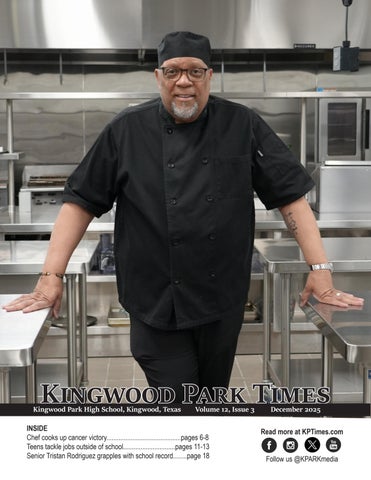
Cover: Chef Anthony Chevalier stands in the culinary classroom. He battled cancer for eight months in 2025. Photos by Cameron Minatrea.
calling them stupid or just not tipping has become normalized. When people choose to stiff their servers by not tipping, most servers basically end up having to pay the restaurant for that table to eat. Depending on the restaurant, servers must share a portion of each table’s money with hosts, bussers or server assistants. Those
jobs each get a set percent of the server’s total sales, since they helped make their job easier. No matter if a table tips or not, those other employees still need to get paid.
Tipping shouldn’t just be a recommendation, it should be a requirement.
KP Media is the official student-produced media of news and information published/produced by KP Media students. KP Media has been established as designated public forums for student editors to inform and educate their readers as well as for the discussion of issues of concern to their audience. It will not be reviewed or restrained by school officials prior to publication or distribution. Advisers may – and should – coach and discuss content during the writing process.
Because school officials do not engage in prior review, and the content of KP Media is determined by and reflects only the views of the student staff and not school officials or the school itself, its student editorial board and responsible student staff members assume complete legal and financial liability for the content of the publication.
The media will serve the best interest of the students and faculty of Kingwood Park High School, keeping itself free from any commercial obligations distracting from this purpose; this is defined by the media itself.
All writing in the media, other than letters to the editor in the newsmagazine, will be written by students of the journalism program and will not be accepted otherwise.
The media will specialize in and emphasize on informing their readers of school news and unique students of the Kingwood Park High School community.
The media will cover community, state, national, and international news if it is directly relevant to the school community, and includes local angles.
The media will strive to provide coverage to all school organizations and functions.
Any decisions affecting the publications on all levels will be made by the editorial board, the adviser is allowed to give legal advice and his/her opinion, but the final decision rests in the hands of the editorial board.
Only the editorial board may prevent material it judges to be in violation of the media editorial policy, from being printed.
Letters to editor will be printed in the opinion section of the newspaper or on the website. Letters to editor should not exceed 300 words, must be signed and must include writer’s address and phone number for verification. Letters to the editor will be verified by a member of the editorial board to determine the authenticity of the writer.
The school newspaper will be distributed free of charge to all students every 6-8 weeks. The paper is completely financed by advertising revenues and fundraising. The money raised is used to pay for the school media printing costs, supplies and other media expenses.
See the entire staff editorial policy at KPTimes.com.
By Joshua Harris

Ah, the sickening sound of one of your bones shattering, it’s burned in your memory. It’s a rite of passage that you hopefully never have to endure, if you have, my regards, friend. A broken bone can either be easy or extremely hard to navigate around with, there isn’t an in between. I have had the unfortunate pleasure of breaking a bone… twice (yes, I know, cue the applause). Let me tell you, it’s awful. When I first fell and heard the crunch, I knew, I’d messed up. I felt the pain shoot up my arm as my muscles tensed and my body burned. I’ve never known a worse pain since. The feeling stays with you, it’s engraved in your mind as you always remember what it felt like. Sometimes if you’re really unlucky, like me, you have to have surgery and you get a scar. A permanent reminder of your pain and, in my case, stupidity.
At this point you’re probably thinking. “Josh, what did you do?” Dear reader, please keep in mind, the following story was a young and naive version of me.
Envision Christmas Eve of 2019, a joyous day in a simpler, less digital age. Three young boys run amuck in a yard, Nerf blasters in hand. A fierce battle had been brewing, a long and hard fought war had occurred that day. The sound of spring-loaded triggers launching a dart that whistles through the air was a sound you couldn’t forget. The sky had been nice, perfectly cloudy while also sunny leaving a nice shade with a little heat. Nothing could ruin this day.
Then, the plan that would change my fate forever was made. We were going to pull the greatest prank of all time… shoot my friend’s sister with a bunch of Nerf blasters. My friend would lure his sister out, and then we’d unload everything. You know, looking back, this was just mean and not a good prank; but we were kids, so cut us some slack. Anyway, the plan was set in motion. I had to get to my station. The plan relied on it. Then I felt the air change. It wasn’t hitting my face directly, like I was going

downward. I looked down and saw it. A wire that was in the yard holding up a Christmas inflatable. I had tripped over it and was sent falling. My fellow soldiers watched as I hit the ground, THUD, and began crying. I had no idea at the time the force from the impact had shattered the growth plate in my left arm.

By Chase Canlas
Now, I know, it sounds ridiculous. I tripped and shattered my growth plate? Yeah, right. If only that was the case, this was some silly story, but it isn’t. When it first broke I didn’t immediately go to the hospital, I just walked home after my friend’s mom had nursed me for a bit.
My mom and I didn’t really think I needed to go to the emergency room. I later decided I did want to go to the ER, so my mom took me. I got seen and the doctor was like, “Dude, you need to go to the hospital.” So we went home, grabbed my things, and headed off. I got to the hospital where they basically said, “Yeah, we’re gonna put metal pins in your arm to correct the break.”
So that, kids, is how I ended up waking up in the hospital on Christmas morning. Zero out of 10, would not do again. To anyone who has had surgery for a broken bone, my condolences. It’s scary and not a fun experience.
Now to any readers who may have caught when I earlier said I’d broken a bone twice, allow me to say that’s a story for another time – the time when I fell off a three foot wall and broke my elbow.

By Isabella Munoz

Ahighlight of science classes is the labs performed throughout the year. The OnRamps Biology class participated in an enzyme lab on Dec. 4. Students observed different ways catalase of liver breaks down in hydrogen peroxide.


