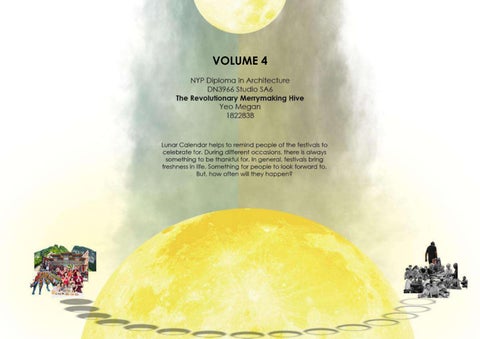
VOLUME 4
Strand 5 : Festival and Rituals
TIMELINE OF CHINESE FESTIVALS (LUNAR CALENDER)
Self - Constucted Chinese New Year (Spring Festival) Qingming Festival (Tomb Sweeping Festival)
Zhonghe Festival (Blue Dragon Festival)
Buddha's Birthday
Duanwu Festival (Dragon Boat Festival)
Lantern Festival
Cold Food Festival
Shangsi Festival
1st day of 1st mth
15th day of 1st mth
Last day of lunar year
2nd day of 2nd mth
8th day the 12th mth
3rd day of 3rd mth
At the Qingming solar term, solar longitude of 15°, 104 days after winter solstice
At the Dongzhi solar term, solar longitude of 270°, the day of winter solstice (around 21-22 Dec.)
9th day of the 9th mth
105th day after dongzhi
15th day of the 8th mth
8th day of the 4th mth
15th night of the 7th mth (14th in parts of southern China)
5th day of the 5th mth
7th day of the 7th mth
Qixi Festival (The Night of Sevens, Magpie Festival, Chinese Valentine's Day)
Laba Festival Dongzhi Festival (Winter Solstice Festival)
Double Ninth Festival (Chongyang Festival) Mid-Autumn Festival (Moon Festival)
Chinese New Year’s Eve
Questions: How did time change the way people celebrate these festivals? How did these festivals attract people?
Ghost Festival
Importance of Chinese Festivals PvP
Strand 5 : Festival and Rituals Self - Constucted Chinese New Year (Spring Festival)
Lantern Festival
1st day of 1st mth
15th day of 1st mth
Last day of lunar year
Past
Present
2nd day of 2nd mth
8th day the 12th mth
Chinese New Year’s Eve
LEGEND:
Zhonghe Festival (Blue Dragon Festival)
Laba Festival
Qingming Festival (Tomb Sweeping Festival)
Shangsi Festival
3rd day of 3rd mth
Cold Food Festival
At the Qingming solar term, solar longitude of 15°, 104 days after winter solstice
At the Dongzhi solar term, the day of winter solstice.
Dongzhi Festival (Winter Solstice Festival)
9th day of the 9th mth
105th day after dongzhi
15th day of the 8th mth
Double Ninth Festival (Chongyang Festival)
Buddha's Birthday
8th day of the 4th mth
15th night of the 7th mth (14th in parts of southern China)
Mid-Autumn Festival (Moon Festival)
Duanwu Festival (Dragon Boat Festival)
Ghost Festival
5th day of the 5th mth
7th day of the 7th mth
Qixi Festival (The Night of Sevens, Magpie Festival, Chinese Valentine's Day)
Purpose of the festivals (Vague)
Strand 6 : Names, Myths and Other Stories Chinese New Year (Spring Festival)
Buddha's Birthday
Set off fireworks after midnight; visit family members
Visit Buddhist temple, offer food to the monks
Double Ninth Festival (Chongyang Festival) Some Chinese also visit the graves of their ancestors to pay their respects.
Duanwu Festival (Dragon Boat Festival) Dragon boat race, eat sticky rice wrapped in lotus leaves Zòng Zi (粽子).
Qingming Festival (Tomb Sweeping Festival) Visit, clean, and make offerings at ancestral gravesites, spring outing
Questions: What do these festivals really mean to people these days? Is the meaning of having the festival like Chinese New Year still genuine? What do people think of if you mention any of the festivals?
Mid-Autumn Festival (Moon Festival) Eat mooncake, family union meal
Ghost Festival Burn fake paper money and make offerings to ancestors and the dead to comfort them in the afterlife and keep them from troubling the living.
Dongzhi Festival (Winter Solstice Festival) Have Tangyuan and Jiuniang and perform ancestor worship, Feast day, family gatherings
Chinese New Year’s Eve Set off fireworks before midnight; visit family members
Strand 3 : Ground-up DIY Questions: What has caused the change in the way people pray? How much has the method of praying changed? Will the restriction in rules change people’s beliefs?
What if there is a day where people are fined for ‘littering’ the papers?
Strand 4 : Technology, Materiality and Craft
Prayer items and its authenticity
Questions: How are these practices being passed down from generations without losing it authenticity? How do we know if the meanings and uses of these are accurate? Will the deceased really receive our offerings? What keeps the beliefs alive?
JOSS PAPER The burning of joss paper is an essential custom of the Chinese. It is a practice that is believed to send money and the material wealth to your deceased relatives and friends. We respect, honor and love our deceased and that is why most of the practices still exist.You may call them joss papers, ghost money or spirit papers. They all refer to the same thing (the Chinese paper offerings). They are paper objects made from coarse bamboo paper or rice paper and used to appease the dead, for transformation, prosperity wishes, payment of spiritual debts and fertility among other purposes.
Strand 2 : Food Questions: How did these became a fixed food for certain festivals? How do we know if it is the taste of origin after being passed down from generations?
Strand 1 : Nature In Buddhist symbolism, the lotus represents purity of the body, speech and mind, as if floating above the murky waters of material attachment and physical desire. According to legend, Gautama Buddha's first steps made lotus flowers appear everywhere he stepped. The Lotus Flower grows in the deep mud, far away from the sun. But, sooner or later, the Lotus reaches the light becoming the most beautiful flower ever.
The Lotus flower is regarded in many different cultures, especially in eastern religions, as a symbol of purity, enlightenment, self-regeneration and rebirth.
Self constructed meaning/ Beliefs:
Purity It helps to bring people’s heart towards the sincerity, truthfulness and kindness in their beliefs. Bringing ONLY the genuine hearts to give their prayers.
Enlightenment It brings hopes and blessings to people.
Questions: How does nature create beliefs for people? How do beliefs connect people? Can beliefs do harm to people?
Self - Regeneration It gives people the confidence and support to stand up again.
Rebirth It gives the spirits and soul a chance to rebirth themselves.
The Lotus in Buddhism The lotus appears frequently in all kinds of Buddhist art across all Buddhist cultures. Scrolling lotuses often embellish Buddhist textiles, ceramics and architecture. The lotus flower is one of the "Eight Auspicious Symbols", and is one of the most important images in the faith. In Buddhist thought, the lotus' pattern of growth signifies the progress of the soul from the primeval mud of materialism, through the waters of experience, and into the bright sunshine of enlightenment. Though there are other water plants that bloom above the water, it is only the lotus which, owing to the strength of its stem, regularly rises eight to twelve inches above the surface. Every important Buddhist deity is associated in some manner with the lotus, either being seated upon a lotus in full bloom or holding one in their hands. In some images of standing Buddhas, each foot rests on a separate lotus. The lotus does not grow in Tibet and so Tibetan art has only stylized versions of it, yet it appears frequently with Tibetan deities and among the Eight Auspicious Symbols. In Buddhism, the color of the lotus has an important bearing on the symbolism associated with it: White Lotus (Skt. pundarika; Tib. pad ma dkar po): This represents the state of spiritual perfection and total mental purity (bodhi). It is associated with the White Tara and proclaims her perfect nature, a quality which is reinforced by the color of her body. Pink Lotus (Skt. padma; Tib. pad ma dmar po): This the supreme lotus, generally reserved for the highest deity. Thus naturally it is associated with the Great Buddha himself. Red Lotus (Skt. kamala; Tib: pad ma chu skyes): This signifies the original nature and purity of the heart (hrdya). It is the lotus of love, compassion, passion and all other qualities of the heart. It is the flower of Avalokiteshvara, the bodhisattva of compassion. Blue Lotus (Skt. utpala; Tib. ut pa la): This is a symbol of the victory of the spirit over the senses, and signifies the wisdom of knowledge. Not surprisingly, it is the preferred flower of Manjushri, the bodhisattva of wisdom.
The lunar calendar uses the phases of the moon to measure time, usually measuring the time from new moon to new moon as one month. The time required for the Earth to rotate around the Sun is one solar year. The solar calendar typically measures the time between vernal equinoxes.
http://factsanddetails.com/japan/cat18/sub114/item608.html
http://factsanddetails.com/japan/cat18/sub114/item608.htm
TIMELINE OF SINGAPORE’S FESTIVALS
Auspicious/Inauspicious Activities Haircut, Installing a door, Growing plants, Digging a well, Meet friend/relative, Stove Installation, Bed Installation, House cleaning, Travel, Wedding, Moving, Adopt pet, Funeral, Tear down building, Build a temple, Marriage engagement, Grand-opening, Purchasing vehicle, Sign a contract, Decorating house, Build a bridge/house, Business trading, Buy house or farmland, Build a ship, Sacrifice, See a doctor, Hunting, Treatment or surgery, Weaving fishing net, Praying for pregnancy, Installing a door, Take a bath, Take ofice, Adopt child, Pray for good luck, Set-up a monument, hang a business sign, Take legal action, Acupuncture, Cleaning the house.
5 phase and 4 quarter calendar
One version of the solar calendar is the five-elements calendar ( 五行曆; 五行), which derives from the Wu Xing. A 365-day year was divided into five phases of 73 days, with each phase corresponding to a Day 1 Wu Xing element. A phase began with a governing-element day (行御), followed by six 12-day weeks. Each phase consisted of two three-week months, making each year ten months long. Years began on a jiǎzǐ (甲子) day (and a 72-day wood phase), followed by a bǐngzǐ day (丙子) and a 72-day fire phase; a wùzǐ (戊子) day and a 72-day earth phase; a gēngzǐ (庚 子) day and a 72-day metal phase, and a rénzǐ day (壬子)
Another version is a four-quarters calendar (四時八節曆; 四八; 'four sections, eight seasons calendar', or 四分曆; 四分). Weeks were ten days long, with one month consisting of three weeks. A year had 12 months, with a ten-day week intercalated in summer as needed to keep up with the tropical year. The 10 Heavenly Stems and 12 Earthly Branches were used to mark days.
A third version is the balanced calendar (調曆). A year was 365.25 days, and a month was 29.5 days. After every 16th month, a half-month was intercalated. According to oracle bone records, the Shang dynasty calendar (c. 1600 – c. 1046 BC) was a balanced calendar with 12 to 14 months in a year; the month after the winter solstice was Zhēngyuè.
Traditional Chinese time
Based on yr 2020
Pongal (Harvest Festival) River Hongbao Mid-Autumn festival
p
Feb to 1
Se to
an
17 16 ct
O
23 J
Hungry Ghost festival
10 Jan
to 9 Feb
Chinese New Year
25
2 Se
n
Ja
26
to
n
Ja
Chingay Parade
p to 31 Jan
1 Feb
31 Jul
8 Fe
Hari Raya Haji
b
un
4
J 25
r
Ap
y
Ma
7 May
24
Thaipusam
Dragon Boat festival QingMing
Hari Raya Aidilfitri
Vesak Day
MAP OF FESTIVALS
AN ORPHANAGE’S PLAYGROUND OF FESTIVALS
DUO-COLOUR
Fusion of 2 festivals that creates a new festival to be celebrated.
UNI-COLOUR
1 existing festival
ALTAR ROOM
People get to give their SINCERE prayers and the moonblocks will decide their festivals every change in moon (est. 1day). Success - they will be able to pick the festival Fail - they will be given a random festival
TRI-COLOUR
Fusion of 3 festivals that creates a new festival to be celebrated.
Chinese New Year
Shang dynasty
QingMing Festival
2016
201 5
20 14
20
14
201
1951
19
52
3
52
19
53
19
2013
1955 1957
2012 1970
1
19
201
70
19
74
0 01
2
19
1996
200
8
20
08
80
1980
1980
Zhou dynasty
Chongyang Festival
Pre - Qin dynasty
Duanwu Festival
Before Qin dynasty
Mid-Autumn Festival
Song dynasty
Traditional Chinese calendar
Compass
A compass is a navigational instrument that shows directions. The compass was invented by Chinese between the 2nd century BC and 1st century AD. It was first used in Feng Shui, the layout of buildings. By 1000 AD, navigational compasses were commonly used on Chinese ships, enabling them to navigate.
Chinese Sundial (rigui 日晷)
Whatever model and design a sundial takes, the underlying principle is the same. As the sun appears to move across the sky in a day, from east to west, so does the shadow it casts from a given fixed style (often a thin rod or a sharp straight edge). The correct time can be told by the position of the shadow as against a properly-aligned flat dial plate.
Water clock tower
The world’s first mechanical clock Water-driven Spherical Birds – was invented by Yi Xing, a Buddhist monk in 725 A.D.. It was operated by dripping water which powered a wheel that made one revolution in 24 hours. Hundreds of years later, the inventor Su Song developed a more sophisticated clock called the Cosmic Empire in 1092
ELEVATION
1:750
ELEVATION
1:750
SECTION 1:750
SECTION 1:750
FLOORPLAN 1 (GROUND)
FLOORPLAN 2 (MID)
ROOFPLAN
SCALE: 1:250
SCALE: 1:250
SCALE: 1:250
SECTION - EAST
SECTION - NORTH
SCALE: 1:200
SCALE: 1:200
PERSPECTIVE VIEWS SCALE: 1:200
ELEVATION - NORTH SCALE: 1:200
ELEVATION - SOUTH SCALE: 1:200
ELEVATION - EAST SCALE: 1:200
ELEVATION - WEST SCALE: 1:200
The pond in each will light up upon the shine of the moonlight and this is for people to enjoy the clear view of the moon even when they are indoors.
!
Bibliography https://www.yourchineseastrology.com/calendar/2020/1.htm https://en.wikipedia.org/wiki/Solar_term https://remembersingapore.org/2014/01/30/a-different-chinese-new-year-celebration/ https://remembersingapore.org/2019/04/07/singapore-past-present-cemeteries-part-1/ https://mothership.sg/2019/03/old-photos-singapore-1970s-1990s/ https://mothership.sg/2017/10/rare-old-photos-of-spore-capture-1960s-life-including-sale-of-exotic-meats/ https://remembersingapore.org/2015/07/28/sg50-singapore-1965-2015/ https://www.youtube.com/watch?v=T1WQ90F4HlI https://www.youtube.com/watch?v=TDYyjeN7L28 https://www.youtube.com/watch?v=cea_G1BjI5Q https://www.youtube.com/watch?v=atADGZw0T7w http://taoist-sorcery.blogspot.com/2014/04/origin-of-chinese-tomb-sweeping-day.html https://www.bookofdaystales.com/qingming-festival/ https://www.straitstimes.com/multimedia/photos/in-pictures-qing-ming-festival-through-the-years https://coconuts.co/singapore/features/memory-lane-what-chinese-new-year-singapore-was-50-years-ago/ https://coconuts.co/singapore/features/memory-lane-singapore-land-living-dead/ https://www.officeholidays.com/holidays/ching-ming-festival https://www.nationsonline.org/oneworld/Chinese_Customs/chinese-new-year-festivities.htm https://calenworld.com/world/chinese-calendar/2020-year-of-the-rat https://earthsky.org/human-world/chinese-new-year-lunar-new-year https://www.pinterest.com/sevencupstea/qing-ming-festival/ https://theculturetrip.com/asia/china/articles/the-story-behind-tomb-sweeping-day-2/ https://www.academia.edu/7006560/The_Chinese_lunar_calendar_1900_2100 https://prezi.com/k4jb74-edtey/chinese-culture-1900-1930/ https://www.chinahighlights.com/travelguide/special-report/chinese-new-year/ https://qz.com/1113432/double-ninth-festival-chongyang-chung-yeung-%E9%87%8D%E9%98%B3%E8%8A%82-what-is-it-when-is-it-how-is-it-celebrated/ https://news.cgtn.com/news/2020-10-25/The-keywords-in-China-s-Double-Ninth-Festival-US8q2DWT16/index.html http://english.sina.com/china/p/2012/0619/478646.html https://www.travelchinaguide.com/essential/holidays/mooncake-history.htm https://www.easytourchina.com/fact-v359-the-mid-autumn-festival https://www.chinaeducationaltours.com/guide/qingming-festival-taboos-questions.htm https://www.roots.gov.sg/learn/resources/ich/qing-ming-festival#:~:text=Ancestral%20worship%20during%20Qing%20Ming,at%20columbaria%20located%20across%20Singapore. https://www.roots.gov.sg/learn/resources/ich/duan-wu-festival https://www.childrensociety.org.sg/Vulnerable-Children-and-Youth