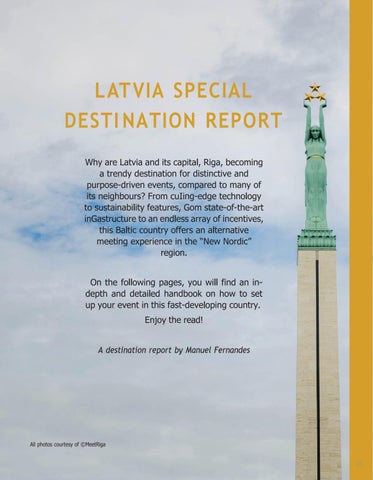
LATVIA SPECIAL DESTI NATION REPORT
Why are Latvia and its capital, Riga, becoming a trendy destination for distinctive and purpose-driven events, compared to many of its neighbours? From cuIing-edge technology to sustainability features, Gom state-of-the-art inGastructure to an endless array of incentives, this Baltic country offers an alternative meeting experience in the “New Nordic” region.
On the following pages, you will find an indepth and detailed handbook on how to set up your event in this fast-developing country.
Enjoy the read!
A destination report by Manuel Fernandes

AFairyTaleinRiga
How Meetings and Events are Transforming the City
Undertheswayofformerempires, Rigawasoneofthelargestandmostadvanced industrial and port cities in old Europe. Today, though, the city is known for its cultural and architectural heritage, and also wants to shine in the meetings and eventsindustry.
Wrapped in the nostalgic and meditative atmosphere of this region, I arrived at Riga’s RIX airport, the largest airport in the Baltic States, hoping to get a glimpse of an unknown side that would fill these pages. The capital Riga is served by the domestic airline airBaltic, which brought me from Brussels on an unblemished journey; fromthere, it only took a 20-minute drive to check the first signs of the landscape and silhouette of a sprawling city. This has reveals a truly international side with morethan 100 direct flight connections, operated among othersby Lufthansa, Finnair, LOT, whichguarantees greatconnections for participants from all over the world Latvia, especially its capital Riga and the other seaside towns, is situated in a privileged geographical location where time moves slowly, making it a strategic and pleasant location for international businesstravellers in this regionofthe‘New Nordics’. Quickaccess to the city centre together with an efficient and smooth local transport network makes Riga, a relatively small capital by European standards, a paragon of urban mobility and car-free environment. Already settled in the toweringRadissonBluLatvijaConference
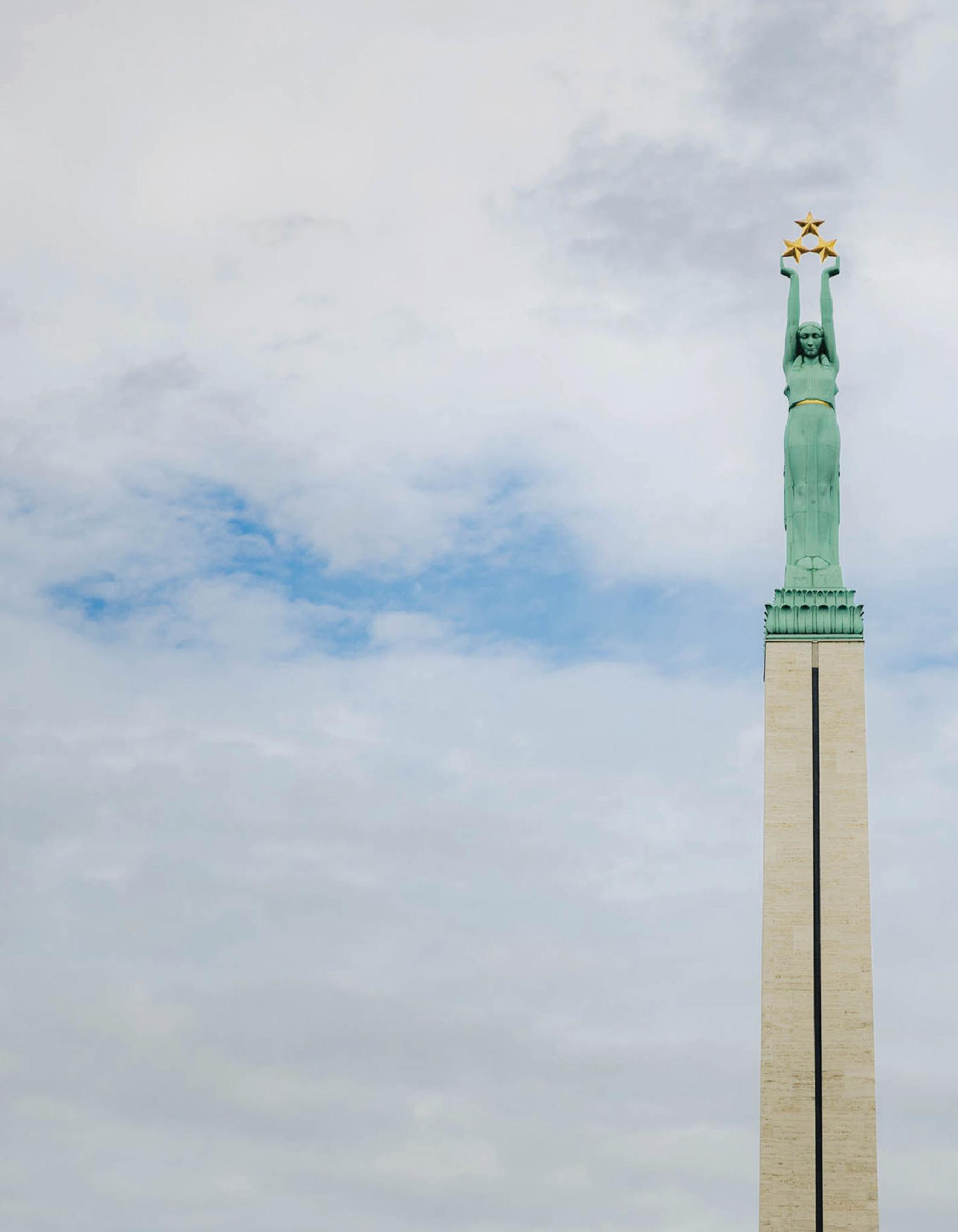
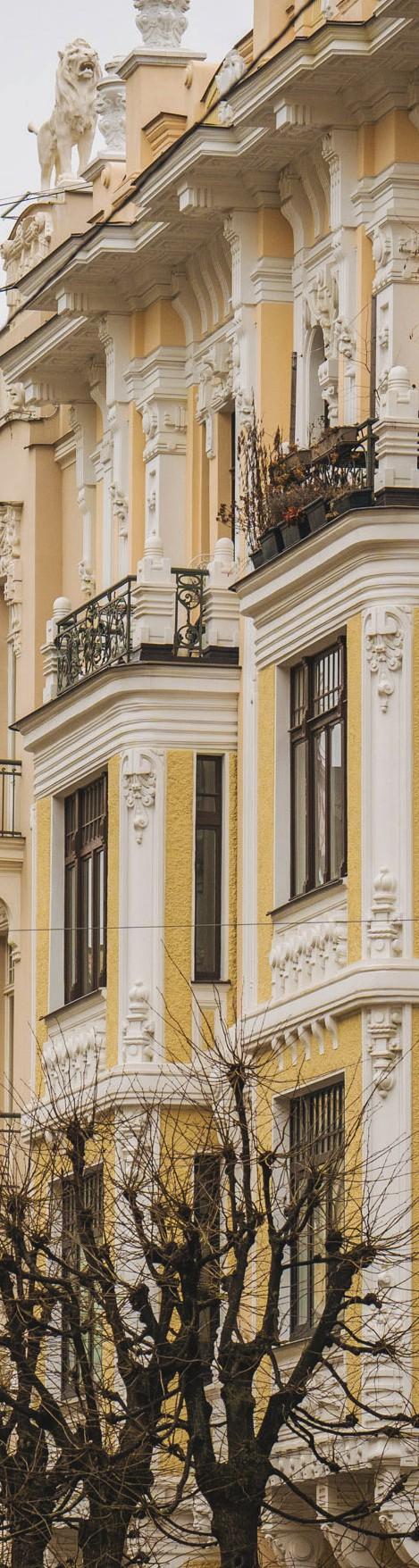
& Spa Hotel, I spentmyfreetimewandering around thecity, swallowed upby its signature landmarks. The architecture is a reflection of the historical memory of the country: from Gothic, Renaissance and Baroque to post-war Modernism and the meandering Art Nouveaustreets like Alberta, thephysical canvas that engulfs merecalls theeclecticism and diversity of each era that has stamped Riga over the centuries. In fact, many of these historic landmarks, such as the former cargo station, Hanzas Perons, orthe monumental ex libris, House of Blackheads, have now been appropriately recreated as meeting and event venues for international associations of all kinds. A cultural heritage properlyconvertedforourindustry.
ACitythatEncourages“SlowTravel”
Another of my quick observations in Riga was the gentle pace and balance between the city and the person to exist, to think, to move... tomeet. Theincreasingly widespread phenomenon ofovertourism across Europe is not echoed here, and this demonstrates not only the opportunities for quieter, more laid-back conferences, but also the challenges of redesigning Riga’s visitation
itself. According to the Latvian Investment and Development Agency (LIAA), business events are an excellent driver for the development of other industries, as well as strengthening Latvia’s image, developing relevant business contacts, and attracting foreign investors. The message is endorsed by MEET RĪGA: the MICE segment has become a pillar for Latvia’s economy, offering significant opportunities to attract international business travellers and events. The sector is a key driver not only for the tourism industry, but also for related sectors such as hospitality, transport and retail. “We are a four-season destination. In terms of leisure, tourists tend to flock here more in the summer. However, we also see more and more travellers coming for so-called city breaks during other times of the year. If we are talking about meetings and events, these usually take place in spring or autumn, when Riga is not so crowded Why? First of all, yougetreasonable prices for rooms and a place to breathe, without missing out on the great customer service and hospitality that the city has to offer,” says Aigars Smiltāns, Meetings & Events Ambassador of Riga City CVBat Riga Investmentand Tourism Agency.
LessforMore
In this respect, Latvia continues to offer very competitive prices, allowing organisers to optimise services, event budgets, and delegatecosts, compared toothertraditional MICE destinations. This cost advantage is another great asset of the country, coupled with its creative industries and supply chain that has gained global recognition for the viable alternatives for both global organisationsandsmallernationalassociation ; as my visit to the multi-purpose ATTA Centre, which was hosting the Latvian
National Farmers’ Exhibition at the time, proved “We are having conversations about accessibility, connectivity and compatibility of institutions with various health associations for their conferences. As we already know, all prices are going up. While all other expenses have increased, catering prices have remained comfortable among our suppliers Here in Latvia it is still quite affordable to sign contracts, so we are able to take advantage of some medical events outside the classic destinations. I believe that, especially when it comes to events in thehealthcare sector, many associations can domorewiththesamemoneytheyspendin otherdestinations,”addsSmiltāns.
Just a 15-minute drive from Riga International Airport is another Latvian hotspot. The largest seaside resort in the Baltic States, Jūrmala combines vast kilometres of white sand and large wooden cottages with modern event facilities, and four- and fivestar hotels. In this small coastal town on the Gulf of Riga you can hold all kinds of events in a fairytale setting, from art exhibitions and concertstocorporatemeetings, seminars or eventeam-building activities. Make themost of the natural and architectural richness of this independent city with its many healing properties while exploring venues such as the Dzintari Concert Hall, Jūrmala Culture Centre, Baltic Beach Hotel, Hotel Jūrmala SPA or Lielupe by Semerah Hotel – the largestconferencehotelinJūrmala.
On the following pages, you will find an in-depth checklist of tips, recommendations and guidelines for navigating your event in Latvia, whether it ismaking it moresustainable, finding therightpartnerorchoosingthevenuethatbest suitsyourneeds.
How to Find your Dream Venue in the “Baltic Pearl”?
Thecharacteroftheclassicbuildingsandcontemporaryspacesin Rigaand Jūrmala reflect thepresentandfutureofmeetings in Latvia. The rapid development of the local infrastructure has been complemented by the renovation of its monumental venues, cultural centres, warehouses and vintage hotels, which now boastbespoke eventfacilities, state-of-the-art technology and integrated services. This interesting mix of centuries-old heritage and contemporary masterpieces offers an attractive environment for associations and event planners, from small-scale meetings to large international congresses. Riga now offers 13,500 hotel beds in a variety of three-to four-star establishments within walking distance of each other, while the capital's350eventvenuesrangefromgrandhistoricballroomstorenovatedindustrialspaces
Here’saround-upofthebestvenues andhotelswevisitedintheregion:
ATTACentre
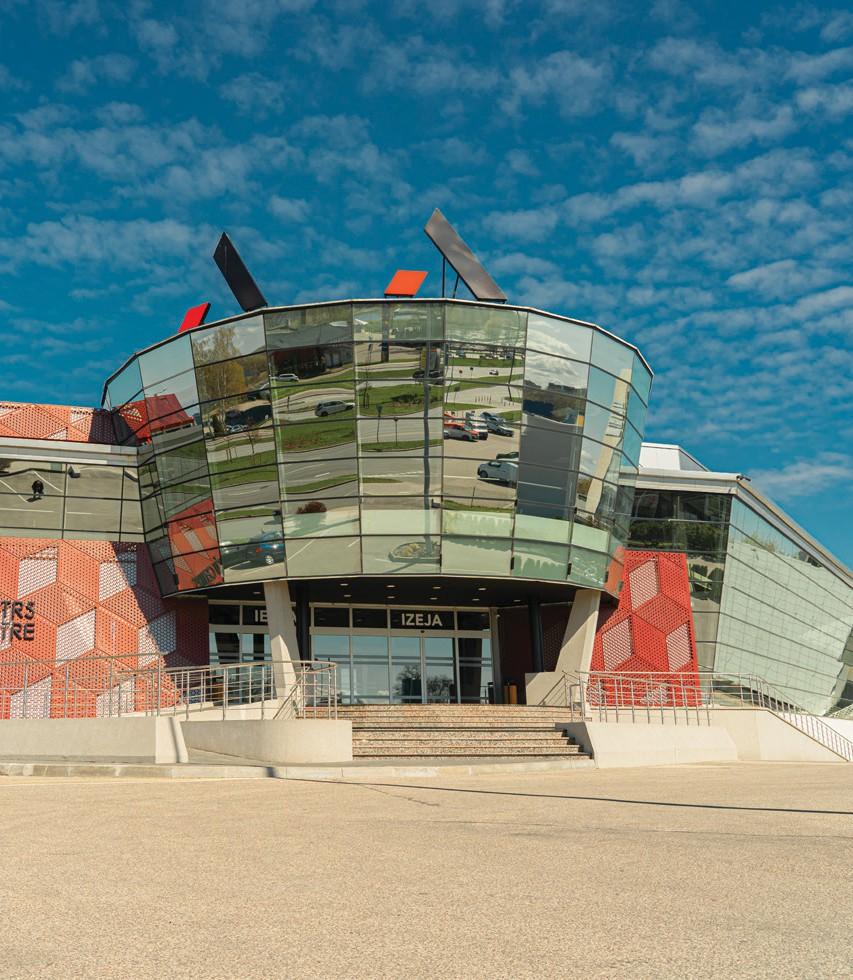
Imagined as a shopping and service complex just a short distance from the old town, the newly renovated ATTA Centre has become the largest convention centre in the Baltics, offering contemporary facilities for up to 3,000 participants. With a total area of 11,500 m2 , the centre has 22 conference rooms of different shapes and sizes, where exhibitions, congresses and summits can be held. ATTA also makes it possible to change the layout of the entire first floor using its high-tech multimodal system, as well as guaranteeing accessibility for people with reduced mobility. The NATO Foreign Ministers’ Meeting, the Three Seas Initiative Summit and Business Forum and the Latvian Dental EXPO alltookplacehere.
TheHouseofBlackHeads
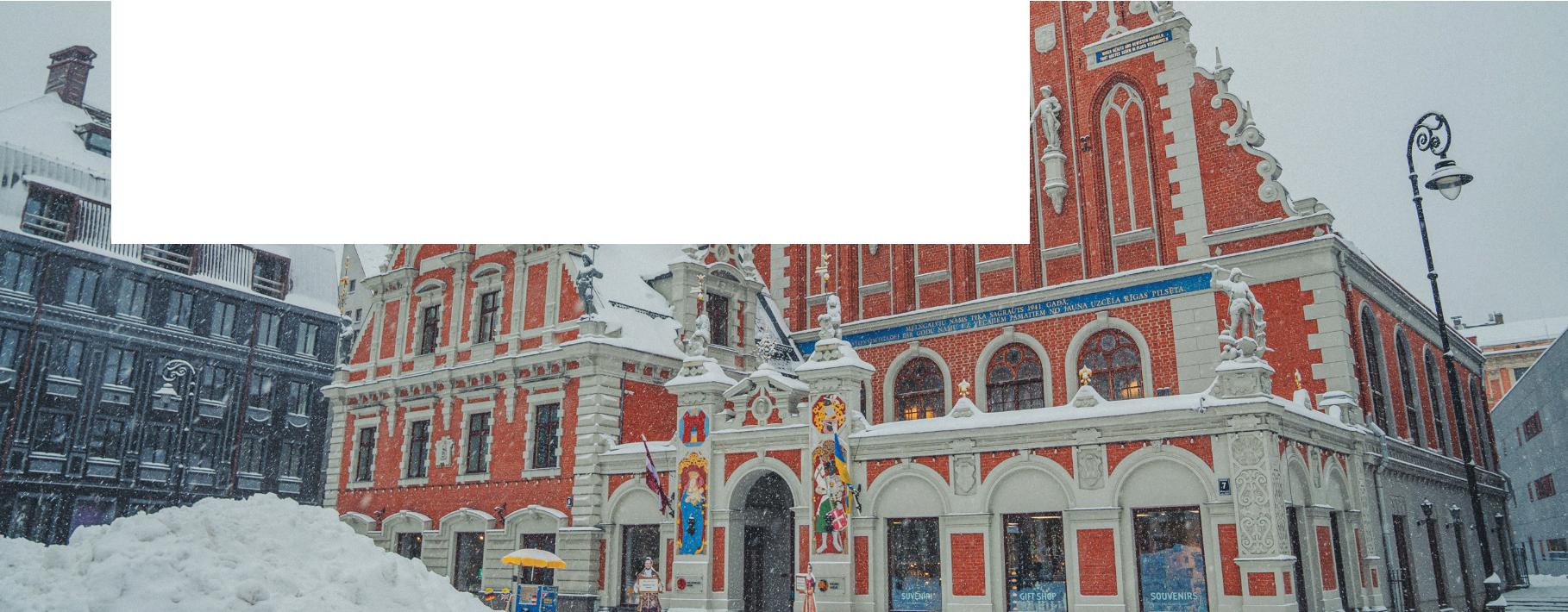
‘If I were to ever collapse, raise me up once again!’ – built in 1334, the ‘New House’ (as it was then known) was already imbued with the spirit of meetings and festivities as the city’s Great Guild. From 1522, it was modified several times until the arrival of a group of German merchants, known as the Brotherhood of the Black Heads, who became the guardians of the house. Thus, was born the House of the Black Heads, which was burnt to the ground during the Second World War In the 1990s, a decision was made to restore this unique symbol of the city using archaeological evidence. Today, the Houseof Black Headsrepresents Latvian resilience against all odds, and is a must for planners and associations with its seven magnificent halls for banquets, board meetingsandluxuryreceptions.
Hanzas Perons
Formerly a railway freight depot in the heart of Riga, Hanzas Perons was remodelled as a concert hall, an arts platform...but also as an event venue. Dating back to the early 20th century, the building has survived to the present day as an adaptable and functional space for presentations, workshops, and conference sessions Within its complex structure made up of brick walls, wooden beams and steel and glass finishes, there is now a 1,200 m2 hall that can be divided into 2 or 3 parts to accommodate up to 2,100 people. Various services can be incorporated on request, such as a kitchen, bar,privateroomsandtechnicalstaff.
Riga Latvian Society House
Rooted in the 19th century, the Riga Latvian Society House is the cultural and intellectual soul of the country, serving as a historic haven of national identity. A five-storey building(sixstoreysinthecourtyardwing)
designed in a symmetrical neoclassical style, the House was also the seat of the Latvian National Opera. It is currently used for various events such as conferences, seminars and presentations, and can accommodate more than 3,000 people in its nine charming rooms. On the top floor, there is a theatre hall with 450 seats in the audience and 210 in the balcony, while the second floor houses a hall for meetings and symposia.
National Library of Latvia


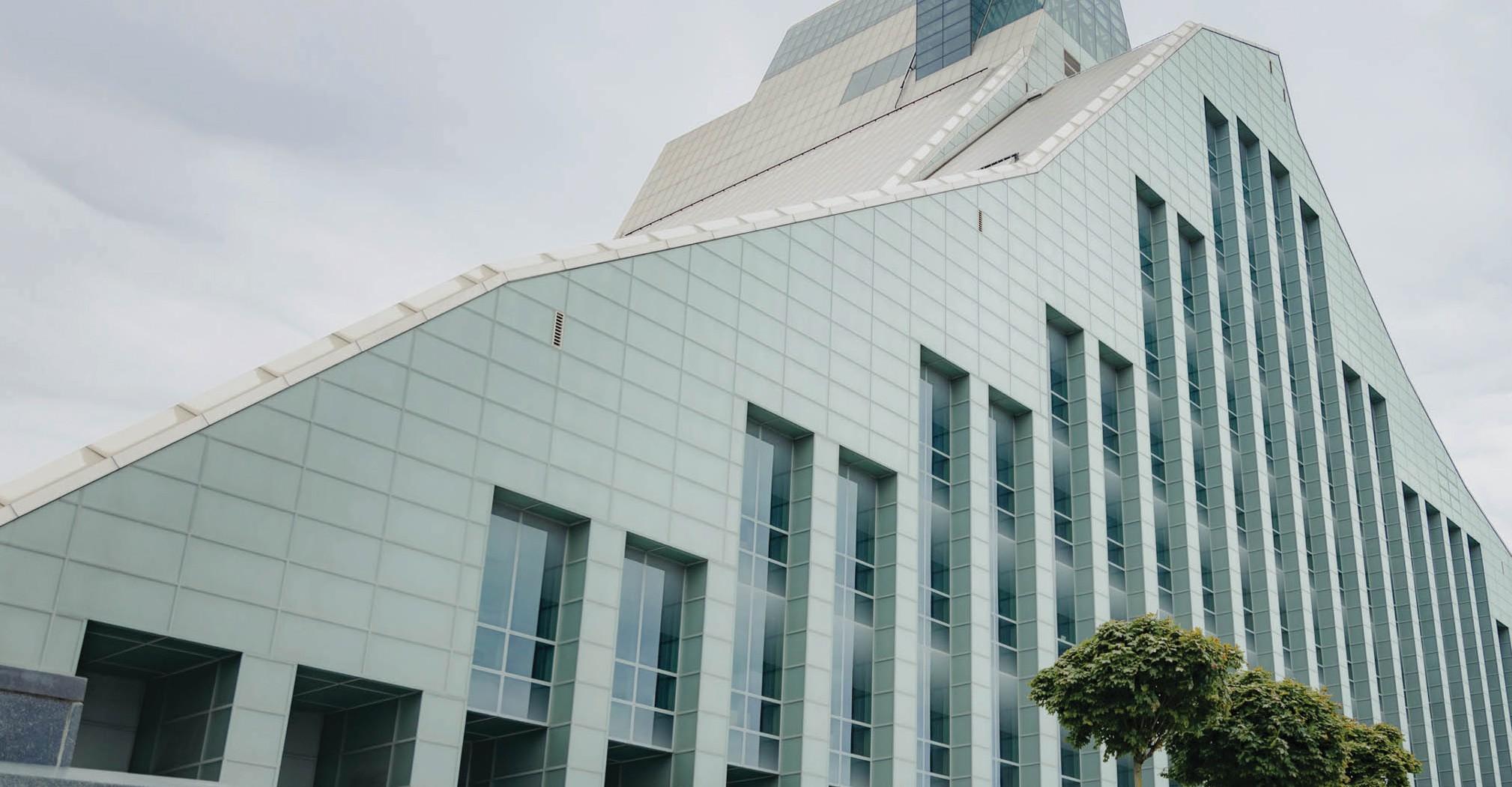
The National Library is an ode to contemporary Latvian architecture by the prestigious Gunnar Birkets. On the left bank of the Daugava, this building stands like a ‘castle of light’ representing one of the most significant bastions of Latvia’s restored independence. Opened in 2014, the library offers an eclectic and extensive programme with the help of a digital guide to seven exhibitions, a breathtaking view from the top floor, and the ‘Dainu skapis, ’ a set of local folk songs included in UNESCO’s Memory of the World Register. Among its premises are nine spaces that unfold into 15 well-equipped meeting rooms forconferences,seminarsorreceptions.
Radisson
Blu Latvija Conference & Spa Hotel
The largest conference hotel in the Baltic States, the Radisson Blu Latvija Conference & Spa Hotel has 571 rooms in various formats, the ESPA Riga spa centre, the Esplanade restaurant and a conference centre with 16 large rooms equipped with audiovisual resources in a space of over 3,661 m2 – the crown jewel being the Omega hall suitable for conferences of up to 1,000 people. Of particular note is the event space located on the 27th floor and the Skyline Bar on the 26th , both offering 360º panoramic views of the cityscape. Designed as the first choice in Riga as a convention hotel, this Radisson Blu is also
committed to providing a clean and safe environment through health and safety protocols. It offers regulations for health events through its certified venues and partnerships, ensuring compliance with healthsectorstandards.
Hotel Jūrmala SPA
The resort town of Jūrmala also has a well-planned infrastructure, which has led to the creation of a vast network of restaurants, event venues and hotels. One of these is the four-star Hotel Jūrmala SPA, which has a conference centre with eight halls of various configurations, capable of hosting more exclusive seminars to a conference with 300 guests with in-house technical support. This hotel also has 190 comfortable rooms with access to a sauna and pool centre, a gym and over 200 spa treatments.
Baltic Beach Hotel & SPA
Right next to Jūrmala beach, the Baltic Beach Hotel & SPA is another great option for blending leisure with business events. Nestled between a strip of sand dunes and a pine tree park, the hotel offers a 1100 m2 conference complex with 12 adjustable area rooms and large atriums for networking. The combined Jura+Jūrmala halls can accommodate 320 people, while the Pērle hall with panoramic windows overlooking the Gulf has a capacity for 220 people. The hotel also boasts 165 guest rooms, one of the largest spa centres in Northern Europe andacollectionofsixrestaurantsandbars.
Other venues to keep an eye on:
• DzintariConcertHall
• Rigascirks
• BellevueParkHotelRiga
• LielupebySemarahHotels
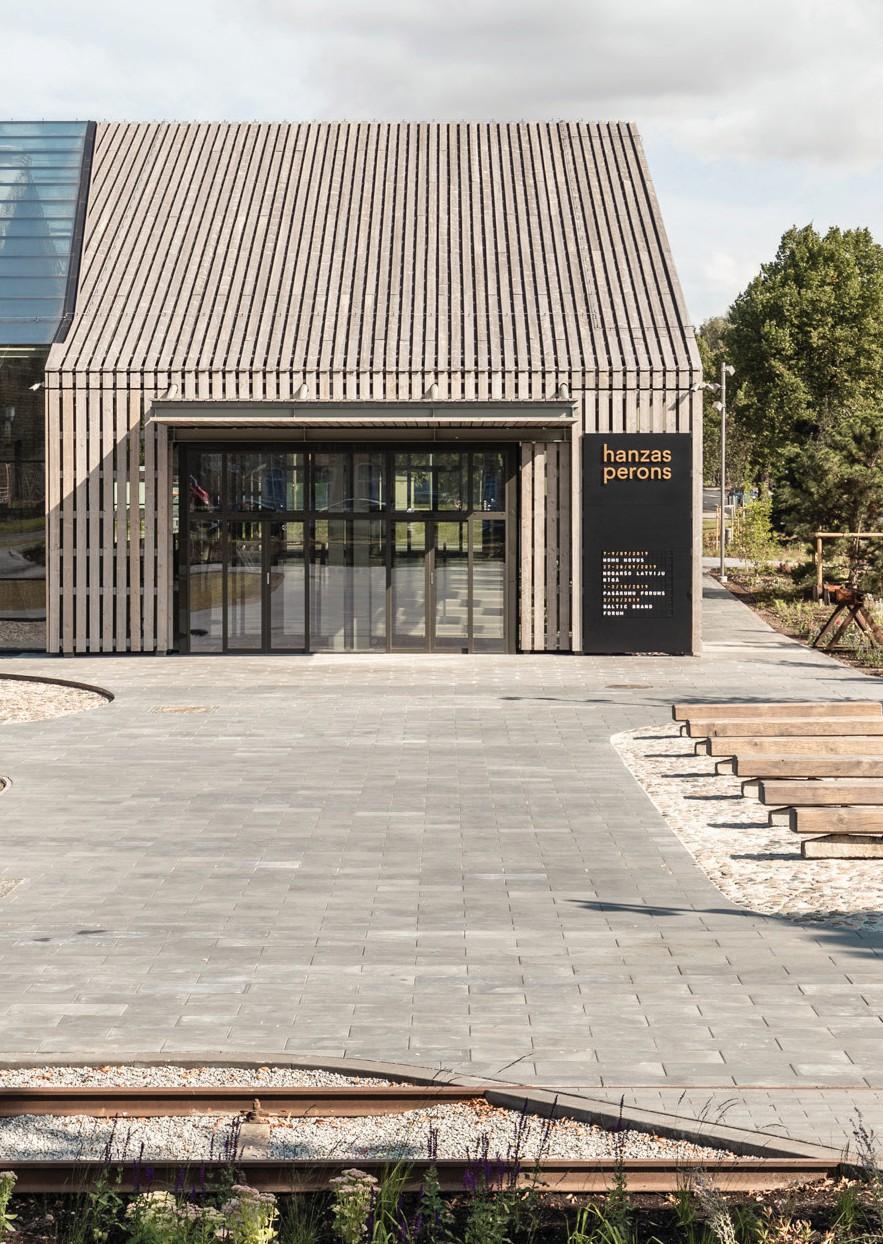
Hanzas Perons
ATTA Centre The House

An Ambitious Journey Towards the Three Pillars of Latvian Sustainability
I“Latvia has committed to reaching climate neutrality by 2050, including a 65% reduction in greenhouse gas emissions by 2030.
n a country that has the fifth highest percentageoflandcoveredbyforests intheEuropeanUnion,witharound56% of the territory’s total area, sustainability runsneckandneckwithLatvia’slegacyand values.Withmorethan12,500rivers,2,256 lakes, and swamps and bogs occupying almost10%oftheterritory,Latviaisahaven forbiodiversitywithmanyrarespeciesof plantsandanimals.Italsoboastshundreds of kilometres of coastline, surrounded by pine forests, sand dunes and pristine whitesandbeaches.With 706state-level protected natural areas, including four national parks, a biosphere reserve, 42 nature parks and seven marine protected areas, the country is steeped in a long traditionofconservationenshrinedinthe Latvian Red Book,whichcontainsthelist ofendangeredspecies.
Likewise, the country’s agricultural areas account for nearly 29% of the total land
area, where approximately 200 farms use organic methods for regenerative purposes. This long standing principle of subsistence farming has created the roots for a responsible and sustainable approach in all sectors, namely tourism and the conference sectors A large number of suppliers outsource their products to local farmers and producers using regenerative resources to mitigate their carbon footprint and achieve zero waste This is especially relevant at a time when planners and associations are incorporating authentic experiences, delegate-orientated natural settings, eco-friendly venues and, broadly speaking, sustainable solutions into their RFPs – to balance their financial flows with Environmental, Social & Governance (ESG) policies. If we talk about Latvian hotels, they are increasingly refocusing their green practices to tackle waste reduction, to purchase local products, and usegreenenergyandwaterconservation,
towards more ecological certifications, such as the Green Certificate and EarthCheck, and Eco-labelling. Currently, 76 accommodations in Latvia have been awarded the Green Certificate eco-label, according to Baltic Country Holidays. Several establishments have been actively involving guests in sustainability initiatives through information boards and separate waste collection programmes. Some of the best success stories can be found at the Riga Islande Hotel, with its efforts to use green energy and waste management, the Grand Hotel Kempinski Riga, a forerunner in energy-efficient technologies, or the AC Hotel Riga by Marriott, which will renovate its building to save and maximise energy.
Latvia and Riga on The Same Page Internationally, Latvia is one of the leading countries in terms of meeting the UN Sustainable Development Goals
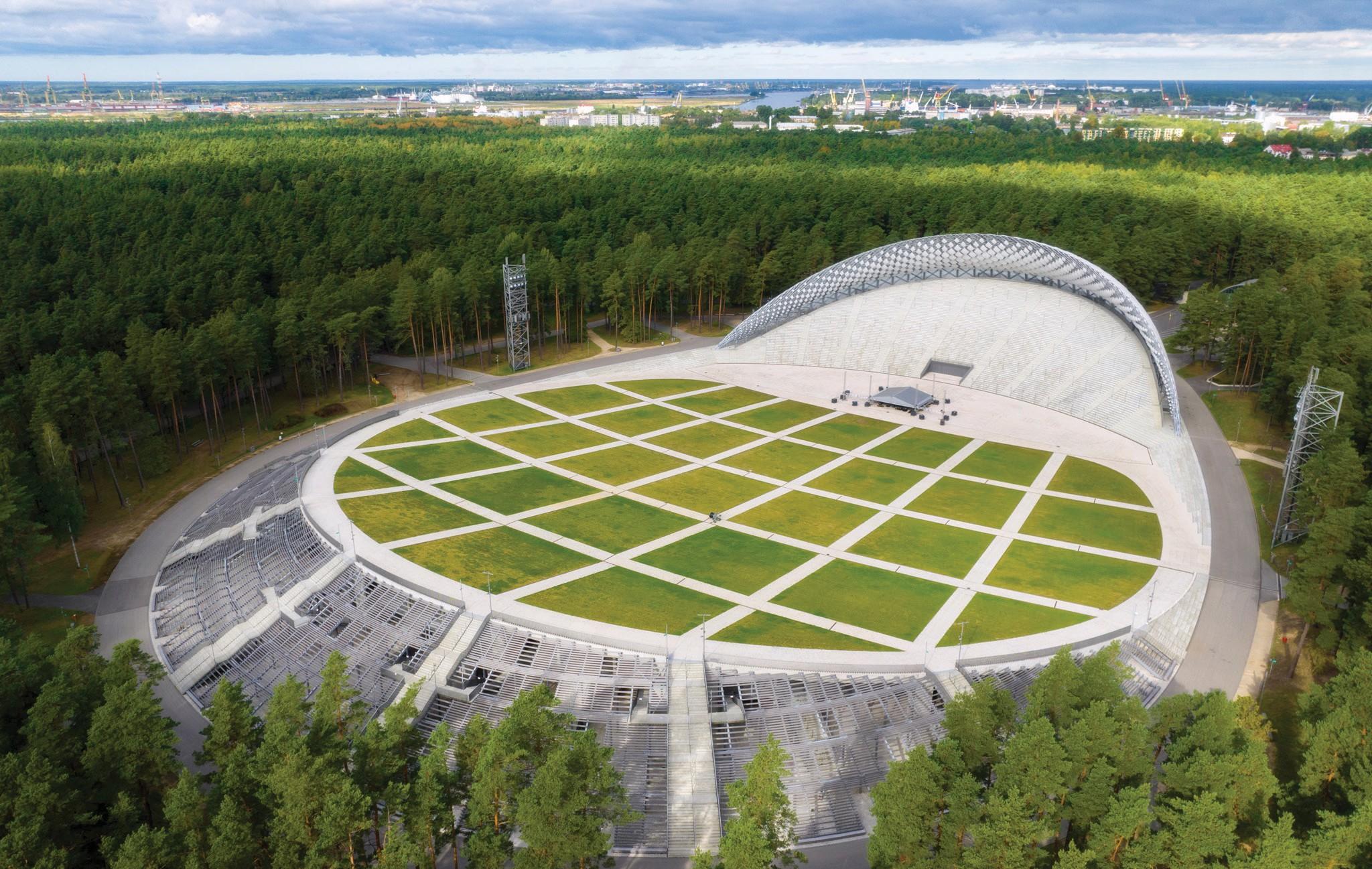
The Mežaparks Great Bandstand in Riga
(UN SDGs), ranking 13th in the latest report monitoring the progress of the countries included in the so-called 2030 Agenda. Experts from the Sustainable Development Solutions Network estimate that Latvia is close to achieving 63.4% of the targets, demonstrating notable progress in UN SDGs 11 on Sustainable Cities and Communities –the main achievements in this area include progress in affordable housing, improving the energy efficiency of buildings and making public transport more accessible, especially for vulnerable groups. In this regard, the country is implementing the UN SDG in the crossroads of the goals defined by the National Development Plan 20212027 and its sectoral policy guidelines, with a focus on science and innovation, reducing inequalities, modernising governance, assisting the least developed countries, and supporting peace in Ukraine and the world. This development policy aims to instil a balanced strategy for economic growth, environmental protection and social well-being (the trifecta approach), while encouraging best practices and benchmarks to support tourism stakeholders and players towards a more sustainablefuture.
The events sector has this unique feature of being closely involved with the progress of various other industries, leading to a constant updating of measures and procedures. Major global trends and social needs have an impact on dialogue with clients, pushing events to pay greater attention to ESG. In Riga, sustainable meetings and conferences cover a broad spectrum of topics, from university and social policy directives to specific projects such as the ‘Sustainability Reporting Tool (SusTool)’ and the ‘Donut Economy Approach’. We can add to this the various co-operations such as the Strategic Alliance of the National Convention Bureaux of Europe and Gevme’s Sustainable HUB for Events, where information has been shared on sustainability and case studies of various destinations. Cumulatively, the city is supported by various initiatives, including thedevelopmentofaSustainable Energy
and Climate Action Plan 2030 (SECAP) and participation in the EU mission for 100 climate-neutral smart cities by 2030. The SusTool project has developed a free digital platform that helps companies understand ESG criteria to improve their sustainability reporting, while SECAP proposes the concept of a Donut City Portrait to help identify priorities and select activities aligned with the principles of sustainability and climate action, such as mobility, transport and citizen engagement. For 2025, a number of sustainability-focussed events have been planned in Riga, including the International Conference on Waste Management, the International Conference on Waste Management, Recycling and the Environment, or the SPOTLOG Exchange of Experience with a focus on sustainable logistics. Other events include the annual conference of the European University Association, the XVIII International Scientific Conference of Environmental and Climate Technologies CONECT 2025, along with meetings on sustainable logistics and events focussed on youth energy and greenpractices.
Riga Airport Sustainability Strategy
Another of Riga’s cornerstones, Riga Airport, has developed a corporate Sustainability Strategy by 2030, which includes reducing theairline’s environmental impact, promoting a more inclusive and safer working environment, investing in fair business practices, and co-operating with the local community. Some of these measures include the development of a solar park, the replacement of light fittings with LED bulbs in all areas of the airport, and the gradual replacement of the airport’s vehicle fleet with CO2-neutral alternatives. The airport has also pledged to set up a social entrepreneurship fund aligned with the needs of the community, to promote the development of start-ups and educational projects, in addition to expanding the Rail Baltica connection – strengthening cycling infrastructure and cooperating with transport service providers in the use of low or zero emission vehicles.
Latvia as a Business Hub for ‘New Nordic Meetings’
Riga has focused on meaningful growth opportunities in its conferenceandexhibitionsector, optimisingaclear,consistentand moderniseddestinationbrandinorderto increaseitsvisibilityininternationalmarkets. Increased investment in infrastructure, digital transformation and emerging markets could further boost the growth of the association events sector, while theintegrationofartificialintelligenceand cutting-edge technology will make the participants’experienceeveneasier
From an economic point of view, Riga offers excellent value for money compared to many Western European destinations, making it an attractive option for budget tourists and business travellers alike. However, this trajectory is also influenced by the recent economic upswing that has taken place in its economy with knock-on effects across various sectors and industries. In the years following the 20082009 financial crisis, Latvia experienced a kind of ‘economic miracle’ characterised by rapid GDP growth and a strong recovery in living standards. During this period, the country went from a struggling economy tooneofthefastestgrowingin Europe, with a significant reduction in public debt and high rates of GDP. Among the factors that contributed to this economic performance were significant fiscal reforms, including spending cuts and tax increases, strong export growth, an increased demand for
its goods and services, the EU membership in 2004 – providing access to larger markets and financial support, and, last but not least, foreign investment due to the relatively low cost of labour and its skilled workforce By wayofexample, Latvia is hometomorethan 500 companies with Danish capital, many of which are concentrated in the Kurzeme region. Following Latvia’s accession to the EU, the stock of foreign direct investment increasedrapidly,andby2024hadreached 26.3 billion euros, attracting investors from Estonia, Lithuania, Germany, the Netherlands, Cyprus, Denmark, Luxembourg andMalta.
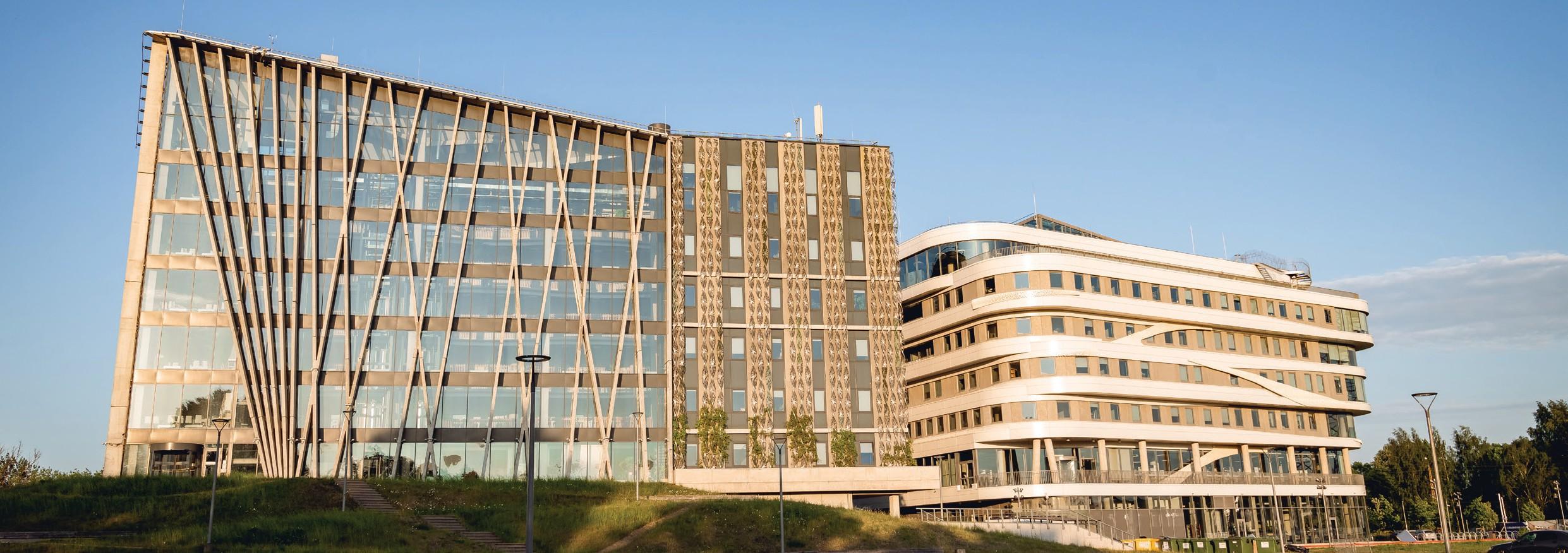
Due to its growing focus on innovation and development, Latvia today boasts an integrated and connectable network of fast and reliable internet, an essential factor for digital events and live broadcasts. The current trend towards remote working and digital nomadism also represents a competitive advantage for Riga to attract visitors from various latitudes looking for a high-quality and well-established working environment. On the other hand, the country has established itself as a regional hub for deep tech companies and start-ups, characterised by a strong focus on smart specialisation, an ‘industryresearch-state’ collaborative model, and a growing digital technology start-up scene. With a robust ecosystem focused on innovation and R&D, the country is also betting on solid educational foundations
“
Improving connectivity through additional flight routes and regional transportation options, such as the Baltic rail links, will significantly boost accessibility.
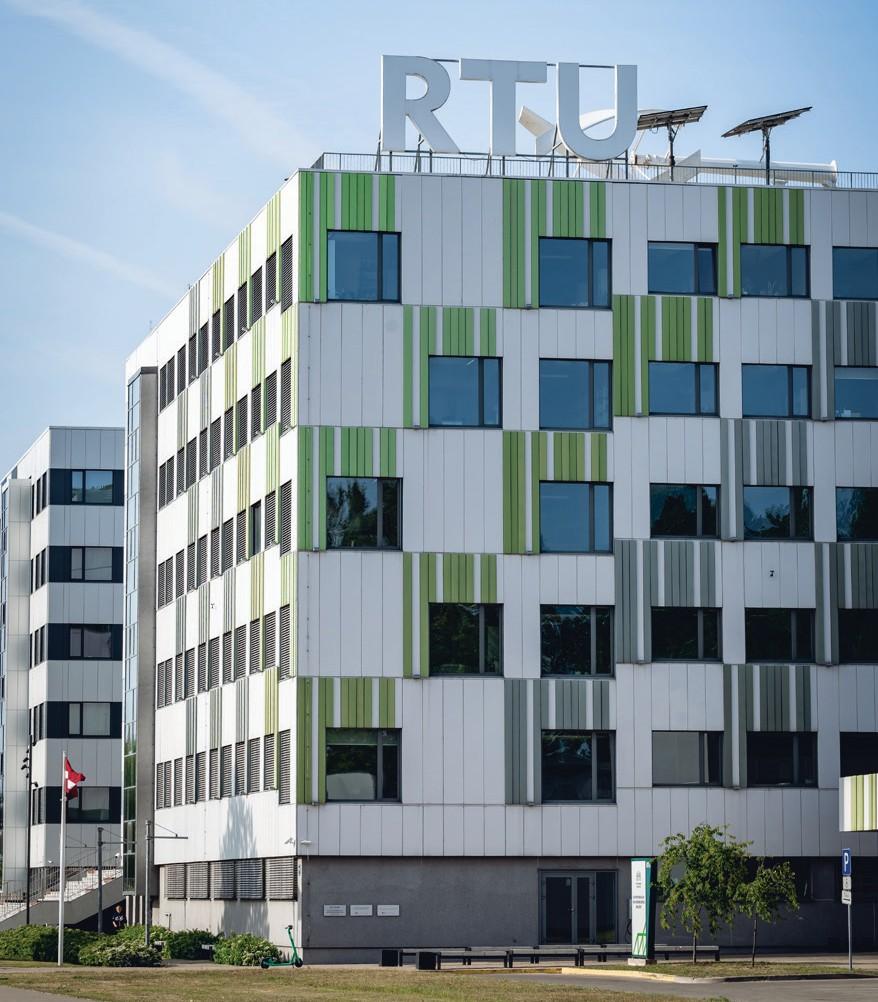
to convince strategic players in global markets, with engineering and technology programmes at institutions such as Riga Technical University or the University of Latvia. In this sense, Latvia is actively working to increase its performance in research and innovation through initiatives such as the Latvian Smart Specialisation Strategy (RIS3) – a national framework to drive economic transformation through investments in research and development in specific areas of the Latvian economy (seebelow).
In 2024, Latvian tech companies raised approximately 34 9 million euros in sectors such as fintech, AI and health technology. As a result of strong collaborations with universitiesandindustryleaders,theLatvian
“
Latviaoffersstartupvisasto foreigntalentsandfoundersin ordertofacilitateentryandthe establishmentoftheirunicorns.
ecosystem is now valued at 2.3 billion euros, and, according to the Latvian Startup Report 2024, it is home to more than 500 startups – 13% of which operate in the deep tech sector These include Sonarworks, a sound calibration scale-up, Mintos, an online platform for retail investors, and Lokalise, a localisation and translation management platform. Recognised as one of the most startup-friendly destinations, Latvia came second among OECD countries last year thanks to various strategic initiatives such as start-up funding, tax benefits, innovation vouchers and the Start-up Visa programme, facilitating the entry of international talent. To reduce bureaucracy, thecountryfeatures afully digitised business environment, allowing entrepreneurs to open a company online in just ten minutes, with electronic signatures and digital tax returns to streamline operations. In line with such disruptive policies, the Riga Investment and Tourism Agency launched the ‘Co-financing Programme for Business Events’ , which aims to increase the attractiveness of the destination for international conferences, congresses, trainings and fairs by providing financial supporttoeventorganisers onthecondition that at least 20% of the participants come fromabroad.
Business events in Latvia serve as a strong catalyst for key sectors that can trigger
foreign investment where Latvia has great expertise, promoting networking, knowledge exchange and cementing crucial opportunities for the country. With forests occupying approximately half of its territory, the knowledge-intensive bioeconomy is one of the key industries for the country’s economy, encompassing sustainable agriculture, forestry and fishing. Moreover, ranking 5th in terms of turnover among manufacturing industries, Latvia leads the field of biomedicine in the Baltics and is at the forefront of research into precision medicine, specialising in the use of big data – the pharmaceutical and biotechnology industries also have a long history of success leaving a rich legacy. Likewise, Latvia has an extensive coastline of 500 kilometres, which represents a huge potential for offshore wind energy –estimated at 16 GW – which has propelled the smart energy sector to new heights. Added to this is the harnessing of hydrogen technologies for energy storage units, with the prospect of further utilisation in various processes While Latvian IT exports account for approximately 1.2 billion euros in exports, the city of Riga has an ambitious project ahead to become the first ‘Metacity’ in the Baltics. This ambitious hub will encompass educational and professional opportunities for the Information & Technology and Communication sectors. Finally, Latvia is among theglobal pioneers in theproduction of fibre optics and also operates in the manufacture and in-house assembly of various electronic equipment, such as 5G routers, and in research into the microchip supply chain – photonics and smart
materials, technologies and engineering are thus key drivers in the economic transformation of fast-paced solutions and value-addedproducts/services.
For all these reasons, Latvia has tapped into a new potential for events of various scales, emphasising the individual approach, the comprehensive nature of communication, the quality of services, the synergy of different sectors and its high creative potential – all crucial aspects for sustaining global competitiveness with regard to other European countries The economic and historical aspects unlock professional activities and allow the discovery of innovative ways to surprise and inspire associations and planners You are welcome toinvesthere!
Bleisure at your Convenience: How to Enjoy Latvia for Team Incentives?
Latvia’s many options as a MICE destination do not end on the last dayofyourconference.Itswealthof restaurants, museums, spa and relaxation hotels and street markets make the country an underestimated treasure waiting to be explored in the competitive roadmap of incentives and bleisure activities. Beyond its multifunctional ballrooms and auditoriums, Riga invites you to extend your stay with a variety of urban and cultural choices that will be the envy of other largescale cities; Jūrmala, with its glittering ensemble of wellness and healthcare centres, festivals, and sports tournaments, offers a complementary face of seasonal recreation free from the capital’s hustle and bustle; around the bucolic and unspoilt surroundings of Sigulda, visit the many medieval castles, savour the delicacies of the small taverns and explore the trails of the Gauja National Park in the Latvian Deep Nature.
Whether it is a floating sauna in the centre of Riga, a treasure hunt in the Old Town, a bobsleigh ride in Sigulda, a boat trip on the Gauja River, climbing classes in Jūrmala, or an interactive cooking workshop, Latvia boasts products and services for every taste, desire and need. Riga has several arguments to convince you for a few more days (you never know when the next time willbe )High-speedInternetconnectionto
check your emails and business contacts –with plenty of co-working areas, a compact size surrounded by design wonders, a vibrant music scene whose centrepiece is the Latvian National Opera, an underrated culinary scene that combines local flavours with top international restaurants, and a nice number of good value for money hotels Finally, as an EU and NATO country, Latvia also guarantees a high level of security.
Here are some ideas for making the most of your incentive programme in Latvia in fourdays:
Welcome to The Capital!
By booking your extra nights in one of the city’s many hotels (Grand Poet Hotel, Hotel Neiburgs, Hotel Metropole, etc.), venture through the cobbled winding streets of the old town and step back in time for a liqueur at the medieval Black Magic Bar. If the trip was too long, we recommend a cocktail at Gimlet, Bar Six or SNOB, and when you get the munchies, feel free to explore the best bakeries in town – Mīkla Bakery, Mulberry, Kūkotava or Bezē – to taste culinary delights such as dark rye bread. You can also visit the largest food market in Northern Europe, Riga’s Central Market, and excellent breweries such as Labietis, lofts or Valmiermuiža alus. At night, enjoy the
laid-back atmosphere of restaurants such as the classic Rozengrāls, the upscale Kaļķu Vārti, the temple Ala Pagrabs or the fine-dining Barents. Any energy left? Plunge into Riga’s nightlife at places like Cuba Cafe and B Bar.