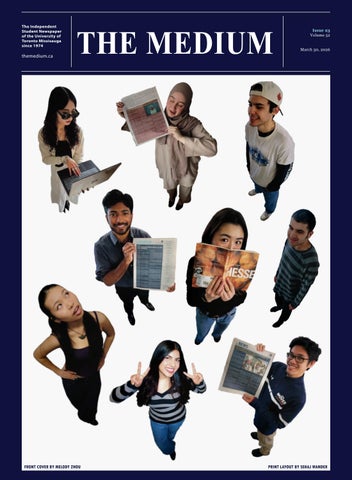
Volume 52 Issue 23

Page 1


FRONT COVER BY MELODY ZHOU PRINT

02 NEWS

Incoming UTMSU execs outline priorities and plans for their term

New executive team points to connection, affordability, and academic advocacy.

The University of Toronto Mississauga (UTM) Students’ Union (UTMSU)’s Spring 2026 election invited undergraduate students to vote for a new Executive Committee for one-year terms. After a two-day voting period, the five IgniteUTM candidates emerged victorious, including Adam El-Falou for president, Xingyi (Freya) Gao for Vice President (VP) Internal, Tiffany Da Silva for VP Equity, Dana Al-Habash for VP University Affairs, and incumbent Rajas Dhamija for VP External.

In an email interview with The Medium, members of the winning executive team said one of the most urgent issues facing UTM students is a “growing sense of disconnection and isolation within the campus community,” arguing that campus life can often feel fragmented and lacking in shared experiences.

They said they hope to address this problem through broader campuswide initiatives, increased collaboration between student groups, and efforts to build a stronger sense of campus identity. Rather than defining student life narrowly, the team said it wants to create more spaces where students can feel “part of something larger.”

The team also pointed to a mix of immediate and longer-term campaign commitments.

In the short term, they explained that students could expect efforts around expanding Free Dinner Fridays, increasing access to food vouchers, strengthening club collaboration through a clubs coalition, and opening conversations with the registrar and Student Housing on academic and housing concerns. Larger issues, including OSAP reform, tuition concerns, transit improvements, and exam deferral fees, were described as longer-term advocacy goals that would require pressure on the university, the province, and munici-

pal partners.

When asked which student concerns have been most overlooked, the winning team emphasized academic pressure, particularly when setbacks carry long-term academic consequences. They pointed specifically to the Second Attempt for Credit policy, saying they want to see more support for students recovering from failed courses so that “one academic moment” does not define the rest of a student’s degree. They also highlighted postgraduation support as an area needing more attention, including stronger collaboration with the Career Centre to help graduating students and recent alumni access jobs, internships, and career preparation resources.

On working across portfolios, the incoming UTMSU team said its success will depend on “transparent and constant communication,” regular check-ins, and collaboration across overlapping student issues. It added that the diversity of the executive team could help broaden outreach to different student communities and campus partners.

The team also acknowledged that many students feel disconnected from the UTMSU or are unsure whether student elections matter. In response, the winners said leadership must become more visible and more tangible in students’ daily lives, whether through affordability measures, academic support, or campus spaces that better reflect the student body.

“If you don’t feel the impact, then we’re not doing our job,” the UTMSU team shared.

Asked about previous UTMSU leadership teams, the new team said earlier executives had built meaningful services, events, and supports, but argued that more work is needed to make those efforts more visible and accessible to students. For them, the priority now is not only to build on that foundation, but to ensure more students actually feel connected to the union and its work in their dayto-day campus experience.

U of T pledges new multimillion dollar investments in Indian students and researchers

The director of the U of T India Foundation explained that U of T’s new partnerships will help to expand “co-learning” with India.

During a recent showcase at the Taj Mahal Palace Hotel in Mumbai, the presidents of the University of Toronto (U of T), McGill University, Dalhousie University, and the University of British Columbia, alongside Prime Minister Mark Carney, recently announced new partnerships with Indian post-secondary institutions. As part of the Canada-India Talent and Innovation Strategy, the partnerships will focus on emerging technologies such as artificial intelligence (AI), cybersecurity, and financial technology.

Universities Canada has highlighted the new strategy as a “commitment to strengthening long-term economic and innovation ties between Canada and India,” positioning universities as key partners in this emerging relationship. For Canadian and Indian students, these partnerships should create new opportunities in research, student exchanges, and hybrid campuses.

As part of the initiative, U of T will jointly develop a new AI centre of excellence with the Indian Institute of Science, invest C$25 million in scholarships for Indian students, allocate C$520,000 in federal funding “to support partnership development through faculty and student mobility in India, Indonesia, Japan and South Korea,” and provide more support to the U of T India Foundation (UTIF), according to U of T News.

Based in Mumbai and partly funded by Tata Trusts, the UTIF supports startups, research, and government initiatives “that address urban and peri-urban challenges,” according to their website.

In an email interview with The Medium, UTIF Director Gauravi Lobo provided further insights into what students can expect from the new initiatives.

“India is one of the fastest-urbanizing

countries in the world, with cities facing climate, infrastructure, and governance challenges at a scale and speed that most Western research institutions haven’t had to grapple with.” This provides a unique opportunity for “co-learning” between U of T and Indian researchers and communities that are directly facing such challenges.

When asked how these partnerships might benefit U of T students and researchers, Lobo said, “Beyond the obvious (fieldwork access, co-authored research, networks), I think the lesstalked-about benefit is epistemic. Working in a context like India, especially in urban or climate domains, challenges a lot of assumptions that get baked into research design when you’re only working in high-income country settings. Students and researchers alike go back with sharper questions, not just more data.”

She also listed several projects the UTIF is currently working on, including “community-level climate risk mapping, urban heat and flooding adaptation models that are built with frontline communities rather than just for them, [and] urban water management systems that help scattered data connect and give government/municipal decision makers an edge.”

Speaking on how the UTIF might contribute to urban innovation, entrepreneurship, and technology development more broadly, Lobo expressed hope that their work will translate into on-theground changes. “There’s a long history of research partnerships that produce papers but don’t produce change. What’s more promising is when collaborations are anchored in specific problems… and structured so that Indian partner organizations aren’t just data sources but co-designers. That’s where you start to see innovations that [are] actually adoptable, not just publishable.”

Lobo emphasized that sustained, context-driven collaboration is key to making innovation possible. “Entrepreneurship/innovation follows when students and researchers on both sides are embedded in those contexts long enough to spot the gaps.”

Photo Credits: Melody Zhou

Game studies and LIA! host dinner featuring ENG328 student game showcase

The dinner featured playthroughs of five interactive narratives, each with a unique take on storytelling and game design.

On March 25, the faculty of the game studies program and Literature is Alive! (LIA!) held a dinner event that allowed attendees to play through five games developed by students of ENG328: Writing for Games and Narrative Design. During the event, each of the game designers gave a brief presentation on their game before allowing attendees to play through it, after which they answered questions from the audience.

The ENG328 students developed their games in the Twine 2 engine, a relatively beginner-friendly tool that doesn’t require deep coding knowledge to create interactive narratives. Most of the student developers had not coded before, and this was their first fray into game development.

The first three games were all somewhat standard visual novels, each with a unique twist. What Lies Beyond is a visual novel that explores the paths of four characters as they go on their journey through the afterlife, accompanied by a mysterious being that seems to know all about them. It featured a creatively sketch-like art style and a clever way to pick each character, with each of the opening choices of dialogue leading the player down each character’s story.

Following this was Floor 49, a more horror-centric game that revolved around a protagonist attempting to get to their room through a seemingly haunted elevator. The game featured several rules meant to frustrate the player and snail-paced dialogue, making it so that each time the player made a wrong choice and got a bad ending, they would have to start again from the beginning, making each attempt more and more frustrating.

The last of the three visual novels was Pretentious Actor Simulator, which is completely text-based. The game itself focuses on a theatre actor as he takes on his first real role in a play, with dialogue options that range from friendly to pretentious. The game also features a hidden counter that keeps track of all the dialogue choices the player makes. At the end, it tallies up the points to decide which of the three endings the player receives.

The fourth game was Arkruine, which is technically a visual novel but more resembles a party-based role-playing game. The game follows two seemingly robotic characters as they make their way through a ruined ark, with an elevator-like structure leading to different floors, each representing a different part of the story. It also features a dice-based combat system, where the player wins by rolling a higher number than enemy non-player characters.

The last game of the batch was Workaholic Simulator, which is a more typical visual novel like the first three games, but differs by having the attributes of the player displayed on the top left of the screen. As the player navigates their way through their career, each choice they make affects their character’s attributes, like losing MP (short for “mental points”) when making a decision that taxes the character mentally.

Overall, the event highlighted a powerful range of creative visions, with students from different backgrounds showcasing how they brought their narratives to life. While the games were limited by the system they had to present themselves in, it was ultimately these restrictions that gave each of them their own unique identity and made them memorable.

Students celebrate Eid al-Fitr and Nowruz at IEC’s final Dinner and Dialogues of the year

The event featured collaborative discussions and activities regarding the holiday, while the UTM Persian Student Association co-hosts balanced celebrating amid political tension in Iran.

The International Education Centre (IEC) recently hosted its final Dinner and Dialogues (DnD) event of the academic year. The event brought together students to celebrate Eid al-Fitr and Nowruz through food and discussions, in collaboration with the University of Toronto Mississauga (UTM) Persian Students’ Association (PSA).

On March 26, students gathered to discuss the cultural significance, traditions and activities surrounding Eid and Nowruz, which both fell on March 2o this year. A buffet-style dinner followed the collaborative activities, featuring Middle Eastern chicken biryani, vegetarian biryani, potato samosas, salad, and soft drinks, all from The Blind Duck.

Experiencing culture through dialogue

The event featured a presentation highlighting the significance of Eid and a breakdown of what Nowruz is for the Persian community, a festival that signifies a time of renewal, family gathering and a new year. The 13-day celebration includes setting up a Haft-Seen, a presentation of seven items symbolizing health, love, beauty, rebirth, and patience. These seven symbolic items all start with the Persian letter S (seen) and usually consist of garlic, bean sprouts, vinegar, sumac, apples, samano, and senjed.

Before the beginning of Nowruz, tradition calls to plant or buy bean sprouts or lentils, allowing them to grow fully until the day of Nowruz. During the 13-day festival, the bean sprouts are displayed and then thrown into a river. The ritual symbolizes the beginning of spring, throwing the sprouts or lentils represents releasing negativity, allowing the water to carry bad luck away.

The Medium interviewed attendees and executives after the event to gain their insight on the last DnD.

Fourth-year biology specialist Sruthi Mulpur, who had previously attended the Diwali DnD back in

October, shared, “I learned a lot, especially about Nowruz. I had never heard of it before.” Mulpur had joined the event in support of a friend, leaving with new knowledge about both Eid and Nowruz.

Safa Khan, a fourth-year life sciences major and Mulpur’s friend, said, “It was my first time attending something close to my religion and culture.” She also mused that the event “was very nostalgic.”

Both students expressed that events like DnD offer students opportunities to explore traditions they may be unfamiliar with. Khan advised readers, “You should experience it once, especially the ones that are not part of your culture, to learn something new.”

For IEC Intercultural Events Assistant Farhada Khaled, the event carried a bittersweet feeling. “It was very bittersweet. So this was the last DND. It was nice but also kind of sad, but I’m glad it was a very nice year.”

This event marked the first collaboration between the PSA and IEC, offering an opportunity to centre Persian culture and traditions on campus. Khaled shared, “It’s definitely a safe space if they want to take a picture with the Persian flag, and to have their voices heard.”

PSA Co-President Bita Khaleghisohi said, “This year was really hard, but we didn’t want grief to stop us from celebrating.” Despite the challenges

for students, Khaleghisohi shared “[The event] reminds us that there is always light at the end of the tunnel.”

The event was both meaningful and complex as Khaleghisohi shared, “I don’t actively practise [Islam], I just know the highlights of Ramadan and [Eid-al] Fitr.” She noted that the event included additional research efforts to represent Eid for attendees.

Balancing both celebrations was a concern for Khaleghisohi, as she shared, “I tried my best, I hope people felt included.” For future DnD plans to combine Eid and Nowruz, Khaleghisohi shared, “Maybe next year, people [who] celebrate Eid would feel more included if they had somebody else speak on it. Or maybe another activity.” She added, “If it were vice versa, maybe I would feel excluded.”

Khaleghisohi said that the ongoing war in Iran had affected her ability to focus when she was deciding how to present. “I spend a lot of time on the news and just consuming a lot of negative media.” Despite these challenges, Khaleghisohi stated, “It’s a significant event for us. It deserves to be celebrated.”

The IEC’s DnD series will continue into the coming fall semester, hosting one cultural dinner and discussion each month. The PSA also shared that it plans to host more Nowruz events on its own next year, which they will announce on their Instagram page @PSA.UTM.

Photo Credits: Rafida Wiyono
Photo Credits: Aqeel Shahid Ullah

04 OPINION

Farewell, Volume 52!

An adieu from our beloved Editor-in-Chief and Managing Editor.

I didn’t expect to be emotional writing this last editorial, but typing “HED, DEK, and BYLINE” for the last time has me feeling sentimental. In the student journalism world, I’d be considered a dinosaur. I’ve been with The Medium since 2019, and seven years is a long time to be involved in an organization that ebbs, flows, and changes every year, if not every semester.

I entered the world of student journalism as a very nervous and insecure writer going into my second year. I joined our mailing list on a whim after issuing myself a challenge to try something new. In my first year as a contributor, I wrote 15 articles for the paper. It was the first time I felt my voice mattered, and over the course of 15 articles, I also felt my voice strengthen, both in writing and in person. Becoming The Medium’s first Opinion Editor was an honor I didn’t expect. Afterall, the section (back then known as “the Comment Section”) had always been edited by the EIC. It marked a new age for the paper, where we expanded the space we were giving to student voices. There have been so many iterations of this paper, and I am proud to have been a part of its journey, especially through so many monumental events, both globally and right in our own backyard.

I am even prouder to see the dedication and care that our Volume 52 Masthead has displayed throughout this year. Every success is thanks to their hard work, vision, and perseverance. From our section editors, who work tirelessly to source, uplift, and edit articles; to copy and photos and design who make a paper publishable and engaging; to our outreach and social media team, who have allowed The Medium to reach more students and UTM community members. I want to say thank you. This small student paper wouldn’t be what it is without you.

Of course, this paper would not even exist if it weren’t for the support, interest, and contributions of our writers, faculty, UTM staff, and community. Student journalism is a shrinking bastion of real community publishing. We stand as a platform to uplift the voices in our community and preserve them for future generations of students. I hope that no matter the future challenges that come our way, you’ll still support The Medium and other student journalists.

To the first EIC who handed me a pen and gave me the sign-up sheet at the start-of-year club fair, Ali Taha, to our next EIC who will continue the good work of generations of student journalists, Samuel Kamalendran, I am grateful to have known and worked alongside you. I will look back upon my time here at The Medium and smile—and what a privilege that is.

Sincerely,

52

As we near the end of both Volume 52 and the 2025-2026 academic year, I remain grateful for the experiences and knowledge these past eight months have granted—and hopeful for what the coming year will bring forth.

Like many of our writers, my journey with The Medium started when I first submitted my email to be added to section mailing lists. What started as a venture into an organization I knew very little about in my first year quickly emerged as a serious commitment, as I applied and developed my journalistic skills to illuminate the stories that composed our campus.

After a stint as Associate News Editor in my first year under then News Editor, May Alsaigh—to whom I owe many thanks for her guidance and impact on my writing—I was elected to take on the mantle as News Editor for Volume 51. My tenure as an editor was instrumental to my development as a writer, student, professional, and a member of our campus community.

This past year, I was privileged to join Aya as Volume 52’s Managing Editor to help continue The Medium’s legacy in student journalism at UTM. From my editorial duties to my outreach work with clubs and administration, the role has allowed me to play a small but impactful role at this resilient organization and our formidable campus. Before leaving this role, it is necessary to recognize the

Are Canadian students apolitical?

Avoiding politics until the consequences catch up.

On February 14, more than 350,000 Iranian-Canadians and allies flooded the streets of Toronto, marching for a country most of them no longer live

people that contributed to Volume 52 and all it has been able to do.

Firstly, it has truly been an honour to edit the work of hundreds of writers. To every contributor to The Medium, thank you for the time and passion you poured into your work. Whether you crafted an inspiring article or illustrated a dazzling graphic, your effort was integral to the reach and impact of our paper.

Secondly, it has been a true fortune to work alongside the Volume 52 masthead. Aya, Aaron, Gisele, Yusuf, Yasmine, Joseph, Tyler, Melody, Sehaj, Jannine, Mash, May, and Anaam—I am grateful for the opportunity to have worked alongside you. In every issue, your commitment and dedication shone as you oversaw the various operations that underpinned The Medium. Our organization would not be the same without you!

Finally, to our readers—it is you to whom we owe the ultimate gratitude. Every time you pick up a paper or survey The Medium’s website, you do more than just read an article or admire an illustration; you become part of our community and get closer to our UTM family. Your engagement does not only celebrate the work of the student creatives who compose our team, it also recognizes the various individuals, clubs, and organizations central to our campus that we cover.

Come next year, my chief aspiration as Editor-InChief is to stand on the shoulders of those who came before me and to continue The Medium’s work. Alongside a powerful team, we will serve the UTM community as a trusted source of journalism that captures the essence of our campus.

At the same time, we will push forward and outside the borders of our paper to resume the work started this year to increase our campus reach. We’ve already done so much work to restore what the pandemic took from us—from restarting our social media platforms to expanding our in-person outreach to students—but, there is still more to do.

Ultimately, our collective goal is to serve you: the student body and our readers. So, if you have an idea as to where we can take The Medium, a pitch you’ve been dying to write or hear about, or are looking to pick up your pen this September, don’t hesitate to reach out—you can find me, starting this May at editor@themedium.ca.

To our incoming community—our masthead, contributors, UTM students, and readers around the world—it’s been an honour being a part of The Medium this year and an even greater honour to continue to serve it. I can’t wait to see what Volume 53 holds for us all.

in—or have never stepped foot into. Toronto police called it one of the largest demonstrations in the city’s history. That alone should have forced a reckoning on Canadian campuses.

But, it didn’t. The problem is not that Canadian students are apolitical. It’s that they are comfortable enough to pretend they are.

The protest for Iran was not symbolic. Demonstrators spoke openly about friends imprisoned, families targeted, and people killed for dissent. That is what politics looks like when it is not optional. And yet, on Canadian campuses, politics still feels like a choice. Why?

Why is it that hundreds of thousands can mobilize for a crisis thousands of kilometres away, while Canadian students struggle to organize around issues shaping their own futures? Why does urgency never exist with us, and for us?

Illustrated by Adanna Scott
Editor | Yasmine Benabderrahmane opinion@themedium.ca
Photo Collage by Melody Zhou

The answer is not ignorance, but insulation.

Canadian students are not disengaged because they do not understand politics. They are disengaged because they have not been forced to experience its consequences in ways that demand action. In Canada’s 2021 federal election, voter turnout among those aged 18 to 24 was just 46.7 percent, significantly lower than any other age groups. For the youth, politics still exists at a distance, contained within lectures, headlines, and occasional moments of outrage.

That distance creates the illusion of neutrality. But still, neutrality is not what is happening here. What is happening is avoidance. Because the moment politics becomes unavoidable, when it determines whether you can speak freely, whether your family is safe, whether your future is possible, you do not debate it. You respond, whether you want to or not.

That is why 350,000 people showed up for Iran. Not because they are “more” political. Because they have less of a choice for silence and distance. This is what Canadian students refuse to confront. We do not lack awareness, we lack urgency.

We critique systems in classrooms, circulate arguments online, and reduce politics to discussion rather than action. We treat engagement as something expressive rather than necessary, something to perform, not something to commit to.

ANNOUCEMENT!

VOL53 MASTHEAD

And then we wonder why nothing changes!

The protests we see in the streets exposed a reality that many Canadian students are still trying to avoid: politics has always shaped people’s lives.

However, that distance is shrinking. Protests are no longer rare. Toronto police report that demonstrations now occur weekly, sometimes daily, driven by an increasingly polarized global environment. Global conflict no longer stays contained. It moves through migration, through communities, through cities like Toronto. And as it does, the line between what is “political” and what is “personal” begins to collapse.

Housing costs, tuition increases, and labour instability are not abstract trends. They are political decisions with material consequences. They are already reshaping what students can afford, where they can live, and what futures feel possible. The only difference is that, for many Canadian students, the impact is still gradual enough to ignore. For now.

But when politics are no longer gradual—when their consequences become immediate, visible, and unavoidable—the illusion of detachment disappears quickly. When that happens, the question will not be: why is everything suddenly political? The question will be: why have we waited so long to take it seriously?

The truth is simple, Canadian students are not less political than the people in the streets. They simply think that they are less affected by politics, but this won’t last as a reality.

Graduating into nothing

Editor-in-Chief

Samuel Kamalendran editor@themedium.ca

News

Natalie Ramadan news@themedium.ca

Opinion

Mashiyat Ahmed opinion@themedium.ca

Features

Madhav Ajayamohan features@themedium.ca

A&E

Diana Varzideh arts@themedium.ca

Sports

Tyler Mederiros sports@themedium.ca

Photo

Melody Zhou photos@themedium.ca

Design

Sehajleen Wander design@themedium.ca

Social

Media

Jannine Uy

social@themedium.ca

TO CONTRIBUTE & CONNECT: themedium.ca/contact

@themediumUTM

@themediumUTM

@themessageUTM

What happens when “work hard now, relax later” stops making sense?

Igraduate next year and I don’t know what the hell I’m supposed to do.

I was told the same thing my entire life: work hard now, and it will pay off later. So I did. I worked; I got the grades; I stacked on extracurriculars like they were currency; and before I could even work, I volunteered so much that I graduated high school with an award for it.

And now I’m sitting here thinking what the hell was the point? Because the version of a “future” that we were promised no longer seems to exist.

Students today are applying to hundreds—sometimes thousands—of jobs and simply get ignored. And if they do get something, it’s underpaid, unstable, or labelled as an “experience” instead of an actual job. People are commuting hours for jobs that barely cover gas. We’ve normalised struggling just to enter the workforce. It feels like the bar keeps moving further away the closer we get to it.

And the worst part is, no one really warns you about that. You’re told to prepare, to build our resumes, to “stand out,” but no one tells you that even doing everything “right” might not be enough. We can follow every instruction and still end up stuck, refreshing job boards, wondering what we’ve missed.

So, what exactly is it that we have been working towards? I’m about to graduate, and then what?

There’s this assumption that graduation is supposed to feel like a finish line. Relief. Pride. Excitement. And I see that. I work at Convocation Hall at St. George, and every season, I watch students walk across that stage glowing. They look ready. They look certain. Families cheer,

cameras flash, and for a moment, everything looks like it makes sense, like everything was worth it.

But, I don’t feel that. I feel like I’m slowly being pushed out of something I’m not ready to leave.

Because the truth is, university has been the best time of my life. Not in a cliché way, but in small, weirdly specific ways. Like, late-night study sessions that turn into conversations about everything and nothing. Lastminute plans that become the most fun nights. Sleeping over at friends’ houses across campuses. Nights out with friends, crappy food runs, even the nasty coffee from the Theos machines.

Even the routines mean something. Walking the same paths between classes. Recognising faces you don’t know but see every day. Complaining about assignments with people who get it. There is a shared understanding that you don’t appreciate until you’re about to lose it.

I even love the stress, perhaps not in the moment, but the idea that I am working towards something. There is always a next step. The next deadline. The next goal. Even when it feels overwhelming, it still feels structured. It feels like it’s leading somewhere. There is always something to measure yourself against,

something to complete, something to finish.

And then there’s this constant comparison that never really turns off.

You open LinkedIn for five minutes and suddenly, everyone your age seems to have it figured out. Promotions. “Excited to share…” posts that somehow make you feel behind even if you’ve been doing everything right on paper. It turns into this quiet competition where you’re measuring your entire life against these curated updates.

And you know it’s not the full picture. You know, people only post the wins. But, it still gets to you. It makes you feel like you’re already falling behind before you have gotten the chance to start.

And now, after all of that, I’m supposed to step into a world where nothing is guaranteed?

No stable job. No clear path. A housing market that makes no sense—the idea of owning a home feels like a sick joke. Even moving out feels unrealistic. The future doesn’t look like something to work towards. It looks like something to survive. And that’s terrifying.

It’s not just uncertainty. It’s the kind of certainty that feels constant.

Illustrated by Aria Zheng

Like, there’s no point where things naturally fall into place. No moment where you finally feel “settled.” Just a series of decisions you hope don’t mess everything up.

I’m not ready for life to become serious in the way everyone says it does after graduating. I don’t want everything to suddenly be about stability, income, and long-term planning. I still want to mess around. I still want to do things that don’t matter. I still want to feel like my life isn’t just about being productive all the time.

But, maybe that’s exactly why they do matter.

Maybe the problem isn’t that university is ending, it’s that we were taught to see it as the only time our lives would feel like this. As though joy, spontaneity, and freedom have an expiration date. As though once you graduate, everything meaningful has to be justified by productivity or success.

Maybe they don’t. Or maybe we simply haven’t been taught how to carry them forward. Because if the goal of all this work was just to survive after graduation, then yeah, this feels pointless.

But, I don’t think that’s what I am working towards. Or, at least, I hope I am not.

FEATURES

I simply thought that there would be something waiting for me at the end of all this. Something that made it all make sense. A wonderful job, a clear path, something that would make all the years of effort feel like they added up to something concrete.

And now that I’m getting close to the end, and there’s nothing there for me, more questions arise. I’m still scared. I don’t have a plan. I don’t know what comes next. And I don’t think anyone really does, no matter how much it looks like they do.

So, I guess this is it. You graduate, and then you just…figure it out.

Centred on representation: a conversation with the Governing Council election winners

outreach and tabling. Those conversations shaped what he now sees as his priorities. “Talking to people and getting to know what’s on people’s minds was a big part of campaigning,” he said.

Areeb Naeem and Samuel Kamalendran reflect on their campaigns, priorities and what representation means to them.

Following the recent Governing Council (GC) elections, newly elected student representatives Areeb Naeem and Samuel Kamalendran are preparing to take up the responsibility to shape decisions across the University of Toronto’s (U of T) tri-campus system.

Although Naeem and Kamalendran carry unique plans and ideas, both point to a similar starting point—most students feel disconnected from how the university is run.

In an interview with The Medium, Kamalendran said his immediate focus is to get ready for his role. “There’s some time before my term starts,” he said. “I got my first set of emails today, and I’ve been in contact with members of this year’s Governing Council to better understand the responsibilities.”

Kamalendran described the election as competitive and shared that the number of votes visualized his responsibility. “The responsibility is huge because of how many people voted,” he said. During his campaign, Kamalendran spent much of his time talking to students directly through

One of the issues that came up most often was the flexibility for Credit/No Credit (CR/NCR), along with concerns about academic deadlines. Kamalendran said that he wants to address them, especially by working with student unions across campuses.

“My first plan of action is working with the three unions of U of T,” he said. Kamalendran added that the GC can also be used to create more opportunities for students, including co-op placements and research positions.

He also acknowledged that many students do not feel connected to governance decisions. “I want to make those decisions more transparent and improve [the council’s] ability to communicate with students,” he said.

Kamalendran plans to use social media, particularly Instagram, to carry out these communications. He shared practical examples, such as providing updates and breaking down meeting content in a way that was digestible for students.

Naeem raised a similar concern, but spoke more directly about how unclear the governing system feels to students. “Most people don’t really know what the Governing Council does,” he said. “Even though it’s deciding most of [U of T’s] major policies.”

He explained that while the GC makes final decisions, much of the actual policy work happens earlier in smaller boards and committees.

For Naeem, the problem does not lie in the secrecy of information. Rather, details are difficult to access in meaningful ways. “Everything is technically public,” he said. “But it’s all buried in long, formal documents. Nobody has the time to read a 60-page report.”

Instead, Naeem aims to focus on making information more accessible and easier to understand. He also spoke about the lack of clear channels for students to raise concerns.

“If you have a problem, most people don’t even know who to contact, so they just give up,” he said. Naeem shared that his role will consist of serving as a point of contact, as someone students can actually reach out to when they have concerns or ideas. Both representatives discussed the importance

of representation and hearing from a wide range of students. Kamalendran noted that while some demographic-specific initiatives fall under student unions, the importance of outreach is not to be undermined.

Naeem agreed, adding that real understanding comes from talking to people directly and listening to different perspectives. “Everyone’s opinions are welcome,” he said, explaining that better decisions come from listening to a wider range of voices.’

As Naeem and Kamalendran prepare for their terms, both view their roles with similar objectives. For them, it is less about holding a position and more about making the system more approachable for students.’

“As a GC member, all my initiatives align with students’ interests,” said Kamalendran. “My goal is to support students, and I will always keep their interests as my priority.”

Naeem and Kamalendran’s terms will begin in the coming months, where they will take part in meetings and committees to shape policies that affect U of T’s entire student body.

Editor’s note: Samuel Kamalendran was not involved in the writing or editing of this article.

Editor | Gisele Tang features@themedium.ca
Prekshaa Surana Associate News Editor
Photo Credits: Areeb Naeem
Photo Credits: Samuel Kamalendran

UTMSU end-of-year reflection: Looking back with gratitude and looking forward with hope

Challenges behind the scene

From improving transport services to strengthening overall student connection, UTMSU looks back at their milestones with pride, while crediting the consistent efforts from previous teams and emphasizing collective endeavours required in the following years.

I

n an interview with The Medium, the University of Toronto Mississauga (UTM) Students’ Union (UTMSU) reflected on their journey as a team, expressed their appreciation for the UTM community and wholeheartedly encouraged students’ involvement.

Proud achievements

UTMSU Vice-President of Campus Life, Lois Ogunnubi, expressed her joy at the popularity of campus events that fostered more student connections, saying, “For the first time in six years, the first Pub Night of the year sold out,” said Ogunnubi.

Many subsequent pub nights were also sold out, while other student activities, such as the Casino Night, Culture Fest and Winter Reading Week Montreal Trip, all attracted many students. It contributed to a more tight-knit and active campus community.

UTMSU Vice-President of Equity, Miatah McCallum, also expressed her delight in seeing improved campus connections and events that promoted respect and appreciation between UTM’s diverse student groups.

McCallum shared examples of initiatives, including the launch of the Committee for Indigenous Justice & Collaboration and the gathering of all black clubs in Black History Month.

On the other hand, UTMSU Vice-President of University Affairs, Manaal Fatima, recounted improved support for students’ political advocacy, such as forming the Palestine Committee and hosting meetings to promote conversation and awareness.

Moreover, UTMSU Vice-President External, Rajas Dhamija, discussed changes in transportation connections that were crucial to improving students’ convenience and access to other areas of Mississauga.

“Previously, the 110 bus did not run on the weekends,” said Dhamija. Securing weekend services for the 110 bus, which connects students to Mississauga’s City Centre and Square One, significantly reduced stress from students’ commuting experience.

Other bus routes, such as bus 48, which connect students from Meadowvale and Erin Mills to South Common, have also been added to improve UTM’s transport connection.

When asked about the executive team’s biggest challenge, UTMSU President Andrew Park candidly stated, “Dealing with the provincial government.” He continued, “And that’s not something that only [the UTMSU] is facing. I’m sure that most student unions across Ontario are experiencing the same thing.”

Fatima added that the team’s challenge also stemmed from students’ lack of understanding of policy changes, specifically towards Bill-33. This led to a lack of student response in the UTMSU’s advocacy efforts.

“It’s not that students don’t care,” said Fatima. “They do care, but they don’t know what’s actually going on.”

Students usually have a basic understanding of policy changes that bring more immediate and apparent impacts, such as adjustments to the Ontario Student Assistant Program (OSAP) and the tuition freeze lift.

However, since Bill-33 involved a complex legislative document, students experienced more challenges in understanding its impact.

To ensure that students were able to fully comprehend the impact of Bill-33, the executive team needed to dedicate extra effort and consideration to communicate with students. Ultimately, the team hoped to empower students with knowledge and understanding to join the UTMSU’s advocacy efforts.

Despite the many challenges that they have faced, the executive team expressed gratitude for the students’ support.

“Something that surprised me is the amount of student support,” Park shared. Students who cared for initiatives and expressed their thankfulness towards the team motivated the executives to move forward.

Ogunnubi also expressed her appreciation for the small vicinity of UTM, sharing that being able to see familiar faces around campus brings much warmth. McCallum echoed this sentiment, especially extending her appreciation to volunteers who supported many events and their efforts to assist other students.

UTMSU needs your voice

On the other hand, UTMSU shared that they were surprised to find that many students don’t know about the resources that the union offers, or the space for students to voice out.

Park encourages students to vocalize their questions or concerns, emphasizing that the UTMSU is here for students.

“It never hurts to ask, just reach out to us,” said

Park. “Take one of our Pub Nights, for example. The artist we featured began with a student emailing us, saying, ‘Hey, I’m interested in this artist.’”

This simple interaction ended up contributing to a sold-out Pub Night where participants immensely enjoyed themselves.

UTMSU emphasized that they are happy to accommodate a range of concerns, from supporting the formation of a new club to combating provincial bill changes that threaten students’ education access.

Fatima emphasized that students’ voices are UTMSU’s building blocks. Individual voices are fundamental to the executive team’s decisions and actions. “[UTMSU] is formed by students to serve students,” she said.

Ogunnubi agreed, highlighting the importance of students’ unity and collective efforts. “Students have to realize that they need to come together,” she said. “The six of us [on the executive team] wouldn’t really be able to do much,” adding that with UTM’s 16,000 students, meaningful change can happen when the entire student body comes together and speaks up.

McCallum elaborated. “Advocate for yourself. It is good practice to speak up.” She explained that practising advocacy is not limited to helping students receive more accommodations. Being able to articulate one’s concerns or ideas is also crucial to students’ other areas in life, such as facilitating good communication in the workplace.

Dhamija agreed, adding that even small initiatives such as filling out surveys can not only improve students’ own experiences, but also contribute to the well-being of the campus community.

“For example, so few people filled out the transportation surveys. We would really benefit from hearing more students’ opinions and feedback,” said Dhamija.

For the next body of executives

When asked about their words of encouragement for the next team of executives, Park answered, “Enjoy the present. The year passes by really quickly.”

McCallum emphasized the importance of selfcare amidst many responsibilities. ‘Take care of yourselves and take breaks,” she said. “Don’t just go home and work more. Spend time with your friends, the team, or even your family. Otherwise, it’s going to come down on you at the end of the year.”

Dhamija agreed with both, suggesting that being present and taking care of oneself is crucial to ensure one is in a good state to contribute to UTM in the long run.

On the other hand, Ogunnubi shared a grounded mindset to carry. “Don’t focus too much on numbers,” she said. “Even if there’s only a small number of participants, focus on giving them the best experience.”

A complex journey condensed into a word

When asked to summarise their experience in one word, Fatima shared, “lasting.” She explained that this word captures that while the current executives’ terms are coming to an end and students might not remember them as individuals, the team’s efforts will leave a lasting impact on UTM.

Park answered “gratitude.” He expressed his thankfulness for his team members and the experiences that UTM provided. Park also shouted out to UTMSU Vice-President Internal, Rui (Owen) Zhang, who was unable to attend the interview.

On the other hand, Ogunnubi shared two words to express her sentiment towards UTM’s future— hopeful and hypertrophy. She explained that hypertrophy describes the buildup of muscles in strength training, which involves the micro-tears of muscles through lifting heavy weights. Ultimately, the muscles repair themselves and grow stronger.

Ogunnubi used this as an analogy to illustrate the UTM community as requiring consistent effort and growth, while emphasizing that she is hopeful and excited for UTM’s future.

Gisele Tang Features Editor
Photo Credits: Prof. Gary Lee Pelletier
Photo Credits: UTMSU

With care, gratitude and hope—thank YOU

With gratitude, The Medium section editors reflect on their journey and offer words of encouragement to readers and future writers.

News

My favourite part of being News Editor was seeing the articles come together. I remember attending events with writers, watching as they zipped from interviewee to interviewee, taking note of every little thing.

All year, writers would run their ideas by me and ask for advice on how to cover events properly. It was awesome to see all the genuine passion and care behind each article, and witness that translate into well-crafted stories that were a blast to read.

Working in this role has encouraged me to be more confident. After seeing so many new and returning writers eagerly step up to contribute to the news section, I felt like I owed it to them to be more confident in my work and leadership. I’d like to think that my leadership was key to building such a strong team behind the news section, and inspiring writers to consistently put out amazing work—shoutout to my associates Prekshaa Surana, Natalie Ramadan, Laila Alkelani, and Diana Fu!

Campus newspapers like The Medium are important because they keep a record of everything that matters to students. We’re not just spewing information—we’re ensuring that the events and voices we cover will be remembered. We’re also giving a platform for community members to leave their mark on the University of Toronto Mississauga (UTM), whether writers, interviewees, or key informants.

University can be such a fleeting part of our lives. Most of us are only in UTM for a few years. And once we graduate, so many of the things we did and worried about as students suddenly won’t matter anymore. So, it’s great that The Medium lets us leave behind something that lasts.

I can’t wait to see all the fantastic work The Medium will do in Volume 53!

— Aaron Calpito, News Editor (Volume 52)

Opinion

I crossed paths with The Medium at the end of my first year when I stashed a copy of the 2021/22 Medium Magazine, Out With The Old—now neatly stored with a collection of newspaper issues I’ve since contributed to—into my school bag. Then, the prospect of writing for the publication was a thrilling endeavour; to be elected as an editor felt delusional.

Becoming the Opinion Editor for Volume 52 has been an honour that I will carry with me as a writer, activist, and lover of anything literary-related. So, to my writers, thank you for trusting me with your thoughts and stories. To the readers, thank you for your endless support. To my team, thank you for your advocacy for student journalism and virtuous coverage on campus and beyond.

I would also like to extend my deepest gratitude to the opinion editors who have come before me. To Kareena Kailass, Aya Yafaoui, and Mashiyat Ahmed, thank you for platforming my voice even when censorship fell heavily on the publication.

Student journalism has always been a cornerstone of journalistic integrity. This is particularly true today, for our stories continue to be threatened by an algorithm that feeds on misinformation and

disinformation. Working in journalism, even as a one-time contributor, is an honour that should not be taken lightly. Not when we bear the same label that Taj al-Sir Suleiman, Anas Al-Sharif, Maryam Abu Daqqa—and thousands of others— were murdered for.

Do not think of your contributions as a careless means of campus involvement. Not when you stand as an essential participant in rewriting our history.

And as always, happy writing!

— Yasmine Benabderrahmane, Opinion Editor (Volume 52).

Features

To the readers and writers of The Medium—thank you for allowing me to serve as your Volume 52 Features Editor.

I stepped into this role with nothing but a passion for writing. Your contributions, ideas and readership made clear to me that my responsibility is to encourage open, sincere and critical conversations that are so often lacking in this society.

Journalism exists for the people. It exists to remind us of the importance of compassion and understanding that is fundamental to a peaceful society. Whether you participated as a writer, a reader, or an interviewee, your engagement has created a space for a critical yet respectful exchange of ideas. This is especially important in a society that promotes isolation and hegemonic narratives.

Being Features Editor has shown me how to appreciate each individual in a new light. All your efforts to express yourself captured the essence of courage and dedication. So, thank you for trying something new and picking up the pen in a small community, while still giving the best you can.

The Medium may not be a grand place, but it’s one of the places where hopeful ideas begin. Your ideas matter; don’t push them aside because you think they are insignificant. They are important. Cultivate them and don’t be afraid to let experiences, dialogues and writing enrich them.

It was an honour to serve as your Features Editor. And as always, have fun writing!

— Gisele Tang, Features Editor (Volume 52)

Arts & Entertainment

My favourite part of being the Arts & Entertainment section editor was seeing my creative vision for each issue come to life.

Ever since I started writing for The Medium four years ago, I’ve always enjoyed the experience of seeing each article develop from just a pitch to a completed piece, ready for publication.

As a section editor, I had the chance to take that further and shape each issue and pitches per my vision. This role inspired me to seek out the variety of arts-related activities on campus. As The Medium shifted to being more UTM-focused, it made me realize just how much creative passion there is in our departments and our Blackwood gallery.

Thus, I was inspired to help artists on campus receive the attention they deserved. To me, this is the significance of campus journalism—the chance to give attention to the talented and passionate community on campus, making art in all forms.

Additionally, it gives aspiring journalists and writers a platform to express themselves and share their voices. I also learned more about the collaborative nature of writing and everyone’s unique ideas.

Being on the other end and working as a section editor taught me the efforts and communication required to work with writers and shape their ideas. I want to give a big thanks to my two associates, Emma Catarino and Diana Varzideh, for their invaluable work in helping the arts & entertainment section this volume.

And to all our readers and writers, your voice and input are unique, and I encourage you to keep sharing them and engaging with campus journalism.

— Yusuf Larizza-Ali, Arts & Entertainment Editor (Volume 52)

Sports & Health

Stepping into the role of Sports & Health Editor halfway through the school year was an absolute privilege gifted to me by the previous editor, Joseph Falzata. It only took me a few weeks to feel the strong chemistry that this masthead has built. I received great article suggestions from Aaron Calpito (News) and Gisele Tang (Features) that aided my transition from an associate to section editor.

My time in this role has taught me the importance of collaboration in the writing process. Listening to ideas from writers, brainstorming artwork with the design team, and communicating pitches with the masthead are all critical steps in the publication process that are impossible to be carried out alone.

Campus journalism has provided me a platform to not only share my talents as a writer, but also inform students about the amazing sports teams and health organizations on campus. Following the tri-campus soccer team on the road to their championship title was an exhilarating experience as both a fan and a writer. The pride I feel towards UTM has grown exponentially thanks to my experience collaborating with writers, organizations, and sports teams on campus.

Thank you to all the writers who made my transition seamless. It’s been a pleasure reading about your amazing sporting achievements and healthy habits. A huge thank you to all the readers who help make campus journalism thrive.

Let’s keep this great momentum going into Issue 53 and beyond!

– Tyler Medeiros, Sports & Health Editor (Volume 52)

Photo Credits: Brain Care Campaign Team
Photo Credits: Adanna Scott
Aaron Calpito, Yasmine Benabderrahmane, Gisele Tang,; Yusuf Larizza-Ali & Tyler Medeiros
Photo Collage by Melody Zhou

DeerHacks celebrates its fifth anniversary and marks UTM’s largest event this year

A conversation that reaches beyond an insider look and reshapes general understandings of hackathons today.

This year, DeerHacks at the University of Toronto Mississauga (UTM) has much to celebrate. Marking its fifth anniversary, the event drew 300 participants, rigorously selected from an application pool of 600 students across the country. They assembled and crafted not only innovative code but also solutions to real-world problems.

Hackathons have become increasingly popular over the years, while DeerHacks remains one of Mississauga’s largest hackathons.

In an interview with The Medium, the organizer of DeerHacks, the Mathematical and Computational Sciences Society (MCSS), shared how their 36-hour event inspired a new appreciation for computer science and innovation.

Open to both coding experts and appreciators from afar

“What makes DeerHacks a little more special is that we are open to beginners and more advanced participants,” Nair said. “We give you the resources and the knowledge through workshops and resources provided to build something of your own.”

The unifying factor for DeerHacks participants was not familiarity or experience with coding, but rather a desire to make an impact.

“I remember when we were going through hacker applications, the [number] of people that would say, ‘I want to build a project that has real-world impact,’” DeerHacks Coordinator Farah Baseet shared, “I wanted to see that happen.” She explained that this sentiment also inspired this year’s theme—innovation.

The theme of innovation also guided DeerHacks’ administration system and mission. This year’s rubric was carefully crafted to reward bold ideas. Organizers hoped this would inspire confidence and entrepreneurship within attendees.

Another amazing feature of DeerHacks is that growth was not accrued alone. The hackathon encourages growth within a supportive, celebratory community. MCSS Vice President Internal, Emily Su, shared that helping others or receiving help, it sparked further inspiration within each individual.

Aaron Li, a fourth-year DeerHacks mentor, shared his experience in a testimonial, saying, “Mentoring DeerHacks was an experience of a lifetime. Being able to interact with the newer generation really gives me inspiration for the future of this bright school.”

Li’s comments captured the unique journeys organizers experienced in DeerHacks and mirrored many attendees’ individual stories.

Journey to DeerHacks

MCSS Vice President of Finance, Yashda Gupta, shared that her first year as an executive gave her a “completely new appreciation for the amount of work that goes into making an event like [DeerHacks] happen.”

Gupta elaborated that DeerHacks pushed her in ways unexpected through a combination of the exciting and light-hearted experiences that it offers. This made her journey extremely special.

She shared that after learning about hackathons, she

immediately developed a love for them as a frequent attendee and felt drawn to help organize them.

She added, “Helping to organize DeerHacks was really special to me. I wanted to implement a lot of new features and activities, and I had the opportunity to do so this year because I had the organizational power.”

Similarly, Baseet shared how MCSS introduced her to DeerHacks. She has since grown through her executive role and accomplished much in establishing protocol.

Nair’s journey to his role was equally inspiring. After he transitioned to UTM as an international student, he discovered and joined the MCSS in his second year, soon after he experienced his first hackathon.

“What I really loved about my first hackathon was just being part of a vibrant community,” said Nair. “From then, I always had this thought in my mind, that it would be really cool to try and organize this event on my own.”

Nair shared that participants’ collective passion motivated him to set a personal goal to run for president of MCSS and to be one of the organizers for DeerHacks.

A “deer”

experience for attendees

The weekend that DeerHacks was held was jampacked with events, workshops, and activities that made a lasting impression on attendees.

For example, Team Mimecraft, consisting of its team members Legolas Zhang, Carol Wang, Aryan Goyal, and Emma LJE, spoke to this in their testimonial, writing, “DeerHacks was an amazing experience!

Between the fun workshops and activities, there was never a dull moment. We even completed our project of building Mimecraft for 3D sculpting. Highly recommend to anyone looking to hack, learn, and connect.”

Not only was DeerHacks meaningful to attendees on a personal level, but it also inspired other hackathon organizers across Ontario campuses. Nair shared that other hackathon organizers asked for advice on managing a hackathon of this scale.

The team shared that DeerHacks’ venue also held significance to participants, who were elated to see deer on the Maanjiwe Nendamowinan field on opening day. The appearance of UTM’s mascot sparked more joy amongst an already energetic crowd.

Baseet and Nair said it is not too common to see deer prancing across other campuses. Encouraged by this natural encounter, Deer Hacks, like the deer that appeared, are also excited to continue moving forward in making an impact.

Future aspirations: One prance at a time

Su, the incoming President of the MCSS, described some of the team’s visions and aspirations moving forward.

She shared multiple core goals for the next academic year. MCSS hopes to expand on its supportive nature, while also broadening its reach to those who may not know about MCSS already.

“The impact that we had this year was very strong. But that was only to those who were already interested.” Su explained, “I want to extend that impact next year and spread it [beyond MCSS members].”

Apart from strengthening hospitality services at the hackathon, Su said, “I just want to continue the momentum we’ve had this year and make sure that there are even better positive reviews next year.”

DeerHacks’ perspective-shifting insight for you

36 hours of pure innovation can feel daunting; however, it is an invaluable opportunity.

“I thought about what I might want to tell myself when I was a freshman, still very new to hackathons. And I just want to say, don’t be shy and just come as you are,” shared Gupta. “36 hours can be such a beautiful, enriching experience. And you can learn so much.”

Gupta encourages all students to participate, emphasizing that DeerHacks is one of the few opportunities where one can build something, meet people across disciplines and gain real-world experience in a short period of time.

On the other hand, computer science has been greatly associated with hustle culture, which is no surprise that you might still think that DeerHacks sounds like a hefty amount of work.

However, Baseet’s powerful reframing of this experience might just be what you need to hear.

“[Coding] is a very powerful tool by which you can create a positive impact for people, or for self-expression. The projects that you build are always, always better when you have fun with it and when you’re putting your genuine passion into it,” said Baseet.

Regardless of your past coding experience, DeerHacks is here for you with a warm welcome. Besides, who wouldn’t want to join a hackathon that is sure to leave you with immense inspiration and growth?

To keep up with DeerHacks future activities and initiatives, their Instagram page can be found at DeerHacks @deerhacks and the MCSS @utmmcss.

Illustrated by Adanna Scott
Photo Credits: Adanna Scott
Photo Credits: DeerHacks

UTM’s latest theatre performance, The Play That Goes Wrong

UTM’s winter 2026 season will come to a close with this famously hilarious play.

Running from March 26th to April 5th, The Play that Goes Wrong will be the last show given at Erindale Studio Theatre for the 2026 winter semester.

First performed in 2012, The Play that Goes Wrong was written by Henry Shields, Henry Lewis, and Jonathan Sayer. It won the “Best New Comedy” award in 2015, and has been touring internationally, including being on Broadway for 2 years. The play is a comedic “play within a play.” The storyline follows the characters, Maxine, Denise, Roberta, Joanne, Annie, Sandra, Trevor, and Chris, who are all actors working for Cornley Polytechnic Drama Society. They are trying to perform a murder mystery play called The Murder at Haversham Manor, though, as the title suggests, things are constantly going wrong. The comedy comes from these mishaps, as the character-actors constantly forget their lines, break props, fall through floors, and more. At one point, a character passes out, and later another character forgets their line and repeats an earlier line of dialogue, causing the actors to repeat the entire scene. Before The Murder at Haversham Manor play even begins, key set pieces are already broken and a dog needs to be chased/returned to the show. It will be interesting to see how UTM adapts this play to fit our smaller studio theatre.

UTM’s performance will include Emma Benabdallah as Maxine, Lauren Cat-

tell as Denise, Sofia “Stevie” Garcia as Roberta, Jaden Jackson as Joanne, Ola Olupinyo as Annie, Jazmine Palmer as Sandra, Gareth Roberts as Trevor, and Adam Stein as Chris. Each actor is tasked with playing not just their roles, but also whichever The Murder at Haversham Manor character they are meant to be, creating a second layer of complexity that undoubtedly takes skill and talent. UTM also has Melee Hutton directing The Play That Goes Wrong. She is an experienced actor/director/stage coach who has worked for multiple prestigious theatre companies. She has also been a full-time professor at our Sheridan campus since 2015.

Illustration by April Roy

UTM will be performing The Play That Goes Wrong for two weeks, with each show being about 2 hours long, including the intermission. For those who’ve never been, the Erindale Studio Theatre is located next to Deerfield Hall. Tickets can be purchased online (with student prices being about $13 per person), with limited seats still available.

The Flexibility of Games: From Engaging Narratives to Tools for Learning

tion.’ All of this goes to show how truly flexible the medium of gaming truly is.

As the potential of games to tell unique stories continued to grow, its ability to be used as a learning tool was eventually recognized as well, with numerous universities from across the globe beginning their own game studies programs. UTM also has its own game studies program, run by Bruno Veras, an assistant professor who teaches several courses related to game studies. During an event featuring narrative games made by students, I had the chance to speak with professor Veras, who told me about the courses he taught, including a new summer course going over the representation of history in games. As a historian himself, he spoke at length about how history has been used as a narrative device in games like Age of Empires and the Assassin’s Creed franchise.

Exploring how narrative is conveyed in games as well as how it has been used in the field of learning

When people are asked about their favourite stories, how often do they mention a game?

Two decades ago, you wouldn’t find that many but nowadays there are numerous games that come up in conversation. Games in general have come a long way from their inception, from being a simple two dimensional table tennis simulation to full blown open worlds that feel lush and alive. Some have even used games as a tool for teaching, like Minecraft, which has its own version specifically for school students, dubbed the ‘Education Edi -

Narrative games find their origin in adventure games, which date back to the late 1970s with titles Colossal Cave Adventure and Zork. These were the first ever pieces of interactive fiction, which had players type in commands for what they wanted their character to do. Over time, these developed into point-and-click adventure games which allowed players to use the mouse to click on objects to interact with them. As games continued to evolve, developers began to understand the full potential of the medium. Games like Metal Gear Solid fully used the potential of games as a method of storytelling to convey narratives that would be impossible to tell in other mediums like books or movies.

One of my favourite games of all time is Outer Wilds, a shining example of how a game can tell a unique narrative and be used as a tool for learning. The game originated from the director’s thesis for his master’s degree, which combined several elements of his previous projects like a planetary system that changed over time and objects that moved when the player did not observe them. After graduating, he went on to eventually develop it into a full game, which revolved around the player exploring a small solar system and discovering its history. The game features only 2-3 cutscenes, as the narrative is conveyed entirely through the many secrets left to find for the player.

Among other storytelling mediums, games are the most unique form of them all. Unlike books or movies, you are not just an observer, but part of the narrative that the game is trying to tell, which adds a layer of interactivity that will always draw people. While some believe that games have reached their peak, I attest that they still have great potential to tell unique and captivating stories.

Aqeel Shahid Ullah Staff Writer
Photo Credits: UTM Department of English & Drama
Design by Fabiha Ruthmila

Stuck in ‘Sauga? See What The City Surrounding Campus Has To Offer This Summer

Here are some ideas to help you find ways to get out under the summer sun

While waiting on the end of another waning winter, it’s easy to preemptively make plans for when the weather heats up. The end of April will bring sunnier skies, warmer winds, and tons of free time following exams, and every week after that will bring so much more daylight that it may be daunting to think about what to do with all of it. Fortunately, The Medium is here to bring a small, local list of suggestions to help students seize each summer day before fall rolls back around.

Some of the best places to travel to on sunny Mississauga days tend to be along the coast of Lake Ontario. Port Credit especially needs little introduction for local residents. The port, its famous lighthouse looking over the harbour, sits at the mouth of the Credit River and near the south end of Mississauga Road. The area and its surroundings contain many parks and trails that stretch over the sparkling waters. And at Port Credit Memorial Park on June 7, participate in the 5th annual Hazel McCallion Walk for Health, a 9:00 a.m. to 2:00 p.m. event that collects funds for local health care and caps itself off with the Family Fun Festival.

Speaking of Mississauga summer festivals, look closer to the city centre for weekly fun at Celebration Square. Once the ice melts and the fountain in Celebration Square starts flowing, the City of Mississauga typically announces a schedule of cultural events and festivals hosted each week altogether under the title “Summer at the Square.” Some festivals announced for the upcoming summer include “Mississauga’s only Wellness and Arts Festival” running June 26 and 27, the Japan Festival Canada on August 15 and 16, and the Mississauga Italfest the subsequent weekend during August 21 and 22. Additionally, recurring events at Celebration Square have included Movie Nights and open-mic nights called Amphitheatre Unplugged.

Mississauga also houses several fascinating homes of local history. One of them, The Grange, is located along Dundas Street West and is only a 12 minute walk from the perimeter of UTM. The Grange was initially home to Sir John Beverley Robinson, the first Chief Justice of Upper Canada. Since 2004, the location has held the

offices of Heritage Mississauga, who not only offer tours of The Grange’s exhibits but have also curated several self-guided “Heritage Tours” in areas all over Mississauga to highlight history hidden in plain sight.

Warm weather can also be enjoyed closer to campus through spring and summer events offered by the University of Toronto Mississauga (UTM) clubs. Kick off the sunny seasons with Spring Picnic & Play, a collaborative event hosted right next to UTM in Erindale Park by the Student Association of Geography and Environment (SAGE). On April 24, SAGE invites students to “Enjoy a variety of fun-filled activities/games, good food, sustainability initiatives, and a relaxed space to spend time with students from different departments and clubs as we celebrate the close of the semester together!” Follow SAGE on Instagram [@sage.utm] to learn more details about the picnic as they are announced.

According to UTM students, generally getting out with friends or family is one of the best ways to spend a summer. “My favorite activities are going to the beach with my friends, sleeping in,” said second year student Tinniyah McIntosh about their summers. First year student Bani Rangar expressed something similar while listing several types of places to visit. “I usually like to go out with my friends,” Rangar said, “Maybe some trails or movies or a mall. I don’t really go out that much, like in the sun. But yeah, mini walks with family and all that type of stuff.”

For fifth year student Andre Bautista, there are plenty of places around the city to enjoy. “I play a lot of volleyball,” said Bautista, “So I usually go to [Pakmen Volleyball] for Friday or weekend drop-ins. There’s a lot of golfing places nearby the school. There’s also a karaoke spot: Young St [Karaoke]. Yeah, just a lot of fun activities here.”

Year-round pastimes like shopping and eating out can also be improved under the sun by attending outdoor markets or dining on patios. Whatever the choice is each week, be sure to enjoy the summer as much as possible through activities unique to the season of high heat. Even on campus, students can witness a new side of UTM when its greenery is in full growth regardless of whether they are enrolled in the summer semester or not. UTM likely will not have gone anywhere by the start of the 2026-27 academic year, but refer to this brief guide for ways to ensure you won’t be saying the same about yourself this fall.

Now Playing: Exam Season

A look at the diverse music tastes students have when it comes to studying.

Spring is just out of reach, and exams are drawing closer. How do you keep the ghosts of lectures skipped at bay and focus on studying when the beach and video games and trips downtown are right around the corner?

The answer, for many students, is music, which serves as a way to clear the mind, and adds some flavor to studying (sometimes it also serves as a distraction but that’s neither here nor there). The type of music students listen to while studying varies, but it can usually be grouped into one of five categories.

The Classics

Some types of music are known for making a good studying ambiance. Classical music is true to its name, and so are other types of non-lyrical beats like Lofi beats, jazz, or that which can be classified as “elevator music.”

Many studies suggest instrumental music helps increase focus by lowering your stress levels and engaging both hemispheres of the brain. These classic options also help create a productive environment by setting the atmosphere. Whether it’s a coffeeshop ambiance for an english essay or movie soundtracks that make you feel like a mathematical mastermind, the classics are tried and true ways to stay on the grind.

On Loop

If music without lyrics isn’t working, but you still don’t want to run the risk of getting distracted, the loop button may be a good go-to. You pick a song you like (but prepare to be sick of it) and queue it up for however long you have to work on your next assignment. After the first few times, the lyrics will fade out of your consciousness and you’ll be able to work without too many external variables or the worry of

finding the perfect playlist to study too. As an added bonus, you’ll have more incentive to finish studying faster if you just want the song to end after several hours.

Disco All the Time, Study Occasionally

For the “I-can-multi-task” crowd, the true test of strength comes from the 2000s throwback playlist lined up with enough Billboard 100 hits to overwhelm a DJ. If you’re actually getting work done or taking extended breaks to dance is anyone’s guess, but sometimes the extra boost of energy from pop music is just what you need to get the job done.

(Not) Sponsored by Nintendo

At the risk of getting a copyright infringement, many studiers are also avid gamers who listen to video game music while studying. This can range from nostalgia-ridden numbers from the likes of Minecraft and The Legend of Zelda, to famous video game song covers and parodies, and everything in between. There’s some overlap with these soundtracks and the classics, but this genre of studying music is perfect for anyone looking to turn their mountain of projects into a speedrun challenge.

Wild Cards

Everything that cannot fit under the first four categories has a home in this category. Maybe you have the perfect, curated playlist of 70s jams that no one else has heard of, or maybe you have “10 hours of silence occasionally interrupted by metal pipe” as your first choice of “song.” Whichever works for you, this is a judgement-free zone.

Take the time to experiment with the genres of music that you study with to see what gets the best results. This can differ between subjects, days, and even your current mood, so flexibility is key. Turn up your choice of music (or silence) and open those books—good luck with finals!

Photo Credits: Enrico Bet

12 SPORTS & HEALTH

The World Cup on Canadian Soil

Canada’s role at the 2026 FIFA World Cup and how UTM is preparing

The world’s most-watched sporting event is fast approaching. In 73 days, the opening match of the 2026 FIFA World Cup will light up our screens with co-hosts Mexico taking on South Africa, a repeat of the 2010 opening game. The United States and our home Canada, are also hosting soccer/ football’s landmark competition this summer. Although the three North American hosts are unlikely to take home soccer’s biggest prize, you can never truly underestimate the advantages of playing on familiar territory.

Canada’s odds and expectations

The Canadian Men’s National Soccer Team is filled with talented attacking options and warriors in the midfield. Jonathan David, Alphonso Davies, and Tajon Buchanan will be looking to spearhead Canada’s attack and score more than the single goal they managed in 2022. Similar to the attack, Canada’s midfield is stacked with European football experience, with Ismaël Kone and Stephen Eustaquio.

Despite this golden generation of playing quality and the home crowd advantage, Canada will have to get through two European heavyweights in Switzerland and the winner between Italy and Bosnia & Herzegovina on March 31st. Canada has an approximately 15% chance of finishing in first place in the group and qualifying for the knockout rounds. The bookmakers have set the odds of Canada lift-

UTM Tri-campus Sports Rewind

Exploring how narrative is conveyed in games as well as how it has been used in the field of learning

Over the course of the 2025/2026 school year, the Eagles have etched their names into UTM history. It hasn’t always been a smooth sailing season, but student-athletes across campus have helped create a vibrant sporting atmosphere at UTM. From dishing out amazing passes to batting close to perfection, UTM has a sporting environment to be proud of. Here’s how The Eagles performed this season.

A mixed season for mixed ultimate frisbee

One of the more underrepresented tri-campus teams on campus is the Mixed Ultimate Frisbee team. With one win, two ties, and four losses to their name this campaign, it was hard to see a world where the men and women could win the championship. The Eagles made it to the semi-finals of the playoffs and narrowly missed out on a place in the final. A bitter 6-3 loss at the hands of the University of St. George (UTSG) Red at Varsity East Field sent the Eagles back to Mississauga.

The Eagles will be looking to win the tri-campus ultimate league for the first time in almost five years next season. Check out the Flickr to get a glimpse of the squad in action

ing the World Cup trophy at 250/1, meaning a $10 bet would bring home $2500. Worth the gamble?

Impacts on and off the pitch

Beyond the results on the pitch, the Canadian soccer federation and its die-hard fans will be hoping this tournament will be a catalyst to enhance the nation’s fan culture. Samm Mohibuddin, fourthyear student at UTM and a Canada soccer enthusiast, had this to say, “I really hope that the World Cup increases the popularity of football [soccer] in Canada and it causes increased investment in stadium infrastructure.” BMO Stadium or Toronto Stadium, for the duration of the tournament, has

undergone a $158 million renovation. Nevertheless, Mohibuddin believes efforts are still needed to improve Toronto’s soccer landscape, “We only have BMO [Field] as a big football stadium in Toronto, and it would be great to have more.”

A positive showing by Canada at this year’s World Cup could ignite fan participation and passion towards a sport often secondary to its eerily similar sports cousin, hockey.

How is UTM Preparing?

UTM Sports hosted the Global Legends Cup in celebration of Canada’s first home World Cup. This 5v5 soccer tournament gathered 12 student-led teams who competed for a variety of prizes, including the Global Legends Trophy, $300 in prize money, and exclusive intramural championship t-shirts.

UTM and the UTM Soccer Club (UTMSC), are also getting ready for one of the biggest events ever hosted on Canadian soil. Farzan Khan, President and co-founder of the UTMSC, spoke about his ambition to host watch parties for World Cup games on campus: “We’re planning to book out the lecture halls to watch the matches with some refreshments and snacks available.” The club faced location limitations, holding them back from hosting several watch parties for the UEFA Champions League. “We’re really limited with the resources we have right now, but the World Cup is in the summer, so the lecture halls will be more free,” Khan explained.

Stay tuned on UTMSC’s Instagram for more information on watchparties and other World Cuprelated events closer to the start of the tournament!

Striving for Cricketing Perfection

This season was nothing short of memorable for both Men’s and Women’s cricket. For the Men’s team, they managed a near-perfect record, winning 3 out of the 5 tournaments they took part in. They secured trophies from games at Humber, Centennial and of course the home grounds of UTM. It was only Sheridan and a second attempt to win at home that the wicket proved difficult for the Eagles, as the men’s team placed 4th and 6th, respectively. For the Women’s team, however, they had a perfect podium record playing 1st and 2nd at both our home tournaments and 2nd at Humber North. One more thing of note was that they also took home two fair play awards, thus leaving something for the boys to learn when it comes to keeping a cool head during a heated season.

Dangles, Bardowns, and Celly’s on the Ice

Despite Canada winning a gold and silver at the winter Olympics in ice hockey, there was a lot left to be desired for the UTM teams this season. The Men’s Tri-campus team won just three games out of 14 games, and the women’s team had only one outing where they could rejoice with favourable results. Yet the silver lining from this campaign was that both teams held their heads high despite the season being one to forget. It is only up from here, and the UTM hockey fandom can rest assured that a comeback story is destined for our Eagles on Ice.

Going for the double and a shot at revenge

Over the course of the 2025/2026 season, UTM soccer has performed exceptionally well. The Men’s Tricampus team won the league with a 4-0 drubbing over UTSG Red in the championship game, and the Women’s team narrowly missed out on their final win with questionable decision-making made by the officiating team.

The winter semester came with opportunities for both squads. For the men, they had their eyes set on a historic double, winning both the outdoor and indoor competitions two seasons in a row. Unfortunately, they couldn’t secure another multiple-trophy season. Pietro Arrigoni, midfielder for the Eagles and team captain, reflected on the team’s season, “I’d say the season was good, the group of guys was amazing and the coaches did a fantastic job. Unfortunately, we fell short of our goal, but we’ll be back next year to reclaim the title.”

The Women’s tri-campus team wanted to set the record straight. But with zero wins, two ties, and five losses, an appearance in the finals wasn’t meant to be.

Didn’t see your favourite sports team mentioned? Take a peek at this year’s sports section to learn more about outdoor soccer, basketball, and volleyball. Also, check out the Tri-campus, intramural, and Varsity Blues websites for more information on how student athletes represented our school with pride!

Tyler Medeiros, Sports and Health Editor & Samm Mohibuddin, Associate Sports and Health Editor
Photo Credits: Melody Zhou
Photo Collage by Melody Zhou
Illustration by Adanna Scott

Turn static files into dynamic content formats.

Create a flipbook