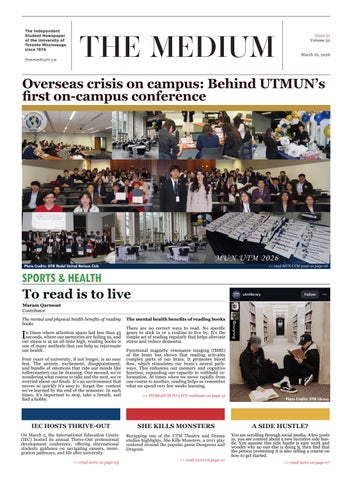
Overseas crisis on campus: Behind UTMUN’s first on-campus conference

Maram Qarmout Contributor SPORTS
![]()

Maram Qarmout Contributor SPORTS
The mental and physical health benefits of reading books
I n times where attention spans last less than 45 seconds, where our memories are failing us, and our stress is at an all-time high, reading books is one of many methods that can help us rejuvenate our health.
Four years of university, if not longer, is no easy feat. The anxiety, excitement, disappointment, and bundle of emotions that ride our minds like rollercoasters can be draining. One second, we’re wondering what course to take and the next, we’re worried about our finals. It’s an environment that moves so quickly it’s easy to forget the content we’ve learned by the end of the semester. In such times, it’s important to stop, take a breath, and find a hobby.
On March 5, the International Education Centre (IEC) hosted its annual Thrive-Out professional development conference, offering international students guidance on navigating careers, immigration pathways, and life after university.
>> read more on page 03
The mental health benefits of reading books
There are no correct ways to read. No specific genre to stick to or a routine to live by. It’s the simple act of reading regularly that helps alleviate stress and reduce dementia.
Functional magnetic resonance imaging (fMRI) of the brain has shown that reading activates complex parts of our brain. It promotes blood flow, which stimulates our brain’s neural pathways. This enhances our memory and cognitive function, expanding our capacity to withhold information. At times when we move rapidly from one course to another, reading helps us remember what we spend very few weeks learning.
>> TO READ IS TO LIVE continues on page 12
Recapping one of the UTM Theatre and Drama studies highlights, She Kills Monsters, a 2011 play centered around the popular game Dungeons and Dragons.
>> read more on page 10

You are scrolling through social media. A few posts in, you see content about a new lucrative side hustle. You assume this side hustle is easy work and wonder why no one else is doing it, then find that the person promoting it is also selling a course on how to get started. >>

UTM students hold a deputation at Mississauga City Hall in “fight for solidarity”
Diana Fu Community Correspondent
The outbreak of the U.S.-Israel war with Iran has exacerbated human rights challenges in the region.
On March 11, students from the University of Toronto Mississauga (UTM) Persian Students’ Association (PSA) held a deputation to Mississauga City Council in a “fight for solidarity” with Iranians in the city and around the world.
In front of an audience of city officials, Athena Savoji, a PSA executive, detailed the “uncertainty and fear” that both earlier protests and the current U.S.-Israel war with Iran have brought upon the Iranian-Canadian community. Ultimately, she advocated for a formal recognition of affirmation and solidarity towards the Iranian community in Mississauga.
“When events unfold across the world, the emotional impact does not stop at national borders. It follows people into their communities,” Savoji stated.
Following the deputation, PSA President Bita Khaleghisohi provided statements to The Medium via email about the deputation and the current situation in Iran.
Speaking on Savoji’s address, Khaleghisohi said, “She highlighted the lack of support from the Mississauga community for the Iranian community, who have been suffering for the past month. She successfully conveyed her message and requested a public statement from the council and a flag-raising ceremony. We’ve already spoken to the mayor of Mississauga and have scheduled a flag-raising ceremony.”
Khaleghisohi also said students can draw more attention to the plight of Iranians by “speaking up and talking about Iran,” but also warned about widespread propaganda. “To avoid propaganda, I recommend listening to Iranians that you know are anti-IRGC [Islamic Revolutionary Guard Corps]. They usually have even lived under the regime, so their lived experience can give you a better understanding of the situation.”
The PSA’s deputation comes as the war in Iran enters its third week. On February 28, the U.S. and Israel abruptly broke off all negotiations with Iran, launching a series of coordinated airstrikes against various targets in the country. On March 2, Israel also began to strike Iranian-aligned Hezbollah positions in Lebanon as part of the conflict.
Israeli Defence Minister Israel Katz has described the strikes as a “preemptive attack against Iran to remove threats to the State of Israel.” At the same time, the U.S. launched its own attacks as part of “Operation Epic Fury,” provoking Iran to retaliate with mass drone strikes on neighbouring Middle Eastern countries with American and Israeli military presence. The initial U.S.-Israeli strikes killed Iranian Supreme Leader Ali Khamenei after missiles struck his compound in Tehran.
The outbreak of war arose as Iran had been caught in a new wave of protests
Pub

starting on December 28, 2025, due to the continued economic downturn in the country stemming from sanctions, according to NPR.
The protests immediately garnered support from Iranian opposition groups led by the exiled Crown Prince Reza Pahlavi, who called on people to come out and voice disapproval of the Iranian regime, CBS News reported. In response, the Iranian government instituted an Internet blackout and led crackdowns that were estimated to have killed up to 30,000 people.
Many American and Israeli political leaders have claimed that the war will help the protesters, with Israeli Prime Minister Benjamin Netanyahu calling on them to “seize the moment” on March 10 due to the airstrikes killing many leading figures within the Iranian government, according to The Times of Israel.
However, the ultimate goal of these strikes remains unclear, as U.S. President Donald Trump has failed to provide a consistent deadline for the war’s end or commit to any end goal for what would actually constitute victory. Additionally, Trump also scrapped a Pentagon plan to reduce civilian casualties in favour of greater “lethality” in operations, according to The Independent.
When asked whether she thinks the war can actually liberate the Iranian people, Khaleghisohi said that it potentially could.
“In 47 years, Iranians have tried every path available, such as elections, reform, [and even] protests with mass uprisings. The regime has always responded with violence. Some examples are arrest, torture, direct shooting or execution. So when you say ‘regime change should come from within Iran,’ well, that’s what we’ve been trying to do for over the past decade, you just weren’t paying attention earlier,” said Khaleghisohi.
“We know that the West is pursuing this war because of its own interests. However, this war is weakening the regime more than we ever could, and that gives us an opportunity to fight back, where the people might actually win because their opponent [has grown] weaker. So yes, depending on how it plays out down the line, it could lead to the liberation of Iranians from the regime.”
Aleeshah Heer Contributor
Our reactions to ordinary nudity reveal more about cultural anxiety than morality
On March 6, students gathered at The Blind Duck for Rangisari Pub Night, an event hosted by the University of Toronto (U of T) Mississauga (UTM) Students’ Union (UTMSU), the UTM Indian Stu-
dents Association (ISA), and U of T Bollywood. The event was an opportunity for students to celebrate South Asian music and culture through an evening of dancing, music, and socialising.
Approximately 50 students attended throughout the night as the pub’s regular drink menu remained available, offering both alcoholic and non-alcoholic options. Music from inside the venue was audible throughout the Student Centre as attendees arrived, with Bollywood songs playing loudly before students

Inside, multicoloured lighting illuminated the space, reflecting the vibrant aesthetic often associated with Holi, the South Asian spring festival known for its celebration of colour and community. Often referred to as the “festival of colours,” Holi marks the arrival of spring and is traditionally celebrated with music, dancing, and the throwing of coloured powders.
Students arrived dressed for the occasion, with some wearing traditional South Asian clothing such as kurtas, long tunic-style shirts often worn by men, and lehengas, colourful embroidered skirts typically worn for festive occasions, while others opted for more casual attire. Decorations were relatively minimal, but a colourful photobooth allowed attendees to take pictures throughout the evening.
The main attraction of the night was the dance floor. A DJ began playing music to kick off the evening’s proceedings, mixing older Bollywood classics from artists such as Kishore Kumar and Lata Mangeshkar with more recent releases from performers like Arijit Singh and Badshah. Students quickly gathered near the front room, dancing and singing along as the playlist progressed.
Although the event did not feature games or stage performances, the dance floor remained active for
much of the night. Students appeared engaged with the music, cheering when familiar songs played and encouraging others to join the crowd.
One event organizer from ISA explained that the goal of Rangisari Pub Night was to create a welcoming environment where students could enjoy music and social connections. “The target audience is essentially anyone who likes to dance,” he said. “We wanted to create a space where people can come together, have fun, and enjoy the music.”
He explained that the event was designed to reflect the energy of Holi celebrations. “It’s a Holi-based event,” he said. “We wanted to bring that kind of energy and atmosphere to campus.”
The organizer also noted that events like this are particularly important at the Mississauga campus. He explained that South Asian cultural programming tends to be more visible at U of T’s St. George campus, where the larger ISA and Bollywood communities regularly host events. Creating similar spaces at UTM helps build a stronger cultural presence for students. “Most South Asian events happen at St. George,” he said. “We wanted to create something like that here at UTM, so people can come together and enjoy the culture.
For many students attending, events like Rangisari
Pub Night provide an opportunity to experience cultural celebrations while studying at university.
Ananya Pandey, a second-year life sciences and international student from India, said that gatherings like this help recreate aspects of cultural celebrations that students may miss while living away from home. “Events like this help me connect with more people,” she said. “Something I miss about my culture is the festivals and how we celebrate back in my country. This kind of brings that feeling back.”
Another attendee, third-year digital enterprise management student Parth Sharma, said cultural events on campus allow students to reconnect with traditions and share those experiences with friends. “It’s amazing to be surrounded by friends and culture,” he said. “Even if you’re not always very connected to it, events like this help you experience it again.”
Interviewees also expressed interest in seeing more events like Rangisari Pub Night organized on campus in the future.
By the end of the night, Rangisari Pub Night had transformed The Blind Duck into a lively celebration of music, culture, and community, offering students an opportunity to connect through dance and shared cultural expression.
Prekshaa Surana Associate News Editor
The annual networking event covered job search, immigration pathways, and networking with employers and alumni.
On March 5, the International Education Centre (IEC) hosted its annual Thrive-Out professional development conference, offering international students guidance on navigating careers, immigration pathways, and life after university.
The two-hour event brought together students, campus advisors, and professionals from a variety of industries to share practical advice about transitioning from university into the workforce in Canada. Beginning with a welcome and agenda overview led by IEC event hosts Rishika Nagpal and Manahil Hissam, the event featured sessions on job searching, immigration pathways, and networking with alumni and industry professionals.
Understanding the transition from student to professional
The first session of the evening, Life After Graduation, was led by IEC Supervisor Kay Kim and focused on the shift students experience when moving from university into professional environments.
Kim highlighted the structured nature of academic life, where expectations are clearly laid out through course syllabi, rubrics, and deadlines. Success as a student often follows a predictable path: enrolling in courses, completing assignments, and meeting outlined requirements.
However, Kim explained that the professional world operates differently.
Illustrated by April Roy even entered the pub.
In job applications and interviews, employers are often asking a deeper question: who are you, and why should they care? Rather than simply listing achievements, Kim emphasized the importance of telling a clear personal story through resumes and applications. Experiences should not appear as disconnected accomplishments but as part of a larger narrative about a candidate’s goals, motivations, and strengths; more importantly, what they bring to the table.
Employers frequently skim applications quickly, Kim noted, making it essential for students to present their experiences in a way that clearly communicates what problems they can solve and why their

experiences matter. By explaining what they did, why they pursued those opportunities, and what they learned from them, applicants can create a stronger and more compelling professional profile.
Navigating immigration pathways after graduation
The next session was led by Arshdeep Bindra, a regulated Canadian immigration consultant and international student advisor at the IEC, who provided an overview of immigration pathways available to international graduates.
Bindra focused primarily on the federal government’s Post-Graduation Work Permit (PGWP), which allows eligible international students to work in Canada after completing their degree.
The PGWP can be issued for up to three years, depending on the length of a student’s academic program and is a one-time opportunity for international graduates. Unlike some other work permits, the PGWP does not require students to secure a job offer before applying. Students can begin applying for jobs and even accept offers before submitting their PGWP application.
Bindra also addressed common questions about
eligibility and timelines, including situations involving leave of absence during studies and when students may be eligible to work full-time while waiting for their final grades.
The session briefly covered documentation required for PGWP applications, navigating the online application portal, and general considerations for students interested in pursuing permanent residence pathways in Canada.
Career strategies for entering the Canadian job market
Following a short dinner break that allowed students to connect informally with speakers and peers, the conference resumed with a session led by Career Centre Employment Strategist Lucille Yi. The presentation offered an overview of the Canadian job market and practical strategies students can use to strengthen their job search.
Yi discussed employer expectations and highlighted the importance of networking, professional communication, and tailoring job applications to specific roles. She also encouraged students to think about how to effectively leverage their international experiences when applying for positions. Experiences gained through studying abroad, mul-
ticultural perspectives, and global experiences can be valuable assets when presented clearly to employers. The Career Centre session also introduced students to campus resources that can support their job search, including resume and cover letter critiques, career advising appointments, workshops, and networking events.
Alumni and employer perspectives
Later in the evening, students had the opportunity to hear from a panel of professionals and alumni work-
ing across different industries. Panellists included Aneesha Sharma from PwC, Hamza bin Waheed from RBC, Naharin Anni from McMaster University’s medical school, Sauhaard Walia from Amazon, and Anil Wasif from the Government of Canada. The panel discussion addressed topics such as hiring international graduates, navigating workplace challenges, and adapting to the Canadian professional environment. Panellists shared their own experiences transitioning from school to professional careers, offering insight into the skills and strategies
Jessy Fan Contributor
When “splitting” becomes selective.
The bill arrives, and suddenly, dating becomes math. Who pays? Who offers? Who pretends to reach for their wallet first?
We like to think that modern dating has moved past these financial questions. We talk about equality now: independence and shared responsibility. So when someone asks to split the bill, the socially correct answer feels obvious. Of course, that’s okay.
I used to think so, too. Until I experienced what I now call selective splitting.
Last year, I talked to a guy for five months before meeting him in person. He lived in Chicago. After months of nightly conversations, he finally flew to Toronto to visit me. When I saw him at the Pearson Airport for the first time, he looked exactly like his photos. Red hair, broad shoulders, and strangely calm.
I ordered an Uber to take him to his hotel. I didn’t hesitate to pay. I live here and he was the visitor. It felt obvious. Later that night, we ordered food in his hotel room; I paid again. Still, it didn’t feel like anything.
At that point, I wasn’t keeping score. I didn’t realize he was.
Then came brunch.
The date was going so well. Easy conversation, laughter, the relief of realizing that someone from your phone screen exists the same way in real life. When the bill arrived, he asked: “Is it okay if we split it?”
I said yes, almost immediately. Why wouldn’t I?
Splitting bills feels modern, fair, even respectful. Studies show that younger generations increasingly prefer to share dating costs as traditional expectations shift alongside financial independence and rising living expenses.
At that moment, I genuinely believed we were practicing equality. But equality, I learned, depends on how you define the split.
Later, we went to the movies. He bought the tickets. Then asked if we could split them. Once more, I agreed. Still reasonable.
Then came the turning point.
He wanted popcorn and a drink, but also needed to use the restroom. He asked if I could order the snacks while he went. I agreed. What else was I supposed to say? No, I refuse to hold popcorn responsibility?
He came back, took the snacks, said thank you, and we watched the movie. No mention of paying me back. No offer to split this time.
That’s when it clicked. He wasn’t asking to split the bill. He was asking to only split the part he paid for.
And suddenly, something felt off. Not financially, but emotionally.
Research shows payment decisions on dates carry symbolic meaning beyond money. Psychologists note that those who pay often communicate interest, generosity, and emotional investment. Dating expenses aren’t just economic exchanges. They signal how people view shared experiences.
Splitting evenly can feel collaborative. But, selectively splitting and tracking reimbursement only when you’ve spent money transforms a shared outing into individual transactions. It stops feeling like we went on a date and starts feeling like two people managing separate budgets at the same table.
The issue wasn’t the cost of popcorn or movie tick-
Prekshaa Surana Associate News Editor
Why do others feel entitled to judge religious practices—particularily amongst the diaspora?
Religion was never supposed to be tied to performance. Yet the modern day reality is the exact opposite.
I have always considered myself a spiritual person. Growing up, faith existed subtly, in everyday life. Praying before an exam, going to the temple routinely before school, bowing in front of the deities, ringing the temple bells, and chanting the holy mantras before bed—these all felt normal. No one asked whether you had done it “correctly.” No one questioned how sincere your faith was.
But somewhere along the way, religion stopped feeling private. It became something people started measuring in each other. People have become entitled over other’s practices. It’s in a comment made by someone who notices you didn’t fast during a religious holiday, or asks why you didn’t attend a
that helped them succeed. An audience Q/A session followed, where students had the opportunity to ask panellists about career development, networking, and professional growth.
The conference concluded with closing remarks summarizing key takeaways before transitioning into an open networking session. During the open networking portion of the event, students had the chance to speak directly with panellists, advisors, and peers in a more informal setting.

Editor | Yasmine Benabderrahmane opinion@themedium.ca
ets. It was the pattern. Equality became conditional.
Gen Z dating culture often celebrates “going Dutch,” and for good reason. Many young adults reject outdated gendered expectations that men must always pay. Financial fairness matters, especially for students navigating tuition, rent, and rising costs.

But, equality doesn’t mean minimizing what you owe at every moment. Real equality looks like shared generosity. Sometimes you pay, sometimes I do, sometimes we don’t calculate because the experience itself was mutual.
Dating, ideally, is collaborative. You invest in the moment together. When someone only asks to split their own expenses, it can signal something deeper. A reluctance to share responsibility for the experience itself. And that changes how the date feels.
Looking back, I don’t regret paying for the Ubers or dinners. What stayed with me wasn’t the moneyissue, but the realization that fairness without consideration can feel strangely unfair.
Illustrated by Adanna Scott
Because relationships, even the early ones, aren’t spreadsheets.
Yes, ask to split the bill. Normalize it. Communicate openly about money. Those are healthy habits in modern dating. But if you’re going to split, split the experience, not just the receipt. Otherwise, equality stops being about respect and becomes reimbursement.
And no one wants their romantic memories to feel like pending transactions.
particular prayer. Or when someone comments on what a woman is wearing and whether it is “appropriate” for a religious space.
Suddenly faith isn’t just about belief, it’s about vigilance.
The religion paradox: faith or cultural performance?
For many international students and immigrants, religion is not only tied to spirituality but to cultural identity, too. Naturally, moving across countries changes how people practice religion. Traditions adapt. Festivals become smaller. Rituals become simpler.
A student who grew up in Canada may celebrate Diwali with friends in residence dorms instead of visiting the temple. Another might observe Ramadan while juggling midterms and deadlines. Others may connect with their faith in ways that look different from how their parents practiced it back home. But, these differences often invite criticism, ignoring the circumstances at hand.
An international Muslim student who doesn’t fast during Ramadan might be criticised: “but everyone back home does it!” A Hindu student celebrating Diwali with friends instead of family rituals might be told they are becoming “too Western/modern.”
Co-Editor-in-Chief
Aya Yafaoui editor@themedium.ca
Co-Editor-in-Chief
Samuel Kamalendran managing@themedium.ca
News
Aaron Calpito news@themedium.ca
Opinion
Yasmine Benabderrahmane opinion@themedium.ca
Features
Gisele Tang features@themedium.ca
A&E
Yusuf Larizza-Ali arts@themedium.ca
Sports
Tyler Mederiros sports@themedium.ca
Photo
Melody Zhou photos@themedium.ca
Design
Sehajleen Wander design@themedium.ca
Social Media
Jannine Uy
social@themedium.ca outreach@themedium.ca
Outreach
Mashiyat Ahmed
Copy
May Alsaigh may@themedium.ca
Anaam Khan anaam@themedium.ca

TO CONTRIBUTE & CONNECT: themedium.ca/contact @themediumUTM @themediumUTM @themessageUTM
These conversations rarely happen publicly. They show up quietly: in group chats, in casual comments at gatherings, or over phone calls with relatives back home. For many young people navigating identity in a new country or an environment, like university, religion becomes something they feel they must constantly explain or justify, often leading to an identity crisis regarding their relationship with these practices and traditions.
Why women are judged more harshly
Within most religious communities, the victims of scrutiny are often women. Across cultures, women’s bodies and behaviours are frequently treated as symbols of religious devotion. Clothing becomes a public marker of how seriously someone is perceived to follow their faith.
A woman who chooses not to cover her head may be questioned about her values. A girl not wearing traditional clothes to a temple might receive disapproving looks. A female student deciding not to fast may be asked repeatedly to justify her actions.
Meanwhile, men rarely face the same level of scrutiny for their choices. When was the last time you saw a man wearing jeans in a temple being called abnormal? Simultaneously, a woman regarded as “immodest” or “untraditional” in dress does not only invite unsolicited looks but plenty of moral policing from people she’d barely know.
This pattern appears across many religious traditions. Women’s behaviour becomes tied to ideals of honour, morality, and tradition, and religion becomes the language used to enforce these expectations.
In many cases, the pressure isn’t actually about theology; it’s about social and cultural expectations that have merged with religion over time.
Where does religious entitlement come from? Why do people feel entitled to comment on someone else’s faith? Part of the answer lies in the way religion functions as a collective identity.
Religious communities often see themselves as guardians of tradition. Rituals and customs are passed down across generations, and people feel responsible for preserving them. When someone practices differently, it can feel like those traditions are being diluted. So, criticism becomes framed as protection.
A relative reminding you to fast might believe they are helping you stay connected to your culture. A community elder commenting on someone’s clothing might think they are preserving religious values. But, intentions don’t always equal impact.
For many young people, these comments slowly turn religion into something performative. Instead of asking themselves what they believe, they begin wondering how their actions will be judged, and therefore end up performing traditions that they may not even fully understand. Faith becomes less about spirituality and more about managing other people’s expectations of you.
When judgement pushes people away from faith
Unfortunately, attempts to protect religion’s tradition

can end up pushing people away from it. Some young people distance themselves from religion entirely because it feels like a system of surveillance rather than meaning. Others redefine their relationship with faith on their own terms.
A student may still celebrate Diwali with friends even if they don’t attend temple regularly. Someone might pray occasionally but not follow every dietary rule. Others may find spirituality in personal reflection rather than organized religious practice.
In these cases, faith becomes personal again, but that is often a product of stepping away from communal expectations, which takes a strong belief in one’s identity. This belief is usually still evolving in the youth, especially young adults who are still trying to integrate their idea of spirituality within their own newly-fabricated identities.
Community should not mean judgement
Religion has always had both personal and communal elements. Festivals, gatherings, and rituals bring people together and create shared meaning. But, there is a difference between community and communal judgement.
Community can offer a sense of belonging, comfort, and identity. Communal judgement, on the other hand, turns faith into something monitored and evaluated. Devotion cannot be measured through clothing, fasting, or visible rituals.
Two people can practice the same religion in completely different ways and still share the same faith. Maybe the real issue isn’t religion at all. Maybe it’s the way communities transform religion into a “standard” that people feel obligated to enforce.
Faith evolves as people grow, migrate, question, and reinterpret traditions. Perhaps the more useful question isn’t whether someone is practicing religion “correctly”. Instead, the question should be why we assume anyone else has the authority to decide what someone’s faith should look like at all. Because if religion is ultimately about connection with the divine, with tradition, and with oneself, then it was never meant to be something others could measure or judge.
Maryam Raheel Associate Opinion Editor
How bilingualism shapes the way I experience emotions
In English, the word “love” extends across multiple contexts. We love our friends, our parents, our favourite song. Its association with everyday things slowly erodes the weight we would usually reserve for special circumstances. Then, when we need love to feel momentous again, we reach for metaphors tangled in stories and poems, or quote the latest romcom as if a scripted confession might restore the gravity the word once held.
My mother tongue, Urdu, is less casual with love. There is ‘‘pyaar,” an everyday term for gentle affection. There
is “mohabbat,” a word used for a deep love that persists over time, based on mutual understanding and respect. And then there is the word “ishq,” which represents an allconsuming feeling of passion reserved for intense romantic love. They all plainly translate to “love” in English. The meaning technically remains the same, but the emotional intensity they carry barely survives translation.
Urdu is full of words that refuse to shrink into English equivalents. My parents often tell me to have “sabr,” a term loosely defined as patience. But the sabr my mother asks of me when she swats my hand away from the samosa she just prepared is not the same as the sabr my father invokes when life begins to overwhelm me. In the latter, patience becomes endurance wrapped in faith.
Growing up, Urdu was the language of reprimands and lullabies. It was taught by relatives who spoke in prov-
erbs and the poetic cadence of prayers murmured under their breath. The language feels natural on my tongue; the emotions travel through generations before forming into speech. In Urdu, it’s difficult to hide one’s true emotion, even the smallest words can reveal more than they intend.
English came later. It was the language I learned to raise my hand in, taught from television and textbooks and red-inked corrections scratched on grammar tests. In English, emotions fold into manageable phrases. Saying “I’m okay” encompassed everything and nothing at the same time, providing closure to unwanted conversations even if the feelings remained unresolved. Even the phrase “I love you” felt too light, as if it had been used too many times, for too many things.
Studies on bilingualism note that emotions behave differently depending on the language we use to express them. Research suggests that bilingual speakers switch between their native language (L1) and a second language (L2) because one language will feel better suited for particular environments and emotional contexts. Emotional reactions can feel less intense in a second language than in the first, meaning the language learned later in life can create a small distance between ourselves and what we’re trying to convey.
Bilingualism also expands the way emotions are understood. Since bilingual speakers move between multiple languages and cultural systems, they tend to develop a better understanding of a broader range of emotions. However, researchers emphasize that this depends on the context and social environment
that conversations take place in.
I notice these shifts most in my friendships. In friendships built primarily through English, my words frame stories in a deliberate way, supple-

menting key moments with explanation and context. These friends know me through paragraphs and prose. Whereas with friends that speak Urdu, explanation becomes unnecessary. A single word would collapse our group into a fit of giggles and a shift in tone will land a joke that would dissolve upon translation. In the same way, English conversations feel more like an analysis, in which problems are described, debated, and dismissed through discussion. While in Urdu, the same story can feel closer to a confession with the explanation more of an afterthought to the emotion.
Rebecca Christopher Contributor
Discomfort is a small price for community.
It’s really funny how much we avoid something the minute it becomes inconvenient or uncomfortable for us. Some of us call this procrastination, but I find that term rather weak when it comes to avoiding community. From what I’ve seen, people don’t avoid community because they resent people like they would resent a deadline; they avoid it because with social interaction comes unspoken caveats and stipulations that can be overwhelming.
Some of these issues may include being unsure on how to get involved in the community, feeling apprehensive because they have nothing to offer, or not being familiar with anyone around you. What also throws people off is also being unsure whether they will be able to or even want to commit effort or time to getting involved in a community. I struggle with this as a university student and I know others do, too—nothing throws people off tasks than that insidious cloud of indecision when all you yearn for is to simply accomplish something.
And it’s not even because we hate community.
I love my present community and all the communities I’ve had from childhood. As a preschooler and a middle schooler, I was more extroverted and trusting, so I interacted actively with my community almost all the time at school, church, basketball, the playground, and even at the hospital where my parents worked! I suppose it was an instinctive desire to enjoy the people around me and it’s something that has never changed about me, even when I became a more introverted adolescent.
But, the Covid-19 pandemic and moving countries drastically changed the way I interact with people. I had to create new connections in a different geographical location and navigate my behavioural changes, the changes to my friends, and also the changes in my interests. With all the changes in my life, I still am figuring that out, I’ve learned that it does take patience. What I feel takes the most effort is understanding how to balance my time with others and time for myself.
As a third child and the youngest, I was on my own a lot, so I ended up entertaining myself often. As a middle schooler, I played a lot with my dolls in my vibrant world of make-believe with the most entertaining stories that were different every single day. As an adolescent, I found myself becoming captivated by music and songs, so I spent a lot of my free time singing along to my favorite singers in concerts, immersing myself in the experience by swaying back-and-forth with a hairbrush held to my mouth with all the passion 11year old me could muster. Even today, I unwind by singing and dancing in front of the mirror.
Yet, living between languages has changed over time. English interrupts my Urdu more often, replacing nouns and technical words, before entire phrases arrive on my tongue quicker than they do in my mother tongue. Linguists describe this phenomenon as code-switching, the ability for bilingual speakers to shift between languages depending on circumstances. Sometimes the interruption feels necessary, allowing me to stress certain aspects of my speech. Other times, it feels a bit like betrayal, as though my native language hesitates to make itself known in front of certain audiences.
Switching languages mid-sentence became an adaptation to the world around me. Certain feelings arrive more naturally in Urdu while others belong to English. This could likely be because of the difference in each language’s structure. English, a headinitial language, places the emotional core, such as a verb, before the complement, like an object. This format reveals meaning quicker like when we say sentences like “I miss you.” On the other hand, Urdu, a head-final language, places the complement before the core. The structure builds toward the emotional center by placing the verb later in the sentence. This creates a subtle difference where in English emotions appear to be declared, while in Urdu, they accumulate.
I often wondered whether living with both languages meant one was reserved for the real version of my emotions. But, the longer I spend with both, the less I feel that divide. What felt like a loss in translation now offers an expanded vocabulary. Together, they do not compete for dominance, but rather present different ways of saying what I truly mean.

The point is, I had an individual way of entertaining myself that momentarily transported me to another world but it also made me prefer that alone time over being with others. I even started to resent spending time with my family and friends, preferring to indulge myself in my fantasy world where I could have fun without needing anyone and where no one needed me.
Whilst having time to unwind is important, holding onto that mindset made me miss out on the life-changing benefits of community. It took ages for me to understand what emotional support really was, how I could also be a part of it, and benefit from it in my community. I also had to slowly learn how to let people in and let them physically support me like allowing others to give me rides home or getting me food that I liked as a kind gesture. What was also new to me were the health benefits of social connection, like reducing the risk of chronic disease, heart disease, stroke, dementia, depression, and anxiety.
There are many interesting recommendations for getting involved in the community. You can start small by getting to know your neighbour, even if it’s just for safety reasons before becoming good friends. You can join a club for an activity or a hobby that you are interested in and then connect in a place outside of home or work or school, so that you can build a strong connection with others in a more relaxed space. Experts even recommend calling family and friends consistently and getting involved in community volunteering.
Whatever works for you and I will be different, depending on the experiences you have had with your communities throughout life. A common thing that I have seen is that you don’t need an extroverted, overly-charismatic, or consistently fun personality to attract people around you. What strengthens your connection with other people is consistently checking on them and showing them love: being a community member. Consistency is what builds community everywhere and for everyone.
Contributor

Bad Bunny and the Latin American identity at the 2026 LX Super Bowl.
The 2026 LX Super Bowl halftime performance was inspiring, filled with polemics, mixed emotions, resilience, and a demonstration of how language is a political statement.
On February 8, 2026, Bad Bunny—a Puerto Rican rapper, singer, and producer—performed at the Super Bowl halftime. It was the first time that a Latin American artist performed primarily in Spanish during the Super Bowl. According to Billboard Canada, this performance set a historical record with 4.157 billion views within 24-hours.
You may ask, well why was this important? Let’s understand the context first. The Super Bowl is one of the most important events in the United States—symbolically American—where families and friends get together all over the country for one night to watch a football game. In a single sitting, 50 million cases of beer are consumed and 280 million pounds of avocados are imported from Mexico, simply for the Super Bowl weekend.
But, the most iconic feature of Bad Bunny’s performance was that, for the first time ever, a Spanish-performance was staged for the Super Bowl halftime show. This comes at an unprecedented time of violence, xenophobia, and racism targeted against immigrants, particularly the Latin American community in the US.
According to the American Immigration Council, as of January 2026, more than 73,000 people have been arrested by the Immigration and Customs Enforcement (ICE) and are in detention centers. In most conditions, arrested people do not have access to their families, lawyers, or any sort of protection while being held in detention, suffering from unhygienic, violent, and degrading conditions. These policies against immigrants, driven by Trump’s administration, have increased racism and segregation of ethnoracial minorities in the United States.
As a result of the growing xenophobia, many people felt offended by the Super Bowl halftime performance—the very core of the traditional American identity—being in Spanish. Organised by Turning Point USA, a conservative nonprofit organisation founded by Charlie Kirk, an alternative show was streamed at the same time as Bad Bunny’s performance in response. This was planned as a rejection of Bad Bunny’s show and what he represents: Latin American and Puerto Rican excellency and culture in the US.
Throughout Bad Bunny’s show, many visual symbols that indexed Latin American identity were used, like sugarcane fields and the field workers, a taco stand, big celebrations and festive gatherings full of dance which happen around the family and the community, to celebrate the Latin American heritage.
But what does it mean to be Latin American?
Latin Americans are often grouped as a mix of different ethnicities and treated as “the other”, being racialized partly due to political instabilities of Latin American nations, as well as cultural differences. Even if Latin America encompasses diverse countries, with different ethnic and Indigenous groups, we share similarities in culture and language, where Spanish is predominant—with the exception of Brazil, where Portuguese is the official language.
Grouping together diverse ethnoracial communities risks erasing individual identities. However, “Latinx identity is a visible identity because of its variability.” Therefore, by using the term Latin American, our cultures and language variations are not fighting against each other, rather amplify a part of who we are, embracing heterogeneity as well as our commonalities.
The complicated part of this comes when our cul-
Samm Mohibuddin Contributor
The pros and cons of popular Gen Z side hustles you might have heard of.
You are scrolling through social media. A few posts in, you see content about a new lucrative side hustle. You assume this side hustle is easy work and wonder why no one else is doing it, then find that the person promoting it is also selling a course on how to get started.
Despite this red flag, you are drawn in. After learning that Canada’s youth unemployment rate climbed to 14.7 per cent in September 2025, the idea of starting a side hustle suddenly becomes a lot more appealing.
To satisfy your curiosity, let’s look at some of the popular side hustles amongst Generation Z (Gen Z)
and see if they are worth getting into.
Content creation
With Gen Z being one of the first generations to grow up with social media, it is no surprise that, in youth career polls, becoming a content creator often comes up as a dream career choice. Despite what older generations may say about this being an unrealistic career choice, Goldman Sachs predicts that the content creation economy can be a US$480 billion industry by 2027.
This prediction may be true, as more creators are joining the industry. According to YouTube trend reports, 65 per cent of Gen Z users self-identify as content creators, showing the popularity of content creation amongst young people.
This comes as no surprise, as the benefits of content creation are alluring. You work on your own time, make content on topics of your interest, all whilst getting paid. Sounds too good to be true?
ture, language, background ,and physical features are used to marginalize us. An example of this is the racial profiling that is used by ICE to detain people, simply for how you look or what you speak. When Latin Americans arrive in North America, they are urged to adapt to society, forced to abandon their tongues and speak in English. Whereas, when English speakers go to Latin American countries, locals adapt to understand them. It is ironic that the US gets to consume our cuisine (like the infamous guacamole made for the Super Bowl weekend) and culture (like Bad Bunny), whilst targeting, detaining, and dehumanising our people.
Amongst other things, Trump criticised the halftime show and commented on his social media Truth Social: “Nobody understands a word this guy is saying.” Here is where Bad Bunny’s performance in Spanish challenges these colonialist ideologies, using language to stand in uncomfortable spaces and to make a statement: “seguimos aquí,” we are still here. This is a sign of resistance: we are here, we are part of the continent, we built our lives here from scratch, and this is our home too!
In the end, Bad Bunny sends a message of unity, platforming all nations of the Americas, including Mexico, United States, Canada, and, his homeland, Puerto Rico. By doing this he refers to America not as a country, but as a continent with different countries, cultures, and languages. Bad Bunny was able to prove to us that our differences do not have to be a drive for hate and conflict, but to use it as a leverage to learn from one another, embrace multiculturality, and appreciate the beauty in our cultures and languages. The show highlighted that being Latinx does not have to be a dichotomy to being a US citizen. This show demonstrated that our cultures can live together, symbolised by the salsa version of Lady Gaga’s Die with a Smile.
Bad Bunny’s performance rendered Latin American culture visible through details and symbols, despite the dehumanisation and stereotypes placed upon Latin Americans. These symbols served as a tool in which Latin American culture defies the constraints of who is allowed to exist in North America, showing resilience and challenging power systems through language.
The message of this event was an example of how performances make Latin American bonds stronger. By showcasing identities and linguistic ideologies through visual symbols and the use of Spanish language, Bad Bunny reflected everyday social realities, which make Latin American culture visible. This was a performance that can help Western society realize the damage that racist and colonialist practices cause and how language can promote a social change, rejecting policies that reinforce inhumane treatments against immigrants.


It probably is. Around 48 per cent of creators see revenue of US$15,000 or less, and only 15 per cent make US$100,000 annually. Periodic algorithm changes can also impact the revenue of one’s content. In some cases, it could even make it obsolete. With many factors to consider, content creation may fall on the side of a long-term craft to perfect, as opposed to being a means for a quick buck.
Albert Einstein once said, “If you cannot explain something simply, you do not understand it well enough.” Well, if there is a topic which you can explain well, it would be a good idea to get paid for it by tutoring.
University students can resonate well with this, as we are constantly surrounded by teachers, professors and tutors. The idea of being paid to help someone else understand course material feels far more grounded than trying to go viral online.
If you manage to become a teaching assistant at the University of Toronto Mississauga, you can expect to earn around C$53 per hour. This hourly rate is higher than most full-time jobs, though work hours are significantly less. If you did not manage to get that TA position, no worries.
According to Indeed, the average salary for tutors is around C$25.19 per hour. If you choose to become a private tutor, you would have the freedom and flexibility to increase your own work hours.
Not only does tutoring help strengthen your understanding of course concepts, but it is also something that you can confidently put on your resume to impress potential employers. If you like stability, predictability and structure, this could be a side hustle to look into.
Buying second-hand has become popular not just with Gen Z but also with Millennials. Therefore, it’s no surprise that resellers have made entire careers in this market, let alone keeping it as a side hustle. You can find entire curated profiles on Postmark, Vinted or eBay catering to a specific niche. If, for example, you have always had a deep knowledge of fashion and are familiar with market values, you could try reselling fashionable clothing pieces. What’s more, consistently practicing negotiation whilst assessing risk and reward is a great exposure to entrepreneurship.
The biggest downside to reselling is that you can easily incur a financial loss. Unlike content creation and tutoring, reselling can cost a significant amount since it often requires an investment in inventory. If you do not break even with your business, you could end up with a pile of unwanted items, all whilst cursing yourself for trying this in the first place.
Investing and cryptocurrency
You may have heard a friend talk about making quick money from coins like Pepe Coin or Dogecoin. They might even insist that if you buy in now and hold on long enough, you could earn more than you ever dreamed of.
Given how the crypto market has little to no regulation, you can easily be scammed into losing all of your investment. For instance, the Canadian Anti-
Fraud Centre reported that in 2024, more than 5,000 people lost over C$170 million to cryptocurrency-related fraud.
Say you don’t go into crypto and try your hand at day trading stocks and commodities. This seems safer until you remember that you are going up against investment banks like J.P Morgan and Goldman Sachs. These companies control assets in the trillions, and their top traders make millions. Depending on where you look, you will see that most casual day traders rarely make a profit.
That being said, it could be beneficial to have a longterm investment portfolio through purchasing index funds or bonds. However, as a side hustle, trading may not be your best bet. And it is better to tune out the media that claim investment as a quick and easy way to make money.
Is it worth it?
The side hustles mentioned above are just a few players in today’s economic pantomime. Before asking whether they’re truly worth it, it may be more important to ask why this culture has grown so rapidly in the first place. Is the economy and job market failing to provide young people with enough opportunities? Or are many simply dissatisfied with the limits of traditional corporate work?
Whatever it may be, if you pick a side hustle, make sure it is worth your time and energy. After all, it is better to invest in yourself rather than give in to
Maaz Ahtesham Contributor
Recounting the club’s journey through delegations and dreaming of a better world.
Only the University of Toronto Mississauga (UTM) Model United Nations (UTM MUN) would bring together the United Nations (UN) First Committee, the UN Security Council, and the Pirates of the Caribbean in a conference.
The conference was a major stepping stone for UTM MUN. In an interview with The Medium, UTM MUN President and Secretary-General Mary Avanessian shared, “The club has started something new that could keep growing from here on.”
MUNs are a critical component of academia and understanding international relations. The UN especially emphasizes that “many of today’s leaders in law, government, business and the arts—including at the UN itself— participated in Model UN as students,” according to their website.
A determined comeback
UTM MUN was first established alongside Erindale College in 1967. It is deemed “among the foremost Canadian student-run organizations focused on international politics and United Nations simulation,” according to their LinkedIn page. However, like most clubs, its activity slowly died down during Covid-19.
In 2025, UTM MUN reorganized and culminated in an online conference for both high school and undergraduate students. This was followed up in the summer by a pair of hybrid events hosted by the UTM Real Estate Club.
As one of several clubs invited to speak, UTM MUN primarily spoke on tenants’ rights. Zainab Khalil, UTM MUN’s vice-president and deputysecretary-general, explained that the topic of housing is not only important to address for the well-being and academic success of students, but also is an opportunity for the exploration of policy and international relations.
“When the Real Estate Club approached us and decided to collaborate with us alongside other clubs, we were excited to contribute,” said Khalil.
In the summer of 2025, UTM MUN was also

driven to expand, especially through networking. They set up a system for growing their social media platforms, which included a spreadsheet with weekly follower goals and a regular posting schedule for events they were hosting.
This January, under-secretary-general media France Landicho met with the group’s marketing and conference teams to begin not only attracting views for the flagship event, but recruiting chairs and delegates for the crucial committees.
“A lot of the work went to marketing the conference, getting signups ready, reaching out to professors, contacting schools and delegations, and setting up the website,” Avanessian explained, “and since Model UN conferences often built their reputation over time, there was always that uncertainty of whether people would actually come.”
On the other hand, Sarah Sheikh, who was recruited as chair of the conference’s United Nations Security Council, worked tirelessly until the morning of the conference.
Sheikh described, “From the moment I was recruited, it was my responsibility to comment for the committee, work on the background guide, make training videos, assign delegates and respond to their emails.”
Aside from the United Nations Security Council, the Disarmament and International Security Committee (DISEC) and the Pirates of the Caribbean also participated in the conference. Ultimately, Pirates of the Caribbean was set as the conference’s fictional crisis committee.
According to Sheikh, chairs were given free rein to select the topic. While DISEC focused on “reducing escalation risks arising from foreign military bases and overseas deployment,” the United Nations Security Council sought to “stabilize the situation in Yemen.”
Sheikh added, “The planning behind the committees came down to being cognizant and sensitive about everything happening in the world. All the while keeping things light and fun so everybody can enjoy.”
Memories created with passion
Many memorable moments stood out over the nearly 10-hour span of UTMUN’s inaugural conference.
Khalil recalled that during the closing ceremonies, one of the delegates from Pirates of the Caribbean came up with a rap song. “He presented it to everyone, which was super cool to watch. Seeing his passion come to life and presenting it to everyone was really amazing.”
Meanwhile, Landicho marvelled at the event as a whole. “While moving between different committees to take photos during the conference, I could see the hard work everyone put in.”
Landicho continued, “And I think that’s really what Model UN is all about—being able to come together, network with students who are passionate about delegation and bring your A-game.” He shared that it was amazing to witness delegates forming connections through communicating in person.
The success of UTM MUN’s conference demonstrates the fulfillment that university connections and events can provide. It represents another step toward the development of global leadership within UTM.
“UTM’s first in-person conference is more than just an event,” said Sheikh. “It’s the creation of an open on-campus space. Students from any program can come together and apply what they’ve learned while engaging with current global issues.”
For Avanessian, what stood out most was the hard work put into the event. “The executive team spent so much time planning, organizing, and hoping people would enjoy it. So, seeing delegates engage and genuinely having fun was really rewarding.”
If you are interested in making meaningful connections and having rewarding growth, be sure to follow UTM MUN on their Instagram @utmmodelun to stay posted about upcoming events.
Debunking the history, myths and impact of a century-old policy in the present-day world.
Every year, at 2 a.m. on a quiet Sunday morning, something strange happens across much of the world. Millions of clocks jump forward by an hour, stealing a small piece of sleep from people around the world. This is known as daylight saving time (DST), and it has been observed for over a century. Many question why we practice DST and whether it serves a meaningful purpose.
The history of daylight saving time
According to National Geographic, the concept of daylight saving time involves moving clocks during warmer months so that evenings have more daylight. One of the U.S. founding fathers, Benjamin Franklin, suggested in 1784 that Parisians could save candlelight by waking earlier. Although Franklin didn’t propose clock changes.
The modern concept is credited to New Zealand scientist George Hudson, who, over a century later, formalized the concept. According to Time and Date, Hudson proposed shifting clocks in 1895 to allow for more daylight after work hours.
The idea became popularised and was widely adopted in the early 20th century during World War I, where Germany became the first country to implement it nationally as a way to conserve fuel. Following this change, many countries started to follow suit across continents. In North America, the U.S. and Canada adopted the concept shortly after for similar war energy-saving reasons.
After the war, the concept of clock shifts died down, and people returned to their old practices. However, due to the inconsistent schedules across the country, the Uniform Time Act of 1966 was developed in the U.S. to create a national standard for when clocks change.

Similarly, in Canada, the rise and fall of the clock shift concept caused a lot of confusion nationwide regarding travel, broadcasting and business schedules. To solve this issue, provinces began to standardize when daylight savings time started and ended to coordinate schedules and maximize daylight hours for factories and production.
A common belief is that daylight saving time was created to benefit farmers. However, farmers historically opposed the concept because it disrupted their schedules. According to National Geographic, agricultural activities depend on sunlight instead of clock time.
A common criticism of DST is its potential negative effect on human health. According to the Sleep Foundation, when clocks move forward in the spring, people lose an hour of sleep. This interferes with the body’s circadian rhythm—an internal clock that regulates sleep and wake cycles.
Bloomberg School of Public Health at John Hopkins highlights that this can increase stress, reduce productivity, and negatively impact overall well-being.
Why is daylight saving time still practiced today?
Despite its negative impact on both farmers and people’s health, DST is still practiced due to economic factors.
According to National Geographic, industries like retail and entertainment benefit from daylight savings. They see an increase in sales. Longer daylight exposure motivates people to shop and participate in activities after work.
Moreover, there is no consensus on what should replace the current system. Some experts support the idea of a permanent standard time, which aligns better with the body’s biological rhythm. A 2025 article from Stanford Medicine highlights that standard time places the sun higher in the sky earlier in the day. This allows people to receive more sunlight in the morning, contributing to more regulated sleep cycles and alertness.
On the other hand, some prefer to keep a permanent time all year round for economic benefits, outdoor productivity and convenience of day-today life.
DVS instructor Marianne Botros invites students to explore memes, emojis, and online imagery through art
T
he Department of Visual Studies recently hosted a Digital Culture Collage-Making Workshop led by instructor Marianne Botros. The event invited students to explore how online imagery can function as a form of artistic and cultural expression. The workshop, centred on collage-making, asked participants to work with materials inspired by digital life, including emojis, memes, GIFs, hashtags, and social media aesthetics.
Botros explained that the idea for the workshop came from her teaching in VCC390: Community and Media. “The goal of this course is to create a community inside a classroom,” she said. In the course, students are divided into groups based on shared interests, with each group forming its own small community through names, images, and collaborative work throughout the semester. That structure, she said, helped shape the thinking be-
Imposing a clock shift meant that farmers would have less daylight during the day for errands, such as delivering crops to markets. In addition, farm animals follow a natural light cycle, and a sudden shift could interfere with their routine and productivity.
Illustrated by Adanna Scott
Daylight saving time is also not universal. Countries near the equator rarely use it because their hours don’t vary across seasons. Countries like Russia and parts of Asia have tried adapting DST, but later abandoned the concept due to health concerns.
hind the workshop.
For Botros, the event was not only about collage as an art activity. It was also about getting students to think more carefully about what culture means in a digital age. “Culture is a set of beliefs. Culture is a set of practices,” she said, adding that culture changes “from one era to another,” because people now communicate, represent themselves, and share meaning online. Botros sees digital platforms as part of contemporary culture itself. “When someone is signing in [on] Facebook, they are practising the new culture of this age,” she said.
That idea became the basis for the workshop. “After teaching this course, I have found that students were so much [more] engaged when they were using digital culture,” Botros said. “So, when I thought about a workshop, how about we do a collage making [event]?”
According to Botros, participants were asked to create “a unique step-by-step collage art piece” inspired by elements of digital and visual culture. Some students used tablets while others worked with paper and other physical materials on a flat surface. Before starting, participants were asked
Now that the clocks have moved forward this year, many around the world are adjusting their routines to account for the increased amount of sunlight. As we continue to evolve our understanding of DST’s impacts, this yearly shift is a reminder of how policies can persist long after the world that created them has changed.

to identify parts of their background, including “their age, race, class, ethnicity, nationality, gender.” and consider how those factors might shape their collage.
Botros also introduced students to examples such as “pixel art, emoji collages, meme-based artwork, social media layouts,” then walked them through the basics of visual composition. “I quickly went through what the elements of art are. Lines, shapes, textures, colours, forms, space,” she said.
Although the workshop drew a small group, Botros still found the responses revealing. “Only 4 students attended,” she said. She partly attributed the turnout to the time of year, saying the workshop took place during “the busy time of the year,” and also suggested that the concept may not have been immediately clear to students.
Even with limited attendance, Botros noticed that students approached the activity differently depending on their aca- demic backgrounds and personal perspectives.
“The engineering student used geometric shapes. Versus anthropology [student], which loved using organic shapes,” she said. At the same time, she noticed a shared approach in the tools students used, whether through “cutting with scissors” or

“using Canva to put their collage together.”
That variety was part of the point. She emphasised throughout the interview that digital symbols do not carry one fixed meaning. Instead, they shift depending on who is interpreting them. “They are all exposed to the same thumbs up, but each one would have a different expression towards it,” she said. In that sense, digital culture can act as a common visual language while still being shaped by age, identity, background, and lived experience.
She also argued that forms like memes, hashtags, and emojis are worth taking seriously as artistic material because they can carry cultural meaning. “Each one of them has a meaning. It’s meaningful, and it represents their own cultural narrative,” she said.
At the same time, Botros drew a clear distinction between digitally influenced work and AI-generated art. “Traditional art is more serious than using AI art,”
Emma Catarino Associate Editor
Recapping one of the UTM Theatre and Drama studies highlights, She Kills Monsters, a 2011 play centered around the popular game Dungeons and Dragons.
M arkiplier, otherwise known as Mark Fischbach, is one of Youtube’s She Kills Monsters is a 2.5 hr long play that was written by Qui Nguyen and debuted in 2011. It follows the main character Agnes, after she loses her younger sister, Tilly, in a car accident. The two sisters have starkly different personalities, with Agnes being a more typical teenage girl, who likes watching TV and hanging out with her boyfriend, while Tilly was more of a “nerd” who loves to play Dungeons and Dragons. Tilly left behind a DND campaign—a binder full of characters, monsters, and a story to follow—which Agnes decides to play through, even though she had no prior interest nor experience in the game. Throughout playing the campaign, Agnes learns more about her sister. She learns about friends, who show up as characters like Kelly/Kaliope, and about bullies, which show up as monsters, like Evil Tina and Evil Gabi. Agnes leaves the game understanding her sister better, and feeling closer to her sister in a way they weren’t when she was alive.
She Kills Monsters was performed at UTM’s Erindale Studio Theatre from early to mid February. It was directed by David Matheson, and starred Laura Dae as Agnes, and Vanessa Whyte as Tilly. The set used was simple, though effective as minimal set props were used, mainly large wooden dice that were moved around and used as seating, moving boxes, and a way to create high/low spatial differences.
Even if you’re unfamiliar with Dungeons and Dragons it won’t dampen your enjoyment of this play. While the game is the core focus of this piece, the mechanics are explained simply and organically to the character Agnes, and thus the audience, at the beginning. A lot of features of DND are used as gags throughout the play, like a character’s desire being thwarted
she said. Explaining why, she pointed to the physical and emotional process involved in making art by hand. “When we create art, we feel,” she said, “When we move physically, it helps in expressing better.” By contrast, she described AI as “highly related to articulating prompts” and said that the process does not engage the body in the same way.
Still, Botros believes the boundary between internet culture and traditional art is changing. When asked whether that line is becoming less rigid, her answer was immediate: “Yes.”
More than anything, Botros hopes students leave the workshop looking at digital imagery more critically. “Number one is to question everything they see,” she said. In a world saturated with visual information, she wants students to become more attentive to the meanings built into the images that surround them and more confident in expressing their own stories through visual culture.

by a bad dice roll, or the subversion of expectations with the devil character, Orcus, being tired of fighting the player characters. This ties into one of the play’s strongest suits, its humor. She Kills Monsters is a lighthearted play, with many jokes throughout, giving you a break from its more emotionally charged moments. Some jokes are innocent fun, others involve mild swear words/sexual innuendos. One character in particular, Chuck, the teenage dungeon master that helps Agnes navigate Tilly’s campaign book, is especially funny as he is an overzealous teenager that wants to sleep with the adult Agnes, while she continually rejects him.
She Kills Monsters also deals with heavy subject matter that left some of the audience crying when I watched the play. It handles themes of grief, as Agnes struggles with the loss of her younger sister. She also deals with the guilt that comes from knowing that everything she’s learned about Tilly through the DND campaign could’ve already been known if she’d made more of an effort while Tilly was still alive. She Kills Monsters is also very LGBTQ+ positive, as we learn through the campaign that Tilly was a closeted lesbian, and Lilith, one of the campaign characters, was made to represent Lilly, a classmate that Tilly may have had a relationship with.
Diana Varzideh Associate Arts Editor
Interviewing some of the minds behind the English and Drama Student Society and its literary journal, Folia
W ith another academic year wrapping up, The Medium spoke to some students working in the English and Drama Student Society to receive their thoughts on how the society and its literary journal’s experience in the 2025-2026 year.
The first person interviewed was the President of the EDSS, Shunsho Ando Heng.
The Medium: Can you introduce yourself?
SHUNSHO ANDO HENG: Hello! My name is Shunsho Ando Heng! I’m a fourth-year specialist in the Theatre and Drama Studies Program and I

am the President of the UTM English and Drama Student Society.
TM: What is EDSS to you, and why did you join it?
SAH: To me, EDSS is like a big family of people who come together to celebrate and explore their passion for everything english and drama related [...] and as a way for anyone at UTM to explore their interests in our fields even if they aren’t part of our department. [...] I originally joined EDSS as the Equity Director for the 2023-24 academic year, as I am passionate about minority representation and I wanted to create more opportunities for minority groups. When I became President, I continued to push that focus while also creating a focus on student work and showcase original works. I not only wanted to create more opportunities for students to be involved but I also wanted to bridge the gap between the various programs in our department.
Illustrated by Sehaj Wander
TM: How has the ‘25-26 academic year been for EDSS?
SAH: The 2025-26 academic year has been a huge success for EDSS! We’ve had many panels with industry professionals, workshops, and other events that have really created a space for students to explore their interests and showcase their talent. [...] A recent spotlight was our production of In the Shadow of Jupiter written by Mateo Scott, a student in the English and Drama department, which was performed at the 2026 UofT Drama Festival at Hart House Theatre. This festival is always exciting for us because it’s our chance to showcase student-written work downtown with other drama societies from UofT St. George and UofT Scarborough. This year, there were 10 productions, and I am happy to announce that UTM EDSS won the IATSE Local 58 Award for Technical Achievement, Janet Bessey Award for Excellence in Stage Management (awarded to Ember Ross), and the Robert Gill Award for Best Direction (awarded to Zack Radford and myself)!
TM: How does EDSS interact with Folia?
SAH: Folia is an integral part of the department as it provides students a platform to showcase their work. Yoon and I worked together to create the rebranding of the academic journal, which originally was named With Caffeine and Careful Thought. I not only pushed for more issues, but more collaboration with the department with things like our special edition of Folia created by the ENG259 students. We also collaborated with Professor Bruno on our Special Issue titled Diversity Texts and History of Black Art in North America, which was a huge success. It wouldn’t be right though to talk about all this stuff without highlighting the amazing work our editor-in-chief, Yoon, has done, [...] and because of her hard work, we’ve reached a point where we are flooded with submissions.
TM: What are your hopes for the future of Folia and EDSS after you graduate?
SAH: I hope EDSS and Folia will continue to grow so that more students are able to showcase their works and explore their interests outside of a classroom setting. I hope our workshops continue to support students and that our community continues to grow, connecting the different programs in our department and beyond!
TM: Thank you for your valuable input!
Next, Gillian Marr provided valuable insight on both EDSS and Folia, as an executive in both organizations.
The Medium: Can you introduce yourself?
Gillian Marr: My name is Gillian Marr, I’m a second-year English major with minors in creative writing and forensic science, and I work with Folia as a poetry editor!
TM: How does the club interact with the EDSS and English and Drama community as a whole?
GM: We have received wonderful support from the EDSS (which I am also currently a part of as the events associate for English) all the way through our editorial process. The English and Drama community really showed up to support us this year—we got 106 total poetry submissions! We are hoping that this year’s launch is our biggest
yet, and that all sorts of people from the English and Drama department will come out to see our finished product and celebrate alongside us!
TM: How has the ‘25 - ‘26 academic year been for Folia? (i.e. notable events, the third issue, new changes…feel free to write a lot for this part if you have a lot to say!)
GM: We [...] had members of the team collaborate with other clubs for certain events, such as our songwriting workshop with Harmonix. This year the team welcomed a new associate editor, who has done an absolutely outstanding job in her role. Our editor-in-chief will be graduating soon, and although I will be sad to see her go since she’s accomplished such a lovely rebranding, I personally believe that our associate editor could be a great person to fill her shoes! In the meantime, our third issue “Friction” will be launching on April 2nd, and details will be posted soon about our launch gala….exciting!
TM: What are your hopes for the future of Folia?
Overall, I hope Folia continues to be the amazing platform for emerging creative writers and artists that it has become over the past few years. I think the team has created a space for these diverse voices to explore the concepts that move them, and it makes me so proud to be a small part of that. I do plan to stay on with Folia next year, and perhaps in a new role. I’ve been wanting to try my hand at prose editing one of these years. But no promises yet!
TM: Wishing you the best on your journey in Folia!
Last, but certainly not least, was Yoon Bae, the Editor-in-Chief of Folia herself.
The Medium: Can you introduce yourself?
YOON BAE: My name is Yoon Bae (she/her). I am a fourth year majoring in Philosophy and double minoring in creative writing and English. I have been serving as the Editor-in-Chief of Folia since the 2024-2025 year!
TM: What is Folia’s role, and how did it come into being at UTM?
YB: To be perfectly candid, I didn’t even know the English department had a literary journal at first. I received an email about a position opening for a journal called With Caffeine and Careful Thought, and my first thought was: wow, we might have to change that name. My second thought was: why have I never heard of this before? I had spent most of my second year submitting my work to journals and lit mags, but I had never encountered one on my own campus. So of course, I applied. When I did apply, it was actually a little funny, because I was the only one who did. But there was also a general consensus within the department that the journal needed new energy. Part of that meant finishing the 2023–2024 issues, which were still outstanding at the time. Working through those really made it clear to me that the journal needed a stronger presence within the English and Drama community. That experience ultimately led me to relaunch the journal as Folia in my first year serving. The idea was to create the kind of literary space I had wished existed when I first started writing and submitting work. The name itself also felt fitting for U of T, which has all
these tree motifs—Acorn, Quercus, and so on—so Folia felt like a natural continuation of that tradition. Since then, the goal has been to foster a small but genuine literary community within EDSS and the broader English and Drama department. Not everyone comes to a journal for the same reason. Some people want to write, some want to publish, some want to edit, and others are interested in the design or the behind-the-scenes work of literary publishing. I wanted Folia to be a space where all of those roles could exist and grow together. Folia’s role is just a space for voices to grow and be planted.
TM: How has the ‘25-26 academic year been for Folia?
YB: This 2025–2026 academic year has been a challenging one for me personally, but also an incredibly meaningful one for Folia. I’m especially grateful for the team that has helped make everything possible: Elizabeth Perron, my associate editor; Kirsty Carnan, our marketing lead; Aspen Purvis, our creative director; and of course our wonderful editors. One of the biggest lessons I took from last year was that running a journal really requires a team. Previously, much of the work fell on just me and the editors, so this year it’s been incredibly rewarding to distribute responsibilities among such talented people and watch everyone bring their own strengths to the journal. [...] The creative direction this year was also fantastic. Elizabeth proposed the theme “Friction,” which opened up so many possibilities for contributors. We received work from a wide range of voices, and many of the pieces carry a remarkable intensity and power. It’s been exciting to see how writers interpreted the theme in such different ways. [...] Another highlight this year has been our weekly workshops. Attendance can vary, sometimes it’s just two people, sometimes closer to twenty, but they’ve become a really special space for writers. Even in a small group, the environment feels both vulnerable and supportive, and it’s been wonderful to see people share their work and grow more confident in it. Creating that kind of literary community is something I’ve always hoped for, and seeing it take shape through Folia has been one of the most rewarding parts of this year.
TM: Since you are graduating this year, what are your hopes for the future of Folia?
YB: My hope is that Folia continues to grow and becomes recognized across the tri-campus community. We’ve already started to see some engagement from students at St. George, and it would be wonderful if Folia eventually became the kind of journal people across U of T want to read, contribute to, and be part of editorially. That said, while that’s the dream, it isn’t strictly necessary for me to feel proud of what Folia has become. [...] More than anything, I hope the next Editor-inChief continues to nurture that space and sustain the sense of community that has started to form around the journal. If Folia can keep offering students a place to create and connect through literature, then I think it will already be doing exactly what it’s meant to do.
These are three of many, dedicated people working in front and behind the scenes to bring together a community within the Eng lish and Drama department at UTM. Folia’s third annual issue is releasing soon, so make sure to grab a copy when it does!

The 2026 F1 season kicks off in Melbourne
Just over a week ago, Formula One fans rejoiced after the three month off season came to a close, making way for the opening race of the 2026 season in Melbourne.
In terms of numbers, this was the biggest opening weekend yet for Australia as a record 483,934 people came through the gates across the four day F1 event at Albert Park in Melbourne.
With this current season being a notable one in terms of a change of rules and regulations, let us first take a look into what’s different.
It is not every season you see a new team in Formula 1, but 2026 is more than exceptional in this regard as fans were greeted by 2 new teams, Audi and Cadillac, during the opening weekend. Furthermore, fans also got to see the debut of 18 year old Arvid Lindblad of Indian descent drive for Racing Bulls. The last time Formula 1 saw a driver of Indian origin was back in 2012 with Narain Karthikeyan.
It’s not just new teams and drivers but also new cars. This season saw a big regulation shakeup in the ways the cars are to be built. The cars have a 200 mm shorter wheelbase and are 100mm narrower whilst being 30 kg lighter. The famed DRS or drag reduction system from previous seasons will be replaced with active aerodynamics. However, the biggest shakeup will probably be with the new power units.
The new power units/engines will see a 50-50
To read is to live (contd. from pg 01)
Samm Mohibuddin Contributor
The mental and physical health benefits of reading books
I n times where attention spans last less than 45 seconds, where our memories are failing us, and

split between electric and combustion power share. Drivers can now control when they want to deploy extra power from their batteries. This should ultimately lead to an increased likelihood of overtakes in races, given how strategies will vary.
The practice session of the Melbourne Gran Prix (GP) was one of the first times drivers could truly test these new machines and see what they are capable of. Between the practice sessions, the pecking order became clear. Ferrari, Mercedes, Mclaren and Red Bull exchanged places for top spots. Drama unfolded in the third practice session when 19-year-old Mercedes driver Kimi Antonelli crashed at turn two, leaving behind a tall order for his mechanics to get things fixed before Qualifying.
The Qualifying session started with a bang, quite literally as four time Formula 1 world Champion Max Verstappen crashed at the start of Q1 putting him towards the back of the grid for race day.
As Q3 ended, George Russel secured pole position with Kimi Antonelli setting the second fastest time thanks to the wizardry performed by his mechanics, making it a Mercedes 1-2 at the top. Third position went to Red Bull’s Isaac Hadjar with Ferrari and McLaren following suit.
As if there was not enough drama with unfortunate crashes, lady luck played a cruel trick yet again as Australian Oscar Piastri managed to spin out of control before the race began during a warm up drive around the circuit. The damage was significant enough to exclude him from the race causing heartbreak for hometown fans and his team McLaren who are defending constructor champions.
our stress is at an all-time high, reading books is one of many methods that can help us rejuvenate our health.
Four years of university, if not longer, is no easy feat. The anxiety, excitement, disappointment, and bundle of emotions that ride our minds like rollercoasters can be draining. One second, we’re wondering what course to take and the next, we’re worried about our finals. It’s an environment that moves so quickly it’s easy to forget the content we’ve learned by the end of the semester. In such times, it’s important to stop, take a breath, and find a hobby.
The mental health benefits of reading books
There are no correct ways to read. No specific genre to stick to or a routine to live by. It’s the simple act of reading regularly that helps alleviate stress and reduce dementia.
Functional magnetic resonance imaging (fMRI) of the brain has shown that reading activates complex parts of our brain. It promotes blood flow, which stimulates our brain’s neural pathways. This enhances our memory and cognitive function, expanding our capacity to withhold information. At times when we move rapidly from one course to another, reading helps us remember what we spend very few weeks learning.
It’s also an excellent source of stress relief. When reading, we naturally begin to concentrate on the words presented on the page. This action alone reduces stress as we begin to forget the thoughts we were once anxious about. Furthermore, the right book can suspend us in an entirely different world, lightening any tension in the heart and muscles.
In the longterm, once you’ve graduated and lived your life, reading regularly would’ve helped pre-

The race got off to an electrifying start with Ferrari’s Charles Leclerc utilizing the new battery power unit, to launch himself all the way into first from a fourth position on the grid. 18 year old Lindblad also made some bold moves, as he moved up to 4th on the first lap and battled seven time world champion Lewis Hamilton for position.
As the race progressed, Charles Leclerc and George Russel traded blows for first position with the lead changing a total of seven times over the course of nine laps. In terms of overtakes, this race was awash with position changes totalling up to 120 overtakes taking place; an exponential increase from 2025 where the Melbourne GP saw only 25 overtakes.
Another theme of the race was reliability issues as six drivers did not finish the race including Isaac Hadjar who was having a stellar race weekend. His teammate Max Verstappen made up for his unfortunate qualifying incident as he clawed up the grid to eventually finish in 6th Position.
Due to some poor pit stop strategies, Ferrari lost their chance at the lead with Mercedes completing a 1-2 finish with George Russel as the winner. Charles Leclerc finished 3rd ahead of his teammate Lewis Hamilton whilst defending Formula 1 world champion Lando Norris Finished 5th.
With the Melbourne GP concluded, we still have 23 races to go which includes an additional 6 sprint races. At the time of this writing, the Chinese Sprint race has just begun with Mercedes showing dominance once again. It is still anyone’s game. However, if the Melbourne GP is any indication of how things will go, fans can expect thrills, heartbreak and twists at any given turn.

vent, if not reduced, the risk of dementia—a condition that affects memory, language, problemsolving, and other critical thinking abilities. A 2010 study has also shown that it’s never too late to start reading. For those that believe it’s only helpful if you start young, rest assured that even if you begin reading in your mid 50’s to late 60’s, the action is proven to reduce dementia.
The physical health benefits of reading books
Not only has reading proven that it can reduce stress and dementia, research also suggests that it can lower blood pressure, improve sleep quality, and prolong life. Because reading helps relax the body, it in turn, declines high levels of blood pressure.
Likewise, since reading is a low-intensity activity and can easily calm the mind, it’s the perfect lullaby for students struggling with sleep. However, it’s only possible when reading a physical copy of a book. Using kindle or other devices may have the opposite effect, disturbing sleep quality and duration.
Rather than magazines or newspapers, students who spend time reading books extend their life by at least two years, reducing their mortality rate by 20 per cent. It doesn’t end there. By reading regularly, students build their vocabulary, strengthen their brain and increase empathy, bringing forth many more benefits to their health.
Don’t force yourself to read. Take your time and enjoy the process. Maybe join the book club the university offers or dig around our library for new and interesting genres.