Volume 52 Issue 20

Page 1


KEVIN EKOFO AT UTM

To close out Black History Month on Friday, February 27, musician, producer, and University of Toronto Mississauga (UTM) alumnus Kevin Ekofo was invited to the Student Centre.

>> read more on page 02

FEAR OF BEING KNOWN

Sometimes, I forget I’m a real person. Someone who can be seen, acknowledged, recalled. Someone who can be perceived by others. When someone says my name, remembers my birthday, or notices something about me, it feels foreign.

>> read more on page 04

WORLD CUP TICKETS

The anticipation of the 2026 World Cup has been overshadowed by the most important factor in the creation of the one of a kind atmosphere: ticket prices.

>> read more on page 12

UTM New Democrats and Model Parliament host MPP Chris Glover to discuss OSAP cuts and tuition reforms

OPINION

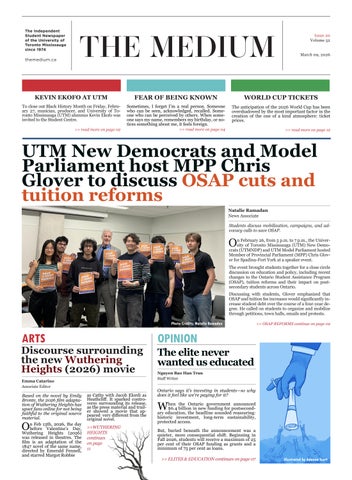
Students discuss mobilization, campaigns, and advocacy calls to save OSAP.

On February 26, from 5 p.m. to 7 p.m., the University of Toronto Mississauga (UTM) New Democrats (UTMNDP) and UTM Model Parliament hosted Member of Provincial Parliament (MPP) Chris Glover for Spadina-Fort York at a speaker event.

The event brought students together for a close circle discussion on education and policy, including recent changes to the Ontario Student Assistance Program (OSAP), tuition reforms and their impact on postsecondary students across Ontario.

Discussing with students, Glover emphasized that OSAP and tuition fee increases would significantly increase student debt over the course of a four-year degree. He called on students to organize and mobilize through petitions, town halls, emails and protests.

>> OSAP REFORMS continue on page 02

Discourse surrounding the new Wuthering Heights (2026) movie

Based on the novel by Emily Bronte, the 2026 film adaptation of Wuthering Heights has upset fans online for not being faithful to the original source material.

On Feb 13th, 2026, the day before Valentine’s Day, Wuthering Heights (2026) was released in theatres. The film is an adaptation of the 1847 novel of the same name, directed by Emerald Fennell, and starred Margot Robbie

as Cathy with Jacob Elordi as Heathcliff. It sparked controversy surrounding its release, as the press material and trailer showed a movie that appeared very different from the original novel.

>>WUTHERING HEIGHTS continues on page 11

The elite never wanted us educated

Ontario says it’s investing in students—so why does it feel like we’re paying for it?

W hen the Ontario government announced $6.4 billion in new funding for postsecondary education, the headline sounded reassuring: historic investment, long-term sustainability, protected access.

But, buried beneath the announcement was a quieter, more consequential shift. Beginning in Fall 2026, students will receive a maximum of 25 per cent of their OSAP funding as grants and a minimum of 75 per cent as loans.

>> ELITES & EDUCATION continues on page 07

Photo Credits: Natalie Ramadan
Illustrated by Adanna Scott

02 NEWS

“The power of choosing your own narrative”: Afghan students host panel discussion and Iftar dinner to celebrate diasporic experiences

Lives Across Nations highlights diverse Afghan experiences beyond mainstream narratives of war, trauma, and geopolitics.

On February 27, the University of Toronto (U of T) Mississauga (UTM)’s Afghan Students’ Association (ASA) hosted Lives Across Nations, a panel discussion and Iftar dinner that aimed to capture how notions of identity, belonging, and diaspora intersect for Afghan-Canadians.

The panel’s first guest speaker was Ferdouse Asefi, a PhD candidate in the Department of Sociology whose research explores themes of ethnic and diasporic identity formation in Canada and multicultural spaces. The next panellist was Moska Rokay, another U of T PhD candidate in the Faculty of Information, whose research aims to use diverse archival methods to document Afghan stories in Canada as well as identity formation and resistance through memory-keeping. The last speaker was author and narrative strategist Mina Sharif, whose journalistic and literary work mixes cultural storytelling and political commentary.

While there are many issues facing Afghan communities both abroad and in Canada, conversations about Afghanistan tend to centre on stories of war, trauma, regional conflicts, gender oppression, and religious fundamentalism. According to ASA President Sonia Qarin, she decided to take the Lives Across Nations panel discussion in a different direction after attending one of Asefi’s classes about race and ethnicity, where Sharif spoke about her personal experiences regarding the subject.

“That conversation introduced a deeper framework around diaspora, identity, and the power of choosing your own narrative, which ended up shaping the theme of this event,” Qarin wrote in an email-interview with The Medium.

The panel was followed by a short Q&A period, prayer, and the community Iftar dinner featuring staples from Afghan cuisine such as Kabuli pulao— the national dish of Afghanistan and made of fragrant rice mixed with veal, raisins, and carrots—kabobs, and potato curry.

Honouring identity: What did panellists discuss?

Each panellist used their area of research or background to explore Afghan experiences. Asefi’s socio-

logical research on the daily experiences of Afghans in the Canadian diaspora set the intellectual foundations for the panel. According to Asefi, research on Afghans is not only sparse but also risks homogenizing the ethnic diversity of the nation into a single image or idea. Through his research, Asefi tries to “go away from things that focus on trauma and pain and suffering of the community to really focus on the strengths of the community.”

In addition, Rokay’s archival research involves collecting stories, documents, images, home videos, and other digital media to bring the history of Afghans in Canada out of the shadows. According to Rokay, standard archival practices—which focus on physical documents—may fail to capture the nuances of immigrant and refugee communities.

In order to challenge the historic underrepresentation of Afghan stories in Canadian archives, Rokay approaches memory-keeping through communitybased practices. Rokay says that the information that is archived over time becomes fact, “and that influences how you see whole groups of people and the histories of those people.”

Lastly, keynote speaker Sharif spoke about her experience of returning to Afghanistan after several years away. Sharif grew up in Canada due to her family’s forced relocation, but returned to her homeland in 2005 for a volunteer trip, which extended into a longer stay lasting until 2019. During her talk, Sharif explained how she expected to encounter hostilities

and discomfort upon returning, a concern based on mainstream news headlines about Afghanistan, but was instead met with kindness, hospitality, and community.

“Having lived and worked extensively in both Canada and Afghanistan, [Sharif] brings insight into what it means to move between nations while navigating identity, belonging, and narrative power,” wrote Qarin.

Why Afghan experiences matter

In reviving the ASA last academic year, one of Qarin and her team’s goals was to make space for the unique experience of being in a diaspora: “Given UTM’s diversity, we hoped this panel would speak not only to Afghan students but to anyone navigating questions of belonging—and we are happy to see that reflected in the turnout,” continued Qarin.

Qarin also went on to say that Afghanistan’s ethnic and linguistic diversity often gets consumed by the decades of “conflict, displacement, and shifting political regimes” that caused multiple waves of migration and migration stories. “This is not uncommon in other countries,” added ASA Vice President Sabrina Mateen. “What makes the Afghan diaspora so unique is that there aren’t many of us, and our languages or culture isn’t shared across borders—making it even more important to cultivate these kinds of spaces.”

following student action against OSAP grant cuts and increased funding for loans. Glover described students organizing across campuses to protest the changes, displaying that students are not powerless and that student action matters.

OSAP and tuition fees

Beyond OSAP, the MPP addressed Bill 33 and its implications for student resources and unions. The legislation could weaken student governance structures and destabilize campus advocacy. Glover emphasized the importance of an organized campus community in responding to policy changes impacting education funding.

He referenced the 2019 OSAP changes, which resulted in a tuition freeze

During the event introductions, Model Parliament Club President Maria Murphy explained the importance of being engaged in politics. “I realized how important it is and just how it applies to literally every single aspect of our society.” She added, “Our elections are a way that we can hold politicians accountable and choose the direction we want our country to go in, and [when] people aren’t informed, they don’t vote, and they don’t participate.”

The Medium interviewed attendees throughout the event.

Editor | Aaron Calpito news@themedium.ca
Photo Credits: Melody Zhou
Natalie Ramadan News Associate
Photo Credits: Mashiyat Ahmed

Murphy discussed the impact of OSAP cuts on future students, saying “It’s devastating, because funding and the cost [of] university is something that people do take into account when choosing to pursue it. And I do think that education is right; everyone should be able to access it. It shouldn’t be hard to pay for university.”

She also shared her financial journey preparing for university. “I’ve been working since I was 13, and I’ve been saving up money since. I can only imagine how much more difficult it would be, especially with so many students working minimum wage jobs, to save up the funds that they need to pay for university.”

UTMNDP Co-Presidents Ibrahim Haq and Roy Su shared with The Medium how campus clubs can educate students on important topics like OSAP.

Haq explained, “The thing we’re trying to do is work with as many on-campus student organizations as possible. We want to reach a lot of people and to know what people think. Get everyone who’s involved to know what’s happening with the OSAP cuts.” He added, “The OSAP cuts affect all of us. It’s going to affect our debt in the future.”

Su shared, “It’s always the political parties at school that [provide] a chance to get grab at politics. If you have a passion in topics we talk about, then you should come [to events].”

Miguel Cruz, the vice president of Model Parliament and secretary for UTMNDP, stressed the importance of face-to-face conversations with students and representatives. “Having an MPP here is terrific—you can directly hear from his experiences. You can see how government affects the real world. It’s not an abstract concept that you see on TV.”

UTMNDP finance executive Ayun Jung corroborated Cruz’s point, sharing, “Students get to directly talk to the people who are involved in policy making.”

MPP Glover shared the expected additional tuition costs for students following the most recent OSAP changes. “Federal Liberals are gonna add C$1,200 a year on students in terms of debt. The provincial Conservatives are adding C$3,500. Total of C$4,700 in additional debt for every year. Over a four-year undergraduate degree, it would be an additional C$18,800 of debt.”

Glover spoke to each student who attended. When asked about the importance of speaking with students, he replied, “I came here primarily to listen and to learn from the students. To share what I know, and to help them to achieve their goals.” He highlighted the role of student clubs like the UTMNDP and Model Parliament Club, hosting discussions and inviting representatives. “Thank you for being involved. It’s so important. Democracy only works when people get involved.”

How to get involved

In an interview with The Medium, Alesha Cabrel, a constituency assistant for MPP Glover, explained the importance of student mobilization. “Our main goal is to just get people active, engaged, mobilized, get boots on the ground and get people really excited to make a change.” She also advised students to take urgent action, “Don’t be scared to get political. Don’t be scared to go to a protest. Don’t be scared to flood the streets. At the end of the day, these are our streets, and we deserve to be seen and heard in them. There are many precedents for this type of event. We know that change can happen.”

The event concluded with calls to action for students to remain engaged through petitions, town halls, and organizing advocacy work. On March 12, 7 p.m., the federal New Democratic Party (NDP) will be hosting a Save OSAP town hall in downtown Toronto, bringing together students and unions to fight back against OSAP changes. The exact location of this event is as yet unannounced. Students can also sign the petition on the saveosap.ca website. Canada: A wolf-in-sheep’s-skin identity

U of T students elect new Governing Council representatives across all three campuses

Following weeks of campaigning, students at St. George, Mississauga, and Scarborough voted in the 2026 Governing Council elections, selecting new representatives tasked with shaping university policy.

Students across the University of Toronto (U of T)’s three campuses have elected new student representatives to the university’s Governing Council (GC) following the conclusion of the annual tri-campus elections.

The GC is the university’s highest decision-making body, responsible for overseeing academic policy, approving budgets, and setting the institution’s strategic direction. Student representatives elected to the council sit alongside faculty members, administrators, and external governors, bringing student perspectives into discussions that affect the entire university.

Each year, students from U of T’s St. George, Mississauga (UTM), and Scarborough (UTSC) campuses vote to elect representatives from several constituencies. The positions are among the most influential elected roles available to students at the university.

This year’s election for full-time undergraduate students in Constituency I, which includes students from UTM, UTSC, and the Faculty of Arts and Science at St. George, drew a particularly competitive field with 38 candidates competing for two seats.

According to official results released by the Governing Council Secretariat, Samuel Kamalendran, a third-year UTM student studying political science and current co-editor-in-chief of The Medium, secured the highest vote total in the race with 563 votes. Areeb Naeem of Woodsworth College won the second seat, receiving 411 votes.

Brown field municipal

Kamalendran’s vote total placed him significantly ahead of the rest of the candidate pool. The next closest candidate, Salaar Khan (UTM), received 315 votes,

The newly elected student representatives will begin their terms in the coming months and will participate in Governing Council meetings and committees that shape policies affecting students across the University of Toronto’s tri-campus system.

Editor’s note: Samuel Kamalendran was not involved in the writing or editing

Illustrated by April Roy
followed by Ericsson Cui (UTM) with 266 votes and Artan Saberi (University College) with 211 votes.
Photo Credits: Aaron Calpito

04 NEWS BITES

U of T dentistry dean on leave pending investigation into antisemitic course material

As of February, Dean at the Faculty of Dentistry at the University of Toronto (U of T) Dr. Anil Kishen is on leave pending an investigation into his use of “antisemitic and discriminatory” images as part of his course material.

U of T Vice-President and Provost Trevor Young said that Kishen is

cooperating fully with the investigation and has since apologized to his students and U of T faculty, according to CP24.

On February 26, B’nai Brith Canada (BBC), a Jewish advocacy organization, stated that Kishen has no excuse for his actions and is demanding accountability from U of T. “Our students deserve better, and we will not rest until our campuses are safe,” according to a post they made on X. ultimate solution to real social change.

Conflict continues to spread across Middle East

Kuwait, the United Arab Emirates, Bahrain, and Qatar. Additionally, Israel and Iran-aligned Lebanon began launching strikes against each other on March 2.

A rapidly escalating conflict between Israel, the U.S. and Iran has spread across the Middle East following coordinated airstrikes that began on February 28.

U.S. and Israeli forces launched attacks targeting Iranian military infrastructure and leadership in Tehran and other cities, killing Iran’s Supreme Leader Ali Khamenei and several senior officials, according to Reuters.

Iran responded with waves of missile and drone attacks targeting Israel and locations hosting U.S. forces across the region, such as

CBC News reported that, as of March 4, more than 1,000 people have been killed in Iran since the conflict began, with there being dozens of other casualties elsewhere in the region. These figures include at least 165 people, mostly children, who were killed at a girls’ school in the city of Miran. Iran blamed the attack on “the American-Zionist enemy,” while neither Israel nor the U.S. have claimed responsibility.

In a Truth Social post on March 6, U.S. President Donald Trump declared, “There will be no deal with Iran except UNCONDITIONAL SURRENDER.”

UTSU announces election results as UTMSU campaigns begin

and Aliyah Kashkari each garnered more votes than Guo, they were both disqualified for breaching election rules, according to The Varsity.

The results of the 2026 executive election for the U of T Students’ Union (UTSU) went live on Wednesday, March 4 at 5 p.m., concluding the union’s annual vote for leadership positions.

According to U of T’s elections portal, Marie Kinderman was elected with 995 votes, beating out Adrian J. Lam with 928 votes and Safia Zaman with 662. A total of 4,498 ballots were cast in the election, representing a 10.9 per cent turnout.

Other executive positions were also decided in the vote. Nadège Jackiw was elected Vice-President (VP) Public and University Affairs, Verona Odhiambo was elected VP Student Life, Juan Diego Areiza was elected VP Equity, and Tony Guo was elected VP Finance and Operations. Although VP Finance candidates Sammy Onikoyi

While the UTSU elections have concluded, elections at the Mississauga campus are currently underway. As of March 2, campaigning has officially begun for the Spring elections of the U of T Mississauga Students’ Union (UTMSU).

The UTMSU elections timeline indicates the campaign period runs from March 2 until March 12. Students will be able to vote online and in person throughout campus from March 10 to March 12, and the results are expected to be announced shortly after the voting period concludes.

The UTMSU elections determine the Executive Committee and Board of Directors, who serve one-year terms representing undergraduate students at the University of Toronto Mississauga.

U of T inks deals with Indian schools amid Carney’s mission to reduce dependence on the U.S.

On his mission to broaden Canada’s trade ties, Prime Minister Carney recently travelled to Australia, Japan, and India, becoming the first Canadian prime minister to conduct a bilateral visit to India since Justin Trudeau’s visit in 2018.

During his trip to India, Carney, alongside U of T President Melanie Woodin and other Canadian post-secondary administrators, announced a slew of new initiatives that are being developed between Canadian and Indian university partners.

U of T’s new commitments include the development of a centre of excellence in India focused on the application of artificial intelligence (AI) in healthcare and C$25 million “for more than 220

scholarships for Indian students,” according to U of T News and the Prime Minister’s Office. U of T will also receive C$520,000 from the federal government “to support partnership development through faculty and student mobility in India, Indonesia, Japan and South Korea.”

“Our strategic partnership, and the speed at which we are working to unleash its potential in energy, talent and AI, is the result of two confident, ambitious nations who want to build the future, together,” the prime minister said.

President Woodin stated that U of T will offer an additional 274 merit-based scholarships for prospective Indian undergraduates in the coming admissions cycle, as part of the school’s “commitment to reinvest six per cent of its international tuition revenue annually in scholarships for top ranked international undergraduate students from across the globe.”

Prekshaa Surana Associate News Editor
Sara Al-Shrouf Contributor
Prekshaa Surana Associate News Editor

EDITORIAL BOARD

Co-Editor-in-Chief

Aya Yafaoui editor@themedium.ca

Co-Editor-in-Chief

Samuel Kamalendran managing@themedium.ca

News

Aaron Calpito news@themedium.ca

Opinion

Yasmine Benabderrahmane opinion@themedium.ca

Features

Gisele Tang features@themedium.ca

A&E

Yusuf Larizza-Ali arts@themedium.ca

Sports

Tyler Mederiros sports@themedium.ca

Photo

Melody Zhou photos@themedium.ca

Design

Sehajleen Wander design@themedium.ca

Social Media

Jannine Uy

Outreach

Mashiyat Ahmed

social@themedium.ca outreach@themedium.ca

Copy

May Alsaigh may@themedium.ca

Anaam Khan anaam@themedium.ca

TO CONTRIBUTE & CONNECT: themedium.ca/contact @themediumUTM @themediumUTM @themessageUTM

05 OPINION

Editor | Yasmine Benabderrahmane opinion@themedium.ca

The fear of being known

Being seen is observation; being known is vulnerability.

Sometimes, I forget I’m a real person.

Someone who can be seen, acknowledged, recalled. Someone who can be perceived by others. When someone says my name, remembers my birthday, or notices something about me, it feels foreign, like they’re talking about someone else with no ties to myself.

“I thought you hated me when I first met you,” are words I’ve often heard.

“You’re so smart!” “You have kind of a crooked smile.” “Are you always this quiet?”

Is this really how people see me? What do they notice when they look at me? Is it what I choose to show them? Is it my little, subconscious habits, or the personality I’ve curated in the moment?

I don’t know which version of me people meet. I’m not sure if they’ve ever met the right one.

I can change my behaviour to accommodate the environment I’m in or the people I’m around. I can laugh a little louder, talk a little less, measure how much of my personality I let slip into conversations. But some think I’m anxious because I avoid eye contact. Someone else might think I’m cold and intimidating because I’m quiet. Others think I’m smart because I selectively contribute to the discussion.

None of them are entirely wrong. The most frightening part of being seen is that I am not the sole author of myself. My identity isn’t my designed personality alone—it’s also what others take from it. Being seen means being interpreted, and interpretation doesn’t belong to me. Perhaps this is why so many of us struggle to let people in, to show ourselves fully—because other people can decide for themselves who we are.

Being seen is inherently external. It’s other people’s observations, what other people decide to believe about us.

If we want to be seen, it can only be through what others choose to see.

But being known is different. Being known means someone understands why I’m quiet before they assume what it means. Being known means they grasp the hesitation behind the silence before the silence itself.

I steadily manage what I want others to see, but being known means that someone can override that control. I can pretend, but they’ll know anyway. And that thought terrifies me.

What if they take too close of a look and know something I don’t even know? The idea of someone slipping past my veneer of composure and finding a piece of myself tucked away feels foreign, invasive, and vulnerable. Being seen risks misinterpretation, but being known risks rejection. It risks judgement. Being known means someone might not really like who I really am at all.

I used to think that meant I preferred being unseen altogether.

When I was in grade school, my classmates made a habit of checking up on me every day. I’d sit at my desk, quietly doodling eyes and hearts in the margins of my paper, when one of them would approach me. They meant well, asking if I was feeling sad or lonely, but the only thing I ever felt was confusion.

Did I really seem that upset? Did they see me as someone isolated and gloomy? Did they miss the times I’d laugh with my friends over corny novels we read, or when I was excited to wear my new shoes to school? Did no one see me when I smiled, but only took notice when I didn’t?

I learned quickly that if I smiled more, they’d stop asking. If I acted outwardly happy, they’d finally believe I was. If I performed well enough, people would stop worrying. No one would look any deeper. It was easier to manage perception than to correct it.

I didn’t realize how much I had grown used to being misread until someone didn’t.

It began with something small. I was apologizing to a friend over a joke I’d made, worrying that I’d offended them. People usually told me it was hard to tell when I was joking because my facial expression came off as cold or irritated. I didn’t want my friend to think I was taking a jab at them or pointing out a flaw.

But, my friend laughed it off. “Hey, I’m not mad,” they told me. “It’s okay. I can tell when you’re joking and when you’re serious. You make that face. There’s a difference.”

There was a difference?

I was unsettled at first. It felt weird, like I wanted to correct them, but there was nothing for me to say. I almost felt violated in a way, as if my friend had stuck their hand through the careful arrangement of who I presented and found something unedited. It was an odd feeling. Why did they know something about me that I didn’t?

I didn’t know how to respond, so I just laughed. It felt strange—yet somehow, a little freeing. For a moment, someone had known me, or something about me, without me having to show it to them. For a moment, all I had to do was exist. Not perform. Not pretend. Just act the way I did, and someone would understand.

Being known is uncomfortable. It’s vulnerable. It doesn’t make everything suddenly fall into place—instead, it feels like someone picked up a spare bolt I forgot to put back in.

But maybe that’s part of the point. Maybe it’s only in allowing ourselves to be understood that we can stop being invisible even to ourselves. Maybe in being known, I can reintroduce my name, my experiences, my own self back to me.

I’m still learning how to let people in, to be seen and known without fear. But when it happens, it’s a quiet reminder that beneath all the curated expressions and the careful management of perception, there is a self that is real; and that someone else can see it too.

Skipping class

is not just an addiction or personal failure. It’s a structural problem.

Why did I learn better by skipping class than I did by forcing myself to show up?

T he first time I showed up for one of my classes last semester was on the day of the midterm I aced. It was a humanities class about environmental justice with tons of dense readings, weekly discussion boards, a few essays and creative assignments, an in-person midterm, and a takehome exam that I had 48 hours to complete. And I loved every minute of the “class” despite only attending like three lectures.

Before you read on, you must know that my opinion is not meant to discourage you from showing up to the classes you paid for nor am I trying to cockily boast about how well I learn on my own. The truth is: it was the summer before my fourth year, I had completed my neuroscience specialist program, dropped out of my writing minor because of a few dreadful professors, and was entirely certain I wanted to do a fifth year because, despite completing a whole-ass specialist, I craved something deeper from my education that biology and chemistry classes simply aren’t designed to give me.

Right now, I am working towards a double minor in Women, Gender, and Sexuality studies (WGS), and Philosophy of Science (think bioethics, for example)—two subjects that many of my STEM friends only know about through internet unemployment memes. Making the decision to radically change the focus of my degree from STEM to humanities was not easy: for the longest time, I was taught that I was smarter, more deserving of praise, more economically secure and job-ready, if and when I pursued a STEM-based career.

On top of that, half the people in my immigrant family are doctors who probably have never uttered the word “sexuality” out loud. And being the eldest daughter who only grows older and becomes more confused about her career? Well, let’s not go there. I couldn’t possibly prepare myself for the emotional labour and exhaustion of convincing my parents that the change I was making was worth it; that they didn’t have to nervously pray for my successful landing as I hurled myself off the clif of my ego; and that I was gonna “make it” regardless.

And just between you and me, I have yet to rip off the band-aid and tell them I’m doing a fifth year.

Building your own education: why it’s okay to skip class, sometimes!

I thought that (the emotional labour, societal expectations, people’s perceptions) would be the hardest aspects of my abrupt STEM-to-humanities transition—and to some extent, they were. But after a few months in, the most challenging aspects for me were never the social expectations or the light-hearted side-eyes and unemployment jokes from my friends. The hardest part was changing how I approached my own learning.

Part of the reason I was dissatisfied with my STEM education was personal: I made the decision to study neuroscience at the end of high school when I didn’t really know what my learning style was or what I had to offer to the world. But, it was also because I was graded based on methods and teaching styles that failed to encourage that organic sense of curiosity and self-motivation that all great scholars have.

This isn’t an original experience, however. Many of my friends have also expressed dissatisfaction with the grading, assessment, and teaching styles of foundational STEM courses—lectureheavy content delivery, assessments that measure memorization over understanding or reflection, unfairly weighted assessments, strict attendance policies, and a one-size-fits-all pacing that ignores different learning speeds. While upper-year seminar-based courses do offer students the opportunity to learn in small class sizes and discuss content rather than just memorize it, the necessary skills to build our own education are robbed from us by the time we enter our senior year.

In many of my humanities courses, I am given the chance to create my own learning rather than passively being handed it through 40% weighted midterms. One of the core elements of learning that I believe many pedagogical designs fail to accommodate is the importance of self-directed study. Many of my WGS courses prioritize personalization and engagement by giving students the freedom to choose how they are being assessed—do you want to submit a final essay or a final class presentation? A recorded podcast episode, a video essay, or maybe even a zine?

In my tutorials, we often sit in a circle, share our thoughts on weekly readings, make connections to our own lives, and are encouraged to use our own lived experiences as a source of knowledge in our essays. This aspect was particularly hard for me since I had never before in my STEM education been asked to implicate myself in the readings. It also exposes a larger issue within academic writing where knowledge is only valid when it comes from “scholarly” sources, as opposed to more subjective or community-based experiences.

Furthermore, the content delivery method in my humanities courses, broadly speaking, engages my intellect, personal curiosity, and how I am able to connect course material to the actual world buzzing outside my window without making me feel heavy or stressed. For instance, I’ve noticed that both my grades and enjoyment of the course is significantly higher when the content delivery style encourages self-directed, autonomous, and connection-driven understanding: this can look like providing students flexible content through recorded lectures, modular readings, or diverse media to supplement the week’s learning.

Self-directed learning can also mean setting personal goals, choosing your own sources and essay questions (rather than being handed a narrow list), or collaborating with peers outside of the course through study groups. In fact, one of my courses had a 10% participation grade just for meeting with friends outside of regular class hours to go over readings.

Cutting class is a symptom, not the problem

For me, sitting in a lecture room in uncomfortable seating, harsh lighting, and just listening to a professor speak—no matter how passionate they are about their course—is not enough for me to retain the material, much less feel inspired by it. I would much rather prefer visiting the content at a time and environment that suits my emotional and intellectual state of mind which does not follow strict schedules.

A 2024 paper in the prominent psychology journal Frontiers of Psychology ran a study exploring how a hybrid learning model impacted learning outcomes and satisfaction among Chinese postsecondary students. The researchers found that “there were significant correlations between the self-directed learning experience [...] and learning satisfaction,” and that “learning approaches mediated the association between the self-directed learning experience and learning satisfaction.” While there may be other factors shaping the experience of these Chinese students overall, studies like this, as well as my anecdotal experience, support the idea that giving students more freedom over their learning through small changes can substantially increase enjoyment, academic outcomes, and how they’ll be taking that course into the future as they pursue greater things.

For higher academia, it may be hard to admit that students (like me) sometimes learn better on their own because self-directed learning—which correlates to self-motivation and leadership—shapes the impact and relevance of a subject more than other traditional indicators. When I’m given the confidence to choose when to watch lectures, go deeper on what actually confuses me, skip the parts I already get, and connect ideas based on my own interests, it boosts autonomy, motivation, and memory way more than absorbing a 2-hour lecture in a classroom.

In the end, I am not encouraging students to cut class. I am suggesting that the fact that so many of our peers do reveals a larger crack within the pedagogical logic that runs through universities. It reveals how we must have bigger, more critical conversations about how we fit into the education given to us. Instead of moralizing the issue of individual students skipping class or pathologizing their so-called laziness or lack of academic ambition, we should be problematizing mainstream pedagogical philosophies that leave students— especially those in STEM—with mixed emotions, dissatisfaction, regret, and feelings of failure as we’re thrust into an increasingly uncertain world.

As students, we might feel powerless here—it’s not like I can force my tenured chemistry professor to hybridize their content delivery or even to read this op-ed. But undergrad is also a time of exploration and—if you’re anything like me—spontaneous experimentation! I urge you to take courses and subjects that challenge the ways you’ve been taught to think about and experience your education. Whether it’s dipping into a WGS course or building a community on campus for self-directed studying, we all deserve to be in love with our education.

Illustrated by Melody Zhou

Saying “Girl Power” is not enough

Misogyny begins in our homes, during childhood.

Everyone knows the story: March 8th comes, stores put up ads with pastel colors, and significant others buy flowers and write letters to the women in their lives. The world is female! Girl power! Do it like a girl!

Suddenly cliché female-empowerment phrases are all over the internet. But what good is that if women and their power are ignored 364 days of the year? When international Women’s Day rolls by, women are given 24-hours of relevance. For 24-hours, society sets aside their affairs to pat women and girls on their backs, claiming they are “so strong”—the very same societies that overlook women’s issues, spew misogyny at every turn, and brush off women’s experiences in society as an overreaction.

A study made by UN Women revealed that in 2024 50,000 women and girls were killed by in-

timate partners and family members. That is 60% of the 83,000 women murdered that same year. Intimate partner violence (IPV) is a problem present everywhere. In Canada, more than 4 out of 10 women have experienced some form of IPV. In 2018, 44% of women reported experiencing psychological, physical, or sexual violence in their lifetimes.

So what is happening? Why is there so much hatred towards women?

Men are not innately violent. Unlike what many contents of the “Manosphere” argue, aggressiveness is not something intrinsic to the male gender. Thinking otherwise is what normalizes the issue. According to Movember Foundation, a men’s health organization and a partner of UN Women, two-thirds of young men consume toxic masculinity content. This not only downplays violence but it radicalizes these men and connects them to extremist ideologies. While many turn to these influencers searching for a purpose, for a way to cope with an unspoken mental struggle, the toxic masculinity environment only causes more harm for its consumers.

The hatred towards women, however, does not begin with a Google search of “how to understand the female body language.” It starts during childhood. One of the hardest truths one faces when trying to understand this problem is that we teach our boys to hate everything related to femininity since youth.

An experiment made by Jubilee in 2021 proved this. In the experiment, five boys and five girls were seperated—the boys sent to a playroom with “girl toys” and the girls to the playroom with the “boy toys.” When observed, the girls immediately played with the superhero figurines and Hot Wheels cars; the boys, however, avoided the dolls shared with me. One even claimed that their mom likes them to “play with boys’ stuff, not girls’.” Another asked the staff to replace his chair because he was uncomfortable sitting on a “girl’s” chair. When all children were reconveined into a third playroom, with both toys available, the same occurred: the girls played with all toys and the boys stuck with toys designed for their gender.

When we raise our boys, from an early age, to understand femininity as something to be uncomfortable with, we teach them to isolate themselves. Talking about feelings and struggles, the display of emotions, or any sort of emotional connection and regulation are taught as feminine traits, some-

thing that boys shouldn’t concern themselves with. The result is one we see now: men struggling with mental health, and instead of seeking professional help, they consume discourse that reinforces toxic masculinity-based beliefs. Men need to be stoic! Be an alpha! Siphon your male energy!

The Western societal norm and the “American Dream” of a wife, two kids, and a house has been shattered for the younger generation. Gen Zers no longer believe that owning a house or retiring are feasible future outcomes. When the idea of what was posed as the promised life breaks, people turn towards conservative narratives because they are reassuring. Men are turning towards hypermasculinity content for the very same reasons. And the system reinforces the beliefs that women should be subordinate to men.

In an international survey, which included Great Britain, Brazil, the US, Australia, and India, data showed that Gen Z men were twice as likely to harness traditional ideas on decision-making in marriages, than Baby Boomers. 31% of Gen Z believe that their wives should always obey their husbands, in contrast to 13% of Baby Boomers.

The hatred towards women is a world issue. In Brazil, for example, there has been an epidemic of femicides and gender based violence. A 20 yearold woman was stabbed and left on life support after rejecting a dating proposal. In South Korea, a woman was stabbed to death by her co-worker who had become obsessed with her. Despite a police investigation and a request for him to be detained, the authorities considered him as a “lowrisk” individual in society.

Not all men go into such extreme acts, but the violence starts when we normalise sexism. It starts off with jokes and inability to hold men accountable. The only way to break the pattern of normalized misogyny and the violence against women is by speaking up and calling out this behaviour.

Recognizing the women in your life, gifting them flowers, writing them letters, and saying “Girl Power” on March 8th is not enough, not when they have to worry about their lives for the rest of the year.

Yes, we should celebrate women, but more importantly, we have to act and fight against a system of misogyny engraved in our society. Only by debating and questioning what we once considered “normal” or “harmless” will we begin to solve the roots of what actively kills our women while destroying men’s mental health.

The elite never wanted us educated

Yes, $6.4 billion is flowing into institutions. Yes, operating funding will increase. Yes, colleges and universities face financial strain, especially after federal caps on international students reduced revenue streams. But, institutional sustainability and student affordability are not the same thing.

That is not a small adjustment—it’s a 60 per cent change in funding, compared to previous years. It is a structural transformation.

As a student juggling part-time work and academic ambition, I don’t experience OSAP as an abstract policy. I experience it as rent paid on time, textbooks purchased without panic, and the difference between graduating with manageable debt or with a financial burden that shapes every life decision that follows.

The province describes this reform as strengthening sustainability and encouraging students’ “appropriate investment” in their education. But, when grants shrink and loans expand, the state reduces its share of the risk and transfers more of it to students. And students are already carrying more risk than ever.

According to national graduate surveys, the average debt of an undergraduate post-graduation was $20,500 in 2000. By 2020, that number had risen to $30,600. The percentage of indebted bachelor’s graduates leaving with “large debts”—defined as $25,000 or more—climbed from 33 per cent to 48 per cent. Nearly half of indebted bachelor’s graduates now leave post-secondary schools with at least $25,000 in debt.

At the master’s level, the pattern is even steeper. Average debt rose from $20,300 in 2000 to $33,300 in 2020, with 51 per cent of indebted graduates now carrying large debt.

Debt is not stable. It has been rising for two decades. Now Ontario is formalizing a 75 per cent loan model.

The province emphasizes that tuition increases will be capped at 2 per cent annually, described as roughly $0.47 a day for university students. But, students do not experience tuition daily. We experience it in semester invoices and repayment schedules that extend years beyond graduation.

Ontario already has some of the highest tuition rates in Canada, averaging over $7,900 annually for undergraduates, more than double of Quebec’s average. When high tuition intersects with rising debt and reduced grant support, the direction is clear: students will graduate owing more.

The consequences are not evenly distributed.

Students whose families can pay upfront will absorb this shift with relative ease. Loans function as a buffer, not a lifeline. But first-generation students, workingclass students, and immigrant families already stretching finances will feel the change immediately. For them, debt is not theoretical, it is restrictive.

When grants shrink and loans expand, education stops feeling like a ladder and starts to feel like a gamble. Those with financial cushions can afford to take risks. Those without them cannot.

The government’s announcement repeatedly emphasizes preparing students for “in-demand careers” and aligning programs with labour-market needs. Employability matters. But, when economic alignment becomes the primary lens for funding, education narrows.

Photo
Credits: UTM Muslim Students Association
Camille Dornellas Contributor
Nguyen Bao Han Tran Staff Writer
Illustrated by Melody Zhou

We have already seen dismissive rhetoric about socalled “basket-weaving” courses from Doug Ford— comments widely criticized as devaluing the arts, humanities, and Indigenous studies. Whether offhand or not, such remarks reinforce a colonial hierarchy of knowledge: programs tied directly to economic output are prioritized and others are treated as secondary.

In a loan-heavy system, that hierarchy gains financial force. Students facing higher debt are more likely to choose programs perceived as financially secure rather than intellectually meaningful. Research consistently shows that debt influences behaviour: students from lower-income households are more debt-averse, less likely to pursue graduate education, and more likely to work longer hours during their studies, which can affect academic performance.

Debt does not simply follow education. It shapes choices within it.

The province insists access will remain protected, pointing to an enhanced Student Access Guarantee. But, guarantees negotiated institution by institution are not the same as broad, predictable grant funding. One depends on local implementation. The other reflects a structural commitment.

Ontario describes post-secondary education as one of its most important long-term investments and

Two things can be bad

On Iran, the United States, and military intervention.

This article was written prior to the initial illegal attacks on Iran by the US and “Israel” on February 28, 2026.

Tensions have spiked over the past few months between the United States and the Islamic Republic of Iran. Facing immense domestic pressure from nationwide student and local protests, the Iranian government has committed to an extraordinary crackdown that has killed countless people who have peacefully expressed their discontent with the government. Meanwhile, the United States has been looking for ways to undermine one of its main geopolitical adversaries in a time of weakness, now considering strikes or even a weeks-long conflict.

While the rapidly rising tensions have spurred extensive debate on all sides of the political aisle, the well-being of the Iranian people is generally disregarded from the discussion. While many (Western) leftists have thrown support behind the Ayatollah in favour of taking a general anti-American approach, the hawks on the right-wing do not have the interests of Iranians in mind either. We should do our best to avoid falling into a camp that generalizes the actions of either political side as entirely good or entirely evil, but instead approach this from a nuanced perspective that weighs the pros and cons of foreign interventionism.

Despite thumping their chest in favour of the protestors, the right-wing does not care about the well-being of Iranians, and as such, their desire for military action should not be seen as a humanitarian regard. There are a few reasons why this is the case.

First, the primary justification in the Western world for bombing Iran is its nuclear refinement program. This was the same justification used to bomb Iran in the summer of 2025. While there is justification for being concerned by the prospect of Iran having nuclear weapons, this is meaningless when it comes to addressing protests. Since Iran won’t nuke its own population, the nuclear strikes against the US are entirely for matters of national security. You cannot have both; if you’re bombing the nukes, you’re not bombing to help the protestors, and if you’re bombing to help the protestors, going after the nukes does nothing to reach that end. There’s a clear explanation for this: Americans do not care about the protestors and are using their struggle as a justification to further their national interests.

Second, if the US truly cared about the will of the Iranian people, they would pay no attention to Reza Pahlavi, the son of the last Shah of Iran. It’s importa

to remember that the unpopularity of the first Shah— which acted as a Western puppet—is what led to the revolution in the first place. Even if the only intention of the US was to deconstruct the current government and rebuild it with a new one, implementing a leader whose lineage is responsible for the current situation is an incredibly bad decision.

This is also not to speak of Pahlavi’s illiberal positions, such as being an open supporter of the Trump administration, his weird openness to restoring himself as a monarch, and backing Israel despite their ongoing genocide of the Palestinians. It’s hard to know if Pahlavi would be the candidate if the current regime collapsed: Trump backstabbed Maria Corina Machado in Venezuela, despite dedicating her Nobel Peace Prize award last year to Trump. So it’s not certain if he would back Pahlavi either, but the fact that we have to speak of preset candidates rather than what the Iranian people want should already be a red flag.

It is also fair to assume that the United States does not care about the protestors or their fight. This all excludes other ramifications of possible strikes. For one, it is still a breach of international law to impede on another state’s independence, even if the government you’re attacking has done incredibly immoral acts. But, this should not be interpreted as support for the current government or regime.

The Ayatollah, and his government, have committed heinous acts of state terrorism against their own population. In the recent set of protests in Iran, estimates of protestor deaths are several thousand on the conservative count, with a United Nations (UN) special rapporteur citing numbers as high as 20,000.

But, the Iranian government has a history of brutalizing its population more generally. While most Iranians enjoy very limited liberties, women are subject to even more oppression, including rights to marriage, divorce, the custody of children, participation in politics, sports, arts, work, with severe restrictions on their freedom of movement, speech, association, and religion. Women are forced to stay in line by being consistently monitored by the “morality police.” Disappearances and torture are commonplace, and the regime frequently rejects the UN rights resolutions and other liberal institutions.

By virtue of Iran being a geopolitical adversary of Israel and the US, there can be a reasonable assumption that one, or both of these countries, will intervene. Intervention, if done correctly, can be moral. Any government that oppresses its population in the way that the Iranian government does should not retain the right to office. The question is then how should they intervene? Striking protestors and their state is not the way to help the cause. Instead, working with regional allies to help deliver food, medicine, and other materials needed to keep the protests go-

that is true. Higher education drives productivity, innovation, and civic participation. But, an investment should be shared.

Students are not asking to be shielded from responsibility. We understand that education has costs. What we are questioning is why a growing share of those costs must be carried individually, especially when debt levels have already risen so dramatically over the past two decades.

A 75 per cent loan model does not eliminate access. But, it changes who feels secure enough to pursue it. When nearly half of bachelor’s graduates already leave school with $25,000 or more in debt, increasing reliance on loans normalizes financial strain as the price of participation.

Money is never just about money. It reflects power—who absorbs risk and who controls opportunity. Ontario is investing billions in its institutions. The question is whether it is equally investing in the students who animate them. Because sustainability for institutions should not come at the cost of greater liability for graduates.

Education should expand possibilities. It should not expand debt as the condition for entry. If post-secondary education is truly essential to Ontario’s longterm prosperity, then access cannot quietly become dependent on one’s tolerance for risk. Otherwise, “historic investment” will mean something very different to the students paying for it.

ing should be considered.

Although the crackdown from the regime has been brutal, a lot has gone unnoticed because of an indefinite media blackout. Western governments should spend time and resources documenting and revealing the actions of the Iranian government both within Iran and externally. Several other things could be done, but it should have one objective in mind: support the protestors and their mission.

But, by no means, should there be a violent breach of sovereignty. As mentioned earlier, this does not help the protestors, but it also legitimizes the Ayatollah and his government. Public opinion of the US and Israel is (rightfully) not highly regarded, and people still remember the horror that was the War on Terror in the Middle East and do not want to replicate it. Striking Iran would not help the protestors but shore up greater support for a government that is internationally renowned as an immoral entity.

Ultimately, the liberation and prosperity of the Iranian people should be the primary concern for the major parties involved in this war. While the Iranian government has committed terrible acts of violence against its population, American intervention is not (in its currently projected form) going to make things better.

Support for the Iranian protestors is moral and necessary, but the way in which we do it is critical, and external violence is not the answer. Both parties—the US-Israel and Iranian parties—in this fight are bad, and the Iranian people are stuck in the middle of a geopolitical conflict; their struggles are dismissed to defend an immoral regime and weaponized to defend an equally immoral act of violence. We must meet somewhere in the middle to ensure that not only are the protestors protected, but that they are also given the chance to a life filled with liberty, prosperity, and in pursuit of happiness.

Illustrated by Adanna Scott
Illustrated by Melody Zhou

09 FEATURES

Funding the creation of classrooms and schools with The Citizens Foundation at UTM

Meet TCF UTM—a club dedicated to educating children in Pakistan through fundraisers.

T

he Citizens Foundation (TCF) at the University of Toronto (U of T) Mississauga (UTM) is a nonprofit organization that exists “to provide educational opportunities for underprivileged children.”

So far, the student group has raised between C$18,000 and C$20,000 for charity through fundraising events and initiatives. Their most recent fundraising event was an “Iftar” dinner (a meal held at sunset to break fast during Ramadan, the ninth and holiest month in the Islamic calendar) in collaboration with the Pakistan Student Association (PSA) and OPEN UTM.

To learn more about the club, The Medium sat down with TFC’s Co-Presidents Mannha Basit, a third-year student in visual culture and communications, and Shahmeer Hashmi, a soon-to-be graduate studying “a mixture of health sciences, business and chemistry,” according to Hashmi.

The inspiration

What motivated Hashimi to join TCF was “the opportunity to help make a difference and raise money for a charitable cause.” He recounted his experience back in Pakistan, where he witnessed the terrible circumstances that the lack of education put children in.

“That’s why I wanted to join TFC UTM in the first place,” Hashimi said. “I took it kind of as a challenge to help make the club as good as possible. And to make a lasting impression both on campus and globally.”

On the other hand, Basit was inspired to join the club in her second year, when she looked to become part of a community on campus. TCF stood out to her because it was an organization based on a cause.

“TCF connected to me because I went to school in Pakistan when I was really young.” Basit shared. “TFC felt like a way to connect and help back home. Also, I’ve always been really passionate about equal education opportunities, especially for women.”

Fundraising

After a year of “laying the foundation,” TCF UTM has raised attention for the club and promoted its goals amongst the student body. According to Hashimi, the club’s main goals are “to raise money and awareness”.

This year, TCF UTM set out to raise C$34,000, which is sufficient to sponsor a school in Pakistan for a year. The club planned to fundraise and host events for the cause as much as possible.

“I think it is a little bit ambitious with a month and a half left now,” Hashimi admitted, “But hopefully, fingers crossed, that we can sponsor at least a few classrooms by the end of the year.”

For a charity group like TCF, outreach is key to accomplishing its goals. Basit shared that their outreach is done mainly through events, tabling and Instagram. And he credited the club’s social media presence to their marketing team.

In addition, events like the TCF Cafe Bake Sale held last September, and the ongoing TCF Charity Markets have been especially important for initiating discussions about their cause. In particular, the TCF Charity Markets have raised awareness beyond the UTM community, as conversations were carried out with other vendors.

Bigger in scale, but values remain unchanged

On February 12, TCF joined forces with The Citizens Foundation Student Chapter

(TCF U of T) and the Pakistani Students’ Association at the Scarborough campus (PSA UTSC) to host “Junoon: A U of T Tri-Campus Formal.” Hashimi shared that the event “raised a couple thousand for the cause.”

“It went quite well,” said Basit. “We even had people from outside the U of T community, like students from McMaster, Laurier and York.”

One of the highlights of the event was the auction held, which served as a primary source for fundraising. This was possible thanks to a variety of donors. One of the companies that contributed to the auction was Seiko Watch, which donated a watch worth over $C600 and got auctioned off for about C$450 to C$500. The funds raised at the event were split between the TFC chapters and fully donated to the foundation.

“We don’t pocket any [money] at the end of the year,” Hashimi said. Money raised during the year is sometimes invested towards larger events like the Junoon formal to accumulate more funds.

Looking forward

“Next year, we hope to see more ‘bigger events’ that engage a larger part of the school community,” said Hashimi.

As a team with close to 30 members, the TCF UTM executive team is motivated by their desire to help Pakistan, UTM, and the world through their initiatives and passion for equal education opportunities.

“At the end of the year, when we can share that we were able to help build a classroom or a school, it makes everything worth it. All the stress and everything,” said Basit.

Hashimi added, “Seeing the kids that we’ve helped grow up and do something, and help make a difference in the world. I think that’s a really good thing.”

TCF UTM is planning to organize another Charity Market from March 11 to March 13 at UTM’s Communication, Culture, Information & Technology (CCIT) building. On top of that, the club will host another Iftar and promote an annual online fundraiser before the end of Ramadan.

Students interested can support TCF UTM through donations and getting involved by following the club’s events on their Instagram @tcfutm.

A confession of a published author: Learning to say my name

Moving forward despite my fears led me to a reality I never thought possible.

For a long time, I introduced myself as if I were apologizing. It showed in the way I spoke, the way that I hesitated and the way I softened my presence, so it wouldn’t inconvenience anyone.

I would mumble my name quickly, like it was something to get through. I learned how to be agreeable, how to blend in and exist without being noticed. It wasn’t that I didn’t have opinions, dreams or ambition. It was that I didn’t think people would want them.

I grew up believing that confidence was something other people were born with. Some kids raised their hands without fear in class, some spoke publicly without rehearsing, and some believed their thoughts deserved space. While I believed that I could never be confident.

So, instead, I learned to observe, to listen carefully and measure my words like they were glass that’d shatter with the slightest carelessness. And somewhere along my habit of silence, I picked up the pen.

Writing did not begin as an ambition or a goal. It was a space where silence didn’t have to be my identity. When I wrote, I didn’t need to judge my own thoughts or check the room. The page never rushed me, and I could take as long as I wanted to finish a thought. I could even restart if it didn’t sound right. For the first time, I felt heard—by myself.

I treated writing like a private language, like it was something sacred that could disappear if mentioned aloud. I filled notebooks and documents with stories that no one asked for or read. Yet, I kept going.

Amidst that routine, something changed. I began to recognize patterns—not just in my writing, but in myself. The characters I wrote were braver than I was.

Aymaan Chowdhury Contributor
Photo Credits: Mannha Basit from TCF UTM
Photo Credits: Aymaan Chowdhury

They made decisions I avoided and spoke when it mattered. At first, I thought that meant I was using fiction as an escape. Eventually, I realized that I was practicing for a dream: becoming an author. Still, I couldn’t imagine calling myself an author. The title felt too big, too public, and required too much confidence. Authors were people who knew their directions in life, while I was still trying to figure out who I was.

When I finally decided to publish my work, it felt terrifying rather than triumphant. Putting my name on something permanent felt exposing. I reread all of my works obsessively, not because I wanted them to be perfect, but because I was afraid that they would reveal too much about me.

When my first book went live, I didn’t celebrate. I quietly stared at my laptop screen and felt exposed. My name was clearly printed, not tucked into a corner. And I remember thinking—now, people can judge me.

And they did. Some responses were kind, and some were validating. But others send me challenges I didn’t brace myself for.

Questions emerged on whether the story really was mine. And speculations followed, “It must have been generated.” These comments didn’t attack my story, but they attacked the possibility of me. And that was something I didn’t know how to respond to.

strange feeling. All the mental cages I broke through were reduced to something void of meaning and humanity. And through these challenges, I realized that others’ doubts don’t always come in the form of jealousy or malice. It can be manifested from their disbelief that someone like me could have written something worth noticing.

I started doubting myself again. I reread my own writing and feel disconnected from it, like it belonged to someone else. I thought: maybe I had been lucky and didn’t deserve to claim writing as a talent of mine. And maybe, the quiet kid was never meant to step forward.

That was the most terrifying part of my journey— not failure, but erasure.

Growing up, no one tells you what coming-of-age can look like. Sometimes, it isn’t about learning how to speak louder, but learning how to stand by your voice when others question it. And this maturity can only arrive when you decide to stand tall for yourself.

I didn’t argue with anyone or defend myself publicly. I merely returned to the only place that ever felt honest—I wrote. Just for the sake to continue. That choice caused a crucial change in me. Because for the first time, I wasn’t writing to be seen, I was writing to stay where I belonged.

Slowly, things began to shift. People reached out— not to question, but to connect. Readers shared how my words stayed with them. And supportive conversations were held, including a dialogue with

the Mayor of Mississauga.

But what mattered most wasn’t the new labels that I was given. It was that I spoke without shrinking. I no longer rushed my sentences, and I didn’t downplay my work. I said “I write” instead of “I just write.”

People began to look at me differently. Some with curiosity and some with respect and some as inspiration. But being inspiring scared me, because I still remember the version of myself that was quiet and uncertain. The idea that someone might see strength in my journey felt heavy. But it also felt right.

If my writing taught me anything, it’s that growth doesn’t erase who you were. It carries all the versions of you forward. The shy version of me didn’t disappear; he learned how to breathe in his own name.

My upcoming book, Blue Tiger, represents empowerment for myself—that confidence can exist despite fear. Because the best way to affirm my value is to decide to move forward, regardless of my selfdoubt.

I still hesitate sometimes and feel the creeping up of my old instinct to shrink my presence. But now, when I say my name, I let it sit and take up space.

My coming-of-age is not becoming someone new, but finally believing the person that I’ve always been is enough to be heard.

Extracting the last dollar: The normalization of assessing everything by its investment potential

When everything seems to double as an investment opportunity, the simple act of enjoying something for its own sake may become a luxury.

Do you ever look at old Pokémon cards or come across your parents’ Sony Cyber-Shot camera from years ago and think, “I wonder what that’s worth today?” In that case, here’s a recent story for you.

Just last month, in February, a Pokémon card belonging to social media influencer Logan Paul was sold at auction for a record-breaking US$16.5 million.

This sale reflects not just the absurdity of card collecting but also a modern-day economic shift in which childhood collectibles, clothing, and even utility items like cars are increasingly treated less as hobbies and more as financial assets.

How did we get here?

Not long ago, activities like trading cards circulated primarily among children and teenagers. If you bought some new sneakers or clothes, your first thought was probably to show them off to your friends, as opposed to wondering how much they would be worth a couple of years from then.

It was in the past decade that this reselling and investment culture took off with the rise of social media. Many of us can remember the “hypebeast” culture that was popularized in the mainstream around 2017, where many social media influencers promoted popular clothing brands like Supreme and Bape, which were popular amongst skaters and streetwear enthusiasts.

It reached a point where people were camping outside of stores for days to buy items like a physical brick. What was special about the brick? Well, it simply had a “Supreme” logo printed on it.

Many consumers went to such extremes in hopes of reselling these items for a considerable profit. If that was not absurd enough, in 2021, Nike Vice President Ann Herbert had to step down after 25 years of work, because her son was caught reselling Nike sneakers with profits estimated in six figures.

Although this “hypebeast” culture eventually faded, it

normalized looking at everyday objects as investment pieces.

The perfect storm

Recently, 2016 trends have made a comeback ten years later, with people listening to throwback songs and emulating nostalgic trends.

Once ubiquitous items like digicams, CDs and MP3 players have turned into novelty items, each with its own market. The recipe is simple—sprinkle in the sensation of trendy social media content, and you have the perfect formula to promote and advertise a market that would’ve otherwise remained exclusive to hobbyists.

Notice how in the introduction, I mentioned “influencer” Logan Paul being the individual who sold the rare Pokémon card. Paul made headlines in 2021 when he first bought the card for around US$5 million. He then spent the subsequent years promoting the item through his platform. This was part of a larger trend that prompted the rise of influencers who specialize in card collection. And of course, many of them focused on trying to flip a profit.

This trend has even seeped into other markets like cars and clothing items. Many of these markets have curated social media pages that piece together metrics of sale prices and market patterns. And all of this is to help consumers target what could potentially be a good investment.

What about traditional markets?

Albert Einstein once dubbed compound interest the eighth wonder of the world. Traditionally, when people thought about investment, they would look at high-interest bank accounts or stock index funds such as the S&P 500. The last place you would look for profit is in a trading card game you played as a kid.

However, the rise of speculative hobby markets becomes easier to understand when looking at the broader economic landscape.

According to the Fraser Institute, a typical family now needs to save roughly 42.9 months of post-tax income, just to afford a down payment on a home in Toronto. Average new car prices have also climbed to roughly C$63,000. Meanwhile, wage growth has struggled to keep pace with inflation.

Furthermore, traditional markets such as the stock exchange can seem daunting to many of the younger demographic. So, naturally, if you find out that a hobby of your interest can be leveraged to make a quick profit, you’d be more obliged to do so.

Loss of fun and the growth of fatigue

The biggest downside to this non-conventional market is the fact that it takes away what makes a hobby enjoyable in the first place.

Say, for example, you’re a car enthusiast, and you grew up watching movies like The Fast and the Furious. Well, that Toyota Supra driven by lead actor Paul Walker has now become a near six-figure collector car.

And even if you do save up enough, it is going to be hard to enjoy your purchase. As thoughts like asset depreciation will creep in, and what was once your passion becomes a burden.

If a market becomes too profitable, it attracts investors who may not be enthusiasts or hobbyists in the first place. Sticking with the theme of cars, auction house RM Sotheby’s recently reported 2025 to be its most financially successful year in terms of car auctions. And it is hard to imagine that every one of those buyers was a genuine enthusiast and not a person who was looking to make a quick buck.

Be it cars or any other hobby, the prospect of their lucrative market prices deters individuals who are passionate but unable to afford their ever-rising prices.

Being told that my voice wasn’t believable elicited a
Samm Mohibuddi Contributor
Photo Credits: Melody Zhou

IEC and EDIO Present “The Culture of Sound,” Featuring Kevin Ekofo

edition of Chris Brown’s 11:11, which won Best R&B Album in 2025.

Grammy-winning producer “Kofo” bridges music and culture in his return to UTM

To close out Black History Month on Friday, February 27, musician, producer, and University of Toronto Mississauga (UTM) alumnus

Kevin Ekofo was invited to the Student Centre to host “The Culture of Sound,” an event organized by the International Education Centre (IEC) and the Equity, Diversity & Inclusion Office (EDIO) where Ekofo spoke about his gradual embrace of his culture’s music, described his journey into the music industry, and led a short workshop where students collaboratively created a song.

Attendees were greeted by the scent of Caribbean cuisine catered from the Blind Duck. In the furthest corner from the entrance of the Student Centre Presentation Room, Ekofo had a very small studio setup consisting of a MIDI keyboard connected to a laptop running Ableton, a digital audio workstation. In the near corner, the Centre for Student Engagement (CSE) had set up a small exhibition table celebrating “Black Brilliance & Belonging.”

After being introduced, Ekofo thanked Christine Nguyen from the IEC for extending him the invite. After the event when asked about her inspiration for doing so, Nguyen told The Medium that “Kevin’s journey is honest, unconventional, and full of both inspiration and hard work. I hoped his story would encourage students to dream big, but also understand that every meaningful path comes with sacrifice and challenges.”

The producer led attendees through his journey where he first “had to learn to be passionate about [music].” However, he learned theory and received private lessons on Congolese-style guitar, his interest for music still hadn’t been established until he played in the church choir, where he was also able to develop long-term friendships. “Music is a language that connects everybody from different walks of life,” Ekofo said after the event. “It’s crazy how far music stretches and that we all understand the basics of it. Which is the idea that evokes any sort of emotion out of you.”

The formula for Ekofo’s journey toward making a living consisted of just six words: “Finish. Work. Work Harder. Execute Vision.” It was this mantra that got him through his four years at UTM, where he graduated with a BA in Digital Enterprise Management in 2018. Ekofo also credits his degree with teaching him discipline primarily, which helped guide the rest of his journey.

Before Ekofo broke into the industry, he spent a year trying music as a full-time job and dabbling with production. Then, he spent the subsequent year networking in music, and this landed him a production credit via the producer P2J who, after hearing his samples, informed him that he would have a song with WizKid. Ekofo’s work has so far culminated into 10 Juno nominations and six Grammy nominations for “Kofo,” including one win for his production contributions to the deluxe

For Ekofo, whose parents emigrated to Toronto from Congo, culture played a key role in developing his interest in music and he now uses music as a means of sharing and spreading culture. “The music I worked on early in my room helped bridge Africa to the rest of the world,” Ekofo later told The Medium, “and all we had to do is amplify specific songs on a global level. This pushed people to want to know more about the origin of certain styles of African music and even why this culture celebrates music the way it does.”

Eventually, Ekofo wished to build something sustainable and combined his passion for music and his business acumen to form his own tech company: Kofo Sound, a music platform that focuses on “community and pushing musicians to their highest potential.”

For the workshop portion of the event, Ekofo invited students to his mini studio at the front of the room and had them create a song by inputting the instrumentals for an acapella he had saved. One at a time, students dragged percussion samples into Ableton, programmed a kickdrum track, and even used Ekofo’s own guitar plug-in software “Buttr FX” to record a chord progression. Ekofo played the resulting mix to attendees and, afterward, shared his contact information inviting them to reach out to him if they are interested in finishing the song.

Jayeden, a student in his final year who inserted a percussion track into the song’s mix, expressed that the experience “was very, very fun. It was so good to see other people interact. And live reception from the public while you’re making music, it’s a good thing.” The first-year student who recorded his own kickdrum pattern for the song, Adrian, appreciated Ekofo’s presence and considered it “a very cool experience, getting to know someone—a giant in the industry that also went to UTM.”

“This session was such an amazing opportunity to me because a big part of my business at this point of my life is giving back in the form of knowledge and experience.” Ekofo said to The Medium. “Most students have a passion for something that they can’t immediately tackle because of many things like doubt, not having enough resources or simply just fear. I want [to] be able to challenge people around me to do something that will bring a lot of purpose to their everyday lives.”

Near the end of the event, after Q & A with Ekofo but just before the group photo, the Access and Inclusion team at the CSE gave a short presentation about a “community quilting project” they were working on through Black History Month with the intention to “recreate and tell the story of Black excellence and culture.” When asked about why events like these that are focused on culture and creative expression are important to have at UTM, Nguyen shared that they “give students a chance to express themselves, explore new ideas, and build community. UTM has such a diverse student body, and creating spaces like this just adds to the strength of that diversity.”

Does UTM have space for music?

The importance of having more practice rooms available on campus.

Most students would agree that moving into residence comes with a number of unique challenges: there’s new roles, new people, and a plethora of new changes. But one change rarely accounted for, was music.

No one wants to be the roommate blasting music in their bedroom at 2 AM, or playing in the common rooms past quiet hours, but that raises a serious question: “Where, and when, do I play?”

There are a few options on campus, such as the Harmonix club room during their scheduled jam sessions, or the piano room in the Roy Ivor Residences. However, these options are limited, and ultimately hard to maneuver around the busy schedule of a university student. Another problem is that these spaces and services are closed during exam season.

Exam season is arguably the most stressful time of the year as it’s when emotions run rampant and motivations run dry. Playing music has been scientifically proven to contribute to both the mental and emotional health of students, and access to it proves difficult at the exact time most students need it the most.

In fact, some of the most notable names in medicine have published articles discussing the importance of playing instruments on brain health.

For example, Harvard Medical School’s 2020 paper on the effects of listening to music listed benefits such as lowered anxiety and depression levels, increased rate of happiness, and overall benefits for cognitive function. While the study looked at a variety of people with varying uses of music in their lives, the positive effects of it seemed to increase as engagement with the music increased. In other words, playing instruments engages more of your mind than simply listening to a song. John Hopkins Medicine also cites playing instruments as a tool to increase problemsolving, memory, and quality of life.

Music is clearly instrumental to student health and wellness, so what is the issue? At first glance, the main problem would appear to be the price of making a music room. Most construction projects aren’t cheap. Ideally, if the room were to be soundproofed, that would cost anywhere from $1,000 (USD) to $5,500 (USD).

But the truth is, music spaces don’t have to be professionally soundproofed. The spaces used currently are just typical rooms that students play music in. It might be more important to increase the number of these rooms, and possibly implement a booking system such as the one used in the library or the Theatre and Drama Study rehearsal halls.

At the end of the day, creative spaces are vital for the wellness and enjoyment of students. If enough students express a need for these spaces, and collaboration and communication occurs between them and those with the power to make a real change, then maybe there can be more room for music here at UTM.

Maaz Ahtesham Contributor
Photo Credits: Rafida Wiyono
Photo Credits: Daniel Fontenele

Discourse surrounding the new Wuthering Heights (2026) movie (contd.

The original Wuthering Heights novel is often misrepresented as a romance novel when it is anything but that. It mainly follows the character of Heathcliff, the adopted sister to Cathy. The two grow up in the Wuthering Heights house and “fall in love,” though their relationship is more obsessive and controlling. For a few different reasons, Cathy and Heathcliff don’t get married as adults, instead Cathy moves to Thrushcross Grange after marrying Edgar Linton. Heathcliff later marries their daughter Isabella Linton. Through manipulation and his connection with Isabella, Heathcliff acquires enough wealth to take over both estates, after ruthlessly tormenting his adopted family, Cathy, and the next generation of children. Heathcliff does all of this out of “love” for Cathy, though it is much more indicative of his controlling, obsessive, brooding nature. Many film adaptations of Wuthering Heights tend to forget Heathcliff’s later actions, as his heinous activity ramps up after Cathy dies halfway through the book. They prefer to

from pg 01)

instead focus on the first half of the novel, and change the narrative to portray a solid romance between the two. The 2026 adaptation is no exception, with director Emerald Fe

SPORTS & HEALTH

Passion Alone Won’t Be Enough to Purchase a Ticket This Time

Concerns around ticket prices at the 2026 FIFA World Cup

No sporting event rivals the imagination that the FIFA World Cup is able to capture. Millions of fans travel across the globe every four years to follow their nation at their first ever tournament, hoping to witness football’s biggest game in person. However, the anticipation of the 2026 World Cup has been overshadowed by the most important factor in the creation of the one of a kind atmosphere: ticket prices. A journey of a lifetime for many has slowly become an unrealistic dream. A dream that one could argue fades away everyday as we edge closer to the opener at Mexico City Stadium.

Tickets for the World Cup final roughly cost between $400 and $9000 depending on the seating areas. Resale prices could be even higher. This has obviously raised concerns of many supporters who are now considering the canceling of their trips. For comparison, the tickets for the entire tournament in 2022 ranged between $70 to $1600.

Why are tickets so expensive?

The introduction of dynamic pricing has been a major factor in the increase of ticket prices, something FIFA has never done prior to this year. This is a model that is common in other sports, where instead of fixed prices, tickets will fluctuate depending on demand. FIFA have said tickets will start at $60 but that could not be further from the truth. The lowest price recorded was $180 for Germany’s opener vs Curaçao and the lowest price for the semifinal was $1,125.

These prices may feel reasonable at face value, but when you consider multiple games, long distance traveling in North America, hotels, and food, the “trip of a lifetime” starts to feel like “maybe next time.” The English Football Association shared pricing information with English supporters which showed that 1 fan will need to spend over $7,000 to follow their team, should they reach the final.

For Torontonians, Canada’s opener on June 12th at BMO Field, or Toronto Stadium as per FIFA’s corporate policy, ranges from $1,300 to $3,035.

Stadium Atmosphere

High ticket prices will most definitely change the atmosphere inside the stadiums. Football is built on the support and foundations of passionate fans who sing, chant, scream, and cheer for 90 minutes. The World Cup sees waving flags every matchday and that energy defines the sport. Supporters that travel long distances are the emotional backbone of major competitions and sports as a whole.

Argentina fans sold their valuables and borrowed money just for a one way ticket during the 2022 World Cup in Qatar! Look how that paid off, seeing their country lift a third World Cup!

A lot of fans worry that those who can afford these tickets are not “true” fans and are only taking advantage of the experience. Ticket prices are so high that fans who did not plan to attend feel offended, which has significantly decreased the hype and anticipation around a tournament dubbed to strengthen soccer culture in North America.

-nnell saying that this movie is “what she thought Wuthering Heights was about when she read it at 14 years old.” The movie also deviates from the novel in that it is rated R, as it includes sexually suggestive scenes.

One of the biggest reasons the 2026 movie has caused discourse online surrounds the casting of Heathcliff. In the original novel, he is a coloured man of unspecified origin. This has a big impact in the book, as it highlights class differences and becomes a source of rage for Heathcliff. In the movie, along with most other adaptations, white actors are cast to play Heathcliff, completely erasing this key part of his character’s story. While a race swap like this can be dismissed in older adaptations as being supported by racism, in 2026 when race swaps for characters are becoming increasingly common, it begs the question as to what the intention behind the decision is, and how it changes the narrative as a whole.

Overall, fans of the novel are upset about how it was portrayed on screen. Besides Heathcliff’s race swap, a lot of other characters’ personalities were changed, along with other details from the novel. Fans feel like the adaptation was not faithful to the original source material, which has also been a concern with other adaptations like the Disney live action remakes. Some people even suggested that Emerald Fennell should’ve given the characters and movie a different name, creating a brand new story, rather than inaccurately represent the original novel.

Inside the Lives of UTM Student-Athletes in Medicine

Off the field, Kit Ross (KR) and Sierra Vaillancourt (SV) are second-year medical students at UTM. On the field, they are members of UTM’s Tri-Campus Women’s outdoor soccer team. Today, they’re joining us to discuss their experience playing for the TriCampus team and share how they balance hitting the books and hitting the pitch.

What inspired you to join the Tri-Campus team?

SV: I actually heard about the Tri-Campus league way back when I was touring UTM for my undergrad degree! When the opportunity came to attend UTM for medical school, I was eager to get involved with the soccer team. I didn’t have a ton of soccer experience, but wanted a more competitive league in addition to intramurals to help me push my abili

ties. I liked the idea of being in a league that offered weekly practices in addition to games to build a stronger relationship with my teammates and have more opportunities to improve my skills. It was also exciting to show some campus pride and represent UTM.

KR: I learned about Tri-Campus sports at an extracurricular fair as part of our orientation during the first week of medical school. Having played NCAA soccer in Ohio during my undergraduate studies, I was excited to learn that there was a chance to continue playing competitive soccer even during medical school. As a new student at UTM and newly back in Canada after four years of university in the US, joining the Tri-Campus soccer team gave me an amazing opportunity to be a part of the campus community and build some truly meaningful friendships!

What are some of the benefits to joining a TriCampus team, especially from a medical student perspective?

SV: I think for students in any program it’s a great way to stay accountable to a regular exercise schedule which can play a big role in managing stress. It’s also a great chance to meet people outside of your program. In medicine, we tend to be in our own bubble because all of our classes are in one building, so it can be hard to get to know other students. Sports in general are a good way to practice the process of learning new things, getting outside of your comfort zone, identifying your strengths and weaknesses, and working on a team, all of which are valuable skills in medicine (and any career).

KR: Being part of a Tri-Campus team has helped me build so many skills that I know will be applicable in my future career. Collaboration, leadership, perseverance, time management, and receiving feedback are all skills needed in a physician. I am able to improve all these skills being on the Tri-campus soccer team all while having fun and making friends. Sometimes I feel pressure to spend all my extracurricular time on research or clinical experiences like some of my peers, but I stay with the team because I love playing soccer and I know I am building critical skills that future employers will recognize.

How do you manage the demands of medical school while also playing soccer, and what recommendations do you have for other students

managing sports and school?

SV: It can take some extra planning and make for longer days on campus but it’s so worth it! Just the way scheduling worked, we had practice Wednesday nights and then had to be back on campus for 7:30 AM for clinical skills classes on Thursday mornings which was a bit tiring. On the bright side, it did force me to stay on top of my preparation for clinical skills since there was no time to cram! I also tried to be productive in moments with downtime, like spending most of the bus rides to games reading notes or doing flashcards.

In terms of tips for other students, it’s all about knowing yourself well enough to determine how long tasks are going to take to complete and prioritizing from there. Organization is another key, but Kit is far more organized than I am so I’ll leave those tips to her!

KR: Balancing medical school and soccer can be challenging, but it is certainly manageable if you plan ahead. I’m someone who likes to make a daily or weekly schedule ahead of time to help me plan out when I’ll have time to complete assignments or study and also block out dedicated time for soccer and working out. It can be stressful or feel overwhelming to split time between sports and school, but I truly believe that the two complement each other. I see soccer as a needed break from my studies and study time as a needed break for my body.

My advice for others when trying to balance being a student-athlete is to make dedicated time for school and sport and be fully present when participating in each. You can only be in one place at a time, so while playing your sport, don’t stress about your unfinished assignment or your test tomorrow. Fully engage and let your mind take a break. Then, when you return to study time, you will be more refreshed and feel more satisfied that you gave your all in your sport.

You can catch the Tri-Campus indoor soccer team in action in their semi-final game on Sunday, March 15th at Varsity Field downtown (kick off time will be announced and posted by @utm_sports on Instagram)! Go Eagles!

Editor | Tyler Medeiros sports@themedium.ca
Sierra Vaillancourt Contributor
Photo Credits: Melody Zhou
Photo Credits: Brian Vaillancourt

Turn static files into dynamic content formats.

Create a flipbook