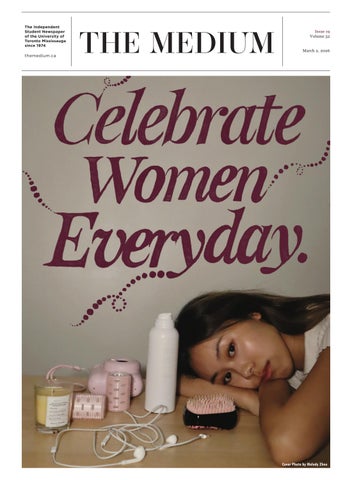
Volume 52 Issue 19

Page 1


by

Cover Photo
Melody Zhou

02 NEWS

UTMSU Spring 2026 Elections underway

Over the next two weeks, students can expect to see an abundance of campaign materials across campus as candidates compete for their vote.

Election season has begun for students at the University of Toronto Mississauga (UTM). Now until March 12, candidates can vote at the annual UTM Student Union (UTMSU) spring election for an executive committee and board of directors. The elections will fill UTMSU’s following positions: president, vice president (VP) internal, VP equity, VP external, VP university affairs, and 14 board of director positions.

The three-week spring election began last week with the nominations period, which ran from February 23 at 10 a.m. to February 27 at noon. During this period, each of the executive and directorial candidates received a nomination package from the UTMSU, collected handwritten nominations, and returned this package to the chief returning officer. Union staff then briefed candidates on election policies at the All Candidates Meeting on February

28.

Voting will take place from Tues day, March 10, to Thursday, March 12, at polling stations in the Wil liam G. Davis Building, the Com munication, Culture & Technology Building, the Instructional Centre, Deerfield Hall, and the Kaneff Cen tre. Voters must present either their TCard or government-issued ID.

Before voting, students are encour aged to meet and learn more about the candidates, as well as ask ex ecutive candidates questions about their platform, at the UTMSU Spring Elections Candidates Forum on Thursday, March 5, from noon to 2 p.m. in The Blind Duck. Some of the concerns students have already voiced in interviews with The Me dium involve OSAP, advocating for student rights, allocation of UTMSU funds, and candidates having a clear plan for their potential term.

Students can learn more about the upcoming elections and find the un official election results afterwards at UTMSU’s ‘Elections’ page on their website.

Long-awaited Eglinton Crosstown LRT finally opens for riders

The new transit line brings muchneeded light rail to Toronto after a nearly 15-year-long construction process fraught with delays, lawsuits, and cost overruns.

The first phase of the Eglinton Crosstown Light Rail Transit (LRT), from Mount Dennis GO Station on Weston Road to Kennedy subway station, opened on February 8.

The Crosstown, also known as Line 5 Eglinton, will have a staggered opening, with current service ranging from 5:30 a.m. to 11 p.m. on most days, including holidays, and 7:30 a.m. to 11 p.m. on Sunday. The 19-kilometre line is part of a C$70 billion investment by the provincial government to “shorten travel times, reduce gridlock and drive economic growth across the region,” according to Ontario Newsroom.

The line currently operates underground and at street level in a 10-kilometre-long stretch between Mount Dennis and Laird stations, with an additional underground section around Don Valley station in preparation for a connection to the future Ontario Line, while remaining mostly at street level past Laird Drive.

Since construction began in 2011, the Crosstown has faced several delays, including from disputes over the public-private partnership model, construction mistakes, and pandemicrelated troubles.

Crosslinx Transit Solutions, the consortium responsible for the construction of Line 5, took legal action against Metrolinx and Infrastructure Ontario several times between 2018 and 2023 over delays and planning disputes, while Metrolinx and light rail vehicle (LRV) supplier Bombardier fought legal battles against each other in early 2017 over delays. The line finally opened six years overdue and one billion dollars over budget amid calls for a public inquiry that have so far gone unaddressed, according to CBC News.

The line is scheduled every four minutes during peak times, and every six minutes during off-peak times, with an estimated end-to-end travel time of 50 to 55 minutes, Toronto Transit Commission Chair Jamaal Myers explained on X. Myers noted that this effectively halves travel time, which had been at 105 minutes utilizing bus routes. He expects full service to occur

Photo Credits: @utmsu

in May, with a public celebration for the line’s opening set to occur around that time.

These travel time estimates have been mostly accurate. On a typical weekday afternoon, the end-to-end time was 57 minutes due to delays on the surface section, which were partly because of the lack of transit signal priority in the area.

Myers has stated that full transit signal priority, which would reduce the amount of red lights and left turns that LRVs would be stuck behind, would not be implemented on the Crosstown until its full opening in May. The statement came amid

fears of similar struggles to the opening of the neighbouring Finch West LRT in December 2025, whose operations were heavily criticized for the lack of transit signal priority on that line.

Besides this, LRVs ran smoothly even with modest amounts of snow on the surface tracks, and its two-car LRVs have so far met ridership demand. The platforms at stations across the Line are long enough to accommodate three-car LRVs should ridership increase.

Construction of the second phase of the Crosstown LRT, extending the line 9.2 kilometres west from Mount Dennis GO station to connect with the Mississauga Transitway at Renforth Gateway, has been underway since 2021. The extension would be mostly underground, except for an elevated section around Jane and Scarlett stations. Metrolinx says that it is also considering connecting Line 5 to Pearson Airport.

MiWay updates some bus services to UTM

Updates to several major routes, including the cancellation of the 101A Dundas Express and the extension of Route 48, are changing how students commute.

MiWay recently announced a series of changes to its bus services to the University of Toronto Mississauga (UTM) campus, including new routes, cancellations, and stop relocations, effective as of February 23.

One of the most significant changes is the extension of Route 48 Erin Mills, which now services UTM directly. According to signage posted at the Inner Circle bus terminal, Route 48 now stops at the west end of the loop (Stop #4800), providing a direct connection between campus and areas along Erin Mills Parkway.

MiWay has also discontinued the 101A Dundas Express route. MiWay advises riders who previously relied on this service to use Route 1 Dundas instead, which continues to operate along Dundas Street but with more frequent stops. MiWay has also cancelled Route 1C Dundas.

Additional adjustments include stop adjustments for Route 26 Burnhamthorpe in South Common Centre and other services across the MiWay network.

Updated maps at the Inner Circle terminal indicate revised boarding locations for multiple routes. The westernmost stop now serves Route 48, while routes such as 44 and 126 operate from nearby stops along Inner Circle Road. Dundas-bound routes, including Route 1, continue to board closer to the Kaneff Centre side of the loop.

For many students, the new Route 48 offers a more convenient alternative to multibus commutes. Harshita Kakkar, a third-year psychology and forensic science student, said she previously relied on Routes 44 North and 35 West, often facing long waits outdoors.

“It was around a 40-minute commute including waiting time, and much harder later in the day, especially in extreme cold,” Kakkar said. “Now it’s one direct bus from campus, so the stress is reduced.”

She added that the extension improves accessibility for students who live along the route and rely solely on public transit, allowing them to stay on campus longer to study or attend evening activities.

However, she noted that frequency remains a concern, particularly on weekends and late at night. “More direct routes help, but waiting time is still an issue,” Kakkar expressed.

MiWay suggests that riders check updated schedules and stop locations online as the changes take effect. Commuters can check for updates on MiWay’s website under the ‘Announcements’ page.

Palestinian students accepted to Canadian universities remain trapped in Gaza

Over 130 Palestinian students have been admitted to Canadian universities, but remain unable to leave Gaza due to visa delays. According to the Palestinian Students and Scholars at Risk Network (PSSAR), nine of those students were accepted to the University of Toronto (U of T).

The PSSAR, a non-profit organization established in 2024 by Canadian academics, has been working to support postgraduate Gazan students by connecting students to professors, assisting with applications, funding and advocating for institutional support.

Despite receiving admission letters and, in some cases, scholarships, these students are stuck in limbo as immigration barriers prevent them from beginning their studies.

Biometric verification has been the main obstacle for Gazan students, a required step in Canada’s study permit process, involving fingerprints and photographs. According to the UK parliament, biometric centres in Gaza have been closed since October 2023 due to safety concerns for staff and customers.

With biometric centres inoperable, students are unable to complete this step in identity verification. Since then, the Rafah border has also closed in May 2024, and many have been unable to leave Gaza and access these centres in Cairo. Israeli authorities reopened the Rafah crossing on February 3.

Nine prospective Palestinian U of T students are stuck in limbo due to study visa delays from the federal government.
Natalie Ramadan Associate News Editor
By Sehaj Wander
Photo Credits: Aaron Calpito
Photo Credits: Diana Fu

Immigration, Refugees, Citizenship and Canada (IRCC) has not granted any biometric exceptions to Palestinian students. The IRCC advises students to wait until they can secure biometric verification. Even students who manage to secure biometric verification face lengthy background checks.

PSSAR’s mission

The PSSAR website shares the organization’s focus on rebuilding Gaza academics beyond undergrad, providing opportunities and support for over 130 graduate students in Gaza. The PSSAR is currently working with nine post-grad and PhD students with admission to UofT.

According to PSSAR, “Our vision is to foster meaningful connections between students and scholars in Gaza and universities and colleges in Canada. We strive to identify and facilitate graduate study opportunities for Palestinians to come to Canada (and worldwide), to promote collaboration between Palestinian and Canadian academics, and to address the academic needs of Gazans in light of the complete destruction of all universities in Gaza.”

The PSSAR offers two programs, Match and Assists and Twin Labs. The match and assist program allows professors abroad to match with students, assist them in interviews, and the application process. The twin labs program focuses on fostering collaboration between Canadian and Palestinian laboratories. The labs often include one Palestinian professor, two Palestinian students and a partnership with a Canadian professor. The team collaborates on projects and helps connect students to the academic community.

The organization has received support from the University of Toronto Faculty Association (UTFA). The UTFA has called on the university administration to expedite the admissions process, set domestic rates for PSSAR-supported students and establish scholarships for the students, matching the C$1 million funding provided for Ukrainian students.

Student voices

According to UNICEF, more than 97 per cent of schools and universities in Gaza have been damaged or destroyed since October 2023. Younger Palestin-

OPINION

ian students are left with makeshift education centres doubling as shelters, while post-grad students are mourning what’s left of their universities, research communities and academic futures.

According to the PSSAR, many students deal with losses, displacement, and severe injuries. Yet, students remain hopeful about the opportunity to study in Canada and pursue a career.

The PSSAR warns that continued delays could mean students lose funding, scholarships, opportunities, and delay life-saving measures. In December 2024, two sisters, Sally and Dalia Ghazi Ibaid, PSSAR-supported students from Gaza who had been admitted to the University of Waterloo PhD program, were killed in an airstrike.

Students at the U of T Mississauga (UTM) have also raised concerns. In the recent UTM Young Liberals event, an anonymous student expressed their concerns to the Members of Parliament panel. They questioned what actions the MPs are taking to further support Palestinian students who are trapped in Gaza. MP Al-Soud and MP Khalid, who were present on the panel, shared that they are working alongside PSSAR and are working to spread the issue to other cabinet members.

In an interview with The Medium, a PSSAR volunteer and UTM student, who wished to remain anonymous, discussed the impact UofT students can create.

The student reiterated the PSSARs campaign to increase scholarship funding to PSSAR-supported students. “Where they’re located is what is stopping them from coming, and the lack of scholarships.”

The student added, “Students within U of T can make an impact within U of T,” they said, “We have a role to take on. We need to do something.”

A voice from Gaza

In a Zoom interview with The Medium, Nour, a PhD student from Gaza, who wished to keep her last name anonymous due to safety concerns, discussed the reality of students in Gaza. Nour is a PhD student with interests in civil engineering and artificial intelligence. Nour received her PhD admission offer from U of

Women’s Day is everyone’s business

Sexism is destructive to everyone and Women’s Day might be the first step towards a cure.

Before you enter a discourse that might send you into an existential crisis (trust me, it’s worth it), I invite you first to answer the following questions:

1. Have you ever been called “aggressive” or “bossy”?

2.Do nutritional guidelines and medical advice work well for you? Or do you experience confusion surrounding health and find that many guidelines lack data for your biological needs?

3. Do you feel like you are underestimated because of your gender?

As you might’ve already guessed, women are more likely to recall negative experiences from the above questions in comparison to men. However, these are just a few examples of how sexism is manifested in our communities. There are many extreme cases where sexism literally affects the survival of women. For instance, according to the United Nations (UN), 64 million more women faced food poverty in 2024, compared to men.

But why are these struggles so universalized among women? Why are they closely tied to the male population’s well-being? And what does Women’s Day have to do with all of this?

The answer to realizing equality: understanding intersectionality

“Intersectionality” was coined by law professor, scholar, and activist Kimberlé Crenshaw in 1986 to describe how various social injustices operate together, exist interconnectedly, and exacerbate one another. To better understand this concept, let’s study a legal case outlined by Crenshaw in a 2015 Washington Post article, “Why Intersectionality Can’t Wait”.

In 1976, Emma DeGraffenreid and other black women in the U.S. sued General Motors for discrimination. General Motors’ hiring requirements were designed so that jobs opened to Black people were limited to Black men, while jobs opened to women were limited to white women. As a result, Black women were denied opportunities to work for the company simply because of their race and gender.

However, the court dismissed Degraffenreid’s case on the grounds that General Motors hired black men, so charges of racism did not stand, and they also hired white women, therefore, charges of sexism were also rejected.

In this example, Black women were subjected to both gender and race discrimination and left unprotected by the law. This form of oppression was justified because society lacked awareness to protect the rights of people who fell into two or more discriminated groups. More importantly, social issues were understood as isolated situations, rather than a reflection of the problematic social construct that affects everyone.

This is where intersectionality comes in. Crenshaw highlighted that the concept addresses the overlooked struggles of individuals who are “constituents within groups that claim them as members, but often

T in May 2024 with the support of the PSSAR and later applied for her study permit in June that same year. She has spent nearly two years waiting for a study, with hopes to focus her research on civil engineering and reducing the harmful effects of pollution. Instead, she says she now spends her time tracking application updates, contacting the IRCC, and reapplying to U of T.

Nour has received support from the UofT Centre for International Experience, which served as her representative to the IRCC. She shared that in the time she’s waited to receive her study visa and support from the IRCC, “I have wasted two years, I couldn’t start my education. Maybe I [could] have finished my courses in these two years.”

Students in Gaza, like Nour, have completed their applications amid a genocide, working towards their study visas, facing high risks every day. Nour says, “Every person has their story. We all struggled to get scholarships and to get admitted to universities.” She adds, “The ceasefire is not completely true; we are still at risk.”

Getting involved

PSSAR Director of Student Services, Nada El-Falou, shared in an interview with The Medium what role Canadian students have in supporting students like Nour. Canada is known for its top universities, as Prime Minister Mark Carney said in the recent World Economic Forum event, “We have the most educated population in the world.” Palestinian students, as El-Falou stated, “They’re a very persevering community.”

Canadian students can campaign alongside PSSAR, working as “The engine of society / to be the reason [these students] can prosper in life.” El-Falou concluded, “As Canadians, not only students, send emails to your MP’s and [the] Minister of Immigration.”

The PSSAR postcard campaign is a method to get involved; signed postcards demand action from Immigration Minister Lena Diab and the Prime Minister. Students can volunteer for PSSAR and work alongside Palestinian students on the match and assist program. Further information for advocacy and campaigning can be found on the PSSAR website.

fail to represent them.” Ultimately, intersectionality serves to empower all oppressed communities.

Sexism is the impediment to our success

Many tend to think that social injustice causes only concern for the targeted oppressed individuals. And in the case of sexism and racism, only women of colour are affected. Understanding intersectionality reveals that sexism negatively impacts everyone in various ways.

In a Social Psychological and Personality Science

Illustrated by Melody Zhou

MASTHEAD

EDITORIAL BOARD

Co-Editor-in-Chief

Aya Yafaoui editor@themedium.ca

Co-Editor-in-Chief

Samuel Kamalendran managing@themedium.ca

News

Aaron Calpito news@themedium.ca

Opinion

Yasmine Benabderrahmane opinion@themedium.ca

Features

Gisele Tang features@themedium.ca

A&E

Yusuf Larizza-Ali arts@themedium.ca

Sports

Tyler Mederiros sports@themedium.ca

Photo

Melody Zhou photos@themedium.ca

Design

Sehajleen Wander design@themedium.ca

Social Media

Jannine Uy

social@themedium.ca outreach@themedium.ca

Outreach

Mashiyat Ahmed

Copy

May Alsaigh may@themedium.ca

Anaam Khan anaam@themedium.ca

TO CONTRIBUTE & CONNECT: themedium.ca/contact @themediumUTM @themediumUTM @themessageUTM

journal, research found that amongst 62 countries, nations where sexism is more prominent showed lower productivity, more collective violence and lower healthy lifespan.

To approach this in a simpler perspective, imagine what the world would be like without wireless transmission technology (essential to the development of Wi-Fi), home security system, and chemotherapy. On top of that, no access to a dishwasher, windshield wipers for cars, or chocolate chip cookies!

I can go on and on about female accomplishments, but you get the gist. Convenience? Gone. The chance of cancer survival? Gone. The treat that lit up countless moments in your life? Gone. That’s what our world would be like if female accomplishments were dismissed.

And considering many of these inventions or discoveries were made when gender discrimination was extremely severe, one can imagine how much more society could’ve benefited from simply respecting women’s rights and values.

The social parasite: inequality

When one group is oppressed, it becomes a reflection that our society tolerates injustice and fundamental disrespect towards human lives. What begins with a sense of superiority births a social parasite. This sense of superiority usually begins with “just a mean comment.” Then, it rapidly expands into justifications of verbal harassment, exploitation, violence, or worst, genocide and war.

And just like a parasite feeding on its host, social injustices also feed on dominators. Sexism brings along terrible struggles for women, but it also subjects men to an unhealthy standard of masculinity that, for instance, directly affects their physical health.

According to an article from the American Psychological

She

Association, men live over six fewer years in countries that most strongly endorse precarious manhood expectations, compared to cultures with the lesser values of hyper-masculinity.

As seen, gender inequality is a lose-lose situation. Rights stripped away from women constitute male privilege, but it also forms extreme, unhealthy expectations for men. Through this lens, sexism becomes quite ridiculous: it causes women to suffer from having too little, while men struggle to carry the rights that belonged to women in the first place.

Please don’t misunderstand Women’s Day

So, how do we overcome our collective sufferings? Women’s Day is a great example. It is a consistent effort in celebrating women and countering oppression with support, rather than another form of oppression.

Many might disagree, especially those who are privileged, because equality often feels like oppression for the privileged. So, we must understand that one group’s happiness isn’t equivalent to another group’s misery. Women’s Day is not about women’s superiority, it’s about peace and collective respect.

Celebrating women is necessary in a society where many sexual inequalities have yet to be addressed. Women’s Day is a reminder that our individual attitude, thoughts, speeches, and actions are crucial in realizing a flourishing society.

And this can only come with recognizing that all humans are equally valuable and the firm belief that celebrating others is fundamental to our own happiness. For it is undeniable that a truly great society is grounded in collective success.

was a girl before she was a mom

Mothers have existed before you and continue to exist beyond you.

We love our mothers, but we rarely see them.

We know what they cook, what they sacrifice, what they do for us. We know how tired they are, how strong they are, how much they give. But, when was the last time you thought about your mother as a person, beyond motherhood?

Not as someone who exists to care for you. Not as someone whose life revolves around the family. But as a woman with dreams, ambitions, fears, and a life that existed long before you were born.

For many of us, the answer is never.

Society has a habit of stripping women of their personhood the moment they become mothers. Once a woman has children, her identity is quietly rewritten. Her ambitions become secondary. Her desires become irrelevant. Her sacrifices become expected. We celebrate her for giving everything to her family—and in doing so, we normalize the idea that she should have nothing left for herself.

My mother was eighteen-years-old when she had to stop studying. Not because she wasn’t capable and not because she was careless. But because poverty and war do not wait for young women to finish their education. Her family needed money, everyone had to work, and survival came first. School became a luxury her family could not afford.

She didn’t drop out because she lacked ambition. She dropped out because the world gave her no choice. She once told me she wished she could have continued studying. She loved learning. She wanted to build a future shaped by curiosity and possibility instead of obligation. But that future ended before it even began. At a time when most young people are just starting to imagine who they might become, she was already carrying the weight of an entire family.

So she worked; and she kept working.

While others her age were discovering who they were, she was figuring out how to keep everyone afloat. Responsibility replaced opportunity; sacrifice replaced self-discovery. Her life became defined by what needed to be done rather than what she wanted to do.

Today, when people talk about my mother, they talk about what a good mom she is. They call her strong, selfless, hardworking. All of that is true. She spent her life balancing work and caregiving, doing everything she can to make sure her children have opportunities she never had. But those compliments only describe what she does for others. They do not describe who she is.

Illustrated by April Roy

Before she was my mother, she was a young woman who wanted to study. She was someone with dreams that had nothing to do with motherhood. That version of her did not disappear, it was simply pushed aside by circumstance, by poverty, by war, and later by the demands of survival in a new country.

Because my mother did something even harder: she left everything behind and immigrated to a new world for the sake of her children. She left her home, her language, her family, and the life she knew in search of something better for us. Immigration is often framed as opportunity, but for many mothers it is sacrifice in its most permanent form. They rebuild their lives from nothing in unfamiliar places so their children can start from somewhere better.

Their dreams are postponed. Sometimes indefinitely.

And yet society continues to reduce them to one role: mother. But, why?

Part of it is cultural. We romanticize maternal sacrifice. We celebrate women who “give everything”

for their families as if losing one’s self is the ultimate show of love. We rarely ask whether they wanted more for themselves, or what it means to expect a woman to disappear into caregiving without a recognition of her individual identity.

Part of it is discomfort. It is easier to see our mothers as endlessly strong than to acknowledge that they had dreams that never came true. It is easier to thank them for their sacrifices than to confront the systems—poverty, war, migration, the patriarchy and its expectations—that made those sacrifices necessary.

When I look at my mother now, I don’t just see the woman who raised me. I see a young girl who had to grow up too quickly. I see a student who never got to finish her education. I see a woman who carried the weight of poverty, war, and migration and still chose hope for her children. I see someone whose life could have unfolded differently if she had been given the same opportunities many of us take for granted.

She is not only my mother. She is a person with her own history, her own dreams, and her own unfin-

ished possibilities.

To know your mother beyond motherhood is to recognize that she existed before you and continues to exist beyond you. It means understanding that her sacrifices were not proof that she had no desires of her own—only that she loved deeply enough to put others first. But love should not require erasure.

Our mothers deserve to be seen in full. Not as caregivers, but as women who navigated worlds we may never fully understand. Women who carried ambitions even when life forced them to set them aside. Women whose identities should never be reduced to a single role, no matter how important that role is.

Because the woman you call “mom” was a person long before you existed.

And perhaps, by recognizing who our mothers are beyond motherhood, we can start building a world where the next generation of women are not forced to give up their personhood the moment they become mothers.

When being a sister isn’t the first assumption

What people get wrong about sisters with age gaps. My sister and I are eleven years apart.

On paper, it sounds simple; just a number, just a gap. But, in real life, it means that whenever I hold my sister’s hand in public, people hesitate before deciding who I am to her.

Sister is never their first guess. They usually assume that I’m her mother.

It happens casually, often without malice. A smile from a stranger, a passing comment, a nod of recognition meant for a tired parent. Still, each time it happens, it lands heavier than it should. I hated it. Not because there is anything wrong with being a mother, but because I wasn’t one. I was still figuring out how to be a teenager, how to be a student, how to be myself. Being mistaken for a parent felt like being pushed into a role I didn’t choose.

These assumptions aren’t harmless. They reveal how uncomfortable we are with families that don’t follow a neat, expected timeline. Research on family perception consistently shows that people rely on visual cues—like age, gender, and proximity—to assign social roles in haste, even when those assumptions are inaccurate. We fill in gaps with what feels familiar, not with what is true.

A moment that stays with me most clearly was one that happened at my sister’s kindergarten graduation. I was still in high school then, wearing a uniform, backpack slung over one shoulder. My mom was parking the car, so I walked my sister inside first, her small hand warm and sticky in mine.

A teacher looked up, smiled, and said, “Ruby’s mom, please have a seat.”

I responded immediately. “I’m her sister.”

The silence that followed was brief, but sharp. An awkward pause hovered between us, filled with embarrassment that didn’t fully belong to either of us. The teacher apologized; I nodded. We moved on. But the moment stayed, lodged somewhere between my ribs. It wasn’t the mistake itself. It was the way it suddenly made me aware of my body, my age, and the way I existed in that space. That wasn’t the last time.

At Shanghai Disney, a place designed for imagination and joy, a staff member assumed my mom was my sister’s grandmother and that I was her mother. That assumption felt different. It wasn’t casual. It felt careless. It reduced our family into something easier to categorize, something that made sense if only the age gap was flattened into a stereotype. I remember feeling angry, but more than that, I felt exposed, like our family configuration had been put on display and judged without permission.

Even people who know we’re sisters often ask the same question, always phrased carefully, as if they’re afraid of the answer,

“Do you have the same parents?” Yes! Yes, we do.

The question itself is harmless, but the repetition isn’t. It implies that a family needs to justify itself when it doesn’t fit the expected timeline. That an elevenyear age gap is unusual enough to require explanation. That closeness must come with sameness. Studies on sibling relationships suggest that large age gaps often lead to more caretaking and emotional closeness, not less. But public perception rarely reflects that reality.

Growing up with a much younger sister means living in two timelines at once. I learned to help her with homework while worrying about my own exams. I knew how to tie someone else’s shoelaces before I fully understood how to untangle my own emotions. There were moments when I felt older than I was, moments when responsibility crept in quietly and cemented itself.

But there were also moments of pure simplicity. Sitting on the floor, building puzzles. Listening to stories I’d outgrown but still loved. Watching her discover the world with fresh curiosity which often reminded me that I didn’t have to rush through mine.

Being mistaken for her mother erased that nuance. It flattened our relationship into something it wasn’t. It ignored the in-between spaces I occupy. Not a parent, not a peer, but something softer and more complicated. I’m her sister. Someone who will grow alongside her, not above her.

Having a much younger sibling means constantly correcting people, sometimes out loud, sometimes only in your head. It teaches you how quickly strangers assign roles based on convenience rather than truth.

Families don’t always look the way we expect them to. Age gaps don’t need explanations, and relationships don’t need labels that make others more comfortable.

I’m not her mother; I’m her sister. And that should never require clarification.

The pick-me trap

What began as a feminist critique has evolved into one of the internet’s most effective tools for silencing women.

For a woman, it only takes one sentence to lose credibility. She laughs at the wrong joke, defends a boyfriend, or shares a preference, and the response is immediate: pick-me. The discussion ends there. Once the label appears, complexity doesn’t stand a chance.

Spend enough time online and you’re bound to encounter the term. It appears in comment sections and social media posts, usually attached to a woman accused of trying too hard to appeal to men. Maybe she prefers hanging out with guys, or jokes that she “isn’t like the other girls.” Maybe she distances herself from stereotypically feminine interests. Maybe she simply expresses an opinion that male audiences happen to agree with. Whatever the trigger, the verdict quickly follows: pick-me.

At first glance, the label seems harmless—even feminist. It appears to critique women who undermine other women for male approval. But in practice, being called a pick-me often functions less like criticism and more like a social sentence. The accusation can permanently damage credibility and redefine a woman’s public image. What makes this especially striking is the imbalance in cultural consequences.

Male public figures, like Chris Brown, have repeatedly recovered from scandals involving gender-based violence, abuse, or criminal allegations, rebuilding careers and fanbases with surprising speed. Meanwhile, women labelled socially undesirable—annoying, embarrassing, or “trying too hard”—can find their reputations far more difficult to repair. This pattern is visible in backlash faced by female celebrities like Rachel Zegler, Amber Heard, and Jennifer Lopez.

So why is pick-me such a uniquely powerful insult?

The answer lies not just in misogyny broadly, but in what the label specifically targets: female desire, relationships, and agency itself.

At its core, the pick-me accusation punishes women for wanting to be liked, particularly by men. Seeking validation is not inherently gendered behaviour. Men perform confidence, flirt, and seek approval constantly, yet these actions are framed as charisma or social skill. When women engage in similar behaviour, however, it is often interpreted as desperation or betrayal of other women.

The label reframes ordinary social interactions as moral failure. Suddenly, laughing at a joke or expressing an opinion becomes evidence of manipulation. The problem is not simply that women seek validation, but that their desire itself becomes suspect.

This creates a deeper contradiction: women are socialized from a young age to seek male approval. Media narratives, romantic ideals, and cultural expectations repeatedly reinforce the idea that being chosen by men signals worth. Girls grow up absorbing messages that desirability equals success, only to be later mocked for internalizing those very lessons.

Blogger Yana Voznyak explains that attention from men often functions as social affirmation—a signal of being noticed, valued, or desired rather than mere romantic interest. When emotional needs feel unmet, people naturally seek reassurance through external validation, upholding the idea that approval equals worth.

The result is an impossible double bind: women are taught to want approval, then punished for seeking it. When approval becomes both expected and condemned, women are left searching for new ways to demonstrate independence—and increasingly, those standards are enforced not just by men, but by other women.

Calling someone a pick-me positions the accuser as the “better” feminist—the woman who refuses male validation and, therefore, occupies moral high ground. But this dynamic transforms feminism from collective empowerment into social policing. Instead of questioning why validation feels necessary, women begin monitoring each other’s behaviour. The focus shifts from dismantling patriarchal expectations to enforcing unwritten rules about how women should perform independence.

It also fuels internalized misogyny. Women become both the subjects and the reinforcers of judgement, reproducing the same systems that rank female behaviour according to desirability and approval.

Solidarity weakens when women fear social exile more than structural inequality. The consequences of this policing extend beyond social tension, and reshape how individual women are perceived altogether.

Perhaps the most damaging effect of the label is how completely it reduces a person’s complexity. Once someone is deemed a pick-me, every action becomes reinterpreted through that lens. Opinions are dismissed as performative. Achievements are questioned. Even genuine beliefs are reframed as attempts to attract male attention.

The accusation assigns a single motive: she only exists to please men.

The pick-me brand often strips women of autonomy by assuming beliefs cannot be genuine. Political opinions, personal preferences, or lifestyle choices are reframed as attempts to impress men, oversimplifying complex individuals rather than recognizing them as people capable of independent thought.

This belief that “pick-me” women aim to please men alone creates a cultural “boywho-cried-wolf” effect. When women are repeatedly reduced to caricatures, their voices lose legitimacy regardless of context. Intelligence and nuance become irrelevant because the label has already explained their behaviour away. Rather than critiquing actions, the label rewrites identity.

Social media intensifies this dynamic by turning accusations into entertainment. Pick-me behaviour is not merely criticized—it is memed, stitched, reposted, and mocked before massive audiences. Unlike private criticism, online labelling creates searchable reputations. A single viral moment can follow someone indefinitely, transforming a fleeting perception into a lasting identity.

Public shaming thrives on simplicity, and “pick-me” offers a perfectly shareable narrative: villain, motive, and judgement condensed into two words. In digital spaces, nuance rarely survives virality.

None of this means the concept itself is entirely useless. There are real situations where women distance themselves from other women or reinforce harmful stereotypes to gain male approval. Naming these patterns can serve an important feminist purpose. Critique can help expose behaviours that uphold patriarchal norms.

The problem emerges when critique becomes weaponized rather than analytical. When the label is applied broadly and disproportionately, it stops challenging systems and starts punishing individuals. Instead of encouraging reflection, it creates shame, and shame rarely produces meaningful change.

The popularity of the pick-me title reveals something deeper than internet drama. It exposes how uncomfortable society remains with female desire, identity, and contradiction.

Women are raised within patriarchal expectations, taught to seek approval, then blamed for navigating the very rules they did not create. Shaming individual women does little to dismantle those structures; it merely redirects that frustration.

If feminism aims to expand women’s freedom, it cannot rely on narrowing the acceptable ways to exist.

Perhaps the real question is not why some women seek validation, but why validation remains such powerful currency to begin with. Rather than turning women into cautionary tales, we might achieve more by interrogating the systems that make approval feel necessary at all.

The problem was never the woman labelled a “pick-me”—it was the culture that needed the label to exist.

Lost in Translation:Women

Maryam Raheel

April Roy Staff Writer

Lily Wilkins

Grisha S.

The inspiration that women invoke is everywhere.

The inspiration we seek often starts at home, tended by our mothers, sisters, and the women we surround ourselves with. Here are three stories of women that have inspired the lives of our writers.

Maryam Raheel: My younger sister.

For years, my role as an older sister was to lead the way. There were mornings my younger sister would sit cross-legged on the floor between my knees as I wove her hair into intricate braids. Before school or hangouts with her friends, she would consult me on her outfit choices or beg to borrow the new top I bought. But somewhere between those mornings and requests for advice, our roles changed.

My younger sister grew into herself unapologetically. As the baby of the family, she was surrounded by opinions from older family members who loved to share their unnecessary advice about how

she should act or what career she should pursue. Yet, she never let anyone’s expectations define her. She knows who she is in a way that took me years to learn.

I watched her embrace the things that make her happy, refuse what doesn’t, and build her life according to her own standards. While I spent years trying to meet others’ expectations and shrinking myself to fit in, she moved through the world grounded in the certainty of who she is.

Now, in moments of doubt or hesitation, I think of her. She inspires me to honour my own voice when navigating the world. Despite being younger, she has shown me that it’s never too late to grow into

Illustrated by Fabiha Ruthmila

who you want to be.

Lily Wilkins: My Nana

My Nana has always been one to inspire me. She inspired me growing up because she was loving and caring no matter what. I remember every time I visited her apartment, she made sure I never left empty handed. She’d give me food she’d made and she’d give me clothes she had bought specifically with my mother and I in mind.

My Nana always made sure I was well-fed when I visited, always stuffing my plates with quality home-cooked meals. My favourites were squash and lentils and she made it so often for me. I also remember, more specifically, her lilies of the valley’s flower teacups she had bought for me, and promised them for me when I’d grow older.

She inspired me so much through her principles of giving back and showing love to those around me. She made sure, regardless of her circumstances, that whenever I was there, I had food in my belly, clothes to take home, and a 20 dollar bill she pulled out of absolutely nowhere.

Even in her absence, my late Nana continues to inspire me, because she was a representation of unconditional love. That no matter the circumstances, loving was always an option. A principle that continues through my mother’s endless love for me.

April Roy: My mother

My mother has been an inspiration throughout my life, but particularly in university. Despite coming from a poorer family, she worked hard to study accounting at the University of Toronto, and went on to become a Certified Public Accountant. Although I never anticipated following in her professional footsteps, she encouraged me to apply to UTM and other universities with higher academic reputations, believing in my potential. She was always incredibly supportive with my choice to go into the writing and communication route of postsecondary and has motivated me to chase my dreams just as she has with her own.

Despite our differences, I have inherited certain traits from my mother, from being a cat lover to having a deep appreciation for nature and heritage. Whether at work or home, my mom has always been a leader. Once she is passionate about something, she puts her all into it—something I have tried to model in my own life. While she is a go-getter, she also cares deeply about others, often looking out for me and my family’s health and making sure we keep up good diets. She deeply empathizes with the struggles of her family members and those in the news.

Although I know being a mother is one of her proudest roles, she still makes time for herself, prioritizing her own happiness and health like retiring early. I can often find her in the garden tending to her flowers, watching a new cop-show with my dad, or commenting on every historic home she sees on walks. Over the years, my mom continues to inspire me to be my most authentic self regardless of what other people think, go after my dreams and goals, and also carve vast space in my heart for loved ones, no

FEATURES

matter how life tries to get in the way.

Grisha S: My dear Didi

On a Friday afternoon, I called my sister for one of our regular video-chats, the distance of 35,000 miles between us separated by a six-inch phone screen. Tired office-goers and laughing children gathered across the streets of London behind her as I sat under my crumpled blanket when she asked me in the most innocuous tone: “When was the last time I went to India?”

The real meaning was plainly hidden behind her nonchalance. When was the last time we saw each other?

This question encapsulated the longing for the young girl I played made-up games with, the talented teenager who I envied, the woman who grew up to be my closest confidant and pedestalized inspiration.

When I stared at her distant face that day, it was a tapestry woven with the academic prowess and emotional intelligence I could only hope to achieve. She had held my hand from afar while I trudged through the trenches of college and scholarship applications that brought me to this university, following the traces of her already trodden path. She shielded me from the eternal air of chaos looming in our house and approached every mind-boggling problem with the patience of an abbot and the logical-thinking of an enigmatologist.

In some ways, my sister and I have always been opposing forces. Restraint and impulse, soft diplomacy and stinging honesty, law and poetry. Yet, I always had a quiet reverence for her qualities even if there was no urgent desire to attain them. Like most siblings, our compliments are disguised as incessant teasing and base insults, but undoubtedly, the delicate sentiment is alive beneath.

I nodded to the camera, replying to her question, “Yes, didi, we will definitely meet this summer.”

A letter you didn’t know you needed: Dissolving the pressure in navigating your twenties

Gen Z often feels the pressure to have their lives “figured out” within their 20s, but is that really how success should be defined?

Your twenties are supposed to be exciting. It’s the time of life where discovery happens and ambition brews. However, for many young adults, their twenties have become a period for performance scrutiny. Hustle culture, popularized through social media and arguably reinforced by older generations’ expectations, has made the twenties a race against time for the younger generation.

Productive or destructive?

Hustle culture endorses elements like having every hour scheduled for productive activities, having multiple side hustles and achieving significant milestones at a young age. Productive routines are also framed as the “successful people lifestyle” on platforms like Instagram and LinkedIn, which reinforces the idea that constant input equals success.

However, this creates a strong fear of falling behind, leaving little room for uncertainty. Research published in the Journal of Social and Clinical Psychology by Melissa G. Hunt and colleagues found that constant comparison increases emotional distress, whereas reducing social media usage decreases feelings of depression and loneliness amongst young adults. Social media narratives encourage young adults to overplan their lives. As a result, constant progress is valued more than intentionality and direction.

People who grow up knowing exactly what they want to do and pursue it with certainty may be viewed as “disciplined” and “admirable,” while those who take unusual paths to explore and understand themselves may be seen as “lost” or “behind” by others or themselves.

A comparative study from the National Library of Medicine highlights that late teens and early twenties are the period of emerging adulthood, a time defined by identity

and exploration. Uncertainty is a necessary and healthy stage of development.

However, under the influence of hustle culture, many feel the need to justify their uncertainty, and not knowing is marked as a personal failure. The narrative that one has to maximize their potential “before it’s gone” creates pressure and fear in many university students.

According to a report by the American Psychological Association on stress among Generation Z (Gen Z) in America, Gen Z has higher levels of stress. Of which a primary stress stems from uncertainty about the future and concerns about success.

The other culprit

Beyond media narratives, younger generations have been increasingly accused of not being hardworking enough. However, these criticisms ignore the fact that economic conditions have changed, and that the value of work today cannot be measured identically compared to decades ago.

According to the same report by the American Psychological Association, many young adults are faced with high living costs, debt and a highly competitive job market.

Under an uneasy societal structure and judgment, it is not

uncommon to hear that many young adults feel as though the jobs that align with their purpose and passion for personal growth do not fit the boxes of success. To transform this situation, it’s important to recognize the complexity of success and its unique definition for each individual.

As highlighted by a paper in the Industrial Psychiatry Journal, adaptations required in navigating one’s twenties and mental health under the strong presence of social media are not properly addressed. This can further amplify the detriments of hustle culture.

For instance, rest is often perceived as correlated to laziness on social media. This can easily elicit guilt among young adults who seek to slow down. As a result, burnout is normalized or even expected. And fatigue becomes proof of hard work instead of a warning sign. This phenomenon often leads to a deeper feeling of emptiness as external goals are met at the cost of one’s physical and mental health.

A pushback

According to an article on Forbes, which discusses Gen Z and hustle culture, many young adults are pushing back against hustle culture by chasing stability and job security.

Ultimately, this reflects that choice is important in leading a fulfilling life. While some prioritize traditional experiences and personal growth, others might embrace flexibility. Although social media has promoted many extreme and unhealthy cultures, it can also serve as a space that allows us to celebrate appropriate rest and respect for individuality.

Ambition should include boundaries and flexibility. Your twenties are a space for you to build curiosity, patience and courage. And that might look like slowing down, being curious, pivoting as you realize what no longer serves you or taking unusual pathways that are crucial to shaping your authentic, ideal self.

Zainab Khalil Associate Features
Editor | Gisele Tang features@themedium.ca
Illustrated by April Roy

What my mother taught me about strength

The woman who has inspired me most does not see herself as extraordinary, but as the product of layered experiences and steady influences that have gently shaped how she thinks and moves through the world.

Trained as an architect, my mother learned to approach problems structurally—to examine multiple possibilities, weigh trade-offs, and accept that most decisions carry both gains and losses.

This mindset extended beyond her profession, into everyday life. “There are always two sides to a story. When we had to design floor plans, we would always decide amongst many,” she said. For her, this is a practical rule for navigating people, work, and uncertainty.

The building blocks of her identity

My mother describes herself as having developed parallel identities early on. In private spaces, she became deeply empathetic and attentive to others. In professional settings, she cultivated decisiveness and efficiency. These seemingly contradictory traits coexist in her. “I knew from the beginning what I didn’t want to become,” she said.

Avoiding self-centeredness and unkindness became my mother’s guiding principle in her actions and choices. This is reinforced by her belief in karma and her mother’s example. When she saw her mother treat everyone in need with generosity, she realized that she wanted the same courage to be unconditionally kind.

On the other hand, her challenges also led her to where she is. My mother described her high school experience as one of the most difficult periods of her life. Coming from a conservative family background, she was exposed to peers who appeared more confident and articulate in English in high school.

Feeling out of place, she worked relentlessly to improve her English while managing chronic migraines and eye pain. As my mother strived to overcome her challenges, her confidence was supported by a teacher who encouraged her with praises of her English grammar. A friend’s suggestion for her to pursue architecture also provided direction when she felt uncertain about her future.

Womanhood is rooted in practice rather than theory

My mother’s understanding of womanhood is rooted in emotional intelligence, adaptability, and the ability to manage multiple responsibilities. She points out that these are strengths often dismissed as ordinary.

Roles traditionally associated with women, like daughter, partner, and caregiver, are frequently framed as limiting. However, she sees them as components of a broader identity. “Being able to hold everything together is something women are rarely credited for,” she stated.

Having grown up in a South Asian household, my mother had to navigate significant domesticity expectations. Academic ambition was largely self-driven. Her ability to fulfill her personal expectations while balancing others’ was a result of her hard work and perseverance over the past three decades. Along with patience, this balance required discipline, endurance, and constant recalibration.

She argues that one of the most persistent misconceptions about women of her generation is that marriage diminishes capability. In her experience, managing both professional and domestic spheres demanded a level of organization and stamina that often went unrecognized.

“People assume women can’t do it all,” my mother said. “Ironically, many [women] have been doing exactly that for decades. A man might or might not be able to do it, but a woman will always achieve that balance.”

Gender inequality nonetheless shaped her trajectory. She shared that during a pivotal stage in her career, she faced pressure to prioritize marriage and motherhood. While her male peers did not share these responsibilities. Many of those peers now hold more advanced positions, and she attributes this disparity partly to unequal caregiving expectations.

Early in her career, my mother also experienced overt skepticism on construction sites. She shared that contractors would often question her authority as a woman in a male-dominated field. These contractors demonstrated their gender prejudice with an audacious flair and got away with it, because many believed that men were more capable.

Outside of formal roles and unbound by relationships, however, my mother identifies as someone simpler: an avid reader, imaginative artist, and curious explorer. When asked who she is beyond responsibilities, she describes a wandering spirit drawn to creativity and to understanding the world through observation. It is a self that exists independently of titles, even if daily life rarely leaves room to inhabit it fully.

Words for young women

Her advice to younger women highlights a pragmatic balance between independence and connection. She insists that financial self-sufficiency is essential, as is the ability to establish boundaries within relationships.

Simultaneously, she resists narratives that frame love or marriage as inherently restrictive, emphasizing the importance of choice and mutual respect. Above all, she encourages living in the present rather than postponing fulfillment for an uncertain future, when there is no idea about tomorrow.

In difficult moments, she turns to spirituality, interpreting setbacks through the lens of karma and personal responsibility. What she considers her greatest achievement is not publicly visible: building a professional life through her own efforts and raising children according to her values.

As for her advice for her younger self, it’s simple—stop worrying about external judgment. Protect your mental peace. Do what matters to you without waiting for permission.

When I asked my mother what kind of woman she hopes I become, her answer made me laugh. She refused to prescribe a path to me. “I will not advise what you become. Become your own definition of good,” she said.

Her answer stems from her faith in my upbringing. She expressed that she believes today’s youth do not need guidance on what kind of person they should be. Rather, they only need the freedom to become their best selves that are “untamed by any societal norms or pressure.”

Quiet strength

Although my mother would not describe herself as exceptional, her life reveals a quieter form of strength. It is one that’s built through persistence rather than spectacle, adaptation rather than rebellion.

She taught me that resilience does not always announce itself, that compassion with self-respect, and ambition with personal responsibilities can coexist. What’s more, identity is not inherently formed but constructed over time and cultivated by perseverance.

My mother proves that the most encouraging figures do not always come from fame or having dramatic achievements. Oftentimes, it comes from someone who built their life piece by piece, steadily, thoughtfully, with a foundation designed to endure challenges.

Women’s Day and keeping humanity’s promise: Why your efforts today are crucial

Rameen

To achieve gender equality by 2030, the world needs our attention.

As nostalgia for 2016 resurfaces across social media, it is easy to focus on the cultural trends that defined the year. Yet beyond the viral moments and pop hits, 2016 also marked the adoption of the United Nations Sustainable Development Goals (SDGs). All 17 goals were set with a target of 2030—a deadline that now stands just four years away, underscoring the urgency of commitments made by the global community.

With a short timeline and a huge ambition for the well-being of humanity as a whole, there are opportunities we must not miss and act on immediately. In light of Women’s Day coming up on March 8, this article will reflect and seek ways to contribute to SDG 5—Achieving Gender Equality

and Empowering all Women and Girls. Canadian efforts

As established in the Canadian Indicator Framework for the SDGs, Canada’s ambitions for SDG 5 are three-pronged: to eradicate gender-based violence and harassment, facilitate gender equality in leadership roles and decision-making levels, and ensure equal sharing of household and family roles and responsibilities.

Several initiatives that focus both domestically and internationally have been established and committed by the federal government to work towards these ambitions. One recent notable advancement includes the National Action Plan to End Gender-Based Violence (GBV) launched in 2022.

The Government of Canada’s webpage outlines five key pillars to end GBV: (1) support for victims, survivors and their families; (2) prevention; (3) a responsive justice system; (4) implementing

Illustrated by Rojin Hajiabbasali
Photo Credits: Prekshaa Surana

Indigenous-led approaches; and (5) social infrastructure and an enabling environment.

These priorities were developed in conversation with primary stakeholders and relevant literature. While they have been assigned a longer goal timeline of ten years and only government frameworks have been discussed, there is a consistent effort made by a variety of communities. If you can’t wait to contribute, don’t worry, some opportunities and ways to get involved will be discussed shortly.

While there are many efforts in place, the fight for gender equality persists, and the need to act intensifies. For example, as per Canada’s official, datadriven SDG progress tracker, limited progress has been made in reducing the gender wage gap.

Between 2015 and 2024, the median hourly gender wage ratio for core-age workers improved from 0.83 to 0.87, meaning women earned 87 cents for every dollar men earned in 2024 — a modest gain but still short of full parity.

For example, women in the community of Black, Indigenous, and People of Colour (BIPOC) have experienced greater wage gaps according to Women and Gender Equality (WAGE) Canada. The ramifications of this have extended to senior, retired women. In 2022, retired women earned 26 per cent less than men. And once again, this inequality is exacerbated for women belonging to BIPOC, who experience the highest rates of low income.

Similarly, limited progress has been made in filling the gap in women in leadership roles. While there has been a roughly five per cent increase in

women in parliamentary positions, the general official status is that limited progress has been made. For instance, the transportation, production, and utilities industries have only experienced a 0.3 per cent increase, according to Statistics Canada.

However, Canada has made significant progress in its legal frameworks in combating gender inequality. According to Our World in Data, an innovative research team partnered with the University of Oxford, Canada has progressed 80 per cent between 2018 and 2024.

Specifically, legal frameworks that respectively address violence and employment have progressed nearly 90 per cent. Of course, this is brilliant and may be a huge relief among the many past statistics regarding progress in realizing gender equality.

Our individual responsibilities

Gender equality matters to us on an individual level. Carrying the passion to contribute to the well-being of humanity, we may excitedly partake in International Women’s Day (IWD) on March 8. IWD serves as a reminder to celebrate the achievements of women and gender equality efforts, while highlighting the still-existing inequality that we must strive to eradicate.

As you celebrate IWD, it is natural to feel unsure of whether an individual’s efforts would make a difference. However, your efforts are crucial. As discussed above, while many legal frameworks are in place, it is the social attitudes, behaviours, and practices that must be reformed for the wider social progress to be achieved.

Some general ways to take action this Women’s Day include supporting women-led initiatives and gender equality-advancing initiatives, committing to advocating in your personal spaces, and sharing stories of women changemakers in your community.

You can also reflect on ways to incorporate gender-equality initiatives into your interests and passions. For example, the Aga Khan Foundation in Canada has created a guide on how to teach SDGs, including SDG 5, through art in partnership with the Government of Canada. If you are still looking for an accessible starting point, the UN Women’s IWD page is an excellent resource, with detailed information on how to learn, advocate, and donate to the initiative.

Ensuring equality empowers us all

It’s crucial to remember that gender equality isn’t just about benefiting women—it strengthens society as a whole. According to a report cited by the Canadian Women’s Foundation, gender equality is the strongest predictor of peace, even surpassing a country’s level of democracy.

Beyond social impact, gender equality drives economic growth. The McKinsey Institute estimates it could add C$150 billion to Canada’s GDP, as highlighted by the Government of Canada.

Let’s take action now, so that by 2030, we can look back at 2026 as the turning point that sparked meaningful change—and inspired others to follow.

ARTS Margaret Atwood Retellings to Read

A look at some lesser-known works by the Canadian author Margaret Atwood known for her interesting retellings of classic tales.

History Has a ProblemMemory

How the Matilda Effect shapes what history remembers, who they remember and who is left out while their contributions are associated to another.

Ilearned about scientists the way most students do: through repetition. Albert Einstein. Isaac Newton, and Charles Darwin.

Their names appeared so often they stopped sounding like people and began to feel inevitable, proof that history had

Margaret Atwood is one of Canada’s most prominent authors. Her book The Handmaid’s Tale is famous across the world, telling a dystopian yet all-too-relevant tale that rivals the works of greats such as George Orwell and Aldous Huxley.

Despite the impact and importance of The Handmaid’s Tale, and her equally famous poetry, Atwood has written numerous other novels that are lesser known outside of the literary world. This piece will outline a selection of these works, focusing on her retellings, for anyone looking to indulge in some feminist and Canadian literature this March as International Women’s Day rolls around.

The Robber Bride

This book originates from its counterpart, The Robber Bridegroom; a story from the Brothers Grimm. Atwood carefully turns the story on its head, as the evil groom in the original story is usurped by Atwood’s villainess Zenia, who disturbs the lives of three friends repeatedly. The strongest aspect of the book is its detailed characterization as the readers peer through the eyes of three complex and different women, trying to unravel the mystery of Zenia.

The Hag-Seed

already decided who mattered.

It wasn’t until a sixth-grade field trip to the local movie theatre to watch Hidden Figures (2016) directed by Theodore Melfi that I noticed who was missing.

The afternoon was supposed to feel like a reward; a break from class. Sticky theatre floors, teachers counting heads in the aisles, the heavy sweetness of popcorn. The lights dim and I remember thinking I would probably not remember the movie afterwards.

Then, in the middle of it, something shifted.

Katherine Johnson recalculated flight trajectories by hand when engineers no longer trusted the computer’s numbers. Mary Jackson was petitioning a court for permission to attend an engineering program that did not want her there due to her race and gender. Dorothy Vaughan was teaching herself FORTRAN, understanding that the new machines would soon replace the human computing unit she led.

And then the feeling hit me. Awe, then undeniable anger. These women were shaping history, solving problems that

This is a retelling of Shakespeare’s play, The Tempest. Felix, the retelling’s version of the bard’s Prospero, puts on The Tempest with a team of inmates at Fletcher County Correctional Institute, creating a play-within-a-play. While the story’s main themes lean more into cycles of vengeance than feminist theory, the book itself is based on a true story about Laura Bates, an English professor at Indiana State University who wrote a book called Shakespeare in Shackles, outlining her experiences teaching Shakespeare to people in maximumsecurity prisons. Atwood’s own novel and its inspiration are both touching stories about the journey of self-discovery.

The Penelopiad

This novella is a retelling of Homer’s The Odyssey, but this time with another classic Atwood spin where the focus is on Odysseus’s long-suffering wife, Penelope. The novella ventures into a mystery left by the original myth, where Odysseus kills twelve of Penelope’s maids upon his return from his voyage. Penelope is given agency and Odysseus’s motives are questioned, making for an intriguing read.

From running a puppetry business in her high school to attending the University of Toronto’s Victoria College, Margaret Atwood has had a rich and interesting life, with the writing to show for it. So if you have time amidst the piles of readings and midterms, take the time to read some of her works!

Aleeshah Heer
Illustrated by Melody Zhou
Illustrated by Rojin Hajiabbasali

determined whether astronauts lived or died, and I was hearing their names for the first time while sitting in a movie theatre on a school trip. I remember thinking very clearly, how is this the first time anyone had ever said these names out loud to me?

Years later, I learned that there is a term historians use for this pattern: The Matilda Effect. Coined in 1993 by science historian Margaret W. Rossiter, the phrase describes how women’s scientific contributions are frequently credited to male colleagues or supervisors instead. Rossiter named the phenomenon after Matilda Joslyn Gage, a nineteenth-century suffragist and writer, who in her pamphlet Woman as Inventor argued that women inventors and thinkers were frequently erased from history not because they lacked achievement, but because society struggled to see them as intellectual authorities.

This theory assigned language to something I had already absorbed without noticing.

Later that year, still in sixth grade, my class did an exercise. We were asked to draw a police officer, a firefighter, a doctor, a nurse, a teacher, and an assistant. There were no instructions beyond the list. Some students finished quickly, while others erased and redrew faces, trying to make them look right.

When we compared the drawings, nobody needed to point anything out, authority figures were mostly men. Support roles were mostly women, no one had taught us this directly. We had learnt it through exposure, repetition and through the accumulation of examples seen on TV and in real life. We are not overtly taught who does or doesn’t belong. But our assumptions are slowly, shaped by the people we see over and over again. The same names repeat over and over again in textbooks and lectures, and eventually they seem like the only ones that matter. When people are missing from that story the absence doesn’t feel noticeable, it just feels normal.

And the pattern is not limited to science, it appears identically across cultures and the arts. Composer Fanny Mendelssohn published some of her work under her brother’s name. Painter Lee Krasner was introduced for years primarily as the wife of Jackson Pollock, even while producing work now recognised as central to abstract expressionism. Recognition followed visibility rather than contribution.

The more you notice it, the stranger history begins to feel. Breakthroughs taught as stories of lone geniuses begin to look crowded. Collaboration seems to always appear where individuality was once emphasised.

What unsettled me the most after watching Hidden Figures (2016) wasn’t the anger itself, but realising that recognition shapes imagination. If you never see people like you attached to discovery, authority, or even intelligence, you do not consciously decide you don’t belong, you simply stop picturing yourself there.

Correcting the record is not only about rediscovering forgotten names decades later. It’s about teaching them from the beginning, placing their work alongside the names we already know, so recognition does not arrive too late to make a difference.

That may be why conversations about the Matilda Effect feel different now, especially among students. We are not only rediscovering overlooked women. We are beginning to notice how narratives form in real time, whose ideas get remembered after group projects, whose contributions quietly fade into the background.

The unsettling part is realising this is not only about the past. Somewhere right now, someone is doing essential work that will eventually belong to someone else’s story.

History very rarely announces when it leaves someone out. It just keeps repeating certain names until they are the only ones we learn to recognise.

Deformed, Beautiful

The rock was course, grainy.

She ran her thumb over the surface, palpating it.

She appreciated its weight in her hand.

She didn’t think much when she chose it, any rock would’ve worked, really.

She hurled it at the mirror.

The mirror is, was, a lovely ornate thing.

Brass angels danced, around the floor-length frame.

The kind of mirror that makes you feel prettier, just for looking at yourself in it.

She picked up a glass shard off the floor.

Careful not to let the dagger slice her palm.

Her face was distorted in the fractals of the bits that hung on.

What should go first?

A man once pulled her hair, arching her neck with force. She begged him to stop, he liked it.

He’d accredited her beauty, to that flowing, shiny hair.

She grabbed a handful, and tore the shard through, right along the scalp.

It felt like a knife cutting raw chicken against the grain.

Locks of chestnut fell, daintily, like leaves in autumn.

A boyfriend once called her pudgy, she made the mistake of disagreeing.

God forbid she talk.

He grabbed a red Sharpie. 1, 2, 3, he counted aloud, as she showed her exactly how chubby she was.

She traced those spots with her eyes, she had no problem remembering where. One-by-one, she hacked at her flesh.

It should’ve hurt.

The mirror piece became slippery, then sticky. A better grip. She didn’t bother to wipe off the blood, it gushed freely. In the cracked mirror, it almost looked like she was draped in velvet. With each new cut, her heartbeat grew louder, and louder.

She almost felt human. What a rush.

A stranger once sat too close on the bus.

The other seats were empty, just them two. Alone.

His eyes, brown and muddled, swollen at the edges, found their way to her chest. Indiscreetly. She replied with a cocked eyebrow, daring him to explain.

You wore that for attention, he scoffed.

As if it wasn’t just a pretty top. As if she wanted the attention.

Recognizing the importance of feminism in literature ahead of International Women’s Day.

Prof Sarah Star’s insight on why learning about feminism through literature is essential for student enlightenment.

WThe mirror shard grew warm in her hand. She traced it up her belly, to her chest, like a delicate finger tip. One, and then the other. She held them up to inspect, handling them like bags of meat. That’s all they were, really.

The voices of hundreds, thousands, of men rang out in her ears. Don’t confuse it with the pounding, of blood loss. Only the voices of men are incessant. Where are you going, goodlooking?

The construction worker whistled across the street. Nice ass! Her classmate whispered in her ear. Why won’t you respond to me? Said every man, ever. Followed by, Ugly, selfish bitch! Again, and again. Over, and over.

Unrelenting.

The sliver of glass found its way, for it had a mind of its own now, deep, piercing into the side of her skull. The ringing stopped. Finally, peace.

The mirror was cracked, more than she remembered. Maybe the fragments were dancing around, in tune with her light-head. She looked like a Barbie doll. Mangled, covered in marker. Played with by a child that hadn’t yet learned respect. She smiled at her handiwork. She felt beautiful.

ith International Women’s Day coming up on March 8th, it’s important to look back on the contributions that women have made for society, especially in literature. Literature has the quintessential importance of giving people a voice, a platform for their stories to be heard, that can transcend generations. Literature from women like Jane Austen or the Bronte sisters, can help us learn not only what life was like during their times, but the unique way in which they experienced the world through the perspective they bring to their stories. Literature also has the effect of highlighting women’s absence, as male writers have been documented or famous for longer, and were silenced less. In the words of our own Professor Sarah Star, “The intersections between feminism and literature are important because they do not just speak to contemporary issues; they illuminate important aspects about literature and cultures of the past, too.”

Professor Star teaches several courses in the English & Drama Department, including ENG100H5, ENG103H5, ENG202H5, etc. She also notably teaches ENG275H5 Feminist Approaches to Literature. This course looks at how feminism has innervated literature throughout history, and across the world. It dissects a number of texts relating in some way to feminism, and how that are influential. When asked why she enjoys teaching this course, Professor Star replied, “Since so much of the literature I teach was written in the pre-modern era, I am always especially excited for students to see that feminism has always existed, even before we had the language to name and describe it. I hope students leave my classes feeling like feminism is for them and equipped with the tools and vocabulary they need to express

their feelings, experiences, and perspectives.”

ENG275 covers a wide variety of texts. One of which is Girl, Woman, Other, by Bernardine Evaristo. The novel is composed of stories from the perspectives of different characters, each unique in different respects, from race to class to sexuality, etc. As the story unfolds, the audience is enlightened to how all the characters are connected, and to how different perspectives challenge our assumptions. Professor Star also believes that the text “The Master’s Tools Will Never Dismantle the Master’s House” by Audre Lorde is an influential piece in women’s literature. “The master’s tools” here are referring to the systems in which society finds itself, the class system, the race system, the patriarchy, etc, that work to oppress certain people in order to uphold the status of others (white men). These tools are built, of course, so that they cannot be used to usurp those on top. Take class, for instance. It is extremely difficult for an impoverished person to get themselves into a more comfortable financial status as that comfort comes from things like an education, or a good job, which are difficult to find or afford when you do not start off from a privileged position. Professor Star likes using this piece in particular because “it’s a phrase that students turn to again and again after reading it, as it gives them a frame for understanding what we can do differently as feminists in our goal to end gender discrimination and violence.”

Understanding feminism is a learning curve, especially as we’ve grown up in a society that actively opposes it. It takes patience, a willingness to embrace the discomfort that comes from seeing the world through the eyes of people unlike you. As Professor Star puts it, “That’s what’s important about a movement—it’s still moving, and I want to keep moving with it.”

Emma Catarino Associate Arts Editor
Illustration for Piece by Melody Zhou
Illustrated by Melody Zhou

12 SPORTS & HEALTH

Improvements to gendered pay gaps are still not enough.

Internal structures in various sport leagues wage against getting female athletes equal pay

T

he majority of women’s sports leagues started, on average, 32 years after their male counterparts. This prolonged gap of active support and heritage in women’s sporting competition now manifests into the internal operations of the leagues and the management of their players. Popular sports with prolific men’s and women’s leagues, such as basketball, soccer, and tennis, have made efforts to decrease the pay gap, but is it enough to finally be called equal?

Over the past five seasons, women’s sports has experienced an increase in viewership across game attendance, broadcasting platforms, and social media networks. As numbers continue to rise through exhibition games, event matches, and popular tournaments, there is hope for female athletes to see the payout that their male counterparts recieve.

Lack of Quality Argument Unsupported

The fight against equal pay has long been protected by the argument that women’s sports showcase a lower quality of play. In a study done for the Sports Management Review Journal, researchers revealed that the quality of performance argument derives from perceived gender stereotypes. Scholars compared performance scores (1=poor, 5=excellent) given by two participant groups; one group reviewed 10 highlight videos from FIFA and UEFA soccer games where a player’s gender was identifiable. Another group reviewed the same 10 videos where the players gender was made unidentifiable.

The performance scores gathered from participants who could identify the gender of the players rated the men’s performance at 4.012 and women’s at 3.839 on average. This significant gap almost disappeared for participants who watched the videos that concealed gender. They rated men’s performance at 3.583 and women’s at 3.556 on average. This difference in ratings contradicts the stereotypes of women’s soccer lacking quality play, and questions what other factors may contribute to unequal pay in women’s sports.

Current Pay Structure

Athletes earn income through set salaries, tournament prize money, and potential endorsements they are selected for. The individual league’s investment and monetary payout structures form the base of an athlete’s earnings, however they also contribute to issues of gender pay gap. The Women’s National Basketball Association (WNBA) and the National Women’s Soccer League (NWSL) have garnered recognition for their substantial financial changes through successful Collective Bargaining Agreements that players have advocated for.

In 2020, WNBA players saw a 30% increase in revenue payout after the league’s agreement to an equal 50-50 revenue split. NBA players, in comparison, settled on this split ten years prior, which lowered NBA player revenue by 7%. Improvements in broadcasting visibility has also raised investments into the WNBA. The league signed streaming rights with ESPN in 2016, allowing endorsement patches on jerseys, and the launch of the WNBA Changemakers Program that encourages youth engagement and player development.

In the NWSL, salary caps are projected for a historic increase from

$3.5 million to $5.1 million by 2030 after the league’s decision to extend their current contract with the NWSL Player Association. Star names such as Alex Morgan and Megan Rapoine, United States Women’s National Team (USWNT), Aitana Bonmati (FC Barcelona, UEFA), and Trinity Rodman (Washington Spirit, NWSL) are some of the highest paid female soccer players with salaries that reach $2 million annually.

To make anywhere near the numbers that male soccer players do, female players rely on endorsements and advertising payouts. During the 2023 Women’s World Cup, both Morgan and Rapione made 80% of their $7 million earnings through their off-field collaborations. Shortening the gap of unequal pay may hinge on player visibility and popularity that appeal to corporations, brands, and private investors who financially support sports teams.

Hopes

of an Equal Present and Future

The Women’s Tennis Association (WTA) and Association of Tennis Professionals (ATP) set a good example for equalizing the pay gap between men’s and women’s sports. Across four major tennis tournaments: the US Open, Australian Open, French Open, and Wimbledon, men and women athletes receive equal prize money. This solution both monetarily and socially rewards female athletes.

Having regulations for equalizing prize money shrinks negative female athlete stereotypes by positioning them on the same performance level as men through financial means. Soccer leagues in Europe have taken on similar changes to tournaments monetary payouts. In 2025, UEFA increased the Women’s Euros tournament prize money by 156% from 2022, accumulating to €41 million ($66 million CAD) to be split amongst the winning team. Despite this step in the right direction, true equality remains far away. The €41 million in prize money is just ¼ of the Men’s Euros prize money.

As the interest in women’s sports grows amongst Millennial and Gen Z generations, there is hope that leagues will turn toward advancing player development and funding initiatives that will continue to increase women’s sports visibility and media engagement. With continuous investment into women’s sports leagues and the acknowledgement, and change of structural biases that impact gendered salary gaps, female athletes can start to inch closer to receiving the financial payout they deserve.

Performing Under Media Pressure

Female Olympians balancing personal, academic, and athletic responsibilities

The 2026 Winter Olympics in Milano Cortina just wrapped up and it showcased the pinnacle of athletic achievement alongside the heartwarming and inspirational stories behind the medals. These games highlighted how mental resilience, media pressure, and life responsibilities define modern olympians.

Alysa Liu: Figure Skating

Alysa Liu, a figure skating athlete competing for team USA, was one of the most celebrated athletes this Olympics for her technical skills. At the games, she completed a flawless short and free program earning her the gold medal in women’s single skating and the figure skating team event. What makes her story inspirational is that at just 16 years old after competing in the Tokyo Olympics in 2022, she stepped away from skating announcing her retirement.

Liu was feeling burnout due to an intense training schedule alongside years of emotional strain. Her return marked a new era in sports in an otherwise very strict environment. She focused on reclaiming her joy and passion for skating.

In an interview with 60 minutes, she said that she returned to the sport on her own terms stating her boundaries and how that yielded positive results. It shows that burnout pacing and rediscovering joy is what sustains healthy and great performances.

Eileen Gu: Freestyle Skiing

Eileen Gu, a free skier competing for team China entered the competition as one of the world’s top ranked female competitors in big air, half pipe, and slopestyle. Gu won a gold medal in halfpipe and a silver in big air and slopestyle, becoming the most decorated Olympic female free skier in history.

Beyond skiing, she juggles her life as a student, model, and professional athlete highlighting the demands of competing at a high level and managing a public role. After winning two silvers, she faced a question during a press conference that downplayed her accomplishments suggesting that her silver medals were failed attempts at gold.

Her response emphasized the value of each achievement, the effort behind it, and this resonated with audiences worldwide. “So, the two medals lost situation, to be quite frank with you, I think, is kind of a ridiculous perspective to take. I’m showcasing my best skiing. I’m doing things that quite literally have never been done before, and so I think that is more than good enough, but thank you,” Gu said. Her story highlights how athletes can assert control over narratives while maintaining peak performance.

Elana Meyers Taylor: Bobsleighing

Elana Meyers Taylor, a bobsledder competing for team USA, made headlines after winning gold for the first time at her fifth Olympics becoming the most decorated black athlete in the Winter Olympics. This year, she won a gold medal in monobob. Beyond bobsledding, she balances motherhood, mentorship, advocacy for children with disabilities, media responsibilities, and learning american sign language to communicate with her sons who are deaf.

In interviews, Meyers Taylor publicly spoke about mental health, and the emotional toll of competing when balancing multiple responsibilities showing how to sustain sports and well-being. Her journey highlights the weight of scrutiny Olympic athletes face, particularly black athletes who experience disproportionate criticism.

Gabrielle De Serres: Ice Hockey

Gabrielle De Serres, an ice hockey player for team France, is a University of Toronto alumna. She has navigated competing internationally at a high level and reflects the hard work required to transition from collegiate sports to representing her country at the Olympics. Her journey shows the adjustments athletes make by adapting to competition, increased visibility, and the responsibility of carrying national expectations.

Stepping into the international scene brings new pressure and the importance of maintaining confidence amid the external narratives that often come with high scale competitions.

Success beyond medals

This Olympics shows that success is far more than medals and that athletic achievements are shaped by perseverance, hard work, and burnout management.

Olympic and Paralympic athletes are not just performing athletically, but are also balancing life responsibilities like school, motherhood, academics, and more. The fact that social media is more accessible than ever allows people to follow athletes in their day to day lives in the Olympic Village. Viewers can see how athletes train which allows most people to approach the sports and the Olympics with an open mind but also leaves athletes vulnerable to criticism.

It provides a powerful lesson for the general public and people in their respective fields, even students; just as Olympic athletes navigate pressure, public attention, and personal responsibilities, you can approach academics, hobbies, and personal growth with resilience, self awareness, and a positive mindset.

The Olympics connects us all and celebrates dedication, perseverance, and sportsmanship proving that achievement is as much about how we care for ourselves as it is about winning a medal. Congratulations to all of the athletes in the Olympics and the Paralympics, all of their stories are truly inspirational.

Zainab Khalil
Illustrated by Melody Zhou
Photo Collage by Kirsty Carnan

Turn static files into dynamic content formats.

Create a flipbook