Volume 52 Issue 13 [FINAL DRAFT]

Page 1


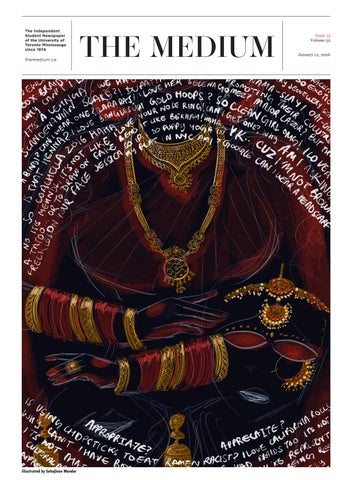
Illustrated by Sehajleen Wander

UTM Muslim Students’ Association hosts multi-disciplinary Career Fair

Students from UTM and beyond were invited to a full-day event of lectures, networking, and panel discussions across eight discipline categories.

On November 22, the University of Toronto Mississauga (UTM) Muslim Students’ Association (MSA) hosted a Career Fair in collaboration with the Islamic Community Centre of Ontario and the MSAs of York University, the University of Waterloo, and the Ontario College of Art and Design University. Taking place in UTM’s Kaneff Centre, it featured a whopping 24 panellists across eight discipline categories, two speakers, and 15 professionals at the networking session. The panel categories included medicine, law, academia and education, entrepreneurship, business and finance, humanitarian work, psychology, and technology.

Attendees had the opportunity to learn about professional and personal development, engage in Q&A, and network. An important theme was the interplay of one’s faith and professional life, as seen with the focus of the two speakers. In particular, Nabeela Elsayed, Former Chief Operating Officer of Walmart Canada, delivered a lecture on building an abundance mindset, and Jannat Firdaus presented a workshop on Canadian workplace rights.

Two UTM MSA event team members, Saad Rizvi and Ahmed Al-Duhaidahawi, shared insights and an insider’s look in an interview with The Medium. While organizing an event of this scale was no easy feat, both touched on how it was accomplished through “months of planning” and inter-departmental collaboration.

Within the professional context of the event, a strong social atmosphere was maintained where attendees felt not only comfortable, but were also active and engaged. Al-Duhaidahawi described how the participants were “having fun,” but were also seeking to “become successful” and were “taking advice from each other.” For some, this event marked the beginning of or significantly progressed their networking journey.

“People were a bit shy at the start of the networking session,” Rizvi noted. “But once it started to get going, it was smooth and people really enjoyed their conversations. When we needed to end the session, it was kind of hard

because everyone was already in a flow state.” He added how inspiring the sense of initiative was, such as seeing “how people were motivated to…engage with the professionals.”

Part of what facilitated this ease in engaging was likely the faith-driven nature of the event, as Al-Duhaidahawi described how praying beside the panellists reminded attendees that they are connected and made them relatable.

Their message to the UTM community, much like the topic of the message itself, was connected. “Getting involved in a club can honestly be life-changing,” said Rizvi, speaking from personal experience. “The MSA is welcoming; you really don’t need to be a Muslim to come to events, to meet people, and make friends.” Similarly, Al-Duhaidahawi explained, “even if you’re alone, don’t be shy to come…. When you go [to MSA events], you’re going to feel like this is a community and you’ve known us for a long time, because we’re really welcoming.”

Students interested in helping to facilitate such events can sign up as general members of the MSA to access many volunteer opportunities. Al-Duhaidahawi noted that attendees also play a significant role in the success of events. “People may think we’re hosting the event, and so we’re carrying it, but I think the people are carrying it; they bring the energy.” Rizvi added that “the most effective way to reach more people is through word of mouth and personally inviting someone to come,” which is also one way people can contribute.

Newly branded PSSA brings together UTM’s best and brightest poli sci students

Aaron Calpito

The Political Science Student Association invited high-achieving students and alumni to discuss the study of politics.

On November 13, the Political Science Student Association (PSSA) of the University of Toronto Mississauga (UTM) hosted its first-ever Student Success Panel. From 4 p.m. to 6 p.m., 10 award-winning UTM students and alumni fielded questions about the study of politics and their personal experiences of studying at UTM. This also marks the PSSA’s first event since it changed its name from the Political Science and Pre-Law Association.

Around 40 students and professors gathered in the MN Grand Hall to hear the panellists speak. These panellists included Ben Makela, Shababa Asad, Samuel Kamalendran, Jan Durkiewicz, Musab Hassan, Lucas MacInnis, Maria Murphy, Kaustav Kochhar, Adam Bakr, and Jana Elghobary. For the first half of the event, the audience sat attentively and curious passersby looked on from the upper-floor walkways as moderator Christine Erhirhie asked the panellists about topics ranging from undergraduate re-

Photo Credits: Melody Zhou
Photo Credits: PSSA
Photo Credits: MSA Fair

search to graduate school to general writing and studying tips. Erhirhie kicked off the discussion by asking the panellists why they chose to study political science at UTM.

“When I chose to go into politics my parents were scared, just because no one in my family was really interested in politics,” answered Elghobary, a recipient of the Peter Silcox Award for Excellence in Canadian Politics. “I saw politics as a way to understand how a lot of the problems in the world occur and why they occur, and it also teaches us how to solve those problems.”

Murphy, named 2025 Community Leader of the Year by the Centre for Student Engagement, likewise explained that she chose to pursue political science because of how prevalent and impactful politics is in everyday life. “The decisions that politicians make, for better or for worse, do directly impact Canadians on an everyday basis, so it’s important to be informed and to know what is happening in your society and how to contribute to that.”

Bakr, recipient of the James Barros Memorial Award in Political Science, explained that he chose the program as a personally rewarding pathway into law. “I grew up in Egypt during the Arab Spring, and that kind of nurtured a very deep interest in politics in me,” he said. “I wanted to be a lawyer for quite a while, and I figured that political science was as good a pre-law major as any… but it was the most interesting pathway to get there.”

Later, speaking on the common struggles of new undergraduates, Student Leadership Award recipient Durkiewicz encouraged students not to undervalue themselves. “I had this idea that the people who get the awards, who do all the extra-curriculars and make all these great changes on campus are all a certain kind of student who is very top-notch, and

OPINION

I just didn’t see myself like that,” he disclosed.

Reflecting on the success that followed his decision to take on leadership roles at UTM on a whim, he advised against giving up on extra-curriculars and academic awards, as they’re often more viable and rewarding than many might think.

Answering a question about pursuing research as an undergraduate, Kamalendran, named Most Promising Theory Student, discussed his research on medical assistance in dying for the Laidlaw Scholars Programme and how it has progressed his academic career. “If you’re interested in pursuing your own research and establishing the foundation of going into grad school, definitely check out the program,” he said. The deadline to apply for the 2025-2026 Laidlaw Scholars Programme is February 2, 2026.

The second half of the event featured a formal Q/A session between the panel and the audience, and wrapped up with networking for all the attendees.

Kamalendran, who is also president of the PSSA, provided further information about the event to The Medium via email.

He explained that his executives planned for the panel to cater specifically to “younger students who are still learning the ropes when it comes to academic success,” although he believed it could benefit all students, regardless of their year of study.

“Given our own experiences as students, it became clear that our biggest event of the semester should grant UTM’s political science community the opportunity to interact directly with students who can provide them with valuable insight into how to obtain professional, academic, and social success in the program,” he wrote. To achieve such a breadth and depth of insight, the PSSA stacked their panel

with a mix of students who were both academically successful and highly involved in extra-curriculars.

The PSSA especially hoped to demystify the struggles political science students most commonly face, namely “challenges rooted in writing essays, performing well on exams, and choosing engaging and meaningful courses,” Kamalendran explained.

He also touched on his team’s decision to drop the “Pre-Law” part of the PSSA’s original name. “The primary issue with our former name was that it captured historical responsibilities of our club, specifically its focused service to pre-law students,” he wrote. “While the core culture of the PSSA remains the same, our new name is meant to mark a new and intentional era in our club’s history.”

Essentially, the name change embodied the PSSA’s renewed mission to support political science students in specific, as well as the executive team’s desire to distinguish the organization from other clubs that cater to the pre-law crowd. The Student Success Panel contributed to this mission “by seeking to bring together individuals who could respond to copious interests and passions, making it as inclusive as possible,” Kamalendran stated.

He concluded by inviting The Medium’s readers to the PSSA’s upcoming winter events. “These initiatives include our Federal Budget event, which will allow students to gain insight into our nation’s financial priorities; a Political Science graduate panel, which will bring together grads across work pathways to discuss their experiences; and finally, our last and biggest event of the year, our first collaboration with UTM’s Students for Liberty to host the second Professors Debate. We will also be present at the Department’s Winter Open House in late January and will be working together on Department Coffee Chats.”

Editorial Belonging without blending

Growing up Italian-Indian made cultural appreciation complex.

Culture is often described as something you belong to. However, for many people, particularly those who are mixed race, culture is something that you navigate.

Culture occurs when people in a location and a community share specific traditions, food and holidays. But I have the case of being mixed race— half-Italian and half-Indian—and live in Toronto, also widely considered as one of the world’s most diverse cities. As a result of this, I don’t follow one single culture in a straight line but see different aspects of Italian and Indian culture correspond with each other in my life.

The traditional idea of culture tends to assume clarity including a single language, a single history, and a single set of customs. However, that defini-

tion leaves little room for people whose identities exist between cultures. People with a single racial background are likely used to having repeated exposure to a single set of customs throughout their life. The traditional model of viewing culture can become limited in who it accurately reflects, as well as unrealistic. In my case as a mixed race person, there is no one culture that follows conforms in terms of food and traditions. Instead I find them corresponding or blending at times; I’ll have Italian food some days, Indian food other days, or often mix the two together which isn’t necessarily part of any formal tradition.

Canada and the United States also have two different expressions when it comes to describing their diverse populations: the U.S. refers to itself as a melting pot, and Canada, a mosaic. This idea of a mosaic allows pieces to remain distinct, while the melting pot suggests that there is a certain blending of cultural aspects which naturally disappear. For someone like me who exists between cultures, the idea of a mosaic feels more accurate of a representation. It does not require people to have to merge into one identity in order to belong,

but acknowledging how different ones can exist simultaneously.

Some of my earliest memories of dissecting what culture truly is from elementary school during the yearly Multicultural Day. On these days, students would bring in their traditional clothing and food from their respective cultures and be encouraged

Photo Credits: UTM Career Centre
Yusuf Larizza-Ali Arts & Entertainment Editor
Photo Credits: Melody Zhou

from their respective cultures and be encouraged to represent their backgrounds with pride. To address my dual backgrounds, I remember bringing in both a crunchy Indian snack food called Namak para and an Italian desert recipe. These events were undoubtedly exciting with the solid intention of encouraging a space for celebrating cultural pride. At the same time, it revealed how easy it is for culture to be reduced to a single dish, outfit or performance and presented as something fixed and easy to explain. For myself, it reinforced the idea that everyone has one specific culture and I just happened to have two. Now, I’m fully aware

that culture extends far beyond what can be displayed in a classroom. It exists in daily routines, family dynamics, and in the blending of traditions that cannot always be categorized.

While my experience as a mixed-race individual makes finding cultural appreciation more complex, it is not unique to me. In multicultural cities, like Toronto, many people are influenced by the cultures that surround them. One just needs to walk through downtown Toronto to find restaurants of all types, mixing identities and cultures. Even those identifying with a single cultural back-

ground are shaped by more than one set of values and traditions. In this way, we can all be considered mosaics that are made up of overlapping influences that keep evolving over time.

I’ve learned from having two very different racial identities that cultural appreciation isn’t about choosing one identity over another. Instead, it’s about learning to live in the spaces where cultures meet and living in a multicultural society that has reinforced this. By embracing complexity we can move closer to being a society that values belonging without blending.

US Democrats’ internal battles

The future of the US Democratic Party resides in the current trends.

As is the case for all democratic politics, parties that fail to take control of the government need to recoup from their loss and start looking forward not just for who could lead the party in the future, but what the broader organization stands for.

The same is true of the Democratic Party following Kamala Harris’ loss to Donald Trump in November 2024. The loss was not a normal one: not only did Trump win all seven critical swing states—Pennsylvania, Michigan, Wisconsin, Georgia, North Carolina, Arizona, and Nevada—but almost all states saw a rightward shift compared to the 2020 election. To add insult to injury, the GOP saw massive gains in the House and Senate, giving the Republican Party total control of the government, the first time since 2019.

As such, the 2024 election proved disastrous not just for Kamala Harris, but for the Democratic Party as a whole. Vocal dissent against the party launched almost immediately from Democratic voters, liberals, and leftists.

Adding further flames to the fire, Democratic elected officials have smelt blood and have begun their own attacks against party leadership. Senator Bernie Sanders (I-VT) has led this charge for nearly a decade now, while increasingly vocal representatives such as Alexandria Ocasio-Cortez (D NY-14) have been providing backup. In a particularly intense situation, in response to 7 Democratic Senators voting to reopen the Government in late November, Congressman Ro Khanna (D CA-17) became the first democratic elected official to call on Democratic Senate Leader Chuck Schumer (D-NY) to resign.

Larger officials have also been throwing their hats in the ring. California’s Governor Gavin Newsom—who has been polling well as the Democratic presidential nominee for 2028—responded to news of the end of the shutdown by tweeting one word: pathetic.

This is all to say that the Democratic Party has been consumed by an internal battle since the 2024 loss. While one side of this conflict is made up of several factions including social democrats, neo-liberals, progressives, socialists, and economic conservatives, they have managed to temporarily unite by bashing Senatorial and executive leadership. Although his popularity remains poor, House Minority Leader Hakeem Jeffries (D NY-8) has managed to escape a vocal uprising, likely attributable to his surprisingly highly effective effort in uniting House Democrats in critical votes. Additionally, with poor handling of immigration, the Epstein Files, tariffs, and foreign policy, House Democrats are poised to claim a decisive majority in the 2026 midterm elections.

This isn’t to say the House Democrats have not been facing their challenges. The unexpected ascension of democratic-socialist Zohran Mamdani in New York has given new life to progressives and fueled a new wave of challenges to Democratic leadership.

Shortly after Mamdani’s win in early November, NYC Comptroller Brad Lander announced he was running against establishment candidate Dan Goldman (D NY-10). The primary—which is taking place on the 23rd of June—is looking to be an intense showdown within the party, as Jeffries, alongside New York’s Governor Kathy Hochul have backed Goldman, while Lander is receiving immense support for AOC, Mamdani, Sanders, and Senator Elizabeth Warren (D-MA). For all the general success seen in the House, however, the Senate has failed to follow suit, with Senators failing to unite, and Republicans still projected to hold onto their majority.

Looking at a presidential ticket, polling indicates that the Democrats are failing to have a comfortable lead over otherwise unpopular GOP candidates like JD Vance. It, therefore, makes sense that most of the battles occurring within the party are spearheaded in the upper chambers of Congress and the White House.

The structure of the Senate makes it difficult for the Democrats to win enough seats to truly have a decisive majority over the Republicans. Unlike the House, the Senate lacks absolute democratic legitimacy, in that every state has the same number of Senators (2). Therefore, despite having a vastly larger population,

states like California, New York, and Massachusetts have the same number of Senators as smaller states like Wyoming, Montana, and the Dakotas. As such, the literal number of states a party can win is the decider in who controls the Senate—and since the majority of the South, rust-belt, biblebelt, and mid-west votes Republican downticket—the Democrats struggle to really seize power.

Furthermore, the Democrats need to win 51 seats rather than 50, as all tiebreakers are decided by the Vice-President. This is not to say, however, that Democrats should abandon trying to take control of the Senate; the filibuster still exists which requires 60 votes, and the Democrats do not need a majority to exert political leverage. The very few number of Senators allows each individual to carry a great degree of political power, making an uprising incredibly difficult. It would seem unlikely that a serious challenge to Chuck Schumer would come in a primary rather than a direct challenge to his leadership position. Even relevant Senators, like Mark Kelly (D-AZ), Jeff Merkley (D-OR), or Tim Kaine (D-VA) who carry disproportionate power, have not been vocal against current leadership. With that being said, an extremely vocal candidate in Chris van Hollen (D-ML) has been more critical of Democratic leadership and may seek a direct challenge in the near future. When all is said and done, however, the Senate looks like it will remain more or less the same until Schumer’s resignation.

In contrast to the Senate, the presidency is an area where immense debate remains. While large battles are currently ongoing, we are noticing that Democratic voters and analysts see where things currently stand. In the long run and short of it, the establishment candidates are still leading.

Despite underperforming in 2020 and disastrously losing in 2024, Kamala Harris remains the top pick. Newsom trails close behind, and Pete Butteigeig—Joe Biden’s transportation minister—stays in contention.

But, are establishment candidates the bright future the democrats need? From what we have seen, the answer should be a decisive no. While current leadership has reached new lows, progressive and populist candidates have popped up with remarkable support.

The issues people are concerned about also matter. As a younger generation submerges itself into political discourse, issues like Israel’s brutal extermination of the Palestinians and Congress’s willingness to back it have become a matter of deep concern for young voters and how authentic they view their politicians. Immigration and housing are important issues, and legacy Democrats have failed to boost their own messaging, instead capitulating to Republican xenophobia.

Not only do voters deserve better than what they’ve gotten, but the Democrats need to set someone effective up for a 2028 run, lest they want a more competent Trumpian figure to win 8 years from now.

Photo Credits: Melody Zhou

Lost in Translation: Code-Switching

April Roy Contributor

Rebecca Christopher Contributor

Madhav Ajayamohan Contributor

When our tongue adapts to those around us.

Switching from languages, accents, dialects, or creoles, often feels like switching personhoods. So, what does it mean to code-switch and how does it feel?

Here are four stories that capture the essence of codeswitching.

Zainab Hassan: A mosaic of my travels

After spending about three weeks in Lahore, I spent the first 48-hours back in Canada re-adjusting my English.

I’ve always had a difficult time with code switching. Having lived in three different countries, I’ve found accents to be accessories I put on and pull off like a one man show on a theatre stage. Slang, phrases, and expressions are my equivalent of Pokemon; added into a rolodex as I attempt to imitate them all. Even now, I sharpen the ‘t’ in “water,” a habit from British secondary school, though it seems to disappear in the middle of “Toronto.”

After spending time back home, words taste different: heavy and sweet on my tongue like halwa, my voice settled low and warm in my throat. Back in Canada I make my voice hike its way up, speaking crisp and sharp like the winter air. I pause in between words the way the sky pauses between flurries, layering them into sentences like the snow on the ground, as light and airy as the flakes. I stop myself from relying on onomatopoeia to relay my feelings and intentions, switching from comic panels to prose as I articulate in paragraphs instead.

I have always found codeswitching to be more about habit than anything else. People sometimes argue that it presents an inauthentic version of themselves, but I disagree. The same way our habits change when we’re

alone versus when we’re with our friends versus when we’re with our family, I codeswitch in different contexts. But it’s all still me, a mosaic of everywhere I’ve been and everyone I meet.

April Roy: Vernacular controls personality

I may not be the only one who notices that different group chats look different based on how I text. It doesn’t have much to do with my texting style—which is usually a cross of informal and formal—but the side of myself I bring forth to the friendship. What side that is depends on my connection to the friend and what I know them to most value in a friendship.

With friends who value deep connection and conversation, I am more likely to text them in a more formal, put-together kind of way; longer and less on-a-whim texts on my end. Other friends value humour and lighter conversations. With those chats, I depend on emoji reactions, text shorter messages, and send a lot of reels. Even though it can be difficult to find a friendship where you feel comfortable to bring forth every side of yourself, I tend to have a higher social battery with texting than in-person conversations.

I’ve always been more introverted in-person, so I often rely on formal social scripts that can help me get through conversations. At my cashier job, I heavily rely on a script, since I’m not always as comfortable going off on tangents with customers.

Either way, I have found that a lot of how these shifts in vernaculars come about has to do with first impressions. These impressions ground me in speaking and acting in certain ways with certain people. It’s both a blessing and a curse because it helps me gain a sense of comfortability with others, but it can also hold me back from growing and evolving socially.

Rebecca Christopher: Code-switching is communicating

I was born in Tamil Nadu, India, but I have lived in 3 countries: India until I was 13, Qatar until I was 18, and now, I’m in Canada. Throughout the years, I have not only picked up on the local languages, but the manner of speaking too. I have become efficient at

EDITORIAL BOARD

Editor-in-Chief

Aya Yafaoui editor@themedium.ca

Managing Editor Samuel Kamalendran managing@themedium.ca

News

Aaron Calpito news@themedium.ca

Opinion

Yasmine Benabderrahmane opinion@themedium.ca

Features

Gisele Tang features@themedium.ca

A&E

Yusuf Larizza-Ali arts@themedium.ca

Sports

Tyler Medeiros

sports@themedium.ca

Photo

Melody Zhou photos@themedium.ca

Design

Sehajleen Wander design@themedium.ca

Podcast

Jia Bawa

Social Media

Jannine Uy

social@themedium.ca

Outreach

Mashiyat Ahmed

outreach@themedium.ca

Copy May Alsaigh may@themedium.ca

Anaam Khan anaam@themedium.ca

TO CONTRIBUTE & CONNECT: themedium.ca/contact @themediumUTM @themediumUTM @themessageUTM

Zainab Hassan Contributor
Photo Credits: Adanna Scott

code-switching.

In India, I used to mix English with Tamil words depending on the circumstances. Tamil snuck into shorter phrases, responses like illai ( no/nothing) and cheri (okay). In Qatar, I slipped British exclamations like oh my days when chatting with my friends from the UK at our British school and I still retain the accent from those years. Many older people would greet me in Arabic with salam alaikum (peace be upon you) and I would respond with wa’alaikum assalam (and peace be upon you, too). I haven’t been in Canada long but I often use old-fashioned phrases for fun. Exclamations like good grief! and what in the tarnation! add a droll punch to my conversations and always get a laugh out of my friends.

But, code-switching can be a burden. It can pressure people into certain constrained behaviours to please others. They also empower some groups and marginalize others which creates a power imbalance.

In hindsight, however, moments of code switching helped me ground myself in different situations, allowing me to connect with others instead of isolating myself. Ultimately, it makes communication the fulfilling human expression that it is, in all parts of the globe.

Madhav Ajayamohan: Code-meshing languages

Sometimes, I feel like there are two versions of me. One version speaks English. He’s polite, quiet, and, I daresay, well-spoken. A little introverted perhaps. He dreams my most vivid dreams and processes my most calculated

thoughts. The second version speaks Malayalam. He’s not quite so eloquent. But he’s sociable and friendly. At times, he’s even funny. When I imagine a friendly conversation, with sarcasm and passion, I imagine it as him.

When I switch between languages, from Malayalee to non-Malayalee, I shift between these versions. As I shift from one language to another, it feels like who I am changes.

When I speak English, I am a consummate professional; I am more capable of doing great things. However, I don’t feel I can connect with others properly. It always feels like I’m a step behind. On the other hand, when I speak Malayalam, I feel liberated. I can talk freely, and connect to others with ease. Conversations come easier, and are less painful. But, I lose some of my thoughtfulness, the part of myself that dreams.

In some twisted way, I suppose neither version of myself is whole. If I code switch between these versions, I’ll only be half of myself. So, I don’t codeswitch; I code-mesh.

Introduced by Vershawn Ashanthi Young, code-meshing is blending your different languages and dialects together and using them to convey your person. When I speak Malayalam and English in tandem, switching from one to the other without hesitation, I feel complete. Studies suggest that I am not alone in experiencing this phenomenon. When code meshing is used in a classroom, teaching using a native language and English simultaneously, while student grades don’t vary significantly, their proactiveness in class increases.

Treading between appreciation & appropriation

Where does the line between cultural appropriation and appreciation end?

Every year, The Medium designates a week to discuss “cultural appropriation.” And every year, the customary “cultural appreciation versus cultural appropriation” conversation appears.

How far can we go with cultural appreciation until we start culturally appropriating? I’ll try to give a definitive answer to this four decade old question.

What is Cultural Appropriation?

To have this conversation, we first need to understand what appropriation is. According to Britannica, “cultural appropriation takes place when members of a majority group adopt cultural elements of a minority group in an exploitative, disrespectful, or stereotypical way.”

At first this definition seems pretty concise. However, in order to understand what appropriation is we need to delve into what “exploitative,” “disrespectful,” and “stereotypical” mean.

Exploitation

First, let us look at a case of a majority group exploiting a minority culture’s group. In Myrtle Beach, South Carolina from the late 1930s to early 1960s there was an African-American owned nightclub in the American South that was the center of music and dancing called Charlie’s Place. It was also one of the few places at the time where Black people and white people could dance together and enjoy music, amidst the segregationist regime.

Charlie’s Place was where The Shag—South Carolina’s official state dance—originated. However, as

the dance grew to be popular everywhere, white Americans claimed The Shag as their own without acknowledging its Black roots. In fact, members of Myrtle Beach claim that the white Americans stole the Shag.

This is a clear case of exploitative cultural appropriation: white Americans claimed a cultural practice from the African Americans heritage for social gain and popularity. This also showcases an important distinction between cultural appreciation and appropriation: an issue of credit.

Disrespect and Stereotyping

Disrespect and stereotyping embody a similar type of cultural appropriation: misrepresenting the original culture. This was most prevalent when we observed Orientalism.

Orientalism is the Western tendency to stereotype and misrepresent Eastern cultures, first introduced by Edward Said in his work Orientalism. For example, many depictions of Muslims in popular media are often reduced to terrorists or “villains.” These continued depictions misrepresent the faith of Islam as violent, when the majority of those who practice Islam condone the small minority that commit atrocities in the name of the religion.

This type of cultural appropriation can occur due to two reasons: as a means to exploit, or simply as a result of ignorance. The origins of orientalism come from a European (and colonial) desire to show that those from the East are inferior; justifying conquering them for their own benefit. Orientalism was simply a reason created for imperialism. There is no doubt that misrepresenting a culture as a means to conquer or destabilize them is wrong.

However, should the same be said of cultural appropriation born from ignorance? If someone truly misunderstood practices from another culture, can we truly blame them?

We may have reached a conclusion on the definition of cultural appropriation. However, that leads to our next question: is cultural appropriation always bad? Or rather, should we fear being on the line inbetween appreciation and appropriation?

Creating New Cultures

I’m a third culture kid of Indian origin. I grew up in Canada until the fifth grade, then I moved to the United Arab Emirates, where 90% of the population are expats. I’ve never felt comfortable claiming Western culture or Indian culture as my own. So I simply didn’t.

Instead, I set out to create my own culture defined by its own rules, by picking pieces of other cultures I liked and adding them into my life. Is that cultural appropriation? Well, it truly comes down to dignifying the cultures of origin.

Perhaps we should start expecting people to understand culture before adopting it. Appropriating strips communities from the honour of practicing their own heritage. Putting in the effort to not appropriate is the first step. But, that’s just my take—I wonder what the next writer will claim!

Photo Credits: Fabiha Ruthmila

Is the Louvre Heist honourable?

blind spot was created.

Perhaps, like the museum institutes, those involved in the heist had no honourable intent but to serve themselves.

If you have scrolled through TikTok or other social media platforms within the last three months, then you have most likely come across some sort of news coverage, reaction video, or opinionated takes that comment on the events of the Louvre museum heist in Paris, France.

The heist occurred on Sunday, October 19, 2025, at approximately 9:30 am and in plain sight at the supposedly secure Louvre Museum. Four suspects dressed as construction workers blended in as ordinary people attempting to get the job done.

While it is not uncommon for any criminal to disguise themselves to avoid being identified, I particularly found the construction worker disguises to be quite clever because they raised no immediate suspicion. Spotting construction workers anywhere and at any given moment is not an odd sight. But what made this heist different?

Well, many commented on the museum’s negligence in taking better security measures. By setting their surveillance in a position facing the Seine River rather than having it face the Apollo Gallery Balcony, a sneaky surveillance

FEATURES

Additionally, the Museum previously set their surveillance camera passwords to be the word Louvre allowing said cameras to get easily hacked, highlighting the consistencies in their security flaws.

As far as we know, this particular heist was not about culture but driven by personal motives. The stolen French crown’s jewels and jewellery were valued at over 100 million USD.

But, some say the Museum had it coming for them as karma for robbing civilizations of their culture. Some claim that heists can be done in the name of justice. Because, for long, France has been benefiting from the stolen artefacts of their former colonies, without reparations.

Who should we blame for how stolen artifacts continue to find their way into museums? Are museums around the world, like the Louvre, Royal Ontario Museum (ROM), the British Museum, making genuine efforts to honour these artefacts?

I, for one, believe that this issue is not a matter of one person’s actions but rather the effects of colonialism on cultures and heritages globally. This is the result of false and delusional entitlements over other people’s property and way of living. Dragging parts of people’s history into enclosed spaces with “do not touch signs” is quite ironic.

However, it does seem that museums like the Louvre, ROM, and British Museum continue to take good measures to preserve these artefacts in the name of educating others. The digitalization of museums, a feature that has emerged over the past few years, is one way that has amplified the preservation of culture.

The digitalization of museums can be efficient, cost friendly, easily accessible with the widespread use of technology, whilst allowing for others to learn about cultural artefacts without physically viewing them and instead allowing the countries of origin to reclaim their heritage.

Whilst some involved in the Louvre heist have been caught, the jewels are yet to be returned. And while there have been hasty assumptions made by the internet that the heist was done in the name of a noble pursuit—returning the artefacts to the rightful owners—we must also understand that it was not their act to commit.

Perhaps, like the museum institutes, those involved in the heist had no honourable intent but to serve themselves.

Akemashite: New year, same traditions

From Japan to Hawai’i

In a conversation with my grandma, I’m learning how traditions evolve with every new year.

Tradition is sticky. It survives because each generation chooses to hold onto it. Every time traditions are carried out, it’s because someone decided they mattered enough to be kept.

I am a fifth-generation American and have been lucky enough to be raised with New Year’s traditions that generations before me have lovingly passed down. My grandmother, Baabaa, chose to hold on and is gently teaching my generation to do the same.

Baabaa is a third-generation American. Her grandparents immigrated from Japan to Hawai’i. She was born in 1946, a year after World War II ended. It was a time when her grandparents barely spoke English, but her generation was expected to assimilate into American culture. Hawai’i was admitted as a U.S. territory in 1898 and became a state in 1959.

Baabaa said she noticed the changes in Hawai’i before statehood. Shoes became a school requirement when she was in second grade. “My mom bought us shoes, which I put on at the stoplight across the street from school and removed after crossing the street after school,” she said.

“The Hawaiian language was forbidden (except for tourist-type music). Hawaiian lyric music was

heard less, and speaking pidgin was frowned upon.” Change was everywhere, but the New Year’s traditions continued.

Policies changed, but New Year’s traditions continued on

Baabaa grew up visiting a Shinto temple with her grandma on New Year’s to be blessed by the Sun Goddess, Amaterasu Ōmikami. Amaterasu is considered the mythical ancestress of Japan’s Imperial Family. Shinto is Japan’s indigenous spiritual tradition, centred on kami (deities). It features a detailed creation story and provides rituals and traditions rather than morals. Shinto has helped shape Japanese culture and is often practiced alongside Buddhism.

This blend of Shinto and Buddhist ideas shaped

Sophie Minot Contributor
Photo Credits: Melody Zhou

Baabaa’s New Year’s celebrations.

There was osoji (the great cleaning) of the house to freshen up for the new year and welcome kami, which would bring good fortune. She belongs to both temples of Honen and the Shinran schools of thought. Jodo Shu and Jodo Shinshu Buddhism were founded by a teacher and his student, respectively. Traditions similar to Baabaa’s are common, not just in Japan but throughout the entire Japanese diaspora, particularly in Hawai’i.

Of all 50 US states, Hawai’i is the only one with an Asian American plurality, it has the largest proportion of multiracial people, and it is the state with the largest percentage of Buddhists. It is now customary for a Hawaiian New Year Celebration to incorporate Japanese traditions like mochitsuki (a mochi pounding ceremony), and Chinese ones, like fireworks, in addition to ancient Hawaiian rituals.

Baabaa pointed out that mochitsuki is the most important of all the traditions. My uncle likes to warn us to chew slowly because, legend is, in Japan, the Emergency Room is full on New Year’s with all the people choking on mochi. Baabaa says that just like the sticky mochi, we will stick together.

Food!

Mochi, like most other foods we eat around this time, is full of symbolism.

The practice of making mochi itself is special. Rice is soaked overnight. Baabaa mentioned that at our family’s mochitsuki, we only pound about 15 pounds of rice. One year, we tried pounding 30 pounds, and it was way too much.

Baabaa grew up making about 100 pounds of rice each year. Her family would spend the whole day “washing the rice, steaming the rice, pounding the rice, shaping it. So it was like a continuous stream.”

People would stock their freezer with mochi and reheat it throughout the year in the oven or pan for yakimochi (toasted mochi). Alternatively, people would also make zenzai or ozōni (sweet or savoury mochi soup) in a pot of boiling water, or agedashi mochi (deep-fried mochi).

I was raised on freezers of mochi, restocked each year, but my generation would normally just reheat ours in the microwave. This New Year, I got to have zenzai for the first time. Mochi is most versatile if

left plain, but I grew up filling about half of them with anko (sweet red bean paste). And if my mom allowed, some were filled with chocolate chips.

Other symbolic New Year foods include toshikoshi soba (a long noodle soup for a long life), kuromame (sweet black beans for health, as the word ‘mame’ also means diligence, symbolizing health and hard work throughout the year), ozoni (mochi soup with veggies from the sea and the mountains, showing gratitude for the bounties of the earth), and more.

Tracing back New Year’s activities

I grew up playing money games on New Year’s Day. According to Baabaa, “the tray game,” in which you put coins on a tray and see how many you can pick up in one fist, came from her grandmother. And “the bag game,” in which you choose a string from a bunch and hope it’s the one strand attached to a bag so you get a prize (more coins), came from her father’s grandmother. The tradition of shaking each other’s hands to transfer money also came from her father’s side.

During our conversation, Baabaa recognized how much traditions had changed throughout her lifetime. “And it’ll change with you too,” she said to me. “And you’ll choose what’s important to you.”

The choice to hold on

I received a text from Baabaa a few days before I got the idea to interview her for this article. She sent me a YouTube link to a documentary titled Japanese New Year Traditions in Hawai’i. It’s the kind of thing she does – softly sharing a piece of our history, a gentle reminder of where I come from.

The documentary is broadcast by the Public Broadcasting Service (PBS) Hawai’i, a locally owned, statewide television station that has been running since 1965. The video features interviews with local Japanese Hawaiians and people who study Japanese Hawaiian culture.

My favourite quote from the documentary was said by Rocky Murakami in reflection of mochitsuki. He said, “Things like this, you cannot get out of your system, because it’s so wonderful.” Maybe that is what makes traditions sticky, not because they are obligations, but because they are wonderful activities that we just can’t let go of.

Experiencing Japan in a Month: Beauty Behind the Flashiness of Tourism

Madhav Ajayamohan

Contribut0r

Fourth Year Student Ndaru Bhramastra shares his experience in his summer abroad program at Keio University, Tokyo, Japan.

The University of Toronto (U of T) is the best place for us to practice cultural appreciation. With students from over 175 countries, we as students have much to appreciate about our peers’ diverse backgrounds. We can listen to anecdotes from our friends, learn about international customs from classrooms, and sample recreations of traditional artifacts. It’s almost like we’re there, except we’re not.

While U of T allows us to encounter new cultures, we can never get a firsthand experience of other countries from within our Canadian confines, except for international students, where Canada as their new home.

However, the university offers us opportunities to see the world beyond, with extensive exchange programs like the Outbound Exchange, UTM Abroad, and the Summer Abroad program.

Ndaru Bhramastra, a fourth-year computer science and geographical information systems (GIS) major, decided to take the plunge and immerse himself

Photo Credits: Sophie Minot
Photo Credits: Ndaru Bhramastra

in an entirely new culture. Last summer, in May 2025, Bhramastra participated in the Summer Abroad program to study at Keio University in Tokyo, Japan, for one month. In an interview with The Medium, he reveals more about the experience.

The Summer Abroad Program

U of T’s Summer Abroad program allows students to complete a “full-year University of Toronto undergraduate degree credit in three to four weeks over the summer” at a foreign university.

The Summer Abroad program was the perfect opportunity for Bhramastra to experience Japan. “I’ve had a strong interest in Japanese culture since I was young,” Bhramastra said. “The opportunity to go there and experience the culture myself was too good to pass up.”

The program’s shorter time frame also enticed Bhramastra. “I wanted to have a learning experience abroad,” Bhramastra explained. “But I didn’t think I was ready for a full semester abroad. The Summer Abroad was a good in-between where I could still study abroad, but not for a full semester.”

Japanese indirectness and Western directness

At Keio University, Bhramastra took the course IRE332: Resolving Workplace Conflict While Employing a Cross-Cultural Perspective under Professor Bob Thompson at Keio University.

“At first I was very worried that what I was learning would have no connection to me as a computer science and GIS major,” Bhramastra said. However, he soon changed his mind when he realized IRE332 offered “soft skills that apply to everything outside of academics.”

IRE332 focuses on showing students communication techniques that can help diffuse conflicts by contrasting the Japanese and Western communication cultures.

“If someone is doing something wrong, in typical Western culture, we would tell them they are doing something wrong, and this is how to fix it,” Bhramastra explained. “But in Japan, people tend to take an indirect approach. They won’t outright say you’re doing something wrong… instead of saying ‘don’t do this,’ they would say ‘Have you tried this instead?’”

Bhramastra observed the same tendency to avoid conflict among the locals. “After learning about [the theory] in class, when you’re talking with locals or going into shops, you can see that indirectness or soft-spoken communication culture we learned about in class.”

From his experiences, rather than subscribing to one communication style, Bhramastra found that achieving a balance between Japanese indirectness and Western directness is the most effective, and looks forward to combining them for future projects.

Beyond the classroom experience

During the program, Bhramastra had three-hour lectures for IRE332 on Monday, Wednesday and Friday. Then, on Tuesdays and Thursdays, the Summer Abroad team took the students sightseeing. Some of the locations include the Japan Stock Exchange Building, the Tokyo Metropolitan Building, some temples and some shopping districts.

Bhramastra particularly enjoyed attending a tea ceremony where students got to wear a kimono (a traditional Japanese attire), and visit a small village around the base of Mount Fuji to see a perfect, cloudless view of the mountain.

However, Bhramstra’s favourite part about Japan had nothing to do with the “touristy” locations he visited.

“You see a lot of beautiful buildings [in Japan], a lot of great food and attractions,” Bhramastra explained, “but a few blocks away from those buildings, you can stumble upon a residential area that’s more captivating than all those buildings and attractions put together.”

“No one really talks about it, but just talking to the locals and communicating with them is such a different feeling than all the popular attractions,” Bhramastra reminisced. “Some of these food and attractions were [overhyped], but one step or one block away, there are so many wonderful people and hole-inthe-wall restaurants that don’t get talked about often, and are some of my best experiences.”

In his free time during the program, Bhramastra explored Tokyo, “seeing what looks good, and hopping right in without a particular plan.” While he was originally worried about the language barrier, Bhramastra was able to explore Tokyo and talk to the locals without much issue.

Brahmastra explained that since Tokyo was a popular tourist location, many locals were able to speak English. “Not perfect English,” he admitted, “but enough to get by. In the worst case, I had to use Google Translate, which sometimes might slow things down or make things awkward. But it’s not like you can’t do anything if you don’t know the language.”

For students interested in visiting Japan, Bhramastra shared that although you can “point your way through most restaurants or stores,” knowing “a few basic phrases and words goes a long way.”

Bhramastra shared that his favourite experiences came from talking to the locals. “Some of the best conversations I had were in restaurants or bars where I was slightly drunk,” Bhramastra shared. “Not a care in the world, with random people I’ll probably never see again, but they still become core memories for me.”

One of the interactions that particularly stood out for Bhramastra was when he visited a second-hand bookshop. An old man, who spoke a bit of English, came up to Brahmstra and talked about his life.

“It was kind of like talking to an old grandpa,” Bhramastra described. “I didn’t say much; it was more like he was rambling. But it was great to hear about other people’s lives and how different it was compared to Canada.”

While Bhramastra was successful in connecting with the locals, he acknowledged that “if you want to go talk to locals, you have to go out of your way to talk to them.” The program housed the students in a hotel, which Bhramastra thought was a “shame, because [he] hoped they would put [him] in student housing to get more chances to interact with other students and locals.” While the Summer Abroad program had originally planned a meet and greet with Keio University students, it was unfortunately cancelled.

At the end of the interview, Bhramastra was asked whether, if given another opportunity to go abroad, he would choose a summer program or a full semester. He replied that if he “were in [his] second or third year,” he would choose a full exchange.

“If you’re unsure whether this program is right for you or useful for you, I think you should still go for it,” Bhramastra advised. “You’ll never know until you take it. If I didn’t have that mindset and not apply, I would have missed out on an opportunity that broadened my perspective.”

10 ARTS

Accuracy of Chinese Culture in Mulan (1998)

Does the classic princess movie portray Chinese culture correctly, or is it still heavily influenced by euro-centric ideals?

The Disney Renaissance occurred during the 1990’s, and produced ten of Disney’s most beloved animated films. The era gave birth to four of the trademarked Disney Princesses. One of which was Mulan (1998), whose story is a retelling of Hua Mulan, a Chinese folklore character.

The movie follows the titular character, Mulan, as she runs away from home to join the army in defense against the Huns, a group looking to overtake China.

In a time period where women weren’t allowed to fight, she chooses to hide her identity as a woman and pose as a man, to join the forces in the place of her elderly father. Accompanied by her cricket CriKee, her dragon Mushu, and her gang of fellow soldiers, Mulan successfully defeats the Huns, saving all of China.

The character of Hua Mulan first appeared in the Chinese folklore song Ballad of Mulan, which was likely composed during the Northern Wei dynasty hundreds of years ago. Similar to the movie, Hua Mulan was a woman who dressed as a man to join her country’s military forces. She kept her identity hidden for years before returning home and revealing that she was a woman all along.

Besides its depiction of the original Chinese tale, Mulan includes a number of Chinese cultural references. Minor aspects of the movie are accurate to Chinese symbolism such as the cricket given to Mulan to grant her luck, which actually has roots in Chinese mythology. While he was intended as a funny side character, Mushu the dragon is fashioned after traditional Chinese dragons, which symbolize power, strength, wisdom, and good fortune.

However, some aspects of the movie are misrepresentative of Chinese culture. There are a few notable scenes, including when Mulan is being made-up as

the “ideal woman” before being presented to the matchmaker, and the scene where the ancestors are gathered to discuss Mulan’s decision to join the army. The matchmaker scene is inaccurate to Chinese culture on the whole, though it does have accurate elements. Mulan’s make-up, for example, is exaggerated and blends looks/ practices from different dynasty eras. However, the idea of match-making and an “ideal wife” for a woman has been common throughout history.

The ancestor scene is also largely inaccurate, and heavily satirical and it’s unclear what religion Mulan’s family would practice, as Chinese citizens participate in a wide variety of religions and the prevailing cultural religion has changed throughout time. Vague themes like praying and honoring one’s ancestors are present in the film, though those ideas can be applied to most world religions. The inspiration, but not depiction, of the (likely) Buddhist religion is due to two reasons. First, Tony Bancroft, director of Mulan (1998) and a Christian man, went on record saying he wanted to keep the scene “light”, and “fun”, so he “didn’t give too much attention to Buddhist beliefs and history.” Secondly, Disney as a whole likely didn’t want to accurately represent the religion, or Chinese culture on the whole, to avoid alienating its Western audience, resulting in the film being mainly composed of “Orientalist” stereotypes.

“I’m Right Here:” Cultural Clubs on Campus and the Importance of

Celebrating Cultural Pride

Sitting down to have cordial conversations with several culturally-focused clubs at UTM.

Consisting of around 15 000 full-time undergraduate students with roughly 25-30% having international enrolled each year at the University of Toronto Mississauga from 2019-2024, the UTM student body raves about its wide range of cultures and traditions. This is further exemplified through the significant assortment of UTM clubs focused on “culture and identity” listed in the Student Organization Portal, each founded and maintained by an ethnic group significantly represented on campus.

For that reason, it is critical to hear from these clubs to get a sense of the community on campus and why we gravitate towards each other into these places. A primary mission of cultural clubs like Caribbean Connections (CC), the Egyptian Students’ Association (ESA), the Filipino Student Association (FSA), the Latin American Students’ Association (LASA), and the Pakistan Student Association (PSA) is to create a space where students can connect with their own culture or learn more about another through their events and initiatives.

PSA’s vice president internal Shalrah Sultana emphasizes that clubs like these bring “People to enjoy their culture even when they’re far away from

home.” FSA’s vice president communications Hero Banares stresses the importance of also bringing in outsiders: “We always try to include other people who are not Filipino. A lot of people come up to me during our events and ask if they’re allowed to go in and I’m like, of course. Just come inside. You can come. We just want to spread the joy of our club and our culture”.

Events are the best way for clubs to reach or educate both their membership as well as the wider community at UTM. Sierra O’Brien, vice president of community outreach and Engagement for CC, highlights events such as the “Caribbean Heritage Expo,” held annually in the Blind Duck Pub during the fall semester, that are able “To allow students—not only Caribbean students, but students at UTM—to come in and learn about Caribbean culture, hear talks, hear different types of music, poetry, and just eat the food that we have, and so kind of build a community that way”. Education is a large focus of cultural clubs at UTM, not only teaching about their respective cultures but also valuable life skills. LASA’s vice president finance Max Hernandez-Garcia explains that one of their biggest goals is “to have a panel discussion with Latin American professionals—as [well] as with Caribbean professionals, for example, people part of BSA and the African Student Association, as well as Caribbean Student Association—to have these individuals share their experiences with being a marginalized group and how they were able to work through the workforce, the kind of things

they had to struggle with to get their job.” Our culturally-focused clubs also tend to build connections with cognate groups on other campuses. ESA’s annual gala, held last year on February 1 at the Grand Victorian Convention Centre, “Is a collaboration between all of the Egyptian student associations across Ontario”, according to ESA president Malak Elassiuty. “It’s basically just a gala with food and music and in a banquet hall; it’s a

Illustrated
Aria Zheng
Maaz Ahtesham Contributor
Photo Credits: Melody Zhou

nice kind of event for Egyptians to come together.”

This sense of collaboration is a key function in how cultural communities operate on campus. Elassuity states that “Collaborations are important, even if it’s not Egyptian clubs, because it allows for a space for different communities to come together.” It is just as important to show compassion and consideration for the cultures on campus outside of our own. PSA’s team “Want to show that [they] can get along with everyone, and [they] love to get along with everyone, so having that collaboration shows that to the UTM student community.”

Social awareness is also a crucial part of these clubs’ DNA as well. Sultana reveals that PSA donates most of their proceeds to charities in Pakistan at the end of the year. LASA particularly expresses that “[they] want to not only celebrate Latin American culture but [they] also have the mission to help a lot of these marginalized peoplemarginalized communities. [They] know that the

Spanish community is not the only marginalized group, but [they’re] working together with other clubs, [they’re] going to strive to support these students academically, socially, and just make a welcoming environment”.

Primarily, cultural clubs on campus strive to celebrate their respective communities and demonstrate what makes them special. O’Brien expresses that cultural pride is a “Really high priority for [them] because one of [their] mottos is ‘One Caribbean,’ so being Caribbean or being West Indian is very, very important to every single one of [them] just because it’s such a unique culture, and the Caribbean population in Canada, even in UTM, it’s not the biggest”. It is important to amplify this pride to cultivate the feeling of belonging on campus. For FSA, cultural pride is “Very important because, when [Banares] was tabling for FSA during the beginning of the year, so many people that came up to [him] during tabling were just like, ‘I never knew there was a Filipino club. I

SPORTS & HEALTH

New Year, New Me

league—be it tennis, basketball or any other sport. Tyler Medeiros

felt like I was the only Filipino at UTM,” to which Banares would respond “Come here, I’m right here.”

In such a vibrant and diverse campus, having places for individual cultures is imperative; it is a crucial part of having people together, bringing people together, and celebrating what makes us similar as well as unique. Building these connections and developing that cultural pride is crucial especially for first-year students, a sentiment that is shared amongst the personal experiences of some of the club executives above. “I feel like everyone should be proud of where they’re from and who they are”, says Hernandez-Garcia. “It’s a big part of their identity and how you do day-today stuff. One of the biggest things that we strive for is making sure everyone’s proud of their culture, having a good space for them to show that, and also welcoming other individuals to see how we live our life and how we have different events, how we celebrate stuff”.

A collection of new year’s resolutions from UTM students

Mladen Djuric

My new year’s goal in the sports/fitness domain is to complete my first 100 mile race in the Sulphur Springs Trail Race being held in late May in Ancaster, Ontario. I’m challenging myself with this task because I have run a marathon previously, and since then I have not been running regularly because there has not been an event to look forward to. Training and running this race will push me physically and mentally to grow and adapt to such a strenuous physical task. To be in the top 100 times, you have to complete it in under 20 hours in the 20-29 age group. That is the time I am aiming for and my goal for the new year.

Samm Mohibuddin

As a person using an accessibility device such as a wheelchair, seeing UTM start sports activities like wheelchair basketball was a welcome change. For 2026, I have a resolution to take part in more accessible sporting activities UTM and Mississauga has to offer. Wheelchair tennis is something that I always found alluring given that tennis is a sport I frequently watch. Last year during the National Bank open here in Toronto, there was a separate tournament bracket for wheelchair tennis. Since then I have been inspired to participate and have my own go at it. I hope UTM can introduce more accessible sports options via the RAWC given how we have a tennis court and 2 open fields. Regardless, I have made it a goal to ensure I take part and complete one full season in one accessible sporting

In 2026 I intend to regain my match fitness. Ever since I could walk I had a soccer ball at my feet. I loved going to the field with my friends, shooting the ball around until it became impossible to see. Since the Covid-19 pandemic, I have been spending more time watching soccer than playing. Over the years I have lost the endurance needed to compete for 90 minutes. This year I will follow through with a regimented workout routine to regain my stamina. My goal is to do the beep test three times a week, pushing myself to a new personal record whilst tracking my progress. I hope to reach the excellent category which for males from the ages of 18-25 is >13/10 according to Topend Sports.

Kirk Gibson

Being on the varsity baseball team means that my health and fitness goals align with our schedule to ensure optimal performance. The school season begins in August, so my goals are all with the purpose of reaching my physical peak by the beginning of the season and maintaining my health and strength throughout the campaign.

In the early months of training, which I’m currently in, my goals are to safely build up as much functional muscle as possible. This means my focus is on hypertrophy, training in the eight to twelve rep range for three sets per exercise. Once I get closer to the season, I’ll transition my training to a more strength-based approach allowing me to move as much weight as I can. In this section, I’ll be training in the three to six rep range for two to three sets of each exercise. My last phase before the season begins is to train for power, meaning I’ll focus on moving as heavy as I can as quickly as possible. This directly impacts my power output needed to play the style of baseball I’m here to play. This includes a lot of Olympic lifts including cleans and snatches, as well as bodyweight plyometrics and cutting back weight on my main lifts like bench press to focus

more on moving the weight quickly. This structure is designed to reduce the risk of fatigue and injury by not lifting too heavy before I build a base ceiling of muscle that I get through hypertrophy training. After developing strength in the second phase, it’s important for me to prepare my muscles to compete at a high level and move quickly which is achieved through my power training.

Throughout these stages, the most important goal I have is to improve my mobility through yoga and stretching daily. These remedies are essential for injury prevention and ensure I maintain athleticism while my muscles develop. This preparation is to help achieve the most important goal I have for 2026: to be part of the Varsity Blues fourth straight OUA championship.

Editor | Tyler Medeiros sports@themedium.ca
Tyler Medeiros Sports & Health Editor
Samm Mohibuddin Contributor
Mladen Djuric Contributor Kirk Gibson Contributor
Photo Credits: April Roy

From the Pitch to the People: Jordan’s New Found Unity Through Football

When Jordan qualified for its first-ever FIFA World Cup last year, I had never seen the streets of Amman be more united. From flags waving from balconies, honking horns, and entire neighborhoods being shut down from all the dancing, that night showed something deeper than a celebration; a nation finding its reflection in football.

Football or Soccer is one of Jordan’s many common cultural grounds, and when it comes to the national team, no one messes about. The support for AlNashama (the national team nickname) transcends regional, social, and tribal lines. With international football, there are always divides in support whether it’s the players or the federation, not every fan comes together to support their team. That doesn’t seem to be the case with Jordan. The resilience found in the team is derived from the resilience of the nation and its people and it is evident when the players always thank the fans after every milestone.

The historic World Cup qualification comes in between two surprising yet central to our culture’s unity tournament performances. Jordan marked two consecutive finals appearances in the 2023 Asian Cup and last month’s 2025 Arab Cup. These milestones have sparked nationwide celebrations and intense emotional pride in the last three years. However, to Jordanians, these weren’t just sporting achievements, they were a narrative of national possibility; a mark on the global stage as a relatively small country. Despite being runners-up in both competitions, everyone was extremely proud of the team and were instilled with belief for the future. King Abullah II publicly praised the team’s performance and highlighted how Jordanians from various corners of life saw themselves in the team’s resilience and determination. This royal praise was extremely powerful in a local context. People were overjoyed to see national leadership tying sport to national identity.

Being around the various communities in Jordan made me realize the support for the national team is beyond just entertainment. It is a symbolic expression of collective belonging and national pride. Overcoming adversity and proving everyone wrong is second nature to Jordanians!

When I was younger, my football coach introduced a sociological concept to help the players understand the dynamics of football beyond the team: collec-

tive effervescence. This term describes moments when people share a common emotional experience that unites them. The goal was for us to grasp the importance of the work we do on the field because there are those outside of it who will cherish it forever.

Funnily enough, he never actually used that term until we got older; he used to say “goosebump moment.” This is extremely meaningful in a country as diverse as Jordan. There are many regional and social differences, but they are always swept aside in support of Al-Nashama.

Football’s role in Jordan is beyond winning. It is for creating a shared national narrative. The team’s recent success provides its people moments of collective pride, stories they can share for generations, regardless of age or background. I remember many Jordanians in the streets celebrating the World Cup qualification, saying all they wanted was for them to be represented on the world stage.

This is why long after the final whistle, what remains aren’t just memories of goals and finals, but a stronger sense of who we are as a nation. In a divided world, for a moment Jordan stood united, and football helped bring us there!

Tune in to watch Jordan compete in the nation’s first FIFA World Cup as they take on 2022’s champions Argentina this summer.

Photo Credits: Melody Zhou

Turn static files into dynamic content formats.

Create a flipbook
Issuu converts static files into: digital portfolios, online yearbooks, online catalogs, digital photo albums and more. Sign up and create your flipbook.