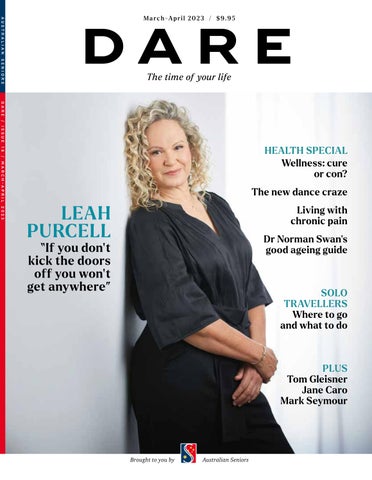
March-April 2023 / $ 9.9 5 The time of your life AUSTRALIAN SENIORS DARE / ISSUE 18 / MARCH-APRIL 2023 Brought to you by Australian Seniors
SPECIAL
cure
con?
dance craze
HEALTH
Wellness:
or
The new
Living with chronic pain
TRAVELLERS
to
and what to do PLUS
Dr Norman Swan’s good ageing guide SOLO
Where
go
Tom Gleisner Jane Caro Mark Seymour LEAH PURCELL “If you don’t kick the doors off
you won’t get anywhere”
THE BEST IN OVER-50s LIVING. THIS IS YOUR TIME.





























1800 490 626
Mahogany Drive, Pelican Waters, QLD 4551 palmlakeresort.com.au
FREECALL
40
EDITOR-IN-CHIEF
Camille Howard
ART DIRECTOR Ivan Chow
MANAGING EDITOR
Ingrid Laurence CONTENT COORDINATOR Anna Neville
EDITORIAL INQUIRIES
02 8114 8900
Level 1, 83 Bowman Street, Pyrmont, NSW 2009 daremagazine@mediumrarecontent.com
ADVERTISING
HEAD OF SALES
Steve Koutsoukos 0406 557 817 steve.koutsoukos@mediumrarecontent.com
NATIONAL ADVERTISING MANAGER
Charisse Villamaria 0403 132 430 charisse.villamaria@mediumrarecontent.com
Heading into autumn, the days are getting shorter and the weather is starting to cool. For many, it’s the perfect time of year for taking stock of one’s health ahead of winter.
Perhaps unsurprisingly, regardless of the season, health is a key focus for most over 50s. Our new Cost of Health research shows that the majority (86%) of seniors are doing everything to improve or maintain health, as a top priority.
Health has a special focus in this issue of DARE, in which our experts lift the veil on the good and bad sides of the growing wellness industry (page 24), the exercise trend improving our bodies and minds (page 30), and fresh ideas on treating chronic pain (page 38).

And celebrity doctors
COMMERCIAL OFFICER Fiorella Di Santo ACCOUNT MANAGER Lisa Clark
HEAD OF AUDIENCE INTELLIGENCE Catherine Ross
DIGITAL STRATEGY DIRECTOR Karla Courtney
SOCIAL STRATEGY DIRECTOR Scott Drummond
FINANCE MANAGER Leslie To
DARE magazine is published for Australian Seniors by Medium Rare Content Agency (ABN 83 169 879 921), Level 1, 83 Bowman Street, Pyrmont, NSW 2009. ©2023. All rights reserved. Printed by IVE Group. Paper fibre is from sustainably managed forests and controlled sources. No responsibility is accepted for unsolicited material. Articles express the opinions of the authors and not necessarily those of Australian Seniors or Medium Rare Content Agency. ISSN 2652-5593. For a copy of Medium Rare Content Agency’s privacy notice, go to mediumrarecontent.com
Australian Seniors Insurance Agency (Australian Seniors) is a trading name of Greenstone Financial Services Pty Ltd ABN 53 128 692 884, AFSL 343079, the promoter and distributer of Australian Seniors insurance products. The insurer for Car, Home, Landlords, and Pet Insurance products is The Hollard Insurance Company Pty Ltd ABN 78 090 584 473, AFSL 241436, and for Life and Funeral Insurance products is Hannover Life Re of Australasia Ltd ABN 37 062 395 484, AFSL 530811. Seniors Pet Insurance is arranged and administered through PetSure (Australia) Pty Ltd ABN 95 075 949 923, AFSL 420183. The insurer for Seniors Travel Insurance is issued and managed by Allianz Australia Insurance Limited ABN 15 000 122 850, AFSL 234708 (Allianz).
Seniors Travel Insurance is issued and managed by AWP Australia Pty Ltd ABN 52 097 227 177, AFSL 245631, trading as Allianz Global Assistance (AGA), acting as agent for Allianz. This is general information only. Terms, conditions, limits and exclusions apply. Sub limits may apply. Consider the relevant PDS and TMD available at seniors.com.au
The research also shows most over 50s are undertaking regular health check-ups (58%), exercise (58%), and eating good foods (56%) to improve their health, and more than half (57%) consider themselves to be in ‘good health’ physically and mentally.
Norman Swan and Ginni Mansberg also share their expert knowledge and latest research in our special report on health and ageing through the decades (page 78).
It’s another fabulous issue full of inspirational and informative stories and we really hope you enjoy reading.
Brenard Grobler

CHIEF EXECUTIVE OFFICER
AUSTRALIAN SENIORS
Australian Seniors has helped hundreds of thousands of Australians protect the most important things in life –whether it’s their family’s future or their valuable assets.
OUR AWARDS: Australian Seniors is a multi-award winning insurance brand, with several accolades for its outstanding products and service over the years, including the Reader’s Digest Gold Quality Service Award, ProductReview.com.au Insurance Annual Award, and the Feefo Platinum Trusted Service Award in 2023.
OUR MAGAZINE: DARE magazine was created to provide policyholders and over 50s with stories that will inspire you to connect with the world around us.
4 DARE MARCH-APRIL 2023
MEDIUM RARE CONTENT AGENCY MANAGING DIRECTOR Nick Smith CHIEF
Proudly brings you WELCOME
Our new Cost of Health research shows that we are doing everything to improve or maintain our health, as a top priority.
WHAT’S ON YOUR MIND?
Our article on ‘dopamine dressing’ – the idea that wearing clothes in bright shades can lift your mood – attracted a colourful discussion on the Australian Seniors Facebook page. Here’s what you had to say.



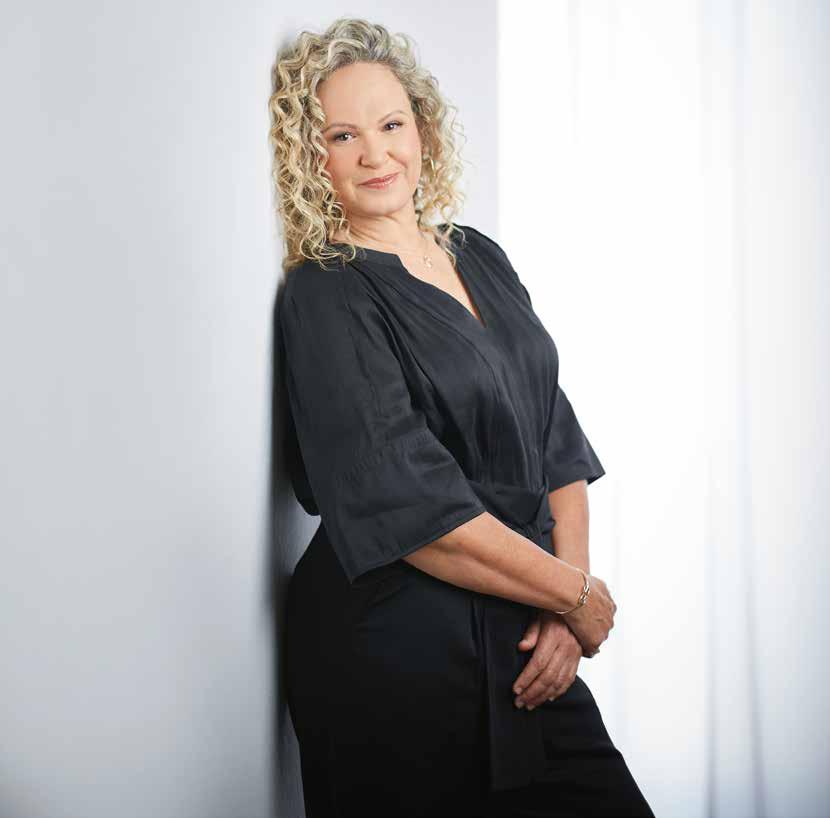
We’ve been lucky to meet many inspiring people who share their time, wisdom and stories with DARE, and it’s certainly the case again this issue. In our interview with cover star Leah Purcell (page 20), the AACTA Best Actress winner for 2022 opens up about drawing on her past experiences and those of her mother, grandmother and ancestors in her work, and how she is kicking down the doors of opportunity and now mentors the “rivers” of Indigenous talent flowing through the industry.
Issue: September-October 2022


I love colour. When young l was dressed in pastel shades, now old I wear bright, clean colours whenever possible. Black is just for emphasising the colour or a gorgeous bit of inexpensive jewellery.
Colour is great, but not to make you look younger. For heaven’s sake, let’s embrace maturity!
You could be right but I am stuck with what I have. Scarves to the rescue!
Quite a lot of my clothes are from op shops. I have managed a few really good buys. Plus it is fun.
I like to wear any colour, as long as it is black!
DARE also meets former Hunters and Collectors frontman Mark Seymour (page 18), who is supporting those whose lives have been touched by Alzheimer’s, as well as local hero and refugee champion Rosemary Kariuki (page 46), who has found a path to connection in her community. And funnyman Tom Gleisner reminds us to really appreciate the opportunities that come our way (page 90).
We’re also very privileged to share stories from folks that you might otherwise never get to hear from. If there’s someone you’d like us to celebrate, just drop us a line at daremagazine@ mediumrarecontent.com
Camille Howard EDITOR-IN-CHIEF

5 MARCH-APRIL 2023 DARE SENIORS.COM.AU FACEBOOK Australian Seniors WEBSITE seniors.com.au PHONE 1300 762 848 Monday to Friday 8am - 8pm
LETTER FROM THE EDITOR
Discover
08 A world of inspiration
What’s new and trending?
Home saunas, electric Kombi vans and cold brew coffee, all designed to inform, excite and improve your life. Includes cricket legend Wasim Akram’s new memoir, plus a chat with music icon Mark Seymour (below).

Explore
20 Leah Purcell
Blazing a trail for Indigenous storytellers
24 The feel-good factor
Wellness is a booming industry – but is it a scam?
30 Dance for life
Why moving to music is the best medicine of them all
34 Time to let it go
Bearing a grudge can play havoc with our health
38 Beating chronic pain
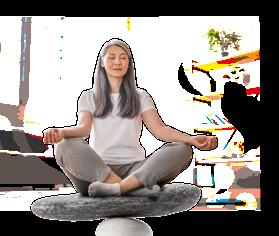
New ideas about how to treat long-term problems

Pla
n
72 Step back in time
Remembering the not-sogood old days of job hunting
74 Making plans
Reviewing insurance needs as you head to retirement
76 Money matters
Seven steps to help you sort your finances for the future
78 Special report
A decade-by-decade guide to health for ages 50 to 100
85 Sleep aids
42 Pet pampering Luxury treatments for your four-legged friends
46 Beating the odds
Two inspirational over 50s with incredible stories to tell
50 Travelling solo Our how-to guide on what
Indulge
56 Nagi Maehashi
The RecipeTin Eats creator cooks up a storm
60 Gardening guide
Australian planting tips in times of extreme weather
Beauty on a budget
We find the superhero ingredients at bargain prices
Use it or lose it
Puzzles and brain-teasers (Solutions on page 84)
Entertain me!
Our top picks for going out and staying at home
PHOTOGRAPHY & ILLUSTRATION CONTRIBUTORS
What gadgets can help you get a good night’s rest?
88 Living with grief
How to support yourself when losing a loved one
90 Tom Gleisner
The comedian on his biggest laughs and greatest regrets
Cover photography: Nick Cubbin. Hair & make-up: Anna Le. Styling: Maia Liakos. Styling assistant: Clare Youngman. Leah’s top: Country Road. Pants: Veronika Maine. Jewellery: Jan Logan. Getty Images. Tina Smigielski. Newspix. Alamy. ABC. The Jacky Winter Group. Disney. Destination NSW. The Illustration Room.
6 DARE MARCH-APRIL 2023 SENIORS.COM.AU
CONTENTS / MARCH-APRIL 2023
(18.) (34.) (24.)
(90.)
















VISIT UNIWORLD.COM/AU | CALL 1300 780 231 | SEE YOUR TRAVEL ADVISOR *Terms and conditions apply. Prices are in Australian dollars, per person in double or single occupancy as specifi ed, inclusive of port charges. Off er is subject to availability and change, and may be withdrawn without notice. Prices are correct at time of print. For more information visit www.uniworld.com/au THE YEAR TO REMEMBER SALE on select sailings in 2023 SAVE UP TO $3,000 * PP ON AN ALL-INCLUSIVE LUXURY RIVER CRUISE PLUS we’ve waived the single supplement on many sailings! NOW from $3,199*pp ONE-OF-A-KIND AWARD-WINNING SHIPS | THE MOST ALL-INCLUSIVE AMENITIES EXCEPTIONAL QUALITY | HIGHEST SERVICE STANDARDS | OUTSTANDING CUISINE THE MOST ALL-INCLUSIVE • Exquisite five-star cuisine & unlimited premium beverages • Carefully curated daily excursions & exclusive private experiences • Onboard Fitness Centre and Wellness Classes • Bicycles and Nordic Walking Sticks for onshore use • Ship-wide Internet and Wi-Fi access • Scheduled Airport Transfers • All Gratuities onboard
VOLKSWAGEN KOMBI
The famous and much-loved ‘hippie van’ with a storied past is now driving into an eye-catching electric future.
Words JAMES JENNINGS
No vehicle conjures up summertime, surfing and flower power quite like the humble Volkswagen Kombi, a minivan beloved around the world, but particularly in Australia.

With a name derived from a far less cuddly German word Kombinationskraftwagen (meaning ‘combination motor vehicle’), the Kombi began life as a sketch by Dutch Volkswagen importer Ben Pon in 1947, before going into production with the even less cuddly name, ‘Type 2’.
Using the same rear-engined, rear-drive layout as the iconic VW Beetle (aka Type 1), the Type 2 has worked through a slew of variants and names over the years, with the original 1950 model coming with only two side
windows and removable middle and rear seats. Although the Type 2 arrived in Australia in 1953, the classic Kombi with the split windscreen didn’t land here until 1965, selling for just under $2,500 (that amount was closer to $10,000 by the time availability dried up in 1980).
The Kombi became a bonafide pop-culture icon: it showed up on the cover of Bob Dylan’s 1963 album The Freewheelin’ Bob Dylan; it was the inspiration for The Who’s 1968 song Magic Bus; Libyan terrorists chased Marty McFly around in one in the 1985 film Back to the Future; and a hippie Kombi accurately named ‘Fillmore’ appeared in the 2006 Pixar film Cars
Just as famous for being cumbersome, not especially
8 DARE MARCH-APRIL 2023 DISCOVER / A WORLD OF INSPIRATION
THE ICON
powerful and even a little unsafe, the Type 2 ceased production in Brazil in 2013 due to more stringent safety regulations, its demise documented in the short film Os Ultimos Desejos da Kombi (The Kombi’s Last Wishes).
The spirit of the Kombi has been resurrected for the new Volkswagen ID.Buzz, an electric five-seater reinvention that has just hit roads in Europe. Australian baby boomers wanting to relive their youth will have a little longer to wait, as it’s not due Down Under until late 2024, at the earliest.


And while love can still be free, the ID.Buzz sure ain’t: it’s expected to sell for somewhere in the region of $100,000, according to a recent drive.com.au article. Hippies will shudder at the thought.

Top left and above: the reinvented Kombi, the electric Volkswagen ID.Buzz. Top: the classic minivan with the splitscreen windscreen.
The changing reign
God save the King! With the coronation of Charles III in May, we can expect plenty of pomp and ceremony – plus some practical changes for Australians.
SMALL CHANGE New coins bearing the King’s head arrive this year, but it’s been announced that Charles won’t replace his mother on our $5 notes. Meanwhile Queen Elizabeth II currency remains legal tender. Want to cash in? Certain $2 coins have rocketed in value since her death –check your purse for the 2012 Red Poppy coin and the 2013 Purple Coronation.
HAPPY BIRTHDAY, SIR This year, on 12 June, most of us will celebrate the King’s Birthday public holiday (his actual birthday is 14 November). The June date mirrors the UK, which marks the monarch’s big day near the start of their summer, in the perhaps optimistic hope of better weather for parades. Western Australia and Queensland will celebrate the birthday later in the year.
PASS THE PASSPORTS The travel documents currently proclaim Her Majesty Queen Elizabeth the Second on the first page, but will eventually “reflect the accession of His Majesty King Charles III”, according to the government.
WHAT ABOUT QUEENSLAND?

While there are no plans to change the state’s moniker (it is named after Queen Victoria), the monarch’s crown depicted on the flag could be updated to reflect whatever bling Charles wears at his coronation.
Words Lisa Sinclair.
FACING THE FUTURE Fancy a refurb? All Australian citizens are entitled to a free portrait of their reigning monarch, provided by their federal MP’s office. Queen Consort Camilla not included.
9 MARCH-APRIL 2023 DARE SENIORS.COM.AU
THE BLUFFER’S GUIDE TO
MODERN RETRO
SOME LIKE IT HOT
From wood-fired shacks to luxury infrared cabins, saunas have come a long way since their Nordic origins.
Words LISA SINCLAIR
There’s always been something slightly comical about saunas, invoking images of naked Norwegians throwing themselves into snowdrifts. Or hot, sweaty strangers packed into a tiny heated cabin on a scorching hot Australian summer’s day, in the less-than-salubrious surroundings of the local sports centre.
But the tradition of cleansing the body by relaxing in dried heat actually has noble origins. Saunas first arrived in northern Europe around 2,000BC; they were built in man-made caves heated by

fires lit under a pile of stones, and were vital for sustaining daily life in harsh winters. And while the method of heating of saunas has changed across the millennia, from wood, then electric and gas, and now infrared light, their main goal of creating a healthy lifestyle remains unchanged.
Devotees say they play a role in relieving pain and stress, and aiding weight loss and toxin release. Even in Australia, where saunas have historically been relegated to public swimming pools and gyms, we’re now appreciating that
saunas can deliver us the same warming and relaxing benefits of sunlight, without any of the dangers of baking in the sun’s rays.
We’re not yet quite up there with the Finns, who have 3 million saunas for their population of 5.5 million, most of them in homes and holiday cabins. But in Australia, home saunas are elbowing the home cinema aside as the latest must-have.
Marko Tossavainen, owner of Australian business Sauna HQ, says there has been a huge surge of interest in the past two years, prompted by COVID lockdowns.
10 DARE MARCH-APRIL 2023 DISCOVER / A WORLD OF INSPIRATION
“I have also seen a move towards more wellness retreat areas in the new homes that we are installing saunas into,” he adds.
The hottest trend is the infrared sauna. Unlike the traditional sauna, which produces steam from hot rocks to warm the air around you, the infrared version uses LED light technology to heat the body directly. “Modular free-standing infrared saunas have been very popular because of the low price and the ease to plug them into a powerpoint,” Marko says.
Even so, with prices for a basic self-assemble infrared design starting from $3,000, and a custommade sauna from $25,000, there is a risk the stress of paying for one will outweigh any positive impact it may have. But there is a cheaper alternative – the infrared sauna blanket means you don’t even have to leave the sofa. As promoted by the likes of Gwyneth Paltrow, these portable heat healers look like a cosy sleeping bag, fire up in 60 seconds and cost less than $600.
Still too expensive? Sauna chain City Cave is expecting to shortly hit 100 stores nationally, offering infrared sweat sessions for $44 for 45 minutes. Now that’s hot stuff.
THE TREND
SOME LIKE IT CHILLED
Coffee has a very long and popular history, with the latest trend seeing appetites cooling off, but in a good way.
Words STEPHEN CORBY
From its first appearance in 15th-century Arabia, where it was often enjoyed by Sufi mystics who wanted to stay awake during religious rituals, humankind has delighted in finding multiple ways to make and consume coffee.
We are so keen on the caffeinated bean, in fact, that coffee is the world’s most popular hot drink, with global sales expected to reach about $800 billion by 2025.
Cold brew coffee is the latest twist on how to serve up the drink that most people can’t imagine starting their day without, although you’d be forgiven for not knowing exactly what it is, other than what sounds like a fancier way of saying “iced coffee”.

“It’s pretty simple – it’s ground coffee, brewed cold,” says Corey Cresswell, co-owner of CBCB (Cold Brew Coffee Bar) in the Melbourne suburb of Brunswick. “The beans are immersed in water for 12 to 24 hours, so the distinct difference is that you’re brewing at cold or ambient temperature and that the
coffee is submerged in the water for an extended period of time.”
Although a recent Italian study found that cold brew coffee is the strongest type when it comes to caffeine content, Corey downplays the claim. “A cup of coffee from one shop to the shop next door is going to have distinctly different volumes of caffeine depending on the bean, the roast and the extraction method,” he says.
It doesn’t appear that the trend is going away, either. Starbucks has reported that 74% of its sales in the US summer are chilled coffee drinks, including cold brew ranges. “It’s just a beautiful way to consume coffee,” says Corey. “It’s obviously not exposed to heat, which takes a lot of that bitterness out and makes it naturally sweeter and easier to drink. It’s got lower acidity, too, so there are quite a lot of people who find cold brew coffee a lot easier on their digestive system.
“It’s not rocket science, it’s just beautiful, delicious coffee and people have been really accepting of it.”
11 MARCH-APRIL 2023 DARE SENIORS.COM.AU
Protect your precious home and its contents with Seniors Home & Contents Insurance. Call 1300 611 384 or go to seniors.com.au
Left: infrared saunas built in your own home are the big trend; this two-person design, complete with LED reading lamp, sits in a master bathroom.
WOMEN WE ADMIRE JANE CARO
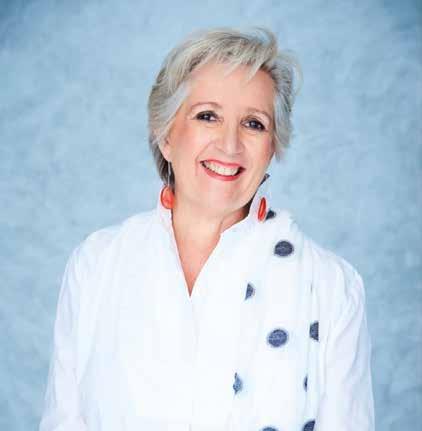
The fabulously forthright journalist, author and broadcaster certainly has a way with words.
Words JOANNA WEBBER Photography DAVID HAHN
If there’s one thing Jane Caro detests being called, it’s a strong woman. “People like to refer to me as a strong woman as if that’s the exception, as if most women are weak and only some of us are strong,” she tells DARE. “You rarely hear a man referred to as a strong man unless he actually works in a circus. Once again, the default position is that men are strong, women are weak.”
If not strong then, the
65-year-old media personality is a funny, clever and notoriously confrontational woman. “What I’m always trying to do, I think, is to help women recognise that they have been groomed to see themselves as weak. It’s the millenniumlong gaslighting of all of us.”
Born in London in 1957, Jane emigrated to Australia with her parents when she was five. She graduated from Sydney’s Macquarie University with a Bachelor of Arts
at the same time as her mother.
“It was 1975 and Gough Whitlam had abolished university fees, allowing many highly-motivated adult women to grab the chance previously denied them,” she says.
“But it was complicated ending up at the same university as my mother. I knew she definitely wanted to be there, but I was also deeply pissed off because I knew she’d vastly outperform me, which of course she did.”
Jane started out as an advertising copywriter, bagging national and international awards, but she was turned off by the “blokeyness” of the industry and eventually left. She has since appeared on Sunrise, Q&A and Sydney radio, but it was her role as a panellist on the ABC’s The Gruen Transfer that turbo-charged her columnist and public speaker career. And in the last federal election, the Reason Party invited Jane to run as a candidate for the Senate. “I knew it was a long shot, but I did it,” she says of her unsuccessful attempt. “I’d never run again. I’m happy writing my books. I’m better able to get my message across that way.”
The author of a dozen books, Jane’s latest novel The Mother is a dark thriller that deals with the grim realities of domestic violence. “I’m always writing about women and power. Mother is about the consequences of holding power.”
If she is remembered for anything, she hopes it is as someone who wrote well and made sense.
“For me, it’s always been about words,” she says. “Speaking them, writing them, using them.”
12 DARE MARCH-APRIL 2023 SENIORS.COM.AU DISCOVER / A WORLD OF INSPIRATION
Four types of plans available for eligible customers — Domestic, Essentials, Comprehensive and Multi-Trip1
Flexibility to cancel your policy if your trip is impacted by COVID-19 border closures or mandatory quarantine requirements and overseas medical cover if positively diagnosed1



Offers cover for things like loss of/ damage to luggage and/or personal effects, cancelled/delayed travel, personal liability, and rental vehicle excess1





Pre-existing medical condition cover may be available on application

Simple online claiming process






• • •

SETTING THE RECORD STRAIGHT
He’s regarded as one of the world’s greatest bowlers but in his new memoir, Wasim Akram, 56, reveals the painful dark side of his celebrated cricket career.
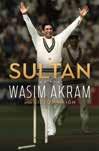
From being worshipped like a god to having his home pelted with stones by his countrymen, Wasim Akram’s life has been one of highs and lows. The former Pakistan cricket captain has been investigated for match fixing and struggled with cocaine addiction and yet is still revered as possibly the greatest exponent of swing bowling the game has ever seen.

Throw in the fact that his pre-fame life started when he was brought up in a tiny, two-room home in Lahore, where he slept next to his grandmother until he was a teenager, and that he was discovered as a prodigy while playing cricket with a tennis ball in the street, and it’s clear why the
sports legend has found plenty to say in his memoir Sultan (a nod to his nickname, the Sultan of Swing).
For almost two decades, Wasim’s cricket did the talking, and Australian cricket fans may well remember a feeling of fear for even our team’s best batsmen whenever the silky smooth bowler hurtled towards them. He took more than 900 international wickets in his career, none more spectacular than the three that helped his country destroy England’s hopes in the 1992 World Cup final.
His captain in that game, Imran Khan, said he had never seen “a cricketer with such natural talent”. You might have
16 DARE MARCH-APRIL 2023 DISCOVER / A WORLD OF INSPIRATION
Words Stephen Corby. TRUE STORIES
SULTAN (Hardie Grant Books, $45, out now).
forgotten that he could also bat a bit – to this day, no-one has ever hit more sixes in a test innings.
A man you might have thought would hold that record, the great West Indies cricketer Sir Vivian Richards, says a bouncer he received from a fired-up Wasim was the fastest ball he ever faced.
Wasim’s place in the pantheon, then, is undeniable, but by the time the 1996 World Cup rolled around he was being accused of faking an injury to fix a match, and his country turned on him. “I was being execrated by politicians,” he recalls. “I was being burned in effigy. Posters of me were being defaced. My mother received threatening telephone calls. My home was pelted with stones.”
Wasim faces, and denies, the matchfixing allegations levelled against him in the book, which he co-wrote with awardwinning Australian cricket writer Gideon Haigh. But he reveals, for the first time, that he developed a ruinous cocaine habit after his playing days finished, in an attempt to replace the highs the game had given him.
He also writes about the heartbreaking death of his first wife, Huma, the mother of his two sons, from a rare fungal infection. “It was tough to revisit those moments in my life – the betrayal, the tragedies –but the reason for doing the book wasn’t money,” says Wasim.
“I probably wanted to forget. I’ve been diabetic for 25 years and didn’t want the stress. But my sons are 25 and 21, my younger daughter is almost eight and it’s my story for them. And my [second] wife, Shaniera. They all wanted to know what happened, my side of the story, because they have heard stuff about me.”
As you might expect, the book is a rollicking read, and an honest, excoriating look at one of the game’s greats.
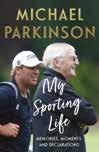
A keen sportsman, Sir Michael Parkinson left school at 16, with the ambition to play cricket for Yorkshire and England and to write about the game for the Manchester Guardian. As his new autobiography reveals, the legendary chat show host didn’t quite fulfil the first half of his dream (he did play for the Yorkshire seconds), but he has gone
on to a stellar journalism career that has managed to include his love of sports. Full of personality, anecdotes and insight, 87-year-old Michael’s memoir reflects on his own family and sporting life, including a special focus on his relationship with the late Shane Warne, as well as his friendships with other legends of sport. Out now.
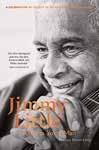
The biography tells the incredible story of one of Australia’s most acclaimed Aboriginal pop and country music legends, the late Jimmy Little. At just 16 years of age, Jimmy travelled to Sydney to make his radio debut, entering the entertainment industry at a time when First Nations people were not counted
in the census. In the face of discrimination, Jimmy would go on to captivate the nation with songs that consistently topped the 1960s music charts, winning many prestigious awards. And now his daughter, Frances PetersLittle, tells the full story behind her father’s life and six-decade career. Published on 5 April.
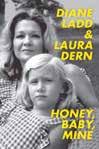
In this deeply personal book, award-winning actress and activist Laura Dern, 55, comes together with the woman she admires most, her mother and legendary actress Diane Ladd, 88. Taking readers on an intimate tour of their lives through a collection of candid conversations, they share
their most honest views on love, life, success, and everything in-between. Peppered throughout these exchanges, Laura and Diane enclose personal photos, family recipes and more. The foreword is penned by fellow Hollywood star Reese Witherspoon. Published on 26 April.
17 MARCH-APRIL 2023 DARE SENIORS.COM.AU
MY SPORTING LIFE by Michael Parkinson Hachette Australia, $34.99
JIMMY LITTLE: A YORTA YORTA MAN by Frances Peters-Little Hardie Grant, $45
HONEY, BABY, MINE by Diane Ladd and Laura Dern Hachette Australia, $32.99
WEAR IT WITH... LIKE THAT TRY THESE
PAY IT FORWARD MARK SEYMOUR
The former Hunters & Collectors frontman on supporting families touched by Alzheimer’s and the role that music can play.
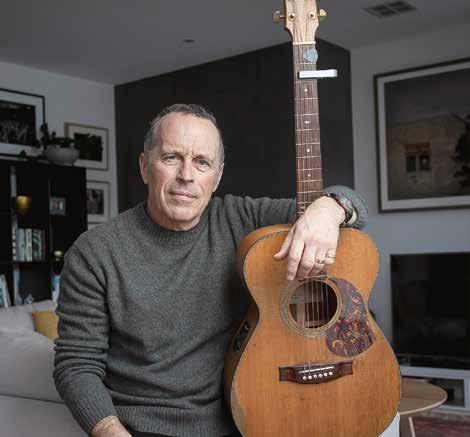
Words MONIQUE BUTTERWORTH
Facing an Alzheimer’s disease diagnosis – whether it’s yourself or a loved one – can be overwhelming. And while everyone’s journey is vastly different, it’s not a tragedy, says Mark Seymour.
While dementia is an umbrella term for symptoms of brain disorders, Alzheimer’s is a physical brain disease, resulting in impaired memory, thinking and behaviour that gets worse over time.
“It’s very, very sad but it’s a disease. You have to remind yourself of that. There’s no guilt or blame attached,” says Mark. “It’s a condition someone acquires over
time and they should be treated with dignity and respect.”
The 66-year-old musician and vocalist is best known as the former frontman of Hunters & Collectors. With a music career spanning four decades, he has forged a successful solo career since the band broke up in 1998, although he has returned to the helm of Hunters & Collectors for various reunions. One of four children, his brother Nick Seymour is also an Australian music icon, as a member of Crowded House.
More recently, Mark has become an ambassador for Dementia Australia. The role came about after
the charity heard his 2011 song Classrooms and Kitchens, which he wrote about his mother Paula’s experience with Alzheimer’s.
“It’s a very simple song that bookended her life. A really early childhood memory of her in the kitchen at Corryong [in rural Victoria], contrasting with where I was with her towards her death in the nursing home at Kew [Melbourne],” says Mark, whose mother passed away in 2015.
“I took on the ambassador role as a means of helping people to understand what they can expect to deal with,” he explains. “I’m offering more emotional support than anything else.”
Mark in his own words
The musician reflects on his family’s journey of “learning the ropes” following his mother Paula’s shock diagnosis.
Mum wasn’t diagnosed with Alzheimer’s disease until it was quite advanced. Her early signs were fairly subdued. We didn’t really know. It gradually became more apparent. The family dialogue emerged over time that “she’s probably got Alzheimer’s” but the GP said she was managing OK. Dad was looking after her. I think our story is pretty typical, really.
A conversation with my sister Helen was the clincher. She thought things were getting bad at home and Dad was struggling. Dad was very reluctant to abandon his responsibilities. It was very
18 DARE MARCH-APRIL 2023 DISCOVER / A WORLD OF INSPIRATION
difficult for him. They had been married for decades. He loved her very much so he didn’t want to admit he couldn’t cope anymore. He was dropping hints though. So, we went to see her and Mum had a pretty severe urinary tract infection, which we later learned can trigger delusional thoughts. She was paranoid, imagining things happening that weren’t, she was out of control. We took her to see a doctor and she was hospitalised that day.
A whole lot of things had to be planned very, very quickly. The journey with my Dad to find somewhere for her to go took weeks. It really opened my eyes to what all these aged care facilities are about.
With Alzheimer’s, typically people are not prepared for it. Those initial days were really traumatic. Especially watching the effect it had on Dad. But gradually, we just knew eventually things
would settle down. We just had to learn the ropes. We found the right place for her to go. After that, the long stretch before her death was just settling into a routine of weekly family visits.
It’s really hard to know how much solitude is bearing down on them, but Mum did definitely settle down. Mum was very aware when we moved her out of the house. She knew something really catastrophic was taking place and that was really frightening for her. That’s probably the most traumatic thing you need to engage with in the process.
I reached a point where I would just drop in and spend an hour sitting in her room with her and the sun coming in the window, just holding her hand. And that would be enough. That quiet solitude and restful state would never have happened with my mother if she had not gotten Alzheimer’s. I just started counting my blessings really, which you’ve got to do.
Music can provoke memories and feelings and strong connections with those diagnosed with Alzheimer’s or dementia. We discovered early on, even when Mum was unable to articulate things, express what she needed, ask questions or have normal conversations, if you started singing a song she knew, she would break into it.
She’d remember songs first. Even after she forgot or lost track of where she was or who the people in the room were, songs would come back to her quite easily. My sister Helen created a song list of favourites for us to sing. Mum had several favourites, but Danny Boy was most evocative.
I sang with my brother Nick recently on stage with Crowded House in Hobart and Melbourne. It was fairly impromptu and it struck me just how much those guys really like each other. They’re incredibly good musicians. Being immersed in that world for a few days, being around people who really love what they do was sensational.
From the outside, people look at bands and see it as a glamorous form of entertainment. They see it on one level but inside, bands can be quite different. Crowded House are really exceptional in that way. They have a really strong family bond between them and it was just great to be around that.
Mark Seymour is currently travelling the country as part of the Red Hot Summer Tour, with dates until 13 May. Go to page 70 for details.
19 MARCH-APRIL 2023 DARE SENIORS.COM.AU
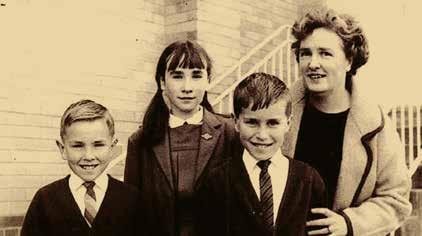
Mark is photographed standing next to his mother Paula in 1967, with his younger brother Nick and sister Helen.
Kicking down the doors
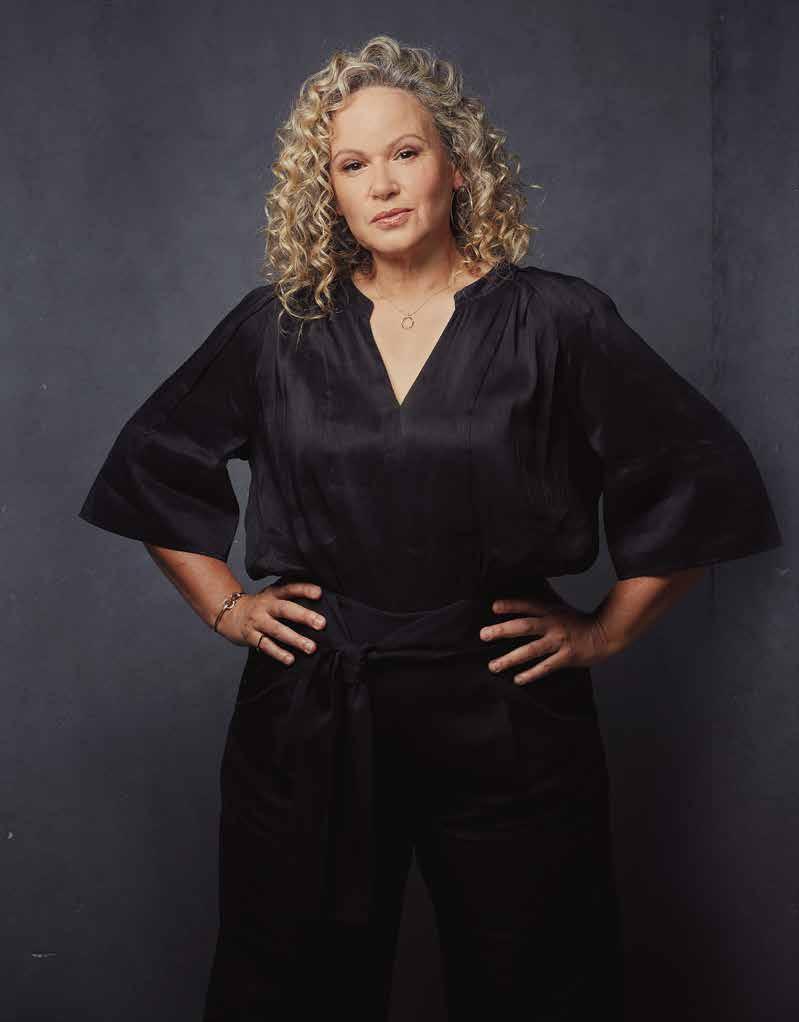
She’s never had any formal training, but that hasn’t stopped Indigenous actor, director and storyteller Leah Purcell from becoming one of Australia’s most celebrated stars.
Words BEVERLEY HADGRAFT Photography NICK CUBBIN
AS A KID, LEAH PURCELL WANTED to be Doris Day. Her mother, Florence, told her that as an Indigenous, C-grade student from the Queensland bush, her career options were the meatworks or nursing.
Leah put her dream aside to care for her beloved mother but when she was 18, Florence died and, distraught, she suddenly remembered: “Didn’t you want to be an actor?” And with that she climbed into her Datsun Sunny, put her new baby Amanda in the back seat and set off.
Now 52, Leah isn’t just an actor. She’s also a writer, director, producer, novelist and muchloved mentor to other Indigenous people. “The floodgates are open and the rivers are running with Indigenous talent, mate,” she tells DARE.
“It’s awesome to see. I feel humble when they say: ‘Leah, you were at the forefront, making those little tracks into highways and now we’re all cruising down, doing our thing.’”
That Leah even finds time to help others when her personal workload is so ferocious is testament to her generous spirit. Since moving to Sydney in 1996 and launching her TV career, it feels as
if she’s constantly been on our screens. Her TV roles have included Police Rescue, Redfern Now and Wentworth and she was in the films Lantana, The Proposition and Jindabyne. Plus she’s been thrilling theatregoers since her semi-autobiographical, one-woman show Box the Pony hit the stage in 1997.
However, she doesn’t just wait to be offered great roles, she creates them herself then finds the cash and logistics to get them produced, the most notable being her super-successful franchise, The Drover’s Wife. Her play, novel and film have won awards from all over the world.
Leah was five when she first heard Henry Lawson’s short story about a woman sitting with her children, watching for a snake hiding under their hut. She’s turned the story inside out, giving the woman an Indigenous heritage, a name, Molly Johnson, transforming it into a raw piece of truth-telling about early settlement and the way women and Indigenous people were treated.
She’s used the records of her ancestors and those in authority at the time to inform her writing and woven her own Songlines and Dreaming through it.

21 MARCH-APRIL 2023 DARE EXPLORE / AGE OF REASON
>
Tickets for the first run of the play in 2016 sold out in four days and on opening night, the audience jumped to their feet as one and were cheering even before the lights had gone up, she recalls.
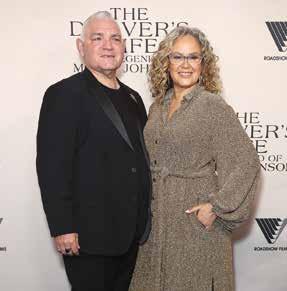
Leah was writer and lead actor for that production. She added the jobs of director and co-producer for the 2022 film version, The Drover’s Wife the Legend of Molly Johnson.
The story is intense and, finally, profoundly shocking. To have inhabited the character of Molly for so long must have been harrowing. “I think you have a responsibility as an Indigenous woman and a writer to not shy away,” she says.
“I didn’t hold back but I did it with care. I didn’t just beat people over the head. I wanted to be truthful because of the silence of my mother, grandmother, great-grandmother and great-grandfather, Indigenous people who were gagged and couldn’t speak their truth.
“There were circumstances where my Mum couldn’t even lift her head and look people in the eye because she’d have been considered a ‘forward Black’ and been punished.”
Leah wrote the backstory of her characters in the novel The Drover’s Wife , published in 2019, which has won
LIFE OF A TRAILBLAZER
1970
Leah is born in Murgon, Queensland, the youngest of seven children to Goa-Gunggari-Wakka
Wakka Murri woman
Florence (right), who died of bowel cancer when the actress was 18. “She was my mother, she was my father, she was my hero,” says Leah.
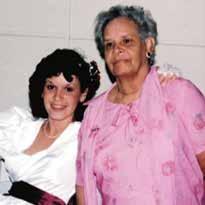
multiple literary awards. She’s already working on a follow-up TV series about Molly Johnson’s children (with one of the Indigenous writers she mentored) and has plans for a second novel.
“Everything I learned over the past 30 years, I’ve applied to this franchise,” she says. “I put my maturity and experience into it and it’s paid off. It’s nice at this age to say: I’m doing all right – and I’ve got another 40 or 50 years in me yet.”
To say she’s “doing all right” is an understatement. But it’s been the result of hard work, passion and discipline.
Fellow actor and friend Deborah Mailman has observed that Leah never takes no for an answer. “She doesn’t just open doors, she kicks them off the hinges.”
Leah laughs at that. “If you don’t kick the doors off you won’t get anywhere,” she says. “This is a tough industry, especially in Australia. You always have to hustle and you’ve got to have a thick skin because this is an industry that works on critiquing people.
“I wouldn’t be pushing anything that wasn’t of standard and there’s no ego with me, mate, but I believe in myself and that what I have to share is something that makes a change in people and our country.”
She’s not formally trained but is a great observer, never one to sit in the Green Room when she could be learning from others. Meanwhile, the starring role in her support cast goes to life and business partner, Bain Stewart.
“I dreamt him!” she says. “Six months later, when I met him, I said: ‘It’s you!’ Our paths were meant to cross. He’s a gift from the ancestors. He supported my dream, which became our dream, and he became my manager and producer of my work. If I hadn’t connected with him, I’m not sure I’d be exactly where I am today.”
EARLY 1990S
By now a single mother to young child Amanda, Leah meets her life partner, proud Ngugi-Goenpul-Noonuccal Murri man Bain Stewart, in Brisbane while she is training to be an aerobics instructor and he is running a martial arts gym. Today the couple’s production company, Oombarra, works across film, TV, theatre and literature.
2016
Already a star on stage and screen, Leah turns Henry Lawson’s 1872 story The Drover’s Wife into a powerhouse play about an Indigenous woman in colonial Australia who will do anything to protect her children. Much-lauded book and film versions follow.
22 DARE MARCH-APRIL 2023
Leah with her life and business partner Bain Stewart: “He’s a gift from the ancestors.”
Bain is also Indigenous and a former Australian kickboxing champion, another connection. Leah comes from a family of boxers. Her father – a white man with a separate white family who barely acknowledged his seven Indigenous children and their mother – was a boxing trainer and her brothers and nephews held a variety of Australian and Queensland titles.
“I’d jump in the ring too when I was little but, in those days, girls didn’t box so I became the spit bucket girl,” she laughs. “I never missed! I’ve got great reflexes. I can still catch glasses falling out of cupboards.
“That was one of the things when they approached me for the role of Rita in [prison drama] Wentworth. I said: ‘You know I can box?’ and they said: ‘Yes, we’d like to utilise this.’”
She still speaks proudly of the prison fight scene in which, at 48, she refused her own stunt double, instead fighting a stunt double boxer half her age. “I told her to go half pace and I’d go full pace and it was unreal. Everyone was cheering but I was buggered at the end!”
Of course, Leah being Leah, she didn’t just act and do her own stunts, she also finished writing The Drover’s Wife novel
during Wentworth filming. “The assistant director said: ‘What are you doing? Writing your life story?’ and I said: ‘Yeah, kind of.’ But, you know, we women, we’re good at multitasking. And that’s how we keep doing what we’re doing.”
Although Leah laughs as she yarns, it should be acknowledged TV and film is not always kind to older women so she’s not alone in creating her own vehicles –fellow Australian Nicole Kidman being another example.
“That’s how we’re going to keep our foot in the door – taking charge and
saying: ‘I can create this’,” Leah says. “I love ageing. I’m embracing my wisdom. My career is where I want it to be. I’ve got plans for the future so it’s a case of staying mentally and physically strong so I can achieve them.”
She’s starring alongside another legendary older actress in her next role, in TV series The Lost Flowers of Alice Hart, the story of a girl who loses both parents and goes to live with her grandmother June on a flower farm. Leah takes on the role of Twig, June’s right-hand woman, with June played by Sigourney Weaver.
“When they offered me the role and said I’d be playing against Sigourney Weaver, I said: ‘Yes thanks!’ I felt very happy at the thought of breathing in the same oxygen as her. Watching Sigourney work was truly a treat. I can’t wait for everyone to see it.”
So what’s next for Leah? “I’ve got a few projects in the pipeline, mate,” she says. “But I’ll take whatever the ancestors gift me with.”
The Drover’s Wife the Legend of Molly Johnson is available on streaming services. The Lost Flowers of Alice Hart will screen on Amazon Prime and Wentworth is on Foxtel and Binge.
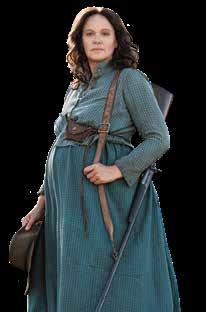
2022
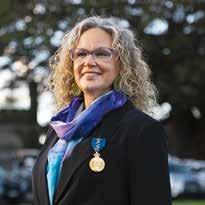
Leah takes a starring role in the final three seasons of hit TV series Wentworth, as inmate Rita Connors. In 2021 she is appointed a Member of the Order of Australia for significant service to performing arts, to First Nations youth and culture, and to women (right).
Finishing up filming on TV series The Lost Flowers of Alice Hart, starring Sigourney Weaver, Leah caps a triumphant year by winning Best Lead Actress for The Drover’s Wife the Legend of Molly Johnson (in character, right), at the 2022 AACTA Awards. The film was also nominated in 12 other categories, including Best Direction and Best Film.
23 MARCH-APRIL 2023 DARE SENIORS.COM.AU
2018-2021
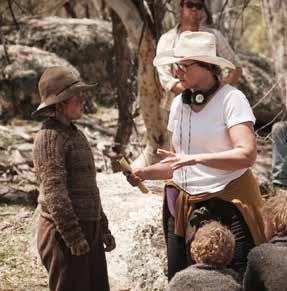
Leah directs Malachi Dower-Roberts, who plays her character’s son Danny in the film The Drover’s Wife
Snake oil or salvation?
The global wellness business is booming, but some experts say it doesn’t measure up to the hype. DARE takes a dive into the good, bad and ugly sides.
Words JOANNA WEBBER
THE WELLNESS SPACE HAS EXPLODED into the mainstream. Locked down during the COVID pandemic and wanting to live better, healthier lives, consumers worldwide scrambled to boost their immunity levels and improve their mental health.
Google trends analysis shows searches in categories such as self-healing, fitness, organic and mindfulness have grown 21% year-on-year since 2020. Searches on mental health reached an all-time high in 2021, and meditation apps like Headspace and Calm have gone viral.
According to the Global Wellness Institute, the wellness market, which includes spiritual self-care products, has grown in value by more than 6% since 2017 to $6 trillion. The US has the largest market slice, and China comes second. Australians, meanwhile, have moved up to sixth place in the wellbeing spend per capita, forking out an average of more than $5,000 a year each. So what are these devotees buying into and does the wellness industry deserve the hype?

MODERN IDEA WITH ANCIENT ROOTS
Wellness is a modern word that traces its origins back to the ancient civilisations of India, China, Greece and Rome, which all promoted forms of self-care and preventative health. The Global Wellness Institute defines wellness as “the active pursuit of activities, choices and lifestyles that lead to a state of holistic health”, and today’s movement can involve healthy living, self-help, self-care, fitness, nutrition and spiritual practices. It’s not a static state but rather an active process, where people make choices that lead to a state of optimal health and wellbeing.
Supporters of the wellness industry say that such practices can benefit physical and mental health, offer emotional, spiritual and environmental wellbeing and encourage meaningful social connections. Critics say there is little difference between wellness and a fad diet. “There are so many diets for the general public and wellness is a more holistic way of approaching a healthy lifestyle; whether they say this is a diet or not, it is a diet,” says Louise Foxcroft, a historian and author
24 DARE MARCH-APRIL 2023 EXPLORE / THE BIG ISSUE
>

25 MARCH-APRIL 2023 DARE SENIORS.COM.AU
THE EVOLUTION OF WELLNESS
of Calories and Corsets: A History of Dieting Over 2000 Years. “It’s a regime to live by and the idea is that you would be slim, because healthy is seen as slim, so there’s no getting away from it.”

When it comes to wellness and weightloss products, people are willing to try almost anything if it sounds healthy. And the wellness industry comes up with some weird and wonderful options. From a diet that cures depression to drinking moon milk before bed, there’s no shortage of products to cater to the trend.
Some claim to de-bloat, de-stress and eliminate anxiety. It seems all that’s needed is the approval of one doctor, an industry-funded study, and a celebrity willing to promote it, and ka-ching! But does wellness actually have any advantages?
HOLISTIC APPROACH
Yes, there are plenty of benefits, says Michelle Winrow, a wellness coach in Byron Bay, NSW who specialises in ‘holistic wellness’, using coaching and practical tools to enable people to build healthy lifestyle habits. “Clients come to me for all sorts of reasons,” says Michelle. “I have the utmost respect for doctors, but a GP just doesn’t have the time to identify conditions with respect to wellness. If you’re not sleeping well, for example, your doctor
simply won’t have the time to address the possible reasons why.”
With more than 20 years of experience and a degree in public health, Michelle says Australia is far more open to the idea of wellness coaching than ever before, but still warns not everyone in the space is kosher. “There are definitely people out there who can sell you a green smoothie and call it wellness coaching,” she says. “It’s annoying, but true. If you’re going to
26 DARE MARCH-APRIL 2023
Source: Global Wellness Institute.
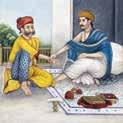
3000-1500BC Ayurvedic medicine
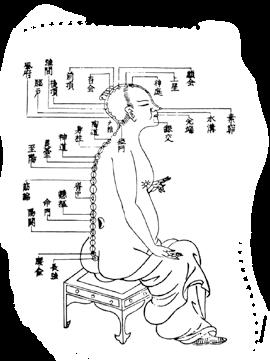
3000-2000BC Traditional Chinese medicine
500BC Ancient Greek medicine
1790s Homeopathy Samuel Hahnemann, physician, Father of Homeopathy
1860s Hydrotherapy
“I have the utmost respect for doctors, but a GP just doesn’t have the time to identify conditions with respect to wellness.”
MICHELLE WINROW Wellness coach
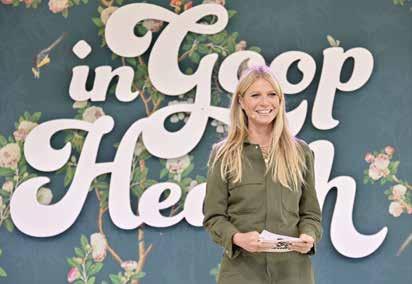
Hollywood actress Gwyneth Paltrow runs wellness website Goop.
1950s Organic farming

1890s Chiropractic
engage in any professional relationship, you need to do your research. Check their qualifications, ask how much experience they’ve had, and read the testimonials on their websites.”
When it comes to formal qualifications, interest in wellness courses is booming. Dr Shuai Zheng, head of the Chinese Medicine Department at Sydney’s Endeavour College of Natural Health, says he has seen a 56% increase in the number of students enrolling in Chinese medicine courses between 2018 and 2020.
“There has been a significant shift in information, and how we access information, because of social media and the internet,” says Dr Zheng. “Previously, doctors and scientists were the gatekeepers of this knowledge. Now there’s a growing realisation of the importance of health and more people are wanting to do their own research. Self-empowerment is becoming a huge thing.”
Dr Zheng stresses the importance of doing your homework before heading online. “You don’t always know who is posting online, so if you’re interested in any alternative therapy, speak with someone who is trained in that area. Check that they are accredited and registered and if what they’re claiming sounds too good to be true, it’s probably not true.”
1970s World’s first wellness centre opens in California
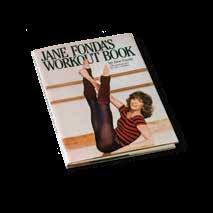
1980s
Wellness goes mainstream with workplace programs, fitness spas and self-help experts 2010 Wellness goes global

CELEBRITY MONEY-SPINNERS

Some big names have been quick to capitalise on the popularity of the wellness industry. Iconic model Elle Macpherson, 58, has a wellness website, WelleCo Australia, which promotes plant-based beauty products and supplements. Launched in 2014, the site’s products include The Goddess Elixir, which promises to support women through all stages of menopause and costs $60 for a month’s supply.
Another high-profile wellness promoter is Hollywood star Gwyneth Paltrow, 50, who was once known for her blockbuster movie roles, but is today focused on running her lucrative website Goop,
which sells ‘cosmic health’ products. Goop started as a newsletter Gwyneth sent out to celebrity pals from her kitchen in 2008, and has since been valued at $370 million.
The company is known for selling bizarre products with hefty price tags, including a $4,000 spirit-animal ring and gold dumbbells priced at $190,000. In 2018, Goop was ordered to pay $215,000 in civil penalties in California for making “unsubstantiated claims” about its jade and rose quartz egg-shaped stones, which promised medical benefits such as balancing hormones, regulating menstrual cycles and increasing bladder control.
IS IT ALL A CON?
Separating the research from pseudoscience isn’t always easy, and Sydney GP Dr Brad McKay, author of Fake Medicine: Exposing the Wellness Crazes, Cons and Quacks Costing Us Our Health, sees patients “getting ripped off” all the time.
“People are taking supplements and having treatments that are not doing them any good and that could potentially be doing them harm,” says Dr McKay. “There are electrical devices for pain management that don’t work. Just the other day I saw online that sleeping with onions in your socks will help detox your feet.
27 MARCH-APRIL 2023 DARE SENIORS.COM.AU
Daniel David Palmer, founder of the chiropractic profession
2012 First UN World Happiness Report
SELF-HELP GURU TONY ROBBINS
“People are taking supplements and having treatments that could potentially be doing them harm.”
>
DR BRAD M c KAY GP and author
“These cons get recycled all the time. But it’s a tragedy when someone with cancer is trying to cure themselves by using infrared saunas or oxygen therapy, and getting nowhere. People spend tens of thousands of dollars travelling to Germany to go to a sauna that promises them the world then get no result. It’s very hard not to get caught up in the hype.”
Professor Tim Caulfield, host of the Netflix documentary series, The User’s Guide to Cheating Death, which investigates wellness practices and claims, also urges caution. He says companies and brands do a very good job of marketing their products, making them sound legitimate when they’re not.
“It’s becoming increasingly difficult to separate fact from fiction,” says Professor Caulfield. “Magazines, television and countless internet articles tout new therapies, diets and health trends as the secret behind a happier, healthier and longer life. Modern medicine has its shortcomings, absolutely. But when it fails us, should we be looking to potentially dangerous wellness fads for a solution?”
Others, including consumers, see the wellness industry as exploitative, particularly of women. “I think a lot of wellness brands prey on women’s insecurities and vulnerabilities,” says 62-year-old artist and wellness sceptic Toni Crosby. “I used to spend a fortune on beauty products and feel-good treatments. I’ve sat inside hyperbaric chambers. I’ve done intravenous vitamin therapy. Whenever I was feeling low, these treatments would boost my confidence and they made me feel better for a while. But it didn’t last.”
Retired small-business owner Colin McLean, 64, has been practising alternative health therapies since he was a teenager.

When I was about 16 or 17 and playing rugby, our coach was a practitioner of Chinese medicine and a kung fu instructor. He had a holistic approach to health and wellness and, when I was injured, he introduced me to acupuncture and Chinese massage.
Of course, when I told my mates, they all said it was rubbish. There was more of a stigma attached to it back then. If I’d gone to my doctor, I would have been prescribed painkillers, but the acupuncture and massage worked. Over time, it opened my mind to trying alternative health approaches rather than just taking prescription drugs.
That same coach also introduced me to stretching and eventually to yoga. It was probably around then that I experienced meditation the first time, too, because a lot of it was laying still and just breathing, relaxing, listening and being aware. In my early 30s I started going to yoga classes more regularly and then to yoga retreats. I enjoyed the physical aspects of it, and I
found it very calming. When you do the stretches the right way, there’s an immediate release of tension in your body, which in turn impacts on your mental state.
I was a little apprehensive about doing my first full-day retreat. I was wondering what on earth we were going to do to fill in that time! But it involved a combination of yoga, meditation and open discussion, as well as sharing a meal together.
There’s also a mental and spiritual side to it. In fact, a lot of the benefit I experience comes from doing yoga with other people. We all share a mutual appreciation about what we’re doing. My wife and I do a lot of yoga and stretching at home and we both meditate. It’s a way of taking time out from the pressures of life.
It’s not just the physical benefits and the resting of the mind, there’s a creative aspect too. Instead of mulling things over, I find I’m often able to solve problems and resolve issues within minutes by fully relaxing my mind and body. It’s quite remarkable.
57% think they are in good health, physically and mentally.
86% make improving or maintaining their health a high priority.
24% practise mindfulness to maintain good health.
14% are enjoying a greater focus on self-care after the pandemic.
To see the full results of The Australian Seniors Series: Cost of Health research, go to seniors.com.au and search ‘cost of health’.
28 DARE MARCH-APRIL 2023 SENIORS.COM.AU
“It’s a way of taking time out from the pressures of life”
WELLNESS BY THE NUMBERS: A SURVEY OF AUSTRALIANS OVER 50 FINDS…
CASE STUDY














































































































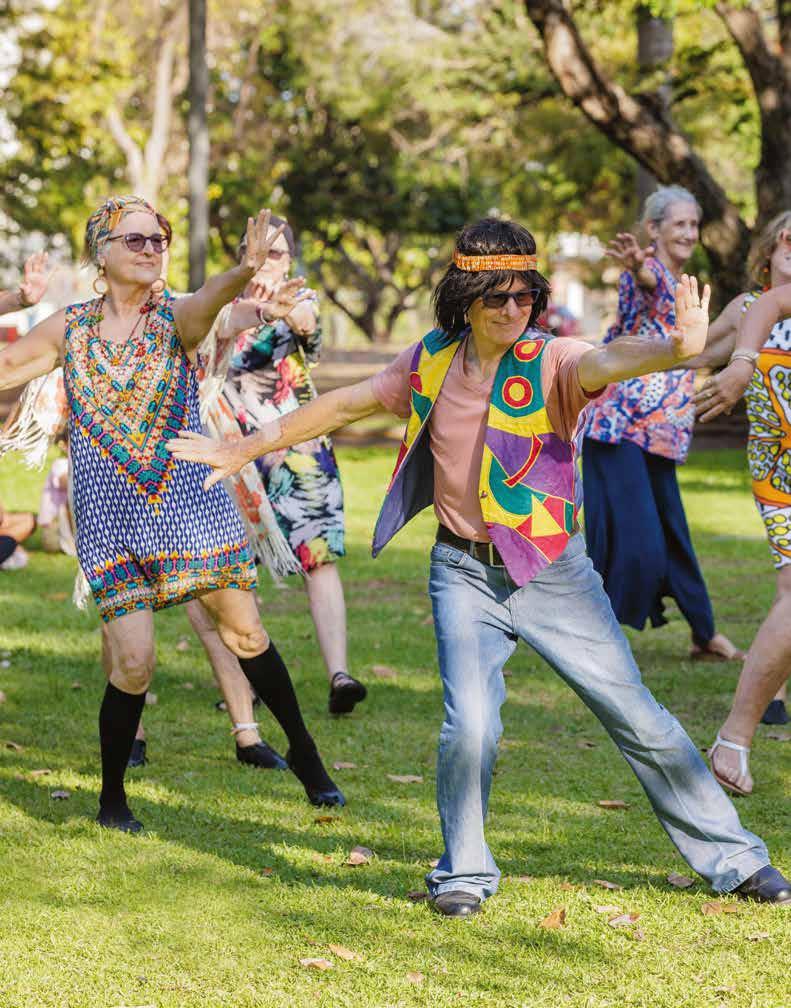
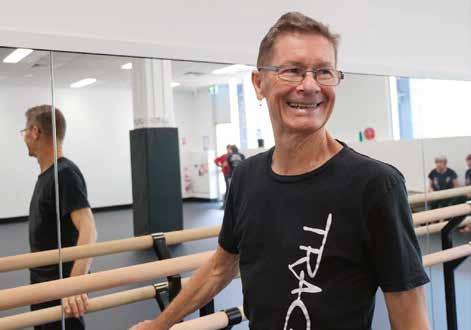
Darryl Butler, 75 (centre) performs with his seniors dance group the Grey Panthers in Darwin. Read his story on page 33.
Get into the groove
Not everyone loves exercise, but most of us enjoy moving to music. The good news is that dance is one of the best exercises you can do, with benefits for the body and the brain, no matter how mobile you are.
Words BEVERLEY
IF A PHARMACEUTICAL COMPANY announced it had created a pill that was effective in reducing dementia, falls and weight gain, improved balance, memory and core strength and treated arthritis, Parkinson’s and depression, there would be a queue around the block for it. Well guess what? There is such a remedy and, even better, it comes with a side effect of fun. It’s called dance.
From ballroom to belly, tango to tap, swing to salsa and lambada to line, dance has a range of impressive physical and mental benefits, says Victorian dance teacher and educator Dr Katrina Rank, who works with older Australians. “Quality dance programs have the potential to ease pressure on health budgets by providing activity that engages individuals, physically, mentally, socially, intellectually and creatively.”
A former professional dancer herself, Dr Rank now trains teachers and creates classes and troupes for seniors – even if they’ve never danced before, or are too immobile to get out of a chair.
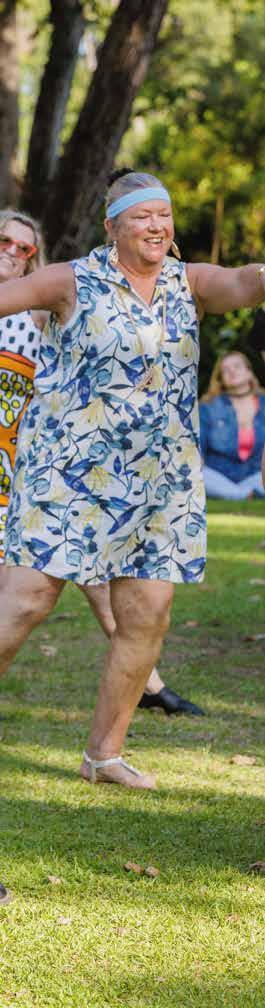
Although we all know physical activity is important, dance has particular benefits. The most startling of these is the impact on the brain. Internationallyrespected gait and cognition expert Dr Joe Verghese studied nearly 500 people over 75 for five years for his Leisure Activities and the Risk of Dementia in the Elderly research.
He found that regular dancing reduced the risk of dementia by 76%, more than twice as much as reading. Doing crossword puzzles at least four days a week reduced the risk by 47%, while cycling, golf and swimming offered no benefit. His conclusion? While dance is seen as recreational, its clinical value is being overlooked.
Dr Verghese is among the experts Dr Rank cites in her research and teaching modules for Ausdance Victoria – although it was the need for social connectedness that first sparked her interest. “Arthritis in my ankles meant I came to a point where I couldn’t attend a regular dance class and I became miserable and lonely. I wanted to
31 MARCH-APRIL 2023 DARE EXPLORE / FITNESS
>
HADGRAFT Photography DUANE PRESTON / TRACKS
share the energy and camaraderie of doing something creative with other people.”
Her immediate solution was to train to teach dance to those with Parkinson’s, before forming Fine Lines, a contemporary dance troupe for mature dancers. It was this that made her appreciate the cognitive benefits of the exercise.
Using improvisation and creativity (rather than memorising specific steps as she had during her ballet career) creates new neural pathways, she explains. “I could feel my brain tingle!” And the theory is that the more pathways your brain has, the greater the improvements in concentration, memory and problem solving.
Dr Rank quotes the work of the late neurologist and Alzheimer’s expert Dr Robert Katzman, who found that freestyle social dancing, such as foxtrot, waltz and swing, were also particularly good for the brain. “They require constant, split second, rapid-fire decision making, which
is the key to maintaining intelligence because it forces your brain to regularly rewire neural pathways,” he once said.
KEEP IT SOCIAL
And while doing a dance class online or playing a dance video game can have benefits, Dr Rank suggests the social interactions of dance are also important, not least because they reduce isolation, depression and anxiety and improve feelings of self-esteem, self-confidence, purpose and achievement. This may be particularly important for retirees who may have lost their usual network, she points out.
If all that isn’t enough, dance is also great for aerobic fitness, weight management, muscle and bone strength, flexibility, joint health and endurance. Moving through space in different directions and in different ways improves static and dynamic balance, spatial awareness, coordination and reaction time.
“Balance reduces after the age of 50,” she says, adding that dancing has been found to reduce falls by 58% as well as improving gait – helping you walk tall.
So what style is best? It doesn’t matter, Dr Rank says. “The most important thing is that people enjoy the style they are doing because to get the benefits you need to keep doing it and do as much as possible.”
To that end, she’d like to make opportunities to dance easier. “Go to Europe and there are dances happening regularly in town squares. Previous generations had dance halls and we do have clubs, but once you’re past clubbing, there’s nowhere to do impromptu dancing and so confidence erodes. Our artistic cultures have never been seen as equal to our sporting cultures – clearly that needs to change.”
If you’re thinking of getting back into the groove, don’t forget that it’s important to seek medical advice before starting any new exercise regime.
“I felt fitter and happier and made great friends of all ages”
Writer and journalist Eva Lewicki, 60, from Sydney had been keen to learn the popular dance style of ceroc for decades, and the chance finally arrived in her 50s.
The first time I saw ceroc, or modern jive, was 30 years ago. I was dying to learn but my husband didn’t like dancing. Twenty years later I was single and when I told a friend I wanted to learn ceroc, she immediately said: “I’ll come with you.”
I had no previous dancing experience so it took a while to feel at ease, but ceroc is pretty easy and three months after starting, I attended a ceroc dance weekend with the aim of never sitting down. I improved so much!
The benefits were numerous. I lost two dress sizes and wore size 10 for the first time in years. I felt fitter and happier and really enjoyed the feeling
of accomplishment when I danced well with someone. I loved the creativity and it definitely improved my poor coordination. I made great friends of all ages and from all walks of life and, unlike other forms of exercise, I never even thought about giving up because it was so much fun.
Best of all, I met my partner Michael at ceroc and we still love to go dancing together. I’d advise anyone to give it a go. You don’t need a partner – although, like me, you might end up with one.
Eva dances with the Ceroc and Modern Jive Dance Co (ceroc.com.au), with venues in Sydney. For other areas, search ‘ceroc’ or ‘modern jive’.
32 DARE MARCH-APRIL 2023
CASE STUDY 1.
Istarted dancing 10 years ago. I was 65 and had wanted to dance for a long time, but a busy life and family made it difficult. That changed when a dance company, Tracks, announced it needed dancers aged between eight and 80 for a new show. I thought, if I don’t do it now, I never will. There aren’t many places to start a dance career at 65.
Some members of the Grey Panthers [a contemporary dance group for seniors] were there, so afterwards I continued dancing with them. I went on to do choreography development work as well, so now I am a septuagenarian dancer and choreographer.
I live in Batchelor, which has a population of only 400, but I’ve also started a dance group for over 60s there. Everyone said: “I’ll do classes but I don’t want to perform.” Now you can’t stop them! The oldest is 79. In the Darwin Grey Panther group, the oldest is 86.
I know there’s a lot of research on the benefits of dance and I’m sure some people dance because it’s healthy, but I think the people who dance for the health benefits alone are rare. It’s a total package. It ticks all the boxes: social, cognitive, creative, physical and emotional.
I’ve exercised for strength, flexibility and balance but that’s so I can do more dance and get more joy from dance. When we get older, we have a tendency to assume an older identity and to think age is about decline. It’s not. It’s only a decline if you take your reference point from young people, rather than from yourself.
Dance teaches you to understand your body, what it can do and the possibilities. You can’t build on negatives, you have to find the positives and use them to achieve what you want to.
Darryl dances with the Grey Panthers (tracksdance.com.au), with groups in the Northern Territory.
DANCE GROUPS FOR OLDER ADULTS
THE GOLDS
A dance and performance group for over 55s in Canberra. canberradancetheatre.org
MADE (Mature Artists Dance Experience)
Based in Tasmania, the company focuses on performances that redefine the mature body. madecompany.com.au
FINE LINES
A Victorian community of mature dancers aged up to 80, founded by Dr Katrina Rank. finelinesdance.com.au
RIPE DANCE (Really Is Possible for Everyone)
Based in Noosa and offers weekly classes for any ability over 60. ripedance.com.au
SPRING FOR SENIORS
DANCE THEATRE CLASS
The monthly workshop at the Sydney Opera House is suitable for over 55s of all mobility levels. sydneyoperahouse.com
LIMITED MOBILITY OPTIONS
DANCE FOR PARKINSON’S
A fun, positive class that uses dance strategies to help manage symptoms, including balance and strength. Some classes are suitable for those with multiple sclerosis, chronic pain and other conditions. danceforparkinsonsaustralia.org
DANCE HEALTH ALLIANCE
Facilitates a variety of dance programs for older adults with movement-restricting conditions. dancehealthalliance.org.au
33 MARCH-APRIL 2023 DARE SENIORS.COM.AU
“There aren’t many places to start a dance career at 65”
CASE STUDY 2.
Scientist turned dancer and choreographer Darryl Butler, 75, from Batchelor, Northern Territory, says dancing is the “total package”.
Forgive & forget
Holding on to grudges can damage both your physical and mental health, and even impact future relationships. But you can train yourself to let go of resentment before it festers.
Words PIP HARRY Illustration JANELLE BARONE

34 DARE MARCH-APRIL 2023 EXPLORE / RELATIONSHIPS
IF YOU ARE HOLDING ON TO A grudge, there are a wealth of reasons why you should instead try giving peace a chance. People nursing a long-term resentment are more likely to experience anxiety, insomnia and even severe depression, not to mention health problems like high blood pressure and heart disease. So how did we get here?
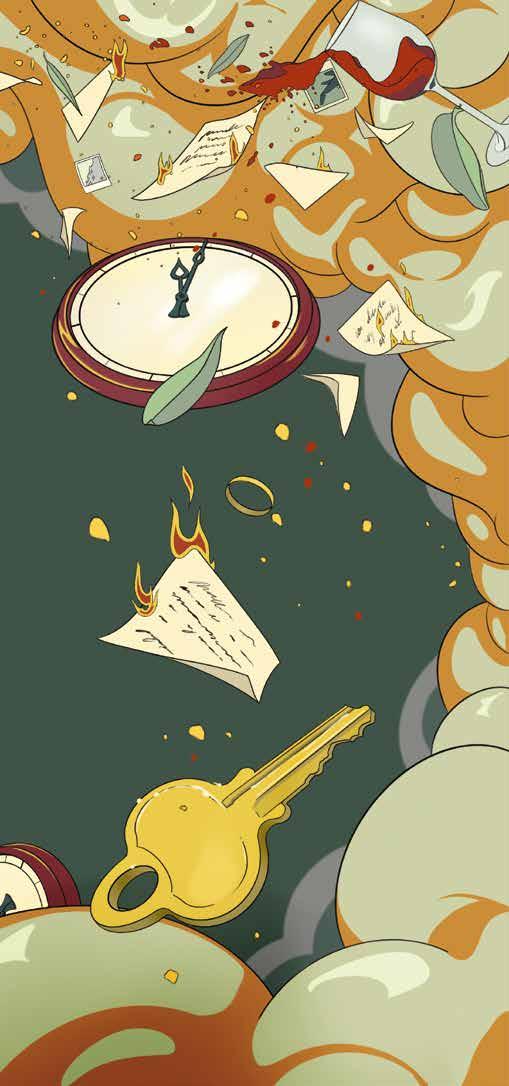
Clinical psychologist Dr Sarah Edelman, author of Change Your Thinking, says it’s common to hold a grudge. “Most of us have held a grudge towards somebody at some stage in our lives. A grudge may be triggered by an action that caused us to feel threatened, insecure, shamed or diminished in some way,” she explains.
“Behaviours that reflect disloyalty, betrayal or duplicity may give rise to a grudge. For example, a friend not being available to support us in our hour of need; someone stealing a romantic partner; someone passing on a secret we told them in confidence or spreading information that reflects badly on us. Being taken advantage of or harmed in some way can lead to a longterm grudge.”
Resenting someone gives us a feeling of dominance over them. “While this is totally irrational, of course – holding a grudge gives us no power at all – it can feel protective,” says Dr Edelman. “Grudges may frequently be held against those we once trusted, such as an ex-partner, a family member, a work colleague or a business partner. Holding a grudge helps us to keep them at arm’s length, so that we will not unwittingly start trusting them again.”
Releasing a grudge might feel like we are giving the other person some sort of victory and letting them off the hook, she adds. “Holding on to the grudge feels like we’re doing something to punish them, although of course it does not affect the other person at all.”
35 MARCH-APRIL 2023 DARE SENIORS.COM.AU
>
THE DAMAGE GRUDGES CAUSE Part of the problem comes down to how our brains work. “Holding on to grudges is bad for our health,” says psychologist Dr Marny Lishman, an expert in mindset and wellbeing. “You’re holding on to a negative thought that happened in the past. However, the primal part of our brain doesn’t know the difference between a thought and reality.”
So even though you’re thinking about things from the past, she explains, your brain and body initially react as though it’s happening now. “This can cause feelings of anger, sadness and resentment. Grudges also stop us moving forward in life and can end up limiting us – often more than the person we think wronged us!”
There’s an impact on mental health. “It puts us into an intimate relationship with
that person, as we carry them with us, inside our own mind,” says Dr Edelman. “We may even have revenge fantasies and imagine what we would do or say to them should we get the chance. It takes up cognitive space, leaving us less opportunity to pay attention to things happening in our present moment.”
Holding on to a grudge can contribute to unnecessary resentment, anxiety, irritation and insomnia, and impair our performance in the workplace, she adds. “Sometimes, it can lead to depression. I think the most useful thing is to recognise that holding the grudge does nothing to punish the other person, but does have a significant negative effect on our own wellbeing. Like the saying: ‘It’s like drinking poison and hoping the other person will die.’”
HOW TO MOVE ON Let it go
Saying goodbye to resentment can bring us greater wellbeing. “Releasing a grudge gives us peace of mind, and provides space to be more present and engaged with our daily life situations,” says Dr Edelman. “It can help us to relax, feel happier, sleep better and focus on other more satisfying areas of our lives.”
Write it down
Put your negative feelings down on paper, or hold a moving-on ceremony, like burning sage or placing healing crystals in spaces the person has been. “Journalling or writing a letter is very therapeutic,” says Dr Lishman. “Ritualising the release of grudges via a ceremony of sorts with loved ones can also be helpful.”
FAMOUS FEUDS
SARAH JESSICA PARKER, 57 & KIM CATTRALL, 66

The two Sex and the City stars fell out during the filming of the famous 1990s TV series, and Kim wasn’t part of the cast of the 2021 reboot of the show, And Just Like That.
Was the grudge resolved?
Apparently not. When Kim’s brother died in 2018, and Sarah posted her condolences on Instagram, Kim replied: “I don’t need your love or support at this tragic time @sarahjessicaparker… You are not my family. You are not my friend.”
CHRIS ROCK, 58 & WILL SMITH, 54
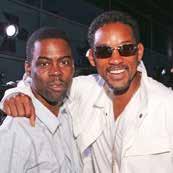
The pair made global headlines when Will climbed on stage at the 2022 Oscars to slap Chris, after the comedian made an ill-received joke about the actor’s wife, Jada Pinkett Smith.
Was the grudge resolved?
Apparently not. Will publicly apologised a few months later in a YouTube video, asking the comedian to “talk it out” with him. But speaking later at a gig, Chris dismissed the apology as a “hostage video” and described Will as “just as ugly as the rest of us”.
DEBBIE REYNOLDS & ELIZABETH TAYLOR
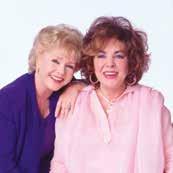
The late actresses were long-time best friends, but they stopped speaking to each other for many years after Debbie’s actor husband Eddie Fisher left her to marry Elizabeth in 1959.
Was the grudge resolved?
Yes, the pair made up in the late 1960s. “Elizabeth and I went on a cruise ship and we were on the same boat and she sent a note to me and I sent a note to her to say, ‘Let’s just forget about it’,” Debbie said. In 2001 they both starred in the TV movie These Old Broads
36 DARE MARCH-APRIL 2023
Tune into your emotions
It’s possible to hold a lingering resentment for years, without fully understanding why you’re doing it. “It’s helpful to understand what’s going on inside ourselves that causes us to have such strong feelings towards the other person,” says Dr Edelman. “Ask yourself, what vulnerability in myself is this opening up? Try to understand what you are trying to achieve by holding the grudge.”
Explore mindfulness
Being mindful – focusing your feelings on the present moment – can help you move on. “Mindful awareness strategies can identify some of the negative thoughts and ruminations that arise in response to the person we resent,” says Dr Edelman. “When the other person becomes totally irrelevant and not worthy of any further thoughts, you know that you have reached a much healthier psychological state.”
Practise self-compassion
“Healing ourselves can enable us to feel less vulnerable in response to other people’s behaviours,” says Dr Edelman. Practise self-compassion through guided exercises on apps and online; push back on negative self-talk; and engage in your favourite self-care routines, like preparing your favourite meal or sitting down to a new book.

Talk to your grudge
If it’s a safe option, share your feelings with the subject of your resentment. “Communicate openly about how you feel,” says Dr Lishman. “Even if you’re not
ready to let it go, let the person know that and why. By doing this, you may be able to let the hard feelings go.” But having that conversation isn’t always possible. “Sometimes the people that wronged us will never be able to help with getting rid of the grudges, perhaps because you don’t have contact anymore, or they have passed away,” she says. “So, in that situation it is up to us to let go of the grudge and come to peace with what happened.”
Forgive them
“Forgiving is the best way to move on,” says Dr Lishman. Remember, you don’t have to forget, patch up the relationship or condone their actions. If forgiveness still seems impossible, it’s worth considering who the grudge really impacts. “If you can’t forgive, you impose an extra unnecessary layer of suffering on yourself,” explains Dr Edelman. “The initial wrongdoing or insult remains, but in addition, we also have a secondary issue: psychological suffering.”
Seek help
If a grudge is festering past its use-by date and impacting your health, it might be worth contacting a mental health professional. “Talking through what happened with a professional will help you debrief, and a psychologist can help you with new cognitive strategies to look at the situation,” says Dr Lishman. “Don’t keep reinforcing the grudge by thinking about it constantly. If you are ready to seriously let it go, then do that. Moving to a state of acceptance is an important strategy. Move on with your life with the learnings you gained from the experience.”
THE BENEFITS OF LETTING GO
Improved mental health and wellbeing, including less stress and anxiety and improved mood.
Better sleep.
Improved physical health as a result of less stress, including lower blood pressure.
A healthier relationship with friends, family and colleagues.
Being more in the present moment.
An opportunity to learn about the imperfections of other people and experience personal growth.
Feeling calmer and more at peace.
Becoming more involved in social situations.
Feeling emotionally lighter as a result of releasing bitterness, anger and resentment.
Being less triggered in the future by other people with problematic behaviour.
SENIORS.COM.AU 37 MARCH-APRIL 2023 DARE
“Holding the grudge does nothing to punish the other person, but does have a significant negative effect on our own wellbeing.”
DR SARAH EDELMAN Clinical psychologist
B y D r MARNY LISHMAN
Fresh ideas for chronic pain
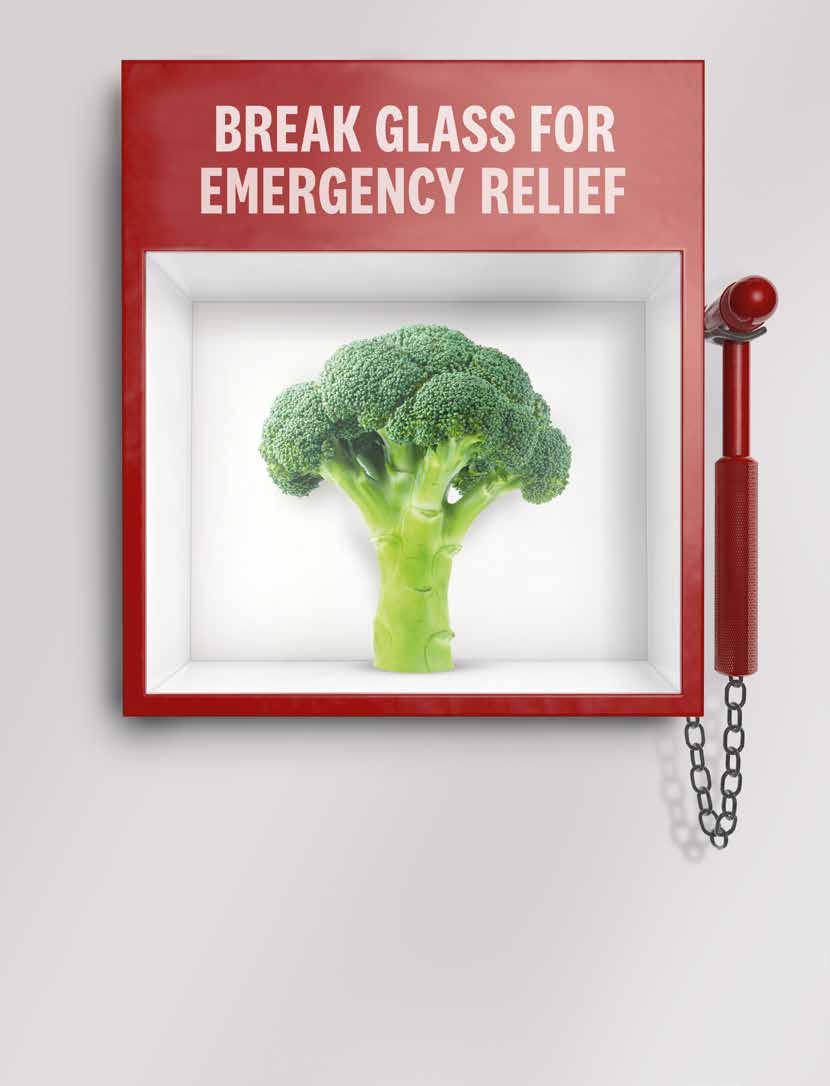
A large number of Australians face debilitating pain on a long-term basis. But a new approach to management that moves away from pills and towards lifestyle changes like targeted exercises and eating leafy greens is delivering results.
Words TRUDIE M c CONNOCHIE
38 DARE MARCH-APRIL 2023
WHETHER IT’S A STUBBED toe, sprained ankle or bad headache, most of us are familiar with the sensation of searing pain. What isn’t so widely understood, however, is what it feels like to experience pain on an ongoing basis.
According to the Australian Seniors Cost of Health research, close to one in two people aged over 50 are living with a major ongoing health challenge. Of these, 58% say their greatest concern is dealing with discomfort and pain.
When this continues for months and even years, it’s known as chronic pain. Common types include back pain, migraines, arthritis and cancer, but often there is no obvious cause. It can be a debilitating condition, limiting people’s ability to work, socialise and function day to day.
Professor Michael Nicholas, director of pain management education at the Pain Management Research Institute, says


misconceptions about chronic pain can make life even more challenging. Acute pain, he explains, is the instant sensation you get when something adverse happens to your body, such as an injury. If that pain goes beyond three months, or the expected healing time, it’s termed chronic.

“It’s pain that persists and can last for years. The key issue is that it doesn’t respond to the sorts of treatments that acute pain responds to,” he says.
THE BRAIN FACTOR
Professor James McAuley, senior research scientist at NeuRA (Neuroscience Research Australia) and psychologist at the University of NSW, says there’s been a significant shift in our approach to chronic pain over the past 10 years. Increasingly, healthcare professionals are recognising that while acute pain relates to the body at a tissue level, chronic pain is about what is happening in the brain.
MARCH-APRIL 2023 DARE 39 SENIORS.COM.AU EXPLORE / HEALTH
PROFESSOR MICHAEL NICHOLAS Director, Pain Management Research Institute
>
PROFESSOR JAMES M c AULEY Senior research scientist, Neuroscience Research Australia
THE EXPERTS
The biological purpose of pain, he says, is to alert us to a threat – for example, our hand is on a hot stove. With chronic pain, however, the body becomes oversensitive to threats and sends “false alarms”.
“The longer people have back pain, for example, the less the pain is telling them that there’s a threat to something in their spine,” he says. “What’s happened is that over time, the pain system has turned into an overactive alarm system.”
His recent clinical trial of 276 people with chronic lower-back pain found that targeting ‘motor imagery’ could offer some relief. Researchers demonstrated to participants through a series of exercises that their backs weren’t actually behaving in the way they thought they were. At the end of the trial, an improvement in pain intensity was recorded.
But that doesn’t mean that chronic pain is imagined. “Chronic pain is absolutely real. It is not the fault of somebody who has pain – they can’t just think it away,” Professor McAuley says.
LIVING WITH CHRONIC PAIN
Traditionally, medication was the go-to for pain management, but this is no longer the case. “In 2011, there was a big review by the Institute of Medicine in the US, where they concluded that the best option is what they called selfmanagement,” says Professor Nicholas. “It’s leading a healthy lifestyle despite the pain – that’s the goal of pain management.” He explains this might include:
• Practising acceptance: “Acceptance is about living with the pain, acknowledging it’s there, but that you’re okay. That doesn’t mean you like being in pain, but, like the noise of traffic outside your house, it becomes part of the background.”
• Regular exercise: The professor says it’s vital to keep moving. “If you spend all your time resting, you’re going to lose fitness, your joints will get stiffer, you’ll put on weight, and then when you do try to move you’ll aggravate your pain.” A physiotherapist or exercise physiologist can devise an exercise program for you.
• Healthy diet: Eating a diet rich in fruits, leafy green vegetables such as broccoli, nuts, legumes and wholegrains, while avoiding processed meat and refined carbohydrates (such as white bread), may help reduce chronic inflammation in the body, and therefore alleviate pain.
• Good-quality sleep: “Pain can make it hard to get to sleep and if you don’t sleep, your pain will be worse – it’s a cycle,” says Professor Nicholas. Good sleep hygiene is important, he adds, which includes “going to bed at a reasonable time, not drinking a lot of alcohol in the evening, not having big meals late in the day, and trying to get up at a regular time”.
• Psychological tools: Regular relaxation techniques, such as meditation, can be helpful. Seeing a psychologist can also be beneficial – especially if you’re experiencing depression, which is common with chronic pain. For further information and support, contact Chronic Pain Australia; go to chronicpainaustralia.org.au
One of the most challenging aspects of living with chronic pain is not knowing how the pain will be on any given day.
For Elizabeth Worboys, 51, who has lived with chronic pain on and off for 27 years, there are some days when the pain is more manageable and others when she can barely move.
Elizabeth first developed chronic pelvic pain in the 1990s and when she finally found an effective treatment, she thought her days of pain were over. But two years ago she injured her back and the pain never dissipated, forcing her to leave her full-time job as a nurse. Even with a walking stick she can sometimes only move short distances, and everyday household tasks, such as preparing meals, are often out of reach.
“Probably one of the hardest elements is dealing with friends and colleagues who don’t fully understand what chronic pain is, and that it is a real illness and not something that people make up,” she says. “People say, ‘How are things going?’
And I’ll say, ‘Well, I’m actually as good as I’m going to get, so it’s about maximising what I can do.’”
Chronic pain also has an emotional impact. “I’ve lost my independence in a way,” says Elizabeth, who now works part-time as a project officer for Chronic Pain Australia. “I’ve gone from doing everything to doing some things, but then I’ve also had to rely on my mother to help me out with other things around the house. I am an emotional person, so there’s a lot of tears.” Working with a psychologist has helped her develop coping strategies to deal with the pain. She enjoys the support of a strong network of close friends, and even though Elizabeth isn’t able to see them as often as she’d like, being able to message and FaceTime them helps her feel less isolated.
“There’s no expectations of what I should be able to do – they take me as I am,” she says of her friends. “I can talk about how I’m feeling and know there’ll be no judgement.”
40 DARE MARCH-APRIL 2023 SENIORS.COM.AU
“It’s about maximising what I can do”
ELIZABETH WORBOYS


















Pampered pooches
By providing unlimited love on tap, pets have pawed and clawed their way up the traditional family hierarchy – and it seems there’s nothing we won’t do to return that affection.
Words MONIQUE BUTTERWORTH
LIFE COMPANIONS, BEST FRIENDS and ‘fur kids’, pets are considered integral family members. As such, it seems, some animal owners will stop at nothing to ensure their pet is truly living their best life.
Pets – and their pampering – are also big business, and we spend around $1.3 billion on clipping and grooming every year, according to Animal Medicines Australia.
Simon Cary, founder of Fido & Fido in Sydney’s Double Bay, traded a corporate career in finance to become a dog walker five years ago. From there, he expanded his business to offer

further dog services such as grooming, day-care, training and even a country boarding retreat.
“To put it simply, pampering our pet is the reward we give them for indulging us with unconditional love,” he says. “A more scientific reason is that humans and dogs experience a surge of the love hormone oxytocin, similar to how parents feel when they look at their baby. There’s a lot of trust involved in the relationship between pet parent and dog walker or groomer. We take care of our furry clients’ physical and mental wellbeing from when they are puppies through adolescence and into their old age.” >

42 DARE MARCH-APRIL 2023 EXPLORE / PETS

43 MARCH-APRIL 2023 DARE SENIORS.COM.AU
Simon says that since COVID and the so-called ‘puppy pandemic’, people are spending more time at home and the bond with their pets has strengthened. “Owners are applying human wellness principles to their dogs. They are more conscious of their dog’s need for exercise, socialisation and the benefits of regular grooming and healthy eating,” he says. “I use the term the ‘humanisation’ of the family pet, and the pandemic underpinned the ‘in home, at home’ expectations that new puppy owners have.”
Most of Fido & Fido’s grooming clients are regulars, visiting weekly for the signature bath and blowdry, which also includes an ear clean, ‘pawdicure’ and fragrance spritz. “If your dog is sitting on your white sofa and sleeping with you in your bed, you really need your dog to be clean and well groomed!” laughs Simon, who says that his country retreat, which offers luxury homestyle accommodation for only 14 guests at a time, always has a long waiting list.
“Like humans, pets function better mentally and physically when they eat healthy food, exercise regularly and have regular grooming to care for their fur and skin which performs a function in their wellbeing.”
RED CARPET PARTIES
When Renee Jernigan and Claire Ohannessian wanted to throw a party for their cavoodle Gus’ birthday, the difficulty they faced sourcing catering and toys for Gus and his fur guests ultimately led to them launching their dog party planning, toy and accessory company Let’s Pawty.
“We both love dogs and it helped that we had an events background. So, we decided we could help others celebrate their dogs without the stress of organising the event,” says Renee, who hosts at least two dog parties a month during Sydney’s warmer months.
“We started our business just before the pandemic, so timing was not the best. It was difficult during the lockdowns, of course, as there was no mingling and no ‘pawties’ but as soon as the lockdowns
were over, there was an explosion of requests,” she says.
“People wanted and needed to get together again and a ‘pawty’ is a great way to bring people together with the goal of celebrating their dog’s special day.” One of the most memorable events Renee and Claire have hosted is a ‘Bark Mitzvah’ for 13-year-old Murray’s ‘barkday’. “There were 40 dogs and 100 people at the event, along with a food truck and an ice cream stand for the humans, and for the dog there was catering, ‘puptinis’, ball pits, puzzles, toys and even a ceremony for
Murray,” says Renee. “The pup of honour arrived in a Tesla and even walked the red carpet.”
GOURMET CATERING
Another pet pampering entrepreneur is former head chef Jason Blachowski, who had been rattling the pans in exclusive restaurant kitchens for more than 25 years when he launched online canine bakery, Woof Gateaux.
“When our Boston terrier turned one, I baked her a dog-friendly birthday cake and put it on social media. I had no intention of
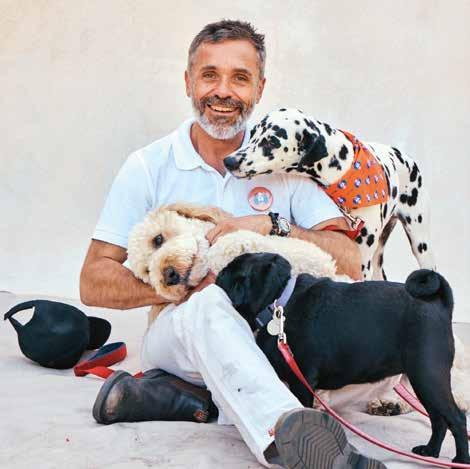
44 DARE MARCH-APRIL 2023
“Pampering our pet is the reward we give them for indulging us with unconditional love.”
SIMON CARY (pictured above)
Founder, Fido & Fido
starting a business,” he says. “From there I was asked to make cakes for family and friends. So we created a website, a bunch of dog-friendly cakes. It just took off.”
Jason now specialises in custom cakes. “No-one just wants the standard cake,” he laughs. “They want a Star Wars cake or a KFC bucket cake, a basketball cake, whatever it is they are into.”
Jason’s cakes are sugar-free and made from natural ingredients. “The good thing is, you put anything in front of them, the dogs are going to eat it,” he smiles. “And their humans know they’re not eating anything that is bad for them.”
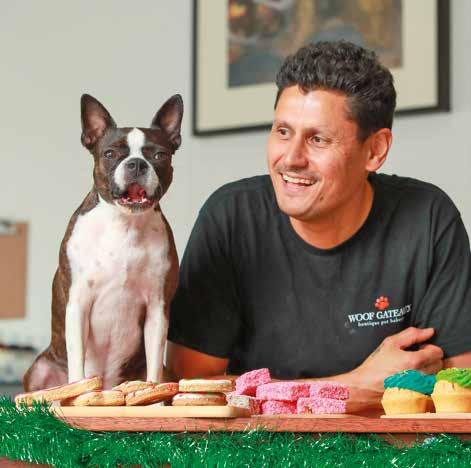
It has taken years to perfect his cakes and recipes to make sure they’re pet-friendly and healthy, Jason adds. And pleasing for even the fussiest of customers. “I’ve had clients send me colour codes from Bunnings paint colour charts to ensure I get the cake colour just right.”
LUXURY HOTEL PACKAGES
As for indulgent pooch stays, luxury hotels such as The Langham hotels in Melbourne and Sydney, Pier One Sydney Harbour, QT Hotels across Australia, the Crystalbrook Albion in Sydney and Bailey Residences in Cairns all cater to the burgeoning pet pampering market.
With everything on offer from pet afternoon teas, birthday parties, breakfast in bed for all the family, in-room treats from the minibar, gift bags, dog stylist fittings, personalised collar and leads, a turn-down service with eye mask and even doggy degustation dinners prepared by a fine-dining chef, there is literally nothing too over-the-top for pets and their humans.
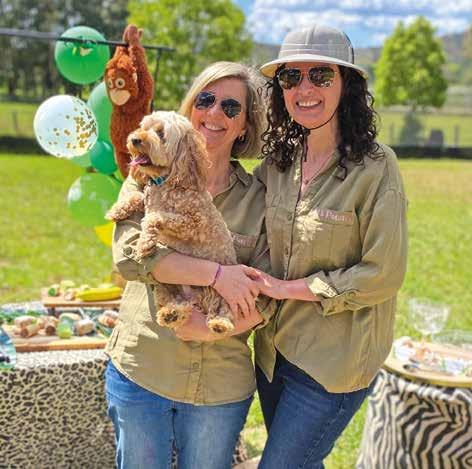
45 MARCH-APRIL 2023 DARE SENIORS.COM.AU
Protect your pampered pooch – or cat –with Seniors Pet Insurance , providing cover for accidental injury and illness . Call 1300 375 903 or go to seniors.com.au
Left: Let’s Pawty founders Renee Jernigan and Claire Ohannessian with their cavoodle Gus. Below left: chef Jason Blachowski and his Boston terrier Poppi with a selection of Woof Gateaux creations.
Finding a way to connect
The fourth season of the Australian Seniors podcast, Life’s Booming: Against All Odds, shares inspirational stories of extraordinary Australians overcoming unimaginable challenges. Here are two more stories of people using their experiences to help others.
Words BEVERLEY HADGRAFT Main photography NICK CUBBIN
Open heart, open arms
Rosemary Kariuki, 62 (right), fled to Australia on her own – but she didn’t stay lonely for long. Her incredible work with other female refugees and migrants earned her Australia’s Local Hero award and a cherished role in the community.
IN
1999,
ROSEMARY KARIUKI
boarded a plane to flee her Kenyan homeland. She’d endured years of violent tribal clashes, seen her home burned, and suffered domestic violence and abuse.
“My life was in danger so I wanted to go to the furthest place from Kenya possible – Australia,” she says. Her children, then 16 and 13, were still in school so joined her later. “Leaving them was hard,” she admits.
If this sounds extraordinary, she is extraordinary. “A big mumma who beams laughter and light,” says one of the many women Rosemary has gone on to support.
She started as she’s continued – despite her personal trauma, her immediate goal was to help others in her new homeland. Within two months, she was visiting lonely residents in nursing homes. Her impact on these people was illustrated when, upset at yet another resident passing, she asked her coordinator: “Can you give me the ones who aren’t dying?” He replied: “Rosemary, we give you the ones that die because we want them to die happy.”
When she moved into her own home in a new neighbourhood and realised how isolating being a refugee on her own could be, she figured she wasn’t alone in her loneliness so began her mission to connect others like her.
Rosemary arrived in Australia carrying one suitcase, $300 and some gifts and teabags she’d bought, hoping they’d help her make friends. Remarkably, by the time she’d left the airport, she’d already made her first – an Ethiopian woman who was so taken with Rosemary she took her home and looked after her until she was able to stand on her own two feet. >
Finding her local African Communities Council, Rosemary began by bringing refugees from Sudan, Sierra Leone, Liberia and others together with the annual African Women’s Dinner Dance. She went on to launch the African Village Market to support migrants and refugees starting their own businesses, and then
46 DARE MARCH-APRIL 2023 EXPLORE / LIFE’S BOOMING
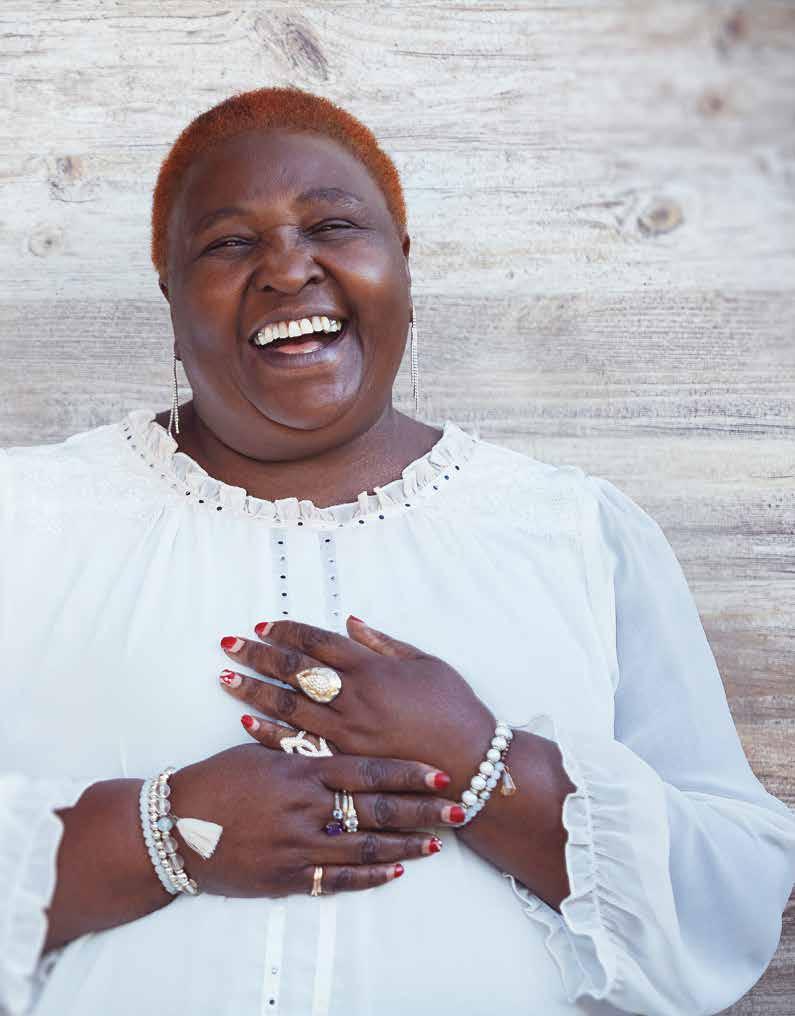
continued that work with other new arrivals, helping them as they gained confidence in the workplace then encouraging them to attain new skills.
For people escaping domestic violence, that’s invaluable, Rosemary says. “Once they start their career, they’ll never go back to their abusive relationships.”
But her main aim is to take people from their cocoon and connect them with fun things. “For instance, I organise high teas or breakfast. Everyone brings a dish and we share.”
Rosemary, now living in Oran Park in Sydney’s south west, organises outings, too and, more ambitiously, community exchange programs between women refugees and migrants and Australian country women, who each host a ‘new Australian’ in their homes for the weekend.
Not surprisingly, her knack for crossing cultural barriers has proven invaluable in her other role as a multicultural liaison officer with the police. “I’ve been working with the police for 16 years now. Where many multicultural people come from, we fear the blue uniform, so my role is to explain that police here are safe people, the people to protect you. I also educate the police about cultural backgrounds, explaining why people do the things they do, so we educate both sides.”
In 2021, Rosemary won the Australian of the Year Local Hero award for her commitment to changing lives, particularly women who, like herself, have experienced gender-based violence and face language, financial and cultural barriers that leave them isolated.

But there’s no need for isolation, she says. Everyone can connect. “You just need to open your heart and your arms and if everyone in Australia did this, we’d be the happiest country in the world.”
The devil and the detail
Drawn into a cult in his 20s and only escaping after he became its leader, David Ayliffe, 68 (above), knows he’s one of the lucky ones who got away. Today, he’s on a mission to help other people.
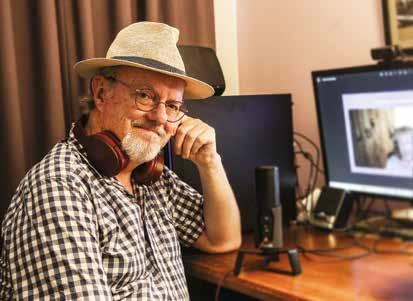
How do people get sucked into cults? Having escaped one, David Ayliffe has a theory. “These things operate on fear,” he explains. “You’re thinking on two levels all the time. On one hand, you think it’s a load of rubbish, on the other you’re terrified in case it’s not.”
David was 22 when he joined the Zion Full Salvation Ministry, founded in Sydney in 1974 by Violet Pryor, who claimed to have Christ’s stigmata and to actually be God on Earth.
As a young journalist, he should have been fuelled by cynicism. Instead, David admits, his cynicism took him against the established church that he thought was getting it wrong and into the arms of Violet, with her beliefs in exorcism and demons and her cruel threats to kill his family, and then him, if he ever tried to
48 DARE MARCH-APRIL 2023
Left: Rosemary is named Local Hero at the 2021 Australian of the Year Awards for her work with migrants and refugees.
Photograph Julian Kingma.
leave. “It was very difficult,” he says now. “I had questions for many years and was too afraid to deal with them.”
It wasn’t until Violet died in 1990 and David found himself leading the group that he was eventually able to read through the cult’s files and see them for what they were: “A load of bull.” Sharing this with the other families in the cult, which by then was based in the NSW Southern Highlands, was difficult, he admits. “But I called everyone together and told them and wasn’t sure what would happen, but they believed me. It was a bit like that story, The Emperor’s New Clothes.”
David, his wife Meg, and their children moved to Melbourne and he found the best antidote to his trauma was to throw himself back into life by serving others. He got a job as CEO of a Christian overseas aid organisation and was involved in fundraising for the Red Cross and Guide Dogs Victoria charities. Two years ago he also co-founded a charity Humanity in Need –Rainbow Refugees, supporting vulnerable people of all sexualities in Africa.
That, and the work he also does in the disability sector, have brought great satisfaction. “Working with people with intellectual or physical disabilities you start to understand life in a whole new way.”
David says he and his family don’t talk much about their past these days, but all four of the children are doing well. “We’ve also got beautiful grandchildren so that’s all very precious.”
He takes comfort, too, in the fact that there are positive memories. “After Violet died, we ended up with properties in the Southern Highlands and bought horses and cattle and the kids learned to exhibit at the Sydney Show, so it was probably quite an extraordinary life.”
But he acknowledges that not everybody who has fallen prey to a cult emerges unscathed. “I think most people who are victims of abuse, in whatever form, don’t really ever recover,” he says. “It shapes who you are. And so you just move on with life and, hopefully, your experiences make you into a better person.”
Life’s Booming with James
Valentine
LIFE’S BOOMING Podcast series
Hear more about Rosemary and David’s experiences in episodes 4 and 5 of the Australian Seniors podcast series, Life’s Booming: Against All Odds, hosted by James Valentine (above). The six episodes (below) tell the incredible stories of over 50s who have survived some of the most extreme challenges life has thrown at them. Listen in and discover their tales of outstanding fortitude.
Episode 1: FINDING JOY AGAIN
More than eight years ago Rosie Batty suffered an unimaginable loss, following the horrific murder of her son Luke at the hands of his father. In the midst of her grief Rosie was catapulted into the spotlight, as she channelled her tragedy into a power for reform around family violence.
Episode 2: THE ART OF FORGIVENESS
In the face of her worst nightmare, Bridget Sakr continues to draw on her faith to turn aside anger and instead focus on love and forgiveness to help deal with the trauma.
Episode 3: EMERGING FROM THE DARK
When Todd Russell and Brant Webb were rescued after two weeks trapped in a Beaconsfield mine in 2006, it was seen as one of Australia’s greatest survival stories. But for Todd, that was only the start of his battle for survival.
Episode 4: OPEN HEART, OPEN ARMS
When Rosemary Kariuki fled her home in Kenya, she arrived in Australia without support and struggled to understand her new culture. But the charismatic Local Hero soon found a way to connect with her community.
Episode 5: THE DEVIL AND THE DETAIL
How does anyone get drawn into a cult and how, when the extreme beliefs that have ruled their lives prove baseless, do they recover? Tune in as David Ayliffe shares the lessons from his own experience.
Episode 6:
LIVING IN THE MOMENT
After receiving a life-changing cancer diagnosis, award-winning surf writer, husband and father-oftwo Tim Baker turned his attention to making peace with his mortality and living in the ‘now’.
Be sure to tune into these and other inspirational episodes across four series of Life’s Booming, exploring life, love, travel and everything in-between. Go to seniors.com.au/podcast or download Life’s Booming from your favourite podcast player.
49 MARCH-APRIL 2023 DARE SENIORS.COM.AU
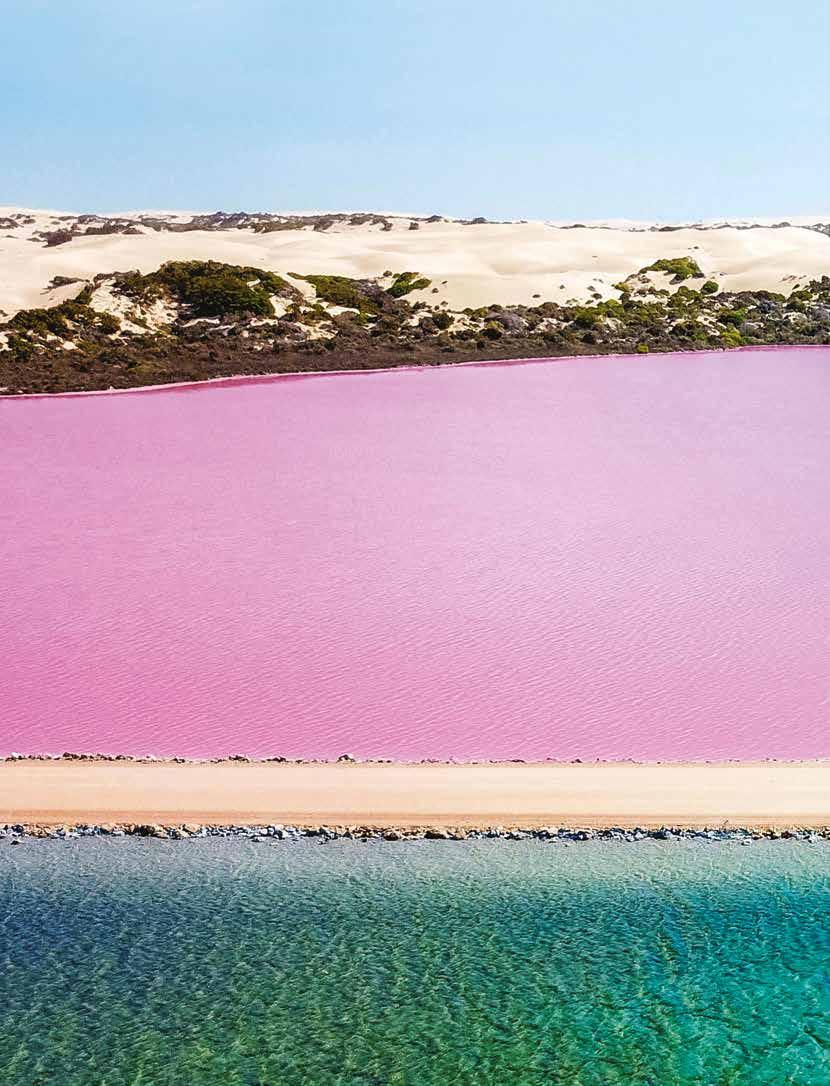
50 DARE MARCH-APRIL 2023 EXPLORE / TRAVEL
Going it alone
Travelling solo means you get to see the world on your own terms – and if you want to test the water, there’s no better place to start than in our own captivating country.
Words BEN GROUNDWATER Main photography RILEY M WILLIAMS
The vibrant pink hue of Lake MacDonnell in South Australia is just one of the stunning sights solo travellers can explore on their own or as part of an adventure group.
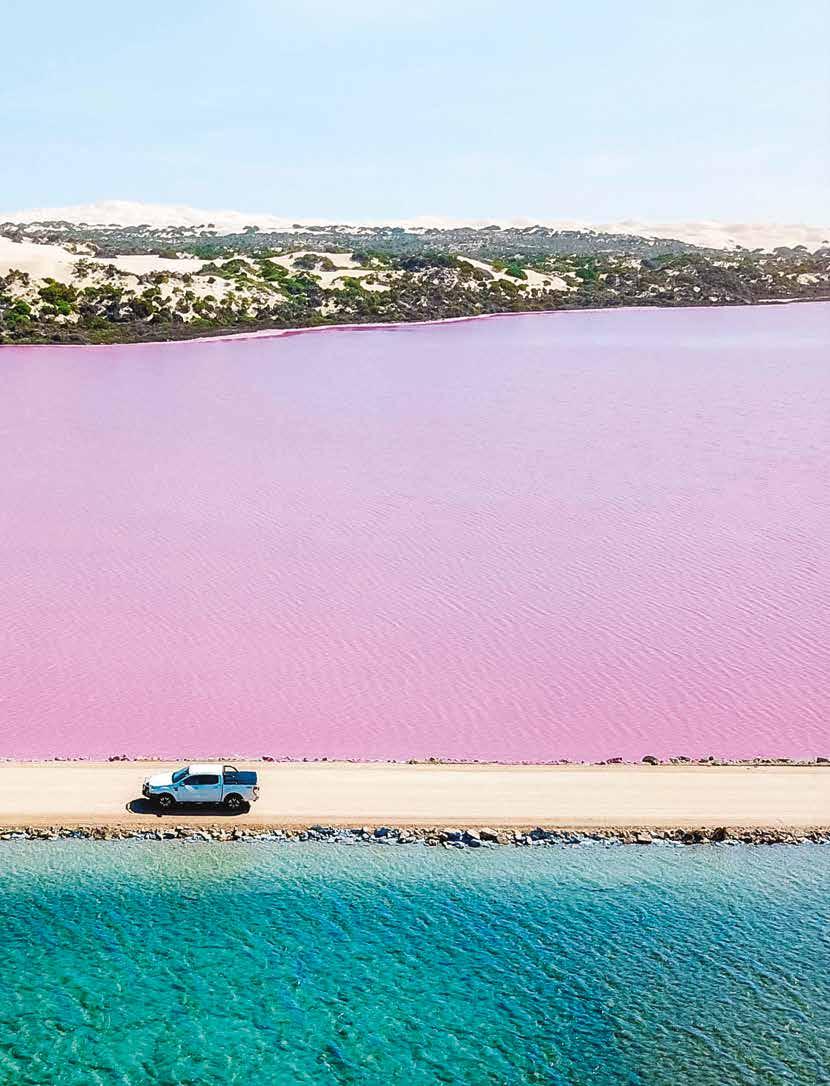
51 MARCH-APRIL 2023 DARE SENIORS.COM.AU
HERE’S
A QUESTION:
WHAT do you want to do today? You, personally, on this day of travel? Where do you want to go? What do you want to experience? What do you want to see and taste and feel?
If you’re travelling by yourself, the answer is: whatever you want. No restrictions. No compromises. Solo travel is the ultimate freedom, the opportunity to act spontaneously and even selfishly with no regrets. And it’s gaining in popularity, particularly among those over 50.
Before the COVID pandemic, travel website Booking.com reported that 14% of travellers were planning solo stays; by the time we emerged from lockdown in 2021,
that figure had nearly doubled. The most recent statistics from Tourism Research Australia show more than one-third of domestic overnight trips in Australia are taken by solo travellers, with almost half of those aged over 50.
Solo travel, after all, is the chance to see the world on your terms. It’s the opportunity to go where you want and do what you want, to rely purely on yourself, to discover what you’re capable of.
The trick is to approach solo travel in a way that is comfortable and enjoyable for you. There are no hard and fast rules. Travel can be a completely solitary pursuit, or it can be something you do as part of a group of fellow adventurers. You can stay
in private accommodation or in a more social setting. You can strike out on your own for part of the trip, and link up with others later on.
The main thing to consider is that you won’t be the only one doing this. No-one will think it’s strange. In fact, you might even be part of the majority.
One of the first things to decide is where to go. Australia is the perfect jumping-off point for anyone experimenting with travelling on their own, a safe and predictable country that still offers a wide breadth of locations and experiences.
If you’re planning on true solo travel – that is, striking out alone without a tour – it’s probably best to avoid long

52 DARE MARCH-APRIL 2023
Solo travellers can visit the Spa Pool at Hamersley Gorge in Karijini National Park, Western Australia, on a day tour.
drives in remote rural areas, and instead stick to Australia’s cities. All of the state and territory capitals are well set up for solo travellers, with numerous accommodation options, plus easily accessible attractions, the opportunity to join day tours, and the safety that comes with large cities with plenty of people around.
Australia’s ‘second’ cities also offer those same benefits, though on a slightly smaller scale: Newcastle, the Gold Coast, Cairns, Fremantle and Launceston are ideal spots for those going it alone.
If you want to get off the beaten track on your Australian adventures, it’s worth looking into a tour company that offers the safety of a group, while also allowing
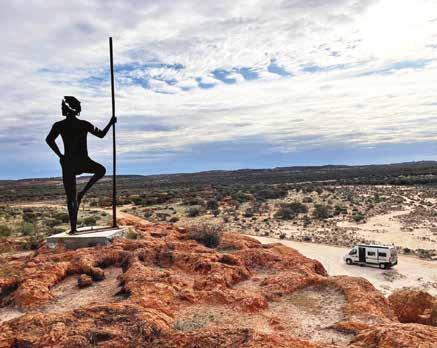
TIPS FOR THE SOLO ADVENTURER
B y JACKY EDSON-HAWKE, 69 Experienced solo traveller
How long have you been travelling solo?
I came to Australia [from the UK] on a working holiday visa 42 years ago. I landed in Perth, and straight away got a job as a cook with a tour company. But I’m an only child, so travel on my own is not a problem. I retired in 2019, bought a motorhome, and I’ve been on the road ever since. [Jacky’s motorhome is pictured below, by a silhouette statue at Mt Welcome, Western Australia.]
What do you do on your travels?
I’ve always been a camper. I just love the outdoors. Bushwalking, going to the beach. I’ve had no bad experiences doing that solo. And I belong to the Caravan and Motorhome Club of Australia. They have a solo section, so I belong to a group of solos travelling in motorhomes and caravans. There’s about 600 people in the group who are on the road full-time.
Do you meet a lot of people?
You do. I think you meet more people on the road when you’re travelling on your own. If there’s a campfire I’ll go and join somebody, and you feel your way – if you’re feeling welcome and having a good chat you stay; if you think you’re not wanted, you say thanks very much and go. You tread carefully.
What’s your advice for people thinking about travelling like this?
Do it. A lot of people say, “Oh, I wish I could do that.” Well, the only way to do it, is to do it. Though I do always say, hire before you buy. If you’re looking for a vehicle like mine, and you hire a couple, then you know what you’re looking for.
SENIORS.COM.AU 53 MARCH-APRIL 2023 DARE
>
freedom for you to do your own thing.
Intrepid Travel and G Adventures, which were once focused on a younger crowd, now encourage travellers of all ages. G Adventures’ tours that partner with National Geographic Journeys are particularly popular with mature clients.
There are other great tour companies in Australia, too. AAT Kings, which focuses on over 50s passengers, offers shared rooms to avoid the dreaded single supplement. Outback Aussie Tours finds that many of its solo traveller passengers meet friends for life on its comfortable, guided tours to outback Queensland. It offers special discounts for Probus members, and attractive itineraries for solo travellers are the Legendary Longreach & Winton, Outback Getaway, and Journey of the Gulf Savannah tours.
For holidays on the rails, Journey Beyond, the operator of iconic train experiences The Ghan and the Indian Pacific, offers luxury single cabins. The train’s restaurant manager can also arrange seating options to ensure solo travellers meet other passengers over meals.
For women travelling alone, Wild Women Journeys offers active adventures that will appeal to those who might like to
try, say, road-tripping through the Kimberley or doing yoga at Uluru on their next solo holiday. Tours like these are a great way to avoid feeling lonely when travelling solo, plus allow you to experiment with adventure travel if you’ve never done it before.
For overseas adventures, cruising offers a good option for solo travellers. Uniworld Boutique River Cruises organises a welcome meet and greet at the start of all its sailings where solo travellers can get to know each other. It is also waiving the single supplement on selected European sailings in 2023. Popular itineraries include an eight-day exploration of Burgundy and Provence in France, following in the footsteps of Van Gogh, Cézanne and Gauguin.
If you don’t want to commit to a whole group journey, there are still plenty of ways to be social for those travelling alone, including staying in shared accommodation such as hostels or B&Bs, and taking day tours. But the fact remains, you will be able to meet people if you want to. Because, ironically, if you’re travelling solo, you won’t be alone.
7 SAFETY TIPS FOR THE SOLO TRAVELLER
1. SHARE YOUR PLANS
Let a few friends know your plans, and pass on any flight or accommodation information. And check in regularly to let people know you’re safe.
2. DITCH THE VALUABLES
Plenty of solo travellers are justifiably worried about security – to mitigate some of those fears, leave any expensive jewellery or other luxury items at home.
3. START SMALL
No need to begin your solo travel career with a month-long overseas jaunt. To settle into this style of travel, begin with a few weekend trips around your own region.
4. DON’T OVERPACK
Bear in mind, whatever you pack, you will have to carry yourself. This is a time to lighten the load.
5. DO YOUR RESEARCH
Knowledge is power for solo travellers. Find out the safest parts of the city, the best hotels, how to get there and more.
6. TRY DAY TOURS
Just because you’re solo, doesn’t mean you have to be alone. Book day tours in the city you’re visiting: say, a food tour, or an art tour, or a day trip out of town.
7. BRING A BOOK
To begin with, it will feel a little uncomfortable to dine and drink alone. Give yourself something to do by packing a good book to read at restaurants and bars.
For top tips on how to overcome shyness on holidays, go to seniors.com.au and search ‘shyness’.
54 DARE MARCH-APRIL 2023 SENIORS.COM.AU
Yoga at Uluru is on the itinerary at Wild Women Journeys, a tour operator based in outback Australia that specialises in adventure trips for solo female travellers.
Explore the world with Seniors Travel Insurance. Call 1300 697 031 or go to seniors.com.au



























Winton 2 R Y Emerald Rockhampton m Dinosaur Stampede 3 N O R TH ER N T ERR I T O Q U E EN S L AN D N E W S O U TH W A AL E S LONGREACH BRISBANE 1 1 • • • • • • • • • •
HITTING THE SWEET SPOT
Her hugely popular RecipeTin Eats website has been tingling millions of global tastebuds for years and now Nagi Maehashi’s debut cookbook
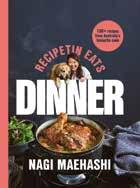
RecipeTin Eats: Dinner is outselling those of seasoned professionals.
Nagi Maehashi is the face (and cook and voice and photographer) behind hit food blog RecipeTin Eats, which has amassed a global fan base – and more than 4.5 million social media followers. Not bad for a corporate accountant turned self-taught cook.
Delivering delicious, tried-and-thoroughly-tested fare, Nagi’s fast and cost-conscious recipes hit several cuisine hotspots. “I have a handful of cuisines I’m strong in, which happen to be foods suited to the Australian palate and also reflective of the fabulous ethnic diversity in our country,” says Nagi, who was born in Japan but moved with her family to Australia as a young child. “My sweet spot is Aussie classics, Asian, Mexican, Italian, Mediterranean, American, some Middle Eastern, French, Indian and British foods.”
Stepping away from corporate life in 2014, Nagi never imagined she’d be able to make a living cooking. “Now I can’t imagine making a living any other way,” she says. “It was a hard and scary decision, risking the security of an office job for this. But just for the record, I’m glad I did!”
With recipetineats.com generating more than 335 million page views a year, the logical next step was a cookbook. But writing a book while maintaining her online presence was challenging. “I tried and I failed. So I put a pause on new recipes on my website for seven months while I worked on my book. I wanted to give it my all.”
The decision paid off. RecipeTin Eats: Dinner immediately sold 37,000 copies, becoming the highest-selling title by a debut Australian author in its first week, according to Nielsen BookData. Surpassing cookbook sales for celebrity chefs like Yotam Ottolenghi and Jamie Oliver, it also became the highestselling non-fiction book in the country.
And with an international release, Dinner is also set for global success. “I really love the thought of my recipes being made and eaten in kitchens all around the world!” says Nagi, 45, who lives on Sydney’s Northern Beaches.
Featuring plenty of ideas for “downright delicious, unfussy food”, and many appearances by sous chef Dozer, Nagi’s just-as-famous golden retriever, it’s easy to understand why. “He is the greatest asset of my business. I’m wondering, can I write him off as a tax deduction!”
Nagi’s success has enabled her to create RecipeTin Meals, a food bank partnered with the One Meal charity to deliver homemade meals to the vulnerable (100,000 annually). It now has its own commercial kitchen, three full-time cooks and a professionally-trained chef at the helm.
“I started RecipeTin Meals during the pandemic when there were increasing food insecurities,” she says. “My goal is to build and set up my business and RecipeTin Meals, so there’s an organic income stream that can keep RecipeTin Meals going long after I’m gone.”
56 DARE MARCH-APRIL 2023
Words ANNA NEVILLE
Portrait ROB PALMER Food photography NAGI MAEHASHI
RecipeTin Eats: Dinner by Nagi Maehashi (Macmillan Australia, $44.99) is out now.
SENIORS.COM.AU INDULGE / HOME COOKING
Turn the page for two recipes from the cookbook. >
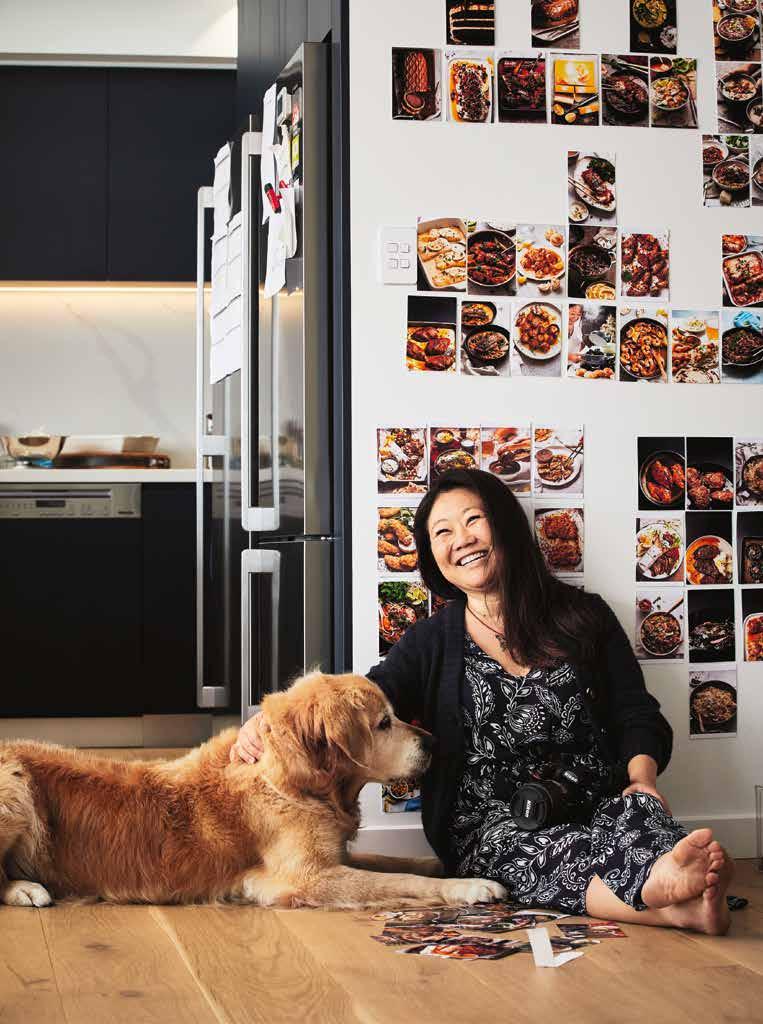
Nagi Maehashi
Butter chicken

Serves 5
Butter chicken is by far the most loved curry recipe on my website! It’s easy to see why. We all can’t get enough of that silky and buttery sauce tinged with tomato and soft spices and, because it’s not at all spicy, it’s one that everyone can enjoy. Happily, butter chicken is also a total breeze to make at home.
INGREDIENTS
750g chicken thigh fillets, cut into 2.5cm pieces
2 tablespoons ghee (or unsalted butter)
260g tomato passata
250ml thickened cream
1 tablespoon white sugar
1¼ teaspoon cooking salt
For the marinade
½ teaspoon chilli powder
1 teaspoon ground turmeric
1 teaspoon ground cumin
2 teaspoons garam masala
1 tablespoon freshly grated ginger
2 garlic cloves, finely minced
1 tablespoon lemon juice
130g plain yoghurt
For the garnish (optional)
Coriander leaves
METHOD
1. Optional blitz – For an extrasmooth sauce, combine the marinade ingredients in a food processor and blend until smooth. I do this when I’m making it for guests!
2. Marinate chicken – Mix the marinade ingredients with the chicken in a bowl. Cover and refrigerate for a minimum of 3 hours and up to 24 hours.
3. Cook chicken – Melt and heat the ghee over high heat in a large non-stick frying pan. Take the chicken out of the marinade, but do not wipe the excess marinade off the chicken and reserve the marinade dregs left in the bowl. Place the chicken in the pan and cook for around 3 minutes, stirring, or until the chicken is white all over (it won’t go brown).
4. Make sauce – Add the tomato passata, cream, sugar and salt. Also scrape in any remaining marinade left in the bowl. Stir to combine, then turn the heat down to low and simmer for 20 minutes. Do a taste test to see if it needs more salt.
5. Serve – Garnish with coriander leaves (if using). Serve over basmati rice, with naan and/or pappadums on the side for slopping!
NOTE:
Chicken thighs work best as they stay tender and juicy. However, chicken breast will also work.
58 DARE MARCH-APRIL 2023 RECIPES BY
BUTTER CHICKEN
The Asian glazed salmon

Serves 2
My friend Kath insisted that this be included in the cookbook, declaring it to be a recipe she makes “all the time” because she always has the ingredients on hand, and it’s so quick and easy. Plus, of course, it’s a hit with everyone. Think juicy salmon slathered in a savoury, gingery, slightly sweet Asian glaze. You know it’s good!
INGREDIENTS
2 x 180g salmon fillets, skinless (or if skin is on, just eat the flesh off the skin)
Canola oil spray
For the marinade glaze
1 teaspoon finely minced ginger
1 garlic clove, finely minced
1 tablespoon soy sauce, light or all-purpose
2 tablespoons oyster sauce
2 tablespoons sweet chilli sauce
For garnishes (optional)
Sesame seeds
Finely sliced green onion (scallion)
NOTES:
Light or all-purpose soy sauce can be used. Do not use dark soy sauce (too intense) or sweet soy sauce.
If your grill is separate and the shelf can’t be positioned the specified distance from the heat source, lower the heat to medium and monitor closely during the final caramelisation part.
METHOD
1. Marinade glaze – Combine the ingredients in a shallow bowl. Add the salmon and turn to coat. Cover and marinate for 30 minutes or up to overnight.
2. Prepare salmon – Heat the oven grill to high. Place the shelf 15-20cm from the heat source. Line a baking tray with foil, then place the salmon on the tray, skin-side down (if it’s got skin). Dab or brush some glaze onto the surface of the salmon. Discard the remaining glaze (don’t pour it over the salmon as any glaze pooled around the salmon will burn).
3. Grill salmon – Place the salmon under the grill for 7 minutes. Remove, then spray the surface with oil. Grill for another 1-3 minutes until the surface is beautifully caramelised and the salmon is cooked (the flesh should flake easily). If using a cooking thermometer, the internal temperature should be 50°C for medium-rare (recommended) or 60°C for medium.
4. Serve – Transfer the salmon to serving plates and leave to rest for 3 minutes. Serve the salmon sprinkled with the sesame seeds and green onion (if using).
59 MARCH-APRIL 2023 DARE SENIORS.COM.AU
THE ASIAN GLAZED SALMON
RAIN, HAIL OR SHINE
Climate change is having a big impact on our backyards. Professional horticulturist and Gardening Australia contributor Angus Stewart shares his expert advice on the best ways to weatherproof your garden.
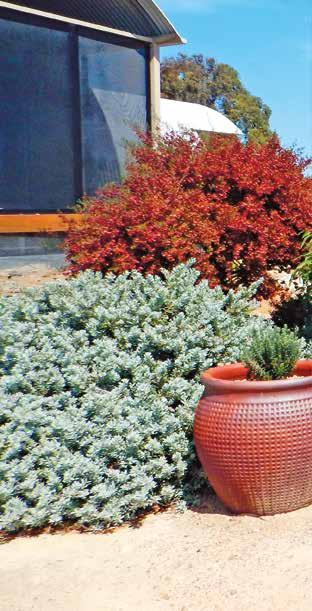 Words PIP HARRY Photography ANGUS STEWART
With extreme weather events wreaking havoc on gardens all over the country, it pays to consider what might happen in your own backyard. So says Gardening Australia contributor and former presenter Angus Stewart, who believes that even the greenest thumbs need to adapt and respond to climate change.
“Gardeners around the world are experiencing extremes such as floods, droughts and bushfires. This is playing havoc with what we have come to expect season-toseason and year-to-year,” he says.
“The good news is that there’s so much we can do to adapt to this challenge. Even better, using new technologies and going back to time-honoured growing strategies ensures we can create or renovate our gardens to make them more resilient and even more productive.”
With this in mind, Angus and his daughter, Emma Stewart, have co-authored Futureproof Your Garden, a new book designed to help Australian garden owners. While Angus has a sprawling, largescale garden in Tasmania, Emma collects rare and unusual plants to tend in her pocket-sized haven in Sydney’s Eastern Suburbs. Together, they offer techniques for growing more with fewer resources.
“Emma brings the perspective
of maintaining a garden on a large concrete slab, to inspire people everywhere that they can establish a resilient, productive garden in a difficult situation,” says Angus. “My site in Tasmania gives us the opportunity to educate about techniques for larger-scale gardens.”
MAKING LASTING CHOICES
There’s no doubt that certain species are more adaptable and resilient than others, Angus explains.
“There are species that will cope with lots or not too much water, or both, for those areas that suffer
alternating droughts and floods.”
If you’re in a heat-prone area, it’s not much good planting wilting English roses over Australian natives or hardy succulents. “A gardening colleague in Perth told me that she will no longer be planting or recommending roses due to the extreme heat waves in recent years,” says Angus. “She’s planting many more succulents instead.”
Another good bet is planting native species or those originating from typically hot and dry climates. “Many of the European species that have been popular over the last couple of hundred years are getting severely stressed during
60 DARE MARCH-APRIL 2023
INDULGE / GARDENS
Above: Angus Stewart. Top right: select drought-tolerant Australian plants to suit your soil type.
extreme heat events. However, species from Mediterranean areas, such as olive trees and salvias, are very drought-tolerant and excellent choices for drying climates.”
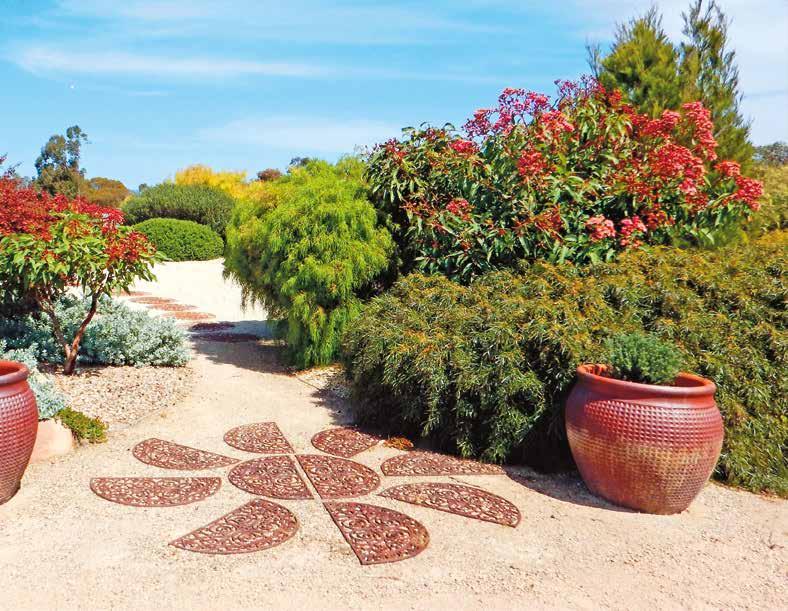
To understand what might work for you, check out the plant guide in Futureproof Your Garden or online at gardeningwithangus.com.au
WEIGHING UP GRASS
Are traditional lawns on the way out as our water sources dry up? “Lawns require regular moisture through the year to look their traditional emerald-green best – not to mention all the energy that goes into mowing, fertilising
and watering,” says Angus. “Many gardeners are replacing their lawns with waterwise species with mulch beneath them. They require much less maintenance and resources but still look fantastic. Indeed, for a fraction of the energy and resources, we can use native species to plant a wildlife habitat garden that looks amazing and creates wildlife corridors while fostering botanical biodiversity.”
KNOWING WHEN TO PLANT
Most of us pull on the gardening gloves during the autumn months, but in a country as vast as Australia there are good times for planting
all year round, depending on your site. “For trees and shrubs, we consider autumn to be the best planting time for most areas,” says Angus. “Atmospheric temperatures are cooling but soil temperatures are still warm, encouraging root establishment rather than leaf growth.”
However, the tropical climates of Australia’s north are a different matter. “Towards the end of the wet season is probably best there,” says Angus. “And there are other plants, such as spring and summer-growing annuals, that are really only suitable for planting in spring.”
61 MARCH-APRIL 2023 DARE SENIORS.COM.AU >
SAVING WATER
There are lots of ways to collect and store rain and stormwater and to landscape your garden to be more water efficient. “We advise a variety of techniques and technologies for efficient water use, such as wicking beds and ollas.”
Wicking beds are containers designed to water plants from below, with water reservoirs at the base. Moisture is drawn up through the soil via a process called capillary action, or wicking. Ollas are unglazed terracotta pots with a tapered shape that are buried in the ground with the neck exposed above the surface. They’re filled with water for self-irrigation – an ancient, but effective way to water plants.
How you plant can also save water, says Angus. “We explore
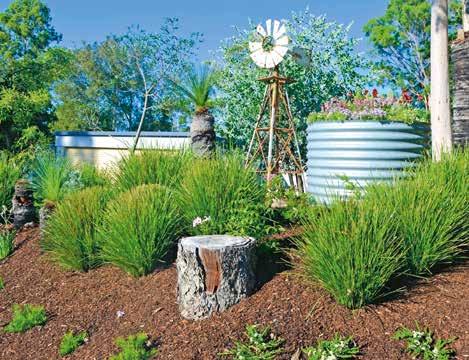
techniques such as planting trees and shrubs up to a metre deep to create an extra-deep root system that has access to moisture and nutrients and is much more stable during severe storm events.”
BUILDING BETTER SOIL
There are techniques for making your soil more adaptable to flood and drought: “Ingredients such as biochar, or charcoal [available from nurseries and hardware stores] raise soil carbon on a permanent basis and enhance growth and resilience,” says Angus. This strategy also helps keep carbon out of the atmosphere. “Adding it to the soil helps plants grow faster to absorb even more carbon dioxide. This reverses the process that is accelerating climate change.”
Old-school kitchen compost and mulch also help keep soil healthy. “We can care for our soil with regular additions of homemade compost and also by utilising locally available materials to use as mulches on top of the soil,” says Angus. “This creates a better environment for plant roots and the beneficial microbes that support their growth and survival.”
By being prepared, you can create a sustainable, waterwise garden that will hopefully last for decades. “It’s impossible to totally guarantee a weatherproof garden, given the fact that climatic records, particularly heat, are being constantly broken,” admits Angus. “However, people can design, plant and maintain their gardens in ways that will give them the best possible chance of standing up to the extremes.”
FUTUREPROOF YOUR GARDEN
 by Angus Stewart and Emma Stewart (Murdoch Books, $45, out now).
62 DARE MARCH-APRIL 2023 SENIORS.COM.AU
“People can design, plant and maintain their gardens in ways that will give them the best possible chance of standing up to the extremes.”
ANGUS STEWART
Horticulturalist and Gardening Australia contributor
Left: using mulch such as pine bark helps to stop water evaporating from the soil surface.

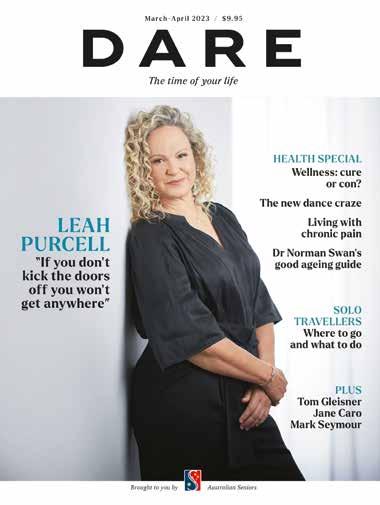



DARE to give the perfect gift? * ONLY $40 for 12 months (6 issues) * SAVE 33% on the cover price * FREE DELIVERY Visit magsonline.com.au/DARE Call 1300 656 933 SUBSCRIBE AND ENJOY NOW! ONLY $40 for 12 months
TREAT YOUR SKIN, FOR LESS
A quality skincare routine often costs a bomb, but it doesn’t have to. Our expert shares all the best brands that have some very surprising price points.
Words ADRIANA DONNOLA
Skincare boomed during the pandemic. Women spent a lot more time – and we mean a lot more time – reading about skincare ingredients and how they worked. They became much more conscious of these skin-transforming superheroes and wanted to know more about them.
Purse-friendly beauty companies reacted swiftly and these performance-based ingredients were soon up front on labelling. Even online retailers started grouping skincare not only under brands and results, but by these powerhouse ingredients, too.
Luxury brands with expensive creams with very similar (read: the same) ingredients suddenly had nowhere to hide. So if you want to use products big on efficacy, you no longer need big bucks.
To know which ingredient and product is right for your skin, think about your biggest concern: is it wrinkles, pigmentation, dryness or sensitivity? Next, use our guide to find which rock-star ingredients – for example, hyaluronic acid, squalane, peptides or retinol – are best for you.
64 DARE MARCH-APRIL 2023
INDULGE / BEAUTY
Right: Rachel Hunter, 53, loves the affordable Essano line made in her native New Zealand.
Photograph courtesy of Essano.
SPOT THE DIFFERENCE
To fade age spots and pigmentation, you need vitamin C. However, the downside of using skincare that lightens is that you increase the chance of the pigmentation returning when exposed to sun. So be sure to use vitamin C products in combination with SPF50+ sunscreen.
For brighter skin we love:
1. Swisse Skincare Vitamin C 10% Brightening Booster Serum, $24.99.

2. AHC Luminous Glow Real Eye Cream for Face, $25.
3. Essano Vitamin C Brightening Gel Cleanser, $14.99.
WELL HYDRATED
If you’re looking for hydration, check the ingredients list for hyaluronic acid (it’s found naturally in skin but depletes with age), squalane (from plants), peptides (proteins that boost skin-plumping collagen production), ceramides (fatty acids) and moisture-binding glycerin, shea butter, vitamin E, jojoba and lanolin.
For dewy skin we love:
1. Essano Visible Repair Day Cream SPF15, $44.99.
2. Neutrogena Hydro Boost Hyaluronic Acid Water Gel, $33.

3. The Body Shop Vitamin E Night Nourishing Cream, $30.


SENSE AND SENSITIVITY
To calm sensitive skin you need ceramides to help restore your skin’s natural barrier, known as the acid mantle. The fatty acids protect and prevent dryness, as do rosehip and jojoba oils. When using an oil, make sure your skin is warm and slightly damp and press into skin, instead of massaging in.
For fewer flare-ups we love:
1. La Roche-Posay Toleriane Sensitive Riche Protective Facial Moisturiser, $33.95.

2. Natio Calm Extra Gentle Eye Cream, $17.95.

3. QV Ceramides Moisturising Cream, $22.99.



A WRINKLE FROM TIME
You can’t erase wrinkles without Botox but you can improve them! The gold standard of skin renewal is retinol (vitamin A), truly the most effective ingredient. It’s also unstable, can swiftly degrade, and you need to build up use gradually, as it can make skin feel more dry and sensitive at the start. A newish arrival that still offers clinically-proven results is bakuchiol, a plant extract ideal for sensitive skin.
For wrinkle reduction we love:
1. CeraVe Skin Renewing Retinol Serum, $41.99.
2. Swisse Bio-Retinol Renewing Night Cream (with bakuchiol), $24.99.
3. La Roche-Posay Redermic R Eye Cream, $46.95.

65 MARCH-APRIL 2023 DARE SENIORS.COM.AU
1.
2.
2.
3.
1.
1.
3.
2.
3.
1.
2.
CRYPTIC & STRAIGHT CROSSWORD
Tackle either set of these clues – you can even mix and match them, because the solutions are the same for both sets.
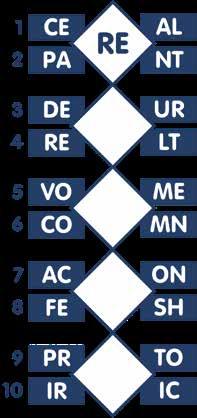
CRYPTIC CLUES
ACROSS
1. Run for office, with support (5)
4. Somehow, plumpish hip lost bulges (5)
7. Hornets seen around dock (7)
8. About the hairstyle, start over (4)
12. Society people show class (4)
14. Campaign push (5)
15. Exclusive and solitary (4)
17. Some stuntmen flipped? That’s crazy! (4)
21. Tampers with Olympic awards broadcast (7)
23. Way one gains weight (5)
24. Rogers and Capone were like kings (5)
DOWN
1. Downright transparent (5)
2. Notices sad characters (3)
3. Condemn mood swings (4)
4. Behind schedule and left at the end (4)
5. Virile fellow gets heartless lady (5)
6. Be quiet and copy outline (5)
9. Self-importance of little white goose (3)
10. Love of French verse (3)
11. Proposal from first beau I had – briefly (3)
12. A number strewn evenly (3)
13. Work back with team leader for pool of money (3)
15. Observes around 500 top tennis players (5)
16. Arm or leg add nothing to bar dance (5)
18. Southern shopping complex is not very big (5)
19. Journalist, for example, returns to the border (4)
20. Insult when egghead ignored new rules (4)
22. Extremely smoky atmosphere (3)
STRAIGHT CLUES
ACROSS
1. Rise to feet (5)
4. Bunches (together) (5)
7. Abridge (7)
8. Perform again (4)
12. Use computer keyboard (4)
14. Car trip (5)
15. Shoe bottom (4)
17. Cashews or almonds (4)
21. Interferes (7)
23. Pebble (5)
24. The R of HRH (5)
DOWN
1. Very steep (5)
2. Commercials (3)
3. Dire fate (4)
4. In the wee hours (4)
5. Masculine (5)
6. Mould (5)
9. Other identity, alter ... (3)
10. Lyrical poem (3)
11. Auction offer (3)
12. Decimal base (3)
13. Plant container (3)
15. Fruit pips (5)
16. In-between state (5)
18. Coins, ... change (5)
19. Move furtively (4)
20. Mumble drunkenly (4)
22. Wide blue yonder (3)
RED HERRINGS
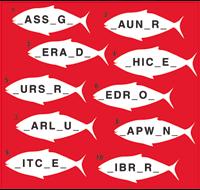
Fill in the gaps with letters to find the names of eight areas around the home. Only eight? Yes, two of the examples are red herrings and won’t produce anything but frustration. All the answers have seven letters.
SEEING DOUBLE
Each pair of words share two middle letters. The first has been filled in as an example. Complete the remaining words to find the mystery keyword reading down.
66 DARE MARCH-APRIL 2023
23 15 8 1 9 21 16 7 2 14 10 19 3 11 24 20 4 17 12 22 5 13 18 6 © Lovatts Puzzles INDULGE / PUZZLES
SUDOKU
Fill the grid so that every column, every row and every 3x3 box contains the numbers 1 to 9.
BRICK IN THE WALL
How many five-letter words can you find reading down the face of our wall? The letters of each word can only read downwards on touching bricks, taking one only from each line.
WORDSEARCH
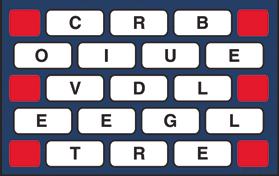
Don’t be left in the dark! Cross off the listed words where you see them in the grid and the leftover letters will spell out what every sunset brings, according to Ralph Waldo Emerson.
Theme:
67 MARCH-APRIL 2023 DARE SENIORS.COM.AU All puzzles ©Lovatts Puzzles.
DAY
DISAPPEARANCE
EVENING
HORIZON
LIGHT MAGICAL NIGHTFALL ORANGE OVER WATER
THE SKY PINK RED RESET ROMANTIC SILHOUETTE SINKING SUN STRIKING STRIP SUNDOWN TIME VIEW WATCH 2 8 5 3 7 7 1 9 5 9 7 6 5 6 4 9 5 7 3 3 2 7 3 8 6 9 8 7 3 6 1 9 2 4 © Lovatts Puzzles W P W O N G N I M A O L G H T N I D R O M A N T I C N Y C H D R V A Z E A I Y M I R K A G I T I N I O S G L K E D S E I S S E G R L U F I T U A E B L A I W E O F N R A C F T H R T P N L A H E T W D T A N T E S P K N H D S R S E L I L S V A E I W L O E E R P G E E T E L A N O N V U G M H M R P N N L R G D O H L E T I E O R I I I A S N E O T F T P I N K A N R N U U W N A W A T C H J P G G C N S O L D R A V E L U O B T E A C L O S E O F D A Y E Y H ©
Puzzles
SUNSET AFTERGLOW BEACH BEAUTIFUL BOULEVARD CLOSE OF
CONTEMPLATE DAILY
ENJOY
GLOAMING GOLDEN GRILL
HUES LAST
PAINTS
Lovatts
Solutions on page 84
INDULGE / PUZZLES
68 DARE MARCH-APRIL 2023
195 190 177 163 154 150 130 118 104 98 86 75 63 48 40 24 17 1 164 145 60 25 178 141 126 115 93 81 76 49 2 155 134 105 67 26 179 135 50 3 171 165 106 99 68 35 27 193 187 136 94 36 22 15 4 119 107 87 82 166 151 120 56 51 5 159 102 88 45 196 191 180 142 131 121 77 64 41 28 18 6 172 116 95 89 37 19 160 146 137 127 83 69 61 57 29 173 156 147 108 70 52 46 7 181 174 161 152 148 132 109 78 71 58 47 30 8 162 143 128 103 65 59 31 188 175 122 90 23 20 194 182 138 123 72 42 16 9 176 110 100 91 38 167 157 149 129 124 84 62 53 10 117 111 96 85 197 192 189 168 139 97 43 39 21 11 183 169 112 73 32 184 140 54 12 158 133 125 113 101 92 79 74 33 185 144 80 55 13 170 34 186 153 114 66 44 14 © Lovatts Puzzles
MEGA CROSSWORD
118. Apollo program agency
Address crowd
slapping noise
Family tree
Scent, ... Cologne (3,2)
Belong
Sets (table)
decree
Right of way
Bundle
111. Mention as example 112. Infant’s toy
More greasy
Maintains pace (5,2) 120. Umpires 121. Tempts
Decorating (wall) 124. Peach-like fruit
Property
Christian festival 135. Not joined 136. Involves (in quarrel)
No matter what
Accounts review
Greenish-blue
A distance 147. Glimpse 148. Red-skinned cheese 150. Unleash 153. Inactive 155. Bow & scrape 158. College finals 160. Actor, ... Alda 162. Quickly (1,1,1,1) 164. Darjeeling crop 165. Cereal grass
Intrepid
Raids
Computer key
Weeder
Hindu sect, ... Krishna
Scarab
Casual top (1-5)
Mexican snack
Ocean phases 178. Cuban drum 179. Conclude (3,2) 180. Reveal secret (3,2) 182. Daft 184. Ethiopia’s Addis ... 185. Jabbed with leg 186. Powdery 187. Norway’s capital 189. Rams’ mates
Solutions on page 84
69 MARCH-APRIL 2023 DARE SENIORS.COM.AU 1. Ascorbic acid, ... C 6. From Mount Everest area 11. Israeli farm 15. Scratch out 16. Internet message 17. Woodmill waste 18. Canine guards 21. Magic lamp master 22. Tiled 23. Achieve 24. Knack 28. Papas 30. Fades away 32. Nursed 35. Approved Muslim food 37. Utilises incorrectly 38. Ryan or Tatum (1’4) 40. Sceptic 43. Choux pastries 45. Massage 47. India’s Taj ... 48. Traffic barrier 52. Yes 53. Gradually stops (6,3) 56. Drink (alcohol) 58. VDU pointer 60. Dreamer 61. Stranger 62. Cooking fluid (5,3) 64. Due time (1,1,1) 65. Battery size (1,1,1) 67. Ex-UK PM, Baroness ... 69. Lucifer 72. Most hygienic 75. Inflatable mattress 77. Scrutinises 78. Walrus tooth 79. Solemn vow 81. Stomach 83. Wound blemishes 84. Entirely consumed (5,2) 86. Brass wind instrument 87. Stage whisper 90. ... or famine 92. Roman dress 93. Female monster 95. Actress, ... Redgrave 96. Shellfish 98. Frizzy hairstyle 99. Outmoded 100. Basil & parmesan sauce 101. Murder (2,2) 102. 12th of foot 103. Famous volcano 104. Splotch 106. Prince William’s mother 110. Speedster 113. Pig’s grunt 115. Pushing for 116. Constituent 117. Baghdad natives
126.
129.
130.
134.
137.
138.
143.
145.
146.
149. Sporadically (2,3,3) 151. Banishes 152. Timber
(3,3) 154. Responses 156. Wood
(1,1,1) 157. Shielded 159. Decompose 161. NE US state 163. Biofuel additive 168. Cold symptom 171. Korean or Thai 172. Home ground 176. Growl fiercely 177. Touch-screen PC 180. Alley 181. Bridge arch 183. Charged (with) 187. Comic, ... Hardy 188. Assistant clergyman 190. Strips 191. Flight assessor (4,5) 192. Stoats 193. Local language 194. Motif 195. Zodiac sign 196. Mediocrity 197. Locum
119.
122. Wet
125. Existence
127.
131. Divorce,
... 132. Scientific information 133. Self-images
Bathing suits 142. Fashionable, ... mode (1,2)
Toddler
Minor dispute
Conical tent
disease
glue
1. Call upon 2. Absorbent cloth 3. Bemoan 4. Fishing traps 5. Movable dwelling 6. Used axe 7. Clearance 8. Confuses 9. Twig shelters 10. Pasta dish 11. Ku Klux ... 12. Steel (oneself) 13. Untied 14. Designated (region) 19. ... & Eve 20. Babbles 25. Fuss 26. Lodge deeply 27. French Le 29. Prima donna 31. Second Greek letter 32. Loving attention (1,1,1) 33. Approaches 34. Misjudge 36. Firebug 39. Exposure to air 40. Sombre 41. Unnoticed 42. Tumbledown 44. Occupies seat 46. Tinted 47. Spiked club 49. Plus 50. Seaside 51. Cookhouses 53. People under patronage 54. Fencing weapons 55. Neglect 57. Crows 59. Seventh planet 63. Citizen soldiers 66. Gulf state 67. Trinidad & ... 68. Made reparations 70. Climb 71. Unprotected (2,4) 73. Despite that (4,2) 74. Promoted 76. Industriously 80. Expressing regret 82. Sunrise direction 85. Bank machines (1,1,2) 88. Midwestern US state 89. Rescued disaster victim 90. Components 91. Get-up 94. Shiny material 97. Absolute (nonsense) 104. Blunderer 105. Stew 106. Frogmen
Eagerly expectant 108. Mend 109. On bad terms (2,4)
107.
113.
114.
123.
127.
128.
139.
140.
141.
144.
166.
167.
169.
170.
172.
173.
174.
175.
177.
ACROSS DOWN
FOR THE FRESHEST SEAFOOD Channel 7 Mandurah Crab Fest
This free community event, which attracts more than 100,000 people, showcases the best entertainment, culture and lifestyle the City of Mandurah in Western Australia has to offer. With a focus on celebrating the native blue manna crab, the festival also features live music and children’s entertainment, cooking demonstrations, celebrities and, of course, plenty of crab activities.
18-19 March; details at crabfest.com.au
FOR SPECIAL SCREENINGS
Gold Coast Film Festival
Cinema lovers and aspiring movie makers gather on the Gold Coast for the 12-day annual film event, which features recent award-winning movies as well as cinematography workshops and celebrity guests. With over 100 films, panels, beachside screenings, parties, premieres, networking opportunities and special events, there are plenty of ways to help celebrate Queensland’s screen industry.
19-30 April; details at gcfilmfestival.com
FOR AN UNBEATABLE VIEW Canowindra International Balloon Challenge

Four hours from Sydney near Cowra, Canowindra is famous for its unique Age of Fishes Museum and annual hot-air balloon festival, one of the biggest events of its kind in the Southern Hemisphere. When you’re not casting your eyes to the sky, indulge in local wine and produce at the popular night markets. 12-16 April; details at canowindrachallenge.org.au
FOR A LEGENDARY LINE-UP Red Hot Summer Tour
With gigs from Hobart to Darwin and dozens of places in-between, this touring music festival features an iconic all-Australian bill including Paul Kelly, Missy Higgins (left), Bernard Fanning, Mark Seymour and Vika & Linda, plus Ian Moss and Troy Cassar-Daley. Check out the website to find your closest venue. Until 13 May; details at redhotsummertour.com.au
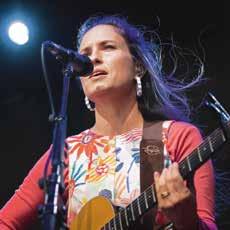
70 DARE MARCH-APRIL 2023 SENIORS.COM.AU INDULGE / ENTERTAINMENT
FOR A FAMILY AFFAIR
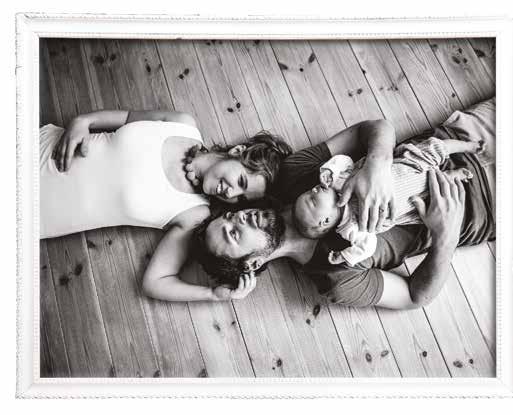
National Folk Festival

Head to Exhibition Park in Canberra this Easter for a family-friendly folk celebration headlined by UK favourite Billy Bragg (right) and local legends The Waifs. Between sets, check out food and market stalls, workshops, roving performances and a program of craft, dance and art. 6-10 April; details at folkfestival.org.au
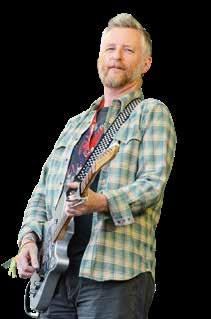
FOR SEA SHANTIES
Fisherman’s Friends: One and All
Based on a true story, this British comedy-drama is the follow-up to 2019 hit film, Fisherman’s Friends, about a famous ‘buoy band’ of mostly matureage seafaring singers from Cornwall. In the sequel we find our unlikely heroes struggling with sudden fame. Starring James Purefoy, Sam Swainsbury, Dave Johns and Richard Harrington (above). In cinemas 23 February
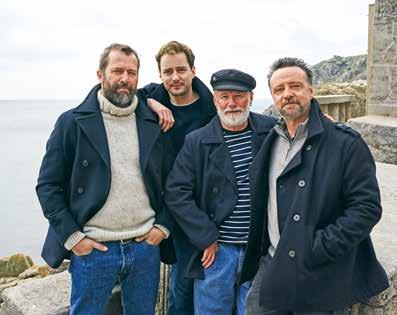
doesn’t tear
apart. Imagine that.
it real through a gift in your will. For more information please call 02 9334 1479 or visit cancercouncil.com.au/mywill
A future when cancer
families
Make
Compiled by ANNA NEVILLE
ONCE UPON A TIME IN JOBLAND
From sending in your résumé by fax to finding the perfect power suit, we take a look at how the job-hunting process has changed in this walk down memory lane.
Words RACHEL SMITH
If there’s one industry that’s moved at warp speed since the 1970s, it’s recruitment. Chances are, you remember the ridiculously inappropriate questions interviewers were allowed to ask back in the day. And who could forget bashing out a job application on a typewriter – and having to find a stamp so you could mail it in?
Fast forward to now: the age of email, keywords, online jobs boards, video interviews – and a sense that there are more robots than humans involved in the jobseeking process.
“Once upon a time the biggest thing we’d agonise over with a CV and cover letter was picking the perfect stationery to use!” says Michael Berger, founder and director at Talent Blueprint in Brisbane. “Jobseekers have had to move with the times – but the good news is, if you present yourself well, and have specialised skills, it’s a great time to be job hunting.”
BACK IN TIME
The 1970s were a time of cultural change, but companies still expected your résumé to list your race, height, weight, marital status, health conditions and even whether you owned your own home. “Details we wouldn’t get away with asking for these days, basically,” says Michael.
The 1980s saw technology take a leap forward: we swapped typewriters for word processors, and the facsimile was born. “It saved you time, but was a weird thing to get your head around,” he remembers. “You just had to feed your résumé through in the right way, and hope it would turn up at the other end!”
In the 1990s, online jobs boards emerged, and that was a big transition for many jobseekers who weren’t quite ready to give up the classifieds. “All that changed in the early 2000s when people realised how easy it was to apply for jobs online, and the recruitment landscape became a bit of a flood.”

APPLYING FOR JOBS
It’s been a long time since any of us checked the newspaper for job opportunities – that seems as
72 DARE MARCH-APRIL 2023 PLAN / CAREERS
MICHAEL BERGER Founder and director, Talent Blueprint
strange to us now as online jobs boards once did. And we’ve had to become detectives of sorts, decoding job ads and inserting the right keywords into our CVs and cover letters, because so many companies now use applicant tracking software (ATS) to screen candidates.
“A primitive form of ATS was available in the early 2000s,” says Michael. “But these days, it’s much more sophisticated – it can rank a pool of candidates and their applications in seconds. Keywords are everything; for example, if the ad mentions advanced Excel skills and you don’t include the words ‘advanced Excel skills’ in your cover letter or CV, you’re going straight into the bin.”
INTERVIEW EVOLUTION
Just as lighting up a cigarette in the workplace is now illegal, the interviewing part of the process has evolved hugely over the years. Take interview wear, for example: in the 1970s, women were warned against looking too “visually provocative”. In the 1980s, it became all about power suits, shoulder pads and big hair (à la the movie Working Girl). These days? It’s far less formal, says Michael. “It’s more accepted today to go to an interview wearing what you’d wear in that particular workplace – and if you’re not sure of the dress code, ask.”
How candidates are assessed has changed, too: in the past, interviews were nearly all face-toface. Today, the Zoom interview is a thing. “The other things we do so differently include using tools like AI, psychometric

Ifirst applied for jobs back in the 1980s and it was all about what you wore, who you knew, and if you went to a ‘good school’. I spent weeks searching for the perfect blue power suit – and I don’t miss that, or having to retype my CV over and over for different jobs.
As for the interview questions, I was asked if I had a boyfriend, wanted children, went to church, whether my parents were married or divorced, what car I drove and even if I was okay to babysit when necessary for the boss!
These days, it’s very different of course – and jobseeking is much easier with the advantages of technology. I also love that there’s more flexibility and work-from-home options. If you’re back jobseeking after many years, my advice would be to upskill in Microsoft Office. There are free courses online or at your local library, and don’t be afraid to ask for help from younger colleagues or friends, because technology skills are essential.
testing and pre-recorded video where candidates answer five questions,” explains Michael. “Companies are increasingly relying on video, especially for customer service roles, to determine if you’re a good fit.”
WHAT HASN’T CHANGED
Although we’ve come a long way in the past 50 years, the jobseeking fundamentals have still stayed the same, says Michael. “We talk about all these whiz-bang AI tools we have, but networking is as important as it ever was – there’s nothing more powerful than getting
the inside word from someone in the know. Tapping into industry groups and communities and building relationships – whether on Facebook, LinkedIn or via another channel – is also a big part of it.”
Keeping your résumé up-todate is also still essential – and these days, your LinkedIn profile is an extension of that. “Market yourself and be consistent across your CV and LinkedIn, and you may never need a CV again,” he adds. “You’re going to be found with the technology that’s available, and which will become even more intuitive in years to come.”
73 MARCH-APRIL 2023 DARE SENIORS.COM.AU
“I don’t miss the inappropriate questions or the power suits!”
KAREN DOANE, 62
Copywriter/brand strategist
INSURING FOR THE FUTURE
With Australians now living longer, working longer and carrying housing debt for longer, it’s worth reviewing your insurance to ensure it suits your changing needs.
Words ANNETTE SAMPSON
As baby boomers get older, they are not only living longer but changing the rules on how it’s done.
According to the Australian Seniors Ageing in the Workforce research, almost nine-tenths (86%) of over 50s surveyed believe that staying in the workforce longer is a good thing. In fact over three-quarters (76%) plan to keep working indefinitely under the premise of supportive and flexible working conditions.
Lengthening our careers is even appealing to those who have previously left the workforce, with more than two-fifths (45%) reporting an attempt to re-enter the workforce after leaving for a period, or making a career change beyond 50.
At the same time, more Australians are moving into their 50s and 60s with dependants from second (or later) marriages, or are looking after their grandchildren. And more are reaching retirement age with a mortgage.
Morning Herald, the proportion of people aged 55 to 64 who still have a mortgage has more than doubled in the past 20 years to nearly 36% in 2021. For those aged over 65, figures have tripled, and now stand at nearly 10%.
important not to have too much insurance as you move towards retirement, but it’s also important to ensure you have enough.
“We’ve had clients who have kept life insurance until quite late in life because they have a property with a mortgage, and they want their spouse to have the opportunity to pay it out if they pass away.”
Michael Hutton, a partner with advisory and accounting firm HLB Mann Judd Sydney, says it is important to recalibrate your insurance to suit your changing needs as you get older. “I’ve just turned 60 so I’ve done this myself,” he says. “It’s
As well as considering how you can continue to provide for the people who rely on you after you are no longer here, Michael says you may also want to consider future possibilities, such as how you would be able to pay for care if you become disabled. You should seek professional advice specific to your circumstances if required.
To find out about getting covered for life insurance at an older age with Seniors Term Life Insurance , call 1300 050 502 or go to seniors.com.au
74 DARE MARCH-APRIL 2023 SENIORS.COM.AU PLAN / SAFEGUARD
“It’s important not to have too much insurance as you move towards retirement, but it’s also important to ensure you have enough.”
MICHAEL HUTTON Partner, HLB Mann Judd Sydney
From the depths of a fiery volcano
radiant treasure helenite diamond ring
No emerald has a story like this! From the depths of a fiery volcano comes the glittering green elegance of Helenite! First discovered after the eruption of Mount St. Helens, this exquisite stone is created from the ashes of its namesake. The earth has given the world a sparkling stone that rivals the beauty of the finest green gemstones. And now it makes its Bradford Exchange debut in this unique and visually stunning statement ring. Our “Radiant Treasure” Helenite Ring is expertly crafted from sterling silver with rich 18K gold plating. At the centre of the design is a 1.25 carat genuine Helenite stone in a gorgeous pear shape framed in a shimmering milgrain setting. The stone is uniquely faceted in an infinity cut, creating an effect of endless light-catching sparkle. The ring’s dual bands—one silver and one gold–are wrapped with pavé-set ribbons of 4 genuine diamonds, 2 on each side of the glittering Helenite. An extraordinary history plus spectacular sparkle— you couldn’t ask for a better treasure than this!
A Remarkable Value...Available Now!

This majestic Helenite ring is only available from The Bradford Exchange at the amazing price of just 5 easy instalments of $35.99 or $179.95, plus $19.99 postage and handling and is backed by our 120-day guarantee. The ring is available in women’s whole sizes from 5-12. It arrives in a custom presentation case and gift box, complete with a Certificate of Authenticity. You won’t find this ring in stores—so don’t wait! To reserve, send no money now. Just mail the coupon or go online today at www.bradford.com.au/glamour

1.25 carat infinity cut pear-shaped genuine helenite

4diamondsgenuine Sterling silver with 18k gold-plated accents
PAY NOTHING NOW
Please Respond Promptly
YES! Please reserve the “Radiant Treasure” Helenite Ring” for me as described in this advertisement. I understand I need pay nothing now.
Ring Size:
www.bradford.com.au/glamour Shop Online with Ease ✔ 120-day money-back guarantee ✔ Interest-free instalments ✔ Quote 129229 for fast ordering Call (02) 9841 3311 ©2023 The Bradford Exchange Ltd. A.B.N. 13 003 159 617 01-24908-001
Please allow between 2-10 business days for delivery. All sales subject to product availability and reservation acceptance. Credit criteria may apply. Our privacy policy is available online at www.bradford.com.au. You must be over 18 years old to apply. From time to time, we may allow carefully screened companies to contact you. If you would prefer not to receive such offers, please tick this box. q Mr/Mrs/Miss/Ms First Name: Surname: Address: Postcode: Phone: Email: Signature: 1. ONLINE at www.bradford.com.au/glamour quoting promotion code: 129229 2. MAIL no stamp required, to: The Bradford Exchange, Reply Paid 86369 Parramatta NSW 2124 3. PHONE: (02) 9841 3311 8am-5pm EST Mon-Fri 9 7 5 10 8 6 11 12 Place one of your own rings on the chart and find a circle that is completely covered by your ring (a simple band works best for accurate measuring). Write your size on the coupon below. Women sizes range between 5–12. Find your perfect ring size
1. REVIEW ESTATE PLANNING
Having an up-to-date will is an obvious first step but Cameron McLean, senior adviser at Acumen Wealth Management, says it is also important to think about other documents like powers of attorney and guardianship. “These differ between states, but are basically there to set out who will look after you and your finances if you’re unable to do so yourself,” he explains.

“Things like guardianship need to be set up early while you have capacity or your family will be in court trying to get it done for you,” adds Alexis Wheatley, Wheatley Wealth Group adviser.
Cameron says it’s also a good idea to check the ownership of your assets to avoid red tape. “Some assets, like joint bank accounts and investments held through joint tenancies, automatically go to the other account holder if you die, which reduces the time and complexity of managing your estate.” Superannuation is another asset that can go straight to a dependant (such as your partner) if you have made a binding beneficiary nomination with your super fund, he says.
2. KEEP PEOPLE INFORMED
Joseph Palmer and Sons managing director Rodney Horin says communication is key. “Your lawyer, accountant and executors should have a copy of your will and your family should know what your wishes are,” he says.
Your family should also know who your professional advisers are,
SORTING OUT YOUR AFFAIRS
What state would your finances be in if you suddenly passed away or found yourself unable to manage your own money? Our experts suggest the seven steps you can take now, to ease the burden on your family in the future.
Words ANNETTE SAMPSON
76 DARE MARCH-APRIL 2023 PLAN / WEALTH BEING
Cameron adds. Plus, it’s a good idea to let them know where assets are located. “If you list all your assets in case of an emergency, your family can see where everything is if something happens.”
3. ADDRESS DEBT
With more older people carrying debt into retirement, Rodney says it’s important to consider how to minimise debt and have a clear plan for paying it off as soon as possible.
“Debt repayments eat away at the money you have to live on,” adds Alexis. She says downsizing may be one option to pay off the debt. Drawing on your superannuation may be appropriate, says Cameron, but our experts agree that having a plan for debt reduction in advance will minimise the chances of you being left without enough to live on.
4. MAKE A PLAN FOR YOUR RETIREMENT INCOME
People usually retire with an idea of what they need to live on in the immediate future, but what about later on? While lifestyle expenses are often a priority in early retirement, many retirees find their costs increase again as they get older, with more money needed for essentials like medical costs and aged care.
“A lot of clients are very active in the initial years of retirement, so we allow extra money for that,” says certified financial planner Daryl La’Brooy. He also asks his Hillross Financial Services clients how long their parents and grandparents lived, and how their
own health is, to help them work out how long they need to plan for.
“A lot of people are concerned about outliving their savings, so we spend time upfront explaining what they can get in government benefits and how long they can expect their savings to last.”
But Alexis believes it is also important not to save too much in retirement. “Sometimes people don’t spend very much early on because they think they will need it later,” she says. “But then they run out of time to enjoy the things they should have done. You need to make sure you enjoy the things you really want to do, because you don’t know what will happen.”
5. THINK ABOUT YOUR FUTURE ACCOMMODATION
Rodney says the worst time to start thinking about aged care options is when you find yourself in hospital and are told you cannot go home. “While that might seem a long way off, planning ahead and knowing your options for both future retirement living and aged care will make future transitions much easier,” he says.
“It’s a continuum,” adds Daryl. “Do you want to downsize from your current property and put more money into super?” While most people want to stay in their own homes, he says it’s worth knowing how the rules for aged care work and how they would apply in your situation.
6. SIMPLIFY WHERE YOU CAN
While many retirees enjoy looking after their investments, Cameron says one goal might be to simplify your affairs. “You may have a big share portfolio, but if you want to keep those sorts of assets you can do it by having everything in one account or managed fund,” he says. “The number of bank accounts you have can also accrue over time, so it’s worth minimising them.”
Rodney says family and corporate structures such as trusts should also be revisited to see whether you still need them. “Seek accounting and legal advice on the benefits of retaining such structures.”
7. PROTECT YOURSELF
Sadly, coercive control in the form of financial abuse is an issue. A family member may attempt to take over the finances of an older relative by convincing them they are no long capable. “Coercive control is a common problem,” confirms Alexis. “You need to be careful you don’t get too isolated.”
It may be worth considering having a power of attorney in place with a trusted person named, or one that requires two trusted people to make decisions jointly.
This is general information. You should seek professional advice specific to your circumstances if required.
77 MARCH-APRIL 2023 DARE SENIORS.COM.AU
your wishes for your estate clear in a will. For a free legal will kit from Australian Seniors, go to seniors.com.au and search ‘will’.
Make

50-100 YOUR HEALTH THROUGH THE DECADES
Risks may increase as we get older, but there’s plenty we can do to avoid illness and live a long and healthy life. Dr Norman Swan and Dr Ginni Mansberg talk us through what to expect, one decade at a time.
 Words STEPHEN CORBY Illustration MARTA ANTELO
The early 1900s were an exciting time to be alive: recently invented planes and cars were revolutionising travel, electricity was making its mark and phones allowed people to talk across vast distances. The big downside, however, was that the average life expectancy in Australia was around 55 years, an appallingly low figure by modern standards.
Wondrous improvements in social conditions and advances in medical technology – chiefly mass immunisation and antibiotics – have meant that the rather low innings of 55 has now extended to around 81 for men and 85 for women, while hitting your century is far more likely.
If that’s your goal, then starting good habits early on is of prime importance, says multiaward winning author and ABC broadcaster Dr Norman Swan. “The earlier you do things like exercise regularly or improve your diet, the greater
the benefit,” says Dr Swan. “It’s never too late to start – that’s really the message here.”
He also notes that GPs and other doctors tend to focus on the over 50s, “because that’s what they’re taught to do, because that’s when risks start to increase”.
But as Australian GP, author and TV personality Dr Ginni Mansberg points out, there’s no one-sizefits-all plan to adhere to. “I’ve seen people in their 40s who just seem to always be sick, and I’ve got patients in their 80s who are fighting fit,” she says.
“You can’t say that there’s this algorithmic thing that happens as you turn 50. It’s just that the odds of certain things can become greater and lesser at certain ages.”
With that caveat in mind, here’s a guide to what you can expect as the decades progress, and the things you can do to better your chances of staying healthy.
79 MARCH-APRIL 2023 DARE SENIORS.COM.AU PLAN / SPECIAL REPORT
>
IN YOUR 50 s
Vital signs
“It’s really important to know what your blood pressure is and what your cholesterol is,” says Dr Swan. “Get it monitored to make sure it’s in a healthy range.”
Family health history
This is also very important, says Dr Swan. “If you’ve got a pattern in your family of diagnosis of cancer, or heart disease, there might be genes running in your family which increase the risks. It’s important to talk to your GP about that and to find out whether it’s something to monitor, because that process could save your life.”
Smoking and alcohol
“Smoking speeds up the ageing of every cell in your body, so if you’re smoking at 50, and you want to live a long life, stop smoking immediately,” says Dr Swan. Alcohol is also an issue, he says. “The problem drinkers are the
over 55s in Australia. You don’t have the brain reserves left to deal with excess alcohol intake, so you’ve got to be really careful about how much you drink.”
Common warning signs
Both Dr Swan and Dr Mansberg say it’s worth investigating some of the more common causes of death for your age group and gender [see box on page 82] so you can keep an eye out for warning signs. A free National Bowel Cancer Screening Program is available for eligible Australians aged between 50 and 74, with early detection resulting in nine out of 10 bowel cancer cases being treated successfully. The test, which involves sending a faecal sample in the mail, is simple and effective, but not enough people have been taking advantage of the program, says Dr Swan. “Looking at the uptake of the program, about 60% of Australians over 50 would rather die than
send their poo off in the post to test for bowel cancer,” he says.
“Or they’d rather have a painful operation, toxic chemotherapy and a colostomy bag. It’s madness – people need to get tested.”
Dr Mansberg also suggests that women get cervical and breast cancer screenings. “The cervical screening test for women, which used to be called a Pap test, starts when you are 25, and then should happen every five years after,” she says. “And then we add to that a breast cancer screening – it’s really important to do both.”
Muscle development
Although you don’t necessarily need to become a gym junkie, keeping your muscles strong as you age is more important than you may think. “One of the things that speeds up ageing and speeds up premature death is weak muscles as you get older,” says Dr Swan. He says we need to exercise 45 minutes to an hour most days of the week, and include muscle strengthening. “It can be with weights, it can be pushups, it can be against your body weight with Pilates, and so on. But you’ve actually got to develop really strong muscles, as well as getting aerobic exercise.”
Other checks
Dr Mansberg recommends screening for diabetes, as well as undergoing regular skin checks, particularly if you have fair skin, and visiting the optometrist to check for glaucoma and age-related macular degeneration.
“The other big thing is dental checks. We know that people who see the dentist twice a year actually live longer and have less chronic diseases than people who don’t see the dentist,” she says.
80 DARE MARCH-APRIL 2023
Extra help
As you’d expect, getting older brings with it a higher likelihood that you may need some form of surgery to keep your body functioning properly, from replacement knees or hips to blocked arteries that need a stent, says Dr Swan.

“You might need a few pills, or you might have an artificial joint, or you might need to get physio to strengthen your muscles, but those things will help you keep going.”
Stress relief
Connecting with family and friends fights stress and helps keep you young, says Dr Swan. “When you’re more stressed, your brain sends messages to the body which speed up ageing. When you’re not so stressed, your body sends anti-ageing messages to your body. So reducing stress actually slows down ageing.”
Good eating habits
Dr Swan recommends copying the good habits of people who live long lives, pointing to the diet of first generation Greek Australians, who he says are the secondlongest living people in the world. “Their diet is typically not a lot of meat – you get your protein from fish and
from legumes like chickpeas and lentils. There’s also a huge variety of vegetables and extra virgin olive oil.”
The secret, though, is how it’s cooked. “They cook using extra virgin olive oil, garlic, onions, fresh herbs and vegetables from the garden – freshness counts more than if something’s organic,” he says. “The moderate heat also means no burnt bits, which is good, because those brown, burnt bits we love so much actually speed up ageing.”
Dementia risks
Although there’s a greater risk of getting dementia as we get older, there are steps you can take to prevent it, including avoiding smoking and drinking too much, staying intellectually stimulated and undertaking vigorous exercise and regular social contact.
And while there’s no current explanation for it, Dr Mansberg says dementia is far more common in women, and the leading cause of death. “We now also have absolute proof that lowering your blood pressure dramatically reduces your risk of dementia,” she adds. “Also, if you are going deaf, don’t put off getting a hearing aid because getting one will actually help prevent dementia.”
Cancer screening
“Most cancer screening stops around the age of 70,” says Dr Swan. “There aren’t official policies on this, but the reality is that you’ve got a long time to live if you’re 70, maybe 30 years to go, so my personal view is that you should continue cancer screenings, even if you have to pay for it.”
Work factor
“Retirement is essentially quite bad for your brain,” says Dr Swan. “If you’re a bloke, because we’re worse at this sort of thing than women, you might paint the front of the house, and then you twiddle your thumbs and sit on the couch and watch the latest Netflix series.
“That’s really bad for you and you should keep working. You don’t have to work for money – you can do volunteer work. It’s really about getting up, going out and doing stuff and maybe learning some new skills. Work is really important for a long and healthy life.”
Medication check
“As you get older, every year or so you should have a medication check,” says Dr Swan. “Get a pharmacist to have a good look at what you’re taking.” For example, he explains, some medications might be interacting with each other negatively and might need to be reviewed.
Bone health
“We know that your bone density peaks at age 30, and then generally it stays about the same until age 50 before starting to drop off,” says Dr Mansberg. “So by age 70, everybody needs to be getting a bone-density check.” >
81 MARCH-APRIL 2023 DARE SENIORS.COM.AU IN YOUR 60 s IN YOUR 70 s
“The earlier you do things like exercise regularly, the greater the benefit. It’s never too late to start –that’s really the message here.”
DR NORMAN SWAN (pictured above) Broadcaster and author
IN YOUR 80 s & 90 s
Mental health
The sad reality is that we will begin to lose friends and family members as we age, which can have an adverse effect on our mental health.
“Mental health issues, such as depression and anxiety, increase brain ageing, so at any age, if you’ve got depression or anxiety, you need to get it treated,” says Dr Swan. “It doesn’t have to be with drugs. It can be with psychotherapy, talking therapies, it could be with vigorous exercise. It could be with improving your diet, because if you improve your diet, you improve your microbiome, and a healthy microbiome has an antidepressant effect on your body.”
“Talk to your GP about any mental health issues, because there’s often a lot of helpful mental health services and resources that they have access to,” Dr Mansberg adds.
Exercise regime
At this age, Dr Swan says you can still rejuvenate your body with exercise. “There’s a researcher at Sydney University who has done weight training with frail 90-year-olds, and it works – they get a little bit stronger and do stuff they haven’t done before.”
Balance and falls
Dr Mansberg says falls are typically related to your sense of balance, which becomes an issue with age. “Osteoporosis usually equals a fracture if you fall, and the problem with something like a hip fracture is that 50% of people who have a hip fracture are either dead or in the nursing home within 12 months. People really don’t realise how bad hip fractures are.
“Medication for osteoporosis can help, but there are balance and
fall-prevention classes out there, which are a great idea,” she adds.
“People can also self-refer to My Aged Care, and they’ll stratify your risk at home. If you’ve already had a fall, they’ll see you in a flash.”
Health checklist
“Contact the RACGP [Royal Australian College of General Practitioners] about getting a health check, because they have a list of everything you should be doing,” says Dr Mansberg (search ‘wellness check’ at racgp.org.au).
“They don’t mention everything –seeing the dentist, for example – but they’ll be able to offer a good guide of what needs to be checked.”
100 & beyond
“More and more people will reach 100, and a few of those are going to live to 105 or 110,” says Dr Swan. “It used to be the situation that with people who got to 100 there was a genetic abnormality there, but now the vast majority of people getting to 100 do not have that gene, they’ve just lived a reasonably healthy life and have not smoked too much and they’ve kept the blood pressure down.” Seniors Health Insurance is coming soon.
TOP 5 CAUSES OF DEATH
2.
4.
3.
5.
1.
2.
3.
disease
4. Lung cancer
5. Breast cancer
82 DARE MARCH-APRIL 2023 SENIORS.COM.AU
MEN WOMEN
Coronary heart disease
IN AUSTRALIA
1.
Dementia, including Alzheimer’s disease
Lung cancer
Cerebrovascular disease
Prostate
cancer
Dementia,
including Alzheimer’s disease
Coronary
heart disease
Cerebrovascular
Source: Australian Institute of Health and Welfare National Mortality Database, based on deaths in 2020.
“We now have absolute proof that lowering your blood pressure dramatically reduces your risk of dementia.”
DR GINNI MANSBERG (pictured
above)
GP and TV personality











































POWER NAP
For many of us, catching some sleep gets more challenging as we age. Luckily, there’s an app for that – plus a few more gizmos to help you nod off.
W
ords ADAM TURNER
If you lie awake in the middle of the night, frustrated that you can’t slip away to dreamland, then technology might be the key to finally getting some sleep.

Before you invest in new gadgets, however, it’s worth trying a few simple tricks to help you nod off. Try avoiding coffee after lunch and snacking after dinner. Some people also find that a weighted blanket helps them sleep.
Putting aside your gadgets an hour before bed can make a difference. The screen’s bright, cool
blue light tells your brain that it’s time to wake up, so try dimming the lights in the room and enabling ‘night shift’ or ‘night mode’ on your gadgets, which automatically shifts the screen to a warmer yellow light in the evenings.
Your smartphone might be responsible for keeping you up late, but it can also be your saviour when it comes to getting some rest. You’ll find a wide range of smartphone apps designed to help you get to sleep and stay asleep, says AAP technology
journalist Jen Dudley-Nicholson.
Many sleep apps offer guided meditation and breathing, Jen says, along with soothing music or calming sounds such as white noise, rain and ocean waves. You’ll also find dedicated smart sleep devices that do a similar job and can live on your bedside table.
“Smartphone apps are a relatively inexpensive option when it comes to sleep tech, but you need to check whether they charge steep ongoing fees,” she says. “It’s also important to consider how to best use these apps, so they don’t disturb anyone else in the bed. If it’s a problem, then you might want to consider wearing earbuds.”
Some apps also slowly adjust the light on the screen to tell your brain it’s time for sleep, or you might invest in a smart light bulb or bedside light that can mimic sunset and sunrise.
If you want to get more methodical, wearables such as fitness bands and smartwatches can track the quality of your rest, wake you at the best time and sometimes make suggestions for getting a better night’s sleep.
“Some will also take extra measurements while you sleep, like your heart rate, respiration and time spent in deep sleep,” Jen says. “If you’re considering a wearable gadget to track your sleep, make sure it’s comfortable to wear to bed and you can easily dim its screen and put it into sleep mode, so it won’t keep you up at night.”
For our comprehensive guide to sleep aids, turn the page
85 MARCH-APRIL 2023 DARE SENIORS.COM.AU PLAN / TECH
CATEGORY BENEFITS PRODUCT PRICE HOW IT HELPS
Calm
APPS
EARBUDS
Affordable and easy to use with your phone on a bedside table
BetterSleep: Relax and Sleep
Block outside noise, don’t disturb anyone else, much smaller than headphones
SMART WATCHES
More accurate sleep monitoring than apps, silent (vibrating) alarm option

Bose Sleep Buds 2

7-day free trial, $89.99 per year
Free, premium features from $9.99
Teaches meditation and plays sounds to help you relax

Plays sounds to help you relax
$379.95
QuietOn 3 sleep earbuds


Apple Watch
$359
From $399
FitBit Sense

Philips Hue White and Color smart bulbs

LIGHTS Trigger natural sleep and wake responses
Philips Wake-Up Light Alarm Clock with Sunrise Simulation

Dodow sleep aid
From $224.95
Blocks noise, plays a library of sounds
Blocks noise via an expandable foam tip
Reminds you to go to bed, monitors sleep quality, sets do not disturb
Reminds you to go to bed, monitors sleep quality
From $99.95
Mimic sunrise and sunset by adjusting brightness and colour
DEVICES Help your body relax naturally
From $127
Sunrise simulation from yellow to bright yellow aids a natural wake up
Shines a light on the ceiling to pace breathing
From $185
Audio headband plays sounds to aid relaxation

86 DARE MARCH-APRIL 2023 CW
WW PLAN / TECH / SLEEP AIDS
supplied)
(10 hours), USB charging cable
Bedtime
sleep tracking, sleep score, snore and noise detect, voice assistant
Sleep and wake automations, work with Google Assistantenabled speakers, easy self-install
Light therapy lamp, speaker with choice of calming sounds, tap-to-snooze function
Metronome with a light system (the light expands and retracts to sychronise breathing), auto shut-off
Ultra-flat earphones wrapped in foam for sleeping comfort, plays other sleep and music apps, choice of sizes
about your sleep and how to improve it
your body clock
A bedside alarm clock that aids natural sleep
Hypnotic stories and guided meditation
87 MARCH-APRIL 2023 DARE SENIORS.COM.AU MODES WEARABLE CONNECTIVITY POWER FEATURES BEST FOR Stories, meditation, mindfulness, stretching and breathing exercises No N/A N/A Award-winning guided meditation programs Using meditation to wind down at the end of the day Music, meditation, ambient sounds No N/A N/A Lets you
to
Drifting off,
Noise-masking, naturescapes, music and alarm, via the Bose Sleep app Yes Bluetooth with smartphone Battery (810 hours) Wireless, small and comfortable for
all night An effective noise-
Active noise cancellation Yes N/A Battery (up to 48 hours) Passive and active noise cancellation, super lightweight Sleeping in silence Sleep tracking, silent alarm Yes Bluetooth with smartphone Battery (up to 36 hours)
schedule,
assistant Troubleshooting
Sleep tracking, silent alarm Yes Bluetooth with smartphone Battery (up to 6 days)
Manual on/off/ scheduling via the Hue app No Zigbee wireless bridge Light socket
Resetting
Wake, sleep, alarm No N/A AC power
combine effects
make soundtracks
blocking out other sounds
wearing
blocking solution
Bedtime
sleep tracking via built-in app, voice
sleep and monitoring overall health
schedule,
Learning
8 min and 20 min No N/A AAA batteries (not
Relaxing and slowing down your metabolism
via the Hoom app Yes Bluetooth
Battery
Music, meditation, hypnotic stories, ambient sounds, white noise,
with smartphone
GOOD GRIEF
Losing someone you love is one of life’s most challenging experiences. Here, an expert shares tips on navigating bereavement.
Words TRUDIE M c CONNOCHIE
Even though we know we’ll lose the people we love at some point, nothing really prepares us for the emotional rollercoaster of grief. The torrent of profound sadness, the shock.
Intensifying the experience, those trying to support you may have misconceptions about grief that can be unhelpful, says Marianne Bowdler, clinical services manager at Griefline.
“People think that it’s a linear process, and people also think that it can be quite short,” she says. “You can have people saying, ‘Oh, that was three months ago –aren’t you over it by now?’ We’re all unique individuals with unique circumstances, and so our grief experience will be unique.”
Marianne shares the following tips when dealing with grief.
1. ACCEPT ALL EMOTIONS
The range of emotions you might feel could take you by surprise, especially if you’re not someone who normally feels anger, for example. If you need an outlet for your emotions, you could take a creative approach. “It’s lovely to do a drawing every day,” Marianne suggests.
2. ESTABLISH NEW RITUALS
The first year of grief, in particular, can be very difficult as you navigate milestones such as the first birthday, anniversary and Christmas without your loved one. Marianne says creating rituals around those events can be helpful, such as eating their favourite cake on their birthday.
“At the beginning it’s difficult, but over time, you can reach a point – it can be decades later – where you’re
Left: to help her grieve, artist Janet Willis created art each day from her mother’s dried funeral flowers, documenting the pieces on Instagram (@jrwillis100days) over 100 days.
just so grateful that you had that lovely person in your life,” she says.
3. MANAGE ENERGY LEVELS
Adjust your expectations about what you’re capable of each day. “Grief is exhausting,” she says. “You have to be very kind to yourself and not think, why am I not achieving all of my tasks and getting everything done on my to-do list?”
4. REMEMBER THEM
Fostering what Marianne calls a “continuing bond” with your loved one can be comforting. You can keep their memory alive by talking to them or writing them letters. Griefline also suggests securing a legacy in their name (such as planting a tree), creating a shrine or photo board at home dedicated to their memory, or becoming involved in a cause they loved.
5. STAY CONNECTED
While grief can be an isolating experience, Marianne says people who make an effort to stay connected to friends and family tend to navigate the process better. Griefline also offers trained counsellors. Call 1300 845 745 or go to griefline.org.au
Leaving loved ones behind isn’t easy. To help with your funeral costs, consider Seniors Funeral Insurance. To find out more, call 1300 356 681 or go to seniors.com.au
88 DARE MARCH-APRIL 2023 PLAN / EXIT STRATEGY
SENIORS.COM.AU


















The Last Word Tom Gleisner
As part of the team behind hit movies The Castle and The Dish, and host of award-winning TV show Have You Been Paying Attention?, the 60-year-old comedian has many strings to his bow. Now with Bloom –a satire about the aged care crisis – he is adding musical theatre to his repertoire.
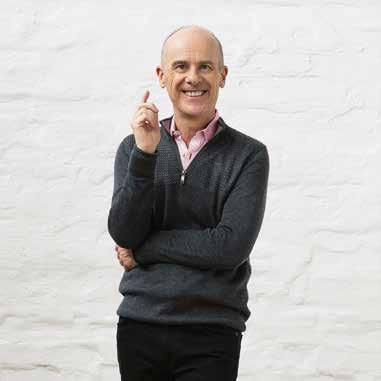 Words CAMILLE HOWARD Photography HWA GOH
Writing, directing, producing, hosting – do you have a favourite? I think writing. It’s the purest creative expression. Everything else seems to involve a meeting.
Live or pre-recorded? Working in comedy these days it’s a lot safer to pre-record. Say one wrong thing live and before you know it you could find yourself cancelled.
Who’s the funniest person you’ve met? Glenn Robbins would be in my top three. We filmed Russell Coight together and I’ve never laughed so much. Rob Sitch in Frontline or Utopia is brilliant to watch. Anne Edmonds on Have You Been Paying Attention? (and soon to be in Bloom) is always hilarious.
How would loved ones describe you, in five words? People who really know me would probably say I’m a “punctual, sensitive, anxious over-pleaser”. Sam Pang [panellist on HYBPA?] would say an “old, doddery, incompetent, moving target”.
Your new musical is about aged care. What would your dream aged care home look like? Like those ones in magazine ads. They come across as luxury tropical resorts full of “oldies” who all appear to be models in their mid 50s.
What TV shows are you watching at the moment? Derry Girls, a series set in Northern Ireland (viewing tip – turn the subtitles on or you’ll miss half the dialogue). I also loved the latest series of Fisk on the ABC (no subtitles needed).
If you weren’t doing what you’re doing, what job would you have? I actually studied law, so I guess ‘solicitor’ would have been my job title. Or perhaps ‘disgraced solicitor’ –depending on how things went.
What lyric best describes your life? It’s hard to go past Joni Mitchell’s famous line: “Don’t it always seem to go, that you don’t know what you got till it’s gone.” I have had the privilege of doing so many wonderful things, but I’m not sure I fully appreciated them at the time.
Your biggest regret? Not taking up golf earlier.
What would you like to be written on your tombstone? “Construction site – do not enter.”
90 DARE MARCH-APRIL 2023 SENIORS.COM.AU
Bloom, produced by the Melbourne Theatre Company, is on at Arts Centre Melbourne from 18 July. Tickets are available now as part of a three-plus play package (single tickets from 30 March).
It’s 1953 and Australian motoring changes forever... General Motors Holden released the FJ. Its impact was immediate, its sales, record-breaking and its legend, enduring. Australia had a car we could truly call our own and as we embraced the FJ, we made Holden our favourite car. With the launch of the FJ, Holden had found its place in the Australian way of life, a relationship that endures and grows stronger into the 21st century. The 65th anniversary of this Holden icon is now celebrated in a golden Proof ingot. Struck to a high specification, only 9,999 are available. For this reason applications will be processed on a strictly firstcome, first-served basis and are limited to one per Australian household. Order the ‘’1953 - FJ Holden Ingot’’ now for just $39.99 (plus $9.99 postage and handling). By ordering now, you will have priority access to further coins in the collection which are available for $89.99 (plus $9.99 P&H) and will be shipped to you at regular intervals. You’re under no obligation. Collect as many as you wish and you may cancel at any time. All purchases are covered by The Bradford Exchange 14-Day Money-Back Guarantee.
Limited Edition with Individual Numbering individually numbered, meaning no two are the same. Yours is the one and only issue of its kind – the ultimate collector’s item.
Fully layered with Pure 24-Carat Gold
As befitting a subject of such importance, the commemorative is fully layered with pure



Officially Licensed by Holden, the edition showcases nostalgic art of the generation to fully embrace the all-Australian car.
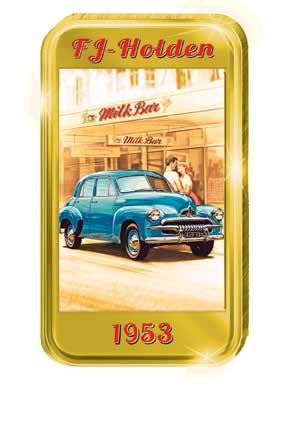

An elegant, high gloss case to display the ingots will accompany a future delivery and is yours FREE as part of your collection.


Fastest way to order: www.bradford.com.au/holden or call on (02) 9841 3311 Lines open 8.00am-5.00pm AEDT Mon-Fri Quote reference code 129230 PAY NOTHING NOW
| Finish: Layered in Pure Gold | Quality: Proof | Edition: Uniquely Numbered | Dimensions: 45mm H x 25mm W
Limitation: 9,999 worldwide
Pure
INTERNATIONAL GOLDEN COMMEMORATIVE ANNOUNCEMENT 0001
Soon - FX Holden Ingot ©2023 The Bradford Exchange Ltd. A.B.N. 13 003 159 617 403-COM95.01 Please allow between 2-10 business days for delivery. All sales subject to product availability and reservation acceptance. Credit criteria may apply. Our privacy policy is available online at www.bradford.com.au You must be over 18 years old to apply. From time to time, we may allow carefully screened companies to contact you. If you would prefer not to receive such offers, please tick this box. q YES, Please reserve the Holden Golden Ingot Collection for me as described in this advertisement, beginning with Issue One “1953 - FJ Holden Ingot”. I understand I need pay nothing now Title Mr Mrs Ms Miss Other _________________________ Name Address Postcode Email Address Telephone Signature Order reference: 129230 COMPLETE AND SEND THIS APPLICATION FORM IN AN ENVELOPE TO: THE BRADFORD EXCHANGE, REPLY PAID 86369 PARRAMATTA NSW 2124 ™ General Motors LLC 1953 - FJ Holden
SAVE $50.00 Yours for just $39.99 + P&H Issue One
Certificate of Authenticity Layered in
Gold
Coming
Ingot
RED CENTRE SPECTACULAR THE
GHAN, ADELAIDE TO DARWIN from $8,275 * pp 10 DAYS 23 MEALS
Immerse yourself in the Northern Territory’s breathtaking natural wonders and settle into The Ghan’s gentle rhythm as you travel through the country on this spectacular 10-day journey. From exploring the West MacDonnell Ranges to taking your place beside spiritual Uluru and Kata Tjuta, you’ll soon understand why people travel great distances to see the Territory’s remarkable landscapes and icons.
HIGHLIGHTS & INCLUSIONS

• 2 nights aboard The Ghan, Adelaide to Darwin, including all meals, beverages, and Off Train Experiences in Marla, Alice Springs and Katherine
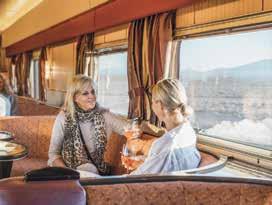
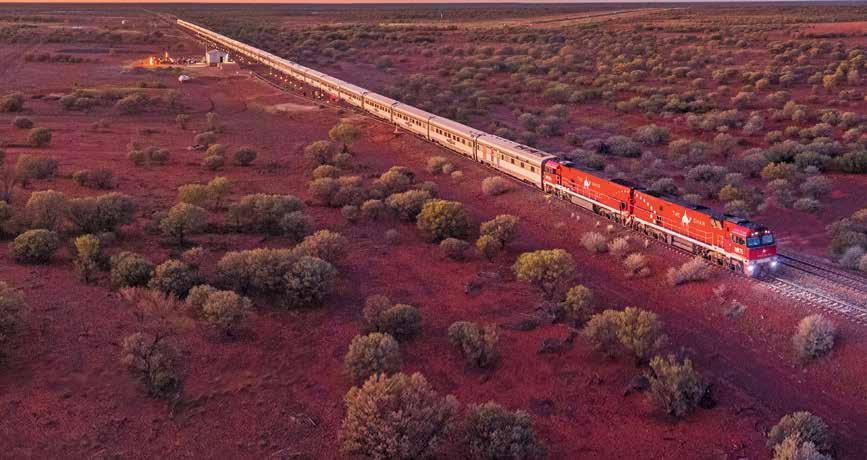
• Transfer from Alice Springs Rail terminal to hotel
• 2 nights’ accommodation in Alice Springs, including breakfast daily
• 5 nights of intimate small-group touring with Outback Spirit, travelling on board a state-of-the-art 4WD Mercedes-Benz vehicle, including accommodation, meals and guided touring

• Visit Kings Canyon for a guided scenic walk and journey through the West MacDonnell Ranges, visiting Stanley Chasm and Ormiston Gorge
• Dine under the stars at the ‘Sounds of Silence’ experience
• Explore the rock formations of Uluru, Kata Tjuta (The Olgas) and Walpa Gorge


• Admire the internationally acclaimed ‘Field of Light’ display at Uluru as it illuminates the desert night
Visit journeybeyondrail.com.au , call 1800 703 357 , or contact your local travel agent. *Red Centre Spectacular: Advertised prices are per person, based on the Everyday fare in a Gold Service Twin Cabin on The Ghan, Adelaide to Darwin in October 2023. Offers are subject to availability. Booking and credit card fees may apply. Should suspension of services occur due to government-imposed restrictions, 100% of the monies paid will be placed in a future travel credit. For full terms & conditions visit www.journeybeyondrail.com.au/terms-conditions/. ~QANTAS FREQUENT FLYER: You must be a Qantas Frequent Flyer Member to earn Qantas Points. Please visit www.journeybeyondrail.com.au/qantas for full conditions. Prices correct as at 25 January 2023. E&OE. 00679JBR Earn 1 Qantas Point per $1 spent on rail journeys 2024 ADVENTURES ON SALE Marla, SA Field of Light, Uluru, NT Outback Explorer Lounge, The Ghan Uluru, NT 2 2 THE GHAN 1 THE GHAN 1 Marla Alice Springs DARWIN ADELAIDE Katherine Kata Tjuta Kings Canyon Uluru 3