Investigation of Nuvec Particles for Effective Gene Delivery N. Ponnappan¹, J. Szczerkowski¹, M. Bachman¹, M. Main¹, D. Templeton², R. Harris², M. Janssen², N. Theobald², D. Yilmaz¹ 1. Medicines Discovery Catapult, Alderley Park, Cheshire, SK10 4ZF, UK. 2. N4 Pharma, Weston house Bradgate Park View, Chellaston, Derbyshire, DE73 5UJ
md.catapult.org.uk
Abstract
A
Cyt D
Percentage GFP
150 100
100
50
50
Cell viability %
on tr ol 0. 05 C
Concentration (uM
C
on tr ol 0. 05
5
0. 5
on tr ol 0. 05
0. 5
0
Concentration (uM)
Concentration (uM)
0
1
2
3
4
Cell viability %
5050ngngplasmid/ug plasmid/ugNuvec Nuvec 50
5
5
5 ng plasmid/ug Nuvec 15 ng plasmid/ug Nuvec
C
Time Time(h)(h)
on tr ol 0. 05
5
0. 5
0 000 0 0 5 5 101015152020252530303535404045455050
Nanoparticles (µg)
Concentration (uM)
50
Day 0
0
0
5
100
30 ng plasmid/ug Nuvec 50 ng plasmid/ug Nuvec 100 ng plasmid/ug Nuvec
80
10 15 20 25 30 60 35 40 45 50
Time (h)
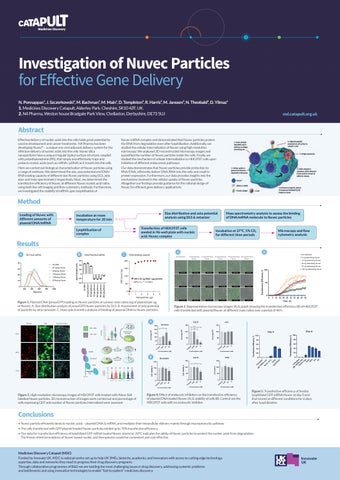
Figure 1. Plasmid DNA (pmaxGFP) loading on Nuvec particles at various mass ratios (ng of plasmid per ug of Nuvec). A: Size distribution analysis of pmaxGFP:Nuvec particles by DLS. B: Assessment of zeta potential of particles by zeta nanosizer. C: Mass spectrometry analysis of binding of plasmid DNA to Nuvec particles.
100 100ngngplasmid/ug plasmid/ugNuvec Nuvec
No treatment
Concentration (uM)
Concentration (uM)
3030ngngplasmid/ug plasmid/ugNuvec Nuvec
0. 5
Transfection Efficiency % Cell viability % Transfection Efficiency %
100
1515ngngplasmid/ug plasmid/ugNuvec Nuvec
100
Transfection Efficiency %
50
50
ro l 0. 05
190 ± 22 ng DNA / µg particle (95% CI, r2 = 0.987)
5 5ngngplasmid/ug plasmid/ugNuvec Nuvec
*
5050
50
CPX NoNotreatment treatment
150
100
100
0
100
0
150
30 ng plasmid/ug 50 ng plasmid/ug 100 ng plasmid/ug 150 Nuvec Nuvec Nuvec
150
200 ng/ug Nuvec
40
Figure 2. Representative microscopy images (A) & graph showing the transfection efficiency 20 (B) of HEK293T cells transfected with plasmid:Nuvec at different mass ratios over a period of 48 h. 0 U
nt gf re p at m ed R N A o N uv nly ec on ly fr e ly op sh hi liz ed
150 ng/ug Nuvec
100 ng/ug Nuvec
Size (nm)
15 ng plasmid/ug Nuvec
C
-20
70 ng/ug Nuvec
1000
5 ng plasmid/ug Nuvec
93
0
-40
400200 600400 800600 1000800
No treatment
B Cyt D
on % Transfection Efficiency t
200ng/ug Nuvec 200ng/ug Nuvec
DNA binding capacity
9. 3
150ng/ug Nuvec 150ng/ug Nuvec
DNA binding capacity
100 100
Genistein
50
Cell border 0
24Hr GFP
Non-GFP
72Hr GFP
Non-GFP
GFP
50
Time (h)
50
C
U
100
0
Concentration (uM)
Concentration (uM)
0
100 80 60
U n m tre R at N e N A d uv on ec ly on ly fr es -2 h 0º C 4º C R T
Figure 4. Effect of endocytic inhibitors on the transfection efficiency of plasmid DNA loaded Nuvec (A) & viability of cells (B). Control are the HEK293T cells with no endocytic inhibitor.
p gf
50
% GFP Cells
20
Figure 5. Transfection efficiency of freshly 40 lyophilized GFP mRNA:Nuvec at day 0 and that20stored at different conditions for 6 days after0lyophilization
Conclusions GFP - Cells
40
Day 6
60
40
60
50
70
GFP + Cells
80
U p nt m re R at N e N A d uv on ec ly on ly fr es -2 h 0º C 4º C R T
150
0
0
0
100
gf
CPX
nt re p at m ed R N A o N uv nly ec on ly fr e ly op sh hi liz ed
100
Transfection Efficiency %
Transfection Efficiency %
C
5
on tr ol 0. 05
Percentage GFP
5
Cyt D * 10 15 20 25 30 35 40 45 50
Concentration (uM)
Figure 3. High resolution microscopy images of HEK293T cells treated with Alexa-568 labelled Nuvec particles. 3D reconstruction of images were carried out and percentage of cells expressing GFP and number of Nuvec particles internalised were assessed
100 ng plasmid/ug Nuvec 20
Concentration (uM)
gf
100
on tr ol 0. 93
Non-GFP
48Hr
5
50 ng plasmid/ug Nuvec 40
Concentration (uM)
150
0
30 ng plasmid/ug Nuvec 60
Transfection Efficiency %
Cell viability %
Distance inside
% Particles Internalised
70
0
0
Day 6
Day 0
15 ng plasmid/ug Nuvec 80
5
150
Inside
72Hr
Genistein
50
0. 5
Reconstruct
BB
5 ng plasmid/ug Nuvec 100
on tr ol 0. 05
In
Concentration (uM)
No treatment
100
C
On the cell
0
Cell viability %
3D
50
5
Out
C
?
Out or in
Reconstruct
Outside
48Hr
on tr
2D
ol 0. 93
0
0. 5
50
0. 5
72Hr
on tr ol 0. 05
48Hr
50
C
24Hr
100
on tr ol 0. 05
0
100
150
C
10
Percentage GFP
20
150
Cell viability %
30
100
CPX
*** **
93
GFP Expression Over time
200
150
93
40
Percentage GFP
50
% GFP Cells
GFP - Cells
*
60
GFP + Cells
24Hr
Genistein
250
Transfection Efficiency % 9. 3
70
Cyt D
0. 5
A A
Reconstruction
9. 3
Cells
Particle
GFP Expression Over time
30 20 10 0
24Hr
48Hr
72Hr
• Nuvec particle efficiently binds to nucleic acids – plasmid DNA & mRNA, and mediates their intracellular delivery mainly through macropinocytic pathway 2D
Reconstruct
Outside
?
Out or in
• The cells transfected with GFP plasmid loaded Nuvec particles exhibit up to 70% transfection efficiency Out
3D
On the cell
In
Reconstruct
• Our data for transfection efficiency of lyophilized GFP mRNA loaded Nuvec stored at -20°C indicates the ability of Nuvec particles to protect the nucleic acids from degradation. The freeze-dried formulations of Nuvec-based nucleic acid therapeutics would be convenient and cost-effective Day 0 Inside
50
Cell border 0
24Hr Non-GFP
48Hr GFP
Non-GFP
72Hr GFP
Non-GFP
GFP
Transfection Efficiency %
% Particles Internalised
70
Distance inside
100 80 60
gf
U
nt re p at m ed R N A o N uv nly ec on ly fr e ly op sh hi liz ed
Medicines Discovery Catapult (MDC) 40 Funded by Innovate UK, MDC is national centre set up to help UK SMEs, biotechs, academics and innovators with access to cutting edge technology, 20 expertise, data and networks they need to progress their drug discovery programs. 0 Through collaborative programmes of R&D we are tackling the most challenging issues in drug discovery, addressing systemic problems and bottlenecks and using innovative technologies to enable “fast-to-patient” medicines discovery. 13201 - A0 MDC Posters Full Set v3.indd 3
5
0. 5
0
C
on tr ol 0. 05
50
5
0
Concentration (uM)
C
93
9. 3
0. 93
ol
100
Microscopy and flow 50 cytometry analysis
0
on tr
Cell viability %
100
*
50
Concentration (uM)
C
on tr ol 0. 05 C 150
0. 5
Percentage GFP
9. 3
on tr ol 0. 93
0 50
5
on tr ol 0. 05 C
93
9. 3
100
C
100
150
50*** **
93
Percentage GFP
Percentage GFP
150
on tr ol 0. 93
100ng/ug Nuvec 100ng/ug Nuvec C
Size (nm)
200
C
50ng/ug Nuvec 50ng/ug Nuvec
20
50 ng/ug Nuvec
200
*
B
40
DNA bound (ng)
25 ng/ug Nuvec 25 ng/ug Nuvec
10 0
No DNA
A
200
25 ng/ug Nuvec
0
60
No DNA
C B
C
Zeta Potential-pDNA Zeta Potential-pDNA
No DNA
10
20
150
Incubation at 37°C, 5% C02 for different time-periods
Cell viability %
B
DLS-size-pDNA
30
B
Genistein
Concentration (uM)
40
20
CPX
B
Zeta Potential (mV)
A
Cyt D
Mass spectrometry analysis to assess the binding 100 100Nuvec particles of DNA/mRNA molecule to A Cyt D CPX
0
DLS-size-pDNA DLS-size-pDNA
30
Concentration (uM)
150
150
250
Transfection of HEK293T cells seeded in 96-well plate with nucleic acid: Nuvec complex
Concentration (uM)
Genistein
Cell viability %
Incubation at room temperature for 20 min
Results 40
0. 93
ol on tr C
B
Lyophilisation of complex
A
0
Concentration (uM)
Loading of Nuvec with different amounts of plasmid DNA/mRNA
50
0
0
Size distribution and zeta potential analysis using DLS & zetasizer
100
50
C
Method
150
*** **
*
200
Percentage GFP
150
Percentage GFP
Genistein
250
CPX
5
Our data demonstrates that Nuvec particles provide protection to RNA/DNA, efficiently deliver DNA/RNA into the cells and result in protein expression. Furthermore, our data provides insights into the mechanisms involved in the cellular uptake of Nuvec particles. Altogether our findings provide guidance for the rational design of Nuvec for efficient gene delivery applications.
0. 5
Here we carried out biological characterisation of Nuvec particles using a range of methods. We determined the size, zeta potential and DNA/ RNA loading capacity of different size Nuvec particles using DLS, zeta sizer and mass spectrometry respectively. Next, we determined the transfection efficiency of Nuvec at different Nuvec:nucleic acid ratios using both live cell imaging and flow cytometry methods. Furthermore, we investigated the stability of mRNA upon lyophilisation of
0. 5
Nuvec:mRNA complex and demonstrated that Nuvec particles protect the RNA from degradation even after lyophilisation. Additionally, we studied the cellular internalisation of Nuvec using high resolution microscopy. We analysed 3D reconstructed microscopy images and quantified the number of Nuvec particles inside the cells. Finally, we studied the mechanism of cellular internalisation in HEK293T cells upon inhibition of different endocytosis pathways.
5
Effective delivery of nucleic acids into the cells holds great potential for vaccine development and cancer treatments. N4 Pharma has been developing Nuvec® – a unique non-viral adjuvant delivery system for the effective delivery of nucleic acids into the cells. Nuvec silica nanoparticles have a unique irregular (spiky) surface structure, coupled with polyethyleneimine (PEI), that simply and effectively traps and protects nucleic acids (such as mRNA / pDNA) as it travels into the cells.
13/10/2021 12:56