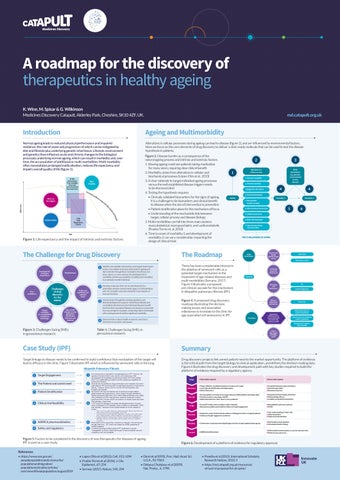
A roadmap for the discovery of therapeutics in healthy ageing K. Winn, M. Spisar & G. Wilkinson Medicines Discovery Catapult, Alderley Park, Cheshire, SK10 4ZF, UK.
md.catapult.org.uk
Introduction
Ageing and Multimorbidity
Normal ageing leads to reduced physical performance and impaired resilience; the rate of onset and progression of which can be mitigated by diet and lifestyle plus underlying genetic inheritance. Lifestyle, environment and genetics then influence acute and chronic changes to the biological processes underlying normal ageing, which can result in morbidity and, over time, the accumulation of additional or multi-morbidities. Multi-morbidity often necessitates prolonged medicalisation, reduces life expectancy and impairs overall quality of life (figure 1).
Alterations in cellular processes during ageing can lead to disease (figure 2), and are influenced by environmental factors. Here we focus on the core elements of drug discovery to deliver a clinic-ready molecule that can be used to test the disease hypothesis in patients.
Frailty Aches/pains Poor eyesight Grey hair Loss of stamina Poor skin tone
Signs of ageing
Inc rea sed
res ilie nc e, im pr ov ed Q n spa life nd ha alt he L/ O
QOL/health
What are the triggers
CVS CNS Respiratory Cancer
Multimorbidity
Figure 2. Disease burden as a consequence of the natural ageing process and intrinsic and extrinsic factors. 1. Slowing ageing could see patients taking medication for many years, requiring clear clinical benefit 2. Morbidity arises from alterations in cellular and biochemical processes (López-Otín et al., 2013) 3. A clear rationale to target individual ageing processes versus the well established disease triggers needs to be demonstrated 4. Testing the hypothesis requires • Clinically validated biomarkers for the signs of ageing. It is a challenge to tie biomarkers and clinical benefit to disease when the aim of intervention is prevention • Patient stratification plans for the mechanism of focus • Understanding of the mechanistic link between target, cellular process and disease biology 5. Multi-morbidities can fall into three main clusters: musculoskeletal, neuropsychiatric and cardiometabolic (Prados-Torres et. al, 2014) 6. Time to onset of morbidity-1 and development of morbidity-2 can vary considerably: impacting the design of clinical trials
Age
Figure 1: Life expectancy and the impact of intrinsic and extrinsic factors.
1
3
Alteration in a cellular process
Other mechanisms, e.g., genetics, environmental factors, lifestyle
1. Genomic instability 2. Telomere attrition
4
4
Morbidity 1
Morbidity 2
3. Epigenetic alterations 4. Loss of proteostasis Ageing 5. Deregulated nutrient sensing
5
6. Mitochondrial dysfunction
6
7. Cellular senescence 8. Stem cell exhaustion 9. Altered intercellular communication
THE 9 HALLMARKS OF AGING
The Roadmap
The Challenge for Drug Discovery
2
Target Identification
Biochemical Assays Specific Target of Hits
Selectivity
Mechanistic safety
1 Identify and validate mechanisms and targets that impact Increased risk of adverse drug effects
Polypharmacy
Challenges of drug discovery for the elderly
Poor compliance
on the core cellular processes that underly ageing and demonstrate through their modulation that these can slow, reduce, or even reverse, the development of morbidity and the accumulation of additional morbidities in an already morbid individual
Patient morbidity. Co-morbidalities compliance trial design
Frailty and nutritional and cognitive issues
2 Develop molecules that can be administered to a potentially already compromised, aged, or frail individual, who, for example, may have impaired renal, hepatic or immune function 3
Age-related changes in drug absorption, distribution clearance and response
Demonstrate through the existing regulatory and clinical development routes in randomised, blinded and controlled trials, that not only individual diseases benefit but that other associated diseases are slowed or prevented from occurring; for example, conducting trials in individuals with a background of another significant morbidity
There has been considerable interest in the ablation of senescent cells as a potential target mechanism in the treatment of age-related diseases and multi-morbidities (Serrano, 2017). Figure 4 illustrates a proposed pre-clinical cascade for this mechanism in idiopathic pulmonary fibrosis (IPF).
Validation
PK
PD Model Cell Senescence
Figure 4. A proposed drug discovery roadmap illustrating the decision making assays and associated milestones to translate to the clinic for age associated cell senescence in IPF.
Target Engagement
Efficacy Model Cell Senescence
Translation
4 Demonstrate a robust health economic case that is attractive to investors and payers
Figure 3. Challenges facing SMEs in geroscience research.
Table 1. Challenges facing SMEs in geroscience research.
Hypothesis Call Senescence is associated with increased risk/ incidence of IPF
Safety Tox
Clinical data exists to support hypothesis Clinical cohorts & samples to confirm hypothesis Biomarkers to support clinical studies
Clinical Age related morbidity eg IPF
Case Study (IPF)
Summary
Target linkage to disease needs to be confirmed to build confidence that modulation of the target will lead to efficacy in the clinic. Figure 5 illustrates IPF which is influenced by senescent cells in the lung.
Drug discovery projects link unmet patient need to the market opportunity. The platform of evidence is the critical path from the target biology to clinical application, and defines the decision-making data. Figure 6 illustrates the drug discovery and development path with key studies required to build the platform of evidence required by a regulatory agency.
Idiopathic Pulmonary Fibrosis 1
Target Engagement
1 Stage
2 3
4
The Patient and unmet need Patient Stratification
Clinical trial feasibility
• Reason data required
Discovery
• Target validation: established platform of evidence for target • Lead molecule identification and Optimisation • Define biomarkers
• Strong link between target and disease • Generate lead matter • Biomarker discovery
Pre-clin
• Develop platform of evidence for target relevance, differentiation and target safety • Preclinical safety & toxicology; ADMET • Define biomarkers for clinic; dose-to-man-prediction
• Strong link between target and disease • Differentiating efficacy • Available and predictive biomarkers
FTIM
• Formal PK studies; dose escalation; safety endpoints • Biomarkers possibly used to define evidence of target engagement
• Bioavailability and tissue exposure • PK/PD
Ph2 PoP
• Exploratory study to demonstrate evidence of biological activity in targeted patients • Evidence of target engagement confirmed
• Clear understanding of safety risks • Safety biomarkers • Evidence in lead indication
Ph3 PoC
• Confirmatory study demonstrating biological activity in large targeted patient group
• Risk/benefit in lead indication • Personalised health strategy
Launch
• Additional patient groups
• Differentiated market position vs current and future SoC • Market access; payers etc...
3
4
5
ADME & pharmacokinetics
5
6
Safety and regulatory
6
References • https://www.ons.gov.uk/ peoplepopulationandcommunity/ populationandmigration/ populationestimates/articles/ overviewoftheukpopulation/august2019
• Main studies required
2
Figure 5. Factors to be considered in the discovery of new therapeutics for diseases of ageing; IPF is used as a case study.
13201 - A0 MDC Posters Full Set v3.indd 5
Cell Based Assay Cell Senescence
• Lopez-Otin et al (2013). Cell, 153; 1194 • Prados-Torres et al (2014). J. Clin. Epidemiol., 67; 254 • Serrano (2017). Nature, 545; 294
Figure 6. Development of a platform of evidence for regulatory approval.
• Dimri et al (1995). Proc. Natl. Acad. Sci. U.S.A., 92; 9363 • Debacq-Chainiaux et al (2009). Nat. Protoc., 4, 1798
• Preetha et al (2013) International Scholarly Research Notices, 2013, 5 • https://md.catapult.org.uk/resources/ virtual-rd-proposal-for-uk-spine/
13/10/2021 12:56