MEDICALEXAMINER FREE T AKE-HO ME COP Y!
TM
HEALTH • MEDICINE • WELLNESS • HEALTH • MEDICINE • WELLNESS • HEALTH • MEDICINE • WELLNESS • HEALTH • MEDICINE • WELLNESS • HEALTH • MEDICINE • WELLNESS • HEALTH • MEDICINE • WELLNESS • HEALTH • MEDICINE • WELLNESS • HEALTH • MEDICINE • WELLNESS • HEALTH • MEDICINE • WELLNESS
JUNE 20, 2025
Y
AIKEN-AUGUSTA’S MOST SALUBRIOUS NEWSPAPER • FOUNDED IN 2006
H T E F Y O E N A A R M
ou have probably never heard of Frederic Tudor, but without doubt you have personally benefited from the unique vision and incredible persistence of this New England businessman of the 1800s. He became known as The Ice King at a time when electricity and freezers were still faraway inventions. As our annual stretch of blazing summer temperatures arrive, let’s raise an ice cold glass of something to Frederic Tudor. The principles of business at their simplest level involve identifying a need and then filling it. People need shoes; let’s manufacture and sell them. Pretty basic stuff. It is another matter entirely to do that in a world where no one currently wears shoes. Frederic Tudor was that kind of visionary: he saw a need - correction - he imagined a need — a need for ice (and he did so on a hot summer day). It was a need which no one was serving, and for good reason: the need seemed impossible to serve. Despite that, Tudor proceeded to invent the industry, and did so in the face of daunting odds and countless setbacks. Yet he managed to succeed, and you and I are still reaping the benefits. It’s a cool story, one in which Augusta plays a cameo role. The cold facts Tudor was born in Boston in September of 1783. At a picnic during the summer of his twenty-second year, Tudor thought of how much people sweltering in the Deep South and the faraway tropics would enjoy the cold drinks and ice cream he and his friends were savoring that day. In the middle of a brain freeze, a brainstorm came to him: when winter comes, why not harvest ice from frozen ponds dotting the countryside and ship it to the hot spots of the world? This was not a new idea: the wealthy and powerful of ancient civilizations like Greece and
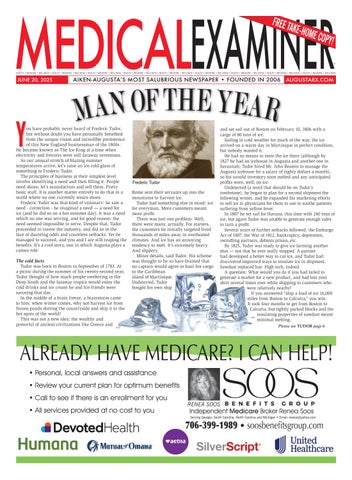
Frederic Tudor Rome sent their servants up into the mountains to harvest ice. Tudor had something else in mind: ice for everyman. More customers meant more profit. There was just one problem. Well, there were many, actually. For starters, the customers he initially targeted lived thousands of miles away in overheated climates. And ice has an annoying tendency to melt. It’s extremely heavy. And slippery. Minor details, said Tudor. His scheme was thought to be so hare-brained that no captain would agree to haul his cargo to the Caribbean island of Martinique. Undeterred, Tudor bought his own ship
AUGUSTARX.COM
and set sail out of Boston on February 10, 1806 with a cargo of 80 tons of ice. Sailing in cold weather for much of the way, the ice arrived on a warm day in Martinique in perfect condition, but nobody wanted it. He had no means to store the ice there (although by 1827 he had an icehouse in Augusta and another one in Savannah; Tudor hired Mr. John Beamis to manage the Augusta icehouse for a salary of eighty dollars a month), so his unsold inventory soon melted and any anticipated profits were, well, on ice. Undeterred (a word that should be on Tudor’s tombstone), he began to plan for a second shipment the following winter, and he expanded his marketing efforts to sell ice to physicians for them to use to soothe patients suffering from yellow fever. In 1807 he set sail for Havana, this time with 240 tons of ice, but again Tudor was unable to generate enough sales to turn a profit. Several years of further setbacks followed: the Embargo Act of 1807, the War of 1812, bankruptcy, depression, swindling partners, debtors prison, etc. By 1825, Tudor was ready to give ice farming another shot — not that he ever really stopped. A partner had developed a better way to cut ice, and Tudor had discovered improved ways to insulate ice in shipment. Sawdust replaced hay. High tech, indeed. A question: What would you do if you had failed to generate a market for a new product, and had lost your shirt several times over while shipping to customers who were relatively nearby? If you answered “ship a load of ice 16,000 miles from Boston to Calcutta,” you win. It took four months to get from Boston to Calcutta, but tightly packed blocks and the insulating properties of sawdust meant minimal melting. Please see TUDOR page 6
ALREADY HAVE MEDICARE? I CAN HELP! • Personal, local answers and assistance • Review your current plan for optimum benefits • Call to see if there is an enrollment for you • All services provided at no cost to you
RENEA SOOS
Independent Medicare Broker Renea Soos Serving Georgia, South Carolina, North Carolina and Michigan • Email: srsoos@yahoo.com
706-399-1989 • soosbenefitsgroup.com
2
AUGUSTAMEDICALEXAMiNER
JUNE 20, 2025
THE FIRST 40 YEARS ARE ALWAYS THE HARDEST
MEDICAL MYTHOLOGY
THOUGHTS ABOUT
PARENTHOOD THOUGHTS 33
by Dr. Warren Umansky, PhD
While driving through a small town on a family day trip to the mountains, you see a billboard that catches your attention. It has just words. It says: “Spend time with your kids, not money. They’ll remember the time, not the stuff.” What do you do? A. You smile to yourself. That’s exactly what you are doing now! B. You pull over and take a picture of the billboard. The photo will go on your refrigerator as a reminder to you and your children. C. Depriving your children of electronics and the things that other kids have will make others think you’re not a good parent. D. You think to yourself: The person who wrote that must not have kids. If you answered: A. You enjoy your children, enjoy spending time with them, and enjoy exposing them to new activities. It does not cost anything to go to the park or go walking or bike or scooter riding near home. It’s fun and inexpensive to go fishing in a pond or lake. Taking a walk together on a regular basis is a wonderful opportunity to model a healthy lifestyle. And, taking small road trips (no electronics allowed!) exposes your children to learning about new environments. B. What a nice thing to do! Having the visual reminder on your refrigerator is as important as posting your children’s stellar report cards, their spelling words for the week, and their awesome artwork. C. This poses a dilemma: Your image as a parent in the eyes of others versus what you really might think is best for your children. One of my favorite cartoons pictures a young girl with a violin standing in front of her parents. The caption says: “Well, fine. If you are taking my phone away then I guess I’ll become an accomplished violinist!” There are great alternatives to “things.” Music, sports, art, and time outdoors are wonderful alternatives to your children being in their room with things. And, time spent together builds memories that will last forever. D. More likely, the writer of the billboard message has found, perhaps the hard way, what works best to make happy and accomplished children in a happy home. Parents who choose to sit with their children at mealtimes with no devices on the table and the television turned off find that time spent with their children is richly rewarding. Other opportunities to spend time with your children bring joy and satisfaction to you as a parent who is doing the right thing. + Dr. Umansky has a child behavioral health practice in Augusta.
THANKS FOR READING!
GENERALIZED ANXIETY DISORDER Editor’s note: Written by local mental healthcare professionals, this series explores how people may think and act when affected by common and lesser-known mental health conditions. “Your hands are like a block of ice!” her husband whispered, as she placed them on his forearm, searching for a warm spot to thaw out her hands and calm her mind as well. From the moment she spotted the woman entering the building, her mind and heart started racing, and she immediately felt a cold sweat forming. “I feel like Elsa from Frozen,” she thought. “I can’t confront this woman. I can’t be seen as anything other than perfect in my role as a preacher’s wife, and I can’t just, ‘Let it go.’ It feels like my body is trapped in ice. I must be going crazy. I can’t keep feeling this way.” She visited her psychiatrist later that week and explained how she had been experiencing these symptoms for the past year, and others, such as headaches, stomach aches, frequent trips to the bathroom, an inability to relax or enjoy social situations, and increased hypervigilance with perfectionistic tendencies at work. She also was constantly worried that she was going to do things the “wrong” way at work or that her husband would be displeased with her if she didn’t live up to his expectations. The psychiatrist reassured her she was not “going crazy.” She diagnosed her with Generalized Anxiety Disorder, and then explained to her what it was, and how they would treat it. What is Generalized Anxiety Disorder? Concerns about health issues, financial situations, family problems, and work/life balance are normal worries that most people find themselves dealing with on a regular basis. However, Generalized Anxiety Disorder (GAD) takes those normal worries and spins them relentlessly out of control. Fear, worry, and an ongoing feeling of being overwhelmed are all produced by GAD—becoming excessive, persistent, and sometimes unrealistic. Other psychological and physical symptoms often accompany the excessive worried thoughts. People living with anxiety disorders have usually had these symptoms for months, if not years, on a consistent basis. GAD often presents in people in their early 30s, but symptoms can be seen as far back as childhood. Symptoms are more frequently seen in women than in men. Signs and Symptoms People with GAD may exhibit: Thought disturbances: • Continuous worrying • Distress that is out of proportion (i.e. - “making a mountain out of a molehill” or magnification of the problem) • Catastrophizing (always thinking of the worst-case scenario and expecting it to occur) • Thinking that all events/situations (and sometimes people) are threatening, even with no indication or proof that they are • Low tolerance for the unknown • Fear of making a “wrong” decision • Inability to make decisions • Obsession with a worry or the inability to let it go • Restlessness or inability to relax • Concentration problems or feeling as if their mind “has blanked out”
Please see THOUGHTS page 3
ANXIETY
1. People with GAD are dramatic or blow everything out of proportion. People with anxiety are usually fixating on worst-case scenarios and may show distress as a result; they are not trying to be dramatic. 2. GAD is generalized anxiety, so it must not be that bad. To be diagnosed with GAD, symptoms must be severe enough to keep a person from functioning normally in several different areas of their life. These symptoms can and do negatively impact a person’s life. 3. People with anxiety will sometimes pretend to have a panic attack to get attention. Panic attacks are not fake and can sometimes be mistaken for heart attacks; that is how severe the symptoms can be. 4. GAD is rare. It is actually affects around 7 million Americans per year. 5. GAD is always obvious. There are physical signs such as shaking, trembling, or sweating, but some people worry in silence. Symptoms will vary from one person to the next. 6. GAD has no physical symptoms. GAD is a mental health condition, but it does also have physical symptoms, such as headaches, excessive trips to the restroom, and many others. 7. People with GAD do not enjoy socializing. Social anxiety and GAD are sometimes confused, but GAD fears are due to multiple concerns, while social anxiety is usually about specific social interactions. 8. Anxiety meds are addictive, so avoid them. Some medications can be habit-forming, but the most widely prescribed medications for anxiety are antidepressants, which are not addictive. They should all be used as directed and under medical supervision. 9. Meds are the only treatment. Counseling can also be effective, with or without medication. 10. You can’t do anything to help someone with GAD. Listening and trying to understand is a great way to help. Also, look for signs that they might be using alcohol or other substances to self-medicate, and be aware when they need help. +
THOUGHTS… from page 2
• Irritability • Impairment in job performance or ability to enjoy social situations Physical symptoms: • Problems falling or staying asleep • Fatigue • Muscle aches and/or tension • Unexplained pains • Headaches • Twitchiness/trembling • Overactive startle reflex • Nervousness • Excessive sweating • Diarrhea • Nausea • Irritable Bowel Syndrome • Stomachaches • Cold hands and/or feet • Issues with swallowing • Feeling lightheaded or out of breath • Frequent trips to the restroom What Causes Generalized Anxiety Disorder? Genetics can play a big factor in the development of an anxiety disorder. Research currently shows that 25% to 33% of people with GAD have a parent who also has it. Additional biological factors, such as disruption of neurotransmitters in the brain, can cause feelings of anxiety and/or depression. In addition, several parts of the brain are involved in fear or anxiety responses, such as the amygdala. The amygdala usually helps control our strong emotional reactions, but it can cause heightened or abnormal responses due to bad or traumatic past experiences that the brain recalls and responds to in new situations, causing an unnecessary anxiety response at times. Medical conditions, such as diabetes or heart disease, can also increase anxiety responses. The presence of ongoing stress, environmental factors like physical abuse or past trauma, and substance use disorders can all contribute to the ongoing and increased effects of anxiety. Treatment and Management Treatment for GAD focuses on addressing the underlying cause and managing symptoms. According to the National Institutes of Health, a low amount of serotonin system activity and an increased amount of noradrenergic system activity can worsen anxiety, so medical professionals often recommend selective serotonin reuptake inhibitors (SSRIs) and serotonin-norepinephrine reuptake inhibitors (SNRIs) as their first choice for the treatment of GAD. Physical symptoms can often be more distressing and prevalent in patients with GAD, which makes diagnosis more challenging. However,
tests like glucose and toxicology screening, thyroid function, and other tests can help rule out physical and medical issues. Anxiety screening tools can also help monitor and diagnose symptoms of anxiety. Cognitive Behavioral Therapy (CBT) and medications are common treatments for GAD. CBT techniques are generally taught by a licensed mental health professional and include teaching patients why they are thinking and feeling the way they do, and learning how to change those thought patterns. Commonly prescribed SSRIs and SNRIs for anxiety include: escitalopram (Lexapro), paroxetine (Paxil, Pexeva), venlafaxine (Effexor XR), and duloxetine (Cymbalta). Occasionally, antipsychotics are prescribed, especially for patients who are having behavioral issues related to their anxiety. These can include benzodiazepines such as Clonazepam and Diazepam, which are long-lasting and used when a short-term treatment or immediate reduction of symptoms is needed. Patients with substance use disorders or a history of alcoholism are not considered good candidates for these treatments, due to concerns of dependence or misuse. Buspirone can be a good alternative in this situation, as it is a nonbenzodiazepine, and does not cause dependency. Triggers for anxiety should also be discussed with a mental health professional, and can often be decreased by improving sleep habits, decreasing alcohol and caffeine intake, increasing water consumption, avoiding nicotine, and learning how to manage stress more effectively. Prognosis The prognosis of patients with GAD can often be described as guarded. This is because patients sometimes don’t continue with medication due to costs or side effects. The most important factors in decreasing symptoms of anxiety include medication compliance, implementing cognitive therapy skills, and stopping the use of caffeine or any other stimulants. When left untreated, anxiety disorders can lead to severe depression and substance use disorders, in an attempt to self-medicate. Suicide rates are also higher in patients with anxiety disorders, when left untreated. Need Support? IPS provides comprehensive behavioral health services including assessment, medication management, and therapy for individuals and families navigating complex mental health and neurological conditions. To schedule an appointment, call 706-204-1366 or visit integratedpsych.care. +
ARE YOU CYBER SECURE?
A CALORIE IS A CALORIE, RIGHT? “A calorie is a calorie” is a tried and true maxim among dietitians. It means that, as far as our bodies are concerned, there is no difference between eating a tub of butter pecan at 4 pm, or at midnight. Ditto for weight control: you won’t gain more weight eating right before bedtime than you would hours earlier. New research at Johns Hopkins University School of Medicine suggests that perhaps all calories are not created equal after all. Researchers found that eating a late dinner can negatively impact metabolism. Their study showed that eating a meal at 10 p.m. instead of 6 p.m. led to higher blood sugar spikes, slower fat breakdown, and increased cortisol levels, which could contribute to weight gain over time. Interestingly, “early birds”—those who typically go to bed around 11 p.m.—experienced even greater metabolic disruptions, while “night owls”—who sleep much later—were barely affected. The findings suggest that meal timing plays a crucial role in metabolic health, and regularly eating late could increase the risk of obesity and metabolic syndrome. Based on the study’s findings, here are a few simple dietary adjustments that can optimize metabolism and minimize the risks associated with late-night eating: Eat Earlier – Try to eat your last meal around 6–7 p.m. rather than late at night, especially if you’re an early sleeper. This helps regulate blood sugar levels and supports better digestion before bedtime. Hydrate Earlier – Drinking enough water earlier in the evening helps prevent hunger signals that might feel like latenight snack cravings. Limit Late Night Carbs – If you must eat later, avoid large amounts of refined carbs, sugary foods, or high-fat meals, which can lead to higher blood sugar spikes. Maintain a Consistent Eating Schedule – Sticking to regular mealtimes, rather than frequently shifting dinner later, can help optimize metabolism. Prioritize Protein and Fiber – A well-balanced early dinner with lean protein (chicken, fish, tofu) and fiber-rich foods (vegetables, whole grains) can help keep blood sugar stable and prevent late-night cravings. +
MEDICALEXAMINER www.AugustaRx.com
The Medical Examiner’s mission: to provide information on topics of health and wellness of interest to general readers, to offer information to assist readers in wisely choosing their healthcare providers, and to serve as a central source of salubrious news within every part of the Augusta medical community. Direct editorial and advertising inquiries to: Daniel R. Pearson, Publisher & Editor E-mail: Dan@AugustaRx.com
A single data breach could be catastrophic.
AUGUSTA MEDiCAL EXAMINER P.O. Box 397, Augusta, GA 30903-0397
us, send an email, WE’LL TAKE A.I.M. orCall visit our website for free AT YOUR SECURITY information about our services.
AMANDLA
TM
AIKEN-AUGUSTA’S MOST SALUBRIOUS NEWSPAPER
Your practice or business is vulnerable.
Our services offer security and peace of mind.
ASSESS • IMPLEMENT • MONITOR
3
AUGUSTAMEDICALEXAMiNER
JUNE 20, 2025
(706) 860-5455 www.AugustaRx.com • E-mail: Dan@AugustaRX.com
INFORMATION TECHNOLOGY SECURITY GROUP (AITSG)
www.Facebook.com/AugustaRX
WEB: AITSGLLC.NET
Opinions expressed by the writers herein are their own and/or their respective institutions. Neither the Augusta Medical Examiner, Pearson Graphic 365 Inc., nor its agents or employees take any responsibility for the accuracy of submitted information, which is presented for general informational purposes only. For specific medical advice, diagnosis, and treatment, consult your doctor. The appearance of advertisements in this publication does not constitute an endorsement of the products or services advertised.
(706) 703-2707
EMAIL: AITSG@AmandlaITSecurityGroup.net INSTAGRAM: AITSG.LLC
© 2025 PEARSON GRAPHIC 365 INC.
4 #237 IN A SERIES
Who is this?
JUNE 20, 2025
AUGUSTAMEDICALEXAMiNER
ADVENTURES IN
Middle Age BY J.B. COLLUM
gifted me a new wonder of the world. If I had just waited two days, the repairs would have been made for me and I wouldn’t have scared some good Samaritans who passed by and stopped to check on me. I wish I had caught their names, but as I was lying back in the seat of my truck at the road, with my eyes closed while I awaited on the liquids I had just imbibed to re-hydrate me and make my cramps stop, I heard a noise and opened my eyes to see a truck stopped in front of my truck on the road. A nice young woman in the passenger seat had her window down and looked concerned. I rolled my window down and she expressed that they had seen me working earlier and when they just passed, I had my eyes closed and I looked like I might be dead. She put it nicer, but that is what she meant. I thanked them for their kindness but said I was alright. There are still good people in the world and they are proof of that. I have only told you of about half of the physical activity I had to do over the past two weekends, and if you know me, you know how lazy I am. So that is saying something. The odd thing is that, despite how much this hurt, I feel stronger. Almost like exercise is good for you or something. Who would have ever guessed? Oh, everyone, you say? Okay, maybe it was just me. In any case, it has inspired me to be more active every weekend. Maybe not to the extreme degree of the past two weekends, but to be active, nonetheless. I mentioned good people in the world earlier and I wanted to mention someone else. I got a lovely letter from a Mrs. Suzanne M. I won’t share the last name since I didn’t have time to ask permission, but her handwritten letter was very touching both to me and to my wife as she wrote to both of us about her and her husband’s similar experience to a past article. Thank you so much for your kind and considerate words, Suzanne. They meant a lot to us, and my wife even teared up a little. Not me though. No, I never cry. My eyes were just watering because they were dry. I’m not crying, you’re crying! If you haven’t yet, please take a gander at my new column, Special Forces Parenting. If my powers of seeing the future are any good, it should be on page 5. The first of these was in the previous issue. Until next time, enjoy the adventure and keep laughing. +
{
Sometimes it takes pushing yourself to your limits to convince yourself to change. I think this happened to me this past Saturday. It was the second Saturday in a row that I completely exhausted myself working outside. It wasn’t because I wanted to. It was my sense of duty. More importantly, it was my fear of Lorie (my wife) that made me do it. I’ll explain further. We have been working for a few weeks to set up an above ground pool. We have done this before, a few times even, for ourselves and for others. However, we were younger then. You might wonder why it has taken us so long, but the reason for that is how large this pool is. It has a diameter of 27 feet (8.23 meters), and is 54 inches (137 centimeters) deep. That is 19,400 gallons of water and that weighs over 80 tons. To put this in perspective, that is more than twice as much beer sold at an average NFL football game on an average game day. I’m not kidding. I checked. I found out that the Indianapolis Colts sell about $500,000 worth of beer on any given Sunday and they cost $7.50 each for a 16 ounce cup. That equals a little over one million ounces, or 8,300 gallons. At least I don’t have to pay $60 per gallon for the water. Now that you have a sense of scale, you might understand the difficulty in getting the ground ready, including leveling it, making sure it is round, rolling out a huge and heavy roll of steel, fastening about 50 zillion screws, bolts and nuts, laying down mats, leveling sand, and doing all of this in the heat and dirt with an army of fire ants, and an air force of horse flies and mosquitoes continuously attacking. Not to mention trying to keep an eye on Freyja, our very special child who never saw a bug or dirt clod she wasn’t happy to eat or a fragile expensive item she wasn’t delighted to break. (You can read more about this in the Special Forces Parenting column to the right, on p. 5) The previous weekend, I had a devil of a time repairing our driveway after the rash of heavy rains we had gotten for the two weeks prior had washed out an area large enough for me to consider putting up signs and inviting people to come see the newest canyon in the continental United States. I decided against it as I was afraid the national park service might notice and decide to “eminent domain” me out of my property. I spent over eight hours toiling on that, fighting cramps, pains, dehydration, and exhaustion, only to have the state road crews show up on Monday and pour new asphalt aprons to repair driveways they had previously scraped for the road repaving. The scraping that had, in fact, been the cause of the run-off that
his man’s medical accomplishments are nothing short of amazing, almost unbelievable. His name was Xavier Bichat, and he is often described as the father of modern histology. Let’s stop right there and analyze that statement. Let’s begin with the definition of histology. In simple terms it’s the opposite of gross anatomy. Gross anatomy, in simple terms, is what any person could see in human anatomy with the untrained naked eye, big stuff like lungs, heart, brain, liver, pancreas, and so forth. The opposite of gross anatomy could be called (and often is) microanatomy — the study of the microscopic structure of biological tissues. It is this branch of medicine which Bichat, who lived and died in the late 1700s, pioneered. His studies identified nearly two dozen individual types of elementary tissues which form various organs of the human body. Without even the most basic knowledge that medical scientists possess today — knowing, for instance, that the cells is the basic functional unit of living things — Bichat was among the first to realize the organs of the body are formed by unique differentiation of various types of tissue. It was groundbreaking. Amazingly, Bichat’s discoveries in microanatomy were made without a key ingredient: a microscope. For his own reasons, he distrusted them. Bichat came to his skills honestly: his father was a physician and was Bichat’s first instructor. By 1793, his training resulted in an appointment to serve as a surgeon in the Army of the Alps, and from there to a position in Paris in 1794 under the noted physician Pierre-Joseph Desault. Desault viewed Bichat as such a genius that he took him into his home and mentored him as his adopted son. The sudden death of Desault in 1795 was an unexpected blow to Bichat. He felt obliged to contribute to the support and welfare of Desault’s widow and orphaned son, which he did by completing the 4th volume of Desault’s Journal of Surgery. At the time, Bichat was all of 24 years old. That volume and his subsequent works “took both the French and English medical worlds by storm.” The following year he and several other colleagues founded a society for the advancement of medicine through collaboration and the exchange of scholarly information. He also published a concise digest of Desault’s many surgical doctrines into a single volume, a work that played a significant role in shaping medical thought and surgical techniques for a generation of doctors all over the world. One of the most notable aspects of Bichat’s career was its tragic brevity. In July 1802 he evidently contracted typhoid fever. He initially felt faint, then complained of a violent headache before passing into a coma from which he never recovered. He was just 30 when he died. +
{
T
Apparently she thought I was dead.
J.B. Collum is a local novelist, humorist and columnist who wants to be Mark Twain when he grows up. He may be reached at johnbcollum@gmail.com
JUNE 20, 2025
Special Forces
Parenting
Teamwork is one of the keys to a successful SFP (Special Forces Parenting) mission. Just yesterday, we experienced a prime example of this inescapable fact. I was in bed, recovering from a stomach virus when I heard my daughter, Kate, repeatedly saying “spit it out” with increasing volume and vehemence. At first, I was just annoyed that I had been awakened from my restorative sleep, but after this went on for a couple of minutes, I was incensed that my sleep was interrupted. You thought I was going to say that I was concerned. Well, I was, it just took a little longer than it probably should have. After the commands to “spit it out” started to sound like a drill sergeant, minus bad language, I decided that perhaps my sleep wasn’t the most important thing at issue and maybe my help was needed. At times, this is just because one of us adults who are charged with Freyja’s care are tired and getting past our breaking point. However, this time, it was because she decided that she wasn’t giving up this apparently tasty rubbery toy that she was chewing on. She usually spits things right out when we demand it. That is a good thing, because she has put some particularly disgusting things in her mouth. I won’t bore you with a list, but it includes bugs, reptiles, and even worse. Far, far worse. If I told you, you would shudder like I just did as I wrote this. Freyja has pica as do so many developmentally disabled people. It basically means that she will chew on or eat a lot of things that aren’t food. By the way, this includes expensive electronics too, which is especially annoying to us and our wallets. I think Kate is on her umpteenth pair of ear buds. You would think that someone with pica would eat whatever food we give her, but no. She is somehow a picky eater of real food, but will put basically anything else in her mouth, chew on it,
and sometimes even swallow it. It beggars belief. And she isn’t consistent. Today she may love chicken nuggets. Tomorrow they may be disgusting to her and worthy only of being thrown across the room. Literally. So, we are in a constant cycle of finding real food she will eat while trying to “pica proof” our home by ultra frequent vacuuming and other tidying up that other non SFP folks get to skimp on. In the case in question, yesterday, she had found a bag of pool toys her grandmother had bought the day before. The particular toy that had appealed to her refined palette was a rubbery lizard that was very much the texture of an artificial worm you would use for fishing, except much stickier. It is designed for kids to throw up against the wall of the pool, and more likely their friends faces, and then to stick there which likely will bring squeals of delight to the children, especially if they can stick it to grandpa’s glasses. Unlike her typical response to “spit it out,” she clamped down on the lizard and would not give it up. When I exited the bedroom, I was greeted with a scene of what looked a lot like a one legged and one armed woman trying to dance while untying a knot a sailor would be proud of. Freyja was thrashing around, trying to wrestle herself away from Kate’s grasp, and at about 80 pounds of mostly muscle and bone, she would likely give even Hulk Hogan a run for his money. I jumped in and at first just tried to help get the sticky lizard out of her mouth, but we eventually realized that we needed to specialize, so I grasped Freyja around the middle and sat on the couch, while Kate took the bullet for me by being the one to reach into those tiny, but strong jaws to retrieve the lizard. She suffered some bites, but I am proud that she avoided any foul language, though if she hadn’t, I would have forgiven her. Freyja has the bite strength of that 2000 pound crocodile, Utan, at Alligator Adventure in Myrtle Beach. Don’t quote me on that. It may not be a scientific assessment. It still took a few minutes, even with this teamwork, but we managed to accomplish our mission. We then made sure there were no more of these sticky lizards anywhere around that she could get to. Once we had cleared the house, I was able to go back to bed to continue my recovery, but by then I was so wound up, that I couldn’t go back to sleep. We are used to missing a lot of sleep though. It is one of the downsides of being Special Forces Parents, but there are still a lot of upsides, and when I can think of them, I’ll share them with you. Until then, keep fighting the good fight and find the humor in even the toughest situations. It’s an antidote to a lot of what ails us. +
Georgia Internal Medicine
Dr.Internal James L. Millen Medicine and Endocrinology NOW ACCEPTING NEW PATIENTS Primary Care • Internal Medicine • Endocrinology
Specializing in expert treatment of: Diabetes • Hypertension • Thyroid Disorders • Preventive Medicine • Endocrine Disorders • General Internal Medicine
James L. Millen, MD Board Certified, American Board of Internal Medicine
5 #11 IN A SERIES
AUGUSTAMEDICALEXAMiNER
706-447-1118
1203 George C. Wilson Dr • Augusta, Georgia 30909
Same or next day appointments available
Who is this?
Not everyone in healthcare can be Florence Nightingale, right? Despite the long-running series on page 4, there are clunkers in medicine, and we will examine some of them in this brief series that should be briefer. Unfortunately, there’s enough material to keep this going for a while.
K
ristin Gilbert: Soccer mom, registered nurse, serial killer. Just an ordinary working suburban mom who happened to have a hobby of killing people. Growing up in Fall River, Massachusetts, she earned a reputation as a liar, a master manipulator of boyfriends and others (which included threatened and fake suicide attempts), and a mean kid who made violent threats against people she didn’t like. Oddly enough, one of her fake suicide attempts (in 1987) led to a career in nursing the very next year, and the year after that, 1988 registered nurse certificate in hand, she started working at the Veterans Affairs Medical Center in Northampton, Mass. She was the subject of a feature article in the April 1990 issue of VA Practitioner magazine. We haven’t seen the article, but it probably made no mention of her extra-marital affair with James Perrault, a night shift public safety offer at the VA. As things would turn out, Perrault was the unwitting catalyst for Gilbert’s growing reputation as “The Angel of Death.” Initially, her co-workers gave her the nickname as a joke. Surely it was just a coincidence that there was an unusually high number of deaths on the shifts she worked. Right? But finally, in 1996, three nurses brought their concerns to the attention of investigators. They had evidence that cardiac deaths were rising during her shifts at about the same rate that epinephrine supplies were dwindling. Injections of the drug, also known as adrenaline, could send a weak heart off to the races, and potentially from there straight to the morgue. The investigation eventually discovered a motive: VA policy required the presence of a hospital police officer at all medical emergencies. Gilbert was apparently creating medical emergencies to impress Perrault. No one knows if she intended to kill patients just for the thrill of it, or if her objective was to take them to the brink of death and then swoop in as the hero to save them, but whatever her intentions, she did both. She tried to cover her tracks. The day she learned she was being investigated, she called in a bomb threat to the hospital. Before that, one patient who was especially vocal in his complaints about her care died, as it was lated proven, at Gilbert’s hands. No one listened to his complaints — except Gilbert. When she left the hospital’s employ in 1996 amid the investigation into her actions, she checked herself into psychiatric hospitals seven times, staying as many as ten days or as few as one. If her goal was a possible insanity defense, the ploy didn’t work: she was convicted in 2001 of murdering four of her patients. However, records showed that she was on duty for about half of the 350 deaths and 300 medical emergencies that occurred in the hospital during her period of employment. An expert at her trial calculated the odds of that happening were 1 in 100 million. In addition to her hundreds of suspected VA crimes, she was also secretly poisoning her husband on the home front. She was busy. She is serving four life sentences in a federal prison in Texas. +
6
AUGUSTAMEDICALEXAMiNER
HAVE YOU HEARD? HEARING ASSOCIATES OF SOUTH CAROLINA welcomes patients from South Carolina and Georgia
NORTH AUGUSTA 105 E Hugh St., Suite 103 North Augusta, SC 29841 (803) 441-3937 AIKEN 39-A Varden Drive Aiken, SC 29803 (803) 641-6104
AikenHearing.com
Celebrating 20 years of giving sound advice to our friends and neighbors
GREG LEOPARD PC AT T O R N E Y AT L AW
“Leopard Law is spot on.” — Actual client comment
CRIMINAL DEFENSE • FAMILY LAW • PERSONAL INJURY 461 Greene Street at 5th • www.gregleopardlaw.com • 706-724-7511
APPS, SCHMAPPS.
YOU DON’T NEED NO STINKIN’ APP TO READ THE MEDICAL EXAMINER ONLINE.
JUNE 20, 2025
TUDOR… from page 1 India became Tudor’s top market. Having ice readily available in its sweltering climate caused such a sensation that construction of an icehouse to receive future shipments began just three days after Tudor’s first shipment arrived. But it wasn’t just Calcutta that eventually became a customer of Tudor ice. If you’ve read Thoreau’s On Walden Pond, you may recall this sentence: “The sweltering inhabitants of Charleston and New Orleans, of Madras and Bombay and Calcutta, drink at my well.” You might have thought was allegorical, but it was actually a quite literal reference to Frederic Tudor and his shipments near and far around the globe, since Walden Pond was one of Tudor’s source ponds during the frozen winters. As the idea of having ice available in hot summer months caught on, sweltering environments became bearable, even though The King of Cool, air conditioning inventor Willis Carrier (the Medical Examiner’s 2010 Man of the Year), was still just a twinkle in his father’s eye. In fashionable restaurants in semi-tropical climes like Augusta, Savannah, Charleston and New Orleans, blocksof Tudor ice were used as centerpieces on tables, quietly cooling the air and making life a little more bearable when temperatures soared. But in more practical ways, nearly everyone benefited from Tudor’s imagination and dogged persistence. Most of us with a year or two under our belts have heard the word icebox, even if we were born into an age of electricity in every home and a refrigerator/freezer in every kitchen. An icebox was exactly what its name suggests: a box that held a block of ice to keep its contents cool. Iceboxes started out looking like fine cabinets, and over time changed to porcelain-coated steel and other easily cleaned surfaces suitable for working kitchens. Their real significance was in improving food storage and even nutrition. People didn’t have to shop for food each and every day; they didn’t have to discard food that wouldn’t stay fresh without refrigeration; they didn’t need to avoid buying good food that they knew would spoil before it could be eaten. And all of this innovation began more than a century before commercial cooling took the first steps of its infancy in the early 20th century. By the time Frederic Tudor died in 1864 at age 80, his decades of failure and frustration were long forgotten. He died a millionaire, and the New England ice trade flourished until electric freezers became the norm in the 1930s. Today, getting all the ice we need for first aid or cooler cooling is a simple matter of going to the store or maybe even just pushing a button on our refrigerator door. But once upon a time, comfortable summertime living in Augusta and other hot spots around the globe enjoyed “the cool factor” courtesy of Frederic Tudor. + Editor’s note: This article originally appeared in the June 21, 2013 issue of the Medical Examiner.
MEDICALEXAMINER IS ONLINE
• issuu.com/medicalexaminer •
JUST VISIT AUGUSTARX.COM OR ISSUU.COM/MEDICALEXAMINER
TRYTHISDISH JUNE 20, 2025
7
AUGUSTAMEDICALEXAMiNER
by Kim Beavers, MS, RDN, CDCES Registered Dietitian Nutritionist, Chef Coach, Author Follow Kim on Facebook: facebook.com/eatingwellwithkimb
HERB SALAD WITH BLUEBERRIES AND ALMONDS Summer herbs and summer berries! I can’t think of a better reason to eat healthy! Salad Base • 1 scant cup mixed herbs; coarsely chopped (parsley, oregano, rosemary, mint, basil) • 5 cups mixed greens • 1 small cucumber, cut into bite size pieces Vinaigrette • 2 sprigs rosemary, stems removed • 1 clove garlic, peeled • ¼ teaspoon kosher or coarse salt of choice • 3 tablespoons lemon juice (about 1 lemon) • 2 tablespoons extra-virgin olive oil • 2 teaspoonS honey • Fresh cracked pepper to taste Toppings 1 cup blueberries ½ cup toasted almonds Directions Gently toss herbs and mixed greens together in a
MOBILITY • BEDROOM/BATHROOM SAFETY INCONTINENCE • ORTHOPEDIC • DAILY LIVING N95 MASKS • GLOVES • HOUSEKEEPING • AND MUCH MORE! LOCALLY OWNED • VETERAN OWNED
gbhillmedical.com 706-955-5909
3066 Damascus Rd, Suite 4, Augusta GA 30909
bowl. Add the cucumbers. To make the vinaigrette, add garlic, rosemary and sea salt to the bowl of the mortar. Use the pestle to mash ingredients into a paste (this will take about 10-20 seconds of mashing and muddling). Add the lemon juice, stirring and mashing during the addition. Add the honey and oil, and continue to mash/mix as you add. Finally add the pepper to taste and toss with the mixed greens. Divide equally into 4 portions and top with berries
and almonds. Yield: 4 Servings Nutrition Breakdown: Calories 190, Fat 14g (1.5g saturated, 9.5g monounsaturated), Cholesterol 0mg, Sodium 150mg, Carbohydrate 16g, Fiber 6g, Protein 5g. Percent Daily Value: 45% Vitamin C, 60% Vitamin A, 8% Calcium, 10% Iron. Carbohydrate Choices: 1 Carbohydrate Diabetes Exchange Values: ½ fruit, 1 vegetable, ½ high fat meat, 2 fats +
Read the Examiner online at AugustaRx.com or issuu.com/medicalexaminer!
Looking for a new pharmacy? We’re pretty easy to find.
P
ARKS
HARMACY
Hometown. Not big box.
437 Georgia Avenue, North Augusta, SC
803-279-7450 parkspharmacy.com
STORE • DRIVE-THRU • DELIVERY • PARKSPHARMACY.COM
8
AUGUSTAMEDICALEXAMiNER
JUNE 20, 2025
TIME CHANGES EVERYTHING Time changes everything. Medicine has changed. Not just the new scientific procedures that we see on TV daily. But how medicine is practiced. Early in my solo medical practice, I had a front office girl and a part-time nurse. She was an RN and had been a beauty queen just a few years before. She had one child and her husband needed her to pick up the child after school each day. That worked perfectly for me and them. I made do with a nurse 6 hours a day. But as time went along, my office grew from my meager beginning to two nurses and four ladies in the front office. And I do mean ladies. They were impeccably dressed. Hair perfect. Nails perfect. Sentences filled with ma’am, sir, and please. They addressed patients as Mr., Mrs., Ms., or Miss depending upon their marital status. No patient was ever asked about their payment status,
BASED ON A TRUE STORY (most of the time) A series by Bad Billy Laveau
insurance, etc., prior to being treated. That information was obtained post-care. No patient was ever turned away for lack of payment. At the end of each year, my front office manager and I wrote off all unpaid accounts. My biggest write-off year was $100,000. I slept well at night. Never did I worry that a patient might’ve had a bad medical event due to my failure to treat them. Was my generosity frequently taken advantage of? Probably. But that is something they can settle with Jesus when their time comes. Within five years, my practice (in a town of 13 physicians) was the largest in town. My malpractice insur-
ance carrier loved me. I was pure profit for them from day one. Never once was I even threatened with a malpractice lawsuit. For that, I am most thankful. Needless to say, I was not loved by everyone. Particularly the other doctors in town. They did not like me making hospital rounds twice every day, seven days a week. And then I opened my office 5½ days a week. But that was just me, it was the way I wanted to do it. It just seemed right. My style of practice no longer exists. Everything is now business-oriented, and predicated on guaranteed payment upfront. I recently fractured my right fibula. I was seen until I proved I could and would pay my bill. They wanted my Medicare card and my credit card before being seen by anyone other than the girl at the front desk. I don’t blame her. She was doing what she was told to do.
GADERM.COM
Michael Sharkey, MD
Lauren Ploch, MD
Taylor Ferrell, PA-C
Chris Thompson, PA-C
Caroline Wells, PA-C
GENERAL, SURGICAL & COSMETIC DERMATOLOGY Skin Cancer • Mole Removal • Skin Exams Mohs Surgery • Botox • Fillers • PRP
Augusta, GA
Aiken Office: 2110 Woodside Executive Ct Aiken, SC
706.733.3373
803.644.8900
Augusta Office: 2283 Wrightsboro Rd (corner of Johns Rd)
The Heart of Hometown Dermatology
Once in the office, a variety of nameless people wandered through. Height and weight taken. Blood pressure taken. Another nameless person took a brief history. A third nameless person palpated my ankle and ordered an x-ray. An x-ray technician made some x-rays. Finally, a PA zipped in and said, “You have a fractured fibula. I will order a boot for you and we’ll see you in six weeks.” The boot-fitting girl came in, slipped the boot on and said, “Stand up and tell me how it feels.” I said, “It still hurts.” She said, “Walk carefully and take Tylenol. You can drive if you wish.” How thoughtfully therapeutic. She did not tell me how to manipulate the gas pedal with a boot on my right foot. It is far from easy. Hobbling out the door, I realized I could not pick one of the people who treated me out of a police lineup if my life depended upon it. Surely, I heard a name somewhere, but I do not recall any. As impersonal as they were, they did not forget to bill me for over $1,000 from a doctor I do not recall seeing (if I did). Could have been Dr. Jekyll for all I know. A far cry from my office staff of old who identified themselves to each patient. My staff knew who was kin to whom. How many kids each had. Which school their kid went to. Who the Dawgs played each week, and last week’s score. My nurse had a disagreeable husband who treated her most poorly, to say the least. For years she did not tell me of this low-rent SOB’s transgressions. When she finally did tell me, I was irate. “Why didn’t you tell me?” She was wiser than me: “Had I told you, you would have done something about it. Probably something drastic.” He had abused her mentally and physically. And brow beat her about ugly she was.
This was my beauty queen nurse (size 6, 118 pounds, with lots of cargo on the upper deck) who, on a bad day, looked like Sophia Loren at her best. But let’s give credit where it is due: The Lord works in mysterious ways. The hubby had the good sense to get a rare parathyroid disease (only 16 cases known at the time) and died, even though I sent him to the Medical College of Georgia. The MCG physician commented, “he just wasn’t a really nice guy.” They tried to save him, but failed. My nurse was right to not tell me. By that time, I had become acquainted with a certain organization (whose name we will not name here) who took it as a sacred obligation to “re-educate” husbands who mistreated wives or children, black or white or whatever. Their “re-education process” was blunt, to the point, and highly effective. I might’ve gotten into trouble for making that referral had the High Sheriff been informed. I fear the closeness of medical practices of recent decades no longer exist among the modern-day office staff, nor among the patients. I fear there are fewer real doctors and more highly trained technicians. I fear this is a crying shame. Patients have diseases. Diseases don’t have patients. My beautiful nurse later happily remarried. Her son is a prominent attorney and doing well. He never knew his father’s short comings. Another good decision by his mother. You don’t have to tell everything you know. My fibula is healing slowly as I relearn proprioception and foot placement. It has been educational for me. Would I have healed faster with more personal medical care? Maybe. But faster or slower, I would have felt more human and less like a number. +
FACEBOOK.COM/AUGUSTARX
JUNE 20, 2025
9
AUGUSTAMEDICALEXAMiNER
FOODISMEDICINE
IS YOUR GARAGE DOOR LOUDER THAN YOUR KID’S ROCK BAND? WE CAN FIX THAT
C HE
MIC
Tasty tips from registered dietitians with the Augusta Dietetic District Association
AL
Safe & Smart Summer Safety by Ari Redcross, MS, RDN, inpatient RD
SAs summer approaches and we spend more time enjoying the outdoors—whether by the pool, at a barbecue, or on a picnic—it’s important to keep food safety in mind. Warm weather and outdoor settings can increase the risk of foodborne illness, so taking a few precautions can help keep everyone safe and healthy. Why Food Safety Matters Bacteria that cause food poisoning grow most rapidly in the “danger zone” between 40°F and 140°F. To prevent this: • Keep cold foods cold (below 40°F) using ice, coolers, or refrigeration. • Keep hot foods hot (above 140°F) by serving right off the grill or using warming trays. • Never leave food out for more than 2 hours—or more than 1 hour if it’s above 90°F outside.
• Store raw meat on the bottom shelf of the fridge to prevent juices from dripping onto other foods. 3. Cook • Use a food thermometer to make sure foods are cooked to a safe internal temperature: Beef, bison, goat, pork: 145°F Ground meats (beef, pork, venison): 160°F Raw eggs: Cook until yolk is white are firm Seafood: 145°F or until the flesh is opaque and separates easily Rabbit or venison: 160°F Leftovers: 165°F Chicken: 165°F
4. Chill • Refrigerate or freeze food within 2 The Four Key Steps to Food Safety hours of cooking (1 hour in hot weather). 1. Clean • After grocery shopping, promptly chill • Wash your hands thoroughly with warm, perishable items to slow bacterial growth. soapy water for at least 20 seconds before and • Store leftovers in shallow containers to after handling food. A helpful timing tip? Sing cool them quickly and safely. the ABCs while washing. • Rinse fruits and vegetables under running Final Tips water before preparing or eating them. • Prepare only the amount of food you oKeep surfaces and utensils clean to avoid plan to eat and store the rest safely. spreading germs. • When in doubt, throw it out! Don’t take chances with food safety. 2. Separate For more tips and updates, visit Food• Keep raw meat, poultry, and seafood sep- Safety.gov. arate from ready-to-eat foods in your grocery Enjoy your summer—and keep it safe bags, fridge, and during food prep. and delicious! +
OVERHEAD DOOR COMPANY OF AUGUSTA/AIKEN
TM
(706) 736-8478 / (803) 642-7269
WWW.OHDAUGUSTA.COM 1529 CRESCENT DR. • AUGUSTA, GA 30909 Headquarters for the well dressed man since 1963
451 Highland Ave in Surrey Center • (706) 733-2256 • www.gentrymensshop.com
Hours: Tue-Sat
(706) 736-7230 +
3351 Wrightsboro Rd • Broyhill Park Suite 204 • Augusta, GA
NEXTISSUEJULY4 facebook.com/DVBSAugustaGA1
Courtesy Shuttle
&
Financing Options
&
24-Hr Towing Available
&
&
• Customer shuttle • 6 months same-as-cash financing • 3-year/36,000 mile warranty • ASE Certified technicians • 24-hour towing & key drop • www.ccautomotive.com
CATCH THE C&C AUTOMOTIVE SHOW SATURDAY MORNINGS FROM 8-10 ON 580 AM OR 95.1 FM
s tha
Les
+
n people can’t be n a millio wron g.
Advertise here
us !
EVERYTHING!
Call 706.860.5455
panies who already sup port s of com
WE FIX
n he te
NO APPOINTMENT NEEDED!
nt Joi
DOWNTOWN 990 Telfair St 706-724-0900 W. AUGUSTA 3954 Wrightsboro Rd 706-863-9318 MARTINEZ 4014 Washington Rd 762-685-5555 Oil Change • Brakes • Cooling System • WARRENVILLE Power Steering • Climate Control • Drive 2355 Jefferson Davis Hwy Train • Transmission • Fuel/Air Induction 803-593-8473 AIKEN • Diesel • And More! 536 East Pine Log Rd 803-649-1341 THOMSON COLUMBIA 24-Hr Key Rental Cars 1213 Washington Rd Drop-Off Available 706-986-5427
+
10
AUGUSTAMEDICALEXAMiNER
JUNE 20, 2025
CRASH MEMORABLE COURSE MYMOST PATIENT
AN OCCASIONAL SERIES
More Americans have died on US roads since 2009 than in World Wars I & II combined
A
the inside of the skull, and so on. Seat belts prevent all of that. Cars are designed with so-called crumple zones that absorb and cushion the impact of a crash, in effect slowing down the jolt from sixty to zero. Even without deliberately-created crumple zones, the laws of physics are unavoidably in play as fenders and other structural components collapse in sequence, soaking up kinetic energy and imperceptibly slowing down the crash. And as we established earlier, seat belts further help to cushion the blows. In effect, a belted occupant is part of the structure of the vehicle, not a loose pinball ricocheting around a violent and chaotic scene. One of the variables in the mix on this topic occurs when some people in a vehicle are belted in and others aren’t. One of the relevant statistics on that scenario: in a frontal crash, an unbelted back seat passenger sitting behind a belted driver raises the risk of death for the driver by 137 percent (as compared to both wearing seat belts). Seat belts are one of the true success stories in the quest to make driving safer and collisions more survivable. In 1983, roadside studies of observed seat belt use showed a mere 14 percent of front seat occupants used their belts. These days those percentages are well up into the nineties. The Insurance Institute for Highway Safety, the source of the statistics we’ve just been quoting, conducted a national telephone survey a few years ago to determine the top reasons why people don’t wear seat belts. For people who said they use belts some but not all of the time, the top reasons were driving only a short distance, forgetfulness, and discomfort. Among respondents who said they never use seat belts, the top reasons were discomfort, the belief that they aren’t necessary, and a dislike of being told what to do. +
{
s everyone knows, Seat Belts Matter. But they matter much more than most of us realize. Sure, back in the earliest days of seat belts they were little more than straps. In recent years seat belts have gotten far more sophisticated than early automotive engineers could have ever imagined. Belts in newer vehicles are engineered to work in coordination with airbags to manage and control the forces at play during a collision. Although seat belts permit free movement in normal driving conditions, within nanoseconds of the start of an impending crash — that’s right, even before the crash, triggered by hard braking — embedded devices called crash tensioners lock down, keeping occupants securely in place. But those tensioners are tempered and cushioned by other devices called force limiters. They permit some belt webbing to spool out (within micro-seconds) to help soften the impact and prevent, in particular, chest injuries. Despite the technological advances and refinements, seat belts are still doing the same basic job they were originally designed to do: make occupants part of the wreckage. As crazy as that sounds, it’s true. Without seat belts, people in a crashing vehicle suffer multiple collisions with potentially deadly results. Let’s say a car leaves the road at 60 mph and hits a tree. Car versus tree is collision #1. The car may come to a sudden and violent stop, but the unbelted passenger(s) continue traveling forward at 60 mph for a split second more until collision #2 occurs as they slam into the steering wheel, the dashboard, the windshield, or perhaps they leave the vehicle and hit the same tree the car did. Then collision #3 occurs when internal organs inside the body that have been along for the same 60 mph ride slam forward. The heart plows into the sternum; the brain bangs against
{
SBM
THEMEDICALEXAMiNERJOKESPAGE +
* ANTICIPATION REALITY AVOID PAGE 13 IF POSSIBLE
At the very start of the COVID-19 outbreak in the US, a visibly pregnant young woman and her husband came into the office. I knew they weren’t scheduled patients because we weren’t expecting any. Like most other doctor’s offices we had recently changed our appointment policies. All routine and non-urgent visits were cancelled. But this young lady walked straight up to my desk and said, “I need to talk to a doctor or a nurse.” She had a strong Spanish accent but spoke English very well. Confused by her words, I told her we only did imaging at this office, and that if she was sick she needed to go to the ER. “No,” she said, tears welling up in her eyes. “Something is wrong with my baby! I keep trying to talk to a doctor but no one will talk to me!” Still trying to figure out what was going on, I took her basic information and looked her up in the computer. I went straight to the radiology reports and saw no notes or anything stating that there was a problem. In fact she’d just had an ultrasound recently and everything was fine. I asked if she was having contractions, etc. She pulled a piece of paper out of her purse and said:”They sent me a letter, something is wrong with my baby!” I took the wrinkled paper from her hand and realized it was from her insurance company. It said that coverage of her most recent scan was denied due to some technicality. “This is just a letter from your insurance company,” I said. She was sobbing now and pointed at the words that described the ultrasound: “…fetal anatomy, size, dates…” This is the terminology for a standard prenatal ultrasound. There are many types of pregnancy ultrasounds, so the descriptors outline exactly what is being looked at on the scan and why it was ordered. Finally, the light bulb clicked and I put it all together. She thought the letter was from a doctor telling her that something about the size or anatomy of her fetus was wrong or abnormal. I smiled and started explaining that it was just an insurance letter. This was her first child. Can you imagine being pregnant with your first in the midst of the COVID madness? It took several attempts to calm her and fully explain what the letter was trying to convey. “My baby is ok?” she asked. I smiled and nodded. ”Your baby is perfect.” Then she really broke down in tears. The husband chimed in: ”See? I told you!” She practically jumped over my desk to give me a hug and thanked me repeatedly. The encounter left me stunned. All anyone had to do was take the time to listen and ask some questions. Was she dismissed because English was not her first language? Doctors and other providers wouldn’t know what she was talking about without that letter. I certainly didn’t know at first. Why didn’t the insurance company send the letter in Spanish? That could have saved her so much anxiety. I’ve worked at my current job 10 years. Patients are constantly teaching me how to improve. +
MEDICALEXAMINER
TM
*
IS ONLINE visit AugustaRX.com
JUNE 20, 2025
The blog spot
JEWELRY LIFE IS COMPLICATED SURGEON Death doesn’t have to be.
the
Caskets & More
— posted on April 12, 2022
MEDICINE WON’T KEEP YOU WARM AT NIGHT Life continues in medical school and residency. Engagements, marriages, and divorces. Becoming a parent to a child. Having a dog or cat. Love and loss. Life and death. Then there is the uniqueness and privilege of being in medical training combined with great responsibilities and pressures that set the stage for some of the highest of highs and lowest of lows. Prior to beginning medical school, I was told by a physician to “find something or someone you love outside of medicine because medicine won’t keep you warm at night.” As it turns out, this was remarkably perceptive advice. It is a simple sentence easily skimmed over and has very little direct meaning or impact unless you have lost something or someone outside of medicine. During the moment that you believe you have lost everything except for medicine, no statement could feel more true than that one. It was one of the most uncomfortable realizations I have had to face. At my lowest point, I quite peculiarly texted a busy and exhausted general surgery resident on his transplant rotation for comfort. If I didn’t know him better, I would have thought his seemingly unperturbed response was due to his exhaustion and preoccupation with far more important events. But we know each other well, and he knew that there is almost always at least one thing that can keep someone in medicine going. I think everyone in medicine should hear it.
IT WAS REMARKABLY PERCEPTIVE
Just hang in there, it’s going to be OK. You have a lot going for you and a lot to offer. The world and patients need you. And the patients come first. And they’re really going to need you. You’re too intelligent and compassionate to pass up. Medicine does not keep me warm at night, but it does get me up in the morning. + The author is an anonymous medical student.
11
AUGUSTAMEDICALEXAMiNER
OUR NEW ADDRESS 4212 WHEELER RD • BLDG D, UNIT 1• MARTINEZ 706) 738-2999 • WWW.CANDMAUGUSTA.COM
Marshall Curtis
MEDICAL VILLA PHARMACY
JEWELRY REPAIR CALL AHEAD:
(706) 284-0190 WE REFURBISH AND REPAIR ROLEX WATCHBANDS AND LOUIS VUITTON PURSES & HANDBAGS
Baron Curtis
Pharmacist
Reliable Prescription Service • Fast Free Delivery
IN THE UPTOWN VA BY THE RETAIL STORE
Pharmacist/Owner
1520 Laney -Walker Blvd. | Augusta, GA 30901 phone: 706.722.7355 | fax: 706.722.7357 email: CurtisRX@aol.com
To view my work visit scscja.org. Click on resources, then merchandise. Click on the ring photo, then the PDF link.
THE THRILL IS GONE Ready to get your life back?
Steppingstones to Recovery
EYEGLASSES REPAIRED
2610 Commons Blvd. Augusta GA 30909
706-733-1935
Welcome COSTCO and EyeGlass World customers, and former Murphy & Robinson customers!
Sparkle
Wash
PRESSURE PROFESSIONALS
HOUSE • ROOF • DRIVEWAY • WALKWAYS • DECK • PATIO 706 863.5050
FREE 10% OFF ESTIMATES!
LIKE US ON FACEBOOK!
MENTION THIS AD AFTER YOUR FREE ESTIMATE FOR 10% OFF!
READ THE EXAMINER ANYWHERE!
DIALING ONE OF OUR ADVERTISERS? WHY NOT MAKE IT TWO?
VISIT AUGUSTARX.COM
PLEASE LET THEM KNOW YOU SAW THEIR AD IN THE MEDICAL EXAMINER.
12
AUGUSTAMEDICALEXAMiNER
The Examiners
JUNE 20, 2025
+
I just had the most profound thought.
By all means, please share.
by Dan Pearson
There are people who believe plants have feelings, right?
I thought you Well, the more likely someone is said it was going to believe that, the more likely to be profound. they are to be a vegetarian.
So I have heard, yes.
The Mystery Word for this issue: LEICMHCA
© 2025 Daniel Pearson All rights reserved.
EXAMINER CROSSWORD
PUZZLE
1
2
3
13
4
5
6
9
16
10
11
12
37
38
15 17
18 21 25
26
28 34
35
36
40 44 47
48
51
52
53
55 59
60
61
Simply unscramble the letters, then begin exploring our ads. When you find the correctly spelled word HIDDEN in one of our ads — enter at AugustaRx.com
Click on “MYSTERY WORD” • DEADLINE TO ENTER: NOON, JUNE 29, 2025
We’ll announce the winner in our next issue!
4 3 7 E S 8 5 1 3 X U 7 5 9 A 3 5 1 D M 6 8 I 9 1 2 O N 3 7 5 K 7 3 1 E 4 3 4 U R 2 by Daniel R. Pearson © 2025 All rights reserved.
64
DIRECTIONS: Every line, vertical and horizontal, and all nine 9-square boxes must each contain the numbers 1 though 9. Solution on page 14.
67
29. HPV is one 30. Exclamation of surprise 31. Gave food to 33. Wily 34. Fuss 36. Partridge ____ 37. Obamacare acronym 38. Type of code 43. Once Georgia’s largest mall 46. Sickness adjective 48. Globe 49. Walker beginning 50. Money can be spent like this 52. Study in general 53. Local Bridge? 54. Sharply curved 55. Metal fastener 57. Eggs 58. Augusta has two 59. Shelter 61. Miami airport code
Solution p. 14
QUOTATIONPUZZLE H O Y O Y O R A N A V E O T A T N O I H S V E I N H D D E U T U I H O W Y S P G L by Daniel R. Pearson © 2025 All rights reserved
9 2 8 5 3 4 7 8 5 1 B 6 9 1A 3 W 4 6 2T 7
— Epicurus
DIRECTIONS: Recreate a timeless nugget of wisdom by using the letters in each vertical column to fill the boxes above them. Once any letter is used, cross it out in the lower half of the puzzle. Letters may be used only once. Black squares indicate spaces between words, and words may extend onto a second line. Solution on page 14.
Use the letters provided at bottom to create words to solve the puzzle above. All the listed letters following #1 are the first letters of the various words; the letters following #2 are the second letters of each word, and so on. Try solving words with letter clues or numbers with minimal choices listed. A sample is shown. Solution on page 14.
1
2
T 3
I 5
1 2 3 4 T 1 2 3 4 5 6 7 8 9
6
7 1
U S 1 2 1 2 3 1 2 3 4 1 2 3 4 W U 1 2 3 4 5 6 1 2 3 4 5 6 7 8 9
K 1 2 3 4
1 2
1.LOSSAWWWINGY 2.OOOOATUEFSH 3.CNNMRTTAU 4.OKTTTED 5.KITE 6.REIN 7.FMG 8.EU 9.LS
SAMPLE:
1. ILB 2. SLO 3. VI 4. NE 5. D =
L 1
O 2
V 3
E 4
I 1
S 2
B 1
L 2
I 3
N 4
D 5
by Daniel R. Pearson © 2025 All rights reserved
NUMBER BY
8
14
19 20 ACROSS 1. Bowie hit 22 23 24 4. Mamie Eisenhower had 27 one of these in Augusta 29 30 31 32 33 9. Comedienne who starred with Goodman 39 13. Lyric poem 41 42 43 14. Something held sacred (Archaic or poetic) 45 46 15. Meadow 49 50 16. ______ lab 54 17. Uncovered 18. Gordon, originally 56 57 58 20. Dietary abbreviation 62 63 22. Walton Way bakery of yore 65 66 25. Road connecting Walton by Daniel R. Pearson © 2025 All rights reserved. Way with Boy Scout Road 27. New prefix 66. Technique 28. Sweet _____ 67. Young hawk 29. Category of drinks 32. Customary DOWN 35. She went to high school 1. Type of group with Snoop 2. Dental org. 39. Summerville 3. Diner on Washington Road 40. Mona Lisa artist 4. Taxi 41. Extinct flightless bird 5. Having wings 42. Golfer Nelson 6. Avian influenza, in brief 44. Crack 7. Notion 45. Fed. intelligence agcy. 8. Silent signal 47. Also 10. Budget rival 49. Litigator 11. Deep sleep ltrs. 51. Benedict last name 12. R of 11-D 54. Big ____ 19. DDE nickname 56. Short letter 21. Regret 58. Susceptible to bribery 23. Fauci 60. Prolonged 24. Downtown Augusta unconsciousness watering hole 62. All About_____ 25. Capitol of the last of the 63. Found attractive original 13 colonies 64. Cotton harvesting 26. Georgia county named for machine U.S. president #4. 65. Type of sale
WORDS
7
THE MYSTERY WORD
6 1 7 3 2 4 9 8 5
4 7 2 9 6 1 8 5 3
8 6 5 2 4 3 7 9 1
3 9 1 5 8 7 6 2 4
JUNE 20, 2025
13
AUGUSTAMEDICALEXAMiNER
THEBESTMEDICINE ha... ha...
A
guy walks in to a deluxe chocolate shop a few weeks before Father’s Day and asks if they do custom work. “Of course,” says the chocolatier. “Can you make a chocolate Volkswagen Beetle? My father used to have one.” “A wonderful idea, sir. No problem at all.” “Would you be able to make it so that the chocolate doors open, and you can see the interior detailed in chocolate, just like a plastic model? The hood and trunk lid would even open?” “That will take a little more work,” said the shop owner, “but yes, we can manage that.” ”Could the wheels roll? And if I turn the steering wheel, the wheels should turn too.” “That is very difficult to do in chocolate,” said the owner, “but I believe I can pull it off.” “I hate to ask, but there’s just one more thing,” said the customer. “Can you make it so that the chocolate windows move up and down when you turn the handles inside the doors?” “Sir, this will be the biggest challenge of my career, but if you give me three weeks, I’ll have it ready for you.” They agreed on a price, and being custom work, the customer paid up front
The
Advice Doctor
in full. Three weeks later the man returns and sees an exquisite chocolate VW Beetle on display. The chocolatier proudly points out all its glorious details: interior, wheels, steering wheel, windows. Everything works perfectly. After the grand tour he asks, “Shall I place it in a nice gift box for you, sir?” “No need,” said the man. “I’ll eat it here.”
©
Moe: A lot of wives say their husbands don’t listen to them. Joe: I’m proud to say I’ve never heard my wife say such a thing. Moe: Back in the day my grandfather owned a thoroughbred racehorse. Joe: He must have been rich. Moe: Not really. That horse never won a single race. Joe: Then why did he keep it? Moe: That’s the thing. He finally lost patience one day and warned the horse: “Either you win this afternoon or you’ll be pulling a milk wagon tomorrow morning.” Joe: So what happened? Moe: Well, that very afternoon, his horse was lined up with all the others in the starting gate. As the race started and the stalls opened, all the horses raced away, but as the gate was removed, my grandfather saw his horse was sound asleep on the track. Angrily he ran over, kicked the horse and yelled: “Why are you sleeping?” The horse wearily lifted its head and replied: “Because I have to get up at three o’clock in the morning!” +
Why subscribe to theMEDICALEXAMINER? Staring at my phone all day has certainly had no Effect on ME!
Because try as they might, no one can stare at their phone all day.
Dear Advice Doctor, I read this column every issue and I’m amazed by how many people ask you questions about stuff that isn’t related to medicine. You are a doctor, right? So my question IS about medicine, thank you very much. My doctor is great but his staff is horrible. Every appointment a different annoying person gets under my skin. I think they take turns! Do you think I should find a new doctor, or just ignore his rude and incompetent staff? — Sad and Sore Dear S&S, This is a subject that I think many of us can sympathize with. I know personally, when something gets under my skin, especially this time of year, the culprit is often a mosquito. They are annoying, no question about it. The question is, what can we do about it? You can do an internet search and discover dozens of allegedly sure-fire recipes for homemade natural mosquito repellents. They have an undeniable popular appeal because, after all, who wants chemicals sprayed all over their body? The honest answer to that question is: people who don’t like mosquitoes. The experts say that people who don’t like mosquitoes should think twice about candles, bracelets, and expensive ultrasonic devices that claim to keep mosquitoes away. Researchers at New Mexico State University (and plenty of other institutions) have studied what works and what doesn’t, and they say those chemical sprays do the trick. As distasteful as that might sound to some, the active ingredient in many sprays (DEET), has been widely used for decades, and studies show it is safe and effective against mosquitoes and ticks carrying malaria, West Nile virus, Zika virus, and Lyme disease, according to the EPA. Before anyone condemns chemical sprays, consider this chemical: p-menthane-3,8-diol, or PMD. Natural repellant fans would probably automatically avoid it, but p-menthane-3,8-diol is nothing more than the official name for oil of lemon eucalyptus extract. Yes, some chemicals come from plants. Who knew? And to the point of our discussion, oil of lemon eucalyptus extract (aka PMD) is the only DEET-free spray that New Mexico researchers found to be effective and long-lasting. Thanks for writing, and I hope I answered your question. + Do you have a question for The Advice Doctor about health, life, love, personal relationships, career, raising children, or any other important topic? Send it to News@AugustaRx.com. Replies will be provided only in the Examiner.
SUBSCRIBE TO THE MEDICALEXAMINER +
+
Why read the Medical Examiner: Reason #88
By popular demand we’re making at-cost subscriptions available for the convenience of our readers. If you live beyond the Aiken-Augusta area, or miss issues between doctor’s appointments — don’t you hate it when that happens? — we’ll command your mail carrier to bring every issue to your house! NAME ADDRESS CITY STATE ZIP Choose six months for $24 ____ or one year for $46 ____. Mail this completed form with payment to Augusta Medical Examiner, PO Box 397, Augusta GA 30903-0397
BEFORE READING
AFTER READING
14
THE MYSTERY SOLVED
JUNE 20, 2025
AUGUSTAMEDICALEXAMiNER THE PUZZLE SOLVED
QUOTATION PUZZLE SOLUTION:
The Mystery Word in our last issue was: EPICENTER
Do not spoil what you have by desiring what you have not. — Epicurus
...cleverly hidden on the suit in the p. 8 ad for GREG LEOPARD PC, ATTORNEY
THE WINNER: CAITLIN LIGHTNER! If that’s your name, congratulations! Send us your mailing address using the email address in the box on page 3. The new scrambled Mystery Word is on page 12. Start looking!
QuotatioN WORDS BY NUMBER Not getting what you want is
SEE PAGE 12
sometimes a wonderful stroke of luck.
The Celebrated TheSUDOKUsolution MYSTERY WORD CONTEST
— Dalai Lama
+
...wherein we hide (with fiendish cleverness) a simple word. All you have to do is unscramble the word (found on page 12), then find it concealed within one of our ads. Click in to the contest link at www.AugustaRx.com and enter. If we pick you in our random drawing of correct entries, you’ll score our goodie package! SEVEN SIMPLE RULES: 1. Unscramble and find the designated word hidden within one of the ads in this issue. 2. Visit the Reader Contests page at www.AugustaRx.com. 3. Tell us what you found and where you found it. 4. If you’re right and you’re the one we pick at random, you win. (Winners within the past six months are ineligible.) 5. Prizes awarded to winners may vary from issue to issue. Limited sizes are available for shirt prize. 6. A photo ID may be required to claim some prizes. 7. Other entrants may win a lesser prize at the sole discretion of the publisher. 8. Deadline to enter is shown on page 12.
READ EVERY ISSUE ONLINE WWW.ISSUU.COM/ MEDICALEXAMINER
PROFESSIONAL DIRECTORY +
ACUPUNCTURE
DIABETIC SHOES
EMF PROTECTION
Dr. Eric Sherrell, DACM, LAC Augusta Acupuncture Clinic 4141 Columbia Road 706-888-0707 www.AcuClinicGA.com
ED BANKS, THE SHOE FITTER Free in-home fittings Direct insurance billing CONVENIENCE MATTERS (803) 319-2975 • quantummedicalsupply.com
EMF Safe Homes Sheila Reavill Certified Building Biology Specialist 209-625-8382 (landline) SURVEY•ASSESSMENT•REMEDIATION
WOODY MERRY www.woodymerry.com Long-Term Care Planning I CAN HELP! (706) 733-3190 • 733-5525 (fax)
IN-HOME CARE
PHARMACY
CHIROPRACTIC
DERMATOLOGY
Evans Chiropractic Health Center Dr. William M. Rice 108 SRP Drive, Suite A 706-860-4001 www.evanschiro.net
Georgia Dermatology & Skin Cancer Center 2283 Wrightsboro Rd. (at Johns Road) Augusta 30904 706-733-3373 SKIN CANCER CENTER www.GaDerm.com
COUNSELING
DEVELOPMENTAL PEDIATRICS
Augusta Psychiatry & Therapy Associates 3665 Wheeler Rd, Suite 1A Augusta, GA 30909 706-250-3902 www.AugustaPsychandTherapy.com
Karen L. Carter, MD 1303 D’Antignac St, Suite 2100 Augusta 30901 706-396-0600 www.augustadevelopmentalspecialists.com
DENTISTRY
DRUG REHAB
Jason H. Lee, DMD 116 Davis Road Augusta 30907 706-860-4048
Steppingstones to Recovery 2610 Commons Blvd. Augusta 30909 706-733-1935
Floss ‘em or lose ‘em!
WILSON DENTAL Family Dentistry 4059 Columbia Road Martinez 30907 706-863-9445
Everyday Elder Care LLC Certified Home Health/Caregiver 706-231-7001 everydayeldercare.com Zena Home Care Personal Care|Skilled Nursing|Companion 706-426-5967 www.zenahomecare.com TLC AT HOME HEALTHCARE Med reminders • Bathing • Dressing • Transportation • Meal Prep • Light Housekeeping 803-443-1559 “Let Our Family Take Care of Yours!”
LONG TERM CARE
Parks Pharmacy 437 Georgia Ave. ARKS N. Augusta 29841 HARMACY 803-279-7450 www.parkspharmacy.com
P
SLEEP MEDICINE Sleep Institute of Augusta Bashir Chaudhary, MD 3685 Wheeler Rd, Suite 101 Augusta 30909 706-868-8555
WEIGHT LOSS/DETOX 3K BODY CONTOUR (NON-SURGICAL) BYE BYE BELLY • Detox Juice/Tea 233 Davis Road Suite H Augusta GA 30907 706-403-7536
CALL THE MEDICAL EXAMINER (706-860-5455) TO BE LISTED HERE
Thank you for supporting our advertisers! advertisers!
JUNE 20, 2025
OUR NEXT ISSUE DATE: 2025
4 JULY
15
AUGUSTAMEDICALEXAMiNER
Stanley A. Cooper NOTARY • LOAN SIGNING AGENT Have Notary Will Travel AVAILABLE 24/7
ROLLED SANDWICHES • SOUPS • SALADS
THINK INSIDE THE WRAP
706.535.8484
FREE! scoopu48@gmail.com
Our advertisers make this free newspaper possible.
Please thank them with your business and patronage.
your
www.facebook.com/ AugustaRx
3626 Walton Way Extension (Walton’s Corner) Phone: 706.736.1099 Fax: 706.736.4401
OrderRolyPoly.com
THE THRILL IS GONE Ready to get your life back?
Steppingstones to Recovery 2610 Commons Blvd. Augusta GA 30909
706-733-1935
ART & FRAME
Custom Framing Custom Mirrors
Art Installation Reframing
526 Georgia Avenue • North Augusta • 803.441.0144
WINDOW CLEANING • PRESSURE WASHING Free estimates! Call us today at 706-828-1919
16
AUGUSTAMEDICALEXAMiNER
E V E RYO N E
H A S
A
JUNE 20, 2025
S TO RY
Let me tell you about my gallbladder It seems that my friends and I have reached an age when physical (or mental) ailments are becoming an everyday concern. However, I can rapidly reach overload when hearing about their various problems and solutions. For instance someone will say, “Do you know Dr. Smith? He’s in a practice with about thirty-five hip specialists. I hear they can do a replacement in about an hour! People are just lined up in the waiting room. They must be really good. My friend, Julie, had her hip done and she’s playing golf again.” Then someone else says, “Oh, Edna, you’re thinking about cataract surgery, not hip replacements.” …and on it goes. When we gather these days, I want to announce, “New rule! We have a limit of ten minutes to discuss ailments, treatments and doctors, then we can move on to more interesting and fun things.” Even that rule can still be problematic since conversations can quickly take a dive to discussions about grandkids! So precious, so cute, so...stop! And then, the phones come out with photos – many photos – which must be passed around for everyone to see. “Just look at little Sally. This was her second birthday party – what a darling child. She looks just like me when I was her age – blue eyes, blonde curls. Too bad she was picking her nose in the photo.” I am always tempted to brag about my (imaginary) grandson who, in spite of spending a year or two in prison has now kicked his drug habit. He’s also studying to get his GED and is living in my basement. I’m so proud. His girlfriend and her twin three-year-olds have moved in also. I think they keep him grounded. So precious. Can this get any worse? Of course, it can. Now that the phones are out to see every baby, graduate and bride-to-be, no one can pass up the opportunity to check their messages or offer up pics of their cute dog, the neighbors’ wedding photos, vacation trips, and last night’s yummy lasagna. Whoopee! By this time you are probably thinking why do I even come to these get-togethers? That’s a valid question. My answer: “Well, because we have all been friends for years and I love them. Besides, I want to tell everyone about my gallbladder removal. It was a breeze! Let me show you my scar!” +
Do you love helping others? ®
Seniors Helping Seniors® in-home care services offers meaningful
emplo
exible schedule.
Join our team of dedicated, mature caregivers in Augusta and CSRA, and discover the joy of lives of other seniors.
— by Pat Tante Augusta, Georgia
MEDICALEXAMINER
50%
TM
Now with
MORE CONTENT* * than if we only did an 8-page issue
Let 's get in touch! hiring@shsmidsouthga.com 762-775-0006