
ROFL
Rolling on the floor laughing (ROFL) is hardly ever meant literally. But at a boarding school in Africa in 1962, that is exactly what it meant. The school was the epicenter of a noted and curious epidemic.
It was just an ordinary Tuesday when three girls started to giggle about something, as kids often do. The old saying is that laughter is contagious, and the pupils at this school in Tanzania proved it. The girls’ laughter spread to another girl, then another, and pretty soon the entire school was affected. Of the total student body of 159, 95 girls were involved. Individually, the girls experienced uncontrollable fits of laughter from a few hours at a time to more than two weeks straight, with around 7 days being the average. No teachers or staff were directly affected, but the chaos made it impossible to conduct classes as the epidemic spread and continued. By mid-March the situation forced the school to close, but upon reopening a month later, the epidemic erupted all over again, this time affecting 57 students, forcing another closure at the end of June.
And that wasn’t all.
In April and May the epidemic spread from its epicenter in Kashasha to another village more than 50 miles away, triggering a laugh attack there which lasted over a month and affected 217 villagers. The school in Kashasha was actually sued for failing to control the epidemic. Before it was all over, 14 schools in a 100-mile radius from the first school were shut down and 1,000 people were affected. Locals viewed the shut-downs as key factors in the spread of the contagion, like a hospital sending people home with a highly contagious disease.
Another part of the and-that-wasn’t-all component of these outbreaks was that the famous laughter epidemic involved a lot more than laughter. The laughter was often interrupted by bouts of uncontrollable sobbing, and many of the stu-
LAUGHTER
it’s complicated
Laughing and hearing others laugh is a universal experience, but despite its common occurrence, laughing is an incredibly complex aspect of human nature.
Everyone laughs in their own unique way, yet we have no trouble identifying laughter, no matter its form.
The different forms laughter takes aren’t all based on the sounds we make. There are other variations, like the difference between laughing with someone and laughing at someone. Polite laughter suggests a forced response, not entirely on board with the other person. In some situations laughter is described as inappropriate
It’s easy enough to say ha-ha-ha, but most people cannot laugh on command, or convincingly disguise fake laughter
As the article to the left shows, sometimes we just can’t stop laughing. Something tickles our funny bone and we laugh normally. But once in a while the laughter takes over and won’t let go. That’s like saying hello to someone as we usually do in greeting, but sometimes we just can’t stop, and the result is “hello-hello-hello-hello...”
Laughter was used in a completely new way starting on Sept. 9, 1950 at 7:00 p.m. That was the first time a laugh track was used on a TV comedy, and laugh tracks have never disappeared since. Research has demonstrated that laugh tracks make people think situations are funnier and as a result they laugh more. TV or not, laughter is a social habit: researchers say people are 30 times more likely to laugh in social situations than when alone, yet less than 20 percent of social laughter is said to be a reaction to a direct, formal attempt at humor.
Yes indeed, laughter is complicated. +

• Personal, local answers and assistance
• Review your current plan for optimum benefits
• Call to see if there is an enrollment for you
• All services provided at no cost to you




MEDICAL MYTHOLOGY
MEDICAL MYTHOLOGY
SUNSCREEN
It’s bad enough that we’re about to enter the hottest, sunniest time of year, but to make matters even hotter and sunnier, we have about 12 zillion fewer trees in this neck of the former woods than we had this time last year.
Downtown Augusta is positively barren, but closer to home, the yard you may have mowed in full shade last summer might be in full sun now. It’s like that all over.
Clearly, sunscreen use is more important than ever. But let’s dispel some common myths to make its use even more effective.
I put it on. I’m good to go. True. And false. You are good to go temporarily. Some sunscreens are labeled waterproof. There is no such thing! If that was true it would be impossible to wash off. Waterresistant is more like it, but even that designation still requires re-application at least every two hours.
I bought SPF 1 million. It is a persistent myth that higher SPF (Sun Protection Factor) numbers permit less fre-







THOUGHTS ABOUT THOUGHTS THOUGHTS
THROUGH THE LOOKING GLASS ALICE IN WONDERLAND SYNDROME
Editor’s note: Written by local mental healthcare professionals, this series shares thoughts on how people think and act when affected by common and not-so-common mental health conditions.
Sarah, a 15-year-old high school sophomore, was reading in her room one afternoon when she suddenly noticed her hands looked enormous—ballooning before her eyes. Moments later, as she walked to the kitchen, the hallway seemed to stretch and twist, as if she were shrinking like Alice falling down the rabbit hole.
These episodes, lasting just a few minutes, were terrifying and disorienting. Sarah was convinced something was wrong with her vision—or worse, her brain. After multiple visits to specialists, she was diagnosed with Alice in Wonderland Syndrome (AIWS), a rare but fascinating neurological condition.
What Is Alice in Wonderland Syndrome?
AIWS is a rare disorder of perception, named after the famous scenes in Lewis Carroll’s novel Alice’s Adventures in Wonderland, where Alice experiences sudden changes in her body’s size and shape. First described in 1955 by British psychiatrist John Todd, AIWS is characterized by distortions in body image, visual perception, and the sense of time.
Though often associated with migraines, AIWS can also occur in relation to infections (especially Epstein-Barr virus), epilepsy, head trauma, or certain medications.
Signs and Symptoms
The hallmark features of AIWS include:
• Micropsia: Objects appear smaller than they are.
• Macropsia: Objects appear larger than normal.
• Metamorphopsia: Objects appear distorted in shape.
• Pelopsia and Teleopsia: Objects seem closer or farther away than they really are.
• Body Image Disturbances: A person’s own body parts may feel abnormally large, small, or disproportionate.
• Time Distortions: Time may seem to speed up or slow down.
Episodes typically last a few minutes to a half-hour and often go away on their own, though they can be frightening.
What Causes AIWS?
While the exact cause is not fully understood, AIWS is believed to involve abnormal electrical activity in the brain’s visual and sensory processing areas, particularly the parietal and occipital lobes. Common triggers and associations include:
• Migraine (especially in children and adolescents)
• Viral infections (notably Epstein-Barr virus)
• Temporal lobe epilepsy
• Head trauma
• Certain medications or hallucinogens
AIWS can also occur in otherwise healthy individuals without an identifiable cause.
Treatment and Management
There is no specific treatment for AIWS itself. Instead, management focuses on treating the underlying cause:
• Migraine Management: Preventive and acute migraine treatments can reduce the frequency of AIWS episodes in migraine sufferers.
• Infection Treatment: Viral infections will usually go away on their own; supportive care may be recommended.
• Medication Review: Medications can also be adjusted if they are identified as the trigger.
Education and reassurance are essential, as the episodes are benign but can cause major anxiety, especially in children.
Prognosis
The prognosis for AIWS is generally good, especially when linked to a temporary cause like a viral illness. Many children outgrow AIWS as they age. However, for those with chronic migraines or epilepsy, episodes of AIWS may happen again during flare-ups.
Debunking Misconceptions
A common myth is that AIWS is a purely psychiatric condition. In fact, while the symptoms are bizarre and disorienting, AIWS is a neurological phenomenon, not a sign of psychosis or mental illness. Misunderstandings about AIWS can lead to unnecessary psychological labeling or fear of brain tumors—both of which are rarely the case.
Integrated Psych Solutions provides inpatient and outpatient mental health services, with or without a referral, to help patients and their families progress through the care journey. To make an appointment, call 706-204-1366 or visit integratedpsych.care.


WHAT DOES “USE BY” MEAN?
Good question! Notice that the question isn’t “What do expiration dates mean?” Back in the day, practically everything bought at the grocery store was routinely labeled with an “expiration date,” something that might look like “EXP 06-302025,” for instance.
You might not have noticed, but those EXPs are gone. The only food legally required to have an expiration date under current regulations is infant formula. Everything else has date stamps that offer some wiggle room. Expiration sounds so final and unforgiving, as though eating some tuna the day after the expiration date could cause the person to expire.
Someone figured out that it’s a bit ridiculous to label a product in a way that suggests it’s not okay to eat today, even though it was perfectly okay yesterday. As a result, food labels today usually have one of three advisories:
• Best by/Best Used By This is a reference to quality, not safety. The date shown is essentially a freshness indicator, advising that, although the food is safe to eat, for every day past the “best by” date shown, the flavor and quality will be a little bit lower. For some non-perishables, the “best by” date might be a long way off, two or three years from now.
• Use By This is often found on perishables like meat, produce, and dairy products. In most cases, if the product has been properly stored it’s still safe to eat even a week past the “use by” date.
• Sell By This is an in-store advisory so that grocers know how long to display a product. Foods are usually still safe anywhere from a few days to a few weeks past the “sell by” date, depending on the product.
Labels are definitely useful, but they should be considered along with our five senses. If a packaged salad is wilted and brown but its label said it will be good until next week, we can forget about the label. And if a label says something was best used by last week but it still looks good, smells good and even tatses good when you sample it, it would be silly to throw it away. Food is too expensive to waste.
The combination of food labels and common sense can help protect our health and our food dollars. +

www.AugustaRx.com
and
Publisher & Editor E-mail: Dan@AugustaRx.com AUGUSTA MEDiCAL EXAMINER P.O. Box 397, Augusta, GA 30903-0397 (706) 860-5455
www.AugustaRx.com • E-mail: Dan@AugustaRX.com

Who is this?
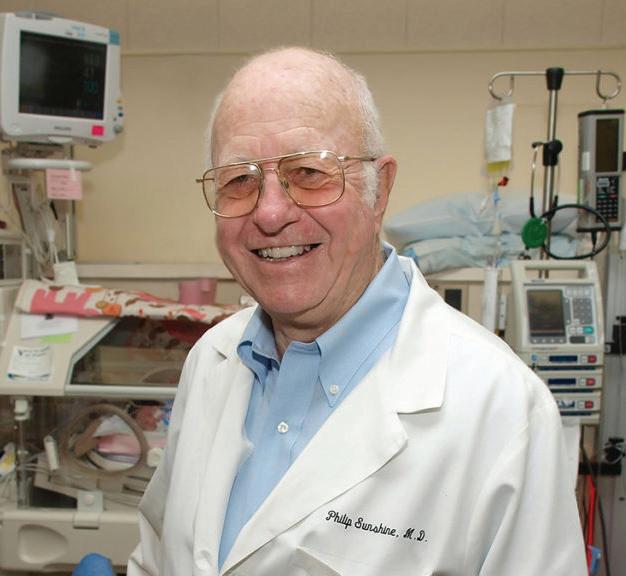
You may have children that are alive and well because of this man. No, he never practiced medicine anywhere near Augusta, but the innovations he brought to the field of neonatology have had far-reaching effects.
In fact, when he began medical school in the 1950s, neonatology as a medical specialty did not even exist, and it showed: back then, more than half of all premature babies died. Today more than 90% survive, and many attribute the improvements to this man.
Some of his innovations were simple and humanistic. The mother of one preemie where he worked in the mid-1960s (Stanford University Medical Center) would come to the nursery every day and sit looking through the window at her baby for hours at a time. Her longing finally prompted the medical team to let her into the nursery to hold her baby. In fact, they made it both a policy and a subject of study, leading to the first published research establishing that the practice did not cause infection rates to increase. The change added the very important elements of empathy and human touch to the care of premature babies.
There were other, more complex innovations. His medical school training in pediatric gastroenterology resulted in groundbreaking methods of feeding premature babies that are taken for granted today. Metabolic complications from intravenous feeding of infants had long been a thorny issue, but it was one he solved. The innovation was crucial for a patient population unable to digest breast milk.
Another major improvement he spearheaded was the refinement of ventilation techniques. It was at Stanford in 1962 that physicians began using mechanical ventilators to help newborns breathe.
The story is often told of one tiny baby whose ventilator malfunctioned. It had a sticky valve, so it took an extra second to transition out of inhaling mode before it helped the baby exhale. Before the ventilator could be repaired or exchanged for another, the team noticed that the “malfunction” was actually improving the baby’s oxygenation and overall ability to breathe. The “error” subsequently became part of routine neonatal care and helped babies get better faster.
He took the view that any and all efforts for each and every newborn were worth it, considering that “you are giving them 80 or 90 years of life.” A true people person, he always said he loved to get up and come to work every day.
The combination of lifesaving care and humble kindness endeared him to his colleagues and patients (and their grown-up parents). His warmth and accessibility made him a perennial favorite among the hundreds of doctors at Stanford. He was dearly loved and trusted like a member of the family, the same way people would feel about a beloved father or grandfather.
He humbly attributed his popularity to nothing more than his name. “People can’t forget Dr. Sunshine,” he once said. Born June 16, 1930, Philip Sunshine died at home in Cupertino, California on April 5 at age 94. He is survived by his wife of 63 years, five children and nine grandchildren. +
Middle Age
BY J.B. COLLUM
I have often written about my own limitations that have come along with age, and I hope I have done it with a balance of brutal honesty and just enough humor to make my sad descent a little more palatable. Humor is the way I deal with bad news and bad situations.
That said, I have not been as candid about the changes and challenges my better half has been dealing with. That ends today, and I hope she reads this with appreciation for my recognition of her struggles, and not with anger for me oversharing as I often do. If you see a new column from me in the first issue of next month, you will know that she was fine with it, or that I survived a cast iron skillet to the head while sleeping. I am ready to accept either outcome. I have a ridiculously hard head, as my wife, Lorie, and her dented cookware will attest to.

{
{ Eventually we have to transition from player to spectator
This past weekend, we were on a camping trip to Mistletoe State Park. Lorie’s parents stayed at a cabin there as well, and we spent a lot of time there eating, talking and just spending time together. All of Lorie’s siblings and most of the grandchildren and great-grandchildren of my in-laws were there at various times. As usual, Lorie was the organizer of all food-related logistics, coordinating who cooked what between her, her sister, and my best friend’s wife, Vicki. Lorie is a natural-born leader, as well as a retired event planner and caterer, so people tend to look to her for direction even if she doesn’t particularly feel like taking the lead anymore. I mean, that is the reason she retired in the first place. However, when you are good at something and people know it, like in the case of pulling together events with lots of people and lots of food in this particular situation, sometimes the implied pressure of people’s expectations pushes us to overextend ourselves. I know from personal experience because I have been working hard at saying no to people’s expectations for a while now after coming to the realization that I am not as young or capable as I used to be and coming to terms with it. It has been a rocky road as I have shared with you here before, but I am well along in that journey. My wife, Lorie, however, has only recently had this dawn on her and for good reason since she is a little younger and in much better overall health than me. Even with these facts, age still gets all of us though, and she is increasingly feeling its bite with each trip around the sun.
This weekend, our special needs granddaughter give us some trouble after an especially difficult week with her anyway, and Lorie also noted her parents worsening frailty. With all of that, plus the pressure of getting all the food organized for a family dinner, plus it being tax season and our large
tax bill, she just had enough. My strong-asa-steel-girder wife, buckled just a little bit. It happens so infrequently that when it does, I am caught off-guard and I don’t really have enough experience and skills to deal with it. So, I just went out on the back porch of the cabin with her and held her hand while we sat and rocked in the rocking chairs there. Then after we talked about it a little while, I asked her if I could say a prayer for us about how to deal with it and I was rewarded by a smile from her as she said that would be great. So we prayed together and felt better for it. After the prayer we discussed some possibilities for lightening our load, and especially hers, and we promised each other that we would revisit the conversation in earnest once we were home and could have some time to review things in detail. We felt better, and returned to the others to enjoy our meal and time together. As challenging as things are for me personally, I find it most difficult to face my wife’s problems as time goes by. For myself, I can better manage if I crack a joke about it and move on. I cannot be as flippant and macabre with my take on her troubles though. As hard as it is at times, I can’t begin to overestimate how much better my life is with her than it would be without her. She is definitely a low-maintenance kind of gal, and I am a high maintenance guy, so I lucked out, or was blessed, more likely. I needed her and I need her even more now.
I did some reading about life expectancy for single men versus married men and the same for women. Somehow I wasn’t surprised that, in general, married men live longer than unmarried men, but married women have lower life expectancy. I hope Lorie doesn’t read this, not just because I fear her cast iron skillet in the night, but maybe she’ll have a revelation about how to make her life easier. If she does, I’d rather take a fatal blow from the skillet than face an existence without her.
I’m not really worried about that because another one of her outstanding qualities is loyalty. She was loyal to me and my parents when she agreed that we had to take my parents in when my father had Alzheimer’s. She was right beside me and in agreement when we decided to take on the task of raising our grandchildren, and she will be there for her parents with whatever they may need if, and most likely, when that happens. She is the epitome of the person you want in your corner.
With all that good, this is the crux of the matter: if she doesn’t start thinking a little more about herself, she may not be there for others or she may not be worth much to them if she doesn’t find a way to ask for and
accept help. We’re working on that though, and maybe I can guide her through it as she has already done for me. She has worked diligently in helping me to recognize my growing limitations, and shrinking capabilities. Now it is my turn.
I recommend that you take a moment to think about the people in your life who sacrifice a lot for others, but are themselves aging and facing difficulties. Do not take them for granted. It is easy to do when they make everything look so easy. However, they may be expending more energy on it than they have to spare. Take some time to really examine what they do and find out how they feel. Look for ways to lessen their burden. You’ll be glad you did.
from page 1
dents experienced physical pain, respiratory problems, restlessness, fainting, and rashes.
Naturally, plenty of investigators were called in to find a cause and a cure. Environmental investigators, doctors, psychologists, and scientists conducted every test they could think of, but no smoking gun was ever found. No toxins or other environmental triggers were identified, and exhaustive physicals and lab workups of the girls also came back as completely normal. And as things of this sort tend to do, they fade away and disappear as mysteriously as they arrived. This one took more than a full year to run its course.
In the end, investigators were left with only one possible explanation: the outbreak was a textbook example of one of the more unusual aspects of human behavior, Mass Psychogenic Illness (MPI). When the right set of circumstances are present, emotional factors can manifest as physical reactions. Those physical symptoms can easily become contagious as MPI — sometimes also called “mass hysteria.”
A simple and non-hysterical analogy is provided by the wellknown fact that yawning is contagious. Something very similar happened in Africa in 1962, but the trigger was laughter, and the laughter lasted so long that it wasn’t funny anymore.
Editor’s note: This occasional series examines some of the strange and unexplained chapters in medical history.





Who is this?
Not everyone in healthcare can be Florence Nightingale, right? Despite the long-running series on page 4, there are clunkers in medicine, and we will examine some of them in this brief series that should be briefer. Unfortunately, there’s enough material to keep this going for a while.
People say the darkly disturbing thing about this man isn’t the number of patients he killed. After all, it sometimes seems that evil has no bounds. No, what had even seasoned homicide investigators shaking their heads about this guy was the sudden explosion of vicious hatred he displayed.
His name is Joan Vila Dilmé (in which Vila is the paternal surname), and he confessed to killing 11 residents of the nursing home where he worked in Spain.
The youngest of his victims was 80 years old, the oldest 96.

That would be a lifetime’s work for some serial killers, but for Vila it was only 14 months between the death of his first victim and the last (Aug. 2009 to Oct. 2010). Had he not been caught, the death toll might have risen considerably: his last three murders happened within the span of just five days. It was an unexpected ending for a strange but apparently harmless man. After a childhood marked by self-isolation due to worries about his acne and sexuality (he would say that he felt like a women trapped inside a man’s body), he proceeded uneventfully through a series of jobs before settling in as a nursing assistant early in 2006 at the nursing home that would become the scene of his crimes. He worked part-time, mainly weekends and holidays, times when relatively few other staff members were at the facility.
Things went along uneventfully, at least on the surface, for three and a half years. Vila was well regarded by his co-workers as an attentive and affectionate caretaker. He was especially caring and compassionate, they said, when explaining the circumstances of death to the grieving family members of deceased patients — deaths that, unknown to anyone at the time, Vila had caused.
It all came crashing down with the death of Paquita Gironés, an 85-year-old widow who had a hostile relationship with Vila. She told anyone who would listen that he was a “bastard,” and claimed that he had hit her. No one investigated her accusations, but it was later found that Vila had taken her to an area without video surveillance, and not long after she was noted to have wounds to her face and breasts.
Vila’s coup de grâce came a few days later in the cruelest fashion: he forced Gironés to drink bleach, a fate he had also inflicted on at least three other patients.
Ironically, Vila and his defense attorney both claimed his actions were so-called mercy killings, driven by compassion and the desire to put the patients out of their misery.
Although Vila freely confessed to 11 murders, records showed 56 deaths happened at the facility dating back to his first day on the job, 27 on his shift. Despite exhumations, the cause of those deaths could not be conclusively determined.
He was convicted and sentenced to 127 years, a symbolic gesture since under Spanish law no one can be incarcerated longer than 40 years.
HAVE YOU HEARD?
NORTH AUGUSTA
105 E Hugh St., Suite 103 North Augusta, SC 29841 (803) 441-3937
AIKEN
39-A Varden Drive Aiken, SC 29803 (803) 641-6104
AikenHearing.com





ADDICTION ALMOST KILLED ME
Way back in ’84, after teaching school for ten years I got restless and bored, and began seeking new careers.
I thought and researched the fields to see what I could find I wanted something noble, where I could be compassionate and kind.
Nursing fit the bill and seemed perfect for me
Because of previous education, would be easy and almost free.
It took only two short years, to get the skills and wit I eased right into a job, Correctional Medicine, a good fit.
Everything was going well until some medical issues came around Exposed to opiates for the first time, there was no way out but down.
I pretended all was well, taking doses too much, too long I found a source at work, helping myself, although wrong.
I deceived all the work staff, until I could do it no more Keeping up with that addiction, became a daily chore.
State Board of Nursing was called, to intervene before I died They offered me a path to recovery, I no longer had to hide.
Four years of license probation, with counseling, reports, and screens I’m on the way to recovering, saving my license and life, it seems.
I finished their strict requirements, and granted a license free and clear I’m currently practicing Nursing, in my thirty-eighth year!
So if you think addiction will always ruin your worth You can count on the Nursing Board to assist your rebirth.
I do something daily to keep recovery alive I never want to return to that painful bee hive!
I could have easily gotten lost, in addiction and despair But today I choose recovery, no other choice I dare.
by an Augusta nurse and Examiner reader

TRYTHISDISH
by Kim Beavers, MS, RDN, CDCES
Registered Dietitian Nutritionist, Chef Coach, Author Follow Kim on Facebook: facebook.com/eatingwellwithkimb
WATERMELON BANANA SMOOTHIE
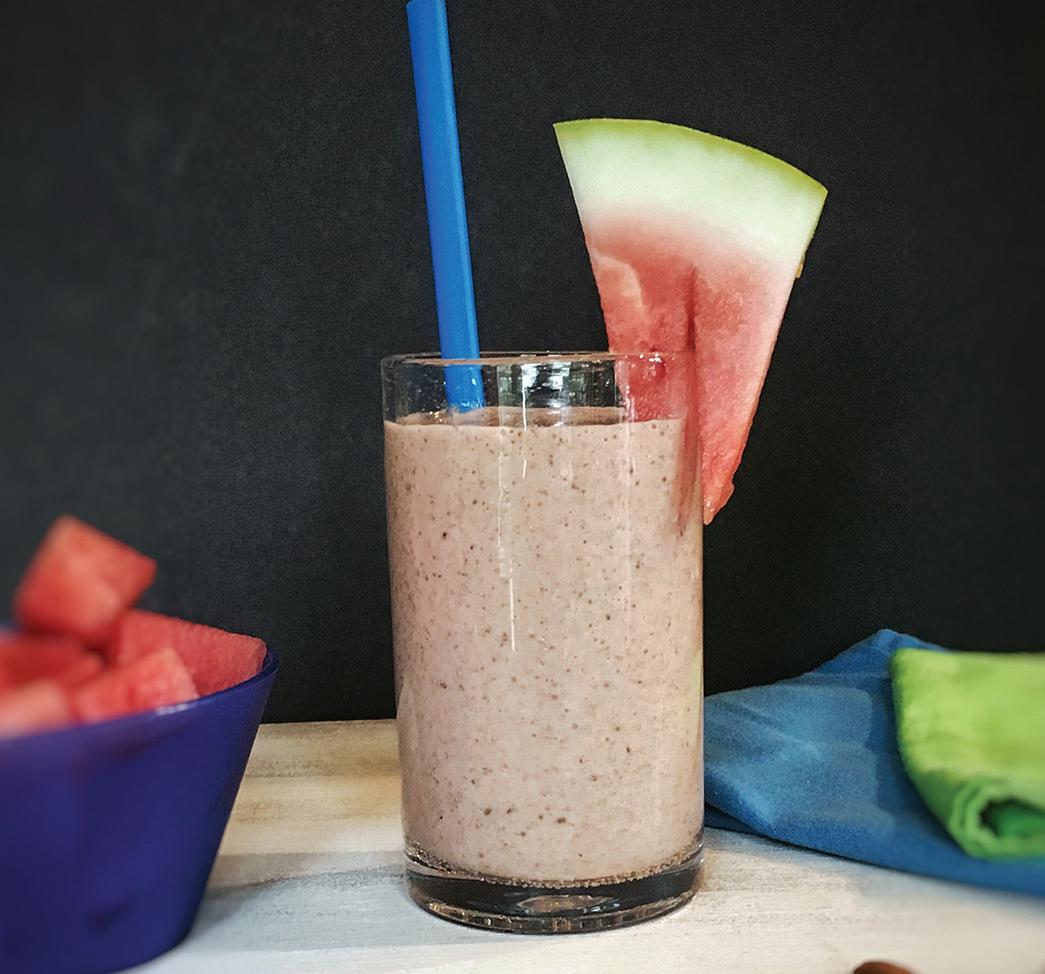
Quick, easy, and refreshing! Packed with immune boosting nutrients!
Ingredients
• 3 cups watermelon, cut into chunks
• 1 cup almond milk
• 1 medium banana
• 1 tablespoon chia seeds
• ¼ cup whole almonds
• 10-20 mint leaves
• ¼ cup crushed ice
Directions Put all the ingredients into a blender and blend until smooth. Serve immediately. Garnish with additional mint leaves if desired.
Yield: 4 cups (Serving size: 1 cup)
Nutrient Breakdown: Calories 135, Fat 6g (3g monounsaturated fat), Cholesterol 0mg, Sodium 41mg, Carbo-


hydrate 22g, Fiber 4g, Protein 3g, Potassium 216mg, Phosphorus 72g
Carbohydrate Choice: 1 1/2 Carbohydrate
Diabetes Exchanges: 1 Fruit, ½ Milk
Inspired by: Sharon Palmer, RD at www.sharonpalmer. com
+

SCIENCE & FUZZY LOGIC BASED ON A TRUE STORY
The problem with living several decades with a fairly reliable memory is that one recalls dire predictions made by people who should know what they were saying. Well, at least some of them were supposed to be knowledgeable.
Do you recall these knee-knocking predictions:
• 1960s: Oil will be gone… within 10 years
• 1970s: A new ice age… within 10 years
• 1980s: Acid rain will destroy all crops…within 10 years
• 1990s: Ozone layer gone… within 10 years
• 2000s: Glaciers melted… within 10 years
• 2010s: East & west coasts will be under water…within 10 years
• 2020s: Human race gone… within 10 years without Green New Deal
(most of the time)
A series by Bad Billy Laveau
All of these profound warnings turned out to be wrong … but they did get Congress to raise taxes. Based on these events, it seems the solution to all major problems is to raise taxes. Our founding fathers warned us to guard our pocketbooks whenever Congress is in session. Sage advice for sure. Profound statements, even by those usually in the know, may or may not be accurate. Sometime conclusions are speculations based on fuzzy logic rather that hard proof. Fuzzy logic is when you have some, but not all, of the


facts. You extrapolate what a reasonable conclusion might be. We use fuzzy logic all the time. Stock market investment is based on fuzzy logic. Poker is fuzzy logic. Football is fuzzy logic. Marriage is fuzzy logic. Otherwise, why would your significant other marry you?
Medical advances are based on fuzzy logic. Phase I studies. Phase II studies. Phase III studies. But they are not perfect. Remember Thalidomide for pregnant women? A great cure for morning sickness, it was claimed, but some babies were born without arms.
On the other hand, thousands of drugs have been safely approved for human consumption. The FDA is not perfect, but I have faith in their fuzzy logic. They sometimes catch a lot of static for being too slow to approve a given drug. The media, as well as multi-national corporations, look critically over their shoulders. The media needs controversy to drive viewership. Corporations need profits immediately if not sooner to drive up their stock prices.
And on top of all that, we have people in the public eye who desire to be providers of super-bad news to justify their self-imposed position of importance.
Twenty-four-hour cable news access was invented by Ted Turner and CNN.
Along with that came Infomercials where anyone with money can have a half hour worldwide TV show. Or a 30 second TV commercial. Remember Peter Popoff’s Magic Spring Chernobyl Water that cured cancer? Or his Magic Water packets that you sleep with and huge amounts of money will surely arrive in the mail?
And now we have political cycles that are as endless as car horns in Jamaica. Or maybe as endless as the stream of “undocumented workers” at our southern border. The only fuzzy logic therein is guessing the number of crossings tomorrow when we are not sure how many crossed yesterday.
But fuzzy logic is necessary for progress. We must take some chances and hope for the best. Hopefully, unfolding events will justify our faith in fuzzy logic.
For example, when a new drug is known to cause nosebleeds in one patient out of a thousand, we take the drug with faith we will not get the next nosebleed. A thousand-toone chance is a reasonable risk.
We must separate these reasonable risks based on the scientific method from the proclamations made by wild-eyed camera-seeking proponents with questionable agendas.
Sometimes reasonable risks have rough edges.

One example is the breast implants used in the 80s and 90s. A huge lawsuit destroyed a company even though it was later shown that women with implants had no more depression, fibromyalgia, arthritis, etc. than women without implants. At present, our TVs are loaded with lawyer ads regarding Roundup weed killer and contaminated water at Camp Lejeune, both now reportedly linked to all sorts of horrible diseases.
Be careful with vaguely associated events. I can find someone who drank water last week and died this week. Both events will be true. And supporting data will be true, but being related does not equal cause and effect. You need not give up drinking water.
Accordingly, we have not plunged into a new ice age, run out of oil, starved because of acid rain, drowned from rising tides, nor suffered demise due to lack of the Green New Deal.
Fuzzy logic is a necessary evil loosely tied to science. Tread lightly. Only the Good Lord knows when one of these conclusions might be right.
But also be encouraged. Medical advances and education, extrapolated from fuzzy logic, has doubled the U.S. life expectancy in the past hundred years.

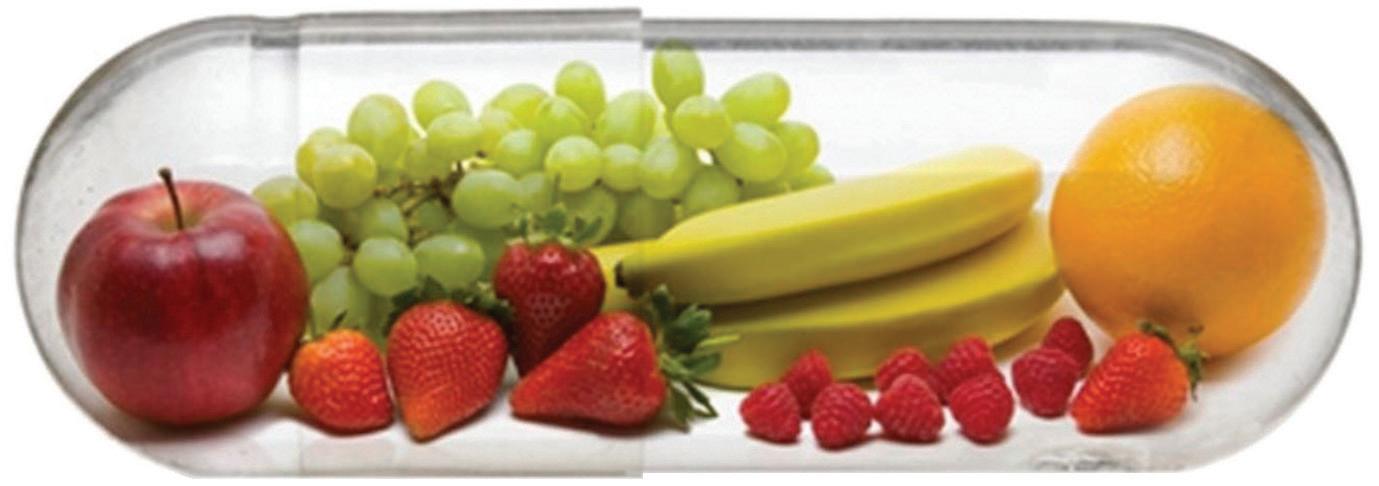
Eating Healthy on a Budget FOODISMEDICINE
by Janice Anglin, MS, RDN, CSG (Certified Specialist in Gerontological Nutrition)
Making food at home can be a helpful way to save money, express creativity, and prepare healthy meals/snacks for later. Cooking can be overwhelming. However, some tools and strategies can make it a bit easier.
Consuming shelf-stable items is a great way to prepare food without the extra steps.
Restock Your Pantry Non-Perishables
Keeping non-perishable items on hand can be a great way to assemble a quick meal or snack.
• Low sodium canned vegetables (green beans, corn, tomatoes)
• Dried or canned lentils, beans, and peas
• Chicken or tuna in a can/pouch
• Fruit cups in 100% fruit juice
• Whole grains (Whole-wheat pasta, tortillas, and crackers)
Frozen foods
Microwaveable and frozen foods retain and preserve nutrients. They are usually more affordable and can be prepared in a timely manner.
• Vegetables (carrots, spinach, broccoli)
• Fruit (berries, mangoes, peaches)
• Frozen poultry or seafood
Mix and Match Foods
Keep food staples from each food group to make more meals.
• Protein
• Grains/Starch
• Fruits
• Vegetables
• Dairy
Breakfast PB&J Wrap-Up
Total prep: 5 minutes | Cook: 0 minutes | Yield: 1 serving | Serving Size: 1 wrap
Ingredients
• 1 (8-inch) whole-grain wrap or tortilla
• 2 tablespoons creamy natural peanut butter
• 2 tablespoons fruit preserves
• 1 small banana
Directions
1. Place the wrap or tortilla on a clean flat surface.
2. Spread the peanut butter on one half of the wrap or tortilla and the fruit preserves on the other half.
3. Place the banana at the edge of the wrap, on the preserves side, along the line between the peanut butter and the preserves.
4. Roll the wrap or tortilla up around the banana, rolling towards the peanut butter side. The peanut butter should act like a glue and keep the wrap together.
5. Enjoy whole as a grab-and-go breakfast, slice into pieces to share, or serve as a side.
Recipe Notes
• Try almond butter in place of peanut butter.
• Look for fruit preserves that have fruit listed as the first ingredient.
• To reduce the total carbohydrates, consider leaving out the fruit preserves



CRASH COURSE

More Americans have died on US roads since 2009 than in World Wars I & II combined
Yes, this article contains the secret to safe travel. “The” is what grammar types call a definite article, meaning that in this instance it isn’t pronounced “thuh.” No, as a definite article it is pronounced “thee,” signifying singularity, exclusivity and importance.
Considering the tens of thousands of people in this country alone who are killed on our roads every year, then adding the estimated 1.6 million who are injured, there is obviously an urgent need for solutions to crashes.
First, just to keep the suspense going for a few moments, consider what hasn’t worked. As a matter of fact, this entire newspaper could be filled with all the improvements that have become part of our asphalt landscape.
Consider: before interstate highways, two-lane roads were a major means of travel. Anyone old enough to remember traveling on these roads may also remember there were not only no shoulders, there was no white line painted along the outer edge. These roads were dangerous enough in broad daylight, but at night they were positively deadly.
Over the years, things like reflective paint and lane markers, acceleration/deceleration lanes, dedicated left-turn lanes, rumble strips alerting drivers to upcoming curves or stop signs, and many other improvements have all become routine elements of road design.
In addition, cars themselves have added a dizzying array of protective features, everything from seat belts and air bags to complex radar collision avoidance systems and sophisticated driver-assist capabilities.
Through it all, the collisions, injuries and fatalities continue, seemingly unabated.
{ THE secret to safer driving.
Of course, part of the increases stem from simple population growth. There are 40 million more drivers in the US today than there were in 2000; the number is more than twice what it was in 1970.
And therein lies both the problem and the solution.
More traffic means more congestion, more delays, more stress. It has been effectively demonstrated that no combination of vehicular and roadway changes makes a massively significant difference.
Clearly, something new and radical needs to be tried, and we suggest it is the secret to safer roads.
Ladies and gentlemen, what could be more radical than civility and manners behind the wheel? And what is more neglected as a safe driving tool?

It is the antidote to speeding, tailgating, road rage, and all the general rudeness we see displayed every time we’re behind the wheel.
Traffic laws may dictate the technical rules of the road, but how many times have you seen something that made you mutter, “Where is a cop when you need one?”
Cops can’t be everywhere, so traffic enforcement is really a matter for self-regulation. Manners and social etiquette fill in the huge gaps that law enforcement cannot ever hope to address.
Letting other drivers merge? That’s basic courtesy. Using turn signals? The same, caring enough about other drivers to let them know your intentions.
On the other hand, letting some driver have it with a long horn blast is basic rudeness. Speeding? That’s a serious act of disrespect for someone else’s life and health. Ditto for tailgating, which endangers you and your passengers and the other driver and his or her passengers.
Some of the actions that display manners, respect and civility are simple stress-reducers; others are key elements of collision avoidance.
All of them, however, help traffic flow more smoothly, help drivers experience less stress and impatience, and help prevent avoidable collisions and road rage incidents.
Plus, having good manners is simply the right thing to do. +

MYMOST MEMORABLE PATIENT




Susie (not her real name) had been my patient for years and I dearly loved her. She was the brightest bulb in her family, though I estimated she would draw 60 watts at best. Short, skinny and snaggle-toothed with a grin reminiscent of Alfred E. Neuman, she managed to survive my medical care for a quarter century. Susie looked old when we first met and it seemed to me that her appearance never changed over the years. Except for all those casts, bruises and bandages.
A storm cloud seemed to park itself permanently over Susie’s head and from time to time it pummeled her with hail. Years ago, while seated in my waiting room and minding her own business, she was fallen on by a fat man, sustaining a fracture of the right humerus, the upper arm bone. Surgery was required. About three months later, she was awakened at 5:30 a.m. by a disturbance in the parking lot of her apartment. Peeking through the window blind, she spied a portly gentleman in respiratory distress, wheezing and pacing to and fro in his pajamas and bathrobe. Being the good neighbor that she was, Susie donned her own bathrobe and made her way into the predawn twilight to see if she could be of some assistance. Once again, unbelievably, she was fallen on by a fat man, this time sustaining a half-in-two fracture of her left femur (upper leg bone). More surgery was needed and an even longer recovery ensued.
One Sunday morning about a year later, Susie called, screaming with the agony of a recurrent kidney stone. I told her to run down to the emergency room and I would meet her there. No sooner had I hung up the phone than a distraught parent called, informing me that her 25 year old schizophrenic daughter had become hostile and something had to be done. I advised that I was headed down to the ER to see a kidney stone victim, and why didn’t they just bring her over and I would try to get her transferred to a proper psychiatric unit.
Upon entering the ER, I found Susie moaning, stretched out on a gurney, her head wrapped in bandages, both eyes swollen and badly bruised. A frantic nurse poured out her tale of woe: Susie had registered and made herself as comfortable on the gurney as her kidney stone would allow. Moments later, the schizophrenic daughter rushed Susie’s gurney and purse-whipped her about the face and neck with resulting significant injuries. As it turned out, poor Susie passed her stone in the ER, but had to be admitted for treatment of multiple contusions.
Susie’s son, Buddy, pulled 40 watts at most. It was uncanny how his frequent smile looked just like his mom’s. Buddy, with his childlike mannerisms and speech, was truly an endearing fellow and I loved him just as much as his amazing mom. It came to pass that Buddy fell in love during a breathless courtship and shortly, one Sunday morning, the happy couple’s engagement photo appeared in the paper. I sighed, shook my head, and wished Buddy all the best.
A few weeks later, Susie showed up for her appointment, flashed her best Alfred E. Neuman grin and proudly announced, “I had that boy spayed, Doc. I sure did. You know a boy like that don’t need to reproduce!”
As it turned out, Buddy’s marriage didn’t last long. DHR put him into protective custody shortly after his bride purse-whipped him senseless in a Krystal parking lot. And for some reason, when I called Safeplace (a shelter for abused women), they were very short on sympathy and hung up on me.
I take it back. Susie pulled 90 watts. Some of the time.
AN OCCASIONAL SERIES
The blog spot
posted by
Damane
Zehra MD on May 10, 2025 (edited for space)
HOW ONE SIMPLE QUESTION CAN TRANSFORM PATIENT CARE
What did you have for breakfast today?”
This phrase is a crucial part of my morning rounds.
IT HELPS ME AND THE PATIENT
While interacting with the patient, the greeting is very important. I believe doctors who approach the bedside without introducing themselves and who immediately ask about the patient’s active complaint tend to come across as less compassionate (whatever their actual intentions might be). This can hinder the development of the bond necessary for obtaining a complete medical history and for making patients feel comfortable and at home around them.
This phrase has been very helpful for me in starting conversations with patients. After the usual greetings and introductions, I like to ask for the patient’s permission to sit down on a nearby sofa, couch, or bench at their bedside.
While active issues, new complaints, and the patient’s progress over the previous 24 to 48 hours are crucial, I also make it a point to ask questions like, “What did you have for breakfast today?”
Discu ssing a meal with a patient helps them feel more like a person than just a medical case.
This approach encourages them to open up about other concerns as well. Asking such questions can serve as a starting point for important conversations about their symptoms in general.
Assessing a patient’s morale and nutritional status is crucial. I find it to be a more cost-effective approach than consulting a nutritionist, especially in a lower-middleincome country like mine. If a patient hasn’t had breakfast, I can inquire about the reasons. This can reveal whether they are feeling nauseous, have altered sense of taste, are experiencing diarrhea or constipation, or simply do not like the food provided at the hospital. I can then offer alternative options and guide them on various ways to improve their appetite and overall well-being. Many times, this simple question can spark a detailed conversation in which patients share their stories about what has been troubling them.
Yesterday, I met a 23-year-old patient who had acute lymphoblastic leukemia (ALL). He came from a very poor background and was struggling to find a hospital where he could receive treatment through a support program. He had visited many hospitals but had not found a suitable opportunity, as all the beds in the hematology department were already occupied. Finally, he was admitted to our hospital, and this was his first day.
When I spoke with him, he was accompanied by his young father and mother, both of whom appeared anxious. I sat beside his bed and after a bit of small talk asked what he had eaten for breakfast. He was hesitant to respond, but as we continued our conversation, the boy felt more at ease and shared that he had not been able to eat for the past few weeks because of a loss of appetite and a persistent low-grade fever.
I asked him what his favorite foods were and what he wanted to eat at that moment. We can arrange something he likes. My reassurance seemed to help him relax, and his father remarked, “Never has a doctor spoken to us with such kindness.” I felt sad and ashamed of our overburdened health care system and the overworked, burnt-out doctors, but his heartfelt compliment truly made my day.
If you’re curious to experience the magic of t his simple question for yourself, I really encourage you to give it a try. You might be pleasantly surprised by what you discover.
Damane Zehra is a radiation oncology resident in Pakistan.







These constant whole body deodorant commercials are disgusting.
by Dan Pearson
Here’s a radical concept: how about instead of covering up their nasty odors with perfume, people use actual soap & water? I agree.
I think one company already thought of that.
Yeah, the other day I overheard somebody mention Butt Dial. Oh really? Good!


ACROSS
1. Ward beginning
6. Vietnamese New Year
9. Venomous African snake
14. Newest state greetings
15. Major baseball stat
16. Hip bone
17. Cadaver stiffness (in brief)
18. NBC staple
19. Aromatic herb of the daisy family
20. Not true north
23. Relieve
24. One of AU’s previous abbreviations
25. Surplus
29. Black Sea peninsula
32. Science of rotating bodies
35. 1960 Pulitzer Prize winner
37. Small secluded valley
38. Star Wars’ character’s middle name?
39. Trudge
40. Instant lawn
41. Extensive
45. Public often follows it
47. McQueen role
48. Where the Wild Things ___
49. Earth’s largest continent
51. Rubella
57. Where roof sections meet
58. Even (poet.)
59. Like a kid on a sugar high
61. Tree of the birch family
62. Baby doctors
63. Those of wealth and privilege
64. Cemetery real estate
65. A Scotsman’s no
66. Starbucks option
1. Up to (or not up to) ____
2. Jim’s nickname?
3. Exercise method for health and relaxation
4. Hosp. on Harper St.
5. Type of racing involving horses
6. Exams
7. Tennessee’s Ford?
8. Baby powder
9. Cell division
10. Formal term for a call to arms
11. Money-making plant
12. Field on the outskirts of Augusta
13. Grant born in Augusta
21. One of four compass points
22. Drug agent, in brief
25. Breakfast staple
26. “Wood” in Greek
27. Statement of belief
28. Very long period of time
29. ____-matic
30. It’s between Broad & Greene
31. British versions of 28-D
33. Askew
34. Cigarette by-product
36. Tense; irritable
39. Letter in Greek alphabet
41. _______ market
42. Region
43. Capital of W. Samoa
44. Collided
46. Evans has one
49. One-celled protozoa
50. Jane Austen title word
51. Respiratory organ of fish
52. Taro plant
53. Ne on the periodic table
54. He won the Masters in 1988
55. Heroic; impressive
56. Stiff bristle (zoology)
57. It can follow murder
60. Whistle-blower
THE MYSTERY WORD
The Mystery Word for this issue: SUARACLV
Simply unscramble the letters, then begin exploring our ads When you find the correctly spelled word HIDDEN in one of our ads — enter at AugustaRx.com
We’ll announce the winner in our next issue!
X A M I N E R S U D O K U
DIRECTIONS: Every line, vertical and horizontal, and all nine 9-square boxes must each contain the numbers 1 though 9. Solution on page 14.
QUOTATION

DIRECTIONS: Recreate a timeless nugget of wisdom by using the letters in each vertical column to fill the boxes above them. Once any letter is used, cross it out in the lower half of the puzzle. Letters may be used only once. Black squares indicate spaces between words, and words may extend onto a second line.
Solution on page 14.
Use the letters provided at bottom to create words to solve the puzzle above. All the listed letters following #1 are the first letters of the various words; the letters following #2 are the second letters of each word, and so on. Try solving words with letter clues or numbers with minimal choices listed. A sample is shown. Solution on page 14.
— Bill Waterson

THEBESTMEDICINE

ha... ha...

Aweasel walks into a bar and sits down at one of the stools.
“This is a first,” thinks the bartender, but he plays it cool and just does his job like always.
“What’ll you have?” he asks.
“Pop,” goes the weasel.
Moe: How is your aunt doing? I know she hasn’t been well lately.
Joe: My old aunt Marjorie? The one we call Marge?
Moe: I believe that’s the one. How is she?
Joe: Marge has been sick so long we started calling her “I can’t believe she’s not better.”
Moe: What did the Tibetan monk say when he saw the face of Jesus in a tub of butter?
Joe: “I can’t believe it’s not Buddha.”
Moe: Hey Joe, I got a joke for you! What patient never needs an appointment?
Joe: I give, who?
Moe: Christopher Walk-In.
Joe: I call dad joke! And you are not a dad. So you can’t tell dad jokes!
Moe: I guess that was a faux pa joke then.
Moe: Wow, your garden is huge! And beautiful. When do you find the time to work on it?
Joe: Thank you. It’s simple, really. My wife loves to sing - even though she is a terrible singer - so whenever she’s singing I go out and work in the garden.
Moe: Sounds like a plan.
Joe: And that way the neighbors can plainly see there’s no domestic violence going on.
Moe: Why did the programmer get new glasses?
Joe: To improve his web sight?
Moe: I read an interesting bit of math trivia.
Joe: Do tell, do tell.
Moe: When you add 10+10 and 11+11, you get the same answer both times.
Joe: No way. 10 plus 10 is 20 and...
Moe: And 11 plus 11 is twenty too.
Moe: You got a reprimand at work? Why?
Joe: They say I need to do a better job of delegating.
Moe: Well, can you do that?
Joe: I hope so. But normally I get other people to do that kind of stuff for me.
Moe: I was reading that Air Force One is equipped for any medical emergency.
Joe: Even full-blown respiratory arrest?
Moe: Yup. Even that. They have a respirator called Forced Air One.
Moe: What do vets use to help mares deliver their foals?
Joe: Probably horse-eps.
Why subscribe to the MEDICALEXAMINER?
Staring at my phone all day has certainly had no Effect on ME!

By popular demand we’re making at-cost subscriptions available for the convenience of our readers. If you live beyond the Aiken-Augusta area, or miss issues between doctor’s appointments — don’t you hate it when that happens? — we’ll command your mail carrier to bring every issue to your house!
NAME ADDRESS
CITY STATE ZIP
Choose six months for $24 or one year for $46 . Mail this completed form with payment to Augusta Medical Examiner, PO Box 397, Augusta GA 30903- 0397
Dear Advice Doctor,


Dear Painful,
The Advice Doctor
Thank you for bringing up this important topic. First, let me offer my heartfelt sympathy for your situation. It’s certainly not what you dreamed of and hoped for when you started this partnership.
But things sometimes happen despite our best precautions. I remember one time personally, I just barely bumped into a door (or so I thought) as I opened it, and by the next morning I had a world-class black eye.
I understand your concern: no one likes a black eye. But in most cases it’s no different than a bruise on your leg or arm. But this very ordinary bruise just happens to be right there on your face where everyone can see it. Bruises on our arms or legs might be concealed by clothing, but there’s not much we can do about a black eye.
Or is there?
Assuming your black eye is just a simple bruise, there are a few home remedies that will help minimize swelling and discomfort. The playbook is pretty much the same as it would be for a sprained ankle: RICE. That’s Rest, Ice, Compression, and Elevation.
How do you rest your face? By resting your entire body. Bonk your face and run a marathon the next day and that black eye will be worse than one by someone who rested.
Applying ice for the first couple of days helps prevent swelling, while warm compresses after that help fluid drain and decrease puffiness. Elevation can be accomplished by using extra pillows at night to keep your head up.
Of course, a serious blow, one that causes double or blurry vision, bleeding from the nose or in the white of the eyes, suggests a trip to the doctor pronto.
I recently sold my small business to a competitor. But not for money. I basically became a 49% owner of the merged companies. That was my payment. So I’m working for and with this new blended company. Good, right? Wrong! The other owner was just charged with theft (from one of our clients) AND tax evasion. It is a huge black eye for the company, and we have lost business as a result. What do you think I should do? — A Painful Collaboration +
I hope this answers your question.
Do you have a question for The Advice Doctor about life, love, personal relationships, career, raising children, or any other important topic? Send it to News@AugustaRx.com. Replies will be provided only in the Examiner.


THE MYSTERY SOLVED
The Celebrated MYSTERY WORD CONTEST
...wherein we hide (with fiendish cleverness) a simple word. All you have to do is unscramble the word (found on page 12), then find it concealed within one of our ads. Click in to the contest link at www.AugustaRx.com and enter. If we pick you in our random drawing of correct entries, you’ll score our goodie package!
SEVEN SIMPLE RULES: 1. Unscramble and find the designated word hidden within one of the ads in this issue. 2. Visit the Reader Contests page at www.AugustaRx.com. 3. Tell us what you found and where you found it. 4. If you’re right and you’re the one we pick at random, you win. (Winners within the past six months are ineligible.) 5. Prizes awarded to winners may vary from issue to issue. Limited sizes are available for shirt prize. 6. A photo ID may be required to claim some prizes. 7. Other entrants may win a lesser prize at the sole discretion of the publisher. 8. Deadline to enter is shown on page 12.



PROFESSIONAL DIRECTORY
ACUPUNCTURE
Dr. Eric Sherrell, DACM, LAC
Augusta Acupuncture Clinic 4141 Columbia Road
706-888-0707
www.AcuClinicGA.com
CHIROPRACTIC







Karen L. Carter, MD 1303 D’Antignac St, Suite 2100 Augusta 30901 706-396-0600 www.augustadevelopmentalspecialists.com

Floss ‘em or lose ‘em!

www.woodymerry.com
















PARENTHOOD
by Dr. Warren Umansky, PhD
You are flabbergasted. It is close to the end of school and you just were notified that your eighth grader is likely to be retained. You thought he was doing well. He never seemed to have much homework. You figured the work was easy for him. He had plenty of time to hang out with his friends on line. You missed parent-teacher meetings when teachers asked to meet with you, but you never heard anything more after that. What do you do?
A. Go to the school and demand that your son be moved on to the ninth grade. His sister is in tenth grade now and it will be easier if they both are in the same school.
B. Go online and find out if any other parents have had similar problems with the school. Maybe you can get a group to protest the way the school communicates with parents about their children.
C. Make an appointment with the principal to find out how your child has gotten to this point without your knowledge.
D. Get information from the school about summer school and virtual classes so your child can avoid being retained.
If you answered
A. This sounds like it’s all about you and what’s convenient for you, rather than why your child is in this position and how to keep it from happening again.
B. Perhaps getting more information first might be warranted. If your position is always that the school is at fault and it couldn’t possibly be you or your child, it’s understandable why your child might feel no obligation to take responsibility for his work or anything else.
C. Middle and high schools have parent portals now that allow parents to go online at any time to check their child’s attendance in class, grades, assignments, and other important information. There should be no surprises at any point during the school year about how your child is doing in school. Furthermore, the teachers had asked for a conference with you and you missed it. Beyond all this, if you are talking with your child daily around the dinner table or at other times, you should know how he is doing both in school and out. Undoubtedly, some responsibility for this situation falls upon your shoulders.
D. After you have an understanding of why your child was recommended for retention and what actions you plan to take to keep this from happening again, you and your child together should plan the way forward. Hopefully, there will be summer school or virtual opportunities to make up for failed subjects.
Good communication and good oversight are critical principles for successful parenthood. You want to look at your child’s schoolwork regularly. (If you start this process in pre-kindergarten, it will be less traumatic for your middle school child!) You also should gather all available information before you take sides as far as who is responsible. In this case, it appears to be you! You can make it much better going forward.
Dr. Umansky has a child behavioral health practice in Augusta.
SUNSCREEN
from page 1
quent applications. In actuality, a sunscreen’s SPF and its life expectancy on skin are two completely unrelated matters. SPF 30 and SPF 15 (and every other SPF) need to be reapplied about every two hours, more often if sweating or swimming.
I have dark skin. I don’t need no stinkin’ sunscreen. Oh yes you do! Darker skin has more melanin, which does offer protection from the sun, but people with dark skin still can get sunburned, skin cancer, and show signs of premature wrinkles and aging from sun exposure. Sunscreen is a good idea for every skin color. Sunscreen is sunscreen. True. And cars are cars, but there are definite differences between, let’s say, Yugos and Lamborghinis. When it comes to sunscreen you definitely want to buy a Lamborghini. You can afford it. And you can’t afford the Yugo. The Lambo is not only at least SPF 30, but its label says “broad-spectrum.” That means it protects against both UVA and UVB rays, the two types of ultraviolet rays which can cause sun damage.
My makeup has built-in sunscreen. That may be true, but two limiting factors are also true: first, makeup is usually a mere 5 to 15 SPF, not the minimum recommended SPF 30. Second, nobody applies makeup everywhere they’re exposed to the sun, so the benefits are doubly limited. It is great to know your eyelids are semi-safe, though.
Clouds are my friends. That is so sweet, and we all need friends. Not to be talking behind clouds’ backs, but they only block some UVB
rays and no UVA rays at all. And UVA rays are a risk factor for melanoma. So using sunscreen is still important even on cloudy days.
I’m a believer! I have a bottle I’ve had for years and I use it faithfully every summer We may be preaching to the choir, but the choir may need new sheet music. Sunscreens have an expiration date, and beyond that date its effectiveness is compromised. It may not even make it to the date if it has been stored in direct sunlight (ironically) or in a hot car.
+
BREAKING NEWS
IN THE WORLD OF SUNSCREEN
In a University System of Georgia first, the Augusta University campus and several locations around town have (or will soon have) touch-free sunscreen dispensers. Look for them in places like the Student Center on Laney-Walker Blvd, the Georgia Cancer Center, the Forest Hills campus inside Christenberry Fieldhouse, at the Augusta Canal Discovery Center, and at multiple locations along the Augusta Canal trail: the Lake Olmstead trailhead, between the suspension bridge and the kayak launch dock near the Headgates (among others). The battery-operated dispensers are free, touch-free, and make using sunscreen simple and convenient. Look for them and use them!