

BABYTALK
Most of us have probably seen signs like these at various locations around town. A logical and natural response would be why? What good purpose could possibly be served by making it easy for people to abandon their babies? Under Georgia law the mother (or whoever is doing the dropping off) does not even have to identify themselves; the process can be completely anonymous.
At first glance, the law could seem to devalue human life, as though “throwaway babies” are so A-OK in our society that we’ve passed laws to protect those who do it.
Actually, so-called safe haven laws are not designed for the mother’s protection; they are intended to protect babies
South Carolina’s law illustrates the reasoning perfectly. Known as Daniel’s Law, it was named for an infant who was found buried in an Allendale County landfill. He survived the ordeal and was nicknamed Daniel by nurses as he recovered in a hospital.
Enacted in 2001, the South Carolina law is designed to eliminate dangerous and fatal abandonments by giving parents who feel utterly hopeless an op-

tion that does not involve prosecution or harm to the baby
The first such law, dubbed a “Baby Moses Law,” was signed in Texas in 1999 in response to more than a dozen incidents of child abandonment in the Lone Star State that year. All 50 states now have a safe haven law.
If you’re wondering how often people take advantage of such laws, Georgia has never has as many safe-haven babies as Texas had in 1999; the alltime peak in Georgia was 12 in 2004. The total for the past 10 years (2014-2023) is 23, which includes zero instances in 2015 and 2017, but 9 in 2022.
South Carolina’s all-time safe-haven peak was 7 babies in 2022. 63 infants have been surrendered under Daniel’s Law since 2009 in the Palmetto State.
In Georgia, the law (in brief) says the infant must be less than 30 days old; in South Carolina, the limit is 60 days from birth. Babies must be healthy and unharmed, and contrary to the storybook image at right, must be given to an on-duty staff member at a hospital or medical facility, fire or police station. South Carolina adds churches “during open hours” to their list of drop-off options. There are a number of other state-to-state variations. For example, in a number of states the infant can be no more than 3 days old. At least one state (California) allows a parent to request to reclaim their infant within 14 days.
In fact, the issue of parental rights within the context of safe haven laws is a sticky one indeed, since critics say the laws in many states favor the mother to such an extent that fathers are completely excluded from the conversation. Anonymity provisions mean that fathers who might be more than willing to raise their child are
• Personal, local answers and assistance
• Review your current plan for optimum
• Call to see if there is an enrollment for
• All services provided at no cost to


not notified; they may not even be aware of the pregnancy.
Let’s say a husband is deployed overseas for a year. While he is away his wife discovers they are pregnant. She knows her husband wants to start a family, but she does not. Because she is against abortion, she delivers their full-term baby and surrenders it anonymously under safe haven protection.
Under similar circumstances women have become pregnant via extra-marital affairs and delivered a child in the husband’s absence, then give it away anonymously.
Defenders of safe haven laws admit they are not perfect (the original Nebraska law allowed children up to age 18 to be sur-
rendered), but argue that they save lives by providing safe and legal alternatives to abortion, infanticide, and abandonment. Even in Texas where these laws were born, the problem continues. Over the past year in Houston, more babies have been found abandoned (5) than turned in through the state’s Baby Moses Law (3).
Last month a crying newborn was pulled from a Houston dumpster. The father, who could have easily surrendered the baby without repercussion, is instead facing felony charges for child abandonment.
Safe haven laws may not be ideal, but after all, they address a decidedly less-than-ideal situation. +


PARENTHOOD
by Dr. Warren Umansky, PhD
You love taking your young child to the playground to play, get exercise, and interact with other children. When it is time to go home, though, it is always a battle. Your child runs off or drops to the ground or starts screaming. What do you do?
A. Stay as long as your child wants.
B. Threaten your child with a spanking if she doesn’t come with you immediately.
C. Walk calmly to your child and gently take her hand. Then tell her it is time to go home.
D. Call your spouse or a friend to come help you.
If you answered:
A. There probably is a good reason to leave and that is your decision. At some point in time, when she is more responsive to your directions, you might give her a chance to stay a little longer if she is having a good time. But not now.
B. You don’t want to control your child with physical threats. More about this later.
C. This is the best approach, although she might catch on the second or third time and start running before you take her hand unless you have set some clear rules. More about this below.
D. You probably want to avoid doing this. You want your child to respond to you and not depend on another adult to bail you out.
We cannot force a child to behave in a certain way. What we can do is set the stage for behaving well by reinforcing good behaviors, providing good role models, and whenever possible not paying attention to negative behaviors. What we also can do is control the consequences of a child’s behaviors. In the situation above, you can prepare your child for the trip to the playground. Let her know in advance what she will get to do there. Ask her how she is expected to behave with other children (help out, if needed, with the words for being kind, taking turns, sharing, etc.). Let her know that you will tell her when she has five more minutes to play before leaving. And let her know that she will have her favorite dessert after dinner and have her usual bedtime if she behaves nicely at the playground. Let her repeat what happens if she does well at the playground and be sure to follow-through at home by giving or withholding her dessert and having her go to bed at the regular hour or going to bed earlier if she did poorly at the playground. After a few trips to the playground (or store or restaurant or a friend’s home), just your verbal reminders alone before going on the outing will be sufficient to generate great behavior.
Dr. Umansky has a child behavioral health practice in Augusta.


SHARKS DON’T GET CANCER
Some myths are harmless; others lead to tragic results.
Have you heard this one about sharks? Many people believe it, but as anyone can find out by simply asking your neighbor, the one who is a marine biologist (or if you keep missing him or her, do a web search), it isn’t true.
The medical myth holds that since sharks don’t get cancer, taking a shark-based supplement will help prevent, slow, or reverse cancer.
Sharks absolutely do get cancer, but the false belief that they don’t has contributed to two separate tragedies.
First, sharks are paying an extremely high price for this pseudoscience: North American shark populations have dropped by 80% in the last decade. One study found that cartilage companies were harvesting up to 200,000 sharks per
month; a single cartilage plant in Costa Rica processed some 2.8 million sharks annually.
Second is the human toll: cancer patients are being diverted away from effective treatments in favor of a treatment that isn’t simply unproven; it’s disproven
Birth of a Myth
If sharks do get cancer, then how did this myth get started? During the 1970s, two researchers at Johns Hopkins School of Medicine were pursuing a common theme in cancer research: angiogenesis. As the name suggests, angiogenesis describes the creation (-genesis) of blood supply (angio-). Tumors are great at angiogenesis; they have to be in order to survive and multiply, creating their own network of self-feeding arteries. But cartilage
has no blood vessels, so it must contain some kind of signaling molecules that prevent even capillaries from forming. Initial studies inserted cartilage from cows and bunnies into tumors with success. Another researcher reasoned that since shark skeletons are 100% cartilage, they would be a better source than the smaller amounts of cartilage available from baby rabbits and cows. These very small, preliminary studies ended without being able to demonstrate any benefit for cancer patients from shark cartilage. But the 1992 best seller Sharks Don’t Get Cancer: How Shark Cartilage Could Save Your Life opened the floodgates. A follow up book in 1996 was titled Sharks Still Don’t Get Cancer.
University of Hawaii researchers responded with an oceanographic survey that found 42 sharks with tumors, including tumors in their cartilage. The FDA and independent researchers have repeatedly published studies showing that shark cartilage does not treat or cure cancer in any way.
Sharks do get cancer. Even if they didn’t, there is no evidence that shark cartilage prevents cancer. The myth has cost the lives of millions of sharks, and an untold number of people.

Editor’s note: This summer rerun was the first installment of “Medical Mythology” in 2022.

Who is this?

Got kidney stones?
Then this man is your new best friend, even though his esteemed place in medical history includes nothing about kidney stones.
Please meet Jean Civiale (1792 - 1867), a French surgeon and urologist who invented an instrument that eliminated the need for many surgical operations. Along the way he fundamentally changed the way medicine is practiced.
Civiale focused his medical attention on a problem that had plagued the human race for thousands of years: bladder stones, a less common cousin of kidney stones.
The traditional treatment was surgery, which got marginally better over time, but was still of dubious success, was excruciatingly painful in a time before anesthetics, and often left patients with infections, incontinence, and erectile dysfunction in men. And those were the ones who survived; a large percentage died.
While still a medical student, Civiale applied in 1818 to the French government for a grant to fund research into new approaches to the problem of bladder stones. Civiale used his grant wisely, and people today still enjoy the benefits of his work.
First, he worked through numerous prototypes to finally develop a usable and effective lithotriteur, a long, thin metal tube with a three-pronged claw at the end. The instrument would be passed through the urethra into the bladder, where the claw could grasp the stone. A tiny drill was then extended through the tube and into contact with the stone, breaking it into pieces that could be extracted or passed via urination.
Civiale first demonstrated the instrument before a large audience of physicians in January, 1824. The patient was a 32-year-old man who had suffered from a large bladder stone since the age of four. The 40-minute procedure was a success, and while it couldn’t have been fun, it had to have been hugely better than the surgical alternative.
Perhaps no one realized it at the time, but that January day marked the first minimally invasive surgical operation, eventually leading to the “keyhole” operations of today, major operations performed through the tiniest of incisions (if any). Civiale also ushered in a new approach to bladder and kidney stones, crushing or dissolving them rather than surgical removal.
Faced with opposition to his new procedure, Jean Civiale also pioneered statistical analysis to prove its effectiveness. Painstakingly collected data on more than 5,000 lithotomies from all over Europe showed 7 deaths in 307 operations using his method (2.2%) versus 1,024 deaths in 5,443 traditional surgeries (nearly 19%). Even those lopsided numbers didn’t convince many, who argued that medicine is about the individual patient and his unique symptoms. “Cookbook medicine” ignored the individual, said skeptics.
Civiale’s data collection may not have been done as rigorously as it is today, but his use of evidence-based medicine was far ahead of its time, as was the radical new approach he brought to surgery. +
WRONG!
Penicillin and sulfa drugs will wipe out infections. Wrong. Germs got smarter and became mostly immune to penicillin and sulfa. Presently, we are in a continuing race. So far, we are slightly ahead of germs.
Electric cars are the immediate answer to get rid of the need for oil and coal. Wrong. If it works out, it will take decades, and we’ll need lots of oil to get there. Electric cars need asphalt streets. Asphalt is made from crude oil.
Birth control pills will greatly decrease populations, but increase immorality. Well, at least one prediction was certainly wrong.
If you read it, it is history. If you hear it on radio or TV, it is news. Wrong. Our news sources have become activist, slanting one way or another. No one wants to be a reporter anymore; they want to be journalist. Be careful what you believe, whether you read it or hear it.
Water has been necessary and drinkable for millions of years. True. But now, bottled water has an expiration date. Wrong. Water doesn’t expire.
When invented, telephones were thought to have no future because women and children would be too frightened to use them. Oh, how very wrong that was.
Dick Tracy’s two-way wrist watch was not possible. Wrong. Cell phones destroyed that myth. Everybody and two of his brothers have one.
Emergency Rooms are for emergency visits only. Wrong. According to a recent study 80% of ER visits could be handled in a doctor’s office.
A liberal arts education teaches you to hate the money it prevents you from making. True. Look at student loan crisis. It seems students hate to pay back the money they borrowed.
Marriage lasts “’til death do us part.” Wrong. 41% of US marriages end in divorce. Average US marriages last 8 years. In Washington DC, 80% of children are born to “single parent homes.” Not a good sign.
When people know what and how much to eat, their health improves. Wrong. The US is the only country in human history where obesity is a major health problem. In most countries, the wealthy are overweight and the poor are skinny. In the US, the opposite is true.
Visits from a wellness doctor once a year will make you healthier and increase your longevity. Wrong. You must follow the doctor’s advice for it to work. Knowing what to do is not the same as doing. Example: A birth control RX will not prevent pregnancy.
Limiting the number of free condoms per visit given by public health departments saves money. Wrong. The cost of one unplanned baby over its lifetime will pay for a ton of condoms. The cost of preventable VD is humongous.

BASED ON A TRUE STORY
(most of the time) A series by Bad
Increasing corporate taxes will not cost average people anything. Wrong. When the government taxes business, consumer prices have to go up for businesses to continue providing products. I drink 2% milk daily. My neighborhood homeowners association frowns on cows grazing in my front yard. I need milk companies even if the government taxes them and I have to pay more for milk. The same goes for medicines. Any and all tax increases come out of consumer pockets, regardless of the consumer’s income. That means you. Period.
All fairy tales begin with, “Once upon a time.” Wrong. Many begin with, “If elected, I promise...”
Outlawing gun will end killings. Wrong. If it were so, outlawing cars with back seats would end pregnancies.
Making more money will make you rich. Wrong. Managing your money makes you rich.
Medical education makes you healthy. Wrong. Practicing what you learn about good health makes you healthy.
Sacrifice to get the things you want. Wrong. Sacrifice to get the things you need. And there are not many things you actually need.
The newest newsstand location where you can pick up your FREE copy of the latest Medical Examiner is at the US Post Office
Summerall Station at the intersection of Pine Log and Silver Bluff Roads in Aiken. Read every
Billy Laveau
Middle Age
BY J.B. COLLUM
What’s that you say? Another column is due? Oh, rats! You’re right! I’ll get right on it. Why does it feel like class just started and the teacher called me to the front to read my book report that I haven’t written yet, for the book I haven’t finished yet? Oh my. Am I turning red yet?
I’m a bit of a procrastinator in the same way that the Grand Canyon is a large ditch. It has followed me my entire life. Not the Grand Canyon, of course, but procrastination. I always seem to get away with it though, so I suppose that encourages my inner procrastinator to keep on keeping on, with not keeping on the ball. Wait, what did I just say? If I had more time, that would have been written much better, or more clearly. You’ll just have to trust me on that. Oh well.
I’ve always been a fairly talented fly-by-the-seat-ofmy-pants pilot. As far as those metaphorical kinds of pilots go, we procrastinators are very much like test pilots. There is a good chance we will crash and burn one day, but each time we don’t we get bolder in our disdain for safety, preparation, planning, and getting ahead of the game. We don’t need no parachute! A checklist? What’s that? We laugh in the face of danger!
However, it is said that there are old pilots and bold pilots, but there are no old, bold pilots. I am beginning to understand that. When I was young, I could procrastinate and still get things done and not just in a “barely get by” fashion, but with some level of quality, style and flair. People would complement me on how hard I must have worked on it. It was an annual occurrence for me to throw together a project for the science fair the day before, or sometimes before school on the morning of the day it was due.
As I hit my mid-thirties that got a bit harder to do. By my forties, it was noticeably much more difficult, but then by my mid-fifties, it felt like I crashed and burned and left a crater that will one day attract tourists from all over the world. Maybe one as big as the one that made all the dinosaurs go extinct.
I’ve always been overly-over-optimistic with my estimates on the timeline for the completion of a task. Maybe I am so lazy that I have to fool myself into thinking a task won’t be too hard so I will even start it at all. Or it might just be my natural optimistic outlook on life. I’m not sure which. Maybe some of both. But now, I blow right past those deadlines, even when I carefully pad my estimates. It is like the lazy, procrastinating part of my brain has a spy in the sensible “pad the estimates” part of my brain, so it knows about the padding and procrastinates more. To give you more insight into my mindset,

let me share this with you. I have two mottos: 1. Why put off till tomorrow what you can get someone else to do today? and 2. I didn’t take this job because it was easy. I took it because I thought it would be easy.
There is another member of the conspiracy. That is… Uh...wait. It is on the tip of my tongue. Hmmm. Hold on. Oh yeah, I remember now! It is my memory. Perhaps the procrastinator in my brain jiggers with my memory to make me forget deadlines and not notice alarms and pop-up notifications I set to help me remember to do important tasks. My brain has a saboteur! Oh dear. What is a middle-aged, lazy, overly-optimistic, procrastinator to do?
The short answer is: I don’t know. That said, as I continue to see a therapist for all of my mental woes and shortcomings, I am also dealing with a physical health issue that is most likely playing a major role in this spy thriller/disaster epic/ zany comedy. That villain is diabetes. Yes, it affects the brain too. That knowledge and the fact that my doctor told me last week that if I have one more bad A1C reading I am being put on insulin, have combined to light a rather sizable fire under me, and by sizable fire, think back to those massive forest-sterilizing-fires in California that seem to ravage the countryside every summer. Now imagine me running just ahead of that blaze while I toss pies, cookies, and ice cream into the fire and munch on a lot of vegetables and proteins. Such a sad picture, I know.
It has been a little over a week since that doctor visit and I have managed to keep my glucose readings under my targets every day since the day after that visit. I really mean it this time. I think, or hope I do anyway. I may still get away with writing my columns right at the deadline, but I can’t put off taking care of my diabetes any longer. If you’ve been told you are diabetic or pre-diabetic, get that under control now, while you still can. Diabetes can take your vision, your limbs, your love life, and even years of your life. It isn’t a joke, even though I joke about it sometimes. I’m an optimist, but I have to be a realist about this. Let’s all take care of ourselves.
If you want to share any similar experiences, please email me at the address provided at the end of this column. I’d love to hear from you. With your permission, I might use them for a future column.

J.B. Collum is a local novelist, humorist and columnist who wants to be Mark Twain when he grows up. Reach him at johnbcollum@gmail.com


IS POPCORN HEALTHY?
It depends. It certainly can be.
Popcorn has plenty of company in the “depends on how it’s prepared” department. Potatoes are rich in vitamins and fiber, particularly when eating the skin is included. But cut into strips, deep-fried, and heavily salted, not so much.
In the case of popcorn, it can be either super-healthy or very unhealthy, all depending on how it’s prepared.
The bad stuff is popped in butter or oil, then more butter is poured over the finished product, followed by a liberal sprinkling of salt. That is not a healthy snack.
While we’re still in negative territory, let’s pop a popcorn myth: people with diverticular disease are often advised to avoid popcorn (as well as seeds and nuts) due to concerns over aggravating their diverticulitis. Recent studies have been unable to prove any such link. In fact, high-fiber foods like popcorn are generally recommended for people with diverticular disease. So as a general guideline, avoiding popcorn seems unnecessary. But some individuals have personal proof that for them, popcorn triggers symptoms. They should avoid popcorn.
For people who don’t have any digestive issues with popcorn, it is a whole grain, high fiber food. Whole grains lower the risk of type 2 diabetes, and foods with a low glycemic index (like popcorn) help people with type 1 or type 2 diabetes manage blood glucose levels. Diets high in fiber are proven to lower the risk of cardiovascular disease and coronary heart disease. “Good” popcorn can help prevent high blood pressure or lower existing blood pressure. Popcorn is low in calories too, so unlike many snack foods, it can help people avoid weight gain. Compared to popcorn, clinical studies have established that people need to eat more potato chips to feel the same level of fullness, and they get hungry again sooner after the chip snacks.
So what’s the best way to enjoy these and other popcorn health benefits? Air-popped is healthiest, delivering only 30 calories per cup. Some movie theater popcorns have been tested at well over 1,000 calories for a bucket-sized serving. Yikes!

www.AugustaRx.com
Medical Examiner’s mission:
Direct editorial and advertising inquiries to: Daniel R. Pearson, Publisher & Editor E-mail: Dan@AugustaRx.com
AUGUSTA MEDiCAL EXAMINER P.O. Box 397, Augusta, GA 30903-0397 (706) 860-5455 www.AugustaRx.com • E-mail: Dan@AugustaRX.com

www.Facebook.com/AugustaRX


FRONT DESK FOLLIES

I was assisting a patient in the ER with a severely broken wrist. As I was giving him the initial workup I asked how he got hurt. He explained in some detail how he had fallen out of a tree he had climbed trying to get across a creek.
When the doctor came in she asked the same question — what happened? — but he just gave her the short version: “I was being an idiot.”
“Well,” she said, “you are a guy.” READERS:


TRYTHISDISH
Probiotic-rich kefir gives you a great start to your day. The fruit and toppings turn this into a nutrient rich and protein packed breakfast or post-workout snack.
Ingredients
• 1 cup plain kefir
• ½ banana
• 1 cup blueberries; divided
• Chia seeds
• Coconut flakes
• Toasted slivered almonds
Directions
Combine the kefir, banana and ¾ cup of blueberries in a blender and blend until smooth. Pour into a bowl and top with remaining blueberries, 1 tablespoon of chia seeds, coconut chips or slivered almonds. Add additional sliced bananas if desired.
Yield: 1 Serving
Nutrition Breakdown: Calories: 300, Fat 9g (2g saturated


fat), Cholesterol 0mg, Sodium 0mg, Carbohydrate 48g, Fiber 12g, Protein 15g
Percent Daily Value: 0%
Vitamin A, 60% Vitamin C, 6% Iron, 10% Calcium
Carbohydrate Choice: 3 Carbohydrates
Diabetes Exchanges: 2 Fruit, 1 Milk, ½ Medium Fat Meat, 1 Fat
Note: Kefir has a tart flavor similar to plain yogurt. The banana and berries sweeten this up, but if you need more sweetness consider adding 1 pitted date (70 calories, 15g sugar, 1 ½ g fiber) or 1 teaspoon honey (20 calories and 5g sugar).


PICKLES AND BEER
by Ken Wilson Steppingstones to Recovery
About 40 years ago my wife and I decided to save money on sandwich fixins and grow our own cucumbers and make our own pickles. The cukes were easy. Pickling, trickier. We used a large earthen churn for the cukes, added the recommended dill spices, stretched an old pair of pantyhose over the opening to keep critters out, and circled the date on the calendar. Was it 4 weeks or 6? I don’t remember, but I do recall sneaking one after a couple weeks and was aghast at the trick it played on my taste buds! I spit the stolen bite about as far as a chunk of cucumber could travel under such locomo -
tion!
Once the circled date arrived we had friends over for lunch and my wife put beautiful sliced pickles on the hamburgers. I waited for someone else to test the waters before I bit into mine. And they were a hit!
Taste matters, at least with pickles. During my 37 years as an alcohol and drug counselor I’ve heard countless times, “I just drink beer for the taste.” I think not. To prove the point, I hold a full can of beer in one hand and a non-alcoholic but otherwise identical beer in the other hand. “After a hot day outside,” I say, “you come inside and see these in the fridge, cold’n ready! Which one would you pick?” In all these years no honest drink-
GET THAT AD, RIGHT? IF YOU BUY TWO ADS, YOU SHOULD GET TWO ADS. THREE? THREE. AND SO ON... CALL US FOR INFORMATION ON OTHER NUMBERS! (706) 860-5455
er has picked the non-alcoholic beer!
And why? Of course, it’s because the real-deal has something in it that will — are you ready for this? — change the way he feels in a way that the non-alcohol beer just can’t.
Beer’s active ingredient primarily slows down the synaptic transmission of signals in the brain so the tired mind isn’t racing as much and naturally – like falling asleep – one feels better very quickly.
According to a Facebook post I saw a few days ago (I know: Facebook: the official fact-checker!) Ben Franklin is reported to have said “Beer makes you feel like you’re supposed to feel without beer.” I kinda like ol’ Ben, and if he had lived a little while longer maybe he would’ve said, “You can learn to feel the way beer makes you feel without drinking beer.” And as part of the bargain, save yourself
a hangover.
The real addiction, then, is not to the beer but to the change of feeling. Where does the beer come in? It’s what guarantees you’ll get that change of feeling, of course. That’s where a good substance abuse treatment program comes in for those who haven’t had much luck winging it on their own. Learning to feel ok without the chemical takes time.
Did I say time? Learning to do without the lifetime practice of changing the way you feel by popping a tab on a cold damp can doesn’t come easily. One beer used to do the job, then it took two, then a case, then 24 or more over a weekend.
The human body builds up tolerance. What started as convivial is now a crutch to “self-medicate.” What started out as a social measure is now done in private and hidden from all the people who love them.
Truth: once that line to


THIS IS YOUR BRAIN
A
being an alcoholic is crossed, one simply can’t go back to drinking “just one.” A pickle just can’t seem to go back to being a cucumber. Something has clicked in the brain chemistry and thousands times thousands of people have learned the hard truth that “one is too many and a thousand is not enough.” Ask anyone who has learned this through the School of Hard Knocks and they’ll tell you that it’s easier to drink none than one.
If you’re open to the thought and are looking around, maybe you can find something that makes you feel as good as beer used to make you feel. I wouldn’t suggest pickles.

The Money Doctor PASSING REAL ESTATE DOWN TO YOUR HEIRS
There are many ways to leave a legacy. Ultimately, wealth is much more than simply what you see on a net worth statement; it’s a combination of both the financial side of things and the intangible items like time, memories, lessons, and values.
One of the ways you can leave a financial legacy for your loved ones is by passing down real rstate to your heirs. This article will give insights and advice on the best methods of passing down real estate from one generation to the next.
Using a Will versus a Trust
Typically, real estate will be passed to heirs through a Last Will & Testament. However, some people choose to use a trust in order to minimize costs and avoid delays in transferring assets. The decision to use a will versus a trust depends on a few factors. The first question we would ask is, “How complicated and expensive is the probate process in your state of residence?” When anyone dies their estate must go through a process called probate. In some states, the process is simple, fast, and inexpensive. In those states, a will is usually fully adequate. In other states, it is a bit more complicated, and using a trust can minimize costs and avoid delays when transferring assets at death. Another question we often ask is regarding estate taxes. If your parents are in an estate tax situation (assets over $12.06 million per individual or $24.12 million per couple for 2022) they may want to consider planning with trusts to minimize estate taxes at death. Talking with a local estate planning attorney is the best first step to answering many of these questions.
What to think about if you are considering selling or gifting a home to your children
If you are thinking about selling your home to your children as part of your legacy there are a few things to consider.
One thing to consider is the tax basis in your home. Are you selling the house or gifting the house? These situations are treated differently from a tax standpoint.
Selling the primary residence will often have a minimal tax impact. However, if the house has appreciated more than $250,000 for a single parent or $500,000 for a married couple, you may run into a taxable situation. You should discuss the sale with your CPA or financial planner. Selling your primary residence to your children if you need the profits may be tax
efficient, provide parents with additional liquidity, and keep things simple. If you are selling a non-primary residence, be aware that selling a non-primary residence does not have the same tax exclusions. Each situation is different, so be sure to discuss your specific situation with your CPA and financial planner.
If you are gifting the house, you may want to think twice before doing so. With a gift while living, the tax basis will transfer to your kids, giving them a potential unexpected tax bill if they sell the property in the future. With a transfer at death, your kids will get a step-up in basis. Then if they sell the property in the future, the higher basis will help minimize taxes. Another option to consider is a transfer-ondeath deed (TOD deed). Most states now offer this option and it is an easy and effective alternative for transferring real estate upon your death. A TOD deed allows you to decide who receives ownership of the property at your death. It can be helpful if you do not want the property to pass through your will and the probate process. In states with a complicated probate process, this can be a great strategy.
Family Conflict
If there are multiple siblings who don’t get along, we encourage families to speak with a local estate planning attorney. They help people through these situations all the time. The worst thing you can do in a high-conflict family situation is to avoid creating an estate plan. The best gift you can give your family is a well-thought-out and documented estate plan. It will clearly define who gets what or controls what asset. In high conflict situations, you can consider using corporate executors and trustees to help. It increases the expenses but puts a third party in place to help minimize family conflicts after you pass away.
We have helped many clients work through settling estates. Some are complete disasters, while others are very smooth and simple. Benjamin Franklin said it best, “By failing to prepare, you are preparing to fail.” Don’t set your family up for failure, take responsibility and get your estate in order before you pass away
by Clayton Quamme, a Certified Financial Planner (CFP®) with AP Wealth Management, LLC (www.apwealth.com). AP Wealth is a financial planning and investment advisory firm with offices in Augusta, GA. +


CRASH COURSE

Americans have died on US roads since 2006 than in World Wars I & II combined
Let’s devote this edition of Crash Course to the parents of drivers who are new to the game, those aged 15 to 20. By definition, most people in that age group are new or relatively new first-time drivers.
That could spell bad news, but after reading this article, all young drivers will no doubt practice safe driving habits.
It is actually a subject of paramount importance because crashes are the #1 cause of death for teens. This age group possesses the potentially deadly combination of lack of skills and experience combined with a propensity for speeding, distracted driving, and — oops — failure to wear seat belts.
Of course, no one ever thinks something horrible is going to happen to them or their teen. But each year thousands of teenagers in the United States die in crashes.
Responsible parents spend years carefully protecting their little bundles of joy, only to finally face the day when they had their child the keys and off they go into the world. What can help ensure they’ll keep coming back in one piece?
Remember that as the parent you have the right to set the rules of the road for your family. In some states, drivers must reach a certain age (anywhere from 16½ to 18) before they can legally drive at night or with passengers. For your teen, you are free to say 18 is the law. It’s completely up to you.
One of the best absolutely unbreakable rules to establish is the no cell phone rule. Your young driver may not talk on the phone or text while driving under any circumstances. It’s bad enough when adults who should know better do this; it’s even worse for inexperienced young drivers. Research shows that texting while driving makes the risk of crashing for a teen driver 23 times higher. Just talking on the phone increases the risk for teens of crashing by six times.
There are a couple of excellent strategies to minimize this danger. First, set a good example. Don’t be a hypocrite. Don’t tell them to avoid something you do all the time. What you do is far more important than what you say. Even so, be sure to say what the rules are. Make sure your young driver clearly knows
the cell phone rule and the consequences for breaking it. They may lose their driving privileges or access to their phone. It won’t be pretty and it will likely be a battle to enforce, but it is vitally important.
Another big issue for teen drivers is speeding. In 2022, speed was a factor in 30% of all fatal crashes involving teenagers. Studies have shown that speeding by teen drivers increases over time, perhaps as they gain confidence. As new drivers they are often not aware of factors like increased stopping distance in rainy weather, or the danger of tailgating, a danger which increases as speed increases. Be sure as the parent to fulfill your responsibility to teach the benefits of obeying the speed limit.
One other vital topic to address is impaired driving due to alcohol or drugs. It should not be a problem: the minimum legal drinking age in every state is 21, so teens and alcohol should never be in the same equation. But it is a problem: in 2022, statistics show that 22% of 15- to 18-year-old drivers involved in fatal crashes had been drinking.
The National Highway Traffic Safety Administration makes this point: “If lucky enough to survive a crash as an impaired driver, your teenager will face the consequences of breaking the law. Those include a possible trip to jail, the loss of his or her driver’s license, and dozens of other expenses including attorney fees, court costs, other fines, and insurance hikes. Your teen will also stand to lose academic eligibility, college acceptance, and scholarship awards.”
The blood alcohol content (BAC) limit for people under 21 is not 0.08; it’s 0.00.
Finally, very few safety factors could be simpler than wearing a seat belt. But teen drivers have the lowest rate of seat belt compliance of any age group. That leads to these shocking and tragic statistics: 50 percent of teen drivers who died in crashes in 2022 were unbuckled, and 90 percent of their passengers who died were also unbuckled. Wow
Clearly, safe driving reminders for teen drivers are crucially important. Parents, if you have a new driver in your house, do your utmost to convey those reminders.
* Except when we don’t. The 4th of July interfered with 1st Friday this month, so we’ve temporarily switched to 2nd and 4th Fridays for July and August. We’ll be back on schedule in September.


The blog spot
—
posted by John C. Hagan III, MD
on Aug. 16, 2024 (edited for space)
CURING BALDNESS: AS ELUSIVE AS PUTTING A MAN ON THE MOON
If they can put a man on the moon, why can’t they cure male pattern baldness? It’s not easy being bald. In winter, you freeze; in summer, you burn. New follicles never “spring” up, and hair continues to “fall.” That pretty much describes the seasons of my discontent. You would think that at age 80, I would have come to grips with my shiny dome. After all, I had the highest forehead in sixth grade. In eighth grade, unfeeling savages in my class would taunt, “Hagan’s hair is starting to wave. Yeah, wave bye-bye.”
I had won the “Most Bald” award at high school and college reunions so many times that I have been declared a professional and am no longer allowed to compete.
Of course, being 18 but looking 35 has, at times, been a substantial benefit. I was in great demand in high school and college for beer procurement. Most clerks would give me the once-over and never ask for ID. Working on a “five cans for thee and one can for me” six-pack commission, I was never short of the sudsy brew.
In medical school, my patients said they were glad to have an older, more experienced staff physician and not one of those really young medical students. When I was in my mid-60s, an 83-year-old female patient went on and on about how good I looked. “You and I are about the same age,” she concluded. “How do you do it?” I concluded it was time to do something about her cataracts.
In general, at least prior to the pioneering work on behalf of the hair-challenged by Yul Brynner, Bruce Willis, and Michael Jordan, I have perceived male pattern baldness as a liability. The classic defense against baldness is the Caesar “comb-forward,” now known as “The Donald Trump.” As density diminished and the Caesar was no longer tenable, I receded into the comb-over, AKA “the flap top.”
Both of these hairdos require a meteorologist’s skill in understanding air currents; one learns quickly to never walk into the wind. A challenge indeed since my Caesar years occurred during medical school in that windiest of cities, Chicago. I achieved prodigious skills in effortlessly tacking into the wind. However, my herky-jerky, multidirectional gait began to attract attention. A fellow medical student expressed concern about a possible cerebellar lesion. Once, rounding a corner onto Michigan Avenue, a strong headwind lifted the comb-over into its fully erect position, causing the hair flap to flail like an animal in pain. A nearby terrified child screamed in horror, “Look Mommy, the man’s head is coming apart.”
In college, I made serious inquiries about faux hair, coarsely “wigs,” more politely, “toupees.” The rug merchant’s unconvincing hairpiece looked like a runt-sized beaver pelt. I was dubious of his earnest assertion that “not even my wife knows I have a hairpiece.” Poor woman, I thought. I wonder what kind of seeing-eye dog she has. I rejected the toupee as I later did spray-on “Chia” hair. Because hope—but definitely not hair—springs eternal, along the way I have conducted extensive hair-raising experiments using patent medicine products that were massaged into the scalp. While none grew hair on my head, I spent years shaving the tips of my fingers.
More cruel irony: my brother Warren, a brilliant double board-certified plastic surgeon, was the leading hair follicle placer for the world’s largest hair replacement corporation. His assessment of how my pate might be rehabilitated? “Not enough donor material.”
Alas, I have concluded the one thing that always stops male hair from falling is the floor.
John C. Hagan III is an ophthalmologist +


Hey, I got a great joke for you! What goes ha-ha-ha-PLOP?
I have no idea.

Someone laughing his head off!
That is so offensive. What if that had happened to someone you know?

PUZZLE
ACROSS
1. Pleat 5. Tear down 9. Anesthetic
Woodwind
15. Anti (Dialect)
16. Rasp; shred
17. Ceremony
18. Tie up
19. Haggard
20. Unexplored or undiscovered land
23. Brain wave activity (abbrev)
24. Flash start
25. Experts
29. Boast
31. Romaine synonym
34. Cloth woven from flax
35. Voice of Princess Fiona
36. Quantity of medicine
37. Like sports in high school
40. Mondrian’s first name
41. Network of nerves
42. Fragrance
43. 2013 sci-fi film
44. Big party
45. Title of reverence for God
46. Clumsy person
47. Type of boat
48. Sharp spending cuts
56. Trunk of the human body
57. Meter prefix
58. Western state
59. Extraterrestrial
60. Partner of zeroes in code
61. Chip additives
62. 7 numbers above 12
63. Regard or consider
64. Jacob’s twin
DOWN
1. Kid’s cardboard structure
2. Off-Broadway theater award
3. Tolkien ltrs.
4. Animal on road signs
5. Viral disease afflicting dogs
6. We’re always doing it
7. Element in some skin ointments
8. Prefix meaning internal
9. Christmas drink
10. Distinguishing quality
11. High-class; elegant
12. Volcano in Sicily
13. Veteran’s abbrev.
21. Healthcare insurer
22. Muslim fighter (and “Ben” follower)
25. “A” of the Hebrew alphabet
26. Nickname for The South
27. Word on many doors
28. Green bottle shampoo
29. Word before control or weight
I think I would laugh my head off.
by Dan Pearson
If that happens, I will too. And I mean that literally, mister.

The Mystery Word for this issue: ALAIARM
30. Infrequent
31. Part of the large intestine
32. Man killed on May 2, 2011
33. Inn for caravans
35. Membership fees
36. Former 5 peseta coin of Spain
38. _______ beer
39. Get something by begging
44. They’re used by conductors
45. Condition characterized by difficulty using language
46. Coworker of Kent and Lane
47. Number of rings in a circus
48. Trunk of a tree
49. Great Lake
50. Apple music player
51. Mr. Sarazen
52. Au naturel
53. Inflammatory suffix
54. California valley
55. Old AU acronym
56. Make lace
THE MYSTERY WORD IS ON BREAK
Simply unscramble the letters, then begin exploring our ads When you find the correctly spelled word HIDDEN in one of our ads — enter at AugustaRx.com
We’ll announce the winner in our next issue!

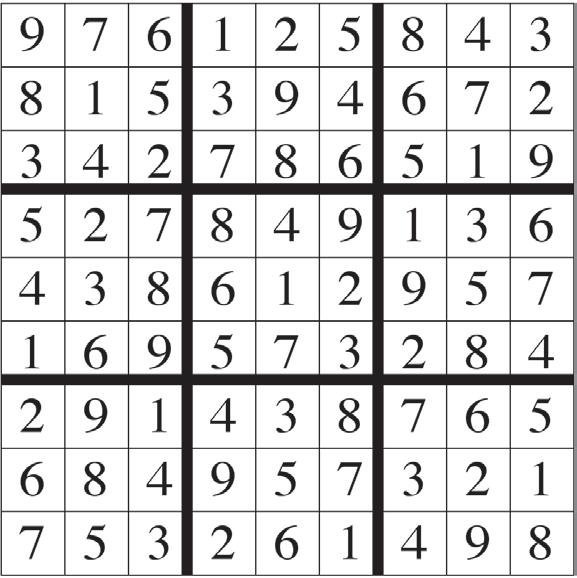
X A M I N E R S U D O K U
DIRECTIONS: Every line, vertical and horizontal, and all nine 9-square boxes must each contain the numbers 1 though 9. Solution on page 14.

DIRECTIONS: Recreate a timeless nugget of wisdom by using the letters in each vertical column to fill the boxes above them. Once any letter is used, cross it out in the lower half of the puzzle. Letters may be used only once. Black squares indicate spaces between words, and words may extend onto a second line. Solution on page 14.
Use the letters provided at bottom to create words to solve the puzzle above. All the listed letters following #1 are the first letters of the various words; the letters following #2 are the second letters of each word, and so on. Try solving words with letter clues or numbers with minimal choices listed. A sample is shown. Solution on page 14.
— Fran Lebowitz

BTHEBESTMEDICINE

acon and eggs walk into a restaurant. The waitress stops them before they can get to a table and says, “Sorry, we don’t serve breakfast here.”
A golf club walks into a bar and orders a beer.
“Sorry, but I can’t serve you,” says the bartender.
“Why not?” asks the annoyed club.
“Because you’ll be driving later,” replies the bartender.
Moe: Yesterday I squirted ketchup into my eyes by accident.
Joe: That couldn’t have felt good.
Moe: True, but now I have Heinz sight.
Joe: What is that?
Moe: 20/57.
Moe: How come you didn’t get lunch?
Joe: I told the lady at the deli, “I want to buy a ham and swiss on toast with pickles.” She said, “Sorry, we only take cash or plastic.”
In a big city office building two men hap-
pened to ride the same elevator from time to time. One was very short, the other very tall.
The short guy hated being short, so one day he asked the tall guy for his secret.
“It’s easy, really,” said the tall guy. “Just rub fat all over your entire body before bed. You’ll be tall in the morning! If you want to be even taller, do it a couple nights in a row.”
“I had no idea it was that simple,” said the short guy. “Thank you very much.”
He followed the tall man’s instructions to the T, but the next morning he was still short. In fact, he got even shorter overnight. He was furious. But that morning he happened to catch the same elevator as the tall man
“What gives with you? I did exactly what you told me to do and look at me! I’m not taller than I was, I’m shorter!”
“That’s impossible,” said the perplexed tall man. “You rubbed fat all over yourself?”
“Yes, Crisco!” said the short man.
“Well no wonder! That’s shortening!”
Moe: My wife told me to put the toilet seat down.
Joe: Why were you even carrying it around in the first place?
Moe: Did you know that alligators can grow up to 15 feet?
Joe: Yes, but most only have four.
Moe: I bought a big balloon elephant to take to the party, but it wouldn’t fit in my car.
Joe: So what did you do?
Moe: I popped the trunk.
Staring at my phone all day has certainly had no Effect on ME!

By popular demand we’re making at-cost subscriptions available for the convenience of our readers. If you live beyond the Aiken-Augusta area, or miss issues between doctor’s appointments — don’t you hate it when that happens? — we’ll command your mail carrier to bring every issue to your house!
NAME ADDRESS CITY STATE ZIP
Choose six months for $24 or one year for $42 . Mail this completed form with payment to Augusta Medical Examiner, PO Box 397, Augusta GA 30903- 0397
Dear Advice Doctor,
The Advice Doctor


Two of my neighbors have had a running battle for years about one little strip of yard between their houses. Fences have been put up and taken down, shrubs and flowers have been planted and dug up, cops have been called. I think one of these days it’s going to escalate to serious violence. What do you think I should do?
Dear Watching,
I have a similar situation in my neighborhood, so I can relate to your concern. There are two gentlemen on my street I would describe as fitness freaks. They are extremely competitive, each one constantly trying to top the other in strength contests, endurance competitions, and just like your neighbors, running battles.
Because so many of us are extremely lacking when it comes to exercise, people generally think that exercise — all exercise — is good. However, people who constantly push themselves to the limit and beyond run several risks, including muscle strains, tendon and ligament tears, and joint issues. Gradual increases are safer and healthier.
It’s not out of the realm of possibility that extreme, highintensity workouts can lead to heart damage and arrhythmias, particularly in individuals who may have underlying heart conditions or genetic risk factors. All the more reason to start exercise programs moderately, and continue to progress moderately, listening to what your body is saying as you go. Overtraining can even lead to a weakened immune system, chronic fatigue, stress fractures and even osteoporosis and bone loss in women in extreme cases.
Another factor to consider in overtraining is mental fatigue and decreased motivation. The resulting burnout will make it that much more difficult to keep exercising.
All of this might sound like it’s anti-exercise. Nothing could be farther from the truth. Exercise is extremely important to good health, and very few of us get enough of it. The key is not avoiding exercise; it’s getting the proper, regular, moderate dose. If you have questions or want suggestions, get help from a physical therapist, personal trainer, or your doctor.
As for running battles, keep this maxim in mind: fitness should be a marathon, not a sprint.
— Watching (and worrying) from the sidelines +
Thanks for writing, and I hope I answered your question.
Do you have a question for The Advice Doctor about health, life, love, personal relationships, career, raising children, or any other important topic? Send it to News@AugustaRx.com. Replies will be provided only in the Examiner.


THE MYSTERY SOLVED
The Mystery Word in our last issue was:
...cleverly hidden in a doctor photo in the p. 16 ad for AIYAN DIABETES CENTER
If that’s your name, congratulations! Send us your mailing address using the email address in the box on page 3. The new Mystery Word is on page 12. Start looking!
The Celebrated MYSTERY WORD CONTEST
...wherein we hide (with fiendish cleverness) a simple word. All you have to do is unscramble the word (found on page 12), then find it concealed within one of our ads. Click in to the contest link at www.AugustaRx.com and enter. If we pick you in our random drawing of correct entries, you’ll score our goodie package!
SEVEN SIMPLE RULES: 1. Unscramble and find the designated word hidden within one of the ads in this issue. 2. Visit the Reader Contests page at www.AugustaRx.com. 3. Tell us what you found and where you found it. 4. If you’re right and you’re the one we pick at random, you win. (Winners within the past six months are ineligible.) 5. Prizes awarded to winners may vary from issue to issue. Limited sizes are available for shirt prize. 6. A photo ID may be required to claim some prizes. 7. Other entrants may win a lesser prize at the sole discretion of the publisher. 8. Deadline to enter is shown on page 12.


PROFESSIONAL D
ACUPUNCTURE
Dr. Eric Sherrell, DACM, LAC Augusta Acupuncture Clinic 4141 Columbia Road 706-888-0707 www.AcuClinicGA.com




Evans Chiropractic Health Center Dr. William M. Rice 108 SRP Drive, Suite A 706-860-4001 www.evanschiro.net

Jason H. Lee, DMD 116 Davis Road Augusta 30907 706-860-4048


Karen L. Carter, MD 1303 D’Antignac St, Suite 2100 Augusta 30901 706-396-0600 www.augustadevelopmentalspecialists.com


www.parkspharmacy.com


