HISTAMINE101
Everyone has heard the word histamine But what is it? What is its role in the body?
Simply put, histamine is a signaling chemical that’s part of our immune system. One reference work describes histamine as “ammonia-like,” and it is a key player in a natural and beneficial response to injuries and invaders.
But if histamine is so beneficial, why are there such things as antihistamines and histamine blockers? We’ll get to that in a minute.
Invaders detected by the immune system are sometimes ignored as harmless and benign. In other cases, a response is launched, one that we might casually refer to as an allergic reaction.
Let’s say the invasion arrived at the end of a bee’s stinger. The skin at the sting site gets red and swollen. It feels hot. It itches. It’s no fun at all.
As unfun as that scenario is, imagine someone escaping from that bee sting by running through bushes they later discover to be covered in poison ivy. The small site of discomfort the bee sting victim has is multiplied by 100 in the poison ivy victim. There are red, swollen, itchy welts all over their arms, legs and torso.
Although their sites of misery are of different size and origin, both people will be plagued for days with the symptoms of allergic reactions. And what is the bringer of all the misery that results from the bee and the poison ivy? It starts with one word: histamine.
When elements of the immune system go on alert because foreign antigens or bacteria
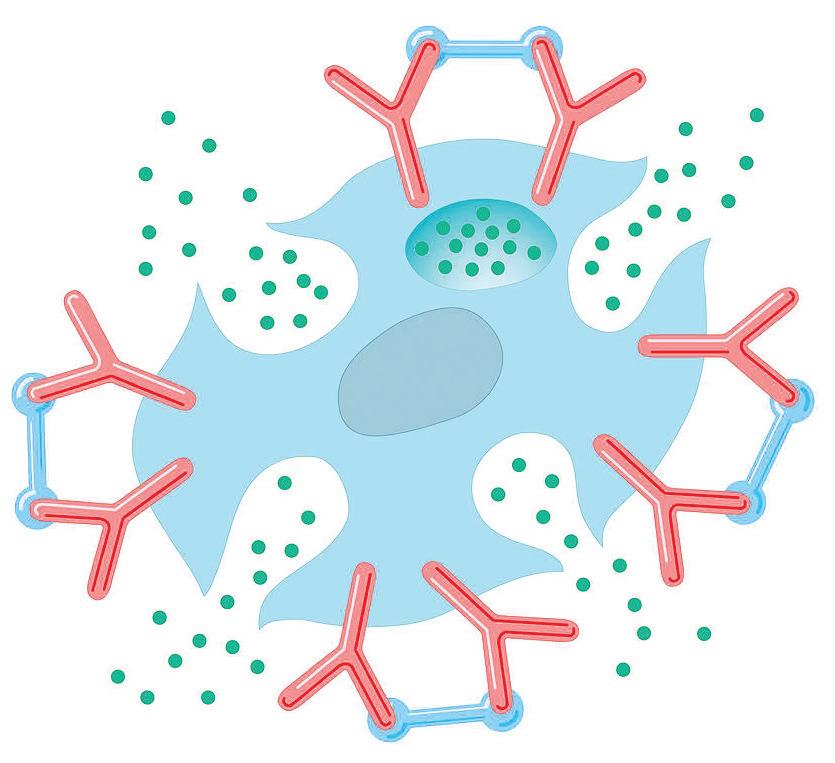
A graphic depiction of a mast cell showing Y-shaped Immunoglobulin E (IgE) antibodies reacting to foreign antigens by releasing histamine granules (green dots).
have been detected, troops aren’t sent out in tanks, or even fire trucks or ambulances. It’s true! Instead, mast cells (discovered by Paul Ehrlich in 1877) are among the troop transports employed. They travel around the bloodstream, bristling with sophisticated detection equipment like IgE antibodies (as shown above). When antigens are detected by IgE, mast cells deploy histamine, trigger ing various chemical reactions which make the work of the immune system easier. For example, vasodilation is one of the primary body reactions when histamine is released. Tiny blood vessels at the site of some invasion — like a bee sting or a poison ivy welt — expand and their walls become more porous, allowing blood to seep out into the problem area. Naturally, that blood
Please see HISTAMINE page 4




SHORTSTORIES
A DOCTOR’S “NOT IN MY JOB DESCRIPTION” MOMENT
We had a patient who had undergone surgery and needed to be admitted overnight. He adamantly refused admission because he lived alone and had brought his dog with him to the hospital. The dog was in his car in the parking lot. The man really needed to be observed overnight, so he agreed to let me take the dog home with me that night and bed him down in our barn, which was enclosed in a paddock in the backyard.
Since I had to work late, I called my husband, described the car and the dog and asked him to come to the hospital to pick up the dog, which he reluctantly did. On arriving home after midnight, I was greeted at my bedroom door by the patient’s Golden Retriever along with my own 3 dogs.
“Honey, what happened to him staying in the barn?”
“He didn’t like it.”
“What do you mean?” I said. “His owner assured me that the dog would be very happy in the barn.”
“I think he wanted an upgrade. Every time I left him in the barn he jumped the paddock fence and beat me to our back door, where he politely waited for me to let him in, so I did.”
The next morning when we discharged the patient my husband brought the dog back to the car in the parking lot. I never saw the patient or the dog again.
+

Be sure to see Part II of the rotator cuff story that led off our last issue. See page 3


HEALTH • MEDICINE • WELLNESS • HEALTH • MEDICINE • WELLNESS • HEALTH • MEDICINE • WELLNESS • HEALTH • MEDICINE • WELLNESS • HEALTH • MEDICINE • WELLNESS • HEALTH • MEDICINE • WELLNESS • HEALTH • MEDICINE • WELLNESS • HEALTH • MEDICINE • WELLNESS • HEALTH • MEDICINE • WELLNESS AUGUSTARX.COM AIKEN-AUGUSTA’S MOST SALUBRIOUS NEWSPAPER • FOUNDED IN 2006 TMMEDICALEXAMINER MAY 3, 2024 FREETAKE-HOMECOPY! BODY PARTS: THE OCCASIONAL SERIES
4158 WASHINGTON RD (ACROSS FROM CLUB CAR) • (706) 364.1163 • SCRUBSOFEVANS.COM WE DO HOUSE CALLS! OFFICE SCAN NOW TO UPGRADE THE PROFESSIONAL IMAGE OF YOUR STAFF AND PRACTICE!
PARENTHOOD
by Dr. Warren Umansky, PhD
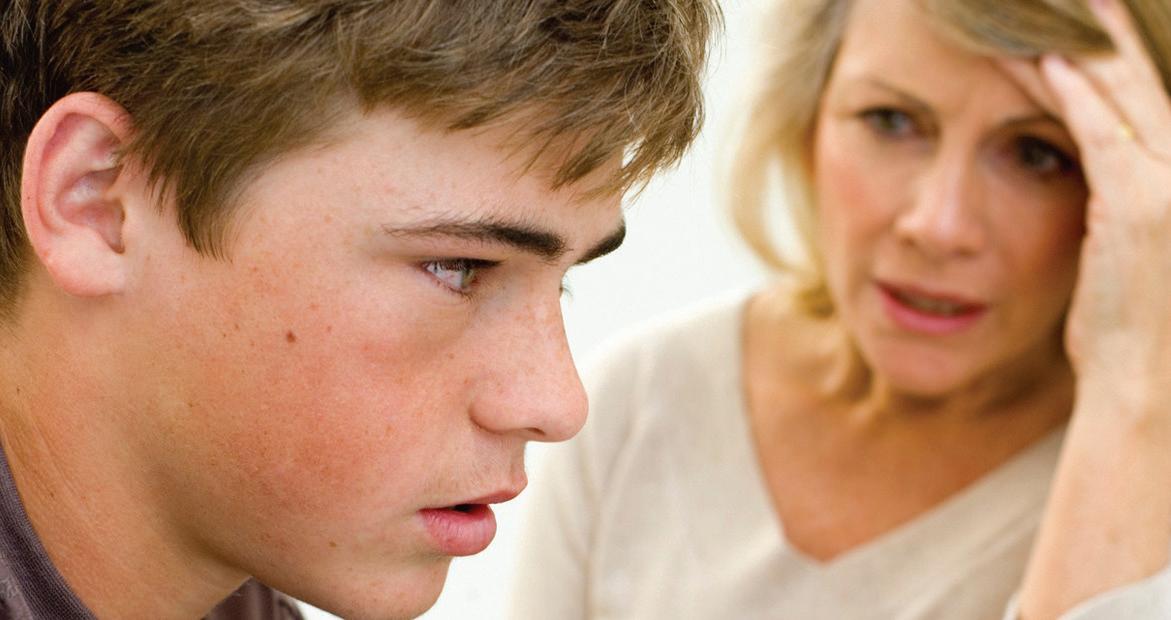
Your child is overweight. She tells you she gets bullied about it at school and your in-laws have commented about it. She is a homebody who doesn’t like to get off the sofa and prefers TV and videogaming to going outdoors to play. She is not involved in extracurricular activities. Her school grades are satisfactory but she never seems very happy. What should you do?
A. Remind her every day about her weight and how she needs to take better care of herself.
B. Change your shopping practices and start serving healthier foods for meals; replace calorie-loaded unhealthy snacks with only healthy ones.
C. Stop her use of electronics, at least during the school week: no gaming, no YouTube videos, no social media, and TV only as a family activity.
D. Take walks together regularly before or after dinner. During these walks, talk about activities she might like to get involved in (e.g., school chorus, individual or group sports, music lessons, acting in school plays, etc).
If you answered:
A. There is no evidence that this approach has a positive effect on lifestyle practices. Being a good role model for your child is a better approach than lecturing and sermonizing.
B. This can be a subtle and very effective approach for controlling weight, especially when low or no calorie drinks also are substituted for soda and other sweetened drinks.
C. This is an amazingly effective change that will encourage her to find alternatives to sedentary screen time, although there may be a few days of complaining about being bored. Offer a list of chores, hobbies, and outdoor activities that will help burn calories and distract her from snacking.
D. This, too, is a great choice. Doing exercise together is wonderful for maintaining good health and building greater closeness among family members.
There is an epidemic of obesity in our country. Being overweight can lead to many serious health and social problems. Good health habits are learned in childhood. Parents are role models for their children. Adopting three of the above choices as part of family life sends a good message to your children and starts them on a healthy path.
+
Dr. Umansky has a child behavioral health practice in Augusta.

WAIT AT LEAST AN HOUR
Our parents told us, and their parents told them: wait at least an hour after eating before jumping in the pool, and especially before jumping in a lake, pond, or river.
The alleged reason? The process of digestion diverts so much blood to its purposes that a post-prandial (after-lunch or -dinner) swim could result in cramps. According to the theory, swimming and its need for oxygen delivery and blood flow to the extremities could interfere with digestion and result in abdominal cramps. Another version held that because of digestion and its great need for blood, a swimmer’s arms and legs could be crippled by a lack of blood flow and oxygen supply, and as a result a swimmer would flail helplessly until sinking below the surface.
Such a dire event would be bad enough in a swimming pool, but would be infinitely worse in a deep lake or pond, or in the swift current of a river.
There’s only one problem
with all of this precautionary advice, and it’s a good problem: the whole thing is a myth.
The myth investigators at snopes.com say “There has not been one drowning death attributed to swimming within one hour of eating.”
Then where did this nearly universal belief arise?
Medical detectives have traced its first occurrence to a 1908 edition of the Boy Scout Handbook. Its advice was to wait at least 90 minutes after
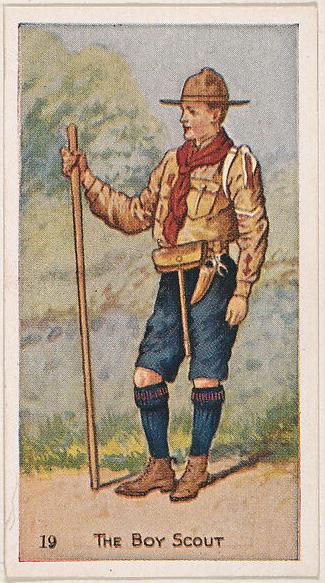
eating or run the risk of drowning, which would be, in the words of the Handbook “your own fault.”
It has stuck around for more than a century despite research dating back to at least the 1960s which found no drowning risk connected to eating before swimming.
The belief is persistent enough that in 2011 the American Red Cross Scientific Advisory Committee surveyed scholarly literature for evidence of any connection to drownings or near drownings. The findings were published in the International Journal of Aquatic Research and Education along with this summary:
“No major medical or safety organizations make any current recommendations to wait before swimming after eating. No reported cases of eating before swimming causing or contributing to fatal or non-fatal drowning are reported in any of the literature searched. Currently available information suggests that eating before swimming is not a contributing risk for drowning and can be dismissed as a myth.”
If someone wants to be concerned about the consumption of food and drink prior to swimming, make that concern about alcohol.
According to the Centers for Disease Control, alcohol plays a role in as many as 70 percent of all deaths related to water recreation.
Other valid precautions: not diving into unfamiliar waters that may have obstructions, and which may not be as deep as swimmers think; also, not swimming alone.



AUGUSTAMEDICALEXAMiNER MAY 3, 2024 2 + LIKE THE MEDICAL EXAMINER ON FACEBOOK! CATCH THE C&C AUTOMOTIVE SHOW SATURDAY MORNINGS FROM 8-10 ON 580 AM OR 95.1 FM • Customer shuttle • 6 months same-as-cash financing • 3-year/36,000 mile warranty • ASE Certified technicians • 24-hour towing & key drop • www.ccautomotive.com WARRENVILLE WARRENVILLE 2355 Jefferson Davis Hwy 803-593-8473 DOWNTOWN DOWNTOWN 990 Telfair St 706-724-0900 W. AUGUSTA W. AUGUSTA 3954 Wrightsboro Rd 706-863-9318 MARTINEZ MARTINEZ 4014 Washington Rd 762-685-5555 COLUMBIA COLUMBIA 4031 Broad River Rd 803-590-8606 AIKEN AIKEN 536 East Pine Log Rd 803-649-1341 NOW IN THOMSON! 1213 Washington Road (706) 986-5427 OUR NEWEST LOCATION! Courtesy Shuttle Financing Options 24-Hr Towing Available 24-Hr Key Drop-Off Rental Cars Available & & & & WHENEVER YOU HEAR AUTO CORRECT THINK OF US. NO APPOINTMENT NEEDED!
THE FIRST 40 YEARS ARE ALWAYS THE HARDEST nioJ eht snet fo seinapmoc ohw ydaerla troppus !su Less than a million people can’t be wrong. Adver t ise here Adver t ise here Call 706.860.5455 + + + MEDICAL
MYTHOLOGY
FACEBOOK.COM/AUGUSTARX.COM
EVERYONE HAS A STORY
IMy rotator cuff story
would be seriously delinquent in my duties as a journalist if I did not follow up on the sad tale I wrote for the previous issue of the Medical Examiner
To recap, that installment of “Everyone Has a Story” recounted the misery I experienced during my first night after having rotator cuff surgery. It wasn’t just the pain; it was also the complete and total inability to find a comfortable sleeping position in bed or on the couch or in the nearest La-Z-Boy during the longest night of all time. Seconds turned into minutes; minutes became hours; hours felt like days; days became... well, you get the idea.
Since I focused exclusively on that first night post-op, I didn’t get to share any good news. Nor did I mention a bizarre phenomenon I experienced, one that I also endured some 20 years ago.
I refer to the strange habit people have of learning your diagnosis and then sharing their worst possible stories about that condition.
“I had rotator cuff surgery and I couldn’t use my arm for 6 months.” Or, “I had that operation. Never again!” Or, “That’s the most painful operation there is.” Or, “My shoulder is worse than it was before the surgery.”
Thank you all so much for sharing your kind words of encouragement.
Unfortunately, I’ve been down this road before, the aforementioned 20 years ago. In 2003 I was diagnosed with prostate cancer, and then in 2006 with colon cancer.
Sometimes my diagnoses would randomly come up in conversation, but then as now I wrote about them in this newspaper, so my medical situations were well known.
The stories I was told make me shudder to this day. One I vividly recall came from a person I encountered walking down Broad Street. I knew this guy, so we stopped to talk for a minute and he brought up my colon cancer, which he had found out about by reading the Examiner. I had just found out myself, actually. It was brand-new and terrifying territory for me.
“Oh Dan,” he said sadly and with great feeling. “My father had colon cancer and...” At this point he paused at the awful memories before continuing. “Dan, the rectal bleeding for the last months of his life...”
As you can imagine, that was just what I wanted to hear. Do you think that bleeding comment was bad? He wasn’t done, not by a long shot. He shook his head as he added more dreadful and gross descriptions of his father’s demise. I will spare you the details.
You’re welcome.

Here’s a question: Why do people do this? Why do some people feel compelled to share stories that are frightening and discouraging with the very people who would be most frightened and most discouraged by their stories?
Here is an even better question: Why did I do that in my previous article? Answer: Maybe I was still affected by oxycodone?
Here’s a suggestion. Let’s say we or someone we know had a horrible experience with cancer of some kind. And we find ourselves talking with someone who has been diagnosed with that same cancer. Why not say something like, “Doctors have made so much progress in treating cancer. I wish you the very best.”
Or maybe we meet someone whose arm is in a sling because they’re recovering from rotator cuff surgery. Maybe we only know rotator cuff horror stories, but what good can come from sharing those with somebody after they’ve already had the procedure? Instead, let’s try “I hope you’ll be the best patient possible. Be sure to do all your physical therapy exercises.”
As for my personal rotator cuff experience, my apologies for any negative outcome misconceptions my previous article created. I am doing great. My range of motion is approaching normal, way ahead of what I expected. Pain is virtually non-existent unless I move my arm in some way that it isn’t quite ready for yet. But I can move pain-free today in ways that weren’t possible even a week ago. There is noticeable improvement every day.
Is my good experience when others have terrible tales thanks to my excellent surgeon, Brian Abell of Legend Orthopedics? Is it because of Hayden Liggett, my outstanding physical therapist at Peak Rehabilitation? Do I get the credit because I’m an obedient and compliant patient and a faithful exerciser? Or is it just because my rotator cuff wasn’t torn as badly as some others?
I have no idea. Maybe it’s a combination of those factors. But if you have some medical procedure coming up and somebody says, “Oh, I had that and...” you should say, “Let me stop you right there — unless it’s a good story.”
Maybe my last article should have started with “Got rotator cuff issues? Don’t read this.” My apologies. I’ll try to do better next time
— by Dan Pearson Medical Examiner publisher


WHY IS THE HPV VACCINE CONTROVERSIAL?
As time goes by, the vaccine is less and less controversial, but it does have a history.
HPV is short for human papillomavirus, which the Centers for Disease Control (CDC) says is the most common sexually transmitted infection in the US and in fact, the world. Some 79 million cases were estimated in the US in 2018 according to a University of Michigan study, with 14 million new cases annually according to CDC research. Only humans are known to be affected by HPV, and the vast majority of the cases are found among people in their teens and early 20s.
One of the most significant concerns about HPV is its connection to cancer. To take cervical cancer as one example, each year in the US, nearly 200,000 women are diagnosed with cervical precancer. Of the cases which progress into full cervical cancer, 9 out of every 10 are caused by HPV. Cervical cancer is just one of a number of cancers linked to HPV.
The good news is that the HPV vaccine prevents more than 90 percent of the cancers in men and women that are caused by HPV. Cervical cancer, once one of the leading causes of cancer deaths among women, has now become one of the most preventable, thanks to the HPV vaccine, which is most effective when given by around age 12.
Sounds like a slam dunk no-brainer, right? Then why is controversy sometimes associated with the vaccine?
Since HPV is transmitted through sexual contact, some parents consider the vaccine to be an implied green light for their teens to engage in sexual activity. Others believe their kids to be of sufficient moral character that the vaccine is unnecessary.
In the real world, teens will be teens — at least many of them will be. Studies have compared U.S. states with legislation promoting the HPV vaccine with states that don’t. Teens living in the states which promoted the vaccine were not having more sex than teens in the other states, researchers have found. +

AIKEN-AUGUSTA’S MOST SALUBRIOUS NEWSPAPER
www.AugustaRx.com
The Medical Examiner’s mission: to provide information on topics of health and wellness of interest to general readers, to offer information to assist readers in wisely choosing their healthcare providers, and to serve as a central source of salubrious news within every part of the Augusta medical community.
Direct editorial and advertising inquiries to: Daniel R. Pearson, Publisher & Editor E-mail: Dan@AugustaRx.com
AUGUSTA MEDiCAL EXAMINER P.O. Box 397, Augusta, GA 30903-0397 (706) 860-5455
www.AugustaRx.com • E-mail: Dan@AugustaRX.com
www.Facebook.com/AugustaRX
AUGUSTAMEDICALEXAMiNER 3 MAY 3, 2024 + + Opinions expressed by the writers herein are their own and/or their respective institutions. Neither the Augusta Medical Examiner, Pearson Graphic 365 Inc., nor its agents or employees take any responsibility for the accuracy of submitted information, which is presented for general informational purposes only. For specific medical advice, diagnosis, and treatment, consult your doctor. The appearance of advertisements in this publication does not constitute an endorsement of the products or services advertised. © 2024 PEARSON GRAPHIC 365 INC.
TMMEDICALEXAMINER
SUBSCRIBE TO THE ONLINE EDITION! IT’S FREE! Just go to www.issuu.com/medicalexaminer and enter your email address.
Who is this?
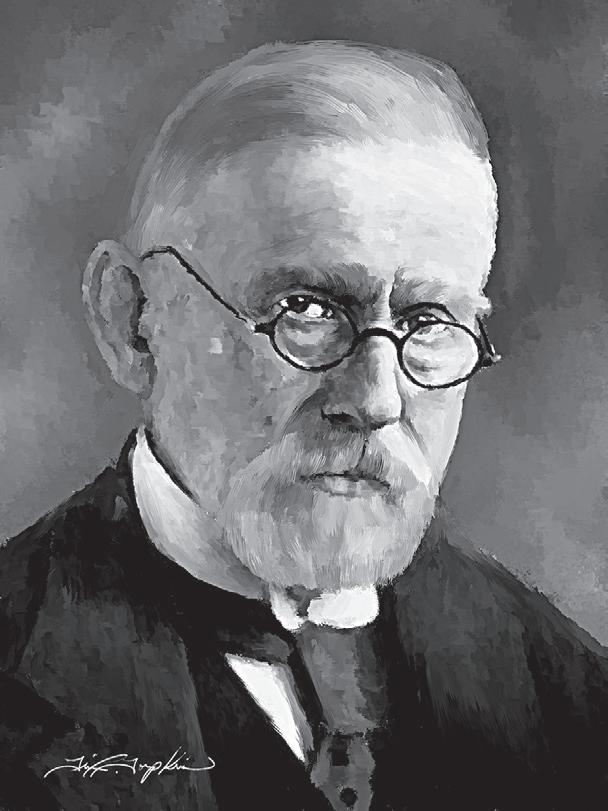
For t he first time in the 211-installment history of “Who is this?” we’re going for a do-over. The subject of our dual profile is the genius depicted above, Paul Ehrlich. If you’d like to check your family Medical Examiner scrapbook for our earlier version, look in the June 5, 2015 issue. And don’t blink. It was pretty brief. Then again, it was installment #2 of this series, so we were still figuring out the format we would eventually settle in to.
So let’s try again.
To recap, that first profile mentioned that Dr. Ehrlich invented chemotherapy, both the word and the concept. The idea arose from the simple process of staining cells. Looking at razor thin slices of tissue under a microscope might seem simple enough, but it isn’t easy to distinguish this pinkish area from that pinkish area. Early on, people like Ehrlich discovered that certain cells absorbed various dyes and stains, while others were resistent. It raised a question: what if cancer-killing drugs could be created which would be absorbed only by cancerous cells? It would be like, to use another term coined by Ehrlich, a “magic bullet.” Imagine such a thing: a bullet that would kill the bad guys and leave the good guys unharmed. Of course, today we don’t have to imagine. Chemotherapy is a reality that has prolonged and saved countless lives.
In addition to improving the ability to fight cancer, the methods he developed for staining tissue made it possible to distinguish between different types of blood cells. That, in turn, led to the ability to diagnose numerous blood diseases.
As epic as his findings in hematology and chemotherapy would seem to be, Ehrlich is best known for his discoveries in the field of immunology. He discovered elements of the immune system that many people have never heard of to this day: mast cells, basophils, eosinophils and neutrophils. In the 1800s! No wonder he is known as “the father of immunlogy, and it’s little wonder that he was awarded the Nobel Prize in Medicine in 1908 for his work in immunology.
But that’s not all. He discovered a cure for syphilis, advanced the cause of treating eye diseases and typhoid, and developed an effective method for combating diphtheria. Ehrlich and a colleague were also the discoverers of a radical concept called the receptor theory. Their hypothesis, which is tied to Ehrlich’s discovery of mast cells and other immunological breakthroughs, was that receptors on cells explained the selectivity of the immune response. Various receptors were calibrated to respond only to certain antigens while ignoring others. That working theory was confirmed by further research decades later, but its application went far beyond explaining why the immune system’s responses were selective; it also paved the way, as with chemotherapy, to administer drugs which would attach themselves only to the receptors of certain targeted cells — cancer cells, for instance
Born in what is now Poland in 1854, Ehrlich died in Germany in 1915 at age 61, three days after suffering a heart attack. +
HISTAMINE from page 1
contains all kinds of infection-fighting components, including white blood cells called neutrophils that immediately start to gobble up foreign antigens, bacteria, and anything else that is where it doesn’t belong. They can be followed by macrophages, larger cells that devour bacteria, dead neutrophils, and any other debris they can locate in the vicinity.
It all sounds like the job of the immune system is being handled very capably and efficiently, getting rid of the irritants that are causing the redness, swelling, and itching.
But while that job is being done, the immune system itself is causing redness, swelling, and itching too.
The histamine influx at the site of the battle has enabled the capillaries to become larger and more permeable so they can deliver first aid supplies. That itself causes swelling. It can make the site feel tender, and all that cellular activity generates heat. The bee sting area feels hot.
The very same histamine effect that thins the walls of blood vessels to deliberately make them leakier also thins nasal membranes and results in runny noses (and sneezes), and does the same thing to the eyes, making them red and watery.
In short, histamine is a bit like a doctor whose treatment of a patient’s pain causes pain of its own. We’ve all been there. It’s just the usually unavoidable price of getting better. We welcome some temporary pain as a means of ending chronic pain.
That is similar to dealing with the discomfort caused by the release of histamine. We don’t want to deal with the effects of histamines any longer than necessary, and they can be quite numerous.
There are four types of histamine receptors, dubbed: H1, H2, H3, and H4, each grabbing released histamine for specific

purposes. H1 receptors are linked to allergic responses, H2 to gastric acid regulation, H3 to neurotransmitter release modulation, and H4 to general immune system function. They are dispersed and utilized depending upon where the perceived problem is.
When a number of issues are all happening at once — say we have a bad cold already, then we get stung by a bee and get poison ivy on top of that — it can be a bit much to take. The immune system can go overboard, like it doesn’t know when to quit.
Pet owners may be able to relate to this analogy: their dog goes crazy when there’s a prowler in the yard at 3 in the morning, but it does the same thing when the UPS man approaches at 3 in the afternoon, or when grandma comes to visit.
When that same overboard reaction happens with immune response, people reach for antihistamines.
As the name suggests, they counteract the effect of histamines, or even block the ability of histamine to bind to receptors.
Antihistamines are classed according to their length of time on the market. So-called first-generation antihistamines worked well, but usually caused drowsiness, limiting their usefulness. Examples of this class include Benadryl, still available because sometimes the drowsy effect is exactly what the patient wants in the mix.
Second-generation antihistamines are as effective as their first-gen predecessors, but don’t result in daytime drowsiness. Examples of these newer antihistamines include such products as Claritin, Zyrtec, and Xyzal.
In summary, we wouldn’t want to be without histamines and the work they do to help enable the various protective activities of the immune system.
But we don’t always enjoy the experience

AUGUSTAMEDICALEXAMiNER MAY 3, 2024 4 + +
#211 IN A SERIES 3835 WASHINGTON RD • COMPUTEREXCHANGE.COM • 706-651-1900 WE RECYCLE SALES • INSTALLATION • SERVICE We service all PCs and laptops. Including Apple. COMPUSERVE ISN’T COMING BACK. But is your CompuServe-era computer * still in your garage or attic? * plus other gaming and electronics gear IT’S A FREE SERVICE, AND YOUR DATA IS ALWAYS SECURE (EITHER DESTROYED/ERASED, OR YOUR DRIVE RETURNED TO YOU)
To advertise in this paper, call 706.860.5455 today! To advertise in this paper, call 706.860.5455 today!
Middle Age
BY J.B. COLLUM
In our previous visit I wrote about preserving wealth to preserve health. Today, I risk being called a hypocrite for spending a lot of money just a couple of weeks later, but bear with me. I have a good excuse. I mean, a good and logical reason for spending the money. Let me explain.
Almost six years ago, we needed a new lawn mower. My wife, Lorie, and I had very different ideas about what to get. I wanted a beastly garden tractor with lots of horsepower (insert manly grunting noises here) and the ability to add tractor attachments. She wanted something easier to drive and fit in and around the obstacles in our yard. We had just moved and had a few acres of grass to cut instead of the fraction of an acre at our previous home, so we needed both a large cutting diameter and the ability to cut around trees, bushes and other obstructions. Based on that, my practical wife wanted a zero-turn mower. Why should she care, you ask? Well, I have been known to be a procrastinator and our marital dynamic is that she will remind me a couple of times, at most, and then do it herself. For most things anyway. So more often than not, by the time I think about cutting the grass, she has already done it, or the sound of her cutting the grass just outside my office window at the start of my one scheduled daily meeting reminds me that I forgot to cut the grass, and of the fact that she knows how to pay me back in her own subtle way, though she will never complain about it directly and she is the world’s best at acting innocent. In addition to her knowing that she most likely will be the one cutting the grass, she wanted something that she wouldn’t struggle with. However, much to my later regret, I saw a so-called good deal on a slightly used, huge garden tractor that came with a plow, chains for the rear wheels, and weights for the wheels to help with using the plow. I didn’t need a plow then. I still don‘t, but the idea of it was cool, and I believe that just thinking about tractors and their implements tends to raise my level of testosterone.
Of course, with my obsessive personality, it didn’t matter that I already owned a compact tractor with a loader, backhoe, and several other attachments. No, I wanted more! If one tractor was good, then two was better, right? She wasn’t exactly thrilled with my choice, but the price was right and it made me happy at the time.
It was trouble from the start. The front wheels were toed out a little and they got worse. It was also large, heavy, hard to steer, and beat you up while you rode it. I also should have been worried by the low price and the desperation of the seller. It was late in the day when I called him about it those six years ago and he didn’t want to wait until

the next day. Since it was almost dark and he had an hour drive to get to my house, I said we could just wait. But then, about an hour later, he showed up at my house. In the dark. He got it running, and based on that and seeing it with a flashlight, I bought it. Never buy anything like this in the dark. I missed some issues I likely would have seen in the light of day. I’ve repaired it a couple of times and we had to take it to a shop to be repaired another time. As this summer approached, we knew we had to do something, and I planned on getting around to fixing it eventually. Yes, you know what that means with me, and so does my better half. Yesterday finally tipped the scales though.
When I got home, Lorie had cut part of the yard and was utterly exhausted because she had used the battery-powered push mower and the weed-eater. She sat me down and said, “I want something. Something big, and I want you to hear me out before you say anything.” At this point, the hairs on my back were standing straight up, and the credit cards in my wallet started getting uncomfortably hot in my pocket. At first, I couldn’t imagine what she might say next. Then, 37 years of being married to her kicked in along with some deductive logic that even Sherlock Holmes would be proud of. Here were my clues:
• She was tired.
• She had cut the grass that day.
• She never liked the lawn mower I bought.
• She never asks for expensive things that aren’t practical.
• Our current mower needed repairs.
• Did I mention she hated our mower?
• She gets tired much quicker now than even a couple of years ago. It’s age, but don’t tell her I said that.
Based on all that, I figured she was going to ask to get a zero-turn mower. My immediate concern then was that we wouldn’t agree on the budget for it. I tend to buy as nice an item as I can possibly afford or maybe just a little bit more. Okay, okay. A lot more. She tends to go a half-step down from the budget. This time though, she had done her research and shared it with me. After a review of the evidence, we headed to Lowe’s to see the three models she had narrowed it down to and we ended up buying the best of the three. It was more than I’ve ever spent on a lawn mower, but after using it this morning to cut the grass in the large field next to the road on our property, I am convinced it was well worth it. Not just me though. Lorie, our daughter Kate, and I took turns using it and each of us had to beg the person on it to give it up every trade. The grass got cut in record time. We weren’t as sore or tired as usual and probably will


AUGUSTAMEDICALEXAMiNER MAY 3, 2024 5 Please see MIDDLE AGE page 6 +
ADVENTURES IN
E=mc2 Examiner = medical communication 2 { { NEVER
NEXTISSUEMAY17 MEDICALEXAMINER ALL THE COOL KIDS READ IT THAT INCLUDES YOU!
BUY SOMETHING LIKE THIS IN THE DARK
SHORTSTORIES
TURNS OUT DOCTORS AND NURSES AREN’T PERFECT! WHO KNEW?
My story isn’t near as bad as some I’ve heard, but it still almost killed me. I was having horrible lower abdominal cramps that felt like a period but 100 times worse” This was after the pandemic had started and hospitals were sometimes being less than caring and welcoming places. I went to Kaiser in Modesto, CA, and had to sit outside the ER for almost half an hour. At that point, I was in so much pain, I could not stand up. I was on my hands and knees on the concrete outside the ER, and at no point did the nurse who signed me in offer me a wheelchair or take me seriously enough to bring me inside. Fast forward and I was finally brought in and they did a pelvic exam.
It is true that I kinda led them in the direction of a gyno issue by describing my pain as “like a period,” but as an EMT myself I knew that you can’t let your point of view narrow when given red-herring information. Their pelvic exam found nothing. So another pelvic exam was done. And another. Then they did an intravaginal ultrasound to check on my ovaries and rule out ovarian torsion.
Nothing was found.
I had been in the ER for about five hours at that point and was in so much pain that they had to give me morphine to take the edge off. It was at that point I had a male doctor come in and mansplain my menstrual cycle to me. At the time, I was 22, an EMT, and was in my 4th year pursuing a BS with an emphasis in Biology with a dream of becoming a PA.
So… I knew what my menstrual cycle was, and I was more than aware of the severity of my cramps. This male doctor told me it was just my “menses” and that I could be discharged and to just take ibuprofen.
No sir. I refused to leave until I was given a CT scan of my abdominal cavity.
About 15 minutes after my CT, a female surgeon came in and told me I had an absolutely massive appendix and she was shocked that it hadn’t burst already. She was about to start a cardiac surgery in a few minutes, but I was next in line in her OR.
My scar is about twice as long as most patients who have arthroscopic appendectomies. She said she hadn’t seen an appendix that large before, and that surely it would have burst at any second. But the male ER doc tried to send me home with ibuprofen and mansplain my period to me.
He could have killed me with his ignorance.

have less of a sunburn as well.
I know that I urged being frugal before, but this episode in our lives helped remind me that how we decide to care for our health and wealth isn’t as black and white as it may seem. As we age, at times we may need to spend a little more on things that make our lives a little easier, or allow us to get things done more quickly and in more comfort. It also can help your marriage in cases like mine this week.
In the next issue I’ll talk about the related issue of how spending some money on experiences versus material things can also enhance our lives during middle age. I’ll even tell you what I recently did in this regard. Here’s a clue: It involves spending exponentially more money for a concert than I ever have, but I am sure it will be worth it and you likely will too when I tell you all about it.

Until then, take care of yourselves and each other.
J.B. Collum is a local novelist, humorist and columnist who wants to be Mark Twain when he grows up. He may be reached at johnbcollum@ gmail.com

AUGUSTAMEDICALEXAMiNER MAY 3, 2024 6 + MIDDLE AGE from page 5 + Augusta Office: 2283 Wrightsboro Rd Augusta, GA 706.733.3373 Aiken Office: 2110 Woodside Executive Ct Aiken, SC 803.644.8900 GADERM.COM
+
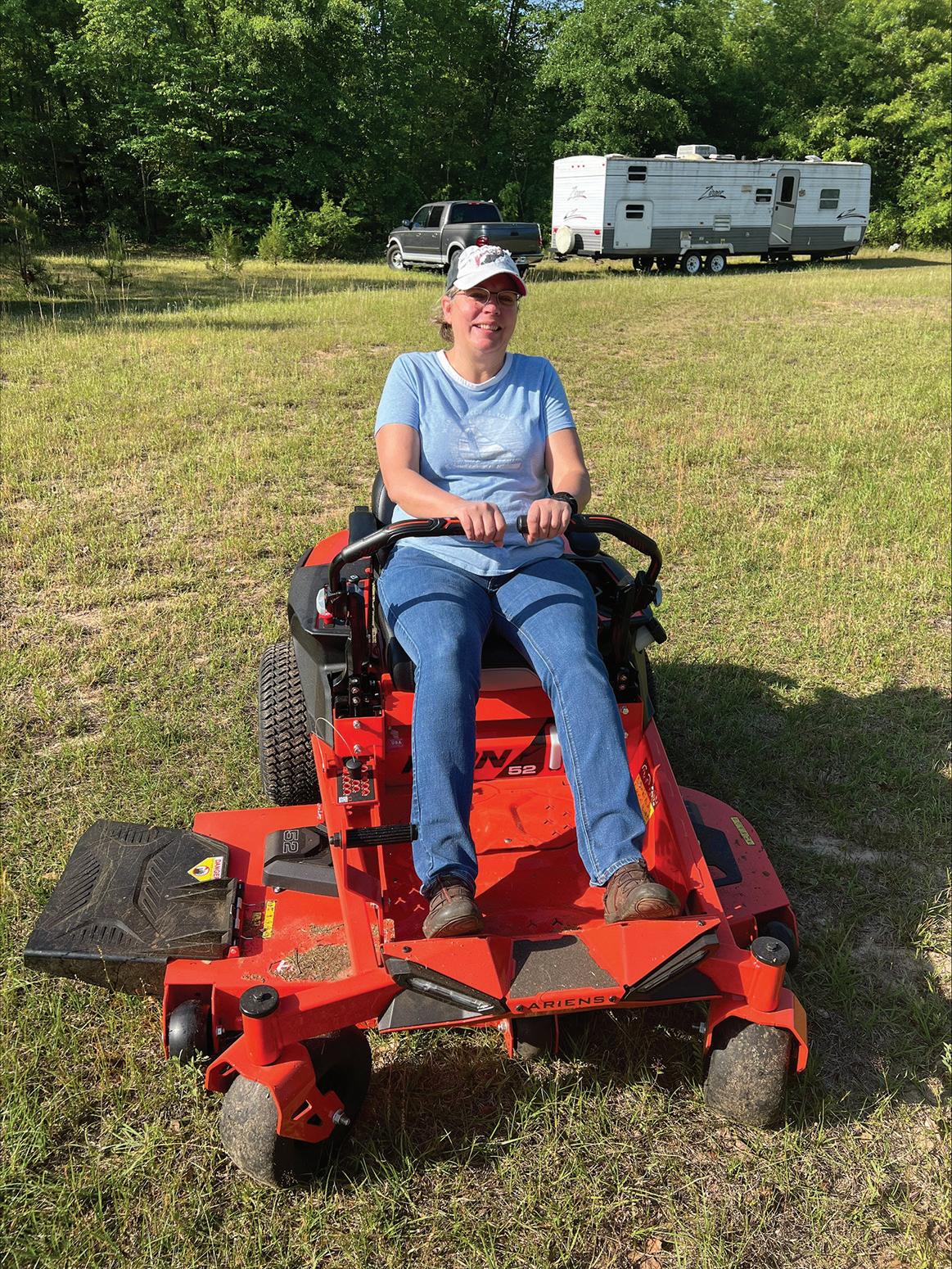
Lorie staking her claim to my newest toy. I mean vital tool.
Our advertisers make this free newspaper possible. FREE! Please thank them with your business and patronage

TRYTHISDISH
by Kim Beavers, MS, RDN, CDCES Registered Dietitian Nutritionist, Chef Coach, Author
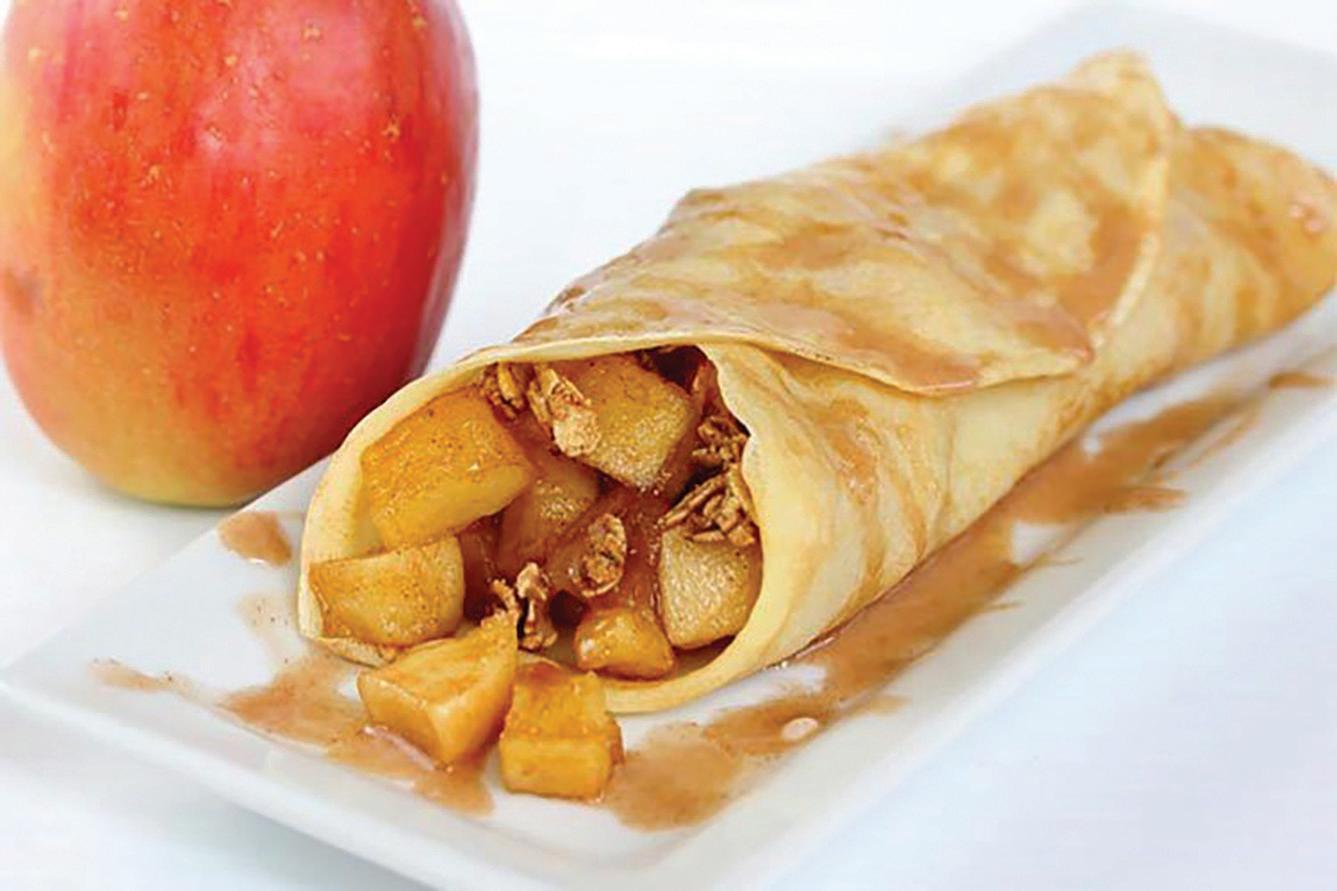
The perfect treat when dessert is desired. This is full of apples, and lends the perfect end to any meal.
Ingredients
• 1 tablespoons butter
• 1 cup apple juice; divided
• 1/4 cup brown sugar
• 4 apples, sliced and chopped
• 1-½ teaspoon cinnamon
• 1 tablespoon corn starch
• 4 pre-made crepes, such as Melissa’s crepes
Directions
Melt the butter in a saucepan over medium heat. Next, add 1/2 cup apple juice, brown sugar, apples and cinnamon; stir until well combined. Cook over medium heat for 10 minutes or until the apples are softened; stir often.
Combine the cornstarch and the remaining apple juice and then stir into the apple filling. Cook, while
stirring, for 1-2 minutes. Set aside to cool.
Assembly suggestion: Lay a crepe out flat. Spoon about ¾ cup of filling onto the bottom one-third of the crepe, from edge to edge, and then roll it up.
Cut the rolled crepe in half and serve
Yield: 4 servings (serving size: 1 crepe)
Nutrition Breakdown: Cal-
ories 230 , Fat 4g (0.5g saturated), Cholesterol 15mg, Sodium 80mg, Carbohydrate 49g, Fiber 4g, Protein 1g, Potassium 160mg, Phosphorous 17mg.
Percent Daily Value: 4 Vitamin A, 15% Vitamin C, 2% Iron, 0% Calcium
Carbohydrate Choice: 3 Carbohydrates
Diabetes Exchange Values: 1 Fruit, 1 Starch, 1 Other Carbohydrate, 1 Fat








AUGUSTAMEDICALEXAMiNER MAY 3, 2024 7 + TMMEDICALEXAMINER ASAP! ASAP! READ THE *AS SALUBRIOUSLY AS POSSIBLE * 461 Greene Street at 5th • www.gregleopardlaw.com • 706-724-7511 GREG LEOPARD PC ATTORNEY AT LAW CRIMINAL DEFENSE • FAMILY LAW • PERSONAL INJURY He just looks friendly. Your fierce defender Events by Deborah, LTD Complete, affordahle, local weddings, beautiful settings $100 Rev. Deborah Page PO Box 1961• Augusta GA 30901 (762) 383-2981 GA Business License #23118854 • Established 2013 IF YOU CAN READ THIS please thank MEDICALEXAMiNER advertisers + PLEASE SUPPORT THEM. THEY MAKE THIS NEWSPAPER POSSIBLE. OVERHEAD DOOR COMPANY OF AUGUSTA/AIKEN (706) 736-8478 / (803) 642-7269 WWW.OHDAUGUSTA.COM TM These businesses all started in a GARAGE Garages matter. Make yours an Overhead garage. +
APPLE PIE CREPES LIFE IS COMPLICATED Death doesn’t have to be. Caskets & More 706) 738-2999 • WWW.CANDMAUGUSTA.COM OUR NEW ADDRESS 4212 WHEELER RD • BLDG D, UNIT 1• MARTINEZ
Follow Kim on Facebook: facebook.com/eatingwellwithkimb
ASK DR. KARP

NO NONSENSE
NUTRITION
Joanie, a Facebook friend from Baton Rouge, Louisiana, asks:
“Would you share a list of fruits and vegetables that require washing? I routinely wash lettuce and other veggies, but many of my friends and family tell me it is unnecessary. Does washing make produce safer?”
Thanks for the question, Joanie. Ignore the advice from your friends and relatives. Washing fruits and veggies is a pretty smart idea. Bacterial surface contamination of fruits and veggies can lead to food poisoning. Also, washing reduces the amount of pesticides that may be present on fruits and veggies, even organic ones. The importance of washing fruits and veggies to reduce pesticide levels varies with the specific fruit or vegetable.
Let’s address the food poisoning issue, first. The two main bacteria implicated in most food poisoning cases are salmonella and listeria. The best way of getting rid of bacteria on produce is to cook the food. Cooking does several things. It not only destroys bacteria, but it also makes the food more digestible and nutrients more bioavailable by breaking down plant cell walls and starch granules. This releases the nutrients. There is the notion “out there” that raw food is healthier than cooked food. Not necessarily.
Cooking veggies is a sure way of getting rid of contaminating bacteria. However, cooking veggies in water for lengthy periods of time can leech out specific nutrients, such as water-soluble vitamins. I often, tongue-in-cheek, have this advice for Southerners who prepare veggies in the traditional way by “boiling them to death.” Drink the cooking liquid and throw out the veggies! Instead of boiling, you can cook produce by microwaving or steaming. These are healthier cooking methods. Let me tell you what grandma used to do. Instead of discarding the liquid from boiled veggies, she added the liquid to a soup stock pot in the refrigerator. Makes great soup which has all those leeched-out nutrients that used to end up down the kitchen sink drain.
Personally, I love eating raw fruits and veggies, so the second-best thing you can do to reduce bacterial contamination is to wash produce under running water. Do not use commercial-

ly-available produce washing products, do not use soap, do not use bleach or disinfectants, do not use vinegar or lemon juice, and do not use detergents. Wash produce with plain, running water. What if the fruit or veggie has a thick peel which will be removed prior to eating? Do even those need to be washed? Yes. Cutting into the produce with a knife will inject surface bacteria into the inner, edible portion. Think of cutting into a surface-contaminated watermelon or slicing into a surface-contaminated orange or an avocado. As long as I have mentioned cutting veggies, have you ever noticed that many reports of food poisoning come from those pre-cut produce packages you can buy in the supermarket? First, these pre-cut packages are much more expensive than buying the produce and cutting it up yourself. More importantly, cutting introduces routes for bacterial contamination. Raw bean sprouts are another common source of food poisoning.
Food safety is even more critical for certain groups of people. These include older adults, young children, people with compromised immune systems and pregnant women. Especially for these groups, discard or cut away torn or bruised parts of the produce. Throw out the outer leaves of cabbage and let-
tuce. If you buy pre-washed fruits and veggies, you do not have to wash them further when you get home.
What about washing produce to get rid of pesticide residues? Pesticides may be present even on organic produce, although the level on organic produce may be lower. Certain produce is at higher risk of pesticide contamination and are more important to wash. Strawberries, spinach, apples, grapes, peppers, cherries, peaches, celery, and tomatoes may have higher levels of pesticides. Avocados, corn, pineapples, onions, asparagus, honeydew, cabbage, mushrooms, watermelon, and sweet potato may have lower levels of pesticides.
What is the “No-Nonsense Nutrition” advice for today? Wash your veggies and fruit with plain water to decrease bacterial and pesticide contamination. Stay away from pre-cut or pre-diced produce and raw bean sprouts. Most importantly, do not let your fear of bacteria or pesticides stop you from eating fruits and veggies. The health benefits from eating the produce are much greater than the risks, especially if you take a few basic precautions. So, cool it, and eat your broccoli
Have a question about food, diet or nutrition? Post or private message your question on Facebook (www.Facebook.com/AskDrKarp) or email your question to askdrkarp@gmail.com If your question is chosen for a column, your name will be changed to insure your privacy. Warren B. Karp, Ph.D., D.M.D., is Professor Emeritus at Augusta University. He has served as Director of the Nutrition Consult Service at the Dental College of Georgia and is past Vice Chair of the Columbia County Board of Health. You can find out more about Dr. Karp and the download site for the public domain eBook, Nutrition for Smarties, at www.wbkarp.com Dr. Karp obtains no funding for writing his columns, articles, or books, and has no financial or other interests in any food, book, nutrition product or company. His interest is only in providing freely available, evidenced-based, scientific nutrition knowledge and education. The information is for educational use only; it is not meant to be used to diagnose, manage or treat any patient or client. Although Dr. Karp is a Professor Emeritus at Augusta University, the views and opinions expressed here are his and his alone and do not reflect the views and opinions of Augusta University or anyone else.


AUGUSTAMEDICALEXAMiNER MAY 3, 2024 8 + +
Dr. Karp
KITCHEN
SHORTSTORIES
OH THE SHAME OF IT ALL When I was around 11 or 12 years old, I got a red rash on my forehead. Without a lot of consideration or careful examination my parents told me that it looked like “teenage spots” and then never mentioned it again. It got worse and worse, spread across my entire face and was itchy and sore. I was so ashamed and could barely look in the mirror. I had to break the connection between mind and body in order to remain barely functional.
Nobody did anything, not my parents (who didn’t take me to the doctors or even the pharmacist), not my teachers, nobody. It was as though my face was an embarrassment to the whole world, and everyone just bought into an unsaid narrative that it must be just bad teenage skin, and nobody could or would do anything.
I lived like this throughout all my teenage years and into my twenties, covering it up (not always successfully) with makeup and feeling a deep sense of loathing for my skin. I eventually figured out that this was not normal, so when I could afford it, I paid to see a specialist doctor who looked at me for all of 10 seconds and told me I had a fungal infection on my face. She asked me how long I’d had it and nearly fell off her chair when I burst into tears and told her I’d had it for 15 years. If I had been taken to the doctors at age 12 and given a simple tube of anti-fungal cream, I would have been saved myself years of torture, not just about my skin but the associated behaviours to feel better about myself. I buried the associated trauma down deep, and it was not until I worked in this field that I understood what had really happened.
I now work as a mind/body coach and have a deep sense of compassion for anyone struggling and who feels ashamed.
It’s true! Our customers gave us 5 stars!
H H H H H
IT’SYOURTURN!
Your turn for what? To tell the tale of your medical experiences for “Everybody Has a Story.” With your help, we’d like to make this a feature in every issue of the Medical Examiner. After all, everybody has a story of something health- or medicine-related, and lots of people have many stories. Send your interesting (or even semi-interesting) stories to the Medical Examiner, PO Box 397, Augusta, GA 30903 or e-mail to Dan@AugustaRx.com. See our “No Rules Rules” below. Thanks!
“My leg was broken in three places.”
“Now THAT hurt!”
“The cause was a mystery for a long time.”
“I retired from medicine seven years ago.”
“OUCH!”
“This was on my third day in Afghanistan.”
“We had triplets.”
“I lost 23 pounds.”
“He was just two when he died.”
“The smoke detector woke me up.”
“I sure learned my lesson.”
“They took me to the hospital by helicopter.”
“I thought, ‘Well, this is it’.”
“He doesn’t remember a thing.”
“And that’s when I fell.”
“At first I thought it was something I ate.”
“It took 48 stitches.”
“She saved my life.”
“The nearest hospital was 30 miles away.”
“Turned out it was only indigestion.”
“I’m not supposed to be alive.”
“It was a terrible tragedy.”
“The ambulance crashed.”
“It seemed like a miracle.”
“It was my first year of medical school.”
AUGUSTAMEDICALEXAMiNER MAY 3, 2024 9 + + Hometown. Not big box. parkspharmacy.com 437 Georgia Avenue, North Augusta, SC 803-279-7450 ARKS HARMACYP
We passed our drug test!
NOTHING SEEMED TO HELP, UNTIL ...
Everybody has a story. Tell us yours!
Here’s our “No Rules Rules.” We’ll publish your name and city, or keep you anonymous. Your choice. Length? Up to you. Subject? It can be a monumental medical event or just a stubbed toe. It can make us laugh or make us cry. One thing we’re not interested in, however: please, no tirades against a certain doctor or hospital. Ain’t nobody got time for that.
READ THE EXAMINER ONLINE! www.issuu.com/medicalexaminer

CRASH COURSE

More Americans have died on US roads since 2006 than in World Wars I & II combined
You see a sign like this and you get over to the left as soon as you can. And what is the reward for your obedience and good manners? Watching driver after driver speed by in the lane that’s ending, zipping up to the head of the line and cutting over ahead of everyone else.
But guess what? Those jerks are doing it right! If everyone did what they do, traffic would flow a lot more smoothly. Smooth traffic flow means fewer accidents, fewer injuries and fewer deaths. And a lot less stress and aggravation.
Oddly enough, though, whenever we see this happen, we have more stress and aggravation. We don’t like the way these selfish, entitled jerks act like they’re more important than everyone else, as though their time is more important than ours.
But again, they are doing it right.

Traffic engineers have noticed the same thing we all have, that most people get over right away and a few don’t merge until the last 100 feet. When this happens on an interstate highway, for example, it leaves one lane backed up for a mile and the other lane, the ending lane and all of its car-carrying capacity, sitting there mostly empty, tempting all the “jerks” to zip ahead and cut in. Naturally, far ahead at the actual point of merger, there are people who tailgate the car ahead to prevent cut-ins. They are this guy (left). Still other drivers are highly annoyed by anyone ahead of them who lets the so-called jerks in. “Don’t reward their rude and selfish driving!”

The problem with all of this is not the jerks who zip ahead and cut everyone else off. The problem is that we need more jerks. The ideal ratio of jerks to “mannerly” drivers should be 50/50. At least, that’s what traffic engineers who have carefully studied the best ways to keep things flowing at their best when a lane is closed tell us. In fact, an increasing number of states are actively promoting this traffic pattern, known as “zipper merging.” Done correctly, both lanes, the ending lane and the continuing lane, have an equal number of cars. At the point of where the one lane ends, cars alternate, left, right, left, right. It is efficient and smooth and keeps delays to the absolute minimum.

Whether or not zipper merging makes its official debut on Augusta area roads in the near future or not, it’s a great idea for Examiner readers to start using. We’re still going to be dealing with Savannah River bridge construction delays on I-20 for awhile yet, a great place to employ zipper merging whe called for. And anywhere else where a lane is ending, whether it’s a permanent thing, or a temporary orange cone kind of thing In places where zipper merging is not clearly marked and encouraged by signage (as above), the biggest obstacle to implementation will no doubt be the fear of being a nice person who is perceived as one of those rude jerks. There are right ways and wrong ways to zipper merge. The jerk method is to floor it until the last minute, then muscle your way into the other lane. The better way is to proceed toward the merge point at a moderate speed, turn signal activated the entire way. Don’t force the merge. Ease in when someone lets you. A friendly wave in thanks will solidify the perception that you’re definitely no jerk. The more people who do it, the more it will catch on.






AUGUSTAMEDICALEXAMiNER MAY 3, 2024 10 +
+
BE THAT JERK! TELL A FRIEND ABOUT THE MEDICAL EXAMINER! Call (706) 860-5455 This space available. If interested, please call the number above. mercadolandscapingservice.com Residential & Commercial LAWN MAINTENANCE IRRIGATION DECKING • Guaranteed Full-Service Work Call us today! (706) 220-8118 Free estimates MEDICAL VILLA PHARMACY Reliable Prescription Service • Fast Free Delivery 1520 Laney -Walker Blvd. | Augusta, GA 30901 phone: 706.722.7355 | fax: 706.722.7357 email: CurtisRX@aol.com Marshall Curtis Pharmacist/Owner Baron Curtis Pharmacist Headquarters for the well dressed man since 1963 451 Highland Ave in Surrey Center • (706) 733-2256 • www.gentrymensshop.com ThE On CAN YOU SOLVE THIS REBUS?
The blog spot
— posted by Shoshana Weiner, on Mar. 29, 2018
WHAT A MARATHON TAUGHT ME
How did you manage training for a marathon while in medical school? “4 ounces of every mile, half an electrolyte ‘gu’ pack over 2.5 miles, ¼ energy bar every 6 miles”
The simple truth: I decided to run a marathon, so I did. Longer story: months of rigorous training, more moments of doubt than I care to recall, and insights already positively impacting my medical training.
Training for and running a marathon is a time-intensive commitment of physical and mental endurance. Age-old lessons of “you can accomplish anything you set your mind to; hard work pays off” hold true and gained new meaning for me.
My first lesson came from an unexpected place: a surgeon known for passionate focus and commitment to quality. During my surgery clerkship, I watched with awe as she meticulously repaired an abdominal birth defect in a tiny baby. Afterward, I overheard her telling the surgical resident about her long-distance cycling. With the slight hesitation of a medical student, I mentioned I’d recently registered for the upcoming NYC marathon. She turned to me, and with a twinkle in her eye revealed she had run the NYC marathon many times, and was again registered for the race.
“Got any advice?” I asked.
“You’ll learn to understand the way a human body works better than any physician could teach you,” she replied. “It’s similar to doing a critical care fellowship! As you train, the physiologic needs and metabolic demands of your body will become crystal clear — you’ll learn fundamentals of hydration, electrolyte balance, carbohydrate needs, and thermoregulation.”
In other words, take heed, respect the body, learn, and enjoy. Words of wisdom professionally and personally. I gained additional wisdom along the course to the finish line. I learned about my drive to succeed, and how to accomplish new feats. I learned how my mind fights back when it wants to stop, and how to access the part that wants to endure. Grueling early morning training runs taught me not only to treat my body with respect by sleeping, eating, and hydrating as best possible, but also to nurture my mind. I could control my outlook by accessing certain thoughts and emotions. Positive self-talk was my own internal cheerleader. I connected to peers who provided encouragement and supported fundraising efforts and even joined me on training runs. Reflecting on lessons learned has fostered mindful self-awareness and perhaps better equipped me to face life’s challenges on the wards and beyond.
Not everyone has to run a marathon, but taking care of ourselves within the high paced, goal-driven world of medical education and practice is crucial for our wellbeing and for quality patient care.
On marathon day, I hit the allegorical “wall” earlier than expected, at mile 17. With knee pain and 9 miles remaining, my mind shut down. I experienced anger mixed with exhaustion and a strong desire to stop. It was then that I saw a man with one leg completing the course on crutches. Something in me sparked back into gear as I was reminded of the ability of humans to endure, inspire, and fight on with courage. Harnessing these thoughts to block out the pain, I pushed towards the finish line.
In 26.2 miles I learned how to accomplish a goal. The experience is now part of my identity, and I hope to wear it well. As I look forward to residency training, I face the daunting prospect of long hours, academic rigors, and pressures of high-stakes decision-making. A marathon. More than 26.2 miles. I think I’m ready.
+





AUGUSTAMEDICALEXAMiNER MAY 3, 2024 11 +
Shoshana Weiner is a medical student
I HIT THE WALL AT MILE 17 Sparkle Wash FREE ESTIMATES! HOUSE • ROOF • DRIVEWAY • WALKWAYS • DECK • PATIO 10% OFF MENTION THIS AD AFTER YOUR FREE ESTIMATE FOR 10% OFF! 706 863.5050 LIKE US ON FACEBOOK! PRESSURE PROFESSIONALS OUR GUARANTEE IF ANY ISSUE OF THIS NEWSPAPER EVER FAILS TO MEET YOUR EXPECTATIONS AS A READER FOR ANY REASON, YOU MAY OBTAIN A FREE REPLACEMENT COPY AT ANY MEDICAL EXAMINER NEWSSTAND AT NO CHARGE, NO QUESTIONS ASKED. HEALTH • MEDICINE • WELLNESS • HEALTH • MEDICINE • WELLNESS • HEALTH • MEDICINE • WELLNESS • HEALTH • MEDICINE • WELLNESS • HEALTH • MEDICINE • WELLNESS • HEALTH • MEDICINE • WELLNESS • HEALTH • MEDICINE • WELLNESS • HEALTH • MEDICINE • WELLNESS • HEALTH • MEDICINE • WELLNESS AUGUSTARX.COM AIKEN-AUGUSTA’S MOST SALUBRIOUS NEWSPAPER • FOUNDED IN 2006 MEDICALEXAMINER APRIL 21, 2023 the JEWELRY SURGEON EYEGLASSES REPAIRED IN THE UPTOWN VA BY THE RETAIL STORE CALL AHEAD: (706) 284-0190 To view my work visit scscja.org. Click on resources, then merchandise. Click on the ring photo, then the PDF link. WE REFURBISH AND REPAIR ROLEX WATCHBANDS AND LOUIS VUITTON PURSES & HANDBAGS Welcome COSTCO and EyeGlass World customers, and former Murphy & Robinson customers! JEWELRY REPAIR CAN PREVENT not reading the Medical Examiner SALUBRIE NOBODY OUT-SALUBRIOUSNESSES THE MEDICAL EXAMINER
Forgive me for asking, but are you putting on weight?
I wish I could say no, but yes, I am. Do you know why it’s happening?

EXAMINER CROSSWORD
PUZZLE
ACROSS
1. First name of 42-A
6. Triangular sail
9. Post-mortem instructions?
13. Entertain
14. Method
15. Great Lake
16. Easy on the ears
18. Sea eagle
19. Endure (Scottish)
20. Donkeys
21. Competed
22. Little devils
24. Vital follower
25. Baby’s sock
28. Ancient Jewish tradition (var.)
31. The cruelest month?
32. Dish of raw vegetables
33. Type of talk
36. Tulip planting areas
37. Cavalry sword
38. Cone source
39. Black bird of South America
40. Banks of Chicago
41. Two-toned bearlike mammal
42. Last name of 1-A
44. Largest city in Myanmar
45. Tic
47. Do no...
48. Songbird
49. Equip; fund
52. Product launched by 6-D
56. Potpourri
57. Bewilderment, confusion
59. Joy starter, sometimes
60. Ring-shaped optic membrane
61. Toxic castor oil derivative
62. New Age singer
63. Policeman
64. Gravy; or insolence
It’s kind of a ripple effect I think.
 by Dan Pearson
You mean several factors are contributing to it? No, only one: fudge ripple ice cream

THE MYSTERY WORD
The Mystery Word for this issue: HNCIEKT
Simply unscramble the letters, then begin exploring our ads When you find the correctly spelled word HIDDEN in one of our ads — enter at AugustaRx.com
We’ll announce the winner in our next issue!
X A M I N E R S U D O K
DIRECTIONS: Every line, vertical and horizontal, and all nine 9-square boxes must each contain the numbers 1 though 9. Solution on page 14.
1. Hairless
2. Giant of Nordic mythology
3. Trick
4. Inflammation of bone
5. Born
6. Creator of 52-A
7. Doing nothing
8. The Secret Life of ____ 9. Cotton archenemy
10. Hydrating/rinsing
11. Cloth woven from flax
12. City in northern England
14. Type of production?
17. Neck back
23. Gibson or Brooks
24. Unhappy
25. Ali’s last name
26. Fracture type
27. Most of the time
28. Mamie’s _____
29. On the sheltered side
30. Ingot
32. Monte’s follower
34. “Within” prefix
35. University department head
37. DOD site
38. Monogamy’s extreme opposite
40. Nightmare street
41. National standard
43. WJBF’s George
44. Two-masted sailboat
45. Seaweed; algae
46. Former Alaska governor
47. Makes iittle jumps
49. Heroic poem
50. Emperor of Rome 54-68
51. IV
53. Baby ICU
54. Of the ear
55. Unit of force
58. Trauma pt. destinations

DIRECTIONS: Recreate a timeless nugget of wisdom by using the letters in each vertical column to fill the boxes above them. Once any letter is used, cross it out in the lower half of the puzzle. Letters may be used only once. Black squares indicate spaces between words, and words may extend onto a second line. Solution on page 14.
Use the letters provided at bottom to create words to solve the puzzle above. All the listed letters following #1 are the first letters of the various words; the letters following #2 are the second letters of each word, and so on. Try solving words with letter clues or numbers with minimal choices listed. A sample is shown. Solution on page 14.
The
xam
E
iners
AUGUSTAMEDICALEXAMiNER MAY 3, 2024 12
Click on “MYSTERY WORD” • DEADLINE TO ENTER: NOON, MAY 12, 2024 + +
WORDS NUMBER BY SAMPLE: 1 2 3 4 1 2 1 2 3 4 5 LOVE BLIND IS 1. ILB 2. SLO 3. VI 4. NE 5. D = by Daniel R. Pearson © 2024 All rights reserved. Solution p. 14
by Daniel R. Pearson © 2024 All rights reserved. E
QUOTATIONPUZZLE
U
by Daniel R. Pearson © 2024 All rights reserved © 2024 Daniel Pearson All rights reserved.
by Daniel R. Pearson © 2023 All rights reserved 1 2 A U A 1 2 3 4 5 6 7 8 9 10 1. WGOBARACDTYY 2. HURANEOOOOO 3. IPIAUUNE 4. LUTTN 5. TGD 6. A 7. T 8. I 9. O 10. N O 1 2 3 4 5 I 1 2 3 4 1 2 3 1 2 3 ’ 1 2 3 4 1 2 1 1 2 1 2 3 1 2 3 4 5 R E O — José Bergamin E G H O I I N N E K W L W A E O A N V H O E K D C W T I H A T H I E S S S S S T T R T R 1 2 3 4 5 6 7 8 9 10 11 12 13 14 15 16 17 18 19 20 21 22 23 24 25 26 27 28 29 30 31 32 33 34 35 36 37 38 39 40 41 42 43 44 45 46 47 48 49 50 51 52 53 54 55 56 57 58 59 60 61 62 63 64
DOWN
6 7 5 3 3 1 8 7 4 1 7 5 6 1 2 4 6 2 5 6 3 2 4 3 5 6 2 1 4 7 6 7 8 5 2 3 5 9 3 4 1 8 4 2 1 9 7 6 8 5 4 6 9 7 2 1 7 8 3 5 9 3 6 1 4 2 1 8 5 7 6 4 7 4 2 3 5 9 3 6 9 2 8 1

TTHEBESTMEDICINE

hree days into his trial, the politician abruptly decided to plead guilty.
“You could have done this at the start of the trial and saved the court’s time,” said the exasperated judge. “Why did you wait so long?”
“Well,” the politician replied, “until I heard all the evidence I thought I was innocent.”
Moe: It’s amazing! Your wife and your daughter look like twins!
Joe: Well, they were separated at birth.
A TV crew is doing an interview with three servicemen, one each from the navy, army, and airforce.
They ask the army guy. What would you do if you woke up and found a spider in your tent? The army guy replies “I would take off my boot and smash it to death.”
They asked the navy guy the same question. What would you do if you woke up and there was a spider in your tent? He replied. “I would take out my bayonet and stab it to death.”
Finally they get to the air force guy. What would you do if you woke up and there was a spider in your tent? The air force guy paused
for a second with a confused look on his face and replied, “Well, first I would call the front desk and ask why there’s a tent in my hotel room.”
Moe: My birthday was yesterday.
Joe: Did you have a good day?
Moe: There was more than $500 in the cards I opened!
Joe: Sweet.
Moe: Definitely. I love being a mailman.
Moe: I figure in 3,026 years, life will either be really great or really bad.
Joe: How do you figure that?
Moe: It’ll be be 5050.
A health club launched a support group for its new members just starting a fitness plan. At their first meeting the director of the group opened with, “Let’s go around the room and I’d like each of you to describe your daily health routine.”
Several people had spoken, admitting their weaknesses and vices before they got to a man who seemed to be the most out of shape and the most overweight member of the group.
“I eat very moderately and exercise frequently.” “Hm,” said the director. “Anything else to add?”
“Well, yes,” said the man. “I lie extensively.”
Moe: My doctor told me my jokes were so bad he was going to have to surgically remove my punchlines.
Joe: Seriously?
Moe: I asked him why, but.
Staring at my phone all day has certainly had no Effect on ME!

By popular demand we’re making at-cost subscriptions available for the convenience of our readers. If you live beyond the Aiken-Augusta area, or miss issues between doctor’s appointments — don’t you hate it when that happens? — we’ll command your mail carrier to bring every issue to your house!
or
The Advice Doctor


Dear Advice Doctor,
Two or three months ago our company hired a new manager who walked into a hornet’s nest. There are so many problems here with pay, inventory, employee theft, turnover, morale... and that’s just the first few that come to mind. This guy has turned this place around like you wouldn’t believe. He is an absolute miracle worker. I take my hat off to him, but I haven’t actually said anything. I don’t want to come across like I’m trying to flatter him for a raise or a promotion. Do you think that’s the right way to go?
— Loving It Here Now
Dear Loving It,
Thank you for getting in touch to share your question, especially since you and thousands of others can benefit from the answer.
As a certified advice doctor, I believe you are following the right course in being reluctant to take off your hat. After all, we are entering the time of year when people spend major amounts of time outdoors. Hats are a commonly overlooked tool in the arsenal of cancer prevention. That is unfortunate, because they are very effective in more ways than one.
You might first think about the old bald spot. Ok. That works. But that’s just the beginning of how a hat offers protection. A hat with a brim (and not just in front like a baseball cap, but all the way around) offers protection for a number of common sites for sun damage and skin cancer: the nose, ears, the face, and potentially the neck — although it’s easy enough to make sure the neck is protected. Some people drape a light, breathable cloth over their head and the nape of their neck and then use the hat to keep it in place. )On the subject of brims, the Skin Cancer Foundation recommends at least a three-inch brim all the way around.)
Here’s the problem: even the perfect hat offers zero protection if you don’t wear it. There is a solution: First, you don’t want to look like you’re going on safari or heading to a Halloween party. Find a hat that makes you look cool. They’re out there, as many patrons recently demonstrated at the Masters. And if vanity prevents you from wearing a hat, just think how cool you’ll look with skin cancer all over your face. That’s called motivation
I hope this answers your question. Thanks for writing!
Do you have a question for The Advice Doctor about health, life, love, personal relationships, career, raising children, or any other important topic? Send it to News@AugustaRx.com. Replies will be provided only in the Examiner.


AUGUSTAMEDICALEXAMiNER MAY 3, 2024 13 ha... ha...
+
ADDRESS
STATE
NAME
CITY
ZIP
Box
GA 30903-
+ SUBSCRIBE TO THE MEDICALEXAMINER + Because try as they
no one can stare at their phone all day.
Choose six months for $24
one year for $42 . Mail this completed form with payment to Augusta Medical Examiner, PO
397, Augusta
0397
might,
Why subscribe to the MEDICALEXAMINER?
© + +
Why read the Medical Examiner: Reason #192 BEFORE READING AFTER READING
THE MYSTERY SOLVED
...cleverly hidden on the Bible in the p. 15 ad for 706-855-WORD
THE WINNER: BRANDY HALL! If that’s your name, congratulations! Send us your mailing address using the email address in the box on page 3. The new Mystery Word is on page 12. Start looking!
The Celebrated MYSTERY WORD CONTEST
...wherein we hide (with fiendish cleverness) a simple word. All you have to do is unscramble the word (found on page 12), then find it concealed within one of our ads. Click in to the contest link at www.AugustaRx.com and enter. If we pick you in our random drawing of correct entries, you’ll score our goodie package!
SEVEN SIMPLE RULES: 1. Unscramble and find the designated word hidden within one of the ads in this issue. 2. Visit the Reader Contests page at www.AugustaRx.com. 3. Tell us what you found and where you found it. 4. If you’re right and you’re the one we pick at random, you win. (Winners within the past six months are ineligible.) 5. Prizes awarded to winners may vary from issue to issue. Limited sizes are available for shirt prize. 6. A photo ID may be required to claim some prizes. 7. Other entrants may win a lesser prize at the sole discretion of the publisher. 8. Deadline to enter is shown on page 12.



PROFESSIONAL DIRECTORY
Dr.
Sherrell, DACM, LAC
Augusta Acupuncture Clinic 4141 Columbia Road 706-888-0707 www.AcuClinicGA.com

Evans Chiropractic Health Center Dr. William M. Rice 108 SRP

Wheeler Rd, Suite 365 Augusta 30909 706-432-6866 www.visitrcp.com


Karen L. Carter, MD 1303 D’Antignac St, Suite 2100








AUGUSTAMEDICALEXAMiNER MAY 3, 2024 14
in our last issue was: PATELLA + READ EVERY ISSUE ONLINE WWW.ISSUU.COM/ MEDICALEXAMINER Thank you for supporting our advertisers! Thank you for supporting our advertisers! CHIROPRACTIC
Augusta
DEVELOPMENTAL PEDIATRICS COUNSELING
The Mystery Word
30901 706-396-0600 www.augustadevelopmentalspecialists.com
Drive, Suite A 706-860-4001 www.evanschiro.net DERMATOLOGY Georgia Dermatology & Skin Cancer Center 2283 Wrightsboro Rd. (at Johns Road) Augusta 30904 706-733-3373 www.GaDerm.com SKIN CANCER CENTER Resolution Counseling Professionals Steppingstones to Recovery 2610 Commons Blvd. Augusta
706-733-1935 DRUG REHAB Parks Pharmacy 437 Georgia Ave. N. Augusta 29841
PHARMACY P ARKS HARMACY DENTISTRY
116
Augusta
Steven
Floss ‘em or lose ‘em! ACUPUNCTURE
30909
803-279-7450 www.parkspharmacy.com
Jason H. Lee, DMD
Davis Road
30907 706-860-4048
L. Wilson, DMD
Eric
LONG TERM CARE WOODY MERRY www.woodymerry.com Long-Term Care Planning I CAN HELP! (706) 733-3190 • 733-5525 (fax) Zena Home Care Personal Care|Skilled Nursing|Companion 706-426-5967 www.zenahomecare.com IN-HOME CARE Everyday Elder Care LLC Certified Home Health/Caregiver 706-231-7001 everydayeldercare.com Sleep Institute of Augusta SLEEP MEDICINE Bashir Chaudhary, MD 3685 Wheeler Rd, Suite 101 Augusta 30909 706-868-8555 +
3633
EMF Safe Homes Sheila Reavill Certified Building Biology Specialist 209-625-8382 (landline) SURVEY•ASSESSMENT•REMEDIATION EMF PROTECTION Augusta Area Healthcare Provider 4321 CSRA Boulevard Augusta 30901 706-555-1234 CALL 706.860.5455 TODAY! YOUR LISTING YOUR LISTING HERE Your Practice And up to four additional lines of your choosing and, if desired, your logo. Keep your contact information in this convenient place seen by thousands of patients every month. Call (706) 860-5455 for all the details! CALL THE MEDICAL EXAMINER (706-860-5455) TO BE LISTED HERE 3K BODY CONTOUR (NON-SURGICAL) WEIGHT LOSS/DETOX BYE BYE BELLY • Detox Juice/Tea 233 Davis Road Suite H Augusta GA 30907 706-403-7536 Family Dentistry 4059 Columbia Road Martinez 30907 706-863-9445 + TheSUDOKUsolution SEE PAGE 12 THE PUZZLE SOLVED Quotation WORDS BY NUMBER You can’t build a reputation on what you are going to do. — Henry Ford QUOTATION PUZZLE SOLUTION In love it is the weak who strike and the strong who caress. — José Bergamin B Y R O N J I B W I L L A M U S E M O D E E R I E L I S T E N A B L E E R N E D R E E A S S E S V I E D I M P S S I G N S B O O T E E C A B A L A A P R I L S A L A D T E D B E D S S A B E R P I N E A N I E R N I E P A N D A N E L S O N Y A N G O N S P A S M H A R M L A R K E N D O W I P O D O L I O P E R P L E X I T Y K I L L I R I S R I C I N E N Y A C O P S A U C E 4 3 5 6 2 1 4 7 6 7 8 5 2 3 4 1 9 5 9 3 4 1 8 2 7 6 4 2 1 9 7 6 8 3 5 8 5 4 6 9 7 1 2 3 2 1 7 8 3 5 9 6 4 9 3 6 1 4 2 7 5 8 1 8 5 7 6 4 3 9 2 7 4 2 3 5 9 6 8 1 3 6 9 2 8 1 5 4 7










Stanley A. Cooper NOTARY • LOAN SIGNING AGENT Have Notary Will Travel AVAILABLE 24/7 706.535.8484 scoopu48@gmail.com AUGUSTAMEDICALEXAMiNER 15 + ROLLED SANDWICHES • SOUPS • SALADS 3626 Walton Way Extension (Walton’s Corner) Phone: 706.736.1099 Fax: 706.736.4401 OrderRolyPoly.com THINK INSIDE THE WRAP MAY 3, 2024 Our advertisers make this free newspaper possible. Please thank them with your business and patronage. FREE! OUR NEXT ISSUE DATE: MAY 17 2024 Free estimates! Call us today at 706-828-1919 WINDOW CLEANING • PRESSURE WASHING WINDOW CLEANING • PRESSURE WASHING Free estimates! Call us today at 706-828-1919 526 Georgia Avenue • North Augusta • 803.441.0144 ART & FRAME Custom Framing Custom Mirrors Art Installation Reframing www.facebook.com/ AugustaRx your IT WAS FUN FOR A WHILE Ready to get your life back? Steppingstones to Recovery 2610 Commons Blvd. Augusta GA 30909 706-733-1935







AUGUSTAMEDICALEXAMiNER MAY 3, 2024 16 + AIYAN DIABETES CENTER AIYAN DIABETES CENTER 462 FURYS FERRY RD • AUGUSTA, GA 30907 (706) 868-0319 • AIYANDIABETES.COM FAX: (706) 868-3719 ENDOCRINOLOGY DIVISION Call 706-868-0319 for SAME DAY appointments
David LaChance, DO
DIABETIC RETINOPATHY DIVISION
Guillermo Gallardo, MD Ophthalmologist and Retina Specialist
Paul Butros, MD
Salman Mufti, MD
Thomas Wehmann, DO Vascular Surgeon
ENDOVASCULAR & WOUND CARE DIVISION
Alain Domkam, MD Vascular Surgeon
PODIATRY DIVISION Diabetic Neuropathy Treatment
Harold Coleman, DPM Podiatrist, Foot & Ankle, Heel Pain
Chanelle Duchaussee, DPM
Janaki Nadarajah, DPM Wound Care Specialist Leg Pain, P.A.D.
Risha Malik, MD
Komal Quershi, MD
