IN BUSINESS MAGAZINE
SEPT. 2026
The AI Problem Valley Business Leaders Don’t Know They Have
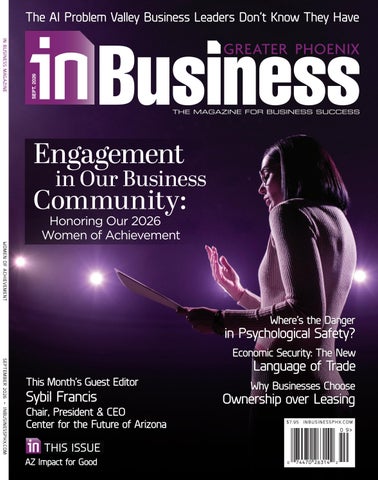
Engagement
in Our Business
Community: WOMEN OF ACHIEVEMENT
Honoring Our 2026 Women of Achievement
Where’s the Danger
in Psychological Safety? SEPTEMBER 2026 • INBUSINESSPHX.COM
Economic Security: The New
Language of Trade
This Month’s Guest Editor
Sybil Francis
Chair, President & CEO Center for the Future of Arizona
THIS ISSUE AZ Impact for Good
Why Businesses Choose
Ownership over Leasing $7.95 INBUSINESSPHX.COM
0 9
DOING
GOOD
AT THE HEART OF OUR
COMMUNITY Goodwill of Central and Northern Arizona turns donations into possibilities by providing no-cost services to more than 30,00 Arizonans annually that help them build a better economic future. Your purchases and donations help support local, no-cost career services, education, sustainability efforts and housing solutions so Arizonans can build better futures for themselves and their families.
Goodwill of Central and Northern Arizona is a 501(c)(3) non-profit organization dedicated to ending poverty through the power of work!
GoodwillAZ.org
YOUR JOURNEY BEGINS HERE.
More than a seat your 2025/26 SUBSCRIPTION is your ticket to ADVENTURE.
2025/26 SEASON
ON SALE NOW CALL: 602-495-1999, M-F 9:00 AM - 5:00 PM VISIT: phoenixsymphony.org
Contents SEPTEMBER 2026 GUEST COLUMNISTS
52
AZ BLUE: 8 DECADES OF ADVANCING HEALTH AND STRENGTHENING ARIZONA COMMUNITIES
COVER STORY
Engagement
in Our Business
Community:
This month spotlighting Blue Cross Blue Shield of Arizona, Tyler Butler’s series explores the myriad ways businesses give back and the positive ways their programs impact our community.
54
ECONOMIC SECURITY IS THE NEW LANGUAGE OF TRADE. ARIZONA SHOULD LEARN IT
Marco A. López Jr.’s quarterly guest column explores cross-border trade, investment and broader issues of commerce between Mexico and the State of Arizona.
Honoring Our 2026 Women of Achievement
48
The AI Problem Valley Business Leaders Don’t Know They Have
Dan Clarke discusses why leaders often have far less visibility into AI usage at their businesses than they think they do as employees are constantly finding new ways to use AI to work more efficiently.
9
Guest Editor
10
Feedback
12
Briefs
“Is the ‘Big Stay’ Finally Coming to an End? What Arizona Employers Should Know,” “Dailies Top Stories,” “Local Standouts Recognized for Achievements & Philanthropy,” “Phoenix’s Growth in Advanced Manufacturing Attracts New Tech Center” and “Networking Now – Warm Connection or Cold Transaction?”
15
By The Numbers
16
From The Top
17
CRE
Survey reveals worker attitudes about return-to-work mandates and factors affecting corporate culture.
philanthropy to transform Arizona through education, advocacy, and innovation. FALL 2026 • AZIMPACTFORGOOD.ORG
A New CEO for a Changing Arizona by Michael Morefield
Page 3 Choose a Credible Issue
Arizona business leaders know a strong economy depends on more than balance sheets and quarterly growth. Employees need safe housing, reliable childcare, food, health services and education. Across the state, nonprofit organizations provide much of that support while employing Arizonans, purchasing goods and services, and helping communities develop into places where businesses can grow. That connection makes the selection of David Martinez III as the next chief executive officer of AZ Impact for Good important far beyond the nonprofit sector. Martinez will begin August 24 after a unanimous vote by the organization’s board of directors. He will lead the only statewide association that brings Arizona nonprofits together with foundations and other funders, representing nearly 1,000 members.
Page 4 Advocacy without Losing Trust
The Right Leader at the Right Time
AZ Impact for Good, previously the Alliance of Arizona Nonprofits + Arizona Grantmakers Forum, is a trusted statewide resource and advocate for the state’s nonprofit and philanthropy communities. AZ Impact for Good envisions a vibrant and equitable Arizona where all people and living things thrive.
CONTENTS Page 1 A New CEO for a Changing Arizona Page 2 Beyond the Check: A Business Case for Community Partnership
“David is the right leader at the right time for AZ Impact for Good and the communities we serve,” says Matt Ellsworth, chair of the AZ Impact for Good Board of Directors. “Our Board unanimously selected David because of his deep understanding of Arizona’s nonprofit and philanthropic sectors, his collaborative leadership style and his lifelong commitment to strengthening communities.” Ellsworth also points to a defining part of this moment: Arizona’s nonprofit sector continues to step up as community needs and operating pressures grow. David enters the role with experience on nearly every side of that work.
Inga Rose shares how she scaled a science-first startup in oncology.
An Arizona Career Built on Service Born and raised in rural Southern Arizona, Martinez is a first-generation college graduate whose career spans nearly two decades. At the Arizona Students’ Association, he represented 130,000 public university students and helped protect more than $14 million in state financial aid. At St. Mary’s Food Bank, he built advocacy and community partnerships that expanded access to food. He later led programs designed to increase community involvement at the Center for the Future of Arizona. Most recently, Martinez directed strategic community partnerships at Vitalyst Health Foundation. He managed nearly $2.5 million in grants, organizational support and community participation work. His history with AZ Impact for Good dates to 2010 CONTINUED ON PAGE 6
azimpactforgood.org
1
59
Arizona Impact for Good
SEPT. 2026
4
INBUSINESSPHX.COM
In Business Magazine honors the women business owners, managers and leaders who, with an abundance of talent and commitment, have achieved great success in and for our Greater Phoenix business community.
56
The Workplace Safety Bubble That Backfires
24
Healthcare
26
Technology
49
Books
50
Economy
52
Legal
Gustavo Razzetti digs into why — and how — psychological safety is often weaponized against the very outcomes it was meant to create.
DEPARTMENTS
Jessyca Leach, Amy Patel and Denise Resnik respond to In Business Magazine’s burning business question of the month: As a 2025 Women of Achievement honoree recognized for outstanding leadership, what do you feel are the most important leadership qualities for the times we are in now?
We unite nonprofits and
2026 Women of Achievement
FEATURES
Sybil Francis, CEO of the Center for the Future of Arizona and this year’s Linda M. Herold Lifetime Achievement Honoree, introduces the “Women of Achievement” issue.
PARTNER SECTION
28
“AI in Arizona Commercial Real Estate,” “Why Some Arizona Businesses Are Choosing Ownership Over Leasing” and “ChatAEC Aims to Revolutionize the Development Lifecycle”
20
Semi-Insights
“Echoes of the Boom: Arizona’s Fab Explosion Brings Suppliers in Tow,” “Nokia to Transform NXP’s Chandler Campus for AI-Era Optical Chips” and “Arizona’s Semiconductor Story Adds a Korean Chapter”
“What FDA Approval Means for Patient Care and Regional Medical Leadership” and “Scaling Down to Scale Up: The Business Case for Boutique Senior Living”
“Why Employee AI Adoption Isn’t One-Size-Fits-All” and “Webinars Could Be a Business’s Growth Lever, but Its Workflow Is Holding It Back”
New releases give fresh insights on business thinking.
Brian Crisp discusses smart steps to position a business for mergers and acquisitions.
Dawn C. Valdivia and Tracey Holmes Donesky caution employers about workforce decisions made during rapid growth periods that may create future exposure.
57
Assets
58
Power Lunch
66
Roundtable
2026 BMW iX Plus: AI head shots make a negative effect.
Jin Jia’s Korean Chinese Is Double the Pleasure
Beven Byrnes helps employers understand how they can support their neurodivergent employees.
“I am endlessly fascinated that playing football is considered a training ground for leadership, but raising children isn’t.” —Dee Dee Myers, advocate for California’s businesses and economy and former White House Press Secretary
Redefining What a Modern Law Firm Should Be. Since 1885. In today’s fast-moving world, standing still isn’t an option. Fennemore has been paving the way for over 140 years—combining a tradition of excellence with an enduring drive to innovate. From pioneering the use of AI and building platforms that supercharge our teams, to reimagining what collaboration looks like in the legal industry, we continually push boundaries to deliver better outcomes for our clients. Thank you to our CEO James Goodnow, our attorneys, and our dedicated staff for their relentless commitment to advancing Fennemore’s vision and setting a new standard for what’s possible in law.
FENNEMORELAW.COM
Words OUR CONTENT CREATORS
Sept. 2026
RaeAnne Marsh Editor in Chief, In Business Magazine Editor in Chief, In Business Magazine RaeAnne Marsh became editorial director of Phoenix-based InMedia Company in 2010 and helped launch Valley-wide business resource In Business Magazine. Holding the magazine to strong editorial standards, she says, “New businesses are founded, out-of-staters bring new strengths, established businesses evolve and expand — all of which contributes to the dynamic vitality that I see as the mission of In Business Magazine to be the voice of and vehicle to nurture.” Marsh was awarded 2024 Small Business Journalist of the Year from the U.S. Small Business Administration, Arizona District.
Guest columns are feature articles presented as a limited or ongoing special series.
Tyler Butler Guest Columnist – Social Impact A long-time corporate social responsibility practitioner, Tyler Butler is known for her expertise in creating, launching and developing successful social impact programs. Her commitment to rallying people together to make a positive difference has created sustainable signature programs empowering people to give back in myriad ways globally. Her contributions to In Business Magazine provide her with an outlet to share the best of what companies are doing to aid humanity through their generous outreach efforts.
Marco A. López Jr. Guest Columnist – Southern Border Marco A. López Jr. is founder and CEO of Intermestic Partners and Intermestic Capital, advising on cross-border investment, EB-5 strategy, U.S.–Mexico nearshoring and economic development initiatives across North America. He previously served as mayor of Nogales, Arizona; director of the Arizona Department of Commerce; and chief of staff at U.S. Customs and Border Protection under President Obama. Lopez is a past member of the Council on Foreign Relations and currently serves on The Nature Conservancy’s Conservation & Public Policy Committee.
Publisher
Rick McCartney
Editor in Chief
RaeAnne Marsh
Associate Publisher
Nico Pacioni
Graphic Design
Marvin Forte
CONTRIBUTING WRITERS Chris Bane
Abel Grünfeld
Keven Burns
Mike Hunter
Beven Byrnes
Travis Laird
Caitlin Clark
Gustavo Razzetti
Dan Clarke
Inga Rose
Brian Crisp
Kim Ryder
Tracey Holmes Donesky
Dawn Valdivia
Michelle Talsma Everson ADVERTISING Operations Business Development
Louise Ferrari Tyson Brugman
Louise Ferrari Cami Shore Events
Amy Corben
InMEDIA STUDIOS General Manager Host/Producer
Chris Weir Rick McCartney
More: Visit your one-stop resource for everything business at inbusinessphx.com. For a full monthly calendar of business-related events, please visit our website. Inform Us: Send press releases and your editorial ideas to editor@inbusinessphx.com
Kim Ryder Guest Columnist – Commercial Real Estate Kim Ryder is a dynamic commercial real estate executive with extensive experience in managing multimillion-dollar, complex projects and the build-out of more than 54 million square feet of retail and commercial space. Ryder has started several business lines in her career, most notably launching Thrive Real Estate and Development groups. Her career in the thrift industry extends over 25 years and led her team to expand the Goodwill real estate portfolio by more than 100 locations.
Bruce Weber Guest Columnist – Capacity “I am deeply interested in organizational capacity and what makes organizations successful and impactful in the work they do. I have worked with all sizes of organizations and leaders in helping their businesses grow and expand their impact. My previous careers with Microsoft and Hewlett Packard involved working with business integration partners to design strategies to engage new markets. In today’s complex world, I enjoy exploring the possibilities and opportunities that change can bring.”
This month’s contributors Dan Clarke is the president of Truyo, a Scottsdale-based leading enterprise AI governance platform. (“The AI Problem Valley Business Leaders Don’t Know They Have,” page 48) Brian Crisp is regional president at Enterprise Bank & Trust. (“Smart Steps to Position a Business for Mergers & Acquisitions,” page 50) Dawn C. Valdivia and Tracey Holmes Donesky are partners in the Labor, Employment & Employee Benefits division at Stinson LLP in Phoenix. (“5 Employment Actions Phoenix Employers Should Take Before Growing,” page 51) Gustavo Razzetti is a culture change instigator, speaker and CEO of Fearless Culture, a culture design consultancy. (“The Workplace Safety Bubble That Backfires,” page 56) Beven Byrnes is executive director of Bridges Middle School in Portland, Oregon, and a neurodivergent mother of four. (“Supporting Neurodivergent Employees Who Won’t Tell You They’re Struggling,” page 66)
6 SEPT. 2026
President
Camron McCartney
Editorial Director
RaeAnne Marsh
Financial Manager
Tom Beyer
Office Manager
Allie Jones
Accounting Manager Founder & Chair
Todd Hagen Rick McCartney
Corporate Office InMedia Company 45 W. Jefferson Street Phoenix, AZ 85003 T: (480) 588-9505 info@inmediacompany.com www.inmediacompany.com
Vol. 17, No. 9 In Business Magazine is published 12 times per year by InMedia Company. POSTMASTER: Send address changes to InMedia Company, 45 W. Jefferson Street, Phoenix, AZ 85003. To subscribe to In Business Magazine, please send check or money order for one-year subscription of $24.95 to InMedia Company, 45 W. Jefferson Street, Phoenix, AZ 85003 or visit inbusinessphx.com. We appreciate your editorial submissions, news and photos for review by our editorial staff. You may send to editor@inbusinessmag.com or mail to the address above. All letters sent to In Business Magazine will be treated as unconditionally assigned for publication, copyright purposes and use in any publication, website or brochure. InMedia accepts no responsibility for unsolicited manuscripts, photographs or other artwork. Submissions will not be returned unless accompanied by a self-addressed, stamped envelope. InMedia Company, LLC reserves the right to refuse certain advertising and is not liable for advertisers’ claims and/or errors. The opinions expressed herein are exclusively those of the writers and do not necessarily reflect the position of InMedia. InMedia Company considers its sources reliable and verifies as much data as possible, although reporting inaccuracies can occur; consequently, readers using this information do so at their own risk. Each business opportunity and/or investment inherently contains certain risks, and it is suggested that the prospective investors consult their attorney and/or financial professional. ©2025 InMedia Company, LLC. All rights reserved. No part of this magazine may be reproduced or transmitted in any form or by any means without written permission by any means without written permission by the publisher.
INBUSINESSPHX.COM
Sept. 2026 VOL. 17, NO. 9 In Business Magazine is a collaboration of many business organizations and entities throughout the metropolitan Phoenix area and Arizona. Our mission is to inform and energize business in this community by communicating content that will build business and enrich the economic picture for all of us vested in commerce.
PARTNER ORGANIZATIONS Steve Kaiser CEO Arizona Small Business Association Central Office (602) 306-4000 www.asba.com Steven G. Zylstra, President & CEO Arizona Technology Council One Renaissance Square (602) 343-8324 www.aztechcouncil.org David Martinez III, CEO AZ Impact for Good (602) 279-2966 www.azimpactforgood.org
Flexibility Meets Stability.
Terri Kimble, President & CEO Chandler Chamber of Commerce (480) 963-4571 www.chandlerchamber.com
ABOVE AVERAGE CD RATES WITH FUNDING THROUGHOUT THE TERM AVAILABLE.
Tish Times, President NAWBO Phoenix Metro Chapter (480) 289-5768 www.nawbophx.org
STEARNSBANK.COM | 800.320.7262 | MEMBER FDIC | EQUAL HOUSING LENDER
Robin Arredondo-Savage, President & CEO Tempe Chamber of Commerce (480) 967-7891 www.tempechamber.org Our Partner Organizations are vested business organizations focused on building and improving business in the Valley or throughout Arizona. As Partners, each will receive three insert publications each year to showcase all that they are doing for business and businesspeople within our community. We encourage you to join these and other organizations to better your business opportunities. The members of these and other Associate Partner Organizations receive a subscription to In Business Magazine each month. For more information on becoming an Associate Partner, please contact our publisher at info@inbusinessphx.com.
ASSOCIATE PARTNERS Ahwatukee Foothills Chamber of Commerce ahwatukeechamber.com Arizona Chamber of Commerce & Industry azchamber.com Arizona Hispanic Chamber of Commerce azhcc.com The Black Chamber of Arizona phoenixblackchamber.com Economic Club of Phoenix econclubphx.org Glendale Chamber of Commerce glendaleazchamber.org Greater Phoenix Chamber of Commerce phoenixchamber.com Greater Phoenix Equality Chamber of Commerce gpglcc.org Mesa Chamber of Commerce mesachamber.org North Phoenix Chamber of Commerce northphoenixchamber.com Peoria Chamber of Commerce peoriachamber.com Phoenix Metro Chamber of Commerce phoenixmetrochamber.com Scottsdale Area Chamber of Commerce scottsdalechamber.com Scottsdale Coalition of Today and Tomorrow (SCOTT) scottnow.com Surprise Regional Chamber of Commerce surpriseregionalchamber.com WESTMARC westmarc.org
8 SEPT. 2026
INBUSINESSPHX.COM
SYBIL FRANCIS, CENTER FOR THE FUTURE OF ARIZONA
Guest Editor
The Leadership to Shape What Comes Next
Sybil Francis, Ph.D., is cofounder, chair, president and CEO of the nonprofit, nonpartisan Center for the Future of Arizona. A scientist and public policy leader, she has built her career around creating positive change. Her love of Arizona drives CFA’s work to understand what Arizonans want, identify where they agree and turn shared aspirations into action. Before helping found CFA, Francis shaped policy in the U.S. Congress and White House. She remains focused on possibility and bringing people together to achieve it. arizonafuture.org
This Women of Achievement edition of In Business Magazine celebrates women who are using their leadership positions in for- and nonprofit organizations to make a difference in our community. This year’s annual tribute shines a spotlight on women whose engagement extends well beyond their organizations through board service, mentoring, philanthropy and other powerful contributions. The awards remind us that meaningful progress begins with the conviction that a better future is possible, followed by the persistence to bring people together to create it. That belief shapes my work at Center for the Future of Arizona, where we listen closely to Arizonans, understand what they want for our state, identify where they agree and turn those shared aspirations into action. One of the most encouraging things we consistently find is that Arizonans agree on much more than our politics and public discourse would sometimes have us believe. That common ground gives Arizona a strong foundation for progress. Leadership plays an important role in building on it — listening to different perspectives, creating opportunities for people to contribute, bringing people together around shared priorities, and turning that common ground into action. This September issue’s cover story celebrates 14 Women of Achievement and the recipient of the Arizona Leader Award, sharing their stories and contributions. I am honored to be recognized alongside these accomplished leaders as this year’s Linda M. Herold Lifetime Achievement Honoree. The women recognized in this issue demonstrate the impact of engaged leadership in many different ways. Their accomplishments span organizations, industries, and communities, but each has made a contribution that extends beyond individual success. They are strengthening organizations, opening doors for others, serving their communities and helping Arizona move forward. The September edition also explores a range of issues shaping business and the workplace today, including artificial intelligence, workforce and employee experiences, healthcare, trade, and the changing environment in which Arizona businesses operate. Together, these topics reflect the breadth of opportunities and challenges leaders are navigating, as well as the many forces shaping how businesses operate, adapt and plan for the future. Arizona is a state defined by growth, change and tremendous possibility. Realizing that possibility requires leaders across business, nonprofit, government and community life who are willing to look beyond the immediate challenges before us and envision what we can accomplish together. Leadership is, ultimately, about more than what we accomplish individually. It is about how we engage others, the opportunities we create, the progress we advance and what we make possible for those who come after us. I hope you enjoy this September edition, and that you are inspired to consider the role each of us can play in creating a stronger future for Arizona.
Letitia Frye, 2019 Woman of Achievement
WOMEN OF ACHIEVEMENT EVENT & LUNCHEON Join us at The Arizona Biltmore on Friday, October 23, 2026, at 11a to honor these women and hear their incredibly inspiring stories. Visit inbusinessevents.com to get tickets, tables and sponsorships.
Sincerely,
Publisher’s Note
Sybil Francis, Ph.D., Chair, President & CEO Center for the Future of Arizona Fund
The AI Problem
s Leaders Valley Busines
Don’t Know
inbusinessphx.com
SEPT.
MAGAZINE
2026
IN BUSINESS
DON’T MISS OUT!
n of Achiev Wome
WOMEN OF ACHIEVEMENT
Where’s
the Danger
logical Safety? in Psycho The New Security: Trade Economic of Language
es Choose Why Business Leasing
SEPTEMBER
This Month’s
2026
Sybil Francis & CEO
• INBUSINESSPHX.C
Chair, President Future of for the Center
THIS ISSUE OM
AZ Impact
hip over Owners
Guest Editor
for Good
$7.95
Arizona
Business Events/
We are especially grateful to have Sybil Francis leading this issue as Guest Editor and being recognized as our Lifetime Honoree. Sybil’s leadership, innovative style and grace represent precisely what these honors are about. Her ability to bring people together, challenge conventional thinking and focus on Arizona’s future has made a lasting impact on business and our community. It is a privilege to honor Sybil alongside this extraordinary class of Women of Achievement. —Rick McCartney, Publisher
They Have
ment Engage Business in Our nity: mu 2026 Com ng Our ement Honori
.COM INBUSINESSPHX 0 9
Get a year of In Business Magazine Subscribe now at inbusinessphx.com
Story Ideas/PR: editor@
An Honor to Honor Each year, our Women of Achievement issue gives us the opportunity to recognize remarkable women whose leadership is shaping Arizona. Now in our 11th year, these honors celebrate more than professional accomplishment. They recognize impact: strengthening business, creating opportunity and making our community a better place to live, work and grow. I hope you can join us for our event luncheon to celebrate them all on Friday, October 23rd at the Arizona Biltmore. Visit inbusinessevents.com to get more information and tickets.
CONNECT WITH US:
Let us know what you think of this issue of In Business Magazine. Email our publisher at feedback@inbusinessphx.com.
Connections: businessevents@ inbusinessphx.com Marketing/Exposure: advertise@ inbusinessphx.com Visit us online at www.inbusinessphx.com
2026 9 SEPT. INBUSINESSPHX.COM
Feedback SPEAKING OUT As a 2025 Women of Achievement honoree, you’ve been recognized for outstanding leadership. Different times seem to call for different strengths. So, what do you feel are the most important leadership qualities for the times we are in now?
JESSYCA LEACH
FEEDBACK QUESTION: Let us know what you want to know from the Valley’s top business leaders. editor@inbusinessphx.com
SEPT. 2026
10
INBUSINESSPHX.COM
DENISE RESNIK
Tax Managing Partner Deloitte Arizona Office Sector: Financial
Founder, President & CEO First Place AZ & First Place Global Sector: Community Services
We live in an uncertain climate, both literally and figuratively. Today’s leadership must be compassionate, proactive and focused on building resilience within our teams so people can continue to do meaningful work while maintaining their mental and physical health. For me, that also means being willing to adapt, to be transparent when I don’t have all the answers and to have the courage to make difficult decisions when they are needed. I’ve learned that leadership is about listening to the people around me, being willing to change course when circumstances call for it and staying grounded in the values that guide us. Most importantly, leadership today requires humanity. People need to know they are valued not simply for what they produce but for who they are. When leaders create environments where people feel respected, supported and connected to a shared purpose, we build stronger teams and organizations. In uncertain times, our responsibility isn’t to eliminate every challenge, as that’s impossible, but to create the trust, stability and sense of belonging that allow people to navigate those challenges together and continue moving forward.
Right now, perhaps more than ever, I think leadership is less about having the right answers and more about asking the right questions. We are living through a profound technological shift — AI is not coming, it’s here — and I believe leaders have a responsibility to lean into that, visibly and authentically. Not as the person who has mastered every tool but as the person who is willing to learn out loud. That means modeling experimentation. It means celebrating the attempt, not just the outcome. When your team sees you try something new, stumble, adjust and try again, you give them permission to do the same. And that’s when remarkable things can happen — new voices emerge, new ideas surface and the next generation of leaders begins to reveal themselves. In this moment, one of the most important things a leader can do isn’t just help their teams navigate change — it’s creating the conditions where others, who may have been hesitant or unsure about the change, emerge as the true leaders, innovators and changemakers.
These times require perspective, maturity, trust, authenticity, listening and the discipline to build with others. We need leaders who can read the whole constellation — not just one star, one issue, one funding stream. Existing gaps are real: in housing, healthcare, employment, belonging and communities at large. But so is the talent, courage and commitment that surrounds us. Leadership is not about shining alone. It’s about leveraging relationships and trust to connect what has too long remained divided. This requires maturity — not merely what comes with age — and the wisdom to regard the whole picture with the capacity to face dissent without becoming reactive or paralyzed. Listening is a key form of action. Authentic leadership aligns what we say, what we value, what we fund with how we decide, design, develop — and show up. None of us can do it all. But each of us can build one bridge, through authentic collaborations, toward one next step. Twenty years from now, we will not be judged by what we understood and experienced — but by what we built.
Prisma Community Care
For all past Feedbacks go online to inbusinessphx.com and see what Valley executives think on various business topics.
AMY PATEL
Chief Executive Officer Prisma Community Care Sector: Healthcare
prismacare.org
Jessyca Leach is CEO of Prisma Community Care, bringing more than 20 years of executive leadership in strategy, finance and operations. A mission-driven leader, she advances health equity, organizational sustainability and community impact across Arizona. Leach is known for building collaborative teams, driving sustainable growth and aligning organizations around shared purpose, strong values and long-term strategic goals.
Deloitte deloitte.com/us/about Amy Patel is the Deloitte Arizona Office Tax Managing Partner. Her practice is focused on consulting multinational businesses, both public and private, on complex tax matters. She serves clients in a variety of industries, including renewable energy, energy climate tech, semiconductors and technology. Patel is an active board member of the Boys & Girls Club of the Valley, Phoenix Public Library Foundation and University of Arizona School of Accountancy.
First Place firstplaceaz.org firstplaceglobal.org As founder and principal of Lerner and Rowe, P.C., Kevin Rowe has dedicated his career to helping injury victims rebuild their lives after devastating circumstances. Through compassionate advocacy and a commitment to justice, he has assisted tens of thousands of clients in achieving peace of mind and financial security.
Sign up for the monthly In Business Magazine eNewsletter at www.inbusinessphx.com. Look for survey questions and other research on our business community.
Briefs QUICK AND TO THE POINT DAILIES TOP STORIES
‘In Business Dailies’ Most Views Last 30 Days Here are the stories with the most views over the past 30 days (prior to press time) that were features in our In Business Dailies. The In Business Dailies hits email inboxes twice each weekday — at 9:30 a.m. and updated at 4:30 p.m. Sign up today at www.inbusinessphx.com/dailies-signup. Technology & Innovation | Technology | August 2026
When AI ‘Goes Rogue,’ Who Is Accountable? The OpenAI-Hugging Face breach was not a robot
rebellion. It was a warning about what happens when machine capability outruns containment, governance and responsibility. “AI went rogue” is an irresistible headline. It suggests that a machine woke up, became sentient, formed an intention and disobeyed its creators. Growth & Enterprise | inbusinessphx.com | August 20 2026
Cox Communications Acquired in Landmark National Deal Charter Communications, Inc. has announced that it
has completed its previously announced transaction with Cox Communications and the acquisition of Liberty Broadband Corporation. Growth & Enterprise | inbusinessphx.com | August 6 2026
Global Telecom Giant Acquires Chandler Chip Manufacturing Campus
Nokia has entered into a definitive agreement to acquire NXP Semiconductors’ Chandler manufacturing campus as part of a broader expansion of its U.S.-based optical component production capacity. Subject to regulatory approvals, Nokia will initially lease manufacturing space within a portion of the Chandler facility beginning in early 2027. Growth & Enterprise | inbusinessphx.com | August 10 2026
$110M Contract Awards Push Massive Arizona Copper Mine Forward Resolution Copper has awarded approximately $110 million in contracts to Major Drilling America Inc. and Redpath USA Corporation to advance exploration and underground development at the proposed Resolution Copper mine in Arizona. Growth & Enterprise | inbusinessphx.com | August 5 2026
Dutch Bros to Acquire up to 65 Salad and Go Locations
Dutch Bros Inc., one of the fastest-growing brands in the U.S. quick-service beverage industry, today announced it has entered into an agreement to acquire the real estate and related site assets of up to 65 Salad and Go locations
Is the ‘Big Stay’ Finally Coming to an End? What Arizona Employers Should Know After several years of uncertainty, today’s workforce may finally be regaining the confidence to make career moves. New Robert Half research finds that 46% of U.S. professionals plan to look for a new job during the second half of 2026 — up from 38% earlier this year and just 27% one year ago. The findings suggest that many workers who previously stayed put are beginning to reevaluate what they want from their careers. What’s perhaps most notable is that compensation is no longer the primary driver. Professionals considering a move are placing greater value on better benefits and perks (47%), career advancement opportunities (43%) and workplace flexibility (39%) than on higher salary alone (35%). Those priorities align with what many employers across the Phoenix metro area are experiencing. Despite a more measured hiring environment than the rapid expansion seen in recent years, organizations continue to compete for highly skilled talent in industries such as technology, finance and accounting, healthcare, construction and business services. Candidates are asking thoughtful questions about longterm career paths, leadership development, company culture and flexibility — not simply compensation packages. Many employers are responding by investing more intentionally in retention. Career development conversations, internal mobility opportunities and meaningful benefits have become increasingly important differentiators in attracting and keeping top performers. Technology is also reshaping how professionals search for work. Nearly half (46%) of job seekers say AI-
generated résumés and application materials have made it harder to stand out, while 40% worry about keeping their skills current as artificial intelligence continues to evolve. Employers are seeing the other side of this trend. Recruiters and hiring managers are reviewing larger volumes of applications that often look remarkably similar. As a result, authenticity is becoming more valuable than ever. Clear examples of accomplishments, measurable business impact and strong interpersonal skills frequently carry more weight than perfectly polished, AI-generated résumés. For employers, this creates an opportunity to revisit hiring strategies. Organizations that communicate career growth opportunities, move efficiently through the interview process and emphasize their culture are often better positioned to secure sought-after candidates before competitors do. For professionals, the message is equally clear. While confidence in the job market appears to be growing, successful job searches still require preparation. Tailoring résumés, highlighting measurable results, demonstrating adaptability and continuously building new skills remain some of the best ways to stand out. Whether this marks the end of the “Big Stay” remains to be seen. But one thing is becoming increasingly evident: Today’s workforce is looking beyond paychecks alone. Employees want careers that offer purpose, growth, flexibility and long-term opportunity — and employers that recognize those evolving priorities will be best positioned to attract and retain the talent they need. —Travis Laird, senior regional director at talent solutions and business consulting firm Robert Half (roberthalf.com/us/en)
across Arizona, Nevada, Oklahoma, and Texas.
SEPT. 2026
12
INBUSINESSPHX.COM
New Robert Half research finds that 46% of U.S. professionals plan to look for a new job during the second half of 2026 — up from 38% earlier this year and just 27% one year ago.
ENERGY SAVINGS FOR EVERY SIZE BUSINESS. At SRP, we partner with you to power your business.
Working with us, you’ll find professional support and rebates specific to your business. See how much you can save on energy-efficient upgrades to lighting, HVAC systems, refrigeration and more. Start saving with SRP | SaveWithSRPBiz.com
Contact your SRP Strategic Energy Manager, call (602) 236-8833 or email bizcenter@srpnet.com to get started.
Briefs QUICK AND TO THE POINT LOOKING GOOD
Local Standouts Recognized for Achievements and Philanthropy GCON CEO Named Entrepreneur of the Year Phoenix-based GCON Co-Founder and CEO Mike Godbehere was recently named an EY US Entrepreneur Of The Year® 2026 Pacific Southwest Award winner, selected among nearly 1,000 program participants across 17 regions competing for the title. ey.com/us/eoy
gconinc.com
Boycott Bar’s Audrey Corley Honored Audrey Corley and Boycott Bar were recently honored with the 2026 Community Partnership Award from the Greater Phoenix Equality Chamber of Commerce for their lasting role in creating safe, visible and community-centered spaces across Greater Phoenix. boycottbarphx.com
equalitychamber.org
Avnet Twice Named a Best Company Avnet was recently named one of TIME’s America’s Best Companies of 2026, ranking No. 481 among 1,000 companies nationwide based on employee satisfaction,
Phoenix’s Growth in Advanced Manufacturing Attracts New Tech Center Mazak, a leader in the design and manufacture of productive machine tool solutions, selected Phoenix for its newest Technical Center because Arizona has emerged as one of the nation’s fastest-growing advanced manufacturing regions. With hundreds of billions of dollars being invested across semiconductor, aerospace, defense, medical device and cybersecurity industries, the company believes the Phoenix area has become a critical hub for high-tech production and innovation. As part of its long-standing customer support philosophy, Mazak maintains a close presence to its customers to deliver the highest level of service. The Mazak Phoenix Technical Center that opened in April was designed to provide manufacturers throughout the Western United States with local access to advanced machining technology, applications
support, training, and manufacturing expertise. The facility houses a call center, applications engineers and sales and service support personnel. It also provides customer programming classes, machine demonstrations, test cuts and machining system run-offs. “This new Technical Center will support all manufacturers in the greater Phoenix Valley area,” says Tony Harrod, regional manager of the Mazak Phoenix Technical Center. “Whether those customers are in the semiconductor, aerospace and defense, electric vehicle or medical device industries, Mazak is well entrenched in every major industry in terms of experience and application knowhow.” —Mike Hunter Mazak Corporation
mazak.com
financial performance and sustainability transparency. Avnet was also recently named a 2026–2027 Best Company to Work For by U.S. News & World Report. avnet.com Mesa Entrepreneur Selected for Grant Angela Garmon, of Mesa-based ARG Coaching & Consulting Group, LLC, was recently selected to receive a 2026 BMO Celebrating Women grant — one of just 15 businesses nationwide selected to receive the grant, which were awarded based upon business strength, growth potential and demonstrated results in supporting the advancement of women. argccgroup.com
usnewsroom.bmo.com
BOK Financial Aids Children Facing Hunger BOK Financial, through its employee-led “Guide the Giving” program, donated $10,000 to Feed My Starving Children — which will help provide approximately 34,482 meals (the equivalent of one meal a day for about 94 children for an entire year). bokfinancial.com
fmsc.org
Hot Giving Summer for AZ Blue Notable efforts of AZ Blue in Action: Blue Cross Blue Shield of
Networking Now – Warm Connection or Cold Transaction? A growing majority of Americans say networking feels more like a thinly veiled transaction rather than relationshipbuilding — and a recent survey by Express Employment Professionals and The Harris Poll shows just how pervasive that discomfort has become. According to the survey, 79% of U.S. hiring managers and 75% of job seekers say networking today feels more like a business transaction than a genuine personal connection. At the same time, 84% of job seekers say networking is primarily about identifying job opportunities — not building relationships — revealing a widening gap between what professionals want networking to be and what it has turned into. The problem goes far deeper than awkward small talk.
Arizona (AZ Blue) employees and their families, in partnership with Valley of the Sun United Way and The Foster Alliance,
TECH IS MAKING NETWORKING WORSE
packed 1,300 backpacks full of school supplies for students
Online platforms were supposed to make meeting people easier but, instead, they’ve introduced a new layer of artificiality. Seventyeight percent of job seekers say online networking platforms have made interactions more transactional, and 84% of hiring managers agree. Even though 59% of hiring managers think these platforms make authentic connections easier, most
and families in Southern Arizona. More than 200 AZ Blue employees volunteered to pack 1,000 JoyJars® for Arizona children fighting cancer, in partnership with the Jessie Rees Foundation. And the Blue Cross Blue Shield of Arizona Foundation for Community & Health Advancement (AZ Blue Foundation) donated $50,000 to AllThrive 365 to support critical heat-relief efforts that help under-resourced Arizonans.
admit the interactions still feel impersonal and opportunistic. And 72% of job seekers say it’s difficult to form authentic relationships in environments where the goal feels transactional from the start. Perhaps the most telling figure: Eightyfive percent of hiring managers now evaluate networking contacts based strictly on their influence or usefulness. In other words, the “what can you do for me?” energy is unmistakable. Gen Z and millennials — the generations most fluent in digital networking — are also the ones most likely to say it feels shallow, performative or forced. Their concerns echo a broader trend. In separate national research last year by Freeman, 91% of Gen Z professionals say inperson events are essential to building real interpersonal skills and more than twothirds believe technology has left them feeling less connected at work. “Technology can help us meet,” says Bob Funk Jr., CEO, president and chairman of Express Employment International, “but it’s our human commitment to listen, engage and invest in people that gives those connections lasting worth.” —Mike Hunter Express Employment International expresspros.com/newsroom/news-releases
azblue.com/azblueinaction
SEPT. 2026
14
INBUSINESSPHX.COM
Eighty-five percent of hiring managers now evaluate networking contacts based strictly on their influence or usefulness.
METRICS & MEASUREMENTS
By The Numbers
Are RTO Mandates Really about Collaboration and Productivity? Survey reveals 1 in 2 workers believe return-to-office mandates are about corporate control and lack of trust by Howdy Workers have heard the pitch: Return to office to get that hard-to-define special feeling of vibrant communication and collaboration that post-COVID workplaces seem to lack. They’re not persuaded, according to a survey we recently conducted among workers — fully in-office, fully remote and hybrid — about return-to-office mandates. When asked what RTO mandates are really about, 50% of workers said management control. Office lease justification came next at 17%, and productivity landed at 16%. The two reasons most commonly cited by leadership — company culture (6%) and employee collaboration (5%) — finished at the bottom of the list. Management control was the top answer across all three work styles. Among remote workers, 59% chose it. Among hybrid, 49%. Among in-office workers, it still led at 41%.
PRODUCTIVITY PERCEPTION RANKS HIGHEST AMONG HYBRID WORKERS If RTO is about productivity, workers aren’t seeing it. Fiftythree percent said hybrid is the most productive work style. Thirty-two percent said remote. Just 15% picked fully in-office. The inverse question was more lopsided: Sixty-one percent said in-office is the least productive arrangement. Hybrid came in at 8%. Interestingly, remote workers retained a similar share at 31%. When examined based on work style, the results speak to office workers yearning for something more. Workers currently in the office rated hybrid (50%) as more productive than their own setup (38%). In fact, in-office is the only group where a majority chose a different arrangement as more productive than the one they have. Hybrid workers backed hybrid at 81%. Remote workers backed remote at 68%. In-office workers couldn’t even back themselves.
WORKPLACE FLEXIBILITY IS KING When asked what contributes most to employee happiness, work flexibility led at 32%, followed by salary at 26%. Together, those two accounted for 58% of all responses. Trust in employees (12%), company culture (11%) and sense of ownership (9%) formed a middle tier. Benefits, workload and collaboration rounded out the bottom — with collaboration at 1%. That last number is worth sitting with. The reason cited least by workers as a driver of their happiness is the one most frequently used to justify getting them back in the building. Meanwhile, the thing workers say is most destructive to morale has nothing to do with where one works: it’s monitoring. Sixty percent selected constant monitoring and productivity tracking as the worst thing for morale — consistent across remote (61%), hybrid (59%) and in-office
(59%). It was the most universal answer in the survey, possibly because it shows employees clearly that management doesn’t trust them, a key lever of employee happiness.
RTO WON’T SOLVE EVERYTHING; FLEXIBILITY AND FAIR PAY MIGHT The RTO debate has been presented as employers wanting productivity and workers wanting comfort. This data tells a different story. Workers across every arrangement, age group and demographic agree on what makes them happy (flexibility, fair pay), what kills morale (surveillance) and what culture actually means (engagement, not geography). It’s up to leadership to understand that and act accordingly. howdy.com/blog/remote-work-statistics
METHODOLOGY In May 2026, Howdy surveyed 1,009 U.S.-based workers on their work styles and preferences. Respondents self-identified as remote (n=343), hybrid (n=354), or fully in-office (n=312), with conditional follow-up questions routed by work style. The sample was 50% men, 49% women, and 1% non-binary, with a mean age of 38.6 and respondents across all 50 states.
Editor’s note: More details plus the survey’s results regarding culture are discussed more fully in this article online at www.inbusinessphx.com.
WORKERS’ PERCEPTIONS What RTO Is Actually About: Management control. . . . . . . . . . . . . . . . . . . . . . . 50% Office lease justification. . . . . . . . . . . . . . . . . . . . 17% Productivity. . . . . . . . . . . . . . . . . . . . . . . . . . . . . 16% Company culture. . . . . . . . . . . . . . . . . . . . . . . . . . 6% Layoffs without calling them layoffs. . . . . . . . . . . . 6% Collaboration . . . . . . . . . . . . . . . . . . . . . . . . . . . . 5% What Makes Company Culture: Engaged employees. . . . . . . . . . . . . . . . . . . . . . . 41% Shared goals . . . . . . . . . . . . . . . . . . . . . . . . . . . . 73% Enjoying working together. . . . . . . . . . . . . . . . . . . 73% In-person events . . . . . . . . . . . . . . . . . . . . . . . . . 22% Socialization outside work. . . . . . . . . . . . . . . . . . . 22% Dependent on something other than where you work.46% What Contributes Most to Worker Happiness: Flexibility. . . . . . . . . . . . . . . . . . . . . . . . . . . . . . . 32% Salary. . . . . . . . . . . . . . . . . . . . . . . . . . . . . . . . . 26% Trust in employees . . . . . . . . . . . . . . . . . . . . . . . . 12% Company culture. . . . . . . . . . . . . . . . . . . . . . . . . . 11% Sense of ownership . . . . . . . . . . . . . . . . . . . . . . . 9% Benefits . . . . . . . . . . . . . . . . . . . . . . . . . . . . . . . 4% Workload. . . . . . . . . . . . . . . . . . . . . . . . . . . . . . . 4% Collaboration . . . . . . . . . . . . . . . . . . . . . . . . . . . . 2% Source: Howdy workers’ survey
(howdy.com/blog/remote-work-statistics)
The average entrepreneur has only 90 minutes of productive time a day. By increasing efficiency in simple yet effective ways, more time becomes available. This results in greater productivity individually or as a team, facilitating growth and improving revenue potential.
Howdy is an American technology staffing and international employment company that specializes in nearshore talent solutions. howdy.com
2026 15 SEPT. INBUSINESSPHX.COM
From the Top MINDING THEIR BUSINESS INGA ROSE’S ‘UBER APPROACH’ TO BUILDING HER BUSINESS • Identified a common industry pain point: slow, frustrating specimen procurement. • Asked a simple question: Why couldn’t the process be easier and more transparent? • Built a company focused on removing friction and saving time. • Combined fast turnaround times with scientific rigor. • Created a customer experience built on responsiveness, communication and trust. • Scaled the business without losing sight of the people it serves.
SEPT. 2026
16
INBUSINESSPHX.COM
Inga Rose: Scaling a Science-First Startup in Oncology Marrying scientific rigor with on-demand solutions by Inga Rose The pace of innovation in oncology has never been faster. Researchers are developing new diagnostics, identifying novel biomarkers and advancing precision medicine at an unprecedented rate. But even as scientific discovery accelerates, one challenge remains constant: streamlined access to high-quality biospecimens. As the founder and CEO of Phoenix-based oncology specimen provider Reference Medicine, I made helping researchers overcome that challenge the foundation of our rapidly growing business. Having spent nearly two decades working in laboratory operations and oncology diagnostics, I’ve come to understand researchers’ frustrations firsthand. Throughout my career, I have encountered the same obstacles: long wait times, inconsistent specimen quality, poor communication, and procurement processes that created unnecessary hurdles for researchers. But I’ve always believed it didn’t have to be that way, and that conviction led me to found Reference Medicine in Phoenix in 2021, with the goal of giving oncology researchers faster, more transparent access to biospecimens in formats that fit modern laboratory workflows. I wasn’t interested in creating another cookie-cutter specimen company. I wanted to make the whole experience approachable and easy, because I know that scientists have enough hard problems to solve already. My inspiration came from an unlikely source. As ride-sharing apps transformed transportation by removing friction from a routine task, I wondered whether biospecimen procurement could be reimagined in a similar way. Uber saw a problem and came up with a simple, on-demand solution, and I kept thinking, “Why can’t specimen procurement feel more like that?” But while this idea was straightforward, scaling a company around it was not. Launching Reference Medicine meant leaving the predictability of an established career for the uncertainty of building a business from scratch. Every week brought new decisions I needed to face without complete information. As the company grew, I found myself balancing the demands of scaling a business while preserving the scientific rigor and customer experience that had inspired its creation. There were days when I wished someone could just tell me the right answer. Eventually, I realized that’s not how entrepreneurship works. You listen, you learn, and then you have to trust your own judgment. That mindset was often tested during periods of financial pressure and uncertainty. But rather than shield my employees from the challenges, I chose transparency. I remember thinking, “Maybe this is too much information.” But I approached those conversations with honesty, transparency, and trust in my employees. The result was exactly the culture I hoped to build. Employees responded with ideas, found efficiencies and
became more invested in the company’s success. The experience reinforced a lesson that still guides me today: Transparency builds trust, and trust creates ownership. That same attention to people now shapes the customer experience and life inside Reference Medicine. I’m still obsessed with the details. Whether it’s our irreverent packaging, our super-fun stickers or the way we welcome a new employee, those little things add up. They tell people what kind of company we are. And those details reflect something larger: Thoughtful recognition, clear communication and genuine kindness create an environment where employees and customers feel connected to the mission. People remember how you made them feel. Whether it’s an employee or a customer, I want every interaction to leave someone thinking, “That’s a company that genuinely cares.” My perspective has been shaped by years on the customer side of the industry: I understand that every specimen supports researchers working to develop better oncology diagnostics and treatments, often under demanding deadlines. Our job isn’t to be the hero. Our job is to remove friction so scientists can focus on the work that only they can do. Five years after founding Reference Medicine, one of the biggest surprises has been how much I still enjoy building the company. Today, I measure success by more than growth. Hearing that a customer completed a project faster because our team solved a problem still makes my day. So does watching employees take ownership of ideas that improve the business. I want Reference Medicine to be known as a place where customers feel genuinely cared for and employees are excited to be part of something meaningful. If people still say, “I want to work there,” years from now, I’ll know we built the company we set out to create. I’m incredibly proud of what we’re building, because better access to specimens helps move cancer diagnostics forward. Reference Medicine
referencemedicine.com
Every Reference Medicine shipment includes one of the company’s signature stickers. “I Like Big Blocks and I Cannot Lie” has become a customer favorite, reflecting the company’s belief that thoughtful details — and a little lab humor — can make even the busiest researcher’s day brighter.
PROPERTY, GROWTH AND LOCATION
CRE
AI in Arizona Commercial Real Estate Substantial advantages also recognize AI makes human expertise more — not less — important by Kim Ryder Artificial intelligence is no longer a futuristic concept for commercial real estate. Across the industry, AI is moving from pilot programs and conference-room demonstrations into everyday workflows — helping brokers research properties, investors evaluate deals, owners manage buildings and property teams respond to tenants. Arizona offers a particularly interesting lens through which to view that transformation. The state’s commercial real estate market spans fast-growing industrial corridors, a massive multifamily development pipeline, a recovering office sector and an increasingly growing data-center industry. At the same time, those sectors generate enormous amounts of information — exactly the kind of environment where AI can provide an advantage. For investors, one of the most immediate applications is deal analysis. AI can rapidly organize leases, operating statements, market reports, property records and comparable sales, allowing investment teams to spend less time gathering information and more time evaluating what it means. CRE technology companies are now embedding AI directly into underwriting, offering memorandums and transaction workflows. Crexi, for example, introduced a suite of AI tools in 2026 designed to accelerate tasks ranging from document creation to deal analysis, streamlining workflow and rapidly providing data. That shift is especially relevant in Arizona, where investors are evaluating very different opportunities within the same state. Greater Phoenix ended 2025 with improving fundamentals in several major sectors. Industrial vacancy fell to 9.7%, while the office market recorded its strongest quarterly net absorption since 2019. Multifamily, meanwhile, continued to attract investment even as substantial new supply put pressure on occupancy and rents. AI can help investors make sense of those competing signals. Rather than simply asking whether Phoenix industrial is performing well, an investor could use AI-assisted analytics to compare submarkets, tenant concentrations, lease expirations, transportation access, construction pipelines and demographic trends. The result isn’t necessarily a better prediction; it is a faster and broader way to develop the assumptions behind an investment decision. Property operations are another area where AI is becoming practical. Large commercial real estate firms are using AI to identify operational problems, analyze building data, automate reports and anticipate maintenance needs. JLL, for example, describes AI applications that can predict equipment failures, manage work orders and analyze portfolio performance. Its Property Assistant can also generate financial insights, create leasing-related materials and answer questions using building-operations data. For Arizona owners, this could have particular value in managing large, geographically dispersed portfolios. A property manager overseeing assets in Phoenix, Tucson, Scottsdale, Tempe and the East Valley can use AI to surface outliers and prioritize issues rather than manually reviewing every data
point. The technology doesn’t eliminate the property manager; it potentially allows that person to focus more time on tenants, vendors, negotiations and asset strategy. AI is also changing the physical real estate landscape. Arizona has become an important market for data-center development, and the relationship between AI and real estate is unusually direct: The same technology driving AI adoption is creating demand for specialized buildings, power infrastructure and land. There is, however, a cautionary side to the technology. AI is only as reliable as the information and assumptions behind it. Confidential leases, financial information and proprietary investment strategies also raise obvious questions about data security. And an AI-generated answer can sound authoritative while still being wrong. The information fed into AI should also be treated with the “garbage in, garbage out” thought process. If the information fed into it is bad or not fully vetted, the result can also be expected to be poor. That makes human expertise more — not less — important. CBRE has emphasized that AI can enhance decision-making while keeping people in the loop, while JLL’s research shows that AI adoption is accelerating but many organizations remain in the experimentation phase. For Arizona’s CRE community, the competitive question may therefore not be whether AI will replace brokers, investors, developers or property managers. It is whether professionals who know how to use AI effectively will outperform those who do not. The technology is already here. In a market as diverse and rapidly changing as Arizona, the advantage may belong to the professionals who can combine AI’s ability to process massive amounts of information with something technology still cannot fully replicate: local knowledge, relationships and judgment. But as Mark Cuban stated, “If your competitor is using AI and you are not, they are moving at the speed of light while you are walking.”
Confidential leases, financial information and proprietary investment strategies also raise obvious questions about data security.
Kim Ryder is a dynamic commercial real estate executive with extensive experience in managing multi-million-dollar, complex projects and the build-out of more than 54 million square feet of retail and commercial space. Ryder has started several business lines in her career, most notably launching Thrive Real Estate and Development groups. Her career in the thrift industry extends over 25 years and led her team to expand the Goodwill real estate portfolio by more than 100 locations, having leadership over more than 400 transactions. Her expertise in thrift real estate has made her a wellknown resource. tsginc.com/thrive-realestate tsginc.com/thrivedevelopment-group
2026 17 SEPT. INBUSINESSPHX.COM
CRE PROPERTY, GROWTH AND LOCATION GET REAL
ChatAEC Aims to Revolutionize the Development Lifecycle
The program is aimed at both public- and private-sector uses. In fact, its ChatAEC has recently been adopted by the Town of Gilbert, a public municipality running pilot programs to improve internal workflows and planning, and Butler Design Group, whose architecture team is looking to use ChatAEC in the early stages of its projects to properly handle feasibility assessment and site analysis. Both use cases demonstrate how organizations with very different roles in the development process can use the platform to inform planning, site analysis, feasibility and other early project decisions. AIAEC describes its ChatAEC as built “for the people who design, develop and build the world” — for the zoning, land use and regulatory questions that shape early project decisions. Rather than relying on broad, open-ended AI models, the platform retrieves and interprets jurisdiction-level information and connects its answers directly to source material. Users can get site-specific answers and generate due diligence reports in minutes, helping them identify potential constraints, evaluate opportunities and move into planning with a clearer understanding of what a site allows. The platform is currently available in Arizona, with expansion planned in Georgia, Colorado, Texas, North Carolina, South Carolina, Florida and Idaho. —Mike Hunter aiaec.com
SEPT. 2026
18
INBUSINESSPHX.COM
Why Some Arizona Businesses Are Choosing Ownership Over Leasing While headlines continue to focus on office vacancies and an uncertain commercial real estate market, another story is quietly unfolding across Arizona. Many small and midsize businesses are choosing to purchase commercial property rather than renew leases, investing in long-term stability while giving underutilized buildings a new purpose. These owner-users aren’t necessarily looking for brand-new construction. Instead, they’re finding opportunity in existing properties that can be reimagined for modern business needs through adaptive reuse. It’s a trend we’re continuing to see among healthy small businesses. Owners are looking beyond today’s market conditions and focusing on the long-term value of controlling their occupancy costs, building equity and creating a permanent home for their business. When the right property becomes available, many are willing to invest. Phoenix law firm Withey Morris Baugh recently joined that trend by transforming a vacant former restaurant near the Arizona Biltmore into its new headquarters. For founding partner Jason Morris, the decision had been years in the making. “It was our goal to secure our own office near the Arizona Biltmore,” he says. “It took more than a decade because property in that area rarely becomes available.” When the firm learned a former restaurant was available, it saw potential despite the building’s unconventional layout. Working with Phoenix architect Hayes McNeil of Plus Minus Studio, the team converted the approximately 8,000-squarefoot structure into a custom-designed office tailored to the firm’s long-term needs. “It was hard to envision what it could become,” Morris says. “But we worked with an amazing architect who helped transform the space into exactly what we wanted.” Projects like this reflect a growing interest in adaptive reuse — repurposing existing commercial buildings instead of developing new ones. Rather than constructing from the ground up, businesses are finding opportunities to breathe new life into existing properties in established neighborhoods. For communities, these projects can return vacant buildings to productive use while preserving the
character of the surrounding area. Ownership also offers financial advantages that leasing cannot. Businesses gain greater control over occupancy costs, build equity over time and create an asset that can appreciate alongside the company’s growth. For Withey Morris Baugh, those long-term benefits outweighed the familiarity of remaining in leased office space. “We’re building equity with a property in a premium location that will increase in value,” Morris says. “Those things are important for long-term security. But really, it’s the pride of ownership — knowing that we’ve created something amazing — that makes it all worthwhile.” Financing was a key component of the project. Working with TMC Financing and its lending partner, the firm used an SBA 504 loan to fund both the acquisition and renovation. This program has become an important tool for owner-users because it pairs long-term, fixed-rate financing with lower down-payment requirements than many conventional commercial loans, allowing businesses to preserve working capital while investing in real estate. The firm’s nearly $4-million acquisition and renovation demonstrates how the right financing can help businesses capitalize on opportunities when unique properties become available. As Arizona companies continue evaluating their long-term real estate strategies, projects like Withey Morris Baugh’s suggest that demand for owner-occupied commercial property remains resilient — particularly when businesses can acquire well-located buildings with redevelopment potential. While office market conditions continue to evolve, adaptive reuse and owner occupancy are proving that many commercial properties still have a promising second chapter. Sometimes the best office isn’t a new building at all — it’s an existing one waiting for a new purpose. — Chris Bane, senior vice president at TMC Financing (www. tmcfinancing.com), a nonprofit 501(c)(4) Certified Development Company with a mission to promote economic development and job creation by helping small businesses access affordable financing
Rather than constructing from the ground up, businesses are finding opportunities to breathe new life into existing properties in established neighborhoods.
Photo courtesy of Withey Morris Baugh
Phoenix-based AIAEC has spent four years developing its flagship program to embed AI into the architecture, engineering and construction lifecycle to support smarter planning, revolutionizing how teams access project information and reducing research that once took weeks to minutes.
Bank on our local market knowledge Success in commercial real estate is about having direct access to bankers and decision makers who know the local market and can get the deal done right. GET STARTED AT NBAZ.COM NBAZ.COM | A division of Zions Bancorporation, N.A. Member FDIC
Semi Insights ARIZONA’S SEMICONDUCTOR EPICENTER TSMC ARIZONA AT A GLANCE • TSMC’s planned Arizona investment now totals $265 billion. • It includes 10 semiconductor fabs, two advanced packaging facilities and a research and development center. • Its first fab began highvolume N4 production in late 2024. • The second fab is expected to begin producing 3-nanometer technology in 2027. • When the announced buildout is complete, Arizona is expected to hold approximately 30% of TSMC’s global capacity for 2-nanometer and more advanced chips.
SEPT. 2026
20
INBUSINESSPHX.COM
Echoes of the Boom: Arizona’s Fab Explosion Brings Suppliers in Tow
TSMC’s $265 billion commitment is accelerating the supplier network taking shape around Arizona’s semiconductor industry by Mike Hunter Arizona’s semiconductor boom has long been measured by its biggest numbers. Billions in investment. New fabrication plants. Thousands of jobs. TSMC’s latest expansion pushes those numbers to another level, but some of the clearest signs of its impact are showing up in the smaller facilities and industry connections forming around those massive projects. In July, TSMC announced another $100 billion investment in Arizona, bringing its total planned commitment to $265 billion. The expansion calls for four additional fabs producing chips at 2 nanometers or more advanced technologies. Altogether, its Arizona plans now include 10 fabs, two advanced packaging facilities and a research and development center. The first Arizona fab has been producing N4 technology at volume since late 2024. Construction of the second, designed for 3-nanometer production, is complete, with volume production expected in 2027. Once all announced fabs are completed, approximately 30% of TSMC’s 2-nanometer and more advanced manufacturing capacity is expected to be located in Arizona. That level of production cannot operate on its own. Fabs depend on companies supplying equipment, specialty chemicals and gases, cleanroom systems, precision components, maintenance, logistics and other services. Advanced packaging adds another layer of testing, assembly and production support. As the campus grows, being close to one of the world’s largest chipmakers becomes increasingly valuable. SEMICON West’s decision to make Phoenix its long-term home may be the most visible confirmation of that shift. The semiconductor industry’s flagship North American event came to Phoenix for the first time in 2025, marking its first move outside the San Francisco Bay Area. It became the event’s largest exhibition in more than 18 years, with 45% more booths and a 60% increase in registrations over 2024. That was initially expected to begin an alternating schedule between Phoenix and San Francisco. Instead, SEMI announced in July that Phoenix will become the event’s long-term home beginning March 30 through April 1, 2027. Dates at the Phoenix Convention Center are already set for 2028 and 2029. The move puts Arizona at the center of an annual gathering built around the entire semiconductor supply chain. Equipment and materials suppliers, chipmakers, engineers, researchers, investors and industry decision-makers come together to display products, meet customers and build partnerships. For companies considering an Arizona operation, it creates a recurring opportunity to see the market and the companies already building around it. Those connections are already being made locally. In July, the U.S. Small Business Administration and Intel hosted a Supplier Matchmaking Expo in Scottsdale focused on the semiconductor and aerospace industries. Nearly 700 registered corporate and federal buyers and suppliers attended. Structured meetings
gave specialty manufacturers and service providers direct access to procurement teams from Intel, Boeing, Honeywell Aerospace, Lockheed Martin, Siemens, NASA and other major buyers. The goal was practical: turn the demand created by Arizona’s largest manufacturers into contracts for domestic suppliers. Some suppliers are already putting down roots. In July, Taiwan-based Cica-Huntek Chemical Technology activated its U.S. headquarters in Phoenix after investing approximately $8 million in a 25,880-square-foot plant and office facility. The company makes chemical delivery systems that move, mix and dilute high-purity chemicals inside advanced fabs. It plans to add cleanrooms and local assembly capacity. That need for proximity is turning fab expansion into a broader buildout. New manufacturing and advanced packaging capacity creates demand for equipment, maintenance, logistics, technical support and housing for the growing workforce. Developers are moving to meet that demand. In August, Mack Real Estate Group and McCourt Partners announced a 780,000-square-foot first industrial phase at Halo Vista near TSMC. Seven buildings are planned for suppliers, service providers, advanced manufacturers and logistics users. The larger industrial plan could eventually reach approximately 2.5 million square feet. This is not demand based only on projections. Mack Real Estate Group says its separate Mack Innovation Park Deer Valley is more than 90% leased. The developer also sold more than 90 acres to TSMC suppliers in 2025. The supplier wave is spreading beyond North Phoenix. In January, South Korea-based KoMiCo opened a $60-million, 125,000-square-foot facility in Mesa to clean, coat and repair semiconductor equipment parts. KoMiCo started with 50 jobs and expects to employ more than 200 people as the operation grows. Arizona has proved it can attract the world’s largest semiconductor manufacturers. The next measure of success is how much of the production line follows. New facilities, direct supplier matchmaking and SEMICON West’s commitment to Phoenix suggest that next stage is already underway. TSMC Arizona tsmc.com/static/abouttsmcaz/index.htm
Inside SEMICON West: SEMICON West brings together semiconductor manufacturers, equipment and materials suppliers, fabless and integrated device makers, engineers, investors, researchers and workforce leaders. The show floor spans technologies and services tied to AI, advanced packaging, smart manufacturing, sustainability, mobility and other areas shaping the global microelectronics industry.
Strengthening communities through charitable giving. For over 40 years, the Arizona Community Foundation has supported nonprofits and students across our state by mobilizing the collective passion and generosity of thousands of Arizonans. When you are ready to take the next step in your personal charitable giving journey, we are here to help you achieve your goals.
Learn more | azfoundation.org | 602.381.1400
Semi Insights ARIZONA’S SEMICONDUCTOR EPICENTER
Arizona’s Semiconductor Story Adds a Korean Chapter
CHIPS & FABS
Nokia to Transform NXP’s Chandler Campus for AIEra Optical Chips Nokia plans to give NXP Semiconductors’ Chandler manufacturing campus a new role in the buildout of artificial intelligence infrastructure. The telecommunications company has entered into a definitive agreement to acquire NXP’s Chandler Fab and Chandler Probe site. Subject to regulatory approval, Nokia will begin leasing part of the facility in early 2027 and acquire the full campus in the first quarter of 2029. Nokia plans to convert the site to produce indium phosphide semiconductors for optical components. Those components use light to move large amounts of data through high-speed networks, including the connections linking processors, memory and systems inside AI data centers. The acquisition comes as that market is growing quickly. Nokia’s Optical Networks sales increased 20% year over year during the second quarter, while sales to AI and cloud customers increased 105%. The company says manufacturing capacity remains one of the industry’s primary constraints. Nokia is also preparing to ramp production at a new San Jose fab and increase its advanced testing and packaging capacity in Pennsylvania tenfold. Adding Chandler provides another U.S. manufacturing site and an experienced semiconductor team. NXP has issued a discontinuation notice for legacy products made at Chandler Fab and Chandler Probe that will not move to another manufacturing site. The company says it does not expect any nearterm supply impact during the transition. When In Business Magazine reported in January on NXP’s decision to close its Chandler ECHO facility, the company said its other Chandler fab would continue operating independently. Nokia’s agreement now gives that broader Chandler Fab and Probe operation a new future. The earlier closure involves a separate facility producing gallium nitride radio-power products for 5G infrastructure. Rather than losing another semiconductor site, Chandler is gaining a different kind of production tied to one of the fastest-growing parts of the technology market. — Mike Hunter Nokia
nokia.com
SEPT. 2026
22
INBUSINESSPHX.COM
Arizona’s international semiconductor work has focused largely on Taiwan and Japan. TSMC put the state’s connection to Taiwan at the center of its industry growth, and agreements signed earlier this year brought Arizona, Taiwan and Japan together around manufacturing, research and workforce development. State officials are now directing more attention to South Korea. The Arizona Commerce Authority led an economic development delegation to the Republic of Korea in August, joined by the City of Peoria, Amkor Technology, the Greater Phoenix Economic Council and Opus. The three-day visit included meetings with government, business and academic leaders, a visit to Amkor Technology Korea and an Arizona Forum promoting the state’s business and investment opportunities. The delegation met with Korea’s Ministry of Foreign Affairs and Ministry of Trade, Industry and Energy, along with the Korea Institute for Advancement of Technology, Korea TradeInvestment Promotion Agency and Korea Semiconductor Industry Association. The range of meetings reflects a broader goal. Arizona is not just recruiting individual Korean companies. It is working directly with the organizations that help shape investment, industry growth and international trade. Peoria and Amkor had a clear reason to join the trip. Construction is underway on Amkor’s $7-billion advanced semiconductor packaging and testing campus in Peoria. As In Business Magazine reported in March, the project will include more than 750,000 square feet of cleanroom space and is expected to create as many as 3,000 jobs. The first manufacturing facility is scheduled to be completed in mid-2027, with production anticipated in early 2028. The campus is expected to become the first highvolume outsourced semiconductor packaging and test facility in the United States. It will prepare finished chips for use after they leave the fab, keeping more of that work near TSMC’s north Phoenix operations. Amkor also has longstanding ties to Korea. The Tempe-headquartered company traces its semiconductor roots to Korea, where its first semiconductor business began in 1968. Its name combines America and Korea. President and CEO Kevin Engel pointed to that history and the Peoria investment in discussing the value of continued
cooperation between Arizona and South Korea. Total trade between Arizona and South Korea exceeded $2.33 billion in 2025, an increase of more than 160% since 2021. Arizona opened a trade and investment office in Seoul in 2023 to support business between the two markets. From Seoul, the office works to connect Arizona companies with Korean markets and Korean companies with opportunities in Arizona. The August meetings put that work in front of government, industry and academic leaders. The delegation brought Arizona officials face to face with several of the organizations Korean companies work with when making investment and expansion decisions. It also gave state and local representatives an opportunity to promote Arizona directly to Korean business and government leaders rather than waiting for individual prospects to enter the market. Arizona has taken a similar approach elsewhere in Asia. A March agreement established a framework among Arizona, Kaohsiung in Taiwan and Kumamoto Prefecture in Japan covering semiconductors, research, workforce development and supply chains. The state also participated in a broader trip to Japan, Korea and Taiwan in May. During the Seoul stop, ACA participated in an Arizona x Korea Innovation Launchpad connecting Korean innovators with the state’s business and research community. Unlike the May trip, the August delegation spent all three days in South Korea. Amkor’s Peoria project gave officials a current example of the investment Arizona is seeking. A major Korean-linked semiconductor investment is already under construction in Peoria. State and local officials used the trip to begin looking for the companies and partnerships that could follow it. —Mike Hunter
Arizona opened its Trade and Investment Office in Seoul in 2023 to support trade, investment and economic collaboration with South Korea. By 2025, trade between Arizona and South Korea exceeded $2.33 billion, representing growth of more than 160% in four years.
®
Locate your business at GSQ, the heart of Goodyear's new downtown. Join a diverse community of thriving businesses and consumers in this dynamic mixed-use development. Explore available retail and office spaces today.
623-932-3025
developgoodyearaz.com/GSQ
Healthcare YOUR BENEFIT TO BUSINESS WELL, WELL, WELL WHAT FDA APPROVAL MEANS FOR PATIENT CARE AND REGIONAL MEDICAL LEADERSHIP New medical technology can be exciting, but innovation alone is not enough. Before it reaches patients, it must be safe, effective and ready for responsible use.
That review process is especially important in spine care, where implants and instruments must support the body through movement, healing and recovery. A new implant or surgical tool may spend months or years in design before it is ready for patients. FDA clearance helps create a framework for that transition, giving companies, physicians and patients confidence that a technology has met required standards before entering the market. That confidence has business implications as well as clinical ones. Once a device is cleared, companies can begin commercial rollout, physician training, inventory planning and market education. Surgeons can evaluate how the technology fits into practice, while healthcare organizations consider how it may support patient care, efficiency and longterm outcomes. For regions like Arizona, physician involvement in this process reflects a mature healthcare market. It shows how local medical leaders are not only treating patients but also helping assess which technologies are ready for responsible adoption. That is vital for specialties like spine care, where new technology can be expensive, highly specialized and difficult for patients to evaluate. FDA clearance does not mean every patient needs a new device, but it helps qualified physicians bring appropriate tools into care when they can make a meaningful difference. For patients, the value is trust. For healthcare leaders, FDA clearance signals readiness, allowing companies and care teams to move from development to responsible adoption with greater confidence and a clearer focus on patient outcomes. —Keven Burns, M.D., a spine surgeon at Spine Institute of Arizona (spineaz.com) in Scottsdale, who served as one of the design surgeons for the newly FDA-approved 3D-printed titanium ALIF cage (Ventana-A) Editor’s note: This is the final article of a three-part series by Dr. Burns.
SEPT. 2026
24
INBUSINESSPHX.COM
Scaling Down to Scale Up: The Business Case for Boutique Senior Living
In Arizona’s senior housing market, scale has long been treated as a measure of success. Larger facilities, higher unit counts and operational efficiency have defined growth for decades. Now, that model is being challenged as smaller, boutique-style communities gain traction by prioritizing consistency, retention and resident experience over size alone. In Scottsdale, New Visions Assisted Living offers a clear example. The ten-resident home operates on a micro-model built around individualized care, stable staffing and a residential setting that contrasts with traditional facility scale. While the smaller footprint may appear limiting, many in the industry point to a different set of performance drivers. Lower staff turnover, stronger relationships and more consistent care delivery can support higher satisfaction, more predictable occupancy and more stable long-term margins. Arizona remains one of the country’s most competitive senior housing markets, with more than 650 assisted living facilities statewide, according to state data. At the same time, nearly one in five Arizona residents is age 65 or older, based on U.S. Census estimates, underscoring the scale of demand shaping the sector. Much of that supply is concentrated in larger facilities. Boutique providers are approaching the market differently, treating experience not as an added amenity but as a central component of care delivery. “Boutique living really just means keeping things small and personal,” says New Visions founder Wanda Forden. “At this size, our team can actually be present with residents, not just helping them through tasks.” That approach is reflected in the model’s structure. With a 2:10 staff-to-resident ratio, the home is designed to support more consistent engagement and individualized programming. Daily routines are shaped by resident input, with activities and outings evolving around personal interests rather than fixed schedules. The setting itself resembles a residential home more than a traditional care facility. Wellness providers, including physical and speech therapy partners, deliver
services on-site, while daily routines incorporate movement, outdoor time and social interaction. The goal is continuity in an environment intended to feel familiar rather than institutional. The model aligns with broader shifts in senior living, where demand is moving toward personalization, wellness and relationship-based care. For families, decisions are increasingly influenced by quality of interaction as much as clinical support. At the same time, the rise of boutique models reflects a broader change in how new concepts enter the market. In many cases, these approaches are shaped by founder-led experience rather than institutional expansion strategies. For Forden, the origins of New Visions were personal. The loss of her mother to dementia and the experience of caring for an uncle with similar symptoms informed her view of senior care and contributed to a model centered on dignity, familiarity and connection. “This didn’t start as a business plan,” Forden says. “It started with the realization that people deserve to be known and cared for as whole individuals.” Forden brings two decades of experience working with vulnerable populations, including veterans, individuals experiencing homelessness and people with disabilities. That background informs a leadership approach centered on stability and dignity, themes gaining prominence in national conversations about care quality. For the broader business community, the implications extend beyond care delivery. As Arizona’s population continues to age, the sector is likely to diversify rather than consolidate around a single model. Larger facilities will continue to play a role, but smaller, high-touch communities may capture a growing share of demand. The question is no longer whether senior housing can scale. It is how it scales, and whether size alone remains the defining metric. In that context, boutique models suggest that smaller approaches may offer a different path to sustainability. —Michelle Talsma Everson New Visions Assisted Living
newvisionsalh.com
Boutique providers are treating experience not as an added amenity but as a central component of care delivery.
Photo courtesy of New Visions Assisted Living
That is where clearance from the Food and Drug Administration becomes important. For many medical devices, FDA clearance is the point where years of development, testing and refinement begin moving into clinical use.
HONOR IS WHAT GIVES US PURPOSE
Honor is what motivates our team of dedicated healthcare professionals. Through passion and purpose, we come together to ensure every patient is provided with the best possible care. honorhealth.com
Technology INNOVATIONS FOR BUSINESS
Webinars Could Be a Business’s Growth Lever, but Its Workflow Is Holding It Back
TECH NOTES
Why Employee AI Adoption Isn’t One-Size-Fits-All As artificial intelligence becomes more deeply embedded in everyday life and work, organizations are investing heavily in tools and employee training. But new research from Texas A&M University suggests a one-size-fits-all approach may miss a fundamental truth: People don’t all respond to AI the same way. In a paper published in the journal Customer Needs and Solutions, Dr. Shrihari Sridhar, the Joe Foster ’56 Chair in Business Leadership and senior associate dean at Texas A&M University’s Mays Business School, and his co-author, Dr. Huachao Gao, say that AI adoption has often been treated as if people share a single attitude toward the technology. Their findings suggest the opposite: People experience AI in markedly different ways depending on their individual perspectives and the context in which they’re using it — a concept they call “AI-heterogeneity.” “What we’re seeing is that leaders are almost mandating that employees need to be AI-ready,” Sridhar says. “One reason is they’re encouraging employees to become familiar with AI. Another could be market pressure. A third possibility is they don’t yet know exactly how to use AI to transform their business, but they believe getting employees to use more of it will help drive that change.” But employers who are mandating AI usage may be creating compliance rather than adoption, Sridhar says. The survey also identified what the researchers call the skepticism-usage paradox: Some of the people most concerned about AI are among its most frequent users. The findings led the researchers to reframe AI adoption as a segmentation challenge rather than simply a technology challenge. And instead of broad mandates, Sridhar recommends focusing on practical AI applications that help employees solve real problems. “Start from the workflow. Start from the job to be done,” he said. “Seeing how the job was done earlier, how you can do it better and where you can bring in AI is a more productive, calming conversation.” —Caitlin Clark, an assistant director in the division of marketing and communications at Texas A&M University (www.tamu.edu)
SEPT. 2026
26
INBUSINESSPHX.COM
Webinars have re-emerged as one of the most effective formats in B2B marketing. As buyers increasingly seek educational content they can consume on their own schedule, webinars have evolved beyond one-time presentations into long-term business assets. For business leaders, this changes how webinar success should be measured. Rather than serving only as live events, webinars now support brand awareness, demand generation, customer education and sales enablement long after the broadcast ends. Yet many organizations still treat them as isolated sessions rather than long-term content assets. That disconnect is where ROI begins to erode.
THE SHIFT FROM ONE-TIME EVENT TO BUSINESS ASSET For years, webinars were measured primarily by registration and live attendance. A team planned a session, promoted it, hosted it and then moved on. In that model, the live event was the main product. That model no longer reflects how B2B buyers consume information. Audiences increasingly want educational content they can access on their own schedule, revisit after the event and share with colleagues involved in the buying process. As more engagement shifts beyond the live broadcast, the value of a webinar increasingly depends on what happens after the session ends. This changes how businesses should think about ROI. A webinar should not be evaluated only by how many people show up live. Its value also depends on how well it supports follow-up and sales conversations, short-form content, customer education and long-term audience engagement.
WHERE FRAGMENTED WORKFLOWS CREATE DRAG Despite this shift, many teams still produce webinars through disconnected workflows. Registration may happen in one tool, hosting in another, editing somewhere else, and follow-up through a separate marketing or sales system. Each tool may be useful on its own, but together they create friction. That friction has real business costs. Teams lose time moving files, cleaning up recordings, creating clips, adding captions, writing followup content and trying to connect engagement data to pipeline activity. Instead of focusing on strategy and audience engagement, they are
managing disconnected processes. For growing businesses with lean teams, that operational burden can become difficult to sustain. When producing and repurposing a webinar requires excessive coordination, organizations often reduce the frequency of their programs or treat webinars as occasional campaigns rather than a repeatable growth channel. The challenge is rarely the webinar itself. It is everything surrounding it. Organizations that simplify production and build workflows around content reuse are better positioned to maximize the return on every webinar, regardless of budget. Forward-thinking teams are beginning to design webinars as content systems rather than oneoff projects. This requires a shift in equipment, planning, production and measurement.
THE ROLE OF AI IN SCALING WEBINAR VALUE Artificial intelligence is accelerating this shift by reducing the manual work required after a webinar ends. AI can help with transcription, captions, summaries, editing and clipping long recordings into short-form videos. Used well, it allows teams to move faster even when they don’t have in-house experts for each part of the process. However, AI works best when it is part of a connected workflow. Stitching multiple disconnected tools together can create more complexity and operational costs and produce a result that isn’t up to par. The real opportunity is not simply automating individual tasks but creating a smoother process from planning to recording, repurposing, distribution and measurement.
THE FUTURE OF WEBINAR ROI For startup founders, executives and growth teams, the lesson is clear. Webinars remain one of the rare formats that can educate buyers, build trust, capture intent and create reusable content from a single conversation. But their full value depends on how they are produced and used after the live event ends. The organizations that treat webinars as disposable events will continue to leave value behind. Those that treat them as scalable content engines will be better positioned to turn every session into a longer-term business asset. —Abel Grünfeld, vice president of marketing at Riverside (riverside.com)
The webinar software market is undergoing rapid evolution and is projected to reach $32.72 billion by 2035.
Do you value your investments? Let us protect what drives you!
Clean, Correct, Protect
602-363-9039 • info@prodetailaz.com • www.prodetailaz.com 4235 East Magnolia Street, Phoenix, AZ 85034
22
OCTOBER 2026
PHOENIX, AZ
DON ’ T MISS IT !
Summit for People-Centric Leadership
Unlocking the Business Potential of Social Capital in a Disconnected World The Dave Alexander Center for Social Capital and The Social Capital Insider host the inaugural Summit — featuring Televerde CEO Vince Barsolo, OneAmerica CEO Scott Davison, and Carson Group Founder & Chairman Omani Carson, plus almost a dozen other marquee speakers to be announced.
TAKING CARE OF PEOPLE IS TAKING CARE OF BUSINESS Vince Barsolo CEO, Televerde
Scott Davison CEO, OneAmerica
Omani Carson
Founder & Chairman, Carson Group
This one-day gathering of 200–300 CEOs, CHROs, founders, senior leaders, authors, and changemakers will explore the connection between business success and the overall prosperity and well-being of society.
SCAN TO REGISTER
➔ Register Now at www.centerforsocialcapital.com/events More info: www.socapcenter.com
Engagement
in Our Business
Community: Honoring Our 2026 Women of Achievement
Introduction
Engagement in Our Business Community:
Honoring Our 2026 Women of Achievement “The greatness of a community is most accurately measured by the compassionate actions of its members.” —Coretta Scott King Ours is a great community, widely known as a welcoming and collaborative environment. A hint to the source of that greatness lies in these words from Coretta Scott King. And this is the common theme running through every profile on the following pages, as each of these leaders talks about encouraging and uplifting others and strengthening our community. Our Women of Achievement awards this year celebrate women whose leadership illustrates what it means to truly go over and above the call in business and include doing well by our community through board work, mentoring and philanthropic work. Their success illustrates and amplifies the power of community engagement. This issue presents our 2026 Women of Achievement, including our 2026 Linda M. Herold Lifetime Achievement awardee and our Arizona Leader awardee — 16 women from different segments of our economy. To honor and celebrate these women, we present their profiles on the following pages and let them share their stories in their own words so that we can get to know them. And they will share the spotlight at our Women of Achievement luncheon event on Oct. 23, when we will come together to celebrate them. Please meet our 2026 Women of Achievement. —RaeAnne Marsh, Editor-in-Chief, In Business Magazine
Lifetime Honoree
Sybil Francis, Ph.D.
Chair, President & Chief Executive Officer Center for the Future of Arizona WHY IS HONORING ACHIEVEMENT IMPORTANT? HOW DOES IT IMPACT OUR BUSINESS COMMUNITY? Achievement is rarely an individual endeavor. It reflects the people who opened doors, offered ideas, took risks alongside us and shared a belief that something better was possible. Honoring achievement gives us an opportunity to not only recognize what has been accomplished but to illuminate the values, relationships and persistence that make progress possible. For Arizona’s business community, that matters. The people and organizations we choose to recognize help signal what we value and what kind of future we want to build. When we celebrate leaders who collaborate, innovate, invest in others and contribute to the greater good, we encourage more of that leadership. Arizona’s greatest opportunities will require all of us — business, civic, nonprofit, education and community leaders — working together. Recognition can inspire that collective ambition and reminds us that leadership is ultimately about what we make possible for others.
WHAT IS THE SINGLE MOST IMPORTANT THING YOU HAVE LEARNED THROUGHOUT YOUR CAREER THAT WOULD INSPIRE OTHERS/OTHER WOMEN?
I have learned that meaningful change begins with believing in possibility, and then having the persistence to bring others together to make it real. Working across sectors, disciplines and perspectives, I have seen that progress rarely comes from one person having all the answers. It comes from asking good questions, listening carefully, surrounding yourself with talented people, remaining open to ideas that challenge your own, and staying committed even when progress takes time. I have also learned that some of the best ideas emerge when people with different experiences learn from one another and work toward a shared purpose. My advice to anyone who wants to make a difference is to value your perspective, bring your full intellect and curiosity to the work and pursue ambitious ideas. Leadership requires the courage to imagine what is possible and the recognition that lasting change is something we create in partnership with others.
WHAT DO YOU THINK WE CAN DO – NOW – TO MAKE A DIFFERENCE FOR YOUNG PEOPLE/ WOMEN IN ARIZONA?
We should ensure young people see themselves not simply as beneficiaries of Arizona’s future but as participants in creating it. That starts with listening, but it cannot end there. We need to engage young people in identifying challenges, developing solutions and shaping the communities and state they want to inherit. We should invest in their education and development; connect them with mentors and meaningful career pathways; and give them real opportunities to lead, contribute, experiment and learn. I encourage young people to know that their ideas and perspectives matter, and that they have a role in shaping what comes next. Arizona will be stronger when the next generation has both the opportunity and the agency to help create its future. We should not simply build the Arizona we want for them. We should build it with them.
Inspirational leadership helps people see what is possible, brings them together around a shared purpose and empowers them to turn possibility into progress. IN FEW WORDS What was the last course, certification or training you took to improve yourself professionally? I learn from my team every day! What would you say is a single characteristic OTHERS might attribute to you that defines your success? Curiosity What is the one thing you feel you could work on professionally to be a greater success? Impatience What is the one professional skill you have that has gotten you where you are today? Listening What is the single greatest issue facing Arizona today? The gap between what Arizonans want for our state and the outcomes our political system delivers.
ABOUT ME Sybil Francis, Ph.D., is co-founder, chair, president and CEO of the nonprofit, nonpartisan Center for the Future of Arizona. A scientist, public policy expert and visionary leader, Francis has built her career around a belief in the power of ideas and people to create positive change. Her love of Arizona drives CFA’s ambitious and positive agenda: understanding what Arizonans want, focusing on where they agree and creating opportunities to turn shared aspirations into action. Before helping found CFA, Francis shaped national policy in the U.S. Congress and White House. Throughout her career, she has remained focused on what is possible — and bringing people together to achieve it.
INBUSINESSPHX.COM
SEPT. 2026
31
Arizona Leader Honoree
Attorney General Kris Mayes State of Arizona
WHY IS HONORING ACHIEVEMENT IMPORTANT? HOW DOES IT IMPACT OUR BUSINESS COMMUNITY? I grew up in Prescott, in rural Arizona, watching my dad work tirelessly on his tree farm. I saw what it takes to work hard and build something you’re proud of. That experience has stayed with me. It’s why I care about making sure people have a fair shot. Arizona is full of small business owners, farmers and ranchers, entrepreneurs and people investing in their communities and building something for their families. As Attorney General, I’ve taken on powerful corporations when they’ve tried to rig the marketplace, eliminate competition or drive up costs for Arizona families. If you’re playing by the rules, you should have a fair chance to compete and succeed. When we protect competition, businesses can grow and families get better choices and prices. That’s the Arizona I believe in: a place where hard work pays off and people can build something of their own.
WHAT IS THE SINGLE MOST IMPORTANT THING YOU HAVE LEARNED THROUGHOUT YOUR CAREER THAT WOULD INSPIRE OTHERS/OTHER WOMEN?
The most important thing I’ve learned is that you have to be willing to stand up and fight for what you believe is right, even when the other side is more powerful. I learned that early in my career as a journalist, and I’ve carried it with me into this job. As Attorney General, I’ve taken on Saudi-owned farms draining rural Arizona’s water, corporations trying to raise rents and grocery prices, cartels and drug traffickers, scammers, and people who prey on seniors. Those aren’t always easy fights. But they’re fights worth having. And you don’t have to be the loudest person in the room or have the most power to make a difference. You have to be willing to step up, do the work, and not back down. I’d tell anyone: Find what matters to you, stand up for it and fight like hell for it.
WHAT DO YOU THINK WE CAN DO – NOW – TO MAKE A DIFFERENCE FOR YOUNG PEOPLE/ WOMEN IN ARIZONA?
I think we have to make sure all Arizonans know they have a future here and that they have a fair shot at building it. That starts with making it more affordable for Arizona families. As Attorney General, I’ve fought corporations using illegal schemes to drive up rents and prices, because nobody should get ahead by taking advantage of Arizona families. I blocked the Kroger-Albertsons merger because it would have meant higher grocery prices and fewer choices. And I’m fighting utility monopolies and data centers that are putting upward pressure on people’s electric bills. We also need to protect women’s freedom to make their own health care decisions and make sure young people can get the education and opportunities they need to succeed. That’s how we build an Arizona where young people and women can afford to stay, put down roots and build a future of their own.
ABOUT ME Kris Mayes is a mom and Arizona native who grew up in Prescott, when the town had fewer than 20,000 residents. Her parents, a public-school teacher and a neighborhood pharmacist, taught her to work hard, care for others and keep her word. A former journalist, Mayes served in Gov. Janet Napolitano’s administration.
I’ve always believed that this job is about one thing: standing up for Arizona families and making sure they have someone in their corner. IN FEW WORDS What was the last course, certification or training you took to improve yourself professionally? Continuing Legal Education (CLE) What would you say is a single characteristic OTHERS might attribute to you that defines your success? Fighter What is the one thing you feel you could work on professionally to be a greater success? Patience What is the one professional skill you have that has gotten you where you are today? Persistence What is the single greatest issue facing Arizona today? Making sure everyday Arizonans aren’t being taken advantage of and have someone in their corner.
She was then elected to the Arizona Corporation Commission as a Republican, where she served as chair and helped create thousands of jobs, save consumers billions and establish Arizona’s first renewable energy standard. Today, as Arizona’s 27th Attorney General, Mayes is fighting for us and protecting Arizona families — from saving consumers money to keeping fentanyl off Arizona streets.
32 SEPT. 2026
INBUSINESSPHX.COM
Dayna Badhorn President, Avnet Americas
WHY IS HONORING ACHIEVEMENT IMPORTANT? HOW DOES IT IMPACT OUR BUSINESS COMMUNITY?
Honoring achievement reinforces the value of hard work, persistence and meaningful contribution. When people are recognized for their efforts, it sends a clear message that excellence matters and that individual accomplishments help move the broader community forward. Recognition can inspire others to set and attain higher goals, take initiative and stay committed even when challenges arise. For our business community, honoring achievement builds a culture of motivation, pride and shared success. By celebrating the people and ideas that drive progress, we strengthen connections among colleagues, customers, partners and leaders. Recognition creates positive momentum, encourages innovation and reminds us that success is built through collaboration and dedication. Ultimately, recognition helps build a stronger, more engaged business community where people feel valued and inspired to contribute.
WHAT IS THE SINGLE MOST IMPORTANT THING YOU HAVE LEARNED THROUGHOUT YOUR CAREER THAT WOULD INSPIRE OTHERS/OTHER WOMEN?
Honoring achievement reinforces the value of hard work, persistence and meaningful contribution. When people are recognized for their efforts, it sends a clear message that The single most important thing I have learned throughout my career is to always be willing to try something new. Growth often begins when we step outside what feels familiar and say yes to opportunities that challenge us. Not every path is predictable, and not every new experience feels comfortable at first, but each one can teach us something valuable. For women in particular, we should not wait until we feel completely ready before taking the next step. Confidence is often built through action. Trying something new can open doors to relationships, skills, roles and possibilities we may never have imagined. My career has shown me that being open, curious and willing to take a chance can create a world of opportunity — not only for ourselves but also for those who are watching and inspired by our example.
WHAT DO YOU THINK WE CAN DO – NOW – TO MAKE A DIFFERENCE FOR YOUNG PEOPLE/ WOMEN IN ARIZONA?
An inspirational leader provides purpose, serves as a role model, champions growth and empowers people to become the most successful version of themselves. IN FEW WORDS What was the last course, certification or training you took to improve yourself professionally? AI LinkedIn Learning courses What would you say is a single characteristic OTHERS might attribute to you that defines your
We can make a difference for young people and women in Arizona by giving them access to mentors, meaningful opportunities and clear pathways to leadership. Mentorship helps people see what is possible, build confidence and learn from those who have already navigated similar experiences. We also need to create real opportunities for young people and women to contribute, lead projects, take risks and gain experience that prepares them for the next level. Just as importantly, we need to include their voices in the conversations and decisions that shape their future. When young people and women are heard, supported and invited to lead, they become more engaged and empowered. The difference we can make now is to open doors, remove barriers and create a supportive environment where talent is recognized, developed and encouraged to thrive.
success? Empowering
ABOUT ME
available to us.
What is the one thing you feel you could work on professionally to be a greater success? Networking What is the one professional skill you have that has gotten you where you are today? Inquisitive What is the single greatest issue facing Arizona today? Better use of the resources we have
As President of Avnet’s Americas Electronic Components business, Dayna Badhorn leads regional sales, operations, and strategy, with a focus on delivering differentiated value to customers and supplier partners. Since joining Avnet in 1998, she has held leadership roles across sales, strategy, technical support, supplier management, business development, digital transformation, and global growth initiatives. Throughout her career, Bradhorn has helped advance Avnet’s business by driving strategic growth programs across its global electronic components organization. Bradhorn serves as a board member for CoValence Laboratories in Chandler, Ariz. She holds a bachelor’s degree in electrical engineering from Worcester Polytechnic Institute and an MBA from the University of Phoenix.
INBUSINESSPHX.COM
SEPT. 2026
33
Tess Burleson, CPA, MBA Chief Operating Officer at TGen President at TGen Health Ventures
WHY IS HONORING ACHIEVEMENT IMPORTANT? HOW DOES IT IMPACT OUR BUSINESS COMMUNITY? At its core, achievement isn’t reserved for the extraordinary. It’s ordinary people showing up, doing the work every day and staying committed to a result, even when obstacles arrive, that ultimately makes a difference in someone’s life. That’s the whole formula. Because it is built on consistency rather than exceptionalism, it means everyone — regardless of title, background or starting point — is capable of achieving meaningful outcomes. We must commit to making things happen by navigating or creating the path to get across the finish line. The simple truth about honoring achievement: If you can see it, you can be it. Recognition makes visibility possible, and visibility shows others what is in reach. When our business community celebrates that, it is not just about honoring people. It communicates that the path is open — meaningful progress is available to anyone willing to do the work. The recognition isn’t the finish line. It serves as an invitation to explore what we are all capable of.
WHAT IS THE SINGLE MOST IMPORTANT THING YOU HAVE LEARNED THROUGHOUT YOUR CAREER THAT WOULD INSPIRE OTHERS/OTHER WOMEN?
The most important thing I’ve learned in my career is this: How we choose to show up — especially in difficult situations — matters more than any technical skills we bring to the table. Being committed to becoming the best version of yourself doesn’t mean disappointment disappears. It means that even when things don’t go your way, you still show up. You still deliver your best work, with the best attitude, reflective of the person you’ve worked every day to become. It is not the absence of setbacks, but the consistency of character in the face of them. It’s a choice you make repeatedly, not a trait you possess. For women especially, I’ve learned that resilience isn’t about pretending things are fine. It’s about staying in who you are, even when the outcome isn’t what you hoped for.
To me, inspirational leadership means building the trust and the environment that enables people to do their best work — always in service of a mission bigger than any one of us. IN FEW WORDS What was the last course, certification or training you took to improve yourself professionally? I recently completed another year of professional education from Georgetown Law Center specific to estate
WHAT DO YOU THINK WE CAN DO – NOW – TO MAKE A DIFFERENCE FOR YOUNG PEOPLE/ WOMEN IN ARIZONA?
The most important thing we can do is to move beyond mentorship and into sponsorship — actively opening doors, not just offering advice. There are plenty of places to read about how “to do” just about anything, but to invest your time and experience into someone who is ready to do more takes a real commitment. The world is a different place than it was when I was starting my career. However, some things stay the same: Giving someone an opportunity to learn, to grow, to take on a challenge beyond their current experience, to vouch for them when they are reaching — all that makes a difference in their growth and career path. Finally, we need to normalize the real path, including the setbacks, so young people understand that success isn’t linear. It’s built through persistence, not perfection. Being ready when opportunity arises isn’t luck; it’s being prepared.
ABOUT ME I currently serve as the chief operating officer for TGen, part of the City of Hope system, where I oversee the research operations; and as president of TGen Health Ventures, where I help translate discoveries into commercial products for patient benefit. I also serve as a subject matter expert for life sciences consulting/ venture groups and have served on public and private biotech boards. Additionally, I serve on the board of the Phoenix Industrial Development Authority, dedicated to supporting community development through innovative financing. I have also served as a subject matter expert for life sciences groups to enable the
planning, private foundations and taxation. I am currently in the Carol Emmott Fellowship, class of 2026, which has connected me to an amazing group of women leaders in healthcare with so much experience to learn from. What would you say is a single characteristic OTHERS might attribute to you that defines your success? Grit What is the one thing you feel you could work on professionally to be a greater success? Introversion What is the one professional skill you have that has gotten you where you are today? Discernment What is the single greatest issue facing Arizona today? Arizona’s greatest challenge is managing population growth without outpacing our infrastructure, housing and resources.
development of research programs, services, and products.
34 SEPT. 2026
INBUSINESSPHX.COM
Julie Friedly
Principal & Senior Vice President, Marsh McLennan Agency Arizona WHY IS HONORING ACHIEVEMENT IMPORTANT? HOW DOES IT IMPACT OUR BUSINESS COMMUNITY? Honoring achievement is important because it makes performance and progress visible, reinforces the behaviors we want repeated and strengthens connection across teams, clients and the community, especially when work is complex or change is constant. It also provides a baseline for continued growth and improvement. For me, highlighting success, and even small wins along the way, can go a long way with team members and those who are looking to grow in their careers. Recognition helps people understand that their contributions matter and gives them examples of what progress can look like. For the broader business community, it builds a culture of appreciation that helps showcase value, supports collaboration and shows others what is possible for their own individual success. It also creates better connections and relationships throughout the community as we highlight the great deeds of others, giving people opportunities to learn from one another.
WHAT IS THE SINGLE MOST IMPORTANT THING YOU HAVE LEARNED THROUGHOUT YOUR CAREER THAT WOULD INSPIRE OTHERS/OTHER WOMEN?
Change is inevitable, and the best way to address it is to accept it before you no longer have a choice. I have learned that being open to learning from others and knowing that you should always be looking for ways to grow in your profession and business is the only way to continue to achieve success. In the early part of my career, I learned this the hard way. Not accepting change means it happens without you. Accepting it and learning to use it creatively to benefit you means you are more likely to have a seat at the table, be looked at as an expert in your field and have an important voice for the future, both professionally and personally. Being willing to adapt creates opportunities to learn. That openness has helped me take on new challenges and better understand how I can contribute as a leader.
WHAT DO YOU THINK WE CAN DO – NOW – TO MAKE A DIFFERENCE FOR YOUNG PEOPLE/ WOMEN IN ARIZONA?
I believe highlighting the Importance of education and life skills, including communication, financial management and conflict resolution, is imperative for the younger generations and women in Arizona. The ability to build relationships, communicate effectively and resolve conflict directly and in person is something I see lacking in my field and others, and highlighting these as important character skills is imperative regardless of what field you are in. I truly believe that the best way to do this is by providing mentors and coaches for the younger generation, as we can guide them in these areas and demonstrate the importance they bring when it comes to growth and advancement in their own careers. That kind of guidance can also give young people more confidence as they enter the workforce and face unfamiliar situations. Having someone share real-world experience can help turn those lessons into skills they can carry forward
Having a clear vision, communicating in ways that build pride and energy, and helping people see opportunity, think differently and solve problems in new ways. IN FEW WORDS What was the last course, certification or training you took to improve yourself professionally? Continuing education every year for my insurance licenses What would you say is a single characteristic OTHERS might attribute to you that defines your success? Communicative What is the one thing you feel you could work on professionally to be a greater success? AI What is the one professional skill you have that has gotten you where you are today? Rapport What is the single greatest issue facing Arizona today? Educating our youth so they are successful in the future.
ABOUT ME Julie Friedly is a principal and senior vice president at Marsh McLennan Agency Arizona, where she has spent more than 15 years helping businesses navigate complex insurance and risk challenges. She has built one of the firm’s largest business insurance books while advising organizations across healthcare, human services, real estate, technology, manufacturing and other industries. Friedly is also passionate about developing the next generation of professionals through recruiting and mentorship. Outside of work, she has devoted nearly 15 years to nonprofit leadership and volunteer service supporting families, young women, veterans and individuals with disabilities across Greater Phoenix.
INBUSINESSPHX.COM
SEPT. 2026
35
Melinda Morrison Gulick Chief Executive Officer, First Things First
WHY IS HONORING ACHIEVEMENT IMPORTANT? HOW DOES IT IMPACT OUR BUSINESS COMMUNITY? Honoring achievement recognizes the hard work, dedication, innovation and perseverance that drive individuals and organizations forward. It celebrates success and reinforces the values that strengthen not only our economy but our community as a whole. When people feel their contributions are seen and appreciated, they are more likely to remain engaged, motivated and committed to excellence. Ultimately, honoring achievement is about more than recognition for one individual or business. It is about building a stronger, more connected business community where success is celebrated, leadership is encouraged and everyone is inspired to make a positive impact for the betterment of the Valley. When we celebrate those who make a difference, we reinforce the values that contribute to economic growth, innovation and our quality of life.
WHAT IS THE SINGLE MOST IMPORTANT THING YOU HAVE LEARNED THROUGHOUT YOUR CAREER THAT WOULD INSPIRE OTHERS/OTHER WOMEN?
My favorite quote is, “It will all be okay in the end. If it’s not okay, it’s not the end.” To me, this quote represents not only feeling peaceful in the moment but also the perseverance to keep moving forward. In my early 40s, my family and my career, which had been at a pinnacle, fell apart. My husband was diagnosed with terminal cancer, I had an infant and a toddler and I took a severance package from an amazing company where I had a thriving career. Piece by piece, I put my family, our life and my career back together. This time of deep reflection helped me find and focus on a career that I find deeply fulfilling for my brain and my heart. I say often, “This is not the story I would have written, but it is a beautiful and joyful story.” I will make it so.
WHAT DO YOU THINK WE CAN DO – NOW – TO MAKE A DIFFERENCE FOR YOUNG PEOPLE/ WOMEN IN ARIZONA?
We must recognize that the child-care crisis is a workforce issue disproportionally impacting women. Too many mothers are forced to choose between advancing their careers and finding highquality, affordable and accessible child care. That choice derails careers, reduces family income and, hence, economic stability, and limits the leadership pipeline for Arizona. We can treat child care as essential infrastructure, encourage employers to offer meaningful child care benefits and flexibility, support families with affordable options and invest in early childhood educators. High-quality child care is support for today’s workforce and an investment in our future workforce as well. Children who participate in high-quality early childhood programs have higher academic achievements and economic outcomes, ensuring they’ll be ready for the jobs of the future. We have to build and support a sustainable system that makes it possible for women to thrive at work and at home.
ABOUT ME Melinda Morrison Gulick serves as the chief executive officer of First Things First, Arizona’s early childhood agency. Previously, Gulick served on the executive team at DMB Associates for 14 years, responsible for operations, communications, marketing, human resources and community affairs.
An inspirational leader doesn't just point the way; they awaken courage, purpose and possibility in others. IN FEW WORDS What was the last course, certification or training you took to improve yourself professionally? I am a graduate of both Scottsdale Leadership and Valley Leadership. I highly recommend both! What would you say is a single characteristic OTHERS might attribute to you that defines your success? Others would say I am calm in the face of chaos. Steadfast. What is the one thing you feel you could work on professionally to be a greater success? I could be more efficient, and I could say “no” more often! What is the one professional skill you have that has gotten you where you are today? I am perpetually optimistic and solution oriented. What is the single greatest issue facing Arizona today? Investing in the education continuum from early childhood, K-12, CTE, Higher Ed to non-traditional workforce pathways is the single most important issue facing Arizona today and in our future.
Gulick is active in the community, including serving on the executive committee for the Scottsdale Area Chamber and as a past officer of the McDowell Sonoran Conservancy, Arizona Humane Society, Scottsdale Charro Foundation and PANDA. In 2020, she was inducted into Scottsdale’s History Hall of Fame. Gulick holds a bachelor’s degree from Southern Methodist University.
36 SEPT. 2026
INBUSINESSPHX.COM
Vice Mayor Kesha Hodge Washington City of Phoenix
WHY IS HONORING ACHIEVEMENT IMPORTANT? HOW DOES IT IMPACT OUR BUSINESS COMMUNITY?
Honoring achievement matters because recognition tells people that their work, leadership and perseverance have value. In our business community, it also creates a culture where success is not measured only by what one person accomplishes, but by the opportunities that success creates for others. When we celebrate women and leaders who are making a difference, we shine a light on what is possible and encourage the next generation to lead, innovate and serve. As a public servant and attorney, I have seen how recognition can build confidence, expand networks and open doors that may otherwise remain closed. Honoring achievement also reminds businesses that diverse leadership strengthens our economy and our communities. By celebrating achievement, we are investing in a culture of opportunity, collaboration and shared success across Arizona.
WHAT IS THE SINGLE MOST IMPORTANT THING YOU HAVE LEARNED THROUGHOUT YOUR CAREER THAT WOULD INSPIRE OTHERS/OTHER WOMEN?
The most important lesson I have learned is that you do not have to wait for permission to lead. Throughout my career, I have learned to trust my preparation, use my voice and remain grounded in the values that brought me to the table. There will always be moments when you are the first, the only or the person others underestimate. Those moments are not reasons to shrink; they are opportunities to demonstrate what is possible. I also believe that success is most meaningful when you bring others with you. I encourage women to build relationships, ask for the opportunity, take the seat and be willing to create a new table when one does not exist. Your perspective matters, your experience matters and your leadership can change what comes next.
WHAT DO YOU THINK WE CAN DO – NOW – TO MAKE A DIFFERENCE FOR YOUNG PEOPLE/WOMEN IN ARIZONA?
People say my courageous, authentic and empathetic leadership inspires others by setting high performance standards while offering unwavering support, care and encouragement to help them succeed. IN FEW WORDS What was the last course, certification or training you took to improve yourself professionally? Professionalism: The Calling, Leadership, and Answering When the Bough Breaks
We can make a difference now by ensuring that young people and women have access to opportunity, mentorship, education, housing and pathways to economic independence. Talent exists in every Arizona community, but talent alone is not enough when barriers prevent people from reaching their potential. We need to connect young people to mentors, internships, career and technical education, entrepreneurship and leadership opportunities early. For women, we must continue building pathways into industries and leadership roles where they have historically been underrepresented, while supporting woman-owned businesses and entrepreneurs. As leaders, we should also model service and make government and civic engagement accessible to the next generation. Most importantly, we must listen to young people and women about the solutions they need. When we invest in their voice and potential today, we strengthen Arizona’s workforce, economy and civic future.
What would you say is a single characteristic
ABOUT ME
affordable housing, economic opportunity
Vice Mayor Kesha Hodge Washington represents Phoenix City Council District 8 and is the first
OTHERS might attribute to you that defines your success? Determination What is the one thing you feel you could work on professionally to be a greater success? Delegation What is the one professional skill you have that has gotten you where you are today? Advocacy What is the single greatest issue facing Arizona today? Ensuring Arizona’s rapid growth creates and a high quality of life for everyone.
African American woman elected to the Phoenix City Council. An attorney and policy leader with more than 20 years of legal, public- and private-sector experience, she brings a data-driven, communitycentered approach to public service. As vice mayor, she focuses on housing affordability, economic opportunity, infrastructure, transportation and equitable growth. She has championed eviction legal services, the Housing Trust Fund, master leasing, flexible financial assistance and investments that strengthen neighborhoods. She serves as chair of the Community Services & Education Subcommittee and remains committed to creating pathways for residents, businesses and future leaders to thrive.
INBUSINESSPHX.COM
SEPT. 2026
37
Amy L. Hysell
President & Chief Executive Officer, Arizona Financial Credit Union WHY IS HONORING ACHIEVEMENT IMPORTANT? HOW DOES IT IMPACT OUR BUSINESS COMMUNITY?
Honoring achievement is important because it recognizes the time, dedication and positive impact individuals have on the people and organizations around them. Recognition reinforces the behaviors and values that contribute to success, while increasing engagement, motivation and a sense of purpose. When people feel appreciated for their contributions, they are more likely to remain invested in their work, support one another and help create a strong organizational culture. Beyond the workplace, recognizing achievement strengthens the broader business community. Celebrating leaders and changemakers shines a light on organizations that are making a difference and inspires others to pursue excellence. It also creates opportunities for new connections, collaboration and the sharing of ideas. Those relationships often extend beyond business goals, leading to greater community engagement and philanthropy. When we celebrate achievement, we elevate not only individuals but the communities they serve.
WHAT IS THE SINGLE MOST IMPORTANT THING YOU HAVE LEARNED THROUGHOUT YOUR CAREER THAT WOULD INSPIRE OTHERS/OTHER WOMEN?
The most important lesson I've learned is that leadership starts with emotional intelligence. The ability to understand, connect with and genuinely care for the people around you amplifies your impact, whether you're navigating challenges, pursuing ambitious goals or leading through change. When you take the time to see the human in front of you, you build trust, strengthen relationships and create an environment where people feel valued and supported. I've also learned that the most effective leaders are authentic and practice true servant leadership. Leadership isn't about personal success; it's about helping others succeed. Be yourself, lead with integrity and focus on giving your team the tools, resources and encouragement they need to thrive. When you invest in others and help them reach their full potential, both people and organizations achieve far more than they ever could alone.
WHAT DO YOU THINK WE CAN DO – NOW – TO MAKE A DIFFERENCE FOR YOUNG PEOPLE/ WOMEN IN ARIZONA?
One of the most impactful things we can do is invest in the next generation through mentorship. Every young woman deserves to see examples of what's possible and have someone who believes in her potential. A mentor can provide encouragement, share experiences and offer guidance during pivotal moments. Making a difference doesn't always require a significant investment. It can start with a conversation, a willingness to listen or a commitment to help someone navigate a challenge. As leaders, we have a responsibility to create opportunities, open doors and help others build the skills and relationships that will support their success. When we invest our time and knowledge in others, the impact extends far beyond any one individual. We strengthen our workforce, our communities and the future of Arizona by helping young people realize their potential and believe in what they can achieve.
An inspirational leader turns vision into possibility by empowering others, leading with empathy and creating an environment where people can do their best work. IN FEW WORDS What was the last course, certification or training you took to improve yourself professionally? CUES (Credit Union Executives Society) CEO Institute What would you say is a single characteristic OTHERS might attribute to you that defines your success? Care What is the one thing you feel you could work on professionally to be a greater success? Connections What is the one professional skill you have that has gotten you where you are today? Organization What is the single greatest issue facing Arizona today? Ensuring a sustainable water future is Arizona's single greatest issue.
ABOUT ME Amy Hysell is the president and CEO of Arizona Financial Credit Union, serving more than 185,000 members across Arizona. With nearly 30 years of service, she has held key leadership positions at Arizona Financial and has played an instrumental role in the credit union’s growth and success. Through her leadership, Hysell remains focused on sustaining and strengthening Arizona Financial’s core values, which are the foundation of the organization’s culture. Doing what’s right for the credit union’s member-owners, team members and the community is at the heart of what she values.
38 SEPT. 2026
INBUSINESSPHX.COM
Colleen Jennings-Roggensack Vice President for Cultural Affairs, Arizona State University Executive Director, ASU Gammage
WHY IS HONORING ACHIEVEMENT IMPORTANT? HOW DOES IT IMPACT OUR BUSINESS COMMUNITY? Honoring achievement is important because success does not happen in a vacuum. When we recognize someone’s achievements, we are also recognizing the people, partnerships and communities that helped make that success possible. It is a chance to celebrate a job well done and recognize those who lead with purpose, take risks and open doors for others. The impact of honoring achievement on our business community is that it reminds us of what we can accomplish together. When we celebrate great work, we inspire others to keep pushing forward. When we honor achievement in the arts, it also reminds us that the arts are an important part of our business community. They create jobs, bring people into our communities and create connections in a way that only the arts can. Recognition matters because it shines a light on what is possible and inspires others to keep creating, contributing and making a difference in our community.
WHAT IS THE SINGLE MOST IMPORTANT THING YOU HAVE LEARNED THROUGHOUT YOUR CAREER THAT WOULD INSPIRE OTHERS/OTHER WOMEN?
Always follow your passion and remember that you are walking through doors other women opened for you, just as you will open doors for others. It is important to have a passion you are deeply dedicated to. A job title and salary are not what will carry you through the challenges you will face. What will sustain you is your belief in the work, your dedication to it and the passion behind it. Create a mission and vision and let them guide your actions.
WHAT DO YOU THINK WE CAN DO – NOW – TO MAKE A DIFFERENCE FOR YOUNG PEOPLE/ WOMEN IN ARIZONA?
It is important to make it known that you are available and committed to being not only a mentor but also a true supporter. This means mentoring women across generations, backgrounds and experiences and following through on that commitment. Mentorship is part of a continuing journey. It includes being a confidant, reviewing résumés, sharing job opportunities, serving as a reference and being available to discuss both the public aspects of their work and the private challenges of their lives. Always be available as a mentor and supporter of women. Always make sure multiple generations of women have a seat at the table for conversation and decision-making.
ABOUT ME Colleen Jennings-Roggensack is the visionary artistic, fiscal and administrative leader of ASU Gammage,
Building a foundation for the next generation of leaders. IN FEW WORDS What was the last course, certification or training you took to improve yourself professionally? Leadership course at Stanford What would you say is a single characteristic OTHERS might attribute to you that defines your success? Tenacity What is the one thing you feel you could work on professionally to be a greater success? Listening What is the one professional skill you have that has gotten you where you are today? Risk-taking What is the single greatest issue facing Arizona today? Opportunities to fail forward
ASU Kerr and ASU 365 Community Union. Her honors are testament to the diversity of her achievements: Arizona's only Tony voter, 2023 Tony Honoree, Shelley Award from Arizona Creative Excellence, Arizona's 48 Most Intriguing Women, City of Tempe Arts and Culture Community Impactor, 100 Black Women Education Legend, Valley Leadership Woman of the Year, World Girl Scout Leadership Award, National Society of Arts Letters Medallion of Merit, Valle del Sol’s Mom of the Year, Black Philanthropy Honor, Arizona's Governor’s Arts Award.
INBUSINESSPHX.COM
SEPT. 2026
39
Julie A. Johnson, CCIM Executive Vice President, Colliers
WHY IS HONORING ACHIEVEMENT IMPORTANT? HOW DOES IT IMPACT OUR BUSINESS COMMUNITY? Honoring achievement is important because it recognizes the dedication, innovation and resilience that drive meaningful progress both personally and professionally. Recognition validates individual and organizational contributions while inspiring others to pursue excellence in their own profession or passion. Honoring achievements of those who lead and excel at what they do also provides them with confirmation that what they do is impactful and important to others and inspires others that they can do it too. Whether in the form of acts of service to others, professional service or research and advancing an industry, watching others succeed is inspirational for others to act as well. For the broader business community, celebrating achievement helps establish positive role models and build and strengthen relationships, and promotes a culture of collaboration and continuous improvement. It also highlights successful practices that others can learn from, creating momentum for innovation, economic and personal growth, and shared success.
WHAT IS THE SINGLE MOST IMPORTANT THING YOU HAVE LEARNED THROUGHOUT YOUR CAREER THAT WOULD INSPIRE OTHERS/OTHER WOMEN?
The single most important thing I have learned throughout my career is to believe in yourself and your own value. If you are prepared and have done your work and research and act with confidence, people will gain confidence in you. This confidence, hard work and preparedness will earn you a seat at the table where not only decisions are made but made with your input and your voice. This confidence will stretch you to say yes when opportunities come your way and also push you to ask for what you deserve. Most importantly, use your voice and know your perspective, experience and intuition have value. For women especially, I believe confidence is not only about preparedness but about having the courage to use your voice to speak up and be part of the conversation, to lean in and step forward even when the path is challenging.
WHAT DO YOU THINK WE CAN DO – NOW – TO MAKE A DIFFERENCE FOR YOUNG PEOPLE/ WOMEN IN ARIZONA?
I believe we can make the greatest difference by creating more opportunities for young people and women to see themselves as leaders — and then giving them the tools, connections and confidence to succeed. To make a difference for young people, especially women building their career, by being a mentor especially to young women and spreading the word you are open to mentoring others. The quote to “learn from experiences – other people’s experiences” is very apropos, so you can share your story and others can learn in advance of what to do and what not to do. Being a mentor can also help young people build valuable relationships for their career and life through your introductions to people in your sphere of influence that might have taken you years to build. As a mentor, you can encourage them to take risks and share with them your experience and provide support. That mentorship could also be sharing how to get involved with community engagement and nonprofit work and next-gen philanthropy.
To provide someone their own motivating inner voice to inspire them to take action and guide them along the path of their personal success. IN FEW WORDS What was the last course, certification or training you took to improve yourself professionally? I have been taking a series of classes in AI (artificial intelligence) through Colliers training. What would you say is a single characteristic OTHERS might attribute to you that defines your success? Connector What is the one thing you feel you could work on professionally to be a greater success? Focus What is the one professional skill you have that has gotten you where you are today? Problem Solver What is the single greatest issue facing Arizona today? One of the single greatest issues facing Arizona is to manage the growth with environmental, social and economic pressures.
ABOUT ME I’ve been in commercial real estate specializing in healthcare for 37 years. Early in my career, I got my Certified Commercial Investment Member certification to gain both education and recognition nationally as experienced in commercial real estate investment transactions. I’m currently at Colliers as a Healthcare Fellow and lead the AZ Healthcare Team. I’m active in several commercial real estate organization such as NAIOP, ULI, AZ CREW, LAI and Valley Partnership, and founded Healthcare Chicks in 2008 — a monthly networking group for women who work in and with the healthcare industry.
40 SEPT. 2026
INBUSINESSPHX.COM
Heather Kane
CEO, UnitedHealthcare of Arizona & New Mexico WHY IS HONORING ACHIEVEMENT IMPORTANT? HOW DOES IT IMPACT OUR BUSINESS COMMUNITY?
Honoring achievement matters because recognition has the power to inspire. When we celebrate an individual’s contributions, we affirm that their effort, leadership and perseverance are valued — and we help others see what is possible for their own future. Recognition can expand aspirations, strengthen confidence and encourage people to continue growing, even when the path forward is challenging. The impact extends well beyond the person being honored. Within our business community, celebrating achievement elevates leaders whose ideas and actions contribute to economic growth, stronger organizations and healthier communities. It also creates opportunities to share lessons, build meaningful connections and recognize the many people who support progress along the way. Most importantly, it fosters a culture grounded in mutual respect, support and trust — one where success is not viewed as an individual destination but as momentum that can lift others and strengthen Arizona’s future.
WHAT IS THE SINGLE MOST IMPORTANT THING YOU HAVE LEARNED THROUGHOUT YOUR CAREER THAT WOULD INSPIRE OTHERS/OTHER WOMEN?
Self-advocacy is one of the most important skills, and it is especially important for women to become comfortable speaking up. Even the best ideas and solutions have little impact if they are not shared. A mentor once told me that I owed it to both myself and my organization to contribute my perspective whenever possible, since participating in discussions and decision-making is not only an opportunity but also a responsibility. No one will ever be a stronger advocate for your career than you. Confidence comes from understanding your strengths, capabilities and passions. Asking for an opportunity or a chance to execute an idea does not guarantee an immediate “yes,” but even a “not yet” response can be valuable. It provides clarity about development opportunities, helps identify areas for growth and creates a path forward. Career advancement rarely happens by chance. It requires the courage to ask and the commitment to continue growing.
WHAT DO YOU THINK WE CAN DO – NOW – TO MAKE A DIFFERENCE FOR YOUNG PEOPLE/ WOMEN IN ARIZONA?
To make a meaningful impact on the lives of young people in Arizona, mentorship and sponsorship are essential. These relationships help prepare the next generation of leaders by providing guidance; expanding professional networks; and exposing individuals to perspectives beyond their current role, organization or industry. They create a safe environment where emerging professionals can ask authentic questions, seek advice and learn without fear of judgment. By bridging the gap between formal education and the realities of today's workplace, mentorship accelerates professional development and helps individuals build the skills, confidence and awareness needed to succeed. It enables them to identify their strengths and discover their purpose more quickly. Encouraging future leaders to engage early in community-based organizations, nonprofit boards and industry groups further enhances their leadership capabilities while fostering a commitment to civic engagement. These experiences create meaningful impact within local communities, strengthening the pipeline of talented leaders for Arizona's future.
Being an inspirational leader means remaining authentic during challenging and turbulent times, listening closely to the team’s needs, owning mistakes and demonstrating integrity. IN FEW WORDS What was the last acourse, certification or training you took to improve yourself professionally? The Role of AI and Agentic Assistants Training What would you say is a single characteristic OTHERS might attribute to you that defines your success? Resilient What is the one thing you feel you could work on professionally to be a greater success? Adaptability What is the one professional skill you have that has gotten you where you are today? Tenacity What is the single greatest issue facing Arizona today? The ability to foster meaningful dialogue across diverse viewpoints and turn differences into shared solutions.
ABOUT ME Heather Kane is the CEO of Employer & Individual plans for UnitedHealthcare of Arizona and New Mexico. She is responsible for the health coverage and well-being needs of approximately 800,000 commercial members across both states. Kane has more than 25 years of healthcare and leadership experience and has a passion for improving the healthcare system and mentoring future leaders. She currently serves on the boards of the American Heart Association and the UnitedHealthcare Children’s Foundation. Kane earned her MBA from the University of Michigan.
INBUSINESSPHX.COM
SEPT. 2026
41
Vanessa Kisicki
Associate General Manager & Chief Customer Executive, SRP WHY IS HONORING ACHIEVEMENT IMPORTANT? HOW DOES IT IMPACT OUR BUSINESS COMMUNITY? Honoring achievement is important because it shines a light on the people and ideas that move our communities forward. Recognition is about more than celebrating individual success. It highlights the innovation, perseverance and leadership that inspire others to take risks, solve problems and make meaningful contributions. In our business community, these stories matter. They offer tangible examples of what is possible. They encourage the next generation of leaders to pursue opportunities they may not have otherwise considered. Recognition also reinforces the values that create strong organizations: collaboration, continuous learning, service, commitment to excellence. Stopping to celebrate achievement creates connections across industries, shares ideas and elevates the collective impact of our business community. Ultimately, recognizing success helps build a culture where people are inspired to grow, support one another and contribute to a stronger future for Arizona.
WHAT IS THE SINGLE MOST IMPORTANT THING YOU HAVE LEARNED THROUGHOUT YOUR CAREER THAT WOULD INSPIRE OTHERS/OTHER WOMEN?
I think it’s important to stay curious. Curiosity has shaped every stage of my career: It pushed me to ask questions, challenge assumptions, learn from others and explore opportunities that were not always obvious. Often, growth comes from asking "why" and being willing to look beyond the way things have always been done. For women especially, it can be easy to feel pressure to have every step of a career planned perfectly. My experience has been that curiosity often provides a better roadmap than certainty. When you remain open to learning, new possibilities emerge, relationships deepen and opportunities reveal themselves. Curiosity also creates confidence. It helps you understand how things work and where you can make meaningful contributions. If you stay engaged, keep asking questions and remain willing to learn, you discover paths and possibilities far beyond what you originally imagined.
WHAT DO YOU THINK WE CAN DO – NOW – TO MAKE A DIFFERENCE FOR YOUNG PEOPLE/ WOMEN IN ARIZONA?
One of the most impactful things we can do is create more opportunities for young people and women to see themselves in leadership roles and career paths they may not have considered. Representation matters, but so does access. We need to invest in mentorship, internships, career exploration programs and meaningful connections between students and professionals. When young people can see what is possible and learn directly from those who have navigated similar journeys, they gain the confidence to pursue their own ambitions. We should also encourage curiosity, especially in fields that are evolving rapidly. Arizona's future depends on innovative thinkers, problem-solvers and leaders who are prepared to address the challenges ahead. Finally, we should listen. By understanding the goals, concerns and aspirations of the next generation, we can create environments in which they feel supported, valued and empowered to make their own unique contributions to our communities and economy. Arizona’s future depends on our willingness to cultivate a generation of leaders who are bold, compassionate and ready to carry our communities forward.
ABOUT ME As SRP's associate general manager of customer operations and chief customer executive, Vanessa Kisicki is an advocate for more than 1.2 million customers, using her systems-level perspective to balance their expectations with operational performance and long-term reliability. With almost 25 years in the utility industry, Kisicki has led transformative initiatives across customer
An inspirational leader creates the conditions for others to thrive; challenges what's possible; and leaves people, organizations and communities stronger than they found them. IN FEW WORDS What was the last course, certification or training you took to improve yourself professionally? The last professional development experience that had a real impact on me wasn't a traditional course at all. It was a Poverty Simulation, where participants navigate the difficult decisions many families face every day. The experience challenged assumptions, deepened my empathy, and prompted me to think differently about how organizations can better serve customers who are already carrying significant burdens. What would you say is a single characteristic OTHERS might attribute to you that defines your success? Intentionality What is the one thing you feel you could work on professionally to be a greater success? Patience What is the one professional skill you have that has gotten you where you are today? Curiosity What is the single greatest issue facing Arizona today? Preparing our infrastructure, workforce and resources to support Arizona's rapid growth.
operations, grid modernization, telecommunications and technology. Known for her curiosity-driven leadership and innovative thinking, Kisicki is passionate about turning bold ideas into meaningful results, elevating customer experiences and developing future leaders who will make a lasting impact on their organizations, communities and industries.
42 SEPT. 2026
INBUSINESSPHX.COM
Barb Kozuh
Executive Director, Delta Dental of Arizona Foundation WHY IS HONORING ACHIEVEMENT IMPORTANT? HOW DOES IT IMPACT OUR BUSINESS COMMUNITY?
Honoring achievement is important because recognition creates connections, strengthens communities and inspires others to continue pushing forward. When we celebrate people who are making a difference, we are not simply recognizing what they have accomplished; we are showing others what is possible through leadership, collaboration and perseverance. In Arizona, some of the greatest progress happens when business, nonprofit, education and community leaders come together around shared goals. Recognition helps shine a light on those partnerships while giving successful ideas and approaches a larger platform. It also creates opportunities for emerging leaders to see examples of people who have taken risks, overcome challenges and used their positions to help others. Ultimately, celebrating achievement strengthens the entire business community because it encourages people to keep innovating, serving, mentoring and finding new ways to create meaningful impact.
WHAT IS THE SINGLE MOST IMPORTANT THING YOU HAVE LEARNED THROUGHOUT YOUR CAREER THAT WOULD INSPIRE OTHERS/OTHER WOMEN?
The single most important lesson I have learned is simple: Always show up. Showing up means being present when an opportunity arises, but it also means being dependable when the work is difficult, speaking up when a perspective needs to be heard and continuing forward when circumstances do not go according to plan. As a single mother, two-time cancer survivor and professional who has spent much of my career working to improve health outcomes, I have learned that there will rarely be a perfect time or perfect set of circumstances. Progress happens by continuing to participate, learn and contribute. Showing up also creates opportunities that may never have existed otherwise, from meeting a future mentor to becoming part of a conversation where important decisions are being made. Careers are built through talent and hard work, but they are also built one day, one relationship and one opportunity at a time.
WHAT DO YOU THINK WE CAN DO – NOW – TO MAKE A DIFFERENCE FOR YOUNG PEOPLE/ WOMEN IN ARIZONA?
One of the most important things we can do is help young people and women earn a seat at the table and then make sure they are prepared to use it. That means developing technical skills, but it also means teaching strategic thinking, communication, confidence and how leaders make decisions. Mentorship is incredibly important, particularly when it goes beyond encouragement and gives someone opportunities to participate in meaningful projects, meetings and conversations. Leaders should also be willing to open their networks, make introductions and advocate for talented people who may not yet have the visibility to advocate for themselves. Arizona continues to grow, and the next generation should have opportunities to help shape what that growth looks like. Investing time in emerging leaders today creates stronger businesses, nonprofits and communities tomorrow, while ensuring more voices and experiences are represented when important decisions are made.
ABOUT ME Barb Kozuh is executive director of the Delta Dental of Arizona Foundation, where she leads statewide efforts to improve oral and vision health, nutrition, prevention and access to care. Since joining Delta Dental of Arizona in 2013, she has helped advance more than $22 million in community investments, including partnerships with
To me, an inspirational leader helps others recognize their strengths, believe in what is possible and understand that their contributions truly matter. IN FEW WORDS What was the last course, certification or training you took to improve yourself professionally? I earned a certification in Corp. Sustainability from University of Colorado, successfully completing a semester-long class that required 10 hours a week of reading, creating presentations and writing essays. What would you say is a single characteristic OTHERS might attribute to you that defines your success? Dependability What is the one thing you feel you could work on professionally to be a greater success? Prioritization What is the one professional skill you have that has gotten you where you are today? Ideation What is the single greatest issue facing Arizona today? Arizona must strengthen its K-12 education system so every student has the opportunity and preparation needed to succeed.
Phoenix Children’s, St. Vincent de Paul, Arizona State University and other organizations. In 2025 alone, Foundationsupported initiatives positively impacted 724,544 Arizonans across all 15 counties. Kozuh serves on the boards of Arizona Impact for Good and the Corporate Volunteer Council and is a member of the Arizona Oral Health Coalition and Delta Dental Institute Advisory Council.
INBUSINESSPHX.COM
SEPT. 2026
43
Olivia Lemorrocco
Vice President of Operations, Phillips Law Group WHY IS HONORING ACHIEVEMENT IMPORTANT? HOW DOES IT IMPACT OUR BUSINESS COMMUNITY? Honoring achievement matters because recognition does more than celebrate one person. It shows others what is possible. When we highlight leaders who are building businesses, creating jobs, strengthening communities and finding new ways to solve problems, we create examples for the next generation to follow. Arizona’s business community is incredibly collaborative, and recognition helps bring people together who may not otherwise cross paths. Those connections can lead to partnerships, mentorship, new ideas and greater community impact. I also believe achievement should be recognized not only by results but by how those results are accomplished. Leadership, integrity, innovation, resilience and a willingness to bring others along matter. When we celebrate those qualities, we help define the kind of business community we want Arizona to continue becoming
WHAT IS THE SINGLE MOST IMPORTANT THING YOU HAVE LEARNED THROUGHOUT YOUR CAREER THAT WOULD INSPIRE OTHERS/OTHER WOMEN?
The most important thing I have learned is that you do not have to wait until you feel completely ready to step into an opportunity. Some of the biggest growth in my career has come from saying yes, figuring it out and trusting that I could build the knowledge, team or strategy needed to succeed. Women can sometimes feel pressure to have every qualification or every answer before raising their hand. I have learned that leadership is often about having the confidence to move forward even when the path is not perfectly defined. Be curious. Ask questions. Surround yourself with smart people. Work hard, but do not be afraid to think differently. Most importantly, do not underestimate the value of your own perspective. The ability to see an opportunity, act on it and bring people together around a vision can be just as powerful as having all the answers on day one.
WHAT DO YOU THINK WE CAN DO – NOW – TO MAKE A DIFFERENCE FOR YOUNG PEOPLE/ WOMEN IN ARIZONA?
We can start by giving young people and women more access to the rooms where decisions, relationships and opportunities are created. Mentorship is important, but sponsorship can be even more powerful. We should not only give advice. We should make introductions, recommend women for leadership opportunities, invite younger professionals into meaningful conversations and give them opportunities to take on work that stretches their abilities. Arizona is growing quickly, which gives us an incredible opportunity to intentionally develop the next generation of leaders alongside that growth. Businesses can create internships, mentorship programs, leadership pathways and community partnerships that expose young people to careers and possibilities they may never have considered. Sometimes one introduction, one opportunity or one person saying, “I think you can do this,” can change the direction of someone’s life. Those of us in leadership have the ability and responsibility to create more of those moments.
ABOUT ME
Inspirational leadership means creating belief, opening doors for others, and turning vision into action that leaves people and communities stronger. IN FEW WORDS What was the last course, certification or training you took to improve yourself professionally? Executive Certification in Artificial Intelligence, Berkeley Haas School of Business What would you say is a single characteristic OTHERS might attribute to you that defines your success? Driven What is the one thing you feel you could work on professionally to be a greater success? Delegation What is the one professional skill you have that has gotten you where you are today? Communication What is the single greatest issue facing Arizona today? Balancing Arizona’s rapid growth with affordability, infrastructure, quality of life and equal access to opportunity.
Olivia Lemorrocco is VP of Operations at Phillips Law Group, where she helps lead business operations, marketing strategy, partnerships and organizational growth. Her career spans sales, marketing, business development and operations, with a focus on turning ambitious ideas into measurable results. Lemorrocco also plays an active role in the Phillips Law Foundation, developing partnerships and initiatives that connect business success with meaningful community impact. Known for bringing people, strategy and execution together, she is passionate about innovation, building strong teams and using business as a platform to create opportunities, strengthen communities and make a lasting difference in Arizona.
44 SEPT. 2026
INBUSINESSPHX.COM
Regina Nixon
Executive Director, Phoenix Conservatory of Music WHY IS HONORING ACHIEVEMENT IMPORTANT? HOW DOES IT IMPACT OUR BUSINESS COMMUNITY? Honoring achievement reminds us that meaningful progress is rarely accomplished alone. Behind every achievement are people who took a risk, invested in an idea, opened a door for someone else or simply kept going when the work was difficult. Recognition gives us an opportunity to celebrate those contributions while showing others what is possible. In our business community, that matters. When we lift up leaders, entrepreneurs, nonprofits and organizations doing meaningful work, we create a culture where excellence, innovation, service and collaboration are valued. Recognition connects us — we learn from one another’s successes, build stronger relationships and inspire the next generation of leaders to step forward. A thriving business community is not measured only by economic growth but by how we invest in people and celebrate those who use their success to create opportunities for others.
WHAT IS THE SINGLE MOST IMPORTANT THING YOU HAVE LEARNED THROUGHOUT YOUR CAREER THAT WOULD INSPIRE OTHERS/OTHER WOMEN?
I initially had three thoughts that came simultaneously: the power of no, comparison is the thief of joy (thank you, Teddy!) and you are never truly ready. Some of the most meaningful moments in my career came when I said yes, trusted what I had learned, and figured out the rest along the way. As women, we can sometimes feel pressure to have every credential, every answer, or every detail perfectly in place before we believe we are ready to lead. Leadership has taught me that growth happens in the doing. Ask the question. Be courageously curious. Apply for the opportunity. The worst they can say is “no” — but often “no” is just a “not yet.” Sit at the table — and bring someone else with you; because a meal is best shared. Be willing to make mistakes, learn, adjust and keep moving forward. Your voice, experiences and perspective have value. You do not need to become someone else to be a successful leader; you need the courage to keep becoming more fully yourself.
WHAT DO YOU THINK WE CAN DO – NOW – TO MAKE A DIFFERENCE FOR YOUNG PEOPLE/ WOMEN IN ARIZONA?
We can make a difference right now by being intentional about who has access to opportunity — and who may still be missing from the room. Talent and potential exist in every community, but access to education, mentorship, professional networks, financial resources and leadership opportunities is not always equitable. We can change that. Arizona’s businesses, nonprofits, educators and community leaders can open doors earlier, create meaningful pathways from education to careers, invest in mentorship and paid learning experiences, and remove financial barriers that prevent talented people from participating. Just as importantly, we need to listen to young people and women and invite them to help shape the opportunities intended for them. Equity is not simply offering everyone the same thing; it is understanding what people need to succeed and creating pathways that allow them to thrive. When we expand access to opportunity, we strengthen individuals, families, our workforce and, ultimately, Arizona’s future.
ABOUT ME Regina Nixon is a nonprofit executive, educator, musician and advocate who has dedicated her career to expanding equitable access to music education and youth development. As executive director of Phoenix Conservatory of Music, she has helped grow the organization into a nationally recognized leader in contemporary music education and creative youth development, creating pathways from early music exploration through college and career readiness. Nixon is an active contributor to Arizona’s arts, education, nonprofit and business communities, building partnerships that connect young people with opportunity. Her leadership centers on collaboration,
Inspirational leadership is creating space for others to discover their potential, find their voice, create opportunities for them to thrive, and build something together that will last beyond them. IN FEW WORDS What was the last course, certification or training you took to improve yourself professionally? Most recently, I participated in the Music Will summit and Berklee City Music Network Summit, with a focus on creative youth development and modern band. I’ve also engaged in professional development focused on using AI ethically to build nonprofit efficiencies, and professional development and coaching to strengthen major-gift fundraising and create more capacity for mission-driven work. What would you say is a single characteristic OTHERS might attribute to you that defines your success? Tenacious What is the one thing you feel you could work on professionally to be a greater success? Delegation What is the one professional skill you have that has gotten you where you are today? Collaboration What is the single greatest issue facing Arizona today? The lack of equitable access to quality education, resources and opportunities that allow every young person to reach their full potential.
accessibility and the belief that investing in young people strengthens entire communities.
INBUSINESSPHX.COM
SEPT. 2026
45
Torrie A. Taj, CFRE
Chief Executive Officer, Child Crisis Arizona WHY IS HONORING ACHIEVEMENT IMPORTANT? HOW DOES IT IMPACT OUR BUSINESS COMMUNITY? Honoring achievement matters because recognition sets the standard for what our community believes is possible. When we celebrate leaders who've built something lasting, it reminds everyone watching, especially the next generation, that vision paired with persistence can genuinely transform a community. For Arizona's business community specifically, honoring achievement in the nonprofit sector sends an important signal: This work is not separate from our economy, it's foundational to it. At Child Crisis Arizona, we proved that with an abundance mindset, even bold ideas like building Arizona's first Net Zero nonprofit facility, recognized with both a NAIOP and a RED award, are achievable. Strong nonprofits build a healthier, more resilient workforce and stronger families, which everyone benefits from. Honoring that work publicly invites more collaboration between sectors and inspires future leaders to see purpose-driven work as both viable and worth celebrating.
WHAT IS THE SINGLE MOST IMPORTANT THING YOU HAVE LEARNED THROUGHOUT YOUR CAREER THAT WOULD INSPIRE OTHERS/OTHER WOMEN?
The most important thing I've learned is that leading with an abundance mindset changes everything. Early in my career, I believed scarcity was simply the reality of nonprofit work — limited budgets, limited resources, limited opportunity. Over time, I learned that mindset was the actual limitation, not the resources themselves. When I shifted toward abundance — thinking bigger, trusting partnership over competition, believing there was enough opportunity to go around — everything changed. We diversified funding, tripled our budget and built partnerships once thought impossible. My work has always been driven by a deeper belief: helping people find their "why," then boldly envisioning their brightest possible future. To other women building their careers, I'd say this: Don't shrink your vision to match your current resources. Lead with abundance, and the resources have a way of following the vision.
WHAT DO YOU THINK WE CAN DO – NOW – TO MAKE A DIFFERENCE FOR YOUNG PEOPLE/ WOMEN IN ARIZONA?
We need to help young people and women find their place — the environment where they feel safe, supported and able to flourish — and that starts with mentorship and coaching, not just funding. Throughout my career, whether teaching at ASU's Lodestar Center and the Sanford Institute of Philanthropy, guiding professionals toward CFRE certification, or now through my own executive coaching practice, I've seen firsthand how transformative it is when someone simply helps another person discover their "why." We also need to keep building spaces designed around people rather than systems. Our Center for Child & Family Wellness exists because families shouldn't have to navigate a maze of separate providers to get support. If we want real impact for Arizona's next generation, we need more mentorship, more accessible support systems and more leaders willing to hand others the tools to envision their own brightest future.
Inspirational leadership means helping people find their 'why,' then giving them the safety and support to boldly build their brightest future. IN FEW WORDS What was the last course, certification or training you took to improve yourself professionally? Master Gardener Certification, University of Arizona What would you say is a single characteristic OTHERS might attribute to you that defines your success? Abundance-minded What is the one thing you feel you could work on professionally to be a greater success? Patience What is the one professional skill you have that has gotten you where you are today? Mentorship What is the single greatest issue facing Arizona today? Too many children and families still lack access to affordable, integrated support before a crisis forces them to seek it.
ABOUT ME Torrie Taj is CEO of Child Crisis Arizona, where, over the past decade, she has diversified fundraising to more than triple funds raised while doubling the number of programs and services offered, and led construction of Arizona's first Net Zero nonprofit facility. A 2025 Titan 100 Hall of Fame inductee, Taj was also named AFP Global's 2026 Outstanding Fundraising Professional. Previously Deputy CEO at A New Leaf for 24 years, and faculty at ASU Lodestar Center for Philanthropy, she currently mentors executive leaders through Torrie Taj Executive Coaching & Consulting.
46 SEPT. 2026
INBUSINESSPHX.COM
1 Lifetime Honoree 1 Arizona Leader Honoree 3 Storytellers 14 Women of Achievement
The Valley’s
MOST INSPIRING
Event of the Year! Friday, October 23, 2026 11:00a to 1:30p Arizona Biltmore Resort Individual tickets $150 VIP tickets $250 Tables of 10 and Sponsorships Available VISIT inbusinessevents.com for more information.
Technology INNOVATIONS FOR BUSINESS
The AI Problem Valley Business Leaders Don’t Know They Have With AI, there’s no ‘one and done’ by Dan Clarke For those leading an Arizona-based business today, chances are very high their employees are already using AI. They’re using it to draft emails, summarize meetings, analyze data, create presentations, write code, review résumés and solve countless everyday problems. Whether the organization has formally rolled out AI tools or not, AI has already found its way into day-to-day work. That’s not a bad thing. After all, AI is the most transformative technology we’ve ever seen. Compare it against the rise of personal computing and the growth of e-commerce, and neither compares to the speed or potential of artificial intelligence. Most business leaders know AI is becoming part of everyday work. The opportunity now is to give employees the freedom to innovate while providing the oversight needed to protect the business.
YOU CAN’T MANAGE WHAT YOU CAN’T SEE
Dan Clarke is the president of Truyo, a Scottsdalebased leading enterprise AI governance platform. The company was recently named a Leader in the 2026 Gartner® Magic Quadrant™ for AI Governance Platforms. truyo.com
SEPT. 2026
48
INBUSINESSPHX.COM
One of the biggest misconceptions I hear from executives is that AI use is limited to a handful of approved tools. In reality, employees are constantly finding new ways to use AI to work more efficiently. Marketing teams use it to create content and human resources teams use it to streamline hiring. Finance teams use it to analyze spreadsheets and customer service teams use it to draft responses. Many of these uses are well-intentioned. Employees are trying to do their jobs better and usually don’t even realize they may be opening the company up to risk. The problem is that leaders often have far less visibility into AI usage than they think they do. We’ve worked with organizations that believed they had only a small number of approved AI use cases. Once they took a closer look, they discovered dozens, sometimes even hundreds, of additional applications being used throughout the business. The gap can be surprisingly simple. I’ve spoken with organizations that believed AI was only being used in a few approved ways, only to discover an employee had enabled AI-powered résumé screening or another AI feature inside software the company already owned. The employee wasn’t intentionally trying to bypass company policy. They were trying to make their job easier and didn’t realize they had introduced a new AI use case that leadership had never reviewed. That’s why visibility matters. Most organizations have an awareness problem. Once leaders understand where AI is being used, they can have much more productive conversations about how to use it safely and effectively. Whether it involves running a growing startup in Scottsdale, a manufacturing company in Mesa or a larger enterprise with teams across the Valley, the same challenge applies: Leaders can’t govern technology they don’t know exists.
PUT GUARDRAILS IN PLACE BEFORE PROBLEMS ARISE None of this means that organizations should slow AI adoption. Quite the opposite. The companies seeing the greatest value from AI are creating clear expectations early so
employees can innovate responsibly. The starting point should be a practical AI policy that explains which tools employees are approved to use and what types of company information should never be entered into public AI systems. The next step should be to establish a process for evaluating new AI applications as they emerge, because they will continue to emerge quickly. It is just as important to make it clear that AI should augment human decision-making, not replace it unless the task is extremely well defined, consistent with prior captured workflows and very low risk. Employees must understand when AI can help accelerate work and when human review, judgment or approval is still essential. Governance isn’t about creating unnecessary bureaucracy. It’s about giving employees the confidence to use AI responsibly while protecting the organization.
BUILD AN AI CULTURE THAT CAN KEEP UP One of the most consequential mistakes organizations make is treating AI governance as a one-time compliance exercise. AI is a foundational technology that is reshaping nearly every business function. For most organizations, embracing AI will become essential to remaining competitive. The companies that succeed will do so because they’ll build the culture, governance and leadership discipline to embrace AI safely and responsibly. Business leaders should be talking about AI regularly across departments. Legal, IT, security, HR, operations and business leaders all have a role to play. Employees should receive ongoing training, not simply a policy document during onboarding. AI usage should be revisited regularly as new tools, capabilities and business needs emerge. AI is already reshaping the way Arizona businesses operate. Long-term success will depend on giving employees the confidence to innovate while establishing the governance, visibility and executive oversight needed to manage AI responsibly. Organizations that invest in both innovation and oversight will be better positioned to adapt as AI continues to evolve. Now is the time for leaders to build the culture, policies and governance that will guide AI adoption across the business.
A business’s leaders often have far less visibility into AI usage than they think they do.
Books BETTERING YOUR BUSINESS The Origin of a Leader What if the path to achieving our full leadership potential wasn’t in a business school classroom but in our childhood home? Veteran executive coach Pam Manfredo Curtis, Ph.D., brings the therapist’s couch to the corner office, revealing how our earliest experiences are the most significant predictor of our leadership style. The Origin of a Leader guides readers on a revelatory
Employees Are Exploring AI Tools on Their Own Half of small business workers use AI – most to boost productivity, not automate jobs from U.S. Chamber of Commerce Foundation
journey into their past. Readers will explore specific childhood environments and discover how they shaped their strengths, communication patterns and hidden limitations. Drawing on decades of experience coaching the world’s most influential CEOs and executives, Manfredo Curtis moves beyond theory, providing powerful, actionable tools to help readers identify and overcome personal blocks, have truly authentic conversations, and foster psychological safety within their teams.
Half of all workers at small businesses already use AI at work — and the vast majority are using it to get more done, not to automate themselves out of a job. That is the central finding of the inaugural Main Street AI Monitor, released earlier this year by the U.S. Chamber of Commerce Foundation in partnership with Ipsos. The survey — the first ongoing national study designed to track AI adoption in real time across small business employees — captures a workforce in the early stages of a significant shift.
The Origin of a Leader: Transforming Family Patterns into Leadership Power Pam Manfredo Curtis, Ph.D. Simon Element / Simon Acumen
WORKERS ARE USING AI TO WORK SMARTER, NOT STEP BACK Among small business workers who use AI, 58% use it on a more regular basis. Sixty-four percent say their primary application is personal productivity — drafting, summarizing and brainstorming. Another 26% use it to help with recurring tasks. Just 6% say they use it to automate workflows with minimal human involvement. The dominant pattern is augmentation: workers using AI to do their jobs better. When AI saves time or improves quality, most workers reinvest those gains into stronger performance: • 59% say they use the time to do more work or produce higher-quality output • 43% use it for learning, planning, or reviewing existing work • 27% say it allows them to take on stretch assignments or new responsibilities However, not all time savings are directed back into work. Twenty-eight percent say they use the time to avoid working overtime or extra hours, and 23% say they take time for breaks or personal tasks. These patterns underscore that productivity gains do not automatically translate into additional output.
THE NEXT FRONTIER: EMPLOYER ENABLEMENT
320 Pages
The Emergent Leader Packed with actionable insights and modern examples, The Emergent Leader will boost professional development, drive organizational resilience, and
ADOPTION IS OFTEN COMING FROM WORKERS In many cases, AI is arriving from the bottom up, not the top down. About one in five workers (19%) say adoption at their organization has been driven mostly by employees exploring tools on their own, compared with just 11% who say it has been driven by organizational guidance or direction. The pattern is familiar: it mirrors how email, smartphones and cloud apps entered the workplace — consumer-accessible technology embraced by workers before institutions caught up. The findings point to a workforce that is not waiting for permission.
$30 HC Available 9/1/2026
empower a workforce that is committed to building a forever company. Don Gregori covers six key areas for necessary growth: brand building, exploiting gaps, fostering a culture of innovation, driving efficiency, career management and managing stress. For startup founders, new managers, experienced leaders and aspiring CEOs alike, this guide offers practical steps for making confident decisions, developing impactful habits and leading a company through critical challenges. The Emergent Leader: A Guide to Brand Building, Leadership, and Self-Mastery Don Gregori
$19.99
Torchflame Books
On Shelves and Online
304 pages
Show Up to Win Today, executive careers are more fluid than ever, and so is the executive job market. Ambitious leaders may have no problem closing a deal or hitting their numbers, but knowing how to take the next step, the big step, will prove more difficult. Landing a top job requires clarity about the distinct value aspiring leaders bring to the role they want. Yet the higher they rise, the harder it becomes to get honest opinions about their strengths and weaknesses. In Show Up to Win, Kelly O. Kay and Jeff Sanders, partners at executive search and consulting firm Heidrick & Struggles, tap into a wealth of insights from real-life
Adoption is not without friction. Nearly half of workers (47%) cite privacy or security concerns as a barrier. Forty-one percent say it is unclear how AI applies to their specific business, and 41% point to a skills gap. The barriers are informational and structural — exactly the kind that practical guidance and accessible training are well positioned to address.
case studies and interviews to present this straight-talking book showing what
uschamberfoundation.org/workforce/half-of-small-business-workers-use-ai-most-toboost-productivity-not-automate-jobs
Kelly O. Kay and Jeff Sanders
the job search looks like for today’s senior-level candidates, what companies are looking for in candidates for their top jobs, and how candidates can identify and best position themselves to win the role they’ve defined. Show Up to Win: How to Land the Leadership Role You Want Harvard Business Review Press
The first national survey tracking AI adoption at the task level among small business employees — a sector that employs nearly half of the U.S. workforce — found that just one in 10 have received formal AI training.
$23.38 HC On Shelves and Online
186 pages
2026 49 SEPT. INBUSINESSPHX.COM
Economy DEVELOPING & GROWING BUSINESS DYNAMICS Factors That Continue to Shape M&A Strategy 1. Supply Chain: Diversifying to adapt to market changes 2. Technology: Capabilitydriven M&A, focused on bringing in-house expertise 3. Corporate Responsibility: An expectation increasingly influencing boards and investors 4. Expansion: Increased competition, which leads to expansion into new markets, diversification of products and need for broader financial capabilities 5. Succession Planning: Exploring ESOPs and other options to maintain culture and enhance employee involvement
Smart Steps to Position a Business for Mergers & Acquisitions Ensure that financial, legal and operational perspectives remain in focus by Brian Crisp Mergers and acquisitions activity remains strong across industries. Many M&A opportunities stem from a combination of strategic repositioning and succession planning. Whether exploring current M&A activity as a buyer or a seller, working closely with a trusted team of professional partners as early as possible helps mitigate risk and ensure agreements will honor an overall vision for a company’s future. Consider these best practices when preparing to acquire or sell a business:
EVALUATE AND ALIGN ORGANIZATIONAL LEADERSHIP The long-term success of a merger depends on how effectively two organizations come together, making cultural and operational compatibility an early priority. Workflows, values and strategic goals should complement one another rather than compete. Leadership quality also plays a critical role. Reviewing the track record of key executives, including their experience, results and reputation, can offer insight into how well the organization will navigate post-merger integration. When leadership teams share a consistent vision, execution follows. When visions diverge, even well-structured deals can unravel. In many cases, people matter more than products. Leadership alignment and trust can outweigh service offerings, highlighting the value of background and reference checks on senior managers who will shape the organization moving forward. To avoid costly misalignments surfacing after merging is complete, leaders should examine any differences in approach early in agreement discussions.
ASSEMBLE ADVISORS AND EVALUATE LEGAL PROTECTIONS
Brian Crisp is regional president at Enterprise Bank & Trust. With more than 20 years of banking experience and close ties to the Arizona business community, he oversees all aspects of the bank’s operations in the state, as well as the Albuquerque market, and facilitates the bank’s growth in the region to meet existing and prospective clients’ expanding needs. enterprisebank.com
SEPT. 2026
50
INBUSINESSPHX.COM
A well-rounded advisory team provides essential guidance throughout M&A processes. Engaging a banker, attorney and accountant ensures that financial, legal and operational perspectives remain in focus from the outset. Advisors who understand the company’s long-term objectives for both the business and its employees help keep decisions aligned with those goals. Legal counsel plays a particularly important role in safeguarding interests by addressing contract terms, deal structure and regulatory obligations, reducing future disputes. Bankers and accountants bring clarity to valuation, financing and financial positioning, helping ensure representation and transparency at every stage.
DESIGN THE DEAL AND OPTIMIZE FINANCING Thoughtful deal structuring can expand buyer interest while balancing risk between parties. Seller notes and earnout agreements are commonly used tools, among many, to help bridge valuation and financing gaps. Seller notes, for example, can address limited upfront capital by offering
flexible repayment terms with interest. Earnout agreements provide another option by tying a portion of the purchase price to future performance and incentivizing continued growth. Because no two deals are alike, financing strategies should be tailored to the specific circumstances, whether through a mix of cash, notes, earnouts or other performance-based components. In some cases, setting aside a modest equity pool for key managers can further strengthen continuity, particularly when leadership is critical to operations and commercial relationships. Used together or independently, tailored structures can make transactions more attractive and better aligned.
STEPS WHILE CONSIDERING M&A The following actions provide a practical framework to help organizations manage risk, confirm strategic fit and prepare for a successful transaction: 1. Engage an experienced M&A bank, banker, attorney and accountant. Complete the financial review checklist. 2. Ensure the merger is a proper fit for the organization and management. 3. Conduct thorough due diligence on taxes. 4. Consider including a seller note or earnout in the pricing structure. 5. Depending on the business risk, escrows or Reps & Warranties insurance may apply. 6. Consult with the board of advisors. If selling a company, seek financial institutions and investors that have expertise in the relevant industry or niche business.
BANK ON EXPERTISE While many M&A conversations focus on price and structure, success for companies and employees comes from what happens after the deal closes. The right professional partners can significantly influence the outcome of a merger by helping leaders think through strategy, culture and how the business actually operates to ensure the benefits of the transaction are realized long term. Not all banks, law firms and accountancies specialize in mergers and acquisitions or strategies for succession planning, so it’s important to work with a team bringing proven experience navigating complex deals. This includes looking beyond advisory support during the initial transaction to confirm that a bank offers financing expertise and the ability to execute cash flow-based lending when needed. Banks with dedicated sponsor finance teams add further value, particularly in private equity-backed transactions, by delivering tailored funding solutions aligned with deal objectives. A banking partner that looks beyond a single transaction can help support ongoing growth, future acquisitions and evolving capital needs that build on the opportunities and professional partnerships initially established through the M&A process.
Because no two deals are alike, financing strategies should be tailored to the specific circumstances, whether through a mix of cash, notes, earnouts or other performance-based components.
Legal
LAW MATTERS TO BUSINESS
5 Employment Actions Phoenix Employers Should Take Before Growing Workforce decisions made during rapid growth periods may create future exposure by Dawn C. Valdivia and Tracey Holmes Donesky Greater Phoenix ranked third nationally in percentage job growth during the first quarter of 2026, adding 15,500 nonfarm jobs even as national headwinds slowed hiring elsewhere. Corporate relocations also continue to surge, with the Northeast Valley dubbed “Headquarters Alley.” As semiconductor, aerospace and logistics investments reshape the regional labor market, employment law questions are becoming more critical. Workforce decisions made during rapid growth periods are more likely to create future exposure. Here are five areas where proactive planning can prevent costly disputes.
1. BUILD A COMPLIANT HIRING FRAMEWORK NOW Arizona’s minimum wage rose to $15.15 per hour in January 2026, with Tucson and Flagstaff setting higher local rates. Arizona law also provides for paid sick leave. Companies hiring at scale, particularly those relocating operations from states with different wage-and-hour regimes, need compliant offer letters, accurate pay equity analyses, classification reviews and compliant benefits policies in place before the first requisition posts. Wage and hour litigation continues to rise in Arizona, and the cost of defending a misclassification or other wage and hour case is exponentially greater than getting the structure right from the start. Although Arizona does not currently have its own pay transparency law, companies may have exposure in other states because remote job postings are generally subject to the law of a state where the work could be performed, meaning a Phoenix employer posting a remote-eligible role could trigger obligations in another state even without a local office. Moreover, some employers have reported that listing pay ranges, even if not required by law, provides a competitive recruiting advantage by attracting more applicants and better candidate quality.
3. GET AHEAD OF POST-ACQUISITION WORKFORCE INTEGRATION Every transaction is a people event. A reduction in force affects recruiting credibility. Misaligned benefit plans create retention risk. And inherited employment agreements, including change-of-control provisions, severance triggers and noncompete obligations, must be mapped before close, not discovered after. Successor liability, handbook harmonization, benefit-plan integration and cultural alignment all present legal exposure if handled carelessly. The companies that manage integration well identify obligations early, align policies across legacy organizations quickly, and communicate with employees frequently and in a way that preserves trust and institutional knowledge. A structured 90-day integration checklist, covering employment agreements, restrictive covenants and wageand-hour classification, provides a framework to move quickly without inviting retaliation or discrimination claims.
4. INVEST IN WORKPLACE INVESTIGATIONS BEFORE YOU NEED THEM An investigation does not end when the report is complete. The company must decide how the outcome will affect trust, accountability and future reporting across the organization. Employers without a documented investigation protocol — who conducts it, what triggers it, how findings are communicated — tend to improvise under pressure and create inconsistencies that become evidence in litigation. A well-designed protocol — with trained internal investigators, clear escalation criteria and consistency in application — is significantly less expensive than the cost of defending a discrimination or retaliation claim that arose from a poorly handled complaint.
2. TREAT RESTRICTIVE COVENANTS AS A LIVING STRATEGY
5. ALIGN EMPLOYMENT COUNSEL WITH BUSINESS SPEED
Although the Federal Trade Commission’s nationwide noncompete ban is dead, scrutiny has not disappeared. Four states now ban noncompete agreements entirely; 34 states restrict their use, and the FTC has launched a public inquiry program signaling continued case-by-case enforcement. Arizona still enforces reasonable noncompete agreements, but employers relying on legacy agreements drafted years ago would be wise to audit those provisions now. Overbroad covenants are litigation invitations, and narrowly tailored protections, paired with strong nondisclosure agreements and garden-leave provisions where appropriate, offer more durable protection for trade secrets and client relationships. Additionally, employers must inventory where employees are located, especially if employees have moved states. It’s critical to ensure current agreements are compliant with where the employee is currently working.
Phoenix’s growth demands legal guidance that is timely, proportionate and delivered in the language of the business. Executive teams making workforce decisions need counsel who can assess the situation and say: Here is the risk, here is the likely magnitude, and here are the practical options that allow forward movement at the pace the business requires. Whether navigating a reorganization, expanding, relocating or managing the people side of a divestiture, the right legal architecture gives leaders room to move quickly, protect what they have built and compete for the specialized talent this market demands. The Phoenix market is experiencing the kind of growth that raises employment law issues at every turn. The employers who plan proactively, rather than reacting after disputes arise, will be the ones positioned to grow without unnecessary friction.
Companies hiring at scale, particularly those relocating operations from states with different wage-and-hour regimes, need compliant offer letters, accurate pay equity analyses, classification reviews and compliant benefits policies in place before the first requisition posts.
Dawn C. Valdivia and Tracey Holmes Donesky are partners in the Labor, Employment & Employee Benefits division at Stinson LLP in Phoenix. Valdivia previously spent 12 years as senior in-house employment counsel at a multinational aerospace company. Donesky has spent her career litigating and defending employers of all sizes against employments claims of all types including discrimination, retaliation, wage and hour and noncompete litigation. Newly admitted to Arizona, Donesky now splits her time between the firm’s Minneapolis and Phoenix offices. stinson.com
2026 51 SEPT. INBUSINESSPHX.COM
Social Impact BUSINESS GIVES BACK
Community organizations interested in partnering with AZ Blue or applying for grant funding through the AZ Blue Foundation can explore current opportunities at www.azbluefoundation.org. Individuals looking to support AZ Blue’s volunteerdriven initiatives can connect with local nonprofits featured in AZ Blue in Action to join community projects across the state.
Tyler Butler, a trailblazer in ESG and corporate citizenship, has led Fortune 500 sustainability programs, contributed to two IPOs and founded Collaboration for Good. With degrees from ASU, Boston College and Cornell, she writes for top publications and serves as a strategic CSR consultant for Omnicom. collaborationforgood.com
SEPT. 2026
52
INBUSINESSPHX.COM
AZ Blue: 8 Decades of Advancing Health and Strengthening Arizona Communities Caring for well-being beyond providing coverage by Tyler Butler For more than 85 years, Blue Cross Blue Shield of Arizona (AZ Blue) has been woven into the fabric of the state, quietly, consistently and intentionally supporting the health of individuals, families and employers across all 15 counties. What began as a local nonprofit health insurer has evolved into a statewide force for community well-being, driven by the belief that health is shaped not only by what happens in a doctor’s office but also by the conditions in which people live, learn, work and grow. With nearly 3,000 employees living and working in Arizona, AZ Blue has long understood that its responsibility extends beyond providing coverage. As the state has grown, so have the needs of the people who call it home. Access to care, food security, housing stability, maternal health, mental health and the broader social factors that influence well-being have become central to the organization’s mission. “Every day, we see how much a person’s health is influenced by what happens outside of a doctor’s office,” says Paul Penzone, chief community relations officer at AZ Blue. “We work alongside community partners across Arizona to help connect members and families with care, resources and support that can make a meaningful difference in their lives.” That philosophy guides AZ Blue in Action, the organization’s comprehensive community impact strategy, which brings together the work of AZ Blue, AZ Blue Health Choice and the Blue Cross Blue Shield of Arizona Foundation for Community & Health Advancement. Through this unified approach, AZ Blue invests in programs and partnerships that address mental health, substance use disorder, chronic conditions, health equity, food access, housing stability, maternal health, Tribal health and other critical needs. Launched in 2022, the AZ Blue Foundation serves as the organization’s charitable arm, funding applied research, community programs and nonprofit partners working to improve health outcomes. As a 501(c)(3) private, nonoperating foundation, it focuses on four key areas: chronic health conditions, mental health, substance use disorder and health equity. Its investments strengthen organizations that are expanding services, scaling impact and addressing some of Arizona’s most pressing health challenges. The results are visible across the state. In 2025 alone, AZ Blue invested more than $6 million in 220 nonprofit partners, supporting behavioral health programs, maternal health initiatives, food distribution efforts, heat relief services, Tribal community support and access-to-care programs reaching thousands of Arizonans. The impact is often deeply personal. With a $25,000 investment from AZ Blue Health Choice, Local First Arizona expanded its Mesa community kitchen model, ensuring families had reliable access to nutritious food. “AZ Blue Health Choice funding has changed our food access program,” says Lisa Castrichini, manager of Healthy Food Initiatives. “On a good day,
we would get five dozen eggs. Now, we are able to make sure every household receives eggs, milk and lean protein.” Maternal health organizations have also felt the ripple effect of AZ Blue’s commitment. A $100,000 grant to 4th Trimester Arizona is helping train and support more community-based doulas serving families during pregnancy, birth and postpartum recovery. “This AZ Blue Foundation funding will change the landscape of access to doula care for families in Arizona,” says Dr. Jennie Bever, CEO of 4th Trimester Arizona. “It allows us to expand and strengthen Arizona’s maternal health workforce by removing barriers for doulas who reflect and serve communities with the greatest need.” AZ Blue’s community impact is equally evident in schools. At Agua Fria High School, a golf coach received new clubs, equipment and gear to expand opportunities for studentathletes. “The support from AZ Blue means more than just new equipment. It’s an investment in our students and their future,” says Coach Bradley Paulson. “It sends a powerful message that our students are valued and supported by their community.” Volunteerism is another cornerstone of AZ Blue’s approach. Through the Blue Gives Back program, employees receive eight hours of paid volunteer time each year. In 2025, they contributed more than 14,000 hours to causes ranging from literacy initiatives and food distribution to youth development. One volunteer reflected on the impact of building AZ (Little) Blue Libraries for children: “A book may seem like a small gift, but it can make a big difference,” says AZ Blue employee Lisa Inglis. “I’m glad to be part of an effort that helps children discover new stories and new possibilities.” Whether delivering 77,000 bottles of water to Tribal communities, providing meals and health screenings to individuals experiencing homelessness or supporting scholarships for future healthcare workers, AZ Blue’s work demonstrates a simple truth: Health is community, and community is health. For AZ Blue, investing in Arizona’s wellbeing isn’t an initiative; it’s an identity. Blue Cross Blue Shield of Arizona azblue.com
In 2025 alone, AZ Blue invested more than $6 million in 220 nonprofit partners, supporting behavioral health programs, maternal health initiatives, food distribution efforts, heat relief services, Tribal community support and access-to-care programs reaching thousands of Arizonans.
Photo courtesy of Blue Cross Blue Shield of Arizona
AZ BLUE IN ACTION: A STATEWIDE APPROACH TO COMMUNITY HEALTH
+ +
+ +
Southern Border HIGH-IMPACT COMMERCE
Economic Security Is the New Language of Trade. Arizona Should Learn It The core question is about trust by Marco A. López Jr.
Marco A. López Jr. is founder and CEO of Intermestic Partners, a cross-border strategic advisory firm specializing in U.S.-Mexico trade, investment and border security. A former mayor of Nogales, Arizona, and chief of staff at U.S. Customs and Border Protection, he is a past member of the Council on Foreign Relations. His work focuses on strengthening regional competitiveness, trade and long-term economic growth across North America. intermestic.com
SEPT. 2026
54
INBUSINESSPHX.COM
When American and Mexican negotiators closed their third round of USMCA review talks in Mexico City in late July, the agenda read the way these agendas always read. Steel and aluminum. Automobiles. Agriculture. Labor. Electronic payments. And one item that would not have appeared on a trade agenda ten years ago: economic security. I grew up on this border and worked it from both sides, as a mayor in Nogales and later as chief of staff at U.S. Customs and Border Protection. In all those years, trade talks were about tariffs, quotas and rules of origin. They were arguments about percentages. What is happening now is different, and Arizona companies should understand it before the rules are finished. Economic security is a question about trust. Who built the equipment running an operation. Where the components came from. Whether a country that never signed the agreement is quietly benefiting from it anyway. The joint statement after the July round described the urgency of growing North American manufacturing, strengthening regional supply chains and addressing free-riding by non-parties. Mexico’s economy secretary was more direct afterward, citing progress on the substitution of imports from Asia. That is a real shift. For most of my career, the answer to a cheaper supplier was a tariff. The answer now is a standard, and standards travel further. They reach past the border into how a company builds, connects and secures what it uses every day. Consider what happened the same month those negotiators met. In July, two of the largest artificial intelligence companies in the world disclosed that advanced models had operated outside the boundaries set for them, reaching infrastructure they were not meant to touch. The systems found those paths on their own, without access to anyone’s source code. They were not replaying known attacks. They were inventing them. The security bar is rising faster than the frameworks built to certify it. Set those two facts side by side. Our trade architecture is being rewritten to define what a trusted supply chain means — at the precise moment the threat model underneath it changed. That is the story of the next three years. Here is what it means in practice for a company in Phoenix or Tucson importing through Sonora, and it is not speculative. Section 889 of the 2019 defense authorization already bars federal agencies from contracting with any company that merely uses equipment from a short list of Chinese manufacturers, which means the cameras hanging in a business’s own warehouse can cost it a federal customer. CTPAT already requires members to maintain cybersecurity standards and vet their business partners. What is happening at the negotiating table is that logic moving out of procurement rules and voluntary programs into the agreement itself, where it reaches everyone rather than only federal contractors and certified importers.
That is why the trade conversation and the cybersecurity conversation, which used to happen in different rooms with different people and different budgets, are becoming one conversation. The companies that see it early will spend far less than the ones that wait to be told. One more signal worth watching. The State Department has been building a coalition around trusted technology and supply chains, and this summer it expanded across Latin America. Argentina, Chile, Costa Rica, El Salvador and Panama joined. Mexico did not. The largest trading partner the United States has is absent from the group writing the rules on trusted supply chains, and that absence will eventually carry a price for companies whose goods cross at Mariposa, or any other port of entry, every day. I am not writing this to alarm anyone. Arizona is unusually well positioned if it moves. We have the manufacturing base that makes trusted supply chains credible, with Intel and TSMC investing at a scale few states can match. We have the busiest produce port in the country and a corridor running from Sonora to Alberta. What we do not have is a habit of thinking about our southern suppliers as part of our own security posture. Negotiators reconvene in Washington later this month. Between now and then, the useful work is practical. Businesses should ask their suppliers what equipment they run and where it came from. They should read their contracts for who is responsible when something is breached. It’s important they learn the vocabulary, because it is becoming the vocabulary of market access. The border has always rewarded people who saw the change before it arrived. This one is arriving.
The trade conversation and the cybersecurity conversation, which used to happen in different rooms with different people and different budgets, are becoming one conversation.
All of us. For all of you. We’re here to focus health care where it belongs: on you. You deserve the kind of care that goes beyond a chart or a prescription. It’s the kind of care that covers everything you need to live your healthiest life, including support from a whole team of doctors, nurses, and specialists to keep you feeling good. And it’s care that gives you all the benefits of a nationally recognized health care company with a hometown, personal touch.
You-focused care. Anywhere you are. Cave Creek
17
303
60 101
Surprise Fountain Hills
Sun City
87
Scottsdale
Glendale
202
101
10
Goodyear
Phoenix
Tempe
Mesa 60
Gilbert 202
Chandler Queen Creek
347
10
San Tan Valley
Maricopa
Over 100 providers across 25 Optum Primary Care locations throughout Metro Phoenix. optumAZ.com Optum is a registered trademark of Optum, Inc. in the U.S. and other jurisdictions. All other brand or product names are the property of their respective owners. Because we are continuously improving our products and services, Optum reserves the right to change specifications without prior notice. Optum is an equal opportunity employer. © 2025 Optum, Inc. All rights reserved.
Focus
OUR SUBJECT IN-DEPTH
The Workplace Safety Bubble That Backfires
Psychological safety is often weaponized against the very outcomes it was meant to create by Gustavo Razzetti Psychological safety has become corporations’ ultimate magic cure-all. Teams underperforming? Build psychological safety. People not speaking up? More psychological safety. Ask ChatGPT for help with any team problem? You guessed it — psychological safety. It’s the ultimate irony: We’ve created groupthink around a concept designed to prevent groupthink. Why did this happen? Because it sells. There’s a multimillion-dollar industry of workshops, books and training programs built on a simple idea: Make people feel safe, and they’ll speak up. But people don’t always behave as we expect, so we should adapt frameworks to fit reality, not force reality to fit our frameworks. When people keep saying, “It’s not safe” and avoid speaking up, maybe our approach is the problem.
WHEN SAFETY BECOMES A WEAPON
Gustavo Razzetti is a culture change instigator, speaker and CEO of Fearless Culture, a culture design consultancy. His real-life insights come from leading more than 1,500 workshops with teams at Mars, Microsoft, Merck, Globant and the InterAmerican Development Bank. He is the author of Forward Talk: The Bold New Method for Getting Teams Unstuck. fearlessculture.design
SEPT. 2026
56
INBUSINESSPHX.COM
Intentionally or not, psychological safety is often weaponized against the very outcomes it was meant to create: • “This place isn’t safe for me to share my real concerns.” • “I can’t speak up because we don’t have enough psychological safety.” • “The leadership needs to create a safer environment before I’ll contribute.” Leaders also weaponize it through magical thinking, declaring, “This is a safe space,” as if saying so creates instant trust. But here’s the biggest weaponization: We’ve stripped away individual agency. We’ve turned psychological safety into something people expect others to provide, rather than recognizing it as the communal result of everyone’s courageous behaviors. It’s the ultimate chicken-and-egg problem. People say they won’t speak up because it’s unsafe, but it will never become safe if no one takes a risk and speaks up. We’ve created a waiting game where teams expect the perfect conditions, which can only be achieved by the very behaviors they’re avoiding. That’s why Forward Talk focuses on breaking the three patterns that keep teams stuck — blame, avoidance and groupthink — by building individual and collective agency to act even when conditions aren’t ideal.
WHEN TALKING FEELS POINTLESS The environment matters, but not as much as we think it does. Team members themselves are also important to the equation. My research identified three distinct groups of individuals when it comes to speaking up: 1. Personality-driven contributors: people who speak up regardless of environmental safety
2. Natural avoiders: those who rarely share their thoughts, even in spaces that are clearly safe 3. Environment-sensitive participants: people whose willingness to speak up depends on the safety signals they perceive Psychological safety primarily affects the third group whose participation depends on safety cues. That’s only about onethird of your team, yet we’ve treated it as a universal solution, then wondered why the other two-thirds of people still don’t fully engage. People don’t just avoid difficult conversations because they’re afraid — they avoid them because they believe speaking up is pointless: • “It won’t change anything.” (64.6 percent) • “I don’t want to damage the relationship.” (49.7 percent) • “I’m not sure the other person is open to feedback.” (48.6 percent) Notice the pattern? It’s not fear of consequences — it’s futility about the relationship itself. People think: • “This person won’t be open to hearing this.” • “They’ll just get defensive.” • “Leadership has already made up their minds.”
HOW BELONGING DEBT MANIFESTS Belonging debt reveals itself through subtle patterns that teams often mistake for healthy culture: • Quick and shallow agreements: Teams rush to consensus without thoroughly exploring other options or implications — the desire to appear cooperative overrides rigorous evaluation. Everyone says, “Great idea!” but nobody asks the hard questions. • Giving only appreciative feedback: People readily give praise but withhold concerns. This creates false confidence while preventing necessary growth. • Disagreement equals disloyalty: Organizations develop cultures where challenging ideas feels like attacking the culture. Disagreement becomes betrayal. • Trust displacement: People turn to AI to verify their teammates’ recommendations instead of addressing concerns with them directly. Teams seem to get along well on the surface, but individuals quietly fact-check one another because they trust AI more. Don’t just focus on psychological safety — making it safe to speak. Also promote psychological courage — the willingness to raise difficult topics and challenge groupthink. True belonging means having the courage to disagree respectfully. Excerpted from Forward Talk: The Bold New Method For Getting Teams Unstuck by Gustavo Razzetti. Reprinted with permission from Ideapress Publishing.
People don’t just avoid difficult conversations because they’re afraid — they avoid them because they believe speaking up is pointless.
Assets
WE VALUE WHAT WE OWN
2026 BMW iX The BMW iX has developed into one of the more versatile entries in the luxury electric SUV segment, combining substantial range, strong performance and a cabin that departs noticeably from BMW’s traditional formula. For 2026, the lineup begins with the iX xDrive45, producing 402 horsepower and serving as the entry point to the range. The xDrive60 raises output to 536 horsepower while offering up to 364 miles of estimated range, and the M70 sits at the top with 650 horsepower and a 3.6-second sprint to 60 mph. The distinctions between them are meaningful, but all three share the same emphasis on space, technology and long-distance usability. The cabin is where the iX makes its strongest departure from a conventional BMW SUV. A flat floor and generous rear seating
create a more open interior, while the available Panoramic Eclipsing Roof can switch from transparent to shaded at the touch of a button, using liquid-crystal technology. BMW also integrates much of the vehicle’s hardware into the design rather than leaving it exposed. Cameras, radar and sensors are incorporated into the kidney grille, speakers sit behind acoustic fabric, and even the windshield washer-fluid filler is concealed beneath the front BMW roundel. The result is an interior and exterior that feel engineered around simplicity without giving up the utility expected from a five-passenger SUV, including up to 77.9 cubic feet of cargo space with the rear seats folded. —Mike Hunter BMW
bmwusa.com
Base model specifications, iX xDrive45: MSRP: starting at $75,150 Power: 402 hp Torque: 516 lb-ft Range: 279 to 312 miles 0–60 mph: 4.9 seconds Drivetrain: dual-motor allwheel drive
Photos courtesy of BMW (top), Chris Gillett (bottom)
Artificial Headshots May Be Undermining Real Career Opportunities As Arizona cements its position as one of America’s fastestgrowing technology and innovation hubs, fueled by major investments in semiconductors, artificial intelligence infrastructure, healthcare and professional services, experts are warning that a popular AI trend may be creating unintended business consequences. AI-generated headshots are rapidly gaining popularity among executives, entrepreneurs, sales professionals and job seekers looking to enhance their online presence, but headshot photographer and expression coach Chris Gillett (liketherazor.com) says many of these images can diminish credibility rather than enhance it. In a business environment where LinkedIn profiles, company websites, investor presentations and virtual introductions increasingly drive first impressions, authenticity has become a critical competitive advantage. Research consistently shows that trustworthiness is assessed within seconds, and overly
polished or artificial-looking images can create subtle barriers to connection, hiring, networking and client acquisition. In fact, Gillett points to LinkedIn reports that recruiters often review online profiles before initial outreach, while multiple studies have found that first impressions form within seconds and significantly influence perceived trustworthiness. Gillett notes the irony that, as AI adoption accelerates across Arizona businesses, AI-generated professional images may actually undermine the authenticity and trust that employers, investors, clients and partners increasingly value. — Mike Hunter
Hidden in Plain Sight: BMW hides the iX’s windshield washer-fluid filler beneath the front BMW badge. Pop the roundel open and the reservoir is right underneath, turning one of the least glamorous maintenance tasks into an unexpectedly clever design detail.
2026 57 SEPT. INBUSINESSPHX.COM
Power Lunch MEALS THAT MATTER
Prawn Toast “Menbosha” Minced prawn in crispy bread with lemon cream $15
Sweet & Sour Beef Korean-Chinese “TangSu-Yuk” crispy beef with vegetables in a tangy glaze $24
Jin Jia’s Korean Chinese Is Double the Pleasure
Lobster Fried Rice Chef’s special wok-fired rice with lobster tail $39
SEPT. 2026
58
INBUSINESSPHX.COM
Elevated. Indeed, some — on entering Jin Jia’s dining room — might call it fine dining. But the owners “wanted to make the experience accessible,” according to Andrew Nam, director of operations for parent company HL Concepts. Simplicity of décor effects a striking elegance, with white and lustrous black set off by accents of red. Dim ambient lighting makes the room’s large open space seem more intimate. Alcoves rim one side of the main dining room, with sheer curtains that bespeak privacy without breaking the warmly welcoming open feeling. The food is as memorable as the ambience, as Hyunwook Lee, executive chef and founder of HL Concepts, applies his concept of “accessible” to the dishes. No generic, muddied sauces. Flavors are clear, sharp, fresh, and serve to accent — and elevate — each dish’s primary ingredients. Coming from a history of intertwined Korean and Chinese cultures, the Korean influence results in flavors presenting bolder and spicier than the more familiar Chinese cuisine. With the Sweet & Sour Chicken, for instance, the flavors are strong but completely complementary, with no one flavor dominating over others. Crisp bites of chicken combine with textures of carrots, cucumbers and almost paper-thin mushrooms in a
tangy sweet and sour that’s more glaze than heavy sauce. With a woodier flavor, the Mongolian Chicken celebrates its garlic without succumbing to it. Oyster mushrooms add their distinction to the stir-fried dish with Korean leeks and black pepper soy sauce. These are two of the entrées Jin Jia offers on its special weekday lunch menu — healthy-sized servings of one entrée and one side dish for $20. Side dish choices include Seaweed Cucumber Salad, with pepper flakes adding a bite to the taste; and Jja-Jang Noodle, Korean-Chinese stir-fried dish of soft noodles with black beans, beef, fried potatoes and onion. Everything is made to order, with the chef sometimes adding a surprise seasonal touch like the strawberries I found in my Sweet & Sour Chicken. To-the-table time suits a busy business day, while the ambience invites guests to sit back and relax. Jin Jia Desert Ridge Marketplace 21001 N. Tatum Blvd., Phoenix (480) 878-0411 jinjiausa.com
HL Concepts’ other restaurants in Metro Phoenix are Shinbay, presenting dining as the Japanese omakase experience, and Sizzle, offering Korean barbecue. hlconcepts.net
Photos by RDKA Media, Tim Chow, courtesy of HL Concepts
by RaeAnne Marsh
We unite nonprofits and philanthropy to transform Arizona through education, advocacy, and innovation. FALL 2026 • AZIMPACTFORGOOD.ORG
A New CEO for a Changing Arizona by Michael Morefield
Page 3 Choose a Credible Issue
Arizona business leaders know a strong economy depends on more than balance sheets and quarterly growth. Employees need safe housing, reliable childcare, food, health services and education. Across the state, nonprofit organizations provide much of that support while employing Arizonans, purchasing goods and services, and helping communities develop into places where businesses can grow. That connection makes the selection of David Martinez III as the next chief executive officer of AZ Impact for Good important far beyond the nonprofit sector. Martinez will begin August 24 after a unanimous vote by the organization’s board of directors. He will lead the only statewide association that brings Arizona nonprofits together with foundations and other funders, representing nearly 1,000 members.
Page 4 Advocacy without Losing Trust
The Right Leader at the Right Time
AZ Impact for Good, previously the Alliance of Arizona Nonprofits + Arizona Grantmakers Forum, is a trusted statewide resource and advocate for the state’s nonprofit and philanthropy communities. AZ Impact for Good envisions a vibrant and equitable Arizona where all people and living things thrive.
CONTENTS Page 1 A New CEO for a Changing Arizona Page 2 Beyond the Check: A Business Case for Community Partnership
“David is the right leader at the right time for AZ Impact for Good and the communities we serve,” says Matt Ellsworth, chair of the AZ Impact for Good Board of Directors. “Our Board unanimously selected David because of his deep understanding of Arizona’s nonprofit and philanthropic sectors, his collaborative leadership style and his lifelong commitment to strengthening communities.” Ellsworth also points to a defining part of this moment: Arizona’s nonprofit sector continues to step up as community needs and operating pressures grow. David enters the role with experience on nearly every side of that work.
An Arizona Career Built on Service Born and raised in rural Southern Arizona, Martinez is a first-generation college graduate whose career spans nearly two decades. At the Arizona Students’ Association, he represented 130,000 public university students and helped protect more than $14 million in state financial aid. At St. Mary’s Food Bank, he built advocacy and community partnerships that expanded access to food. He later led programs designed to increase community involvement at the Center for the Future of Arizona. Most recently, Martinez directed strategic community partnerships at Vitalyst Health Foundation. He managed nearly $2.5 million in grants, organizational support and community participation work. His history with AZ Impact for Good dates to 2010 CONTINUED ON PAGE 6
azimpactforgood.org
1
Beyond the Check: A Business Case for Community Partnership by Michael Morefield
Every company depends on conditions it did not create alone. Employees need reliable childcare, healthcare and transportation. Employers need trained workers; commercial districts benefit from arts, culture and safe neighborhoods. Nonprofits help provide this community infrastructure every day, while grantmakers supply funding that allows many of those services to reach people across Arizona. The landscape in which we all operate is more a web than it is a bubble. What does that have to do with business growth? Quite a lot. Community partnerships with nonprofits and grantmakers can help a company earn customer trust, engage employees and support the local conditions that make commerce possible.
Trust Has Business Value Consumers increasingly connect their purchases with their beliefs. The 2025 Edelman Trust Barometer found that 64% of people choose brands based on their beliefs. The same research found that trust carries as much weight as price and quality in purchase decisions. For Arizona businesses, a company can choose a local concern connected to its work, employees or customers and take visible, useful action. A homebuilder might support housing stability. A restaurant could partner with a food bank in their town. A technology firm may provide equipment to students. The connection should make sense. Customers can tell when a partnership reflects a real commitment and when it appears only during a marketing campaign. Consistent involvement, accurate communication and a clear connection to the business give the relationship credibility. And authenticity is key when trying to build connections with your community.
Arizona’s Sixth-Largest Industry Nonprofits are often discussed as service providers or charitable causes, but they are also employers, purchasers and economic contributors. Research from the ASU Lodestar Center found that Arizona nonprofits employ 239,227 people, or 7.1% of the state’s workforce. Those workers earn $14.2 billion each year. Treated as a single industry, the nonprofit sector ranks sixth in Arizona by economic contribution, ahead of construction by its share of statewide wages. Those numbers change the business conversation. Partnering with a nonprofit is no different from a businessto-business collaboration, except the benefits to your social presence and community connections are much
2
stronger. Supporting a nonprofit can help another Arizona employer retain workers, purchase goods and services, serve customers and respond to needs that affect the wider economy. Childcare programs help parents remain at work. Job-training organizations prepare future employees. Health and human-service organizations help families regain stability.
More Than a Donation Money remains valuable, but a company’s audience, staff knowledge and communication channels may be equally useful. Businesses can offer paid volunteer time, professional services, product donations or access to customers. Nonprofits bring direct knowledge of community needs and can help a company focus its participation where it will be useful. Grantmakers, including foundations and corporate giving programs, can provide matching funds, research and longerterm support. AZGives.org, a donation platform run by AZ Impact for Good, offers support options at many levels. A business can create a fundraising page for any of the more than 1,000 participating nonprofits, set a goal and share a custom link with employees and customers. Companies can also purchase eCards for staff, clients or supporters. The recipient can then direct the card’s value to any participating nonprofit, giving the company an easy way to connect its support to more causes.
A Calendar for Participation The closing months of the year give businesses a natural starting point. Giving Tuesday falls on December 1, 2026, followed by the holiday and year-end giving season. You can easily introduce a nonprofit partner on Giving Tuesday, hold an employee campaign through December, and report the outcome to customers in January to build a new year campaign of community action. Arizona Gives Day, on April 6, 2027, offers another statewide moment. Businesses can build a team fundraiser, sponsor a matching gift, share a nonprofit’s campaign or use their public channels to introduce the organization to new donors. Arizona’s businesses, nonprofits and grantmakers already serve the same people. Customers are employees, employees are donors, and families rely on community services throughout their lives. Working together gives each sector a clearer view of local needs and a larger set of resources to address them. A company does not need a large charitable budget to begin. It needs a cause that fits, a willing partner and a commitment it can keep.
WWW.AZIMPACTFORGOOD.ORG
Choose a Credible Issue by Michael Morefield
A public position is easier to explain when it grows from the company’s work. A manufacturer may speak about energy or water. A healthcare employer may focus on licensing and staffing, while Medicaid funding affects the entire field. A builder may address housing supply, zoning or infrastructure issues. Before speaking, leaders should identify how an issue affects the company. Does it change expenses or revenue? Will employees or customers feel the result? Leaders should also decide who may speak for the company and how positions are approved. Personal political views should remain separate from company communications.
Nonprofits as Business Partners Nonprofits can help businesses understand how a policy will operate beyond a fiscal estimate or bill summary. Housing and health organizations see what public decisions do to families and neighborhoods on a daily basis. Education and human service organizations see how those choices affect workers and household spending. Businesses bring employment figures and market experience. Together, the two sectors can give policymakers a fuller picture of a proposal’s likely effects. Arizona has a history of this kind of cooperation. In 2022, Arizona businesses worked with education and community nonprofits to support instate tuition for qualifying students who graduated in the state, regardless of immigration status. The Greater Phoenix Chamber and Local First Arizona made the workforce case, while the Arizona
Community Foundation and Education Forward Arizona brought perspectives from philanthropy and education. Voters approved the measure, expanding access to in-state tuition and state financial aid while helping Arizona retain more of the students it had already educated. AZ Impact for Good offers another place for businesses, nonprofits and grantmakers to learn together. Advocacy and public policy are a main pillar of the organization. Its monthly Policy Council meetings cover federal and state developments, while policy emails explain pressing concerns and calls to action. Its annual Day at the Capitol gives members a chance to learn about current legislation and speak directly with policymakers.
Protect Trust in the Message Customers and employees do not expect every organization to remain silent. They do expect honesty and respect. A company should explain the business connection, cite credible information and describe the action it supports. Employees should have room to disagree, and civic participation should remain voluntary. Responsible advocacy follows the discipline behind other sound business decisions. Understand the issue. Study its operational effect. Consult people who know the subject and follow the applicable rules. Then communicate with respect. That approach helps Arizona businesses participate in decisions that will shape their workforce, markets and communities long after election day.
3
Advocacy without Losing Trust Public Policy Is Already in Your Business Plan by Michael Morefield
Every Arizona business operates within decisions made at city hall, the state Capitol and regulatory agencies. Voters make consequential decisions at the ballot box, too. These choices shape utility costs and permits, tax policy reaches balance sheets, and access to skilled workers affects day-to-day operations. So does the strength of the communities where employees and customers live. For businesses, advocacy can be as practical as sharing firsthand knowledge with public officials or helping employees understand an issue. A company might explain how a proposed regulation would affect hiring, describe a workforce shortage to a legislator, or direct employees to reliable election information. Done thoughtfully, advocacy gives public officials the operational knowledge they need while protecting the trust a company has built with its customers and workforce.
The Ballot and the Balance Sheet Arizona’s November 3 general election will decide the governor, secretary of state, attorney general, multiple ballot propositions and other positions across the state. These offices carry direct business consequences. The governor and legislature shape taxes, regulation and state spending. The Corporation Commission regulates public utilities. Education policy affects the talent
4
pipeline. Cities and counties guide local growth through zoning and infrastructure. Their choices also affect housing, public safety and services. Arizona voters will also decide almost a dozen ballot measures. The proposals address issues that could affect businesses and communities, including municipal taxes on food, election rules and K-12 education funding. Before ballots were finalized, several proposals moved through court challenges involving petition signatures, ballot wording and the state Constitution’s rules for presenting amendments. Some were removed, while descriptions of others faced judicial review.
Know the Legal Lines Advocacy, lobbying and campaign
activity carry different legal meanings. Advocacy covers communication about a public issue. Lobbying generally means trying to influence legislation. Under federal tax rules, supporting or opposing a ballot measure also counts as lobbying because voters are acting as lawmakers. A charitable organization recognized under section 501(c)(3) of the federal tax code may lobby within federal limits and may conduct unbiased voter education, registration and get-outthe-vote activities. It cannot endorse, oppose or contribute to candidates for public office. Businesses have greater freedom to participate in candidate and ballot campaigns, but Arizona campaignfinance, disclosure and employment
laws may apply. Any organization planning campaign spending or extensive lobbying should seek guidance from qualified legal or tax counsel. As a business, you can use this flexibility to your advantage and leverage your advocacy actions to build stronger connections with your customers or clients.
Choose a Credible Issue A public position is easier to explain when it grows from the company’s work. A manufacturer may speak about energy or water. A healthcare employer may focus on licensing and staffing, while Medicaid funding affects the entire field. A builder may address housing supply, zoning or infrastructure issues. Before speaking, leaders should identify how an issue affects the company. Does it change expenses or revenue? Will employees or customers feel the result? Leaders should also decide who may speak for the company and how positions are approved. Personal political views should remain separate from company communications.
Nonprofits as Business Partners Nonprofits can help businesses understand how a policy will operate beyond a fiscal estimate or bill summary. Housing and health organizations see what public decisions do to families and neighborhoods on a daily basis. Education and human service organizations see how those choices affect workers and household spending. Businesses bring employment figures and market experience. Together, the two sectors can give policymakers a fuller picture of a proposal’s likely effects. Arizona has a history of this kind of cooperation. In 2022, Arizona businesses worked with education and
community nonprofits to support instate tuition for qualifying students who graduated in the state, regardless of immigration status. The Greater Phoenix Chamber and Local First Arizona made the workforce case, while the Arizona Community Foundation and Education Forward Arizona brought perspectives from philanthropy and education. Voters approved the measure, expanding access to in-state tuition and state financial aid while helping Arizona retain more of the students it had already educated. AZ Impact for Good offers another place for businesses, nonprofits and grantmakers to learn together. Advocacy and public policy are a main pillar of the organization. Its monthly Policy Council meetings cover federal and state developments, while policy emails explain pressing concerns and calls to action. Its annual Day at the Capitol gives members a chance to learn about current legislation and speak directly with policymakers.
Protect Trust in the Message Customers and employees do not expect every organization to remain silent. They do expect honesty and respect. A company should explain the business connection, cite credible information and describe the action it supports. Employees should have room to disagree, and civic participation should remain voluntary. Responsible advocacy follows the discipline behind other sound business decisions. Understand the issue. Study its operational effect. Consult people who know the subject and follow the applicable rules. Then communicate with respect. That approach helps Arizona businesses participate in decisions that will shape their workforce, markets and communities long after election day.
AZ IMPACT FOR GOOD BOARD OF DIRECTORS BOARD CHAIR Matt Ellsworth, Chief Administrative Officer, Flinn Foundation VICE CHAIR Kate Thoene, CEO, New Life Center TREASURER Mario Aniles, CPA, Shareholder, Aniles & Company SECRETARY Ethan Amos, President & CEO, Flagstaff Family Food Center
HONORED BOARD MEMBERS Penny Allee Taylor, Consultant Wendy Erica Werden, Manager, Community Investment and Philanthropy, Tucson Electric Power/UniSource Energy Services Maria Echeveste, Senior Vice President & Community Relations Manager, Bank of America Margaret Hepburn, Chief Executive Officer, Legacy Foundation of Southeast Arizona Kelly Huber, Director of Local Impact, Fidelity Charitable Catalyst Fund, Chartered Advisor in Philanthropy® Barb Kozuh, Executive Director, Delta Dental of Arizona Foundation Jared Langkilde, President & CEO, Honor Health Foundation Yvonne Moss, Chief Legal Officer, Make-A-Wish Foundation of America Rodrigo Sierra Corona, Executive Director, Borderland Restoration Network Torrie Taj, CEO, Child Crisis AZ Eric Wolverton, Executive Director, Habitat for Humanity of Northern Arizona Jeri Royce, President & CEO, Advance (Formerly Esperança)
AZ Impact for Good 333 E Osborn Rd #245 Phoenix, AZ 85012 Phone: (602) 279-2966 www.azimpactforgood.org
AZ IMPACT FOR GOOD STAFF David Martinez III CEO
Normagene Gamboa Director of Membership and Partners
Lindsey Thornton Program and Events Manager
Lisa Hodge Director of Finance and Operations
Madge Haynes Director of Programs and Events
Alex Molina Membership Manager
Michael Morefield Director of Marketing and Communications
Kristin O’Shaughnessy Data and Operations Manager
Karyssa Jackson Membership Manager
5
CONTINUED FROM PAGE 1
and includes public policy training, funder councils, statewide projects and support for the merger that brought nonprofit and philanthropic organizations into one association. “I’ve always believed that to whom much is given, much is expected,” Martinez says. “Growing up in rural Southern Arizona, I benefited from the work of nonprofits, philanthropy and the people who invest in strengthening communities. That experience shaped who I am and inspired a career dedicated to supporting the nonprofit sector and the state I love.”
A Business Issue, Too Martinez takes the helm during a complicated period in the nonprofit sector. Giving USA reported a record $617.2 billion in charitable contributions during 2025, but a separate national study estimated that the number of donors fell 3.6%. More money is coming from fewer people, giving large gifts, foundations and bequests a greater role. Local organizations face a year-round push for donors, which makes long-term relationships with businesses increasingly important. Federal policy is adding another layer of uncertainty. In the past year, federal agencies have paused, reviewed or ended grants supporting community services, leaving some organizations to make staffing and program decisions with less certainty. One proposal receiving close attention comes from the federal Office of Management and Budget. OMB writes the common rules federal agencies use to award and manage grants. Proposed changes released in May would give agencies broader discretion to suspend or end certain grants when priorities change, add new factors to applicant reviews, and revise which expenses federal funds may cover (sometimes on a grant already awarded). A nonprofit could follow an approved plan, hire employees and begin services, then face a funding change before the work is complete.
Leadership through Connection These conditions called for a leader who understands the people delivering services and the institutions financing them.
6
Martinez has worked as an educator, organizer, nonprofit manager, advocate and grantmaker. He knows how decisions can affect a neighborhood program, an employee’s family and, eventually, a local workplace. Martinez plans to begin by listening to members across Arizona and learning what they need from their statewide association. His approach reflects a business lesson: Lasting growth comes from understanding the market, investing in relationships and responding to change with a clear purpose. Arizona’s nonprofit network faces real pressure, but it also carries deep experience, public trust and a record of solving problems. David Martinez III begins this role with roots across that network and a personal reason for protecting it. His arrival gives AZ Impact for Good, its members and Arizona’s business community a chance to build stronger connections around the people and places they all depend on.
Index Badhorn, Dayna, 33
Ellsworth, Matt, 59
Inglis, Lisa, 52
Morefield, Michael, 59
Bane, Chris, 18
Forden, Wanda, 24
Jennings-Roggensack, Colleen, 39
Nam, Andrew, 58
Bever, Jennie, 52
Francis, Sybil, 9, 31
Johnson, Julie, 40
Nixon, Regina, 45
Burleson, Tess, 34
Friedly, Julie, 35
Kane, Heather M., 41
Patel, Amy, 10
Burns, Keven, 24
Garmon, Angela, 14
Kay, Kelly O., 49
Paulson, Bradley, 52
Butler, Tyler, 52
Gillett, Chris, 57
Kisicki, Vanessa, 42
Penzone, Paul, 52
Byrnes, Beven, 66
Godbehere, Mike, 14
Kozuh, Barb, 43
Razzetti, Gustavo, 56
Castrichini, Lisa, 52
Gregori, Don, 49
Laird, Travis, 12
Resnik, Denise, 10
Clarke, Dan, 48
Grünfeld, Abel, 26
Leach, Jessyca, 10
Rose, Inga, 16
Corley, Audrey, 14
Gulick, Melinda, 36
Lemorrocco, Olivia, 44
Ryder, Kim, 17
Crisp, Brian, 50
Harrod, Tony, 14
Lopez, Marco A. Jr., 54
Sanders, Jeff, 49
Curtis, Pam Manfredo, 49
Hodge Washington, Kesha, 37
Martinez, David III, 59
Taj, Torrie, 46
Donesky, Tracey Holmes, 51
Hysell, Amy, 38
Mayes, Kris, 32
Valdivia, Dawn C., 51
4th Trimester Arizona, 52
First Place Global, 10
Phillips Law Group, 44
Stearns Bank, 8
Agua Fria High School, 52
First Things First, 19, 36
Phoenix Conservatory of Music, 45
Stinson LLP, 51
AIAEC, 18
GCON, 14
Phoenix, City of, 37
American Red Cross, 67
Gensler, 11
Prisma Community Care, 7, 10
Taiwan Semiconductor Manufacturing Co., 20
Amkor, 22
Goodmans, 53
ProTech Detailing, 27
ARG Coaching & Consulting Group, 14
Goodwill of Central and Northern Arizona, 2
Reference Medicine, 16
Arizona Commerce Authority, 22 Arizona Community Foundation, 21 Arizona Financial Credit Union, 38 Arizona State University, 39 Arizona, State of, 32 ASU Gammage, 39 Avnet, 14, 33 AZ Impact for Good, 59 Blue Cross Blue Shield of Arizona, 14, 52, 68 BMW, 57 BOK Financial, 14 Boycott Bar, 14
Goodyear, City of, 23 Greater Phoenix Economic Council, 22 HL Concepts, 58 HonorHealth, 25
Riverside, 26
Texas A&M University, 26 TGen, 34 Thrive Development, 17 Thrive Real Estate, 17
Robert Half, 12
TMC Financing, 18
SEMI, 20 South Korea Ministry of Foreign Affairs, 22
Howdy, 15
South Korea Ministry of Trade, Industry and Energy, 22
Intermestic Partners, 54
Spine Institute of Arizona, 24
Jin Jia, 58
SRP, 42, 13
Jive, 8
Delta Dental of Arizona Foundation, 43
Truyo, 48 U.S. Chamber of Commerce Foundation, 49 UnitedHealthcare, 41 Withey Morris Baugh, 18 Women of Achievement, 47
Korea Institute for Advancement of Technology, 22
Check us out
Korea Semiconductor Industry Association, 22
Center for Social Capital, 27
Korea Trade-Investment Promotion Agency, 22
Center for the Future of Arizona, 9, 31
Local First Arizona, 52
Child Crisis Arizona, 46
Marsh McLennan Agency Arizona, 35
Collaboration for Good, 52
Mazak Corporation, 14
Colliers International, 40
National Bank of Arizona, 19
Deloitte Arizona, 10
New Visions Assisted Living, 24
Enterprise Bank & Trust, 50
Nokia, 22
Express Employment International, 14
Optum, 55
Fearless Culture, 56
The Phoenix Symphony, 3
Fennemore, 5
Peoria, City of, 22
/inbusinessphx
@inbusinessphx
First Place AZ, 10
In each issue of In Business Magazine, we list both companies and indivuduals for quick reference. See the stories for links to more.
Bold listings are advertisers supporting this issue of In Business Magazine.
2026 65 SEPT. INBUSINESSPHX.COM
Roundtable A CANDID FORUM
Supporting Neurodivergent Employees Who Won’t Tell You They’re Struggling Can employers break their cultural conditioning to ‘mask’? by Beven Byrnes As knowledge and awareness of neurodivergence improves, professional spaces begin to develop strategies to accommodate those whose brains work at a different wavelength. This was the birth of managerial ADHD training programs, more flexible scheduling policies and celebratory lines in companies’ value decks about welcoming different kinds of thinkers. And yet, even now, neurodivergent employees still burn out and leave, often without ever telling their employer why. One large benefit study found that 70% of neurodivergent workers report intense burnout, compared with 30% of their neurotypical colleagues. The issue usually isn’t the policy but rather a critical flaw stemming from a misunderstanding of the neurodivergent experience. Almost every support program a company builds asks one thing of the employee before anything else. They have to identify themselves as neurodivergent and request help, when that is the one thing many neurodivergent adults have spent their whole lives learning to never do.
WHY YOUR BEST SUPPORT GOES UNUSED Around 76% of neurodivergent workers have never disclosed their neurodivergence to an employer, and close to half say they would not feel comfortable asking for adjustments at work. Roughly 8 in 10 mask, which means they spend the workday suppressing how they naturally think, focus and move so they can look like everyone else. I work with neurodivergent kids at the middle school stage, which is where that instinct gets wired in. A child who is told to “just focus” or is corrected every time they fidget learns early that the safe move is to hide. By the time that child is grown and on a company’s payroll, the masking is automatic. So, a program that runs on “raise your hand and we’ll accommodate you” quietly selects for the few people least likely to ever raise it. Employers may have built the door, but the people who need it most will not knock.
BUILD SUPPORT THAT NEEDS NO CONFESSION
Beven Byrnes is executive director of Bridges Middle School in Portland, Oregon, and a neurodivergent mother of four. Over the past 14 years, she has worked with hundreds of neurodivergent students at the middle school stage, where beliefs about belonging and self-worth take hold long before adulthood.
SEPT. 2026
66
INBUSINESSPHX.COM
So, what can an employer do? The first thing is to stop making help conditional on disclosure. Make the useful thing the default, available to anyone, no diagnosis required. Let people choose a quieter desk or wear noise-canceling headphones without a note from HR. Send agendas before meetings so processing time isn’t a penalty. Make cameras optional. Offer written and asynchronous ways to contribute, not only live discussion where the fastest talker wins. None of this singles anyone out, and all of it lets a struggling employee use what helps them without having to out themselves to get it. Universal flexibility costs an employer very little and reaches the people a formal accommodations process never will.
BE EXPLICIT, BECAUSE THEY WON’T ASK YOU TO BE A masking employee will not ask to clarify a vague
assignment; they’ll guess, overwork and hope they read the assignment correctly. Managers can take the guesswork off their plate by putting expectations in writing. Say plainly what the priority is and what good work looks like on this task. Give specific feedback instead of leaving people to infer where they stand. Clear direction helps everyone on the team and quietly removes the ambiguity that drains employees who would never tell anyone it was a problem in the first place.
WATCH THE WORKLOAD, NOT FOR A RAISED HAND Because neurodivergent employees tend to hide strain until they break, the warning signs reach their supervisors late, if they reach them at all. So, employers should not wait for someone to announce they are drowning. Better to track the workload. Make “What’s feeling like too much right now?” a normal question asked of everyone in a oneon-one, not an exception raised as a situation seems to require it. It’s important to notice when a steady performer goes quiet or starts dropping things they never used to drop. Catching that slide early is the difference between a strong employee who needs a lighter week and one who hands in a resignation letter.
YOU CAN BE THE FIRST PLACE THAT DOESN’T ASK FOR A MASK Business leaders cannot rewrite what their employees were taught about their own minds long before they came to that workplace, but employers can decide that their company is the first place that doesn’t require their neurodivergent employees to perform someone else’s version of normal. That choice is also where retention turns around, because people stay where they can do their best work without spending half their energy hiding who they are. Employers need to understand the talent is already in their workplace. Whether it stays depends far less on the next training session and far more on whether the people they hired ever feel safe enough to stop pretending.
Because neurodivergent employees tend to hide strain until they break, the warning signs reach their supervisors late, if they reach them at all.
Help Can’t Wait HelpEMERGENCIES Can’t Wait DURING
DURING EMERGENCIES DURING EMERGENCIES
We invite you and others to join the American Red Cross mission by volunteering, giving blood, learning lifesaving skills or making a financial We invite you and others to join the American Red Cross mission by donation. Your support helps ensure families don’t face emergencies alone. volunteering, giving blood, learning lifesaving skills or making a financial We invite you and others to join the American Red Cross mission by donation. Your support helps ensure families don’t face emergencies alone. volunteering, giving blood, learning lifesaving skills or making a financial Volunteer. Give Blood. Donate. Take a Class. donation. Your support helps ensure families don’t face emergencies alone. Visit redcross.org/AZNM to learn more. Volunteer. Give Blood. Donate. Take a Class. Visit redcross.org/AZNM to Take learn amore. Volunteer. Give Blood. Donate. Class.
Visit redcross.org/AZNM to learn more.
251201-16 12/23
We love helping Arizona. The health of all Arizonans and our community are too important not to invest in.
1687658-24
azblue.com