
The Built Environment Transition
With Features on Property and Energy Transition
“According to data, London has seen housing completions plummet to just 5% of the required output.”
Melanie Leech, Chief Executive, British Property Federation Page 02

“Investment in our grid is long overdue and necessary with or without the clean energy transition.”
Adam Berman, Director of Policy and Advocacy, Energy UK Page 12


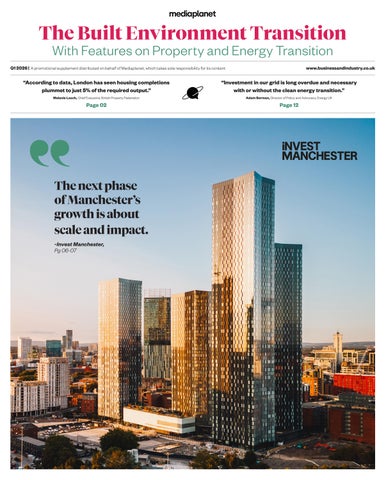
The next phase of Manchester’s growth is about scale and impact.
~Invest Manchester, Pg 06-07

WRITTEN BY Paul Richards Chief Executive Officer,
A bigger voice – solving bigger problems
The built environment is crucial to national success, and it seems too obvious to point out.
Let me provide numbers: it’s 24% of the economy (on a GVA basis) and employs 12% of workers.1 Recent calculations show that the commercial property industry pays £18 billion in tax 2 and its investments are worth almost £1 trillion. 3
UK real estate helps propel economic growth
On some measures, UK real estate is bigger than UK financial services. Perhaps it’s time we started thinking of real estate — the buildings that surround us — in the same way as the financial conurbation: a collection of villages joined by common interests and infrastructure. After all, it’s the homes, warehouses, laboratories, primary schools, offices, data centres, doctors’ surgeries and other essential assets that push economic growth upwards and carbon emissions downwards. And builders, developers, architects, property funds and other real estate villages
It’s the homes, warehouses, laboratories, primary schools, offices and other essential assets that push economic growth upwards and carbon emissions downwards.
have a material interest in the sector’s success.
I’m writing as chief executive of the Association of Real Estate Funds — the trade body for investment funds that finance such buildings. Fairly soon, we’ll combine with peers to create a new association, Real Estate:UK, to better demonstrate the value of the built environment and to harness the sector’s opportunities.
Ensuring a balance and pipeline of investments British defined benefit pension schemes used to hold more property. But, as their members retire and pass away, they’ve reduced this holding, so it’s vital we encourage replacement finance.
One AREF member recently devised a brand-new fund type to help solve this. As his idea becomes reality, we’re likely to see investments in more social and economic infrastructure — hopefully even large institutions addressing the issue of homelessness.
As AREF becomes Real Estate:UK, our members will continue investing for a more secure financial future for their fund holders, representing millions of hardworking people. They’ll also continue investing in a more secure future for our society and environment.
References:
1. McKeogh, N. The Built Environment Sector. NLA.
2. Property Industry Alliance. (2024). Property Data Report 2023.
3. IPF Research Programme. (2025). The Size and Structure of the UK Property Market: End-2023.
Addressing the challenges in UK real estate

Reforms are underway to help revitalise UK real estate in 2026 and beyond
It’s been a challenging few years for UK real estate. High debt and finance costs, material and labour price increases and novel and cumulatively burdensome regulations have added to the ballast that a development must carry before it can create a penny in return to investors.

This has led to a viability challenge, even a crisis, across the country. According to data from Molior Consultancy, London has seen housing completions plummet to just 5% of the required output in 2025.
Pursuing planning reform with a ‘build, baby, build’ mantra
The fundamentals are there for the UK. It has a government with a large majority overtly committed to growth and to new housing and other development. There are investment opportunities across sectors as diverse as residential, mixed-use, logistics, advanced manufacturing, labs, data centres and multiple infrastructure sectors. Our long-term assets of the rule of law (and contract), the English language and cultural attractiveness remain compelling.
Promising start for UK real estate
For these reasons, 2026 should
Many of the planning and other reforms the Government undertook in its first 18 months should bear fruit. Interest rates are coming down slowly, easing finance costs and delays at the Building Safety Regulator (the biggest cause of frustration for our members) are reducing. Of course, nothing is certain, and global politics remains volatile, especially with the USA, the single biggest investor nation in UK real estate.
The British Property Federation (BPF) has advocated for the UK’s property sector for over 60 years, responsible for 5% of the country’s economy and accounting for 1 in 12 jobs, according to a report we commissioned. Later this year, we’ll be turbocharging this advocacy by merging with the Association of Real Estate Funds (AREF) and the Investment Property Forum (IPF) to form Real Estate:UK, creating a more powerful and effective single voice for the UK’s real estate sector. We’re excited for our next chapter supporting this vital sector for the UK’s growth and the health of our communities.
@Mediaplanet UK & IE
Project Manager: Charlie Mai Weddell charliemai.weddell@mediaplanet.com
Interim Managing Director: Sarah Muir | Lead Designer: Ellen Cahill | Interim Content Manager: Rachelle
unless otherwise specified
The rise of data in institutional property investment
Data is transforming institutional real estate investment, enabling high-volume asset analysis, predictive modelling for investment strategy and automating operations, reporting and asset oversight.

Institutional investors are large organisations that invest money professionally, including pension funds, insurance companies, large asset management and real estate funds. These investors add large-scale properties to their portfolio, bringing in greater capital, portfolio diversification and long-term investment strategy.
Simon Todd, Group Head of Real Estate, JTC, explains:
“Institutional capital plays a fundamental role in the real estate sector, driving investment strategies that are increasingly professional, data-driven, and governed by robust reporting standards. The presence of institutional investors ensures a greater focus on governance, transparency, and long-term performance across the industry.”
Data transforms institutional real estate investment
Traditionally, real estate investment management relied on manual analysis, broker relationships and historical sales data. In today’s digital age, data and analytics are changing the way large professional investors buy, manage and evaluate real estate. Todd explains how the scale of institutional investment is driving a new level of sophistication in how data is managed and used across the asset lifecycle.

“Large institutional portfolios generate huge volumes of data, from property-level operational metrics to fundlevel reporting,” he explains. “Managing that information securely and with strong data integrity is fundamental to the custodianship of those assets.”
How heat networks can play a major role in the UK’s energy transition
Heat networks are an important part of the UK’s lowcarbon future. Their benefits include energy efficiency and resilience, and for the built environment, better placemaking.
If the UK is to meet its ambitious 2050 net zero targets, it needs to decarbonise space heating, a major source of greenhouse gas emissions. That’s easier said than done because more than 70% UK homes and businesses rely on gas heating.1
Heat networks can make a big difference. It takes heat from multiple energy sources — which can be surplus heat like wastewater plants, factories and data centres — and delivers via a shared infrastructure of insulated pipes to buildings across a neighbourhood.

“It makes sense to use heat we’re already producing to heat homes and businesses,” notes Charles Robson, who leads the Clean Heat team at Burges Salmon, a legal advisor for the Government’s Heat Network
“There’s growing expectation that AI tools will democratise information access across the asset management process, with key benefits including predictive modelling for investment strategy, and the automation of operations, reporting and asset oversight.”
Future of institutional real estate: transparency, efficiency and insight
According to research from Morgan Stanley, around 37% of tasks in the real estate sector could be automated using AI, representing around $34 billion in operating efficiency gains by the year 2030.1 Todd highlights that while this will have a transformative effect on the industry, real estate is still a “people trust people” environment, recognising the ongoing need for human relationships and personal connection.
“The most significant benefit of AI integration will be time,” explains Todd, “Real estate experts will be freed up from routine data processing tasks to focus on higher-level strategic analysis and decision-making.”
“There’s a perception that real estate is a simple asset class, but in practice, there are significant nuances in investor requirements, return expectations and risk profiles,” he explains. “Meeting those changing demands requires a highly analytical approach, with data playing an increasingly central role in investment decision-making.”
References: 1. Morgan Stanley. (2025). How AI is reshaping real estate. https://tinyurl.com/mv8879w9.

Transformation Programme. “It’s heat that would otherwise be wasted.” Multiple sources also make the system resilient. Plus, because these networks can store excess electricity as heat, they can help balance supply and demand on an overloaded electricity grid and alleviate capacity demands on local electricity grids.
What heat network zoning means for developers
Heat networks aren’t a new idea: Nordic countries have been using them for decades. Yet they currently supply just 3% of UK heat.2 So why are we behind?
“It’s demand risk,” says Robson. “Understandably, private investors want to know that enough people will take heat from the network to justify the capital investment.
But there’s been good progress in building district heat networks in recent years, and now the Heat Network Transformation Programme is intended to move the dial.”
Zoning involves the Government identifying zones where heat networks provide the lowest-cost, low-carbon heating options; then introducing regulations that require certain building categories to connect to heat networks.
Heat network infrastructure should be factored in at the masterplanning stage, alongside other utilities such as power, water and data connections.
“Heat strategy and networks will form a major part of masterplanning for new developments — especially when you take into account zoning,” says Ros Harris, Partner in the Burges Salmon real estate team. “It involves thinking about heat on a neighbourhood, estate or wider basis, rather than an individual building approach, and should be an earlystage consideration. Heat network zoning offers a great opportunity for collaboration and integrated thinking between planners, developers, local authorities and other stakeholders.”
References:
1. Department for Energy Security & Net Zero & Department for Business, Energy & Industrial Strategy. (2021). Heat and building strategy (accessible webpage). https://tinyurl.com/4j9r6duf.
2. Department for Energy Security & Net Zero. (2024). Heat network zoning: overview. https://tinyurl. com/2ra9mmz4.


INTERVIEW WITH Simon Todd
Group Head of Real Estate, JTC Group
WRITTEN BY Bethany Cooper
INTERVIEW WITH Ros Harris Partner, Burges Salmon
INTERVIEW WITH Charles Robson Director, Burges Salmon
WRITTEN BY Tony Greenway
Why energy-enabled logistics is critical to the UK economy

LPaid for by Prologis

system that is clear, consistent and focused on delivery.
The proposed reforms to the National Planning Policy Framework are therefore significant. Greater certainty would give investors like Prologis the confidence to commit capital — unlocking jobs, growth and the infrastructure the UK needs.

The UK’s economic performance rests on the strength of its supply chains. From advanced manufacturing and life sciences to retail and construction, every sector depends on resilient, well-located logistics facilities.
ogistics is no longer simply about distribution. It underpins growth, supports the energy transition and shapes regional competitiveness. As consumer demand evolves and operations become more technology-driven, the customer requirements we see in the market are rapidly changing. Electrification, automation and digitisation are increasing power demand, while many businesses face mounting pressure to decarbonise.
A challenge, but also an opportunity Well-planned logistics parks can provide the physical and energy platform that the modern economy
needs. Large-scale rooftop solar, battery storage, EV charging and grid capacity can be designed in from the outset, rather than retrofitted later.
In doing so, logistics real estate becomes part of net zero delivery. It enables customers to electrify their fleets, operate more efficiently and cut emissions, while strengthening domestic supply chains and attracting long-term investment.
Policy must keep pace Planning reform, grid investment and energy strategy need to reflect the realities of modern supply chains and rising power demand. Development at scale requires a
Spatial Development Strategies also offer promise. By aligning housing, employment land and transport across functional economic areas and grounding decisions in labour markets and supply chains, they can provide a more coherent framework for growth.
For too long, logistics has been an afterthought in strategic planning. Yet it supports almost every part of the economy. Recognising its role in national prosperity and the energy transition is essential if the UK is to compete effectively.
At UKREiiF, conversations will centre on unlocking development and attracting investment. With planning reform and energy policy moving in step, there is a real opportunity to deliver energy-ready logistics at the scale the economy demands.
At Prologis, we take a long-term view. Properly planned and properly powered, logistics real estate is fundamental to the UK’s economic future.
From promise to proof: turning talk into development
The property sector is rich with ideas, ambitions and panel discussions. The real test now is moving beyond talk and committing to tangible development that delivers homes, regeneration and long-term value for communities.

WRITTEN BY Nathan Spencer Director, UKREiiF
From conversation to construction
The UK property and infrastructure sectors are no strangers to big ambitions. From housing delivery and regeneration to sustainability and infrastructure investment, the industry is full of strategic vision – but vision alone is no longer enough. The challenge is to close the gap between conversation and construction and take shared responsibility for delivery.
Progress in real estate rarely happens in isolation. It depends on collaboration between local authorities, developers, investors and communities. When these groups come together with clear purpose and the will to act, discussion becomes decision-making, and decision-making becomes delivery.
Collaboration in action
unlocked opportunities and driven regeneration.
Local authorities bring place-based knowledge, strategy and land; the private sector contributes investment, delivery expertise and commercial momentum. Together, they unlock sites, accelerate programmes and turn ambition into real projects.
Regeneration in particular demands this collective effort, alongside the confidence to act.
Progress in real estate rarely happens in isolation. It depends on collaboration between local authorities, developers, investors and communities.
Across the UK, partnerships between the public and private sectors are already demonstrating what can be achieved when intent turns into implementation. At UKREiiF, examples include Stoke-on-Trent City Council and Capital & Centric, Torbay Council with Milligan and Willmott Dixon, and Hull City Council with ECF, showing how aligned stakeholders, coming together to talk face-to-face, have
From words to deals
Strategy sessions can only take projects so far. The tipping point comes when intent becomes proposals, structures and delivery plans - agreeing terms, committing resources and setting timelines.
The key question is no longer “what could we do?” but “what are we prepared to commit to now?”
Proof of progress
The UK’s development challenges will not be solved by discussion alone. They demand collaboration, commitment and action - turning today’s conversations into tomorrow’s developments.
WRITTEN BY Jason Longhurst UK Head of Sustainable Investment & Partnerships, Prologis
Understanding the opportunities and challenges of data centre development

As data centre demand rises exponentially, stakeholders need to navigate strategic and legal challenges in a complex and changing landscape.

“There’s a growing acceptance that AI is going to materially change the way we live and work,” says Tom Baines, Partner at international law firm Gowling WLG. “So, the question is: How much new infrastructure will be needed to support it?”

If the estimates are right, the answer is: an immense amount. It’s this expectation currently driving the rapid growth of data centres across the world. While the US remains the biggest data centre player globally, Europe and the UK are seeing significant growth — and demand is rising.
This rise in demand is changing the data centre delivery landscape. For instance, London has long been the major data centre hub in Europe, but a shortage of power and land is pushing projects into the regions.
Evolving nature of data centres
Data centres have been around for longer than many realise. But the meteoric rise in data creation, and processing demands of AI language learning models, are driving the need for bigger facilities. “At one end of the spectrum, there are ‘edge’ data centres, typically small and located close to urban conurbations to support systems that need real-time responses,” explains Jocelyn Paulley, Partner, Gowling WLG. “At the other end, there are ‘hyperscale’ data centres, which are huge and highspec.”
The technology underpinning data
centres is also rapidly evolving. The pool of people who know how to build, develop and operate these facilities is small, so competition for their skills is fierce. The past year has seen high profile collaborations between data centre operators and property companies, marrying expertise with land banks and development pipeline.
Challenges of data centre development
Although data centres serve many different purposes, they all share the potential to create legal and strategic challenges for operators, developers and investors.
“Firstly, finding the right location for a data centre is key,” says Baines. “Edge data centres need to be close to end users for latency, while those designed for AI machine learning can be further away.” Crucially, though, whatever type of facility is mooted, it will need proximity to power. This can often be the most significant obstacle; getting projects connected to the grid can take as long as a decade, with little comfort offered around timescales.
This lack of certainty can make projects difficult to get off the ground. The planning process — another pain point for developers and investors — can also be frustratingly slow.
“It’s why operators and developers are looking at former industrial sites with established power connections,” says Baines. “These sites are ‘ovenready,’ they can reduce uncertainty and significantly de-risk a project.”
Occupier risk
Securing an end-user is often crucial
to make a project financially viable.
“A further issue is that data centre owners will need to find a main occupier in order to secure funding needed for development,” notes Paulley. “Many will prefer a hyperscaler because these are big businesses that offer the guarantee of strong financial covenants. However, hyperscaler customers impose strict contractual requirements on operators for service levels and ensuring the developments go live on time, with credits and payments due if those measures are not met.”
Any delays could result in substantial penalty payments for developers, and missing service levels will result in potentially hefty credits, further increasing their risk profile.
Seeking crucial advice from experts in a high-stakes
sector
For these and many other reasons, stakeholders will require end-to-end support from legal professionals who know the data centre delivery environment well and have expertise in issues such as real estate development, energy, planning, funding, compliance, commercial contract law and leasing.
“This is a fast-moving, highstakes sector,” says Baines. “Those operating in it need advice from an interdisciplinary team of specialists who have an ingrained understanding of the challenges of data centre delivery, how these projects differ from other developments and what it takes to make them successful.”


Paid for by Gowling WLG
INTERVIEW WITH Tom Baines Partner, Gowling WLG
INTERVIEW WITH Jocelyn Paulley Partner, Gowling WLG
WRITTEN BY Tony Greenway
How Manchester is becoming a global leader in manufacturing, life science, tech and creative industries
Learn how Manchester is achieving economic success, bringing high-value employment and improving liveability by investing in key industrial clusters.

Manchester’s transformation from postindustrial decline to sustained, above-average growth has been widely documented, but the real significance lies in how that growth has been delivered and what it enables.
Cllr Bev Craig OBE, Leader, Manchester City Council
Manchester’s approach has been grounded in longterm leadership, economic diversity and a clear focus. Rather than chasing short-term returns, it invested in the fundamentals that underpin investor confidence: skills, health, infrastructure and neighbourhoods that support everyday life.

That strategy has paid off. Life expectancy is rising, reflecting continued action on inequality and public health. The city has also undergone a major skills transformation, with the proportion of workingage residents without formal qualifications falling dramatically.
Improving Manchester’s liveability
A healthier, better-skilled population strengthens productivity, supports business growth and underpins long-term demand for housing, workspace and services. Our population is rising rapidly, with over 100,000 living in the city centre. To support this, we’re deploying a detailed housing strategy, creating thousands of homes at all levels of affordability in neighbourhoods in the city centre and beyond.
Attracting major international events like the Brit Awards has cemented Manchester’s reputation as a cultural hive, improving global visibility and acting as a talent magnet, enticing companies of all sizes and industries. Manchester’s economy is deliberately broad, enabling it to remain resilient and create an attractive entrepreneurial ecosystem that encourages cross-sector collaboration and R&D.
Backed by our universities, established innovation clusters like The Oxford Road Corridor and new districts like Sister and MIX Manchester, the city is creating the conditions for business growth.
Having a resilient market for investment, with depth and momentum, the next phase of Manchester’s growth is about scale and impact. We need to translate investment into wider opportunity; creating jobs, homes and a vibrant economic core that benefits everyone.
Joe Manning, Managing Director, Invest Manchester
For the third consecutive year, Greater Manchester has attracted more foreign direct investment than any other city region outside of London. Over 2,000 foreign-owned companies are based here, from global names like Google, Amazon, IBM, Siemens, Puma and BNY Mellon to fastgrowing businesses choosing Greater Manchester as the
place to scale.
Sectors driving investment
The sectors driving that investment span advanced manufacturing, life sciences, creative digital and tech and financial and professional services. Developments like Atom Valley, spanning Bury, Rochdale and Oldham, cover over 2,500 acres and represent one of the most significant manufacturing and logistics development zones in Europe.

In life sciences, the Oxford Road Corridor brings together the University of Manchester, Manchester University NHS Foundation Trust and a growing cluster of biotech and medtech businesses. The proximity between academia, clinical expertise and industry creates advantages difficult to replicate elsewhere.
Greater Manchester’s digital and tech economy is the largest outside London. MIX Manchester, sitting adjacent to Manchester Airport, offers two million square feet of manufacturing, R&D, laboratory and office space, and is the only major science and manufacturing campus in the UK with direct access to an international airport.
Part of what makes this work is the talent pipeline, with five universities producing 120,000 graduates a year, and we retain over half of them, the strongest rate outside London. They stay because of career opportunities, but also because Greater Manchester is a place people actually want to live. That combination of talent supply and retention is something international businesses consistently tell us matters when they’re making location decisions.
With Greater Manchester competing with European cities such as Lyon, Munich and Barcelona, for businesses weighing up where to locate in the UK, the track record speaks for itself.
Mark Robinson, Director of Economy and Place, Rochdale Borough Council
Greater Manchester’s coordinated approach to development and its long term economic vision is creating the right conditions for advanced manufacturing, materials and machinery businesses to plan for growth from the outset.
Atom Valley, one of the UK’s most significant emerging innovation clusters, contains established employment locations: Kingsway Business Park and Stakehill. These sites already accommodate major manufacturers and supply chain activity, giving the wider programme both scale and a solid commercial foundation. Strong existing transport connections offer manufacturers reliable public transport access,
WRITTEN BY
Cllr Bev Craig Leader, Manchester City Council
WRITTEN BY Joe Manning Managing Director, Invest Manchester

proximity to major highways and established commercial facilities.
Atom Valley’s unique growth opportunity
The Atom Valley Mayoral Development Corporation will build on what already exists by delivering further development ready employment land, supported by planned housing and transport improvements at Northern Gateway. This will make it easier for businesses to access the people, suppliers and services they need across Greater Manchester.
Designed to close the gap between research and production, Atom Valley will work with the region’s world class universities to speed up the route from innovation to commercial manufacturing.
Alice Webb, CEO MediaCity & dock10
Greater Manchester has always recognised the power of the creative industries to drive growth, jobs and sustainable businesses. Their newly launched £1bn Good Growth Fund focuses on five core growth sectors, of which Creative Industries and Media is one. Its ambition is to double the size of Greater Manchester’s MediaCity over the next decade. Long-term, stable support for creative businesses attracts investment, but also fuels a real sense of identity and pride, which itself attracts the best creative talent. It’s a virtuous circle Greater Manchester has been committed to, and the results speak for themselves: the region has the highest percentage of creative businesses outside London and the South-East.


Through long-term investment, new global connections, contracts, products and more talent, we’re accelerating its evolution.
How creative clusters play in Greater Manchester’s creative industry growth
Creative clusters like MediaCity turbocharge growth, not just locally, but internationally. Scale matters — to enable meaningful careers for a largely freelance workforce and attract investment from foreign partners; to unlock skills pathways, which only become viable through partnership and scale, not to mention bringing creative talent that thrives on connection and networks.
Businesses in MediaCity benefit from Greater Manchester’s longterm strategic vision for creative industries, but can also tap into all it can offer as a leader for innovation, immersive technology and content and media production. Through long-term investment, new global connections, contracts, products and more talent, we’re accelerating its evolution, which will unlock more opportunities for businesses to thrive here.
Liz Bamber, Director of Place, Sister Manchester
Manchester has always been a city of firsts — from splitting the atom to the birth of the first programmable computer. Our culture of innovation — especially in science and technology — is nurtured by collaboration between world-class academic institutions, industry and entrepreneurs.
Greater Manchester’s role in driving the life sciences sector
This ‘Triple Helix’ provides life science businesses with a faster route to market, giving leaders the guidance and support they need to grow an idea into a successful venture. Crucially, Manchester provides this ecosystem with a competitive cost of living, helping businesses’ capital go a bit further.
Growing a life science business requires a 360-wrap-around ecosystem. From navigating the regulatory landscape to accessing the latest research, it takes a community to raise an idea. Sister’s role is to connect the drivers of innovation, bridging entrepreneurs, academics, investors and industry experts to propel growth-ready businesses forward.
With growth at twice the UK average and a population boom that will see 250,000 residents in the city centre by 2035, the scale of opportunity in Manchester is undeniable. We offer the affordability and space the capital lacks, but with the culture, connectivity and talent of a global city. Manchester isn’t just growing; it’s leading.

WRITTEN BY Mark Robinson Director, Economy and Place, Rochdale Borough Council
WRITTEN BY Alice Webb CEO, MediaCity & dock10
WRITTEN BY
Liz Bamber Director of Place, Sister Manchester
Real estate’s next chapter of innovation

Over the past decade, real estate has navigated a wave of PropTech, piloting new solutions and exploring what’s possible.

WRITTEN BY Sammy Pahal
Managing Director, UK
PropTech Association/ Director, British Property Federation
That period of experimentation has delivered valuable learning, generated data and helped the industry build confidence. But the next chapter is less about adding more tools and more about fixing the foundations and the plumbing beneath them.
Connecting over layering technology
Chairing a panel with leaders from Grainger, British Land, Indurent and Canary Wharf Group, a consistent theme emerged: the industry is shifting from layering technology on top to revisiting how it all connects.
The industry is shifting from layering technology on top to revisiting how it all connects.
The “plumbing,” i.e. the sensors, integrations, data flows and processes that carry information from assets into operational and investment decision-making, is increasingly recognised as critical infrastructure.
Across the sector, shared priorities are becoming clearer:
• Simplifying fragmented tech stacks
• Improving how data flows from buildings into core systems
Meet the team at UKREiiF or connect at any time to progress your projects.
• Building robust, connected data lakes
• Strengthening the processes that sit around technology
• Creating incentives that support adoption and highquality data input
As leaders explore AI-plus-human strategies, teams are confronting a simple truth: without clean, connected, well-governed data, even the smartest tools will underdeliver.
Technology should help, not complicate, jobs
At our kick-off event, British Land spoke about moving beyond pilots to embedding technology into core strategy. Grainger shared how becoming a more customer-centric B2C business has sharpened its approach to data capture. Indurent highlighted the advantage of being “legacy-free,” while Canary Wharf Group reinforced that technology should help people do their jobs better, not make them more complex.
The next chapter of real estate innovation won’t be defined by who adopts the most technology. It will be defined by who gets the basics right: foundations, plumbing, data, governance, skills and culture. Fix those, and everything else, including AI, flows.
Later this year, the British Property Federation (BPF), Association of Real Estate Funds (AREF) and the Investment Property Forum (IPF) will merge to form Real Estate:UK, creating a more powerful and effective single voice for the UK’s real estate industry.
The UK PropTech Association will sit within this new organisation, ensuring technology and innovation are at the heart of its agenda.


The future of London’s property lies in mixeduse neighbourhoods
The rise of mixed-use London: how the capital is redesigning the way we live and work.
For much of the past century, property development followed a simple formula. Cities were divided into distinct zones: offices in one place, retail in another, housing somewhere else entirely. That model shaped how London grew, but it’s no longer how the city — or its property market — functions.
The future of property in London will be less about delivering standalone buildings and more about shaping neighbourhoods.
Developments that bring uses together, not separate them
This evolution reflects changing expectations. Hybrid working has altered daily routines, reducing the dominance of traditional commuting patterns. Retail has become increasingly experience-led, prioritising destination and interaction.
Demand for housing close to amenities, culture and green space also continues to grow. Developments that combine living, working and
leisure are proving more resilient because they respond to these overlapping needs.
Why diversified neighbourhoods are the future of property
London has already demonstrated the power of this approach. Areas such as King’s Cross, Elephant Park, Battersea Power Station and The Queen Elizabeth Olympic Park show how integrating workspace, homes, education, culture and public realm can transform underused land into thriving districts with longterm economic value. The lesson is clear: places succeed when they remain active throughout the day and evening, attracting people rather than simply accommodating them.
For investors and developers, diversified neighbourhoods distribute demand across sectors, helping assets perform through economic cycles. Strong public realm, cultural programming and transport connectivity are increasingly central to value creation, not secondary considerations.
The future of property in London will therefore be less about delivering standalone buildings and more about shaping complete neighbourhoods. As the capital continues to grow, success will depend on creating places that are flexible, connected and human-centred — environments designed not just for occupation, but for life.

WRITTEN BY Nick McKeogh Chief Executive, NLA
Energy Transition Pages 12-16


Delivering an electrified economy
The shift to clean, electrified power is driving a transformative energy transition, reshaping efficiency, infrastructure and long-term prosperity.
The UK is in the midst of a new industrial revolution. The energy transition is having farreaching consequences for the way homes and businesses use energy, and the new technologies that increasingly power our economy. We’re moving from a centralised fossil-fuel-driven system to a largely electrified economy powered by stable, secure and distributed clean power.
Electrification: renewal for society While this change may have its roots in combating the rising emissions that continue to change the climate around us, it has become so much more.
than a gas boiler. Electrified economies use 40% less energy than those reliant on more traditional fuels while reducing dependence on volatile energy imports.
Why is grid investment necessary?
Modernising the energy system is crucial to deliver the transition’s benefits and boost efficiency across the country.
Some infrastructure on our grid dates back to the 1920s, with the average age of an electrical transformer being 63. Modernising the energy system is crucial to deliver the transition’s benefits and boost efficiency across the country.
Electric vehicles use half the energy of internal combustion vehicles for the same distances, and heat pumps are an astonishing four to five times more efficient
Powering Britain’s energy transition: unlocking the UK supply chain
A fragmented UK supply chain could fuel significant economic growth with targeted action from the Government, investors and corporate organisations ahead of ED3.
UK electricity demand is expected to grow by 2-3x by 2050 as transport, heat and industry electrify, rising to as much as 760 TWh in NESO scenarios.
Paid for by
Roland Berger
Grid investment must step up dramatically: industry and Ofgem estimates suggest £170–210 billion in electricity networks by 2050, the largest expansion since the 1960s Supergrid.1 SMEs form the supply chain’s backbone, delivering transformers, switchgear, cables, protection relays and substation automation. Transformer and switchgear player Brush is a great growth story: investment to expand capacity and capability drove revenue to £150m over three years, culminating in Greenbelt Capital’s acquisition to fund the next growth phase.2 Yet most UK supply chain players don’t have the clarity needed to invest at the scale and pace required.
Investment in our grid is long overdue and necessary with or without the clean energy transition. A more efficient electrified energy system will help stabilise the costs of this modernisation.
Short-term flexibility could help reduce system costs by £30-£70 billion between 2020 and 2050, with flexible consumer use of power helping reduce the amount of distribution network investment required by 15%.
Less reliance on volatile international gas prices, lower costs of running the grid in the long term and a more flexible system able to deliver energy when we need it most — this is what our electrified economy should look like. With it will come thousands of skilled, well-paid jobs around the country, delivering prosperity straight to the heart of our communities.

Necessity of scaling domestic supply chain “Without targeted action from Government, investors, Ofgem and network operators, much of the net zero spend will flow to overseas OEMs rather than creating capacity, capability and high-value jobs in the UK,” says Geoff Versteeg, Senior Partner, Roland Berger.
The ED3 price control (2028-33) is make-or-break. Ofgem must provide certainty on network investment and funding mechanisms so the supply chain can scale now. “We must leverage the learnings from the Transmission price control and enable distribution network operators to create greater commitment and certainty with their suppliers now,” asserts Versteeg. Distribution companies must also step-up. “Qualifying as a supplier takes significant investment, these are multiyear framework agreements. We cannot compromise on quality, but DNOs need
to evolve procurement practices to operate more quickly and flexibly,” says Houda Ougaddoum, Principal, Roland Berger.
Government support needed Government initiatives like Great British Energy (£1bn “Energy Engineered in the UK” programme for domestic manufacturing), the Energy Supply Chain Taskforce and National Wealth Fund represent important first steps.3 However, they must be underpinned by a focused national supply chain strategy, explicitly prioritising high-value segments to build competitive advantage while strategically leveraging global supply chains elsewhere. Building capability across every value chain element risks diluting impact by spreading public and private capital too thinly. Roland Berger works across the ecosystem, advising grid operators, SME equipment suppliers, large corporates and private investors to accelerate growth and unlock investment at scale. “With the right support and prioritisation, targeted investment can catalyse hundreds of thousands of high-value jobs and ensure the energy transition is truly ‘built in Britain,’” concludes Versteeg.
References:
1. EnergyUK. Net Zero facts and stats. https://tinyurl.com/ mv43aaej.
2. BRUSH. BRUSH Group to be acquired by energy investor Greenbelt Capital Partners. https://tinyurl.com/mr42hpsx.
3. Great British Energy. (2025). Major boost for UK clean energy supply chains. https://tinyurl.com/5a4mzshx.


WRITTEN BY
Adam Berman Director of Policy and Advocacy at Energy UK
INTERVIEW WITH Geoff Versteeg Senior Partner, Head of UK Energy & Infrastrucure, Roland Berger
INTERVIEW WITH Houda Ougaddoum Principal, Energy Transition/ Value Creation, Roland Berger
WRITTEN BY Bethany Cooper
Delivering Britain’s energy transition: busting myths around net zero and the grid
As the UK moves towards clean power, our energy system is undergoing its biggest transformation. Yet, it’s clouded by myths that clean power isn’t needed and is unaffordable.

In fact, clean power will help keep costs down in the longer term and protect consumers from volatile gas prices like those we are seeing due to the conflict in the Middle East.
Clean power will shrink the grid, and we can decarbonise without major new infrastructure
Decarbonisation doesn’t mean using less electricity. As transport electrifies, heating moves away from gas, and industry reduces fossil fuel use, electricity demand will rise significantly.
At the same time, where energy is generated is changing. Offshore wind in the North Sea, high renewable output in Scotland and growing demand in the Midlands and South all require a grid built for today’s system, not the last century.
There’s no route to clean power without major investment in transmission and distribution. Through RIIO 3 and the Accelerated Strategic Transmission Investment programme, we’re enabling upgrades to relieve congestion, prevent bottlenecks and get renewable power to consumers.
This isn’t a blank cheque. Networks will be held to account on cost and delivery, but without expansion and modernisation, we cannot build a system
fit for the future.
Myth - Grid delays are unavoidable
Another myth is that lengthy grid connection delays are an unavoidable consequence of building more renewables. In truth, delays stem largely from system design.
For too long, viable projects have been stuck behind speculative ones, slowing economic growth and deterring investment. Businesses seeking to connect new sites or expand face similar outdated processes. Connections reform will unlock progress. By prioritising “ready to go” projects, physical delivery replaces paper ambition.
Myth - renewable systems are unstable
A power system dominated by wind and solar requires more flexibility, not less security and long-duration energy storage is crucial.
Long-duration storage captures excess generation during high wind or sun periods, releasing it when conditions or demand change. This reduces reliance on gas-fired generation, cuts exposure to volatile fuel prices and eases network pressure. Existing assets, like pumped hydro storage like Dinorwig in North Wales, are vital.
Powering the energy transition: how heat metering, smart data and heating controls are shaping the UK’s net zero future
In central London neighbourhoods, like Victoria, the energy transition is a daily reality for residents facing rising energy bills and ageing building infrastructure.
Across London, around 1 in 10 households is estimated to be in fuel poverty.1 Buildings account for around 37% of London’s total energy consumption,2 while heating homes contributes to nearly 18% of the UK’s greenhouse-gas emissions.3 In Westminster, home to Victoria, energy demand is substantial, with the borough consuming almost 7,900 GWh of energy annually across residential and commercial buildings.4
Providing smarter energy solutions


Addressing these challenges requires more than clean energy generation — it demands smarter ways to measure and manage consumption. With nearly four decades of experience in the UK energy sector, Secure supports utilities, housing providers and building managers with intelligent heat and smart metering solutions. By capturing precise consumption data, these systems improve billing accuracy while giving residents greater visibility and control over their energy use. Despite increasing digitalisation, only around 2.8% of UK households are currently on Time-of-Use tariffs,
limiting both cost savings and grid flexibility.5 Smart metering provides the foundation to address this gap, enabling consumers to shift usage to lower-cost and lower-carbon periods.
Enabling smarter grids
Beyond individual consumption, smarter grids require integrated, real-time data. Secure’s solutions combine bulk power monitoring, scheduling and power quality data into a unified platform, eliminating silos and enabling holistic grid visibility. Advanced analytics, demand side management monitoring and deviation accounting support accurate forecasting, compliance and efficient grid operations.
Actionable dashboards and power quality insights allow utilities to move from reactive management to proactive decision-making. This datadriven approach improves reliability, optimises asset utilisation and strengthens overall grid resilience.
Improving efficiency and sustainability Intelligent control technologies further enhance efficiency. Secure’s Radbot, an
intelligent thermostatic radiator valve, can deliver up to 30% energy savings by optimising heating without requiring behavioural change — particularly valuable in private dwellings, social housing and multi-occupancy buildings.
As regulations such as Awaab’s Law place greater emphasis on safe and healthy living conditions, accurate monitoring and efficient heating systems are becoming increasingly important.
Industry collaboration is also accelerating progress. Through initiatives like the BEAMA 2050 Connected Climate Commitment, Secure is working with partners to advance energy-efficient technologies to enable smarter, more sustainable buildings.
Ultimately, achieving net zero will depend not only on how energy is generated, but on how intelligently it is used. By combining accurate data, intelligent controls and actionable insights, smarter grid and metering solutions enable better decisions, stronger energy security and a more sustainable future.
References:
1. Greater London Authority. Economic Fairness –Fuel Poverty. London Datastore. https://tinyurl.com/ mrvn58r2.
2. DESNZ. (2025). Fuel Poverty Factsheet 2025. https:// tinyurl.com/48jkukep.
3. NAO. (2024). Decarbonising home heating. https:// tinyurl.com/2vv2rdft.
4. GLA. London Energy and Greenhouse Gas Inventory (LEGGI) – Data Explorer. https://tinyurl.com/3ubn3eeb.
5. Ofgem. (2026). State of the market report: energy retail market highlights. (2026). https://tinyurl.com/ mrh9754b.

WRITTEN BY Amit K Gupta Territory Head UK & Ireland,
Meters

UK can take global leadership for nuclear regulatory reform

Nuclear energy is regaining prominence as governments seek reliable, low-emission electricity.
Nuclear energy is back on the global agenda as governments seek reliable, low-emission electricity.
Global momentum
Delivering steady power, independent of weather and volatile fuel markets, makes nuclear vital for long-term energy security. More than 30 governments have endorsed the goal of tripling nuclear capacity by 2050.1 The emerging trend is clear: regulatory readiness will determine which countries convert ambition into delivery.
Strategic alignment across planning, environmental assessment and grid connection processes would further improve certainty for investors.
From
ambition to action
Worldwide, efforts are shifting from setting ambitions to creating the conditions needed for timely deployment. Analysis in the World Nuclear Outlook shows that the primary barriers to scaling nuclear aren’t technological, but organisational and regulatory. These challenges reveal a structural pattern common across advanced nuclear programmes: complex approval pathways, limited regulatory capacity and inconsistent interpretation of safety requirements. Overcoming these hurdles will require a change in mindset towards proportionate, risk-informed decision-making that
supports safe and predictable delivery.
The UK’s recent review, led by John Fingleton, sets out a structured route to accelerated deployment. It shows how the application of regulation — not the regulation itself — can create avoidable cost and delay. The principle of ‘as low as reasonably practicable’ has been over-interpreted toward excessive conservatism, prioritising minimisation over balanced, proportionate risk assessment. Restoring proportionality would help projects progress more efficiently while maintaining high standards of protection.
Strategic alignment across planning, environmental assessment and grid connection processes would further improve certainty for investors. A more coordinated system would extend beyond nuclear, supporting major infrastructure project delivery across the UK. Predictable, timely decision-making is essential for restoring confidence in delivery and boosting investor confidence.
Building leadership
The UK is well-placed to demonstrate how modern regulatory practice can enable rapid, safe deployment. Implementing the review’s recommendations, alongside clear political commitment, would show that large projects can be delivered at pace while upholding rigorous oversight. Demonstrable domestic success would strengthen the UK’s international position and open opportunities for collaboration and export of expertise. As global momentum builds, countries able to align regulatory culture with credible delivery will shape the next phase of nuclear expansion.
References: 1. World Nuclear Association. (2026). Global Energy Developments. World Nuclear Outlook Report.

Cut costs of public EV charging to keep the transition on track
The cost of public EV charging has been inflated by regulatory change. The Government can take action to make EVs affordable for all.

There are now nearly two million electric vehicles (EVs) on UK roads. Automotive manufacturers are hitting the targets set by the Government’s Zero Emission Vehicle Mandate. These have enabled the massive growth of charging infrastructure, including more than 118,000 EV chargers on the public network.1
The transport transition has accelerated out of ‘early adoption’ and into the mainstream. But like the wider energy transition, it’s being pitted against the cost of living.
Action must be taken on standing charges, equalising VAT and exploring the credit schemes available for EV charging.
Is cost a real threat to the transport transition?
Through the Government’s Electric Car Grant, the upfront cost of a new EV is reduced. The used EV market is increasingly healthy, with fantastic deals to be found. Most drivers will be able to charge affordably, thanks to low-cost off-peak home energy tariffs.
However, the cost of charging on public networks is a different story, having risen 38% since 2021.2 Charge point operators are finding innovative ways to offer affordable charging, but costs have risen to
a degree that the typical kWh price is significantly more than home charging.
This might work for a driver not fully reliant on public charging, but less so for those without a driveway, which will be increasing as EVs continue to gain traction.
What are the cost drivers?
Unlike home energy bills, it’s now largely policy that’s inflating the cost of public charging. Charge point operators’ standing charges have increased by as much as 462% due to regulatory changes.3
There are also fixed operational costs — those of installing and maintaining a network — meaning public charging prices will never equal home charging. But there’s also a higher tax, VAT, levied at 20% compared to the 5% on home energy.4
Action must be taken on standing charges, equalising VAT and exploring the credit schemes available for EV charging. The Government has a multitude of ways to address the cost of public EV charging and make it more affordable, and keep the transition on track.
References:
1. Zapmap. (2026). EV market stats 2026. https://tinyurl.com/3pzxt7uc.
2. Zapmap. (2026). EV charging statistics 2026. https://tinyurl.com/2raxnp6k.
3. ChargeUK. (2024). EV charging network can deliver half a billion miles of motoring every day. https://tinyurl.com/56cey5xt.
4. Wright, J. (2026). VAT on electric car charging should be cut to 5pc, tribunal rules. The Telegraph. https://tinyurl.com/2wd8rn2z.

WRITTEN BY Vicky Read Chief Executive, ChargeUK

Forget gas — this is the future of cheaper heating
The argument for keeping gas boilers has collapsed. New analysis proves low-carbon heat networks could soon be cost-competitive.

Chris Unsworth Head, ADE Heat Networks
For years, we assumed clean heat meant higher costs; that assumption is now dead. Our Clean Heat 2040 report shows that heat networks can be cost-competitive with running a gas boiler — this could change everything.
Gas boilers have met their match
Every time you pay a gas bill, you’re sending money to volatile foreign markets, and we have no control over those prices. Qatar sneezes, and British households catch the flu.
The Government then piles taxes onto your electricity bill to fund green schemes. If you try to switch to a clean option, you get penalised with higher running costs. We’re taxing the solution and subsidising the problem. British industry throws away enough heat to warm every home in the country; we vent it into thin air. Data centres glow with heat while nearby estates burn expensive gas; we’re quite literally burning cash. Heat networks fix this — they’re simple pipes that capture wasted heat from rivers, old mines or factories and pump it directly to your home. This severs the link between your heating bill and volatile global gas markets.
Untapped potential of heat networks
Heat networks could unlock over £100bn of investment and create 100,000 jobs, turning an unavoidable household cost into an engine for economic growth. We stop being held hostage by foreign gas prices and start

using what we already have.
The Government needs to act now. First, treat heat networks like the critical infrastructure they are. Give them the same long-term backing we give to technologies like offshore wind. Second, fix the electricity tax. It makes no sense to pile green levies onto electricity, actively penalising people who try to switch. Rebalance it onto gas to send a real signal. Third, give local authorities the tools to zone areas for heat networks. Let them connect places with free heat to the people who need it.
The heat is there, and the technology works. The only question is whether we have the guts to build it.
Accelerating the energy transition
