
Life Science Innovation
www.healthnews.ie
“The life science sector is changing worldwide, with moves towards data-driven healthcare.”
Dr Finnian Hanrahan, Scientific Programme Manager, Research Ireland Page 02

“Today, the innovation gap between Europe and global leaders underscores the urgency of reform.”
Eimear O’Leary, Director of Communications & Advocacy, IPHA Page 07

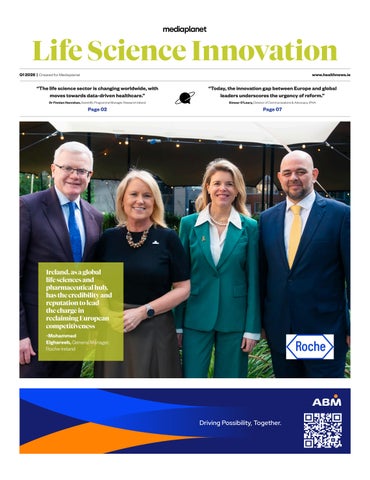
Ireland, as a global life sciences and pharmaceutical hub, has the credibility and reputation to lead the charge in reclaiming European competitiveness
~Mohammed Elghareeb, General Manager, Roche Ireland


Solving cold chain challenges in the biopharmaceutical sector
Ultra-low temperature (ULT) storage is essential, directly influencing research outcomes, manufacturing efficiency and the safe preservation of biological materials.


Q: What organisations typically face ULT storage challenges?
Any organisation using ULT freezers for applications other than stable, long-term storage will face challenges with cold-wall technology. In life sciences, biotech companies, contract development and manufacturing organisations (CDMOs), academic research labs and pharmaceutical manufacturers store materials at ultra-low temperatures and rely on cold-wall ULTs for that purpose. These organisations often store irreplaceable patient samples, sensitive biologics or high-value research materials, sometimes decades of research. When your work changes people’s lives for the better, safeguarding it is critical.
Q: What challenges do your customers face?
Access is a major limitation of traditional cold-wall ULT technology. These systems were designed for long-term storage of conditioned material with minimal, infrequent access requirements — and they’re good at meeting that need.
But what we’re seeing more — as the complexity of therapies evolves — is the use of cold wall ULTs in applications that require unit access 5-10 times per day and the storage of unconditioned material that needs to be brought down to ultra-low temperatures quickly and stored. Conventional ULTs weren’t designed to support these workflows and introduce significant risk.
Q: How is forced-air cooling different?
Forced-air technology actively circulates conditioned air throughout the chamber, creating a more uniform and
UK & IE
stable environment.
The system drives cold air across the stored material to reach target temperatures faster while maintaining conditions across the entire unit by consistently removing heat from the chamber.
FARRAR® CYCLONE™, the first forced-air convection freeze/store chamber, uses this principle to provide a solution to address the specific challenges biopharma companies experience when driving their workflows through traditional cold wall ULTs.
CYCLONE protects samples from temperature excursions while combining dual-purpose freeze-andstore capability in a single unit. It also prevents frost accumulation on walls, doors and gaskets, common in cold-wall ULTs.
Serviceability is also a challenge. Cold-wall systems usually require the unit to be taken offline and samples moved during thawing, cleaning and recalibration.
CYCLONE™ has a quick-change refrigeration system, which can be swapped without taking a unit out of service, without wiring or brazing, decreasing service complexity.
Q: What should organisations consider when selecting cold storage solutions?
Flexibility and scalability. Biopharma organisations often don’t know what materials they’ll be storing in the future, especially contract manufacturers with multiple clients.
Systems that can operate across a wider temperature range, from –20°C to –80°C, that can both freeze and store materials, and that accept a wide range of bottles and bags, provide more operational flexibility.
Contact information: ie.info@mediaplanet.com or +44 (0) 203 642
Strategic Account Manager: Kate McSwiggan kate.mcswiggan@mediaplanet.com Business Development Manager: Robert Joyce Interim Managing
Interim Content Manager: Rachelle Ong | Paid Media Manager: Jonni Asfaha All images supplied by Getty Images, unless otherwise specified

Dr Finnian Hanrahan Scientific Programme Manager, Research Ireland
|
Research’s role in life science evolution
Ireland has grown into a knowledge economy powerhouse, particularly in life sciences. Strategic investments and partnerships can help advance research and innovation in this area.
Ireland’s research and innovation story is one of transformation and achievement. It has become a knowledge economy powerhouse, particularly in life sciences, and boasts the highest university graduation rate globally.
Bubbling medtech ecosystem
The medtech sector employs 50,000 people nationally –the highest level per capita in Europe. This is particularly concentrated in the West. Around 1 in 10 working adults in Galway work in medtech, from large multinationals to a bubbling ecosystem of SMEs and startups.
The life science sector is changing worldwide, with moves towards data-driven healthcare, including advanced treatments like cell and gene therapies. These areas depend on strong links to the clinical research system, and enabling infrastructure like biobanks, registries and electronic health records. Research Ireland aims to foster and grow this vibrant life science research and innovation system. Ireland must be strategic and focus on areas where we have potential to make a difference.
Research and pharma deeply connected
Research Ireland has invested in CONCEPT – a facility
for early-stage biotherapy development at the National Institute for Bioprocessing Research and Training (NIBRT) in Dublin. It now contains some of the most advanced technology in the world for biologics, cell and gene therapies.
Similarly, Research Ireland Centres – a network of large-scale multi-disciplinary, multi-institutional centres of excellence – are operating at the interface between academia, industry, the healthcare system and society.
For instance, SSPC Research Ireland Centre for Pharmaceuticals has, over 16 years, developed deep connections with Ireland’s pharmaceutical sector, provided a pipeline of talent, worked with industry on the sector’s greatest challenges and led to the spinning out of high-tech startup companies such as the global-leading APC Ltd and the emergent ArrayPatch.
Research Ireland will continue to make strategic investments in medtech, pharmaceuticals and biopharmaceuticals. New paradigms like digital health and cell and gene therapies are increasingly being monitored. Achieving scale in these areas will enable Ireland to continue punching above its weight in life sciences.
Director Sarah Muir
Lead Designer: Ellen Cahill
Brandon Russell Marketing Leader, Life Science Solutions, Trane Technologies
David Moran Senior Product Manager, Ultra-Low Storage, Trane Technologies
WRITTEN BY
Bethany Cooper
A decentralised model allows blood centres to build their own local, scalable and highcapacity spray-dried plasma production.
Making plasma available where and
—
when it is needed
a game changer for global trauma care
Promoting plasma self-sufficiency and eliminating cold chain delays could transform emergency trauma care.

Richard Meehan President, CEO and Chairman, Velico
WRITTEN BY Tony Greenway
Richard Meehan has heard many horrific and tragic stories from doctors and first responders about preventable deaths caused by uncontrolled bleeding.
“You only need to spend three or four minutes with military or civilian clinicians to understand how critical immediate access to blood products is,” he says. “If someone is injured in an accident or on the battlefield and is haemorrhaging, their chances of survival are at least 30% greater if they’re given a transfusion of blood or a blood component such as plasma at the point of care.1 Yet, I’m continuously told of patients who die at the roadside because blood products weren’t available in time.”
Part of the challenge comes down to cold chain logistics, as blood and plasma must be frozen for storage and transportation. “Blood and plasma can take 40 minutes to defrost before they’re ready for use,” explains Meehan, President, CEO and Chairman of Velico, a company focused on developing blood-based technologies. “But in emergencies, minutes matter and 40 minutes can be too late for the patient.”
Minutes matter in trauma situations
Severe haemorrhage remains one of the leading causes of preventable death, and he sees a rare opportunity to shift that reality. “I didn’t begin my career in biotechnology,” he says. “But I’m now working in a field where, when we succeed, we have the potential to save tens of thousands of lives over the coming years and materially reshape the trajectory of emergency medicine worldwide.”
Meehan’s company aims to completely remove the need for a cold chain by developing a “plugin” manufacturing system that fits into existing labs and allows hospitals, blood centres and the military to produce their own spray-dried plasma in just half an hour.

Because the supply of dried plasma is constrained globally, the solution offers another benefit. Rather than relying on expensive shipments from centralised pharma factories, a decentralised model allows blood centres to build their own local, scalable and high-capacity spraydried plasma production.
“We live in an unstable geo-political environment, healthcare systems are seeking sovereign solutions,” says Meehan. “Decentralisation enables countries to manage their own plasma supplies and reduces reliance on external commercial providers.”
Lives saved from day one
Last year, a first-in-human Phase 1 safety trial for the company’s spray-dried plasma product yielded positive results, so Meehan hopes it will become commercially available in the next 18 months.
“When it does, the impact will be immediately obvious,” he insists. “Consider the time required for an air ambulance to reach an injured person in remote regions such as the Australian outback or the Rocky Mountains. The ability to administer plasma rapidly at the point of care could alter outcomes from the outset. We’ll see lives being saved from day one.”
“This is about human outcomes because haemorrhaging can happen to anyone,” says Meehan. “These lives aren’t just anonymous figures in clinical trials or statistics in trauma care. They’re people we know and love: your wife or husband, son or daughter, parents, neighbour, colleague or your community.”
Spray-dried plasma could save their lives. That’s why, in the next decade, he wants to see a global network of spray-dried plasma production facilities.
Sponsored by Velico

This is “a life sciences game changer” because the dried plasma is stored in an ultra-lightweight, flexible PVC bag (no fragile containers or spaceheavy storage needed) and can be rehydrated in the back of an ambulance or point of injury, and ready for transfusion in just two-and-a-half minutes.
“Trauma doctors worldwide have wanted this type of solution for decades,” he says. “For us, success isn’t defined by market share; it’s about getting dried plasma into every ambulance and into the backpack of every medic, so plasma is ready where and when it is needed most. ”
Reference 1. Cannon, J. (2018). Hemorrhagic Shock. N Engl J Med.
Clarity in uncertain times: Ireland aligns for life science leadership
From DETE’s consultation to ongoing sector dialogue, Ireland is turning planning into action, connecting bench to bedside (and home) to unlock jobs, competitiveness and better health outcomes.
With global tariffs, geopolitical instability and a widening competitiveness gap across Europe, the healthcare landscape can feel uncertain. What reduces uncertainty is clarity, and clarity comes from planning: scenario planning, long‑horizon planning and an implementable national strategy that aligns ambition with delivery.
When stakeholders are brought together early, and expert voices are channelled into a structured process, complexity becomes navigable, allowing Ireland to optimise the strengths, talent and infrastructure we already possess.
Benefits of having a Life Sciences Strategy
These months mark a turning point in Ireland, with the Department of Enterprise, Tourism and Employment (DETE) advancing the new national Life Sciences Strategy. HealthTech Ireland has long championed this, working with IDA, Enterprise Ireland and IPHA to advocate for a framework that strengthens human health and national competitiveness. It looks across the continuum, from laboratory bench to bedside, and into people’s homes through digital and connected care.
Other countries are already on later strategy iterations, and the evidence is consistent: mature, long‑term strategies deliver, attracting investment, growing talent, strengthening enterprise, improving competitiveness and importantly enhancing health outcomes. When health, industry and education align, society benefits. Ireland also reflects this shift. The DETE consultation last year opened meaningful channels for ecosystem input. The consultative work now underway, engaging member associations like HealthTech Ireland, alongside clinicians, innovators and partners, is surfacing real‑world pressures and opportunities at pace. This is grounding national planning in lived experience, making the landscape more navigable and enabling Ireland to better harness available assets.
Secrets to success
Recent geopolitical shocks show that what was once assumed can no longer be taken for granted. Technological excellence is no longer enough; those innovations already succeed globally. What will set Ireland apart is how quickly we learn, how coherently we act and how effectively we turn knowledge into impact. The moment is ours to act collectively, confidently and shape the next era of life science leadership.

Why digitalisation is Ireland’s real medtech advantage
Digitalisation is no longer a supporting act in medtech — it’s moving to the core.
Across Europe, the medical technologies sector has endured regulatory tightening, supply chain related stress and geopolitical uncertainty. Yet Ireland’s medtech industry has emerged not only as resilient, but as increasingly strategic because it’s prepared to embrace digital transformation at scale.
AI has moved decisively from concept to core capability. Medtech operations in Ireland are using machine learning to optimise manufacturing, improve quality and device performance and strengthen competitiveness. Digital workflows now sit at the heart of quality control and predictive maintenance, helping companies realise innovation and navigate regulation without sacrificing speed.
Ireland’s medtech story is no longer reliant solely on manufacturing excellence to deliver value — it’s also about innovation.
Ireland’s greatest asset — people
What truly differentiates Ireland is talent. The country ranks among the EU leaders in digital skills, providing companies access to engineers, data scientists and advanced manufacturing specialists who can work across physical and digital systems. In an era where value creation matters more than low cost labour, this capability is decisive. Ireland’s offering to global medtech companies has evolved — from access to markets to the ability to do more with better enabled people.
Digitalisation is also reshaping how healthcare is delivered. Robotics and minimally invasive systems continue to gain traction. Digital surgery tools are transforming training and procedural planning. Meanwhile, automation and digitalisation on the factory floor are driving productivity — not by replacing expertise, but by amplifying it.
Innovation: key to medtech excellence
Ireland’s medtech story is no longer reliant solely on manufacturing excellence to deliver value — it’s also about innovation. Global companies are increasingly locating R&D and data driven activities alongside established world renowned manufacturing operations, recognising Ireland’s collaborative ecosystem and proven ability to reliably bring complex products to market quickly.
As medtech becomes more digital, more data driven and complex, Ireland’s advantage is clear – it has aligned talent, technology and operational excellence at exactly the moment the industry needs all three.
How trade shifts, health system pressures and AI affect the Irish medtech sector
We operate in an interconnected marketplace, subject to global trends. To maintain competitiveness, we need the right policies and supports, such as an ambitious Government-led National Life Sciences Strategy.
Ireland is a global medtech hub, with 500 companies employing over 50,000 people, and €20 billion in exports. This is underpinned by high performing regional clusters including Dublin, Galway, Cork, Limerick and Waterford.
Dr Eoghan Ó Faoláin, Irish Medtech Director, said, “Our vision is to position Ireland as the leading global destination for medtech. The ‘Irish Medtech Strategy 2026 – 2029: Innovating for Patients, Driving Prosperity’ has been developed with industry leaders and international experts to help us achieve our potential.
Five key trends in medtech
To do this, we need to understand the global context and wider trends.
The first is about shifting to prevention and early intervention, as well as patient centricity and personalisation amid health system pressures. This is especially true with ageing populations and the rise of chronic diseases. Next is about data and tech integration, including AI enabled devices and robotics, connected and virtual care models, data as a value driver and digital manufacturing and 3D printing.
The third trend is about supply chain resilience amid global shifts in environmental, social and governance. This includes changes in regulatory requirements, sustainable operations, green procurement pressures and alternative sterilisation methods.
The next trend is about market access shifts. With more regulations and greater regulatory burdens, there’s a shift towards value based procurement and diverging global frameworks. The changing investor landscape also means greater competition for financing. Finally, there’s also a change in global talent dynamics. There’s a rising demand for technical skills. Recruitment is impacted by greater global mobility, increased cost of living and new approaches to ecosystem collaboration.
Committed to advancing patient care and economic prosperity
Irish Medtech is committed to connecting leaders and delivering on our strategic pillars, which focus on talent to thrive, innovation with impact, enterprise excellence, digital and AI leadership, as well as empowering founders.
By empowering both indigenous start ups and multinationals to navigate these shifts, we aim to transform patient care while driving economic prosperity.
Susan Treacy CEO, HealthTech Ireland

John Nugent Head of Medical Technology, IDA Ireland

Dr Eoghan Ó Faoláin Director, Irish MedTech Association

Why strategic facilities management delivers for the life science sector
Providing facilities management services in highly regulated life science environments is a challenge, but one that can be solved with technology, training and forward-thinking.
Facilities management is an absolutely critical function that has to run faultlessly at all times in the life sciences sector. “These are operationally complex and controlled environments that are developing products for patients,” says Chris Delaney, Director of Healthcare and Life Science Centre of Excellence Europe at facilities management provider Apleona. “So, it’s essential they remain uncontaminated, and their equipment is well-maintained.”

Apleona’s services — which include technical maintenance, specialised project and energy management, cleaning, waste management and security solutions, all delivered through a network of SME partners — are becoming increasingly data-driven. For example, the company uses AI for real-time monitoring to prevent equipment faults before they occur, and it deploys occupancy sensors to show how and when a building is used, helping identify where energy savings can be made.
our client partners?’”
Training infrastructure that supports talent development Yet she stresses that optimisation must never compromise compliance. For instance, cleaning operatives and maintenance technicians working in life sciences spaces must always be fully cognisant of and adhere to strict Good Manufacturing Practice rules.
“As a facilities management provider, we have to align with our clients’ policies, strategies and procedures,” explains Golden. “To do that, we ensure that our people on the ground are highly trained.”
We give operatives access to data via digital tools, but they must have the expertise and judgement to interpret that data properly.
“The facilities management sector used to be highly reactive,” admits Valerie Golden, Director of Operations at Apleona Ireland. “It was always, ‘There’s an issue that we need to fix — let’s fix it.’
Now it’s much more proactive, strategic and risk-based. There’s a lot more thinking ahead in a sector where organisations must be adaptable, flexible and audit-ready. We’re always asking, ‘How can we maximise efficiencies for
Smart factory, faster care for rare disease
It takes patients an average of 4.8 years and 7.3 specialist visits to receive a rare disease diagnosis. In rare disease medicine manufacturing, every second matters.

Advanced biologics and global distribution create a high-stakes balancing act: pioneer scientific discovery, protect quality and get medicines to patients faster. Scaling ultra-rare therapies presents unique challenges: small batches, complex analytics and globally dispersed patients.
“Our job is to overcome those challenges,” says Mike O’Donnell, Vice President, Technical Operations at Alexion, AstraZeneca Rare Disease. “Technical operations power everything from development to approvals to distribution. We’re designing with digital and AI tools that augment our already exceptional manufacturing practices.”
O’Donnell explains how role-based analytics ensure each team member gets the metrics and alerts that matter for their job. “So, we act faster, and only when it counts.” Harmonised GxP
In technical environments like these, subject expertise really matters.
To bridge the skills gap and develop talent, the company created its own training infrastructure and education programmes.
“We give operatives access to data via digital tools, but they must have the expertise and judgement to interpret that data properly,” says Golden. “Technology can automate a process — but (our operatives) optimise it.”
The best facilities management providers will offer an integrated, one-stop-shop solution that makes a real difference for life sciences clients, says Delaney. “It’s not about working for them,” he notes. “It’s about partnering with them — and becoming the engine room of their sites.”

data governance moves teams from manual trending to exception-based management and near-real-time decisions.
Build capability where the biology leads “We follow the science and the technology — science sets the direction; tech speeds the journey. Our priority is an end-to-end digital thread that drives continuous and connected processing.” The result is faster cycle times and more right-first-time outcomes, with less waste and energy per batch because innovation must not increase environmental footprint.
“We’re meeting our commitment to achieve carbon net zero by 2045 at pace,” says O’Donnell.
He cites Alexion’s transition later this year to biomethane to provide 100% of the heating needs at Dublin and Athlone manufacturing sites, HVO for road freight, 100%
Sustainable Aviation Fuel for freight to Europe and reduced water usage YoY. “We’re proving you can move faster for patients and lighter for the planet.”
Given the complexity and uncertainty of global supply chains, O’Donnell acknowledges the need for network resilience. “Predictive capacity modelling, digital supply chain twins — adaptability is built into our operations.”
Self-healing supply chain and human collaboration
The company is also enhancing systems for a “self-healing” supply chain — sensing disruptions early, correcting routine issues automatically and elevating complex decisions to expert teams quickly. The growing presence of parent company AstraZeneca is also increasing capacity at Alexion’s strategically critical Dublin campus, a legacy site.
“We’re cross-pollinating our rare disease manufacturing expertise with AstraZeneca’s technology and reach,” says O’Donnell. “A business-friendly ecosystem that includes the IDA, HPRA and a supportive government sector also supports us in delivering treatments for patients.”
That human collaboration can’t be underestimated, nor can talent.
“Technology can augment operations, but our people are our core,” says O’Donnell. “When we get people with the right attitude and aptitude into a room together, we can solve problems and drive creativity.”

Chris Delaney, Director of Life Sciences, Apleona Centre of Excellence
Valerie Golden, Director of Operations, Apleona Ireland
Mike O’Donnell Vice President, Technical Operations, Alexion, AstraZeneca Rare Disease
Read more at apleona.ie
Want to transform the lives of people living with rare disease? Explore opportunities with Alexion: careers. alexion.com/
Sponsored by Apleona
Sponsored by Alexion
WRITTEN BY Tony Greenway

Healthcare spending isn’t a drain on expenditure, but a strategic investment in ‘health and wealth.
From local action to global leadership: Ireland’s EU Presidency is an opportunity to reclaim European competitiveness
Ireland’s upcoming Presidency of the Council of the European Union in July arrives at a defining moment.

According to recent reports by the European Federation of Pharmaceutical Industries and Associations (EFPIA), Europe is losing competitiveness in the pharmaceutical industry due to a declining share of global R&D, clinical trials and slower access to new, innovative medicines.
According to EFPIA, the US is now attracting more than double the R&D investment in comparison to Europe and the European Economic Area’s (EEA) share of commercial clinical trials dropped from 22% to 12% in ten years, resulting in 60,000 fewer patients accessing trial places, while China’s share has doubled. The organisation has found that patient access to new, innovative medicines is generally slower and more unequal across Europe compared to other high-income regions like the United States.
Sponsored by Roche

Ireland: global life sciences and pharmaceutical hub Ireland, as a global life sciences and pharmaceutical hub, has the credibility and reputation to lead the charge in reclaiming European competitiveness while also strengthening the national life science ecosystem.
“This year will see Ireland hold the EU Presidency and the anticipated launch out of Ireland’s first-ever National Life Science Strategy. At Roche, we are advocating for a Strategy that creates a cohesive, crossdepartmental framework that fosters innovation, increases clinical trials, and accelerates patient access to new treatments”.
“The upcoming Strategy should reflect the fact that Ireland is pro-innovation and recognises the value of investing in healthcare innovation. Healthcare spending is not as a drain on expenditure, but a strategic investment in “health and wealth”. Such a stance would give Ireland great credibility on the global stage when it comes to leading EU-wide discussions on closing the innovation gap with the U.S. and China and the need to recognise the value of healthcare innovation”, said Mohammed Elghareeb, General Manager of Roche in Ireland.
National Life Science Strategy
The implementation of a National Life Science Strategy will build on the recent success of the IPHA Framework Agreement, a deal between Irish Pharmaceutical Healthcare Association (IPHA) and the Health Service Executive
(HSE), that governs medicine reimbursement— and includes a commitment to meet the legal 180-day timeline for approving new medicines, a significant improvement over previously faced delays of over 600 days.
“Change and improvement do not take place in isolation, and a partnership approach is crucial in order to have a real impact for patients, the healthcare system and wider society. Organisations such as IPHA and Health Tech Ireland nationally and EFPIA on a European stage are crucial when it comes to creating a collaborative environment to support the health of people in Ireland and across Europe, as well as contribute to the economy. In Ireland, we have seen great unity among the trade associations and members regarding the future of Ireland’s life science sector and the role we must all play to make this vision a reality”, continued Mohammed.
Ireland’s local actions—such as the National Life Science Strategy and the recent IPHA Agreement— provide a credible blueprint for a sovereign, innovative, and healthy Europe. Now, as we look toward the EU Presidency, Ireland is ready to lead.
founded
Mohammed Elghareeb General Manager of Roche Ireland
Ireland’s growing role in fixing the global pharmaceutical supply chain
Breakthrough treatments such as advanced vaccines and gene therapies are transforming how diseases are treated or cured. However, these bring a new challenge: safely transporting highly sensitive medicines across the globe.

Leandro Moreira President of Transportation, Frontier Scientific Solutions
Unlike traditional pharmaceuticals, many modern medicines must be kept within strict temperature ranges throughout their journey from manufacturing sites to hospitals or pharmacies. Even small deviations in temperature or handling conditions can compromise product integrity, making reliable, controlled transportation essential.
As pharmaceutical manufacturing has expanded globally, many logistics networks haven’t evolved at the same pace. Products often pass through multiple airports, warehouses and distribution centres before reaching patients, introducing risk, increasing dwell time and creating more opportunities for temperature excursions.
Creating solutions to better transport medicines globally
Frontier Scientific Solutions is among those building logistics infrastructure specifically designed for the life sciences industry, supporting both pharmaceutical manufacturers and the 3PL partners that manage their global distribution.
Rather than adapting traditional cargo networks, Frontier Scientific Solutions’ approach integrates temperaturecontrolled storage, handling, distribution and air transport into a single, coordinated system designed to protect sensitive medicines at every stage of the journey. This model reflects the emergence of Qualified Temperature-Controlled Corridors, where each step in the supply chain operates within a single, aligned framework to reduce risk and maintain product integrity.
Ireland’s role as a hub for pharmaceutical manufacturing Ireland sits at the centre of the EU–US pharmaceutical


Tmanufacturing and supply chain ecosystem and is uniquely placed to bring together the expertise and knowledge required for pharmaceutical manufacturers to efficiently and compliantly deliver therapies across global markets.
Building on this position, the Ireland–US corridor provides a more integrated and controlled approach to the movement of temperature-sensitive medicines between major global markets. Through this model, temperature-controlled storage, handling and transport are aligned to minimise handoffs, reduce dwell time and maintain consistent environmental conditions throughout transit — reducing complexity while ensuring products remain within tightly controlled parameters.
For Ireland’s life sciences sector, one of the country’s most significant industries, efficient and reliable global logistics are critical. As medicines become more complex, higher value and increasingly temperature-sensitive, supply chains must evolve to ensure therapies reach patients quickly, safely and in full compliance.
By combining purpose-built infrastructure with specialised transportation networks and aligning stakeholders across a single, qualified corridor, this approach strengthens supply chain resilience and performance, ensuring life-saving medicines move globally with the speed, control and reliability modern healthcare demands.
Breakthrough treatments such as advanced vaccines and gene therapies are transforming how diseases are treated and cured, but they also increase the need for highly controlled, end-to-end logistics capable of supporting these increasingly sensitive products at scale.
Positioning Ireland as a global leader in life sciences
As Ireland prepares to assume the Presidency of the Council of the European Union, the country stands at a pivotal moment for shaping the future of its life sciences sector.
he Irish Pharmaceutical Healthcare Association (IPHA), representing the international research based industry in Ireland, is calling for a cohesive national Life Sciences Strategy that focuses on innovation, competitiveness and most importantly, patient access.
Ireland’s life sciences ecosystem is one of the strongest globally, but its continued success depends on the country’s ability to evolve and adapt.
A rapidly changing global landscape — underscored by intensifying international competition, geopolitical uncertainty and an ageing population — demands a more strategic, future focused approach.
Wider impact of Ireland’s life sciences sector
Last year, the EU published its Life Sciences Vision, which Ireland
needs to align with. It outlined three strategic pillars: optimising research and innovation, enabling rapid market access and boosting trust through digital uptake.
Central to Ireland’s opportunity is the strength of the life sciences industry and its role in the economy. It’s a major employer, a driver of regional development and an anchor of high value investment.
A thriving manufacturing base spans the country, powering exports and supporting thousands of skilled jobs. Manufacturing alone is no longer enough. To remain competitive, Ireland must build a closed loop life sciences ecosystem — one in which research, regulation and healthcare delivery are seamlessly connected, allowing new technologies to be tested, adopted and scaled rapidly.
How policy reforms can drive growth IPHA’s vision for the National Life Sciences Strategy reflects an ecosystem that’s future ready, where the pricing and reimbursement system values scientific advancement, and where Ireland becomes an early launch market for breakthrough treatments and digital health solutions. The newly agreed IPHA Framework Agreement is a significant step, with the potential to deliver faster access to medicines and create the agility needed to respond to the next wave of medical technologies.
Today, the innovation gap between Europe and global leaders — highlighted in the Draghi Report — underscores the urgency of reform. The EU’s policy and legislative framework remains a major determinant of national competitiveness. With multiple policy files affecting the sector, Ireland must adopt a more coordinated, cross government approach — supported by a proposed Life Sciences Council — to ensure coherence and impact.
Ireland has the talent, infrastructure and industrial strength to lead in this era of transformative healthcare innovation. What it now requires is a unified strategy — spanning research labs to patient bedsides — that signals, unequivocally, that Ireland intends not just to participate in the future of life sciences, but to shape it.

Eimear O’Leary Director of Communications & Advocacy, IPHA
Digital switch fixes growing compliance risks


What are the key operational and compliance pressures facing regulated life sciences facilities today?
Dinny Crowe (DC): To guarantee their products are safe, effective and produced to the highest quality, life sciences companies must adhere to strict regulations from the FDA (US Food and Drug Administration), the European Union and other global regulatory agencies. That means their own staff in production and operations must follow strict compliance rules. External contractors from companies like ABM, who are delivering facility management services on site, such as cleaning laboratories, must also be compliant to ensure we don’t affect any part of the production process.
What challenge does this represent for you?

DC: For example, when our staff clean a laboratory in a highly regulated GMP (good manufacturing process) environment, everything must be tracked from start to finish. That includes the gowns worn by cleaners, chemicals in their cleaning products, tasks they complete, processes they use and the time the cleaning was carried out.
When these processes and procedures are recorded manually in paper-based logbooks, what can happen?
WRITTEN BY Tony Greenway
In the strictly regulated life science sector, digital technology allows facility management services to be carried out in a way that drives compliance and improves efficiency.
document and sign off on their work. They can’t skip a step, either, because once they scan into a controlled area using a QR code, the system won’t let them go further until they confirm they’ve completed the job.
Connect drives compliance by ensuring critical processes are executed correctly, reduces risks of errors and deviations, provides a regulatory and audit trail to show in real-time that compliance has been met and eliminates the need for paper logbooks. Plus, it reduces downtime, so it’s better for productivity, and it means a company is always audit-ready.
Any data is easily accessible to the company through a central data stack, enabling stakeholders to make datadriven, actionable decisions. How the data is shown can also be configured, so the client can easily access the most important data points they need for their business.
Digital solutions are compliant with regulations and perform the same function as paper-based systems, but far more effectively.
Peter Brogan (PB): Cleaners can clean a lab in a way that’s fully compliant with regulations. But if they don’t sign the logbook afterwards, because of time pressure or human error, as far as compliance rules are concerned, the cleaning didn’t happen at all. Or say there was a product failure, and an auditor requests cleaning records from a particular lab. Then it’s all hands to the pump while everyone hunts for the paperwork.
How do technology-enabled service partners support measurable performance improvement?
PB: Digital solutions are compliant with regulations and perform the same function as paper-based systems, but far more effectively. For example, we have a software platform called Connect, which allows teams to electronically
Eanna Kavanagh (EK): The system is also compliant with the FDA’s 21 CFR Part 11 regulations for secure and reliable electronic record-keeping. That’s an industry first and proving to be a differentiator in the marketplace. And it’s not only for use by cleaning staff. It’s scalable for any activity or service within that type of controlled environment, such as technicians managing and maintaining HVAC (Heating, Ventilation and Air Conditioning) systems.
How should site leadership approach digitisation in a GMP environment?
DC: In a controlled way. In any industry, organisations don’t suddenly stop using manual processes and switch to a digital solution. They’ll have a roll-out in a particular area, department or building with a proper lead-in time and training. They’ll run their traditional manual paperbased method alongside a digital system for months until they get to a place where everyone is fully trained and comfortable with the new way of working. When it’s apparent that there have been no deviations in the new system, a decision can be made to retire their traditional paper-based processes and move full-time to digital.

Peter Brogan Operations Director, ABM Ireland
Dinny Crowe Vice President, Operations, ABM Ireland
Eanna Kavanagh Senior Director –Transformation, ABM Ireland
Sponsored by ABM