Innovations in Patient Care www.HealthNews.ie
Supplement created for Mediaplanet
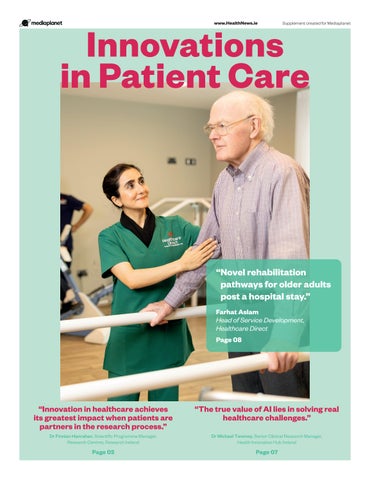
“ Novel rehabilitation pathways for older adults post a hospital stay.” Farhat Aslam Head of Service Development, Healthcare Direct Page 08
“Innovation in healthcare achieves its greatest impact when patients are partners in the research process.”
“The true value of AI lies in solving real healthcare challenges.”
Dr Finnian Hanrahan, Scientific Programme Manager, Research Centres, Research Ireland
Dr Michael Twomey, Senior Clinical Research Manager, Health Innovation Hub Ireland
Page 02
Page 07
AN INDEPENDENT SUPPLEMENT FROM MEDIAPLANET WHO TAKE SOLE RESPONSIBILITY FOR ITS CONTENT
Advancing patient care through research Investment in research and innovation is helping to deliver more personalised treatments, improved outcomes and better patient care.
B
Dr Finnian Hanrahan Scientific Programme Manager, Research Centres, Research Ireland
ehind every advance in patient care is a research journey. Whether it’s faster diagnosis, more personalised treatment or a better understanding of a patient’s needs, research provides the evidence and innovation that drive progress in healthcare. Across the Research Ireland Centres and wider research ecosystem, this work is helping transform how patients are diagnosed, treated and supported.
that wouldn’t have been available, delivering profound benefits for patients and families.
Patients as partners
In Research Ireland Centres, patients help shape the research from the outset. This patient-centred philosophy can be seen across the Research Ireland portfolio. At CÚRAM Research Ireland Centre for Medical Devices, patient engagement Precision medicine in practice helped identify pain and odour as Innovation in healthcare FutureNeuro, Research Ireland priorities in wound care, directly Centre for Translational Brain achieves its greatest impact informing the development of new Science, is an example of this solutions. when patients are partners impact. FutureNeuro is leading a Innovation in healthcare achieves clinical trial with Danish company its greatest impact when patients in the research process. UNEEG Medical in evaluating a are partners in the research process, small, implanted device capable helping ensure discoveries translate of continuously monitoring brain activity for up to 36 into meaningful improvements in care and quality of life. months. By capturing information that traditional tests Research Ireland continues to invest in research can miss, the technology has the potential to improve and innovation at scale. The recently launched epilepsy diagnosis, support more personalised treatment €460m funding for the Rinn Network includes new decisions and reduce the need for lengthy hospital stays. centres focused on medical devices, the production of FutureNeuro is also helping bring precision medicine patient-centric medicines, connected and digital health into routine care. Through advanced genetic testing, and cell and gene therapies. Through these efforts, the hundreds of patients have received definitive diagnoses focus remains the same: supporting research that not for neurological conditions. These diagnoses have led only advances scientific knowledge, but changes how to major changes in treatment or access to clinical trials patients are cared for and improves lives.
New medical devices centre turns ageing research into real-world devices for Irish patients A medical devices centre aims to enter a new innovation phase focused on healthy ageing.
R
inn Medical Devices is one of seven centres forming the Rinn Network, funded through Research Ireland. It builds on the work of CÚRAM, the Research Ireland Centre for Medical Devices that ran from 2015 to 2026. Prof Abhay Pandit Director of Rinn Medical Devices
Rose Anne Kenny Regius Professor of Physic at Trinity College Dublin
Medtech solutions for healthy ageing
According to Prof Abhay Pandit, Director of Rinn Medical Devices, the centre’s guiding principle is simple: “Our goal isn’t just a longer life, but more years lived well, mobile and independent in our own homes. Chronic conditions often arrive as we age, and our research tackles the most prevalent conditions associated with cardiovascular and neurological health, as well as cancer and inflammatory conditions.” Anchored within a dynamic ecosystem of researchers, clinicians, industry partners and innovators, Rinn Medical Devices will traverse the trajectory from discovery-based research to realworld health solutions and drive innovation in medtech to patients worldwide. At every step, patient
@Mediaplanet UK & IE
@MediaplanetUKIE
voices, experiences and priorities shape what they do, ensuring that the devices developed are not just scientifically sound but genuinely meaningful to the people they’re designed to help. The Rinn combines the significant academic leadership and expertise of scientists, engineers and clinicians from ten national Higher Education Institutes, including three Technological Universities. Every national partner brings its network of industry and international academic collaborators, infrastructure and alternative perspectives, all of which enrich the Rinn.
Experts developing meaningful devices
Rose Anne Kenny, Regius Professor of Physic at Trinity College Dublin and founding Principal Investigator of TILDA, the Irish Longitudinal Study on Ageing, is part of the leadership team at Rinn Medical Devices. For almost two decades, Regius Kenny and TILDA have tracked thousands of adults as they age, building one of the world’s richest pictures of how heart, brain,
mobility and cognitive health change with age. As Director of the Falls and Syncope Unit and the Mercer’s Institute for Successful Ageing, her clinical work already shapes how falls and cognitive decline are treated.
Multidisciplinary approach to design
“This depth of population-level and clinical insight is exactly what Rinn Medical Devices is designed to harness”, explains Regius Kenny. “Partnering with TILDA enables Rinn Medical Devices to draw on rich, longitudinal data, connecting population science, clinical insight and engineering to transform discoveries about ageing into devices for prevention, diagnosis and monitoring that are grounded in real-world need.” The Rinn will continue to improve the medtech innovation space in Ireland through multidisciplinary medical device innovation, integration of the patient voice in the research agenda and continued talent recruitment through PhD and postdoctoral training networks.
Contact information: ie.info@mediaplanet.com or +44 (0) 203 642 0737
Sponsored by Rinn Medical Devices
Find out more at rinn-medical devices.ie
Please recycle
Project Manager: Georgia McCutcheon georgia.mccutcheon@mediaplanet.com Business Development Manager: Robert Joyce Managing Director: Margot Thomas | Designer: Juraj Prikopa Senior Content Manager: Angelica Hackett O’Toole | Paid Media Strategist: Jonni Asfaha Digital Campaign Manager: Jan Martorell | All images supplied by Getty Images, unless otherwise specified
02
MEDIAPLANET
READ MORE AT HEALTHNEWS.IE
AN INDEPENDENT SUPPLEMENT FROM MEDIAPLANET WHO TAKE SOLE RESPONSIBILITY FOR ITS CONTENT
Global trials with local ICU impact Global clinical trials and patient partnerships are helping shape how critical care research reaches patients in intensive care units across Ireland.
T
Declan Devane Professor of Health Research Methodology and Scientific Director of the HRB-Trials Methodology Research Network
Niamh Mahon Project Manager, Irish Critical Care-Clinical Trials Network
he Irish Critical Care-Clinical Trials Network (ICC-CTN), based at University College Dublin, coordinates critical care research across Ireland and works with international partners to improve care for patients in intensive care units. In collaboration with the Health Research Board Trials Methodology Research Network (HRB-TMRN), the ICCCTN recently brought together international research leaders, early-career investigators and Patient and Public Involvement (PPI) researchers and contributors at the HRB-Trials Methodology Research Network (HRB-TMRN) 10th Annual Symposium. Participants explored how globally designed clinical trials can make a meaningful difference to local healthcare. The theme was ‘Making Global Care Local: Innovations & Collaboration in Clinical Trials.’
biological samples. A major highlight was a keynote address by Professor John Marshall (Founding Chair, International Forum of Acute Care Trialists), who offered a forward-looking vision on the evolution of platform trials in intensive care units (ICUs). He said international adaptive platforms are reshaping critical care research worldwide and can create opportunities for Irish patients to take part in major global studies that may influence future standards of care. Global trial networks also create professional opportunities for researchers early in their career. Participating in large research programmes allows them to build practical skills in innovative trial methods, work with international experts and lead specific trial areas, biosampling substudies and additional analyses projects.
Benefits of platform trials
Patient partnerships in trial design
The symposium focused on the future of platform trials and other innovative trial designs. Unlike traditional clinical trial models, platform trials test several interventions at the same time within a single, ongoing research structure. This shared structure can produce clinical answers faster, reduce administrative and financial demands and may require fewer patients to reach meaningful conclusions. Because the same trial structure stays in place, research teams can study several questions without building a separate trial from the ground up each time. Platform trials can also support precision and personalised medicine, including through substudies that collect
Sponsored by Irish Critical Care Clinical Trials Network (ICCCTN)
Patient and public partnerships were another focus, including the establishment of a new international PPI group that advises three global platform trials: REMAPCAP, PANTHER and PRACTICAL. The group brings together patient representatives from Ireland, the United Kingdom, Pakistan, Canada and Australia. Their lived experience helps inform how the trials are designed and run. By bringing together adaptive trial methods, institutional partnerships and patient input, the symposium showed how international trial networks can help bring advances from global trials closer to bedside care in Irish ICUs.
Find out more at iccctn.org
mTBI: An invisible injury with visible consequences Concussion needs to be recognised as an injury. While a concussion may happen in seconds, its consequences can persist for months or years. Our healthcare system must reflect that reality.
“
Dr Lisa Ryan Head of School of Health, Sport Science and Nutrition at Atlantic Technological University, and Research Lead for Sport, Exercise and Nutrition, Co-founder, Irish Concussion Research Centre
Written by Bethany Cooper Sponsored by Irish Concussion Research Centre – ATU
Concussion is not simply an acute event requiring shortterm symptom management and return-to-play decisions,” says Dr Lisa Ryan, co-founder of the Irish Concussion Research Centre (ICRC) at Atlantic Technological University (ATU). “It is a complex, multi-system injury with potentially significant physical, cognitive, psychological, nutritional and family consequences.” The ICRC is calling for a shift in how concussion is understood, particularly in sport. “Let’s stop using the word concussion and start talking about head injury,” says Dr Ryan. “It is an injury. If we don’t recognise it as such, we put pressure on players to get back to playing before they’re ready.”
Recovery needs to be holistic and personalised
While many people will recover well from a minor head injury, others are left struggling with persistent and sometimes poorly recognised symptoms, including changes in mood, sleep disturbance, light sensitivity and irritability.
READ MORE AT HEALTHNEWS.IE
“There has long been inconsistent recognition of these persistent or less visible symptoms associated with head injury, and many people are left without the specialist, multidisciplinary support they need,” says Dr Ryan. In their recent multi-cohort study of 401 athletes with a history of concussion, 62.1% of athletes with a history of concussion reported at least one gastrointestinal symptom. “These symptoms are poorly represented in standard concussion assessment tools,” explains Dr Ed Daly, Principal Investigator. “GI assessment and access to nutrition advice where symptoms persist could be a valuable addition to management and recovery, and yet, this is rarely considered.” Evidence supports moving beyond isolated symptom management towards coordinated input across medicine, rehabilitation, psychology, nutrition, sleep, physical conditioning and cognitive recovery. “Recovery should be guided by individual need,” explains Dr Daly. “Support must continue long after the initial assessment.”
Families left to fill in the gaps
Qualitative research carried out by the ICRC shows that families struggle to have persistent or invisible symptoms recognised, and may end up coordinating care themselves, advocating for referrals and managing risk without clear guidance on where to turn. Daly says: “Families feel lost and unheard, and are left begging for help in a fragmented care system where they have to become the experts.” “The financial cost of accessing specialist head injury care can add further pressure,” says Dr Ryan. Far from discouraging people from playing sport, the ICRC advocates for a coordinated, patient- and family-centred system that supports recovery for as long as recovery requires. “We need a proper care pathway for head injury, so people know what recovery might look like, what symptoms to look out for and where to turn for support,” concludes Dr Ryan.
Dr Ed Daly Lecturer, Atlantic Technological University, Ireland, Department of Sport, Exercise and Nutrition and Principal Investigator, Irish Concussion Research Centre
Find out more at
MEDIAPLANET
03
AN INDEPENDENT SUPPLEMENT FROM MEDIAPLANET WHO TAKE SOLE RESPONSIBILITY FOR ITS CONTENT
Hear from today’s medtech industry experts at this free event Join two days of expert insight, practical learning and thought-provoking discussion with leading voices in medical technology.
M
edical Technology Ireland Conference returns on September 23rd and 24th, bringing together industry experts to highlight medtech opportunities and
celebrating leadership and career development across the sector. Attention then turns to international expansion with Scaling Beyond Ireland, where global experts share practical strategies for companies looking to establish challenges. and grow in overseas markets. One of the highlights of this year’s conference sees Hear from medtech experts former elite athlete and RTÉ pundit Cora Staunton join The conference begins with an opening address from Yvonne Comer to discuss leading through pressure, Eoghan Ó Faoláin, Director of change and setbacks, drawing Irish Medtech, before Damian powerful parallels between highAcross the programme, Carr, Founder of Eyedea performance sport and business MedTech Education, sets the delegates will hear from experts leadership. tone with a keynote examining The conference concludes by representing industry, academia examining the future of advanced medical one of the industry’s technologies. most pressing challenges: and Government as they tackle Across the programme, building resilient medical device the issues that matter most. delegates will hear from experts supply chains. representing industry, academia and Government as they tackle the issues that matter Who is it for? most. Sessions will explore the outlook for medtech Whether your focus is regulatory affairs, quality, R&D, in 2026 and beyond, opportunities and regulatory manufacturing, operations, commercial leadership considerations surrounding artificial intelligence, plus or business growth, the Medical Technology Ireland the journey from research to commercial success. Conference offers fresh ideas, valuable connections Technical excellence remains a core focus, with and practical takeaways from some of the sector’s most dedicated sessions covering ISO 10993, digital labelling, respected experts. Every conference session is free to biological evaluation and programme delivery in attend for registered visitors. complex, high-growth environments, providing practical The event is targeted at the medical device OEM insights that delegates can apply within their own (original equipment manufacturer) engineering, supply organisations. chain and procurement management community. It showcases the entire spectrum of advanced technology, Conference highlights and discussions materials and solutions for the design, development and Day two opens with the Women in MedTech session, production of medical devices.
David Morrissey Conference Manager, Medical Technology Ireland
Register for FREE entry to the twoday Exhibition and Conference at www.Medical Technology Ireland.com
Making trusted health information easier to find Clear and accessible health information has never been more important, particularly as people navigate a growing range of digital sources when making decisions about their health.
P
eople have access to more health information than ever before. Search engines, social media and, increasingly, artificial intelligence can provide answers within seconds. Anita Ghafoor-Butt Communications Lead, National Immunisation Office
Find out more at www.hse.ie
A changing information landscape
More information does not necessarily mean better information. People may encounter accurate advice alongside outdated, misleading or false content, making it increasingly difficult to know which sources to trust. For immunisation programmes, this matters. People need information that is not only clinically accurate, but clear enough to understand and use when making decisions about their own health or their child’s health.
Making information easier to understand
The HSE National Immunisation Office (NIO) Communications
04
MEDIAPLANET
Strategy 2024-2027 recognises this changing environment. Our approach is to provide timely, accurate and evidence-based information through trusted HSE channels, while making that information as accessible as possible. That means leading with simple and consistent messages and using Plain English principles when developing public information. We are also developing easy-to-read resources so that complex clinical information can be understood by as many people as possible. This is particularly important in immunisation, where unfamiliar medical terminology can make already difficult decisions feel more complicated.
Reaching different communities
Accessibility also means recognising that the same communication will not work for everyone. The NIO is developing information in additional community languages
and working with community organisations to understand how those resources will be used. Translation alone is not enough. Information needs to be culturally appropriate, available in the right format and delivered through channels that people know and trust. Healthcare professionals also remain central to this approach as trusted sources of information for patients and communities.
Trust matters
AI will continue to change the way health information is created and accessed. Public health communications need to evolve alongside it. For the NIO, that means continuing to provide a clear route back to credible, evidence-based information: information that is accurate, easy to understand and accessible to the communities we serve.
READ MORE AT HEALTHNEWS.IE
AN INDEPENDENT SUPPLEMENT FROM MEDIAPLANET WHO TAKE SOLE RESPONSIBILITY FOR ITS CONTENT
Male fertility: putting innovation into practice As our understanding of male fertility evolves, research and innovation are opening new opportunities to improve how sperm is being assessed, selected and supported.
“
Dr David Crosby Clinical Director and Consultant Obstetrician & Gynaecologist, Merrion Fertilty Clinic
Dr Aoife Campbell Ph.D. Innovation Manager, Merrion Fertility Clinic
Dr Louise Glover Ph.D. Head of Research, Merrion Fertility Clinic
Written by Bethany Cooper
The narrative around fertility can sometimes be Extensive, long-term semen assessments that it is primarily a female problem,” begins Dr At the heart of this approach is a commitment to ensuring Aoife Campbell, Innovation that new technologies Manager at Merrion Fertility translate into meaningful Clinic. “Increasingly, however, outcomes. “For us, Fertility treatment is already research is looking at the biology innovation isn’t about of sperm and how male health expensive. We don’t want to create introducing something can influence sperm quality and new for the sake of it,” additional barriers by charging reproductive outcomes.” explains Dr Louise Glover, This shift is prompting a closer patients for access to a technology Head of Research. “It’s look at what factors influence about understanding the like ZyMōt, which could sperm quality and function, underlying biology, using driving research into areas such as meaningfully benefit their care. that knowledge to improve nutrition, sperm selection and male what we do, and ultimately reproductive health. The clinic, asking whether it makes a investigating how environmental meaningful difference to influences affect male fertility and reproductive health, patient care and outcomes.” is using such evidence to evaluate and introduce The clinic’s commitment to evidence-based innovation technologies within its own practice. is illustrated by its 16-year evaluation of over 18,000 semen analyses from over 15,000 men attending the Cutting-edge sperm selection technology clinic between 2008 and 2023. While global studies have According to Campbell, the question is increasingly reported declining semen quality, their own patient data moving from ‘How many sperm are there?’ to ‘Can we showed a 22.8% increase in median sperm concentration. identify sperm with the characteristics associated with “We are also revisiting Physiological Intracytoplasmic better reproductive potential?’ injection, PICSI, a hyaluronic acid binding technique ZyMōt is one such technology, taking a different which helps identify mature sperm capable of successful approach to conventional sperm separation. It has fertilisation,” continues Glover. “Research has suggested been designed to better reflect the biological process of a potential benefit of lower miscarriage rates, and our sperm mobility. “Rather than relying on techniques that team is investigating how these findings might translate physically process and filter sperm samples,” explains into our own patient population.” Campbell, “ZyMōt is a separation device, which allows the sperm to swim through a filter, letting biology guide Improving access to specialised services the process to ensure that we are selecting the highest ZyMōt has been introduced into Merrion Fertility Clinic quality, most motile sperm.” without any additional charge to patients. They are working with two Consultant Andrologists to improve Computer-aided specialist support access to microTESE, a highly specialised service. Technology is also being explored to address one of the “Fertility care should be evidence-based and accessible most challenging situations in male fertility: finding according to clinical need, not a patient’s ability to pay,” sperm when very few are present. MicroTESE is an explains Glover. “Fertility treatment is already expensive. advanced surgical procedure used to retrieve sperm We don’t want to create additional barriers by charging directly from the testicles of men with non-obstructive patients for access to a technology like ZyMōt, which azoospermia, where sperm production is extremely could meaningfully benefit their care.” limited. This collaborative approach extends beyond access, Merrion Fertility Clinic is exploring how computerbringing together fertility, urology and andrology aided vision could support scientists during this process. expertise through its multidisciplinary team to discuss The software analyses images of the sample and flags complex cases, building specialist knowledge on topics structures that may be sperm. An embryologist can then including fertility preservation and the potential use assess them. “This isn’t about replacing the embryologist of microTESE in young men facing loss of fertility after or allowing a computer to make autonomous decisions,” cancer treatment. explains Campbell. “It is about utilising advancing technology to support specialists with a task that can traditionally take hours under a microscope, where there are often only a very small number of sperm to find.”
READ MORE AT HEALTHNEWS.IE
Sponsored by Merrion Fertility Clinic
To find out more, go to: merrionfertility.ie
MEDIAPLANET
05
AN INDEPENDENT SUPPLEMENT FROM MEDIAPLANET WHO TAKE SOLE RESPONSIBILITY FOR ITS CONTENT
From innovation to implementation in healthcare Innovation in healthcare can mean many things. One practical way to understand its impact is through time: time to diagnosis, time waiting for decisions, time in the system, and time spent at home with the right support.
W
Susan Treacy CEO, HealthTech Ireland
Find out more at healthtech ireland.ie
06
MEDIAPLANET
ith rising demand, workforce pressures and increasing complexity, time is constrained, making it one of the clearest lenses through which innovation can deliver real benefit. In practice, this looks different for each patient. For someone with a rare disease, it can mean connected data across hospital, community and palliative services, reducing repetition and enabling more coordinated care. For others, it is assistive technology that supports independence or enables remote care at home. Elsewhere, improved diagnostics help clinicians focus on patients who need attention most. These innovations are not theoretical; many are proven in Ireland and internationally. Yet, they are not yet consistently embedded in everyday care.
Ireland’s life sciences strategy
Strong collaboration between clinicians, patient groups and industry
The focus is now firmly on implementation, creating clearer pathways to adopt what is already proven and supporting services to embed it in day-to-day care. The HSE national innovation framework, released recently and ongoing crosssector work for an implementation plan, will enable delivery. All of this is critical to building structure and clarity around how innovation is brought into routine use. With the EU Presidency too and associated events with HealthTech Ireland, there is a real opportunity to better align strategy, procurement and frontline delivery, moving innovation consistently into practice. Done well, this can reduce administrative burden, support clinical teams and enable earlier, more proactive care. At a time of sustained system pressure, the urgency is clear. Innovation is not in short supply. The priority is implementation, ensuring that what already exists reaches patients consistently and becomes standard practice.
In Ireland, critical work is underway on a Life Sciences Strategy, informed through engagement across DETE and the DoH, supported by insights from HealthTech Ireland and others. It reflects a shared ambition to better connect innovation across data, diagnostics, devices and medicines with patient care. Through HealthTech Ireland, and in collaboration with the HSE, hospitals, HIQA and the National Health Collaboration Council, there is strong commitment across the system, alongside a robust national healthtech and life sciences base with engaged patient and clinical communities. Translating this into direct value requires delivery at pace and at scale.
Turning intent into practice
Improved diagnostics help clinicians focus on patients who need attention most.
National strategies set clear direction, alongside enabling developments including the Health Information Bill and EHDS. A key component of meeting future healthcare challenges, and ensuring Europe remains globally competitive, is effective AI application as part of this broader innovation ecosystem. Applied well, AI can support earlier diagnosis, smarter resource allocation and more proactive care, while reducing administrative burden. This challenge is playing out in Europe and at home. At the recent MedTech Forum in Stockholm, the urgency for Europe to strengthen its innovation competitiveness was clear. The European Commission recognised the need for a more innovation-friendly environment, including the impact of regulatory complexity and the need for procurement reform to better enable access to innovation. This comes against a shifting geopolitical backdrop, where resilience, strategic autonomy and the ability for innovation scalability within Europe are increasingly important.
READ MORE AT HEALTHNEWS.IE
AN INDEPENDENT SUPPLEMENT FROM MEDIAPLANET WHO TAKE SOLE RESPONSIBILITY FOR ITS CONTENT
AI driving better patient care Healthcare innovation is transforming patient care. Through real-world clinical evaluation, artificial intelligence (AI) technologies are helping improve safety, access and efficiency across the health service.
E
very healthcare system faces the challenge of delivering better care with finite resources. Innovation is part of the solution, but only when new technologies are rigorously evaluated and shown to improve outcomes for patients and clinicians. Generating robust evidence is essential to ensure innovation translates into better outcomes for patients, clinicians and the wider health service.
Turning innovation into evidence
At Health Innovation Hub Ireland (HIHI), we work with healthcare providers, innovators, academia and industry to evaluate new technologies in real-world clinical settings. By evaluating their clinical, operational and real-world impact, we generate the evidence needed to support informed decision-making and the safe adoption of innovation across the Irish health system. AI is one area where rigorous evaluation is becoming increasingly important. While AI offers enormous potential to enhance healthcare, its value lies in addressing genuine clinical and operational challenges rather than simply applying technology for technology’s sake.
AI solving real healthcare challenges
The latest HIHI AI Call reflects this approach, supporting innovative technologies that address priority healthcare needs. Recent projects supported through the HIHI AI Call illustrate this commitment, with AI-powered solutions improving medication safety through clinical decision support, expanding access to speech and language therapy through personalised, AI-supported interventions that can help address a range of communication challenges. Together, these innovations demonstrate how AI can enhance patient safety, improve access to care and support more efficient healthcare delivery. Dr Michael Twomey, Senior Clinical Research Manager, Health Innovation Hub Ireland, says: “The true value of AI lies in solving real healthcare challenges. These projects have the potential to improve patient care, support clinicians and strengthen healthcare delivery. Through robust evaluation, we will generate the evidence needed to support their future adoption across the Irish health system.” As these evaluations progress, they will generate valuable evidence to help shape how AI is safely and effectively adopted across the Irish health system, ensuring innovation delivers lasting benefits for patients, clinicians and healthcare services.
Tuesday 3 November Aviva Stadium,
PUTTING PATIENTS AT THE HEART OF
IRISH HEALTHCARE Patient Solutions returns for its second year, hosted by Irish Medical Times in collaboration with MIMS Ireland, with a renewed focus on the full patient journey, from prevention and early intervention through acute care, discharge and ongoing support in the community. Through real-world examples and solution-focused discussion, attendees will gain actionable insights that can be implemented within their own services and organisations. Hear from our expert speakers shaping Irish healthcare including: Derek Tierney, Secretary General, Department of Health Damien McCallion, Chief Technology and Transformation Officer & Deputy CEO, HSE Liz Yeates, CEO, Marie Keating Foundation Prof. Orla Hardiman, Professor of Neurology/Head of Academic, Clinical Medicine, Trinity College Dublin
SECURE YOUR PLACE
Dr Michael Twomey Senior Clinical Research Manager, Health Innovation Hub Ireland
SPONSORS: Find out more at: hih.ie/initiatives/hihi-ai/
READ MORE AT HEALTHNEWS.IE
MEDIAPLANET
07
AN INDEPENDENT SUPPLEMENT FROM MEDIAPLANET WHO TAKE SOLE RESPONSIBILITY FOR ITS CONTENT
The transformative impact of post-acute geriatric rehabilitation It is estimated that 25% of older adults admitted to an acute hospital each year require post-acute rehabilitation. This is equivalent to 42,000 people. Once their acute care has finished, they can recover their function and have longer-term resilience with post-acute rehabilitation.
O
Laura Tobin Head of Operations, Healthcare Direct
Cora Carroll Head of Quality & Workforce, Healthcare Direct
lder adults occupy the majority of beds in multi-disciplinary service solutions within Ireland acute hospitals. They have the most complex since its establishment in 2009. HCD has the full range needs and deteriorate from their functional of rehabilitation specialists (healthcaredirect.ie) and is baseline by 30% while in leading the implementation hospital, irrespective of the reason of a novel post-acute service for admission. in Ireland. National and international Having predictable access to post- A commitment to evidence consensus recommends the rehabilitation pathway for all geriatric rehabilitation acute rehabilitation is a critical older adults to avoid prolonged Headquartered in Limerick determinant of better outcomes city, Healthcare Direct hospital stays and consequently unnecessary or premature maintains services to a post illness or surgery. admissions to long-term residential growing client base across care. Having predictable access the country, ranging from to post-acute rehabilitation is HIQA-registered residential a critical determinant of better care facilities to post-acute outcomes post illness or surgery. rehabilitation centres and both in-patient and out-patient hospital settings. We are leading the provision of geriatric Meeting the growing demand for post-acute rehabilitation with teams of clinicians and therapists, and rehabilitation our key strength is in measuring our effectiveness. The demand is growing exponentially, given the changing Distilling the essence of rehabilitation, we are and ageing demographics. Providing the capacity to now publishing data across four quadrants: Activity, deliver that at the pace of demand is challenging. The Interventions, Outcomes and Patient Experience. Core HSE Recommendations on Post-Acute Rehabilitation datasets for each rehabilitation discipline have been have highlighted a significant national capacity shortfall. agreed and use specific and sensitive quantitative A public-private collaboration is one way of making up measures. Data is synthesised and presented visually, for the shortfall now and into the future. In partnership tailored to client reporting requirements and patient with Mowlam Healthcare, Healthcare Direct (HCD) profile. provides exactly this — focused geriatric post-acute An exemplary discharge home rate is achieved rehabilitation leading to a return home. across services where our older patients provide their Healthcare Direct may be a new name to many, but unwavering focus and effort in their quest to return our company has been transforming the provision of home.
From 100 days in hospital to walking home: why quality rehabilitation matters ‘I was told I’d never walk again.’ Sean Smullen’s remarkable journey from being told he may never walk again to regaining his independence, highlighting the transformative impact of high-quality rehabilitation.
F
Farhat Aslam Head of Service Development, Healthcare Direct
WRITTEN BY Bethany Cooper
08
MEDIAPLANET
ollowing a fall at his home in Wicklow town, Sean Smullen found himself admitted to hospital, where he spent over 100 days trying to regain his mobility. “I have very little recollection of the first 20 or 30 days, as I was in so much pain,” he recalls. With multi-morbidity including lymphoma, Parkinson’s and recurrent falls, Smullen found that his mobility suffered during his hospital admission, to the point where doctors told him he would never walk again. “Being told you won’t walk again is extremely depressing,” explains Smullen. His experience highlights the profound physical and emotional impact that a prolonged hospital stay can have on older adults, with deconditioning and loss of mobility making the prospect of returning home increasingly difficult.
Rehabilitation supported by multidisciplinary teams
Smullen was admitted to Leopardstown Care Centre for 28
days of intensive rehabilitation from an acute hospital, where he received assessment from a multidisciplinary team, including physiotherapists, nurses, occupational therapists, therapy assistants, doctors and social workers. Commencing a therapeutic regime in its firstclass rehab facility, Smullen had access to the space, equipment and surroundings suitable for his rehabilitation, co-located within a nursing home. “I think it’s partly attributed to my stubbornness, but mostly to the amazing team who helped me,” says Smullen. “I did an hour of rehab every morning and afternoon with a physiotherapist. I slowly went from not being able to walk at all, to standing from my wheelchair, to shuffling, to walking with a frame, and now I would say I have around 80% of my pre-hospital mobility back,” which Smullen identifies as being a credit to everything the staff has done for him.
Regaining independent mobility
Sean achieved independent mobility and reached all his rehab goals, returning home to his wife Margaret, who he explains has also been instrumental in his recovery. “My wife has helped me so much, buying mobility aids and grab rails to support me in retaining my independence at home. I couldn’t have done it without her,” he says. “People take the little things for granted, like being able to take a shower by yourself. This rehab programme has helped me go from the lowest point in my life to regaining my independence. For that, I will always be grateful,” he concludes. Post-acute geriatric rehabilitation enables older adults to return to what matters most to them: going back home to their familiar environment where they can regain a sense of purpose and independence.
Page sponsored by Healthcare Direct
To find out more, go to healthcaredirect. ie
READ MORE AT HEALTHNEWS.IE