
Future of Transport
“Transport infrastructure matters more than ever.”
Damien Owens, Director General, Engineers Ireland Page 04

“Together, Ireland can keep driving towards a cleaner, electrified future.”
Anna Conlan, Head, Ireland Electrified Page 06 www.businessnews.ie

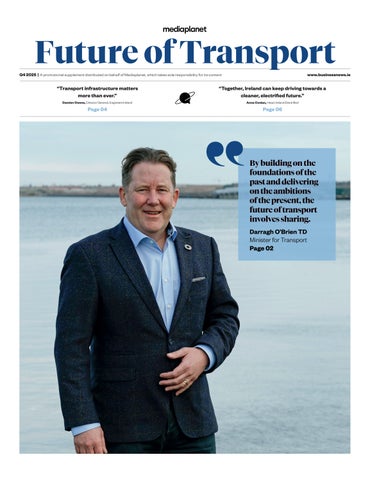
By building on the foundations of the past and delivering on the ambitions of the present, the future of transport involves sharing.
Darragh O’Brien TD Minister for Transport Page 02

Darragh O’Brien TD Minister forTransport, Minister for Climate, Energy and the Environment
Shared mobility: Ireland’s ‘pay-as-yougo’ journey
Shared mobility options like bikes, e-scooters and cars for hire are fast emerging as affordable alternatives to personal car use.

Ireland is transforming how it travels. Through the National Sustainable Mobility Policy, the range of travel options is continuously growing – supported by an enduring commitment to invest in public transport, cycling routes and walkable town centres.
From Dublin bikes onward
The concept of shared mobility isn’t new in Ireland; dublinbikes is 16 years old and an integral part of the city’s landscape. It paved the way for TFI Bikes in Cork, Galway, Limerick and Waterford. Thanks to collaborations between public authorities and private providers, the pay-as-you-go model is now commonplace. Shared cars have been widely available for many years, and shared bike schemes are no longer exclusive to city areas, with schemes in many Irish towns such as Sligo, Kilkenny and Athlone.
Building on this, the Programme for Government 2025 included a game-changing commitment to establish shared mobility hubs in every local authority area. This was re-stated in Ireland’s first policy document in this area: National Policy Statement on Shared Mobility and the Provision of Hubs, published in June 2025.
Real-world impact in Wexford’s Fleadh Cheoil
During this year’s Fleadh Cheoil in Wexford, shared mobility proved its value. With the core of the town pedestrianised to accommodate the festivities and parking restricted to the outskirts, the town’s e-scooters and e-bikes, operated by Bolt, facilitated over 4,000 trips covering a total of 9,300 km. The uptake during this period — with many users coming from all corners of the country and the world — demonstrates the growing appetite for shared mobility options in Ireland and beyond.
What’s next for shared mobility
A successor to TFI Bikes will roll out next summer, operating over a wider area with larger fleets and increased use of e-bikes. A Mobility Hubs Pilot Programme is also in development; this will establish a dense network of shared mobility hubs in five urban areas, ensuring easy access to shared bikes, e-scooters and EVs.
Meanwhile, the ROBUST project funded by SEAI is testing the operation of new shared mobility hubs in Galway, Letterkenny and Waterford, with another to be opened in Dundrum. By building on the foundations of the past and delivering on the ambitions of the present, the future of transport involves sharing.
Why
more Irish drivers are switching to BEVs in 2025

BWhen we look at the electric vehicle (EV) ecosystem and transition, sustainability is a key aspect that needs to continuously improve and come in many facets. So, what does part of this look like?
attery electric vehicle (BEV) adoption in 2025 has recovered from a poor 2024 and is on a 38% increase in BEV sales. We can account for part of this shift in 2025 to be an upward trajectory in choice, all while affordability and price parity are starting to make their impact on the initial up-front costs. Used EV vehicle prices are stabilising, as per Donedeal Motors’ H1 2025 Price Index. Infrastructure has been steadily increasing; our figures show a 30% increase in charge points since the start of the year.
Right-sizing for the right fit leads to less waste.
actual needs and not the closest fit due to limited vehicle choice or infrastructure concerns led to over-buying on battery size of more expensive vehicles in the past — something we are starting to move past. Choice means that our cities can now have small city cars or BEV buses; those in rural areas or travelling for work are now getting choice in range and performance at affordable prices. Right-sizing for the right fit leads to less waste.
More accessible community charging Beyond the vehicles, charging gullies are now being installed in Northern Ireland, allowing cables to be safely placed in channels in a footpath and providing accessible charging close to home. This is something we want and expect to follow in the Republic of Ireland. The Shared Charging scheme will allow for charge point sharing within a community, reducing the time when commercial EV charge points would be idle, making these units commercially viable while providing the
Strategic Account Manager:

Matthew Sealy Chairperson, Irish Electric Vehicle Association
Rail can be catalyst for housing and climate action


Envisaging the future of transport and our transport systems is essentially envisaging the future of how our society, environment and economy will work. For rail, this isn’t new — two centuries of history show how the railway’s introduction transformed countries and continents — but we’re on the cusp of the most significant increase in rail’s role in this country in generations.
Housing delivery, climate action, sustainable development and mobility and regional balance are just some of the national policy imperatives Iarnród Éireann’s ambitious investment goals can help deliver.
Housing plan highlights rail’s role
The recently published housing plan from the Government, ‘Delivering Homes, Building Communities’, outlines how rail investment will unlock land for housing development and delivery across Ireland.
• The DART+ Programme won’t just double the capacity and treble the electrification of the Greater Dublin Area rail network, but enable tens of thousands of homes to be delivered along public transport corridors with far greater frequency of service.

Rail investment doesn’t just affect transport — it can support policies from housing to climate action, creating an impact on our society, environment and economy.
Planning for further phases of the Western Rail Corridor, for reintroducing rail services to Navan and for bringing the vision underpinning the All-Island Strategic Rail Review to reality — including options for rail connections to our airports and ports — are underway.
Greater frequency on Intercity routes will be facilitated as DART+ fleet deliveries free up existing trains on national and regional routes, supported by quick wins in infrastructure development.
From an all-island perspective, jointly with Translink, we hope to order a new Enterprise fleet, which provides better customer facilities and faster journey times on our hourly service, and sets us on the route to decarbonised Intercity travel.
Across passenger and freight transport, rail presents an opportunity to meet the transport sector’s climate action goals. Under existing investment plans, both Dublin and Cork’s commuter networks will be fully electrified. Electrification of our busiest Intercity routes will follow, supported by alternative fuel strategies for other Intercity and regional lines.
Under existing investment plans, both Dublin and Cork’s commuter networks will be fully electrified.
• The Cork Area Commuter Rail programme won’t just yield a 10-minute service frequency along each of three commuter routes. Through the development of eight new stations, it’ll also enable focused Transport Oriented Development across the region.
• Developments in Limerick, Galway and Waterford are critical not just to supporting urban development in, and commuting to and from these cities, but to building strong inter-regional connections that can redefine how we travel and live away from a Dublin-centred pattern to one of true regional balance.
Additionally, we in Iarnród Éireann are working with national agencies, regional assemblies and local authorities to advance the pipeline of rail projects to unlock the potential for housing supply along highcapacity rail corridors into the medium and long-term.
Freight’s future is bright
How we move goods is also a consideration for our future transport strategy. The imperative of reducing emissions has ensured a re-evaluation of rail freight’s role, and our Rail Freight 2040 strategy targets bringing Ireland towards European norms in market share.
In 2026, the Limerick to Foynes rail line will be reopened for freight and aligned with existing routes, and the proposed Western Rail Corridor development from Athenry to Claremorris will become a significant freight corridor. New freight wagon orders have been placed to enable more customers in industry to choose rail, and plans for inland freight hubs at rail terminals are being advanced.
As Port Authority for Rosslare Europort, Iarnród Éireann is also poised to provide the onshore hub for the Offshore Renewable Energy developments in the Celtic and Irish Seas.
Our vision is to be the backbone of Ireland’s sustainable transport network: join us on the journey.
Mary Considine Chief Executive, Iarnród Éireann
Sponsored by Iarnród Éireann
Image provided by Iarnród Éireann
Driving Ireland forward: why transport infrastructure matters more than ever
High-quality infrastructure is the invisible engine behind thriving businesses, vibrant communities and sustainable development.

Transport infrastructure is not simply about roads and rail; it is the foundation of a modern economy and society. It enables growth, drives competitiveness and ensures that communities remain connected and resilient in the face of change.
The backbone of a modern economy
The Government’s commitment to €165 billion in public capital investment between 2021 and 2030 is a welcome step. However, in a recent submission on accelerating infrastructure, Engineers Ireland noted that many critical infrastructure systems — particularly transport — are operating at, or near, capacity.
Big plans, bold investments
networks will ensure that no community is left behind.
Climate action on the move
Transport emissions account for nearly 20% of Ireland’s overall emissions. The Climate Action Plan sets a bold target to halve those emissions by shifting from car dependency to sustainable mobility such as electric vehicles, expanded rail and safe cycling routes.
Ireland’s future depends on engineering.
Ireland is investing heavily in infrastructure, with significant allocations to housing, rail, EV charging and climate-resilient roads in Budget 2026. €24.3 billion has been earmarked for transport under the National Development Plan Review 2025 to 2030. Flagship projects like MetroLink, DART+ and BusConnects promise cleaner, faster public transport. Rural mobility schemes such as Local Link and active travel
How
a clean,
green diesel replacement is cutting Irish carbon emissions
There’s a growing demand among motorists and businesses for HVO, a diesel replacement that significantly reduces carbon emissions without the need for engine modifications.
Across Ireland, increasing numbers of diesel drivers and businesses are understanding the benefits of switching to hydrotreated vegetable oil (HVO), a low-carbon biofuel that’s a greener, cleaner replacement for regular diesel.

“We first made HVO available to our customers in 2022,” says Laura Byrne, Head of Sustainable Fuels at Certa Ireland. “The response was incredible, and demand grew quickly.” So much so that Certa is now offering HVO — via a distinctive pink nozzle — at 27 of its forecourts nationwide, with more locations to follow.
HVO offers motorists the same
The role of engineers
Engineers are responsible for providing the social, economic and productive infrastructure required to sustain growth and competitiveness and attract foreign direct investment. Ireland’s future depends on engineering.
To meet the challenges of sustainability, energy and housing, we will need over 22,300 additional engineers in the next decade. That is why it is more important than ever to attract and retain talent in the engineering sector, including construction and energy generation areas.
I encourage young people to consider a career in engineering, whether through university degrees, QQI FET (PLC) courses, apprenticeships or a combination of these routes. There is a path into engineering for everyone.

performance as regular diesel but doesn’t require any engine modification. HVO is made by hydrotreating waste oils and fats. While CO2 is released when it’s used, this is biogenic carbon from renewable feedstocks, so it doesn’t add to long-term atmospheric CO2 in the way fossil fuels do. “It’s a hassle free, drop-in replacement for diesel, produced entirely from renewable waste feedstocks and certified under internationally recognised sustainability standards,” explains Byrne. “HVO does carry a small price premium, but by using it, customers can reduce their carbon emissions by up to 90%. I think people genuinely want to make better, more
sustainable choices, so we believed that by making the sustainable choice simple and accessible, customers would naturally embrace it.”
Why businesses are switching to HVO Certa Ireland’s business customers — conscious of their Scope 1 sustainability targets — are recognising the advantages of HVO. These include construction company Sisk (which is using it to lower emissions across its Irish sites), Dublin Airport, National Ploughing Championships and Dublin Port (which is fuelling its pilot boats with HVO). Because Certa Ireland has received ISCC (International Sustainability and Carbon Certification) accreditation, it can provide customers — including those it supplies with HVO — with a full, transparent and traceable chain of custody.
Jerry Malee, Head of Enterprise and Biofuels at Certa Ireland, notes that by using HVO in its own fleet, the company has reduced its CO2 emissions by more than 2300 tonnes in a year. As such, it’s an important part of the green energy mix. “We don’t view HVO as a carbon emissions silver bullet,” he admits. “But it’s a product that’s right here, right now, and it’s a much cheaper alternative than electric trucks or trucks that need modifications. So, while HVO is still a relatively new fuel, we’re seeing lots of interest in it.”


Laura Byrne Head of Sustainable Fuels, Certa Ireland
Jerry Malee Head of Enterprise and Biofuels, Certa Ireland
Damien Owens Director General, Engineers Ireland
Ireland deserves a modern, reliable taxi sector that serves every county and type of customer.
Fewer barriers mean more taxis
— let’s get Ireland moving
Anyone who’s waited in the rain for a taxi that never comes will recognise the problem: Ireland’s taxi market isn’t working.

In a country with a booming economy and fast-growing population, the number of Small Public Service Vehicles (SPSV), or more simply, taxis and hackneys, has fallen. We have fewer taxis and hackneys on our roads than we did in 2019, despite our population growing by 8.5% in the same period.
Regional and economic impact of taxi shortages
Out of 26 counties where taxis are regulated by the NTA, 23 have fewer taxi drivers than they did in 2019. The regional SPSV fleet has shrunk by more than 10% and the border region’s fleet is down almost 20% in that time. Dublin now carries almost 60% of taxis while making up just 28% of the population. These aren’t abstract figures but symptoms of deeper policy issues holding the taxi industry back.
With tight restrictions on new taxis and hackneys entering the market, throttling supply, the growth of the SPSV fleet has not kept pace with population or economic growth. This has left many parts of the country underserved while cities struggle with availability during peak times.
This is now having a negative knock-on impact economically, particularly for tourism, hospitality and the late-night economy. Our experience is supported by the Restaurants Association of Ireland, who regularly speak to local businesses across the country, sharing their stories of the impact taxi shortages are having on their businesses — especially pubs and restaurants in rural areas.
Creating inclusive growth

entry for new drivers is too high. Crucially, the WAV mandate also clashes with electrification and decarbonisation ambitions because few WAV models are available as electric or hybrid vehicles.
While over 25% of the taxi fleet are WAVs, our statistics show that only 0.44% of WAV journeys booked through the Uber app actually serve people with an accessibility need.
Uber is committed to addressing transport challenges for people with disabilities in Ireland and across the world. Through our work with Paralympics Ireland, we’ve seen how barriers to a reliable transport service can hinder mobility and opportunity.
Taxi shortages mean longer wait times for all passengers, including those who specifically need WAVs. We must advance evidence-based policies that deliver improved service for all. There are alternatives to a one-size-fits-all WAV mandate that target accessible mobility where it’s needed most. At Uber, we advocate for rules that allow the market to grow, while establishing guidelines around ETAs — so wheelchair users or those with an accessibility need should never wait longer for a taxi. We believe this real-time allocation of WAVs is a more responsive and effective approach, while allowing the general taxi fleet to grow.
Sponsored by Uber
While multiple issues are holding back the industry’s growth, unfortunately, a wellintentioned rule has become a major chokepoint: the requirement that all new taxis and hackneys entering service be wheelchair accessible vehicles (WAVs).
WAVs are more expensive, and the WAV grant scheme, while welcome, is insufficient, with the total allocated funding last year drawn down in just fifteen minutes. Without significant financial help, or a relaxation of the rules, the barrier to
As members of the Taxis for Ireland Coalition, we believe there should be reform of these regulations. The development of a National Taxi Strategy should look to address rural undersupply, improve peak-time availability in cities and ensure greater opportunity for taxi drivers to earn a sustainable living, while delivering improved services for all. The strategy must set an ambitious target to increase SPSVs by 30% from 2024 levels, and address competing public policy levers.
Ireland deserves a modern, reliable taxi sector that serves every county and type of customer, while ensuring drivers have greater opportunities to maximise their earnings. Backing sensible change, as set out by the Taxis for Ireland Coalition, will deliver greater access and a more reliable service for passengers and drivers. It’s practical, achievable — and urgently needed.
Kieran Harte Head of Ireland, Uber

Dublin and Cork Airport operator’s carbon targets get global seal of approval
Airport and travel retail group receives recognition for its sustainability efforts, proving sustainability can be a priority, rather than an afterthought.
daa has hit a major milestone — our emissions reduction targets have been validated by the Science Based Targets initiative (SBTi). This places us among a select group of organisations whose climate goals align with the Paris Agreement and the best available science. It wasn’t easy, but it signals our ambition and underpins our roadmap to net zero by 2050.
“Validation by SBTi is more than a milestone. It’s a statement of intent,” says Andrea Carroll, Group Director of Sustainability. “daa is serious about climate action and committed to supporting aviation’s transition to a lowcarbon future.”
Why the validation matters
SBTi is the most globally recognised independent validation of climate-related target reductions and plans, and validation of our targets ensures that we’re doing everything we can to set a credible path to net zero emissions for our business. It proves that meaningful decarbonisation is possible and that we’re playing our part in the race to keep 1.5C within reach.

Big moves at Dublin and Cork Airports Sustainability isn’t a side project — it’s built into our strategy. At Dublin Airport, a €627 million investment programme, backed by the European Investment Bank, is driving change through large-scale solar installations, EV charging infrastructure, water system upgrades and geothermal
Cleaner, smarter and electric:
how Ireland can drive ahead
with electric transport
Ireland’s shift to electric vehicles (EVs) is accelerating. Learn about the systematic changes that can help support EV transition and how it can revolutionise Ireland’s energy system.

Ireland’s roads are changing fast. More drivers are switching to electric vehicles every year, drawn by lower running costs, cleaner air and to help tackle climate change. However, to keep this momentum going, Ireland needs more than just new cars and chargers — we need a power grid that can keep up.
Systematic changes to help ease EV transition
As more EVs plug in, our demand for electricity will grow, especially during busy times like early evening when people return home. That means the national electricity grid — the network that delivers power to homes, businesses and
feasibility studies. Our solar farm’s Phase 1 already powers 13% of Dublin Airport’s electricity needs, and Phase 2 will push that beyond 20% by 2030. From next month, all car park shuttle buses at Dublin Airport will transition to a fully electric fleet, delivering a significant reduction in ground transport emissions and further supporting our net-zero roadmap. Cork Airport is also exploring solar energy and has led the Irish semi-state sector in energy savings for two consecutive years.
We’re rolling out renewables, electrification, biodiversity initiatives and leveraging ESG finance to maximise impact. Digital tools help us manage these systems efficiently, from live occupancy sensors and smart water and energy controls to AI-driven passenger services that optimise resources and improve resilience.
Our investments are designed to improve the passenger experience while reducing environmental impact.
Electrified fleets cut emissions on the ground. Renewable energy powers reliable terminal services. And in our lounges, 75% of existing furniture has been reused as part of our circularity goals, proving comfort and sustainability can go hand in hand.
Our commitment: continue to invest, innovate and act, driving down emissions, expanding renewable energy and embedding sustainability into every decision we make. We’re determined to deliver a net-zero future by 2050, ensuring Ireland’s airports remain at the forefront of climate action while providing world-class passenger experiences.

chargers — must be stronger and smarter than ever. Investing in upgrades to local networks, substations and smart chargers will help ensure everyone can charge up without overloading the system. A reliable charging network is also key. Drivers need to know they can find a charger wherever they go, from small rural villages to busy city centres. That means installing more fast and ultra-fast chargers across the country, while also making home and workplace charging easy and affordable. Smart chargers that automatically draw power when electricity is cheapest and cleanest can save drivers money and reduce pressure on the grid.
How EVs could return power to the grid
In the future, electric cars could even sell back to the grid. With new technology called vehicleto-grid (V2G), EVs could supply power back to the system at busy times, acting like thousands of tiny batteries, helping to balance the flow of renewable energy from wind and solar. We saw examples of this during Storm Eowyn, when EV drivers were able to power essential devices in their homes using a car battery.
Strengthening Ireland’s electricity network
Electrifying transport isn’t just about swapping engines for batteries — it’s about completely rethinking how Ireland uses energy. With the right grid investments, smarter charging and support for innovative technologies, every EV on the road will help build a more flexible, cleaner and more reliable energy system for everyone.
Ireland Electrified is leading our clean electricity revolution. We represent suppliers, energy users and technology providers who are together calling for a national electrification action plan. Together, Ireland can keep driving towards a cleaner, electrified future — powered by our own renewable energy.
Anna Conlan Head, Ireland Electrified
Andrea Carroll Group Director of Sustainability, daa


Level 5 is a fully automated (or autonomous) vehicle expected to operate in all environments without even a remote supervisor for backup.
The rise of autonomous vehicles
Autonomous vehicles, or driverless or self-driving vehicles, can drive without human input and could be a game-changer towards achieving our vision of zero road fatalities and serious injuries.
Most road traffic collisions are caused by human behaviour, like dangerous driving, driving under the influence of drugs or alcohol, falling asleep at the wheel, breaking the speed limit and mobile phone use. Standard measures to curb these behaviours, like education and awareness campaigns, enforcement, fines and penalty points, are essential, but what if you could remove these behaviours entirely?
For a vehicle to drive itself, it must first see and interpret each item in its environment. It uses a pre-trained neural network to scan the image of the scene ahead and classify each object (eg. person, car, traffic light) and predict its possible movement. Graphical processing units allow thousands of objects to be analysed in parallel. This neural analysis scan happens at 30 frames a second across multiple sensors. For instance, the Waymo robotaxi uses 13 cameras, six radars and four lidars! So, it’s fair to say that an autonomous vehicle needs a lot of computing power.
From driver assistance to full automation

The Society of Automotive Engineers introduced a scale to express the level of automated driving capability for a vehicle.
Level 1 and 2 means that the vehicle assists with some driving functions, such as lane positioning and adaptive cruise control. These systems are collectively referred to as Advanced Driver Assistance Systems (ADAS), many of which are mandatory for new vehicles. Level 2 capable vehicles are common in Ireland today; however, the driver must remain alert and fully engaged at all times.
Level 3 technology is the first point where we see vehicles operating on their own without requiring the driver to be fully engaged with the vehicle for specific operating conditions (eg. on the motorway). The driver may read a book or look at a screen, but remain available to take over. Such vehicles are already available in Germany.
Level 4 technology goes further and doesn’t require a driver to be physically present, such as Waymo or Tesla robotaxi services available in the US. Notably, Level 4 technology demonstrations are dominated by large IT firms. They see business potential by removing the need for car ownership through robotaxi services, and with a shortage of truck drivers, there’s sizeable potential to offer non-stop 24-hour-a-day driverless freight services. Waymo and insurance company Swiss Re claim that
following 25 million miles of driving, Waymo vehicles offer a 90% reduction in claims related to human-operated vehicles. A Waymo vehicle was involved in one fatal collision in 2025, but it was empty and stationary at the time and Waymo was not held liable for the multi-car collision.
Finally, we arrive at the holy grail: Level 5 is a fully automated (or autonomous) vehicle expected to operate in all environments without even a remote supervisor for backup. This may be years away, but it will emerge naturally as the patchwork of cities and routes where Level 4 is approved to operate steadily expands.
What about us?
Ireland is developing an industrial edge in this technology, west of the Shannon, which we must nurture. We must prepare ourselves for this march towards automation and ensure society is fully informed. Both drivers and enforcement agencies must be clear about the law concerning the use of automated vehicles, which will require consideration of our legal definition of driver and driving. Lastly, we must consider the need to allow these vehicles to be tested and trained safely on Irish roads, as is the case in most of the EU, to ensure that the highest level of safety benefit is obtained for Ireland.
Graham Brennan Head of Vehicle Standards, Road Safety Authority
Short-term thinking, longterm loss: why transport resilience matters
Transport networks are quietly celebrated when they work — and fully noticed when they fail. Beneath the smooth operation of roads, trains, ports and airports exists a growing, systemic vulnerability.
Climate volatility, ageing infrastructure, demographic change and complex travel behaviours are reshaping transport. These pressures accumulate slowly, sometimes unnoticed, until their impacts become sudden and severe.
Transport systems are difficult to change in the short term, as infrastructure projects are extensive, long-term and usually planned decades ahead. MetroLink, for example, will add valuable redundancy and accessibility to the Dublin network, but has taken years to plan and many more to complete.
Long-term thinking is essential — if we act too late, the problem will arrive before the solution.
Resilience requires seeing what others ignore Food, medicines and goods depend on functioning transport, and if it’s disrupted, a country can quickly come to a standstill. Therefore, we must plan for a resilient transport network capable of operating during disruptive events.
However, sometimes the barrier is psychological. Decision-makers often need to justify spending through immediate returns, making long-term adaptation seem optional. But resilience isn’t about repairing what’s broken — it’s about anticipating what will break without action. Early investment prevents greater losses, reducing physical damage and the social and economic impacts of disruption.
Understanding how a transport system behaves under stress — and how one disruption can trigger a cascade of failures — is essential for rapid adaptation and recovery. Only resilience models can reveal these dynamics, enabling testing of both familiar and unexpected risks. With limited budgets, this modelling becomes more than a technical tool: it’s a strategic compass. It ensures every euro is invested where it delivers the greatest protection, safeguarding the key connections that keep society moving.
Transformative data: the backbone of future mobility
Data is essential for building resilient transport systems. It reveals hidden risks, supports proactive planning and helps decisionmakers respond more intelligently. One example is the SETO project, which aims to address fragmented, incomplete and nonstandardised information across the sector. SETO will give authorities access to reliable and consistent information for enforcement of transport operations. Better data isn’t just an administrative improvement — it’s an investment in a more resilient system.

Used EV prices finally stabilise, marking a new phase for the Irish market
Ireland’s used electric vehicle (EV) market is stabilising, with slower price drops and rising consumer confidence as new EV prices level out.
A smoother road ahead for used EVs
The latest DoneDeal Cars Price Index reveals that the steep year-on-year declines in used EV values have slowed dramatically. By early 2025, average used EV prices were down just 2.8% annually, a far cry from the nearly 13% drop seen at the end of 2024.
Why the market is settling down
The main factor behind this newfound stability is the levelling out of new EV prices. In the past two years, manufacturers have frequently adjusted new EV prices downwards, causing corresponding turbulence in the used market. With new prices now more predictable, the used EV sector is finding a stable footing.
The future of passenger mobility in Ireland: 2025 and beyond
Electrification, digital integration and a renewed focus on accessibility are reshaping how people move, and Ireland is showing that a coordinated national strategy can deliver real-world results.
Passenger mobility is entering a defining phase. The change is visible everywhere — cleaner fleets, expanding rural services and shifting consumer preferences.
Initiatives accelerate clean transport and improve rural mobility
Public transport electrification continues to accelerate. More than 41% of PSO buses across Cork, Galway, Limerick and Waterford are now low- or zero-emission, with Limerick becoming Ireland’s first fully electric bus city.
Ireland’s rural mobility challenge is also being tackled head-on. The Connecting Ireland Rural Mobility Plan has introduced over 150 new or enhanced routes, driving a 28% patronage increase in 2024. TFI Local Link carried 4.7 million passengers, a remarkable 47% year-on-year rise. For many communities, these routes are becoming vital links to education, employment and healthcare.
Dr. Beatriz Martinez-Pastor Director, UCD Centre for Critical Infrastructures Research, Assistant Professor, School Civil Engineering


Consumer interest in used EVs is rising, supported by the promise of lower running costs and a wider selection.
Median asking prices for 2025-plate EVs hover around €44,950, while threeyear-old 2022 models average €27,900. The slower depreciation rate gives both dealers and buyers more confidence in the market’s trajectory.
What this means for consumers
As the market matures, consumer interest in used EVs is rising, supported by the promise of lower running costs and a wider selection. DoneDeal Cars currently lists over 5,000 used electric vehicles across Ireland, including more than 2,900 from its Trusted Dealer network.


Active travel growth continues, supported by more than 1,000 kilometres of new greenways and infrastructure delivered since 2020. Public bike usage has risen 51%, proving that when infrastructure is safe and joined-up, people adopt sustainable modes.
The private vehicle market is shifting rapidly, too. Electric vehicle (EV) sales jumped 51% and now represent 16% of new car sales, supported by grants and expanding charging networks. Rail and aviation are also rebounding strongly, with rail demand up 8% and Irish airports handling 41 million passengers last year.
Sustainable mobility is within reach
Ireland is on track to meet 70% of its Sustainable Mobility Policy targets by the end of 2025 — but future progress rests on people as much as technology. The mobility transition demands new skills, competencies and continuous upskilling. CILT Mobility & Supply Chain Skillnet is already delivering subsidised, industry-led training to equip the workforce with the capabilities required for electric fleets, digital operations, sustainable logistics and multimodal integration.
As the professional body for mobility, logistics and transport, CILT Ireland will continue to drive standards, strengthen skills and support the sector through the next phase of transformation. I encourage all organisations engaged in Ireland’s mobility future to participate, collaborate and invest in the talent that will ultimately determine our success.


Sponsored by University College Dublin
Sponsored
James Kearney Education and Network Manager, CILT Mobility & Supply Chain Skillnet
Sponsored by DoneDeal Cars
Find out more at donedeal.ie
Paddy Comyn Head of Automotive Content and Communications, DoneDeal Cars