Family Health & Wellbeing healthnews.ie
Supplement created for Mediaplanet
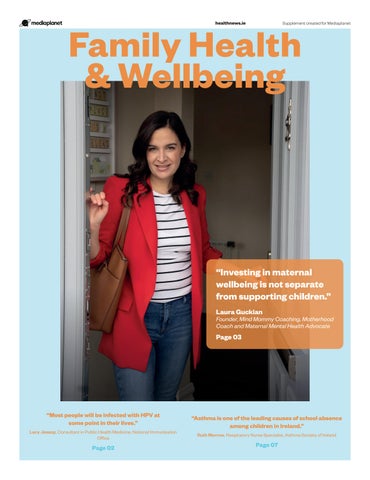
“Investing in maternal wellbeing is not separate from supporting children.” Laura Guckian
Founder, Mind Mommy Coaching, Motherhood Coach and Maternal Mental Health Advocate
Page 03
“Most people will be infected with HPV at some point in their lives.” Lucy Jessop, Consultant in Public Health Medicine, National Immunisation Office
Page 02
“Asthma is one of the leading causes of school absence among children in Ireland.” Ruth Morrow, Respiratory Nurse Specialist, Asthma Society of Ireland
Page 07
AN INDEPENDENT SUPPLEMENT FROM MEDIAPLANET WHO TAKE SOLE RESPONSIBILITY FOR ITS CONTENT
Free HPV catch-up vaccination available to eligible students Young people who missed the human papillomavirus (HPV) vaccine when it was first offered now have another opportunity to get protected through the free Laura Brennan HPV Vaccine Catch-Up Programme.
F WRITTEN BY Lucy Jessop Consultant in Public Health Medicine, National Immunisation Office Lead
rom September 2026, the Laura Brennan HPV The most effective time to receive the HPV vaccine is Vaccine Catch-Up Programme is being offered to when it is first offered. However, the catch-up programme eligible boys and girls in second to fifth year of provides an important additional opportunity for young post-primary school who missed HPV vaccination people who missed vaccination previously. when it was previously offered. For most young people, one dose of the HPV vaccine The programme will be delivered provides the recommended protection. primarily through schools, with HSE If your child already received one dose For most young people, of the HPV vaccine when it was offered vaccination teams visiting schools to offer the free vaccine to eligible in the first year of post-primary school, one dose of the HPV students. Eligible home-educated they are fully vaccinated and do not vaccine provides young people can also access free HPV need a second dose. vaccination through the HSE. Young people with a weakened the recommended immune system require a three-dose protection. Why HPV vaccination matters course. If they have already completed HPV is a very common virus. Most their recommended three doses, they people will be infected with HPV at do not need any further doses. some point in their lives. While most infections clear naturally, some types of HPV can cause cancer later in Take up the opportunity life. HPV can cause cervical cancer as well as cancers Parents and young people are encouraged to read the affecting the throat, anus, penis and vulva. Vaccination information provided by the HSE and take up the free is a safe and effective way of reducing the risk of HPVHPV vaccine if eligible. The programme continues related cancers and is recommended for both boys and the legacy of Laura Brennan, whose advocacy helped girls. transform awareness and understanding of HPV vaccination in Ireland.
Visit HSE.ie for information about the HPV vaccine, eligibility and how to access vaccination.
The HPV facts every parent in Ireland should know Human papillomavirus, or HPV, can be difficult to discuss due to misconceptions, stigma and limited information, making clear, informed family health conversations especially crucial.
M
Sinead Tuite Vaccines Business Lead, MSD Ireland
ost people will come into contact with at least one type of HPV throughout their lifetime; and for many, the infection clears naturally without causing harm.1 HPV rarely causes symptoms, which means many people who have it do not know they carry it.2 However, some types of HPV are known as highrisk because they are associated with certain HPV-related cancers, including cervical, vulvar, vaginal and anal cancer.2
How much do people know about HPV?
Despite how widespread it is, research commissioned by MSD Ireland and carried out by Ipsos B&A among more than 1,000 people suggests that public understanding of HPV remains limited. Only one in 10 people surveyed said they were aware of and had a full understanding of what HPV is, while 93% did not realise how widespread the virus is.3 The research also found that 38% of people did not know or @Mediaplanet UK & IE
@MediaplanetUKIE
were unaware that HPV can lead to certain types of HPV-related cancer.3 The research highlighted a gap in understanding when it comes to boys versus girls. Nearly one in four people surveyed were unaware that boys can develop certain types of HPV-related cancers.3 HPV can affect people of all genders. If the conversation stays focused on girls, boys can be missed.
Trusted information makes a real difference
In Ireland, the national HPV vaccination programme is offered to students in the first year of secondary school as part of the HSE School Immunisation Programme.4 There is also an additional opportunity for young people who may have missed vaccination when it was first offered through the Laura Brennan HPV vaccination schools catch-up programme.5 There is a national ambition to eliminate cervical cancer by 2040 through a combination of awareness, screening, vaccination and treatment. Thanks to those joint
efforts, Ireland is now on track to achieve this within the space of one generation.4 For many families, the most useful starting point may simply be a conversation. What do we know about HPV? What have we assumed? Have we read the information that came from school? Parents want to make decisions that support their children’s future health. When the information is clear, reliable and easy to access, those decisions become easier to make.3 1
2
3
4
5
HSE, What Cervical Screening Is, 2022. Last accessed July 2026. NHS, Human Papillomavirus (HPV), 2022. Last accessed July 2026. MSD Data on File 2025. The research was commissioned by MSD Ireland and carried out by Ipsos B&A on a sample population of 1,000+ adults in Ireland. 2025. HSE, Cervical Cancer Prevention Starts with HPV, 2026. Last accessed July 2026. Gov.ie, Ministers for Health and Education and Youth announce the next phase of the Laura Brennan HPV Vaccine Catch-Up Programme, 2026. Last accessed July 2026.
Contact information: ie.info@mediaplanet.com or +44 (0) 203 642 0737
Sponsored by MSD
For more information about HPV and the School Immunisation Programme, parents can visit the HSE website: School Vaccination Programme. Further educational information is also available through HPV Aware, a website developed, funded and provided by MSD Ireland: hpvaware.ie
Please recycle
Project Manager: Rebecca Mulcahy rebecca.mulcahy@mediaplanet.com Business Development Manager: Robert Joyce robert.joyce@mediaplanet.com Managing Director: Margot Thomas | Designer: Juraj Príkopa Senior Content Manager: Angelica Hackett O’Toole | Paid Media Strategist: Jonni Asfaha Digital Campaign Manager: Jan Martorell | All images supplied by Getty Images, unless otherwise specified 02
MEDIAPLANET
READ MORE AT HEALTHNEWS.IE
AN INDEPENDENT SUPPLEMENT FROM MEDIAPLANET WHO TAKE SOLE RESPONSIBILITY FOR ITS CONTENT
Raising an emotionally aware generation Supporting children’s mental wellbeing begins with helping them to understand their emotions, but it must also include supporting their mothers.
A Laura Guckian Founder, Mind Mommy Coaching, Motherhood Coach and Maternal Mental Health Advocate
WRITTEN BY Bethany Cooper
s parents, we often have an internal desire than believing they must hide parts of who they are to to protect our children from everything, make other people comfortable.” which can sometimes mean hiding our own emotions. Laura Guckian, a qualified and Supporting the whole family accredited Motherhood Coach, With a network of resources is passionate about educating built on the context of her own on the importance of emotional struggles with postpartum honesty, a tool for building health, including Mind If we genuinely want children to mental emotional awareness and Mommy Coaching and the thrive, we must support the whole ‘Momfessions’ podcast, Guckian resilience. “I have always allowed my is dedicated to normalising the family. children to see my emotions. challenges of motherhood whilst If I am sad, angry or excited, I supporting mothers to find their explain why in a way they can ‘village’. understand,” explains Guckian. “We place enormous “I want them to understand that there are no ‘good’ or responsibility on mothers to protect their children’s ‘bad’ emotions, and they are safe to express how they mental health, often without asking who is protecting feel.” theirs,” explains Guckian. “If we genuinely want children to thrive, we must support the whole family. Investing Different brains have different needs in maternal wellbeing is not separate from supporting Understanding and accepting neurodiversity can help children. It is one of the most important ways we can do children to feel confident in expressing their needs. “My it.” children are neurodivergent, as am I,” says Guckian. “I In a society where information has never been more teach them that different brains experience the world accessible, fostering honesty around the realities of differently, and there is nothing shameful about that.” motherhood is essential. Guckian encourages mothers They are allowed to express their needs, ask for space to speak openly about how they feel and seek support and recognise when something feels overwhelming. “I when they need it, challenging the idea that they should want them to grow up understanding themselves, rather navigate motherhood alone.
Dealing with the constant and life-threatening reality of severe allergies Children with severe allergies are at risk of life-threatening anaphylaxis. What’s needed in schools — and society — is more awareness of this issue, plus training and support.
I
of adults and 5%–6% of children) living with food allergies. “There needs to be more public awareness of serious allergies and the treatment for anaphylaxis,” says Donnellan.
Teachers and public unaware of allergic reaction management
Access to emergency medical treatment in educational settings
f you saw someone in anaphylactic shock, would you know what to do? Because your response could save their life, insists Demelza Donnellan from Allergy Action Ireland.
Demelza Donnellan Allergy Action Ireland
WRITTEN BY Tony Greenway
Worryingly, many of us wouldn’t know, including the majority of teachers. According to a 2024 study from the University of Galway, 80% of teachers and special needs assistants in primary schools were not trained to recognise the signs of a severe allergic reaction, and 77% were not trained to administer an adrenaline device. Allergy Action Ireland, a voluntary parent-led advocacy group, is calling on the Irish Government to introduce national policies that formally recognise allergies as a public health issue. According to Allergy Action Ireland, it’s a growing problem with an estimated 160,000 people (1%–2%
READ MORE AT HEALTHNEWS.IE
Donnellan, a nurse by profession, deals with this reality daily because her two teenage sons are severely allergic to (different) multiple foods, including nuts, eggs, fish, peas, lentils, chickpeas and dairy. As interaction with these ingredients can be life-threatening, she writes care plans for their school to follow. She says: “There are things my sons can’t do in life because of their allergies.” Allergy Action Ireland wants people with severe allergies to have greater access to Oral Immunotherapy (OIT) and other treatments. With OIT, patients receive supervised doses of food
they are allergic to, increasing the amount over time, enabling them to build tolerances to foods that can trigger serious allergic reactions. The group also calls for better access to emergency medical treatment in public settings and a standardised approach to clinical support and mandatory training in educational and childcare settings. Hopefully, the Education (Medical Emergencies in Schools) Bill 2026, if enacted into law, will support enhanced allergy care in schools. Currently, though, it is still in the legislative process. Donnellan goes into her own children’s schools on a voluntary basis to inform staff about the dangers of serious allergies. “In one Q&A session, I was asked: ‘What happens if I don’t administer an auto-injector to a child in anaphylaxis?’,” she remembers. “My answer: ‘Then you will watch that child die in front of you.’ Everyone’s jaw dropped, but it’s that serious. Knowing what to do will save lives.”
References to studies mentioned available in online article at healthnews.ie
This article has been sponsored by Viatris. Viatris has provided funding support only and has had no input into the content of this piece.
MEDIAPLANET
03
AN INDEPENDENT SUPPLEMENT FROM MEDIAPLANET WHO TAKE SOLE RESPONSIBILITY FOR ITS CONTENT
A parent’s guide to hydration: choosing the best drinks for children’s health Explore the differences between sugarsweetened beverages, energy drinks, smoothies, fruit juices, water and milk.
A
s a registered dietitian, the importance of diet in children’s health and wellbeing is my top priority when working with children and their families. One significant factor in this is the beverages children consume.
Understanding sugars: natural vs. added
Natural sugar is found in whole fruits and dairy (eg. milk and yoghurt; these sugars come with essential nutrients like vitamins and fibre). Added sugar is common in fizzy drinks and juices, which offer little nutritional value and can lead to dental issues, weight gain and increased body mass index (BMI). They impact dental health, bone health and weight management. Added sugars promote cavities. Whole fruits are less harmful due to their fibre content, which helps counteract the effects on teeth. In terms of bone health, milk is rich in calcium and vitamin D, which is essential for strong bones and overall growth. For weight management, beverages high in added sugar can contribute to excess caloric intake, impacting weight and BMI.
The gut connection
Eating whole fruits provides dietary fibre, essential for a healthy gut microbiome. In contrast, smoothies and juices often lack this crucial component, leading to less effective digestive health.
Optimal hydration in school and sports
Water and milk are ideal choices for hydration. They support better concentration in school and improved athletic performance. Water hydrates without any added sugars, helping to maintain focus and energy levels. Milk offers protein and calcium, supporting overall growth and recovery after physical activities.
Tips to increase water and milk intake
• Set a routine: Encourage your child to drink water or milk at designated times each day. • Fun alternatives: Use colourful bottles and cups to make hydration more appealing. • Offer flavoured water: Add slices of fruits like lemons or berries for a refreshing twist. • Milk with meals: Serve milk with lunch or as a snack for added nutrition. Choosing the right beverages is crucial for your child’s health. Encourage water and milk as the primary drinks to promote their wellbeing, and help to foster healthy habits that will last. Katie O’Sullivan Dietitian and Founder, MyDietitian.ie Clinic
You can find out more MyDietician.ie
04
MEDIAPLANET
READ MORE AT HEALTHNEWS.IE
AN INDEPENDENT SUPPLEMENT FROM MEDIAPLANET WHO TAKE SOLE RESPONSIBILITY FOR ITS CONTENT
How to protect your child from flu Flu can cause serious illness in children. The best protection is the flu vaccine. The vaccine is safe, effective, free and available for all children aged two to 17. Flu is more than a cold
Dr Louise Marron Consultant in Public Health Medicine, Health Service Executive
Protecting families and communities
Each year, flu season runs from October to April. This Vaccination protects your child. It also helps to stop flu winter, all children aged two to 17 in Ireland will be from spreading to others, including siblings, parents and offered the flu vaccine free of charge. Flu is not the same grandparents. It can also reduce time away from school as a cold; it is a serious and and other activities. highly infectious illness that can cause severe illness and A proven vaccine, free of complications in children. charge Children who get flu can The children’s flu vaccine used Parents can book the vaccine with in Ireland has been safely given experience complications such as pneumonia or bronchitis, and to children for many years in their GP or local pharmacist. those with long-term conditions the US and the UK, and since are at even greater risk. 2020 in Ireland. Most children can get the nasal spray, although Safe and easy protection a small number with certain The good news is that we can medical conditions may need an protect children. The flu vaccine is safe, effective and alternative flu vaccine given by injection. easy to give. It is administered as a quick, painless spray Side effects, if they occur, are usually mild, such as a up each nostril. No needles are needed. The vaccine runny nose, headache or mild fever. However, they often helps your child’s immune system to fight off the flu pass quickly. Serious side effects are very rare. virus if they come into contact with it and gives them Parents can book the vaccine with their GP or local the best available protection against flu infection and its pharmacist. In some cases, it may also be offered in complications. schools. Both the consultation and the vaccine are completely free.
For more information, speak to your GP or Pharmacist or visit www.hse.ie/flu
Keeping children protected from influenza Professor of Immunology, Christine Loscher, educates on the importance of childhood flu vaccinations. The vaccine is available as a quick and painless nasal spray, which is effective and free for eligible children aged 2–17 years.
Christine Loscher Professor of Immunology, Dublin City University
Written by Bethany Cooper
Sponsored by Astrazeneca
While Ireland had its most successful uptake yet when it came to childhood flu vaccines during last year’s season, it is still falling far below the national target of 50%, something which Professor of Immunology, Christine Loscher, is trying to change. “I don’t think people realise how badly flu can affect younger children,” she explains. “Children often can’t tell you how unwell they are, and they deteriorate very quickly.” While systems are being rolled out in some schools to give childhood flu vaccinations more practically, these services are fragmented. Loscher believes this should be standardised across schools to make vaccination as convenient as possible for working parents, pointing to Ireland’s school-based vaccination programme for 5- to 12-year-olds as a model worth building on. “If we want to drive uptake, we need to
READ MORE AT HEALTHNEWS.IE
empower and enable parents, and remove potential barriers,” she says. “Although GPs are often the first port of call for parents, pharmacists also have a huge role to play in promoting this access.”
Serious and preventable illness
Children under the age of five, and children of any age with certain chronic conditions, including asthma and diabetes, are at an increased risk of developing serious complications from influenza. “People associate flu season with older adults,” explains Loscher, “but the highest influenza incidence at several points during the 2025/26 season was actually amongst children under the age of five.” While flu often causes relatively mild symptoms, including fever, fatigue, a dry cough and a sore throat, it can also lead to complications such as ear infections, which require antibiotic treatment, or more
serious issues like encephalitis and pneumonia. “The children’s flu vaccine is a quick, painless nasal spray that’s effective and free for all children aged two to 17, with an alternative available if the spray isn’t suitable,” says Loscher. “The nasal vaccine isn’t a new approach; it’s been used for many years and is a tried and tested form of vaccination.”
Benefiting the wider community
While vaccination offers excellent protection for children, it also reduces the risk of severe illness if they do get the flu, as well as helping to provide additional protection for vulnerable people in the wider community. “Boosting vaccination rates in the under-18s is a missed opportunity in providing further protection of our older population,” says Loscher. “The single most powerful thing we can do to protect the most vulnerable this winter is getting the flu vaccine.”
IE-9617 DOP Sept 2026
Uptake of childhood flu vaccines
MEDIAPLANET
05
AN INDEPENDENT SUPPLEMENT FROM MEDIAPLANET WHO TAKE SOLE RESPONSIBILITY FOR ITS CONTENT
Helping every child find their place in sport The benefits of sport and physical activity extend far beyond childhood, which is why Sport Ireland is committed to investing in programmes that help children and young people build physical literacy and lifelong wellbeing.
R Mary Van Lieshout Director of Participation Ethics Integrity and Research, Sport Ireland
egular physical activity provides welldocumented physical and mental health benefits. For children, it promotes bone health, encourages healthy muscle growth and improves motor and cognitive development. Mary Van Lieshout, Director of Participation, Ethics, Integrity and Research at Sport Ireland, the national development body for sport in Ireland, says the benefits of sport extend far beyond childhood, fostering lifelong wellbeing, resilience and encouraging healthier lifestyle choices. “People who are active in their early 20s are more likely to remain active throughout life,” she explains. “Ireland has the largest generation of teenagers we’ve seen in a long time, presenting a real opportunity to build an active and healthy generation.”
Making sport accessible for every child
For more information, visit sportireland.ie
As part of Sport Ireland’s mission to help people unlock the gateway to lifelong participation in physical activity, it uses its long-running Irish Sports Monitor research programme to identify participation trends, address inequalities and inform programme investment. “We know that barriers such as time, cost and travel can prevent people from participating in sport,” says Van Lieshout. “Our focus is on creating sustainable, health-promoting communities. Our research helps us
map sporting infrastructure across Ireland to ensure investments are made where they’ll have the greatest impact.” Across Ireland, the Local Sports Partnership (LSP) network, funded by Sport Ireland, is delivered through 29 local partnerships aiming to increase participation in sport and physical activity. “Reaching underserved communities, including children with disabilities and families experiencing socioeconomic disadvantage, is a huge priority,” explains Van Lieshout.
Building confidence through physical literacy
While activity levels in Ireland are encouraging, with 2.12 million over-16s participating in sport, retaining participation remains a priority. “One of our biggest concerns is keeping girls engaged throughout secondary school years,” says Van Lieshout. “Academic pressures often mean they step away from sport, and some never return. Closing that participation gap is a major driver for our Women in Sport programme. “Too many people grow up believing they’re ‘not sporty’,” says Van Lieshout. “We need to build physical literacy during the formative years, so young people develop the confidence and skills necessary to feel comfortable participating in sport and physical activity for life.”
A second chance for tiny hearts: how community support helps save lives From providing lifesaving equipment and essential patient and parental support to making groundbreaking paediatric research possible, vital funds are supporting sick children and their families across Ireland.
A Lucy’s mum, Nathalie In support of Children’s Health Foundation
t just three weeks old, baby Lucy underwent open-heart surgery at CHI Crumlin. Her specialist medical teams care for some of the country’s smallest and most vulnerable patients, performing complex procedures on tiny hearts.
Uncertainties of neonatal complications
For new parents Nathalie and Máirtín, the joy of bringing home their newborn daughter was cut short. At just three weeks old, she was diagnosed with a severe narrowing of the aorta — a critical
06
MEDIAPLANET
artery carrying blood from her heart to the rest of her body. Instead of settling into life at home, Lucy’s parents found themselves navigating hospital wards, constant medical monitoring and the terrifying uncertainty of open-heart surgery. “You find yourself unable to help, or do anything, or even fully believe what is happening,” recalls Nathalie. “You just wait, and you trust.”
Beyond medical intervention
Through donor generosity, Children’s Health Foundation provides resources that transform
the hospital experience for sick children, including therapeutic play and music. For a sick child, play is far more than a distraction; it is a critical part of their physical, cognitive and emotional health. In a hospital setting, therapeutic play gives children a sense of ease in an environment where almost everything feels unpredictable. By surrounding world-class medical treatment with complete emotional and developmental care, we work together to ensure that every sick child gets the best possible chance to heal, go home and thrive.
Find out more at childrenshealth.ie
READ MORE AT HEALTHNEWS.IE
AN INDEPENDENT SUPPLEMENT FROM MEDIAPLANET WHO TAKE SOLE RESPONSIBILITY FOR ITS CONTENT
A healthy start to the school year for children with asthma As children head back to school, a few simple asthma checks can help prevent flare-ups and missed school days.
F Ruth Morrow Respiratory Nurse Specialist, Asthma Society of Ireland
or many families, back-to-school preparations include uniforms, books and lunchboxes. But if your child has asthma, it’s also the perfect time to check that their asthma is well controlled. Asthma is also one of the leading causes of school absence among children in Ireland. September is a particularly challenging month for children with asthma, with hospital admissions rising each year after schools reopen.
A few simple checks can make a big difference
Arrange an asthma review with your GP before or soon after the new school term begins. If your child has been advised that they do not need to take their controller inhaler over the summer months, they should start taking it again two weeks before going back to school. Also, make sure your child has an up-to-date Asthma
Action Plan, knows how to use their inhaler correctly and has any prescribed medication available at home and in school. It is also important that teachers and school staff know your child has asthma, understand their triggers and know what to do if symptoms worsen and are aware of the 5-Step Rule.
Free expert support for parents
If you have questions about your child’s asthma, you’re not alone. The Asthma Society of Ireland offers a FREE Asthma Adviceline, where parents can arrange a callback from a specialist respiratory nurse for personalised advice and support. You can also message an asthma nurse through the Society’s free WhatsApp Messaging Service (086 059 0132) at a time that suits you.
To arrange a free nurse callback, call 1800 44 54 64, or visit asthma.ie for trusted advice, resources and practical support.
New immunisation programme protects babies against RSV Babies are particularly vulnerable to respiratory syncytial virus (RSV) as they go through their first autumn and winter. Immunisation offers protection against severe RSV illness.
R Dr Chantal Migone Consultant in Public Health Medicine, National Immunisation Office
SV is a common virus that causes breathing infections. Most children will get RSV at some point, but babies under six months are more likely to become seriously ill. Each winter, around one in two babies get RSV, and many need medical care. Around three in every 100 babies are hospitalised, with some requiring treatment in intensive care.
Protection that works straight away
The HSE recommend immunisation to help protect babies from severe RSV infection. It is an antibody rather than a vaccine. It gives babies antibodies directly and begins protecting them straight away. One
READ MORE AT HEALTHNEWS.IE
injection provides protection for around five months, covering the autumn and winter period when RSV levels are highest. Evidence shows that this immunisation prevents more than 80% of RSV hospitalisations and reduces the risk of babies becoming seriously ill.
RSV immunisation is free of charge
Babies born between 1 September 2026 and 28 February 2027 will be offered RSV immunisation before leaving the maternity hospital. Babies born between 1 March and 31 August 2026 can receive the immunisation through their GP. Babies under 24 months who are at higher risk of severe RSV
illness, including some babies born prematurely or with heart, lung or immune system conditions, may also be eligible. Parents should discuss this with their paediatrician or neonatologist.
Safety and side effects
Immunisation can be given at the same time as routine childhood vaccines, and there is no need to delay vaccination appointments. Most babies experience no side effects. Where side effects occur, they are usually mild and may include redness at the injection site, a temperature or mild rash.
MEDIAPLANET
07
AN INDEPENDENT SUPPLEMENT FROM MEDIAPLANET WHO TAKE SOLE RESPONSIBILITY FOR ITS CONTENT
To learn more about Family Health and Wellbeing, visit healthnews.ie
08
MEDIAPLANET
READ MORE AT HEALTHNEWS.IE