Circular Economy IE - Q1 2026

Page 1


Circular Economy & Net Zero

www.businessnews.ie

“Circularity isn’t abstract; it’s practical, local and the foundation of smarter growth.”

Minister of State Alan Dillon, Department of the Environment, Climate and Communications Page 02

“The principal remains: eliminate waste, maximise resource efficiency and create value from what would otherwise be lost.” Stephen Prendiville, Partner Deloitte Advisory, Company Secretary, Chapter Zero Ireland (Ibec) Page 04

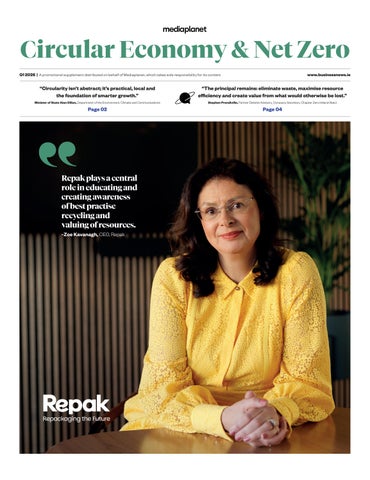
Repak plays a central role in educating and creating awareness of best practise recycling and valuing of resources.

Driving innovation through Ireland’s New Circular Roadmap

The circular economy is about rethinking how we use resources by designing out waste, keeping materials in productive use for longer and creating economic value from what we already have.

This isn’t simply an environmental goal, but an economic necessity that strengthens Ireland’s competitiveness, supports high-quality jobs and builds communities that can thrive.

Since Ireland’s first circular economy strategy was published, we’ve made progress. We’ve seen enterprises and communities embracing reuse, repair and remanufacturing, from the Deposit Return Scheme and the development of a National Reuse and Repair Network to design innovation in construction, packaging and textiles. These efforts demonstrate that circularity isn’t abstract; it’s practical, local and the foundation of smarter growth.

Progress towards a more sustainable Ireland

Last month, I launched Ireland’s Second Whole of Government Circular Economy Strategy, which marks the next step in our journey toward a more resilient, sustainable and innovative future. The strategy commits to increasing our circularity rate by 2% per year with measures like:

• A pilot Repair Voucher Scheme that will reduce repair costs, increase the perceived value of used devices and

drive society-wide support for repair.

• Digital Product Passports, which will store and share data about a product’s sustainability and circularity, will help consumers to make informed decisions about what they buy, and drive demand for sustainable products.

• Other measures include a Centre of Excellence for the Circular Economy, an enhanced Circular Economy Innovation Grant Scheme, increased separate collection of unwanted textiles and targets for the waste reduction from sectors like construction and packaging food waste.

Collaboration between private organisations and the public

This strategy recognises that the transition will work best when people and enterprises move together. Our goal is simple: to make circular living the attractive choice for households and the smart choice for business.

Together, we can decouple growth from environmental impact, build economic and climate resilience and secure a more viable future for future generations.

A circular economy isn’t just good environmental policy; it’s an economic opportunity, and a chance to build an Ireland that’s a resilient and competitive society, based upon sustainable consumption and production.

@Mediaplanet UK & IE Contact information: ie.info@mediaplanet.com or +44 (0) 203 642 0737

@MediaplanetUKIE

Renovation, not reinvention, for Ireland’s building stock

Buildings are responsible for nearly 40% of Ireland’s greenhouse gas emissions. They present one of the biggest challenges to meet the Government’s goal of achieving a climate-neutral economy by 2050.

Buildings provide one of the biggest opportunities to decarbonise, particularly through the largescale retrofit of existing buildings to deliver rapid and measurable emissions reductions.

This requires circularity — not a reinvention of the wheel. Renovation through digitisation can have a transformative effect. Transitioning to energy-efficient, electrified and digitally managed buildings not only cuts emissions, but future-proofs Ireland’s existing building stock.

Data-driven insights for optimal planning

The technology already exists to execute this circularity roadmap. Combining digital technologies with electrification can create buildings that are intelligent, adaptable and capable of supporting a low-carbon energy system.

IoT sensors, for example, enhance adaptability, improve safety and ensure compliance with Ireland’s tightening energy performance standards. AI is also integral, able to dynamically adjust environmental conditions such as lighting, temperature and air quality based on occupancy patterns and external weather conditions.

ongoing optimisation. This enables building managers to plan confidently for future infrastructure, like EV charging, on-site renewables or battery storage – critical to bolstering energy resilience.

Existing measures, such as the Nearly Zero-Energy Building (NZEB) standard and National Retrofit Plan, are helping to embed sustainability across the lifecycle of both new and existing buildings.

We need a stronger emphasis on digitisation within existing frameworks and policies.

But Ireland must go further. We need a stronger emphasis on digitisation within existing frameworks and policies. Embedding incentives for technologies such as BMS, AI and solar PVs would encourage commercial operators and homeowners to adopt energy efficiencies and clean energy solutions. The easiest way to cut costs is to avoid using the energy in the first place. Overall, these practices can enable Ireland to unlock deeper energy savings, improve grid stability and accelerate the decarbonisation of its building stock.

Backbone to a resilient, low-carbon future

Meanwhile, digital twins, like those offered by Schneider Electric, can take things a step further, streamlining the design and operation of electrical infrastructure. By creating a virtual replica of a building’s power system, managers can simulate and optimise performance preinstallation – then receive real-time updates to enable

Smart buildings are the backbone of a resilient, low-carbon future. By harnessing the right technologies, buildings can move beyond efficiency gains. They can create healthier indoor environments, lower operating costs and enable adaptability to challenges such as volatile energy markets, rising grid demand and extreme weather.

With the right roadmap in place, Ireland can ensure buildings remain safe, efficient and comfortable for generations to come.

Rhonda Doyle Country President, Schneider Electric Ireland
Strategic Account Manager: Lucy Harris lucy.harris@mediaplanet.com
Account Manager: Jen Church Interim
Director : Sarah Muir | Lead Designer: Ellen Cahill | Interim Content Manager : Rachelle Ong | Paid Media Strategist: Jonni Asfaha | All images supplied by Getty Images, unless otherwise specified
Minister of State Alan Dillon Department of the Environment, Climate and Communications with special responsibility for Circular Economy

To fully realise circular innovation at scale, regulatory frameworks and standards must keep pace with technological progress.

Why cement matters for net zero

As Ireland accelerates its net zero commitments, some of the most effective solutions already exist, particularly in construction, one of the country’s most carbon-intensive sectors.

Concrete is the second most consumed material after water. However, its primary binder, traditional cement, is a major source of greenhouse gas emissions.

Cement and the global carbon challenge Despite representing only 15% of concrete’s volume, cement accounts for over 90% of its embodied carbon. In Ireland, cement production was responsible for approximately 5% of national emissions in 2022. The most effective strategy for reducing these emissions is to substitute clinker, cement’s most carbon-intensive component, with lower-carbon alternatives.

Industrial circularity and clinker substitutes Transitioning the construction sector requires upcycling industrial byproducts. For over 25 years, Ground Granulated Blast Furnace Slag (GGBS) - a steel industry byproduct and Ecocem’s first commercial product - has served as a primary clinker substitute. This material significantly lowers the carbon footprint of concrete while maintaining structural durability.

Ecocem’s technology has supported major infrastructure projects including Le Grand Paris Express, Dublin’s Aviva Stadium, the Paris 2024 Athletes’ Village, and the UK’s HS2. These landmark developments prove

that low-carbon solutions can meet the most rigorous structural and safety requirements of modern engineering.

As Chisom Ekomaru, Sustainability Manager at Ecocem, notes, “By transforming industrial by-products into high-performance cement, we cut carbon at the source and enable our customers to meet their climate commitments with scalable lowcarbon solutions, reducing reliance on costly downstream fixes.”

As the steel industry shifts toward Electric Arc Furnace (EAF) technology, the profile of available byproducts is changing. Along with a consortium of partners, Ecocem is leading a research programme supported by the European Innovation Council Pathfinder, to optimise EAF and Basic Oxygen Furnace (BOF) slags for lowcarbon cement production.

New breakthrough cement technologyACT

Ecocem is preparing to bring ACT to the market. The first globally scalable cement technology capable of delivery rapid, cost-effective decarbonisation to the cement industry. Developed through extensive R&D, ACT uses widely available materials and existing infrastructure to reduce cement’s carbon footprint by up to 70%.

In 2025, Ecocem introduced more than €220 million of investment in new production capacity and R&I facilities to accelerate the commercialisation of ACT. This

investment includes €50 million for its first production facility at Dunkirk, increasing ACT capacity to over 1 million tonnes per year by 2026, and €170 million to build four new production lines in France - ensuring that the next generation of lowcarbon cement is available at the scale required for global decarbonisation.

Policy and removing barriers

The European Commission identifies clinker substitution as a highreadiness, cost-effective solution. However, barriers remain, including regulatory lag, where materials like recovered glass are still classified as “waste,” and standardisation processes that don’t yet recognise these circular inputs.

Susan McGarry, Director of Public Affairs and Sustainability emphasises, “Public policy is crucial to accelerating low-carbon cement adoption. Ireland has shown leadership by mandating 30% clinker replacement in publicly funded projects, the first EU country to do so. Building on this with greater ambition and alignment with proven technologies can drive deeper emission cuts. To fully realise circular innovation at scale, regulatory frameworks and standards must keep pace with technological progress, providing clear and efficient pathways for high-performance, low-carbon materials to reach the market.”

Chisom Ekomaru Sustainability Manager, Ecocem
Susan McGarry Director Public affairs and Sustainability, Ecocem
Image provided by Ecocem

Net zero and the circular economy: the board’s imperative for value creation

The transition to net zero is no longer a compliance checkbox — it’s a strategic imperative that directly impacts shareholder value, operational resilience and competitive advantage.

Many boards treat decarbonisation and the circular economy as separate agendas. They’re not —they’re two sides of the same coin.

Circular economy: operating model that makes net zero achievable

Linear “take-make-waste” systems are inherently carbon-intensive. They extract virgin resources, generate emissions throughout supply chains and create waste that requires energy to manage. Circular systems — where materials are designed to be reused, repaired, repurposed or regenerated — fundamentally reduce the carbon footprint of your business while unlocking new revenue streams.

Companies embedding circularity into their net zero strategies report improved margins, reduced supply chain volatility and enhanced brand loyalty.

But circularity extends beyond materials and waste management. It’s a philosophy applicable to every input and output of your business. Energy efficiency, waste heat recovery, shared services and optimised logistics networks are all circular economy opportunities. Whether you manufacture products, deliver services or operate infrastructure, the principle remains: eliminate waste, maximise resource efficiency and create value from what would otherwise be lost.

Consider the evidence

Companies embedding circularity into their net zero strategies report improved margins, reduced supply chain volatility and enhanced brand loyalty. They’re not just meeting climate targets — they’re outperforming peers financially.

Yet boards often lack the knowledge to ask the right questions. How circular is your supply chain? Are your products designed for longevity or disposal? Is there a commercial or positive use for our waste product? Do we produce waste heat that could be purposed or sold? What’s the carbon cost of your material sourcing? These aren’t niche environmental questions — they’re governance questions that belong in your boardroom.

As your organisation’s stewards, you have the authority and responsibility to ensure management integrates circularity into net zero strategies across operations, not as an afterthought, but as a core business lever. The businesses that will thrive in the next decade are those where boards actively champion the circular-net zero nexus. They’ll have resilient supply chains, lower carbon costs and sustainable competitive advantages.

Whether you’re a prospective or current board member, we invite you to engage with circularity alongside your net zero and decarbonisation initiatives.

Take the hassle out of everyday recycling

Effective waste management helps build a circular economy. However, knowing which bin to use or where to recycle an unusual material can be confusing. Thankfully, one website offers an all-in-one resource.

The MyWaste website, Ireland’s official guide to waste, provides a range of useful and accessible information, toolkits and resources to help households and businesses to reuse, recycle and segregate waste easily and confidently.

MyWaste — your guide to waste

In addition, the site’s excellent A to Z search function offers information on where and how to recycle hundreds of materials. The link between recycling and segregating waste on one hand and climate action on the other isn’t always obvious, but it’s very real. Recycling provides valuable resources, reducing the need to

use virgin materials and lowering energy usage. It’s the climate action we can all take many times each day.

Food waste

For example, the food placed in your brown bin will, within weeks, become either rich compost for growing fresh local vegetables or be used to create green energy. This is the circular economy in action.

The National Food Waste Recycling Week campaign, run annually by MyWaste.ie, aims to encourage brown bin usage and improve overall understanding of how to separate food waste. MyWaste provides bin stickers, animations and video information

to help households make the most of their brown bins. The 2026 campaign will run from May 30th to June 7th.

Recycling in the workplace

For businesses and workplaces, ensuring that staff members and clients segregate waste properly can be a difficult and frustrating task. MyWaste takes the hassle out of this task by providing a Commercial Waste Toolkit, which aims to inform, engage and enable workforces.

The CWT is free to businesses and includes a suite of posters, bin labels, guidance animations suitable for staff induction or as timely reminders, online training modules, and case studies. It is suitable for a range of businesses including retail, hospitality, leisure and administration.

DIY and reuse

Household renovation and DIY often result in needless waste. Much of the discarded material is still perfectly fine and could be reused. MyWaste urges households to “Think before you Skip it”, prioritising reuse and repurposing where possible.To help with this, MyWaste offers a bank of resources, such as practical stepby-step guides and videos to help homeowners be more circular when clearing out and renovating their homes.

Dr Joanne Rourke Resource Efficiency Officer, Regional Waste Management Planning Offices

Repackaging the future

Innovations in packaging design are contributing to a greener future for Ireland, making meaningful progress in reducing waste, supporting reuse and producing sustainable packaging.

For more than 25 years, Repak has been at the centre of Ireland’s packaging system, providing expertise to companies on sustainable packaging design, compliance with regulations and achieving EU recycling targets.

Central in Ireland’s packaging system

With a broad membership base, the company supports businesses across manufacturing, retail, e-commerce, food service and logistics in meeting their legal obligations for packaging waste, while collectively funding Ireland’s recycling system.

“We have around 3,500 members throughout Ireland, making up around 60% of the national packaging footprint,” explains Zoe Kavanagh, CEO. “We secure member funding based on the packaging they place on the market, covering at least 80% of recycling costs, with eco-fee modulation and reduced fees over ten years.”

This producer funding allows them to work with Ireland’s waste industry and ensure packaging is collected and prepared for recycling in accordance with EU packaging regulations.

Network of continuous improvement

Continuously working with members on practical and innovative packaging solutions, the organisation hopes that small, medium and large businesses can learn from each other throughout the network. Examples of good practice include Donnelly Fresh, a supplier of fresh produce, which recently launched ‘Earthpack’ for its citrus produce, made from paper and bamboo fibres, 100% plasticfree, biodegradable and recyclable.

Badger & Dodo, a coffee roaster in Cork, transitioned from foil-lined coffee bags to monomaterial plastic bags, diverting 40 tonnes of packaging from landfill and repurposing jute bags for reuse by local farmers. Another member, Boots Ireland, the healthcare company, established in 2023, ‘Recycle at Boots Scheme.’ To date, it has saved over 500,00 hard-to-recycle items from being sent to landfill, exchanging them for vouchers.

“We want to support small and medium enterprises in ways that work for them,” says Kavanagh. “By learning from larger, multinational members and sharing best practices and case studies, we help smaller businesses adopt proven strategies and make meaningful progress on sustainability.”

Recently surveying its members, they’re actively supporting more than 250 smaller enterprises with practical resources. “This includes digital toolkits, design-for-recycling guides, prevent-and-save resources and our plastic pledge,” she continues. “We also provide guidance on engaging employees and customers around correct bin use, helping businesses to reduce contamination and lower their waste costs.”

Ongoing support and the Irish infrastructure By 2030, packaging considered unrecyclable cannot be placed on the market, and all labels must be harmonised by 2027. The organisation will play a central role in guiding its members through these new requirements, aligning packaging design with

real-world recycling systems, while supporting environmental targets. “We’re working with our members proactively to transition to compliant packaging and labelling, which takes time,” says Kavanagh. “We don’t want to create waste; we want a seamless transfer to new label requirements.”

“One of the biggest challenges for both our members and wider industry is ensuring we have the infrastructure needed to meet these new recycling targets,” she continues. While members are compliant, Ireland currently sits at around 61% against a 65% national target, and according to Kavanagh, it must push further, particularly on plastics. This means investment in a coordinated infrastructure to divert more plastic from landfill and incineration into recycling streams. “Ireland needs greater capacity if we are to close that gap and meet future obligations.”

Repak also plays a central role in educating and creating awareness of best practise recycling and valuing of resources. To this end, the organisation is involved in a number of pilot projects , trialling novel technologies to improve waste segregation, reduce contamination and increase recycling rates nationwide.

“We’re piloting AI and camera technology with waste operators to improve bin use,” explains Kavanagh. “As bins are lifted and tipped, AI captures images to identify contamination and provide households or businesses with guidance on correct sorting. Innovations like this can significantly reduce contamination, boost recycling rates and ensure society plays its part in effective waste segregation.”

EU packaging and packaging waste regulation

The new EU packaging and packaging waste regulation (PPWR) harmonises rules around recycling and packaging throughout Europe to reduce waste and promote a circular economy. With stronger recyclability and design requirements, greater focus on minimal packaging, an increase in recycled contents expectations and enhanced data and reporting standards, the regulation represents a significant shift in standards.

“With this new regulation coming into force in August of this year, there will be added obligations for all businesses in Ireland that place packaging or packaged products on the market,” explains Kavanagh. “With Ireland’s waste industry entirely privatised, it’s important all obligated producers join their scheme to ensure the waste system is properly funded.”

With Global Recycling Day on March 18, the organisation will continue to lead and support Irish businesses, in the delivery of smarter packaging solutions, stronger recycling performance and a more sustainable future.

Zoe Kavanagh CEO, Repak To
Sponsored by Repak
WRITTEN BY
Bethany Cooper
Image provided by Repak
ISmall steps can lead to massive impact, including cost reductions.

Putting circular thinking into practice with national guidance

Across Ireland, companies are redesigning packaging and improving recycling systems in preparation for upcoming EU requirements.

support helps us to embed circular thinking throughout the company.”

Sustainability by design

Intersport Elverys aims to be recognised as the leading Irish sports retailer practising and promoting a more sustainable business and lifestyle, and is taking proactive steps towards a better and more sustainable future. “Guided by the principle of effective recycling, our approach begins at the design stage. By working closely with suppliers, we aim to eliminate unnecessary packaging from the outset,” explains Cormican

Innovative reverse logistics recycling and distribution initiative

n 2025, Intersport Elverys’ packaging innovations meant that over 210 tonnes of cardboard and just under 15 tonnes of plastic were recycled.

Repak membership in action

As a Repak member, Intersport Elverys is already transforming packaging to reduce waste, eliminating unnecessary materials and improving recyclability. Among their most impactful initiatives is the introduction of 100% recyclable online and in-store bags, in addition to a reusable and recyclable warehouse pallet box system.

“We’ve been a member for around 20 years,” explains Mark Cormican, General Manager at Intersport Elverys. “We place huge emphasis on sustainability, and working with Repak has given us strong direction on national governance and evolving EU regulations and best practise.”

Providing technical advice, training and regulatory guidance, the company supports Intersport Elverys to leverage this expertise within its own internal processes. “Our goal is continuous improvement, and their

Honoured with the Global Leadership Excellence Award in Sustainability for two years running, Cormican credits an innovative reverse logistics recycling and distribution initiative for driving this ongoing achievement. This initiative was strengthened with the company’s investment in a dedicated distribution centre in 2022, which Cormican describes as a self-contained loop.

“This initiative, alongside our purpose-built recycling centre, enables recyclable waste throughout our store network to be returned to our distribution centre for efficient processing,” explains Cormican.

“Since its inception, the company has recycled 784 tonnes of cardboard, 57 tonnes of plastic and 3.5 tonnes of polystyrene.”

Giving his advice to other businesses throughout Ireland, Cormican explains, “Start with simple, low-level changes. Look at how you’re handling waste and packaging, then reach out to experts. Small steps can lead to massive impact,including cost reductions. Through our sustainability performance, we want to position ourselves as an agent of positive change in sport retail.”

Mark Cormican General Manager, Intersport Elverys To find out about how Repak can help your company, go to: repak.ie
WRITTEN BY
Bethany Cooper

Decarbonising electricity through the principles of the circular economy

Ireland’s leading electricity utility is working to embed the principles of the circular economy into its operations, decarbonising electricity responsibly and sustainably to build resilient and flexible infrastructure.

Decarbonising electricity is essential to achieve a net zero energy system, requiring a global shift from fossil fuels to renewable energy. While this transition has become an imperative for organisations and governments worldwide, building the renewable generation and network infrastructure needed to support this requires extensive resource use.

Sharon McManus, Group Head of Sustainability at ESB, explains how this challenge affects the company’s approach. “We have huge ambitions to decarbonise the electricity system even as it continues to expand. Grid reinforcement and expansion require significant investment and materials, so our approach to resource use must be responsible. This means reducing reliance on new materials, maximising reuse and improving recovery at the end of life.”

For an already asset-heavy company, the question of how to decarbonise responsibly impacts the entire organisation, considering the need for increased resources, renewable energy assets and a mindset shift for employees and stakeholders alike. However, McManus considers this to be an opportunity as well as a challenge: for collaboration, and to maximise efficiency, cost savings and innovation throughout the sector.

Circular principles also support systems that are durable, modular and resource-efficient, extending asset life and ultimately strengthening system resilience.

Resilient infrastructure

Dr Bláthnaid McPolin, Circular Economy Lead, has taken a new role to develop a group-wide resource use and circular economy strategy, reflecting the organisation’s growing recognition of the importance of circular principles in driving long-term sustainability.

“Embedding circular economy principles ensures that as we continue to move to renewable energy, we do so in a way that minimises our use of material, maximises efficiency and minimises our waste,” she points out. “Globally unsustainable resource use via the take-makewaste model is driving the triple planetary crisis of climate change, biodiversity loss and pollution. Circular economy principles and practices mitigate these impacts, and we need

to apply them in a strategic and coordinated way across the entire company.”

At the same time, circular principles also support systems that are durable, modular and resourceefficient, extending asset life and ultimately strengthening system resilience. “Electrical infrastructure is long-term, highly regulated and safety-critical, often operating for 20-40 years,” explains McManus. “And while our infrastructure is built for durability, we’re also designing for longevity and flexibility, allowing assets to expand or contract as needs change.”

As capital investment grows to meet net zero goals, responsible use of materials is becoming a strategic imperative, building supply chain resilience and stakeholder trust. According to McManus, strategic planning across the supply chain, careful reuse of resources and financial discipline are essential to navigate resource scarcity and rising demand.

As legislation around reuse, recycling and sourcing of critical materials continues to evolve, a forward-looking approach is key. “Our circular economy strategy allows us to stay ahead of a changing policy landscape,” explains McManus.

Embedding circularity

ESB hopes that by embedding the core principles of a circular economy across all aspects of its business, it will be able to lead by example.

“The circular economy breaks down silos, driving efficiency and collaboration throughout the industry,” explains McPolin. “It’s a major opportunity to boost cost savings, innovation and reputation, while aligning with market and legislative drivers to extend circular thinking across the sector.”

Shifting to circularity is a global challenge and requires collaboration throughout supply chains. “ESB cannot achieve circularity alone; Ireland as a whole needs to be circular,” concludes McPolin. “But we’re proud to be actively moving foward in this space, and hope that by creating a roadmap focusing on priority materials, systems and culture, we can embed circularity across the whole company.”

Sharon McManus Group Head of Sustainability, ESB
Bláthnaid McPolin Circular Economy Lead, ESB
WRITTEN BY Bethany Cooper
Sponsored by ESB

As the electricity sector rapidly advances to decarbonise in a sustainable way, questions of design, engineering and innovation are moving centre stage.

Órla Burke, Sustainability Manager within ESB’s Engineering and Major Projects business unit, explains how circular thinking is shaping energy companies’ approach to largescale infrastructure projects: “The circular economy is a fundamental pillar to achieving emission reduction targets; our pathway to net zero will embed circular principles across the full life cycle of our infrastructure and operations.”

Sustainability by design

From Burke’s perspective, circularity should be embedded in the early development and design stages, long before construction starts.

“Sustainability by design is about proactively integrating environmental, social and governance standards directly into the core of our business, recognising that the early stages of a project can offer the greatest and most scalable impact,” she explains. “Designing out waste, selecting lower-carbon materials, planning for sustainable

How smart design and innovation can make Ireland’s energy sector more circular

Sustainability and emerging technology managers at Ireland’s leading electricity utility speak to the importance of designing for circularity and collaborative innovation.

construction methods and future decommissioning aren’t add-ons; they’re fundamental engineering decisions that shape an asset’s performance for decades.”

Reframing its thinking from cradle-to-grave to cradle-to-cradle, ESB is considering disassembly, reuse and repurposing from the beginning, looking ahead to what happens at end-of-life before an asset is even built.

As Burke points out, “Decommissioning is no longer the end of the story. While acknowledging the challenges, we are increasingly recognising the opportunities that circularity can bring: assessing development and retirement of assets through a circular lens can lead to reuse, material recovery and broader societal benefit.”

Innovation and project development

Innovation in this space supports both incremental improvements to enhance existing business models and transformational innovation to develop new areas of business, explains John Walsh, Emerging Technology and R&D Manager.

“We started by developing a clear understanding of what assets we have and smart systems to track them, so we know what’s becoming available and when, and where assets could be safely redeployed,” Walsh explains.

“In renewable infrastructure such as wind turbines and battery storage, we’re looking closely at material composition, recyclability and long-term impact,” adds Burke. “We’re engaging with manufacturers and R&D partners to understand what goes into these technologies, what can be recovered and how assets can be repowered or repurposed.”

Innovation also leverages technology, partnerships, and breakthrough solutions to transform energy generation,

storage and use. “New technologies like vehicle-to-grid are enabling us to use EV batteries to support the grid during growing peak demand,” explains Walsh. “We’re exploring low-carbon materials such as green cement, manufactured using by-products from steel production. Biomethane is another exciting example, turning materials considered waste into renewable energy, and we can also repurpose wind turbine blades as structural elements for bridges, telecom towers and even street furniture for bike storage.”

Supply chain collaboration

Circularity cannot be achieved in isolation and requires active collaboration across the entire supply chain to facilitate the development of low-carbon materials, greener production or next-generation circular renewable technologies. “We’re seeing the energy system change,” explains Walsh. “Traditional barriers between industry, markets and consumers are breaking down, enabling new technologies, smarter grids and circular approaches to become more interconnected and flexible.”

“Through an open innovation ecosystem, we collaborate with universities, research organisations, energy start-ups and major industry players, as well as local authorities and community stakeholders to drive progress,” explains Walsh. “It’s this shared approach to innovation in industry that will enable us to unlock the potential of a circular economy.”

Recognising the value of datadriven decision-making to achieve scalable and verifiable progress, ESB also conducts extensive research and development into new technologies, producing an annual emerging technology insights report to inform industry practice and development.

WRITTEN BY Bethany Cooper
Órla Burke Sustainability Manager, Engineering & Major Projects, ESB
John Walsh Emerging Technology and R&D Manager, ESB

The circular economy of buildings starts with what we already have

What comes to mind when you hear about the ‘circular economy?’ Maybe you think about carefully recycling waste or buying second-hand clothes in charity shops?

These are both important, for sure. But the first step in a circular economy should always be avoiding the creation of waste and making the most of existing resources. In the built environment, this means making better use of our existing buildings.

Circular economy in built environments

One great example comes from Ava Housing, a not-for-profit organisation in Dublin that helps older homeowners reconfigure their large family-sized dwellings, adding a bedroom and bathroom downstairs and creating a rental unit upstairs. This generates income for the homeowner while improving energy efficiency and comfort.

Another example comes from Paris, where the city has opened 42 school playgrounds to the public on weekends, saving carbon and materials from building new facilities.

The first step in a circular economy should always be avoiding the creation of waste and making the most of existing resources.

Better utilisation of existing infrastructure and new builds

As well as making better use of existing buildings, we can make better use of existing infrastructure. This means prioritising brownfield sites in towns and cities, where roads, lighting and water pipes are already in place, when we do build new. This not only prevents waste and saves carbon but can help deliver housing more quickly (because the infrastructure is already in place) and create more vibrant communities better served by public transport.

When we do build new, we can also design buildings to be adaptable — like Vrije University Amsterdam, which created a new lecture hall to be used as a cinema on evenings and weekends. Or by thinking from the outset about how homes can be adapted in future as families change in size and age profile. We can also design buildings so it’s easier to take them apart and reuse their components in future. This starts with something as simple as using reversible connections, like screws, instead of non-reversible ones, like glues.

Marion Jammet Deputy CEO, Irish Green Building Council

Energy affordability must be at the heart of Ireland’s energy transition

As Ireland reshapes its energy system, affordability must remain a guiding principle for policymakers and industry.

Recent rises in home heating oil and fuel due to global volatility, and Government concerns about safeguarding Irish consumers from price shocks, show that affordability is a very real issue for households across the country.

At the same time, Ireland’s clean energy transition is gathering pace, but for many consumers, the question remains simple: will the future feel fair? Affordability must be at the centre of our national conversation, because the energy transition will only succeed if people can feel the benefits in their daily lives.

A better system delivers better value

At SSE Airtricity, we understand the pressure customers face and the frustration that comes with rising energy bills. Many of the costs behind bills are outside suppliers’ control, from regulated network charges to system operator costs and global wholesale prices, with suppliers accounting for around 10% of a typical bill. That’s why we’re advocating for a cleaner, more secure energy system that unlocks renewable power.

a million homes. In other words, wind farms are being instructed to curtail output because the grid is unable to handle it. When clean energy can’t reach the grid, customers lose out.

Ultimately, upgrading grid infrastructure is essential if households and businesses are to really benefit from Ireland’s renewable resources in the long term.

Ireland’s path to net zero is an opportunity to build a cleaner, more resilient energy system, but it must also be fair.

Ireland has made strides in renewable generation, but too often, the system can’t keep pace. EirGrid data shows that in 2025 alone, Ireland lost over 2 million MWh of wind power due to dispatch down, enough to power half

LThis isn’t just a market issue; it’s a policy one Decisions on network investment, system charges and market design directly impact what customers pay. As a supplier, we’re committed to working with policymakers and the CRU to ensure the system evolves to support decarbonisation and fairness. A transition that isn’t affordable won’t carry public support and simply won’t work.

Structural reform is essential, and so too is supporting customers. Providing a different kind of energy with practical tools to help consumers manage their energy use, and continued investment in products to empower people to take control of their energy usage.

Ireland’s path to net zero is an opportunity to build a cleaner, more resilient energy system, but it must also be fair.

Circular procurement tackles global e-waste challenge

E-waste is the world’s fastest-growing waste stream, yet less than a quarter is recycled. Green Public Procurement helps secure goods that have a lower environmental impact throughout their life cycle.

arge quantities of resources are utilised throughout the life cycle of electronic equipment, including mining, manufacturing, transport, retail, consumption and disposal. Circa 31 million tonnes of metals were embedded in e-waste globally in 2022, with a value of US $91 billion.

The circular solution

Remanufacturing is the process of returning a used product to at least its original performance specifications, with a warranty that matches or exceeds that of a newly manufactured equivalent. It is “like-new” in terms of

functionality and durability, with customers perceiving it as equivalent to new.

Ireland’s leading Green Public Procurement framework and impact

In 2024, Ireland’s Office of Government Procurement (OGP) launched a new ‘first-of-its-kind’ framework for public bodies to acquire remanufactured laptops. The €30 million contract was granted to GreenIT and Circular Computing, specialists in remanufacturing enterprise-grade laptops. Approximately 60,000 could be procured during the term, potentially reducing CO2 emissions by 19 million kg, mined

resources by 72 million kg and water consumption by 11 billion litres.

Driving broader EU adoption Ireland’s OGP has created the procurement framework conditions to enable circular market building in the context of ICT/electronics; however, mainstreaming these circular procurement practices requires new ways of working.

In response, Irish Manufacturing Research (IMR) is leading the Irish pilot within Circular Shift (an Interreg NWE project), designed to drive market building for circular products and services across five EU countries. Irish associate partners include DCEE, WEEE Ireland and Sandyford Business District.

The project addresses three key barriers to scaling circular procurement: limited value chain coordination, lack of internal commitment and capacity and insufficient impact measurement tools. Eight procurement pilots across laptops, phones and workwear, underpinned by a value chain collaboration methodology, decision-making framework and impact dashboard, combined with bespoke training modules, will support the adoption of circular procurement best practices.

Stephen Gallagher Managing Director,
Patrick O’Donnell CE Technologist, Irish Manufacturing Research (IMR), Project Manager for Circular Shift, an Interreg NWE project
E-waste is the world’s fastest-growing waste stream, yet less than a quarter is recycled.
~Patrick O’Donnell CE Technologist, Irish Manufacturing Research (IMR), Project Manager for Circular Shift

Turn static files into dynamic content formats.

Create a flipbook