Career Transformation IE - Q1 2026

Page 1


Career Transformation

www.yourcareer.ie

“Chartered Engineer status is increasingly vital for career progression.”

Damien Owens, Director General, Engineers Ireland Page 02

“Retention should be viewed not as a defensive strategy, but as a powerful signal of organisational health.”

Jim Flynn, CEO, Great Place to Work Ireland Page 05

“Why Deloitte believes the best digital health delivery always has people at its heart.”

Page 03

“We completely changed how we attract, manage and optimise talent to create a high-performance culture.”

Page 07

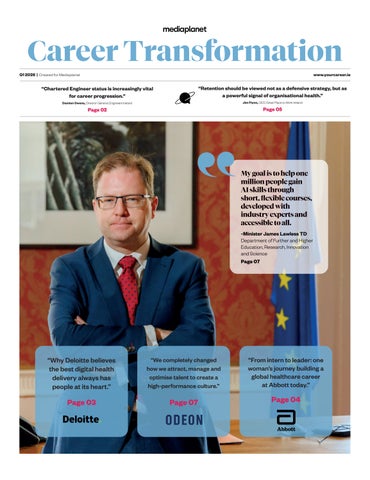
My goal is to help one million people gain AI skills through short, flexible courses, developed with industry experts and accessible to all.

~Minister James Lawless TD Department of Further and Higher Education, Research, Innovation and Science

Page 07

“From intern to leader: one woman’s journey building a global healthcare career at Abbott today.”

Page 04

Sparking ambition: a new generation of women in engineering

Two women from Jones Engineering share their insights on why women are choosing to work in this sector.

Jones Engineering’s recently qualified Electrician, Lauren O’Rourke, and Chief People Officer, Carmel Walsh, reflect on why more women are choosing engineering, and why visibility, opportunity and support matter.

Lauren — from apprentice to electrician Choosing an electrical apprenticeship was about finding a career that felt practical, challenging and meaningful. I’ve always enjoyed understanding how things work, and engineering allows me to apply that curiosity every day. What appealed most was the hands-on nature of the apprenticeship, earning while learning and gaining real experience onsite from the beginning.

I’m constantly developing new technical skills, working alongside experienced colleagues and contributing to projects that have a visible impact. There’s a real sense of achievement in seeing a job progress and knowing you’ve played a part in it. That’s something unique about engineering: you can physically see the results of your effort.

succeeding, whether as apprentices, engineers or leaders, it makes the path feel possible. Engineering isn’t just one thing: it’s technical, collaborative and creative. There are many routes and specialisms, and apprenticeships are a strong, ambitious option for anyone who wants to build a rewarding STEM career.

I believe the more we talk openly about these pathways, the more we can challenge outdated perceptions and inspire the next generation to consider engineering as more than just a job, but a long-term career.

When young women see others succeeding, whether as apprentices, engineers or leaders, it makes the path feel possible.

Starting in a male-dominated environment can feel intimidating. I was aware I might be in the minority, but I’ve learned that confidence is key. Backing yourself and focusing on your ability makes a huge difference. The industry is changing, and there’s far more encouragement and support for women coming into these roles now. Representation matters. When young women see others

@Mediaplanet UK & IE

Carmel — women driving change in engineering From an organisational perspective, increasing female participation in STEM isn’t simply about representation; it’s about strengthening our industry. Diverse teams bring broader perspectives, better problemsolving and stronger innovation. That diversity ultimately improves outcomes for our clients and business.

At Jones Engineering, we’re focused on building a sustainable talent pipeline. That means engaging with young people early, supporting apprenticeships and graduate programmes and creating inclusive workplaces where everyone can thrive.

Lauren’s journey from apprentice to qualified electrician reflects the progress being made, but there’s still work to do. By continuing to support development and mentorship initiatives for females across the industry, we can ensure that more women not only enter engineering but go on to shape its future.

Contact information: ie.info@mediaplanet.com or +44 (0) 203 642

Strategic Account Manager: Jen Church jen.church@mediaplanet.com Managing Director : Margot Thomas | Lead Designer: Ellen Cahill Interim Content

Manager: Jonni Asfaha All images supplied by Getty Images, unless otherwise specified

The Chartered Engine er advantage

As Ireland transforms its career and skills landscape, continuing professional development (CPD) is essential for engineers seeking to remain competitive and future-ready.

The Registered Professional Title of Chartered Engineer (CEng) represents the highest level of professional competence, ethical practice and leadership within engineering. Recognised in Irish law and internationally, it signals that holders can apply advanced engineering knowledge to solve complex challenges.

Rigorous process for accreditation Engineers Ireland requires members to complete a minimum of 35 hours of CPD annually, ensuring that Chartered Engineers continually deepen expertise and adapt to emerging technologies and industry demands. This benefits individual career growth, while strengthening Ireland’s ability to meet infrastructure, climate, digital and innovation challenges. It’s a

minimum, and some sectors may require additional hours of specialised CPD content.

Becoming a Chartered Engineer is a rigorous process that combines accredited engineering education, substantial professional experience and a structured assessment of competence across engineering knowledge, leadership, communication and ethical responsibility. The title is widely regarded as the gold standard of engineering in Ireland.

Chartered Engineer status is key to rising faster and farther Chartered Engineer status is increasingly vital for career progression. Many employers view it as a benchmark of senior professional capability, and it provides enhanced credibility with clients, regulators

and project partners. It also delivers measurable benefits: Chartered Engineers can expect to earn approximately €5,000 to €10,000 more per year than equally experienced non-Chartered peers.

For instance, an untitled engineer with 6 to 10 years of experience typically earns €72,000, while a Chartered Engineer who graduates in the same year usually earns €83,000. Furthermore, Chartered Engineers who become Fellows of Engineers Ireland can expect to earn an additional €20,000 to €30,000 per year compared to untitled engineers.

The Chartered Engineer title and Engineers Ireland-accredited qualifications are formally recognised among the minimum standard for engineering grades within local authorities, making it a key eligibility requirement for those seeking to build impactful careers in local government and public infrastructure delivery. The professional title is also recognised internationally via agreements to which Engineers Ireland is a signatory, allowing Chartered Engineers to have local recognition.

|

Lauren O’Rourke Electrician, Jones Engineering Find
Sponsored by Jones Engineering
Carmel Walsh Chief People Officer, Jones Engineering
Manager: Rachelle Ong
Paid Media
Damien Owens Director General, Engineers Ireland

How Deloitte is transforming the healthcare sector with AI and digital innovation

This is where the Digital Health & Social Care team at Deloitte Ireland comes in. By aligning innovation with this purpose, the result is better outcomes and an improved quality of life for individuals across the health and social care sector.

Advanced digital technology doesn’t simply have the potential to improve healthcare delivery. It has the power to change the way we plan and manage some of the most complex and pressing challenges, while fundamentally reshaping how patients engage with the health and social care system.

For example, AI is playing a fundamental role in making healthcare predictive, personalised and preventive. Generative AI has the game-changing ability to map disease progression and anticipate health and social care events, enhance diagnostics and enable treatments tailored to individual patients. Meanwhile, in research and development, it’s accelerating drug discovery and shortening development cycles.

Using advanced tech to improve outcomes and quality of life

This is where the Health Care team at Deloitte Ireland comes in. We work with our clients to explore the potential of new and emerging technologies and support them to deliver initiatives that will lead to the transformation of healthcare delivery in Ireland.

Our teams achieve the objectives of Sláintecare through the delivery of the right care, in the right setting and at the right time. The result: better outcomes and experiences for patients and their carers across the care continuum.

“We’re privileged to partner with a diverse portfolio of public and private healthcare clients who seek out our knowledge and experience,” explains Suzanne McDonald, Partner, Health & Social Care.

“By combining deep sectoral knowledge with proven tech capabilities, we work with clients to co-design and deliver comprehensive healthcare solutions. With the patient to the fore, we understand the importance of safety in everything we do — combining the best of our digital, operational and clinical capabilities.”

Additionally, the Deloitte team works with clients to deliver complex programmes aligned with national strategies, spanning critical areas such as mental health, infrastructure, AI, virtual care, acute care, community services and social care.

Making a meaningful impact in health and social care

McDonald admits that, as the digital health landscape shifts, it’s important for the team to stay ahead of the curve. “We recognise the critical balance between driving innovation and maintaining robust governance to build trust and confidence as our clients advance their digital strategies,” she says.

“We invest heavily in continuous learning and professional development, including certifications in cuttingedge technologies and sector-specific expertise, ensuring we consistently deliver the latest insights and solutions to our clients.”

This means that Deloitte Ireland is always looking for professionals to join the team. “Our strength lies in our unique blend of operational, clinical and technical expertise, reflected in the diverse skillsets of our people,” says McDonald. “We’re particularly interested in professionals with experience in electronic healthcare programmes — whether in clinical workforce planning, change management or programme planning and delivery.

With a variety of permanent and contractor opportunities available across all seniority levels, we welcome passionate, collaborative individuals eager to make a meaningful impact in health and social care.”

Why the best digital health delivery always has people at its heart

What’s the best thing about working in digital health?

At Deloitte, I work closely with leaders in our health service to identify and utilise technology that improves access, enhances patient experience and fosters better collaboration. What we do directly benefits our community and makes a difference for my family and friends.

I’ve been fortunate to work on projects, digital health strategies and programmes that are critical components of the Government’s Sláintecare ambition to transform healthcare delivery in Ireland.

What’s your advice for those interested in a digital healthcare career?

Embrace the technical and human aspects of the industry. Digital health isn’t just about technology. It’s about developing a patient and people-centered approach and solutions that support healthcare professionals, patients and users to improve access to information.

Guided by Deloitte’s purpose to make an impact that matters for our clients, our people, and society, this team supports the health system to use the latest technologies that are transforming of healthcare delivery in Ireland.
Join our contractor community in Ireland
Suzanne McDonald Partner, Health & Social Care, Deloitte Ireland
Sponsored by Deloitte
Lisa Brunner, Senior Manager Digital Healthcare, Deloitte, reveals why working in healthcare is fulfilling, and the difference it can make to patients’ lives.
WRITTEN BY Tony Greenway
Lisa Brunner Senior Manager, Digital Healthcare, Deloitte
WRITTEN BY
Tony Greenway
Working in different divisions taught me to challenge assumptions and find new ways of solving tricky problems.

From internship to leadership: building a healthcare career at Abbott

For Alanna Moran, an operations leader at Abbott, curiosity has been the driving force behind every step of her career.

“Curiosity has always guided me,” she says. “I love understanding how systems work, how people collaborate and how ideas evolve into action.”

That mindset fuels her deeper purpose: helping people live their fullest, healthiest lives.

From student intern to operations leader

Curiosity and purpose first led Alanna to study microbiology at the Technological University of the Shannon (TUS) and later to apply for a student internship at Abbott. There, her analytical problem‑solving skills aligned with work that directly improved people’s lives.

After completing her degree and internship, she returned to Abbott through the Operations Professional Development Program (OPDP), a three‑year rotational graduate programme designed to develop future leaders. Working across diverse roles, she gained first‑hand experience in building healthcare products at scale – from diagnostic tests that provide fast, reliable results to medical devices that support cardiovascular, neuromodulation and diabetes care.

The experience was fast‑paced and immersive. “I gained a deep appreciation for strategy, responsiveness and quality,” she says. Rotations across different divisions and sites – including diagnostic manufacturing in Longford, vascular products in Clonmel and later an assignment in Dallas – broadened her technical knowledge and strengthened her leadership capabilities. During this period, she also completed a master’s degree in supply chain management with Abbott’s support.

A culture that develops people

One aspect that defines Abbott in Ireland is its emphasis on continuous learning. “Abbott enables people to grow by treating development as broad and experience‑based,” Alanna says. Her journey through multiple roles has shaped her leadership style. “Working in different divisions taught me to challenge assumptions and find new ways of solving tricky problems,” she reflects.

“Abbott has consistently given me roles that stretch my capabilities while offering strong support. From my early career development program to leading employee engagement initiatives today, I’ve always been empowered to make a meaningful impact.” This mix of opportunity, mentorship and purpose driven work has strengthened her confidence as a leader.

Purpose-fuelled innovation

Alanna is deeply motivated by the impact her work has on real people. “Every improvement in process or advance in technology supports a better outcome for someone who depends on what we make,” she explains.

Innovation is embedded in how teams collaborate, solve challenges and deliver improvements. Across its 10 sites in Ireland, Abbott demonstrates the power of modern manufacturing – where advanced technology, skilled teams and cutting edge processes work together to meet evolving healthcare needs.

A career shaped by possibility

Today, Alanna leads a team focused on strategic projects that support manufacturing operations. Working for a global healthcare leader with strong development pathways has helped her carve out a career with purpose and direction. “I’ve seen the power of harnessing new technologies to shape products that help people live healthier lives,” she explains.

Digital transformation has introduced new tools and techniques, but she notes that analytical thinking, collaboration and problem‑solving remain foundational. “I’m proud to use innovation in a way that strengthens Abbott’s manufacturing capabilities and ultimately supports patients’ needs.”

Reflecting on her journey from intern to postgraduate student to operations leader, Alanna credits her development to the trust, opportunity and purpose that define Abbott in Ireland.

“It’s the kind of environment where you grow because you’re encouraged to try, explore and contribute,” she says. For those seeking a place where curiosity can fuel a meaningful career, her story offers a clear message: there is room to grow here, and an opportunity to make an impact that matters.

If her journey resonates with you, we invite you to explore opportunities at Abbott in Ireland. Your next step could begin at one of our ten sites located in Dublin, Donegal, Clonmel, Cootehill, Galway, Kilkenny, Longford and Sligo.

Alanna Moran Operations Leader, Abbott
ImageprovidedbyAbbott

How great training and support can shape a new future for women in STEM

If you desire a dynamic STEM career, the opportunity and support could be there for the taking at Dublin Airport.

daa offers STEM opportunities for women across technology, infrastructure, finance and operations. From graduate programmes, apprenticeships and internships to roles for experienced professionals, the company provides multiple entry points into rewarding STEM careers.

As part of its move towards skills based hiring, it focuses on the skills that matter most for success, opening opportunities to a more diverse talent pool.

According to Keavy Gorman, Talent Director at daa, women in STEM benefit from accelerated development through exposure to challenging, high impact assignments. This is supported by initiatives like mentoring and targeted development programmes.

Mary Wyse and Caoimhe McQuillan, who both work in STEM roles at Dublin Airport, reveal how they started their careers.

Can you describe your STEM journey?

Caoimhe: I started as an electrician at daa — the company that supported my Electrical Engineering degree — and then became a planner within the Asset Management department.

Currently I am part of a team that delivers energy projects across Dublin Airport to meet our 2030 Carbon targets, and to upgrade and maintain assets, including electric vehicles, lighting and solar farm assets.

Mary: I loved science and problem-solving, and studied

As organisations across Ireland navigate economic uncertainty, skills shortages and shifting employee expectations, understanding what motivates people to stay, or prompts them to consider a move, has never been more important.

Why job-seeking is generally lower, but elevated in one cohort

Insights from the Great Place to Work© European Workforce Study, which surveyed 26,458 employees across Europe, including 1,526 in Ireland, provide a clear view of job-seeking intent and career confidence. When asked, “Will you be looking for a new job this year?”

Irish employees show a distinct pattern compared to the European average. While many remain open to change, job-seeking intent in Ireland remains lower, reflecting a stronger attachment to employers and rising

biotechnology as an undergraduate. After college, I worked in airport retail, ending up in management.

I was encouraged into retail analytics, which started my STEM career. I studied a post-graduate degree in Applied Statistics, which solidified my love for what I do. I currently manage a team that helps the company use insights and analysis in decision-making.

Which opportunities supported your progression?

Mary: I’ve received a lot of support through the company, including access to different training programmes, and they also supported my post-graduate degree. I’ve also had mentoring support from colleagues. I wouldn’t be where I am without them, so now I mentor and support others.

How do you see the role of women in STEM evolving?

Caoimhe: I believe more women will join apprenticeship programmes. We’re already seeing the benefit of earning while learning technical and life skills.

What advice would you offer women considering a STEM career?

Mary: After college, I didn’t think I would end up working in analytics, but I took the opportunity. So, don’t be afraid to pivot or change your career plan.

Caoimhe: If you enjoy applying theory to practice, it’s a wonderful, rewarding option. If you think you want a career in engineering, trades or construction, my advice is: Give it a go. You won’t know until you try.

Employee retention and career confidence in Ireland

expectations of work.

Employee retention has become one of the most telling indicators of career confidence in today’s workforce.

The data becomes even more compelling when we look at employees and junior managers specifically. Junior managers in Ireland show elevated levels of job-seeking intent compared to individual contributors, highlighting a group under pressure. Often positioned between leadership expectations and team needs, this cohort is reassessing whether their organisations are supporting longterm career progression, wellbeing and growth.

Factors driving retention So, what does this mean for employers? Retention today is no longer driven solely by salary or job security. Employees are increasingly evaluating whether their workplace supports meaningful career development, offers flexibility and fosters trust. A great place to work is one where people feel valued,

listened to and confident that their role contributes to personal and organisational success.

Organisations that invest in learning opportunities, transparent career pathways and psychologically safe cultures are more likely to retain talent — even during periods of transformation. These factors don’t just reduce turnover; they actively build career confidence, enabling employees to envision a future within the organisation rather than elsewhere.

As Irish employers look ahead in 2026, retention should be viewed not as a defensive strategy, but as a powerful signal of organisational health. By understanding jobseeking intent and addressing what truly makes a great place to work, organisations can support meaningful career transformation for their people and their business.

WRITTEN BY
Tony Greenway
Sponsored by
Mary Wyse Data Product Development and Analytics Manager,
Caoimhe McQuillan Asset Management Energy Systems Lead, daa
Jim Flynn CEO, Great Place to Work Ireland

Graduate recruitment landscape remains cautiously optimistic

Ireland’s graduate recruitment trends in 2026 continue to show resilience amid economic caution, with strong employment rates supported by targeted hiring in high-demand sectors.

Research from gradireland reports that over 90% of tertiary graduates are securing jobs within nine months, surpassing EU averages per CSO data, despite a national unemployment rate that sits at just under 5%.

Post-graduation employment insights

HEA’s 2024 Graduate Outcomes Survey indicates an 80.2% employment rate for the Class of 2024 nine months postgraduation, up marginally from 2023. Undergraduates achieve 74.9% employment, while postgraduates reach 86.6%; 91.7% of employed graduates work in Ireland, predominantly Dublin (40.9%). Median earnings start at €555 weekly for recent cohorts.

Recruitment trends in sector and skill set demand

Research from gradireland’s 2025 Ireland’s 100 research shows that employers face challenges in recruiting graduates for accounting, finance, engineering, healthcare and construction roles, with skills shortages driving demand. One in four firms plans expansions in 2026, emphasising the impact of AI, data and sustainability skills via programmes and mentorship. Skills-based hiring prevails, valuing adaptability over degrees; recruitment timelines stretch to 10 weeks. Engineering, data and research roles top student preferences, per gradireland’s most recent salary survey, alongside healthcare and tech, with 20% vacancy growth. Permanent contracts dominate (60.6% undergraduates), with 62% of postgrads exceeding €40,000 annually; internships boost outcomes (61.6% participation). International permits hit 31,044 in 2025 to help address skills shortages.

Future outlook of graduate employment landscape

Despite rising challenges in the graduate landscape, our research underscores robust partnerships and careers events amid AI uncertainties, which is optimistic for graduate pipelines. Graduates prioritise work-life balance, progression and relevance (60.6% alignment). As we look forward to the 2026 gradireland Graduate Recruitment Awards, innovation in inclusion and sustainability continues to shape earlycareer strategies, despite global pushback on this front from the US, in particular.

“Why my career as a Garda offers purpose, opportunity and fulfilment”

Emmanuel Tacima Samuel came to Ireland 18 years ago from South Sudan, and now works as a Garda in Wicklow. He tells us exactly what he likes about his job.

When he was 12, Emmanuel Tacima Samuel — originally from South Sudan — came to Ireland to start a new life with his family in Kilkenny. Now, 18 years later, he’s about to finish his probation as a Garda in the town of Wicklow.

“I’ve always enjoyed volunteering with local communities, groups and organisations,” he says. “So, this career seemed like the perfect opportunity to work with all kinds of different people. It also makes me feel as though I’m giving something back to Ireland.” After completing the application, testing and interview process, he began his training in 2023 at Carlow Garda Station.

It also makes me feel as though I’m giving something back to Ireland.

Varied roles for people with different skill sets For Garda Samuel, the best part of the job is being able to help people in need. “When I was young, I remember my family needing help — and how we felt when that help came,” he says. “So, I find it fulfilling to help someone resolve a situation and see the relief they feel. Also, no two days are the same. I can be in the office completing paperwork or dealing with phone calls, or I’ll be out on patrol or dealing with incidents and emergencies. I enjoy that balance.”

To anyone thinking of becoming a Garda, he has this advice. “I’d definitely recommend it,” he says. “There are so many different departments, too, including the Special Detective Unit, units that investigate scams and fraud and the Protective Services unit. You can always find the area that best suits your skill set and personal qualities.”

Upskill for the future of work

Trinity College Dublin offers accredited learning to help advance your career and build in-demand skills in areas like AI and healthcare.

Micro-credentials are short, accredited courses that give workers a skills uplift. Designed to fit around busy careers and life responsibilities, micro-credentials at Trinity College Dublin offer targeted development in high-demand areas like AI, sustainability, healthcare and leadership through a mix of online and in-person sessions. Areas in Trinity offering micro-credentials include Nursing and Midwifery, Engineering, Innovation and Enterprise and Executive Education.

Adapting to AI in the workplace

Workers are seeing in practice how AI is transforming the workplace. Trinity Executive Education specialises in leadership development and in equipping organisations to lead AI strategy and implementation, with six-week micro-credentials supporting teams to adapt to current shifts.

The micro-credential in ‘Driving Performance with AI and Analytics’ is aimed at leaders looking to extract greater value from AI and analytics to drive organisational performance, and the micro-credential in ‘Mastering AI in Digital Marketing’ is for marketers who want to apply the latest GenAI tools to marketing research, strategy and content.

Responding to sectoral needs

With an ageing population and ongoing advancements in medical technology, demands on the healthcare sector continue to increase. Trinity Executive Education is extending its leadership and AI expertise into this space through targeted sectoral courses. Learners on the micro-credential in ‘Finance for Healthcare Professionals’ gain an understanding of financial fundamentals, including budgets and reporting, improving planning, accountability and sustainability in healthcare settings. Upcoming courses, including ‘AI for Healthcare Professionals’ and ‘Leading Healthcare Teams,’ are designed to support leaders navigating complex, technology-enabled healthcare environments.

Skills for now and the future

The World Economic Forum estimates that 39% of existing skill sets will be transformed or outdated by 2030. People understand that they need to regularly acquire new skills and knowledge to stay relevant or change to a new career area, but they can be anxious about returning to learning. Micro-credentials offer a great entry point back into education and help people to engage in and enjoy lifelong learning.

Sponsored by Trinity College Dublin
Sponsored by An Garda Síochána
Find out more at tcd.ie/ courses/microcredentials/
See if An Garda Síochána is a fit for you:
Orla Bannon Head of Careers and Development, Trinity College Dublin
Garda Emmanuel Samuel An Garda Síochána WRITTEN BY Tony Greenway

Building the skills Ireland needs for the future

Technology is changing fast, and with that change comes endless opportunities — for workers, students, businesses and communities across Ireland.

Artificial Intelligence (AI) is already reshaping everyday tasks, from planning a holiday to managing household bills. As these tools become more widely available, they have the potential to make our working lives easier, more efficient and more productive.

Skills and confidence needed to make opportunity a reality

My focus, as Minister for Further and Higher Education, Research, Innovation and Science, is on ensuring that everyone, regardless of age, background or experience with technology, can benefit from AI rather than feel intimidated by it.

A report by the OECD highlighted clear gaps in Ireland’s current skills system, and the National Skills Council has rightly called for a more coordinated national approach. That’s why, in January, I brought forward a proposal to Cabinet to establish Ireland’s first National Skills Observatory.

Consolidating information in one place Right now, our information on skills and the labour market is too scattered and too slow to match the pace of change. The new Observatory will bring this information together in one place, helping us see the skills people already have, the skills employers will need in the years ahead and where future opportunities are likely to emerge.

AI is one area where change is happening fastest, and where we must act now to ensure workers, employers and educators can keep up. Research shows that 3 in 10 people in Ireland don’t feel comfortable with AI or digital technologies. In leading Nordic countries, that figure is closer to 2 in 10, a gap we simply cannot afford to let widen.

This is why I secured Government approval to develop Ireland’s first national AI Skills Platform — the State’s most ambitious AI - skills initiative. My goal is to help one million people gain AI skills through short, flexible courses, developed with industry experts and accessible to all.

With the right investment in our education and skills system — with pathways that help people learn, upskill and reskill throughout their lives — we can ensure they’re ready for whatever comes next.

Building expertise in agriculture and food with

micro-credentials

The agriculture and food sector is constantly evolving, and professionals increasingly need targeted skills to keep pace.

University College Dublin’s (UCD) Agriculture & Food Micro-credentials, developed by faculty in the School of Agriculture and Food Science, offer a flexible way to gain practical, industryaligned knowledge.

Flexible courses across a wide range of topics

These short, online courses draw on the research and expertise from the School of Agriculture and Food Science. They’re designed to fit around professional commitments, making it possible to upskill without taking extended time away from work.

Courses cover a broad range of topics that reflect current challenges and opportunities in the sector. Learners can explore areas such as Sustainable Livestock Systems, Food Safety and Standards, Advanced Animal Nutrition and Global Food Systems. Other microcredential courses focus on innovation and consumer needs, with subjects like Creativity & Innovation in Food or Concepts of Nutrition and Healthy Eating.

Insights that can be applied directly to new roles

Completing a micro-credential allows professionals to apply new insights directly in their roles. Whether aiming to upskill in a specific area or broaden understanding of emerging trends, these flexible courses provide practical tools and knowledge for today’s agriculture and food professionals.

By offering short, targeted learning grounded in research and industry relevance, UCD Agriculture & Food Micro-credentials support career growth while helping the sector respond to ongoing changes and challenges.

Explore UCD Agriculture & Food Microcredentials today and take the next step in upskilling your career.

explore all UCD Micro-credentials in Agriculture & Food and beyond, visit:

Why one cinema chain took a big picture view of talent development

The pandemic changed the way that people view their careers and skills development. In response, one cinema chain decided to overhaul the way it attracts and develops talent.

It’s been a turbulent time for the cinema industry. In 2020, the pandemic forced cinemas to close. Then, post-lockdown, the Hollywood writers’ strike caused industry-wide production delays. It wasn’t a double bill anyone wanted to see.

When things settled down, one thing became immediately apparent: the way cinema employees viewed their careers and skills development had completely changed. “We faced a simple truth,” says Zarah Doyle, European Director of People and Transformation at ODEON Cinemas Group. “In this new landscape, our old talent strategy wasn’t working anymore. Rather than tweaking it, we decided to leave it on the cutting room floor.”

Developing skills to create a highperformance culture

Over the next two years, the Group developed and then rolled out a brandnew talent framework — with people at its heart — that transformed leadership and skills development.

“We completely changed how we attract, manage and optimise talent, and how we develop skills to create a high-performance culture,” says Doyle. “Recruitment was revised to remove barriers and widen access. We redesigned talent reviews to give colleagues a broad, cross-functional understanding of their potential. We introduced new mentoring and coaching programmes, created new talent pots for individualised talent development and launched an immersive leadership programme. Everything changed.”

Creative environment that encourages idea generation and excellent quality Consequently, the way people communicate and collaborate has been elevated and accelerated. For Doyle, it’s now a more creative, inclusive environment focusing on idea generation and quality of delivery. “Our talent retention has never been better, and we’ve seen strong improvement in commercial results and growth in our market position,” she says. “The results have been fantastic.”

Sponsored by ODEON Cinemas
Sponsored by University College Dublin Find out more at odeoncareers.co.uk
Zarah Doyle European Director of People and Transformation, ODEON Cinemas Group
Dr Fiona Lalor Lecturer/Assistant Professor Director of Executive Education Director of MSc Food, Nutrition & Health
UCD School of Agriculture & Food Science
To
WRITTEN BY Tony Greenway

Every line of code we write ultimately supports someone’s parent, spouse, child or friend.

Medtronic Patient Care Systems: join us in building software that saves lives

Medtronic Patient Care Systems: building technology with heart, where every line of code contributes to protecting and improving the lives of people we love most.

Ireland’s west coast has long been known as one of the world’s great medical technology clusters. For decades, Galway and the surrounding region have designed and manufactured life-saving medical devices.

What’s less recognised is what’s happening alongside it. The same medtech hub is increasingly becoming a place where software engineering and healthcare innovation are converging.

Where software engineering and healthcare innovation converge For companies like Medtronic, that convergence reflects a broader shift in how modern medical technologies work. The devices remain critical, but the software and connected platforms around them play a bigger role in how patients are monitored, treated and supported.

Medtronic has been part of Ireland’s medtech landscape since 1982, when it established one of its first manufacturing operations outside the United States. Over the decades, the company’s presence in Ireland has grown into a critical global hub for manufacturing, engineering and innovation.

Now, the company is beginning to expand its focus to include software development capabilities in Galway, building on the region’s deep pool of engineering talent.

“What started as a manufacturing presence has evolved significantly,” said Alex Mann, Vice President of Patient Care Systems at Medtronic. “Ireland has become a global centre for medical technology, and the growing intersection of healthcare and software represents a natural next chapter. With that momentum, we’re expanding our team in Galway across a range of software roles. If you’re a software engineer interested in applying your skills to technologies that save lives, visit medtronic.com/en-us/our-company/careers.html — or share this article with someone who is.”

At first glance, devices like pacemakers and implantable defibrillators may sound like purely medical hardware. In reality, they’re sophisticated mini-computers, constantly monitoring heart rhythms and delivering therapy to correct potentially dangerous abnormalities.

“People who receive these devices typically have them for life,” Mann said. “What’s becoming increasingly important is the digital ecosystem that supports them and the software that helps clinicians monitor and manage those patients over time.”

This includes technologies like tablet-based programmers used by clinicians in hospitals, bedside monitors placed in patients’ homes, smartphone apps that connect patients with their care teams and cloud platforms that securely manage and analyse device data.

Through Medtronic’s CareLink network, more than three million patients worldwide who live with and benefit from implantable cardiac devices are already supported through remote monitoring technologies.

Software plays a role from the moment a device is implanted. “At implant, each device is programmed specifically to the needs of that individual patient,” Mann said. “Software in both the implanted device and the clinician programmers helps ensure that therapy is tailored to address each patient’s condition.”

Once patients leave the hospital, that digital connection continues. “As patients move on with their lives, software in their smartphone app or bedside monitor helps them stay connected to their clinic,” Mann explained. “Whether they’re at home or travelling, that link allows clinicians to keep an eye on the device and the patient’s condition, and intervene if needed.”

The technology can even help address situations that were once more complicated for patients with cardiac implants. Embedded software in newer devices allows many patients to safely undergo MRI scans, something that historically required special precautions.

Unique engineering challenge for software developers

“Every line of code we write ultimately supports someone’s parent, spouse, child or friend,” Mann said. “That connection to real patient outcomes gives the work a very clear sense of purpose.”

For developers who might never have considered a career in medtech, Galway offers a compelling proposition: work on modern software platforms, tackle complex engineering challenges and see your work directly improve people’s lives.

Or, as Mann puts it: “If you’re a software engineer who wants your work to matter in a very real way, this is the kind of place where your code can truly make a difference.”

Alex Mann Vice President of Patient Care Systems, Medtronic
Alex Mann is Vice President of Medtronic Patient Care

Turn static files into dynamic content formats.

Create a flipbook
Career Transformation IE - Q1 2026 by Mediaplanet UK&IE - Issuu