ADVERTISEMENT DECEMBER 2025 | INNOVATINGCANADA.CA
@MediaplanetCA
Please recycle
A SPECIAL INTEREST SECTION BY MEDIAPLANET
Future of Healthcare Discover how the Canadian Coalition for Green Health Care is helping hospitals and clinics reduce emissions, strengthen climate resilience, and deliver sustainable care. RE AD THE F U LL STO RY O N L I N E
NURSE JOHN:
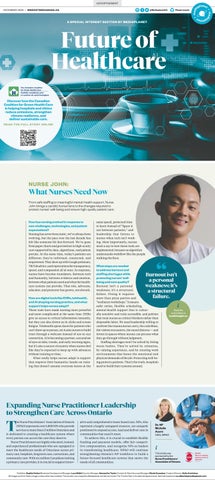
What Nurses Need Now From safe staffing to meaningful mental-health support, Nurse John brings a candid, human lens to the changes required to protect nurses’ well-being and ensure high-quality patient care. How has nursing evolved in response to new challenges, technologies, and patient expectations? Nursing has never been static, we’ve always been evolving, but the pace over the last decade has felt like someone hit fast-forward. We’ve gone from paper charts and gut instinct to high-acuity care supported by data, algorithms, and patient portals. At the same time, today’s patients are different: they’re informed, connected, and empowered. They show up with Google printouts, TikTok advice, and expectations for transparency, speed, and compassion all at once. In response, nurses have become translators. Between tech and humanity, between evidence and emotion, between what patients need and what the healthcare system can provide. That role, advocate, educator, and protector has grown, not shrunk.
How are digital tools like EHRs, telehealth, and AI shaping nursing practice, and what support helps nurses adapt? These tools have made nursing more powerful and more complicated at the same time. EHRs give us access to critical information instantly, but they can also drown us in clicks and screen fatigue. Telehealth opens doors for patients who can’t show up in person, yet it asks nurses to build trust through a webcam instead of eye-to-eye connection. AI is becoming a partner, a second set of eyes on labs, trends, and early warning signs, but it’s also a source of anxiety when nurses feel like they’re expected to keep up with advances without training or time. What really helps nurses adapt is support that respects their humanity: hands-on training that doesn’t assume everyone learns at the
same speed, protected time to learn instead of “figure it out between patients,” and leadership that listens to nurses when tech isn’t working. Most importantly, nurses need a say in how these tools are implemented, because no algorithm understands workflow like the people walking the floor.
What steps are needed to address burnout and staffing shortages while protecting nurses’ wellbeing and care quality?
Burnout isn’t a personal weakness; it’s a structural failure.
Burnout isn’t a personal weakness; it’s a structural failure. Fixing it requires more than pizza parties and “resilience workshops.” It means safer ratios, flexible scheduling, mental-health support that is culturally sensitive and truly accessible, and policies that treat nurses as critical thinkers rather than disposable labor. We need leadership willing to confront the trauma nurses carry, the code blues, the violent encounters, the moral distress — and invest in spaces where nurses can process what they go through without judgment. Staffing shortages won’t be solved by hiring warm bodies. They’re solved by retention, by valuing experience, and by creating work environments that honor the emotional and physical demands of the job. Protecting well-being protects patients. That’s the truth, hospitals need to build their systems around.
Read the entire Q&A on healthinsight.ca.
Expanding Nurse Practitioner Leadership to Strengthen Care Across Ontario
T
he Nurse Practitioners’ Association of Ontario (NPAO) represents over 5,800 NPs who provide services to more than 13 million Ontarians and is dedicated to creating a healthcare system where every person can access the care they deserve. Nurse Practitioners are highly educated, trained, and experienced professionals who are equipped to meet the healthcare needs of Ontarians across primary care, hospitals, long term care, corrections, and community care. With six million Canadians lacking a primary care provider, it is crucial to support innov-
ative and comprehensive team-based care. NPs, who represent a largely untapped resource, are uniquely positioned to expand access, lead and deliver care in communities that need it most. To achieve this, it is crucial to establish flexible funding and payment models, offer fair competitive compensation, and recognize NPs as leaders in transforming healthcare. NPAO will continue strengthening Ontario’s NP workforce to build a future-focused healthcare system that meets the needs of all communities.
Dr. NP Michelle Acorn CEO, NPAO
This article was sponsored by the Nurse Practitioners' Association of Ontario .
Publisher: Sophie Dottori Business Development Manager: Luca Bidini Country Manager: Samantha Taylor Content & Client Success Manager: Nicole Kansakar Creative Director: Kylie Armishaw All images are from Getty Images unless otherwise credited. This section was created by Mediaplanet and did not involve The Toronto Star or its editorial departments. Send all inquiries to ca.editorial@mediaplanet.com.