“Supporting clinician wellbeing creates the foundation for transparent, collaborative care that can protect patients.”
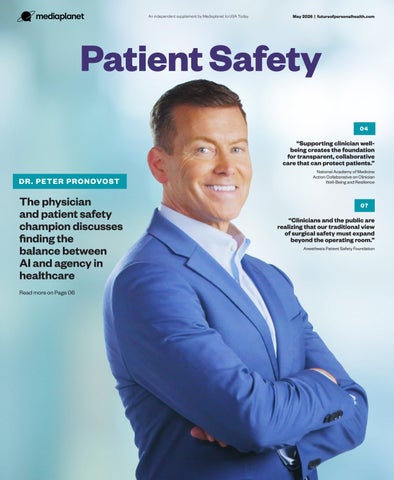
DR. PETER PRONOVOST
“Clinicians and the public are realizing that our traditional view of surgical safety must expand beyond the operating room.”
Designing Safer Care: How Data, Culture, and Relationships Drive Better Patient Outcomes
Our panel of experts discusses how healthcare organizations can move beyond reactive fixes to build systems, cultures, and technologies that prevent harm before it occurs.
What best practices and innovations have you seen make the biggest impact on improving patient outcomes?
Dheerendra Kommala: Healthcare organizations that achieve sustainable improvements in patient safety embrace a systems-based approach, a just culture for the workforce, and human factors engineering principles.
Della Lin: Improving patient outcomes is often framed as implementing the newest “best practices.” Yet, healthcare is a complex clinical environment where teams continually adjust and improvise, particularly amid workforce turnover and relentless production pressure. These
adaptations involve tradeoffs that are often invisible to colleagues or leadership. When organizations focus primarily on compliance with best practices, systems can become brittle, assuming care unfolds as designed while overlooking the tradeoffs clinicians make to keep patients safe. Leaders improve outcomes when they create space to pause, reflect, and debrief, asking “What surprised us?” and “What tradeoffs did we make?”
What technological application do you foresee making the greatest impact on improving patient outcomes?
DK: Healthcare operates on a vast amount of data, but most organizations use the data reactively rather than
proactively. By shifting to predictive data analytics, healthcare teams can turn patterns into warning signs to spot risks earlier. This allows clinicians to intervene and prevent adverse events, side effects, and patient harm before they occur.
DL: More important than “keeping the human in the loop” is “keeping the relationship in the loop.” Patient outcomes are not just about alerts and data; they emerge from how well patients, clinicians, caregivers, and teams coordinate in uncertainty. Transformative technologies should amplify signal over noise and create space for relational coordination, trust, and shared sense-making.
America’s Hospitals Are Constantly Raising the Bar on Patient Safety
Patient safety and innovation aren’t competing priorities. America’s hospitals are proving they can be achieved together, and the results are already saving lives.
Everyone in healthcare shares a goal: to keep patients safe. Patients expect and deserve care that is safe, high-quality, effective, and innovative. The truth is, we can only deliver on those expectations when safety comes first.
To do that, we must shift away from what I often describe as “or” thinking and move toward “and” thinking. Healthcare cannot be a choice between safe care or innovative care. It must be safe and high-quality and innovative and effective. When we think in terms of “and,” we change what is possible for our patients and the people who care for them.
allows patients more uninterrupted time to heal and gives nurses more time to focus on what matters most: being there for patients.
Innovation in service of safety Innovation plays an important role in helping us achieve this goal. Today, we have tools that help us provide safer, more effective care. For example, small wearable devices can monitor patient vitals in real time and send updates directly to nurses. This
These innovations help hospitals better serve their patients and communities, and we are seeing results. According to a Vizient analysis, hospitalized patients in the second quarter of 2025 were nearly 30% more likely to survive based on their underlying severity than similar patients in late 2019, even as today’s patients arrive
sicker and with more complex conditions.
By continuing to embrace change and invest in innovative technologies, America’s hospitals and health systems will continue pursuing our most important goal: keeping patients safe.
Alessandra Ietta Business Developer Isabella Rawls Managing
Gretchen Pancak Production Manager Dustin Brennan Creative Director Kylie Armishaw
Editor Taylor Rice Cover Photo Courtesy of
WRITTEN BY Marc L. Boom, M.D. President and CEO, Houston Methodist; Board Chair, American Hospital Association
INTERVIEW WITH Della M. Lin, M.D., M.S., FASA Board Member and Secretary, Anesthesia Patient Safety Foundation
INTERVIEW WITH Dheerendra Kommala, M.D. Chief Medical Officer, ECRI
Bridging the AI Health Divide
Patients and health systems are both turning to AI, but on separate tracks, with a widening gap between them that won’t close on its own.
Across the spectrum of healthcare, health delivery organizations and the patients they serve are finding themselves on parallel and disparate tracks of AI adoption. Both are driving toward a shared goal of better health outcomes, but the gap between them is rapidly widening to a chasm that will not close on its own.
Organizational AI is being deployed inside controlled frameworks with use cases like clinical validation, virtual trials, and EHR integrations. Patient use of AI is almost entirely unstructured, driven by hope, curiosity, or convenience, but disconnected from the tools clinicians use.
Patients arrive at appointments anchored to AI-generated hypotheses they can’t fully explain, while clinicians operate AI-assisted workflows into which patients have no visibility. Neither side is wrong for adopting available tools, but the absence of a connection between these two trajectories creates a structural gap.
The risks of the divide
The risks are real. AI tools that are not calibrated to clinical standards can reinforce confirmation bias or default to common diagnoses while missing critical outliers. Large language models could give patients false reassurances that delay necessary care.
Accelerating AI adoption in healthcare requires honesty about its limits.
Accelerating AI adoption in healthcare requires honesty about its limits. Models trained on historical data inherit historical biases. Underserved populations are often underrepresented in the datasets that inform AI tools, meaning performance may be weakest precisely where the need is most acute.
In the end, we will all be patients, and most of us will help those we love navigate their own healthcare journeys. We need to look to organizations bridging the chasm between clinical and consumer AI for health.
The AI divide in healthcare will not close on its own. It will close when patients demand better, and when health systems rise to meet the challenge.
Sponsored
Unacceptable Risks for Patients Unable to Communicate With Caregivers
When patients can’t fully communicate with their caregivers, their risk accumulates across every stage of care.
Adangerous situation arises when clinicians misunderstand patients’ descriptions of symptoms. Whether at intake, consent, treatment, or discharge, it’s no exaggeration to characterize many such exchanges as life-or-death. Limited English proficient (LEP) patients run this risk millions of times a day, as do doctors, hospitals, and insurers.
The need to ensure every patient has the same level of quality healthcare is why language access belongs in every “patient safety” conversation. In one peer-reviewed study from six Joint Commission-accredited hospitals, 52.4% of adverse events involving LEP patients were linked to communication errors, compared with 35.9%
for English-speaking patients. And language support must be professional and HIPAA-certified. Family members or untrained bilingual staff had an 11x higher error rate compared to professional interpreters.
Recent peer-reviewed healthcare evidence for the cost-effectiveness of language access includes:
• 55% of malpractice cases come from miscommunication between patients and caregivers
• Doctors spend an extra 10-30 minutes initiating every interpreting session, which could add up to tens of millions of dollars of wasted provider/surgeon time a year.
Jeenie helps build quality and access into healthcare’s daily workflow. The
Jeenie platform connects clinicians to qualified interpreters in 300+ languages, including ASL and rare or Indigenous languages, with average connection times under 8 seconds. It is supported by more than 20,000 interpreters and has a 4.9-star (out of 5) client rating. For low-risk interactions, Jeenie also offers AI interpreting with escalation to a live interpreter when conversations turn complex.
Approximately 1 in 12 people in the United States are at risk of adverse events because of barriers created by language discordance. Clearly, patient safety starts with every patient being understood, every time.
Written by Dr. Richard Brecht, Co-Founder and Chief Language Officer, Jeenie
WRITTEN BY Reid Oakes Chief Operating Officer, Healthcare Information and Management Systems Society (HIMSS)
Scan the QR code to learn more about Jeenie:
Transparency Is the First Step to Ending Emergency Department Boarding
There is a growing crisis in America’s emergency rooms known as emergency department (ED) boarding. Emergency physicians are sounding the alarm, while patient advocates and policymakers are taking notice.
Emergency departments are the front door to a hospital. However, for too many patients, they have become holding areas instead. Boarding occurs when patients who have already been admitted remain in the ED because no inpatient beds are available. According to the Association of Academic Chairs of Emergency Medicine, ED boarding rose nearly 130% from 2012 to 2019 and increased further after COVID-19.
This is not just an inconvenience. Crowded EDs mean longer wait times, delayed diagnoses, and clinicians and facilities stretched beyond safe capacity. Older adults and patients experiencing behavioral health crises often endure the longest boarding times.
It’s time for things to change. In 2025, The Leapfrog Group added questions to our hospital survey about ED boarding times, and we intend to publicly report this data next year. The Centers for Medicare & Medicaid Services also approved a new measure this year that requires hospitals to track and report ED boarding and transfer delays.
Measuring ED boarding alone does not solve the problem, but shining a light on it is a critical step. Hospital leaders must measure it, own it, and set goals to reduce it so no patient who needs a hospital bed is left waiting in harm’s way.
Patients and Clinicians as Powerful Partners for Better Health Outcomes
Prioritizing investment in patient safety is deeply intertwined with a culture of clinician well-being.
The connection between patient safety and clinician well-being is not abstract. Healthcare professionals enter their fields to care for patients, but burnout makes it harder to deliver on that commitment. Clinicians experiencing burnout are more likely to make errors in diagnosis, treatment, and patient communication. But the problem extends even further. As healthcare workforce numbers have still not returned to pre-pandemic trends, gaps in access to care persist. Health workers face increased workloads, longer hours, and greater stress — conditions that increase the likelihood of errors. When health workers are stretched too thin, emotionally depleted, and unsupported, even the most dedicated professionals struggle to provide the safe, high-quality care their patients deserve.
Partnership between patients and providers
care providers and patients. The hospital and clinicians involved acknowledged their mistakes and implemented steps to help prevent future errors. The hospital’s chief medical officer became a key ally in the family’s advocacy work.
This kind of accountability and partnership requires that healthcare workers have the support and capacity to engage with patients, acknowledge mistakes, and work collaboratively toward solutions. When clinicians lack institutional support, it can be challenging to foster these connections. Stories like these remind us that patients and providers are on the same team, working toward the same goal: better health outcomes.
WRITTEN BY Leah Binder President and CEO, The Leapfrog Group
Supporting clinician well-being creates the foundation for transparent, collaborative care that can protect patients. One patient safety advocate, whose loved one died due to a medical error, now champions collaborative relationships between
Supporting healthcare professionals’ well-being is essential for patient safety. To learn more about patient-provider partnership directly from patients, visit nam.edu/PatientProviderStories. These stories highlight moments of shared decision-making, errors caught and reported, and care that made a real difference. When we support healthcare workers, we support patients and their families.
Written by National Academy of Medicine
Action Collaborative on Clinician Well-Being and Resilience
Photo courtesy of National Academy of Medicine
Healthcare Safety Is Improving but Preventable Medical Errors Still Harm Patients
Since the COVID-19 pandemic, certain safety measures have improved in some healthcare settings, such as infection rates and medication errors. However, these gains are inconsistent, and safety can vary widely depending on where patients receive medical care. It is estimated that 1 in 4 inpatient admissions involve an adverse event. As many as 250,000 deaths a year in the United States are linked to medical errors and preventable harm.
Every clinician swears an oath to “do no harm,” and yet despite their best intentions and the valiant efforts of countless national organizations and regulators, it happens at healthcare facilities every day. At ECRI, we analyze safety data, pour over research, and tap into our national networks of thousands of hospitals, health systems, and clinics to identify what’s causing the most patient harm, and what evidence-based and innovative strategies are unlocking solutions.
Healthcare challenges leading to patient harm:
• Resource constraints, funding cuts, and staffing shortages
• Poorly designed, fragmented healthcare delivery systems
• Limited access to care, especially in rural communities
• Blame-driven workforce cultures that suppress safety reporting
• Technology failures and misuse of tools like AI
• Disparities in care disproportionately impacting vulnerable communities
• Rising rates of preventable acute illness and disease
These challenges are pervasive and that’s just the tip of the iceberg, but many healthcare organizations are making sustainable gains by implementing evidence-based strategies that protect patients.
Proven solutions that advance patient safety:
• Design systems and workflows that protect against inevitable human error
• Apply human factors engineering to create resilient work systems
• Leverage predictive data analytics to flag risks and intervene before harm occurs
• Foster a Just Culture that encourages safety reporting and empowers staff
• Commit to safety and radical transparency from the boardroom to the frontlines
In my 35-year career as an anesthesiologist and intensive care specialist turned industry executive and CEO of a patient safety nonprofit, I’ve never been more hopeful about our nation’s ability to spur transformative change in healthcare safety. The tides are turning. More healthcare leaders are seeing the clear link between safe systems and operational efficiency. More industry leaders are shifting from reactive to proactive approaches.
The obstacles we face are real, but so is the ingenuity of the clinicians and care leaders working day and night to heal the sick and wounded. We can and must do better — for patients, for their loved ones, and for our resilient healthcare workforce.
When it comes to improving patient safety in the United States, the healthcare industry is making progress — but not nearly enough. Visit ECRI.org to download research reports on the Top 10 Patient Safety Concerns for 2026, and the Top Ten Health Technology Hazards for 2026.
• Engage patients and their families as partners in care
• Understand and proactively address health disparities to provide equitable care
ECRI is a global nonprofit organization improving the safety and quality of healthcare. ECRI operates one of the largest Patient Safety Organizations (PSOs) in the U.S. with a multidisciplinary team of safety experts and a dataset of more than 8 million patient safety events.
WRITTEN BY Marcus Schabacker, M.D., Ph.D. President and CEO, ECRI
peopleimages.com | Photo courtesy of ECRI
Why Doctors Must Lead the AI Health Revolution
Physicians are uniquely prepared to ensure AI aligns with medicine’s ethical foundations, but only if they are actively involved in building it.
Patients place their trust in physicians, not technology. That is why physician leadership in the design, development, and use of AI tools is so critical for medicine’s future.
The rapid expansion of AI in medicine raises important questions about responsibility, equity, and transparency. These are not theoretical concerns; they directly affect patient care. Physicians are uniquely prepared to ensure AI aligns with the ethical foundations that have long guided our profession — to do no harm, respect patient autonomy, promote equity, and maintain professional accountability. Technology must serve these values, not redefine them.
What physicians bring to the table If physicians are not actively involved in AI creation, use, and regulation,
If physicians are not actively involved in AI creation, use, and regulation, those decisions will be made by others, often with different incentives and priorities.
those decisions will be made by others, often with different incentives and priorities. Technology companies bring extraordinary expertise, policymakers play an essential role, and innovators are critical partners, but physicians
bring something no one else can: deep insights about the needs of patients and what actually works inside the exam room.
Physicians are present for the hardest conversations, the uncertain diagnoses, and the life-altering decisions. That perspective must help guide the technologies that increasingly influence how care is delivered.
Physician leadership ensures that AI advances what matters most: better outcomes, greater access to care, reduced administrative burden, and more time for the human connection that defines medicine at its best. If physicians are absent from this moment, others will define how AI is developed, how it is deployed, and what it ultimately prioritizes. When physicians lead, technology follows medicine’s mission, not the other way around.
Transforming Healthcare for Everyone With AI Innovation
We have a responsibility to leverage the power of artificial intelligence (AI) to improve healthcare for all.
AI can improve patient access and experience, scientific discovery, and patient outcomes. From a patient scheduling an appointment more efficiently to a provider analyzing “big data” to identify disease patterns, predict patient outcomes, and prescribe personalized treatment, AI has the potential to enhance satisfaction while also helping providers in their decision-making process.
AI also promises to reduce errors in diagnosing and treating conditions, offering caregivers crucial support to democratize excellence. Reasoning AI performed almost flawlessly in making an accurate diagnosis and treatment plan, compared to physicians. It can also allow providers to gauge the quality of the care
they’re providing with metrics reported in real time, not years later. Those quality outcomes matter a great deal.
The goal is to be a system that is more efficient, equitable, transparent, and patient-centered.
Balancing AI and agency
AI technology has the potential to enhance healthcare significantly, but
attitudes and abilities are essential in driving this change. Agency in this context refers to the ability of patients and providers to take control of the healthcare journey. In practical terms, this means that we, as empowered patients, are actively managing our health data, enabling us to make informed choices about our care. For providers, agency means having the necessary tools and information to deliver high-quality care.
The future of healthcare lies in seamlessly integrating both AI and agency. It will require healthcare systems to invest in both infrastructure and people. It will also require a forward-looking attitude of abundance rather than scarcity from all of us. The goal is to be a system that is more efficient, equitable, transparent, and patient-centered.
M.P.H. CEO, American Medical Association
WRITTEN BY Peter Pronovost, M.D., Ph.D., FCCM Chief Clinical Transformation and Quality Officer, University Hospitals
WRITTEN BY Jim Weinstein, D.O., M.S. Vice President, Microsoft Research
The Patient Experience: The Missing Vital Sign for Safe Perioperative Care
More than 99% of surgical deaths and complications occur outside the operating room, and patients’ own reports of how they feel may be the most critical signal we’re missing.
More than 30 million surgeries are performed annually in the United States. Thanks to modern anesthesia and surgical advances, patient deaths during the operation itself are now extremely rare.
Yet, the intra-operative period represents only a tiny fraction of the patient’s surgical journey — less than 1% of the 30-day perioperative mortality metric used to assess quality. More than 99% of deaths and complications occur outside the operating room, driven by events like bleeding, cardiac injury, infection, and other complications that may unfold long after surgery.
Clinicians and the public are realizing that our traditional view of surgical safety must expand beyond the operating room. We must amplify our focus on the signals of safety during recovery and especially after discharge, when clinical visibility drops.
The patient’s experience as a vital sign
These important signals include our patients’ vital signs. Traditionally, we use vital signs as physical measures of health that guide clinical actions and outcomes. Changes in heart rate, blood pressure, respiratory rate, and oxygenation all reflect a patient’s system under stress. However, the patient’s lived experience is a different set of vital signs that is often overlooked.
When patients and their family members say, “This doesn’t feel or look right” — noting changes in energy levels, mood, appetite, sleep, or pain patterns — they are often detecting subtle deviations that precede measurable decompensation and harm. When these time-sensitive and context-rich signals are dismissed as expected discomfort, anxiety, or noise, the system loses a critical opportunity to intervene early.
Actions to encourage safer perioperative care
Action
Patients and their families
Track daily symptoms (pain, sleep, appetite, mood, energy) in a notebook or secure app
Set red-flag thresholds (e.g., fever > 100.4°F, new shortness of breath, uncontrolled pain)
Clinicians
Educate patients pre-operatively about which symptoms matter most and how to report them
Create multidisciplinary trigger alerts that combine traditional and remote monitoring data with patient narratives to triage urgency
Health organizations
Integrate patient-reported outcomes into the EHR as a dedicated “patient voice” field
Provide staff training on interpreting patient-reported signals and integrating them into the care plan
This is a call to expand what we consider actionable vital signs. This is a call for technology to amplify the patient and family voice as integral members of the healthcare team. This fall, the Anesthesia Patient Safety Foundation’s Stoelting Conference will explore this very topic. Partnering with patients and elevating their voices to the level of a vital sign is critical to prevent harm in the very period when patients are most vulnerable. Let’s intentionally design safer care together.
How it helps
Creates a structured record for clinicians to review quickly.
Gives clear guidance on when to call the care team
Sets expectations and establishes a patient partnership for timely, coordinated recovery
Merges objective and subjective data for timely decision-making
Widens situational awareness and makes information visible at the point of care
Builds a culture where the patient voice is treated as a vital sign
WRITTEN BY Vonda Vaden Bates Patients for Patient Safety US; Anesthesia Patient Safety Foundation
WRITTEN BY Steven L. Coffee, M.A., EMCQSL Patients for Patient Safety US; Head2Heart Connections; Anesthesia Patient Safety Foundation
WRITTEN BY Della M. Lin, M.D., M.S., FASA Board Member and Secretary, Anesthesia Patient Safety Foundation