New Home + Condo Guide – Greater Toronto Area – March 21, 2026
COLUMNS
Why the GTA housing market is brighter than the headlines suggest 40
Bringing together industry and government to discuss housing and growth 42 TRREB Report
Restoring momentum in Canada’s housing market
44 Tarion Report
What every buy should know about your Pre-Delivery Inspection
What
48 In Conversation With Kirby Heckford, Principal, Tillsonburg Developments 50
Smart eating after 55: Nutrition that supports longevity
How to protect your money when markets get bumpy
The modern bedroom for wellness: Creating spaces that restore and recharge
works
Turning a plain interior into a meaningful space 58
How light affects mood, sleep and safety as we age 60
Beauty in the background: The details behind thoughtful interiors
HOME DESIGN | MARIAM ABOUTAAM
An award-winning interior designer, Mariam Aboutaam is Director, Sales and Marketing, Interior Design at Kylemore, Markham, Ont., a builder known for master-planned communities and luxury homes. kylemoreliving.com.
PERSONAL FINANCE | JESSE ABRAMS
Jesse Abrams is Co-Founder at Homewise, a mortgage advisory and brokerage firm based in Toronto. thinkhomewise.com
TARION REPORT | PETER BALASUBRAMANIAN
Peter Balasubramanian is President and CEO of Tarion. tarion.com.
WESTERN VIEW | MIKE COLLINS-WILLIAMS
Mike Collins-Williams, RPP, MCIP, is CEO West End Home Builders’ Association. westendhba.ca.
HOME REALTY | DEBBIE COSIC
Debbie Cosic is CEO and founder of In2ition Realty. She has overseen the sale of more than $15 billion worth of real estate. With Debbie at its helm, In2ition has become one of the fastest-growing and most innovative new home and condo sales companies. in2ition.ca
AGE STRONG | DR. JAMES FUNG
Dr. James Fung is a Chiropractor and Principal at Complete Balance Health Centre, Toronto. completebalancehealth.com
REAL ESTATE PRO | BARBARA LAWLOR
Barbara Lawlor is CEO of Baker Real Estate Inc. A member of the Baker team since 1993, she oversees the marketing and sales of new home and condominium developments in the GTA, Vancouver, Calgary and Montreal, and internationally in Shanghai. baker-re.com
STAT CHAT | BEN MYERS
Ben Myers is the President of Bullpen Consulting, a boutique residential real estate advisory firm specializing in condominium and rental apartment market studies, forecasts and valuations for developers, lenders and land owners. Contact him at bullpenconsulting.ca and @benmyers29 on Twitter.
TRREB REPORT | DANIEL STEINFELD
Daniel Steinfeld is President of the Toronto Regional Real Estate Board (TRREB). A Chartered Accountant, he previously served as Vice-President and Chief Financial Officer with the Toronto Argonauts and is a Broker and coowner On The Block Realty.
BILD REPORT | DAVE WILKES
Dave Wilkes is president and CEO of the Building Industry and Land Development Association (BILD), the voice of the home building, land development and professional renovation industry in the GTA. For the latest industry news and new home data, follow BILD on Twitter at @bildgta or visit bildgta.ca
SENIOR MEDIA CONSULTANT Amanda Bell 416.830.2911 amanda.bell@nexthome.ca
EDITORIAL DIRECTOR Amanda Pereira
EDITOR-IN-CHIEF – GREATER TORONTO AREA Wayne Karl wayne.karl@nexthome.ca
CONTRIBUTORS
Mariam Aboutaam, Jesse Abrams, Olivia Bailey, Peter Balasubramanian, Mike Collins-Williams, Debbie Cosic, Dr. James Fung, Anwar Husain, Linda Kafka, Barbara Lawlor, Linda Mazur, Ben Myers, Mimi Pineau, Daniel Steinfeld, Dave Wilkes
Advertising Call 1.888.761.3313 for rates and information. Fax: 1.888.861.5038
Circulation Highly targeted, free distribution network focused on real estate buyers, using street-level boxes and select Canada Post distribution channels across the Greater Toronto Area and surrounding municipalities. Canadian subscriptions 1 year = 13 issues – $70 (inc. HST). Canada Post – Canadian Publications Mail Sales Product Agreement 40065416.
Copyright 2026 All rights reserved. All copyright and other intellectual property rights in the contents hereof are the property of NextHome, and not that of the individual client. The customer has purchased the right of reproduction in NextHome and does not have the right to reproduce the ad or photo in any other place or publication without the previous written consent of NextHome.
Editorial Submissions from interested parties will be considered. Please submit to the editor at editorial@nexthome.ca.
Terms and Indemnification Advertisers and contributors: NextHome is not responsible for typographical errors, mistakes, or misprints. By approving your content and/ or submitting content for circulation, advertisers and contributors agree to indemnify and hold harmless NextHome and its parent company from any claims, liabilities, losses, and expenses (including legal fees) arising out of or in connection with the content provided, including but not limited to any claims of copyright infringement, unauthorized reproduction, or inaccuracies in the content. Advertisers acknowledge that they have the necessary rights, permissions, and licenses to provide the content for circulation, and they bear full responsibility for the content’s accuracy, legality, and compliance with applicable laws upon approval. Contributors acknowledge NextHome reserves the right to omit and modify their submissions at the publisher’s discretion.
SPRINGING INTO FORM
WAYNE KARL
EDITOR-IN-CHIEF
New Home + Condo Guide
EMAIL: wayne.karl@nexthome.ca
TWITTER: @WayneKarl
Now that we’re fully into spring and Daylight Saving Time, our minds and moods naturally move toward lighter things and brighter days.
In real estate, spring has typically meant busy season. While there are signs that market conditions are looking a little brighter, challenges remain. There is some progress on housing policy as it relates to action of federal and provincial governments (see our news pages), but more needs to be done (also see news pages and various other pieces of content in this issue).
Indeed, Kirby Heckford, principal at Tillsonburg Developments in Tillsonburg, Ont., has some rather pointed words for those in power: Do more. It’s a sentiment repeated by some of our other columnists, and by those in the industry who understand the implications of inaction better than our governments, apparently, do.
At time of writing, we awaited two key dates: The latest rate announcement from the Bank of Canada on March 18; and the 2026 Ontario budget, to be tabled on March 26. While most experts expect BoC likely to hold rates, we’re hopeful that Premier Doug Ford unveils meaningful measures in the budget, not just hyperbole about convention centres and highway tunnels.
Heckford is even more direct. “We need to get the market going. The province is putting all this money into roads and other infrastructure, yet potential homebuyers are stagnant. Some of them don’t feel good about buying right now. Nothing’s promoting them to buy. There’s no incentive.”
In the meantime, whatever homebuying demographic you might be in, there is lots of other content in this issue to educate, inform and even enlighten you. In addition to our regular contributors in the condo, finance and marketing sectors, for example, we have an expanded roster of experts in active adult living (a growing category, let’s be honest). Everything from exercise to diet to room design to financial retirement planning, there’s plenty here to enjoy.
More informed, better rested, improved lifestyle… everything is here to help you spring into form, whatever awaits.
UPTICK IN GTA HOME SALES
EXPECTED IN SECOND HALF OF YEAR: TRREB
Greater Toronto Area (GTA) resale housing market conditions tightened in February 2026 compared to February 2025, according to the latest statistics from the Toronto Regional Real Estate Board (TRREB). While sales were down year-over-year, new listings declined by a greater annual rate. The dip in new listings is in line with recent polling results from Ipsos which show listing intentions are down for 2026.
“Many would-be homebuyers are waiting for selling prices to level off
The One Stop Shop for Builder Storytelling
before moving into the market,” says TRREB President Daniel Steinfeld. “If new listings continue to trend lower through the spring, competition between homebuyers will increase, supporting home prices and a recovery in sales.”
Adds TRREB Chief Information Officer Jason Mercer, “There is substantial pent-up demand in the GTA ownership market, with more than 100,000 buyers holding off on making a home purchase. Buyers are waiting for selling prices to level off and for positive news on the trade front. Once we see both, there could be substantial momentum driving home sales in the second half of this year and into 2027.”
GTA realtors reported 3,868 home sales through TRREB’s MLS System in February 2026 – down by 6.3 per cent compared to February 2025. New listings amounted to 10,705 –down by 17.7 per cent year-over-year.
On a seasonally adjusted basis, February home sales and new listings were down month-over-month
compared to January 2026. New listings were down by a greater monthly rate than sales.
The MLS Home Price Index (MLS HPI) Composite benchmark was down by 7.9 per cent year-over-year in February 2026. The average selling price, at $1.01 million, was down by 7.1 per cent compared to February 2025.
On a month-over-month seasonally adjusted basis, both the MLS HPI Composite and the average selling price were down compared to January 2026 figures.
“The long-term sustainability of the GTA housing market depends upon the industry’s ability to bridge the gap between condominium apartments and traditional single-family homes,” says TRREB Chief Executive Officer John DiMichele. “TRREB, with its partners in the Housing Advancement Coalition, is urging the federal and provincial governments to take immediate targeted action to pave the way for increased ‘missing middle’ home construction.”
BILD CELEBRATES HALL OF FAME INDUCTEES AND AWARD OF MERIT RECIPIENTS
The Building Industry and Land Development Association (BILD) recently celebrated the induction of Myron Pestaluky and Gary Gregoris into the BILD Hall of Fame, and presented Gabriel DiMartino and Jude Tersigni the Chair’s Award of Merit at its 2026 Chair’s Dinner.
The BILD Hall of Fame recognizes the unique historical role that certain BILD members have played in making outstanding and lasting contributions to the building industry and the association at the local level. Its inductees are a distinguished group of industry leaders and yesterday, BILD celebrated two posthumous additions.
Pestaluky dedicated more than 45 years to the land development industry and was the president and founder of Delta Urban Inc. His unwavering leadership, commitment to his craft, and dedication to the industry has made a lasting impact. Maria Venturo of Delta Urban remembers Pestaluky’s legacy and his wife Kelly received the BILD Hall of Fame award in his honour.
Gregoris was also inducted into the Hall of Fame. Gregoris built his career on hard work, dedication, listening and building relationships. He was a former BILD board member and was always quick to lend his time and expertise to the BILD team. His professionalism, devotion to the building industry and tireless advocacy efforts were honoured and remembered last night. Gregoris’ wife Laurie accepted the award on his behalf.
“In the last few years, the industry has lost two outstanding and irreplaceable people who impacted so many of us,” says Dave Wilkes, president and CEO of BILD. “Myron Pestaluky and Gary Gregoris were friends to us all, they were industry leaders, and they were respected
and fierce advocates. We miss them dearly and it is an honour to induct them into the BILD Hall of Fame.”
A further feature of BILD’s 2026 Chair’s Dinner was the Chair’s Award of Merit, which was presented to two exceptional individuals –Gabriel DiMartino, senior executive vice-president at Trinity Point Developments, and Jude Tersigni, senior vice-president of planning and development at Menkes Development.
The Chair’s Award of Merit is traditionally bestowed upon members who show outstanding commitment to the industry. They often work behind the scenes, without seeking recognition, to drive the industry forward. It is their passion that moves them to volunteer their time, expertise and knowledge. Both DiMartino and Mr. Tersigni exemplify these values, BILD says.
DiMartino plays a strong advocacy role and works with municipal and regional staff across the GTA to consistently represent industry-wide interests. He volunteers his time and knowledge readily and is a proactive problem-solver. He was formerly BILD’s York chapter co-chair and continues to be a regional advisor for the area.
Tersigni has been an active contributor to BILD’s advocacy efforts across municipal and federal jurisdictions. He works relentlessly to create lasting change through various advocacy-related files. In addition to his work at Menkes, he is a BILD board member and participates as an industry representative on several municipal working groups.
“Mr. Tersigni and Mr. DiMartino are incredible examples of individuals who go above and beyond to serve the interests of the building and land
development industry,” says Jason Sheldon, BILD’s Chair. “Their efforts impact every corner of our trade. From local change to province-wide and federal issues, they are involved in steering the future of the business and I am thrilled to recognize them with the Chair’s Award of Merit.”
Gabriel DiMartino
Jude Tersigni
HOMEBUILDING INDUSTRY APPLAUDS PASSING OF C-4, PRESSES FOR MORE CHANGE
After almost a year since Prime Minister Mark Carney announced the government’s intention to remove the GST on new homes priced at less than $1 million and lower it on homes between $1 million and $1.5 million for first-time buyers, Bill C-4 has received Royal Assent.
The delay in getting this bill through the many legislative stages and political filibustering has been extremely difficult for industry and for would-be buyers, according to Canadian Home Builders’ Association (CHBA). While the intent of the measure was to increase housing supply, the impact of not getting this through parliament has been the exact opposite.
At every stage and at every opportunity, CHBA says it has been pressuring the government to pass C-4 to allow would-be buyers to move off the sidelines and take advantage of the proposed tax rebate, as well as advocating for an extension of GST relief.
The FTHB GST Rebate is available to qualifying purchasers if the agreement of purchase and sale for the home was entered into with the builder on or after March 20, 2025 and before 2031. If ownership was transferred to the buyer before the proposed legislation received
Royal Assent, the buyer will need to apply separately to Canada Revenue Agency for the FTHB GST/HST rebate. Now that the legislation has received Royal Assent, builders will be able to credit the FTHB GST/HST rebate to their buyers using the CRA forms going forward.
While pushing for C-4 to be approved, CHBA says it has been advocating for an extension of GST relief to all buyers of new homes (not just first-time buyers), which would enable move-up buyers and downsizing buyers to purchase new homes and ensure a further boost of housing supply, freeing up entry-level homes for first-time buyers in the existing housing market.
In Ontario, the Residential Construction Council of Ontario (RESCON) is applauding the passage
of Bill C-4, calling it a landmark legislation.
“While it took a long time to get here, the passage of Bill C-4 is extremely welcome news,” says RESCON President Richard Lyall. “Eliminating the GST for first-time buyers on new homes will make a meaningful difference for purchasers and help revive the new home market which has suffered greatly over the past couple of years. This has the potential to kick-start much-needed residential construction.
“The timing of this legislation is critically important,” adds Lyall. “Without swift passage, many potential buyers would have delayed their decisions over the summer, which would have further weakened an already fragile housing market. This will help kick-start the market.”
HOMEBUILDING SECTOR CALLS ON GOVERNMENT FOR TARGETED ACTION ON HOUSING NOW
A coalition representing various stakeholders of the housing industry is calling on the federal and provincial governments to take targeted and immediate action to tackle issues facing the sector.
The Housing Advancement Coalition, comprising representatives from realtors, builders, trade associations, not-for-profit organizations and rental providers from Ontario’s housing sector, says Ontario and Canada remain in the grip of a housing crisis that is increasingly defined not only by insufficient supply of the housing that is needed, but also by a decline in confidence across the housing ecosystem. While governments and industry have made meaningful progress on planning reform, funding programs and streamlining approvals, housing delivery is still constrained by stalled demand, frozen capital and regulatory uncertainty. As a result, tens of thousands of approved
housing units across Ontario and Canada remain unbuilt, putting future supply at risk.
The underlying housing shortage has not abated, the group says. Ontario continues to face a severe lack of housing options that would allow seniors to downsize, families to move up and younger households to enter stable ownership. These dual challenges of weak demand alongside persistent structural undersupply of family-friendly homes require coordinated, disciplined and fiscally responsible action by both the federal and provincial governments.
As governments prepare fiscal and policy decisions, the coalition continues to speak with one voice, urging a renewed focus on restoring confidence and unlocking demand. The coalition is proposing a renewed push for targeted action by the governments of Canada and Ontario on the following:
FEDERAL POLICY RECOMMENDATIONS
1. Expand the GST sales tax rebate on new homes to all buyers
2. Modernize federal financing tools to support rental and missing middle ownership housing
3. Restore practicality to mortgage qualification rules
4. Amend the prohibition on foreign home buyers, with clear and enforceable guardrails
ONTARIO POLICY RECOMMENDATIONS
1. Reform development charges and improve cost transparency
2. Expand the HST sales tax rebate on new homes to all buyers
3. End exclusionary zoning in large municipalities
4. Remove municipal barriers to housing delivery
“We must act now through bold measures; the time for incremental steps is behind us,” the group says. “The housing sector stands ready to partner with both orders of government to translate the recommendations found in our joint letter into real homes, real jobs, and lasting affordability for Canadians.”
WHY NOW IS THE RIGHT TIME TO BUY
– WITH DEMOCRAT HOMES
Have you been thinking about a new home but aren’t sure if now is the right time to buy?
The truth is that you have to look at the pluses and weigh them against potential minuses, then make an informed decision that ultimately leads to a lifetime of happiness for your family. As a builder, Democrat Homes wants to make everything right for you, to ensure success. This means searching for the right setting, creating the right community atmosphere, designing the right homes and features, and all at the
right price. That’s a tall order, but the company believes it has done exactly that in Forest Heights Estates, a oneof-a-kind community of detached homes surrounded by breathtaking nature. Now is the time to see if Forest Heights is right for you.
First of all, there’s the private location in picture postcard Horseshoe Valley, just one hour north of Toronto. This offers the kind of setting that is very difficult to find in today’s world of crowded, housing intensification. It’s definitely different here. The quiet cul-de-sacs
and relaxed roadways are literally surrounded by nature, with mature trees and protected greenspace providing the perfect backdrop. The green theme continues with a verdant golf course and famed ski hills just a five-minute drive away, while hiking trails and a spacious park are within walking distance. Yes, schools and places of worship are close at hand, as are the conveniences of Barrie and Orillia – just a 20-minute drive in either direction. You’ll agree that this is the perfect place to raise a
family… or to really enjoy your adult years in the most ideal setting of all. Forest Heights Estates offers the right location.
Next let’s talk about community. There are only 80 homes here, on exclusive half-acre to more than oneacre ravine lots providing highland and valley views. The distance between the homes means you’re far enough to ensure privacy, but close enough to embrace the benefits of a true neighbourhood. Each estate lot is unique and expansive, offering you the opportunity to add a patio, playground, swimming pool or almost anything else your lifestyle demands. And that’s just in your backyard. Beyond that, every lot has trees, all kinds of beautiful trees. Activities here abound, both in summer and winter. Now this is your immediate community, but what about the larger community outside your cosy street? Whether you have an entire brood or are happy empty-nesters, rest assured that things-to-do, amenities, clubs and social events you require are also close at hand. Forest Heights is the right community for you and yours. Now to the most important part of all – your new home. The design has to be right, to fit your lifestyle and your budget. Let’s start with a simple choice, bungalow or two-storey? Both layouts are proven winners with various square footage to live in and grow in. Now select two to four bedrooms, two- or three-car garages, walkout or standard lot, fantastic features and finishes. There are a dozen home designs to select from. You will also appreciate the endless choices you can make to personalize your abode. But remember, sticking with the standards is also and always right. Brick construction, half-acre lot, carefree vinyl windows, two- or three-car garage, modern kitchens, main floor laundry, 30-year shingles and the list goes on. Forest Heights Estates has the right designs for you.
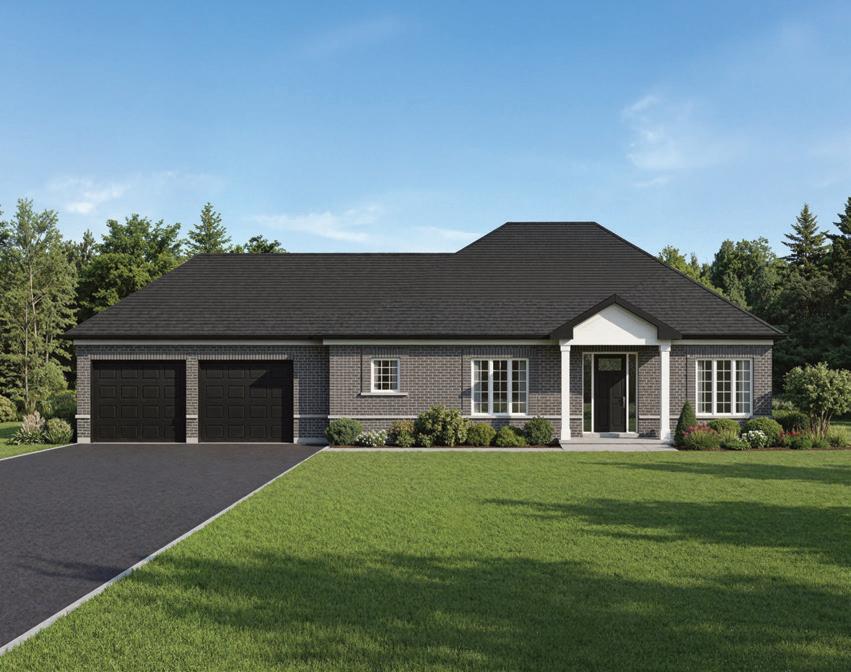
Most exciting, in the third and final phase, Democrat Homes is introducing two new models and a lower than low price point. Meet The Elegance, a perfect 1,150-sq.-ft.,
two-bedroom, two-garage bungalow with all the bells and whistles starting at an incredible $849,900. Imagine owning your piece of paradise, with a solidly built, technologically superior, aesthetically pleasing detached bungalow from a very affordable $849,900. And if you join in for the Phase 3 Grand Opening celebration, the company will give you a one-percent bonus off your lowest interest rate for a two-year period. A second new model is called The Essence, and it offers 1,320 sq. ft. of spacious living, also at a very reasonable price point. Here you’ll discover a modern open concept, main floor laundry, large windows and convenient singlefloor layout. Forest Heights gives you
everything want in a new luxury home at the right price point.
So, is this the right time to buy the new home you’ve dreamed of? If you wish to take advantage of a historic opportunity to own a forever home, in an exclusive community on a large estate lot, then this is truly the right time to buy a new home in Forest Heights Estates. Please note that this is the final phase of the development, with only 30 remaining homes available.
To register for the Grand Opening April 18 and 19, or see the new model home and choose the right home in Forest Heights Estates, visit democrathomes.com.
1,150 sq. ft. Elegance
MARK PALUMBO
SALES MANAGER, FOREST HEIGHTS ESTATES, DEMOCRAT HOMES
Whatever your place in life, whether you’re empty nesters transitioning into retirement or a young family wishing the quieter things in life, Forest Heights Estates from Democrat Homes may be the place for you.
Just picture it: Quiet cul-de-sacs, relaxed roadways, mature trees and protected greenspace… and that’s just your surroundings. Imagine living there in a comfortable detached home on an expansive lot, with all the amenities and comforts within reach. This could be your life in this private location in Horseshoe Valley, about 122 kms north of Toronto, in this one-of-a-kind community.
Mark Palumbo, sales manager for Forest Heights Estates, explains why
by WAYNE KARL
the community appeals to so many, and what else Democrat Homes has to offer.
How was 2025 for Democrat Homes?
Last year was a big building year in our centrepiece community, Forest Heights Estates. Our focus remained on the families waiting for their homes. We stayed disciplined, prioritized our construction schedules and successfully closed every home earmarked for our purchasers. Sure, we had our share of economic challenges, and like many in the industry, navigated a complex economic landscape with fluctuating interest rates and rising material costs, but the proof is in our homes.
What were the highlights?
The true highlight is always seeing a community come to life. I find it immensely satisfying to see a design move from blacklines on a page to a physical reality in our exclusive development. Forest Heights Estates has really come together over the last year and is already a shining jewel in the Oro-Medonte region.
And how are things shaping up for 2026?
This feels like a year of renewed momentum. As the economic outlook stabilizes, we are starting to see confidence return among buyers and a stronger sense of activity in the market. Our focus this year is twofold. First is execution, making sure we
continue to move projects forward and get shovels in the ground for our remaining homes so we can deliver on the commitments we have already made. Second is looking ahead to the next phase of the community by bringing new homes to market and continuing to refine our designs.
As homeowners’ needs evolve, we are paying close attention to how people want to live today and making thoughtful adjustments to our plans so the homes we build remain functional, modern and well suited for families.
There’s been a lot of movement among governments at all levels to address the issues facing the housing industry. What more do you think can be done?
The intent is there, but the execution needs to be more streamlined.
From a builder’s perspective, one of the biggest challenges is the amount of red tape involved, particularly the time it takes to move from an approved plan to an
issued permit. Greater consistency across municipalities would help significantly, as would a reduction in the heavy development charges that are ultimately passed on to the homebuyer. If we want to make real progress in addressing the housing crisis, we need to create a system that makes it faster, more predictable and more cost effective for businesses such as ours to build new homes.
What new developments or phases is Democrat introducing this year?
We are very excited to be launching Phase 3 of Forest Heights Estates this spring. It is a significant milestone for us and an important step forward for the community. This phase will continue to build on the aesthetic we have established, featuring a mix of our most popular bungalow and twostorey models. Many of these homes have been revisited and thoughtfully refined to improve flow, functionality
and overall design, while still sitting on the generous lots our buyers have come to expect from a Democrat community.
At the same time, we are introducing several new models at a very competitive price point. Our goal is to expand the range of options available and open the door for more buyers, giving as many people as possible the opportunity to become homeowners.
How are things coming along at Forest Heights Estates
Excitement is building here as we prepare to launch Phase 3 this spring. While many builders slowed down or paused activity over the past couple of years, we continued moving forward and closing homes despite the challenges the industry faced. As a result, we remain right on track with our plans.
Interest in the community has been strong, which speaks to the unique value the area offers to buyers.
On the construction side, we are preparing for a major push in the coming months. Our targets for the year are ambitious, but our trades are ready, and we are looking forward to welcoming many more families into the community by the end of the year.
What is the typical buyer demographic?
It is a wonderful mix. We see young professional families who are looking for more space and a better environment to raise their children. We also see many empty nesters who are ready to transition into a home that is easier to maintain while still offering the quality and comfort they are used
to. In addition, there are many buyers who are right sizing and moving out of the GTA in search of a high-quality home that is more manageable, while still being close to nature and without giving up the modern features and conveniences they value.
What sets this project apart from others in the area?
What makes Forest Heights truly special is the setting. These are large, wooded lots, something you just don’t see anymore. And getting a lot like this at the price we offer is almost impossible. But it’s more than just the land. You’re getting a complete package: A home built with architectural integrity and energy efficiency, beautiful finishes from a team that is truly dedicated to quality and excellence. It’s a lifestyle. You’re surrounded by nature, and its minutes from Horseshoe Valley and the Copeland Forest, but still connected to every amenity you need. That is what we call the “Democrat difference.”
What do you look forward to most in 2026?
What I’m most excited about in 2026 is seeing our plans come to
on a personal note
What or who is your most influential inspiration for what you do?
My greatest inspiration is my father. Working with him showed me what it really means to run a business with integrity and care. He taught me that being honest is just as important as the quality of the work.
That idea of trust is something I carry into everything we do. Every purchaser I meet and every project we take on reflects those values, and when someone chooses Democrat Homes, they can feel confident they are getting more than just a house. They are getting
a builder who stands behind their word every step of the way.
Away from the office on your downtime, you’re happiest when you…?
I’m happiest when I’m at home with my family. Whether I’m in the kitchen experimenting with a new sourdough bread recipe tending my garden or just spending quality time with my wife and kids... Those moments are where I recharge, where I find balance, and where I’m reminded of what really matters. Home is my place to slow down and enjoy the people I love most.
life. We have a number of builds in the pipeline, but the launch of Phase 3 really stands out. There’s nothing quite like breaking ground on a new phase and knowing families will soon be moving into these homes. I’m looking forward to the first homeowners turning the key in their door and watching the community grow. There is a unique energy that comes with a spring launch and exciting times are ahead.
What’s next for Democrat Homes?
Our focus is straightforward: Delivering excellence in every home. Every Democrat home sets a standard for quality in Ontario and reflects our unwavering commitment to craftsmanship.
By following a disciplined construction schedule and maintaining a hands-on, family-driven approach, we ensure each home is built with care, attention to detail and lasting value. This approach allows us to consistently deliver high-quality homes while preserving the personal touch and accountability that our homeowners appreciate most.
democrathomes.com
What’s on your TV binge watch, reading or podcast list these days?
My daughter does her best to control the music blasting through the speakers at our house, but I always use every other song to introduce her to classics, from The Beatles and Zeppelin, or wind down to jazz greats such as Ella, Louis and Sinatra. I’ve also been revisiting the films of Kubrick and Hitchcock, and it’s amazing how timeless their work is. When I’m driving, you’ll usually find me listening to Stuff You Should Know, catching up on topics I never knew I was interested in.
$849,900...Yes $849,900!
Forest Height Estates in Horseshoe Valley offers so much home for your money.
- Bungalow & 2-Storey
- Brick and Stone - Ravine 1/2 Acre+ Lots -Top Features & Amenities - Much More
Hurry! REGISTER NOW
BUILDER PROFILE
Lucchetta Homes: Award-winning builder of thoughtfully built communities for active adult living in Niagara
As homebuyers across southern Ontario reconsider what “living well” truly means, the Niagara Region continues to attract those seeking a more balanced lifestyle. For those ready to take that leap of faith, partnering with a trusted local builder is essential. For more than 60 years, Lucchetta Homes has been helping families and active adults make that transition with confidence.
INTEREST RATES
Ontario mortgage brokers urge bank of Canada to address housing crisis through direct action
The Canadian Mortgage Brokers Association of Ontario (CMBA Ontario) says it is disappointed by the recent decision by the Bank of Canada (BoC) to hold its policy interest rate at 2.25 per cent. CMBA Ontario encourages a more direct and aggressive approach to curb the worsening housing crisis and rebuild consumer confidence in the market.
HOUSING MARKET
Home sales and prices to remain stable in 2026 amid ongoing affordability pressures
The Toronto Regional Real Estate Board’s (TRREB) 2026 Market Outlook and Year in Review report highlights a housing market shaped by improved buyer choice and affordability, alongside cautious consumer sentiment across the Greater Toronto Area.
PERSONAL FINANCE
Mortgage renewals: Why your bank’s first offer may not be your best
Over the next few years, a very large share of Canadian mortgages will come up for renewal. For many households, this will mean higher payments. For others, it will mean tough choices about budgets and timelines. But it also creates an opportunity, if you handle your renewal the right way.
ACTIVE LIVING
4 types of exercises to help you stay strong, active and healthy after 55
Staying active after 55 is one of the most powerful ways to support your health and maintain independence. At this stage of life, exercise isn’t about fitness goals – it’s about moving in ways that help you feel strong, steady, energized and confident in everyday life.
BUILDER PROFILE
Welcome home… in a Doug Tarry Home
Rooted in St. Thomas, Ont., Doug Tarry Homes has been shaping communities with care and intention since 1954. Founded by Doug Tarry Sr., the company has grown through generations with a clear purpose: To build thoughtfully and leave a positive impact wherever they work. That belief, inspired by lessons Doug Sr. shared during family canoe trips, continues to guide everything the team does today.
BRAMPTON BRICK
WHERE YOUR NEW HOME JOURNEY BEGINS
Homebuyers these days are increasingly discerning – about everything. From the beginning of their journey a sales centre, to walking through model homes, to exploring floorplans, considering upgrades and options and generally imagining how their life will unfold.
Location, home design – and especially with economic challenges – pricing.
So too are they demanding more from the home itself – beginning with the exterior. When it comes to new lowrise homes, it all begins with what everyone new-homebuyer desires –beautiful brick exteriors.
Brampton Brick understands the excitement, the questions and dreams that come with this first step, and the company is here to make the choices you make about your home’s exterior simple, beautiful and lasting.
With more than 150 years of experience, Brampton Brick brings
a legacy of quality, innovation and craftsmanship to every project.
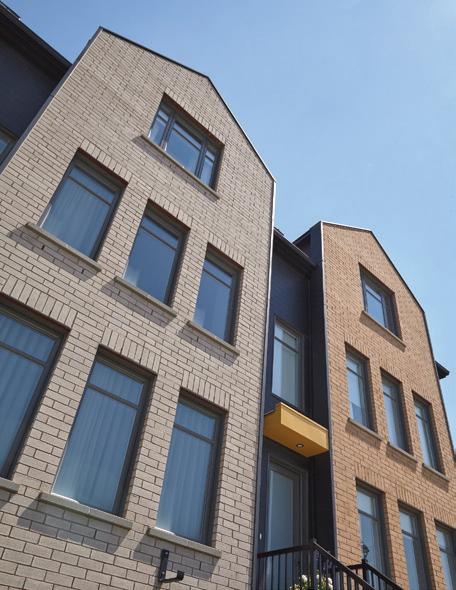
Founded in 1871, it is one of North America’s most respected manufacturers of clay brick and integrated masonry products, proudly made in Ontario from locally sourced materials. Choosing local not only ensures superior quality and durability but also supports Ontario jobs and communities.
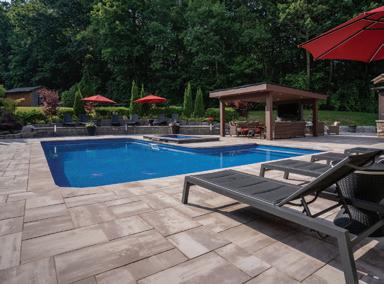
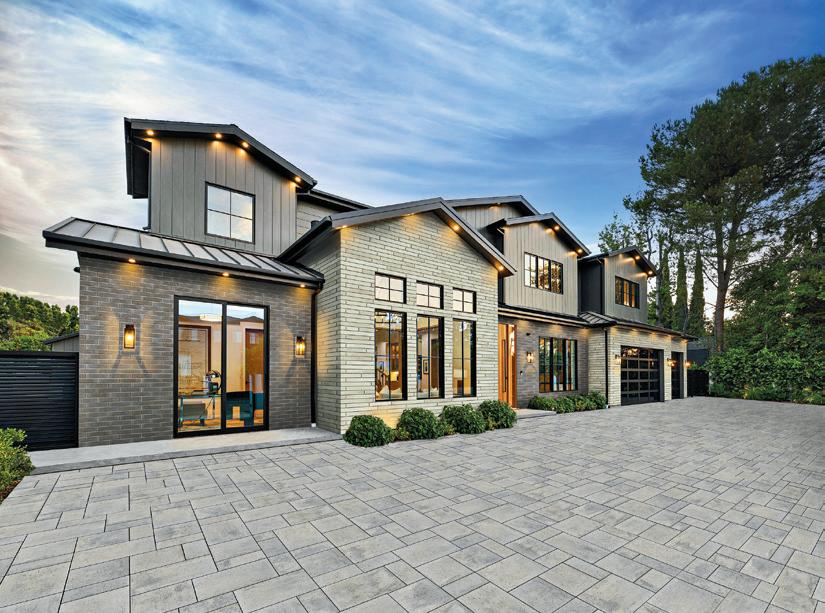
The company’s portfolio of brick, stone and concrete masonry products, along with Oaks Landscape Products for driveways, patios, walls and pool areas, combines design flexibility with consistent performance to enhance every aspect of your home. Designed for durability, timeless style and longterm value, Brampton Brick gives homeowners confidence that their home will look beautiful today and stand strong for generations.
Brampton Brick’s masonry collections are more than just
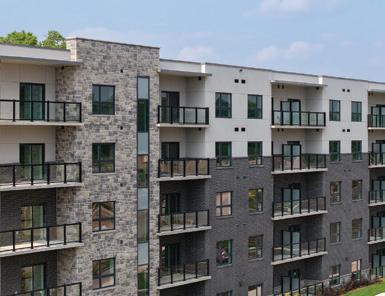
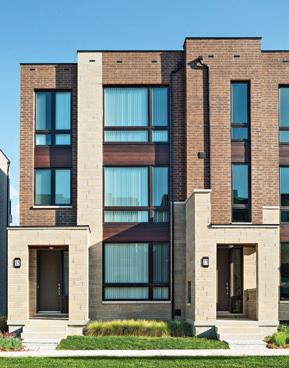
building materials, they are a canvas for your creativity. With a wide range of sizes, shapes, textures and colours, Brampton Brick products give homeowners the freedom to design exteriors that reflect their personal style. For a sleek, modern look, the Contemporary Series clay bricks pair beautifully with Bonneville or Contempo Stone, creating clean lines and a refined aesthetic. For a more traditional aesthetic, the Legacy Series clay bricks combine perfectly with Artiste 2 or Granada Stone, offering rich textures and dimension. The true artistry comes in how you combine and layer bricks and stones from different collections, creating a home that is uniquely yours. Every choice, from subtle texture variations to bold colour contrasts, contributes to a cohesive design. With Brampton Brick, your home becomes a space where functionality meets inspiration.
WHY BRICK AND STONE MATTER FOR YOUR HOME
Choosing your home’s exterior is more than style. It’s an investment in comfort, safety and value:
• Structural durability and longevity: Brick and stone are built to last. Unlike lighter siding materials that may warp or fade, masonry maintains its integrity for decades.
• Fire and impact resistance: Brick walls can withstand intense fires for up to hours and absorb impact from wind, debris and everyday wear, giving you peace of mind.
• Thermal comfort and energy savings: Brick and stone help keep your home cooler in summer and warmer in winter, making indoor temperatures more comfortable and reducing energy costs.
INTRODUCING TALIA: A MODERN TOUCH
Continuing a tradition of innovation, Brampton Brick is excited to introduce Talia, its newest stone. Currently being introduced to the market, Talia’s long, slender design creates clean horizontal lines and subtle texture, adding a refined, contemporary touch to both modern and transitional home designs. Developed with input from builders and homeowners alike, Talia reflects today’s architectural trends while offering the durability and timeless appeal you expect from Brampton Brick.
CLAY BRICK AND STONE MASONRY
When it comes to building for the long haul, few materials have a track record quite like clay brick and stone masonry. We aren’t just talking about decades – we’re talking
centuries. Their resilience stems from a combination of thermal mass, fire resistance and sheer structural “stubbornness.”
From touring model homes to selecting the perfect exterior and imagining your backyard oasis, Brampton Brick’s goal is simple: To help you build a home that looks incredible today and stands strong for generations.
By choosing Brampton Brick, you’re selecting a material that protects your investment, enhances curb appeal and delivers lasting value, all proudly sourced and manufactured in Ontario.
As Canada’s housing industry continues to grapple with affordability pressures, record-low new home sales, supply constraints and slow policy implementation, there comes a rare silver lining in the form of a massive opportunity to make lasting change to how we fund growth in Ontario.
Announced in the fall federal budget, the government has earmarked $12.2 billion over 10 years, and is seeking matching contributions from provinces, to
lower development charges by up to 50 per cent. Governments should seize this moment to deliver long-lasting structural reform to the development charges (DCs) system in Ontario and create a reformed mechanism that permanently lowers costs, ensuring future generations of new homebuyers have access to more affordable housing.
Development charges have been with us in Ontario for more than three decades, and in that time, we have seen a huge escalation in the price of new homes, as well as DC rates. Those two factors are not unrelated. Development charges are municipal and regional charges applied to the cost of a new home upfront to pay for municipal and regional services and infrastructure. They are just one
of the municipal fees and charges added to new homes and now range between $95,000 and $163,000 per single-family home, depending on the Greater Toronto Area (GTA) municipality.
For new-home owners in highland value areas such as the GTA, the charges are especially significant. In the GTA, DCs have increased on average by a shocking 327 per cent since 2009, with some areas, such as the City of Toronto, seeing a rise of more than 1,000 per cent during that same period.
Interestingly, Ontario is only one of two provinces in Canada that widely use DCs, and is an oddity in North America for their use. This, and the federal and provincial governments present focus on reducing
development charges, provides us the opportunity to consider how we might do things differently and in doing so, introduce a system that results in permanently lower DCs, not simply lower DCs for three, five or 10 years.
So, what could some of those systemic changes look like?
First, some infrastructure currently funded through DCs could be shifted to higher orders of government. Transit is an obvious example.
In the GTA, most municipalities embed a significant transit cost within their DCs. Brampton’s transit portion exceeds $14,000 per single-family home, most York Region municipalities exceed $21,000 and the City of Toronto’s is $54,000. However, new transit infrastructure and equipment benefits entire communities, not just new-home owners, so re-orienting these infrastructure and equipment costs (not operating costs) to higher orders of government would effectively spread the cost over the entire tax base and materially lower housing costs.
Second, there are services that really should not be upfronted and should instead be spread over a 20- to 25-year period of use for the new home. Water and wastewater infrastructure immediately come to mind here – this is how it’s done in
Quebec (where housing costs are materially lower than Ontario) and vast swaths of the United States.
The Ontario government has been actively exploring this for some time and in a paper developed by Keleher Planning & Economic Consulting Inc (KPEC) for BILD and the Ontario Home Builders’ Association in 2025, it is estimated that this change could lower DCs by 25 to 30 per cent. Instead of paying upfront with a DC that is rolled into the price of a home and ultimately a mortgage, the cost of water and wastewater infrastructure is paid for with a smaller annual or monthly charge on the utility bill or tax bill of a new home, until the cost of the infrastructure is recouped.
Existing homes are not impacted as the charge applied to new homes is on a go-forward basis. Spreading the cost also results in a lower cost to the homeowner versus a lump sum that is incorporated into a mortgage.
Lastly, how do you control or reduce the remaining costs? If the first two changes are implemented, then the DCs that are left are those suited for the municipal level of government (roads, libraries, community centres and emergency services). Controlling and lowering those costs are about incremental improvements to the Development Charges Act to standardize approaches, better define calculation methodologies, increase
accountability, and encourage municipalities to lower costs. Ontario is making progress on that front, but more work remains.
These structural changes would have a dramatic effect on the market and would result in proportional reductions of 50 per cent or greater for nearly all municipalities while ensuring funds are present to support infrastructure and growth. This makes housing projects more viable to support growth and housing more attainable for future generations of Ontarians.
Governments have a historic opportunity to strategically change the trajectory of the DC system – it is time they seize this moment to protect generations of future new homebuyers and safeguard the industry for years to come.
Dave Wilkes is President and CEO of the Building Industry and Land Development Association (BILD), the voice of the homebuilding, land development and professional renovation industry in the GTA. For the latest industry news and new home data, follow BILD on Twitter, @bildgta or visit bildgta.ca.
+MORE CONTENT ONLINE nexthome.ca
HOW MODERN BUYERS
ARE NAVIGATING HIGH-PRICED MARKETS
JESSE ABRAMS
For decades, the “20-per-cent down payment” was the undisputed gold standard of Canadian real estate. It was the finish line every homebuyer was told they had to cross to avoid mortgage insurance and unlock the most favorable terms. But as we move through 2026, that rule isn’t just being challenged, it is effectively being rewritten.
A combination of persistent home value growth in major hubs such as
Toronto, Vancouver and Calgary, paired with the most significant mortgage policy reforms we’ve seen in a generation, has fundamentally shifted the math. For many modern buyers, the traditional race to hit a 20-per-cent down payment might actually be a sub-optimal financial move that keeps them on the sidelines while the market moves past them.
THE SHIFTING LANDSCAPE: WHY 20 PER CENT ISN’T THE ONLY WAY IN
Until very recently, if you were looking at a home priced at more than $1 million, you had no choice: It was 20-per-cent down or no
house. With the average price of a detached home in many Canadian cities hovering well above that mark, first-time buyers were often stuck in a “savings marathon.” They were trying to bank an extra $50,000 or $100,000 while home prices rose faster than they could save, effectively moving the goalposts every single year.
TWO MAJOR POLICY SHIFTS HAVE RECENTLY CHANGED THIS DYNAMIC FOR THE BETTER:
1. The $1.5M insured cap: The government’s decision to raise the price cap for insured mortgages from $1 million to $1.5 million was a massive shift. You can
now purchase a home up to that $1.5-million mark with a down payment as low as roughly 8.3 per cent on a blended basis. This opens up thousands of familysized homes that were previously gated behind a mandatory $200,000 to $300,000 down payment requirement.
2. 30-year amortizations: First-time buyers and those purchasing newly constructed homes can now stretch their insured mortgage more than 30 years instead of the traditional 25. While a longer amortization means more interest over the life of the loan, it significantly lowers the monthly “carrying cost” of the home. In a high-cost environment, monthly cash flow is often a much bigger hurdle for young professionals than the total interest paid three decades from now.
THE ‘OPPORTUNITY COST’ OF WAITING
The biggest risk in the 20-per-cent down strategy is what economists call “opportunity cost.” If you are sitting on 10 or 15 per cent of a down payment today and choose to wait two or three more years to save the remainder, you have to ask a difficult question: Will home prices rise more than the cost of the mortgage insurance premium?
In many high-demand Canadian markets, the answer is historically “yes.” Mortgage default insurance (often referred to as CMHC insurance) is a one-time fee added to your mortgage total. While it isn’t pocket change, it is often a fraction of the price appreciation a home sees over a few years. By entering the market sooner with an insured mortgage, you stop paying a landlord’s mortgage and start building your own equity. You also benefit from any market appreciation from day one, rather than chasing it from the sidelines.
THE “INSURED ADVANTAGE” THAT MANY OVERLOOK
There is a persistent myth that putting less than 20 per cent down makes
you a “risky” borrower in the eyes of a bank. In reality, lenders actually prefer insured mortgages. Because the loan is backed by a mortgage insurer, the lender’s risk is virtually zero.
This leads to a surprising reality: Insured mortgages often come with lower interest rates than uninsured ones.
When you put 20 per cent down, the lender takes on the risk themselves, and they often charge a slightly higher rate to compensate for it. When you put down 10 per cent, the insurance protects the lender, and they pass those savings on to you in the form of a “sharper” rate. When you factor in the lower interest rate, the cost of the insurance premium is often partially offset over the first five-year term of the mortgage.
NAVIGATING THE “HOUSE POOR” TRAP
The 20-per-cent rule was designed for a different era of housing, one where a detached home cost four times the average salary, not 10. Today, the goal isn’t just to avoid a fee; it is to find the most efficient path into a home that fits your life without becoming “house poor.”
For first-time buyers or those looking at new construction, your first step shouldn’t be an arbitrary savings goal based on an old rule of thumb. Instead, it should be a baseline assessment of your monthly budget. If putting 10 per cent down allows you to keep $50,000 in an emergency fund or an investment account, that liquidity might be far more valuable to your family’s financial health than a slightly smaller mortgage balance.
FINAL THOUGHTS
The real estate market in 2026 requires a more nuanced strategy than the simple “save 20 per cent” advice of the past. Whether you are leveraging the new $1.5-million cap to get into a better school zone or using a 30-year amortization to keep your monthly costs manageable, the priority is clear: Get into the market with a plan that prioritizes your lifestyle and long-term equity growth.
“
” For first-time buyers or those looking at new construction, your first step shouldn’t be an arbitrary savings goal based on an old rule of thumb.
Speaking to a unbiased professional, such as our advisors at Homewise, is a great way to leverage someone with experience in the space to help steer you in the right direction. Navigating these new rules is simpler when you stop looking at the mortgage as a hurdle and start looking at it as a strategic tool. The best move isn’t necessarily the one that follows the old rules, it’s the one that gets you into the right home at the right time for your financial future.
THE MODERN BEDROOM FOR WELLNESS: CREATING SPACES THAT RESTORE AND RECHARGE
The primary bedroom has quietly evolved into one of the most important spaces in the home. No longer just a place to sleep, it has become a personal retreat; a sanctuary designed to restore energy, calm the mind and create distance from the constant noise of everyday life.
Working in pre-construction design allows me to shape these spaces long before homeowners move in. The goal is always the same: To create a
by MARIAM ABOUTAAM
bedroom that feels layered, calming and supportive of daily rituals.
One of the most effective ways to achieve this is through texture. A room immediately feels warmer and more inviting when multiple materials are introduced. Upholstered headboards, grasscloth wallcovering, tailored drapery, woven throws and plush area rugs soften the architecture and create visual depth. These elements bring comfort to the
room while allowing the space to feel elevated and refined.
Lighting is equally important. I like to layer light sources throughout the room, using ambient ceiling lighting, bedside reading lamps and subtle accent lighting. This allows homeowners to shift the atmosphere depending on the time of day. When paired with thoughtful window treatments, lighting can also support natural circadian rhythms. Drapery
that gently filters daylight in the morning and creates a cocooned environment in the evening helps the bedroom function as a space for true rest and restoration. This approach reflects Kylemore’s broader philosophy of wellness-focused design.
Another element I often introduce is the idea of functional zones within the bedroom. Rather than treating the space as one large open area, I like to carve out moments that support daily living. A small lounge area with comfortable seating offers a place to read, decompress or enjoy a quiet morning. A discreet beverage station, whether for coffee, tea or water, adds convenience and elevates rituals that start and end our day.
Custom furnishings can also bring a strong sense of character to a room. In one of our award-winning model homes, I designed a wrap-around
upholstered headboard that extended across the wall and transitioned into a built-in chaise lounge. Beyond anchoring the room visually, the design served another purpose; it preserved unobstructed views of the window. Whether sitting on the chaise or resting in bed, the view remains open to natural light and the outdoors, reinforcing the calm, restorative feeling of the space.
The relationship between the bedroom, the ensuite and the walk-in closet is also critical. When these spaces are positioned thoughtfully, the flow between them feels effortless. Morning routines unfold naturally, and the bedroom maintains the quiet atmosphere that defines a true retreat.
Ultimately, a well-designed bedroom should feel like a place where the outside world fades away. It should support rest, reflection and moments of stillness.
In today’s fast-moving world, that sense of calm has become one of the greatest luxuries a home can offer. And at Kylemore, creating spaces that support wellness and everyday comfort remains at the heart of how we design.
DESIGN TIPS FOR A WELLNESSFOCUSED BEDROOM
• Layer with texture. Mix materials such as linen, wool, wood and soft upholstery to create warmth and depth. Texture brings richness to the room without needing excessive decor.
• Create a lounge moment. A chaise or comfortable chair transforms the bedroom into more than a sleeping space. It becomes a place to pause, read or simply unwind.
• Introduce a beverage niche. A small station for coffee or tea adds quiet luxury and supports slower morning and evening rituals.
• Use lighting thoughtfully. Combine ambient lighting, bedside lamps and subtle accent lighting to shift the mood of the room throughout the day and to support natural circadian rhythms.
• Preserve the window view. Keep sightlines open to natural light and outdoor views whenever possible. It instantly enhances the sense of calm within the space.
• Design for flow. Position the bedroom, ensuite and walk-in closet so that daily routines feel effortless and intuitive.
An award-winning in-house designer, Mariam Aboutaam is Director, Sales and Marketing, Interior Design at Kylemore, Markham, Ont., a builder known for master-planned communities and luxury homes. kylemoreliving.com.
WHAT’S NEXT FOR PROPTECH IN 2026?
Technology is playing an increasingly important role in shaping the real estate industry. From how homes are discovered to how projects are marketed and sold, digital tools are redefining the experience in ways that feel faster, more transparent and more connected.
What was once considered a niche sector of startups has grown into a significant ecosystem. PropTech now touches every stage of the real estate lifecycle, including development, construction, marketing, sales, financing and property management.
Across Canada, the PropTech ecosystem is expanding rapidly.
According to the PropTech in Canada 2025 in Review & 2026 Trends report, there are now more than 590 active PropTech startups operating across the country, with approximately 25 per cent founded within the past five years – reflecting a growing industry focused on modernizing how real estate is built, marketed and sold.
Historically, real estate and construction account for more than 20 per cent of Canada’s national GDP, underscoring both the scale of the sector and the opportunity for technology to improve how it operates. Canada’s broader technology environment is also helping drive this growth. The country has more than 1.5 million workers in the technology sector, supported by more than 100 incubators and accelerator programs that help new companies bring products to market.
Government investment is also supporting innovation in housing and artificial intelligence. Federal initiatives such as Build Canada Homes include more than $13 billion in funding aimed at increasing housing supply and modernizing the industry, creating new opportunities for technology companies working in the built environment.
Beyond the growth of the ecosystem itself, several trends are shaping how these technologies are being applied across real estate.
The hottest topic everyone is talking about is AI. Artificial intelligence is moving from experimentation to real-world use. Companies across the PropTech landscape are embedding AI into their products to streamline workflows, analyze market signals and uncover patterns that improve decision-making.
Another visible shift is the rise of immersive digital experiences. Visualization tools, interactive floorplans and virtual walkthroughs allow people to explore homes and communities in much greater detail before visiting in person. For new developments in particular, these tools help translate architectural concepts into something far easier to understand. Behind the scenes, many of these technologies are also becoming more integrated. Marketing, analytics, communication and sales tools are increasingly connected within unified platforms, providing a clearer picture of how interest develops around a project.
Another trend is the increasing role of data. Digital platforms now capture detailed insights about how people interact with listings, floorplans and project information. These insights
are helping inform how developments are positioned and how information is presented throughout the sales process. At the same time, the real estate journey is becoming increasingly mobile. Research, comparisons and project exploration often begin on a phone, allowing people to gather information quickly and conveniently.
As PropTech continues to evolve, its greatest impact may be its ability to simplify complexity. By combining data, visualization and intelligent tools, technology is helping create a more informed and efficient real estate experience for everyone involved.
Tim Ng is the Founder and CEO of ADHOC STUDIO and BLACKLINE, pioneering industry-leading digital solutions merging real estate, art and technology to transform the sales experience. To explore ADHOC’s awardwinning renderings and BLACKLINE’s innovative sales platform, visit adhocstudio.ca and blacklineapp.com. BLACKLINE
CENTRAL PARK
NATURE-INSPIRED COMMUNITY IS RISING IN THE BAYVIEW VILLAGE NEIGHBOURHOOD
Construction of Amexon’s The Residences at Central Park is well underway on Sheppard Avenue in the east end of the prestigious Bayview Village neighbourhood.
Phase 1 sold out ahead of schedule, and construction has already taken this first tower to its full height of 31 storeys.
The development is one of the largest residential projects currently under construction in Toronto. Designed by Core Architects for Amexon Development Corp., this 12-acre master-planned community will reshape York’s Bayview Village area, with five towers ranging from 12 to 31 storeys.
Central Park is a vibrant, mixeduse condominium community where urban life meets and marries with the natural world. Residents enjoy proximity to a range of urban conveniences and also have direct access to the East Don Parkland’s sprawling, forested ravine that embraces the property in lush nature.
At the heart of the community is the award-winning Central Park Common – a landscaped, threeacre urban park that will feature pedestrian-friendly streets, bike paths, casual dining venues, fountains, reflecting pools and year-round programming featuring a farmers’ market and ice-skating rink. Other highlights include retail space, restaurants and services including onsite daycare facilities. All Central Park residents will have the use of 55,000 sq. ft. of fitness, wellness, leisure and social amenity space – and they’ll find getting around the GTA incredibly convenient, with subway and GO transit right at their door.
Central Park was recently the winner of the coveted IPAX Americas Property Award for Best Sustainable
Residential Development in Canada. Additionally, the Ontario Home Builders’ Association (OHBA) has awarded Central Park with the Project of the Year Award – People’s Choice. This highly sought-after award recognizes project excellence and is given to a company that exemplifies outstanding professionalism and integrity with their business, their community and the industry at large.
The entire community will incorporate a range of industryleading Green features, and Central Park has been recognized by the Building Industry and Land Development Association (BILD) as a finalist for the Green Builder of the Year award. Setting a new standard in the sustainability arena, Central Park is the first large-scale project of its kind in Canada to include EV charging stations in all parking areas for residents, visitors, office tenants and retail patrons. In all, there will be more than 1,500 charging stations installed.
The community will eventually encompass more than 1,500 suites
in one- to three-bedroom plus den layouts, in sizes from 439 to 1,200 sq. ft. Suite and amenity interiors by II BY IV DESIGN are warm and sophisticated, and the living spaces incorporate flow-through layouts that make the most of spectacular views from the floor-to-ceiling windows and generous outdoor balconies. Prices begin from the $700,000s. Amexon’s award-winning, 10,000-sq.-ft. Central Park Presentation Centre is located at 1200 Sheppard Ave. E., Toronto. Flooded with natural light through floor-toceiling glass walls, the centre was built to be a permanent fixture, with plans for it to ultimately serve as a community event venue. Visitors can indulge in gallery-like surroundings that include kitchen, bathroom and walk-in closet vignettes, and explore a curated selection of premium interior finishes and high-end appointments that come standard here.
For more information, call 416.252.3000 or visit centralparktoronto.com.
THE CONTINUING CASE
FOR BUYING A HOME
We’ve had challenging real estate markets in Canada before, but at the end of the day, homes are amazing investments – and we get to live in them. For many Canadians, homeownership is the best and most profitable financial and lifestyle decision they ever make. Housing –especially the new homes sector – is a cyclical industry. Over the decades,
we have had our ups and downs, but those who ride out the cycles typically do well when it comes to building equity and benefitting from price increases over time. In a tough market like today’s, prices fall and savvy people buy.
Look at things historically. New homes rose in value after the economic crisis in 2008. Some prices doubled or tripled because of low interest rates, population growth and shortages of supply. By 2024, the national average price of new homes had risen from $306,500 to more than $700,000. In some markets across Canada, benchmark prices
increased between 100 and 200 per cent during the past 20 years.
During the 2019 to 2021 pandemic years, predictions were that falling prices would not recover to their pre-pandemic levels until at least 2023. By the end of 2021, however, Canadian Real Estate Association’s (CREA) house price index had risen by 26.6 per cent, the fastest annual pace on record. Condos accounted for most of the new housing in Ontario. This period also brought with it the tremendous appeal of “zoom towns” with remote workers, and housing prices soared. Living outside Metro Toronto became more
BARBARA LAWLOR
economically feasible for those who worked in the city. Smaller towns offered affordability and a slowerpaced lifestyle.
In early 2022, prices peaked, having doubled since 2011, and the Bank of Canada started raising interest rates. By September of that year, average and median prices for detached houses declined by nearly $400,000 in the GTA. Since then, housing price decreases and declining interest rates have had some effects on housing affordability. What we need now is renewed consumer confidence in real estate.
Cycles have shown that new homes follow resale in cycles. CREA tracks areas in Canada, and according to that organization, from 2015 to 2025, 35 of the 51 tracked areas saw resale real estate prices rise by 100 more or more. The lowest increase over the 51 areas was 5.2 per cent. In other words, generally, real estate appreciates over time.
“ ” For many Canadians, homeownership is the best and most profitable financial and lifestyle decision they ever make.
That is why despite all the negative coverage in the media, we are actually experiencing a “buyers’ market.” During Q4 2025 and the beginning of Q1 2026, the GTA housing market showed increasing inventory levels, especially for condos. At the end of October, the combined inventory level in the GTA sat at around 22 months, as very little inventory had been added during 2025. This was the highest inventory
level seen to that date. Savvy real estate professionals are encouraging potential condominium purchasers to buy NOW. With inventory the way it is, they will find outstanding prices and more negotiating power than ever before.
Today’s interest rates are incredibly low compared to what we experienced in the 1980s and 1990s. And remember that back then, those who found strategies to cope with cyclical lows came out ahead in the long run.
Homeownership provides tax benefits and is an important part of a diversified financial portfolio. Compared to stocks and bonds, real estate is far less volatile of an investment. For one thing, it is a tangible asset, which offers a certain level of peace of mind. Owners can keep an in-person check on their investment and can change or upgrade it without permission from a landlord.
Even in economic downturns, holding onto your real estate in the long run means you continue to build equity and increase the chances of profiting. But financial perks comprise only one aspect of the benefits of home ownership. One of my recent columns focused on the psychological advantages, such as a sense of permanency, security and belonging. Homeowners and their families usually feel more grounded in a house or condominium than a rental dwelling. Home ownership is a visible representation of achieving a milestone in life that is deeply gratifying. This is something that never changes and is a major reason why homeownership remains the Canadian dream.
Barbara Lawlor is CEO of Baker Real Estate Inc. A member of the Baker team since 1993, she oversees the marketing and sales of new home and condominium developments in the GTA, Vancouver, Calgary and Montreal, and internationally in Shanghai. baker-re.com
+MORE CONTENT ONLINE nexthome.ca
Northshore by National Homes
THE GTA CONDO MARKET IN EARLY 2026:
WHAT BUYERS SHOULD KNOW (AND WHAT DEVELOPERS ARE ACTUALLY THINKING)
BEN MYERS
If you’ve been watching the Greater Toronto Area condo market with a mix of curiosity and caution, you’re not alone. Buyers are dealing with headline noise, record-low sales, shifting interest-rate expectations, and a steady drumbeat of “is now the time?” questions. I discussed these topics and more on Episode 100 of Toronto Under Construction. The panel included Gus Stavropoulos (Tribute Communities), Stuart Wilson (Alterra) and Amanda Ireland
(Osmington Gerofsky Development Corp.), and we talked through what the market feels like from inside the development business in early 2026: Where projects get stuck, what’s changing in product and what the next cycle might look like.
One of the most important signals for buyers is happening far upstream from any sales centre: Construction financing is settling into something closer to an “equilibrium.” After the cost shock that hit the industry post-2022, the pace of material and labour inflation has moderated to mid-single digits, with some markets even seeing quarter-overquarter softness. That matters because most highrise projects are finely tuned machines. When costs
stop accelerating unpredictably, it becomes easier to price a building, secure financing, and actually start construction. But the panel makes a key point: there is no last-minute trick that suddenly makes a marginal project feasible. Wilson’s view is that feasibility is won or lost long before a project lands “on the cusp.” The best operators run disciplined tenders, treat trade partners fairly when pricing softens, and protect longterm relationships with banks, equity partners, consultants and contractors. Value engineering might save a few percentage points, but credibility and execution tend to be what move a deal from spreadsheet to shovels. Stavropoulos adds a buyer-relevant detail that often gets lost: Lenders
have expected a large share of hard costs, often about 70 per cent, to be fixed under contract for years. What’s shifting now is the temptation to leave more scope unfixed in hopes of capturing future cost relief. From a buyer’s standpoint, this is a reminder that “cost certainty” is real, but never absolute. Change orders, delays, interest costs and scope creep can still bite. The goal for a well-run developer isn’t perfection; it’s getting as certain as reasonably possible without squeezing trade partners to the point where quality and schedule are put at risk.
That discussion naturally opens into one of the biggest strategic themes in the GTA right now: The rental pivot. Purpose-built rental (PBR) projects aren’t just a policy concept anymore; they are a pipeline decision for major developers. Ireland points out one clear underwriting difference that buyers might not think about: Broker commissions. A condominium launch has a major selling cost embedded in the pro forma; rentals can avoid a big portion of that. But that doesn’t mean rental is cheap to build. In some cases, rental specifications can be higher. More durable finishes, materials selected for long-term performance, and design choices that hold up under years of wear become priorities, especially when the goal is to keep a trophy asset in the portfolio. For buyers, the implication is subtle but important: As developers build more rental, some of the best design thinking is shifting toward durability and operations, not just quick saleability.
The episode also spends time on a question that’s increasingly shaping new communities: How tall is too tall, and what kind of density actually works? The panel digs into Bayview Village examples where height and density are being revisited as planning frameworks evolve around major transit stations. Stavropoulos is candid that it’s hard to make any pro forma work cleanly right now, condo or rental, and that if Tribute were buying land today, the company
wouldn’t pay the same basis they did in prior years. But you can’t rewrite sunk land costs. One lever you can pull is the denominator; adding density in a transit node can bring the effective land cost per unit down and better align with the surrounding zoning context. That’s not just “build bigger;” it is a financial response to a changed market.
Wilson’s counterpoint is the one buyers should keep in mind when they look at skyline renderings: The industry doesn’t necessarily need more density; it needs better density. He argues there’s a sweet spot for highrise efficiency about 40 to 50 storeys, where building services, elevatoring and core layouts can stay relatively standard and floor plates remain efficient. Go much higher and structural and performance demands rise. Wind, sway, exposure and complexity start pushing costs and design trade-offs. The buyer’s takeaway isn’t that tall buildings are bad, but that ultra-tall is not automatically better and it tends to come with real cost and livability questions.
Then there’s the product itself, the thing buyers actually live in. Wilson offers a blunt critique of podiums: They are often mandated by policy, complicated to build and typically absorb all the essential but unglamorous functions such as loading, garbage, parcel rooms, mail, bike storage and circulation. That can lead to deep floor plates and long suites that exist because they are easy to stack, not because they’re great homes. Ireland pushes the conversation toward a bigger reset: The copy-paste condo product that repeats the same unit mixes from Hamilton to Oshawa is unlikely to work as well in the next cycle. Homogenization has created gaps. Certain sizes and housing types have been under-supplied in particular submarkets. More developers are going deep on neighbourhood fundamentals and taking controlled risks where the data supports a different program. Even amenities
may get more honest. In her framing, affordability itself is almost an amenity, more valuable than the latest flashy feature room that looks good in marketing but doesn’t match how residents live.
Finally, the episode confronts the question everyone whispers about: Distress. Receiverships, troubled projects and land resets are real in parts of the GTA. Stavropoulos describes a pragmatic approach: Tribute isn’t trying to play Monopoly with every distressed asset, but the company is also not sitting out compelling opportunities, especially when deals come through lender relationships looking for a stronger operator. The warning is that many distressed sites were overlevered from the start; adding capital doesn’t fix a broken land basis.
The conclusion was that 2026 isn’t a clean recovery year. It’s a reinvention period. Developers are rethinking what they build, how they finance it and how they operate it, often with a more sober, long-term mindset. For buyers, that can be good news. A market that rewards discipline, durability and livability tends to produce better buildings. It is difficult to sum up what all this means for prospective new-home buyers. Don’t expect prices to rise (or fall) dramatically in 2026 and 2027, but a supply cliff is coming in 2028. So, if you’re waiting for the perfect time to buy at a market low price, we may soon hit that bottom, so don’t wait too long. Do your own research, surround yourself with an experienced team, and good luck.
Ben Myers is the President of Bullpen Consulting, a boutique residential real estate advisory firm specializing in condominium and rental apartment market studies, forecasts and valuations for developers, lenders and land owners. Contact him at bullpenconsulting.ca and @benmyers29 on Twitter.
+MORE CONTENT ONLINE nexthome.ca
CONFIDENCE RETURNING:
WHY THE GTA HOUSING MARKET IS BRIGHTER THAN THE HEADLINES SUGGEST
Over the past few years, headlines about the Greater Toronto Area housing market have often focused on uncertainty, specifically rising interest rates, affordability challenges and shifting market conditions. While
these factors are certainly part of today’s landscape, they don’t tell the full story. From where we sit, working closely with developers and buyers across the region, we’re seeing something the headlines often miss: Confidence is quietly returning to the GTA housing market.
Periods of adjustment are a natural part of any real estate cycle. The rapid pace of growth experienced in previous years was always going to be followed by a period of recalibration.
What we are seeing now is a market that is stabilizing and in many ways becoming healthier and more balanced for everyone involved. Buyers today are approaching the market with renewed confidence. After spending time on the sidelines, many are recognizing that conditions are improving. Inventory has increased, interest rates have begun to stabilize, and buyers now have the time and space to make thoughtful decisions, something that was often
“
” The GTA housing market has demonstrated resilience time and again, and there is every reason to believe the years ahead will bring renewed growth and opportunity.
missing during the intense bidding wars of the past.
At In2ition, our teams interact with thousands of prospective purchasers through our sales centres and marketing platforms. What we’re hearing consistently is that demand hasn’t disappeared, it has simply been paused. Many buyers, particularly first-time purchasers and young families, still want to be part of the GTA housing market. For them, homeownership remains one of the most important milestones in building stability and long-term financial security.
We’ve also seen encouraging signs from the market itself. Throughout 2025 and even into the first quarter of 2026, several new developments launched across the GTA achieved strong sales and, in some cases, sold out completely. What these projects had in common was a clear understanding of today’s buyers, they were priced
appropriately for the current market and offered real value. These successes demonstrate that when product, pricing and market timing align, buyers are ready and willing to move forward.
The fundamentals supporting the GTA housing market remain incredibly strong. The region continues to experience significant population growth, fueled by immigration and international talent choosing Canada as a place to live and build their futures. At the same time, housing supply has struggled to keep pace with demand – reinforcing the longterm need for new housing across the region.
Toronto and the GTA are global cities that attract investment, innovation and opportunity. As infrastructure expands, transit improves and new communities are planned, the housing market will continue to evolve to meet the needs of a growing population.
Markets move in cycles, but strong fundamentals endure. The GTA housing market has demonstrated resilience time and again, and there is every reason to believe the years ahead will bring renewed growth and opportunity. While headlines may focus on short-term challenges, the long-term outlook remains clear. Confidence is returning, buyers are re-engaging and the future of housing in the GTA is brighter than many might think.
Debbie Cosic is CEO and founder of In2ition Realty. She has overseen the sale of more than $15 billion worth of real estate. With Debbie at its helm, In2ition has become one of the fastest-growing and most innovative new home and condo sales companies. in2ition.ca
+MORE CONTENT ONLINE nexthome.ca
WEHBA INDUSTRY LUNCHEON BRINGS TOGETHER
INDUSTRY AND GOVERNMENT TO DISCUSS HOUSING AND GROWTH
At a time when housing supply, affordability and development timelines continue to dominate public debate, leaders from across the residential construction sector recently gathered for the 12th Annual Industry Luncheon hosted by the West End Home
Builders’ Association. The event, the association’s largest of the year, brought together builders, renovators, developers, policymakers and industry partners from across the West End to discuss how collaboration can help address growing challenges in housing delivery.
Held against the backdrop of rising demand and increasing regulatory complexity, the luncheon served as a forum for dialogue between industry and government, with speakers at all levels
emphasizing the need for alignment if housing goals are to be met.
Opening the program, WEHBA Chief Executive Officer Mike Collins-Williams highlighted the role of industry associations in bridging conversations between the residential construction sector and decision-makers. He noted that meaningful progress on housing requires cooperation across municipalities, provinces and the federal government, alongside active engagement from industry stakeholders.
MIKE COLLINS-WILLIAMS
That message was echoed by Burlington Mayor Marianne Meed Ward, who addressed the importance of municipal and industry collaboration as communities across the region continue to grow. Ward spoke to the pressures municipalities face in balancing growth, infrastructure and community needs, while underscoring the value of working closely with builders and developers to deliver housing responsibly and efficiently.
The remainder of the luncheon was guided by Charles Wah, WEHBA first vice-chair, who moderated the program and acknowledged the broad range of industry professionals and elected officials in attendance.
From a provincial perspective, Christina Giannone, chair of the Ontario Home Builders’ Association, addressed the mounting challenges facing Ontario’s residential construction sector. Her remarks focused on regulatory pressures, housing supply constraints and the need for sustained advocacy to ensure builders and renovators can continue to deliver much-needed housing across the province.
Ontario Minister of Citizenship and Multiculturalism Graham McGregor expanded on the province’s role in supporting growth while protecting Ontario’s heritage. He spoke about archaeological clearance processes, economic development and the importance of the construction industry in building complete and resilient communities, emphasizing the need for balance as development accelerates.
Recognition and community impact were also key themes throughout the luncheon. The Paul Wright Memorial Award was presented by The Hamilton Spectator to Mike Memme of Mountainview Building Group, recognizing his leadership and long-standing contributions to the residential construction industry. The award honours individuals who have demonstrated a lasting commitment to both the industry and the broader community.
Attendees also viewed a video presentation highlighting the work of Keaton’s House, WEHBA’s charity of choice, reinforcing the association’s ongoing engagement with community-focused initiatives beyond housing and construction.
Federal housing priorities were addressed by Karina Gould, member of parliament for Burlington, who spoke about national housing and community development objectives. Gould emphasized the importance of coordination between federal programs and local implementation, noting that collaboration with industry stakeholders is critical to achieving meaningful outcomes.
Looking ahead, the luncheon’s central message of cooperation was reinforced during the 2026 Chair’s Industry Address delivered by Dani Gabriele. Gabriele outlined the association’s priorities for the coming year, focusing on advocacy, leadership and continued engagement with government partners as housing challenges evolve.
The event concluded with the induction of Peter Turkstra, owner of Turkstra Lumber Company Ltd., into the WEHBA Hall of Fame. Inducted by Aldo DeSantis, Turkstra was recognized for his long-standing commitment to the industry and his contributions to the association over several decades.
The WEHBA Industry Luncheon continues to serve as a platform for dialogue, recognition and alignment, reflecting the growing importance of collaboration as the residential construction sector works to meet the housing needs of the West End.
Mike Collins-Williams, RPP, MCIP, is CEO West End Home Builders’ Association. westendhba.ca.
+MORE CONTENT ONLINE nexthome.ca
RESTORING MOMENTUM IN CANADA’S HOUSING MARKET
DANIEL STEINFELD
Canada’s housing conversation often centres on supply. We need more homes, and we need them faster. While that remains true, another challenge has emerged within the housing system that deserves equal attention: Confidence.
Across Canada, many approved housing projects are not moving forward. Builders face higher construction costs and tighter financing conditions, while many buyers remain cautious as they consider interest rates, economic
uncertainty and the long-term commitment of homeownership. As a result, housing delivery has slowed at exactly the moment when more homes are needed.
WHY THIS MATTERS TO HOMEBUYERS
The homes not being built today will be the homes missing from the market several years from now, and that affects everyone. Families hoping to move into larger homes may face fewer choices, while seniors looking to right-size may struggle to find suitable options in their communities. Younger households trying to enter the ownership market may also encounter fewer attainable opportunities.
Recognizing this challenge, the Toronto Regional Real Estate Board
(TRREB) recently formed a coalition of realtors, builders, rental housing providers, business groups, labour organizations, trade associations, innovators and not-for-profit housing groups to call on both the federal and Ontario governments to take immediate targeted action to restore confidence and unlock housing construction. The coalition represents a broad cross section of the housing sector united by a common goal: Ensuring approved housing projects move forward so more homes reach the market.
RESTORING MOMENTUM THROUGH FEDERAL ACTION
Several federal policy changes could help restore momentum in the housing market. One proposal calls
for expanding the GST rebate on newly built homes to all buyers. The rebate currently applies only to firsttime buyers, but broadening eligibility would reduce the cost of purchasing a new home and help stimulate demand for new housing.
The coalition is calling for the modernization of federal financing tools to better support rental housing and missing middle housing, such as townhouses and small multi-unit buildings. Many projects cannot proceed because financing programs no longer reflect current construction costs or market conditions. Mortgage qualification rules also require review to ensure policies remain practical and reflect today’s economic environment while maintaining financial stability.
Federal policymakers should also consider adjustments to restrictions on foreign homebuyers so that foreign investment can support the construction of new housing supply.
THE ROLE OF THE ONTARIO GOVERNMENT
Provincial leadership is also essential to improving housing delivery. Development charges have increased
significantly across many Ontario municipalities over the past decade and now represent a substantial portion of the cost of building a new home. Reforming these charges and improving cost transparency would help restore project feasibility and give buyers a clearer understanding of how government fees influence housing prices.
The coalition is urging the Ontario government to expand the provincial HST rebate on new homes to all buyers. Extending this rebate would help lower the purchase price of newly built homes and support construction activity at a time when housing starts are declining.
Zoning reform remains another important part of the solution. Allowing missing middle housing such as duplexes, triplexes, fourplexes and small apartment buildings in existing neighbourhoods can expand attainable housing options while making better use of existing infrastructure. Removing municipal barriers that delay or complicate housing approvals will also help ensure housing policies translate into homes that are actually built.
TURNING POLICY INTO HOMES
Ontario’s housing shortage developed over many years, and solving it will require sustained effort from all levels of government. Restoring confidence across the housing ecosystem is an essential step toward getting projects moving again. When builders can build and buyers can buy, communities benefit from a healthier and more balanced housing market.
The housing sector stands ready to work with governments to translate these policy recommendations into more homes for Canadians.
To learn more about TRREB’s ongoing work to support housing supply, affordability and other advocacy initiatives, visit trreb.ca/advocacy.
Daniel Steinfeld is President of the Toronto Regional Real Estate Board (TRREB). A Chartered Accountant, he previously served as Vice-President and Chief Financial Officer with the Toronto Argonauts and is a Broker and co-owner On The Block Realty.
+MORE CONTENT ONLINE nexthome.ca
TARION MARKS 50 YEARS
OF HELPING ONTARIO’S NEW-HOME BUYERS
PETER BALASUBRAMANIAN
As it marks its 50th year, Tarion is confronting an increasingly complex housing market, with Ontario’s new home market is being tested in ways few anticipated.
Financing conditions and project delays have heightened risk for everyone involved, from buyers committing savings years in advance to builders navigating tighter margins
and increased scrutiny. When projects stall or collapse, the consequences are immediate, exposing why consumerprotection systems must function effectively under stress, not just in stable markets.
In response, Tarion has sharpened its focus on strengthening the safeguards that sit behind every newhome purchase. That work centres on enforcing the protections behind every buyer, expanding oversight to stop risky and illegal home sales earlier, and modernizing how warranties are delivered through new digital tools. In a market where uncertainty has become a defining feature, resilience
and transparency are essential to maintaining confidence across Ontario’s new-home sector.
As the consumer protection organization responsible for administering Ontario’s new home warranty program, Tarion serves as the financial safety net if projects collapse or builders become insolvent and are unable to deliver their homes. Established in 1976, the organization’s role has taken on heightened importance in recent years, as builder failures and market instability have exposed the realworld consequences for buyers when protections fail.
As the housing industry has evolved, new risks have emerged. Construction standards now play a greater role in how homes perform, affecting everything from energy efficiency and indoor air quality to long-term durability. Warranty coverage has expanded to reflect those realities, such as new protections that help homeowners address elevated radon levels that can pose health concerns.
At the same time, expectations around transparency and access to information have changed. Today’s buyers want timely updates, clear communication and straightforward ways to understand their coverage. That shift has driven investments in new digital and cloud-based platforms that allow homeowners to register purchases, track key warranty milestones, submit claims and receive updates online, improving transparency and communication.
Market volatility has underscored why these protections matter. When projects stall or collapse, deposit losses can be devastating for families
“
” Construction standards now play a greater role in how homes perform, affecting everything from energy efficiency and indoor air quality to longterm durability.
who have committed significant savings years in advance. In response, our focus has increasingly shifted toward prevention, and Tarion is committed to identifying risks earlier in the buying process and strengthening safeguards before problems emerge. Strengthening oversight and verification earlier in the system helps surface potential risks sooner, rather than after homeowners are already facing losses.
As we reflect on the past 50 years, one lesson stands out: Consumer protections cannot remain static. Housing markets will continue to change. Economic cycles will test both builders and buyers. Consumer expectations will continue to rise. A warranty system designed decades ago must keep adapting to the market buyers face today – not the one that existed in the past.
For most people, buying a home is the largest financial decision they will ever make. Ontario’s new home buyers deserve a warranty system that evolves with that reality. That responsibility will continue to guide the system, just as it has for the past 50 years.
Peter Balasubramanian is President and CEO of Tarion. tarion.com.
The Bridges Estates, Tillsonburg’s New Premier Community, set in The Bridges Golf Course where every detached home either backs onto a ravine lot, treed lot, or backs directly onto the golf course.
Phase 1 is now open for viewing and includes a limited selection of 10 Executive Townhomes.
18 Greenhill Drive
The model home hours: Tues-Thurs 1-5pm | Saturday 12-4pm
David Bennett, B.A., Broker
Executive Circle Member
Top 35 under 35 for RLP 519.550.6642
ART THAT WORKS
Trust, as they say, is everything. And when it comes to buying a home, especially an estate home intended for retirement, buyers want to know and trust who is delivering it.
Enter Tillsonburg Developments in Tillsonburg, Ont., a third-generation homebuilder with deep roots in the local community.
We sat down with Kirby Heckford, born and raised principal of the company who has other local businesses, to discuss a little history, the current state of the industry and some ideas to make the future better for homebuyers.
Let’s start with an easy one… how was 2025 for Tillsonburg Developments?
To be honest, it was a so-so year. It’s like a lot of us homebuilders, we haven’t had very much success over the last two or three years. Our biggest problem that we have right now is that we need HST off our homes so they can compete against resales.
We’re getting more people looking because they believe things are stabilizing and are well prepared financially. We’re not first-time home builders. Our buyers typically aren’t as concerned about shorter term market fluctuations, as they’re buying a home for the second or third time, and our price points suit more mature buyers. Our subdivisions are along a golf course, with wooded lots, and ravine lots with water features. So, we’re kind of unique in our own way.
Such an approach, though, clearly means HST relief is even more important for a company like yours because you’re not appealing to first-time home buyers… Correct, correct. We really need that to be eliminated and hopefully that’ll be part of the budget on March 26. Time will tell.
We need to get the market going. The province is putting all this money into roads and other infrastructure,
yet potential homebuyers are stagnant. Some of them don’t feel good about buying right now. Nothing’s promoting them to buy. There’s no incentive.
We really need to straighten out housing – it’s so important. The stress test needs to be a little lighter for the younger generations to buy homes. Everything makes it so difficult for them.
What more do you think governments can do?
I’m a developer, too, so I put in the roads. The red tape and all the extra fees… it’s just ridiculous what we pay… hundreds of thousands of dollars in fees that are taken from us all through this process. I think people would be shocked.
Even when you have a registered subdivision, and say three years go by, you have to pay another fee to keep it active. You should pay it once.
The process is broken. It’s just difficult, moving through the proper channels. It should be simplified.
What new developments or phases is Tillsonburg Developments introducing this year?
We have phase one of The Bridges Estates subdivision open, a year or so ago, and we’re waiting to open phase two until conditions improve. Homes there start at $1 million, and our townhomes start at about $825,000. Lots are minimum 60 ft., and some are 165-ft. deep. They’re really nice sized lots.
Who are your typical buyers?
Some are buying as retirement homes, maybe they’re originally from here, worked in one of the surrounding cities and are coming back to retire. Tillsonburg is a lovely town, with a great, vibrant little downtown with all the amenities, yet still has that small-town feel.
What is it about the town of Tillsonburg that makes it an attractive place to build and buy new homes?
There are a lot of automotive jobs here, in an industrial subdivision. Our proximity to Lake Erie… we’re only 30 minutes away. We’re also just 35 minutes to London, 45 minutes or so to Kitchener-Waterloo and 1.5 hours to downtown Toronto. We also have our own hospital, a great community centre and sports facilities. It’s a very
progressive little town, very clean and we do still have a really nice downtown.
What sets Tillsonburg Developments apart from other area homebuilders?
We build way above average homes. We focus on quality because we know many of our buyers are buying a home for the second and third time, and they understand value. Plus, they’re dealing with a local company, not a large builder from another city. I’ve got other businesses in town, I have kids in business and grandkids coming along, so you’re dealing with
somebody who cares about the town and the communities we build here. I sit on a lot of local boards and do what I can to make sure the town’s going in the right direction. I’m looking at the long term, not the short haul. That’s what separates us.
What do you look forward to most in 2026?
We’re considering doing some models and some spec homes so they’re complete when people are ready to buy, but we need this HST off so that we can compete against resale.
tdinewhomes.ca
What or who is your most influential inspiration for what you do?
I’ve always enjoyed designing and building nice quality homes. That’s just me. If you came into my subdivisions, even my standard subdivisions, you can see the ones I’ve built versus what the others have built, just take a little more care and pay attention to detail. Different details and finishes… That’s basically who we are.
Away from the office on your downtime, you’re happiest when you…?
I spend a lot of time in the wintertime in Florida. Things are pretty normal down here, given everything that’s going on. It’s not perfect… There are fewer Canadians here, a lot of them have sold. But you can’t beat the weather.
What’s on your TV binge watch, reading or podcast list these days?
I’m not really a TV guy… and when I am relaxing, I like to disconnect. I guess I’m old school. I like sports and things like that, but when I am in Tillsonburg, I’m focussed on work. Here, I want to disconnect and relax. on a personal note
SMART EATING AFTER 55: NUTRITION THAT SUPPORTS LONGEVITY
DR. JAMES FUNG
Many adults over 55 still feel young mentally. In my head, I’m still 25. I crave the same foods and assume I can “burn it off.” But physiologically, the body is operating under a different set of rules.
Patients often tell me, “I’ve always eaten this way.” And that may be true. The difference is that over time, the body responds differently. Lab values begin to shift. Blood sugar becomes less forgiving. Weight becomes harder to manage. Joints feel stiffer. Energy dips earlier in the day.
Then the advice starts coming from every direction: Go low fat, try keto, cut carbs, lose weight. No wonder it feels confusing.
With age, nutrition is no longer about dieting. It becomes a lifestyle strategy – just like exercise. It’s one of the most powerful tools you have to protect future strength, support steady energy, reduce inflammation and preserve brain function. You don’t need a trendy diet. You need a few solid, non-negotiable principles.
THE BASIC RULES THAT MATTER MORE AFTER 55
1. Protein is no longer optional Muscle mass naturally declines with age unless it’s actively maintained. This process, known as sarcopenia, affects metabolism, blood sugar regulation and balance.
Healthy older adults benefit from about 1.0 to 1.2 grams of protein per kg of body weight daily. That is roughly 25 to 35 grams per meal. A
simple guide: One palm-sized portion of cooked protein provides about 20 to 30 grams. Active individual may require slightly more.
Breakfast is often called the most important meal of the day. It literally means “break-fast” – the first meal that ends your overnight fast, whether you wake at 6 a.m. or 2 p.m. What you choose to eat at that first meal can influence your energy, focus and mood for the rest of the day.
In clinical practice, I often see carbohydrate-heavy breakfast –oatmeal alone, toast or cereal. These meals are often low in protein and can lead to blood sugar spikes followed by energy crashes. Starting the day with adequate protein helps stabilize blood sugar and sustain energy levels throughout the morning. Personally, I prefer eggs as a protein source, often combined with avocado for healthy fats.
2. Fibre becomes your metabolic friend
Fiber supports blood sugar control, lowers LDL cholesterol, feeds beneficial gut bacteria and improves digestion. Excellent sources include vegetables, legumes, chia seeds and flax seeds. If you’re increasing your fiber intake, do so gradually and make sure to increase your water intake as well. Otherwise, digestion can feel worse before it feels better.
A simple strategy I use personally is adding chia seeds to plain Greek yogurt overnight. By morning, the chia seeds soften and thicken the yogurt. I then add fresh berries for additional antioxidants and great taste.
3. Sugar hits harder now
What used to be “just a treat” now impacts energy, inflammation and weight more noticeably.
One simple rule I share with patients: Most pre-packaged
foods contain added or hidden sugars – including flavored yogurt, granola, refined breads, sauces and condiments. Always read the labels. Research shows high intake of added sugar is linked to increased inflammatory markers, contributing to joint discomfort and chronic disease risk. In practice, many patients with inflammatory conditions notice reduced joint pain after cutting back on sugar. It’s often one of the simplest changes with meaningful impact.
4. Healthy fats protect your brain and heart
Did you know that our brain is about 60 per cent fat, so fat quality matters. Olive oil, avocados, nuts, seeds, coconut oil, and fatty fish support brain and cardiovascular health. When choosing fish, remember “SMASH”: sardines, Atlantic mackerel, anchovies wild salmon and herring. These are rich in omega-3s and generally lower in mercury. Healthy fats aren’t something to fear – they’re protective.
5. Calcium and vitamin D: Supporting bone strength
Bone density becomes a concern after 50. Calcium doesn’t have to come only from dairy (30- to 35-percent absorption). Sardines with bones provide about 40 to 50 per cent, while kale and bok choy offer roughly 50 to 60 per cent.
Many people recognize vitamin D’s role in bone health, particularly in Canada, where supplementation is often necessary. The dosage should be individualized based on age, health status and ideally guided with blood testing.
Another key nutrient for bone health is vitamin K2. It helps direct calcium into bones and teeth instead of allowing it to accumulate in blood vessels. Simply put, vitamin D helps you absorb calcium; vitamin K2 helps guide it to the right place.
6. Hydration affects everything Fatigue, brain fog, constipation and joint stiffness can be linked to mild dehydration. Many adults don’t drink enough water. It sounds simple – but it’s foundational.
7. Probiotic foods support gut and immune health
Gut bacteria diversity can shift over time, influencing digestion, immune health, inflammation and mood. Probiotic-rich foods such as yogurt with live cultures, kefir, sauerkraut, kimchi and tempeh support a balanced microbiome. Start small and choose options without added sugars. Combined with adequate fibre, these foods help create a healthier internal environment that supports long-term resilience.
IF YOU’RE MANAGING A HEALTH CONDITION
Many adults over 55 are navigating high blood pressure, Type 2 diabetes or gradual weight gain. The same foundational principles support these conditions: Prioritize protein, increase fibre, reduce sugar, limit refined carbohydrates and focus on whole, nutrient-dense foods. You don’t need extreme measures. You need consistency.
The real shift isn’t about eating less – it’s about eating smarter. It’s choosing foods that help manage health conditions while preserving strength, clarity, mobility and confidence for the years ahead. It’s having the energy to say yes to opportunities, the stability to move without fear, and the vitality to travel, stay active and play with your grandchildren. That’s what smart nutrition protects – the ability to keep living life fully, on your terms.
Dr. James Fung is a Chirpractor and Principal at Complete Balance Health Centre, Toronto. completebalancehealth.com
+MORE CONTENT ONLINE nexthome.ca
HOW TO PROTECT YOUR MONEY WHEN MARKETS GET BUMPY
When markets get bumpy it is natural to feel stress because of the loss of control that investors feel. Like last year, the start of 2026 has provided volatility in the markets again. So how do you take back control? Here’s a few things that can help:
1. DON’T TAKE ON MORE RISK THAN YOU CAN HANDLE
Although this is intuitive, many investors can find themselves in a situation where their investment portfolio has higher risk than they should take. This often comes during a period when the stock markets have increased for a sustained period and returns are high. After a few good years, it’s easy to get the feeling that your investments will continue to grow every year and the “fear of missing out” leads new investors to stocks. When a
market decline arrives, it can be more than some investors can handle. In addition to causing unnecessary stress, it can lead to damaging decisions such as selling stocks at the bottom of a market decline. If you invest within your level of risk tolerance, you can avoid this scenario.
2. MARKET DROPS ARE NORMAL – HAVE A PLAN THAT ACCOUNTS FOR THEM
Declines in the stock market are not a rare phenomenon. If you look at
every decade for the past century you will see that each decade has several negative years. Although the market direction is upward sloping, it is not linear. There are jagged edges of varying degrees depending on market volatility. When you create a financial plan, you will assume a reasonable average return that your portfolio will be earning, but each year will be different, and some will be negative. You can take comfort in the fact that your plan has already accounted for the negative period that you are experiencing, and your long-term goals are not impacted by the shortterm movements.
3. LONG TERM INVESTORS TYPICALLY RECOVER
If you are invested in a well-diversified portfolio then you will be able to
“
” If you have set the correct fundamental behaviours in place, such as preparing a financial plan, setting up monthly automatic contributions and creating a diversified portfolio then you are well-positioned
ride out financially bumpy periods. Investors who stay invested for the long term will typically recover while the results can be mixed for shortterm investors. If you jump out of the market trying to predict a decline (or worse, in the middle of one) then you need to determine when to go back in again. After that you would need to predict the next decline, and so on. Jumping in and out of the market is a gamble since it is essentially a strategy based on speculation.
4. AVOID THE NEWS
Watching the financial headlines is only relevant if you are an active short-term trader. If you are planning for long-term goals, then it is more harmful than helpful. As mentioned previously, your plan has already accounted for these times so reading a variety of headlines and opinions will only stir up the wrong emotions. If your advisor has a plan in place and has diversified your portfolio then you have already planned for regular market declines. It is best to tune the noise out since it doesn’t apply to your situation.
5. SET UP AUTOMATIC MONTHLY CONTRIBUTIONS
If you are in the process of saving for retirement, then you will be contributing to your investments every year. Instead of doing it in periodic lump sum contributions, it is better to set up an automatic monthly contribution plan. First, it makes it easier to build the contributions into your budget, and it becomes a habit rather than a one-off event. Secondly, it helps to average out the purchase price of your investments. If you contribute once per year, then
the price you buy at is dependent on whether you catch the market at a positive or negative time. If you break down the amount into 12 equal monthly deposits, then you are averaging your cost throughout the year. As the market goes through bumpy periods, you end up buying at lower prices with your new contributions.
In summary, if you are a long-term investor, volatile market periods are something that you should expect to experience often. They can create stress and emotions which often get amplified by the news coverage they receive. But, if you have set the correct fundamental behaviours in place, such as preparing a financial plan, setting up monthly automatic contributions and creating a diversified portfolio then you are well-positioned. You can never completely escape the emotions that market volatility creates but you can minimize them by focusing on what you have done rather than news headlines. This will help you feel in control rather than overwhelmed as you navigate through bumpy market periods in the future.
Anwar Husain is an award-winning finance professor at the University of Toronto, a former CFO and a senior investment advisor, wealth advisor with Richardson Wealth. He has been published in the Globe and Mail and several peer-reviewed academic journals in the areas of finance and economics.
+MORE CONTENT ONLINE nexthome.ca
worksART THAT
by LINDA MAZUR
Artwork in a home can often be overlooked, even thought of as a lastminute requirement simply to fill a void. But should this be the case? Art is more than just a space-filler, when it is well curated it can transform and elevate any room. Art should be intentional and set the tone of the space while enhancing the overall design aesthetic. It is – or should be – a reflection of those who inhabit the home.
Understanding the role your artwork plays in your space is important. A vibrant abstract can create energy; a subtle landscape can be calm and peaceful. A gallery wall of travel and family could add a sense of emotion and nostalgia, while an oversized colourful piece could evoke drama. The colours, textures and forms found within the compositions should be complementary to the surroundings of the room to create harmony and balance within your
space, adding not only visual interest but also depth to the design. You can use pieces of art to make a statement, create a focal point or simply add a subtle nuance to a small little corner of a room. Art can be the starting point when designing or it could be that extra layer that is needed when creating a well-curated space.
Whether you are working with original art, simple prints you fell in love with, photography from your travels or some great vintage pieces you found while thrifting, you need to decide the role these pieces will have within your space. Is the artwork to be used as the inspiration for your designs, a strong focal point within space or simply be a piece that accompanies and completes the overall design? However you decide to incorporate these pieces, know that they will certainly add dimension, richness and interest to the area.
So, the question remains, how do you design a space to highlight your art. One of the more classic and easiest ways to co-ordinate your art selections within your living spaces is drawing on colour. This is not about having your art “match” everything in the space, but rather developing a palette of colour and texture throughout that will support the pieces. This could be a simple repetition of some of the colours found within the piece through paint, fabric and accessories which will help to strengthen the visual impact of the art. A coordination and balance of colour, pattern and texture within your decor will draw you into the room and visually highlight the art.
For a more modern approach, the design of a room can be a little more restrained, both in colour and composition, allowing the art to become more of an impactful focal point. With the use of strategically placed directional lighting you can add another element to highlighting your art and truly make it the centre of attention. When working with strong or large scaled pieces of art, put some thought in to how you’d like to display these pieces and
make the design or decor of your space complement them instead of just allowing the art to exist. If you are selecting fresh pieces for your room, select wisely, in both size and composition. Look to creating groupings or collages, with some smaller sized pieces to avoid simply hanging a single piece per wall. While art is subjective and personal, it does need to vibe with the space it will be in to truly shine.
Art can be statement-making and elevate your space, but it should also mean something to you and make you happy. Make a bold statement with your art selections or create a calm and relaxing environment, whichever suits your personality and style best. Be creative with your selections, and don’t be afraid to play with scale as well. A large piece on a smaller wall can really make an impact in a room, and the same goes for the reverse. Whatever your inspiration is, just don’t underestimate the importance of art in your home, or the selections within your collection. Your art is a reflection of you, your life, your history, your travels… have fun with it and don’t be shy to show your true self.
Linda Mazur is an award-winning, nationally publicized designer and Principal of Linda Mazur Design Group. With almost two decades of experience this in demand multidisciplinary design firm is known for creating relaxed, stylish spaces and full-scale design builds within Toronto, the GTA and throughout Canada. lindamazurdesign.com @LindaMazurGroup
So many homeowners face the same dilemma: How to turn a plain interior into one that feels personal, unique and inspiring.
Whether it’s a new-build home or condo that feels boxy and generic, a house with expansive wall space to fill, or a room that simply needs something extra, the challenge is real. While many people embrace a simple, clean-lined look, too much blank white space can leave a room feeling empty and devoid of personality.
Many homeowners also feel disappointed when they confidently embrace a trendy all-white palette, only to discover that it results in an interior that feels cool rather than welcoming.
WHAT IS YOUR STORY?
The secret to making a space unique is to bring yourself into the design
by MIMI PINEAU
MAKE IT PERSONAL: TURNING A PLAIN INTERIOR INTO A meaningful space
mix. Rather than trying to live up to an aesthetic dictated by influencers and glossy publications, surround yourself with items that bring you joy and make you pause to reflect.
For many people, travel leaves impressions that stay with us long after we return home. Even within a minimalist interior, there is always room for the colour, craft and culture of faraway places. One way to balance vibrant tones is to echo them selectively in accent features and accessories, such as cushions, throws or drapery.
Artwork is another powerful way to personalize a space. When planning wall layouts, it can be helpful to anticipate future acquisitions, ensuring that new pieces can be easily integrated into your existing scheme. Gallery walls remain an elegant way to display
family photographs and treasured mementos. When thoughtfully arranged, they can bring both symmetry and visual calm.
Wallpaper is another excellent option for adding visual interest to a large wall or bringing character to a generic powder room or hallway.
TEXTURE, WARMTH AND PERSONALITY
Area rugs are particularly effective at softening the hard lines of a boxy interior. Their texture, softness, colour and pattern all contribute to making a space feel warm and inviting. If the opportunity arises, consider sourcing a rug while travelling – or even commissioning a custom piece – to introduce a truly personal design element.
Music lovers may also appreciate the renewed popularity of classic
Photographie
items, clothing, office supplies, toys and hobby equipment all require thoughtful cabinetry solutions.
turntables and vinyl collections. Whether incorporated into a vintage cabinet or displayed within a custom built-in unit, a music area can become a meaningful focal point within the room. Album covers themselves can also make for a distinctive wall display.
COLLECTED AND CURATED
Over time, small objects and keepsakes tend to accumulate into an unidentified assortment of trinkets. The key to displaying a collection successfully is to curate and style items intentionally. Whether arranged on a wall, lined along shelves or assembled into a tabletop vignette, aim to create a display where each piece can be fully appreciated. Maintaining a sense of rhythm and simplicity within the arrangement ensures that even a diverse collection feels calm and cohesive.
STORAGE THAT DOES MORE THAN STORE
In any living space, storage is a necessity. Kitchen and pantry
Plain cabinetry is often the biggest culprit behind a bland or forgettable interior. While big-box retailers offer excellent value for basic cabinetry profiles and sizes, an elevated look can be achieved by repurposing a family heirloom, upcycling a vintage sideboard or customizing cabinet doors and hardware.
Shapely millwork details, distinctive door hardware and higher-quality finishes can instantly introduce character and depth to an otherwise simple interior.
LIGHTING THAT ADDS DEPTH
When considering ways to enrich a room, lighting is often overlooked. Yet it plays a critical role in creating layering and depth within a space.
Accent lighting can highlight collections or architectural features, while table and floor lamps create welcoming pockets of light throughout a room. A chandelier or sculptural pendant fixture also brings visual presence, helping to furnish the upper levels of the space and draw the eye upward.
A successful design seamlessly integrates items of joy within a calm backdrop. When intentionally displayed, collections feel purposeful and cherished. Decorative objects, meaningful artwork and layered lighting contribute richness to the overall scheme.
Together, these elements naturally create a design thread that weaves a story – one that feels authentic, personal and uniquely yours.
Mimi Pineau, ARIDO, IDC, NCIDQ is a Registered Interior Designer and owner of Mimi Pineau Design, a full-service studio specializing in thoughtfully designed residential interiors with a chic, modern edge. mimipineaudesign.com.
Mark Olson Photography Inc.
Mimi Pineau Design
Mark Olson Photography Inc.
HOW LIGHT AFFECTS
MOOD, SLEEP AND SAFETY AS WE AGE
LINDA KAFKA
In March, when the days start to become a bit longer, many of us notice a gentle change in how we feel. The sun stays out a little longer in the afternoon, the light feels brighter, and it seems like winter is finally letting go. That extra hour of daylight may not seem like a big deal, but our bodies sense it. As we become older, light has a big effect on our mood, sleep and even how comfortably we move around our homes.
People usually think of light as something that helps us see. However, light is also one of the most crucial cues our body utilizes to keep its rhythm. There is a little area deep in our brains that work like the body’s internal clock. It depends on light coming into the eyes to tell us when to get up and when to get ready for bed. When the light of day hits the eye, it tells the brain to stop making melatonin, the hormone that makes us sleepy and helps the body get ready for the day.
Those signals can get weaker during the darker months of winter, especially in northern areas like ours. Many individuals feel more tired or have trouble sleeping when there is
less daylight. It is common to feel a little down when the weather is grey, especially in the winter months. Our bodies progressively adjust, as the days get longer in early spring. People feel more awake during the day, their energy levels go up and their sleep patterns frequently return to normal. March also brings another minor shift that might affect our mood. We turn our clocks forward in the spring and switch to Daylight Saving Time. Even though it is only an hour, our internal clock does not change on its own. Many individuals feel a little off for a few days. You could feel more tired in the morning and it can take you longer to fall asleep at night. The change might be more obvious for
older persons, whose sleep habits are already lighter and more susceptible to change. In the days after the time change, getting outside in the morning light might help the body go back to its normal rhythm faster.
For older adults, light is even more crucial for a different reason. Our eyes change as we age, which changes how much light gets to the brain. The pupil gets narrower and less sensitive over time, which lets in less light. The lens of the eye gets thicker and turns a yellow, which makes it harder for light to reach the retina. Because of this, a person in their 70s may require two to three times more light to see properly than they did when they were younger.
These changes affect more than what we perceive. The impulses that tell us when to sleep and when to get up also become weaker when less light reaches the brain. That is why we get up earlier, sleep less deeply or wake up in the middle of the night. Getting a lot of natural light, especially in the morning, can assist those biological signals to work better and help you sleep better.
Light is also vital for mental health. The brain makes serotonin, a neurotransmitter that makes
you feel good, positive and clearheaded. People frequently feel more like moving, talking to others and interacting with their environment when the sun is shining. Even modest things such as raising the window curtains in the morning, reading by a window or going outside for fresh air will help.
Another significant reason to pay attention to lights as we age is safety. When you can see well, it is simpler to see changes with floor levels, edges of furniture, small pets and other things that get in the way. Often bad lighting can make shadows darker and make it difficult to see things. This can make it more likely, that people will slip and fall, which is still one of the most common reasons for older adults to get hurt and end up in the hospital.
On the other hand, adding bright overhead lights to a home does not improve the illumination. So, it’s recommended to use a tiered lighting strategy. Ambient lighting lights up the whole space, whereas task lighting helps with things like reading, cooking or hobbies. Accent lighting may assist throughout a room by making hallways, staircases and entryways simpler to find your way
around. In the evening, softer lighting, with more red wave lengths, helps the body get ready for sleep while still offering safety.
Every spring, we are reminded of how strongly our bodies are linked to the natural cycle of light and dark. As we age, paying attention to light, along with the type of light we use, is a simple yet effective strategy for staying healthy. Brighter mornings can help you sleep better, feel better and make it safer to get around in ordinary places.
The tiniest adjustments in our surroundings may often have the largest effects. As spring gently brings back the light, it reminds us that light does more than just make our homes brighter. It helps keep our bodies in check.
Linda Kafka, Wellness and Aging in Place Educator, writes about wellness, aging in place and how our homes support well-being at every stage of life. livablecanada.com.
+MORE CONTENT ONLINE nexthome.ca
INSPIRATION | personal space
Beautybackground IN THE
THE DETAILS BEHIND THOUGHTFUL INTERIORS
by OLIVIA BAILEY
Beautiful interiors are often defined by the elements we notice first: The colour palette, furniture or architectural materials that give a room its personality. These features set the tone for a space and are usually what people remember when they first step inside. But in my experience as a designer, the rooms that feel truly comfortable and complete are the ones where the unseen details work quietly in the background.
It’s not just about what meets the eye. How a drawer opens, the way a cabinet closes or how lighting is built into shelving may seem minor, but these small decisions make a big difference in how a home functions. They aren’t the first things visitors notice, but they determine whether a space actually feels good to live in.
For me, great design is about balance. Visual elegance should coexist with practical function. Every choice from the initial layout to the finishing touches is made with daily life in mind. A home should look beautiful, but it should also feel comfortable, intuitive and effortless. When a space is designed thoughtfully, moving through it feels natural, almost second nature.
The kitchen is a perfect example of this principle. While people often notice the stone countertops or stylish cabinetry first, the real measure of a kitchen’s success is in how it supports everyday life. Preparing meals, hosting friends or grabbing a quick cup of coffee – all of these routines rely on details that quietly
work behind the scenes. Integrated hardware, soft-close drawers, concealed hinges and internal organizers make the kitchen run smoothly, creating a refined and enjoyable experience.
Lighting is another area where beauty and function intersect. Instead of treating lighting as an afterthought, I design it into the space from the beginning. Built-in lighting inside cabinets, under shelves or along millwork not only highlights materials but also makes a space easier to use. Subtle LED lights can add warmth and depth without cluttering the design. Layering lighting – combining task and ambient sources – allows a room to feel dynamic and comfortable throughout the day.
PRO TIP
When planning built-ins or cabinetry, think about daily use. Adding softclose hardware, integrated lighting and interior organizers from the start ensures that your space will not only look beautiful but also function effortlessly for years to come.
Another detail that often gets overlooked is how a space supports movement and accessibility. Consider how people enter a room, how furniture placement affects flow or how frequently used items are stored at reachable heights. Small adjustments – such as sliding shelves, pull-out countertops or rounded edges – make a space easier to navigate and enhance the overall experience of living in it.
Storage is a detail that’s often overlooked but can completely change how a home feels. Thoughtful storage solutions, such as pullout shelves, hidden organizers or integrated pantry systems, help maintain a calm, clean environment. When everything has its place, the space feels lighter, more organized and more inviting. Good storage design allows the design elements themselves – the colours, textures and finishes – to shine without distraction. For designers, having access to quality architectural hardware and interior fittings also opens up creative
possibilities. Reliable systems make it easier to bring unique ideas to life while ensuring that every feature works as it should, year after year. The technical details might be subtle, but they create a foundation that supports the beauty and functionality of the home.
Ultimately, a room may be admired for its finishes or furnishings, but it’s the thoughtful technical decisions that make it a joy to live in. They may go unnoticed at first glance, but over time, they shape the way a home feels comfortable, refined and effortless.
Olivia Bailey is Creative Director and Principal of Olivia Bailey Interiors, a Toronto-based luxury design studio celebrated for its refined, contemporary aesthetic, serving Toronto, the GTA, across Ontario and nationally. oliviabaileydesign.com oliviabailey.interiors
Photos: Valerie Wilcox
FIND YOUR NEXT HOME
AURORA
1. Allegro 36 Klees Cres. geranium.com
2. Shinning Hill 24 St John’s Sideroad countrywide.ca
BUILDERS IF YOU WOULD LIKE TO INCLUDE YOUR PREVIEW REGISTRATION, NEW RELEASE OR SITE OPENING IN THIS FEATURE, JUST EMAIL THE DETAILS TO EDITORIAL@NEXTHOME.CA
PORT PERRY
28. Courts of King’s Bay Near Port Perry geranium.com
RICHMOND HILL
29. Jefferson Reserve 363 Jefferson Side Rd. countrywide.ca
TORONTO
30. Westbend Residences Bloor & High Park mattamyhomes.com
31. The Briar 386 Briar Hill Ave. brightstone.ca
32. Allure Condominiums 250 King St. East emblemdevcorp.com
33. Forent Hill Village 429 Walmer 429walmer.ca
34. Missoni Sky Condo 229 Jarvis
missonisky.com
THORNHILL
35. The Elms Thornhill Wood Dr. & Elmway Court brightstone.ca
WHITBY
36. Country Lane Taunton Rd. & Country Lane countrylanewhitby.com
37. Wellings of Whitby 372 Taunton Rd. E. wellingsofwhitby.com
WOODBRIDGE
38. Woodend Place Major MacKenzie & Pine Valley Dr. woodendtowns.ca
FIND YOUR NEXT HOME
BURLINGTON/ WATERDOWN
1. Northshore Condo 484-490 Plains Rd. E. nationalhomes.com
2. Tyandaga Heights Burlington nationalhomes.com
3. Northshore Towns 490 Plains Rd. E. nationalhomes.com
4. Martha James Condominiums Martha and James St mattamyhomes.com