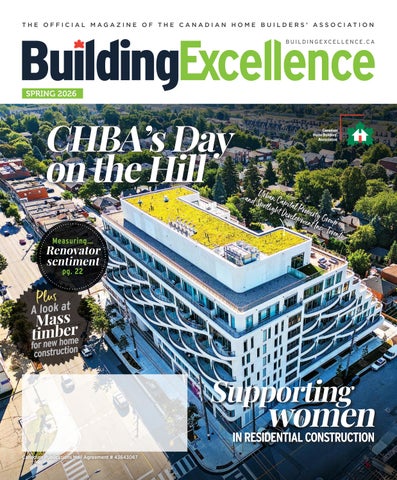

CHBA’sDay onthe Hill






BR product portfolio
Reliable power breaking and circuit protetcion
BR loadcentres, Circuit breakers


Self-leveling tabs allow for quick drywall offset.

Optimized knockout locations for additional access.
• BR 1-inch per pole circuit breakers come in 1, 2 and 3 poles with amperage ranging from 15-125 A at 10 kAIC or 22 kAIC
• The BR Fire alarm circuit breakers also provide clear permanent indication of fire alarm circuits via “Red” handle and “FIRE ALARM CIRCUIT” label

Surge protection

• The combination of circuit protection and surge protection provides flexibility and space savings in the loadcenter
• Help protect appliances, TVs, sensitive electronic equipment, smart home devices and more with clear, visible LED indication

DNPL Duplex/Quadplex
• The Duplex plug-in breakers consist of a two single-pole circuits provided in a 1-inch space
• The Quadplex plug-in breakers provide various combinations of two-pole and single-pole devices in a 2-inch moulded case
22 or 25 kAIC series rated main breaker with lock-off bracket for superior protection.

Allows quick connection of neutral and ground conductors. Neutral bar and BR breaker screws will share a common drive type.

• Eaton arc fault (AF) , ground fault (GF) and dual purpose (DF) circuit breakers are equipped with a diagnostic LED to determine the cause of a tripped breaker
• Improved arc fault circuit interrupter (AFCI) and ground fault circuit interrupter (GFCI) algorithms significantly reduce nuisance tripping, resulting in less call backs

Smart breakers
• Monitor energy habits with revenue grade metering
• Remotely operated using your phone via Eaton’s Brightlayer Home app
• Integrate with existing infrastructure and smart home systems
To learn more about Eaton’s BR plug-on neutral portfolio, please contact your local representative or visit EatonCanada.ca/residential © 2026 Eaton, All Rights Reserved. Printed in Canada, Publication No. SA003063EN, January 2026

BR thermal breakers
BR electronic breakers



EDITOR
Wayne Karl wayne.karl@nexthome.ca
EXECUTIVE MEDIA CONSULTANTS
Michael Rosset
SENIOR VP, SALES NEXTHOME Hope McLarnon 416.708.7987 hope.mclarnon@nexthome.ca
SENIOR MEDIA CONSULTANTS
Amanda Bell 1.866.532.2588, amanda.bell@nexthome.ca
Merlyn Minty 204.782.8692 merlyn.minty@nexthome.ca
VOLUME 9, NUMBER 1 SPRING 2026
CEO Kevin Lee
SENIOR DIRECTOR, OPERATIONS & COMMUNICATIONS
Natasha Rombough
MANAGER CUSTOMER SALES/SERVICE
Marilyn Watling
SALES & MARKETING COORDINATOR
Gary Chilvers
POLICY AND COMMUNICATIONS ANALYST
Emily Fielden
HOME SHOW MANAGER & NEWSPAPER CIRCULATION – GTA
Josh Rosset
DISTRIBUTION distributionteam@nexthome.ca
ACCOUNTING INQUIRIES accountingteam@nexthome.ca
VP MARKETING — GTA
Leanne Speers
DIRECTOR OF PRINT MEDIA
Lauren Reid–Sachs
VP PRODUCTION — GTA
Lisa Kelly
PRODUCTION MANAGER — GTA Yvonne Poon
GRAPHIC DESIGNER & PRE-PRESS COORDINATOR Hannah Yarkony
COMMUNICATION STRATEGIST
Chloe Perreault
Published 4 times a year by NextHome, on behalf of the Canadian Home Builders’ Association (CHBA), all rights reserved. No part of this publication may be reproduced in any form without written permission. Building Excellence, NextHome, and the Canadian Home Builders’ Association (CHBA) are not responsible for any claims or promises in any advertisement, nor for any unsolicited material sent to the magazine. Canadian Publications Mail Agreement # 40065416
Published by nexthome.ca
Advertising Call 1.888.761.3313 for rates and information. Fax: 1.888.861.5038
Copyright 2026 All rights reserved. All copyright and other intellectual property rights in the contents hereof are the property of NextHome, and not that of the individual client. The customer has purchased the right of reproduction in NextHome and does not have the right to reproduce the ad or photo in any other place or publication without the previous written consent of NextHome.
Terms and Indemnification Advertisers and contributors: NextHome is not responsible for typographical errors, mistakes, or misprints. By approving your content and/or submitting content for circulation, advertisers and contributors agree to indemnify and hold harmless NextHome and its parent company from any claims, liabilities, losses, and expenses (including legal fees) arising out of or in connection with the content provided, including but not limited to any claims of copyright infringement, unauthorized reproduction, or inaccuracies in the content. Advertisers acknowledge that they have the necessary rights, permissions, and licenses to provide the content for circulation, and they bear full responsibility for the content’s accuracy, legality, and compliance with applicable laws upon approval. Contributors acknowledge NextHome reserves the right to omit and modify their submissions at the publisher’s discretion.



PRESIDENT’S message

DRIVING THE NARRATIVE
2026 STARTS FULL STEAM WITH CHBA ADVOCACY
BY CURTIS MERCER, CHBA PRESIDENT
Parliament and the Senate rose as usual for the holidays and January, but as soon as they returned, CHBA was in full engagement mode.
On Feb. 10, I joined CHBA colleagues from across the country in Ottawa for CHBA’s annual Day on the Hill. It was one of the busiest yet as CHBA builders, renovators, developers and association staff came together to meet directly with federal ministers, MPs and senior officials to talk about housing supply, homeownership and affordability.
CHBA delegates had a record number of meetings with federal officials and wrapped up the day with a reception where we connected with several new MPs and Senators, bringing us to 91 total engagements with Parliamentarians (more details on page 16).
Throughout my time at the Association, I’ve always found Day on the Hill to be an excellent opportunity for CHBA members to speak directly to policymakers about what’s happening on the ground in homebuilding and renovation and what needs to change, building on CHBA advocacy throughout the year. This year for the Day on the Hill, we had three priority recommendations for govern -
ment to help spur construction and get homeownership affordability back in line. They included expanding GST relief to all buyers of new homes and renovations that add new housing supply, working with municipalities to rein in excessive development charges, and fixing overly restrictive mortgage stress test rules. These recommendations are among several more that aim for long-term solutions to Canada’s housing supply and affordability crisis.
Overall, the event this year was great in terms of political engagement, and I’m excited to see how the conversations continue between parliamentarians and CHBA in the coming months. It was good to see Bill C-4 finally pass after months of constant engagement by CHBA urging parliamentarians and senators to “get the job done;” first-time homebuyers can now finally access long-awaited GST relief. And of course, CHBA continues the push to have that exemption extended, per the focus on the Hill and many other CHBA advocacy activities.
As I continue my time as national president, as a CHBA member from Newfoundland, I’m always struck by how similar our issues are from coast to coast: we’re all facing affordability pressures, labour shortages, rising material costs and the need for coordinated action across all levels of government. That’s why it’s so important to be engaged in the association, so that we can speak to policymakers with cohesive messaging and keep market-rate housing front and centre on government dockets. If you’re not already involved in a committee or council, or if you haven’t yet

attended a CHBA event, I’d encourage you to do so.
CHBA’s next major event – one I’d say is the biggest of the year for the residential construction industry – is coming up in May. Home Building Week is happening in beautiful Quebec City, and it will be the place to connect with industry colleagues, learn about the latest products and innovations, and hear all about how CHBA is working for you. If you’re not already slated to attend, I’d encourage you to register at chba.ca/homebuildingweek. Speaking from experience, I can honestly say that association engagement is invaluable for your business, the industry and CHBA as it advocates on your behalf.
As I head into more travel in the spring, I look forward to hearing from even more members so I can carry your perspectives back to Ottawa. Together, we can inspire real change.

ADVOCACY AT WORK

USING DATA TO ILLUSTRATE THE NEED FOR HOLISTIC HOUSING POLICY
BY KEVIN LEE, CHBA CEO
especially aspiring homeowners. Canada needs policies that support the construction of housing across the entire continuum, of all forms and tenure.
Those who work in the residential construction industry know how deeply Canadians value homeownership. Yet housing policy since last year’s federal election campaign has reverted to a focus on affordable (social) housing, after years of success by the Association in getting government to prioritize solutions that support homeownership and market-rate affordability. The good news is that those much-needed policy changes have not been walked back, but the path forward requires a heavier hand to keep that momentum going – and CHBA is hard at work on that front.
Initiatives such as Build Canada Homes –which plans to build subsidized housing primarily on federal lands – are important to support our most vulnerable. But make no mistake: Build Canada Homes will not solve affordability challenges for most Canadians, as it will create only about one per cent of the new construction – nowhere near what is needed to close the housing supply gap and help improve affordability. It will support those in core housing need, which is important, but it will not help the 95 per cent of Canadians who live in market-rate housing, and also need support in this housing crisis,
To quantify that Canadians share this same concern, CHBA commissioned Abacus Data, a top public opinion polling firm, to poll the public on housing affordability and expectations of the government. The results confirmed what industry professionals hear every day: Canadians still believe in the dream of owning a home, but they are losing confidence that it will ever be possible. They also know that government leadership is needed to help make that dream a reality.
According to the polling, 88 per cent of Canadians younger than 45 say they want to own a home one day, yet only 29 per cent of non-homeowners think they will actually be able to do so. Meanwhile, fewer than one in five Canadians are satisfied with federal efforts to improve affordability for homeownership, and once informed about Build Canada Homes’ scope, 78 per cent say the government must do much more to address market-rate housing challenges. The data is clear: Canadians don’t think the government is doing enough to increase market-rate housing supply, restore affordability and bring back confidence in homeownership.
Data-driven insights, such as those coming out of CHBA’s Housing Market Index (HMI) and new Renovation Market Index (RMI), have been invaluable for CHBA’s advocacy work on members’ behalf. We used the Abacus polling data strategically around CHBA’s Day on the Hill in early February to re-ignite the conversation both in the public sphere and amongst policymakers. A week ahead of the Day on
the Hill – which supports CHBA’s year-round advocacy efforts by bringing association leadership to Ottawa to meet with parliamentarians – we co-released the research with Abacus Data, which made a splash in the media and drummed up interest to meet with our delegates. We also leveraged the Abacus data in our CHBA policy infoguide for government, as well as took out several strategic digital and out-of-home ad placements targeted at MPs and policymakers. There is no doubt this research, and its accompanying marketing campaign, has made an impact. In 84 meetings with MPs and policymakers (a record number), it helped drive the message home that action cannot be exclusively on Build Canada Homes, setting the stage for CHBA delegates to deliver recommendations for change for the full market with one cohesive voice. The result has been strong interest from policymakers in working together to improve Canada’s housing outcomes, which we look forward to nurturing throughout the year, with the next big marker being the Spring Economic Statement.
Moving forward, the local, provincial, and national levels of CHBA will continue to leverage this data to illustrate the need for holistic policies at all levels of government that support homeownership affordability to get more shovels in the ground and support renovations that create added housing supply. Rest assured, CHBA is keeping our foot on the gas.
A full rundown of CHBA’s Day on the Hill is available on page 16. To read CHBA’s full suite of recommendations to the federal government on how to restore homeownership affordability, visit affordability.ca. CEO’S message

MARINO GENERAL CONTRACTING LTD.
A WEST COAST FAMILY CONSTRUCTION BUSINESS FINDING SUCCESS THROUGH SMART PROCESSES AND KEEPING PEOPLE FIRST
BY NATASHA ROMBOUGH , SENIOR DIRECTOR, OPERATIONS & COMMUNICATIONS, CHBA
Meredith Yuen and Steve Marino didn’t plan on running a home building and renovation company, let alone assuming
FAST FACTS
Company Name:
Marino General Contracting Ltd. (Marino GC)
Head Office: Vancouver
Number of Full-Time Employees: 12
Approx. Annual Gross Revenue: $11M
Projects per year: 30-plus
responsibility for one in their early twenties. But in the nearly 10 years since they suddenly took over the family business, Marino General Contracting Ltd. (Marino GC) is thriving.
Based in Vancouver, Marino GC delivers around 30 or more projects per year, from custom new homes to unique, high end renovations. Yuen – who co-runs the business with Marino, her partner in work and in life –says it’s the systems that have been the game changer. But getting to this point wasn’t easy.
THE FIRST GENERATION
Marino General Contracting began in 1989 in Toronto, founded by Steve Marino’s father, Joe. In 1994, the Marinos moved west to Vancouver, and Joe continued to build the business the way many small contractors once did: With a strong instinct for estimating, a mental record of past and ongoing jobs, and a solid reputation.
It was a true “mom-and-pop shop,” with old school ways of doing business, but it worked

for Joe. “He had a great team and a really good reputation,” Yuen says, crediting that strong team as a key element of the company’s transition.
Yuen, who was born in Hawaii and raised in San Diego, and Marino, met at university in California through their shared interest in rowing. Neither were tracking into entrepreneurship, though Yuen knew by the end of her degree she wanted to go into business – she just hadn’t planned on it being in residential construction.
That changed abruptly in 2017. Shortly after they graduated from university, Marino’s dad asked him to come home to Vancouver to
Steve Marino and Meredith Yuen


help with the company. Steve began working for his dad as a carpenter. Soon after, Joe was diagnosed with terminal cancer, and without warning, had limited to no capacity to work. Overnight, the family’s reality changed. In the midst of dealing with the terrible news, Yuen and Steve Marino found themselves taking over the company, with minimal access to Joe and the critical information he’d been storing in his head.

“What Steve and I realized almost immediately was we can’t run things the way that Joe did. We were too young, we did not have enough experience, and we were coming into a lot of these projects right in the middle. So, we didn’t have any choice but to put formal systems in place so the company could still run if something happened to one of us. And we’ve been quite militant about that because of how we had to take over,” Yuen explains.
A NEW WAY OF DOING BUSINESS
Yuen and Marino began documenting workflows, formalizing budgeting and estimating processes, and breaking projects into trackable phases – from planning and demolition through finishing.
“I recognized early on that it is hard to successfully run a construction company if you don’t have experience running projects,” Yuen says. “I learned the administrative side of running a business, but I didn’t know how to frame a wall or fix issues that came up on site. And while it is not always a requirement for project managers, I wanted to know.”
Yuen leaned heavily on the existing team, many of whom had worked under Joe Marino for years, to learn the ins and outs of home construction. The crew, who were quite a bit older, took her under their wing, taking time to
Coming CHBA Events
walk her through jobsites and show her the ropes. She took it seriously and made sure not to waste their time: “I made sure that I only asked a question once. I would write down every single thing someone would say to me so that I could go home at night and study.” Yuen still works with most of those same subcontractors and employees today.
In learning the business, Yuen and Marino also reviewed the experience of their crews. They realized that when crew members bounced between sites, they rarely got to see a project through, which wasn’t ideal for project continuity and took away from the sense of ownership and pride of building something through to completion.
They addressed this by forming consistent project teams. Each project manager is paired with a dedicated group that works together across projects, making it easier to share updates and maintain clear visibility into project status.
Marino and Yuen created a repeatable project framework with tracking onto each stage of construction so that costs, hours, materials and subcontractors could be monitored in real time. The team was supportive, and the outcome surprised all of them: Marino GC scaled fast, essentially doubling its revenue year over year in the early period after the transition.
MAY 4-8, 2026
CHBA’s Home Building Week in Canada Québec City
MAY 8, 2026
Winners Announced for 2026 CHBA National Awards for Housing Excellence
OCT. 26-30, 2026
CHBA National Fall Meetings Ottawa
A CLIENT-FIRST APPROACH
Today, Marino GC specializes in high-end renovations and custom new homes, with occasional commercial work where clients want residential-level detail. But within that range, Yuen says the clients are the most important element – if it’s the right fit, no project is too small.
Much of their work comes through repeat clients and referrals. Joe Marino built a solid reputation that Steve and Yuen work hard to continue. They also embraced the opportunity to cultivate relationships with local designers and architects to broaden their referral network in a way that Joe never had. Because having the right fit for projects is a priority, Yuen says they focus on authentic relationship-building rather than big marketing campaigns to attract clients.
Within Marino GC, the leadership duo have clearly defined roles, while still sharing certain responsibilities. Marino is the relationship engine – sales, estimating and client-facing momentum, while still running projects. Yuen says he’s “the heart of the company,” someone clients and staff naturally gravitate toward.
Steve describes Meredith as the “Captain” – the one that wears many hats, and keeps the machine running smoothly. She leads projects, oversees project managers, manages accounting and financials, drives operations and strategy, and is always looking to refine processes to optimize the team’s efforts and positively impact the client experience.
PROCESS-DRIVEN RESULTS
If Marino GC’s first phase of operational transition was about creating systems under pressure, the second phase is about integration and optimization. Recently, they overhauled their operational backbone once again. What Yuen evaluates now is not just whether their project management software is being used, but how much it’s truly improving day-to-day processes and the client journey. She notes an example of a project manager reporting an unexpectedly productive budget meeting, where homeowners arrived already informed because they’d been following the same data the team sees. For a company that
prioritizes client experience, that transparency is not only efficient, it also garners trust, strengthening their reputation and client experience.
FINDING A CREATIVE NICHE
Marino GC has a fascinating portfolio of projects, from detailed heritage renovations to unique custom homes. Meredith lights up describing the projects that combine both. One recent standout: A whole home renovation with a large landscape component. The landscape renovation has a massive 50-ft. cantilevered deck that gives the illusion of floating into the tree canopy and out over a ravine. Blackened steel, diamond cutouts and lighting below create a starry sky effect when walking on the boardwalk and night. It’s a feat of engineering made possible by heavy coordination, shoring, helical piles and driven professionals collaborating on creative problem-solving.
For that same client, they sourced a massive 15-ft. yellow cedar log and transformed it through repeated CNC iterations into a custom-fit bench. The piece was craned over the 5,000-sq.-ft. home to its final location. Leftover cedar became a second bench, and the remaining material was donated with help from Marino GC’s longtime lumber supplier to a local Indigenous artist who carved it into a totem pole.
Yuen embraces projects that combine technical creativity with the unique vision of homeowners. “We do a lot of heritage renovations, which are both rewarding and challenging because they involve uncovering layers of history. You are looking at the good and the bad, and the goal is either to restore a home to its original grandeur or elevate the construction and finishes to a higher standard.”
FUTURE PLANS
The future does come with its concerns: Recruiting new talent is difficult and Yuen worries about a looming knowledge vacuum as their veteran tradespeople retire over the next decade. Affordability is another pressure point, with construction costs continuing to rise, including materials, labour and the

increasing impacts of added regulation and red tape. That is one reason she values builder associations: they advocate at a scale individual companies can’t, and they can have the tough conversations with governments.
There’s also plenty of hope for the future, and Yuen is doing what she can to broaden the residential construction workforce. Marino GC joined the Greater Vancouver Home Builders’ Association (now HAVAN) in 2016, and she became deeply involved in shaping early Women’s Council programming, later serving as Chair. Ironically, her end goal is similar to other women working towards the same outcome: to make these councils unnecessary by normalizing women’s presence in the industry. Her advice to builders who want to support more women in the industry is to build a company culture grounded in respect, making sure you have an environment where new hires succeed because the team is aligned, welcoming and focused on doing excellent work.
Long-term, Yuen envisions Marino GC continuing to evolve and grow while raising the standard for the industry as a whole. She has faith that finely-honed processes and a committed team that shares their vision will get them there.
“Working in construction is really about how you build and grow your community,” she says. “A good team will pour everything into you if you do the same back to them. And I don’t think I would be where I am today if I didn’t have those relationships early on.”
MAKING WHAT MATTERS WORK
Eaton’s BR 25 mm (one-in.) load centres are designed for modern residential construction, renovation and redevelopment. With fast installation, they are configurable either as a main breaker for service entrances or a main lug panel for expanding electrical systems, adaptable to new builds, upgrades and retrofit applications. The main breaker offers full panel protection and acts as a service disconnect, while branch breakers safeguard connected loads such as lighting, appliances and receptacles.


SURGE PROTECTION AND SPECIALTY PANELS
Eaton integrates surge protection to safeguard appliances, electronics, smart systems and connected devices. LED indicators confirm surge protection status, simplifying inspection and maintenance for professionals.
For outdoor and specialty needs, Eaton spa panels reduce installation time and labour costs. These panels meet National Electrical Code (NEC) requirements and combine a GFCI and disconnect switch into an easy-toinstall device, ensuring reliable protection for spa pumps and hot tubs.
BR CIRCUIT BREAKER PORTFOLIO
Eaton’s BR circuit breakers are widely used in load centres and panelboards for residential applications. The portfolio features standard one-in. BR breakers, arc fault circuit interrupters (AFCI) and ground fault circuit interrupters (GFCI), helping projects comply with codes and improve reliability. To maximize panel capacity and minimize expensive service upgrades, Eaton provides duplex and quadplex plug-in breakers. Duplex breakers house two single-pole circuits in a single one-in. space, and quadplex breakers offer combinations of singleand two-pole circuits in a compact two-in. case. These space-saving solutions are ideal for high-density housing and renovations, supporting future expansion.
SMART HOME ENERGY MANAGEMENT
Eaton’s AbleEdge home energy management system enables builders and developers to future-proof residences. AbleEdge transforms Eaton BR load centres and metre breakers into modular smart panels, often avoiding main panel upgrades while supporting solar, energy storage and electrification needs. This scalable system delivers an efficient, low-carbon power solution, adding long-term value to residential projects.

MODERN SAFETY TECH
Homebuilder customer- and field-facing teams operate at the front lines of the customer experience. They work independently across show homes, presentation centres and active communities – often alone, often meeting unfamiliar clients and often without immediate support nearby. As builders grow, so does the responsibility to protect these distributed, customer-facing professionals.
For years, safety systems placed that burden on internal teams – requiring managers to monitor alerts, coordinate response and maintain infrastructure. But leading builders are recognizing a fundamental shift: Safety should scale with the business, not create operational overhead. And this is exactly where my-eforce delivers a new standard of protection.
YOUR SAFETY IS HANDLED END-TO-END
Builders such as Jayman BUILT are embracing a fully managed approach. As Adam Lacasse, safety officer, says, “With my-eforce, emergency alerts are handled immediately by dedicated professionals. Every situation is verified and escalated in real time, ensuring our team
members get help faster than traditional internal processes could deliver. It’s a welldesigned platform that every frontline representative should have on their phone.” With trained specialists monitoring alerts 24/7, every situation is handled without relying on internal staff – delivering faster response, accountability and peace of mind.
BUILT ON THE DEVICES YOUR TEAM ALREADY USE
Equally important is accessibility. Partners Development Group recognized that safety only works when it integrates seamlessly into daily workflows. Says Keira Andrews, CRSP, safety manager at Partners Development Group, “Adoption was immediate because my-eforce operates on the devices our teams already use. There was nothing new to deploy, and our sales, rental and customer care teams – along with field staff who often work independently – all have instant access to protection.” With no hardware to install or infrastructure to maintain, my-eforce delivers always-on protection wherever teams work.
“ With my-eforce, emergency alerts are handled immediately by dedicated professionals. Every situation is verified and escalated in real time, ensuring our team members get help faster than traditional internal processes could deliver. It’s a well-designed platform that every frontline representative should have on their phone. ” – Adam Lacasse, Safety Officer, Jayman BUILT


BUILT FOR URBAN PROFESSIONALS
For builders such as Logel Homes, the value lies in purpose-built design. Their sales professionals operate in dynamic, publicfacing environments traditional safety systems were never designed to support. As Reilly LePage, director of sales and marketing, says, “Our teams work independently across multiple communities, and with its multiple safety features, my-eforce provides the protection and confidence they need while representing our brand.”
Builders are moving beyond fragmented tools toward safety infrastructure that scales effortlessly and ensures every team member is supported. Connect with my-eforce to see how your organization can do the same.
For more information, email sales@my-eforce.com, call 403.768.3117 or visit my-eforce.com.
CEO & FOUNDER




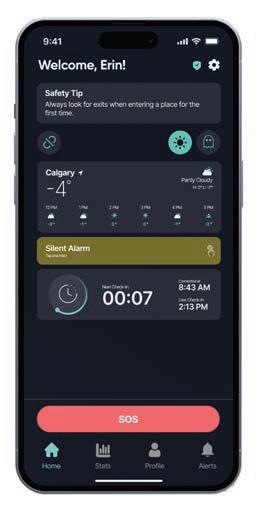
Safety That’s Simple & Scalable
Fully Managed Emergency Response


Faster response, clear accountability and no internal workload.
Consumer-Grade Devices
Immediate adoption, always-on access and safety people actually use.
Built for Home Builders
Safety designed specifically for urban professionals.
Modern Safety Tech That Works Where Your People Work




2026Day onthe Hill
CHBA MEMBERS AND HBA STAFF SHARE NATIONAL
RECOMMENDATIONS ON PARLIAMENT HILL
BY NICOLE STORESHAW, DIRECTOR OF GOVERNMENT RELATIONS, CHBA
CHBA’s annual Day on the Hill is a signature event for the association. Member leaders and HBA staff from across the country meet with Cabinet Ministers, Members of Parliament and other officials to help boost the yearround federal advocacy done by CHBA. This year, delegates gathered in Ottawa with an even more determined vigour. Since last year’s election of a new prime minister, there has been a shift back by the government to affordable housing, with less focus on homeownership and policies to support it. So, armed with new and compelling public opinion survey data, CHBA delegates spread out across Parliament Hill on a cold and snowy day to remind politicians that Canadians still want to own a home, but government actions and plans are not nearly enough.
RECORD-BREAKING NUMBER OF ENGAGEMENTS
On Feb. 10, delegates participated in a record-breaking number of meetings for any Day on the Hill hosted by CHBA. Proving that market-rate housing supply and affordability remain key issues, 84 meetings with Ministers, MPs and other senior officials took place. That is an impressive number considering the number of competing events and issues taking place in Ottawa at the same time, including the ongoing budget debate.
“Being able to feature the cross-country strength of the Association further reinforced the scale and importance of the residential

construction sector and the challenges our membership is facing,” says CHBA CEO Kevin Lee. “It really helped to drive home CHBA’s recommendation in today’s environment of falling homeownership housing starts and layoffs happening due to current crisis conditions, particularly in Ontario and British Columbia.”
Speaking as one association and bringing the same messages and recommendations to those meetings is crucial. This is why there is a
mandatory training session the day before meetings take place. CHBA delegates have a reputation for being very well prepared and coming with solutions, not just complaints. The training session equips members with an overview of the current political environment in Ottawa, followed by an extensive review of CHBA’s federal policy recommendations. This year’s training session included a fireside chat between Lee and Official Opposition Shadow Minister for Housing, MP Scott Aitchison.
Members of CHBA’s Executive pose in front of a bus ad located outside the Finance Building in Ottawa.

Participants were then provided with best practices on advocacy and how to (or how not to) conduct a meeting with an MP. This exercise was helped by a couple of meeting simulations and further practice within the delegate teams.
NEW PUBLIC OPINION SURVEY REINFORCES ADVOCACY
New public opinion research conducted by Abacus Data for CHBA shows widespread dissatisfaction with federal efforts to improve homeownership affordability, with fewer than one in five Canadians satisfied with current federal action. This was, of course, highlighted with politicians.
Canadians still have a strong desire for homeownership. According to the polling, 88 per cent of those under 45 would like to own a home one day. But homeownership rates have been falling severely since 2011 due to a lack of affordability, and today only 29 per cent of non-homeowners are confident they will ever be able to purchase a home.
Canadians point to Ottawa as responsible for fixing the housing crisis: 65 per cent say the federal government is most responsible

for the housing affordability crisis, and 66 per cent say it’s most responsible for solving the problem, but only 17 per cent think they’re doing enough to address affordability for homeownership.
CHBA delegates deftly utilized this data in their meetings with politicians and stressed that the federal government’s focus on non-market housing is seen as insufficient on its own. Thirty-one per cent of those surveyed said “much more” focus should be placed on homeownership affordability, compared to 17 per cent for non-market housing.
GETTING THE WORD OUT
CHBA began its Day on the Hill advocacy before the event, deploying a variety of pointed ads using the Abacus data that were aimed at policymakers. From targeted social media posts on LinkedIn and X, to banner ads on websites where they spend time, to an op-ed in the Hill Times, CHBA’s messaging helped fuel the interest in meeting with our delegates to discuss housing. This year, CHBA also deployed two bus shelter ads at strategic locations in front of Parliament and the Finance building, where policymakers frequently walk.
Members and HBA staff preparing for MP meetings during training day.
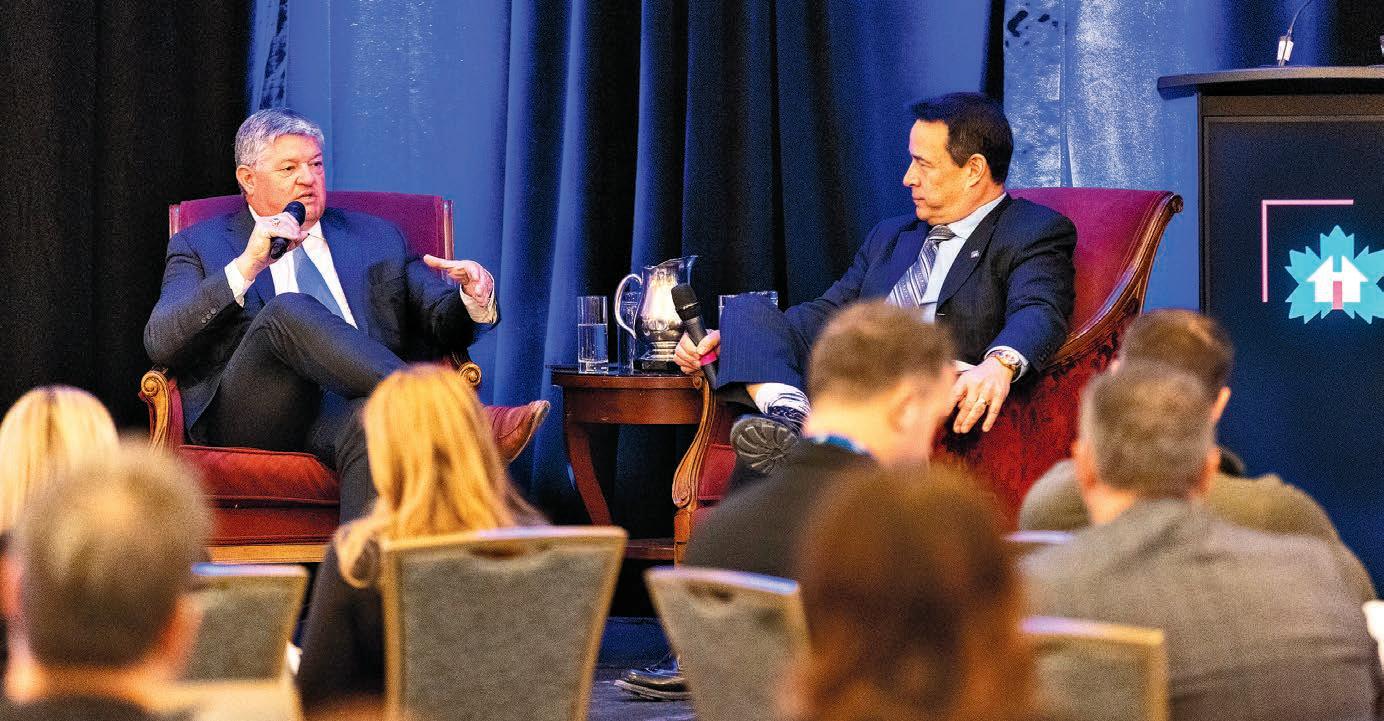
Federal Minister of Housing and Infrastructure Gregor Robertson speaks during CHBA’s Day on the Hill Reception.
Delegates amplified the messaging during the Day on the Hill, posting group photos with MPs and thanking them for meeting while reiterating CHBA’s recommendations. Together, delegates made more than 110 posts that day, which CHBA reshared. LinkedIn was the placed to be, and CHBA’s LinkedIn profile had more than 18,000 organic impressions in the two weeks around the event.
CHBA POLICY RECOMMENDATIONS
Day on the Hill delegates took this data, along with CHBA recommendations, to drive home the message that Canadians need and expect much more to be done in support of homeownership policies.
CHBA’s policy infoguide, Unlocking the Door to Homeownership – Recommendations on the Federal Role 2026, provides a pathway to housing affordability and supply, especially for homeownership. These are the recommendations that members and HBA staff brought forward:
1. Return to federal leadership and a comprehensive approach to affordability for market-rate housing now, and lead collaboration with provinces and municipalities on affordability and supply.
2. Lower taxes to address affordability and get the market moving by broadening GST relief to all buyers and extend to renovations that

add new units, such as secondary suites and ADUs. Use all levers available to have municipalities reduce development taxes and collaborate to find alternative funding models.
3. Fix the stress test by eliminating it on uninsured mortgages and make it dynamic on insured mortgages.
4. Maintain and increase housing-supportive infrastructure and transit investments and tie them to housing affordability and supply outcomes.
5. Remove municipal barriers and red tape within the homebuilding process. Catalyze municipal process improvements by tying them to housing supply outcomes (zoning, bylaws, approval/permitting delays,

NIMBYism) and harmonize all municipal building- and development-related regulations.
6. Avoid adding costs through codes and regulations. Pause all changes to the National Building Code, as Australia has done. Revisit the 2025 code to reduce costs and complexity before adopting, adopt affordability as core code objective and establish a national code interpretation centre.
7. Support housing affordability and supply through renovation measures including introducing renovation tax credits for first-time homebuyers and energy efficiency retrofits. Make Net Zero renovations eligible for GST rebate.
CHBA CEO Kevin Lee and Official Opposition Shadow Minister for Housing, MP Scott Aitchison, talk homeownership.
CHBA members Connor Johnstone (London), Natasha Paikin (Burlington), and Tom McLaughlin (Guelph) connect with MP Aitchison.
during the meetings and connect with more key policymakers, CHBA hosted a reception in the evening at the Chateau Laurier. The reception was well attended by MPs, Senators, other staff and officials. Some MPs attended because a daytime meeting did not fit into their schedule, but many others who already had meetings wanted to spend more time with delegates to talk housing.
Federal Minister of Housing and Infrastructure Gregor Robertson was the guest speaker at the busy and lively event. While his speech emphasized the government’s focus on social housing, he did acknowledge the importance of home builders and developers. CHBA CEO Lee and President Curtis Mercer were able to meet with Minister Robertson following his appearance to reiterate that while social housing is important, the government’s focus on its new agency, Build Canada Homes, will deliver only one per cent of the new housing supply needed to meet the government’s own targets of 500,000 new homes per year.
The following day, during the CHBA Board of Directors meeting, there was a debrief where delegates discussed how CHBA messages were received during the previous day’s meetings.

“As a participant, I can say that the Day on the Hill was a great experience,” said Mercer. “Each area of the country has its own particularities, but when we come together for this event, we’re all bringing the same message in a united front, while sharing our personal experiences to bring those recommendations to light. I think everyone came away feeling energized and encouraged that we hit the right notes and generated even more momentum with policymakers.”
NEXT STEPS
Coming out of the Day on the Hill, CHBA followed up with the MPs and officials who met
with delegates to thank them for the meetings and provide any additional information that they sought. However, CHBA’s advocacy work is never done.
Going forward, CHBA will continue to strongly engage with the federal government to push for more policies to support affordability and homeownership, including in the Spring Economic Statement. CHBA will also continue to roll out the data contained in the Abacus Data survey (see more info on page 24). This information will be very valuable in advocacy efforts as well as in media outreach. The 2026 Day on the Hill has set a high bar for the federal government to unlock the door to homeownership.
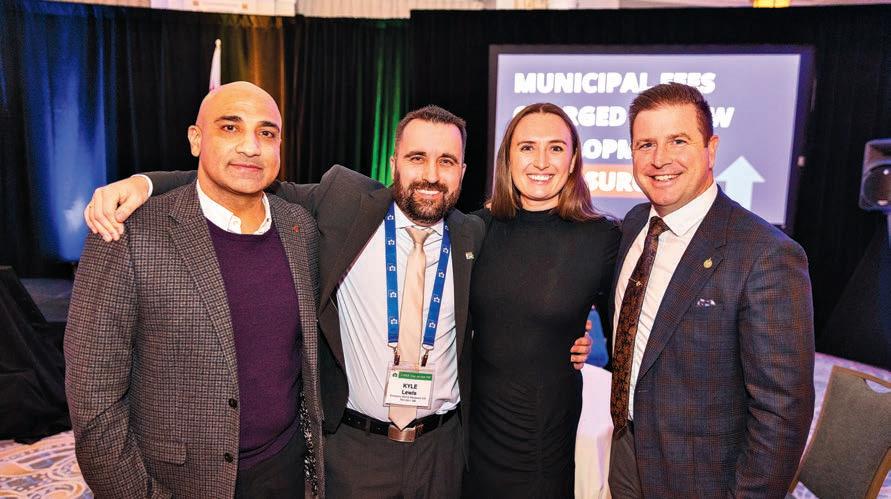
CHBA members Kyle Lewis (Moncton) and Cassidy deVeer (Kelowna), chat with MP Parm Bains (far left) and MP John-Paul Danko (far right).
RENOVATION MONTH SUCCESS
LEVERAGING THE REACH OF MEMBERS, HBAS, AND STRATEGIC DIGITAL TOUCHPOINTS TO DRIVE RESULTS
BY SARAH CARON, DIRECTOR, RENOVATION SERVICES, CHBA
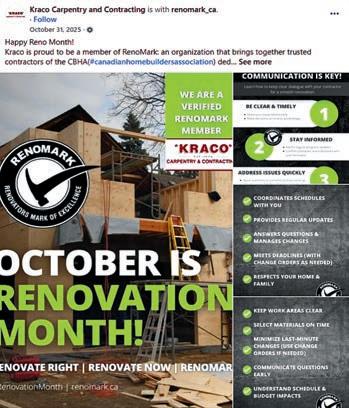
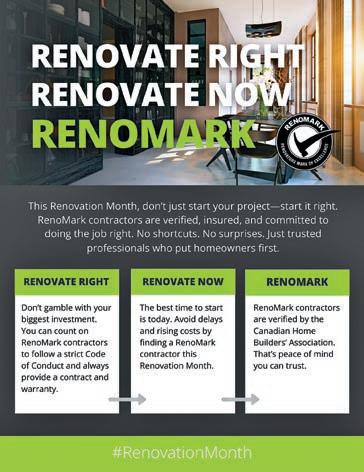
The 2025 Renovation Month campaign marked a milestone for RenoMark, generating a surge in brand awareness and engagement across Canada. By leveraging a multi-platform strategy, the initiative successfully connected with Canadian homeowners searching for renovation advice and trustworthy professionals. The campaign delivered an impressive 19.7 million total impressions across radio, print, digital and social media. This expansive reach was not simply a matter of numbers, but a deliberate effort to engage Canadians where they live, work and connect, both on- and offline.

The campaign achieved a remarkable digital presence, reaching 16.3 million impressions across platforms such as Google, Meta RENOVATORS’

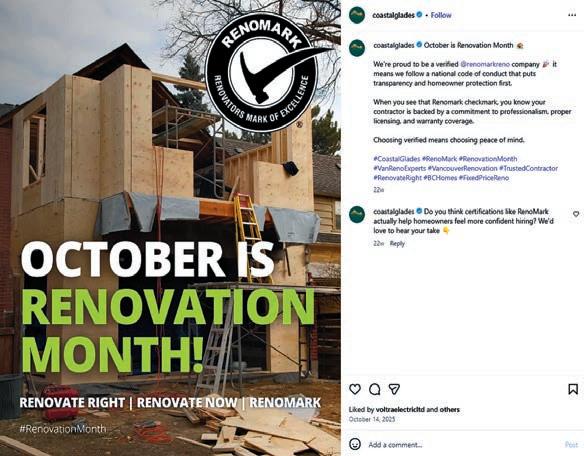
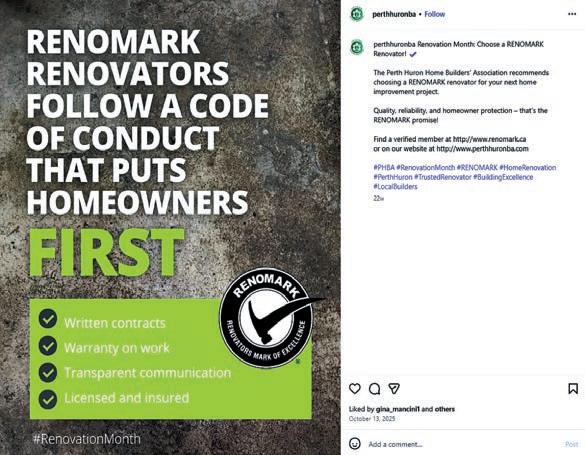
The campaign’s impact went far beyond metrics, fostering a wave of national participation from provincial and local home builders’ associations (HBAs) and members. The campaign demonstrated that unified national messaging, backed by strong local activation, can create an extraordinary ripple effect. HBAs and renovation professionals across Canada stepped forward in unprecedented numbers to post stories, educate homeowners and champion the value of professionalism in the renovation industry.
Central to the campaign’s success was a comprehensive promotional toolkit tailored to the diverse needs and capacities of HBAs and industry members. With usability at the forefront, CHBA created a robust suite of assets that included ads (digital, print and radio), signage, email graphics, a press release, social media posts and renovation guides. The strong visual impact and concise messaging helped reinforce the campaign’s themes and ensured that Renovation Month was consistent and recognizable across Canada. Meanwhile, the variety of assets enabled HBAs and members to connect with audiences on platforms where Canadians spend much of their time – whether scrolling through social media feeds, searching online for renovation tips or listening to streaming audio on the go.
RESULTS




(Facebook and Instagram), Pinterest, Reddit and Spotify. Meta ads excelled at driving engagement and click-throughs particularly among users aged 35 to 44. Google delivered reach and cost efficiency across a variety of high-profile Canadian sites such as theweathernetwork. com, cbc.ca, citynews.ca and breakfasttelevision.ca. Reddit reached communities passionate about DIY, home improvement and design, while Pinterest resonated with users interested in home decor and architecture. Spotify achieved a remarkable 98 per cent ad completion rate for the 30 second audio ad, primarily reaching users aged 25 to 44.
The campaign’s single-month impact on the RenoMark website was substantial. Website traffic skyrocketed, delivering 24,539 page views, a remarkable 382-per-cent increase during the campaign period. This included 20,000 new users, a fivefold increase over the previous month. User engagement soared, with nearly 60,000 events (clicks, scrolls, forms) triggered on the site, underscoring strong interaction with digital tools. The “Find a Renovator” page continued to perform as the website’s primary conversion driver. Without a doubt, the Renovation Month campaign elevated RenoMark’s digital presence to new heights, driving measurable gains in awareness, engagement and conversions.
As the campaign unfolded, the collective efforts of HBAs and members became a driving force behind its success. Members participated enthusiastically, sharing campaign
assets and highlighting the benefits of working with verified professionals. Earned media generated an additional 3.4 million impressions worth $114,000 in ad value equivalent were achieved via radio and print thanks to local HBA participation. This grassroots engagement reinforced the campaign’s national message and created a sense of unity and pride among renovation professionals across Canada.
SUMMARY
The effectiveness of a targeted, multi-platform strategy underscores the campaign’s signifi-
cant contribution to raising the profile and awareness of the RenoMark brand. The success of Renovation Month is not only reflected in the campaign’s impressive analytics but also in the strengthened relationships within the industry. CHBA, provincial and local HBAs and members have set a new standard for collaboration, showing that together, they can create lasting impact on a national scale. This campaign will serve as a blueprint for future initiatives, proving that with the right tools, message, and collective effort, Canadians can be inspired to take action toward their home renovation goals.
WORKFORCE development

REMOVING BARRIERS
HOW RESIDENTIAL CONSTRUCTION COMPANIES CAN SUPPORT WOMEN IN THE SECTOR
BY EMILY FIELDEN, POLICY & COMMUNICATIONS ANALYST, CHBA
For years, CHBA and businesses in the residential construction sector have been sounding the alarm on a significant workforce shortfall. According to BuildForce Canada, 22 per cent of the residential construction industry is set to retire over the coming decade with not enough workers to replace them. Meanwhile, it is estimated that Canada will need 1.04 million workers by 2033 to pursue the doubling of housing starts needed to help restore housing affordability in communities across the country.
If companies (with the support of governments) don’t tap into the full potential and expertise of the entirety of the Canadian workforce, if/when the industry picks back up, Canada will have little chance of reaching the government’s housing starts targets, let alone maintaining the status quo. Yet barriers for women and other underrepresented groups still exist.
While the industry has made headway in recent years to remove the barriers for women and other underrepresented groups – particularly in offsite roles where women make up now approximately 40 per cent of the workforce – more can be done to encourage and support women entering the sector, mostly notably in onsite roles.
This has left residential construction companies across Canada asking an important question: How do we not only attract more women to the industry, but ensure they thrive once they’re here? The answer, according to leading women across the industry, starts with culture and extends into actionable policies, workplace flexibility, and revising everyday behaviours that are often unintentionally overlooked.
Members of CHBA’s Women in Residential Construction Council (WIRCC) shared their insights into how businesses in the sector can support women in their workplaces.
FOSTER A CULTURE OF RESPECT
A recurring theme we heard points to culture as the foundation of an inclusive workplace. Natasha Paikin, director of client experience at New Horizon Development Group in Burlington, Ont., puts it simply: “The number one thing businesses can do is foster a culture of respect – onsite and in the office… setting clear expectations around communication, leading by example and addressing any inappropriate behaviour quickly so women feel supported, safe and valued.”
Linda Mansfield, president of Homeworx Modular Homes in St. John’s, Nfld., agrees that a supportive workplace begins with “creating a culture that supports respect and inclusion with clear anti-harassment and no tolerance policies.”
Meredith Yuen, partner at Marino General Contracting Ltd. in Vancouver, emphasizes alignment: When a company shares common
Meredith Yuen (left) with Jennifer O’Bray, Chair of HAVAN’s Women’s Council on a site tour in Richmond, BC
goals and mutual respect, it “goes a long way in creating an environment that is welcoming for not just women, but everybody.”
HIRE, PROMOTE AND DEVELOP BASED ON ABILITY
Support also means ensuring women have equal access to growth opportunities. Jenna Johannesen, co-owner of Park Lighting and Furniture, Cartwright Lighting and Furniture, and True Light Co. Lighting with locations in Calgary and Edmonton, encourages businesses to foster inclusive leadership and offer mentorship opportunities while ensuring women have access to growth, training and decision-making roles. Through being mindful and conscious that women’s contributions can be unintentionally overlooked or undervalued, workplaces that actively recognize and promote women into visible leadership positions signals that advancement is possible.
Laurie Cole, co-founder, creative director and master builder of New View Designs in Fredericton, NB, echoes this sentiment: “Hire based on ability and skill.” She notes that women are an integral part of the team and should be judged on performance, not singled out. Structured mentorship programs, such as comprehensive onboarding and leadership development initiatives, can help build confidence and long-term retention.
Just as important is avoiding unconscious bias. Mansfield cautions companies not to pigeonhole women into traditionally gendered tasks like taking meeting notes or organizing office celebrations – roles that are often assigned unintentionally.
CREATE FLEXIBILITY AND OFFER PRACTICAL SUPPORT
The industry’s “make hay while the sun shines” mentality can mean long days and early starts. Rikki Paquette, general manager of Kamloops Truss Ltd. in Kamloops, BC, notes that this isn’t always realistic, especially for working parents. “Offering flexible schedules, open communication and opportunities for work-sharing can help attract and retain talented women in the industry.”
Mansfield echoes Paquette’s words, adding that companies should ensure facilities are inclusive by enabling access to properly fit personal protective equipment (PPE), private change areas and washrooms designed for everyone.
The overarching theme from the WIRCC members is that flexibility and practical support shouldn’t just be viewed as a workplace perk – it’s a retention strategy. When companies adapt to different life stages and offer practical support for their staff, they broaden their talent pool and strengthen loyalty, which is “just good business.”
BUILD NETWORKS AND ENGAGE IN ACTIVE LISTENING
Internal workplace diversity networks and involvement in industry associations also play a key role in fostering a positive environment.
Paula Strilchuk, underwriter, new home warranty at Travelers Canada located in Calgary, highlights the important role of allyship groups, noting that workplace allies are necessary to “work together and advocate for one another.” These forums create space for connection, mentorship and shared problem-solving.
Equally important is the simple act of “active listening.” Strilchuk stresses that women bring skills, credentials and insights that should be recognized and valued.
Chiara Sulyok, regional partner at Alair Homes in Nanaimo, BC, calls for a shift away
from the old “sink or swim” mentality. Instead, she advocates for teaching, guiding and embracing new perspectives in the sector. “We want (women and underrepresented groups) to stay in the trades. We want everyone to grow.” She suggests creating structured training pathways and supportive supervision to ensure people aren’t pushed out of the sector prematurely.
Ultimately, the goal is to normalize women working alongside men in the industry. Yuen reflects that her long-term hope is a future where individual women’s councils are no longer necessary – a future where women’s visibility in the industry is so common that special initiatives feel redundant. The industry is evolving towards that goal, and businesses that want to be the best workplace they can be for all should focus on intentional hiring, leadership development and fostering an inclusive culture of genuine respect, she says.
KEY TAKEAWAYS
Overall, the message from the industry leaders of CHBA’s WIRCC is clear: Residential construction companies that focus on culture, mentorship, flexibility and equity aren’t just supporting women and other underrepresented groups –they’re building stronger, more resilient teams. In an industry that is so critical to the health and growth of Canada’s communities, fostering inclusive workplaces is part of how we build the best future for all.
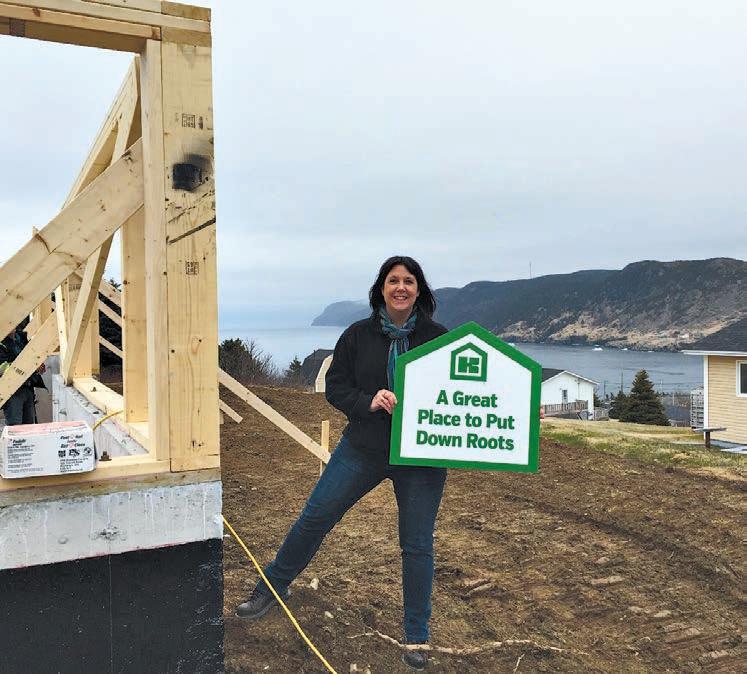
Linda Mansfield, president of Homeworx Modular Homes and CHBA Newfoundland and Labrador’s representative on CHBA’s national WIRCC standing next to one of her projects
RENOVATION MARKET INDEX
CHBA BOLSTERS ADVOCACY FOR RENOVATORS BY NOW MEASURING RENOVATOR SENTIMENT IN ADDITION TO BUILDER SENTIMENT
BY EVAN ANDRADE, CHBA ECONOMIST
Economic data often lacks the context of what the industry is actually facing. The principal example of this is the historically strong housing starts over the past five years. In January, the annualized housing starts of 254,794 units appears strong, but it does not tell the full story of the changing composition of the types of housing that are being built, and how that’s impacting affordability, especially for ownership, and, in turn, the industry. When we dig deeper into the starts data, we see that over the past five years housing starts for ownership have represented a smaller and smaller share of overall starts. Increased rental housing starts, which represented 51 per cent of total housing starts in 2025, are coming at the expense of starts for homeownership.
CHBA’s Housing Market Index (HMI) provides a much-needed leading indicator about the current and future health of the residential construction industry in Canada with respect to housing units for ownership. In Q4 2025, the HMI recorded new record lows, as builder confidence in new home sales
continues to worsen. The single-family index fell 5.5 points to 19.6 in the final quarter of 2025, which was the second consecutive record low and the first time the single-family
HMI has fallen below a score of 20. The multi-family index was 14.7 in Q4 2025, down 7.3 points from a year ago and also a second consecutive record low. These results continue
IMPORTANCE OF A GST REBATE FOR RENOS THAT CREATE NEW PRIVATE DWELLINGS
“ Canada’s residential construction sector is very important economically, but there is a lack of data about it, especially compared to existing home sales. ”
to paint an alarming future for new home construction starts and point to a multi-year dearth in starts for freehold or condominium ownership if drastic changes are not made.
Canada’s residential construction sector is very important economically, but there is a lack of data about it, especially compared to existing home sales. That dearth of information was CHBA’s original motivation for creating the HMI. Since its inception in 2021, the discussions the HMI data has generated with policymakers and media have been invaluable to CHBA’s advocacy.
The residential renovation industry also desperately needs this critical market intelligence, so CHBA is working to fill the void.
Over the past five years, the residential renovation sector has seen volatility in annual industry GDP output not seen since the late 1980s and early 1990s. After three years of consecutive declines in output between 2022 to 2024, a modest rebound of just over two per cent in 2025 still puts the industry’s national output at slightly more than $53 billion in 2017 dollars. This is a level of output last seen in 2014, suggesting that the industry is no longer growing with the expansion of the housing stock. This worrisome backdrop has spurred CHBA to extend the success of the HMI to further support members across Canada who work in the renovation space.
CHBA launched its inaugural Renovation Market Index (RMI) in late 2025, collecting a strong number of responses from renovator members across the country. Just like the HMI, CHBA modelled the RMI after a similar indicator used by NAHB in the U.S. that has been developed and used for years. This has enabled CHBA’s indices to be accurate and
credible right out of the gate. The RMI survey asks renovators to rate the current business conditions for six major types of renovations as Good, Average or Poor. The survey then asks renovators to similarly rate their pace of inquiries and quotes, as well as the length of their current backlog. These two questions represent renovators’ future expectations. Just like the HMI, the RMI is a weighted average of current and future conditions, expressed as a number between zero and 100, where 50 represents neutral renovator confidence. A score further above/below 50 is expected to correlate with higher or lower renovation economic output growth over the near future.
CHBA’S RENOVATION MARKET INDEX (RMI): 2025 Q3/Q4
guidance that renovation output growth in 2026 will likely not be too far off the one-percent growth that was experienced in 2025.
Given the large size of CHBA’s renovator membership and their active participation, CHBA has been able to parse the RMI into regional results as well. The RMI showed stronger sentiment in the Prairies (61.3) and Atlantic Canada (64.6), versus poorer scores in Ontario (46.1) and British Columbia (41.7). These scores are much higher than the current HMI, which is showing record lows overall due to extremely poor sentiment in Ontario and BC, but the regional variation trends in renovator confidence mirror that of the HMI. The RMI results show regional housing affordability conditions are reflected the health of demand for renovation services.
The special questions that were asked in the RMI give us additional insight into the industry. For example, interior renovation jobs are faring much better than exterior improvements in terms of demand.
48.3
The RMI for the second half of 2025 registered a score of 48.3 out of 100. This is close enough to 50 to represent a neutral score, with neutral overall current conditions weighed down by markedly pessimistic future conditions. The current conditions subindex, which is given a 75-per-cent weighting, was 52.7, and the future expectations subindex, which takes up the remaining 25 per cent weight, was 35.2. These results give forward
Accessory dwelling units (ADUs) are a growing segment of the industry as urban areas are finally allowing more infill projects to expand their housing stock. Under CHBA’s direct recommendations, Canada Mortgage and Housing Corp. (CMHC) now reports the number of urban accessory suite starts on a quarterly basis. In support of these kinds of developments and the renovators that build them, one of CHBA’s main policy recommendations is for the federal government to make GST relief applicable to renovations that add an additional unit of housing to existing homes, like ADUs and secondary suites. Among RMI respondents, 37 per cent of renovators said that this policy would help a lot, and another 37 per cent said it would help somewhat. CHBA also continues to push for the expansion of a full federal five-per-cent GST rebate for all buyers, not just first-time buyers.
If you are renovator member and would like to join the RMI survey panel, administered just twice a year, please email hmi@chba.ca to signal your interest.
BY THE numbers
CANADIANS WEIGH IN
PUBLIC OPINIONS ON HOMEOWNERSHIP AND EXPECTATIONS OF THE FEDERAL GOVERNMENT
BY NATASHA ROMBOUGH, SENIOR DIRECTOR, OPERATIONS & COMMUNICATIONS, CHBA

The cost of living, including housing affordability, continues to be a defining challenge facing Canada. The current federal government is focused on Build Canada Homes (BCH), which will build social housing principally on federal lands, as a solution. While BHC is important, it won’t support market-rate housing, which is what most Canadians live in. Maintaining balance in federal housing policy is critical; our governments must ensure that efforts to expand non-market housing are matched by policies that enable builders to increase overall supply and deliver homes that reflect what Canadians actually want and can afford.
This slip by the federal government back into prioritizing social housing while neglecting market-rate housing needs to be corrected. To help make the point in a way that registers with politicians, CHBA enlisted Abacus
Data, one of Canada’s best known and most respected polling and market research firms, to find out how the public viewed homeownership, government efforts to-date, and some of CHBA’s key recommendations.
In December 2025, Abacus polled 3,000 Canadians from coast to coast. CHBA used the data leading up, during, and after its advocacy around the 2026 Day on the Hill in Ottawa, with Abacus amplifying the messaging. The data will continue to be used throughout the year as part of CHBA’s multi-faceted public relations strategy.
Below are some insights from the study. At a high level, what the data tells us is that Canadians still have a strong desire for homeownership. That dream is getting harder to achieve, though, which people see as a systemic failure – one that they believe the federal government should be focused on trying to repair.
Key Issues: GST and development charges
According to the Parliamentary Budget Officer, first-time buyers make up only 5.8 per cent of buyers of new homes, so while GST relief for first-time buyers of new homes is a start, CHBA has been pushing for the GST relief to be expanded to all buyers of new homes, as well as to renovations that add an additional unit of housing to existing homes, like Accessory Dwelling Units (ADUs) and secondary suites. Once the rational was explained, more than half of all Canadians support expanding the GST relief.
Development charges have grown to an unsustainable level, deeply impacting housing affordability and supply in many of Canada’s toughest markets. In the Greater Toronto Area, they make up nearly $200,000 of the price of a typical new home, and in the Greater Vancouver Area, it’s nearly $100,000. When polled, a majority of Canadians (51 per cent) agree that development charges place too much of the infrastructure cost on new home buyers and that these costs should be shared across the broader tax base. Just 16 per cent disagree.
Perceptions of government performance
Overall, satisfaction about government action is low: Only 17 per cent think the federal government is doing enough to address affordability for homeownership. But while the federal government is uniquely positioned to lead on market-rate housing affordability, all levels of government have an important role to play, and the public recognizes this. Across the board, Canadians say their governments aren’t doing enough.
More than half of Canadians are not familiar with Build Canada Homes, which is the federal government’s plan to build social housing principally on federal lands. Once informed about Build Canada Homes, and the fact that it will only create about one per cent of the new construction needed, most say the initiative won’t be enough, and they expect more to be done.
88% of
But only 29% of all non-homeowners are confident they’ll ever be able to buy one
70% of Canadians say declining homeownership rates are negative for Canada
Canadians’ views on homeownership
Homeownership remains a core aspiration for Canadians, despite worsening affordability: 88 per cent of those under the age of 44 want to own a home, and 78 per cent of Canadians say that homeownership is an important life milestone. Nearly seven in 10 believe homeownership should be realistically achievable for most people, and 76 per cent tie it to feeling financially secure. But only 29 per cent of non-homeowners are confident they’ll ever be able to own a home one day, and 83 per cent are concerned about affordability –that number jumps to 93 per cent when looking at people under the age of 30. When asked about how they feel about declining homeownership rates, 70 per cent say that is a negative direction for Canada to be headed.
MASS TIMBER
A CLOSER LOOK AT THE POSSIBILITIES FOR NEW HOME CONSTRUCTION
BY FRANK LOHMANN , SENIOR DIRECTOR, BUILDING SCIENCE, CHBA
Mass timber construction in Canada has been around for decades, but despite being widely known, it remains outside the business scope of most homebuilding companies. The reasons are familiar: Uncertainty around cost, questions about constructability and the idea that it may be better suited for one-of-a-kind projects than everyday housing. But in the right circumstances, mass timber could help with housing affordability pressures, labour shortages and carbon reduction targets.
WHAT MASS TIMBER ACTUALLY MEANS
Mass timber is not a single product, but a family of engineered wood systems. It includes cross-laminated timber (CLT), nail-laminated timber (NLT), dowel-laminated timber (DLT), glue-laminated timber (glulam) and laminated veneer lumber (LVL). All are manufactured by assembling smaller wood elements into large structural panels or members under controlled factory conditions.
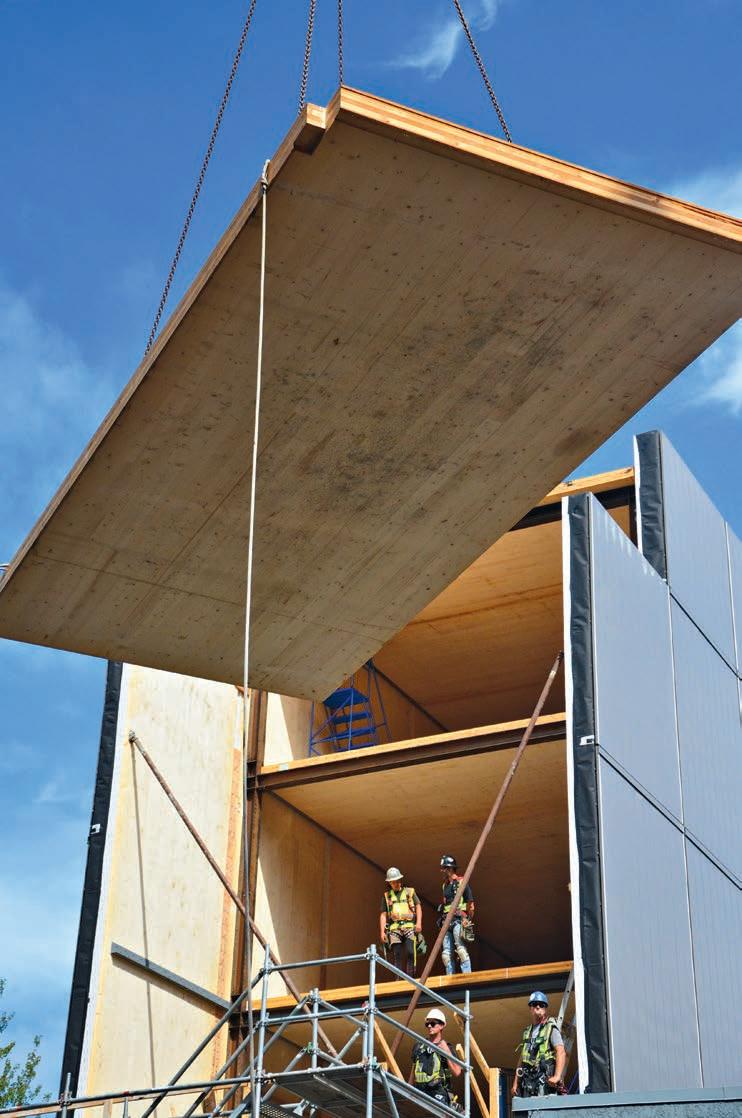
What distinguishes mass timber from conventional light wood framing is scale and precision. Instead of assembling dozens of smaller pieces on site, mass timber arrives as large structural components, often pre-cut, pre-drilled and sometimes even pre-finished. Floors, walls, shafts and even entire cores can be lifted into place in hours rather than days.
Rob Jonkman, vice-president of codes and engineering at the Canadian Wood Council (an excellence source for technical and educational information for wood construction), says
“this shift from site-built to manufactured construction can offer appealing advantages with the proper advance planning.”
THE TIMELY BENEFITS OF MASS TIMBER
Mass timber can help lessen several pressures builders are facing:
1. Increasing productivity – Switching from light wood joists to mass timber floor panels alone can shave weeks off construction schedules, allowing entire floors to be installed in a single day.
2. Lowering carbon emissions – Wood products have inherently low embodied carbon, and mass timber allows wood to be
used in building types where concrete and steel once dominated.
3. Optimizing density – Traditional wood framing is often not well suited to midrise, missing-middle and mixed-use projects.
Mass timber enables wood construction beyond six storeys and allows hybrid solutions that unlock new building forms.
PROJECTS BEST SUITED FOR MASS TIMBER
CHBA hosted a webinar in November 2025 to delve further into what builders need to know about mass timber in residential construction. Members can still watch the recording of the webinar at chba.ca/webinars. During the
Naikoon Contracting Ltd. craning in prefabricated mass timber floor panels into the structure for an office building in Vancouver.
Photo: Naikoon Contracting Ltd.
webinar, participants heard from structural engineers and sustainability specialists from the Canadian Wood Council and WoodWorks, two organizations that play a central role in advancing wood construction across Canada through technical guidance, research and code development.
Their technical insights were paired with on the ground experience from Joe Geluch, from Naikoon Contracting, a leading builder who has been an early adopter of mass timber systems for more than a decade.
The webinar emphasized that the strongest business case for mass timber today is neither single-family homes nor typical lowrise residential construction. It is multi-family, midrise and taller buildings where speed, repetition and scale can be leveraged.
Examples include six-storey residential buildings that began as light wood frame projects and incrementally introduced mass timber where builders cut weeks off their project schedules by replacing framed floors with CLT panels and by switching concrete elevator cores to mass timber (eliminating curing delays). While mass timber is an option to replace light-frame below six storeys, in taller projects exceeding six storeys, going with wood requires mass timber systems. In these cases, the conversation shifts from whether to use mass timber to how to use it intelligently, often in combination with
prefabricated envelopes and serviced floor cassettes.
THE HARD TRUTH ABOUT COST IN LOWRISE HOUSING
The message from both technical experts and builders was clear and refreshingly honest: As far as lowrise residential is concerned, mass timber is usually not cost-effective. Replacing a conventional two-by-six framed wall with a CLT wall rarely makes financial sense on its own. Light wood framing is already highly optimized, low carbon and inexpensive. In purely structural terms, mass timber often costs more. Where mass timber solutions make sense is when multiple benefits stack together, such as long cantilevers, thin floor profiles, large open spans or exposed interior finishes. When structure, finish and architectural expression are combined into a single element, the equation changes.
When Geluch showcased Naikoon’s recent mass timber projects during the CHBA webinar, he emphasized that mass timber only delivers savings if the entire project is planned differently, where design coordination, digital modelling and trade involvement must happen earlier and in greater detail – in other words, front-loading the effort. If foundations are poured and then sit idle waiting for panels, most of the benefit is lost. He emphasized that mass timber projects must be approached as
manufacturing and logistics exercises, not traditional site-built sequencing.
As an example of some of the time savings that can be achieved with proper planning, Hailey Quiquero, Structural Engineer and Technical Manager with WoodWorks noted in one case study that “Replacing concrete cores with mass timber was estimated to save approximately 48 working days by eliminating pouring and curing delays.”
Geluch explains that “you cannot assess CLT line by line. It often costs more on paper, but the real question is what schedule, quality and value benefits it delivers for the owner.”
A PRACTICAL PATH FORWARD FOR BUILDERS
For builders curious but cautious, the advice from Geluch and the team from the Canadian Wood Council and Woodworks was consistent: Start small but start intentionally. Pilot projects using mass timber floors, elevator shafts or roof panels will allow teams to learn without overcommitting. Engaging manufacturers and technical advisors early through design-assist services (for example, those offered by WoodWorks) helps optimize layouts and avoid unnecessary cost.
“Mass timber is not a silver bullet for solving affordability, but in the right building types, with the right planning, it can offer builders a tangible market advantage,” says Geluch.
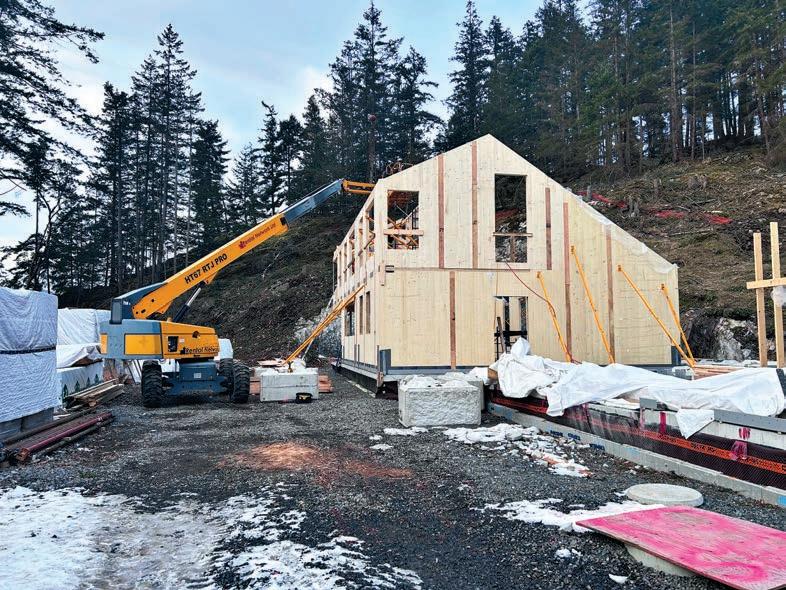
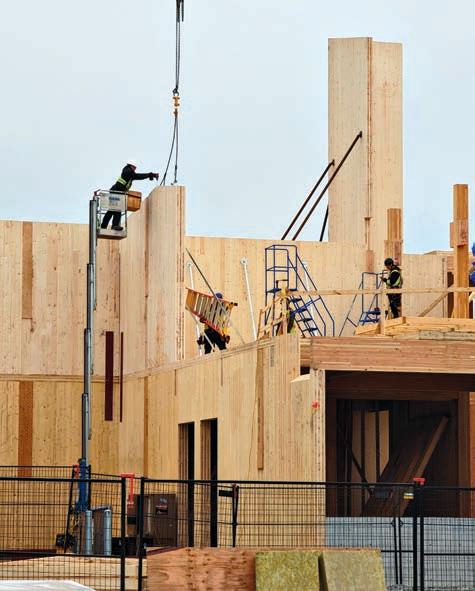
Naikoon Contracting Ltd. flying in mass timber for the superstructure on a 16,748-sq.-ft. presentation centre and public house in Squamish, BC Photo: Rob Young Productions
Photo: Naikoon Contracting Ltd.
Naikoon Contracting Ltd. erecting the CLT superstructure for a mass timber custom home on Bowen Island, BC


BEAUTITONE PAINT
BeautiTone is Home Hardware’s exclusive paint brand, located in Southwestern Ontario. With more than 45 years of trusted quality, it offers premium paints, stains and specialty paint products. State-of-the-art manufacturing, expert colour forecasting and rigorous testing ensure BeautiTone consistently delivers high-quality products to customers across Canada.
BEAUTITONE HOME HARDWARE beautitone.ca
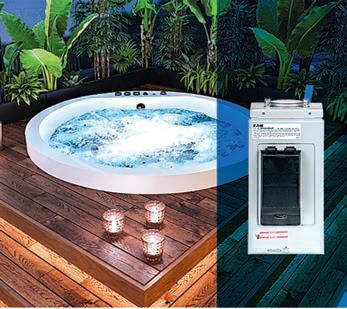
SAVE TIME AND MONEY WITH EATON’S SPA PANEL
Eaton’s spa panel features a reliable protection for spa pumps and hot tubs. They are designed to save time as our panels are prewired, offering ground fault circuit protection device and a disconnect switch in a single simple device.
EATON eatoncanada.ca

MY-EFORCE
Safety shouldn’t require hardware rollouts, IT projects or internal monitoring. myeforce deploys instantly across your team’s existing mobile devices, delivering fully managed protection backed by a 24/7 live response centre. No infrastructure and no operational burden. Just immediate, scalable safety. For more information, email sales@my-eforce.com
MY-EFORCE my-eforce.com
Building BTR Across Canada
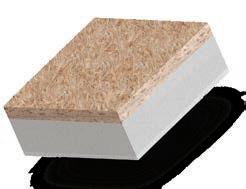
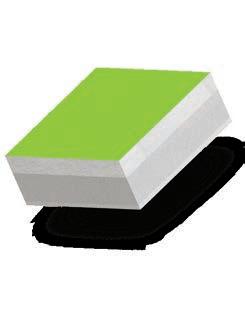
Easy to install and reduces thermal loss, BTRboard is the most cost effective way to add R-Value to homes. That’s why Jayman BUILT, Alberta’s largest builder, uses BTRboard.
• 30% better R-value than EPS per square inch
• Costs less than XPS panels
• 21% structurally stronger
• Fire & moisture retardant
• Build faster with less labour

IN CONVERSATION with
IN CONVERSATION WITH…
Natasha Paikin
DIRECTOR OF CLIENT EXPERIENCE NEW HORIZON DEVELOPMENT GROUP
BY WAYNE KARL, EDITOR, BUILDING EXCELLENCE
When Natasha Paikin entered the homebuilding industry in 2018, things were a lot different. Housing was booming and demand was explosive. A couple years later COVID hit, and the entire sector had to rethink everything. And now today, market challenges are once again forcing builders to adapt.
For Paikin, director of client experience at New Horizon Development Group in Burlington, Ont., agility and resilience are simply parts of the job. Being a woman in a leadership role in a male-dominated industry means she also faces additional challenges – but also opportunities.
Whatever the task, she takes the responsibility seriously.
WHAT IS THE FOCUS OF NEW HORIZON DEVELOPMENT GROUP THESE DAYS?
New Horizon is focused on finding creative solutions to build communities that meet the realities of today while anticipating the needs
of tomorrow. That means doubling down on attainable and sustainable housing offerings and continuing to innovate in how we deliver homes and experiences to our purchasers.

THE COMPANY’S HISTORY AS A BUILDER IS ONE FOCUSED ON SUSTAINABILITY AND GREEN TECHNOLOGIES. WHAT’S THE FUTURE THERE?
Sustainability has never been a trend for us –it’s been a core value since the beginning. We were early adopters of geothermal heating and cooling systems – building our first geothermal-supported custom home in 2008, and first geothermal-supported condominium building in 2011. We have built more than 3,000 residential units supported by geothermal in the history of New Horizon. Looking ahead, we’ve been taking the time to explore even more solutions that help homeowners reduce their environmental footprint. The
“ Sustainability has never been a trend for us – it’s been a core value since the beginning. We were early adopters of geothermal heating and cooling systems – building our first geothermal-supported custom home in 2008. ”
NEW HORIZON HAS ALSO MADE BUILDING ATTAINABLE, ENTRY-LEVEL HOUSING A PRIORITY… WHAT ARE SOME EXAMPLES OF THIS APPROACH?
We are committed to doing our part to address the affordability crisis within the housing sector. The majority of the communities we’ve designed have been specifically to give first-time buyers and young families a foothold in the market, and nearly 10 per cent of homes we’ve completed have been designated affordable sales or rentals. Most recently, we built more than 130 townhomes in Stoney Creek that were sold at below-market rates and offered, through a non-profit partnership, financing assistance to new-home buyers. On the rental front, our most recent completed building at 870 Queenston Rd. offers 20 per cent of its units as below-market, affordable rentals.
WHAT ARE SOME OF YOUR OTHER SIGNATURE PROJECTS, AND WHAT DISTINGUISHES THEM FROM OTHER OFFERINGS IN THOSE COMMUNITIES?
New Horizon’s signature project that differs significantly from our typical attainable,
entry-level housing offerings was Bridgewater Residences on the Lake in Burlington, Ont. The first of its kind in the GTA west, this project offered 151 “completely custom homes in the sky” – custom condominiums unmatched in the GTHA and attached to the Pearle Hotel and Spa. Bridgewater was a finalist for CHBA’s Best Completed Mid-/Highrise in Canada in 2024 – and later featured on the cover of Building Excellence in spring 2025. New Horizon is still incredibly proud of our team that succeeded in offering once-in-a-generation luxury condominium living – a product that is very much outside of our “bread and butter.”
THE COMPANY’S TAGLINE IS “REDEFINING EXPECTATIONS OF WHAT A HOME CAN BE.” WHAT IS THE ORIGIN OF THIS PHILOSOPHY, AND HOW IS IT EVOLVING IN THE CURRENT MARKET CONDITIONS?
This philosophy comes from our belief that a home is more than four walls – it’s a foundation – and one that provides a community – for people’s lives. From day one, New Horizon has challenged the idea that buyers must choose between affordability, sustainability and functionality.
YOU’RE DIRECTOR OF CLIENT EXPERIENCE AT NEW HORIZON… WHAT’S YOUR FAVOURITE ASPECT OF THE JOB?
I love the creativity and collaboration that is involved with working with a team to take the “blank slate” that is a piece of land, and designing a future of new homes on it. That feeling is tied with helping purchasers navigate what is often the biggest investment of their lives. Witnessing their excitement and pride on occupancy day – or hearing that they feel truly at home once theirs is complete – that’s incredibly rewarding.
HOW IS IT ALL CHANGING – AMID EVOLVING ERAS? YOU JOINED THE INDUSTRY IN A BOOMING HOUSING MARKET, FOLLOWED BY COVID AND NOW THE CHALLENGING CONDITIONS MANY IN THE INDUSTRY ARE FACING…
The last several years have completely reshaped our industry – and personally, my ability to cope with change. There has been a constant need to pivot since I joined the business in
2018. The boom years when I started brought overwhelming demand and growth – municipal approvals could not keep up and internal processes were pushed to adapt. And then, COVID-19 forced us to rethink how we communicate to, build for and support employees and homeowners. And now, today’s unprecedented market challenges in Ontario require significant resilience, creativity and a renewed focus. What hasn’t changed, in the eight years I’ve navigated significant change, is the importance of trust. New-home buyers want stability and clarity, and builders need to be adaptable and transparent to earn that trust.
WHAT’S IT LIKE WORKING IN A MALEDOMINATED INDUSTRY (NEGATIVE OR POSITIVE) AND HOW HAVE YOU NAVIGATED IT?
There are challenges, of course, but there are also tremendous opportunities. I’ve been fortunate to work with leaders who value competence and collaboration above anything else. Navigating the industry has meant learning to be confident in my skills, growing expertise and building strong relationships within the industry’s demographics. I’ve also learned that representation matters – when women see other women as leaders in the industry, it accelerates the timeline for their confidence.
YOU’RE ON CHBA’S URBAN COUNCIL AND WOMEN IN RESIDENTIAL CONSTRUCTION COUNCIL… WHAT DO YOU HOPE TO ACCOMPLISH IN THAT CAPACITY?
On Urban Council, I want to contribute to solutions that make housing more creative and attainable across the country. On the Women in Residential Construction Council, my goal is to help create pathways for women to enter, stay and advance in the industry. This includes mentorship, visibility and advocating for workplace cultures that support women at every stage of their careers.
WHAT’S THE BIGGEST CHALLENGE YOU THINK DEVELOPERS AND BUILDERS ARE FACING TODAY?
In Ontario, it is the fact that builders cannot build a home for a cost the market is able to bear. This is a convergence of years of affordability pressures, regulatory complexity and increasing costs to build. Delivering homes that
people can afford, at the pace communities need, while navigating rising costs and lengthy approval processes, is incredibly difficult. Housing starts and job losses in our sector have hit record 30-year levels – something has to change immediately to provide a solution for new-home builders, buyers trades, suppliers and their communities alike.
WHAT’S NEXT FOR NEW HORIZON?
Challenge is where the team at New Horizon thrives – I’m excited to see and share where our creativity takes us all as we continue to navigate the current industry challenges in Ontario.
And on a personal note…
WHAT OR WHO IS YOUR GREATEST INSPIRATION FOR WHAT YOU DO?
I take so much pride in seeing how a new home – one that people I admire have worked together to create – can change someone’s life. This is what motivates me to continue to be my best supporter and leader for our team.
WHEN YOU’RE NOT ON THE JOB, AWAY FROM THE OFFICE…
I am outside somewhere with family or friends. Spending time unplugged, completely present and – as a bonus – enjoying activities such as running, hiking, skiing, canoeing or swimming, in the beauty of our natural world, is so soul-filling. I am grateful for my mom who taught my sisters and me the value of simply being together – and being in the moment together.
WHAT’S ON YOUR BINGE WATCH, READING OR PODCAST LISTS THESE DAYS?
I always have to recommend the book The Obstacle is the Way by Ryan Holiday. A dear mentor and friend who has built an impressive business in our industry recommended this stoic way of thinking to me years ago, and it has changed my perspective on life and work ever since.
nhdg.ca
The latest in apps tech tools &
SOFTWARE SYSTEMS, APPS AND HIGH-TECH TOOLS ARE ASSUMING AN INCREASINGLY IMPORTANT ROLE IN STREAMLINING PROCESSES AND TASKS IN BUILD-MANAGEMENT

MANAGE COMPLEX, MULTI-PHASE BUILDS
Buildertrend is designed for:
• Builders who oversee more than five projects a year or handle complex, multi-phase builds
• Builders who want to go from six to eight figures
• Builders who won’t compromise on production deadlines
The company says its product helps builders stay on top of everything in one place, and put an end to questions such as, “Where’s that receipt? Who made the last sales call? Which projects are framing today?”
Clients want information about the status of their build. “Buildertrend gives it to them. Instead of constant emails or texts, they can see what’s happening without any extra effort from a builder’s team,” the company says. buildertrend.com
BLU – YOUR SMARTEST CREW MEMBER

SITE POSITIONING SYSTEM
The Trimble Sitework site positioning system available from SITECH is designed to streamline construction workflows. With real-time data, intuitive software and rugged hardware, the system helps crews work faster, smarter and more accurately boosting productivity across the jobsite.
Builders can connect their offices to the field with a Trimble tablet, a rugged and fully connected field computer for construction measurements and site positioning. Advanced tools streamline construction workflows by integrating design data, machine control and field operations. sitech-ec.ca
Blu is a digital building assistant powered by AI, trained on thousands of residential projects and fully integrated into a builder’s estimating and planning workflow, the company says.
Features include:
• Prepare quotes knowing you have the latest pricing from your favourite material dealer
• Build accurate estimates trained on real homebuilder data from construction pros
• Work with Blu using your own words, as you would speak to team members
The product also has a full toolbelt of helpful features:
• Assembly Assistant checks for accurate estimating on repeatable jobs
• Estimate Reviewer double-checks your estimate for common mistakes and overlooked items
• Takeoff Assistant scales and measures digital plans quickly for a faster bidding process
• Estimate Generator for creating a complete, customizable estimate from scratch buildxact.com
GENERATING CONCRETE MIX SAVINGS
SmartMix, available through Giatec Scientific, is an AI-powered platform that quantifies concrete mix savings to review and action in just a few clicks, gathering all concrete mix and performance data from plant to pour in real-time.
The platform offers a flexible and intuitive mix management platform, centralizing all your QC data for easy access and troubleshooting. With traceable changes, you can track, review and revert past mix adjustments effortlessly. It automates data flow to generate actionable insights that meet the fast-paced demands of the ready-mix industry. With 10-times greater efficiency, users can spend more time on analysis and stay ahead in a dynamic market.

LEVERAGING SOFTWARE COLLABORATION
BuildingPoint Canada helps the construction industry leverage constructible data, modelling and real-time collaboration with software, field solutions and professional services.
Part of Cansel Group, BuildingPoint Canada says it “improves productivity and profitability with solutions that blend innovation and practical features to solve construction challenges.”
Centralized data and real-time insights can help producers work more efficiently, optimize mix designs to reduce costs and carbon emissions, and make informed quality decisions. giatecscientific.
GREEN-BEAM THREE-PLANE LINE LASER
The Bosch Three-Plane Leveling and Alignment-Line Laser provides an all-in-one level and alignment solution for one-person job setup. The leveling laser generates three green-beam laser chalk lines in 360-degree laser planes – one horizontal and two vertical. With Bluetooth connectivity, users can control the setup of the laser from across the room with their smart phone and the free Bosch Leveling Remote App. The laser offers dual power technology: Bosch 12V Max Lithium-ion battery for extended runtime or with four AA alkaline batteries. The laser has a working range of up to 200 ft. diameter, and with pulse mode the range extends up to 330 ft. diameter with the optional LR8 receiver. This laser features VisiMax Technology to drive maximum line visibility, CAL Guard for calibration assurance and robust over-molded construction to withstand rainy or dusty jobsite conditions. Designed to be up to four times brighter than red laser beam for greater visibility. boschtools.com
Through its long-term partnership with Trimble, BuildingPoint says it is “dedicated to transforming the planning, design, construction and operation of buildings through advanced, accessible, intuitive technologies in Canada. The portfolio of synergistic hardware, software and service offerings – built around Trimble Connect, a cloud-based collaboration platform – streamlines communication and collaboration throughout the design-build-operate lifecycle.” buildingpoint.ca

CREATE AS-BUILT DRAWINGS
This software available from Leica Geosystems was developed for carpenters, kitchen builders, stair builders, door/window installers and metal workers. It covers the entire 2D/3D measurement process in interior construction. With the field software Leica iCON, builders can create as-built drawings including all details and then export the data for further processing in their preferred CAD software. The CAD design then allows you to programme your CNC machine and manufacture the individual components to fit precisely. This reduces the assembly effort on site to a minimum as rework is reduced to an absolute minimum. leica-geosystems.com
COMMUNITY SPIRIT

Canadian Home Builders’ Association (CHBA) members have been building, developing, and renovating Canadian homes for generations. We are sharing the extraordinary contributions CHBA members make in their communities every day through our ongoing #CdnBuilt for Generations campaign. Here are a few recent stories. To read more stories follow our hashtag or visit chba.ca/giving-back
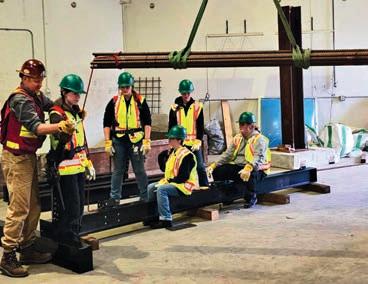

CHBA FraserValley Boot Bank helps students step into careers in residential construction
CHBA Fraser Valley (CHBA FV) found a practical way to open doors for young people looking to access careers in residential construction through its lending Boot Bank. Started after a secondary school asked for spare steel-toed boots for a field trip, the CHBA FV Boot Bank now includes about 50 pairs of donated footwear, along with safety vests and gear. With support from local partners such as Industry Workwear and JBS Equipment, the program loans boots to schools across the BC Lower Mainland so students can safely visit jobsites. Boots are also donated to students starting their careers and have supported community groups like South Fraser Women’s Services Society. By removing the cost barrier of steel-toed footwear, the CHBA FV Boot Bank helps teachers expand trades field trips, supports women exploring construction careers, and gives more young people a safe first step into Canada’s residential construction workforce.
BILD Central Alberta members collect winter gear for Red Deer’s most vulnerable
Members of BILD Central Alberta (BILD-CA) showed strong community spirit by stepping up for SPARC Red Deer’s Paint the Town Positive: Winter Warm-Up campaign. Donations collected by BILD-CA volunteers quickly filled a truck bed with mittens, toques, socks and winter gear for vulnerable residents across Central Alberta. The effort was part of a friendly challenge between local member-based associations. BILD-CA members rose to the occasion, rallying teams and networks to make a meaningful difference. By supporting the initiative, BILD-CA members demonstrated that strong communities and strong industries go hand in hand. Their generosity helped ensure local families have essential winter wear and showed how the residential construction sector in the region continues to build more than homes.

Founder of Richcraft Homes donates $20M to the Ottawa Hospital Foundation
When Kris Singhal arrived in Ottawa from Delhi with two suitcases in hand, he brought values that would shape a lifetime of community impact. In 1983, he founded Richcraft Homes, a member of Greater Ottawa Home Builders’ Association (GOHBA), building thriving neighbourhoods while giving back to local causes focused on education and healthcare. Most recently, Singhal and his family made one of the largest healthcare gifts in the city’s history, donating $20 million to The Ottawa Hospital’s Campaign to Create Tomorrow. The contribution will support a new state-of-the-art hospital health and research centre to help ensure that essential care will continue to evolve and save lives for generations. For Richcraft Homes’ generosity, a new campus building will be named in the family’s honour.





















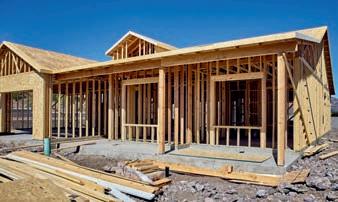



















WSBT02

2026 EXTERIOR COLOUR OF THE YEAR


Each plank painted in Bark tells its own story. From the playful knots to the subtle twists, it celebrates the joy of nature’s quirks, bringing warmth and character to your outdoor space. Bark is more than just a colour, it’s a conversation starter, a touch of woodland magic, and a nod to the perfectly imperfect beauty found in nature.