Mechanical Business January/February 2026

Page 1


Air gaps versus air breaks

Residential commissioning HVAC pros take an idea to market Employers and transparency legislation How to deal with existing equipment

Upgrade your inspection camera to General Pipe Cleaners’ new Gen-Eye Fusion™ video pipe inspection system.

• High-de nition camera

• Advanced video recorder with full HD 1080p capability

• Three ways to record – USB to Flash Drive, Internal memory recorder, or live Wi-Fi streaming

• Touch screen keyboard for titling

• Gen-Pack™ battery adapter for remote operation

• Compatible with all of General’s camera systems

Get the full picture. Call the Drain Brains at General at 800-245-6200, or visit www.drainbrain.com/fusion

33WET HEAT SUPPLEMENT

Check out the first 2026 issue of the semi-annual Wet Heat Applications & Technology. The latest products are showcased and our experts explore system design, retrofit solutions, the history of hydronics, heat exchangers, and more.

AIR GAPS VERSUS AIR BREAKS:

24QUATTRO’S CORNER

While the definitions are almost identical, the difference between an air gap and an air break is waste pipe versus water outlet.

Andrew Quattrociocchi

70

HUMAN RESOURCES

Legislative changes are challenging employers to go beyond simply paying people in the same job title the same amount.

Sue Sodek

74

PROJECT SPOTLIGHT

The Mayflower Curling Club recently celebrated the opening of its net-zero, more inclusive facility in Timberlea, NS.

28PROJECT PROFILE

Animal centre features state-of-the-art system design

Because of its multiple functions, the centre will require a system similar to systems used in hospitals and other healthcare facilities.

Carolyn Cooper

MB SPECIALISTS

20HIGH-PERFORMANCE HVAC

Residential commissioning

Tom Grochmal

As residential equipment becomes more energy efficient and offers a wider range of performance, the importance of proper commissioning is upon us.

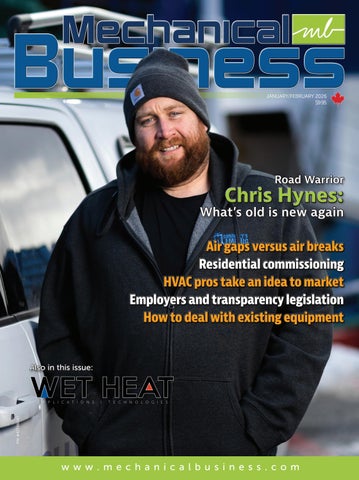
What’s old is new again

Carolyn Cooper 59JOBSITE JARGON

Test your knowledge of hydronic terminology for a chance to win a $150 gift card.

36HYDRONICS

High temp, high rewards

Matthew Reid

There are ways to hit high temperatures and still maintain high efficiencies through a bit of creative design.

60MARKETING

New year, new focus

Paul Bies

Set marketing goals before you spend a dollar.

64PLUMBING

Efficient, economical hot water

Fred Bretzke

Combination boiler/indirect heat systems for potable hot water and hot water for space heating have undergone significant improvements over the years.

Getting an idea off the ground: Lessons and best practices

HVAC pros share how they took a concept to the field.

Carolyn Cooper

How to keep electric jetters working effectively

Smaller, high-pressure machines is the next big thing in jetters.

Dave Dunbar

REFRIGERATION

Mike Squires

Mike will be returning next issue.

these

distributors

Available across Canada at these fine distributors

Available across Canada at these fine distributors

Ontario

Western Canada

Western Canada

Ontario

Western Canada

Quebec

Ontario

Ontario

Ontario

Quebec

Quebec

Quebec

Atlantic Canada

Atlantic Canada

Quebec

Atlantic Canada

Atlantic Canada

Atlantic Canada

Content Media Group Inc.

2 Campbell Dr., Suite 807 Uxbridge, ON L9P 0A3

Tel: 905.465.2919 www.mechanicalbusiness.com

January/February 2026 Issue

Published 6 times per year.

For

All

Subscription Inquiries

Circulation Director: Shila Naik, C 905-272-4175 shila.naik@mechanicalbusiness.com

Editor:

Kerry Turner, C 416-435-1193 kerry.turner@mechanicalbusiness.com

National Sales Manager: Kyle Badder, C 416-735-1375 kyle.badder@mechanicalbusiness.com

Operations Manager: Caroline Bexfield, C 647-217-2076 caroline.bexfield@mechanicalbusiness.com

Contributing Editor: Carolyn Cooper editorial@mechanicalbusiness.com

Art Direction: Fourteen Orange Graphic Design Inc. davem@fourteenorange.com

Controller: Liz Mills liz.mills@mechanicalbusiness.com

Publisher: Bruce Meacock, C 416-457-9563 bruce.meacock@mechanicalbusiness.com

PM:41536047

ISSN 1916-0674 MB (Print) ISSN 1906-0682 MB (Online)

Proudly created and printed in Canada.

We acknowledge the support of the Government of Canada.

Submissions: Copyright in material submitted to the magazine and accepted for publication remains with the author, but Mechanical Business and its licensees may freely reproduce it in print, electronic or other forms. Mechanical Business also reserves the right to edit said submitted materials to suit the editorial needs and mandate of the publication.

Notice: Mechanical Business is published for owners, managers and decision makers with mechanical contracting firms and the sector’s supply chain partners in Canada. While every effort is made to ensure the accuracy of the information, Mechanical Business, Content Media Group Inc., its staff, directors, officers and shareholders (‘The Publisher’) assume no liability, obligation or responsibility for advertised claims, for errors and/or omissions, or for the results obtained from the use of this information. Manufacturers’ instructions take precedence over published editorial. The publisher reserves the right to publish a printed correction in a subsequent issue for editorial errors, omissions and oversights. Subscriptions are available for $90 plus taxes in Canada and the U.S. Single copies are $15.00. Outside Canada and the U.S., the rates are $150.00 (annual) and $25.00 (single copy).

© Copyright 2026. The contents of this magazine may not be reproduced in any manner without prior written permission of the publisher. Proud members of:

CONDITIONS IN CANADA 20 25

WORTH A LOOK

Businesses continue to face cost-related obstacles

A Statistics Canada survey reveals business owners anticipate facing more cost- and labour-related obstacles into this year. The Canadian Survey on Business Conditions surveyed businesses between October and November 2025 and found that 41.1 per cent of respondents expect inflation to continue being an obstacle, while 26.4 per cent anticipate having a problem recruiting skilled employees. That number jumps to 33.2 per cent for construction businesses.

Seven per cent of businesses identified the cost of inputs to be their most challenging expected obstacle. Meanwhile, prices for raw materials increased 5.8 per cent year-over-year in October, while national hourly wages have increased 3.5 per cent year-over-year. And 39.3 per cent of businesses expect their average wages to increase within the next year due to inflation and in order to retain employees. Tariffs are also increasing costs, with 39.9 per cent of businesses saying they are very likely or somewhat likely to pass cost increases due to tariffs onto customers over the next year.

Despite the obstacles, 66.3 per cent of businesses surveyed say they are very or somewhat optimistic about their outlook over the next 12 months. Many of these companies say they have changed their marketing in the previous six months to promote Canadian products, with 22.2 per cent of manufacturers reporting an increase in sales of Canadian products.

The purpose of this quarterly survey is to collect information on business expectations and conditions in Canada as well as emerging issues. These data are crucial in helping governments, chambers of commerce and business associations across Canada devise strategies, policies and mechanisms in support businesses in Canada.

statcan.gc.ca

EASY

FIELD-LEVEL

CONVERSION

FOR MULTIPLE LIGHT

DUTY APPLICATIONS

Flexible design for a variety of light duty applications.

208/240/480 Voltages available on all models

30 to 119-Gallon models available in 3kW-12 kW, tall and short

Factory shipped in simultaneous configuration

3 Year Limited Warranty, upgradeable to 5 Years

To learn more, visit Rheem.ca

2025 National Model Codes now available

The 2025 Canada National Model Codes were released in late December 2025 by the Canadian Board for Harmonized Construction Codes (CBHCC) and the National Research Council Canada (NRC). The CBHCC has also released a page highlighting significant technical changes to all of the national codes. Key updates focus on climate change resilience (using future climate data), enhanced accessibility, mass timber use, radon mitigation, and harmonized requirements across Canada. The National Code Models include the National Building Code of Canada, the National Energy Code of Canada for Buildings, the National Fire Code of Canada, and the National Farm Building Code of Canada. cbhcc-cchcc.ca nrc.canada.ca

Beware of counterfeit refrigerants

Environment and Climate Change Canada (ECCC) has issued an information bulletin warning HVAC technicians, service providers, and refrigerant importers that cylinders of counterfeit refrigerants falsely labelled as R-410A have been found in Canada. Instead of the R-410A blend, the cylinders contain a mixture of R-40 (methyl chloride, or chloromethane) and hydrofluorocarbons (HFCs). R-40 is used as a counterfeit refrigerant because it is cheaper to produce than HFCs and it can resemble genuine refrigerants in HVAC systems. However, even brief exposure to R-40 can have a significant impact on human health. It is also flammable and corrosive to aluminum and plastic, impacting equipment and generating reactive and toxic compounds. According to ECCC, counterfeit refrigerants often have generic or unusual labelling, seals or logos; packaging without a manufacturer's name or safety warnings and are in non-refillable cylinders; and may be priced significantly below average market value. If you suspect counterfeit refrigerants contact the ECCC at enviroinfo@ec.gc.ca or (819) 938-4228. canada.ca

Vancouver now permits press-connect fittings

The City of Vancouver will now permit the use of pressconnect fittings to join piping in a stainless steel or copper water distribution system. According to the BC Building Code Interpretation Committee, in an Interpretation File No. 24-0116, regarding the BC Building Code 2024, Book II: Plumbing Systems, and BC Building Code Book I: General, press-connect fittings are permitted by Part 7 of the Vancouver Building By-law 2025, under Article 7.1.5.2. A code change proposal relating to press-connect fittings is currently being considered by the Standing Committee on HVAC and Plumbing, but hasn't been adopted into the National Plumbing Code.

vancouver.ca

New leak assessment program for facilities in Manitoba

Efficiency Manitoba has launched the Leak Assessment and Repair Program for industrial, commercial and agricultural facilities in Manitoba that use large amounts of energy for compressed air, or operate large steam boilers and distribution systems with many steam traps. Pre-qualified service providers visit participating facilities and identify leaks, quantify the benefits and help access incentives. Efficiency Manitoba covers 50 per cent of the cost of a leak assessment and provides incentives to fix the leaks – $100 per repaired compressed air leak and $150 per steam trap leaks. Customers can participate in the program annually to identify and fix new leaks.

efficiencymb.ca

Energy Efficiency Act to receive updates

The federal government has introduced amendments in the Senate to modernize the Energy Efficiency Act. The amendments will ensure the Act keeps pace with technological innovations in the way energy is used and managed. The updates will expand the legislation to: include online sales and digital labels; bring it in line with other modern legislation, including making it nimbler with targeted compliance options; and make the regulatory process faster and more cost-effective with new mechanisms that streamline government processes. natural-resources.canada.ca

Packaging from counterfeit refrigerants falsely labelled as R-410A found in Canada.

ALL-CLIMATE COMFORT.

The Daikin FIT AURORA inverter heat pump —named after the dazzling natural light that appears at Earth’s magnetic poles — symbolizes performance at the outermost extremes. From harsh winters to intense summers, the FIT AURORA is engineered to deliver majestic comfort and e ciency all year round.

Features and benefits:

technology Low-GWP R-32

1380 Demand Response Compatible Intelligent defrost mode Dual Fuel Applications

capacity up to

and heating down to -20°F

Daikin

CPI Benchmarking Study provides baseline for plastic waste in construction industry

Light House has released the Construction Plastics Initiative (CPI) Benchmarking Study, which highlights opportunities and gaps in the pathway to a circular economy for plastic waste in the Canadian construction industry. This is the first national study evaluating plastics in Canadian construction projects at scale. It is based on analysis of diversion data from 253 LEED certified projects in seven provinces, and reveals that plastic waste from construction has been under tracked and managed. The study also notes reporting systems rarely separate plastics by material type, making benchmarking progress difficult. Recommendations include the need for standardized tracking, and industry-wide best practices. It also points out opportunities for increased waste diversion, as approximately 80 per cent of construction plastics are clean packaging and readily divertible. Canada’s Federal Plastics Registry is expanding in 2026 to include construction plastics, meaning companies that supply or use building materials will be required to report how much plastic they produce, recycle and dispose of. light-house.org

Changes to Nova Scotia’s Workers’ Compensation Act

Nova Scotia’s Workers’ Compensation Act (Bill 144) has been amended to modernize the system, expand protections, and streamline the process. The changes include: allowing workers 90 days to appeal a claim decision, up from 30 days; extending death benefits to dependent adult children or other dependents; updating definitions of spouse to include common-law partners and same-sex spouses; including transportation costs as part of medical aid claims; increasing the cost-of-living adjustment for benefits from 50 to 100 per cent of the CPI, up to three per cent annually; and giving workers better access to return-to-work information. Most of the changes were effective January 1, 2026, while changes such as cost-of-living indexing are effective in 2027. Employer rates will also be reduced in 2027, with more details to come this year.

novascotia.ca

Manitoba eliminates sick note requirements

Manitoba has introduced Bill 202 The Employment Standards Code Amendment Act. Under the Act, employers are prohibited from requiring a sick note from an employee who has been away from work for seven consecutive days unless the employee has taken more than seven days of sick leave in the preceding 12 months, or there is a noticeable pattern to the employees’ absences that creates doubt the absences are due to injury or illness. When sick notes are required, they can be provided by a doctor, nurse, nurse practitioner, or pharmacist. Employers must reimburse the employee for any fee to obtain the sick note if the employee has not shown a pattern of absences. Saskatchewan, BC, and Nova Scotia only require sick notes for absences of more than five days, while Quebec and Ontario require them after three days. According to the Canadian Medical Association, sick notes for short-term minor illnesses place unnecessary burdens on the healthcare system. web2.gov.mb.ca

BC introduces job-protected medical leave

The Government of BC has introduced amendments to its Employment Standards Act to allow workers with a serious illness or injury to take up to 27 weeks of unpaid, jobprotected leave within a 12-month period. It will protect workers who are covered by the Act who are unable to work for at least seven consecutive days due to serious illness or injury. Workers must present a medical certificate from a medical doctor or nurse practitioner to be eligible, and employers must ensure workers can access their unpaid, job-protected leave. The amendments also bring BC’s protections to the standard of other jurisdictions in Canada, and complements financial supports available through the Employment Insurance Sickness Benefits program. The Employment Standards Branch offers a resource guide outlining the leave program. 2.gov.bc.ca

Manitoba’s Bill 202 The Employment Standards Code Amendment Act eliminates requirements for sick notes for short-term employee absences.

HEAT UP THIS SEASON

Skills Ontario grows its mobile tech training program

Skills Ontario has expanded its Trades & Tech Truck Program with the addition of two trucks, growing its fleet from four to six mobile training units. The trucks are designed to inspire Ontario youth to explore a career in the skilled trades by providing interactive experience through VR learning, simulators, and hands-on stations. They travel the province year-round supporting schools, camps and community-based programming. The new trucks will allow Skills Ontario to offer training to an additional 75,000 Ontario youth. Funding for the new trucks, which are expected by August 2026, comes through a $2.6-million investment by the Ontario government.

skillsontario.com

Mobile refrigeration allows Florida to host outdoor NHL game

Initiative helps workers access harm reduction services

The Tailgate Toolkit Project is a program introduced by the Vancouver Island Construction Association (VICA) designed to educate employers and workers in the construction sector about the harm reduction resources available to them. The initiative is a response to the fact that men in trades are overrepresented in the number of illicit drug poisoning deaths in BC. By offering tools to encourage discussions around substance use, mental health and pain management, the program hopes to create a safer, healthier industry. Free resource guides available at thetailgatetoolkit.ca include region-specific information on mental health services, overdose prevention sites, chronic pain resources, and more. The program also offers onsite and virtual toolbox talks, supervisory training, and an industry support group. The program is currently only available in BC and Calgary, AB, but VICA hopes to expand it to other provinces. Funding for the program comes from the ministry of mental health & addictions, the Canadian Mental Health Association (BC Division), and the Community Action Initiative. vicabc.ca

The 2026 Discover NHL Winter Classic took place January 2 in Miami, FL between the Florida Panthers and the New York Rangers, with the help of two mobile refrigeration units. Creating the outdoor rink usually requires just one mobile refrigeration unit, but Miami’s sunny, hot weather meant extra refrigeration power was necessary. The NHL has staged 43 outdoor games, generally in temperatures between -21 and 18°C. Construction of the ice rink began two weeks before the game at baseball stadium loanDepot park, which has a retractable roof to protect the ice as it was being built. Workers began by putting decking around the rink to protect the synthetic turf, and then built a laser-levelled stage deck with 253 aluminum pans in three rows on top of it. Piping was then laid from the pans to the mobile refrigeration units. The mobile refrigeration units pumped glycol through the pans and pulled heat from the surface, while sprayed layers of mist on top of the pans created a sheet of ice, helped by the air conditioning inside the stadium. The game took place at night, with the stadium roof and glass panels open. nhl.com

Assistance for businesses looking to sell to the government

Public Services and Procurement Canada (PSPC) is offering resources, workshops and personalized support through Procurement Assistance Canada for smaller businesses interested in accessing federal opportunities. Among other services, PSPC offers a list of tender opportunities for federal, provincial and territorial governments, help for Indigenous entrepreneurs accessing and competing for contracts, and information on global procurement pathways. It also offers online education sessions.

canada.ca

Construction of the outdoor ice rink in Florida required two mobile refrigeration units.
Ontario Premier Doug Ford tours a mobile learning unit during Skills Ontario’s LevelUp! Career Fair in Toronto.

Movers & Shakers

Watts purchases Superior Boiler

Watts Water Technologies, Inc. has completed its acquisition of Superior Boiler. Hutchinson, KS-based Superior Boiler manufactures customized steam and hot water boilers and related equipment for commercial, institutional and industrial applications, including firetube, watertube and condensing boilers. superiorboiler.com watts.ca

Duravit opens Quebec manufacturing facility

Ariston Group announces plans to purchase Riello

Ariston Group has announced plans to purchase Carrier Global Corporation’s Riello business. Legnago, Italy-based Riello manufactures HVAC/R equipment, including burners. The company became part of Carrier in 2020. The acquisition is expected to close in the first half of 2026.

aristongroup.com corporate.carrier.com riello.com

Fujitsu General is now GENERAL Inc.

Fujitsu General has changed its trade name to GENERAL Inc., effective January 1, 2026, and introduced a new corporate brand symbol. The names of the company’s domestic and overseas consolidated subsidiaries have also changed, including Fujitsu General America, Inc., which is now known as GENERAL HVAC Solutions America, Inc. The change was initially announced in October 2025, and commemorates the company’s 90th anniversary in 2026, and its new chapter as a member of the Paloma Rheem Group. It has also introduced a new slogan, “Creating a Life Conditioner. generalww.com

Duravit has opened its ceramic plant in Matane, QC, its first North American manufacturing facility. The facility is one of the first plants in the world to fire sanitary ceramics with electric kilns powered almost entirely by renewable hydroelectric power. The 35,000-sq. m plant will produce up to 450,000 toilets, sinks and ceramic pieces annually, and will achieve full capacity by 2027.

duravit.com

Copeland acquires SPH Sustainable Process Heat

Copeland has completed its acquisition of Overath, Germanybased SPH Sustainable Process Heat Gmbh (SPH), a manufacturer of heat pump technology for industrial steam applications. The acquisition will expand Copeland’s Vilter industrial heating portfolio. Cheltenham, UK-based Spirax Group continues to maintain a minority share of SPH, and will broaden SPH’s sales channels by marketing its heat pump solutions through its direct sales channel.

copeland.com spheat.de

Mestek and BioTherm partner to target the greenhouse market

Mestek, Inc. has announced a strategic partnership with BioTherm Solutions to bring Sterling HVAC and RBI branded products to the greenhouse, indoor farm, and controlled environment agriculture market. Cotati, CA-based BioTherm produces greenhouse climate technology, including packaged hydronic heating systems. The systems include RBI high-efficiency boilers and water heaters and Sterling HVAC’s Agricultural Series unit heaters.

biothermsolutions.com mestek.com

Duravit’s new Matane, QC ceramics manufacturing facility.

Robotics company opens new homebuilding facility in Calgary

AI and robotics provider Promise Robotics has begun full-scale production at its homebuilding facility in Calgary, AB.

The 60,000+sq. ft. facility is designed to produce prefabricated homes in just a few weeks, marking a turning point for scalable, industrialized homebuilding in Canada with the use of construction AI and robotics. The Factory-as-a-Service platform is designed to support large developers, and small- to mid-sized builders, and has already been used by builders such as Mattamy Homes Alberta Division, with whom Promise Robotics has a multiyear strategic commercial partnership. The company also has a manufacturing facility in Edmonton, AB. promiserobotics.com

A. O. Smith purchases Leonard Valve Company

A. O. Smith Corporation has acquired Cranston, RI-based LVC Holdco (Leonard Valve). The acquisition will expand A. O. Smith’s presence in the water management market, and complements its core water heater and boiler business. aosmith.com leonardvalve.com

Milwaukee Tool to open Service Hub in Georgina, ON

Milwaukee Tool’s 54,000-sq. ft Service Hub in the Keswick Business Park in Georgina, ON will consolidate logistics, manufacturing and service operations from multiple facilities into one site. Plans are to have the Service Hub fully operational by 2026 Q4. The company is also preparing to launch its first Canadian distribution centre in 2026 to improve shipment times for Canadian customers.

milwaukeetool.ca

CE Canada opens new headquarters, partners with Kerr Controls

NEXT Supply opens Bramalea, ON location

NEXT Plumbing and Hydronics Supply has opened a new branch at 835 Intermodal Drive in Bramalea, a suburb of Brampton, ON. The company already has a distribution centre in Brampton at 98 Rutherford Rd. South. The new location adds more than 50,000 sq. feet of warehouse space as well as a customer pick-up counter. nextsupply.ca

Carrier Enterprise (CE) Canada has moved its headquarters, including distribution centre and wholesale parts store, to 30 Resolution Drive in Brampton, ON. The new facility has a larger wholesale branch, and more than 116,0000-sq. ft. of combined warehouse and office space. The warehouse has 24 bay doors and one drive-in door. In other news, CE Canada has announced an HVAC/R exclusive distribution agreement with Kerr Controls in Atlantic Canada for Carrier’s residential and commercial products. CE Canada is a joint venture between Watsco, Inc. and Carrier Corporation, with 34 wholesale branches and four distribution centres across Canada.

carrierenterprise.com kerrcontrols.ca

Georgina Mayor Margaret Quirk (centre left), Councillor Dave Neeson (centre backrow), Councillor Dan Fellini (fourth from left), and members of the Economic Development Advisory Committee welcome Milwaukee Tool representatives to Georgina.

Movers & Shakers

Jones Goodridge relocates HQ

Jones Goodridge has moved its head office to 220-79 Eagle Drive, in Winnipeg, MB. The company is a manufacturers’ agent for the plumbing and heating industry, including the residential, commercial and luxury product markets, in Canada’s mid-west. Jones Goodridge also has offices in Saskatoon and Regina, SK. jonesgoodridge.com

AD Canada partners with Reznor

AD Plumbing & Heating – Canada has added Reznor as a new supplier partner. Reznor offers industrial and commercial HVAC solutions, including gas, electric and hydronic unit heaters. Mississauga, ON-based Affiliated Distributors (AD) Canada is the Canadian business unit of Affiliated Distributors (AD), a member-owned organization that supports independent distributors and supplier partners. adhq.com

Windfields Mechanical now distributes MagneGrip products

Oshawa, ON-based Windfields Mechanical Group Inc. is now an authorized distributor in Ontario for MagneGrip vehicle exhaust removal systems and air purification solutions. Cincinnati, OH-based MagneGrip manufactures exhaust removal systems for applications such as firehouses and vehicle maintenance facilities, including Exhaust Removal Systems, AirHAWK Air Purification Systems, and HazVent Pneumatic Systems.

magnegrip.com windfieldsmechanical.ca

Kerr Controls partners with LG

Kerr Controls is now an authorized LG distributor, selling LG Air Solutions at its Atlantic branches. The partnership has included in-person training sessions with LG on the LG ducted and ductless residential lines Kerr now offers. Truro, NS-based Kerr Controls has 10 branches in Atlantic Canada. The company also has three branches in Ontario under the Kerr Smart Energy brand. kerrcontrols.ca lg.com

Daikin establishes R&D lab, expands data centre portfolio

Daikin Applied Americas is investing $163 million to establish a research and development test lab at its headquarters in Plymouth, MN. The 71,000-sq. ft. lab will advance HVAC product innovation, including research in chillers, air handlers, heat pumps, and hyperscale data centre cooling technologies. Phased commissioning of nine test cells has already begun, with completion of the facility expected in 2027. Daikin Applied also recently purchased Chilldyne, Inc. a Carlsbad, CA-based manufacturer of negative pressure liquid cooling systems for highperformance and AI data centres. Chilldyne’s liquid cooling technology will be integrated with DDC Solutions’ (acquired by Daikin Applied in August 2025) modular high-density cooling cabinets for cooling high-density rack environments. In addition, Daikin Applied has acquired the exclusive licence to Sorbent Ventilation Technology (SVT) from enVerid Systems, Inc., giving the company the right to manufacture, sell and distribute the air-cleaning technology in North America.

chilldyne.com daikinapplied.com enverid.com

New plumbing business launches in Ontario

Oakville, ON-based Legent Home Products Ltd. is a new Canadian company led by Peter Riley, former president of Unique Appliances Ltd. Legent manufactures a three-in. drain water heat recovery device, the LHP-338-PEX, which is now stocked in plumbing wholesalers in Ontario. The device complies with CSA B55.2.20 and CSA B55.1.20. legenthomeproducts.com

Have a look on page 68

The 71,000-sq. ft. R&D lab at Daikin Applied’s Plymouth, MN headquarters will advance HVAC product innovation and hyperscale data centre cooling technologies.

People in the news

Ilce Kostovski has joined Ontor Ltd.’s Canadian technical services team, supporting Aspen Manufacturing products across Canada.

Rheem Canada Ltd. has hired Gabriel Finn as national technical trainer, based in Calgary, AB.

Guelph, ON-based Building Knowledge Canada has announced changes to its leadership team: Derek Cheung (1) has joined the company as operations manager; Mehmet Ferdiner (2) has been named senior project manager, business development lead; and Kevin O’Donnell (3) is now senior project manager, operations lead. In their new roles, Ferdiner will help drive growth and client engagement, while O’Donnell will champion operational efficiency and mentoring across the team.

Systemair Group has hired Robert Larsson as president and CEO. Skinnskatteberg, Sweden-based Systemair Group is a ventilation manufacturer, with business in 51 countries.

AAON, Inc. has promoted Doug Wichman (1) to executive vice president and general manager of its AAON Business Unit. He succeeds COO Stephen Wakefield (2), who has moved to a consultancy role as an AAON fellow and principal engineering advisor.

Amherst, NS-based Harris Atlantic Sales Ltd. has hired Landen Clarke as outside sales representative for Atlantic Canada.

Justin Chep (1) has been appointed account manager at Bartle & Gibson, while Robert Oddie (2) has been named territory manager, both based in Calgary, AB. Chep joined the company in October 2021 as electrical sales and lighting specialist. Oddie has been with the company since 2010, and most recently held the position of sales manager.

Ryan vanDyk has been promoted to OEM business unit leader – air and water solutions, at GE Appliances, a Haier company. VanDyk joined the company in November 2023 as senior director pro channel – air and water solutions. He previously worked for GE Appliances from 2018 to 2022.

Wolseley Canada Inc. has announced two employee promotions: Ryan Hunt (1) has been named HVAC/R strategy manager, Ontario; and Steve Roetsch (2) has been named HVAC strategy manager, West. Hunt has been with Wolseley since 2013, most recently as Ontario dealer development manager. Roetsch joined the company in 2020, and was HVAC sales manager, Western Canada. Wolseley has also hired Julian Molina (3) as inside sales trainee, based in Sudbury, ON.

Copeland has promoted Luciano Di Biase (1) to manager, technical services, based in Brantford, ON. Di Biase has been with the company since June 2017 as HVAC/R training specialist. The company has also named Nikita Simpson (2) senior manager, human resources, providing HR leadership across Canada. Simpson has been with Copeland (formerly Emerson Canada) since 2015, and was most recently human resources manager.

Refrigerative Supply Ltd. (RSL) has hired Raymond Winger as residential territory manager supporting Langley, Abbotsford and surrounding areas in BC.

Bill Davis has joined The Master Group as vice president, Western Canada. Davis is based in Vancouver, BC.

Calgary, AB-based James Electric Motor Services Ltd. has hired three new employees: Norman Dupuis (1) has joined the company as service manager; Amanda Glynn (2) joins as HSE (Health, Safety and Environment) coordinator; and Trish Varze (3) joins as field service coordinator.

Vellinge, Sweden-based SAMON has hired Ryan Vanos as sales manager for North America. SAMON develops and manufactures refrigerant leak detection devices.

Richmond Hill, ON-based Designtest & Balance Co. Ltd. has promoted Arjun Sahota to operations manager. Sahota has been with the company since 2016 as TAB technician.

Smardt Chiller Group has hired Mihai Mihai as specification engineer specialist – Western Americas, based in Calgary, AB.

ThermOmegaTechhasannouncedchanges withinitscommercialplumbingdivision: DanielKovacisnowcommercialplumbing businessunitmanager,andJosueVazquez isnowcommercialplumbingnationalsales manager.Kovacwillberesponsibleforsales performance,profitabilityandthestrategic directionofthedivision.

To have your company’s personnel announcements included, free of charge, in an upcoming edition of Mechanical Business, simply send a note and a few details, to kerry.turner@mechanicalbusiness.com.

up to Date

RESIDENTIAL COMMISSIONING

HVAC commissioning has been an important staple for commercial building systems for many years. Building owners want to ensure they are getting everything they paid for from the equipment they purchased and the contractor who installed it. As residential equipment becomes more energy efficient and promises a wider range of performance, the importance of proper commissioning is now upon us. If you are a professional contractor who wants to sell premium equipment that avoids callbacks, delights customers and earns higher margins, then read on.

As contractors, you should have commissioning procedures technicians follow to document the performance of the system when installation is complete.

Commissioning requires a different skillset

Setting up a furnace, heat pump or energy recovery ventilator (ERV) requires a detailed understanding of the equipment – not only how it works but the acceptable ranges of temperature, pressure and airflow when operating. Technicians need to know, for example: the proper air flow required by the system to support heating and cooling requirements; the acceptable temperature rise across a heat exchanger; and acceptable superheat and subcooling based on environmental conditions.

Commissioning is a quality assurance process

High-performance equipment, which promises greater efficiency and a wider range of comfort compared to the lower cost option, requires a highperformance installation. In addition to proper alignment, fit up, and hook ups, a high-performance installation requires proper commissioning: setting up and verifying that the equipment operates as intended, to the specifications of the equipment manufacturer. If the system is not operating within the tolerances set forth by the equipment manufacturer, then performance claims are not likely to materialize, resulting in disappointed customers, shorter equipment life, and call backs when equipment fails prematurely.

Technicians require the use of tools to measure thermodynamic quantities.

To perform these procedures at the end of an installation, technicians require the use of tools to measure thermodynamic quantities − temperature, pressure, and flow – so they can assess whether equipment is operating at

Tom Grochmal

its peak efficiency. Technicians also need to dedicate the time – 30 minutes to an hour – to do the job properly. This boils down to proper training, tools and time. Because of these additional requirements, it is a challenge for many contractors to fully equip installation teams to verify each installation. It may mean bringing in an experienced service technician who is better versed in equipment operation and maintenance.

Tom Grochmal, PhD, P.Eng. is founder and CEO of Trim Tab Energy Retrofits (trimtabretrofits.com), an energy contractor with a mission to renew housing and inspire better living.

Photo
Yellow Jacket

Serious long-term risks

Another challenge with commissioning is the consequences of not doing it aren’t felt until weeks or months (or even years) later. Here are some serious issues that can result over the course of time from not properly commissioning an HVAC system:

1. Improperly charged refrigeration lines in a heat pump can result in a reduction in cold weather performance. If improper charging causes liquid refrigerant to enter the compressor, this will result in premature failure.

2. Indoor coil freeze offs from improper air flow or refrigeration line charging, leading to reduced efficiency, call backs and downtime.

3. Lack of fresh air entering the building because an ERV is not mechanically balanced, causing a negative pressure, thereby increasing the infiltration of cold air and, potentially, radon.

Equipment features to reduce the burden

Many equipment manufacturers, to head off warranty issues, will incorporate features to reduce the burden on installing contractors for commissioning. This is an important consideration for contractors when sourcing equipment and selling to customers. I’ll highlight an example with ERVs.

My company, Trim Tab, works in the social housing space, where indoor air quality (IAQ) can be a serious problem. Many of our retrofit projects centre around envelope air sealing and proper ventilation. In these situations, ERVs are installed not as a code requirement, but as a necessary component to improving IAQ. An ERV is intended to introduce a steady stream of fresh air into the home, while exhausting an equal amount, thereby making it balanced. However, an ERV is balanced if, and only if, it is commissioned that way. Traditionally, this commissioning process requires pressure measurement, chart look-ups and damper adjustments to ensure there are adequate and balanced air streams.

Several manufacturers of heat and energy recovery ventilators, such as Panasonic and Venmar (pictured above), now incorporate autobalancing control, which eliminates the need for technicians to complete a balancing procedure as part of the installation. The display in the photo shows the real-time CFM readings for the supply and exhaust air flow streams, and dual ECM motors keep the air flows equal, even in changing environmental conditions.

Manufacturers now offer autobalancing as a feature on their ERVs. I believe this is an absolute game changer for this type of equipment. They are built with two modulating fans (one for each air stream) that continually adjust fan speed to dial in precise and balanced air flows, even if conditions change, such as dirt build up on the fresh air filter. It eliminates the need for the balancing process, and the guaranteed performance and time savings justifies the incremental cost of the equipment.

Streamline the process

Given the complexities of commissioning advanced equipment, tools that guide the process and confirm it is being done right are very useful. One example is measureQuick, software that wirelessly connects with an array of smart tools such as refrigerant gauges and temperature probes to streamline HVAC routines such as diagnostics, maintenance and commissioning.

For critical commissioning tasks such as properly charging and setting the correct airflow on an

Using specialized apps, which retrieve information from smart tools, technicians can receive accurate and real-time feedback to guide fan speed adjustments and refrigerant charging.

HVAC system, a tool such as measureQuick streamlines the process by analyzing the data it receives from the smart tools. The app will issue a set of “vitals,” indicating if refrigerant charge, heat transfer, and air distribution are in the right range. At the end, it produces a report that serves as a baseline for future maintenance and repair, and gives assurance to the owner that the system was set up properly, with the measurements to prove it. It can be a great tool for building trust with customers, and reducing call backs.

Takeaways

1. Commissioning is the process of setting up and verifying equipment operates as intended, to the specifications of the equipment manufacturer. Performance claims will not materialize, and call-backs are more likely, if the system is not properly set up.

2. Commissioning is the final step in the installation process and requires technicians to have the time, measurement tools, and training to do the job properly.

3. There are industry associations that offer courses on the proper commissioning of residential HVAC systems.

4. Understand the commissioning requirements of the equipment in your product line up, including checklists that must be followed. Some manufacturers offer features to reduce the burden on contractors.

5. Software tools are available that aid the process to ensure it is done right.

Smart measurement tools are a critical part of the commissioning process.

In a future article, I will discuss this topic in the context of commercial building HVAC systems.

QUATTRO’S CORNER

AIR GAPS VERSUS AIR BREAKS: DO YOU KNOW THE DIFFERENCE?

Hey readers − thanks for landing here for this edition of Quattro’s Corner. With the recent release of the 2024 Ontario Building Code (OBC) I thought it would be easiest to address something that has not changed. The requirements for air gap and air break remain the same in the new edition of the OBC. As always, definitions play a vital role in understanding the difference between the two.

Air break means the unobstructed vertical distance between the lowest point of an indirectly connected waste pipe and the flood level rim of the fixture into which it discharges.

Air gap means the unobstructed vertical distance through air between the lowest point of a water supply outlet and the flood level rim of the fixture or device into which the outlet discharges.

Notice that the definitions are almost identical. The difference is waste pipe versus water outlet. When I teach the Ontario Building Officials Association Plumbing All Buildings course, I always ask the class this question: How many people saw an air gap this morning? So, I now ask you the reader: Did you see an air gap this morning? We all did. Morning routines hopefully include brushing your teeth. If you didn’t brush your teeth, gross, stop reading this and go brush them. That faucet you turned on this morning was the perfect example of an air gap. I hope the next portion of this article helps you understand the requirements and differences between the two.

UNDERSTANDING AIR GAPS AND AIR BREAKS IN THE ONTARIO BUILDING CODE

In plumbing and construction, ensuring the safe and effective delivery of potable water while preventing contamination is of paramount importance. Two critical concepts in this regard are air gaps and air breaks. While both are designed to protect water systems from contamination, they serve different purposes and are regulated by specific guidelines within the OBC.

Andrew Quattrociocchi is the chief building official for the Township of King in Ontario, creator of Quattro’s Corner, and author of the Photographic Code and Guide through Orderline. He is a plumbing instructor for the Ontario Building Officials Association, and a licensed plumber with over 24 years experience.

An air gap to the top of the sink provides an unobstructed vertical space.

WHAT IS AN AIR GAP?

An air gap is a physical separation between a water supply outlet and the highest possible water level in a fixture or container that could receive water. The key feature of an air gap is that it provides an unobstructed vertical space, ensuring there is no possibility of backflow, a condition where contaminated water could flow back into the clean water supply system.

Key Characteristics:

Physical separation: The air gap is typically measured from the water outlet such as a faucet to the flood level rim of the receiving fixture – a sink or basin for example.

2

Backflow prevention: Because there is no direct connection between the water supply and the receiving fixture, the air gap serves as a simple and highly effective method of preventing backflow.

Your Trusted Mechanical Piping Partner Since 1850

For over 170 years, Flocor has been the name professionals trust for quality, reliability, and innovation in mechanical piping. Proudly Canadian-owned and operated, we continue to deliver a full spectrum of solutions tailored to your needs. Flocor – Your Complete PVF Solution.

Experience excellence. Experience Flocor.

Flocor

Minimum height requirement: The OBC specifies the minimum height of an air gap, typically at least twice the diameter of the water supply pipe but no less than 25 mm (1 in.).

Code requirements

7.6.2.9. Air Gap

(1) An air gap shall not be located in a noxious environment.

(2) Every air gap shall be not less than 25 mm high and at least twice the diameter of the opening of the water supply outlet in height.

WHAT IS AN AIR BREAK?

An air break is an indirect connection between a drainage system and a fixture or appliance. Unlike an air gap, an air break is not a complete physical separation. Instead, it allows wastewater to drain freely without creating a direct connection to the drainage system. This method is often used in situations where a complete air gap is not feasible.

Key Characteristics:

Indirect connection:

An air break allows wastewater to flow into a fixture’s drain, which is then connected to the drainage system, but the connection is not sealed, leaving an open air space.

Contamination prevention: While an air break helps prevent contamination, it is generally considered less foolproof than an air gap, as there is still some potential for backflow, particularly under adverse conditions such as blocked drains.

Air breaks are considered less foolproof than an air gap in preventing contamination.

Code requirements

7.3.3.11. Indirect Connections

(ii) directly with a backwater valve installed on the drainage system before connection to the sanitary building drain. 1 2 3 3

Common applications: Air breaks are often used in commercial kitchens in steam tables, for example, or furnace and hot water tank discharge tubes, where wastewater needs to be drained efficiently while reducing the risk of backflow.

(1) Where a fixture or device is indirectly connected, the connections shall be made by terminating the fixture drain above the flood level rim of a directly connected fixture to form an air break.

(2) The size of the air break shall be at least 25 mm.

7.4.2.1. (1) Connections to Sanitary Drainage Systems

(d) the following devices shall be indirectly connected to a drainage system:

(i) a device for the display, storage, preparation or processing of food or drink,

(ii) a sterilizer,

(iii) a device that uses water as a cooling or heating medium,

(iv) a water operated device,

(v) a water treatment device,

(vi) a drain or overflow from a water system or a heating system, or

(vii) a drain line from an HVAC system or equipment, and

(e) floor drains within walk-in coolers shall be connected to a sanitary drainage system,

(i) indirectly with an air break, or

Applications for air breaks include steam tables in commercial kitchens.

While both air gaps and air breaks are designed to prevent backflow and contamination, they differ significantly in their applications, effectiveness and regulatory requirements under the OBC. Both air gaps and air breaks play crucial roles in safeguarding water quality in plumbing systems. I hope you now have a better understanding between the two.

Animal centre design features state-of-the-art HVAC system

A rendering of the David & Helen Capin Regional Centre for Pets and People.

In fall 2025, the Georgian Triangle Humane Society (GTHS) broke ground on the David & Helen Capin Regional Centre for Pets and People (RCPP), a stateof-the-art facility that will deliver both animal shelter and community services in the South Georgian Bay, ON community.

The planned 19,000-sq. ft. facility at 135 Sandford Fleming Dr. in Collingwood, ON will enable the organization to shelter more than 5,500 animals while increasing adoptions and veterinary services. It will also provide crisis support to community members, and offer youth programming such as workshops and hands-on activities. Other features will include animal holding, adoption, and quarantine suites; a dog daycare and grooming area; and an animal hospital with surgery, dental, exam and x-ray rooms.

Because of its multiple functions, the new centre will require an HVAC system similar to the systems used in hospitals and other healthcare facilities, allowing for plenty of fresh air while limiting the potential spread of infections.

Tatham Engineering has overseen mechanical, electrical, structural and civil engineering for the project. According to Nathan Williams, manager – mechanical at Tatham Engineering, “In general, the HVAC system design follows Ontario Building Code requirements including ASHRAE standards and those recommended by the Association of Shelter Veterinarians outlined in the Guidelines for

Georgian Triangle Humane Society

Architect: Unity Design Studio, Peterborough, ON Builder: Bertram Construction, Barrie, ON Engineer: Tatham Engineering, Collingwood, ON

Standards of Care in Animal Shelters document, which have very specific environmental requirements. This resulted in an HVAC design more akin to what would be encountered in a human hospital or clinic setting. Autodesk Revit was used by the design team to make sure that the mechanical design was properly coordinated with the building architecture.

“A major consideration in the HVAC system design was selection of appropriate ventilation rates and avoiding air cross-contamination between animal holding spaces, particularly the surgical and quarantine spaces. Due to the high amounts of outdoor air required to ventilate animal holding spaces, Oxygen 8 Nova high efficiency, energy recovery ventilators (ERVs) equipped with counter-flow core air-to-air heat exchangers were selected to meet the ventilation needs and to comply with the OBC minimum energy efficiency requirements. The counter-flow core

allows for both sensible and latent energy recovery with no moving parts or risk of cross-contamination,” explains Williams.

“In addition, the ERVs are equipped with DX cooling coils integrated with a 65-ton Daikin Emerion VRV air source heat pump system, allowing for tight control of the leaving air temperature and humidity. The air handling systems are hard ducted on both the supply and exhaust air streams to minimize the risk of air cross-contamination between spaces, which would be a potential issue with a return air plenum system. The remainder of the building areas, including main lobby, reception areas and staff office spaces, are served by Daikin FXMQ series ducted concealed fan coil units and Daikin VAM-GVJU series ERVs.”

Williams says that during winter operation, “the Daikin heat pump system provides the building with heating capacity down to -5°C outdoor air temperature, with a hydronic system providing heating capacity at colder winter temperatures. The hydronic system consists of four Viessmann Vitodens 200-W, B2HA-285 gas-fired boilers providing hot water to the air handling system coils, perimeter radiators, radiant in-floor heating and snow melt systems. To mitigate high infiltration rates in the perimeter dog run zones, a radiant in-floor heating was selected, supplemented with a snow melt system to the adjacent outdoor areas.”

The facility is expected to be complete in January 2027, and will be open to the public in spring 2027.

Oxford Energy
Lisa Bertram, president of Bertram Construction, speaks at the groundbreaking ceremony for the new facility.

HVAC/R Products

Rigid couplings

ASC Engineering introduces two Gruvlok rigid couplings, Fig. 74CL and 74SL, with fast and easy grooved mechanical joint installation. Sabertooth Installation Technology allows piping installers to verify with just a touch or a look that the couplings are properly installed, even in dark tight spaces, overhead, or behind ductwork. The new indicator also helps reduce the chance of overtightening or overstressing bolts. The couplings are ready-for-install, require no disassembly, and feature zinc/aluminum coated hardware.

www.

asc-es.com

Modular solution

Armstrong Fluid Technology has launched Systems Envelope - Fluid Management Station (SE-FMS). It leverages Armstrong’s Envelope Core platform, which integrates advanced digital technologies such as performance mapping, digital twinning, and real-time performance tracking. Systems are delivered pre-wired and the Wrench app streamlines commissioning for fast and efficient startup. www.

armstrongfluidtechnology.com

Gas insert

The CRD3 gas insert is designed for retro-fit installations to upgrade old wood-burning or gas fireplaces. It fits into an existing masonry cavity and uses the current chimney structure, making it a cost-effective way to modernize heating units. The insert offers up to 30,000 BTUs using combined gas and electric heat, choice of mandatory backerplates and faceplates, a variety of decorative panels, riser box, CF60 remote control, oak log set, millivolt seven-day ignition, and choice of hybrid gas and electric blower.

www.

continentalcomfort.com

Dry coolers

All-in-one heat pump

EVAPCO has expanded its eco-Air Series of dry and adiabatic coolers with its largest unit, the Titan. The air-cooled heat exchangers are suitable for large-scale heat rejection applications. The unit can use natural refrigerant systems, including ammonia and C02, and cools circulating water or glycol with highefficiency fans.

www.

evapco.com

Trane’s Thermafit Model MAS air source modular multi-pipe heat pump offers simultaneous all-electric heating and cooling for new and existing buildings. The 30-ton modules can be banked with up to 10 modules for larger capacities or future expansions up to 300-ton bank/4,330 MBH heating. The system uses low-GWP refrigerant R-454B, and features a vapour injection scroll compressor with advanced defrost capabilities for cold climates.

www. trane.com

Destratification fan

Modine introduces the DSU destratification fan for commercial and industrial facilities. The DSU evenly redistributes heat during the winter and enhances ventilation during summer. Made of 18-gauge steel, the fan has a high-efficiency EC motor calibrated for continuous speed control and axial airflow of 6,500 CFM, and generates 71 dBA of sound. A single controller can control up to 10 units for zoning functionality. The DSU is available in two sizes for different configurations, and includes chain suspension and rod mount options. www. modinehvac.com

Gas Connectors

Choose a More Reliable Connection.

Learn More

Corrugated Stainless Steel

Choose yellow or black epoxy-coated nishes for improved corrosion resistance and easy gas identi cation.

Flexible Configurations

Available in multiple connection types and lengths-rated for installations up to 290,900 BTUs.

Installer-Friendly

Design

Deep corrugations enhance exibility for smooth routing and reliable sealing.

RELIABILITY MEETS EFFICIENCY

00e Series High-Efficiency Circulators

At Taco, we believe in making water work—for you, your clients, and the environment. That’s why we’re excited to share the benefits of our High-Efficiency Circulators. When it comes to optimizing performance and saving energy, our circulators are designed to do more with less.

Content Media Group Inc. 2 Campbell Dr., Suite 807 Uxbridge, ON L9P 0A3

Tel: 905.465.2919 www.mechanicalbusiness.com

January/February 2026 Issue Published 2 times per year.

For All Subscription Inquiries

Shila Naik Circulation Director 905-272-4175 shila.naik@mechanicalbusiness.com

Editor: Kerry Turner, C 416-435-1193 kerry.turner@mechanicalbusiness.com

National Sales Manager: Kyle Badder, C 416-735-1375 kyle.badder@mechanicalbusiness.com

Operations Manager: Caroline Bexfield, C 647-217-2076 caroline.bexfield@mechanicalbusiness.com

Contributing Editor: Carolyn Cooper editorial@mechanicalbusiness.com

Art Direction: Fourteen Orange Graphic Design Inc. davem@fourteenorange.com

Controller: Liz Mills liz.mills@mechanicalbusiness.com

Publisher: Bruce Meacock, C 416-457-9563 bruce.meacock@mechanicalbusiness.com

Hydronic

The

Catie VanWormer

There are projects out there still operating at high supply temperatures – that doesn’t mean we have to look at these projects as start-from-scratch scenario.

CHRIS HYNES: WHAT’S OLD IS NEW AGAIN

Chris Hynes, a plumber and foreman for Connolly’s Plumbing in St. John’s, NL, works on historic buildings and homes, which he says can be both interesting and challenging.

Carolyn Cooper

This article aims to help you make the best choice according to your needs, capacity, maintenance requirements and the type of fluids you’re working with.

Todd Wiggins

Test

SYSTEM DESIGN

High temp, high rewards

Mid-efficient equipment doesn’t have to mean a start-from-scratch scenario

Most heating systems in Canada are now high efficient. That means the efficiency of the appliance will be at minimum 90 per cent. The brochure says the appliance you are installing is more like 95 per cent or more but if you don’t make that appliance condense you will never hit those efficiencies, so we have a new rule of keeping our return temperatures low.

In a forced air application this isn’t difficult to achieve. Our return air is normally 65°F to 75°F in most applications which will condense our flue gasses all day long and make for an efficient system. In hydronics, however, we must design to keep those return temperatures low − somewhere in the >130°F range and we will most definitely start to condense. What happens when we are retrofitting a building with design supply temps in the 160°F to 180°F range? Well, what we usually end up doing there is putting in a high efficiency boiler and just running off of combustion efficiency and letting the latent heat in the flue gasses go to “waste.” Waste being the imperative word here − we’ll get back to that. What about a system where the design supply is 190°F or 200°F? A lot of mod/con boilers can’t hit that supply temperature, but for the ones that can, running a condensing boiler at these temperatures may result in nuisance high limit tripping. Do we then retrofit the entire building and increase the size of the heat emitters to be able to provide the required BTUs at a lower water temp? We would not approach it like that unless we have unlimited funding. This is a problem we have been up against with a number of projects lately.

Here are a few solutions to the problem.

1

Use an electric booster

Some electric boilers can have output setpoints of 200°F. They can hit these temps and are still at 99 per cent efficiency levels so the supply and return temps don’t matter to them. The issue here becomes the complexity of controls for a project such as this. Even though the design supply temperature may be in the 190°F to 200°F range doesn’t mean the heat

2

emitters need that temperature all season long. A good outdoor reset program will have the boiler systems that need this high temperature running a range from ~ 160°F and up depending on a few details. It is only the coldest days of the year that we need 200°F so we must design a control strategy to only divert flow to the high temperature electric boiler when we need it to hit the high supply temperature.

Use a high output temperature heat pump

Again, this would act as a boost to the boiler supply temperature and only activate when it is required, which presents another control conundrum. These heat pumps are traditionally for industrial applications that require these super high temperatures and which also come with a high price tag.

These solutions will work but they also mean the high efficient boiler you are installing is not working at peak performance. Maybe this is acceptable and maybe it isn’t. What you do have though is a very hot flue and a lot of latent heat going to waste.

Control systems are critical when using an electric boiler.

High output air source heat pump.

Matthew Reid is technical director – heating division at E.H. Price Solutions’ Richmond Hill, ON office. He can be reached at mreid@ehpricesolutions.ca.

Even condensing boilers can use a little help sometimes to hit peak efficiency and that is where heat recovery can come into play. Heat recovery is by no means new but it has advanced leaps and bounds in the last few years. It used to be that heat recovery was only something we thought about with steam boilers. There is a lot of waste heat to be recovered in steam flue and when we recovered it we could add some additional efficiency points to the system. In the world of condensing boilers it’s not something we really think about. But we should.

Heat recovery shouldn’t be seen as something that is only used on the biggest of projects with the hottest of flue temps.

Heat recovery shouldn’t be seen as something that is only used on the biggest of projects with the hottest of flue temps. We can recover flue gasses on condensing boilers as small as 500 MBTUH and on steam systems as small as 5 BHP. We now have a use for lower flue gas temperatures we get when we fire a condensing boiler to 180°F. Let’s think about a very efficient type of system: a water source heat pump (WSHP). A WSHP can create decent output temperatures when the source is as low as 45°F so that leads to the question, can a flue be a source for a heat pump? The answer is absolutely. We can use heat recovery on condensing boilers operating at high temperatures to lower the flue gas temperatures, causing the gases to condense and hitting high efficiencies even at high supply temperatures. The question then becomes where do you want to put the heat? Heat exchanger for boiler direct flue gas to water.

There are a few options here. The easiest and most effective way to use the heat is for domestic hot water (DHW) preheat. If the water heater doesn’t have to lift the temperature all the way from 40°F to 140°F that will reduce the overall energy in the domestic system. With DHW preheat we can preheat the incoming water to something more in the 90°F range, making that delta much smaller, which means less energy required. This is great for newer technologies such as heat pump water heaters, which operate slowly to recover heat. Another great home to send that recovered heat to is a heat pump, which can boost that temperature again to achieve extremely high efficiencies improving the COP of the heat pump.

There are a lot of projects out there still operating at high supply temperatures and just because mid efficient units are no longer allowed in comfort heat and DHW systems doesn’t mean we have to look at these projects as a startfrom-scratch scenario. There are ways to hit high temperatures and still maintain high efficiencies through a bit of creative design and by utilizing the products we have available to us right now.

Heat recovery module heat pump package.

HYDRONIC PRODUCTS

Fire tube boiler

Lochinvar’s KNIGHT fire tube boiler series, available from Aqua-Tech Sales and Marketing Inc., has six models from 55,000 to 285,000 BTU/hr, with 95 per cent AFUE and up to 10:1 turndown ratio. Features include ECM variable speed boiler pump, SMART SYSTEM operating control and CON·X·US remote connect capability. The boilers qualify for Aqua-Tech’s POV program where you will receive rewards when you purchase a wall or floor model. www.

aquatech-canada.com lochinvar.com

Control system

The Smart Heat Pump Control System from tekmar is suited to residential and light commercial applications, and operates up to four heat pumps in either 2-pipe or 4-pipe configurations, with the ability to expand control to 16 heat pumps through optional modules. It supports simultaneous heating and cooling of buffer tanks in 4-pipe systems and integrates seamlessly with a backup boiler loop using the tekmar Smart Boiler Control 294. www.

watts.ca

Buffer tank

The Flexcon Argosy pressurized composite buffer tank is a lightweight unit used for hot or chilled potable and non-potable water. It reduces heat pump short cycling during low load periods and has a reinforced durable continuous strand fibreglass inner tank, threaded stainless steel water connections, stainless steel reinforced thermal well port, injected High-R value closed cell foam, lower drain, and black plastic outer jacket. Models available from 22 to 110 volume gallons. www. flexconind.com

Leak detection

Belimo introduces the Rope Leakage Switch for reliable liquid leak detection. It senses conductive liquids along its entire cable length. The sensor cable, up to 65 ft., can be spiraled around pipes or laid in a meandering pattern on surfaces or collection trays. Insulated twisted cables allow use on conductive materials, making it suitable for detecting water leaks under air conditioning units or burst pipes. Automatic reset occurs after drying. www.

belimo.com

Radiant floor system

Ontor introduces Legend’s Versatherm floor system, a lowprofile, high-output, snap-fit radiant panel system suitable for new construction and renovations. The 3/4-in. panels snap together in minutes, can be cut for tight installations, are pre-insulated, and are naturally water resistant. The 1.2-in. tubing allows for greater circuit lengths, and is 100 per cent protected by metal. The entire surface of the tubing transfers heat.

www. ontor.com

We’ve always owned the basement. Now we’re taking it outside.

Highly Efficient

Eco-friendly

Installation Ready

Flexible Applications

Optimal Design

Cost Savings

Small Footprint

Introducing ECO™ Hybrid—the smart, dual-fuel system that combines our trusted boilers with an air-to-water heat pump for ultimate efficiency and comfort.

From the coldest Canadian winters to the mildest days, ECO™ Hybrid knows when to switch gears—keeping homes cozy, energy bills low, and footprints light.

With an Easy-Up manifold, standard power supply, and flexible installation options, you’ll save time without sacrificing performance.

Ideal for retrofits and new build hydronic installations.

This is what Simplicity, Engineered

looks like.

HYDRONIC

PRODUCTS

Electric boiler

The BTH ULTRA XL electric boiler (power from 40 KW to 72 KW) from Thermo2000 is equipped with a T2 UltraSmart Smart Controller. It has an operating range of 50°F to 190°F and weighs 180 lbs. The boiler can be paired with an auxiliary boiler for a dual-energy installation. Maximum operating pressure is 30 psi.

www.

thermo2000.com

Potable & radiant tubing

The Total System Solution with VIPERT (PE-RT) tubing from CB Supplies is made in Canada. The tubing is designed for potable water and radiant heating and has a low greenhouse gases emission footprint, and is 100 per cent recyclable. Compatible with crimp, push-fit, and cold expansion joining methods, it pairs with an IVAR manifold for a complete radiant heating system.

www. cbsupplies.ca

Hybrid plant capability

AERCO’s Benchmark E electric boiler features the Edge Controller with peak load management to lower building peak loads and operational costs by maximizing charging time during hours with off-peak electricity rates. Its hybrid plant capability increases energy savings further by integrating gas-fired Benchmark boilers into the plant so customers can prioritize gas or electric boilers depending on local gas/electricity rates. Benchmark E is available in five sizes (216 to 684 kW, and 750 to 2,500 MBH).

www.

aerco.com

Condensing gas boiler

The Conforto residential and commercial condensing gas boilers deliver 95 per cent+ efficiency. Designed to maximize energy savings and reduce operating costs, residential models feature a turndown ratio of up to 10:1 for precise comfort. Flexible installation is supported with direct venting up to 150 ft. and built-in cascade control for up to 16 boilers. An intuitive display available in 18 languages simplifies operation.

www.

confortohvac.com

Smart heat pump

Chiltrix by Unico offers the CX35 and CX50 residential smart heat pumps, providing capacities ranging from 2 to 3.5 tons cooling, and 3.4 to 4.8 tons heating. While traditional condensing units measure efficiency in SEER, air to water heat pumps measure efficiency using IPLV (Integrated Part Load Value), measuring equipment operating efficiency at various capacities. The CX35 has an IPLV of 23.27, and the CX50 has an IPLV of 21.2.

www.

unicosystem.com

HYDRONIC PRODUCTS

Air pressure switch

Cleveland Controls’ ANS2 Series universal, field adjustable air pressure switches are designed to make set point adjustments faster and simpler. The unit is calibrated by turning the key on the adjustment cover with an Allen wrench and using the scale to select the desired set point. No PVG or manometer is required. The switch is available in three set point ranges, and is suitable for residential and commercial applications.

www.

clevelandcontrols.com

Pressure boosting system

Franklin Electric has enhanced its SpecPAK pressure boosting systems with VR and Inline configurations. The units are suitable for different applications, from large residential water systems to municipal water supply. Features include preprogrammed variable frequency drives, integrated control panels and modular pump assemblies, and a 7-in. touchscreen with user-friendly interface and control panel.

www.

franklin-electric.com

Hook-and-loop radiant system

The RAUPEX Speed hook-and-loop radiant system from REHAU is suited to concrete slab-on-grade, suspended slab or thin slab overpours. RAUPEX Speed O₂ barrier pipe attaches to the RAUPEX Speed mat or iBoard without drilling or anchoring. The mat’s self-adhesive backing allows for installations on different surfaces, while the iBoard’s expanded polystyrene board and hookand-loop fastening system simplifies radiant overpour applications.

www.

rehau.com

Great People. Efficient Solutions.

HYDRONIC PRODUCTS

Snow melt mixing panels

HeatLink’s pre-fabricated snow melt 4-way mixing panels include all the components necessary to control a building’s snow melting system supply water temperature. The panels may be used with a dedicated heat source such as a boiler or other non-DHW appliance, or a non-dedicated heat source with a heat exchanger, such as district heating. All panels include a 4-way mixing valve and motor, pump, circuit setter, thermometers, isolation valves, and cover. www. heatlink.com

A2W heat pump

The Verta Series of monoblock air to water heat pumps from NTI is designed for single-family homes and apartments with limited space. Features include R32 refrigerant, programmable timing for DHW storage, auto heat cool switch, and a 7-in. LED touchscreen control system that connects with external products such as boilers and electric heaters. The unit requires pairing with an indoor unit available in two wall-mounted options: the Control Box and HydroBox. www.

ntiboilers.com

Self-sensing ECM

The Taco 00e VR series are ECM high-efficiency, wet-rotor, self-sensing commercial circulators. The range of models with low, medium, or high head options provide differential head pressures up to 65 ft. and flow ranges up to 320 GPM. BMS communication with Modbus, BACnet, 0-10Vdc, and PWM come standard. The stainless steel models are NSF 61 & 372 domestic and commercial hot rated.

www.

tacocomfort.com

From big to small, we’ve got it all! With optimized and innovative energy-saving features, we deliver the future of pump technology to your doorstep.

Higher Turndown Hydronics

Avenger® Series II

Heating & Domestic

Hot Water Boiler

5000 & 6000 MBH

The Avenger® Series II is an advanced two-pass, counter-flow firetube commercial boiler, providing efficient hot water for demanding commercial needs.

» Industry-leading 40:1 turndown

» Thermal efficiencies of up to 96%

» Designed for today’s higher turndown variable primary and low pressure systems

» 3 to 4 week lead-time with stock units available for quick ship

www.camus-hydronics.com/HigherTurndownHydronics

Camus

HYDRONIC PRODUCTS

Dual-fuel hydronic system

The ECO hybrid dual-fuel hydronic system from Weil-McLain Canada pairs an air to water heat pump with a high-efficiency boiler for residential hydronic applications. The unit switches between heat pump and boiler operation based on outdoor conditions. The ECO HP outdoor unit delivers up to 55,000 BTU/hr (16 kW) with a maximum water outlet of 65°C. The system operates with R32 refrigerant, with COP ratings up to 5.7. www.

weil-mclain.ca

Distribution manifold

Calefactio’s wall mounting cabinets are designed to hold distribution manifolds in walls of between 4 and 6 in. in depth, and offer an adjustable depth range of 1 5/8 in. The cabinets allow for easy access to the distribution manifold through a door which can be secured with the provided safety lock. Door, frame and housing are in 18-gauge steel and covered with a white baked paint. Four cabinet sizes of widths between 24 and 52 in. are available. www.

calefactioradiant.com master.ca

Two wire thermostat

The SGL-0600 from HBX includes a Wi-Fi enabled fullcolour touchscreen thermostat and relay box to control heating and cooling equipment. The thermostat is a two wire (power and communication) thermostat which makes it suitable for retrofits by re-using the existing two wire electrical. The module allows users to control up to two stages of heating/cooling with the ability to control humidity and fan control. The zone box allows for two dry demand outputs to heating and cooling devices. Wiring the relay box requires 24V. www.

hbxcontrols.com

DIELECTRIC WATERWAY® FITTINGS

The Precision Dielectric Waterway® fittings are Precision Plumbing Products new offering, it has a thermoplastic liner with pre-formed end shields.

Our Precision Dielectric Waterway® fittingsare available in thread x thread sizes 1/2” NPT, 3/4” NPT, 1” NPT and 2” NPT. More options will soon be available Assembled at our ISO 9001 and ISO 14001 certified-green factory.

Meets BABAA Build American Buy America Act and American Iron and Steel.

Precision Dielectric Waterway® fittings are designed to meet the requirements of ASTM standard F1545 for continuous use at temps of up to +225 oF (+-5 oF) and for pressures up to 300 psi.

Precision Dielectric Waterway® is listed by IAPMO/UPC.

THE HEART BEHIND THE HEAT FOR 20 YEARS

For the last 20 years, the Lochinvar® Knight® Boiler has set the standard for advanced heating technology. Designed for both performance and reliability, Knight has earned the trust of contractors everywhere, making it the heart behind the heat for homeowners everywhere.

KNIGHT BY LOCHINVAR.

LEARN MORE

HEATING

Hydronic forced air furnace provides retrofit solution

Dale Johnson, a homeowner of nearly two decades in Chilliwack, a community in the Upper Fraser Valley of British Columbia, recently decided it was time to outfit his home with a new furnace. There were three pain points with Johnson’s existing furnace to address in upgrading the home: efficiency (both operational and cost); heat quality; and noise levels.

The system had previously been updated in 1989, and between the age of the unit and advances in technology, it was time to identify solutions that would solve those challenges and modernize his home heating.

Chilliwack − flanked by steep mountains at just 30 feet above sea level − is known for its unpredictable weather. Temperatures can drop to -15⁰C in the winter months. Keeping the four-bedroom, two-and-a-half bath house evenly temperature controlled was a problem.

“The old furnace was noisy, inefficient, and often left us feeling uncomfortable,” Johnson recalls. “We knew it was time for a change.”

And with the costs of everything being higher in the current economy, a path to lower total home heating costs was a major driver.

“We really were looking for efficiencies to bring our costs down. Everything’s going up. So anywhere we can save a dime is well worth it,” says Johnson. During his research and in discussing options with John Sadler Plumbing & Heating, Johnson discovered that a manufacturer he was already familiar with had introduced a high-efficiency hydronic forced air furnace with variable capacity operation.

Faced with replacing an aged furnace, the homeowner opted for a system that would resolve noise, comfort and efficiency issues.

Seamless installation

The furnace features a stainless steel hydronic heat exchanger, condensing technology, and a high-efficiency blower and modulating gas burner that allows the unit to operate from 15 to 100 per cent for both natural gas and propane applications. The variable speed blower, particularly, provides five key advantages:

• Increased electrical efficiency because it matches the exact airflow requirements of the HVAC system

• Reduces unnecessary energy consumption for lower energy bills

• Operates with indoor air quality (IAQ) accessories in continuous “fan-on” mode

at less cost than traditional blower motors

• Soft start and stop capabilities minimize power surges and extend the service life of the blower

• Can run at lower speeds, which reduces sound levels

“The hydronic forced air furnace represents a significant leap forward in energy efficiency,” says Colin Sadler, owner of John Sadler Plumbing & Heating. “The utilization of hydronic heating coils ensures consistent performance and durability, promising long-term savings for homeowners.”

While contractors are occasionally wary of installing new products, Sadler has an extensive history with the manufacturer’s other products and notes the seamless integration of the system into Johnson’s home.

“It was an interesting experience for my team, because it’s a brandnew product to them,” he says. “However, the control panel is similar to that of the tankless water heaters we install, so we were able to understand how to use it very well, and then the setup wizard clearly led us through the installation process.

“As far as the furnace itself goes, sheet metal connections are pretty standard, so nothing out of the ordinary as far as the return air and the supply vent. It’s a nice standard size, so 34 inches tall, 17-and-ahalf inches wide. So, that went in pretty seamlessly.

“This furnace is a game-changer in terms of installation,” Sadler continues. “Once we familiarized ourselves with the product, the process was smooth sailing.”

Tailored heat output

Following the installation, the homeowner shared his initial experience with the new furnace. He appreciates the unit’s quiet operation and gradual heat dispersion, contributing to a more comfortable indoor environment.

Johnson also enjoys the furnace’s efficiency, crediting it to the modulation technology that tailors heat output based on demand.

“It’s very quiet, and the heat’s different in that it doesn’t come out really hot right away,” Johnson explains. “It kind of gradually brings in the heat, and so it feels like a warmer heat, which is a silly thing to say, but that is what it feels like. We don’t hear any more creaking or anything from the vent ducts when they heat up really fast and then cool down really fast and we’re really enjoying it.

“The old one was more like a jet engine taking off some days and the new one, it’s like an EV car going down the road. You don’t even hear it unless you’re right beside it. And we’ve noticed a significant improvement in air quality, thanks to the enhanced filtration system.”

Variable capacity and comfort

Despite the product being new to them, the John Sadler team found the installation to be a game changer.

Sadler was impressed with the unit’s variable capacity capabilities. He explains how the furnace sustains a consistent temperature, which ensures a more comfortable indoor climate, with less discernible temperature fluctuations. “Homeowners can expect a steady, comfortable heat without the jarring fluctuations of traditional systems,” says Sadler.

Most importantly, the homeowner notices the difference. “It just adjusts so perfectly, and it just makes it more comfortable to be in our home,” says Johnson. “With the old furnace, it was a 30-, 40-year-old technology, so it was either on or off. And I think with the new furnace having the variability, it was a great upgrade.” 22_0470_Safety_Glasses_HalfHoriz_US_MXsp Mod: October 7, 2025 9:31 AM Print: 01/08/26 page 1 v2.5

Name: Chris Hynes

Nickname: Bud

Company: Connolly’s Plumbing

Job Title: Foreman

Born in: St. John’s, NL

Lives in: St. John’s, NL

Age: 35

Spouse: Courtney Jackson

Pets: Louie, a husky mix, Darla, a lab mix, Petunia, a calico cat, and Maggie, a tuxedo cat

Chris Hynes: What’s old is new again ROAD WARRIOR

“D

efinitely the end result is what I enjoy the most about my job. Looking at your finished product, and seeing how far you’ve come,” says Chris Hynes, a plumber and foreman for Connolly’s Plumbing in St. John’s, NL, which offers a range of plumbing and heating services, as well as installations and renovations. “And definitely getting into some of the old heating jobs. That’s my forte.”

As one of the oldest cities in Canada, St. John’s has its fair share of historic buildings and homes, which Hynes says can be both an interesting opportunity and a challenge. “What I enjoy about [the older buildings] is that it’s not your everyday pipe,” he explains. “There’s just something about going in and putting back something so historic. And it’s all exposed piping, so everything has got to look nice. You have to be happy with it when you leave.”

Many of the older buildings Hynes works on feature some form of hydronic heating. “Most of the time it’s the big cast iron radiators and rad valves,” he says, “but I’ve done high-pressure

steam, low-pressure steam, hot water radiation, baseboard and in-floor heating. And now we’re adding air to water heat pumps, so now you’ve got three systems going into some of these buildings.

Some of these historic buildings really test your brain. You have to draw up a sketch. And then you can’t just go wrenching apart pipes, because some of this pipe is 60, 70 years old. So, you’ve got know what the trials are. You learn pretty quickly that you’ve really got to know what you’re doing before you start.”

As well as dealing with old piping, Hynes says there are unique issues with historic designations that prevent structures from being altered. “Right now, I’m working on a building turning it into condos. It’s a pre-1900s building and I’m doing the plumbing. The piping is new, but the challenges are all the old beams you’re not allowed to drill, all the old headers over the doors, none of it is allowed to be touched. So, communication is the biggest thing, and staying adaptable.”

When it comes to new technology, Hynes is impressed by the high-efficiency variable speed

circulators, which can be controlled through a smart phone app. “I recently used three of them, and I’m blown away at the performance of them,” he says. “They’ve been around for a while, but the technology wasn’t there, and now it’s a newer technology. There’s a lot of places I wouldn’t try this, like in an older heating system, but on something new, like an air to water heat pump system, you can see how well it works. Sometimes you’ve got to take a leap and try something new on the market.”

In the mechanical industry since: 2009

Schools: Prince of Wales Collegiate high school, graduated 2008, and College of the North Atlantic, graduated 2019 with Red Seal plumbing certification

Favourite teacher: Mrs. Manning

Favourite class: Woodworking

Advice for young people considering entering the trades: Be a sponge everyday. You will meet very wise people on your journey with a lot of knowledge in the trades who will change your path forward

Current work ride: 2022 Ford F-150

Service area: Avalon Peninsula

Any area you like to get dispatched to, and why: Downtown St. John’s. You see all aspects of the trade from historic to new, and every job is completely different

Favourite part of the job: Everyday is different – different people, different jobsite

The most useful tool in your toolbox: Knipex alligator pliers

If you were granted one wish: I wish I lived in a log cabin on a lake

Favourite season: Fall

Favourite video game and preferred gaming system: Roadcraft Xbox Series X

Favourite restaurant or local lunch hangout: Guv’nor Inn & Pub

Favourite food: Barbecue

Favourite outdoor activity: Having a fire

Favourite band/performer: Zac Brown Band

Last movie you saw: Anaconda

Favourite place to be: Jamaica

Tool you wish you had: Milwaukee band saw

Best concert you ever attended: Morgan Wallen in September 2025

Favourite TV show: Yellowstone

Favourite movie: The Goonies

Favourite sport: Soccer

Favourite car of all time: Willys Jeep

Yard work

Favourite website: homedepot.ca

One place in the world you would like to visit:

thing most people don’t know about you: Scared to

If you could meet anyone, alive or dead, who would it

Favourite snack: Assorted bag of gummy candy

HEAT TRANSFER

Todd Wiggins is with Watts Water Technologies in the role of regional sales manager, Canada. Wiggins works closely with Watts’ partners across Canada, supporting and growing key product lines.

A practical guide to heat exchanger selection

Of the many parts and processes involved in energy transfer, heat exchangers stand out because of their potential impact − positive or negative − on performance, energy consumption, and reliability. The role of a heat exchanger is critical to various mechanical systems, including HVAC and hydronic heating, so choosing the right type is key.

The most common types of heat exchangers are brazed plate, gasketed plate and frame, and shell-and-tube. Each has pros and cons, making it better suited for specific situations. This article aims to help you make the best choice according to your needs, capacity, maintenance requirements, and the type of fluids you’re working with.

BRAZED PLATE HEAT EXCHANGERS

Brazed plate heat exchangers (BPHEs) are designed with thin, corrugated stainless steel plates that are compressed together. These plates are joined using high-temperature brazing material, typically copper or nickel. Together they form a network of channels through which fluid can flow. This effect is known as turbulent flow, allowing for efficient heat transfer between two fluids. Some brazed plate heat exchangers feature a double-wall design to prevent cross-contamination in the event of a leak between two different fluids. Figure 1 illustrates the compact nature of these brazed plate heat exchangers.

BPHEs are standard in various residential and commercial applications, such as domestic hot water systems, radiant floor heating, snow melt systems, HVAC chillers, and industrial process cooling. These compact heat exchangers are ideal where there are space constrictions, and cost savings may be significant.

BPHEs are ubiquitous components in air-source heat pumps and air-source chillers. The BPHEs prevent the refrigerant and the building loop water from coming into contact, allowing the refrigerant to absorb heat from the water efficiently. Figure 2 provides a visual representation of a BPHE coexisting with an air source heat pump.

GASKETED PLATE AND FRAME HEAT EXCHANGERS

Like BPHEs, gasketed plates and frame heat exchangers (GPHEs) use numerous thin corrugated plates. These plates are typically made of stainless steel, titanium, or another corrosion-resistant material. GPHEs are assembled with plates in an alternating hot and cold fluid pattern to maximize heat transfer efficiency by creating counterflow

Figure 1 Brazed plate heat exchangers
Brazed plate heat exchanger
Controller Inverter scroll with EVI technology
EC fans
Air-side heat exchangers Suction Accumulator
Graphic courtesy York
Figure 2

Regardless of installation location, pressure or temperature, the Spirovent Superior removes all dissolved gases from heating and cooling water systems. Once degassed, air problems can no longer occur, at any point, in the system. The Spirovent Superior can be installed at almost any point in a system and optionally replenish system water deficits.

12 Leswyn Road, Toronto, Ontario M6A 1K3

Tel: (416) 781-5286 Fax: (416) 781-7680

E-mail: info@ontor.com Orders: orderdesk@ontor.com

Covering Canada Coast-to-Coast www.ontor.com

paths that ensure high turbulence and thermal contact between the fluids across the thin plate surfaces.

Gasket material can range from nitrile, EPDM, and synthetic rubber and fluoropolymer elastomer, to other materials, based on temperature, to withstand the physical and chemical properties of the fluids.

The frame for the heat exchanger is a fixed head plate, which is a stationary plate component that supports one end of the plate pack. On the opposite end, you have the movable (follower) plate, which slides along the carrying bars to allow for maintenance.

Carrying and guide bars support and align the plate during installation. In some cases, carrying and guide bars are intentionally designed longer, to allow for additional heat transfer plates. These additional plates provide flexibility for building expansion or increased system demand. Note that GPHEs need to be torqued to the manufacturer’s specifications. These heat exchangers are designed with serviceability in mind; the plates can be opened and cleaned to ensure the heat exchanger maintains its efficiency. GPHEs are customizable and offer excellent heat transfer. In the field, it is common to see GPHEs in a range of hydronic systems, HVAC systems, district energy systems, and industrial applications. With the range of applications, these heat exchangers can vary in size. Figure 3 illustrates the size of these heat exchangers, which I photographed during a tour of a district heating and cooling plant at the University of Calgary in Alberta. When considering a GPHE, a cascade configuration offers significant redundancy, improved energy efficiency, and flexibility to customize each stage for different temperature zones or load conditions.

SHELL-AND-TUBE HEAT EXCHANGERS

Let’s examine the shell-and-tube heat exchanger (S&T HX). Introduced in the 19th century, it is one of the oldest heat exchangers in the industry. It was initially developed for steam and power generation and was later adopted for industrial and chemical processes, characterized by high pressure and temperature, as well as robust and straightforward construction. The construction of this type of heat exchanger consists of two main parts: the shell, which is a cylindrical pressure vessel, and the tubes, which are arranged in bundles within it. Tube bundles comprise multiple tubes supported by tube sheets at each end. These tubes can be U-shaped or straight, typically made from stainless steel, titanium, copper, or other corrosionresistant materials. Baffles in a shell and tube heat exchanger are flow-directing plates installed inside the shell to support the tubes and force the shell-side fluid to flow across the tube multiple times, enhancing heat transfer and reducing fouling.

S&T HXs are used in HVAC systems and chillers, large commercial and industrial cooling systems, district cooling plants, and central plant-based HVAC systems. They are also commonly used in hydronic heating systems for heat transfer between boilers and closed-loop heating circuits, particularly in large buildings on campuses where high flow rates and pressure drops are involved.

S&T HXs are ideal for cases where dirty or glycol-based fluids require a durable and clean interface. They are also excellent for chlorinated or saltwater pools because they can be made from high-grade titanium stainless steel. Figure 4 is another photograph I took while touring the central heating plant in Calgary, with a large, insulated shell-and-tube heat exchanger being used to heat water by utilizing the flue gas from the generator below.

In conclusion, each heat exchanger type offers unique advantages. The type you select is based on application, efficiency, maintenance needs, and system flexibility. A thorough understanding of design and operating principles ensures optimal performance, energy savings, and long-term reliability in any thermal system.

Figure 3
Figure 4

MARCH 25–27, 2026

Metro Toronto Convention Centre

South Building

STEP INTO THE FUTURE OF HVACR & PLUMBING

Get hands-on with the latest equipment, tools & tech

Connect with 500+ suppliers & manufacturers

Stay sharp with live demos, code updates & training

Unlock timesaving & profit-boosting solutions

The history of hydronics: A journey through innovation

From the emergence of centralized steam heating in the early 1800s, to the integration of renewable energy sources, the history of hydronics reflects a steady advancement in technology and an increasing focus on sustainability. Driven by engineering ingenuity and the need to adapt to changing building designs and energy efficiency standards, this journey reflects the dynamic interplay between innovation and demand.

The advent of central building heat

The early 19th century marked the introduction of steam heating systems. These systems offered several benefits, including centralized heating that allowed entire buildings to be warmed from a single source. This innovation facilitated the construction of large structures such as factories and highrises.

Steam heating improved safety by reducing the fire risk posed by an open flame but it was not without its drawbacks. The lack of zone control led to uneven heating throughout a building. Radiators were challenging to modulate, delivering 90 per cent heat output with only a 10 per cent valve opening. Thermostatic controls were not invented until the late 1800s, and their use on steam radiators came much later due to their high cost. Moreover, gravity-dependent systems, requiring gravitybased condensate return, complicated design and operation. Parasitic losses from condensate pumps reduced overall efficiency, and disruptive banging sounds hindered widespread adoption. Despite these issues, steam heating laid the foundation for future advancements in hydronic systems.

The early 19th century marked the introduction of steam heating systems offering several benefits.

Transition to hot water systems

By the mid-20th century, hydronics transitioned to hot water systems, addressing many limitations of steam heating. Firetube boilers were redesigned for hot water, enhancing both efficiency and functionality. Copper-finned pipe radiation emerged as a cost-effective and versatile solution to radiators, and the rise of central air systems necessitated reheat capabilities, further integrating hydronic systems with building HVAC designs. The introduction of sealed windows in buildings created the need for better temperature control. Fortunately, thermostats and zone valves that allowed precise temperature regulation became more affordable. It was at this time that hydronics pioneer and Bell & Gossett head engineer Gil Carlson presented a paper about the importance of compression tank design and location for hot water heating systems. He also introduced the concept of primary/secondary pumping systems for streamlined flow control and enhanced efficiency. These developments established hot water systems as a more versatile and effective solution for building heat.

firetube boiler with a four-pass design and integral burner technology.and efficiency.

Hydronic

Catie VanWormer is vice president of modular products – packaged boiler systems for Cleaver-Brooks and is an expert in hydronics and optimizing boiler system performance.

The emergence of hot water reset systems

The 1960s saw the introduction of hot water reset systems, which further advanced hydronic technology. These systems allowed better control of water temperature based on external conditions, conserving energy and enhancing comfort.

Central-water-source heat pumps expanded hydronic applications in commercial buildings, while air-control systems mitigated air entrainment issues, improving overall system performance.

Energy awareness and flexible watertube boilers

ASHRAE introduced Standard 90.1 in 1975, establishing guidelines for energy-efficient building practices.

The energy crisis in the 1970s underscored the importance of energy conservation and together with Standard 90.1, paved the way for more sustainable hydronic systems.

efficiency of pumps and fans, while variable-flow systems allowed for flow rate adjustments based on demand.

The first direct-digital-control system was introduced in the 1980s, enabling precise monitoring and management of building HVAC operations. Additionally, small water source heat pumps gained in popularity, providing decentralized heating and cooling solutions for specific building types.

In the 1990s, modular boilers emerged, which enabled precise load management and operational flexibility. Variable-flow primary systems simplified system design while improving efficiency. This innovation demonstrated the growing emphasis on modularity and energy conservation in hydronic systems.

The energy crisis of the 1970s heightened awareness of conservation and efficiency.

During this period, flexible watertube boilers were introduced, which achieved high efficiencies in a compact design. These boilers overcame the flow limitations of firetube boilers, offering greater adaptability to changing demands. Additionally, larger central heat pump systems began to emerge, though they faced temperature limitations.

Efficiency and adaptability

Due to ASHRAE 90.1, energy-efficient building design shifted from heating-dominated to cooling-dominated, necessitating more efficient and adaptable hydronic systems. For example, variable-air-volume systems replaced constant-volume systems, reducing reheat loads and conserving energy.

Variable-speed drives started to appear, enhancing the

The first high-mass stainless steel firetube boiler was introduced in North America in 2003.

Breakthroughs in the 2000s

The turn of the millennium brought significant advancements in boiler technology and system design. Condensing boilers that captured latent heat from flue gases significantly increased efficiency, setting a new standard for performance. ASHRAE 90.1 standards continued to progress, mandating variableflow systems for large buildings. This enforced energy-efficient practices and elevated the role of hydronics in sustainable design.

Now and beyond

As the demand for energy efficiency and sustainability continues to grow, hydronics is poised to play an even greater role in building technology. The future of hydronic boilers will evolve with advancements in system optimization, smart technology and longevity. Key trends shaping the future of hydronic boilers include:

• Hybrid hydronic systems:

Pairing a condensing boiler with an electric boiler or heat pump combines the strengths of these diverse technologies to maximize energy efficiency, enhance system reliability, reduce carbon emissions and lower operating costs. This hybrid approach provides greater flexibility in both system design and operation, enabling a tailored solution that adapts to varying energy demands and environmental conditions.

A pumping perspective

High-capacity fully condensing boilers addressed the needs of sizable buildings seeking to achieve exceptional efficiency.

Although early hot water systems took great advantage of natural principles to create circulation, these systems were very limited in how they could be applied relative to modern hydronic systems. Many of these limitations were eliminated when electricallypowered circulators became available in North America starting in the early 1930s.

Circulators could create much greater pressure differentials compared to those created solely by the buoyancy differences between hot and cool water. This allowed for smaller diameter piping that could go in virtually any direction. The boiler no longer had to be located at the base of the system. Piping layouts could be very different from those previously required. Response times were also significantly shorter than with natural circulation systems.

Systems of earlier vintages were entirely constructed of steel or iron piping, typically with threaded cast iron fittings. As time progressed, copper tubing became an increasingly popular alternative, especially in residential systems.

• Smart technology: The integration of IoT (Internet of Things) technology enables hydronic boilers to be more connected, offering remote monitoring, predictive maintenance, and performance optimization. This will lead to better system management and energy savings.

• Improved maintenance and longevity: With advancements in materials and designs, hydronic boilers will have longer lifespans, lower maintenance needs and enhanced durability, reducing total cost of ownership.

Overall, the future of hydronic boilers will be marked by a balance between high performance, environmental responsibility and intelligent connectivity, enabling more efficient and sustainable heating solutions.

With the introduction of ECM (electronically commutated motor) technology in the 2000s, circulator energy use was drastically reduced without sacrificing performance.

to traditional three-piece circulators. By 1980, they had become the predominant type of circulator used in new residential and light commercial hydronic systems.

The availability of circulators from a number of manufacturers also allowed for distribution systems and heat emitters very different from those required by earlier gravity flow systems. With the introduction of ECM (electronically commutated motor) technology in the 2000s, circulator energy use was drastically reduced without sacrificing performance. Today’s most advanced ECM circulators automatically determine the lowest possible operating-efficiency point to meet changing system demand.

In 1958, the first wet rotor circulator was introduced to the North American hydronics market. Wet rotor circulators slowly gained acceptance as an alternative With

JOBSITE JARGON

TEST YOUR HYDRONIC KNOWLEDGE!

Match the terminology you hear and see in the field to the correct definition or function by April 10, 2026 and enter for your chance to win a $150 VISA gift card. This contest is open to Mechanical Business subscribers in Canada. Send your answers to kerry.turner@mechanicalbusiness.com or enter online at mechanicalbusiness.com.

JOBSITE JARGON

ability

individually select and control the area

A) A condition in which the captive air in an expansion tank is eventually replaced by water

B) Mechanical energy content of a fluid based on its pressure, elevation and speed at some specified location in a piping system

C) The replacement of a defective and non-repairable heating or plumbing system with another new system of better quality

D) Time between when the concrete slab (radiant panel) is warmed by the boiler water and heat is radiated into the living space

E) The ability to individually select and control the area to be heated

F) Adjustable safety device which prevents boiler operation when the system pressure falls below the preset level

G) Transfer of heat from your body caused by the movement of air around you

H) Movement of heat energy by radiation, convection, or evaporation from one source to another

I) A federal, provincial or municipal department, board, agency, ministry or commission that has responsibility for regulating the use of products, materials or services within its jurisdiction

J) Provides the minimum provisions for installation, extension, alteration and renewal of hydronic systems

K) Temperature sensing device on the boiler which is used to control the water temperature being supplied to the radiant panel

New year, new focus

Set marketing goals before you spend a dollar

The frustrating part? The warning signs are usually visible in January.

This is the time of year when marketing gets “tuned up.” Budgets are reviewed. Campaigns are refreshed. Website changes get approved. A few new platforms or subscriptions have been added. Even if nothing is being rebuilt, momentum increases.

The risk isn’t spending. It’s committing time, money, and internal resources without a clear definition of what success actually looks like.

Before you adjust your website, renew subscriptions, or push harder on ads, it’s worth stepping back to clarify three fundamentals: the business outcome you’re driving toward, the customer you want more of, and how you’ll measure whether any of it is working.

. By mid-March, most business owners and business development leaders can tell whether the year is shaping up or slipping away.

Get those right, and marketing supports growth. Skip them, and even a steady, year-round budget can quietly drain focus, margin, and momentum.

Start with one clear business goal

Most businesses begin the year with a long list: more leads, better clients, higher margins, stronger brand recognition, improved efficiency. All valid. All are difficult to pursue at once.

The most effective marketing plans start with one primary business goal for the next six to 12 months. Not a slogan. Not a vague intention. A clear outcome marketing is meant to support. Examples include: increasing qualified inbound leads; improving organic visibility; attracting

Paul Bies

larger or more profitable jobs; and shortening the sales cycle by improving trust and clarity upfront.

This single goal becomes the filter for every subsequent decision. If an initiative doesn’t directly support it, it’s delayed or dropped. That discipline alone eliminates a surprising amount of wasted effort.

Define the customer you want more of this year

Many businesses claim to know their customers. Fewer can clearly describe the customer they want more of. That distinction matters, especially if you’re trying to improve lead quality, margins, or scheduling.

Instead of focusing on demographics, focus on buying behaviour and intent:

• Are they price-driven or value-driven?

• Do they conduct extensive research before reaching out?

• Are they repeat buyers or one-time projects?

• Do they need education and reassurance, or speed and availability?

For some businesses, adapting to an aging customer base also becomes practical rather than theoretical. These customers often value clarity, trust, and straightforward communication over novelty.

A clearly defined customer doesn’t just attract better leads. It prevents the wrong ones from entering your pipeline in the first place.

Paul Bies, co-founder and president of Mystique Brand Communications (mystique.ca) in Toronto, ON, brings a wealth of marketing expertise to his role as Mechanical Business marketing columnist. His mission is to empower businesses and to share insights that provide valuable perspectives for their success. As the son of an HVAC entrepreneur, he understands the business landscape and is committed to helping MB readers thrive.

Your website: Must-haves versus nice-to-haves

Early in the year, “website improvements” often top the list. That doesn’t necessarily mean a complete rebuild. More commonly, it looks like: updating service pages; creating landing pages for campaigns; improving quote forms and contact flows; and strengthening proof, credentials, and trust signals.

The better question isn’t “Should we redo the website?” it’s “Is our website helping us achieve this year’s goal?” Most websites don’t lose deals because they look bad. They lose deals because they leave too many unanswered questions.

Must-haves include clarity, obvious next steps, trust signals, mobile performance, and search visibility for the services you actually want to sell. Nice-to-haves, like animations, trends, and complex features, can wait.

Budget-friendly doesn’t mean “cheap”

When budgets are reviewed early in the year, many businesses default to “doing more for less.” A better mindset is doing fewer things well. Budget-friendly marketing isn’t about cutting corners. It’s about sequencing:

• Fix clarity before driving more traffic

• Improve conversion before increasing spend

• Strengthen trust before scaling volume

If you already have a monthly budget, the new year is a reset moment to ask what’s still earning its keep and what’s simply been rolling forward out of habit. Every dollar you continue to spend is a decision, whether you actively made it this year or not.

When marketing looks busy but growth stalls

This is where many business owners get stuck. The phones are ringing. The pipeline looks full. The team is busy. Yet revenue growth stalls, margins tighten, and deals take longer to close. When that happens, the problem is rarely effort. It’s alignment.

Marketing activity without a clear goal tends to attract mixed-quality leads. Sales conversations start with too much explanation. Prospects hesitate because they’re unsure what makes you different or why they should move forward.

Early in the year is often the only realistic time to correct this. It’s time to tighten positioning, sharpen messaging, and ensure marketing supports sales, not just drives volume. Left unaddressed, these small inefficiencies compound quietly all year.

Platforms don’t replace strategy

A clearly defined customer attracts better leads.

Software and platforms are added throughout the year to solve real problems: lead flow, follow-up, scheduling, and reporting. The risk is mistaking activity for progress.

If your stack keeps growing but results don’t improve, the issue is usually upstream: unclear goals, an undefined customer, or a website that isn’t performing as expected.

Google Analytics: Measure What Matters

Analytics don’t need to be intimidating. You don’t need dashboards full of charts. You need answers:

• Where are our best leads coming from?

• Which pages help people decide to contact us?

• Where are visitors dropping off?

If reporting doesn’t change what you do next, it isn’t insight. It’s noise.

PLUMBING Products

Water heaters

Supply lines

Wolverine Brass introduces Finale supply lines with an orange silicone washer and 12-point triple crimping for secure connections. The supply lines have stainless steel braiding for flexibility, and easy-to-grip hex nuts. They are suitable for a range of applications, including for faucets, toilets, and laundry machines.

www.

wolverine-brass.com

Bradford White Canada now offers 32- and 50-gallon Bock oilfired water heaters. The water heaters are a flexible solution for residential applications, offering 104,000 to 152,000 BTU/hr, and delivering 125 gallons in the first hour. Features include .64 UEF rating, glass-fused-to-steel water tank, and dual magnesium anode rods to prevent corrosion. Bock water heaters have a Turboflue high performance heat exchanger with patented helical-fin, and multistage design for superior heat conduction and fuel efficiency. www. bradfordwhite.com

Closet auger

Teletube Flexicore heavy-duty closet augers from General Pipe Cleaners clear stoppages just beyond the toilet bowl, without the need to pull the toilet. The unit has 3 ft. of Flexicore cable telescoped inside the guide tube that can be accessed with a push of a button for extra cable length when needed. The auger features a vinyl bowl guard, vinyl grip handle and turning handle, and a grip clip for securing the cable. Optional down head follows bowl contours and springs while protecting inner walls from chipping or breaking. A closet auger bag is also available to carry the unit. www. drainbrain.com

Lavatory carrier

Two-piece toilet

The Qatego two-piece toilet from Duravit is the company’s first carbon-neutrally fired product from its new ceramics facility in Matane, QC. Qatego features a universal elongated soft-close seat, high-efficiency flushing, DuraShield 2-in-1 protective glaze that eliminates most bacteria, and a rimless design with a glazed trapway for cleanliness and consistent flushing.

www.

duravit.us

Bradley introduces the in-wall lavatory carrier, a structural support for its wallmounted lavatory systems including the Verge and Express lavatory systems. The concealed carrier is a code-compliant mounting alternative that doesn’t require custom backing or field modification. It is compatible with standard construction framing, and comes with laser-engraved, pre-punched mounting holes and threaded rods. The unit is built with structural uprights, welded feet and zinc-plated hardware, and comes with hanger plates and uprights or one- to four-station configurations.

www.

bradleycorp.com

Bracketing system

Sioux Chief’s SnapBack bend support bracketing system is a solution for mounting PEX bend supports to the face of the stud. The unit secures bend supports to any flat/grommet bracket, hyco bars, or any 1 11/32-in. punched hole in metal studs, simplifying installation without needing any additional materials. It also works with suspension brackets for commercial ceiling chases, and to secure stub ups through sub floors. The bend support can be rotated after installation.

www. siouxchief.com

PLUMBING

Fred Bretzke is a full-time pipe trades instructor with Calgary’s SAIT Polytechnic and the recipient of the 2024 Cadmus Teaching Chair. Fred also received the 2020-2021 Innovation of The Year Award: SAIT for digitizing the project-based learning approach apprenticeship training is known for. Fred’s new code book appendix, entitled It’s In The Code, has now been copyrighted and published with SAIT. He can be reached at fred.bretzke@sait.ca.

EFFICIENT, ECONOMICAL HOT WATER

With the rise in popularity of cold tub plunges, it’s surprising we still crave hot baths and long, hot showers. However, there’s still a need for plenty of hot water uses beyond personal hygiene. While we have an abundance of water in the great white north, we have the challenge of finding an economical way to heat it.

It’s been quite some time since the plumbing and heating industry first introduced the combination boiler/indirect heat system for both potable hot water and hot water for space heating. These systems have undergone significant improvements over the years. The stainless-steel internal coil in indirect tanks has ensured their longevity. The system combines a high-efficiency boiler with an indirect water heater to provide both space heating and domestic hot water. The boiler heats water to approximately 200°F for home heating, which is then transferred to the indirect tank through a heat exchange coil. The indirect tank then delivers potable hot water at around 120°F to taps, showers and other fixtures.

At SAIT, we have many stalls in the heating lab that demonstrate different boilers and indirect heaters.

KEY FEATURES

• Indirect water heaters are ideal for large homes or businesses with high demand because they can deliver 200 to 400 plus gallons of hot water in the first hour. Their integrated design allows the boiler to supply heat for both space heating and domestic hot water, eliminating the need for separate appliances.

However, it’s important to note that water heaters are subject to safety regulations. The maximum outlet temperature for any water heater is 210°F (98.5°C), and exceeding this limit can lead to steam explosions and severe damage. To ensure safety, a properly rated temperature and pressure relief valve is mandatory.

This valve must match or exceed the BTU rating of the water heater, be installed within six inches of the heater’s top and never be capped off. Additionally, the boiler thermostat limits water temperature to below 210°F to prevent dangerous conditions.

Boilers typically produce 150,000 to 300,000 plus BTU/hr, heating water to near-boiling temperatures for efficient heat transfer to the indirect tank.

Here is a basic piping schematic diagram for an indirect water heater integrated with a high-efficiency boiler system. It includes:

• A boiler on the primary loop.

• An indirect water heater with an internal coil.

• A dedicated circulator.

• Zone valves for the radiant fins.

• Check valves to prevent backflow.

• Supply and return piping with proper flow direction.

A reduced pressure backflow preventer should be added to the boiler feed or make up water to ensure cross connection protection as this would be a severe hazard.

High efficient boilers with an indirect heater will definitely provide the customer with lots of hot water, thereby solving their hot water issues for years to come.

The Western Canada Section of the American Water Works Association (WCS AWWA) Cross Connection Control Committee has announced the winners of the 2025 Bad and Ugly Contest.

The annual contest is open to backflow prevention testers in the field and cross connection control inspectors, who can submit pictures of “bad” and “ugly” cross connections they come across, without identifying the building or property owner. It is designed to increase awareness of cross connections and educate water industry representatives in the field.

This year’s winners are Eric Reijne, a backflow tester at CAON Services in Calgary, AB, and Craig Befus, a cross connection control inspector for the City of Calgary.

Reijne, who received a Watts test kit for his submission (picture 3), says of his submission:

“I discovered maintenance staff had used a screwdriver and electrical wire to hold the RP relief drain closed. The device was rebuilt, and retested. Before the repair, relief did not leak until the screwdriver was removed.”

Befus was awarded a WCS AWWA gift card for $100 for the ugly set up he saw while inspecting a business (pictures 1 & 2). “I conducted an impromptu inspection of this premise due to the absence of a recent inspection on record,” he says. “Site maintenance escorted me to the meter room, which was obstructed by mop buckets and hoses draped over piping. Upon inspection, I observed a water line connection upstream of both the water meter and backflow preventer, an immediate red flag. The site contact claimed The City of Calgary had instructed them to install the line to prevent service line freezing. However, the City’s frost prevention guidance only recommends leaving a tap running during cold spells; it does not endorse or mention upstream installations. “Additionally, the copper line was improperly connected to the sanitary trap arm downstream of the p-trap, without an air gap, and the premise isolation and irrigation backflow assemblies were also significantly overdue for annual testing. The water line in question was disconnected from the drain and the site is still being actively monitored for compliance,” notes Befus.

Winners announced in the 2025 Bad and Ugly Contest

the

including how to submit photos.

Craig Befus submitted these images (above, left) of an ugly cross connection he found while performing an inspection.
Eric Reijne came across this bad cross connection on the job.
(L-R) Aaron Charlton presents Craig Befus with a WCS AWWA gift card for $100.
Aaron Charlton (R), cross connection control inspector, City of Calgary, Water Services and chair of the WCS AWWA, presents Eric Reijne with a Watts test kit donated by Watts Canada.
contest,

Freezer coat

The HiVis Iron-Tuff Enhanced Visibility Siberian freezer coat from RefrigiWear is comfort rated to -46°C. The coat features RefrigiFill insulation, a fleece-lined collar, storm flap over brass zipper, rivet reinforcements, and a wind-tight, water-repellent shell with bound seams to resist abrasion, and wear and tear. A zippered sleeve pocket, dual pencil stall and oversized front pockets allow the wearer to store gear while keeping their hands warm. Two-in. reflective tape around the waist and forearms ensure visibility on the job. www.

pro.refrigiwear.com

Tool pouch

STUFF YOU NEED

The Malco Group introduces the TP-LDP/Veto Pro Pac, a large tool pouch designed for service technicians looking for compact storage with dedicated compartments for test equipment. The tool bag is one-sided and closeable, with sidemounted padded meter pockets. Features include an injection-moulded base, rear tablet pocket, hang-up hook, detachable padded shoulder strap, and over-moulded carrying handle. Zippered meter pockets fit meters up to 8 x 3.5 x 2 in. www.

vetopropac.com

Cordless grinder

Lunch bag

The Dakota WorkPro Series lunch bag is designed to carry enough food and drinks to fuel a full day on the job. It works as both a hard and soft lunch bag due to the collapsible hard insert. The bag features IsoTec insulation and a heat-sealed, leak-proof PEVA lining. There’s a zippered pocket to for keys and wallets. This lunch bag has a padded carry handle, as well as an adjustable shoulder strap. www. marks.com

Dewalt’s ATOMIC 20V MAX 4 in. cordless angle grinder is designed for mobility in tight spaces. The grinder offers up to 44 per cent more power than 0.7 HP rated pneumatic angle grinders. The tool also features the Dewalt Perform & Protect Anti-Rotation System to stop the wheel when a pinch, stall or bind-up is sensed, reducing torque and maximizing user control. Additional products in the lineup include the 4.5 in. angle grinder, die grinder, and right angle die grinder. www.

dewalt.ca

Digital Alert

Duct sizing app

The Digiduct is a free app from the Syska Henessy Group that calculates the optimal friction loss and air flow velocity for HVAC system design. The user-friendly app can size rectangular, round and flat oval ducts, and takes the duct’s location into account to adjust for high-pressure versus low-pressure systems, or shafts versus plenums. It also tells users when they select a size that exceeds maximum pressure drop or velocity. The app can be downloaded from the Apple Store or from Google Play.

syska.com

Getting an idea off the ground

Lessons and best practices

Husband and wife team Sean Ramsey and Tara Townson are the owners of Techsaver Marquee Inc., a company offering lightweight, durable pop-up shelters for HVAC technicians working on commercial and residential systems outdoors during inclement weather. Both Ramsey and Townson are employed in the HVAC industry in addition to owning their own business, with Ramsey working as an HVAC/R technician in the residential and commercial sector since 2008 and Townson working on the wholesale and sales side of the industry.

Mechanical Business asked Ramsey to discuss the process of designing, manufacturing and marketing the company’s first products – tents for commercial and residential use.

MB: Why did you decide to develop the Techsaver Marquee?

SR: I have had this idea for several years, and I finally started the process during the COVID pandemic. I have been stuck on the roof in rain, snow, and wind at all hours of the day, and night, and I felt there had to be something to make it just a little bit more comfortable and safer – especially due to the high voltage aspect of the HVAC equipment. There was also a hole in the market for this type of product, and an opportunity to make other technicians’ jobs safer, and more comfortable, which made the decision to pursue this product easy.

MB: What was the design process like, and what challenges did you have to overcome?

SR: In 2020 I made a rough prototype – I had to learn how to sew to make it. Once the first prototype was complete, and worked the way I wanted it to, we had to start sourcing better materials. With better materials, I made several more prototypes to give away, so we could get feedback from other technicians on the design and functionality. The results were very positive, and we knew we had something. The next step was to try and produce these tents myself on a larger scale, which we quickly learned was not viable, as we both work full time, and have a family. It took approximately one week just to make one tent, so we knew we needed to source manufacturing. The next obstacle we faced was finding a company willing to sew the tents in North America, but unfortunately we couldn’t find a company that was cost effective or willing to work with us as our first orders were not large enough to meet their minimum order process.

MB: How did you deal with this hurdle?

SR: After several months of dead ends, we decided we needed a product development team to help us get to the next level. This wasn’t easy either, as most product development companies don’t

(L-R) Sean Ramsey and Tara Townson began Techsaver Marquee from scratch, with financing through personal equity and business loans.

deal with textiles. Finally, we were pointed in the right direction, and we were referred to Leslie Mann at Invent2Retail. Once we spoke with Les, we knew we had finally found the right person for the job! Almost immediately, Les had us partnered up with a manufacturing plant that could fulfill our R&D and manufacturing needs. We were able to perfect our commercial tent, and develop our residential tent from scratch. We spent two years working with the manufacturing team and now have two great products coming to the market.

MB: Did you get a patent?

SR: Yes, we have a Utility Patent on our commercial tent. We felt that we needed a

little protection on our idea. Even though this was an expensive process, we are glad that we did it.

MB: How have you handled distribution and marketing?

SR: With our contacts in the industry, we have been able to secure three wholesalers across Canada. Technicians can purchase our tents at The Master Group, Metalworks HVAC, and Controls Depot.

MB: What’s been the most challenging part of the journey so far?

SR: The most challenging part of this journey so far has been staying focused and positive while hitting numerous roadblocks. It’s extremely deflating moving one step forward, and three steps back at every turn. Several times we’ve contemplated walking away from this journey, but we always had someone in our corner cheering us on and pushing us to continue to believe in the process. This type of journey is not for the faint of heart, and if it wasn’t for our passion for this product, we probably would have given up years ago.

MB: What has the response been?

SR: We have had really good feedback from customers and the industry so far. Technicians really seem to appreciate the amount of thought that has gone into the development of our tents. We know that technicians will not use this product if it was tedious to use, or too heavy to carry, so we made sure these items were at the top of our list for functionality.

MB: Any future plans to discuss?

SR: We look forward to being at upcoming trade shows to showcase our product, on a national scale, and eventually break into the U.S. and overseas markets.

The Techsaver Marquee keeps technicians and tools safe and dry during inclement weather, and is available for use with commercial and residential HVAC systems.

I can see clearly now: Employers and transparency legislation

Welcome to the semi-annual list of I Have To Worry About What Now − HR Edition

First, a disclaimer: legislation can have subtle and sometimes substantial variations from province to province. This information is being presented as an overview, but you should always check with an experienced HR consultant or employment lawyer if you need advice on a specific case. In 2026 employers will see a focus on openness and transparency.

New guidelines to achieving pay equity

The basic principle of “equal pay for equal work” was always just a starting point. Legislative changes are challenging employers across Canada to go beyond simply paying people in the same job title the same amount by now requiring them to actually evaluate and compare wages across very different jobs. The initial goal is to ensure jobs at any given employer that are primarily performed by women are not undervalued compared to roles primarily performed by men, when the work is of “equal or comparable value.” So instead of comparing only apples to apples, you need to step back and look at the whole produce department.

Pay equity guidelines in Canada are our collective, best attempt to ensure people with similar qualifications who perform the same or substantially similar work are paid the same, regardless of gender or other protected factors. To be clear – no one would suggest this legislation is justification to ever hire or promote unqualified workers. And while no two employees are identical, where experience, time on the job, and level of responsibility in a given role are all roughly equivalent, there is really no excuse for the canyon-wide pay gaps that previously existed.

Pay transparency and job ad regulations

If you are looking to expand your workforce, there are some new regulations coming into play that impact what you need to include in any positions you advertise, and how you then deal with the applications you receive. Actual legislative requirements do vary from place to place but you should know all provinces are moving toward more open, transparent hiring and pay practices.

In British Columbia, the Pay Transparency Act requires all public job ads to include a pay range. The range can be broad but it must be included in all postings. Tread carefully when talking money in interviews or at work. There is a ban on pay history questions (employers can’t ask potential hires about past compensation), and employees can’t be punished for discussing or asking about pay. As of November 2026, all employers with more than 50 employees are required to evaluate and report on pay gaps. Failing to comply can lead to fines –protect your business and make sure you are meeting your requirements.

In Ontario, changes are being driven under the revised and expanded Working for Workers Four Act (Bill 149). As of Canada Day 2025, employers became responsible for providing clear, written information to new employees (names, contact info, pay details, pay cycle, work location, and initial hours) before a hire begins. As of New Year’s Day, 2026, there is new depth needed to job posting requirements. Employers with more than 25 employees must include salary ranges in postings for all jobs paying under $200,000, and that range must not be wider than

$50,000. Still a good deal of room to play with, but definitely something to keep in mind if you already have employees and are advertising for more (see notes on Pay Equity on previous page –if there are gaps, it is better to address them sooner rather than later).

Further, all job postings must now disclose if AI will be used at any point in the screening or selection process (quite a sign of the times). If you personally screen each and every resume that hits your inbox, well done, but you are in the minority. Since you are likely using pre-screening questions to narrow down the usual flood of applicants to the more manageable, qualified short list, don’t stop, just let people know about it in advance. Clarity and openness help to build trust before you’ve even spoken.

There are several other additions required that should make job hunters and employers happy, including indicating whether it is a new or existing role, stating there is no “only Canadian experience” requirement, and the provision of timelines for record keeping (all job ads, applications, and interview communications must be retained for three years). The final piece, responding to all interviewed candidates with a decision within 45 days of the last interview, is one of those bare minimum requirements all good employers should already be adhering to. You wouldn’t ghost a customer and expect to stay in business long; make sure you never do the same to someone you’re considering hiring.

Employers in Ontario are also required to comply with the Accessibility for Ontarians with Disabilities Act (AODA) by providing accessible recruitment, employment, and workplace practices. This may include notifying applicants that accommodations are available throughout the recruitment and hiring process, providing (reasonable) accommodations, and developing, maintaining, and enforcing accessibility policies and training as required by law.

While this list can seem quite daunting, I can almost hear “Just how long are these job ads meant to be?”, you can comply with most of this new legislation by just including a standard disclaimer at the bottom of all postings, such as: ABC Company is an equal-opportunity employer and will provide accommodation throughout the recruitment process where possible on request. This posting is for (an actual vacancy)(a new position). We (do/do not) use automated or AI-based screening tools in recruitment. Candidates must be legally entitled to work in Canada. We thank all interested applicants and will contact those under consideration within (time frame).

As for the compensation requirement – I recommend you include it front and centre. Major job boards report traffic to and applications from ads with compensation clearly stated are exponentially higher than those with none. Why not give yourself a little competitive edge?

What this all means to you

The bottom line is, transparency is the new norm. Yes, your operations may need updating, with job ad templates, applicant communication and records management all impacted. But posting pay ranges, clear job details and timelines helps build trust and boosts applicant numbers, and reporting and compliance is no longer optional. Why risk Human Rights complaints, warnings, or enforcement? Better to prepare early.

Internal pay audits, clear documentation, and proactive communication with employees will make compliance smoother and may even give your business a competitive advantage in attracting and keeping talent. Even if your business isn’t federally regulated or in BC or Ontario, these changes set a clear direction all of Canada is likely to follow. The expectation of pay transparency and equity is spreading, and early adopters are more likely to win the trust of employees and jobseekers alike. A little work now and you’ll lead the pack for years to come.

Sue Sodek has over 20 years of human resource and consulting experience across a variety of businesses and currently manages HR for UCEL Inc. in Uxbridge, ON. She can be reached at sue.sodek@gmail.com.

HOW TO KEEP ELECTRIC JETTERS WORKING EFFECTIVELY?

Over the past few years, plumbers and drain cleaners have mentioned the need for smaller high-pressure jetting machines designed to navigate kitchen sinks. According to the pros, about half to three-quarters of the grease gumming up today’s plumbing is down the drain within 10 to 15 feet of a kitchen sink. We are front-loading our pipes with grease, fat and oils, and when these substances cool, they tend to create clogs and plugs that can block the normal function of drainpipes.

When plumbers and drain cleaners receive a call to open a kitchen sink, they tend to prefer highpressure jetter machines over snakes to do the job. A snake will poke a hole in the clog, allowing water to flow temporarily, but then the obstruction will ‘re-heal’ within several hours or days, requiring another visit. On the other hand, if the contractor uses a jetter, the high-pressure water will scour the grease from the inside of the drain, making it look like a new pipe when they are done.

Because of this, we’re hearing that “small is the next big thing in jetters!” Compact, lightweight electric jetters generally produce 1.4 to 1.6 gallons per minute flow (GPM) at about 1,500 pounds of pressure per square inch (PSI). They connect to 1/8 or 3/16 ID hose, which have the needed flexibility to negotiate the twists and turns of a 1 1/4” drainpipe commonly found in kitchen sinks. Due to the output specifications listed above, these units can utilize small, electric motors that draw approximately 13 amps, well below the 15 amp threshold of most residential and commercial circuit breakers. This allows them to be used in virtually any home or business, without the fumes associated with gasoline motors.

Dave Dunbar is the national sales manager with 25 years of experience with General Pipe Cleaners (drainbrain.com), McKees Rocks, PA USA.

Contractors must keep their tools operational and ready for use.

Because of their advantages, plumbers and drain cleaners report that these small, self-contained electric jetters can pay for themselves quickly. So, the question arises, what problems can occur with this type of equipment that could keep it from completing its appointed tasks?

To answer this question, we spoke to Dave Wintruba, General Pipe Cleaners technical support specialist for high pressure jetters, to see what kind of calls the customer service department was getting regarding these machines. According to Wintruba, the biggest issue that customers report is low or intermittent pressure. As mentioned above, drain cleaning jetters designed to clear kitchen sinks and other small drains generally produce about 1,500 PSI at a flow rate of approximately 1.4 gallons per minute. Pressure and flow levels below this level will prevent the machine from performing as intended, resulting in wasted time and money for the contractor.

TROUBLESHOOTING CHECKLIST

The following troubleshooting checklist will help operators to help identify the primary issue.

Is the pump getting enough water?

The pumps used in the drain cleaning industry are positive displacement pumps, which means that they don’t suck. In other words, the water supply being delivered to the device must be coming from above the machine or be under positive pressure. Additionally, there must be a sufficient quantity of water to meet the pump’s specifications. For example, if the output of the pump is 1.4 gallons per minute, you have to be putting at least that much in for everything to work smoothly. Suppose the pump doesn’t receive enough water. In that case, it can create an effect known as cavitation, which can

damage the valves, seals, and plungers inside the device, compromising performance and often necessitating costly repairs. For this reason, if you are unsure whether the water supply is adequate for the machine you are using, take the time to measure the flow rate before you begin. Just get a two-gallon bucket and time how long it takes to fill it up. If it takes longer than a minute, consider looking for an alternative water source.

Is anything leaking?

You can safely assume the pumps used in the drain cleaning industry, as well as the hoses and fittings that connect them to the machine, should not leak any substantial amount of water. If you see more than a few drops escaping the system, then the device is leaking water volume and perhaps gaining air, both of which can reduce the working pressure. A pair of pliers, some Teflon tape, and a brief call to the customer service department can usually resolve the issue.

Check the thermal relief valve.

Most pumps used in the drain cleaning industry are cold water pumps, designed to operate with water at temperatures below 140 degrees Fahrenheit. To prevent critical damage to the pump, most models have a thermal relief valve designed to release water when it exceeds the maximum. When this happens, a valve opens, dumping the entire output of the machine. The rationale is that it is better to replace a thermal relief valve than replace the pump. However, this whole process can take the contractor by surprise if they aren’t aware they have been using hot water, and the pressure will plummet as a result. The customer service department can help the user to locate and check the thermal relief valve.

Nozzles.

nozzle-related problem is when an obstruction gets inside the nozzle and clogs one or more of the openings. In this case, the orifice is made smaller or closed it off completely. When this happens, another part of the jetter kicks in to prevent the hose from exploding. This component is the unloader, the pressure regulator for the jetter.

Unloader problems.

When the unloader senses pressure is rising downstream from the pump, it reduces the water flow and unloads the remaining water back into the pump inlet. This will be experienced as a sudden loss of pressure, or more commonly, as a ‘cycling’ as the unloader attempts to maintain a consistent pressure in the hose. If you experience either of these symptoms, replace the nozzle with a new one to see if it corrects the problem. Approximately 50 per cent of low or intermittent pressure problems can be resolved in this manner. However, if the issues persist after following the recommendations above, you might have a broken or defective unloader.

According to Wintruba, most of the pressure problems he sees in electric jetters are because of worn or dirty nozzles. The pump is responsible for sending a consistent water flow rate through the system, but it is the process of squeezing fluid through a small hole in the nozzle that creates the pressure necessary to scour the inside of the pipe. If the small hole, or orifice, expands due to wear, the pressure goes down. For that reason, it’s makes sense to replace nozzles regularly. Another

One tool handles a range of PE and PP-RCT pipe sizes

• Spring-loaded design for uniform peels — even on out-of-round pipe

Powerful penetrating nozzle cuts through grease and ice.
Wide spray flushing nozzle cleans inside of pipe thoroughly.

Curling club opens upgraded, accessible facility

The Mayflower Curling Club recently celebrated the opening of its new greener, more inclusive facility in Timberlea, NS.

The net-zero facility was completed in September 2025, and includes energy efficient, carbon-reducing and accessible features. That includes building materials and equipment that exceeds building code requirements for insulation, heating systems, appliances and lighting, as well as an energy recovery system to allow surplus thermal energy to be used, reducing the energy needed for heating, ventilation, domestic hot water, floor water heating, and dehumidification.

The building was designed to maximize natural light and reduce the need for lighting during the day, while the roof was designed for maximum solar panel installation. The building is fully accessible, including the ice surface, locker rooms, washrooms, meeting spaces, and spectator areas.

The club, which was established in 1905, has eight sheets of curling ice, as well as two lounges, a banquet hall, multi-purpose room, full-service bar, kitchen and pro shop. It has more than 700 members, and a long history of hosting major curling events.

“We have created a vibrant, inclusive community centre and we look forward to making it even more sustainable,” says Kirk MacDiarmid, president of the Mayflower Curling Club. “Our vision is to have curling for everyone in a facility that has only positive impacts on the community and the environment.”

THE TEAM

Refrigeration: Accent Refrigeration Systems Ltd.

Mechanical/Electrical: The MCW Group

General Contractor: Lindsay Construction

The club is now operating out of its new facility with eight sheets of world-class curling ice for year-round curling.

The curling club received a $4-million investment from the federal government through Housing, Infrastructure and Communities Canada and the Green and Inclusive Community Buildings program. housing-infrastructure.canada.ca

Mayflower has a long history of hosting major events, including the 1995 TSN Skins Game, the 2002 Canadian Mixed Championship, the 2011 Canada Winter Games (Curling Venue), and the 2014 Travelers Curling Club Championships. In 2016 and 2017, the club hosted the Nova Scotia Men’s and Women’s Provincial Championships concurrently for the first time.

Architectural: Architecture49

Civil: DesignPoint Engineering & Surveying

Structural: BMR Structural Engineering

The Mayflower Curling Club is one of the largest and most recognized curling clubs in Eastern Canada.

March 10 – 11

Ottawa, ON cga.ca

CGA Energy Security Summit

World Plumbing Day

March 11 Worldwide worldplumbing.org

ACCA

March 15 – 18

Las Vegas, NV acca2026.com

NADCA Annual Meeting & Expo

March 23 – 25

Colorado Springs, CO annualmeeting.nadca.com

CIPH Gala in support of Habitat for Humanity Canada

March 24, 2026 Toronto, ON ciph.com

CWQA Conference

March 24 – 25 Toronto, ON cwqa.ca

CMPX

March 25 – 27 Toronto, ON cmpxshow.com

ABMA Boiler Expo

March 31 – April 2 Nashville, TN abmaboilerexpo.com

Sustainable Workforce Summit

March 31 – April 1 Vancouver, BC energyconferencenetwork.com

IGSHPA Annual Conference

April 13 – 15

St. Charles, MO igshpa.org

NAFA Institute & Expo

April 13 – 15 Cleveland, OH nafainstitute.org

CxEnergy

April 21 – 24 Chicago, IL cxenergy.com

BuildGreen Atlantic

April 27 – 28 Halifax, NS buildgreenatlantic.ca

OWWA Next Wave

May 4 – 7 Niagara Falls, ON owwa.ca

MEET

May 6 – 7 Moncton, NB meetshow.ca

2026 CALENDAR OF EVENT S

ORAC 59th AGM

May 14 – 17

Quebec City, QC orac.ca

AHRI Policy Symposium

May 18 – 20

Washington, DC ahrinet.org

IAQVEC

May 18 – 22

Los Angeles, CA iaqvec2026.org

OGA Conference

May 20 Toronto, ON ontariogeothermal.ca

OPIA AMES Conference

May 31 – June 2

Niagara Falls, ON opia.info

WINTER WEATHER WOES

71

Per cent of Canadians who say they are concerned about winter storms and the related risks, according to a new survey by First Onsite Property Restoration, up from 63 per cent in 2024.

68

Per cent of respondents who say they are worried about extreme cold and burst pipes.

84

Per cent of respondents in Atlantic Canada who say they are concerned with winter weather risks, the highest in Canada.

POWER OUTAGES

29

Per cent of BC residents who say they feel prepared for prolonged power outages, according to a FortisBC survey.

100,000+

Hours of electricity outage time each year caused by trees that touch or fall on electrical power lines due to wind and snow in BC.

SMART TECH ON THE RISE

59

Per cent of consumers in Canada and the U.S. adopting smart home technologies, according to the Association for Smarter Homes & Buildings’ 2025 Smart Home Technology Trends Survey, up from 49 per cent in 2024.

34

Per cent of respondents who said they adopted smart thermostats last year, the second highest rate of adoption for all smart home tech after entertainment systems.

HVAC CONTRACTORS HIGHLIGHT REVENUE

58

Per cent of North American HVAC Contractors surveyed by the Electric & Gas Industries Association who reported increased revenue in 2025. Twenty-two per cent reported no change, while 20 per cent reported a revenue decrease.

51

Per cent of respondents who were optimistic about the future of the industry, compared to 46 per cent who were neutral, and two per cent who were pessimistic.

1st

Where labour shortage ranks among top HVAC industry threats, according to respondents. Overall cost of goods and services ranked second.

INCREASING APPRENTICESHIPS

101,541

Number of new registrations in apprenticeship programs in 2024, a 5.9-per cent increase over 2023 and a record high since 2008, according to Statistics Canada. 46,971

Number of apprentices who certified in 2024, still 9.6 per cent below pre-pandemic levels.

36.3

Per cent increase in refrigeration and air conditioning mechanics certified in 2024, the second largest trade group certified after heavy duty equipment mechanics. 80

Per cent of parents in Alberta who would recommend a career in the skilled trades, according to a 2025 Canadian Apprenticeship Forum survey.

Fire rated. Code approved. Peace of mind built in.

FRZERO50 ® non-combustible* plumbing solutions are engineered for use in multi-residential and high-rise buildingsQAI Certified and tested to CAN/ULC S102.2 with a Flame Spread Index of 0 and Smoke Developed Index of 40.

cCSAus certified to the ASME A112.18.2/CSA B125.2 standard.

Smart design. Rock solid performance.

Temper Water. Not Expectations. Temper Water. Not Expectations.

Unmatched Versatility. Effortless Efficiency. Experience the Next Generation of Digital Mixing. CONSISTENT TEMPS

Turn static files into dynamic content formats.

Create a flipbook
Mechanical Business January/February 2026 by Mechanical Business - Issuu