
Electrical installations in both industrial and consumer buildings need to meet the new challenges of our growing power needs. To increase the energy efficiency of buildings, while at the same time integrating consumers into the load compensation, will mean that controlling the switching of electrical devices on or off according to external signals, such as time and consumption, will be vital. www.new.abb.com/smartgrids/ smart-grid-technologies/smarthome-and-intelligent-buildings
Based on the Connected Building Platform from Bosch Software Innovations
The Bosch Smart Home range includes both Single System products and System Solution products. Test the range of smart solutions to understand how these products are able to assist you in your daily lives; offering additional comfort, security for peace of mind and
ASSA ABLoY is the global leader in door opening solutions, dedicated to satisfying end-user needs for security, safety and convenience.
Since its formation in 1994, ASSA ABLoY has grown from a regional company into an international group with about 46,000 employees, operations in more than 70 countries and sales close to SEK 68 billion.
The Group has a leading position in areas such as access control, identification technology, entrance automation and hotel security.
www.assaabloy.co.uk/en/local/uk/
Designed to be offered as a service from the ground up. Enabling our channel partners – insurers, telcos and builders - to add value to their core business creating a more intimate relationship with their consumer and B2B customers. The Cozify










Editor Chris Hewett editorial@mebmedia.co.uk
Accounts Jay Kempisty accounts@mebmedia.co.uk
Publisher Wayne Banks +44 (0)1622 201207 wayne.banks@mebmedia.co.uk
Website and Circulation Manager Kevin Villa website@mebmedia.co.uk
Design and Production
Charles David production@mebmedia.co.uk
Smart Automation Magazine is published 4 times a year by MEB Media Publishing Ltd 13 Princes Street Maidstone Kent ME14 1UR United Kingdom Tel: +44 (0)1622 201207, info@mebmedia.co.uk www.mebmedia.co.uk
Articles and art may not be reproduced or reprinted without the express written permission of the publisher.
Exclusion of Liability
Although every effort will be made to ensure the accuracy of all materials published, the publisher takes no responsibility for errors or omissions.
Copyright © MEB Media Publishing Ltd 2010-2026, all rights reserved.


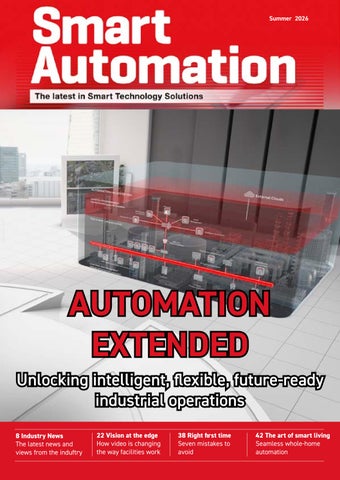
4 Automation extended Unlocking intelligent, flexible, industrial operations
8 Product & Industry News
The latest news and views from the industry
22 Vision at the edge How video intelligence is changing the way facilities work
26 Data value creation From compliance to performance, disparities between countries
30 Cybersecurity is now an automation problem Why every installer needs to think beyond the installation
34 Breaking bottlenecks Software to solve food and beverage’s costly headache
38 Right first tim Seven mistakes to avoid when specifying your automation system
42 The art of smart living Seamless whole-home automation
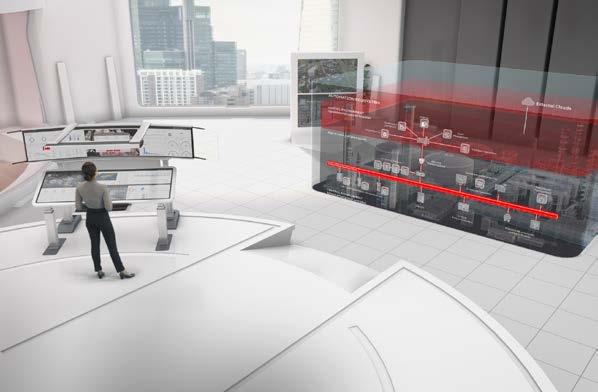
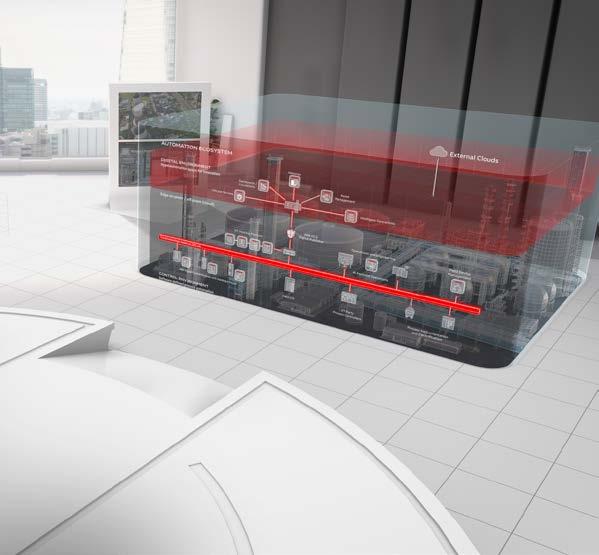
Automation plays a key role in the safe, efficient operation of factories, refineries and processing facilities. Stefan Basenach, Senior Vice President, Automation Technology at ABB, introduces ABB’s Automation Extended program that streamlines the evolution of industrial plant owners’ Distributed Control Systems while minimizing impact on production.
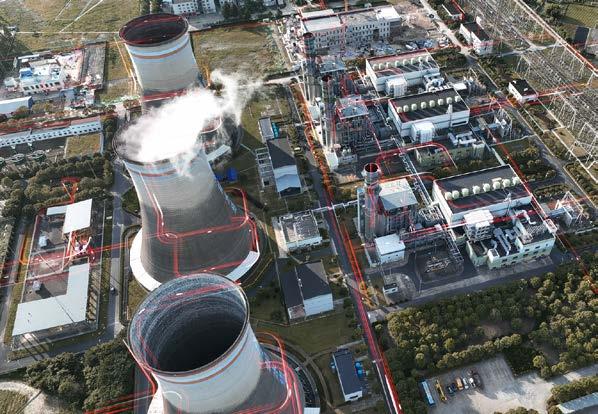
From oil refineries to paper mills, food and beverage, power generation and water treatment plants, automation systems keep industrial operations running smoothly, efficiently and safely.
In process plants and other industrial facilities, operations have traditionally been orchestrated by
Distributed Control Systems (DCS).
These automate various steps in batch or continuous processing, with the objective of maintaining reliable plant operation and consistently high-quality output. Efficiencies realized by the DCS also help plant owners reduce energy consumption and minimize waste.
The commercial challenges confronting industrial operators have multiplied since the first DCS deployments in the 1970s. The consequences of global competition, changing demand and rising material costs are compounded by stringent regulation, tighter safety standards and the mandate to decarbonize
through greater energy efficiency and lowered emissions.
Like all organizations, plant operators must safeguard themselves against a growing spectrum of cyber security threats. Meanwhile they are dealing with the realities of changing workforce demographics, where traditional heavy engineering skills are giving way to a new generation of digital native workers.
In a changing world these pressures on efficiency and profitability mean plant owners and automation suppliers must ensure their control systems are modular, secure, future ready and capable of fully harnessing the opportunities that digitalization brings.
Tech trends including Artificial
Intelligence and Machine Learning (ML), cloud and edge computing are extending the scope of today’s industrial automation systems beyond their original role of deterministic real-time process control. Increasingly smart applications can unearth powerful business insights from the deluge of data generated by connected field devices in a modern plant. Similarly, advanced data analytics can inform preventative maintenance strategies to minimize unplanned shutdowns and extend asset lifespan.
Integrating these new capabilities into heritage automation systems can deliver valuable dividends in terms of greater process efficiency, reliability, safety and sustainability. However, the need for stability can conflict with ambitions to innovate. Plant owners are often reluctant to embrace the opportunities offered by the latest technology when business continuity is an overarching priority. Modernizing process automation systems has traditionally been a major undertaking that requires major shutdowns. And every hour of lost production in even a modestly sized factory or processing plant can potentially run to hundreds of
thousands of dollars in lost revenues.
As a pioneer in process automation and a global leader in distributed control systems, ABB is responding to the changing demands of industrial organizations with its Automation Extended program.
Reflecting ABB’s longstanding leadership in Distributed Control Systems and its extensive installed base across multiple sectors, Automation Extended allows plant owners to capitalize on new automation capabilities with minimal disruption. The overarching goal of Automation Extended is to preserve system integrity while providing the efficiency and agility needed for the next era of industrial operations. Building on ABB’s proven automation platforms and based on open technology standards, Automation Extended provides a smart, secure and readily scalable modular automation ecosystem that allows innovation to flourish without jeopardizing reliable daily operation.
Separating control and digital environments Central to ABB’s Automation
Extended program is the concept of a “separation of concerns”. This frames the automation ecosystem as a future-ready, cyber-secure architecture comprising two distinct yet securely interconnected environments, each optimized for its own purpose.
The first of these two architectural elements is the control environment. This is a software-defined domain that oversees robust, reliable and deterministic real-time control of critical processes. Prioritizing safety and reliability, this control environment reflects the traditional purpose and strengths of the DCS in dependably automating day-to-day plant operation.
Securely connected to this control layer, a second digital environment enables advanced applications, edge intelligence and real-time analytics. Leveraging Artificial Intelligence and Machine Learning to augment human decision making, this digital environment lets plant owner progressively introduce new capabilities without disturbing proven control structures. Crucially, this separate space allows new applications and tools to be introduced, updated or patched
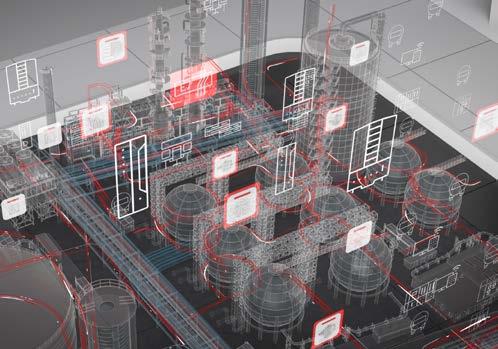
without impacting on core control functions.
Despite this separation of concerns, these two domains nevertheless form a single common ecosystem, united by common information models and communication standards, shared engineering principles and a unified user experience. Reinforcing rather than replacing the value of human workers, Automation Extended also provides an intuitive environment augmented by visualization tools and decision-support systems. As well as supporting quicker, betterinformed decision making, this allows engineers to shift their focus from overseeing daily operations to performing higher value strategic tasks.
Similarly, separating control and digital domains simplifies the task of minimizing exposure to rapidly evolving cyber threats while assuring compliance with evolving regulations.
Enabling innovation with continuity
This separation of concerns
provides a clear, low-risk path to modernization of existing automation systems, allowing new technologies to be integrated at a comfortable pace without threatening the integrity and stability of day-to-day operations. Protecting and extending the life of industrial operators’ existing DCS investments, Automation Extended offers increased flexibility, scalability and efficiency for the next era of industrial operations.
The DCS represents a significant long-term investment for industrial operators. Core control systems can frequently remain in service for 20 years or more before technology obsolescence makes replacement necessary. With Automation Extended, plant owners can continue to rely on their proven process automation solutions such as ABB Ability™ System 800xA®, ABB Ability™ Symphony® Plus and ABB Freelance that are tried and trusted across multiple industries. Adding new capabilities to these systems can be performed incrementally, with security, safety and interoperability always at the core.
A stable platform for modernization with continuity
For industries looking to modernize and protect their long-term investments, ABB’s Automation Extended program delivers modular, cyber-secure and future-ready automation that boosts efficiency, enhances stability and accelerates time to market.
Unlike traditional rip-and-replace approaches, Automation Extended enables seamless evolution of industrial operators’ existing DCS infrastructures. Rather than being locked into inflexible upgrade cycles, plant owners can benefit from an integrated automation ecosystem where innovation does not have to compromise reliability.
With Automation Extended, commercial returns on decades-old DCS investments can be extended by leveraging modern technologies, helping plant owners adapt, scale and stay profitable while they embrace new commercial opportunities.

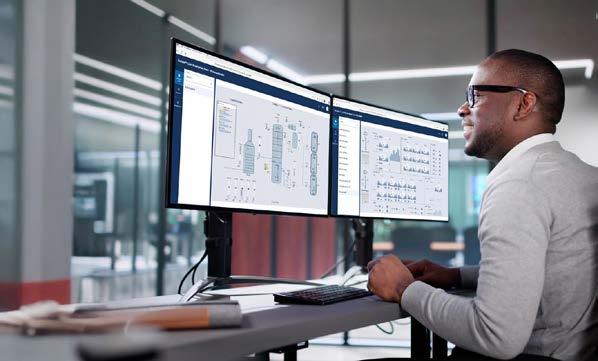
DeltaV Live Enterprise View securely extends visibility of operator graphics across the enterprise Emerson, a global automation leader, continues to define the industrial edge with the release of DeltaV™ Live Enterprise View, a new application that securely extends real-time control system visualisation beyond the control room. The new software joins Emerson’s rapidly expanding edge application ecosystem and empowers engineering, maintenance, reliability and leadership teams with browser-based, read-only access to live plant displays – as operators see them – without requiring display conversion, additional engineering or changes to the control system.
The ability to take fast, decisive action in today’s volatile markets is a critical enabler of operational excellence. However, layered solutions without native integration introduce latency and ongoing engineering overhead, constraining enterprise productivity. DeltaV Live Enterprise View addresses this challenge by leveraging Emerson’s innovative edge capabilities to deliver DeltaV Live displays via secure, read-only browser access available to users from any location within the network with a viable internet connection.
“DeltaV Live Enterprise View is an ideal fit for organisations leveraging the DeltaV Edge Environment as a secure OT-to-IT data platform,” said Sean Saul, vice president of product for Emerson’s process systems and solutions business. “As one of several high-value applications available in a rapidly expanding DeltaV Edge Marketplace, DeltaV Live Enterprise View builds on Emerson’s enterprise operations platform and boundless automation vision by delivering operatorgrade, real-time control system visualisation to relevant
operations personnel through a standard web browser – strengthening collaboration to improve operational performance.”
Most enterprise visualisation solutions require duplication, transformation or redesign of graphics. In contrast, DeltaV Live Enterprise View automatically renders graphics as they are configured in DeltaV Live, delivering instant, visible, role-based value. Enterprise users see what operators see, customised to their own needs, lowering friction and speeding adoption.
DeltaV Live Enterprise View’s secure, read-only visibility of operations is delivered via unidirectional data flow through the DeltaV Edge Environment. The DeltaV Edge Environment provides secure access to fully contextualised DeltaV data while maintaining proper system boundaries.
DeltaV Live Enterprise View joins an existing marketplace of powerful applications available at the edge, including DeltaV Edge Explorer, DeltaV Agent. Connect and a wide variety of curated open-source applications such as Grafana, Jupyter Notebook and Node-RED. The applications empower users to drive enterprise-wide optimisation via advanced analytics, AI assistance, customisable dashboards, trending, alarm analysis, workflow automation and batch investigation.
As Emerson expands upon its vision for the enterprise operations platform – the first flexible, software-defined OT-ready digital platform built on scalable control, industrial AI and zero trust cybersecurity – more applications like DeltaV Live Enterprise View will continue to enable seamless scaling from edge to enterprise.
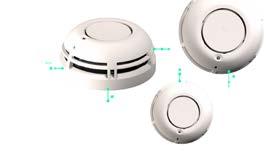
Siemens Smart Infrastructure today unveiled its new Cerberus Nova fire detector portfolio, set to transform traditional fire safety into a proactive, smart, and connected approach, part of the foundation of technologies that pave the way toward autonomous buildings. The new portfolio enhances operational safety, streamlines service team efficiency, allows for ease of system upgrades, and unlocks data-driven digital services through its cloud-connectivity. With their advanced technology, these systems are designed to meet various needs across industries such as healthcare, higher education, data centres and commercial real estate.
In healthcare facilities, where patient safety and operational efficiency are both essential, Siemens new fire detectors ensure performance with continuous, autonomous detection. The automated Disturbance-Free Testing (DFT) technology runs self-checks around the clock, reducing systems’ potential downtime. With support of the Smoke Entry Supervision (SES) technology, which monitors smoke entry points in real time, safety teams can intervene immediately before risks escalate. Additionally, the ASAplus technology, incorporating multi-wavelength optical and dual thermal detection, minimises false alarms – decreasing unnecessary evacuations. The fully IoT-enabled detectors are compatible with cloud-based applications, such as Siemens Building X Fire Apps. These capabilities provide facility teams and service providers with shared, actionable data insights and allow for real-time monitoring, remote diagnostics, and predictive maintenance.
Data centres’ high density of electrical systems and the need for continuous operations create unique fire safety risks, including overheating and electrical failures. Siemens Cerberus Nova detectors not only help maximise uptime of critical IT and electrical infrastructure, but also provide transparency on system conditions. Automated self-checks, cloud-based monitoring, and predictive maintenance allow facility teams to respond quickly and proactively, reducing disruptions and protecting these critical assets efficiently.
Other industries, such as higher education and
commercial real estate, often operate multiple, widely distributed buildings, making centralised fire safety management essential. Siemens Cerberus Nova detectors help facility teams maintain consistent protection standards across all sites by providing continuous monitoring, reducing the risk of unnecessary disruptions, and supporting proactive maintenance. This holistic approach provides an oversight of widely dispersed facilities and ensures reliable and resilient operations across the entire building portfolio.
“The launch of our Cerberus Nova fire detection portfolio is a game-changer in ensuring all alarms are accurate. By moving from periodic checks to continuous, data-driven, self-supervising systems, we’re laying the foundation for truly human-centric, autonomous buildings. By automating testing, delivering real-time insights, and enabling remote action, these solutions protect people while freeing up staff to focus on strategic priorities. This shift isn’t just about innovation – it’s about smarter, safer, and more efficient operations,” said Peter Nebiker, Head of Fire Safety at Siemens Smart Infrastructure Buildings.
No matter the industry, the best-in-class Siemens Cerberus Nova detectors represent a transformative approach to fire safety. They allow for stepwise upgrades while ensuring continuous protection, making them suitable for both green- and brownfield projects. Existing fire panels remain compatible, eliminating the need for a rip-and-replace approach. By allowing for plug-and-play integration including automatic transfers of configured settings, these systems offer seamless modernisation while reducing installation time and risk.
Carrying an environmental product performance label – Siemens EcoTech – for enhanced sustainability transparency, the detectors are not only made of recycled plastics, but also promote environmentally responsible design, resource efficiency, and circular economy principles. The Cerberus Nova fire detectors are part of the Siemens Xcelerator portfolio, an open digital business platform that enables customers to accelerate their digital transformation easier, faster and at scale. The offering has been developed in Switzerland, where it is also being produced.
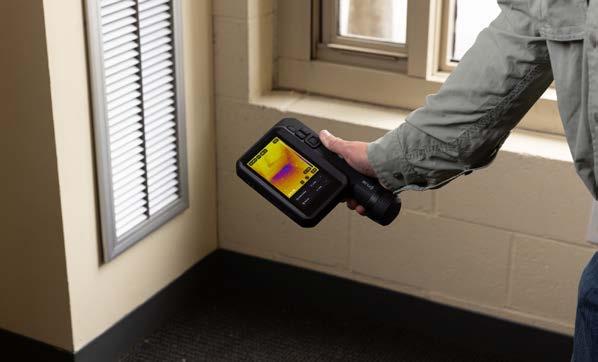
Flir announced an enhanced integration between its professional-grade iXX-Series thermal imaging cameras and RocketPlan, the leading mobile-first platform for the property restoration industry.
Flir announced an enhanced integration between its professional-grade iXX-Series thermal imaging cameras and RocketPlan, the leading mobile-first platform for the property restoration industry. This collaboration embeds high-resolution thermal data directly into digital field workflows, allowing restoration professionals to document moisture damage and structural anomalies with unprecedented speed and precision.
In an industry where "time is money" and documentation is the primary currency of insurance claims; this integration effectively eliminates the traditional bottleneck of manual data entry. By syncing Flir iXX-Series cameras with RocketPlan’s cloud-based ecosystem, thermal imagery is automatically tagged by project, room, and timestamp. This seamless connectivity ensures that every thermal insight captured on-site is immediately useful, rather than being trapped on an SD card or lost in a camera’s internal memory.
Thermal imaging remains the gold standard for detecting hidden moisture and insulation failures, yet the manual transfer of files from camera to report often leads to data silos and administrative delays. "Restoration professionals require more than just a great image; they need that image to be actionable and defensible," said Heliel Morales, Director of Global Business Development . "By integrating Flir’s industryleading thermal clarity directly into the RocketPlan
workflow, we are helping firms reduce administrative overhead and provide the transparent, high-quality documentation that insurance adjusters demand."
The benefits of this integration extend beyond the field technician to the entire restoration business. Images captured via the iXX-Series, Flir ONE and Flir Edge are instantly synced to the specific job file, which removes the risk of lost or mislabeled data. Technicians can then overlay this thermal data with floor plans, moisture readings, and time-tracking within a single mobile interface. This level of transparency allows office teams to share standardized, professional reports with insurance partners in real-time, significantly accelerating claim approvals and project completion.
"Our mission is to simplify the complex lives of restoration contractors," added Joe Tolzmann, CEO of RocketPlan. "Partnering with Flir allows our users to capture critical thermal insights and organize them instantly. It’s about moving from the assessment phase to the mitigation phase faster than ever before."
While the Flir iXX-Series offers the ruggedness and resolution required for large-scale loss, the RocketPlan integration also supports the Flir ONE® Series, Flir Edge®, and the Flir MR277 moisture meter with IGM™. This ensures that every member of a restoration crew, from the lead estimator to the technician, has access to the tools they need on a single platform. The integrated solution is available now for RocketPlan subscribers and Flir users.
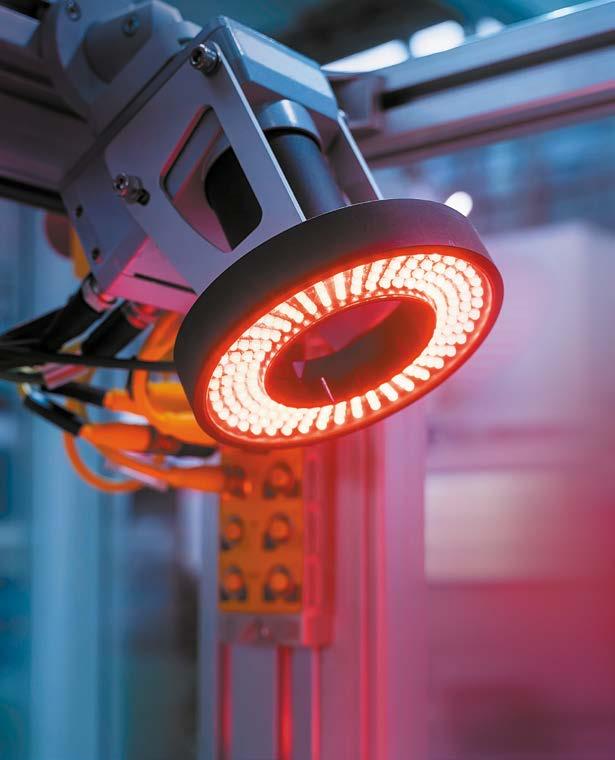
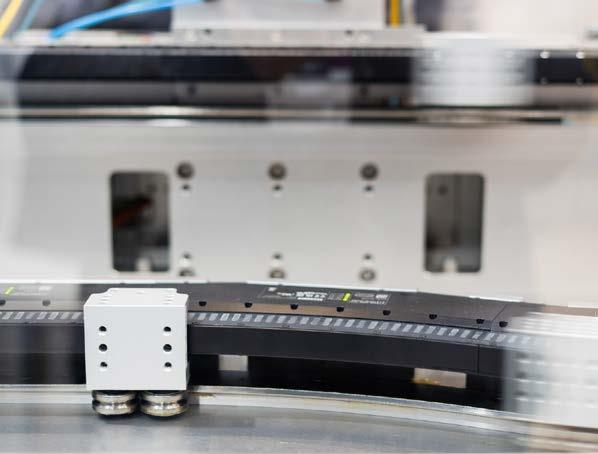
Beckhoff to demonstrate intelligent transport and collaborative robotics at London Lab Live 2026
Beckhoff UK will exhibit at London Lab Live at ExCeL London from May 6-7, 2026, an event that will focus on digital, automated and connected laboratories and include automation and robotics among its core themes. On stand B51, Beckhoff will demonstrate how PC-based control can help pharmaceutical and biotechnology manufacturers build more flexible sample and product handling processes.
A key attraction on the stand will be a live demonstration combining Beckhoff’s XTS intelligent transport system with a Dobot collaborative robot. The XTS combines linear and rotary drive principles, while TwinCAT integrates PLC, motion control and robotics functions on a single Industrial PC.
At London Lab Live, visitors will see the cobot track and interact with independently moving XTS movers in real time, coordinated by one Beckhoff Industrial PC running TwinCAT 3 automation software. The demonstration is designed to show how laboratory and production teams can handle vials, cartridges, microplates and consumables more flexibly, while reducing the need for mechanical changeover.
Because the movers can be controlled individually, the system can adapt to different process steps and container formats within the same machine architecture. The open approach also makes it easier to integrate third-party robotics, existing instruments and wider automation systems, giving users a practical route from laboratory-scale development through to full production.
“Many pharmaceutical and biotechnology manufacturers want to automate handling tasks without creating rigid systems that are difficult to adapt,” said Bradley McEwan, business development manager at Beckhoff UK. “Our demonstration at London Lab Live shows how transport and robotics can be coordinated in real time on a single control platform. That gives users the flexibility to work with different container types, adapt workflows quickly and scale automation more effectively as requirements change.”
McEwan and technical support engineer Sebastian Lindqvist will be available on stand B51 throughout the show to discuss how Beckhoff’s PC-based control technology can support laboratory automation projects. Visitors can register for the event through the London Lab Live website.
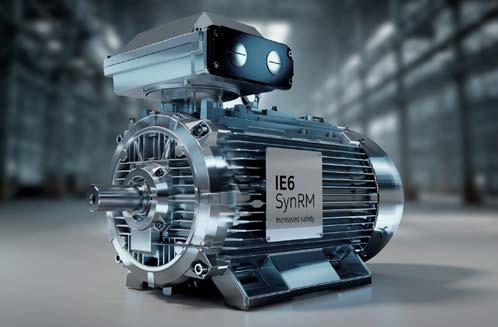
ABB is the world’s first manufacturer to offer an IE6 Hyper-Efficiency motor certified to ATEX and IECEx requirements for use in hazardous areas. The new IE6 Increased safety motor, based on ABB’s magnet- and rare earth- free synchronous reluctance (SynRM) technology, offers up to 60 percent lower energy losses than the IE3 induction motors commonly used in Zones 1 and 2. This enables operators to realize a major boost in energy efficiency and avoided carbon emissions in industries where gas, vapor or dust might be present, such as chemicals, marine, oil & gas, pharmaceuticals and food & beverage.
The IE6 SynRM Increased safety motor is certified for use with variable speed drives (VSDs) to offer accurate control and high efficiency throughout the whole speed range, even at partial loads. This makes it the ideal upgrade for standard IE3 induction motors in pumps, fans and compressors. Over a typical 20-year service life, the energy savings from switching just one motor up to IE6 would be €87,5201, resulting in an eight-month payback period with 157,540 kg CO2 avoided—equivalent to 37 gasoline powered passenger cars driven for a year.
“In its Energy Efficiency report 2025, the IEA highlights the pressing need to make sustainable technology available as an affordable choice. And that is central to ABB’s own Engineered to Outrun philosophy,” said Stefan Floeck, President IEC LV Motors, ABB. “With the world’s first IE6 Hyper-Efficiency SynRM motor
for hazardous areas, we now have the ideal solution for customers who must drive down their operating expenses while meeting stringent sustainability targets.”
The new IE6 SynRM Increased safety motor covers ratings from 110 kW, with IE5 versions available for up to 90 kW. As well as increased reliability and reduced maintenance, SynRM technology enables a more costeffective installation. In Zone 1, cooler running can allow the use of an Increased safety SynRM motor where a Flameproof motor with a special enclosure would be the traditional choice. Furthermore, in Zone 2, the improved loadability of SynRM motors enables more power from the same size as an equivalent induction motor. This could enable a smaller, lower-cost motor to fulfil the same duty.
ABB’s IE6 and IE5 SynRM technology is part of the industry’s broadest portfolio of IEC LV motors for hazardous areas, with induction alternatives up to IE4 efficiency level. Whatever the technology, these motors combine robust construction, high energy efficiency, and reliable operation to deliver trusted performance and certified safety in the most demanding environments.
To learn more about ABB’s IE6 SynRM motors for hazardous areas, visit this website: https://www.abb. com/global/en/areas/motion/motors-generators/ low-voltage-motors/iec-low-voltage-motors/motorsfor-explosive-atmospheres.
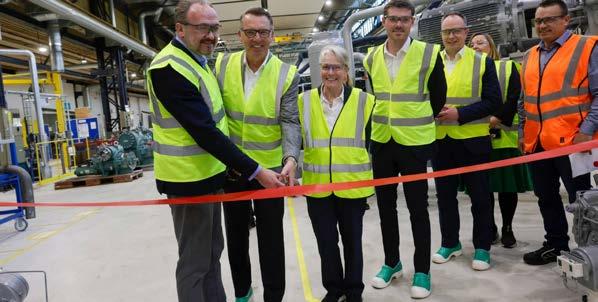
Johnson Controls (NYSE: JCI), a global leader in thermal management, mission-critical building systems, energy efficiency, and decarbonization, today announced the expansion of its Holme, Denmark heat pump and chiller facility, increasing production and testing capabilities to meet growing demand for high-capacity heat pumps across Europe. Operating on 100% green energy, the site strengthens European manufacturing capability while helping to reduce reliance on imported fossil fuels.
The expansion includes 2,300 additional square meters of new production space and an 1,800 square meter customer experience and test centre, compliant with the latest European Heat Pump Association testing standard (EN 14511). Together, these additions strengthen Johnson Controls ability to design, build and validate high-capacity heat pumps for district heating, public infrastructure and industrial applications, including high-stakes environments from research campuses and life-science labs to universities and food-and-beverage operations. The project is expected to create more than 100 new local jobs and includes modernization of existing buildings at the site.
The EU Commissioner Energy & Housing, Dan Jørgensen, together with Mayor Anders Winnerskjold from the City of Aarhus, and EU Policy Assistant, Rasmus Beim Hvide joined Johnson Controls employees and partners to mark the opening of the expanded facility.
“With generations of manufacturing expertise in Europe and a market-leading position in commercial and large-scale heat pumps, this expansion in Holme reinforces our long-term commitment to building critical technologies here, for Europe,” said Richard Lek, president EMEA at Johnson Controls. “By scaling production and real-world testing of large heat pumps, we are enabling municipalities and energy-intensive industries to electrify heat, lower costs and reduce emissions – with solutions designed, engineered, built and tested close to where they are deployed.”
Heat accounts for more than 60% of energy use in
European industries, according to the European Heat Pump Association, spiking costs and draining resources that otherwise could go to innovation and bolstering competitiveness. Advances in heat pump technology now can turn this around. Electrifying heat through large-scale heat pumps allows cities and industries to capture natural and waste heat from sources such as wastewater, seawater, geothermal energy and industrial processes. This serves to transform otherwise lost energy into affordable, low-carbon heating. In 2025, Johnson Controls heat pump solutions helped customers reduce heating energy costs by up to 32% and cut emissions by up to 55%, underscoring the urgency of scaling proven technologies.
The Holme facility manufactures customized Sabroe-branded heat pumps and chillers, along with remanufactured, aftermarket and marine spare parts. Using zero and low GWP refrigerants, the technologies are designed to align with upcoming EU regulations taking effect from 2027 and 2030.
“This site has served as a foundation for heating and cooling innovation since Thomas Sabroe founded the business here in 1897,” said Benthe Klokkerholm, vice president, Manufacturing Operations HVAC/R, EMEA. “With this expansion, Aarhus further cements its role as a centre of excellence for district heating technology delivering value to customers across Europe and the wider region.”
Johnson Controls has delivered large-scale heat pumps to hundreds of customers across Europe and beyond, for example Vattenfall Berlin, Energie BadenWürttemberg in Germany, New Aalborg University Hospital in Denmark, and upcoming projects due to start operations later this year such as Hamburg, Neustadt in Holstein and in 2027 in Zurich.
The Holme facility complements Johnson Controls’ broader European and regional manufacturing footprint, alongside sites in Nantes, France; Milan, Italy; Cork, Ireland and Budapest, Hungary supporting customers across the region.
Switch and dim lights, call up lighting moods, save energy
See who is calling, display camera images, secure building
Play music, control multiroom systems
Synchronise calendars and time clocks, play occupancy simulations
Display energy consumption, turn power outlets on and off, save electricity
Time-dependent control of blinds and shutters, monitor windows and doors
Analyse data and consumption
Control innovative building technology via radio
Save energy, manage energy consumption, heat in an energy-conscious manner, protect the climate
Control and monitor building technology from outside
Use door communication and keyless access control, secure building
Call up weather forecasts, use weather services
Regulate heaters and air conditioning units automatically, heat in an energy-conscious manner
Simulate occupancy, use timers, secure building
Monitor and automatically open and close windows and doors, secure building
Intelligent building technology from Gira

On a high-speed food and beverage line, small errors rarely stay small across the wider production environment.
A slightly underfilled tray. A seal that doesn’t fully bond. A trace of product caught where it shouldn’t be.
Individually, they seem minor. But multiplied across thousands of units per hour, they turn into waste, rework, complaints and sometimes recalls. And when that happens, it’s not just the business that feels it. Production teams face pressure. Quality managers answer difficult questions. Consumers lose trust.
Many manufacturers still rely heavily on visual inspection to catch these issues. The reality is simple. What you can see is not always what is happening.
The real risk on the filling line
Filling and sealing are deceptively complex stages as speeds are high, materials vary, and environmental conditions can shift throughout the day. Even minor temperature inconsistencies at the seal point can affect integrity.
Manual inspection and standard vision systems have their place, but have limits; sampling means some packs are never checked. Operators rotate. Fatigue sets in. Opaque or multilayer packaging hides defects that traditional cameras cannot easily detect.
Weak or contaminated seals compromise shelf life and, in the worst cases, food safety, highlighting the importance of seal integrity monitoring.
When an issue escapes the line, the consequences move fast. Production stops, stock is quarantined, and teams work late to contain the damage. But it doesn’t end at the factory gates; products may be pulled from shelves, customers inconvenienced, and in serious cases, consumers put at risk. The financial cost is visible, and the human cost is felt.
Quality control without blind spots
Thermal imaging adds a different layer of control.
Instead of relying on surface appearance, it measures heat distribution as seals are formed and products move through the line.
The Flir A70 Smart Sensor captures detailed thermal patterns at production speed. Variations in temperature highlight underfills, trapped product in the seal area and inconsistent sealing pressure, even through opaque or printed packaging.
This is not sampling. It is continuous, 100 per cent in-line inspection. Every pack. Every cycle. No sampling gaps. Defects can be rejected immediately, before they progress further downstream or leave the facility, reducing surprises.
From checking to controlling
When thermal inspection is integrated into existing control systems, quality shifts from reactive checking to process control.
Data feeds directly into the plant’s existing platforms, creating a clear, auditable record and supporting HACCP and BRCGS requirements. Edge processing ensures decisions happen instantly, without slowing the line.
Protecting more than product
In food and beverage manufacturing, quality failures are not just technical events. They affect people, putting reputation at risk and undermining consumer confidence.
Filling Line and Seal Inspection using thermal imaging closes a critical gap. It verifies fill levels and seal integrity on every unit without adding manual workload or slowing production.
Because quality assurance should not depend on chance, eyesight, or end-of-line discovery, it should be built into the process, protecting product, performance and, most importantly, people.
Explore how seal integrity and fill accuracy can be improved across your production line
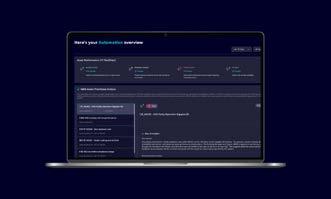
Siemens Smart Infrastructure today launched Asset Performance Advanced, a new AI-enabled managed building service. By combining an integrated predictive failure mode classification with advanced fault detection and diagnosis (FDD), the solution helps customers across industries optimize operations, improve energy performance, and enhance occupant comfort. Bringing together predictive intelligence, prescriptive AI, and expert-guided actions, Asset Performance Advanced supports the transition toward human-centric autonomous buildings – enabling them to sense issues, decide actions, and continuously improve performance.
The solution is built on three core capabilities: predictive, prescriptive, and workflow. It identifies root causes of performance issues, recommends high impact actions to address them, and enables automated, optimized execution across teams. Unlike analytics-only solutions, Asset Performance Advanced not only detects issues but also operationalizes response – combining AI-assisted recommendations, standardized resolution playbooks, and integrated workflows that route tasks to the right teams, supported by Siemens Digital Service Centers. This ensures that insights consistently translate into measurable outcomes.
Asset Performance Advanced is designed for industries where uptime and operational reliability are critical – including healthcare, higher education, and commercial real estate – and is supported by intuitive dashboards and expert-led reporting. Healthcare facilities operating around the clock can detect issues early and maintain compliance in critical environments such as operating rooms and patient care areas. Higher education institutions gain portfolio-wide visibility to proactively manage assets across distributed campuses. Commercial real estate owners can improve comfort consistency, meet energy and ESG targets, and enhance both tenant satisfaction and asset value.
“As buildings become more complex and data-rich, the challenge is no longer visibility but translating insights into meaningful impact. At Siemens, our vision
is to create human-centric autonomous buildings that continuously adapt to the needs of their occupants while optimizing performance in the background. With Asset Performance Advanced, we are closing the loop between detection, decision, and execution by combining AI, domain expertise, and service delivery to enable more resilient, responsive, and sustainable building operations,” said Brad Haeberle, SVP of Services at Siemens Smart Infrastructure Buildings.
Traditional reactive maintenance can cost three to five times more than planned or predictive approaches, often leading to emergency repairs, service disruptions, and occupant dissatisfaction. Asset Performance Advanced moves beyond rule- and alarm-based monitoring by prioritizing issues based on their impact on comfort, energy, and uptime. By leveraging advanced analytics to continuously monitor heating, ventilation, and air conditioning (HVAC) systems and building automation devices, the service enables early detection – before alarms are triggered – while helping teams focus on the highest-value actions.
AI-assisted recommendations further extend beyond traditional guidance by determining and initiating optimal workflows. Through standardized resolution playbooks and recurring performance reviews, the service continuously optimizes building portfolios and closes the operational loop – shifting from reactive responses to proactive, outcome-driven decisionmaking. The service also connects insights directly to execution through integrated digital workflows delivered via the Siemens Customer Interaction Portal. Issues are automatically prioritized and routed to the appropriate teams – whether in–house or to Siemens Digital Service Centers – enabling customers to act faster and more efficiently with fewer resources.
Asset Performance Advanced further expands Siemens' automation services portfolio and is integrated within the Building X ecosystem. Building X is a digital building platform that supports customers to digitalize, manage, and optimize their building operations.








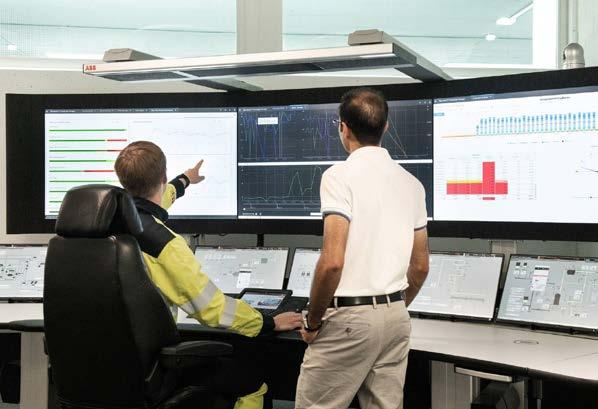
Novada Cement, part of the Medcem Cement Group, has chosen ABB to deliver full plant electrification, automation and drives solutions for its new plant in Tampa Bay, Florida. ABB will design, supply and commission the solutions and provide integrated engineering, project management and support. With ABB Ability™ System 800xA® distributed control system (DCS) as the integration platform, operators will gain deeper insights and understanding of plant status and be enabled to take more effective measures to maximize plant production.
The plant is expected to produce over 600,000 tons of cement annually when it reaches full production and become a supplier to the regional construction industry. It marks a first investment in the US by Novada, which together with the wider Medcem Group has large-scale production in Türkiye as well as plants in Cameroon and Tunisia. Medcem Group’s strategy focuses on digitalization, efficiency and sustainability, while also pursuing investments to expand its presence in the international building materials sector.
ABB’s process control and electrification system will enable greater process visibility for operators, resulting in energy savings, quality improvements and optimization opportunities at Novada Cement Plant.
“ABB helps the world’s cement manufacturers and producers make real progress in their production journey,” said Bulent Kolanci, North America Sales
Manager for Business Unit Cement, ABB’s Process Industries division. “The team at Novada Cement is very inspiring to work with as they are creative and focused in achieving their stated objectives. We’re very happy to be a part of this journey with them.”
“We’re actively involved in the growth of the cement market globally and wish to push forward in ways that are considered sustainable and productive,” said Mr. Isa Eltez, Plant Manager at Novada Cement. “Our expertise as we aim to successfully start-up the Novada Cement Plant in the US will be augmented with ABB’s technologies to accelerate what we can achieve in this important market. By centralizing operations with ABB technology we’ll improve energy performance, maximize throughput and deliver expected quality. We’re looking forward to the results.”
ABB has a long-standing relationship with Medcem Group who previously selected ABB as a technology supplier for their global digitalization efforts at their cement production facilities in Türkiye.
Novada Cement, a subsidiary of Medcem, operates within Medcem Group, which includes mining, port, concrete, sales and global export divisions. Medcem’s Mersin plant in Türkiye is one of the world’s largest, producing 6.5 million tons of clinker annually, with 90 percent shipped internationally via Medcem Port. Medcem Global exports products such as cement, clinker and industrial byproducts
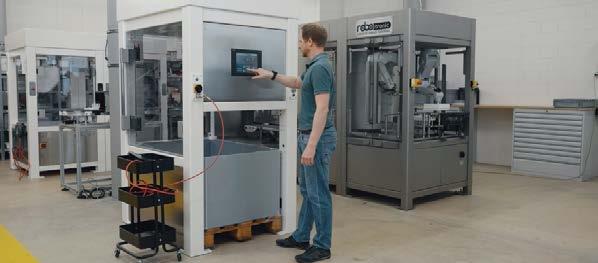
A long-standing automation partnership between a Swiss machine builder and one of the world’s leading manufacturers of industrial robots is aiming to help transform the pharmaceutical supply chain in Europe with the launch of what is believed to be the ‘smallest’ automated palletising cell for vials and pre-filled syringes.
Swiss-based Robotronic has partnered with Mitsubishi Electric’s Factory Automation EMEA division for more than two decades. Now, the two organisations are collaborating together on a new low-footprint cell to help the pharmaceutical industry overcome record-high shortages across Europe in recent years for medicines ranging from children’s cough syrups through to antibiotics and even cancer treatments.
The growing demand, which has impacted patient treatment and quality of life, has led the European Medicines Agency to increasingly focus on one of the main causes of shortages - manufacturing and quality issues - with the aim of ultimately strengthening the fragile pharmaceutical supply chain.
Mike Weber, founder of Robotronic, says faster production is required to shorten lead times and cope with the ever-increasing demand.
“We are a Swiss company concentrating on machine building with robotic applications for the pharmaceutical industry, including everything from de-nesting and re-nesting, through to de-traying, re-traying, and palletising. We have specific expertise in vial and prefilled syringe handling, offering solutions that deliver maximum efficiency with a small footprint, and enabling pharmaceutical manufacturers to rise to the challenges in their supply chain.”
One of the key challenges for Robotronics is compliance. “Pharmaceutical consistency is about more than quality,” says Mike. “It is also about regulatory compliance and safety.”
He continues: “To get the required productivity, we need two robots working very closely together at high-speed, but we also need the assurance that the delicate products being handled will not be damaged in the process.”
The Robotronic choice is Mitsubishi Electric, specifically the FR series, a highly flexible robot with compact arm sizes that is equipped with SoftTouch technology.
The result is a small footprint automation solution with increased productivity for handling pallets as small as 120cm x 80cm. Most importantly, the FR series has built-in compliance control that offers soft touch capability that delivers zero product damage with no glass-to-glass contact, no broken glass and is easy-toclean.
“The challenge was to have two robots operating side by side in a confined environment without compromising speed or precision,” says Mike. “With Mitsubishi Electric’s help, we have two robots driving at full speed within millimetres of each other with no possibility of collision. This enables our cells to process up to 600 products a minute, without really challenging the robots.”
He concludes: “The relationship between Robotronic and Mitsubishi Electric is a true technological partnership – a combination of deep pharmaceutical process expertise allied to best-in-class robotic technology. Together, we believe we can develop machines that can shorten lead times and create a more robust pharmaceutical supply chain.”
Stefan Knauf, Division Manager at Mitsubishi Electric Factory Automation – German Branch, adds: “The biggest challenge was enabling Robotronic to safely and continuously operate two robots side-by-side in a confined environment, without compromising speed or precision. Our FR series robots with additional servo axis perfectly matched their requirements to deliver high throughput from a small footprint.
“The unique, built-in compliance control also allows the robots to gently handle glass vials without the risk of damage. Ultimately, in pharmaceutical production, consistency isn't just about quality, it is about regulatory compliance and safety. Our relationship with Robotronic is a true technological partnership. Mike and his team bring deep pharmaceutical process expertise and we bring robotics innovation.”

How
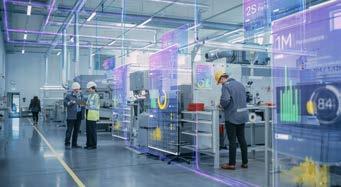
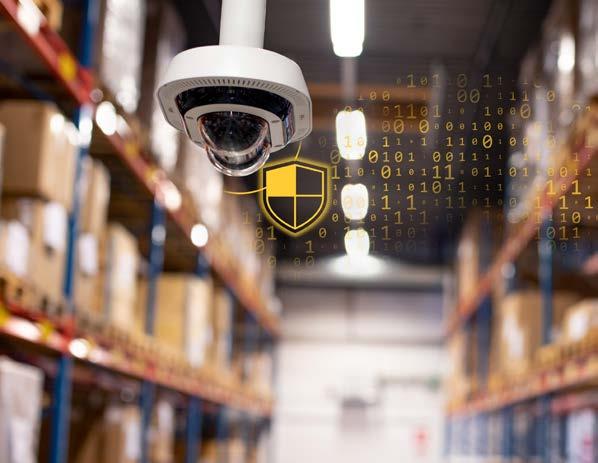
Video has evolved from a passive recording tool into a powerful source of operational intelligence, helping factories and warehouses improve compliance, resilience and overall performance. Factories, warehouses and materials-handling environments are under pressure. The pace of the market pushes them to operate at higher speeds with higher accuracy and fewer unplanned disruptions.
At the same time, duty of care obligations and workplace safety standards are rising. Meeting these dual marks depends on the effective collection and analysis of operational data, meaning video intelligence has now emerged as one of the most important tools on the plant floor. Every pixel of a video feed can be a sensor. A camera provides, in essence, a continuous stream of actionable data wherever it is needed most. Video adds benefits to obvious
functions like security, but it also empowers innovations in countless other areas. With digitalisation now a day-to-day competitive requirement, network video’s transformative properties place it in the same category as robotics, automation and interconnected IT and OT systems.
A new data source for a new era Materials-handling environments are complex by nature. Forklifts, automated vehicles, pallet trucks and
pedestrians often share the same space. Vehicle interactions, loading dock activity, temporary staff and contractors all introduce risk outside of standard operating procedures. Despite mounting compliance requirements and increased scrutiny from the HSE, monitoring levels in factories can often be insufficient, or at least inconsistent.
This is where video analytics are beginning to deliver immediate value. Cameras equipped with edge-based intelligence can be put to work directly on safety improvement tasks. They can detect PPE non-compliance, identify when pedestrians stray into mechanical areas, or when forklifts deviate from their authorised routes.
Rather than relying solely on operator awareness or periodic manual checks, facilities can build automated, real-time safety enforcement into their processes using the same cameras they use for security. Through intelligent metadata, cameras can also be made to integrate with existing operational systems.
If an unsafe event is detected, the appropriate response can be triggered, be that a closed barrier, a red-light signal, a visual or audible alert, or control over dynamic messaging and signage. Cameras can
also join the supervisory role of other sensors within, for example, SCADA systems, interacting with PLCs to slow or disable potentially dangerous equipment if a hazard is detected. As long as the camera platform is open and flexible enough, it could run any applicable function on the network edge.
This proactive approach to safety shifts it from an arduous box-ticking exercise to a dynamic, data-driven system which quickly demonstrates ROI from digitalisation. Video analytics can lead to a reduction in the number of RIDDOR-reportable incidents, support compliance with PUWER requirements, help enforce the HSE’s workplace-transport
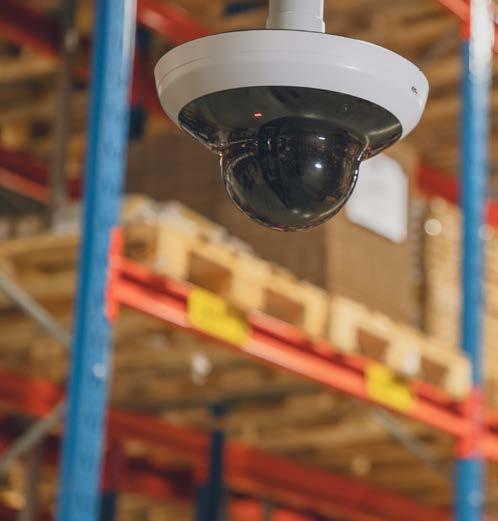
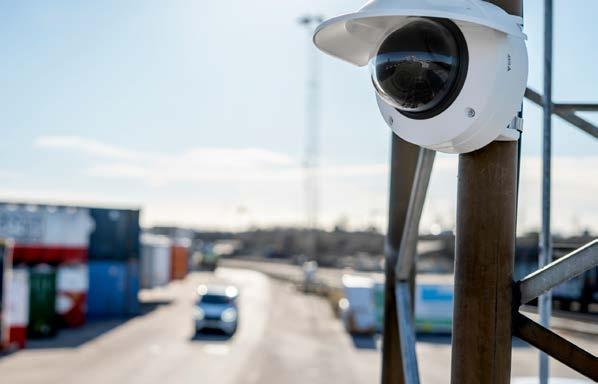
separation guidelines, and much more.
Each compliance check generates data of its own, helping management to identify recurring issues or persistent problems, target training where it is most needed, and create a cycle and culture of improvement. And as can be implied from video data’s potential in safety improvements, it has similar power as an integrated tool directly within factory and handling processes.
Fresh efficiencies even for old technology
Analytics can drive improvements at fixed workstations, monitoring areas like picking lines and packing stations to detect missed process steps or incorrect material flow. This reduces the reliance on manual audits, allows for rapid intervention before mistakes make it through and, perhaps most importantly, enables any deviation to be accompanied by clear evidence for future investigation.
Video could, for instance, record the condition of palletised goods as they are unloaded from containers, and again as those goods are dispatched, creating a vital chain of evidence. This can prevent costly
write-offs and, by documenting any pre-existing damage, provide the evidence needed to rebut fraudulent claims and demonstrate diligence to customers.
Digitalisation is an ongoing project; for OT which has not yet been replaced, or equipment which is difficult to formally integrate with digital environments, video analytics can form a bridge. Analogue gauges and readouts can be converted into live, actionable data streams. Machines without automated maintenance alerts can be virtually inspected, with machine learning automations trained to see or hear deviations from normal operation.
Compounding benefits from a videodriven future
There is little on the factory floor that would not benefit from the introduction of visual analytics. But we must be clear that video data is not a bolt-on, it’s a build-upon, something which can grow its influence over factory and handling operations. Starting small with visible wins like PPE compliance is a great way to build the momentum required to fuel larger digital transformation (DT) initiatives. A
connected, intelligent infrastructure transforms risk management, boosts operational efficiency, and cements customer trust.
The benefits are clear, and they compound quickly. Safety analytics like smoke detection have direct financial benefits; they can help to drive down insurance costs for example. Video data used in logistics functions like packing can save fines or claims against incomplete orders. And when analytics scale up, providing live feedback, strong historical data, and an immutable audit trail, the efficiencies that are unlocked could be worth millions.
Whatever the need, and wherever DT projects begin, it is vital to build the next generation of logistics technology on a platform that is ready to support it. The sharper the footage, the stronger the edge processing and machine learning capabilities, the better the data. Those who see cameras as the intelligence platforms that they are will be the ones to create the smarter, safer factories of tomorrow.
Learn how Axis enables flawless logistics and enhanced business performance here.









AI is an accelerator that widens the gap
Equans, a global leader in multitechnical services, today unveils, together with L’Usine Nouvelle and L’Usine Digitale (Infopro Digital), the findings of an international study on how organisations create value from data, based on interviews with 980 decision-makers across six countries (France, Belgium, the Netherlands, the United Kingdom, the United States and Canada). The challenge is no longer only to secure and govern data, but to turn it into a tangible driver of performance.
Key figures – International study
• 91% of organisations say they have data governance in place: the challenge now lies in realworld implementation and value creation.
• Only 45% exploit more than half of the data they collect: value remains under-industrialised, despite a widely shared strategic narrative.
• 61% in the UK and the US say their approach is already operational, versus 46% in France: Europe’s “performance lag” is about execution, not ambition.
• 59% of organisations in the United States already have a single platform, compared with 38% in France and 29% in the Netherlands: unification is the real engine for scaling.
• 71% (US) pool data collection across departments, versus 50% (France) and 44% (Netherlands) : maturity is also organisational (breaking silos and enabling internal circulation).
• AI is accelerating the conversion
of data into performance, but it first requires unified, shared data: 54% usage in the United States vs 19% in the Netherlands.
Data security is largely in place, but data exploitation remains the glass ceiling
Data collection and inventorying are now largely established across all countries: 91% of respondents say they have governance rules defining ownership, responsibilities, access and security.
However, maturity is decided on the final step, turning data into tangible outcomes. Overall, only 45% say they exploit more than half the data they collect. This points to a practical glass ceiling: in many organisations, data mainly supports day-to-day operations, while insight delivery and the conversion into
actionable information remain the weak link. In other words, making data “talk” is still the hardest capability to industrialise.
In Europe, data is still mainly a compliance issue, while Englishspeaking countries treat it as a performance lever
The international comparison reveals two distinct dynamics. On one side, the English-speaking bloc, where most of the organisations report exploiting more than 50% of their data (Canada 55%, UK 54%, US 52%). On the other, continental Europe, where exploitation is lower: France reaches only 41% above the threshold (52% below it), and the Netherlands 39% (42% below it), signalling that scaling remains immature.
This divide is also reflected in the nature of projects: where English-speaking countries are moving towards production-ready, standardised data use, Europe more often remains focused on operational steps (collection, processing, reporting). The gap is therefore less about intent than about the ability to move from reporting to true exploitation.
Without a single platform and internal data sharing, creating value is difficult
The study highlights very concrete levers that explain the gap.
The first break point is unification: 59% of organisations in the United States say they already have a single platform, compared with 38% in France and 29% in the Netherlands.
Second lever: the ability to break down silos. Data collection is more often pooled in the United States (71%) than in France (50%) or the Netherlands (44%), a key marker of data circulation across departments.
Third lever: proving value. Quantified ROI is measured more frequently in the United States (45%) than in France (25%), and drops to 11% in the Netherlands, illustrating how difficult it can be to manage data through a performance lens.
In this landscape, the Netherlands is a revealing case: the survey results show it more often trailing on industrialisation markers. They cautiously suggest that a stronger emphasis on protection and security frameworks can, in practice, create additional barriers before use cases reach production, illustrating a Europe that is highly attentive to governance, but still constrained when it comes to scaling.
AI boosts performance, but catching up requires industrial-grade data Final takeaway: AI does not erase gaps; it can amplify them. AI use for data exploitation is markedly higher in the United States (54%) than in the Netherlands (19%) or France (36%). And while AI is seen as a future priority everywhere, it is
even more so in English-speaking countries: 93% in the United States, versus 73% in France and 68% in the Netherlands.
The study underlines a key point: AI becomes a lasting lever only when it rests on data that is already unified, shared and managed through relevant indicators. In short, AI accelerates, mostly where data execution is already ready to scale.
Jérôme Stubler, President of Equans:
“This study shows that the issue is no longer only about governing data, but about unlocking tomorrow’s performance from it: cleaning and structuring it so it can be used, analysing it in real time, pooling it across departments, and steering it through relevant, shared indicators to support decision-making. Scaling is what now makes the difference between the English-speaking bloc and continental Europe. For Equans, the challenge is to help our clients unlock the value of their treasures, sometimes hidden, by turning them into concrete use cases. Working on IT/OT integration and then AI, across factories, industrial processes and infrastructure, to boost the competitiveness of both private and public organisations.”
Focus: United Kingdom
The United Kingdom stands out for a clearer shift from framework to execution: 61% consider the approach operational, and majority


exploitation is more common (54% say they exploit more than half of their data). These indicators suggest less a difference in intent than a difference in adoption at scale: beyond pilots, data becomes a routine management tool, with wider, more standardised use, and therefore more sustained performance impact.
Methodology: online study carried out by Infopro Digital’s research institute for L’Usine Nouvelle / L’Usine Digitale and Equans, from 24 November to 5 December 2025, among 980 respondents in six countries, including 480 in France and 100 in each of the five other countries (Belgium, the Netherlands, the United Kingdom, the United States, Canada).
In the United States, maturity is reflected in the ability to bring use cases into production and manage data as a performance asset. 61% of respondents say the approach is already operational, showing a more advanced deployment logic than in much of Europe. This lead rests on strong industrial foundations: 59% say they already have a single data platform, a key enabler to unify flows, break silos and scale from pilots to enterprise-wide rollout. In this context, value is more measurable: quantified ROI is tracked more often (45%), signaling a performance culture that turns data into tangible outcomes faster.
The Netherlands highlights the European paradox: visible momentum, but industrial foundations are still in their infancy. While 57% say their approach is operational, only 39% report exploiting more than half their data, and single-platform adoption remains far less common (29%). The survey cautiously suggests that stricter frameworks and a high sensitivity to protection and security can, in practice, slow progress before use cases reach production. The takeaway is clear: the challenge is not to add more governance, but to simplify and unify to accelerate execution
Canada shows a profile of “controlled acceleration”: it combines stronger effective exploitation with a high level of operationalisation. It is the country with the highest share of organisations saying they exploit more than half their data (55%) and where the approach is most often viewed as operational (67%). This suggests maturity built less on a single technological leap than on progressive standardisation of use cases, more robust over time. It also creates favourable ground for AI: 40% say they already use AI to exploit their data.
France illustrates a common
continental paradox: data is increasingly becoming a structuring topic, but the conversion into performance remains incomplete. Only 46% say the approach is operational, and just 41% report exploiting more than half their data, highlighting a gap between intent and widespread adoption. Scaling is notably constrained by unification: 38% say they already have a single platform, limiting the ability to connect flows and industrialise practices across the organisation. The takeaway: the priority is no longer conviction, but tooling, pooling and proof of value.
Belgium sits in between: momentum is real, but industrialisation remains uneven. 54% consider the approach operational, yet the share of organisations exploiting more than half their data is lower (47%), suggesting that value is still too often created case by case, without sufficient cross-functional diffusion. In other words, the country has moved past the commitment stage; the next step is standardisation: breaking silos, equipping teams and spreading shared use cases across functions to turn effort into lasting performance.
For further information please visit www.equans.com











For years, cybersecurity was seen as someone else’s problem. It was the responsibility of the IT department, while installers concentrated on getting systems up and running, making sure everything worked as it should and handing the project over to the customer.
Today, that approach no longer works.
Whether you’re installing a building management system, smart lighting, access control, HVAC controls, industrial automation or connected sensors, there’s a good chance the system will be connected to a network or the internet. Customers expect to monitor and control their systems remotely,
receive alerts on their phones and access real-time data wherever they are.
Connectivity has transformed the automation industry, creating smarter buildings, more efficient factories and better customer experiences. However, it has also created new challenges that every installer needs to understand.
The good news is that cybersecurity doesn’t have to be complicated. In many cases, it’s simply about following good installation practices and building security into every project from day one.
Everything is connected now There was a time when most
automation systems worked in isolation. A controller managed a production line, a building management system looked after heating and ventilation, and access control or CCTV systems did exactly what they were designed to do. Once installed, they often ran for years with very little outside interaction.
Fast forward to today, and the picture is very different.
Modern automation is built around connectivity. Building management systems can be monitored from anywhere in the world, production equipment sends performance data to the cloud, and engineers can diagnose faults remotely without setting foot on site. End users expect to control lighting, heating,
security and energy systems from a smartphone or tablet, while manufacturers rely on real-time information to improve productivity and reduce downtime.
For installers and system integrators, this has created exciting new opportunities. Connected systems offer more functionality, better customer service and the ability to provide ongoing support long after the installation has been completed.
But every internet connection, remote login and mobile app also creates another doorway into a system. If that doorway isn’t properly protected, it could allow unauthorised access or disrupt the way a building or factory operates.
Convenience comes with responsibility
Remote access has become one of the biggest selling points of modern automation.
An installer can diagnose a fault without travelling to site. Facilities managers can check building performance while working from home. Manufacturers can monitor
production around the clock, and customers can control systems from almost anywhere.
These features save time, reduce costs and improve customer service.
However, remote access also needs to be managed properly. Leaving default passwords in place, sharing login details between multiple users or forgetting to remove old user accounts can leave systems vulnerable.
Most cyber incidents don’t happen because criminals have found some sophisticated way of breaking into a system. They often happen because simple security measures have been overlooked.
Changing default passwords, using strong login credentials and keeping software and firmware up to date can dramatically reduce the risk of problems later on.
Small mistakes can have big consequences
Cybersecurity isn’t just about protecting data. In automation, it is often about protecting the operation of a building or production facility.
Imagine a warehouse where
the building management system suddenly stops responding, or a factory where production equipment can no longer communicate across the network. Even a short period of downtime can lead to lost productivity, missed deadlines and frustrated customers.
Fortunately, these situations are rare, but they highlight why security should be considered as part of every installation rather than something that is added afterwards.
As systems become smarter and more connected, installers are increasingly becoming the first line of defence.
The good news is that improving cybersecurity doesn’t always require expensive software or specialist knowledge. Often, it’s the simple things that make the biggest difference.
Change default usernames and passwords. Never leave factory settings in place once a system has been commissioned.
Keep software and firmware updated. Manufacturers regularly

release updates that improve both performance and security.
Limit remote access. Only enable remote connections where they are genuinely needed and remove access when it is no longer required.
Use different passwords for different systems. Reusing the same password across multiple installations increases the risk if one account becomes compromised.
Talk to your customer. Explain why updates, maintenance and good password management are just as important as the original installation.
These simple steps take very little extra time but can significantly improve the long-term security of an installation.
Security is becoming a selling point Customers are becoming more aware of cybersecurity than ever before.
Whether they’re managing an office building, a school, a
manufacturing facility or a retail site, they want reassurance that connected systems have been installed responsibly.
Being able to explain how a system has been secured, why passwords have been changed, how remote access is managed and what maintenance is recommended demonstrates professionalism and helps build trust.
Increasingly, cybersecurity is becoming another way for installers to differentiate themselves from the competition.
Looking ahead
Automation will only become more connected over the coming years. Artificial intelligence, cloud platforms, smart sensors and remote monitoring will continue to deliver new opportunities for installers and end users alike.
With those opportunities comes
greater responsibility.
Cybersecurity should no longer be viewed as a separate specialist subject that only concerns IT departments. It has become part of everyday automation, and every installer has a role to play in protecting the systems they design, install and maintain.
The good news is that good cybersecurity doesn’t always require complex technology. It starts with good installation practices, careful planning and attention to detail.
As the industry continues to evolve, customers will increasingly judge an installation not only on how well it performs, but also on how well it is protected.
For today’s automation professionals, building secure systems is no longer an optional extra—it is simply part of doing the job properly.


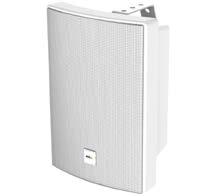
AXIS C1004-E Network Cabinet Speaker
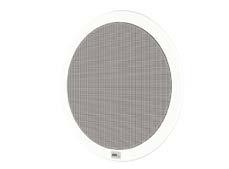
AXIS C2005 Network
Ceiling Speaker
AXIS C3003-E Network
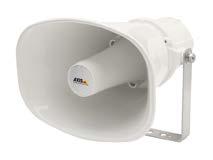
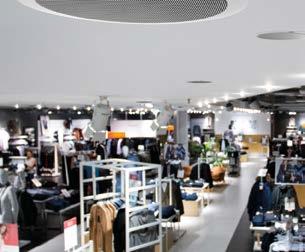
Axis network speakers are complete high-quality audio systems in a single unit. And because they’re based on open standards, they’re easy to integrate with other systems. Our ceiling and cabinet speakers are perfect for public address system and background music in stores and other settings, such as schools. And with our horn speaker you have a cost-efficient way to deter crime by complementing your video surveillance solution in outdoor settings.
Learn more about our network audio systems at www.axis.com/products/audio

In food and beverage, the stakes are especially high — a single point of delay can undo the efficiencies achieved everywhere else. Here, Beth Ragdale, software business manager at industrial automation and control specialist Beckhoff UK, explains why tackling bottlenecks requires a
rethink of traditional production lines, moving beyond purely mechanical fixes to embrace flexible, softwaredriven solutions.
The word “bottleneck” carries more weight in food and beverage than almost any other sector. A 2018 study by Garvey found that many companies in the sector experience
as much as 500 hours of downtime every year, to the tune of $20,000 to $30,000 an hour. That’s $10 to $15 million dollars lost to downtime a year.
This is an industry where speed is critical, hygiene is non-negotiable and the smallest of slowdowns can ripple through the production line,
throwing schedules off balance and squeezing margins.
While it’s impossible to prevent bottlenecks entirely, the real stepchange in reducing the impact of bottlenecks comes from integrating software-driven control that can adapt the line in real-time, removing the need for mechanical redesigns.
Traditionally, manufacturers have responded to bottlenecks by redesigning machinery. A slow capping station? Make it bigger, faster, stronger. A conveyor lagging behind? Upgrade it.
Mechanical design is vital. It provides the strength, reliability and precision that production lines need, but it has limits. Physical systems are inherently fixed once built and even carefully tuned equipment can
become a constraint when demand shifts, product formats change or new regulations emerge.
This is particularly the case when it comes to stock keeping unit (SKU) proliferation and rapidly changing consumer preferences, requiring food and beverage producers to have equipment that can adapt as quickly as the market does. This calls for a rethink of what’s considered “core” to the production line, moving beyond purely mechanical solutions.
How about hybrid?
Instead of relying solely on mechanical redesign to break bottlenecks, the conversation is moving towards software-driven flexibility. These are systems that use mechanics as a foundation but rely on advanced control to orchestrate production at a much more granular,
adaptable level.
Mechanics provide the strength and reliability, while software offers adaptability, precision and the ability to orchestrate production in far more dynamic ways. It’s this kind of flexibility that opens new possibilities.
Instead of running the entire line at the speed of its slowest process, software can manage the flow so faster stages feed into slower ones in a controlled, balanced way. Rather than tearing down equipment for every changeover, adjustments can be made in code.
In terms of hygiene, food and beverage plants face strict cleaning and sanitisation requirements, often involving partial disassembly of machinery. Systems designed

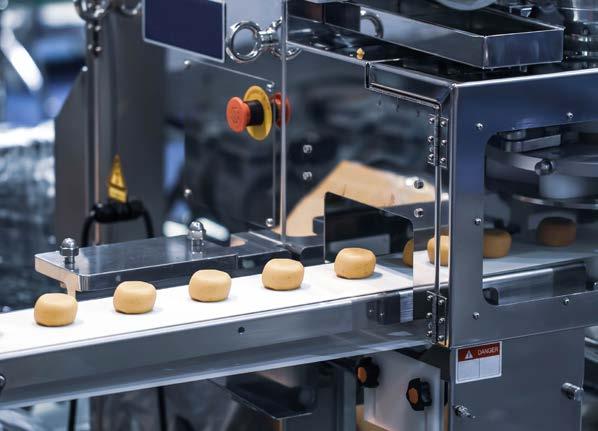
with minimal exposed components, smooth surfaces and sealed drives reduce cleaning time while maintaining safety standards.
This is where linear transport systems, like Beckhoff’s XTS, come into play. The XTS uses a sealed, hygienic design that minimises exposed mechanical complexity, reducing the effort and time required for cleaning. This is not only a win for food safety but also another way to reclaim productivity otherwise lost to extended cleaning cycles, a bottleneck many overlook.
At first glance, the XTS looks like a conveyor — a way of moving products from point A to point B. Rather than relying on fixed mechanical paths and timing, the XTS uses software-controlled movers that can be positioned and operated independently along a flexible track.
Each product carrier becomes its own controllable element, capable of varying speed, acceleration and position on demand. Instead of all products moving at the same pace through every stage, the line can
slow down for delicate operations, speed up where capacity allows and even reroute flows dynamically. These flexible motion profiles also open up opportunities for process optimisation that go beyond eliminating existing bottlenecks. Producers can use real-time data from the XTS to identify emerging slow points before they become critical.
Predictive adjustments can be made during a run, maintaining optimal throughput even as variables shift. Over time, this allows for a more proactive approach to productivity, one where bottlenecks are anticipated and avoided rather than reacted to after they occur.
The theory of constraints
However, it’s worth acknowledging that no production system can ever be entirely free of bottlenecks. The theory of constraints, which is a process improvement methodology that emphasises the importance of identifying the system constraint or bottleneck, teaches us that there will
always be a slowest step. Remove one, and another will take its place.
The goal isn’t to chase the impossible dream of eliminating bottlenecks entirely, but to create a production environment in which they can be moved, resized and managed with minimal disruption.
Mechanical redesigns have a role here, but they are most powerful when combined with the adaptability of software-driven motion systems. Real-world results show how this approach pays off.
In one frozen pizza facility, replacing mechanical change-outs with the XTS eliminated lengthy manual adjustments between 26 different SKUs, cutting downtime and maintaining a high throughput of 15 cases per minute without product damage. In a sector where downtime can cost tens of thousands of pounds an hour, that kind of flexibility doesn’t just keep production flowing, it saves millions in potential lost revenue.
For more information on the XTS, visit the Beckhoff UK website.
For today’s manufacturers, automation is no longer a choice; it’s a business imperative. Speeding up production times, reducing energy costs, cutting waste and relieving the staffing burden caused by the manufacturing labour crisis, it’s no wonder that in factories across the UK and Ireland, robotic systems are being installed in increasing numbers – and not just in cuttingedge industries such as automotive and medtech, but also in traditionally manual-heavy sectors like food & beverage and packaging. However, not all automation
solutions are equal. Before investing in a robotic system, it’s vital to ensure that any potential supplier understands your production needs and limitations, as oversights at this level can be costly. Here, we outline the seven key mistakes that every manufacturer should avoid when embarking on a new automation project, to make sure your installation runs smoothly from day one…
Mistake #1: Not taking into account your existing equipment
Any proposed new solution needs to easily integrate with your existing
equipment, otherwise it will lead to production issues further down the line, reducing output and costing you money – essentially, creating more problems than it resolves.
A reputable supplier should want to visit your site and see for themselves the hardware and software systems that are already in place before recommending a solution that integrates well with both. At Tekpak, we use OPC UA for our automated packaging systems, a cross-platform, secure, open-source communication standard to enable convenient data exchange between our solution and the customer’s
existing equipment.
Our engineers will arrange a site visit at the start of every project to find out which signals are already in place and work these in when writing client-specific software, to ensure seamless integration from the point of installation. Make sure to have this conversation with your supplier at the start of your automation project –don’t let it be an afterthought.
Mistake #2: Not considering your available space
Manufacturing facilities are busy, often crowded spaces. And this rings especially true for packaging halls. Your dream automation solution may look great on paper but if its footprint is too large for your existing layout, you’ll be left with the costly dilemma of deciding whether to increase space, remove existing equipment or rework your new automation system.
We prefer to work ‘backwards’, beginning not with a proposed solution but from the starting point of the customer’s available space. This avoids logistical challenges further down the line. Ask your supplier if they offer a modular solution that can adapt to your layout constraints – not only will this keep down costs and limit installation difficulties, but it
will also futureproof your operation, enabling you to increase production capacity as demand grows.
Mistake #3: Not thinking about day-to-day usability
Often, an automation project is specified by a technical or engineering manager, with input from the C-suite and finance teams. Yet, on a day-to-day basis, the people using the system will be operatives on the shop floor. To ensure your shiny new set-up isn’t left gathering dust in the corner of a workshop, it’s essential that it is easy to operate by employees who may not have advanced coding or engineering skills, and who may not even have English as their first language.
Simple HMIs with touch screens, intuitive menus, colour coding and clear visual cues – as opposed to lengthy technical jargon – will ensure your system can be widely used by all production staff, so check with your supplier that their systems are as user-friendly as this.
At Tekpak, we always ask for feedback on usability from a variety of staff members following the FAT and SAT stages of a project, including those working on the shop floor. Making sure that operatives can
easily alter packaging formats and layouts on the HMI, for example, is essential to the long-term success of your automation project.
Mistake #4: Not building in production flexibility
One of the biggest mistakes a manufacturer can make is choosing an automated system that’s perfect for them now. Automation is a big investment and consumer demands change rapidly. If your solution has been specified for one particular application, on one particular line, for one particular product, it may quickly become obsolete if your product range alters.
When we deliver a system to a customer, we make it clear that we’ve not merely sold them a machine but the software, too. We ensure that both can be altered as required, to offer maximum production flexibility now and in the future – whether that be a change of size, speed, product type or configuration. For example, we previously installed a high-speed vial coding line that was initially designed to handle three vial sizes. We are currently collaborating with the client to introduce a fourth, smaller format. Thanks to the original futureproof design of
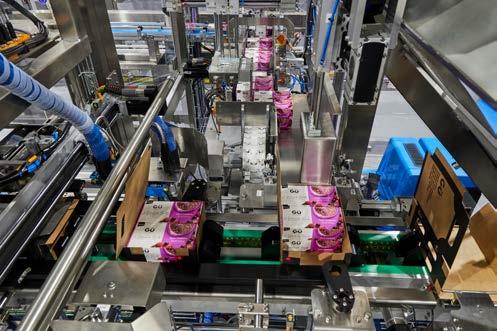
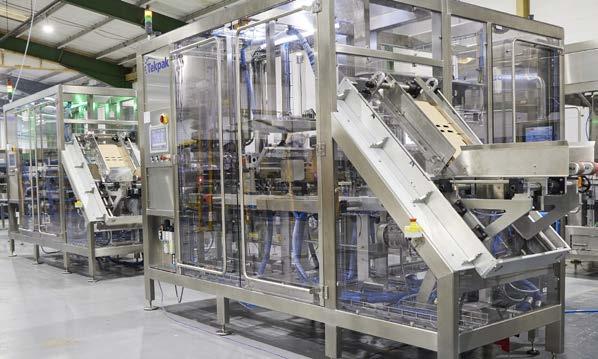
all modules, this addition can be implemented seamlessly without any mechanical modifications, providing full flexibility with no complications or unplanned downtime.
Mistake #5: Not having a single point of responsibility
An automated line may comprise equipment from numerous OEMS. However, for a project to succeed, the overall system needs to be ‘owned’, installed, managed and – most importantly – made compliant by one single company. Having a single point of responsibility will limit your risk, reduce admin load and speed up installation and delivery time, while giving you peace of mind that your solution meets the necessary regulations such as CE, Cyber Resilience and Machinery Directive, as well as validation requirements if applicable.
Some companies go a step further. For example, one of our current customers has ordered additional equipment from a different supplier which will run alongside the robotic pick-and-place packaging cell we are building for them. We have arranged for this equipment to be delivered to our workshop so we can integrate it with our cell and ensure it’s running at the correct rate before it gets
to the customer’s site – thereby increasing the chance of project success from day one.
Mistake #6: Not futureproofing your technology
Technology is changing fast. AI tools are becoming increasingly common in automation systems, with AI-enabled vision systems helping to position parts accurately, quality check products and increase worker safety, among other things. How can you ensure your automation system is fit for the AI revolution and won’t be outdated in a few years’ time, while remaining confident that your data is safe and secure?
Firstly, check that your supplier’s software can be remotely updated as technology evolves and make sure any smart features are included in the FAT and SAT checks. In addition, ask if their solution is compliant with the incoming EU Cyber Resilience Act (CRA). Beginning in September 2026 with full enforcement taking place in December 2027, the CRA sets mandatory cybersecurity requirements for hardware and software products with a digital element. At Tekpak, all our systems are CRA-compliant as standard, well before the Act becomes enforceable.
Mistake #7: Not thinking about after care
Finally, don’t forget that your relationship with your automation supplier should not end at the point of installation – think of it as a partnership rather than a sales transaction. To ensure you get the best out of your system, your supplier should offer training, warranty and after-sales support for as long as you need it, including remote access to limit unexpected downtime.
After the SAT has been completed, our engineers usually remain on site for a week. After this, our service agreements and warranties, including remote access as standard, make sure our systems are never left unsupported. We’ll continue to support the customer for as long as they need us – in fact, we’re still caring for some machines 12 years after they were first installed. Make sure your supplier views your investment as a long-term partnership, not just a quick sale.
To find out more about how Tekpak Automation’s range of automated packaging solutions can boost your manufacturing business: Go to www. tekpakautomation.com


A custom home combines handcrafted architecture, sustainable living, and seamless whole-home automation to create a connected lifestyle without compromising warmth or character
Crestron Home® OS delivers a cohesive fusion of rustic design and smart technology.
Nestled in the scenic Fox Hill community of Franktown, Colorado, this custom-built home
beautifully captures the essence of rustic charm and sustainable living. Thoughtfully designed to reflect the values of community and craftsmanship, the residence blends natural materials and handcrafted details to create a warm, inviting atmosphere.
Project: Fox Hill Sanctuary Region: Colorado, USA Dealer: Quality Audio Video "Crestron was able to provide technology that not only provided the

homeowners with comprehensive control but also matched the aesthetics of the home."
Tyson Rabani, CEO, Quality Audio Video
The Challenge
The homeowners sought to create a home with unparalleled convenience, security, and entertainment potential while preserving the traditional communal experience of
the neighborhood. The technology needed to complement their lifestyle by enhancing their daily routines and leisure activities.
The Solution
Quality Audio Video (QAV) was involved from the beginning, allowing the team to seamlessly integrate technologies from the ground up and ensure a cohesive and thought-out implementation. The QAV team chose
the Crestron Home® OS to blend advanced technology with the home's unique design.
"Based on the homeowners' needs and wants, Crestron Home was the ideal choice. We could fully tailor the system to match their routines and lifestyle."
Tyson Rabani, CEO, Quality Audio Video
The Technology

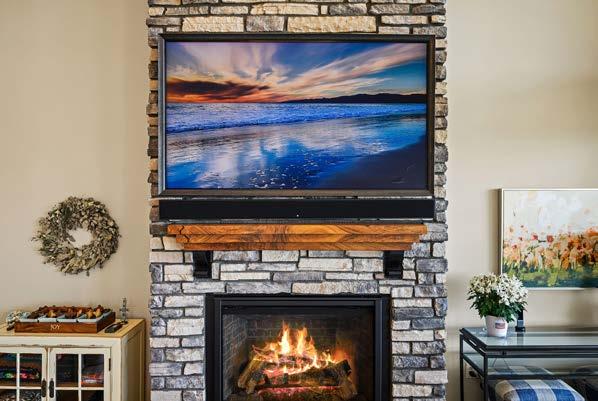
Crestron Home OS proved to be the best option due to its centralized control over the home's various environments. Throughout the home, there are sophisticated lighting and climate control systems, advanced security features, and high-quality audio and visual setups designed for entertainment and relaxation.
The Crestron Home system can be used to adjust the lighting, shades, and climate control to suit the homeowners' preferences at different times of the day through routines such as "Good Morning" and "Good Night."
The home theater uses Crestron DM NVX® AV-over-IP technology and Crestron DM NAX® Audio-over-IP technology, allowing the family to enjoy an immersive entertainment experience. A custom handcrafted Leon Edge Media Frame surrounding the TV matches walnut wood from the family farm, adding a personalized touch. The Crestron DM NVX and DM NAX platforms distribute video and audio throughout the home, making them ideal for wholehome entertainment. The family also enjoys a dedicated listening room
featuring a record player connected to the DM NAX system.
To complement the home's vaulted ceilings, motorized window treatments were installed, enabling the homeowners to easily manage natural light and privacy. These shades also support sustainable living by allowing sunlight to warm the home during winter and helping keep it cool during summer by reducing solar heat gain.
One of the home's most unique features is a modern "dinner bell" system that allows communication between the main house and the woodworking shop, demonstrating a thoughtful blend of tradition and innovation.
"The ability to control things remotely, whether we are on this continent or in this state, or wherever, it's not just one piece of equipment, it's the whole Crestron integration. It has made us more comfortable, above and beyond what we were thinking."
Results
Crestron technology elevated the homeowners' experience while
preserving the rustic charm that defines the residence. With remote access to their system, the homeowners enjoy peace of mind no matter where they are.
"A high level of coordination was essential to merge the technology elements with the home's handcrafted features, creating an advanced, yet aesthetically pleasing, space," says Tyson Rabani, CEO at Quality Audio Video.
Featured Products
• 4-Series® Control Processor for Crestron Home® OS (CP4-R)
• DM NVX® 4K60 4:4:4 HDR Network AV Decoder (DM-NVX-D30)
• DM NVX® 4K60 4:4:4 HDR Network AV Encoder/Decoder Card with Downmixing and Dante® Audio (DM-NVX-363C)
• DM NAX® 8-Zone Streaming Amplifier (DM-NAX-8ZSA)
• CAMEO® In-Wall Remote Dimmer (CLW-SLVU)






Electrical installations in both industrial and consumer buildings need to meet the new challenges of our growing power needs. To increase the energy efficiency of buildings, while at the same time integrating consumers into the load compensation, will mean that controlling the switching of electrical devices on or off according to external signals, such as time and consumption, will be vital. www.new.abb.com/smartgrids/ smart-grid-technologies/smarthome-and-intelligent-buildings




The Bosch Smart Home range includes both Single System products and System Solution products. Test the range of smart solutions to understand how these products are able to assist you in your daily lives; offering additional comfort, security for peace of mind and energy efficiency, saving you money within your home. Connectivity is more than just technology, it is now part of our every-day lives making life easier and allowing more time for the things that really matter! www.bosch-smarthome.com


Connected products is a growing area for Dyson building world-class cross functional Agile teams and adopting the latest technology and techniques delivering our ambitious vision in the connected space. In 2016 we launched our first two connected products now having a connected user base of hundreds of thousands in twenty countries. Culture of design and engineering excellence with an innovative start up mentality winning the 2016 T3 Connected product of the year. https://careers.dyson.com/


Energenie is part of Sandal Plc a public listed uK technology company, Sandal Plc is the brand and IP owner of the Mi|Home smart home system. The Mi|Home ecosystem can control heating, lighting and electrical appliances via both plug and play and retro fit actuators, including radiators valves, retrofit wall sockets and retro-fit light switches. The system also includes a range of sensors that are able to control the Mi|Home actuators allowing for a smarter experience. https://energenie4u.co.uk/

ASSA ABLoY is the global leader in door opening solutions, dedicated to satisfying end-user needs for security, safety and convenience. Since its formation in 1994, ASSA ABLoY has grown from a regional company into an international group with about 46,000 employees, operations in more than 70 countries and sales close to SEK 68 billion. The Group has a leading position in areas such as access control, identification technology, entrance automation and hotel security. www.assaabloy.co.uk/en/local/uk/


Designed to be offered as a service from the ground up. Enabling our channel partners – insurers, telcos and builders - to add value to their core business creating a more intimate relationship with their consumer and B2B customers. The Cozify platform offers complete flexibility in data gathering and utilization. If so chosen, none of the data leaves the Cozify Hub. Alternatively, with consent from end users, the data can be extracted and analysed to support business decision making. www.en.cozify.fi/pages/for-partners


Enado has over 15 years of experience in the installation and provision of home automation systems. our multiple award winning platform allows multiple, disparate manufacturer systems and devices in the home, integrated into one solution. Industry standard offering of lighting and energy to facilitate control of multiple consumer electronics devices including satellite receivers, smart tv’s, sky and other satellite boxes. www.enado.com


eQ-3 Group is one of the leading innovation and technology companies for home control and consumer electronics. eQ-3 provides the largest product portfolio in the industry and has placed more than 21 million wireless home control devices in almost one million households in the market. eQ-3 is the European market leader in smart home with regard to the installed base of whole home solutions and electronic radiator thermostats. www.HomeMatic.com


With subsidiaries and representative offices in 11 countries, FERMAX is placed among the most important brands in the world. At Fermax, we have been cultivating our passion for design, technology and innovation for the past 65 years. www.fermax.com


Paxton10 delivers out of the box access control, IP video management and building automation. It interfaces with existing building infrastructure to control lighting, heating, air conditioning, intruder and fire alarms. The system comprises a web-based user interface for easy building management and a selection of discreet hardware. www.paxton10.com

EcoStruxure™ With Innovation At Every Level, we are redefining power and automation for a new world of energy. We operate in over 100 countries with around 144,000 employees worldwide. www.schneider-electric.com


Trend is one of the world’s leading Building Energy Management Systems manufacturers, with a worldwide distribution and support network covering over 50 countries. Its fully integrated control solutions are able to meet the most complex requirements of modern buildings. www.trendcontrols.com


A Fortune 100 company, Honeywell invents and manufactures technologies that address some of the world’s most critical challenges around energy, safety, security, productivity and global urbanization. Our connected portfolio of products, services and software spans multiple industries and is able to deliver end-to-end solutions that improve quality of life for people around the globe.
www.honeywell.com


NorthQ is a Danish IoT manufacturer which specializes in developing home automation and energy management solutions. Company’s products serve as an innovative tool to track, control and optimize energy consumption. Our vision, A New Way of Living, entails responsibility for the environment and conscious decision-making regarding the energy we use on a daily basis. Our newest product, the Q-Reader is a universal meter reader providing real-time data from various electricity, gas, heat, and water meters. www.northq.com


Building technology with its integrated disciplines such as building automation, fire safety, security, lighting, and lowvoltage power distribution is often indispensable and forms the heart of a Total Building Solution from Siemens. www.buildingtechnologies. siemens.com


Artificial Intelligence for Smarter Homes. The Viva Smart Home Platform is a turn-key white label platform that uses artificial intelligence to learn family behaviour and automatically programme smart home services. Service Providers can launch plugand-play products and services, like home security, heating, lighting and home protection, which improve family life for everyday living rather than being a throwaway gadget. www.meetviva.com