IN SECURITY THE MAGAZINE WITH THE INSIDE STORY ON SECURITY ISSUE 80 JUNE 2026
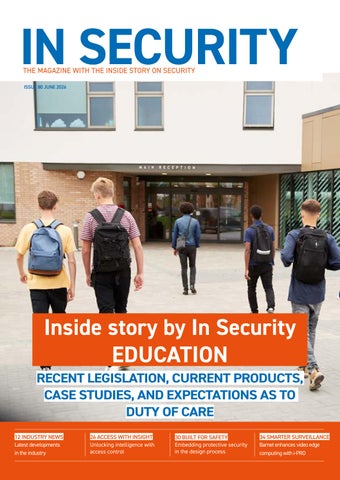
Inside story by In Security EDUCATION RECENT LEGISLATION, CURRENT PRODUCTS, CASE STUDIES, AND EXPECTATIONS AS TO DUTY OF CARE 12 INDUSTRY NEWS Latest developments in the industry
26 ACCESS WITH INSIGHT Unlocking intelligence with access control
30 BUILT FOR SAFETY Embedding protective security in the design process
34 SMARTER SURVEILLANCE Barnet enhances video edge computing with i-PRO IN SECURITY | June 2026 | 1
CLIQ® The smart way to digitalize access Take your access management into the digital era – smoothly, securely, and without overhauling existing infrastructure. With CLIQ, you upgrade from mechanical to digital access at your own pace to gain greater control today and adaptability for tomorrow.
Download our whitepaper to learn more about making the switch to digital access
26
Editor Chris Hewett editorial@mebmedia.co.uk Accounts Jay Kempisty accounts@mebmedia.co.uk
30
Publisher Wayne Banks +44 (0)1622 201207 wayne.banks@mebmedia.co.uk Website and Circulation Manager Kevin Villa website@mebmedia.co.uk Design and Production Charles David production@mebmedia.co.uk In Security Magazine is published 6 times a year by MEB Media Publishing Ltd 13 Princes Street Maidstone Kent ME14 1UR United Kingdom Tel: +44 (0)1622 201207, info@mebmedia.co.uk www.mebmedia.co.uk Articles and art may not be reproduced or reprinted without the express written permission of the publisher. Exclusion of Liability Although every effort will be made to ensure the accuracy of all materials published, the publisher takes no responsibility for errors or omissions. Copyright © MEB Media Publishing Ltd 2010 - 2026, all rights reserved.
Contents 4 Inside story by In Security: Education Jeremy Malies looks at recent legislation, current products, case studies, and expectations as to duty of care 12 Product & Industry News Latest developments from the security industry 26 Access with insight Unlocking intelligence with access control by Nicholas Smith, Genetec
42
30 Built for safety Embedding protective security in the design process in a market town 34 Smarter surveillance for Barnet Barnet enhances video edge computing with i-PRO 38 Access without excess 7 ways switching to digital access reduces costs 42 When worlds converge Physical-cyber convergence under NIS2 and EU security
IN SECURITY | June 2026 | 3
IINSIDE STORY
Inside story by In Security: Education Jeremy Malies looks at recent legislation, current products, case studies, and expectations as to duty of care
T
he survey spans simple locked doors to the advent of the intelligent campus. An overview shows where current technology is excelling and where it continues to fall short. Places of education from primary
4 | June 2026 | IN SECURITY
schools right up to leading university colleges should never have fortresslike security; the culture should be inclusive and welcoming with a focus on quality of experience. And yet there is also an overriding obligation to eliminate risk to pupils, students, and indeed staff even if this means
challenging the entry credentials of every conceivable kind of visitor. Martyn’s Law Laws named after individuals! This is a great development and a humanising of legislation worldwide. Megan’s Law requires
publicly available information about registered sex offenders. Sarah’s Law gives parents the right to ask police if somebody has convictions for child sexual offences. Clare’s Law empowers people to ask authorities if their partner has a history of domestic abuse. So, what is Martyn’s Law and how will it affect physical security in the education sector? Martyn Hett was one of 22 people killed by terrorist Salman Abedi during the Ariana Grande concert at the AO Arena in Manchester in 2017. Martyn’s mother, Figen, has campaigned for new regulations which will better protect the public in all environments and notably in education. The Law has specific content to improve preparedness and reduce harm to schools and universities from such attacks. (Ariana Grande’s demographic appeal meant that many of the killed and injured were young
but Martyn was 29.) The legislation received Royal Assent in 2025. There will be a 24-month period of implementation but in distinct phases or medium-size increments rather than a gradual process. A prime requirement is that any place of education (right down to early years providers) that could have 200 learners assembled – even if this is a peak attendance – must have an evacuation and lockdown plan in the event of a terrorist threat. There must also be a plan for invacuation. (For me, “invacuation” is a clumsy phrase, and a better term is “shelter in place”.) The focus will be on proportionate planning and preparedness. So how are security manufacturers, installers, consultants, industry regulators as well as observers reacting? How are they responding to the Law’s provisions for primary, secondary and further education? This article
(my remit is a broad view of educational security technology over and above Martyn’s Law) will consider areas including: • access control • video surveillance • perimeter security • lockdown procedures All of us looking at security requirements and procedures in education think, in the first instance, of mass communication and emergency alerts during critical incidents. Media coverage of horrific crimes across the world has conditioned us this way. Providers of such systems look to optimise lockdown procedures and critical incident responses through audio (public address & voice alarm), other mass communication methods, and emergency alert platforms. The aim is to deliver clear, understandable alerts that are targeted across zones within a
IN SECURITY | June 2026 | 5
building, cluster of buildings, or campus. Administrators must be able to adapt messages to particular areas according to the precise threat. Public address is a primary mode, but of course messages to desktops and push notification systems are important. Inevitably with young people, alerts to smartphones perhaps by a campus-issue App are a must as is use of official campus social media accounts. Security in education must be layered – I would even use the word “nested” – across subsets. At points of entrance, UK senior schools rely on video surveillance, video intercom, and assessments based on staff observations. Only when there has been intelligence suggesting a threat do police become involved. Specific risk scenarios (again the likelihood is word of mouth and perhaps related social unrest in the wider area) may see occasional use of hand-held wand 6 | June 2026 | IN SECURITY
or walk-through metal detectors. In the last five years there have been disturbing incidents (met with use of metal detectors) of pupils taking weapons into primary and middle schools in Cardiff, Wales. The items included knives, BB guns, and even a metal ruler sharpened to a blade. But the UK has not been obliged to go down the route of (occasionally malfunctioning) AI weapon detection that sent a school in Seminole County, Florida, into lockdown. The false positive occurred when the system mistook the clarinet being carried by a music student for a firearm. Disruption to the curriculum must have been significant, and depending on the mental robustness of the pupil involved, the error could have been at best a distraction and at worst the cause of distress. Draw a schematic of a legacy security system at, say, a UK middle
school and you would come up with an assembly of cameras, locks (both key-based and fob or biometric door readers and controllers), perhaps a few passive infrared sensors (PIRs) and fencing but this would be fences as a traditional barrier not a detection device. By contrast, new designs are truly connected systems in which threats surface in real time and can be acted on while an intruder or other miscreant is still on site. AI-enabled video monitoring can alert staff to atypical behaviour immediately without the need to trawl through footage. Similarly, unusual patterns of movement or sensors alerting on doors propped ajar can create alarms. “Solving for time” is a new phrase that comes up in tender documents. School and university stakeholders want broad views of their premises without the wage costs associated
with manned guarding and staff staring at screens. There is also insistence that access control should be able to lock down areas in a precise way when an intruder is detected but also give pupils and staff optimum routes out to points of safety and places where a roll call can be taken. Video surveillance Camera usage at schools is a fraught topic. Parents obviously want minimal if any recording of their children. And yet, even the simplest video analytics can assist managers by alerting on situations such as a corridor or choke point intersection becoming overcrowded. And young people often react better to being told something digitally than being addressed by their elders. It’s uncontested now that on simple matters such as overcrowding, AI makes better and quicker decisions than humans and can communicate
information well in noisy environments through attentiongrabbing public address, signage or other visual cues that can even extend to strobe indicators. Assuming that the component systems are integrated on the same platform, the chain of messaging will be quicker without human intervention. It barely needs to be mentioned that human intelligence can then focus on higher value tasks. Even the most privacy-focused parent will concede that if an active shooter is at large on a campus and video feeds can allow security staff to overpower them or give first responders the best locational information, then young people appearing on camera is an acceptable aspect of the larger situation. Are there go-to specialised camera brands for the education sector? In a word, “No!”, and one might be skeptical of a vendor who claimed
to have a universal solution for educational settings. Any commercial video surveillance brand will serve many industries, but certain suppliers have put serious thought into how their offerings can be used in education, with emphasis on seamless integration between camera streams, video management systems (VMS) and access control. Motorola Solutions has an impressive case study in which its video surveillance and evidence gathering has allowed it to partner with the University of Oklahoma and the local police department serving the university’s Norman campus. (Norman is the third biggest city in Oklahoma.) I have just watched a webinar in which stakeholders discuss surveillance and bodycam evidence management and how Motorola has empowered law enforcement officers with a comprehensive discovery package. The focus is on information-sharing
IN SECURITY | June 2026 | 7
and rapid assembly of evidence from multiple agencies. An educational case study close to my home is by Eagle Eye Networks (a Brivo Solution). Ibstock Place School in south-west London worked with installer SES Technologies to expand video surveillance. The client also wanted a sliding scale of footage retention periods. Executives at the school have the foresight to be following developments in video analytics closely and asked for complex event alerting capability. Futureproofing was vital throughout the project for a user with a commitment to open platforms and wanting easy integration with third-party technology. The school is benefiting from instant access to live and recorded footage through the Eagle Eye Cloud VMS. SES Technologies ensured continuity of service as they migrated the school from on-site to Cloud systems. Eagle Eye Networks marketing describes specific education solutions, and the success
8 | June 2026 | IN SECURITY
of this project endorses such claims. Lockdown procedures If a school, college or university has one overriding duty of care, it is perhaps to have optimised lockdown procedures should an intruder gain access to the site. Technology providers are rightly focused on solutions for this, and ASSA ABLOY can point to their portfolio of dedicated educational security offerings. These contrast with generic products, perhaps with a few tweaks, offered by many commercial hardware companies. Crucially, a dedicated lockdown product will balance rigour in closing areas of a site with the (possibly) conflicting demands on the fire and life-safety spectrums. SMARTair® Lockdown from ASSA ABLOY is designed to allow facility managers to lock down access points such as doors and gates in response to intruder threats and can be used in a precise manner as a miscreant is observed moving around a campus.
SMARTair® is truly responsive to site-specific needs and can be enabled remotely through mobile devices. As with vendors right across this survey, ASSA ABLOY appreciates the need to ensure general site continuity during installation which can be done wire-free. The system will open, close or block access points based on predefined settings or according to an operator’s individual judgements, giving senior site managers optimum control during emergencies. Financial background Finance directors at schools and universities should be included in discussions in the first instance and (if they have good judgement!) their views must be part of the mix. The survey of the education sector for this article has thrown up case studies where enthusiastic governing boards have taken short-term grants to finance sophisticated systems but have been unable to maintain and upgrade them, install patches, train
staff and cover future license fees. Discerning budget controllers can look beyond features to consider usability in the long run. Industry analysts are quick to give their opinions about best practice, but case studies by leading vendors are often a better source of information about optimum approaches. A linguistics faculty at the University of Lodz in Poland is using the GenetecTM Security Center for access control as part of a smart campus hub. The project forms a dispersed infrastructure initiative (a phrase I like) and the client has complimented Genetec on their product’s ability to integrate with IoT devices as electricity, water and thermal energy consumption are all optimised. The university is looking to set the standard for smart buildings in higher education in the region. Moving to another usage example that allows us to focus on a few trends, Paxton Access have installed their Net2 networked access control
system at Higham Lane School which caters for pupils between 11 and 18 in Nuneaton, Warwickshire. The school has more than 1,400 students and is part of the Central England Academy Trust. A notable aspect of the installation (echoed in other usage cases) is that as part of safeguarding plans, there was an absolute requirement for a full audit trail of entrance, egress, and general movement across the site. Specifiers wanted a video door entry intercom system at the entrance gate as well as integration with existing video surveillance and a fire alarm system. Simple, effective roll call functions (an obvious requirement in education) were also mandated. In addition to the obvious control of movement and awareness of site usage, the school has benefited from reduced risk of theft and vandalism. Installers MES Systems Ltd have been able to react quickly to the needs of school managers by providing remote system configuration using
the Net2Online web user interface and the Paxton Connect app which operates from smart devices. Increasingly in secondary schools, senior pupils may be issued with cards or fobs using RFID/NFC technology for access. In business contexts there might be use of phones and smart watches as credential devices but in schools this is avoided. Usage can be as simple as opening the door of an area used by only a few students, perhaps a music room or an arts workshop. Access control technology might open a locker containing specialist sports equipment. As with adults, there may be higher user privileges for prefects and student leaders. I have avoided any discussion of pupil violence towards staff here but such incidents and the publicity they create will make administrators conservative in terms of access rights. So, can I draw any conclusions from this survey of physical security across the education sector? I have certainly absorbed the fact that IN SECURITY | June 2026 | 9
data needs to flow rather than be siloed. Case study after case study has shown that schools, colleges, and universities throw up the same demanding requirements against familiar backdrops. Footfall is high and there is the cocktail of differing access rights for academic staff, technical staff, and employees engaged in administration. As with any organization, operational continuity is vital but not as important as factoring out risk from miscreants be they intruders, disaffected staff, current or former pupils. Any more lessons? Knowing that it may sound like a platitude, I conclude that the best advice for facility managers is to use existing tools in 10 | June 2026 | IN SECURITY
the first instance for observational exercises. What are the movement patterns of pupils and staff – both academic and administrative? Can heat maps from existing technology help us? How and when do students use the most important assets on campus? In what way do they integrate socially and academically with third parties? Look to these issues first, making the very best use you can of legacy equipment. Talk to installers and manufacturers who have good credentials. Then and only then start buying new technology. However sophisticated the technical offerings and genuine the duty of care shown by facilities managers, any consideration of security in the education sector
takes one back to the same realities noted at the beginning. And these fundamentals are the same for nursery or reception-year primary school pupils as for pensioners from the UK’s Open University gathered at a campus during the summer vacation. The core challenges for authorities are to protect everybody on their site, protect assets from theft, engage with neighbouring communities rather than being a fortress, optimise the learning potential of everybody who wishes to study, empower those whose role is to teach, and ensure recreational facilities are available for all. That is quite a remit!
Phone-based, cloud-hosted.
Access control. Reinvented.
Simplicity of standalone, power of networked
Built to the highest cyber security standards
Game-changingly affordable
See it first. Join the Paxton Tech Tour and claim your free one-door kit.
Limitless opportunities
PRODUCT & INDUSTRY NEWS
From pioneering electric strikes to intelligent systems For more than 90 years, ASSA ABLOY has pioneered electromechanical locking technology — continuously innovating since the first effeff electric strike was patented in 1932 and Abloy began developing highsecurity electric locks in 1978. Today, electromechanical locks represent the intelligent evolution of mechanical security, combining trusted engineering with seamless digital connectivity for safer, smarter, more efficient building management. Modern electromechanical devices transform the way buildings are secured. Their embedded intelligence enables reliable communication between door and system, remote operation, and data insights. They give facilities managers new levels of control and convenience without the need to be physically present at every opening. “When ASSA ABLOY´s effeff brand patented their first electric strike in 1932, it set a new standard for intelligent building security,” explains Julian Riester, Director & Head of Product Unit eStrikes & egress at ASSA ABLOY Opening Solutions EMEIA. “Electromechanical locking and opening were born. Doors became electrically controlled and remote operation was a new reality. We have continued innovating and setting new standards for this technology ever since.” Electric strikes are compact, reliable electromechanical devices that upgrade existing mechanical locks by enabling controlled, remote unlocking and seamless integration with intercoms, access control, and digital systems. They are mounted discreetly within the door frame for smarter, more flexible entry. For installers, OEMs, and resellers, they offer easy integration, broad application versatility, certifications, and high customer demand, making them simple to specify, sell, and deploy across commercial and multi‑residential buildings. Effeff electric strikes are engineered for universal fit and long‑term reliability, offering more than 10,000 strike and latch‑plate combinations as well as
12 | June 2026 | IN SECURITY
customized solutions for specialized environments. They deliver trusted security through rigorous DIN‑certified and TÜV‑audited production, high holding forces, extensive cycle testing, and durable components designed for harsh or high‑frequency conditions. A compact, installer‑friendly design enables fast, clean, cable‑free integration into almost any door, supported by adjustable alignment, sustainable EPD‑verified construction, and low power consumption for energy efficiency. Extending the applications for electromechanical locking E‑strike technology laid the foundation for modern electromechanical locking, which ASSA ABLOY’s ABLOY brand advanced in the late 1970s by embedding electricity and intelligence deep within the door leaf to enhance mechanical security and meet demanding regulatory and architectural requirements. ABLOY Electric Locks are trusted worldwide for meeting the highest security and compliance standards. They deliver a premium door experience, even in demanding, high‑traffic, or high‑security environments. They integrate seamlessly with access control, alarm, and building‑management systems to make every door intelligent and controllable, enhancing functionality, efficiency, and real‑time awareness across complex security ecosystems. “The long service life of our electric locks gives building managers the peace of mind that comes with products designed for maximum reliability,” adds Mika Savolainen, Director & Head of Product Line Management ELMECH PU at ASSA ABLOY Opening Solutions EMEIA. “These locks are backed by ASSA ABLOY’s global network of experience and expertise. They have proven performance over decades in a whole range of access control environments.” Click to learn more about ASSA ABLOY’s pioneering Electric and Electromechanical Access technologies.
Activist pressure reshapes UK risk landscape as insider threat rises, warns Securitas
UK businesses are entering a new phase of activistdriven disruption, with security intelligence indicating the threat will intensify – and increasingly move inside organisations. New analysis from Securitas’ Risk Intelligence shows activist activity has accelerated sharply over the past year, evolving from external protest into sustained, multi-front campaigns that now target not only companies, but their people, partners and operations. Crucially, the findings highlight a growing convergence between external activism and internal workforce pressures – a shift that is elevating the risk of insider-enabled disruption, including data leaks, operational interference and misuse of corporate systems. Organisations perceived to be falling short on ESG commitments – including net zero delivery and DEI – continue to attract significant activist attention. But the risk landscape is now broadening, as restructuring, automation and technology-driven job losses fuel labour rights activism and heighten employee sensitivity. Securitas Risk Intelligence indicates these dynamics are creating conditions where activist campaigns can be amplified from within. “This is no longer about isolated protests – it’s sustained, strategic pressure,” said Mike Evans, Director of Securitas’ Risk Intelligence Centre. Businesses are being targeted across multiple fronts simultaneously – from coordinated social media campaigns and reputational pressure, to supply chain disruption,
executive targeting and internal data exposure.” For businesses, the implications extend far beyond physical security. Risks now include sustained reputational pressure, impacts to investor and consumer confidence, increased executive protection costs, operational disruption, and heightened legal and regulatory exposure. Securitas warns that many organisations remain structurally unprepared for this shift, particularly where security, HR, risk and communications functions operate in silos. Instead, experts are urging a more integrated, intelligence-led approach. This includes assessing how corporate decisions and public positioning may trigger activist mobilisation; monitoring workforce sentiment alongside external sentiment; and strengthening early detection of insider risk. “Organisations relying on reactive, site-specific responses risk falling behind events,” Mike concluded. “As activist tactics continue to evolve, Securitas’ Risk Intelligence emphasises that businesses must move beyond siloed approaches. A joined-up, proactive strategy – combining external intelligence with internal insight – will be critical to anticipating risk, protecting operations, and building long-term resilience.” For more information on the security risks dominating the threat landscape, read Securitas’ Annual Intelligence Estimate 2026.
IN SECURITY | June 2026 | 13
40 Leadenhall leverages Genetec to unify security and elevate the occupier experience Advanced automation proves integral to daily operations for iconic London landmark Genetec Inc. (“Genetec”), the global leader in enterprise physical security software, today announced 40 Leadenhall has deployed Genetec™ Security Center and Genetec Mission Control™ to create a seamless modern experience for visitors and tenants. Located in the capital’s insurance district, 40 Leadenhall is one of the biggest City of London developments ever to receive planning permission. It spans over 900,000 square feet of commercial office, amenities, and retail space, serving up to 10,000 occupants. A unified security platform formed part of the original performance specification, with Genetec Security Center ultimately selected to give 40 Leadenhall the flexibility to integrate best‑of‑breed hardware and software, support informed decision‑making, and tailor the interface to a wide range of user needs and access privileges. “Genetec is proud to be safeguarding a growing portfolio of flagship buildings across the City of London - including some of its newest and largest developments,” said Viet Tang, Account Executive at Genetec Inc. “40 Leadenhall is a standout example of how forward‑thinking property owners are embracing unified, intelligent security to deliver safer, more efficient and more intuitive environments.” The smart building solution incorporates over 200 cameras, more than 250 doors, and 2,600 data points, all managed through Genetec Security Center and hosted on Genetec Streamvault™ servers and archives. Genetec Mission Control™ further enhances operations by standardising incident response with advanced automation. By integrating with other building systems, it can automatically trigger workflows for events such as power loss, water leaks, or high winds thus enabling teams to respond proactively with timely notifications and targeted actions that help ensure occupant safety. 14 | June 2026 | IN SECURITY
Access control and visitor experience technologies from partners including HID Global, Mercury Communications, and STid help enable seamless navigation throughout the facility. Occupiers can use mobile wallet credentials for frictionless entry, while visitors receive QR‑code passes that remove the need for temporary plastic cards. Integrated cameras from Axis Communications enhance situational awareness across the site. Genetec workstations located throughout the building provide role‑based access for operators. Reception staff can enrol visitors, while control-room security teams can run reports, investigate events, and monitor live video on either dedicated workstations or tablets. “The Genetec security system is easy to use and enables us to deliver a world class service to our occupiers and guests, ensuring occupant wellbeing and building security,” says Stewart Maynard, Smart Systems Manager at 40 Leadenhall. “Collaboration between delivery, systems and service partner teams has helped make 40 Leadenhall a truly smart building.” By uploading interactive floor plans into Security Center, operators can quickly identify devices, investigate activity, or access live video with a single click, significantly reducing training times. The building’s digital experience is further enhanced through integration with the 40 Leadenhall app, powered by VTS Activate. Occupiers can issue virtual visitor passes, receive arrival notifications, and seamlessly access amenities including wellness spaces, cycle facilities and the Peloton studio. “We believe Genetec provides the ideal platform to support 40 Leadenhall’s future growth and technology goals,” concludes Maynard. “The investment in leading technology, supported by strong partnerships, positions 40 Leadenhall at the forefront of innovation.” Read the full customer story here.
HID enables enterprise passkeys governance without user friction Built into HID’s FIDO authenticators, Enterprise Attestation gives organizations policy-level control over which devices can register passkeys without changing the user login experience HID, a global leader in trusted identity solutions, today announced the availability of Enterprise Attestation in its FIDO authenticator portfolio of smart cards and keys, a FIDO standards-based capability that enables organizations to enforce only companyissued passkeys at registration, proving authenticator provenance before a credential is ever accepted. By doing so, Enterprise Attestation helps organizations strengthen device trust, gain visibility into authenticator origin and support high-assurance authentication without adding friction for users. Passkeys Verify the User. Enterprise Attestation Verifies the Device While passkeys address phishing, enterprises also need assurance that the devices creating those credentials are ones they have issued and trust. In the FIDO Alliance’s State of Passkey Deployment in the Enterprise report, 20% of organizations cite strict regulations as a key barrier to passkey adoption. Enterprise Attestation addresses this gap by making device trust and authenticator governance explicit and enforceable. Without it, a personal authenticator could be registered to an employee, with no reliable way for the enterprise to distinguish it from a credential enrolled on a device the organization controls, monitors and can revoke. Enterprise Attestation verifies that the device being registered was issued by the organization. It gives security teams the governance, traceability and device control they need without changing the user 16 | June 2026 | IN SECURITY
login experience. Device Verification at the Point of Enrollment Built into HID’s Crescendo authenticators, including FIDO2-certified smart cards and security keys, and supported by identity platforms such as PingOne, Enterprise Attestation verifies authenticator provenance at the point of passkey registration. If a device cannot present valid attestation data, enrollment is blocked by policy, without requiring any changes to application workflows or additional steps for users. Enterprise Attestation is part of the FIDO Alliance’s WebAuthn and Client to Authenticator Protocol (CTAP) specifications and is actively supported through the FIDO Alliance Enterprise Deployment Working Group. This standards-based foundation ensures organizations can enforce passkey governance without proprietary authentication flows, application lock-in or deviations from the standard user experience. Built for Regulated Industries and Zero Trust Mandates For highly regulated industries such as financial services, healthcare and critical infrastructure, the capability directly supports compliance requirements around auditability, device provenance and lifecycle control. Global organizations operating under frameworks such as the European Union’s NIS2 Directive, the Digital Operational Resilience Act (DORA, applicable to EU financial services organizations) and Zero Trust mandates gain a practical mechanism to enforce policy at the authenticator level. To learn more, visit the website.
Innovative new devices extend the use-cases for CLIQ® programmable keys
Organizations of every size and type have already discovered the security and convenience benefits of a CLIQ digital key access management system. Now, new CLIQ Readers and Updaters for indoor and outdoor use make extending the scope and reach of a CLIQ solution even simpler, including to third-party digital access devices. It takes CLIQ to new openings more easily than ever before. These new additions to the CLIQ family are compatible with fully electronic eCLIQ and electromechanical PROTEC2 CLIQ solutions. They simplify both secure unlocking and the transfer of access updates to CLIQ keys. With new CLIQ Readers, all the keyholder needs to do is insert their key and wait for visual confirmation from its inbuilt LED – they do not even turn it, which minimizes key wear-and-tear. The Updater incorporates the same intuitive LEDs as CLIQ Wall Programming Devices (PDs) – informing the keyholder about update and key battery status. “The new CLIQ Readers are the first readers which are fully integrated with the CLIQ system,” explains Ralf Stange, Product Manager at ASSA ABLOY. “Managing access is simple because the software treats a Reader just like a cylinder. The new Updater makes it easier and more cost-efficient to add secure credential updating protocols to outside spaces.” A fast, reliable new Reader, inside or outdoors The CLIQ Reader is compatible with everything an organization needs to manage access more flexibly: with
CLIQ Web Manager and Local Manager; with the CLIQ Go mobile solution for small businesses; and with the full range of CLIQ programmable keys. The Reader itself offers customized setup options to suit individual needs. Switch delay may be set between 1 and 10 seconds, with a choice of activation on key insertion or on removal. An optional remote relay unit can add an extra layer of security. Installing and connecting a Reader can put a CLIQ system in control of user access to doors with electric strikes or motorized locks, automatic revolving doors or sliding glass doors, lift priority and more. Secure outdoor credential management with a new Updater Another new addition to the device range, the CLIQ Updater provides a secure way to add CLIQ key updates outside a building. Because connecting the Updater does not require a network cable, the device is fast and secure to install even on retrofit projects. The Updater is simply linked via RS485 cable to an existing CLIQ Wall PD (Gen 2), up to 200 metres away, with no need for network configuration. All security-related elements remain in the building interior. When connected to a Wall PD featuring a free output switch function (FO1), the Updater can activate third-party devices such as electric strikes. Click here to learn more about CLIQ. IN SECURITY | June 2026 | 17
Paxton Solo training available to security installers Following the success of Paxton’s fully booked UK Tech Tour for Solo, Paxton is now rolling out dedicated Solo training sessions across the UK to support security installers working with the system. As part of the Solo launch campaign, Paxton is giving away 10,000 one-door starter kits to installation companies. Any company that has not yet received a kit will be able to take one away at the end of their training session. Solo is Paxton’s new phone-based, cloud-hosted access control technology, where the phone is the system, and the key. Installers use a smartphone to create and manage the system directly through the Paxton Solo app. System users then use the same app on their own phones to access their premises. There is no on-site data network required, making installation simple and infrastructure-free. Security installer Aaron Bonshor, from Access Control Solutions UK, attended Paxton’s Tech Tour. He said: “This is a fantastic bit of technology that I think could be very powerful and simple at the same time.” Eamonn O’hArtghaile from Manguard Plus, another attendee, said: “It looks very impressive. Simple and easy to set up in seconds - this is a gamechanger.” The free Solo training course takes just two hours and is delivered by Paxton’s expert training team at a range of locations across the UK, including installers’ own premises. The training includes demonstrations and hands-on exercises that explore system setup, configuration, user management, and commissioning. 18 | June 2026 | IN SECURITY
Installers will also learn how Solo differs from traditional access control systems. Steve Woodbridge, Global Training Manager at Paxton, said: “Solo training is a hands-on session designed to give installers practical experience with the system. It focuses on how Solo works, where it fits, and how it is installed with real world use cases, helping installers understand the system before they quote jobs and install it on customer sites. “The training is also about giving installers an opportunity to discuss potential Solo projects, as well as tips and tricks, so they can deliver an installation effectively from day one and understand how the system can be positioned alongside existing Paxton solutions.” Solo is unlike any other access control system. Being cloud-hosted and managed through the Paxton Solo app, as well as game-changingly affordable, Solo supports flexible ways for installers to structure their offerings to customers. It enables them to build ongoing service relationships, creating opportunities for recurring revenue, depending on how they choose to deliver and support a Solo system. Training across Paxton systems Paxton’s training options are designed to support installers across their full product range, with Solo forming the latest addition to the security manufacturers’ hands-on workshops. Sign up for Paxton training.
500
DO YOUR BEST WORK One of the most versatile work utility vehicles on the market, the Carryall 500 has the power to replace pickup trucks at a fraction of the cost. With a rustproof, aircraft-grade aluminum frame, and cargo box, along with best-in-class ergonomics, the Carryall 500 is the perfect solution for your industrial and commercial jobs.
www.clubcar.com info@clubcar.com
HID and Sharry Debut Digital Wallet Student IDs in Europe with H-FARM College HID and Sharry have taken digital wallet-based student IDs into European higher education for the first time, delivering the capability at H-FARM College and enabling students, faculty and staff to access campus spaces using their smartphones or smartwatches. The deployment marks a significant milestone for European higher education, bringing together Sharry’s smart access and workplace experience platform and HID’s trusted identity solutions to deliver a seamless, digital-first campus experience. Located on the edge of the Venice lagoon in northern Italy, H-FARM College is a unique innovation ecosystem where education, startups and technology coexist on one integrated campus. Now, the institution is pushing the boundaries of how technology enhances everyday campus life. With the recent launch of Wallet-based student IDs, undergraduate and postgraduate students, faculty and staff at H-FARM College can access their campus spaces with just a tap of their phone or smartwatch – from their room to common areas and printer stations. “From the very beginning, we envisioned a campus where credentials would always be within reach, directly on a smartphone. With HID and Sharry, this vision has become a reality through a solution that is simple, secure and reliable. Student enthusiasm was evident right away: within just three minutes of receiving the notification, 70% had already activated their virtual badge - a clear sign of how much this innovation was anticipated,” said Alberto Aldrigo, CTO at H-FARM. A Fully Connected Campus Experience At the core of the campus’ digital experience is the H-FARM app, available on both the App Store and Google Play. The app enables students, professionals, 20 | June 2026 | IN SECURITY
and visitors to explore the campus map, order and pay for food and stay up to date with events and news. The addition of wallet-based student IDs extends that experience by enabling smartphones and smartwatches to function as secure digital credentials, reflecting H-FARM’s commitment to advancing campus technology and the student experience. HID’s trusted identity infrastructure provides the credential issuance layer, enabling secure digital IDs to be provisioned and managed at the campus scale. Sharry connects H-FARM’s identity management with HID’s infrastructure, acting as the middleware layer that ties the two together. With a single tap in the H-FARM app, users can add their credentials to their digital wallets. And, thanks to Sharry’s integration with a Genetec access control system, students can move across campus spaces quickly and securely, all without having to open additional apps or carrying physical badges. “H-FARM’s deployment is a strong example of what a truly digital campus can be: secure, mobile and frictionless by design. By placing student identity at the heart of the digital wallet experience, this implementation demonstrates how modern identity and access can be delivered seamlessly across the entire campus environment,” said Dominic Bruning, Director of Strategic Alliances for Mobile, EMEA, at HID. This deployment marks a significant step toward fully digital campuses in Europe, enabling identity, access and services converge in a single mobilefirst experience. It also expands the long-standing collaboration between HID and Sharry, who have previously delivered several industry firsts, including early wallet-based office access projects in the United States, European Union, and most recently Latin America.
Red Dot Award: DoorBird receives International Design Award for D31x Series
The DoorBird D31x series has been awarded the prestigious Red Dot Design Award. With this distinction, the international jury recognizes the sophisticated product design of the professional IP video intercom systems, which combines functionality, durability and design clarity. The Red Dot Award is one of the world’s most renowned distinctions for product design. Key evaluation criteria include degree of innovation, formal quality, functionality and longevity. The D31x series particularly impressed the jury with its reduced aesthetic and its system architecture consistently tailored to professional applications. Designed for demanding architecture and large buildings The DoorBird D31x series was specifically developed for use in large residential and commercial properties. Thanks to its scalable system architecture, it is suitable today for installations with up to 3,000 units, meeting
the highest requirements in terms of planning reliability and investment protection. From a design perspective, the D31x series offers extensive customization options: the integrated 7‑inch touch display can be individually configured; the door stations themselves are available in portrait or landscape format, for flush or surface mounting, and in more than 50 colors and finishes. The 3‑millimeter solid metal front plate ensures durability in daily use and supports long-term value retention. As with all DoorBird products, the D31x series is continuously further developed. Accordingly, the D315G will be launched this year – the world’s first IP video door intercom with 5G. With the Red Dot Award, DoorBird once again underlines its claim to develop door communication as a functional component of modern architecture. Recently, the D31x series had already been honored with the iF DESIGN AWARD. IN SECURITY | June 2026 | 21
Mayflex wins two ‘Distributor of the Year’ awards
Mayflex, the distributor of Converged IP Solutions, is proud to announce it has been recognised with two Distributor of the Year awards at the Motorola Solutions Executive Partner Forum, held in Paris from 14–16 April 2026. Mayflex was awarded: • Distributor of the Year – Top Avigilon Unity Sales, UK & Europe • Distributor of the Year – Top Avigilon Alta Sales, UK & Europe The awards recognise Mayflex’s outstanding performance in both on‑premise and cloud‑based security solutions, as well as its continued commitment to supporting partners throughout the transition to next‑generation security technologies. The awards were presented by Dean Brazenall, Vice President MSSSI, VS&A International Distribution for Motorola Solutions, to Ross McLetchie, Sales Director at Mayflex. Driving growth across on‑premise and cloud security Mayflex has a long‑standing partnership with Motorola Solutions and Avigilon and Pelco and continues to play a key role in helping UK & Middle East partners design, deploy and support Avigilon Unity and the rapidly expanding Avigilon Alta cloud platform. Over the past year, Mayflex has seen strong growth in customer adoption of cloud‑based security, with Avigilon Alta increasingly selected for its scalability, flexibility and ongoing innovation. To support this shift, Mayflex ran a series of joint customer events with Motorola Solutions throughout 2025, helping integrators and end users better understand cloud deployment
models, migration strategies and the long‑term benefits of Avigilon Alta video and access control. A commitment to expertise, enablement and value‑added support Commenting on the awards, Ross McLetchie, Sales Director at Mayflex, said: “We are delighted to receive both awards. Motorola Solutions is a strategic focus for Mayflex and these wins reflect not only our sales performance, but the depth of expertise and level of support we provide to our partners.” “The continued growth of Avigilon Alta demonstrates a clear shift towards cloud‑based physical security. Our role is to ensure our customers feel confident at every stage – from understanding the technology, to designing solutions, through to deployment and ongoing support. Last year’s joint events with Motorola Solutions were a key part of this process and we look forward to building on that momentum.” Mayflex supports its partners with a dedicated team of security specialists, extensive local stockholding and a comprehensive range of Config Services, including pre‑configuration, staging and value‑added services – ensuring customers receive more than just products, but a complete support system. These latest awards further reinforce Mayflex’s position as a leading value‑added distributor for Motorola Solutions, combining deep technical knowledge with a strong focus on partner enablement and customer success across both traditional and cloud‑based security platforms. To find out more about the Motorola Solutions brands available, please visit www.mayflex.com/brands.
IN SECURITY | June 2026 | 23
Redvision brings enhanced Digifort support to UK Integrators Redvision brings enhanced Digifort support to UK Integrators with accredited engineering team and new factory acceptance testing facility. From 1st July 2026 Redvision CCTV renews its agreement with Digifort to continue supplying its enterprise Integrated Security Platform software to the UK market. Redvision’s specialism in rugged CCTV and Digifort’s leading software bring fully integrated security solutions to installers and end users across verticals including utilities, custodial, public space, education and airports. Redvision and Digifort have been working successfully together since 2017, delivering solutions for Critical National Infrastructure projects across the UK. To support UK integrators, Redvision’s technical support team have recently achieved level 3 certification covering Digifort VMS, VCA analytics, LPR/ANPR and facial recognition, enabling Redvision to provide hands-on training and technical support directly to the channel. Redvision has also invested in a dedicated engineering facility at its Hampshire site for preconfiguration and factory acceptance testing of Redvision cameras and Digifort software. This allows Redvision engineers to set up and run complete systems locally for client review before shipping. The service can significantly reduce commissioning time for integrators while giving end users added confidence by demonstrating the system in operation. 24 | June 2026 | IN SECURITY
Unlike subscription-based alternatives, the Digifort software license is provided for a one-off fee, with no recurring costs. This makes it a compelling proposition for enterprise projects where long-term cost of ownership matters. “Digifort was designed to go beyond traditional VMS, to connect and integrate an organisation’s entire security infrastructure including video surveillance, access control, fire detection and intrusion alarms. That level of integration is increasingly expected on enterprise-scale projects, and Redvision’s engineering expertise and deep knowledge of our platform make them an ideal partner to deliver it across the UK market.” Francois Levy, Vice President of Digifort Global. “Over the past nine years, Redvision cameras and Digifort software have proven themselves across some of the UK’s most demanding critical infrastructure and enterprise environments. Together, we deliver a complete, robust surveillance solution that customers can depend on, supported by expert local engineering, technical support and now enhanced pre-configuration and testing services.” Dr Guy Hucker, Sales Director at Redvision. For more information about how Redvision and Digifort can support an upcoming project contact Redvision through the website.
coülocated ith
Shaping the Future of Global Securit GLOBAL SECURITY DECISION-MAKERS
e citing
LIVE DEMONSTRATIONS
»¸¸
INTERNATIONAL EXHIBITING BRANDS
highüle el
SUMMIT & CONFERENCE
SCAN TO REGISTER FOR FREE
ACCESS CONTROL
Access with insight Unlocking intelligence with access control by Nicholas Smith, Genetec
F
or many organisations, access control systems were originally deployed with a simple objective: control who can enter specific spaces and maintain a record of activity. But as organisations grow more distributed and complex, access control is taking on a broader, more strategic role. Security leaders today are responsible for more than doors. They manage multi-site environments, evolving compliance requirements, cybersecurity expectations, and cross-functional coordination with IT and facilities teams. In this context, access control cannot operate as a standalone enforcement tool. When properly designed and centrally managed,
26 | June 2026 | IN SECURITY
it becomes a source of operational intelligence that helps shape policy, planning, and cross-functional decision-making across the organisation. Modern systems generate continuous data. Every credential swipe, access attempt, and schedule change contributes to a larger picture. And when this information is part of a unified system and made visible across locations, it supports faster decisions, more consistent policies, and stronger accountability. Moving from reactive review to proactive detection Historically, access control workflows have been reactive. An incident occurs, and teams pull logs to
reconstruct events. This process is time-consuming and often requires manual cross-checking with other systems. Modern platforms support a more proactive approach. Security teams can configure rules to highlight unusual patterns, such as repeated failed access attempts, activity outside normal hours, or unauthorised entry into sensitive zones. Rather than relying on manual review, operators receive alerts tied to predefined thresholds. Automation strengthens this process further. Beyond alerting, modern access control systems can turn intelligence into strategic automation — saving time and resources across the organisation.
HVAC systems can go into sleep mode when the last person badges out for the day. Intrusion alarms can automatically disarm when the first employee badges in. Threat levels or event-based scheduling can automate a sequence of actions for a particular function: an operator can programme the system to automatically unlock specific doors for an evening event whilst restricting access to others. At multi-tenant buildings, badging requirements for lifts can be activated after hours. Operators can establish workflows to escalate events to the appropriate stakeholders, send notifications, or initiate targeted responses — reducing variability in how incidents are handled and ensuring that established procedures are applied consistently. Organisations can simplify compliance and auditing, too, by automating access based on regulatory or legal requirements. Suppose an employee’s clearance or job certificate is not current, or their driver’s licence has expired. In that case, compliance requirements may dictate that they’re not allowed in a building or restricted area. Operators can set the ACS to deny access until the licence information is updated automatically. The result is a structured environment that allows security personnel to focus on meaningful events whilst routine activity is
processed in the background. Turning access data into meaningful insight Access control systems collect far more information than many organisations actively use. Over time, that data can reveal patterns about how facilities are used and how policies are enforced. One of the simplest ways to turn real-time access control data into meaningful information is by leveraging dashboards and reporting tools. The capabilities of reporting tools can save significant time by pulling data and presenting it in an easy-to-follow, easy-to-absorb format. Reports on space use and work patterns can help inform office layouts and equipment use. If smaller conference rooms are used more often than larger ones, for example, facilities managers can use that knowledge to help plan future renovations or determine if the current office space fits the organisation’s needs. If access control data notes high traffic levels in certain buildings or spaces, facilities managers can better schedule office and communal space cleaning in the highly trafficked areas. They may decide that facilities not in use could be a potential source for energy savings, reducing HVAC and lighting use when no one is in the building. Facilities managers can even view reports to
understand staffing needs, possibly adjusting front desk personnel and security staff schedules during lower occupancy periods. When access control data is centralised across sites, leaders gain a broader view of operations. They can identify trends in occupancy and traffic flow, evaluate how restricted areas are accessed, and assess whether current policies are delivering the intended outcomes. Security leaders can refine those policies based on real-world behaviour, improving resource allocation and reducing avoidable operational costs. Connecting different systems across the enterprise unlocks even further insight. Contract employee hours can be cross-referenced with billed hours to ensure accuracy. Cafeteria managers can use reports on purchasing patterns to determine appropriate stocking. Employee credentials can extend across the enterprise, linking to point-of-sale software for cafeteria purchases, parking payments, and more. Supporting identity lifecycle management and people flow Access control is closely linked to how organisations manage identities and the flow of people within their facilities. Each new hire, contractor, role change, or departure affects permissions across the system. Without consistent processes,
IN SECURITY | June 2026 | 27
permissions can accumulate or remain active longer than intended. Modern ACS can help simplify the flow of people within an organisation. Solutions can link cardholder data to human resources (HR) databases or doors and other devices to facility information databases. This strategy helps facilities management teams better understand and facilitate day-to-day operations. For example, contractual employees can be given temporary credentials based on responsibility whilst providing an audit trail of their time and location. When an employee leaves a company, the offboarding and access can be terminated automatically when the HR system updates. If an employee travels to another facility within the organisation, they can easily receive temporary credentials to access those buildings. The HR and facilities management teams can even set up processes to automatically update credentials based on job role and permissions that should be associated with that role. This seamless integration ensures that employees and visitors have the correct access when needed and reduces the potential for human error in access management. A modern system supports structured role-based access, making it easier to assign permissions based on defined attributes, such as department, location, and certification. When individuals change roles or leave the organisation, updates can be applied consistently and automatically, reducing the security gap caused by relying on 28 | June 2026 | IN SECURITY
manual updates. Detailed audit trails document who modified permissions and when changes occurred. This strengthens accountability and supports compliance requirements without adding manual reporting overhead. By aligning access control with identity lifecycle management, organisations can reduce policy enforcement gaps and improve overall governance. Cybersecurity and resilience As systems become more connected, physical and digital security are increasingly intertwined. Access control platforms must be designed with cybersecurity in mind. Modern architectures incorporate authentication controls, encrypted communications, and health monitoring capabilities. Centralised oversight makes it easier to manage updates and monitor the integrity of controllers and connected devices. This layered approach reduces exposure and strengthens resilience over time. It also supports organisations operating in regulated environments where the highest level of cybersecurity is necessary, and documentation and traceability are essential. Flexibility for evolving requirements Few organisations modernise their infrastructure all at once. Different sites may have different network capabilities, hardware investments, or regulatory constraints. A practical access control strategy must accommodate that reality. Platforms that support
multiple deployment models allow organisations to modernise incrementally. Some environments may remain on premises. Others may incorporate cloud-managed components to simplify maintenance and scalability. In many cases, a combination provides the right balance. This flexibility preserves existing investments whilst enabling new capabilities. It also creates a path for incorporating emerging technologies and additional operational tools without requiring disruptive replacements. From door control to operational system Access control remains a core element of physical security. But when it’s part of a unified, centrally managed system, and aligned with broader organisational objectives, it becomes more than a control mechanism. It enables proactive and operational insight, supports structured governance and compliance, and allows the flexibility to evolve as requirements change. Organisations that approach access control in this way gain clearer visibility into how their facilities function and where risk may surface. That visibility strengthens coordination across teams and supports decisions that extend beyond security alone. In an environment defined by complexity and constant change, access control can serve as a data-driven foundation for smarter operations and stronger strategic alignment across the entire enterprise.
Supercharge Your Cameras with Industry-Beating IDIS AI
Up to 98% accuracy powered by the in-house developed IDIS Deep Learning Engine IDIS is transforming video surveillance with an advanced choice of edge cameras, AI box devices, servers, and software ― innovations that make it easy to supercharge your operations without the burden of ongoing maintenance agreements or device connection costs. Regardless of the size or type of your business, regardless of your operational priorities, IDIS makes it affordable to harness the power of AI video with solutions that give you optimized security and safety plus actionable business intelligence ― all with industry-beating accuracy. And our expanding AI video range upholds the IDIS promise of plug-and-play installation, robust performance, and a low total cost of ownership.
IDIS HQ
IDIS Europe
IDIS Middle East
IDIS Tower, 344 Pangyo-ro Bundang-gu, Seongnam-si Gyeonggi-do, 13493 Republic of Korea
1000 Great West Road Brentford, Middlesex TW8 9HH United Kingdom
P.O. Box 341037 D-308, DSO HQ Bldg Dubai Silicon Oasis Dubai, U.A.E.
T +82 (0)31 723 5438 F +82 (0)31 723 5100 E sales@idisglobal.com
T +44 (0)203 657 5678 F +44 (0)203 697 9360 E uksales@idisglobal.com
T +971 4 501 5434 F +971 4 501 5436 E sales_mena@idisglobal.com
Turkiye Liaison Office T +90 533 696 7780 E sales_mena@idisglobal.com
COUNTER TERROR
Built for safety Embedding protective security in the design process in a market town
G
uidance from the National Protective Security Authority (NPSA) indicates that permanent hostile vehicle mitigation is generally the preferred long-term solution to protect people in outdoor spaces where people routinely gather or circulate, such as public realm squares, markets and pedestrianised areas. The most efficient and costeffective approach to enhancing the
30 | June 2026 | IN SECURITY
security of public realm locations with proportionate, permanent HVM measures is to consider threat vulnerability and risk as part of the design process for any public realm development projects. That’s exactly what has happened at a current project in a market town in the north of England, where SAFECROWDS GROUP were involved at a very early stage of the design phase to carry out a Threat, Vulnerability & Risk Assessment (TVRA), including
a Vehicle Dynamics Assessment (VDA). Their TVRA and VDA enabled them to make recommendations that are being incorporated into a major public realm regeneration project. A public realm for all The regeneration project aims to enhance this typical Victorian market town, enabling its market square to become a space that brings people together, not only for markets, but also for shows and events.
In addition, the plans include closing a road leading away from the market square to traffic, creating a pedestrianised shopping street. SAFECROWDS GROUP’s brief was to consider public safety and the protective security principles reflected within the Terrorism (Protection of Premises) Act (Martyn’s Law), as part of a TVRA that assessed Vehicle as a Weapon (VaW) threats, vehicle borne threats, and wider protective security considerations. SAFECROWDS GROUP was then able to report back on their findings to recommend a hostile vehicle mitigation strategy, along with suggestions for HVM barriers, and other security enhancements. A collaborative approach Specialists from SAFECROWDS GROUP’s qualified counter terrorism team visited the town to carry out
the TVRA and VDA, working with the local police counter terrorism security advisor (CTSA), the council, the architects, and their in-house crowd management professionals
to gather a full understanding of the specific risk profile of the location. Carrying out a Vehicle Dynamics Assessment (VDA) alongside the TVRA ensured that engineering
IN SECURITY | June 2026 | 31
analysis, rather than assumption, underpinned their recommendations . Alongside the security considerations involved in SAFECROWDS GROUP’s TVRA, the company also focused on operational criteria. Any HVM designed into the public realm needs to be viable for all stakeholders and enable safe crowd flows during busy periods. It was clear from the VDA that appropriately rated bollards would be required for both the market square and to limit vehicle access to the pedestrianised road. SAFECROWDS GROUP’s report included recommendations on both the rating and type of barrier, suggesting that the project team specify the Side Slider 30 HVM Barrier, as this manually operated barrier from Safetyflex provides effective protection against vehicles of up to 7,200kg travelling at speeds of up to 48kph, but can be removed to enable deliveries or emergency vehicle access. Cost considerations were also factored into SAFECROWDS 32 | June 2026 | IN SECURITY
GROUP’s recommendations, to ensure that their approach did not focus exclusively on the capital investment required to install hostile vehicle mitigation measures in the town centre, but also looked ahead to the operational costs of different systems. This was an important element of the proposals because, while the regeneration project has secured external funding, the ongoing maintenance and operational costs of the HVM measures will remain the responsibility of the local authority. Finally, SAFECROWDS GROUP’s recommendations also needed to consider the aesthetics and heritage of the location. The market square is not only at the heart of the town, but also part of the town’s 19th century character. For this reason, SAFECROWDS GROUP suggested that the HVM be finished with black shrouds to resemble traditional cast iron. By engaging at the design stage, security requirements could be integrated into the wider public realm scheme, avoiding costly redesigns and ensuring that
safety, accessibility, operational functionality and aesthetics were considered together rather than in isolation. Looking beyond hostile vehicle mitigation As always, SAFECROWDS GROUP’s TVRA and recommendations went above and beyond hostile vehicle mitigation to consider the town centre’s complete risk profile. The company considered the parking locations and dwell time, the impact on traffic movements and pedestrian footfall, and the location for CCTV cameras, lighting and street furniture to mitigate risk across the area earmarked for redevelopment. As the design phase continues, SAFECROWDS GROUP will continue to support the project team as the proposals move towards delivery, helping to create a public space that is welcoming, accessible and resilient, and allows people to go about their daily lives with greater confidence.
Open-platform body worn solutions. Solutions that work with yours.
SURVEILLANCE
Smarter surveillance for Barnet
B
Barnet Council enhances video edge computing with i-PRO
arnet Council recently undertook a major upgrade of its CCTV infrastructure, partnering with i-PRO and systems integrator DSSL to enhance security, improve urban planning, and drive smart city initiatives. The project was driven by the need to replace an aging and largely non-functional CCTV network while maximising cost efficiency and scalability. With i-PRO’s marketleading edge computing analytics, the council was able to implement a future-proof technology that not only delivers high-quality security and safety but also provides valuable data insights for business and
34 | June 2026 | IN SECURITY
community planning.
close to 350,000 residents.
The customer Barnet London Borough Council, also known as Barnet Council, is the local authority for the London Borough of Barnet in Greater London, England. The borough’s major urban settlements are Hendon, Finchley, Golders Green, Friern Barnet, Chipping Barnet, Whetstone, and Edgware; there are also village settlements notably Totteridge and Arkley along with rural areas and countryside part of the Green Belt. As such, the area is geographically diverse and is also the largest London borough by population, with
Business challenge The council’s previous CCTV system was in a state of disrepair, with only 15-20 of its 3000 cameras operational across the entire estate. Further to this, the council also looked ahead and made the decision to future-proof existing technology and enhance the capabilities of the system by strategically upgrading to smarter technology, capable of providing deeper insights, finding new efficiencies and generally improving the quality-of-service Barnet Council could provide to constituents and local businesses
alike. The solution To address this, Barnet opted for a phased upgrade and system enhancement using the X-series AI Processing Relay Application, integrating i-PRO cameras with a newly upgraded control room and an enhanced Genetec video management system (VMS). The decision to go with i-PRO was influenced by its prominent AI capability and the substantial cost savings— an estimate of £600,000 over five years — when compared to server-based alternatives. Additionally, the system’s scalability allowed Barnet to expand its camera network without requiring extra server infrastructure, space, or cooling requirements. “A key factor in the decision was the ability of i-PRO cameras to serve as multifunctional sensors, capturing both security footage and valuable urban analytics. The cameras are used for people and vehicle counting, feeding real-time data into Power BI for internal council reports,” states Aaron Stephens, Managing Director at DSSL Systems. The analytics data has become instrumental in planning future expansions, which will include additional coverage in parks, railway stations, and high-traffic areas. The insights generated help local businesses understand customer
footfall, assist in investment decisions for town infrastructure, and support the council in managing traffic and public spaces more efficiently. “Unlike traditional server-based AI technology, which place a heavy burden on network infrastructure, i-PRO cameras process analytics on the edge, transmitting only metadata rather than large video files,” continues Stephens. This approach significantly reduces costs while enabling faster and more efficient data analysis. The system was deployed with strict cyber security compliance, in alignment with regulations such as NDAA. Installed by DSSL, the network adheres to stringent firewall policies and integrates seamlessly with the Genetec video management
solution, ensuring secure and reliable data management. “The i-PRO forensic capabilities are directly embedded within Genetec Security Center, which enables control room operators to quickly find specific objects or events by filtering through attributes and characteristics captured by the cameras. This speeds up the investigative process and enhances collaboration with the Metropolitan Police,” said Benjamin Durrant, Account Executive, Genetec UK & Ireland. The deployment included 127 X-series bullet cameras for general safety and monitoring, 10 fisheye cameras in libraries for heatmapping and people counting, and dual-view 5G re-deployable units for festivals and outdoor events. In
IN SECURITY | June 2026 | 35
Barnet’s unmanned libraries, the cameras also play a critical role in security, with audio detection triggering alerts for disturbances and automated people counting ensuring buildings are empty before lockdown procedures are initiated. Barnet Council’s investment in smart city technology extends beyond security. Re-deployable 5G cameras are being used to track attendance at public events, festivals, and religious gatherings, providing valuable crowd insights for better planning within a culturally diverse community. Return on investment and planning “With an initial £1 million investment, the council has maximised existing infrastructure to expand its data capabilities without significant additional spending. Phase two of the project, which has already been approved, will see the addition of 60-70 new i-PRO bullet cameras,” states Stephens. Beyond security, the smart city 36 | June 2026 | IN SECURITY
and community safety teams are leveraging i-PRO’s capabilities for advanced applications such as people and vehicle analytics. A new trial for automatic number plate recognition (ANPR) is also set to begin, potentially leading to a larger rollout. The council has already started benefiting from i-PRO’s analytics, such as heat-mapping in libraries, but is awaiting governance approval before publicly sharing results. The system complies with data privacy regulations as it does not use facial recognition. Looking to the future, Barnet is exploring additional IoT integrations, including environmental sensors, flood detection, and traffic signal coordination. These efforts will further enhance the council’s smart city infrastructure. “This transparency, combined with i-PRO’s compliance with strict security standards, solidified the council’s trust in the solution. The i-PRO team came in to answer
questions from the council and really won them over with their knowledge and honesty,” said Stephens. “Furthermore, i-PRO’s deep integration with the Genetec security solutions portfolio created a seamless ecosystem, reinforcing its market position as a leading smart city solution provider. Looking to the future As Barnet Council continues its journey towards a fully integrated smart city, the focus remains on future scalability and efficiency gains. The initial return on investment is still being assessed, but the long-term impact is clear: by leveraging real-time data insights, the council can optimize public spending, justify infrastructure investments, and drive smarter, more connected urban development. As more councils recognize the benefits of data-driven planning, projects like Barnet’s will set the standard for the future of smart city technology.
More Than Access Control Flexible security for a changing world Maxxess eFusion software opens up limitless possibilities, taking you beyond feature-rich, enterprise-level access control to give you all the benefits of a total security and safety management platform – without the cost or complexity. Ready-made to integrate more than 60 leading technologies, off-the-shelf, Maxxess eFusion now lets you combine access, video, fire, intruder, visitor management, building systems, widely used databases and site-specific applications.
www.maxxess-efusion.com Europe Maxxess Systems Europe Ltd United Kingdom +44 (0) 1344 440083 sales@maxxess-systems.com
Middle East Maxxess Systems Middle East United Arab Emirates +971 (0) 509467717
North America Maxxess Systems, Inc. United States +1 (714) 772 1000
ACCESS CONTROL
Access without excess 7 ways switching to digital access reduces costs as it boosts security
C
ost efficiency is higher than ever among the priorities of today’s security and facility managers. At the same time, the ways in which they must support their organization is in a constant state of flux. Access is one area where cost savings can be made: streamlining access management is often key to achieving more without breaking the
38 | June 2026 | IN SECURITY
budget. Getting the right solution in place represents a long-term investment in the health of a business’ cost base. Hybrid work-patterns, increased on-site deployment of contractors, workspace reconfigurations, and increasing compliance demands are no longer exceptions; they are everyday realities in many organizations. To meet these growing
demands, even in times of budget limitations, security and access management must remain flexible, secure, and future‑ready. Digitalizing access, with the latest electronic and electromechanical locking solutions and systems, has become one of the most effective ways to tackle these demands. It provides a concrete return on investment (ROI) which benefits the organization over the
long haul. In at least the following 7 ways, access digitalization marries increased building security and safety with ongoing, sustainable cost savings. #1: Eliminating hidden costs in a dynamic organization Mechanical access systems were never designed for a world in which change is ever-present and often unpredictable. With traditional mechanical access, every lost key, access update, or organizational shift triggers manual workload, site visits, and additional costs. Digital access replaces physical interventions with software‑based control, including remotely. By supporting workflows and not just access, this approach reduces recurring costs while boosting operational agility. #2: Relieving budget pressures with lower installation costs Digital access solutions do not usually need extensive wiring or disruptive construction work. Often devices are battery-powered, and so don’t need cabling, or they generate their own operating energy. A faster, low-footprint installation translates into less need for specialist contractors like electricians and minimal disruption. This directly lowers project costs* – an immediate
benefit when budgets are tight (which in most businesses, is most of the time). #3: Reducing admin workload to streamline operations Manual key-handling consumes time and resources. Digital access enables faster issuing, amending, and revoking of access rights, which reduces workload for security or facilities teams and lowers ongoing labour costs without compromising control. Digital access devices and systems can also integrate with complementary digital products such as time-and-attendance or visitor management. By linking access events with workforce and visitor presence, organizations reduce duplicate data entry, minimize errors, and streamline everyday administration. With these and similar system integrations, security managers deliver additional organizational efficiencies beyond access management alone**. #4: Retiring physical keys to eliminate rekeying costs (and risks) With digital access, lost credentials can be blocked instantly. This is impossible with mechanical keys, where a missing credential triggers a cycle of emergency callout, locking cylinder replacement, and unplanned expenditure. This saving
represents one of the most tangible cost-efficiency improvements over a digital system’s lifetime. Of course, at the same time, limiting the risk of lost credentials remaining in circulation also boosts site security. It is a win–win for cost and safety. #5: Deterring security threats to prevent costly incidents Digital access provides traceability and visibility as standard. Audit trails and access insights help reduce internal incidents, support investigations, and limit the financial impact of breaches. Higher security also has cost-reduction implications. For example, according to IBM, the average cost of each data leak – as a result of cyber, physical, or hybrid cyber-physical breach – is now EUR 3.75 million***. Still further efficiency gains are achievable when digital access is integrated with other security systems such as CCTV or intruder detection. Correlating access events with video or alarm data helps security teams to respond faster, investigate more efficiently, and avoid prolonged disruption – which also mitigates operational costs. #6: Staying flexible to minimize reinvestment when the organization evolves With a wireless digital access
IN SECURITY | June 2026 | 39
solution, office moves and refurbishments may be handled through reconfiguration rather than construction. It is often possible to move a wireless access device from door to door, for example, saving time and money. Existing systems can be extended by adding and seamlessly integrating devices at new openings, instead of starting again from scratch. In these and other ways, digital access can adapt without new hardware or infrastructure, helping organizations to avoid the duplication of security investment as their needs evolve. #7: Future-proofing security even when budgets are limited When budgets are under pressure, long‑term value performance matters more than short‑term saving. Over the medium term, digital access significantly reduces total cost of ownership (TCO) by lowering installation, in-use, 40 | June 2026 | IN SECURITY
and change‑related costs. This can include the harnessing of technologies such as energy harvesting to reduce costs in a sustainable manner. Access digitalization enables organizations to invest once, remain flexible, and be ready for what comes next. “Switching to digital access is not about adding complexity or cost,” explains David Moser, SVP & Head of Digital & Access Solutions at ASSA ABLOY Opening Solutions EMEIA. “It is about preventing unnecessary repeat expenditure, strengthening security, and ensuring access management can keep pace in an era when organizational change is a constant, across sectors and geographies.” “This is exactly the approach taken in ASSA ABLOY’s portfolio of Digital Access Solutions. Our solutions are engineered to help security and facility managers reduce costs at
the same time as they future‑proof their buildings. Careful management of resources is not a barrier to access digitalization and workflow innovation, when organizations identify the right solution with ASSA ABLOY – whether this is a new access system or the addition of connected devices to increase the reach and power of an existing system.” To learn more about Digital Access Solutions from ASSA ABLOY, download a free brochure at www.assaabloy.com/group/emeia/ solutions/topics/access-control. *: www.assaabloy.com/group/emeia/ stories/access-stories/3-ways-wirelesstechnology-can-unleash-the-hiddenpower-of-access-control **: https://app.livestorm.co/assa-abloyopening-solutions/influencing-yourdigital-transition ***: www.ibm.com/reports/data-breach
s
TRANSFORM THE EVERYDAY
With the next generation Cerberus Nova fire detectors • Disturbance free testing • Smoke entry and Cover supervision 24/7 • ASAplus technology - no false alarms • Backwards compatible and field updateable That’s what we call fire safe for life. Email: bpsales.gb@siemens.com
SECURITY CONVERGENCE
When worlds converge Physical-cyber convergence under NIS2 and EU security policy
P
hysical-cyber convergence is a critical topic of discussion for many businesses. As of May 2026, 21% of companies are believed to face cyberattacks against Operational Technology (OT) infrastructure annually, 40% of which lead to business disruptions. In Europe, digital assets now account for around 80% of cumulative business investments, signalling the importance of digital infrastructure to organisational goals. To safeguard both digital and physical assets, convergence between IT and OT
42 | June 2026 | IN SECURITY
infrastructure is a major priority. For many kinds of businesses, convergence is now a mandated undertaking, with legislation like NIS2 expanding mandatory cybersecurity obligations to over 160,000 entities. With this in mind, the post below explores physicalcyber convergence under NIS2 and EU security policy. The importance of physical-cyber convergence In recent years, security convergence has emerged as a top priority for modern organisations.
Increasingly, threats posed against modern businesses cross between the physical and digital realms, exploiting blind spots in traditional security operations. In the past, organisations have approached cyber and physical security as independent undertakings, with minimal knowledge shared between siloed teams; malicious actors have used these gaps to wage serious attacks. By pursuing convergence between OT and IT systems and breaking down organisational silos, entities can significantly improve key cross-practice threat detection and
response capabilities. Whether mandated or not, the benefits of physical-cyber convergence include: • Cross-practice threat mitigation: Knowledge and skill sharing between OT and IT security teams helps to flag anomalous events across both domains more effectively. • Streamlined response capabilities: By eliminating blind spots, OT and IT teams can enact responsive protocols across both practices swiftly to combat threats in real time. • Improved operational efficiency: Convergence can streamline access management across physical and digital environments
to raise business-wide operational efficiency. • Cost and resource optimisation: Increased visibility into OT and IT infrastructure can help leaders to identify redundancies and duplicate efforts straining limited resources. Core requirements of physical-cyber convergence under NIS2 The NIS2 Cybersecurity Directive is an expansion of the EU’s previous NIS1 framework that now mandates entities across 22 major sectors to pursue security convergence. Under NIS1, a formal designation from national authorities was required before entities were mandated to comply; under NIS2, entities
operating in a listed sector are automatically required to comply. NIS2 listed sectors include: • Highly critical sectors: Energy, transport, banking, financial services, health, water, digital infrastructure, ICT service management and public administration. • Critical sectors: Postal and courier services, waste management, chemicals, food, manufacturing, digital service providers and research. Under NIS2, relevant entities are legally required to safeguard physical infrastructure against cyber threats. The directive employs an
IN SECURITY | June 2026 | 43
all-hazards approach to physical and cybersecurity, meaning all physical security systems like access control and CCTV solutions are treated as network-connected assets and, as such, face the same risk scrutiny as traditional IT solutions.
used to inform responses. • Supply chain security: All third-party providers of physical security equipment must undergo risk assessments; all vulnerabilities will be classed as network security risks.
To maintain compliance with NIS2, entities must ensure convergence in the following areas: • Access control: Entities must mandate authenticated physical access to high-risk areas like server rooms and establish integrated physical and digital access systems. • Hardware security: Physical hardware like cameras and sensors must be secured against unauthorized access and tampering to minimise risks of failure and data loss. • Incident response: Workflows must be integrated across both OT and IT teams, with hardware, software and principles from both practices
NIS2 and aligned legislation are guiding security optimisation NIS2 is just one element of wider efforts by EU officials to help modern organisations protect themselves against sophisticated threats. In alignment with NIS2, legislation like the Critical Entities Resilience (CER) Directive, the Digital Operational Resilience Act (DORA) and the Cyber Resilience Act (CRA) combine to help entities strengthen defences and optimise workflows. As the threat landscape continues to evolve, with attackers leveraging intelligent solutions to bypass protections and expose new vulnerabilities, the importance of convergence will likely grow. To
44 | June 2026 | IN SECURITY
help organisations stay ahead of threats and mindful of security gaps, maintaining compliance with NIS2 and wider EU security policy is a critical and widely beneficial pursuit. Will MacDonald Will MacDonald is the Director of Product Management for the Avigilon Alta Video product line at Motorola Solutions, where he oversees the development and strategy of cuttingedge cloud-based video surveillance technologies. Building on his extensive experience as a technology leader, Will plays a key role in driving innovation, scalability and security within the video surveillance industry. With a strong background in SaaS, unified communications and cloud infrastructure, he ensures the delivery of impactful solutions tailored to the evolving needs of enterprise and public safety customers worldwide.
BUILDING A STRONGER DIGITAL WORLD
REgister our free pass internationalcyberexpo.com
coülocated ith
IN SECURITY | June 2026 | 45
DIRECTORY
The ASSA ABLOY Group is the global leader in access solutions. Our offering covers products and services related to openings, such as locks, doors, gates and entrance automation solutions. This also includes expertise in controlling identities with keys, cards, tags, mobile and biometric identity verification systems.
Innovating for a smarter, safer world by combining intelligent technology and human imagination, at Axis Communications we offer solutions based on sight, sound and analytics to improve security and optimize business performance. www.axis.com
www.assaabloy.com
azena accelerates the next generation of smart security and safety solutions through joint innovation with customers and partners. Our goal is to be the leading open platform and marketplace for smart security and safety solutions. The platform we offer is based on a camera operating system that powers cameras from various manufacturers on the market.
Buildings today don’t only provide a safe, functional place for people to live and work. They can also cater for – and even respond to – their needs, while helping them work more efficiently and sustainably. At Bosch Building Technologies, we are at the forefront of these new developments. www.boschbuildingtechnologies.com
www.azena.com
Club Car boasts nearly 60 years of industry-leading innovation and design, initially focused on golf cars and then expanding to commercial utility vehicles and personal-use transportation. www.clubcar.com
With a full HD camera and an optically stabilized, 40x zoom lens from FUJINON, two high-performance components are integrated into one system. This innovation is the result of years of experience in digital cameras and a dedication to the highest optical quality. www.fujifilm.eu/fujinon
46 | June 2026 | IN SECURITY
Hanwha Techwin Europe, formerly Samsung Techwin Europe, offers robust and reliable video surveillance products designed to meet the current and future needs of security professionals. Our cameras, video recorders and other devices are built to exacting standards which reflect the heritage of precision engineering associated with the Samsung brand.
HID powers the trusted identities of the world’s people, places and things. We make it possible for people to transact safely, work productively, and travel freely. We are passionate about helping people use a verified, trusted identity to make it more convenient and safer for them to get to where they need to go and achieve what they want to do in everyday life.
www.hanwha-security.eu
www.hidglobal.com
Maxxess Systems delivers innovative SaaS and security management software solutions that combine otherwise disparate physical security, communications, business intelligence and data integration capabilities onto one unified management platform. https://maxxess-systems.com
At Mayflex we lead the way in the distribution of Converged IP Solutions. Bringing together ‘best-in-class’ Infrastructure, Networking and Electronic solutions. We’re a growing international force, enriched by the skills, expertise and unique personalities of our people. Globally owned but with a family and local feel. www.mayflex.com
Panasonic i-PRO Sensing Solutions Corporation of America a global leader in professional security solutions for surveillance and public safety, is launching their new name, i-PRO Americas Inc., and taking a unique approach to best navigate the evolving business environment and technology demands of the professional security industry.
With over 30 years of experience, we design and manufacture marketleading security solutions for a range of buildings. Around 25,000 buildings each year are secured globally with Paxton products. Our global Head Office is based in Brighton, we have colleagues in 12 countries and we export to over 60 countries worldwide. www.paxton-access.com
https://i-pro.com/eu/en
As a trusted advisor and reliable partner, as a system integrator, service provider and a product vendor, Siemens offers energy-efficient, safe and secure buildings and infrastructure. With our people, our global footprint and our technical expertise, it's our passion helping you to create the perfect place – your perfect place.
From its inception in 2001, SALTO was created with one objective: to devise a world-class access control system that was simple to use and extremely efficient, giving users the ability to control all their access needs and secure all their doors without complex and expensive wiring. www.saltosystems.com
www.siemens.com
Transforming teaching and learning with creative solutions to engage and inspire every student. Learning’s becoming more interactive. More immersive. More collaborative. At Sony we’re working with universities, colleges and schools to create richer, more rewarding educational experiences for today’s students and teaching staff.
Videx Security is a leading manufacturer and supplier of access control systems across the UK. We are experts in the door entry market. Videx and our team of estimators, technical support and designers are focused on making and providing high quality products and support to customers. www.videxuk.com
https://pro.sony.com
IN SECURITY | June 2026 | 47
Desigo – the state-of-the-art building automation system One system for all requirements of an intelligent building
siemens.com/desigo