
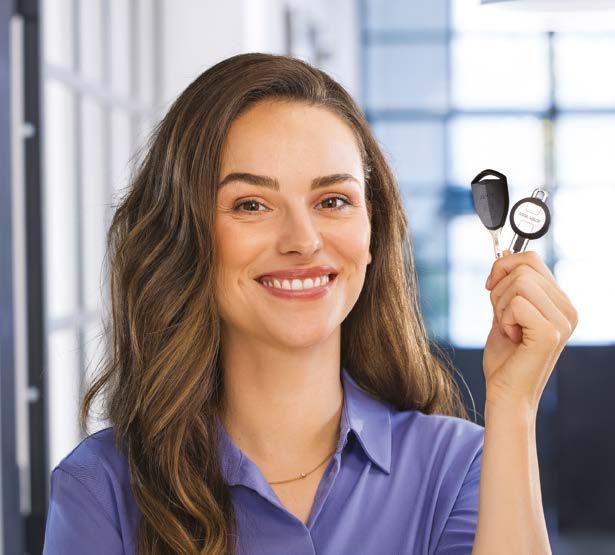
Take your access management into the digital era – smoothly, securely, and without overhauling existing infrastructure. With CLIQ, you upgrade from mechanical to digital access at your own pace to gain greater control today and adaptability for tomorrow.
Download our whitepaper to learn more about making the switch to digital access
Editor Chris Hewett editorial@mebmedia.co.uk
Accounts Jay Kempisty accounts@mebmedia.co.uk
Publisher Wayne Banks +44 (0)1622 201207 wayne.banks@mebmedia.co.uk
Website and Circulation Manager
Kevin Villa website@mebmedia.co.uk
Design and Production
Charles David production@mebmedia.co.uk
In Security Magazine is published 6 times a year by
MEB Media Publishing Ltd
13 Princes Street Maidstone Kent ME14 1UR
United Kingdom Tel: +44 (0)1622 201207, info@mebmedia.co.uk www.mebmedia.co.uk
Articles and art may not be reproduced or reprinted without the express written permission of the publisher.
Exclusion of Liability
Although every effort will be made to ensure the accuracy of all materials published, the publisher takes no responsibility for errors or omissions.
Copyright © MEB Media Publishing Ltd 2010 - 2024, all rights reserved.




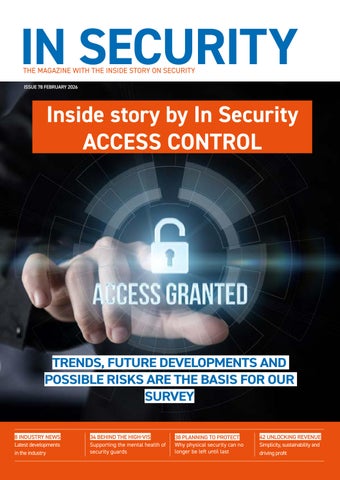
4 Inside story by In Security: Camera surveillance Trends, future developments and possible risks are the basis for our survey
12 Product & Industry News
Latest developments from the security industry
26 The Security Exhibition 2026
Europe’s most anticipated security exhibition returns to NEC Birmingham for 2026
30 State of Security and Identity Report
Identity convergence drives focus on trust and protection
34 Behind the high-vis Supporting the mental health of security guards
38 Planning for protection
Why physical security can no longer be left until last
42 Unlocking new revenue Simplicity, sustainability and driving profit

Jeremy Malies, content editor at In Security Magazine, assesses the driving forces in the access control market. The areas of focus include biometric & mobile credentials, artificial intelligence (AI), pros and cons of access control as a service (ACaaS), and pressure from budgetary restraints as costs rise.
The article looks at vertical sectors for access control where requirements may be unusual or demanding, and what vendors and
consultants are doing in terms of system design. Sectors lending themselves to innovative access control include pharmaceuticals, petro-chemicals, construction, mining, flexible workspace sites and shared occupancy buildings.
Background
Access control offerings have progressed greatly from the days when you often found yourself performing the ludicrous task of inputting your date of birth into a
keypad. Product suites now focus more and more on biometric systems with speed of access being crucial. Visitors to major corporate sites expect to be issued with passes in advance by email so that pre-vetting can be done by facility managers. When you go to the premises, it’s likely that you will already have received a QR code on your mobile. Mobile phones can of course be compromised but much can be done in terms of judicious use of public wi-fi, avoiding unnecessary Apps,
premium antivirus software and awareness of phishing attacks.
In the lead-up to my visit to a high-security site, a conscientious facility manager might ask, “Just who are In Security magazine? Should their content editor, Jeremy, be here? Can he provide supporting information?” Come the day, the QR code gets the visitor through the turnstile or other physical barrier or merely reassures reception staff that this is a legitimate guest.
No access control vendor would market their products now on the grounds of ability to create a hierarchical system of entry privileges. Such functionality is a given. And yet, applying artificial intelligence as a failsafe against bad hierarchy decisions on access seems wise. I often wonder if excessive deference and failures in commonsense might leave a facility prone to attack or theft. It would for instance be unwise for any organization to put me in charge of its physical security. My impulsiveness and trusting nature might see me do something ludicrous such as giving the chief executive officer of a hospital board an access-
all-doors privilege level. A moment’s thought makes it obvious that unless his/her core competence lay in those areas, no hospital would want the security credentials of its CEO to give them entry to a server room or a pharmacy. Such an access request would have to be the result of their ID being stolen by an intruder intent on IT sabotage or theft of drugs with street value.
Security credentials according to generation
Credentials held on a phone or smartwatch, perhaps a QR code that might be for one day only, is the approach that is best suited to anybody from Gen X or younger. It is also the most intuitive. Gen Z (the first truly digital-native generation who will likely have been given a phone when they hit adolescence) may even be dismissive of a fob or card. And a card is a dumb item that can be passed around or stolen. If I were a miscreant working from the inside either alone or with an accomplice, it would be difficult for me to say credibly to human resources, “I picked up Jeremy’s phone unwittingly and used it to
open a door” or “Jeremy gave me his phone!”
Biometrics and mobile credentials
“All About You” was a hit record for British pop-rock band McFly. And innovative access control vendors who are focusing on biometrics want entrances to places of work, leisure and residence to, indeed, be all about you. There is a security industry adage that badges are items that you have and pin codes are something that you know. But biometrics – be it your fingerprints, iris or voice – are what you are.
Driven by the needs of end users at sites where trespass can have disastrous consequences in terms of reputation not to mention commercial losses, innovative vendors are looking to offer doors, gates, barriers and turnstiles where the reading/ activation device responds solely to biometric information. With the possible exception of the custodial sector, the trend in mission-critical environments is away from traditional keys. Increasingly, even cards have become legacy technology and there is a vogue for near field communication (NFC) credentials
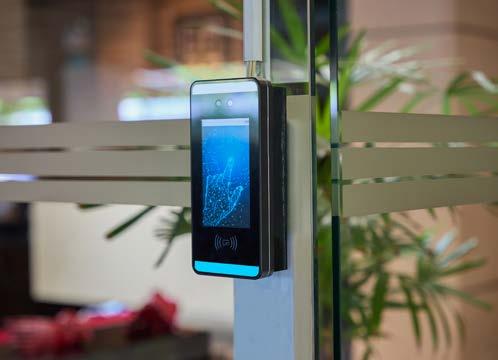

stored in digital wallets most usually on a smartwatch. But waking in the morning to single-digit battery charge on phone or smartwatch will be familiar to most of us. Biometric credentials truly are the most robust identification approach.
Building sector benefiting from biometrics
With redress for workplace accidents resulting from negligence or malpractice extending right up to charges of corporate manslaughter against CEOs, few industries are more vigilant than the construction sector in its protection of sites and overseeing of work practices. High incidence of “buddy punching” (one worker clocking in or out for another), use of equipment such as forklift trucks by unqualified operatives, and breaches of general health & safety protocol mean that managers are very keen to control movement around and access to sites.
With construction workers often wearing gloves and likely to pick up dust and aggregate particles so rendering fingerprint scanning
difficult, building sites are making increasing use of facial recognition cameras at entry points such as turnstiles to allow workers on site. This gives a live headcount and helps with mustering in the event of evacuation. It also makes buddy punching and tailgating all but impossible. Safety and compliance rules can be applied at the entrance points. It’s pleasing to note that modern facial recognition can cope with workers wearing a hardhat.
Products of particular value to those managing construction workforces are offered by Biosite Systems based at Solihull in the UK’s West Midlands. The company specializes in innovative access control for construction sites with the suite including facial recognition with (a sign of the times) optional integrated temperature measurement.
The solution is completely contactless and valued by users for real-time visibility which is reassuring for management. Facial matching is achieved in less than 0.2 seconds and workers are
automatically locked out of site if there is an attempt at spoofing or an accreditation has expired. The offering also includes smartcards and fingerprint scanning. At smaller, often linear construction sites, managers can use the Biosite Mobile app on their phones to apply facial recognition scrutiny to workers seeking access. Biosite Systems have an impressive set of case studies with their construction client Bowmer + Kirkland. Biosite Systems are an ASSA ABLOY company.
Biometric access control is increasingly popular at leisure venues, notably sports stadiums where history teaches us that fan bottlenecks/choke points must be avoided at all costs. There will soon be case studies in the trade press where season ticket holders load a selfie onto their club’s system and gain entry by simply looking at a camera. This is preferable to printing out a ticket at home or barcode/ QR code scanning from a dimmed low-battery mobile.
Much of this remains in the near
future and there have been some less-than-accurate claims from vendors about facial recognition usage at British football grounds. Supporters’ associations have voiced legitimate concerns about privacy and data management, but if the technology is used responsibly (with opt-out alternatives) and scrutinized by third parties, it will surely be to the benefit of everybody.
Facial recognition in the US
I have found one well documented case study of fans using facial recognition to enter a stadium, this being the Intuit Dome in Inglewood (California) whose main use is as the basketball home for the Los Angeles Clippers. The technology, GameFace ID, was implemented in 2024. Signing up for the system is voluntary; fans can always opt out if their preference is for traditional payment and entrance methods with stewards always on hand.
Scrutiny of how data is collected and retained is rigorous. In the first six months of usage, more than 400,000 fans became users of this frictionless solution. It should be noted, if there are any sceptics, that the technology mitigates the risk of alcohol sales to those under 21. Again, to optimize spectator safety and reduce the risk of ticket forgery, GameFace ID uses Bluetooth sensors
to report on seat presence.
Facial recognition technology has either been used, is being used or is under trial at venues including FirstEnergy Stadium in Cleveland (home to NFL side the Cleveland Browns), the multi-purpose Mercedes-Benz Stadium in Atlanta, and the Citi Field baseball stadium in New York used by the New York Mets.
Authorities in charge of border crossings have proved early adopters of biometrics. Last summer, my holidays saw me criss-cross between Serbia (non-EU) and Hungary which is an EU member and thus in the Schengen Area. Like anybody in the industry, I compulsively watch security technology in action even during my leisure time. Crossing at Kelebia, Serbia, by coach into Tompa, Hungary, my Irish passport minimized any fuss across this external border of the EU.
But there were delays as passengers from non-EU countries walked to booths where facial photographs were taken and scans given from four fingers of the right hand. This is one of the first implementations of the new European Union Entry/Exit system (EES) that mandates biometric border checks. EES is also being
implemented at border crossings between Serbia and Croatia, these being on another external border of the EU. The system is an illustration of what is now known as the “Brussels Effect” whereby EU regulations become de facto global standards.
Access control exploiting artificial intelligence (AI)
The essence of artificial intelligence in present-day access control is that it moves us away from static rules to adaptive behavioural analysis, a means of decision-making that demonstrates self-learning. AI can alert site managers to behaviour that is not unauthorized but sits just off kilter, beyond the baseline of typical activity and therefore warranting attention. Richard Dawkins berates anybody who confuses drastic change in the short term with evolution. But AI is making constant incremental changes to bring the access control sector to something better than axiomatic decisions. Dawkins might allow us to say that this niche part of our industry is truly evolving.
My survey here suggests that AI is doing much to reduce the threats to biometric access control from fraudsters and other criminals (including political protestors resorting to criminal acts when desperate). Deepfakes such as


masks and silicone fingers show determination by criminals to commit identity fraud, but there are now sophisticated algorithms for liveness detection. Identification is not just a question of looking at static images; there is assessment of eye movement, skin reflection and blood flow.
Biometric access control enhanced by AI
An area in which biometric access control is being made possible by AI is voice activation of doors and other entrance points. In 2001: A Space Odyssey, HAL (the sentient supercomputer) famously refuses to open the pod bay doors. If he had opened them, it would have been through voice activation. But voice-controlled doors are now revolutionizing how many people move through buildings in the real world. Post-Covid, contactless door usage has attractions.
Demand for this technology is also driven by mandates and general efforts to cater for the needs of the elderly and those with mobility challenges. Voice activation is no
more difficult for a wheelchair user than it is for the able-bodied or for an able-bodied person who is perhaps in charge of a palette of goods or a patient on a trolley. The technology scores well in terms of general inclusivity.
Machine learning for voice identification
I’ve long known that walking patterns (gait) is far more subtle than one might suppose, and video analytics can exploit this in order to identify unusual behaviour and people who might be agitated, smuggling contraband or perhaps conducting hostile reconnaissance at an infrastructure hub. Machine learning models for voice analytics (also known as speaker recognition) look at pitch, cadence, tone and projection – these qualities being independent of language even when the languages are notably different such as Arabic contrasted with the Latin languages.
A staff member’s voice is recorded as a voiceprint while they speak in everyday naturalistic tones. This forms an encrypted model. It is not stored as audio but becomes
a mathematical sequence which reduces the possibility of reverse engineering. When the user seeks entry to premises or wants to make some other demand of equipment, a comparison (with a degree of latitude) is made. Access or permission will be granted if there is a match, with the latitude even making allowances for factors such as slight illness.
Robust against spoofing
The technology is respected by installers and consultants for being robust in terms of attempted spoofing and deception by deepfakes. From here, it’s hardly a conceptual leap for there to be a hierarchy of access privileges by which your voice allows you to open some doors but not others, access the site at particular times etc. This is all familiar to us, but as an external observer with intermediate knowledge at best, it still impresses me greatly.
Any technology that reduces physical contact with objects is appealing to specifiers and end-users. The technology fits well with the Internet of Things and the
general trend towards urbanization. Are there any drawbacks? The spectre of hacking will always remain in the minds of managers, up-front costs are high and there is a need to educate people as to the benefits.
If there is an element of AI usage in access control that is particularly impressive it is surely the ability of machine learning to identify even minor anomalies and often predict a significant threat before it happens. Is there a catch or limitation?
The most notable limitation is simple costs, with allocated budgets obviously varying according to the seriousness of the consequences if access control is compromised. The amounts of data that AI needs to “train” itself effectively can be vast. This can be a hurdle not just in terms of cost but man hours required to collect the data and put it in place. False positives and indeed false negatives are inevitable as an AI system is bedded in, and once AI acquires its own momentum the decision-making criteria of the algorithms can become opaque to the overseeing human intelligence.
Vertical sectors making innovative use of access control
Anybody who attends meetings with startups or small companies will have noted the rise of flexible workspace providers who allow business people to meet in city centre and financial hub locations where actual rents would be prohibitive. Such sites require flexibility of user privileges and quick issue of credentials be these on a smartphone or through biometrics such as fingerprint or even iris recognition.
ASSA ABLOY has a UK case study with such a provider, this being Clockwise, a company that offers workspace at locations right across Europe. The facilities include hot desks, permanent desks, offices, meeting rooms and “Zoom rooms” that are now benefitting from ASSA ABLOY’s Incedo™ software solution. Incedo™ is a scalable software platform tiered at Lite, Plus and Cloud. It is being used at these flexible workspace sites with Aperio wireless locking devices and Incedo™ door reader modules as well as cluster controllers reporting to Incedo™ Business Cloud. Documented end-user benefits
include the ability to update cards remotely and dispense with the need to issue new cards in person.
Multi-tenancy and multi-use buildings ask testing questions of access control equipment and its deployment by integrators and facility managers. (The range of uses can even extend to a mix of commercial and residential occupancy.) Combined usage of buildings is an aspect of increasing urbanization that makes regulatory compliance difficult. The assets to be protected can range from equipment to data and of course, above all, people.
Access control as a service (ACaaS) Even vendors who were initially sceptical about ACaaS are now accepting it as a model and including it in their offerings. Take-up is influenced by the client’s existing IT infrastructure (degree of interconnection within the site or between a group of sites) and the possible repercussions of the premises being compromised during Internet outage either from the outside or triggered by a disaffected insider.
Would-be ACaaS users need to ask themselves how important it is to have redundancy? Privacy concerns (sensitivity of company data) and whether the client is moving generally to being a smart building while embracing the Internet of Things (IoT) can be factors that make ACaaS attractive or a non-starter. If an industry is rigorously overseen by an ethics watchdog, it may be that ACaaS is simply not allowed in terms of compliance.
Seamless upgrades with prompt implementation will be attractive to on-site engineering staff, while the prospect of monthly or yearly payments without ever owning the equipment could be a turn-off for a financial director. It’s a given that ACaaS puts a premium on multilayered defence against hacking in an environment where breaching the mobile phone of a single employee could prove problematic.
It is scaremongering to suggest that a single breach of this kind will compromise an enterprise-wide system but encryption and defence in multiple layers needs to be of
the highest order. Data is at its most vulnerable when new user details and activity reports are being transmitted to the vendor’s central platform. Over a decade ago now, I watched the first ACaaS offerings become commercially viable. It was soon obvious that the approach was ideal for any business working with franchisees and this continues to be a lucrative market.
Transition is fraught
Real-time monitoring, flexibility and optimum scalability are major advantages of ACaaS. The transitionary phase from a system where all the components apart from perhaps offsite data backup are held locally to a Cloud system must be fraught with difficulty however experienced the vendor is in easing clients through a migration. Fields such as roadworks, rail construction/ maintenance and open-cast mining suggest themselves as ideal sectors to benefit from Cloud-based access control if there is cellular connectivity. Just as it can be expanded easily, ACaaS can also be scaled down promptly which is ideal for remote works sites.
I have seen bullish ACaaS vendors refer to access control where equipment resides at the core as “legacy”. Well not just yet, and Cloud systems obviously fall short of being a universal solution. Even with an attentive vendor, the demands made on in-house engineering staff may be greater than what has been required to run the local system so there will be a knowledge gap.
It is paramount that data is protected not just in transit (the obviously vulnerable stage) but also at rest. Interoperability with video surveillance cameras and VMS systems is a given now with any Cloud provider. This can be counted as a major plus for ACaaS when prospective users are deciding whether or not to implement it. ACaaS can contribute to broad business intelligence when it interacts with CCTV which can also be overseen on a Cloud model. Remote management of access control with the macro perspective that this brings fosters good decisions about energy consumption
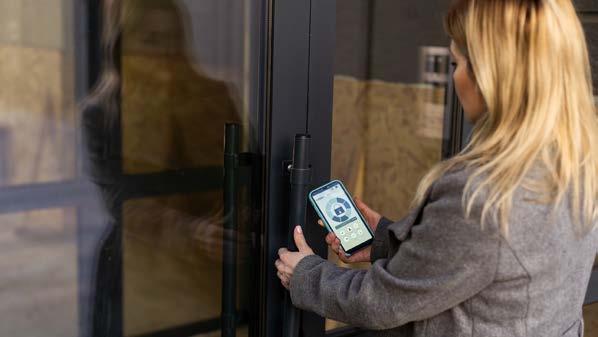
and awareness of which parts of the site are underused.
ACaaS fosters a collaborative approach. In all but military-grade and critical national infrastructure (CNI) sites, it’s apparent that access control can double and treble up with visitor registration systems and time & attendance. I can recall from at least a decade ago being shown round a branch of the French supermarket chain Hyper U in the Loire Valley where an ACRE Security access control system was proving flexible. The platform was not only securing entrance and egress but also allowing general logistics managers to optimize movement around the site and even contributing to safety by ensuring staff did not become locked in chilled areas or spend more time in them than best practice recommends.
Centralized offerings such as ACaaS that can multi-task bring major cost savings and are appealing at a time when budgets are straitened. They allow security managers to work alongside their general logistics colleagues to look at site-wide movement, footfall and energy usage. Colleagues can collaborate to assemble broad datasets while
also mitigating risks from intruders, internal miscreants or simply enforcing good risk management protocol. But unless the organization already has a high level of IP connectivity, set-up costs for Cloud access control are likely to be significant and return on Investment (RoI) will be slow to medium.
Effective interaction with building management systems (BMS) and even Heating, Ventilation and Air Conditioning (HVAC) can have a positive effect on profitability by reducing labour costs, avoiding false or nuisance alarms and minimizing call-outs to remote sites. Disparate systems working from a single platform can produce economies by reducing repair bills through intelligent preventative maintenance. It is possible to produce compelling arguments for implementing ACaaS on the grounds of lower total cost of ownership. And yet, initial investment can be prohibitive.
So where is the access control sector headed? It should be remembered that access control is usually only a component within overall building management. Buying behaviour will lie within the macroeconomic perspective. The trend for access control to be automated through
attribute-based decisions rather than a set of inflexible predefined rules being used to say “yes” or “no” based on a single credential is impressive. Factors such as the person’s role, the time of day, their previous pattern of movement and their training certifications will all contribute to whether an access privilege is granted.
Perhaps even more importantly, if access is denied then the system’s innate intelligence will drill down to evaluate the staff member’s behaviour. A simple “allow” or “deny” decision pattern is outdated. A set of movements across the site might be legitimate according to protocol but simply non-standard. Even if the irregular behaviour is innocent, middle and senior managers will want to understand it in order to focus on atypical incidents that really matter. Perhaps it is in the realm of collaboration that access control is scoring highest? The sector is now quicker to implement advances from other engineering disciplines than at any time this century. The more that AI is taught and learns for itself, the closer we will come to making optimal decisions at all times. Expect the decade to continue with less friction and more collaboration, at least in this subset of the security industry.
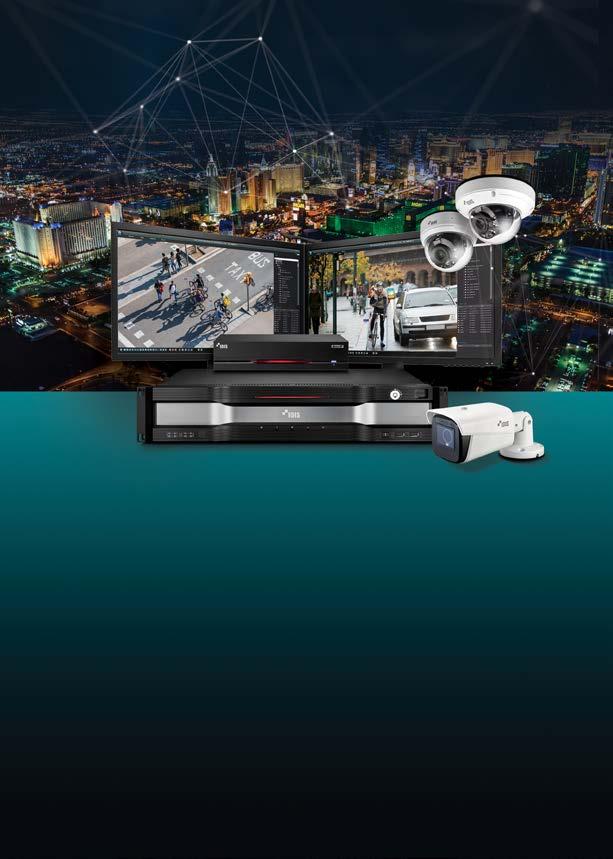
IDIS is transforming video surveillance with an advanced choice of edge cameras, AI box devices, servers, and software ― innovations that make it easy to supercharge your operations without the burden of ongoing maintenance agreements or device connection costs.
Regardless of the size or type of your business, regardless of your operational priorities, IDIS makes it affordable to harness the power of AI video with solutions that give you optimized security and safety plus actionable business intelligence ― all with industry-beating accuracy.
And our expanding AI video range upholds the IDIS promise of plug-and-play installation, robust performance, and a low total cost of ownership.
HID’s new M1 Transparent Gateway solves Europe’s high-security compliance challenge without operational disruption
Introducing The Industry’s First Add-On Cryptographic Security Gateway to Deliver Transparent Architecture Without the Need to Rip and Replace Existing Access Control Infrastructure
HID, a worldwide leader in trusted identity and physical access control solutions (PACS), announces the HID M1 Transparent Gateway — a security module that sits between existing OSDP (Open Supervised Device Protocol) controllers and readers to perform all cryptographic operations in a secured location. As a first-of-its-kind solution, it enables organizations to achieve transparent architecture compliance without the need to replace their existing physical access control infrastructure.
High-security facilities across Europe increasingly face regulatory mandates requiring transparent architecture — a framework where cryptographic operations occur in physically secured locations rather than at vulnerable perimeter readers. France’s ANSSI (Agence nationale de la sécurité des systèmes d’information) CSPN certification already requires this approach, with similar frameworks under consideration in other countries.
Until now, organizations had limited options: deploy entirely new transparent architecture systems from the ground up or forgo opportunities in markets where these requirements apply.
“Security teams shouldn’t have to choose between compliance and protecting their existing investments,” said Jos Beernink, HID’s VP of Europe for PACS.
“The HID M1 Transparent Gateway changes this. Organizations can now meet the most stringent transparent architecture requirements while continuing to use their current controllers, PACS software, and credentials. It’s compliance without compromise.”
The HID M1 sits between existing OSDP controllers and readers, handling all transparent architecture
cryptographic operations independently. From the PACS software’s perspective, the controller continues communicating exactly as before. Each main node supports up to eight transparent HID Signo™ readers, with a dedicated key module storing encryption keys under sovereign organizational control.
Benefits include:
Compliance with complete control: The HID M1 eliminates cryptographic operations at perimeter readers, meeting transparent architecture standards such as France’s ANSSI CSPN. Organizations maintain exclusive control over encryption keys through centralized administration via HID Linq Key Manager.
The HID M1 is controller-agnostic, working with any OSDP controller.
Flexible, door-by-door deployment: Unlike solutions requiring systemwide transformation, the HID M1 enables incremental upgrades. Organizations can secure only the entry points that require transparent architecture, scaling based on security priorities and budget while preserving existing controller and PACS investments.
Zero operational disruption: The HID M1 integrates seamlessly with existing PACS and does not require software changes. Current MIFARE DESFire cards and HID Signo readers continue functioning. Existing workflows, maintenance agreements, and staff training remain unchanged, meaning deployment requires zero downtime.
Future-ready architecture: An AI-capable processor enables future intelligent security capabilities, while software updates keep the system current as threats and compliance requirements evolve.
The HID M1 Transparent Gateway is available from selected partners in Europe now. Learn more about the HID M1
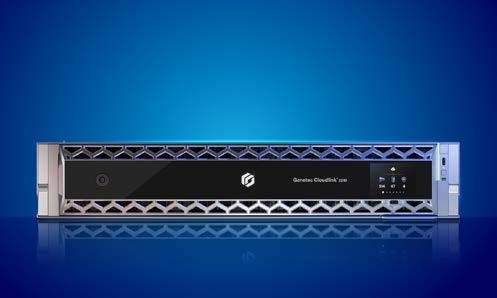
New high-density appliance enables enterprises to scale cloud-managed physical security without forcing cloud-only storage or infrastructure replacement
Genetec Inc. (“Genetec”), the global leader in enterprise physical security software, today announced Genetec Cloudlink™ 2210. Designed for complex, enterprise-scale deployments, the new cloud-managed appliance addresses the practical challenges enterprises face when adopting a cloud-managed model at scale, including cloud storage costs, support for existing devices that do not enable direct-to-cloud connectivity, and the need to maintain local operation during connectivity disruptions. With a stackable, 2U rack-mount form factor, the Cloudlink 2210 enables large organizations to extend cloud-managed security across high-density, mission-critical environments without redesigning their existing infrastructure.
Like the rest of the Genetec Cloudlink line, the 2210 supports multiple workloads, including video management, access control, and intrusion, in a single appliance. By consolidating these workloads into one appliance, it reduces system sprawl, simplifies management in large-scale environments, and lowers operational overhead.
Unlike solutions that separate workloads across multiple proprietary systems, Genetec Cloudlink 2210 is built on an open architecture that supports a wide range of third-party devices, including cameras, access control systems, and intrusion panels. This enables organizations to modernize at scale within a unified, cloud-managed model designed to preserve architectural flexibility, while securely integrating existing hardware, maintaining business continuity, and reducing migration risks.
“Enterprises don’t want to choose between innovation and operational certainty,” said Christian Chenard Lemire, Product Director, Unified Solutions, Genetec Inc. “With Cloudlink 2210, we’re redefining
what cloud-managed physical security looks like at scale by giving organizations the freedom to modernize on their own terms, control long-term costs, and maintain the resiliency and continuity their most critical environments demand.”
Designed for scale and flexibility
Cloudlink 2210 supports hundreds of connected devices per appliance and provides up to 240 TB of local storage per unit, making it well-suited for deployments with high device density and long retention policies. The Cloudlink 2210 is ideal for enterprise environments where uptime and local retention requirements are operational priorities because its design minimizes dependence on cloud storage, helping organizations control long-term storage costs while maintaining the performance and availability required in enterprise environments.
Resiliency for environments that cannot afford downtime
Cloudlink 2210 also incorporates hardware-level resiliency to support strict uptime and retention requirements. RAID-protected storage and redundant system components help ensure data protection and OS availability. Security workloads continue operating locally, independent of cloud connectivity, allowing deployments to maintain continuity even during network disruptions. Dual network interfaces provide redundancy and support network isolation to strengthen cybersecurity.
Scaling without infrastructure overhaul
Cloudlink 2210 scales by adding units as requirements grow, enabling organizations to increase device counts and storage capacity without redesigning their infrastructure. Centralized cloud management maintains visibility and control across deployments.
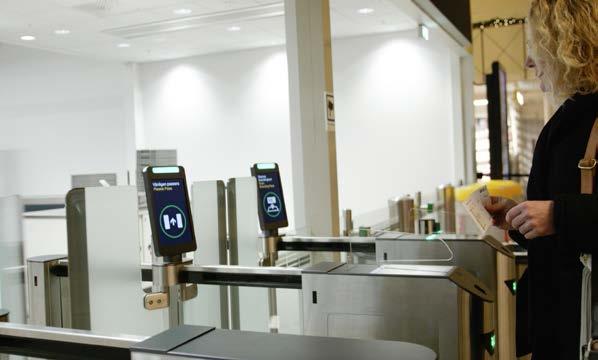
Gunnebo Entrance Control will return to Passenger Terminal Expo 2026, showcasing how latest intelligent entrance control solutions can support secure, efficient and passenger-friendly airport environments.
On stand B290, as a global provider of stylish entrance control solutions, Gunnebo Entrance Control will demonstrate a range of boarding, pre-security and immigration gate technologies designed to respond to the operational, spatial and aesthetic challenges faced by smart terminals.
Visitors to the stand will see several configurations from the AFL airport gate portfolio, highlighting flexibility in both performance and design. The AFL Ultra Compact in white, is a solution engineered for locations where space optimisation is critical without compromising security or throughput.
Says Nathan Anstee, VP of Mass Transit at Gunnebo Entrance Control: “Airports are under increasing pressure to process growing passenger volumes efficiently, while still delivering a safe, intuitive and comfortable experience. Our focus is on developing entrance control solutions that are intelligent, adaptable and designed around real operational needs. By offering a range of gate formats, finishes and detection capabilities, we help airports create environments that improve flow, enhance security and remain flexible as requirements evolve.”
The AFL Compact will be on display in black, demonstrating a balance of robust functionality and contemporary styling, while the AFL 3.6 in stainless
steel will illustrate durability and suitability for hightraffic airport environments.
The stand will also feature the AFL HS, a new system offering enhanced performance capabilities for demanding airport applications. Complementing the AFL range, ImmSec will be showcased in both black and white, underlining Gunnebo Entrance Control’s ability to deliver cohesive entrance control solutions that integrate seamlessly into a wide variety of terminal designs.
The solutions on show at Passenger Terminal Expo demonstrate how entrance control can be tailored to suit different airport requirements, from spacerestricted areas to high-traffic zones, while maintaining consistent security performance and passenger flow.
Nathan added: “Passenger Terminal Expo is a vital platform for meaningful conversations with the global airport community. We look forward to welcoming visitors to demonstrate our latest entrance control solutions and to discuss how they can be tailored to support bespoke requirements and create safer, more efficient and future-ready airport terminals.”
Gunnebo Entrance Control invites attendees to visit stand B290 at Passenger Terminal Expo to experience the latest developments in airport entrance control and explore how its solutions can support evolving terminal requirements.
For more information please visit https://www.pte-world.com/
























































This April Paxton will launch Solo, a brand-new access control system designed to transform how installers and end users manage security. Developed by Paxton technology specialists, and backed by 40 years of industry innovation, the system is phone-based and cloud-hosted, marking the beginning of a new era in access control.
Adam Stroud, Paxton’s CEO, explains: “We’re always exploring how evolving technology can help Paxton installers and customers. By starting with a blank sheet of paper and looking at the technology available today, we’ve developed something truly game changing. It is simple, elegant, and a practical solution that will open new possibilities in access control. April marks the start of a new era, and we can’t wait for installers to see what’s possible.”
Access control is evolving fast. Installers and end users are looking for systems that are simple to install, easy to manage remotely, and flexible enough to scale. Mobile credentials are on the rise, and security expectations remain higher than ever.
In response, Paxton has been exploring how emerging technologies can reshape access control for the modern world and is set to deliver its biggest technology year yet.
Installers interested in experiencing the new technology first-hand can do so at the Paxton Tech Tour, running at great locations throughout the UK in the spring and summer of this year.
Attendees will get the first look at Solo and a free one door kit, as well as learn how to fit and benefit, and get exclusive updates on Net2, Paxton10, PaxLock & Entry.
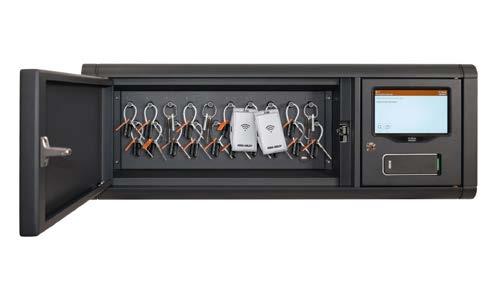
Traka, an ASSA ABLOY company and the global leader in intelligent management solutions for keys and equipment, announces the release of Traka Touch Core, a compact electronic key cabinet designed to deliver professional-grade key control for small and mid-sized organisations and multi-site operations.
Across numerous industries, managing physical keys remains a persistent operational challenge. Manual key safes, paper logbooks and entry-level electronic cabinets lack visibility, accountability and reliable audit trails, leaving companies exposed to lost assets, compliance gaps and operational delays.
Traka Touch Core, the latest release in the awardwinning Touch line from Traka, is purpose-built to address this gap. Designed specifically for smaller operations and distributed environments, Core delivers trusted Traka reliability in a compact, affordable, standalone cabinet. Supporting up to 20 secure key positions, the solution provides controlled access, automated key tracking and a tamper-proof audit trail, ensuring companies always know who has which key and when it was taken or returned.
Unlike traditional systems that require network connectivity or complex IT integration, Core operates as
a powerful standalone solution. Its self-install design enables rapid deployment and immediate operational impact, reducing time spent searching for keys, resolving disputes or manually recording transactions. The result is smoother daily operations, improved accountability and reduced risk across teams and shifts.
Core is also designed with the future in mind. Optional upgrades, including network connectivity and integrated access readers, provide a clear path to scale as organisational needs evolve. Multi-site environments can standardize secure key control across locations and introduce centralized oversight over time, without replacing hardware or increasing complexity.
release of Core reflects Traka’s continued commitment to expanding access to intelligent key management solutions that meet real-world operational needs. By closing the gap between enterprise-grade systems and low-cost alternatives, Core enables companies of any size to achieve secure, compliant and efficient key control.
For more information about Traka and our innovative solutions, please visit our website at www.traka.com
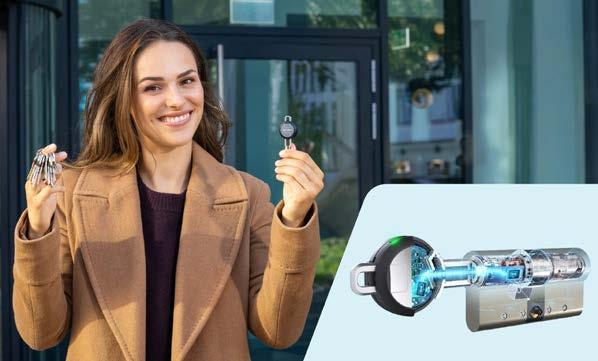
Security, cost-management, and compliance demands placed on building managers have grown significantly.
The key to meeting them all without increasing workload and costs could be the strategic implementation of smarter digital access, as a new whitepaper explores.
As organizations upscale, downsize, or onboard new locations faster than ever, facilities managers must be able to manage access flexibly and to adapt on the fly. The boom in service contracting means many essential building functions are now handled by third-party providers rather than employees: they need access to complete their work while keeping the premises secure. At the same time, new access and security solutions must battle for budget and justify their total cost of ownership (TCO), producing real returns on investment (ROI) in the process.
Mechanical locking was never designed for this kind of demanding, dynamic environment. Yet it is becoming the ‘new normal’ in many sectors.
In addition, physical, cyber and ‘hybrid’ physical-cyber security threats loom larger than ever, as do strict regulations designed to protect critical sectors from these threats, including the EU’s NIS2 guidance and forthcoming Cyber Resilience Act (CRA)1. Clearly, compliance within a complex regulatory landscape and the implementation of joined-up security and access management are critical challenges, particularly in sectors on which NIS2 obligations fall most heavily: infrastructure, finance/banking, healthcare, energy,
transport, and ICT sites such as data centres.
Programmable key access management
One valued benefit of the mechanical key is its familiarity. In many cases, a mechanical locking system with patent-protected cylinders and keys may be the appropriate solution. However, unlike mechanical security, a digital solution offers the ability to allocate time-based rather than blanket access authorizations, and to amend them quickly and flexibly. A digital credential, such as a smart key, can be programmed or de-authorized in seconds, negating the threat of a lost key in circulation, not to mention the cost of changing cylinders and re-keying. The ability for building technology to connect solutions for access, fire protection and escape routes, for example, may also enhance user safety and facilities management.
With a digital solution, audit capability is automated for each lock and user, benefitting compliance efforts; manual access tracking with mechanical keys is either time-consuming or, in many cases, impossible. Tracking and tracing access is one requirement of NIS2 regulations.
To learn more about switching from mechanical to digital access management, read the Whitepaper “The move from mechanical to digital locking” in full at https://www.assaabloy.com/group/emeia/stories/ access-stories/switch-to-digital-access.



HID Converged Credentials helps security teams close identity gaps, simplify credential management and strengthen their overall security posture without adding operational complexity Cardiff, UK.
HID, a leading provider of trusted identity solutions, today announced the launch of HID Converged Credentials, allowing organizations to secure their facilities and manage employee identities and credentials through a single, unified platform. Designed to give security teams a practical path to modernize their identity architecture, the solution consolidates physical and logical access under a single phishingresistant credential, reducing vendor complexity and strengthening security posture without disrupting existing infrastructure.
For most organizations, securing a building and securing a network are treated as two separate disciplines, often with separate vendors and separate credentials. An employee may badge into the office with one card, log into their computer with a password and authenticate to cloud applications with another method. With different systems and credentials operating in isolation, the potential points of failure multiply, creating gaps that are difficult to audit and expensive to manage.
At the same time, the threat landscape is evolving, with AI-enabled attack methods making credential-
based vulnerabilities harder to ignore. Organizations that unify how they govern identity across physical and logical environments are better positioned to stay ahead of those risks.
“Our customers have trusted HID to secure their facilities for decades. HID Converged Credentials is a direct response to what they’re telling us: they want fewer vendors, less complexity and a credential that works everywhere, from the front door to the desktop and the cloud. We’re uniquely positioned to deliver that, because identity is in our DNA,” said Daniel Gundlach, Vice President and Head of Business Unit, NAM - PACS, HID.
This sentiment is widely shared across the industry. According to HID’s 2026 State of Security and Identity Report, which surveyed more than 1,500 end users and industry partners, 75% of organizations have already deployed or are actively evaluating converged identity solutions. Identity management ranked as the top strategic priority across all categories surveyed, with 73% of physical security professionals identifying it as a leading trend and 60% planning to increase investment in this area. Yet despite clear demand, 52% still cite the complexity of managing fragmented identity systems as their greatest barrier to progress.
For more information on HID Converged Credentials solution, please visit the website.

Mayflex, the distributor of Converged IP Solutions, has further strengthened its external security team with the appointment of Dan Miller, who will focus on the London and South-West.
Dan joins Mayflex from Veracity, where he served as the Lead UK Systems Sales Manager. He brings extensive experience from across the security sector, having previously worked as a Senior Security Consultant at Westronics Ltd, supporting a wide range of projects and customer requirements.
Francesco Bellavia, Director of Sales for Security at Mayflex, commented: “We are delighted to welcome Dan to the team. He brings a wealth of experience in security and access control, a strong commitment to customer service, and a clear drive to succeed - all of which align perfectly with our ‘driven to deliver more’ philosophy. Dan will be working closely with new and existing customers to support their security and access control needs, ensuring they receive the highest levels
of service and technical expertise.”
Frankie continued “Dan will be quickly getting up to speed before taking responsibility for selling and supporting our full portfolio of security solutions, including Avigilon Unity, Avigilon Alta and, Axis, Hikvision, Milestone, Mobotix, Paxton, Pelco, Secure Logiq, Suprema and Veracity. Additionally, he will offer a full suite of infrastructure products from Excel to provide customers with a total installation solution.”
Frankie concluded “In the first few weeks Dan will undergo a comprehensive induction to bring him up to speed on the brands and all about Mayflex.
For anyone needing to contact him, he will be available at Dan.Miller@mayflex.com.
For further details on the full range of security products distributed by visit the Mayflex website



Gunnebo Safe Storage has introduced TransitGuard, a mobile vault solution designed to provide certified physical security in locations where permanent secure infrastructure is not available.
TransitGuard is constructed with a reinforced container format and engineered to meet recognised European burglary resistance standard (EN1143 - 1.)
The solution is intended for organisations requiring high levels of physical protection during transport, temporary deployment or operations conducted outside fixed facilities.
Typical use cases include defence and security operations, critical infrastructure projects and environments where assets must remain protected while being moved or deployed in the field.
“Organisations are increasingly required to secure high value or sensitive assets across temporary sites, transit points and decentralised operations, where a traditional vault infrastructure cannot be installed,” says Jacob Duhan, Head of Defence at Gunnebo Safe Storage. “TransitGuard was developed to address this by extending certified vault level protection to environments that were previously difficult to secure to the same standard.”
The mobile vault is compatible with standard logistics and transport systems, enabling movement by road, rail or sea. Once positioned, TransitGuard functions as a safe storage environment capable of
protecting field equipment, protective gear, classified documents and materials together with operational tools and combat resources. Its design supports both short term and extended use, depending on operational needs and risk assessments.
TransitGuard can be configured to different security grades and equipped with electronic locking systems, alarm interfaces and internal layouts tailored to specific operational requirements. Additional options such as internal lighting, power integration and environmental controls support usability in a wide range of deployment conditions, while maintaining compliance with applicable security standards.
“By applying recognised security standards to mobile storage, organisations can better align risk management, compliance and operational continuity across transport and deployment phases,” adds Jacob. “This proactive approach in launching TransitGuard helps ensure protection levels remain consistent, regardless of where the asset is located.”
The introduction of TransitGuard reflects a broader shift in how organisations manage physical security across distributed operations. As assets move between permanent facilities, temporary locations and operational zones, security controls increasingly need to be designed around the asset itself rather than a fixed site.

Sometimes a digital system cannot cover all the openings an organization needs. Readers, escutcheons and security locks can equip many doors. But what if they also want to deploy intelligent key-operated locking for alarm boxes, medicine stores, server rooms or power units? Until now, the only secure option was to run two systems in parallel. A new integration between two digital ecosystems puts facilities managers in control like never before.
The SMARTair® wireless access system, part of a suite of connected Digital Access Solutions from ASSA ABLOY, now enables management of CLIQÒ programmable smart keys from the same software interface. When businesses extend their SMARTair digital access solution with CLIQ battery-free cylinders, they implement complete oversight for their premises, including any outdoor spaces. There is no cabling and no more need for mechanical keys – just smart, flexible management.
When CLIQ electronic and electromechanical cylinders are deployed within a SMARTair-controlled installation, security teams can manage even more doors. They can implement digital access almost anywhere, without drilling or causing damage to the building structure. The broad range of openings already covered by SMARTair are supplemented with a range of more than 60 CLIQ and eCLIQ cylinder types, making every access point secure. SMARTair’s intelligent TS1000 software manages and monitors every opening and credential, including smart keys and mobile keys if required.
“For healthcare, education, multi-residential properties, and many more types of building, this new integration puts so much more power in your hands,”
says Mikel Gaztañaga, Sales Manager at ASSA ABLOY Opening Solutions EMEIA. “Building managers gain transparent oversight over every type of opening, from one familiar software interface. It helps them to meet the growing demands of compliance and to control access much farther into and through their buildings.”
“With this new integration of SMARTair and CLIQ, you make life more convenient for everyone who manages or uses your premises. Facilities teams work smarter and more efficiently. Users enjoy a streamlined, unified experience right from the front door.”
One solution, maximum reach
By bringing CLIQ devices into a SMARTair solution, organizations gain fully integrated control and total traceability of access. They can extend access control even to remote locations with durable CLIQ cylinders and programmable keys, all from the familiar SMARTair TS1000 software interface.
In addition, SMARTair’s Wireless online management option gives security teams real-time system control via wireless HUBs. For added convenience, every CLIQ key has an RFID chip inside which can be programmed to unlock authorized doors secured with SMARTair battery-powered devices. Aligning CLIQ with SMARTair gives facilities managers the choice of mobile credentials or RFID credentials (smart cards, fobs or badges) for SMARTair devices, smart keys for CLIQ cylinders or smart keys with RFID tags for both SMARTair and CLIQ devices.
To learn more about SMARTair/CLIQ integration, download a free Solution Guide here
Offer your customers more flexibility from Paxton’s video door entry with a brand-new mobile app.
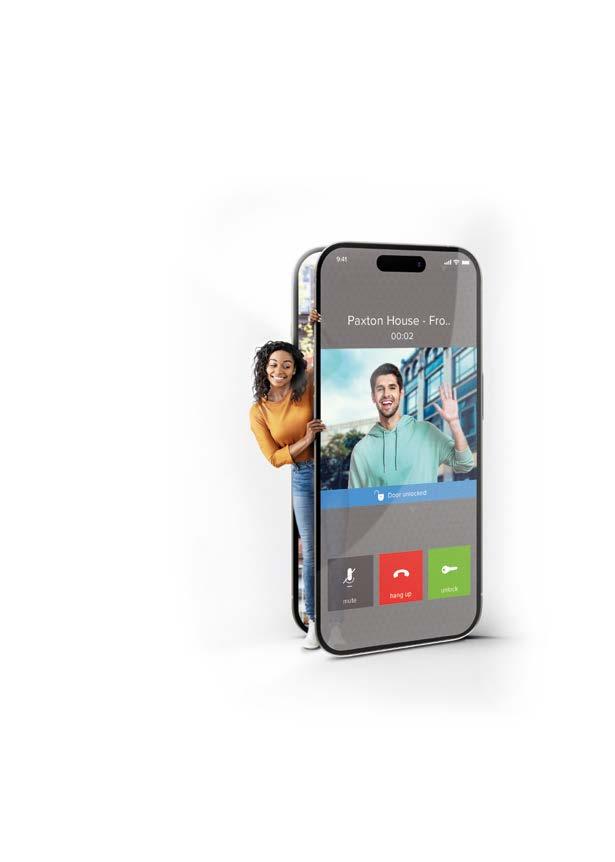
Total convenience Grant access from your phone
Earn recurring revenue Low-cost monthly user license
More opportunities
Ideal for new & existing installs
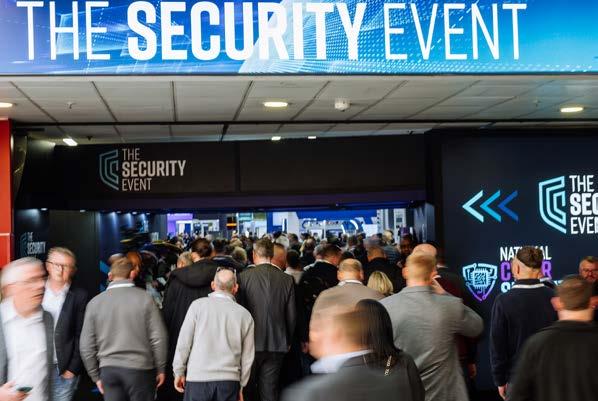
Following a record-breaking show in 2025, The Security Event (TSE) will return to the NEC Birmingham for 28-30 April 2026, bringing together the global security community for three days dedicated to the latest innovations, insights and technologies shaping the future of security.
Now firmly established as the UK’s largest commercial, enterprise and domestic security exhibition, the event will span over 22,000 sqm of exhibition space, welcoming hundreds of world leading
manufacturers, suppliers and service providers showcasing the latest security innovations, technologies and solutions.
Part of the wider Safety & Security Event Series, The Security Event continues to act as a central meeting point for installers, integrators, consultants, distributors, end users and security leaders from across the public and private sectors.
“The Security Event has grown into one of the most important meeting points for the security industry across Europe. What began
in 2019 as a UK-focused exhibition has evolved into a truly international platform for innovation, collaboration and knowledge-sharing,” said Trison Norman, Group Managing Director. “Welcoming our community back to the NEC Birmingham is incredibly rewarding, and we’re proud to support such a dynamic industry as it continues to develop solutions that help create safer environments to everyone. We’re extremely grateful to our exhibitors, visitors and partners for their continued support and commitment to the event.”
Education remains central to The Security Event, with a comprehensive programme of CPD-accredited sessions delivered across multiple conference theatres, including, The Security Leaders Summit, Designing Out Crime Zone, Professional
Security Officer Live and the XForum. Through a partnership with The CPD Group, all sessions contribute towards visitors’ professional development requirements.
Attendees can scan a QR code at each session to register attendance and
receive personalised CPD certificates, enabling them to track and share their learning with employers, professional bodies and industry associations.
Visitors attending The Security Event 2026 will experience the latest

developments in security technology through live demonstrations and hands on showcases across the exhibition floor.
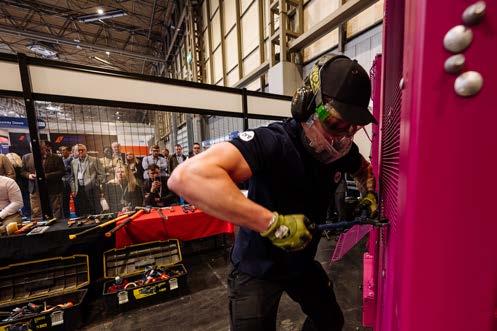
A key highlight returning to the show is the LPCB Live Testing Lab, where visitors can witness physical security products put through rigorous testing in real time. Demonstrations will include the testing of products such as padlocks, fencing and key safes, offering valuable insights into product performance and certification standards.
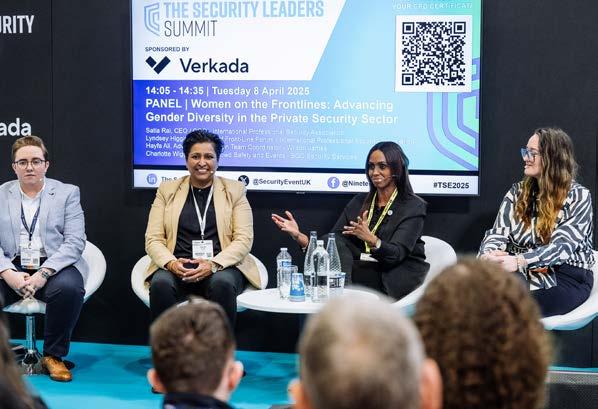
Also returning to the show is the Women In Industry Network, a key initiative across the Safety & Security Event Series. Among the sessions will “Women on the Frontline: HERstory in Action” on the Professional Security Officer Live stage, highlighting the lived experiences and life saving impact of women in frontline security roles. By sharing their stories, the initiative recognises their contributors while strengthening learning, visibility and respect across the sector.
Another discussion, “Women Leading Change: Building a Modern,
Inclusive Security Sector” on The Security Leaders Summit, will explore how women leaders are driving change across the industry by shaping inclusive cultures, modern leadership approaches and a future ready security workforce. The session will highlight practical actions that strengthen resilience, representation and long-term impact across the sector.
The 2026 event will also introduce the Next Gen Network, a new initiative designed to support emerging talent and strengthen skills pipelines across the industry. Supported within the security sector by Skills for Security, the programme will provide opportunities for young professional to engage with industry leaders and contribute to key discussions shaping the future of the sector.
As part of the programme, Skills for Security, will lead the session “Securing the Future Together: Shaping the Next Generation of Security Professionals” exploring training pathways, workforce developments and the experiences of those entering the industry today.
To enhance networking opportunities and foster new connections, networking receptions will be held at the end of day one and two. Visitors, exhibitors and partners are invited to relax and recharge in a casual atmosphere to enjoy complimentary drinks and live music, whilst building valuable relationships.
The Security Event 2026 will be co-located with The Fire Safety Event, The Health and Safety Event, The Workplace Event, Pro Integration Future Europe and the National Cyber Security Show, bringing together professionals responsible for protecting people, places and assets across the built environment.
Visitors can access all six events with one free pass creating a powerful platform for cross-sector collaboration, innovation and professional development.
Registration is open for The Security Event 2026, taking place 28-30 April at the NEC Birmingham.
Find out more and register for a free pass HERE




















New research highlights seven trends shaping identity, access and trust, alongside rising ethical and privacy concerns
HID, a global leader in trusted identity solutions, today released its 2026 State of Security and Identity Report, revealing how organizations worldwide are fundamentally reshaping their approach to identity management. Based on insights from more than 1,500 security and IT professionals, end users and
industry partners, the research shows that security leaders are focused on how to manage identities in ways that build trust, strengthen protection and preserve user choice across increasingly converged physical and digital environments.
“Security leaders are clearly under pressure to modernize access and identity infrastructure, but our research shows they’re equally focused on the governance, protection and transparency that build lasting trust,” said Ramesh
Songukrishnasamy, Senior Vice President and Chief Technology Officer at HID. “The organizations succeeding in 2026 are those giving stakeholders meaningful solution choice while maintaining robust security.”
Seven Interconnected Key Trends Define the Path Forward
The report identifies seven key trends that collectively illustrate how trust, protection and choice are reshaping security strategy:
Identity management now dominates strategic planning
Nearly three-quarters of respondents (73%) identified identity management as a top priority, the highest category in the study. Organizations are moving beyond standalone credential systems toward unified identity governance that spans physical access and digital systems.
The shift reflects a market-wide consensus: the question is no longer whether to consolidate identity platforms, but how to do it in ways that reduce friction, ensure compliance and deliver measurable return on investment (ROI).
Mobile credentials have reached critical mass
Mobile credentials adoption is now driven by security improvements (50%) rather than convenience (34%), a notable shift as organizations recognize the protection advantages of mobile credentials. Hybrid credential environments remain standard, with 84% of end users maintaining physical credentials within their mobile deployment, reflecting diverse user groups and operational needs that require flexibility over time.
Biometrics are expanding beyond MFA into core access control
Biometric technologies continue to gain traction (45% view them as strategic), with fingerprint (71%) and facial recognition (50%) leading modalities. Yet, ethical and privacy concerns more than doubled yearover-year from 31% to 67%. This is driving organizations to implement safeguards and reinforces the need for transparency and compliance during deployment.
Real-time location solutions are moving into mainstream use cases RTLS adoption continues to expand, particularly in healthcare, manufacturing and logistics. About 42% of end users identify RTLS as a strategic priority, while 40% report active deployments. Yet barriers persist: costs (33%), privacy concerns (29%) and integration complexity (29%) slow progress, while 38% of partners report customers remain unfamiliar with RTLS capabilities, signaling substantial education needs.
Physical and digital identity convergence is accelerating Unified identity solutions are moving mainstream, with 75% of organizations either having
deployed (29%) or actively evaluating (46%) unified identity solutions. While single credentials spanning buildings, networks and applications deliver efficiency and stronger security, budget constraints (51%), complexity (37%), and expertise gaps (34%) remain persistent barriers.
RFID adoption continues to grow steadily
RFID is now infrastructure, not innovation. RFID adoption is growing steadily, with 54% of respondents reporting active use for asset tracking, inventory management and loss prevention. Once viewed as niche technology, RFID is now increasingly treated as core infrastructure for asset visibility, inventory control and operational intelligence. Security leaders cite faster tracking (62%) and improved visibility (41%) as key benefits.
Investment patterns are shifting decisively toward integrated platforms
The era of point solutions is ending. Organizations are prioritizing integrated identity and security platforms over standalone point solutions to improve visibility, efficiency, and resilience across increasingly complex environments.


Yet integration complexity persists as the primary barrier (52% for identity systems, 37% for physicaldigital convergence).
Ethics and privacy concerns are at an all-time high
Beyond individual technology trends, the report highlights a defining concern for 2026: ethical considerations and privacy concerns are at an all-time high. For biometrics, 67% of end users expressed high or moderate concern about ethical and privacy implications. Alongside location tracking and converged identity platforms, organizations are
navigating the tension between stronger protection and individual rights. Many respondents report actively developing policies, governance frameworks, and technical controls to address these concerns, signaling a broader maturity in how security decisions are made.
What sets the 2026 report apart is the increasing depth and diversity of its data. Responses reflect a wide range of industries, including healthcare, education, government, finance, manufacturing, and critical infrastructure, with perspectives from both end users and the partners who design, deploy, and
support security systems. This dual perspective provides insights into where strategy aligns with execution and where gaps remain.
The result is a report that provides a clear snapshot of how businesses are making decisions under real operational constraints. For security and IT leaders, it offers a grounded view of how peers are prioritizing investment, addressing risk, and preparing for a future where identity sits at the center of trust.
The full 2026 State of Security and Identity Report is available for download HERE.


Beneath the high-visibility jackets and stoic expressions, security guards face a daily grind that’s far more complex- and far more dangerous - than many realise. They are often the first responders to emergencies, the frontline against aggression, and the unseen guardians of public and private spaces. But behind the calm exterior lies a mounting mental health crisis
that needs to be addressed by those who employ security guards.
Recognising the issue is the first step to resolving it, and the rising mental health pressures in the security industry deserve to find their way into the spotlight during the month of World Mental Health Day.
The fact is that guards regularly endure long, unsociable shifts, deal with verbal and physical
abuse, and operate in high-stress, high-risk environments with minimal recognition or support. The effects are undeniable. Research from the University of Portsmouth shows nearly 40% of security guards report symptoms of post-traumatic stress disorder (PTSD), and large numbers experience burnout, anxiety, or depression. Yet the mental health needs of this workforce have too often been overlooked by employers.
The research showed that 64% of security guards suffered verbal abuse at least once a month – with 50% of these as regular as once a week – and 43% of respondents reported threats of violence at least once a month, sometimes even on a daily basis.
The statistics are alarmingly stark. Aside from high rates of PTSD, studies show that security officers are significantly more likely than the general workforce to experience workplace violence, emotional exhaustion, and poor sleep quality. The result is a workforce that’s stretched too thin, both emotionally and mentally as well as physically.
Investing in wellbeing isn’t just a moral obligation, but it also makes good business sense. Guards who feel supported are more engaged,
resilient, and effective under pressure. Meaning employers benefit from lower turnover, reduced absenteeism, and stronger performance in situations where professionalism and calm decisionmaking matter most.
Even though it makes commercial sense, research consistently shows that many employers fail to provide adequate mental health and wellbeing support for security guards, with some managers unaware of -or dismissive towardthe seriousness of these challenges.
This shortfall underscores the urgent need for greater industrywide conversations around this, focused interventions, and broader acknowledgment of the mental health risks inherent in security roles. Awareness and support need
to come from the top, down - and employers are in a strong position to make improvements. World Mental Health Day is the perfect opportunity for those in the industry to actively review internal practices and explore new ways to prioritise team wellbeing.
The first step is to normalise talking about mental health in a traditionally unflinching profession, removing the need for guards to suffer in silence - fearing judgment or professional consequences if they speak up. Open conversations can also help others recognise their own symptoms as signs of a deeper issue. It’s so essential that we equip managers and team leaders with the knowledge to recognise and


address mental health issues within their own teams, as well as creating a workplace culture where talking about mental health in a peer-to-peer setting is encouraged and stigmafree. It might seem like a minor step, but being able to talk about sensitive issues like these goes a long way to creating change.
While many employers are already taking steps in the right direction, there’s value in ensuring that any formal wellbeing policies are tailored to the specific realities of security work — rather than relying on generic documents designed for other sectors.
Highlighting existing resources from charities such as MIND or PTSD-charities can also help raise awareness of where individuals can seek more support. Promoting these services actively, rather than just burying them in an employee handbook, or expecting employees to research support options for themselves, encourages uptake and offers a clear path to help for those
that might feel isolated with their issues.
Managers are often the first to notice changes in staff behaviour, but don’t always know how to respond to that information. Some organisations are introducing mental health first aiders to give teams a dedicated, approachable point of contact on shift. Others are providing training to help leaders feel confident having supportive conversations when they’re needed. Training and equipping managers to know what to do if they do notice early warning signs of stress or trauma can prevent issues from escalating.
Individually, these changes may seem modest - normalising conversations, introducing tailored policies, signposting to resources, or training managers to notice the signs. But together, they can transform the way security teams experience their work. For guards who often feel invisible, even small
gestures of recognition and support can significantly reduce stress, boost morale, and make them feel more loyal to both employers and their team.
Employers have the power to shift the culture of the industry, making it one where mental health is openly acknowledged, properly supported, and genuinely prioritised.
World Mental Health Day serves as a reminder that mental wellbeing matters - not just in theory, but in practice. Across the security industry, we all have a part to play in building environments where mental health is openly acknowledged, properly supported, and prioritised.
The message is clear: meaningful change doesn’t always require sweeping reforms. Sometimes, the most powerful difference comes from small but intentional actions, consistently applied. For the individuals wearing high-vis jackets and carrying the weight of responsibility, those actions can be life-changing.
Maxxess eFusion software opens up limitless possibilities, taking you beyond feature-rich, enterprise-level access control to give you all the benefits of a total security and safety management platform – without the cost or complexity.

Ready-made to integrate more than 60 leading technologies, off-the-shelf, Maxxess eFusion now lets you combine access, video, fire, intruder, visitor management, building systems, widely used databases and site-specific applications.
www.maxxess-efusion.com

Why physical security can no longer be left until last By Richard Ellis,
When major construction projects commence, the objectives and deliverables are often influenced by budgets, planning constraints, architectural vision and programme milestones. Physical security, however, is still too often left until the latter stages of delivery as its importance is misunderstood and it can be considered as a small package of work needing minimal consideration. By this point, civil works and hard landscaping can be well underway, utilities are in place, and design intent is established,
leaving little scope for meaningful integration without disruption, cost escalation, or a compromise in the effectiveness of a scheme.
But whether designing a new transport hub, redeveloping a town centre, or upgrading critical infrastructure, security can no longer be treated as a last-minute package. It must be embedded from the outset as a fundamental design principle.
Introducing hostile vehicle mitigation (HVM), perimeter protection or access-control measures at the
end of a project creates a cascade of challenges. Retrofitting into completed public realm may require re-excavation, relocation of utilities, or clashing with carefully conceived landscaping schemes. The result is not only costly disruption, but often visible interventions that dilute architectural coherence and undermine user experience.
The consequences go beyond aesthetics. Late procurement can overlook the long lead times required for certified HVM products, sometimes forcing reactive substitutions that may not align with threat assessments or programme
requirements.
Without early Vehicle Dynamics Assessments (VDAs) and validated utility surveys, there is a significant risk of misspecification. Projects may either under-specify systems so that products fail to meet the threat level or over-specify solutions with unnecessarily high impact ratings that are more costly and might demand deeper foundations than the site can accommodate. Equally, unchartered service clashes can make intended installations unnecessarily complex or worse case unbuildable, forcing costly redesigns or substitutions.
Such compromises risk creating environments that appear secure but are not, exposing clients to safety liabilities, reputational damage, and increased long-term operational burden.
The case for early integration
The earlier security is factored in, the greater the freedom to design
solutions that are functional, discreet, and sympathetic to the place. At this stage, layouts, materials, and utilities can be coordinated with protective elements, allowing bollards, barriers, gates and street furniture to perform dual functions without cluttering space or creating accessibility issues. This approach reduces whole-life system cost, simplifies installation, and improves user experience. Importantly, it also allows security specialists to work alongside architects, engineers, and contractors to ensure threats are correctly assessed and proportionately addressed.
shifting threat landscape
The nature of security risk has changed significantly in the past decade. Vehicle-as-a-weapon attacks remain a present danger, but they are not the only concern. Crowding in public spaces, poorly managed access points, and vulnerabilities around perimeters all create risk.
The pandemic accelerated changes to how we use our cities, and we’ve seen more pedestrianisation, outdoor dining, and re-purposed urban areas. Meanwhile, geopolitical instability has increased awareness of terrorism and state-level threats. Against this backdrop, security must be flexible and treated as a dynamic discipline that adapts to changing circumstances and risk profiles when needed, which is only possible if it is embedded from the outset.
Collaboration drives resilience
Resilient security is never the product of a single discipline. It relies on early and open collaboration between planners, architects, contractors, security engineers and specialist competent HVM physical security manufactures and the communities who will use the space. When there is early collaboration between the key parties, an appropriate balance can be found between aesthetics, safety, and

cost can be made transparently. Contractors can raise any buildability issues before they escalate, while security specialists can advise on certified systems that balance performance with practicality. Better still if done so in conjunction with the HVM Physical security manufacturer. The community can also raise their concerns or issues, whether about permeability, accessibility or how a space will feel in everyday use. As such, the outcome is not only safer, but also more likely to win public acceptance because protection feels like part of the design rather than an afterthought and reassure rather than restrict.
Case study: Tottenham Hotspur Stadium
Tottenham Hotspur Stadium demonstrates what can be achieved when security is woven into the design from day one.
Building a stadium of this scale next to a busy multi-lane road created an obvious vulnerability.
Yet the architectural brief, led by Populous, was for a venue that felt spectacular, open and inviting. Any security strategy, therefore, had to deliver world-class protection without compromising on aesthetics, blending into a landmark that would host Premier League football, NFL games and international concerts.
The solution required security to be part of the blueprint, not an add-on. The perimeter package demanded high-performance impact resistance, but also a design aesthetic consistent with the stadium’s bold architecture.
On the single pavement outside the stadium, where tens of thousands of fans flow in and out, clutter was a major risk. Alongside protective measures, the area also needed to accommodate traffic light columns, signage, and street lighting. To avoid crowding and trip hazards, these elements were integrated into the security line itself, creating multi-functional assets that reduced obstruction without compromising

protection.
Back-of-house service yard access demanded the same level of precision. Gates and barriers had to fit seamlessly into stadia protocols while maintaining resilience. Ongoing service and maintenance were also built in from the outset, recognising the profile and constant use of the venue.
The Tottenham Hotspur stadium scheme demonstrates how early engagement with security specialists enables creative engineering solutions that reconcile performance, aesthetics, and public safety. Had these conversations taken place at the end of the project, retrofitted barriers and disconnected measures would have undermined both appearance and function.
Testing, credibility and trust
Security is only as robust as the performance of its components. Products must be independently tested to recognised standards (BSI PAS 68, IWA 14, ISO 22343) and installed as designed and specified. Equally, the competence and track record of the supplier and contractor are just as important.
This is where engineering credibility comes in. Choosing the lowest-cost option or an unproven provider may save money in the short term, but it undermines confidence and creates long-term risk. With increasing regulatory scrutiny, from the Building Safety Act’s “golden thread” of accountability to the proposed Protect Duty (Martyn’s Law); trust, transparency and competence are essential.
From afterthought to foundation
If construction is to meet the challenges of the next decade, physical security can no longer be left in the shadows. It must be treated as a design principle in its own right and not a box to tick at the end of a project.
When security is built in early from the concept stage, projects are more efficient, more resilient, and more trusted. They also stand a better chance of delivering the open, welcoming public spaces we all want to use.

























Visit the Azena Application Store: the largest open platform for IP cameras. Offering groundbreaking software that runs on different models and integrates seamlessly with third party systems. Letting you benefit from AI video analytics – whether optimizing new cameras or retrofitting existing ones.


The range of ready-to-install apps extends beyond security and safety; adding value to operational intelligence, automation, or process control in such industries as healthcare, manufacturing, retail, transportation and tra ic.

Release the power of AI video solutions. www.azena.com






Start with a free trial Our free trial program is an easy way to test our solution with our support – no strings attached.



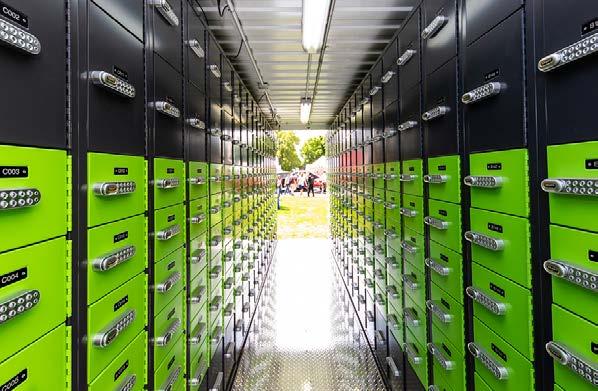
Drawing on insights from Codelocks’ leaders across four continents, Global Director of Marketing at Codelocks, Ros Bayliss, explores with the Codelocks team how customer needs are changing in access control, the shift from locks as an expense to a revenue generator, and how the industry is balancing innovation with simplicity while meeting rising sustainability demands.
In the eyes of some, locks are simply used for keeping people out, and for keeping the contents of a
building, cabinet or locker safe. But as we know at Codelocks, access control is about so much more than that. It’s about managing spaces and giving people convenient access in ways that can transform how a building or space works and feels. That’s one of the reasons we rarely talk about ‘security’, if at all.
If you focus on access control as being simply about protection, then you’re likely to see locks and other access control solutions as just a cost – an expense line on a balance sheet. You’d also overlook one of the biggest changes impacting the
industry, and the first of several trends shaping access control in 2026: the change from a cost centre to a revenue generator.
Entrepreneurs and access – from cost to profit centre
“There’s been an explosion in shortterm rental applications over several years, and I mean much more than just BnBs or holiday homes,” said Jo Milne-Rowe, Managing Director at Codelocks UK. “We’re reaching a point where almost anything that has the potential to be shared and rented out is being. Entrepreneurs
are seeing new opportunities, and using access control to turn them into profit-generating realities.”
Festival lockers are a booming example. They are simple storage units rented to attendees at music festivals and events. People book online, select the rental duration, and receive a time-sensitive access code instantly. The coded locks allow customers to store belongings without keys, while operators remotely manage thousands of lockers, changing codes automatically between rentals without swapping keys and with minimal staff input.
This use of locks to create new revenue-making products and services also changes what customers want. It alters their ‘buying equation’. In applications that
focus on short-term product rental to drive revenue, customers are seeking locks that help to improve business fundamentals, like utilisation and booking rates. Likewise, they’re looking for locks that improve the customer experience and create an attractive, easy-to-use product. As manufacturers and product innovators, this changes what we need to offer customers in 2026 and beyond.
The balancing act – new tech and simple solutions
There is a lot of hype around AI at the moment. And understandably so if you’ve used ChatGPT or similar.
The UK government is looking for the country to become an ‘AI superpower’ while also using the new technology to do things like free up NHS hospital beds.
With all this attention on bleedingedge technology, however, people can be led to think that access control must follow the same path: that because everyone’s talking about tech, it’s what customers will be demanding in 2026.
However, despite the attention lavished on breakthroughs like AI, many customers are still looking for simplicity of operation and maintenance in their access control solutions – even the entrepreneurs.
“With any new tech, there’s hype and there’s practical application. European customers aren’t demanding AI in their access control solutions right now,” said Steve Newman, Regional Director for Codelocks Europe. “That’s probably for several reasons, not least
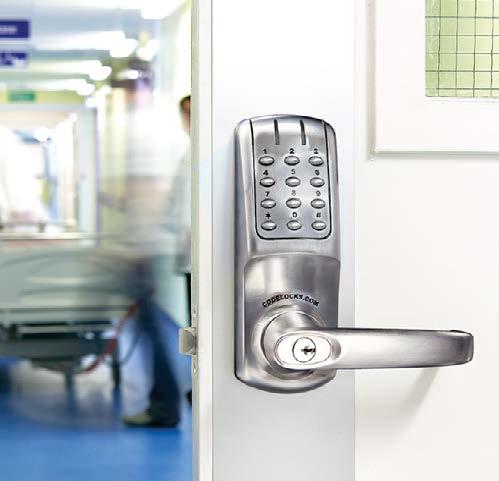

because simplicity is something they prioritise.”
The demand for simplicity is especially strong in the locker market, where most facility and building managers are responsible for looking after thousands of different lockers that require regular maintenance. In large sites such as student accommodation or government offices, small issues quickly add up to be a large drain on resources.
“For lockers – which make up the majority of our business – most customers are choosing either mechanical locks or hard-wired solutions because they want to avoid battery maintenance,” said Mark Samuelson, Director for Codelocks Australia.
Mechanical lockers are ideal for short-term, multiple occupancy applications requiring simplicity and minimal maintenance to keep costs low. Hard-wired solutions don’t tick all these boxes, though. The cost of installing new wiring can outweigh the cost of avoiding batteries, leaving mechanical locks as the simplest and best choice. Still, with an eye on the future, we don’t think customers will have to make these kind of choices for much longer. Battery harvesting will soon become popular, using the power in people’s mobile phones to temporarily power a cabinet, door or locker lock.
Despite all of this, the real winners
in 2026 will be those organisations that listen to their customers. Those companies that focus on solving fundamental customer challenges without over-egging the latest trends.
“Protection concerns have driven people to effectively over-specify the locks they need, which is neither cost-effective nor necessary,” said Matt Welty, Vice President at Codelocks Americas. “For us, this has been an opportunity. We’ve guided many companies toward the right-fit product, rather than the over-the-top product. It’s about understanding the real customer need and meeting it.”
The urgency around climate targets and sustainability is growing as 2050 net-zero targets and interim milestones, such as 68% emissions cut by 2030, get closer. Customers everywhere are also more focused on the environmental impacts of their purchases, while supply chain scrutiny is increasing.
In access control, sustainability is a consideration on two levels. Practically, people are demanding products that last longer. They need products that can be repaired rather than replaced, and they’re looking to minimise waste. On a procedural level, customers need their products to be certified so they can satisfy procurement requirements. Success in 2026 requires addressing both
of these customer needs, building genuinely more sustainable products that are supported by the right certifications and accreditations.
Almost all Codelocks products are repairable, which massively reduces waste and promotes a more circular economy. In 2025, as part of our sustainability efforts, Codelocks UK achieved ISO 14001 (environmental management) to help our UK customers with their supply chain requirements; 2026 will be the first year we report our emissions too, giving transparency to our customers for their own emissions reporting.
What’s become clear from conversations with Codelocks senior leaders is that listening to customers has never been more important. Access control in 2026 comes down to understanding what customers actually need, versus what the industry thinks they should want. Whether working with entrepreneurs applying rental models to new spaces, helping facilities managers balance innovation with operational simplicity, or providing repairable locks backed by ISO certifications, success lies in responding to real needs with the right solutions.
For further information please visit www.codelocks.com
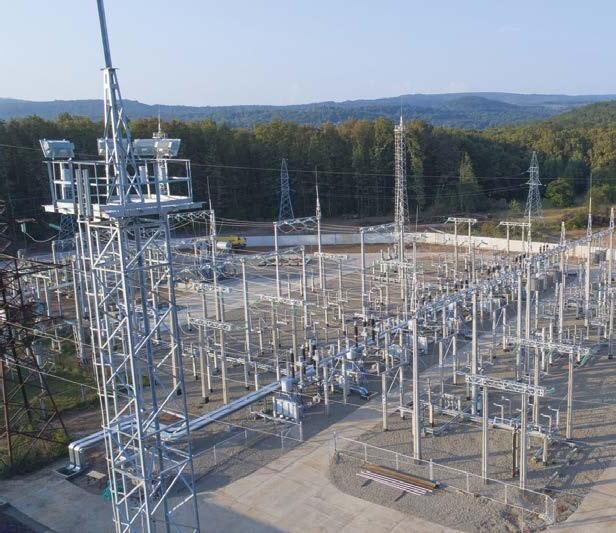
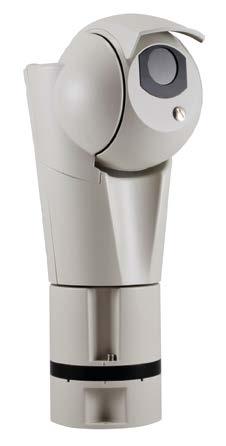



The ASSA ABLOY Group is the global leader in access solutions. Our offering covers products and services related to openings, such as locks, doors, gates and entrance automation solutions. This also includes expertise in controlling identities with keys, cards, tags, mobile and biometric identity verification systems.
www.assaabloy.com

azena accelerates the next generation of smart security and safety solutions through joint innovation with customers and partners. Our goal is to be the leading open platform and marketplace for smart security and safety solutions. The platform we offer is based on a camera operating system that powers cameras from various manufacturers on the market.
www.azena.com



Club Car boasts nearly 60 years of industry-leading innovation and design, initially focused on golf cars and then expanding to commercial utility vehicles and personal-use transportation.
www.clubcar.com





Innovating for a smarter, safer world by combining intelligent technology and human imagination, at Axis Communications we offer solutions based on sight, sound and analytics to improve security and optimize business performance.
www.axis.com
Buildings today don’t only provide a safe, functional place for people to live and work. They can also cater for – and even respond to – their needs, while helping them work more efficiently and sustainably. At Bosch Building Technologies, we are at the forefront of these new developments.
www.boschbuildingtechnologies.com
With a full HD camera and an optically stabilized, 40x zoom lens from FUJINON, two high-performance components are integrated into one system. This innovation is the result of years of experience in digital cameras and a dedication to the highest optical quality.
www.fujifilm.eu/fujinon
Hanwha Techwin Europe, formerly Samsung Techwin Europe, offers robust and reliable video surveillance products designed to meet the current and future needs of security professionals. Our cameras, video recorders and other devices are built to exacting standards which reflect the heritage of precision engineering associated with the Samsung brand.
www.hanwha-security.eu
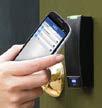
HID powers the trusted identities of the world’s people, places and things. We make it possible for people to transact safely, work productively, and travel freely. We are passionate about helping people use a verified, trusted identity to make it more convenient and safer for them to get to where they need to go and achieve what they want to do in everyday life.
www.hidglobal.com







Maxxess Systems delivers innovative SaaS and security management software solutions that combine otherwise disparate physical security, communications, business intelligence and data integration capabilities onto one unified management platform.
https://maxxess-systems.com


Panasonic i-PRO Sensing Solutions
Corporation of America a global leader in professional security solutions for surveillance and public safety, is launching their new name, i-PRO Americas Inc., and taking a unique approach to best navigate the evolving business environment and technology demands of the professional security industry.
https://i-pro.com/eu/en
As a trusted advisor and reliable partner, as a system integrator, service provider and a product vendor, Siemens offers energy-efficient, safe and secure buildings and infrastructure. With our people, our global footprint and our technical expertise, it's our passion helping you to create the perfect place – your perfect place.
www.siemens.com
Transforming teaching and learning with creative solutions to engage and inspire every student. Learning’s becoming more interactive. More immersive. More collaborative. At Sony we’re working with universities, colleges and schools to create richer, more rewarding educational experiences for today’s students and teaching staff.
https://pro.sony.com



At Mayflex we lead the way in the distribution of Converged IP Solutions. Bringing together ‘best-in-class’ Infrastructure, Networking and Electronic solutions. We’re a growing international force, enriched by the skills, expertise and unique personalities of our people. Globally owned but with a family and local feel.
www.mayflex.com
With over 30 years of experience, we design and manufacture marketleading security solutions for a range of buildings. Around 25,000 buildings each year are secured globally with Paxton products. Our global Head Office is based in Brighton, we have colleagues in 12 countries and we export to over 60 countries worldwide.
www.paxton-access.com
From its inception in 2001, SALTO was created with one objective: to devise a world-class access control system that was simple to use and extremely efficient, giving users the ability to control all their access needs and secure all their doors without complex and expensive wiring.
www.saltosystems.com


Videx Security is a leading manufacturer and supplier of access control systems across the UK. We are experts in the door entry market. Videx and our team of estimators, technical support and designers are focused on making and providing high quality products and support to customers.
www.videxuk.com