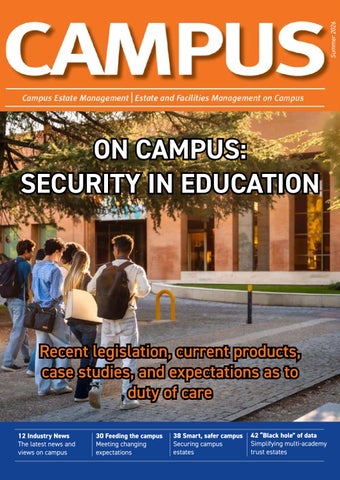
Summer 2026
ON CAMPUS: SECURITY IN EDUCATION
Recent legislation, current products, case studies, and expectations as to duty of care 12 Industry News The latest news and views on campus
30 Feeding the campus Meeting changing expectations
38 Smart, safer campus Securing campus estates
42 “Black hole” of data Simplifying multi-academy trust estates CAMPUS | Summer 2026 | 1
CLIQ® The smart way to digitalize access Take your access management into the digital era – smoothly, securely, and without overhauling existing infrastructure. With CLIQ, you upgrade from mechanical to digital access at your own pace to gain greater control today and adaptability for tomorrow.
Download our whitepaper to learn more about making the switch to digital access
26 Editor Chris Hewett editorial@mebmedia.co.uk Accounts Jay Kempisty accounts@mebmedia.co.uk
30
Publisher Wayne Banks +44 (0)1622 201207 wayne.banks@mebmedia.co.uk Website and Circulation Manager Kevin Villa website@mebmedia.co.uk Design and Production Charles David production@mebmedia.co.uk Campus Estate Management Magazine is published 4 times a year by MEB Media Publishing Ltd 13 Princes Street Maidstone Kent ME14 1UR United Kingdom Tel: +44 (0)1622 201207, info@mebmedia.co.uk www.mebmedia.co.uk Articles and art may not be reproduced or reprinted without the express written permission of the publisher. Exclusion of Liability Although every effort will be made to ensure the accuracy of all materials published, the publisher takes no responsibility for errors or omissions. Copyright © MEB Media Publishing Ltd 2026, all rights reserved.
42 Contents 4 Security in education Legislation, products, case studies, and expectations as to duty of care 12 Product & Industry News The latest news and views on campus 26 Rethinking the estate Why universities might need to reimagine the purpose of the campus 30 Feeding the campus How campus catering is evolving to meet changing
student expectations and commercial pressures 34 Beyond fit and forget Why universities need a single source of truth for estate management 38 Smart, safer campuses Fit for today, safe for tomorrow 42 Escaping the "black hole" of data Managing the growing complexity of multi-academy trust estates CAMPUS | Summer 2026 | 3
ON CAMPUS COVER STORY
On campus: Security in education Jeremy Malies looks at recent legislation, current products, case studies, and expectations as to duty of care
T
he survey spans simple locked doors to the advent of the intelligent campus. An overview shows where current technology is excelling and where it continues to fall short. Places of education from primary schools right up to leading university colleges should never have fortresslike security; the culture should be inclusive and welcoming with a focus on quality of experience. And yet
4 | Summer 2026 | CAMPUS
there is also an overriding obligation to eliminate risk to pupils, students, and indeed staff even if this means challenging the entry credentials of every conceivable kind of visitor. Martyn’s Law Laws named after individuals! This is a great development and a humanising of legislation worldwide. Megan’s Law requires publicly available information about registered sex offenders. Sarah’s
Law gives parents the right to ask police if somebody has convictions for child sexual offences. Clare’s Law empowers people to ask authorities if their partner has a history of domestic abuse. So, what is Martyn’s Law and how will it affect physical security in the education sector? Martyn Hett was one of 22 people killed by terrorist Salman Abedi during the Ariana Grande concert at the AO Arena in Manchester in
2017. Martyn’s mother, Figen, has campaigned for new regulations which will better protect the public in all environments and notably in education. The Law has specific content to improve preparedness and reduce harm to schools and universities from such attacks. (Ariana Grande’s demographic appeal meant that many of the killed and injured were young but Martyn was 29.) The legislation received Royal Assent in 2025. There will be a 24-month period of implementation but in distinct phases or medium-size increments rather than a gradual process. A prime requirement is that any place of education (right down to early years providers) that could have 200 learners assembled – even if this is a peak attendance – must have an evacuation and lockdown plan in the event of a terrorist threat. There must also be a plan for invacuation. (For me, “invacuation” is a clumsy phrase, and a better term is “shelter in place”.) The focus will be on proportionate planning and
preparedness. So how are security manufacturers, installers, consultants, industry regulators as well as observers reacting? How are they responding to the Law’s provisions for primary, secondary and further education? This article (my remit is a broad view of educational security technology over and above Martyn’s Law) will consider areas including: • access control • video surveillance • perimeter security • lockdown procedures All of us looking at security requirements and procedures in education think, in the first instance, of mass communication and emergency alerts during critical incidents. Media coverage of horrific crimes across the world has conditioned us this way. Providers of such systems look to optimise lockdown procedures and critical incident responses through audio (public address & voice alarm), other
mass communication methods, and emergency alert platforms. The aim is to deliver clear, understandable alerts that are targeted across zones within a building, cluster of buildings, or campus. Administrators must be able to adapt messages to particular areas according to the precise threat. Public address is a primary mode, but of course messages to desktops and push notification systems are important. Inevitably with young people, alerts to smartphones perhaps by a campus-issue App are a must as is use of official campus social media accounts. Security in education must be layered – I would even use the word “nested” – across subsets. At points of entrance, UK senior schools rely on video surveillance, video intercom, and assessments based on staff observations. Only when there has been intelligence suggesting a threat do police become involved. Specific risk scenarios (again the likelihood is word of mouth and perhaps related social unrest in the wider area) may
CAMPUS | Summer 2026 | 5
s
TRANSFORM THE EVERYDAY
With the next generation Cerberus Nova fire detectors • Disturbance free testing • Smoke entry and Cover supervision 24/7 • ASAplus technology - no false alarms • Backwards compatible and field updateable That’s what we call fire safe for life. Email: bpsales.gb@siemens.com
see occasional use of hand-held wand or walk-through metal detectors. In the last five years there have been disturbing incidents (met with use of metal detectors) of pupils taking weapons into primary and middle schools in Cardiff, Wales. The items included knives, BB guns, and even a metal ruler sharpened to a blade. But the UK has not been obliged to go down the route of (occasionally malfunctioning) AI weapon detection that sent a school in Seminole County, Florida, into lockdown. The false positive occurred when the system mistook the clarinet being carried by a music student for a firearm. Disruption to the curriculum must have been significant, and depending on the mental robustness of the pupil involved, the error could have been at best a distraction and at worst the cause of distress. Draw a schematic of a legacy security system at, say, a UK middle school and you would come up with
an assembly of cameras, locks (both key-based and fob or biometric door readers and controllers), perhaps a few passive infrared sensors (PIRs) and fencing but this would be fences as a traditional barrier not a detection device. By contrast, new designs are truly connected systems in which threats surface in real time and can be acted on while an intruder or other miscreant is still on site. AI-enabled video monitoring can alert staff to atypical behaviour immediately without the need to trawl through footage. Similarly, unusual patterns of movement or sensors alerting on doors propped ajar can create alarms. “Solving for time” is a new phrase that comes up in tender documents. School and university stakeholders want broad views of their premises without the wage costs associated with manned guarding and staff staring at screens. There is also insistence that access control
should be able to lock down areas in a precise way when an intruder is detected but also give pupils and staff optimum routes out to points of safety and places where a roll call can be taken. Video surveillance Camera usage at schools is a fraught topic. Parents obviously want minimal if any recording of their children. And yet, even the simplest video analytics can assist managers by alerting on situations such as a corridor or choke point intersection becoming overcrowded. And young people often react better to being told something digitally than being addressed by their elders. It’s uncontested now that on simple matters such as overcrowding, AI makes better and quicker decisions than humans and can communicate information well in noisy environments through attentiongrabbing public address, signage or other visual cues that can even CAMPUS | Summer 2026 | 7
extend to strobe indicators. Assuming that the component systems are integrated on the same platform, the chain of messaging will be quicker without human intervention. It barely needs to be mentioned that human intelligence can then focus on higher value tasks. Even the most privacy-focused parent will concede that if an active shooter is at large on a campus and video feeds can allow security staff to overpower them or give first responders the best locational information, then young people appearing on camera is an acceptable aspect of the larger situation. Are there go-to specialised camera brands for the education sector? In a word, “No!”, and one might be skeptical of a vendor who claimed to have a universal solution for educational settings. Any commercial
8 | Summer 2026 | CAMPUS
video surveillance brand will serve many industries, but certain suppliers have put serious thought into how their offerings can be used in education, with emphasis on seamless integration between camera streams, video management systems (VMS) and access control. Motorola Solutions has an impressive case study in which its video surveillance and evidence gathering has allowed it to partner with the University of Oklahoma and the local police department serving the university’s Norman campus. (Norman is the third biggest city in Oklahoma.) I have just watched a webinar in which stakeholders discuss surveillance and bodycam evidence management and how Motorola has empowered law enforcement officers with a comprehensive discovery package. The focus is on information-sharing
and rapid assembly of evidence from multiple agencies. An educational case study close to my home is by Eagle Eye Networks (a Brivo Solution). Ibstock Place School in south-west London worked with installer SES Technologies to expand video surveillance. The client also wanted a sliding scale of footage retention periods. Executives at the school have the foresight to be following developments in video analytics closely and asked for complex event alerting capability. Futureproofing was vital throughout the project for a user with a commitment to open platforms and wanting easy integration with third-party technology. The school is benefiting from instant access to live and recorded footage through the Eagle Eye Cloud VMS. SES Technologies ensured continuity of service as they
migrated the school from on-site to Cloud systems. Eagle Eye Networks marketing describes specific education solutions, and the success of this project endorses such claims. Lockdown procedures If a school, college or university has one overriding duty of care, it is perhaps to have optimised lockdown procedures should an intruder gain access to the site. Technology providers are rightly focused on solutions for this, and ASSA ABLOY can point to their portfolio of dedicated educational security offerings. These contrast with generic products, perhaps with a few tweaks, offered by many commercial hardware companies. Crucially, a dedicated lockdown product will balance rigour in closing areas of a site with the (possibly) conflicting demands on the fire and life-safety spectrums. SMARTair® Lockdown from ASSA ABLOY is designed to allow facility managers to lock down access points such as doors and gates in response to intruder threats and can be used in a precise manner as a miscreant is
observed moving around a campus. SMARTair® is truly responsive to site-specific needs and can be enabled remotely through mobile devices. As with vendors right across this survey, ASSA ABLOY appreciates the need to ensure general site continuity during installation which can be done wire-free. The system will open, close or block access points based on predefined settings or according to an operator’s individual judgements, giving senior site managers optimum control during emergencies. Financial background Finance directors at schools and universities should be included in discussions in the first instance and (if they have good judgement!) their views must be part of the mix. The survey of the education sector for this article has thrown up case studies where enthusiastic governing boards have taken short-term grants to finance sophisticated systems but have been unable to maintain and upgrade them, install patches, train staff and cover future license fees. Discerning budget controllers can
look beyond features to consider usability in the long run. Industry analysts are quick to give their opinions about best practice, but case studies by leading vendors are often a better source of information about optimum approaches. A linguistics faculty at the University of Lodz in Poland is using the GenetecTM Security Center for access control as part of a smart campus hub. The project forms a dispersed infrastructure initiative (a phrase I like) and the client has complimented Genetec on their product’s ability to integrate with IoT devices as electricity, water and thermal energy consumption are all optimised. The university is looking to set the standard for smart buildings in higher education in the region. Moving to another usage example that allows us to focus on a few trends, Paxton Access have installed their Net2 networked access control system at Higham Lane School which caters for pupils between 11 and 18 in Nuneaton, Warwickshire. The school has more than 1,400 students and is part of the Central
CAMPUS | Summer 2026 | 9
England Academy Trust. A notable aspect of the installation (echoed in other usage cases) is that as part of safeguarding plans, there was an absolute requirement for a full audit trail of entrance, egress, and general movement across the site. Specifiers wanted a video door entry intercom system at the entrance gate as well as integration with existing video surveillance and a fire alarm system. Simple, effective roll call functions (an obvious requirement in education) were also mandated. In addition to the obvious control of movement and awareness of site usage, the school has benefited from reduced risk of theft and vandalism. Installers MES Systems Ltd have been able to react quickly to the needs of school managers by providing remote system configuration using the Net2Online web user interface and the Paxton Connect app which operates from smart devices. Increasingly in secondary schools, senior pupils may be issued with cards or fobs using RFID/NFC technology for access. In business contexts there might be use of phones and smart watches as credential devices but in schools this is avoided. Usage can be as simple as opening the door of an area used by only a few students, perhaps a music room or an arts workshop. Access 10 | Summer 2026 | CAMPUS
control technology might open a locker containing specialist sports equipment. As with adults, there may be higher user privileges for prefects and student leaders. I have avoided any discussion of pupil violence towards staff here but such incidents and the publicity they create will make administrators conservative in terms of access rights. So, can I draw any conclusions from this survey of physical security across the education sector? I have certainly absorbed the fact that data needs to flow rather than be siloed. Case study after case study has shown that schools, colleges, and universities throw up the same demanding requirements against familiar backdrops. Footfall is high and there is the cocktail of differing access rights for academic staff, technical staff, and employees engaged in administration. As with any organization, operational continuity is vital but not as important as factoring out risk from miscreants be they intruders, disaffected staff, current or former pupils. Any more lessons? Knowing that it may sound like a platitude, I conclude that the best advice for facility managers is to use existing tools in the first instance for observational exercises. What are the movement patterns of pupils and staff – both
academic and administrative? Can heat maps from existing technology help us? How and when do students use the most important assets on campus? In what way do they integrate socially and academically with third parties? Look to these issues first, making the very best use you can of legacy equipment. Talk to installers and manufacturers who have good credentials. Then and only then start buying new technology. However sophisticated the technical offerings and genuine the duty of care shown by facilities managers, any consideration of security in the education sector takes one back to the same realities noted at the beginning. And these fundamentals are the same for nursery or reception-year primary school pupils as for pensioners from the UK’s Open University gathered at a campus during the summer vacation. The core challenges for authorities are to protect everybody on their site, protect assets from theft, engage with neighbouring communities rather than being a fortress, optimise the learning potential of everybody who wishes to study, empower those whose role is to teach, and ensure recreational facilities are available for all. That is quite a remit!
kieurope.com info@kieurope.com 020 7404 7441 Made in the UK
PRODUCT & INDUSTRY NEWS
Education for All Bill gives schools green light to accelerate SEND investment plans The Government’s plans to introduce the Education for All Bill will give education leaders the confidence to move forward with projects that support inclusive learning environments, according to multi-disciplinary consultancy Pick Everard. The proposed reforms build on the Government's 'Every Child Achieving and Thriving' schools white paper, which aims to raise standards and improve support for children and young people with special educational needs and disabilities (SEND). Under the plans, all pupils in mainstream schools will receive a level of Targeted support, while a new Specialist support category will be introduced for those with the most complex needs. Schools will also be expected to provide greater access to specialist services and dedicated SEND spaces, including inclusion hubs. Pick Everard says the proposals provide long-awaited clarity for schools and academy trusts, enabling them to identify viable projects now and avoid delays once the legislation is implemented. Sean Conneely, Director of Project Management specialising in education projects at Pick Everard, said: "The Education for All Bill will help to remove much of the uncertainty around the future direction of SEND provision. Schools will have a clearer picture of the support they will be expected to provide and can begin planning the spaces, facilities and environments needed to deliver it effectively. "The most successful projects won't necessarily involve major new-build programmes. In many cases, schools already have spaces that can be adapted into inclusion hubs, intervention rooms or specialist support areas. The key is identifying those opportunities early and developing a plan that aligns with future 12 | Summer 2026 | CAMPUS
requirements." Pick Everard believes the school environment will play a critical role in delivering the Government's vision for a more inclusive education system, with flexible and adaptable spaces helping schools provide the support all pupils need to thrive. Under the Government's Plan for Change, 60,000 new SEND places are expected to be created in mainstream schools, with every school set to have access to an inclusion hub. The Government has also announced significant investment in SEND provision and specialist support services over the coming years. Sean added: "The Education for All Bill will give schools greater certainty about the direction of travel for SEND provision. Those that begin planning now will be best placed to create inclusive environments that support both educational outcomes and pupil wellbeing. "Whether through adapting existing spaces, creating inclusion hubs or rethinking how learning environments are used, schools have an opportunity to make improvements that will benefit pupils for years to come. The key is taking a strategic approach today, with the aim of building better together, so projects can be delivered efficiently when they are needed most." Over the last 10 years, Pick Everard has designed and managed more than 30 Department for Education projects with a collective value of £500 million. With extensive experience supporting local authorities, academy trusts and education providers throughout the UK, the firm is well equipped to deliver education programmes and estate improvements. For more information about Pick Everard and its services, please visit www.pickeverard.co.uk.
University estates at a crossroads: Where should investment go first?
University estates are under increasing pressure. Capital budgets remain constrained, buildings are ageing, and expectations around carbon reduction, energy performance and climate resilience continue to grow. Over the past decade, decarbonisation initiatives, backlog maintenance programmes and energy efficiency projects have often been planned separately. Yet estates teams are increasingly recognising that these priorities are closely connected. A failing heating system, outdated building fabric or ageing electrical infrastructure can affect energy consumption, carbon emissions, operational resilience and maintenance liabilities simultaneously. In this environment, investment decisions have become more important than ever. The result is a shift from isolated projects to coordinated investment programmes that reduce carbon, improve building performance, tackle maintenance liabilities and strengthen estate resilience. However, knowing where to begin can be difficult. How do universities identify priority buildings? How should projects be sequenced? What evidence is needed to support investment decisions? And how can institutions build compelling business cases in a competitive funding environment? These questions will be explored in the upcoming free Willmott Dixon CPD-accredited webinar: Decarbonising University Estates – Where to Invest, How to Fund It, How to Deliver It The session will examine the changing priorities shaping university estates and provide a practical framework for turning estate data into costed, deliverable investment programmes. Attendees will gain insight into:
• Understanding the changing priorities shaping university estates • Using estate data and intelligence to prioritise investment • Aligning decarbonisation, backlog maintenance and energy efficiency • Applying the Energy Hierarchy to maximise value and reduce carbon • Identifying priority buildings for investment • Developing costed investment strategies and phased delivery programmes • Building stronger business cases and exploring funding opportunities • Turning estate ambitions into deliverable programmes of work Combining sector insight with practical delivery experience, the webinar is designed for estate leaders, sustainability professionals and university decisionmakers seeking to make informed investment decisions that support long-term performance, resilience and value. • Date: Tuesday 29 September 2026 • Time: 11:00am to 12:00pm (UK time) • Format: Online, CPD-accredited webinar As universities balance growing expectations against finite resources, the ability to prioritise investment effectively will become a defining factor in estate performance. This webinar offers an opportunity to explore how institutions can move beyond individual projects and develop an evidence-based approach to estate transformation. Register now and join the conversation on where universities should invest first: Register here. CAMPUS | Summer 2026 | 13
Lighting a new home for Oxford University’s humanities Delivering lighting across teaching, performance, library and public spaces, TRILUX supplied 6,691 luminaires for the Stephen A. Schwarzman Centre for the Humanities at the University of Oxford — one of the University’s most ambitious building projects. The scheme combined bespoke product development with TRILUX’s standard portfolio. At the heart of Oxford’s Radcliffe Observatory Quarter, the Stephen A. Schwarzman Centre for the Humanities brings teaching, research, performance and public engagement together within a single cultural campus. Designed by Hopkins Architects with Max Fordham as M&E engineers and lighting designers, and delivered by main contractor Laing O’Rourke, the project represents the largest single building development ever undertaken by the University. TRILUX played a central role in delivering the lighting for the Schwarzman Centre, supplying 6,691 luminaires across the building, including general, architectural and emergency lighting solutions. A lighting strategy for complex spaces The diversity of spaces within the Schwarzman Centre required a flexible lighting approach capable of supporting both specialist performance environments and everyday academic use. Key architectural areas such as the main entrance, Great Hall and concert venue required carefully integrated lighting solutions, while teaching spaces, circulation areas and study environments demanded efficient, reliable illumination. Lighting across the site uses wireless lighting control. TRILUX supplied wireless luminaires with Bluetooth connectivity throughout the building, supporting flexible scene setting, zoning and real-time lighting adjustment across the campus. Supporting Passivhaus performance 14 | Summer 2026 | CAMPUS
Sustainability was a core principle of the Schwarzman Centre design. As a Passivhaus-certified building, the project required highly efficient building systems and careful coordination across disciplines. TRILUX’s lighting solutions support these ambitions through high-efficiency luminaires and intelligent control, helping to minimise energy consumption while maintaining appropriate lighting quality across academic, cultural and public spaces. Collaboration on a complex project Collaboration across the project team played a key role in delivering the lighting strategy. TRILUX worked closely with Max Fordham, Laing O’Rourke and other partners to ensure the lighting solutions aligned with architectural intent, construction methodology and long-term operational requirements. The project demonstrates TRILUX’s ability to support complex, large-scale developments through a combination of bespoke design capability, reliable product solutions and flexible lighting control. A future-ready cultural and academic space The completed Schwarzman Centre provides a flexible environment that supports teaching, research, performance and public engagement. The lighting strategy plays an important role in shaping these spaces, creating environments that are comfortable, adaptable and efficient. As one of the University of Oxford’s most significant building projects, the Schwarzman Centre highlights how lighting design, product innovation and collaboration can support world-class academic and cultural environments. Click here to learn more about TRILUX lighting.
500
DO YOUR BEST WORK One of the most versatile work utility vehicles on the market, the Carryall 500 has the power to replace pickup trucks at a fraction of the cost. With a rustproof, aircraft-grade aluminum frame, and cargo box, along with best-in-class ergonomics, the Carryall 500 is the perfect solution for your industrial and commercial jobs.
www.clubcar.com info@clubcar.com
Morgan Sindall celebrates topping out at The Kingsbrook School in Aylesbury Morgan Sindall Construction’s Northern Home Counties business has marked the topping out stage of the £13 million extension at The Kingsbrook School in Aylesbury with a ceremony to celebrate the progress on site. Attendees at the event included representatives from the Morgan Sindall project team, Buckinghamshire Council, teaching staff from the school, and Homes England. During the ceremony, Councillor Carl Jackson marked the building reaching its highest point by performing a ceremony blessing with the Trust. Procured through the Southern Construction Framework (SCF), Morgan Sindall was appointed to the project by Buckinghamshire Council which will see the three-storey building boost the secondary school’s current capacity of 1,080 pupils by a further 360 student places. The new extension will contain 20 new classrooms, food preparation rooms, science laboratories, a new Sixth Form study area and social spaces. It will also increase the size of the existing special educational needs (SEN) area. As the new 2,300 square metre extension will connect seamlessly with the existing building, precision is paramount for the build. Morgan Sindall is using a traditional steel frame with precast floors. This will make the construction process more efficient, improve the build quality of the new extension, and reduce onsite waste. In line with Morgan Sindall’s commitment to sustainability, the team will install photovoltaic panels on the roof of the building to reduce the school’s energy consumption. Air source heat pumps will also be installed for its heating and hot water requirements, with the only gas provision on the completed project 16 | Summer 2026 | CAMPUS
being used for the science labs. The increased capacity at The Kingsbrook School will meet the rising demand for school spaces in the Aylesbury area due to the creation of a new housing development nearby, which is due for completion in autumn 2026. Emma Curtis, Area Director for Morgan Sindall Construction in the Northern Home Counties, said: “It always adds a layer of complexity when we’re delivering a school project and the site is still fully operational, but it’s a challenge we thrive on. “We’re well-versed in creating smart workarounds that prioritise student safety and minimise disruption to the school day. Reaching the topping out stage is a proud moment for the whole team, and it’s a chance to showcase the high-quality, sustainable extension we’re delivering for Buckinghamshire Council and for the next generation of young people.” Councillor Carl Jackson, Buckinghamshire Council’s Cabinet Member for Education and Children’s Services, said: “This is a significant milestone for Buckinghamshire and for everyone involved in delivering this important project. The expansion of The Kingsbrook School is about more than bricks and mortar – it is about ensuring that local children and young people have access to high-quality education close to home and in environments which inspire them to succeed. As our communities grow, we need to provide new infrastructure to support them. By delivering modern, adaptable and sustainable school buildings, we are ensuring we can meet demand for school places today and for years to come.”
University of Chester connects campuses through 100-screen digital signage network
The University of Chester has built a digital signage network spanning more than 100 screens across its campuses in Chester, Warrington and Birkenhead, helping improve communication, wayfinding and student engagement. Working with digital signage platform NowSignage and integrator Roche AV, the university uses screens throughout teaching spaces, communal areas and catering outlets to deliver student communications, campus updates and live event broadcasts. Originally introduced to improve internal communications, the network has evolved into a university-wide tool supporting both central messaging and localised content across multiple locations. Building a connected campus experience Operating across multiple campuses presents challenges when communicating consistently with students and staff. The university wanted to ensure students received the same core information regardless of location, while still allowing individual campuses to share content relevant to their own audiences. Today, students across Chester, Warrington and Birkenhead receive a mix of university-wide announcements alongside local updates tailored to their campus. Ben Dempsey Sawin, Digital Signage Specialist at the University of Chester, said: “NowSignage has helped us create a more connected experience across our campuses. Even though NowSignage has grown over the last five years, the platform remains simple to manage and easy for teams across the university to use.”
Supporting communication, navigation and live events The screens are used throughout the day to display student communications, including Student Union events, open day information, student voice testimonials, surveys and campus announcements, as well as timetables, building maps and wayfinding information. They also support livestreaming of major university events, including graduation ceremonies, which allows students, staff and visitors to engage with events even when venues reach capacity. This has helped extend the reach of university events while creating a more inclusive experience for students, staff and visitors. Digital signage has also expanded into teaching spaces, enabling departments to communicate directly with students during periods when attention levels are naturally high. Looking ahead The university is continuing to expand its digital signage estate with the introduction of outdoor displays, including a large LED screen currently being installed outside a new campus building. The display will support both signage content and live event streaming, extending communications beyond indoor environments. Nick Johnson, CEO at NowSignage, said: "Every interaction a student has on campus is an opportunity to inform, engage or guide them. The University of Chester has created a connected communications network that enables teams to share relevant information across multiple campuses and react quickly to changing needs, while keeping management simple behind the scenes. It's a strong example of how organisations can create more responsive experiences at scale without adding operational complexity.” CAMPUS | Summer 2026 | 17
Historic Ramsden Building officially reopens after major University of Huddersfield refurbishment The University of Huddersfield has officially reopened its newly restored Grade II-listed Ramsden Building with a special event that gave guests an insight into the historic finds unearthed during the project. The distinctive building, which is one of the oldest on campus, has undergone an extensive refurbishment over a 12-month period, giving it a new lease of life. The event took place on 7 July, 143 years to the day since the building first opened its doors in 1883, when the Duke of Somerset marked the formal opening of Huddersfield Technical School and Mechanics' Institute. During the restoration, undertaken by HBC Construction and their team including GSSArchitecture, a number of artefacts were uncovered. These included hand-painted wallpaper with a crown and emblem pattern believed to have been created for the Duke of Somerset, old newspapers dating back to 1892, and coins, maps and music sheets used for teaching as well as historical photographs and portraits. Guests at the official reopening event included the Mayor of Kirklees, Councillor Karen Allison, alongside representatives from the project’s contractor and architects, and local history and civic groups, as well as staff who are now based in the restored building. Visitors were able to tour the building and find out more about the stained-glass windows, the restoration of the striking staircase and panelling, as well as the war memorial. In a speech during the event, Deputy Vice-Chancellor of the University, Professor Tim Thornton said: “This is a very special moment for the University. The Ramsden Building is not simply one of the most recognisable 18 | Summer 2026 | CAMPUS
buildings on our campus. It is one of the most important. It has stood at the heart of education in Huddersfield for more than 140 years, linking our present-day University with the town’s proud tradition of technical and vocational learning.” He added: “Today is about much more than the successful completion of a significant refurbishment project. It is about respecting the past while creating a building that is ready to serve students, staff, researchers and visitors for many years to come.” The building, which is now home to the University’s International Study Centre, the International Office, and its Doctoral College for postgraduate research, was designed by architect Edward Hughes and is an example of the Gothic Revival movement. The land it was built on was provided by Sir John William Ramsden along with a £1,000 donation towards its costs. The family coat of arms features on one of the exterior walls and in the stained-glass window at the front of the building. Refurbishment work has seen the addition of air source heat pumps to replace the previous heating system, as well as old mechanical and electrical systems being brought up to date in line with the University’s drive towards decarbonisation of its estate. The building is designed to operate using 100% electricity, with zero fossil fuel consumption. The work has also revealed features of the building that were hidden during the many alterations of the previous 140 years, including historic decoration and structural elements.
Open-platform body worn solutions. Solutions that work with yours.
Stepnell completes complex refurbishment programme to transform Warwickshire school Experienced education contractor Stepnell has successfully completed a major reinstatement and refurbishment works at Aylesford School, fully restoring its teaching operations in permanent and modernised classrooms. Procured through Procure Partnerships Framework and engaged at the early stages of the project, Stepnell in collaboration with the school, Department for Education, design team and supply chain have modernised the existing facilities to create a safe and future-proofed environment that supports teaching, learning and development. Stepnell commenced on the project with refurbishment works including structural steel installations and joinery, ceiling and floors repairs, as well as M&E upgrades including upgraded cabling and enhanced IT infrastructure. The creation of modern science laboratories, IT spaces and flexible learning areas will also provide students and staff with adaptable environments that support collaboration and innovation. Tom Sewell, director at Stepnell, said: “From the outset, this project has gone far beyond reinstating an existing unused asset to deliver a safe, modern and inspiring environment for the pupils and teachers, delivering modernised teaching facilities equipped to meet the evolving needs of the school community for years to come. “Tackling the concealed building condition issues, this complex project highlights our expertise in delivering specialist and practical solutions within a live teaching environment.’’ Strategic phasing and tight coordination were critical to maintaining operational continuity and minimise disruption to the school community throughout the programme, with sectional handover of critical teaching space allowing areas to be reinstated into use ahead of final completion. Throughout the project, Stepnell delivered a
20 | Summer 2026 | CAMPUS
comprehensive programme of social value, with the initiative generating lasting benefits beyond the construction works, helping to strengthen the regional economy and create local opportunities. More than 42 hours of educational and community engagement activities were delivered throughout the project, providing students with valuable employability insights through mock interviews, while a health and safety poster competition saw the winning designs displayed across the site hoardings. Additionally, Stepnell has delivered 96 volunteering hours and a range of employment and skills initiatives, including hosting employment fairs, facilitating work experience placements and supporting the creation and retention of four full-time equivalent roles throughout the contract. Anna Orme, director of operations at Aylesford School, said: “Stepnell has consistently demonstrated a clear understanding of the purpose behind this project - never losing sight of the fundamental objective to restore the building into a safe, modern and high-quality teaching environment for our students. “Equally important has been Stepnell’s collaborative and supportive approach. Stepnell has worked in genuine partnership with the school, carefully navigating the challenges of maintaining day-to-day operations alongside construction activity, and always showing flexibility, professionalism and a willingness to help. Its recognition of the wider impact on our community, alongside its efforts to add social value and engage positively with students and stakeholders, has made a significant difference. “We are extremely proud of what has been achieved together and confident that we have had the right partner to deliver such an important project.” For more information on Stepnell and its services, visit www.stepnell.co.uk.
Dudleys commences new HQ for North York Moors National Park Authority
Dudleys Consulting Engineers has commenced work on site to deliver a new £3.3 million headquarters office and rangers’ depot for the North York Moors National Park Authority (NYMNPA). Located in the village of Helmsley, the new facility will bring the Authority’s existing premises together in one more efficient base for the team serving local communities and helping to protect the North York Moors. Designed by Bowman Riley Architects, the building will provide high-quality office space for modern hybrid working, with open-plan workstations, meeting rooms, breakout areas and a large committee room for public meetings. It will also include welfare and storage for the operational NYM rangers, along with parking for overflow use, electric vehicle charging, fleet vehicles and bicycles. Preparation works have already completed with foundations now ongoing by the main contractor OGL Construction. Dudleys have been involved on the scheme from very early stages, providing initial design input directly to the North York Moors Council, before being novated to OGL to take the scheme through to completion, providing all of the necessary civil engineering requirements to enable and service the site. It is also advising on all structural engineering requirements for a steel-frame, 2 storey building. Paul Brownlow, Director at Dudleys Consulting Engineers, said: “We are pleased to see work begin on site for this
important project, which has taken several years to reach this stage. Having delivered the adjacent housing development a few years ago, we know the site well and can help accelerate the groundworks to keep the structural programme on track. “The structure will use around 55 tonnes of hot-rolled steelwork to support a first-floor composite concrete deck, founded on traditional pad and strip foundations bearing on shallow natural ground. Locally sourced Witton Fell sandstone will also be used for the external façade, providing a modern HQ Building, with traditional stone elevations in keeping with the locality. Externally, we have designed a combination of permeable paving with a traditional drainage system, passing through a below ground attenuation tank before discharge into the local sewer network.” The project is expected to be completed in 2027. Based in Leeds, Dudleys provides structural and civil engineering consultancy services across the UK. Established more than 17 years ago, the privately owned firm employs 30 highly skilled engineers and works across all major real estate sectors, including residential, industrial, commercial, retail and education. Its projects and clients include South Bank Leeds, the San Francisco 49ers, Skelton Grange Leeds, Bettys & Taylors of Harrogate, Leeds Bradford Airport, Leeds United Football Club, Arla Foods and Unilever UK. For further information visit www.dudleys.co.uk.
CAMPUS | Summer 2026 | 21
Nelson Place is top of the class at letting light in Nelson Place, one of Northern Ireland’s largest student accommodation developments, has utilised Brett Martin’s Glass Link rooflight system above one of the building’s atriums. The rooflight has introduced high levels of natural daylight, a key design requirement, that has played a fundamental role in enhancing student wellbeing, boosting concentration and supporting the project’s wider goal of creating healthy environments for learning and living. Winner of Commercial Development of the Year at the Belfast Telegraph Property Awards 2024 and recipient of a highly commended recognition in the Property Week Student Accommodation Awards in December 2025, the 12-storey Nelson Place showcases how thoughtful design and high-performance building solutions can transform educational environments. A key focus was student wellbeing with the building’s design prioritising flexibility, social connection and active use across the recreational spaces. This is shown through the integration of communal lounges, study zones and Ulster University’s state-of-the-arts sports centre. With its blend of red brick, metal cladding and glass, the building establishes a lively and visually striking presence along the street. Brett Martin’s 20 fixed module Glass Link rooflight system was selected by the architectural team at Fletcher Joseph after being recommended by the project’s contractor. The aim was to complement the building’s overall design, whilst introducing natural daylight above the atrium, which connects the communal area and sports centre.
Sandy Deans, Associate Director at Fletcher Joseph, commented: “This was our first time working with Brett Martin products and we were highly impressed with both the finish and the overall success of the atrium, which has received excellent feedback. The product’s performance, durability and adaptability allowed us to create naturally lit communal circulation spaces while preserving the architectural clarity of the central atrium.” Manufactured to specific requirements and easy to fit on both new build and refurbishment projects, Brett Martin’s Glass Link rooflight allows daylight to flood internal spaces below. Available in special glass options, including solar control, tinted, obscure and self-cleaning, the rooflight offers the ideal solution for commercial projects, including educational applications. Matthew Wilson, Senior Operations Manager of Student Roost Nelson Street, stated: “We are really impressed with the finish of the Brett Martin Glass Link installed in the Nelson Place complex. The rooflight not only fills our core spaces with natural daylight, which would otherwise be inaccessible to sunlight, but it has also enhanced the building’s architectural appeal and increased student wellbeing.” Nelson Place has achieved an EPC A rating and BREEAM Very Good certification. For more information about Brett Martin’s range of rooflights, visit www.brettmartin.com.
CAMPUS | Summer 2026 | 23
Pulse bolsters student accommodation portfolio with suite of project appointments London-based construction consultancy Pulse Consult is supporting the delivery of a range of pivotal residential schemes in the London and the South of England with its project management and cost consultancy services, at a combined value of £300 million. Pulse Consult have recently been appointed on two inner-city schemes in central London. The first project involves the delivery of a 24-storey student residential tower within a constrained and complex urban environment, providing 647 bedspaces. The second scheme is a 31-storey tower on a brownfield site that will provide 522 bedspaces. Also included in the consultancy's ongoing growth is the development of student housing in Bristol. Here, the scheme valued at £20 million, has recently completed the delivery of 184 student beds, along with commercial units to support local infrastructure. Pulse Consult’s cost consultancy and work as employer’s agent was vital to the project programme and overall completed delivery. Across the UK’s capital, where adequate housing supply is a growing pressure point, Pulse Consult has provided project management services for a co-living and affordable housing development valued at £60 million, which is also set to utilise vacant brownfield land. Pending planning approval, the development will create 324 unit's total. James Peake, director at Pulse Consult said: “All of these projects are delivering vital residential infrastructure across the capital and wider South of England. There’s no doubt the wider residential sector
24 | Summer 2026 | CAMPUS
is under pressure and our ability to support in solving these problems is incredibly rewarding. “Working cohesively with our project partners and understanding how we secure project viability early on are just two of the crucial factors that support successful delivery. Across these four projects, and for all of the residential schemes we are part of here at Pulse, reflects our consistent commitment to delivering vital, necessary and future proofed projects that offer long-term value to our clients. "It's this commitment, along with the expertise of our team that is allowing us to see increased longevity in our pipeline and continuing what is a really exciting time for us, as we continue to expand our residential portfolio." Pulse Consult’s project management team is also navigating the complexities of student accommodation delivery. This includes a purpose-built student development with 291 beds which is currently in the planning stage, valued at £40 million. The team are also playing a key role in the evolution of a listed Neo-Georgian building to essential student accommodation; initial phase is valued at £5 million. Following the upcoming completion of its first phase, ready for the 2026 summer intake, and subsequent delivery of its second phase, the scheme will deliver 113 beds. For more information on Pulse Consult and its services, visit https://pulseconsult.co.uk.
The New Standard in Academic Integrity Turnitin Originality rises above similarity checking, addresses new and emerging trends in misconduct, and keeps integrity at the core of all student work.
Learn more:
turnitin.com/products/originality
ESTATE STRATEGY
Rethinking the estate Why universities might need to reimagine the purpose of the campus
D
arren Kibble, Director at Landwood Group, considers the growing importance of estate strategy to the future of higher education. The role of the university estate is changing. For decades, campus development largely meant expansion. New teaching buildings, student accommodation and specialist facilities reflected a sector experiencing sustained growth. Today, however, many institutions face a very different set of priorities. Financial uncertainty, changing patterns of learning and ambitious sustainability targets are pushing universities to assess if the estate they own still reflects the institution
26 | Summer 2026 | CAMPUS
they are becoming. Across the sector, estate strategies are moving away from expansion and towards optimisation. Universities are increasingly asking whether they have the right buildings at all. Student demand remains unpredictable, government funding continues to tighten and competition for both domestic and international students has intensified. At the same time, the cost of operating large estates has risen sharply. Energy, maintenance and compliance now consume a greater proportion of university budgets, placing renewed scrutiny on every square metre of campus space. For estates teams, utilisation has
become one of the most valuable metrics available. Many institutions possess buildings that are occupied for only a small proportion of the working week, while others continue to carry ageing facilities that no longer meet modern teaching requirements. Hybrid learning, flexible timetabling and new course models, including accelerated degrees, are all changing how campuses are used. Understanding those patterns requires robust data. Occupancy monitoring, condition surveys, maintenance histories and energy performance data are increasingly informing strategic decisions. Universities that can combine these datasets
gain a clearer picture of where investment will deliver the greatest long-term benefit, whether through refurbishment, consolidation or disposal. Condition is becoming just as important as utilisation. Much of the UK's higher education estate was built decades ago and now requires significant investment simply to remain operational. Deferred maintenance has created growing liabilities, while ageing mechanical and electrical systems continue to increase running costs and carbon emissions. For many institutions, the most sustainable building is not necessarily a new one. Extending the life of existing assets through carefully targeted refurbishment often delivers better value than wholesale redevelopment. Upgrading building fabric, replacing inefficient plant and improving energy performance can reduce operational costs while supporting institutional net zero commitments. Masterplanning is therefore evolving beyond identifying sites for future development. Increasingly, it begins with understanding the condition, performance and strategic purpose of the existing estate before considering where new investment is
genuinely required. Universities are also looking beyond their traditional role as campus operators. Partnerships with commercial organisations, healthcare providers, local authorities and developers are opening new opportunities to share facilities, generate income and improve utilisation. An open campus model can create assets that work harder throughout the day and throughout the year, benefiting both the institution and the communities it serves. None of these decisions should be made in isolation. Property valuations, development appraisals and market intelligence provide an essential evidence base for long-term estate planning. They allow institutions to understand not only what their assets are worth today, but what role they could play in supporting future financial resilience. The universities best placed to navigate the years ahead are unlikely to be those with the biggest estates. They will be those with the clearest understanding of how every building contributes to their academic mission, financial sustainability and environmental ambitions.
Five estate planning priorities 1. Why valuations should inform estate masterplanning A masterplan should be more than a map of future buildings. It should begin with a clear understanding of what the existing estate is worth, how those values may change over time and which assets are genuinely strategic. Professional valuations can identify opportunities that aren't immediately obvious. A building that appears to have limited operational value may have significant redevelopment potential, while another asset may be worth retaining because of its long-term income-generating capacity or future development prospects. By integrating property valuations into the masterplanning process, universities can make more informed decisions about investment, disposal, redevelopment and future campus configuration, rather than allowing short-term financial pressures to dictate long-term estate strategy. 2. Why disposal isn't always the best solution When budgets are under pressure, selling property can appear to offer an immediate solution. However,
CAMPUS | Summer 2026 | 27
disposing of assets should rarely be viewed as the default response. Many sites can deliver greater long-term value through refurbishment, repurposing or alternative commercial uses. A surplus teaching building could become flexible workspace, healthcare facilities, innovation space or student services. Other properties may generate sustainable income through leasing or partnership arrangements while remaining under university ownership. The challenge is understanding which assets are genuinely surplus and which simply require a different role within the estate. 3. Assessing commercial partnerships strategically Universities are increasingly looking beyond traditional funding models, but successful partnerships require
Darren Kibble
careful evaluation. Whether working with private developers, healthcare providers, local authorities or research partners, institutions need to understand both the market value of their assets and the implications of different partnership structures. Property expertise can help universities assess whether a joint venture, long lease, development agreement or outright disposal offers the best outcome, ensuring they maximise value while protecting future flexibility. Commercial partnerships should support the university's long-term objectives rather than simply providing a short-term financial boost.
understandable priority, but rightsizing should not become short-sighted downsizing. Universities need to retain sufficient flexibility to respond to changes in student demand, research opportunities and future funding. Once an asset has been sold, replacing it can be both difficult and expensive. A strategic review should therefore distinguish between assets that no longer support institutional objectives and those that may become valuable again as teaching models, partnerships or as local markets evolve. Estate decisions should support resilience over decades, not just immediate financial years.
4. Balancing estate rationalisation with future flexibility Reducing estate costs is an
5. Using condition data and market intelligence together Condition surveys identify what needs repairing. Utilisation data shows how buildings are being used. Market intelligence reveals what those assets could be worth or how they might be repositioned. Bringing these sources of information together creates a much stronger basis for decision-making. For example, a building with high maintenance costs but strong redevelopment potential requires a very different strategy from one with similar maintenance costs but little market value. Likewise, understanding local demand for commercial space, healthcare facilities, housing or research accommodation can help universities identify opportunities that may otherwise be overlooked. Darren Kibble is Director of Building Consultancy and Project Management at Landwood Group. With over two decades of experience in property, estates and project management, Darren has worked across both consultancy and client-side roles, including senior positions at the University of Salford and Currie & Brown. His background spans estates strategy, facilities leadership, surveying and project delivery, with particular experience in the higher education sector. For more advice please visit www.landwoodgroup.com.
28 | Summer 2026 | CAMPUS
CATERING
Feeding the modern campus
H
How campus catering is evolving to meet changing student expectations and commercial pressures
istorically, universities traded on their academic reputation. Strength of teaching, research performance, subject rankings and graduate pedigree all shaped perceptions and drove demand. While those foundations still matter, the competitive landscape has widened considerably. Today’s institutions operate on a much bigger chessboard, also competing on
30 | Summer 2026 | CAMPUS
factors such as price, employability outcomes, visa success rates, accommodation quality, campus experience and brand perception. One of the clearest ways this new competition shows itself is in food. The old image of jacket potatoes in a fading canteen or Pot Noodles in halls no longer reflects expectations. In many ways, modern campus catering and student experience now mirror what we see in corporate
workplaces, where food, space and service design are central to employee engagement, wellbeing and retention. At the same time, recruitment conditions have become more challenging. Following changes to immigration policy and sustained cost pressures, many universities have seen a fall in international student numbers. The financial impact of that decline is hard to
ignore. International students have long underpinned the commercial model of many universities. When that income tightens, the pressure is felt quickly across services. Domestic recruitment therefore takes on greater importance, but so does keeping the students you already have. That puts a spotlight on the quality of the on-campus experience, where food, cafés and social spaces help shape open-day decisions, influence daily habits and feed directly into how students judge whether the institution is living up to what it promised. For estates teams, this brings food directly into conversations about experience, space, infrastructure and even long-term asset performance. Catering for cost-conscious students Affordability now sits behind almost every decision students make. Rent continues to absorb a growing share of monthly budgets, while spending on food is also under pressure. Financial stress affects not only what students buy but also when and how they eat. Skipping meals, trading down to cheaper options and
minimising discretionary spending have become common coping strategies. For campuses, this shows up in shifting trading patterns. Peak periods are sharper, discretionary spend is more fragile, and footfall can fluctuate across the day and week. Yet expectations of a lively, social campus environment remain. Balancing affordability with vibrancy is one of the defining tensions facing university catering today. At the same time as budgets have tightened, expectations of quality and choice have risen. Student populations are more diverse in dietary needs, cultural backgrounds and personal values than ever before. A decade ago, a solid vegetarian option might have been enough. Now food offers must accommodate vegan diets, allergens, lower-carbon choices, high-protein trends and a wide range of preferences. Cultural influence plays a role too. UK students are more globally exposed, more adventurous in their tastes and quicker to adopt new food trends. Social media has lifted the baseline of what “good” looks like. As
a result, food spaces are increasingly expected to feel like destinations in their own right. For estates professionals, this evolution has physical consequences. Food spaces must now support faster switching of concepts, flexible layouts, higher throughput at peak times and different styles of service through the day. What was once a fixed-function refectory increasingly operates as a multi-use destination. Competing in a delivery-driven world Today, universities are competing with the entire high street, delivered to a student’s door in minutes. Platforms such as Uber Eats have reset expectations around choice and convenience. If the on-campus offer feels slower, narrower or poorer value by comparison, many will simply default to their phone. Universities are responding in different ways. Click-and-collect, app-based ordering and on-campus delivery are becoming more common. We have introduced autonomous delivery robots across some universities to take food directly to students across campus. This may sound like a novelty but it reflects the
CAMPUS | Summer 2026 | 31
shift in behaviours. The result is a very different competitive landscape. Campus catering is now judged against national brands, real-time promotions and the ease of having food arrive to the students. Human contact still matters Yet for all the growth in digital ordering and cashless systems, students still value human interaction. Since the pandemic in particular, there has been a noticeable appetite for more personal, reassuring everyday experiences. Being able to ask what’s in a dish, understand where ingredients come from or discuss dietary needs directly still matters. This shapes how food spaces feel. Visible kitchens, open counters, clear allergen communication and approachable front-of-house teams all influence whether an environment feels safe, inclusive and welcoming. Sustainability and ethical sourcing also increasingly factor into how students judge the places they choose to eat. Food spaces have become visible expressions of institutional values as much as service points. Food as engagement Food spaces now sit much closer to the centre of student engagement than they once did. Markets, pop-ups, 32 | Summer 2026 | CAMPUS
live cooking and themed events help animate parts of campus that might otherwise fall quiet, encourage mixing between cohorts and create reasons for students to spend time in shared environments. There is also growing recognition that students want a voice in shaping these spaces. Feedback platforms, menu trials and student panels allow rapid adjustment and avoid static, top-down assumptions about preferences. When students feel a sense of ownership over campus food spaces, they are more likely to use and protect them. Looking ahead With recruitment under pressure and students more price-conscious than previous cohorts, universities are entering a more competitive and uncertain phase. The overall student experience is under closer scrutiny, and every square metre of the estate is expected to work harder. Catering spaces now play multiple roles at once. They support affordability and wellbeing, drive daytime and evening footfall, activate mixed-use buildings and contribute to how a campus feels to live in. The takeaway for estates managers should be that food has become part of the physical and emotional architecture of the modern university. How well it is integrated, supported and adapted will increasingly shape
not just daily student life, but how institutions compete in a tightened market. About Craig Stewart Craig Stewart is the divisional managing director – stadia and universities, for Elior UK. He joined Elior in 2010, spending eight years as operational manager and one year as an operational director before taking on his current role. He has a demonstrated professional experience in the food and beverage industry and is skilled in menu engineering, catering, budgeting and operations management. Craig Stewart
Discover exceptional campus-wide
WiFi and mobile signal coverage with Simpli-Fi's enterprise wireless connectivity solutions.
Working on a better future with schools, colleges and universities throughout the UK. Enterprise WiFi - Next-generation speeds and security. In-Building Mobile Signal Coverage – No more dropped calls.
Get in touch
Wireless Point-to-Point – Wirelessly link your campus buildings.
t. 0345 612 3008
IP CCTV - Intelligent AI security systems. Managed Services and Support - Giving you peace of mind.
e. hello@simpli-fi co.uk simpli-fi.co.uk
FIRE SAFETY
Beyond fit and forget
T
Fit for today, safe for tomorrow: Why installation matters
he installation of fire door hardware is the point at which compliance and performance either come together or fall apart, explains Karen Trigg of Allegion UK. Installation has always been the final step in the fire door assembly process. The essential task of fitting hardware relies on best practice, but for decades it has perhaps had limited regulatory guidance
34 | Summer 2026 | CAMPUS
when compared to other areas of fire safety. Now, with improper installation more widely recognised as a major risk to fire door performance, professionals must respond and lean on the support that’s available. Fire door hardware is designed and rigorously tested to help protect lives, and installation becomes the stage at which simulated performance translates into
real-world protection. Fire doors, together with their frames, hinges, locks, closers, seals and fixings are tested as a complete assembly, with Certifire-accredited products independently verified to provide fire resistance for up to 30 or 60 minutes (depending on their FD rating), when installed in accordance with the tested specification. However, improper installation or alignment issues can invalidate a
fire door’s certification completely, compromising the integrity and long-term reliability of the complete doorset, and leaving a building and its occupants at risk in the process. With this in mind, the sector must continue to strengthen its understanding of fire door hardware installation, developing it from a simple checklist exercise to a recognised process for achieving reliable fire door performance. Common challenges, significant details The Building Safety Act 2022, together with an increased focus on competence across the construction sector, has helped to reshape the cultural attitudes and fundamentals associated with fire door safety.
A fire door assembly is only as effective as its weakest component,
and as such, fire door hardware installation - alongside specification and ongoing maintenance - is now widely accepted as a key route to compliance. Yet, life-threatening errors still remain prevalent across the built environment. Some of the most common hardware related issues following installation can be identified as: Self-closing devices that are missing, disconnected or incorrectly adjusted Intumescent seals that are missing, damaged or painted over, preventing them from expanding as intended in the event of a fire Smoke seals that are damaged, incorrectly fitted or absent from the doorset (smoke seals must be installed on doors designated for smoke control, FD30S and FD60S) Hinges that are incorrectly specified or installed in insufficient numbers (fire doors must have three certified hinges present, fitted firmly with no missing screws) Locks and latches that are incompatible with the tested fire door assembly, preventing the correct closing and latching method Excessive or inconsistent gaps between the door and frame caused by poor installation or subsequent door movement (gaps should remain consistent and be no more than 2-4mm around the top and vertical edges of the door, and no more than 3mm around the bottom if smoke protection is required) Missing fire door signage (preventing occupants from identifying emergency escape routes) Each of these seemingly minor CAMPUS | Summer 2026 | 35
Carina Svensen
issues has the potential to cause a fire door failure, and with life safety on the line, evidence suggests that there is still significant work to be done. Beyond ‘fit and forget’ The latest fire safety statistics for England (year ending March 2025) show that, of the 51,020 fire safety audits carried out by Fire and Rescue Services, only 58% were judged satisfactory. Whilst these findings represent fire safety compliance as a whole rather than fire doors specifically, they demonstrate considerable room for improvement across the built environment, with competent fire door installation playing a key role. Where professionals, responsible persons and occupants are today more aware of fire door issues and how they may impact the safety of their buildings, there is a growing recognition that fire door installation 36 | Summer 2026 | CAMPUS
requires specialist expertise. Fire door compliance is not achieved by simply selecting certified products. In fact, incorrect installation can invalidate testing evidence, undermining the certification that specifiers, contractors and responsible persons rely upon when forming a comprehensive fire safety strategy. For this reason, leading manufacturers continue to invest in improving installation accuracy with accessible fitting instructions, technical guidance and digital support tools. These resources are further supporting teams throughout the installation process whilst reinforcing the evidence behind a product’s fire-rated performance. During installation, installers should always adhere to the manufacturer’s guidelines and fitting instructions, which can often be found online or may accompany reputable fire door hardware products within the packaging.
Many hardware solutions are often unique to the manufacturer, and as such, their distinctive components, fittings and fixing methods must be followed precisely to achieve the tested level of performance. With accountability now at the forefront of industry decision-making, should any uncertainty remain at the installation stage, or should a fire door not be operating as intended, it is essential to seek professional guidance. As standards continue to rise across the sector, competence must remain at the core of every fire door installation. Dependable fire door performance relies on fire door components working in tandem, not certification alone. And so, by placing greater importance on installation quality today, the industry can continue to deliver safer buildings for tomorrow. For more, visit www.allegion.com.
COOLING | HE ATING | VENTIL ATION | CONTROLS
about decarbonising your campus
Ecodan CAHV-R
Decarbonising university estates is now more achievable than ever with Mitsubishi Electric’s renewable heat pump and chiller technology. We’ve partnered with universities like Durham and Salford to implement low-carbon HVAC solutions that utilise lower-GWP refrigerants and reduce embodied carbon. Our offerings include commercial heating systems for hot water and space heating and modular high performance chillers for scalable heating and cooling. Backed by our robust MELServe aftersales service, our solutions ensure continuous optimal performance and longevity. Discover our full product range at: les.mitsubishielectric.co.uk
OPERATIONS
Compliance without compromise Replacing your compliance platform without disrupting operations by Francis Lyons, ECAT Group CEO
F
or many estates and facilities teams, compliance software has become an essential part of daily operations. From managing audits and inspections to reporting across multiple sites and providing proof of presence, compliance software underpins many of the processes that are critical to safety, governance and service delivery. Switching such important software isn’t something many organisations consciously consider. But when the need arises, estates teams should seize the opportunity to ensure compliance software properly support current operational needs as well as tomorrow's strategic ambitions.
38 | Summer 2026 | CAMPUS
Compliance software is about more than compliance Over the last decade, compliance platforms have evolved significantly. What was once primarily a means of digitising inspections and replacing paper-based processes has become an important source of operational insight. Modern estates teams are expected to demonstrate not only that inspections have been completed, but that issues are identified promptly, corrective actions are tracked and performance can be monitored consistently across buildings, campuses and contractors. In higher education, where estates departments often oversee a diverse property portfolio with multiple stakeholders, the ability to access
accurate, real-time compliance information has become increasingly important. Whether managing planned inspections, monitoring service delivery or demonstrating governance, the software supporting these activities plays a far greater role than simply recording completed audits. And that’s why choosing the right compliance software should be about supporting operational effectiveness rather than simply matching an existing feature list. Start with your operational priorities, not the software One common mistake is starting with technology instead of operational requirements. Before looking at the different suppliers and systems, it’s
often worth pausing and asking a few fundamental questions. For example, which compliance processes are genuinely business critical? Which reports are relied upon by senior management? Which workflows are delivering value and which have evolved over time without being reviewed? Are there opportunities to simplify existing processes rather than recreating them exactly as they are today? Understanding how the current platform is used across the organisation provides a much stronger foundation for selecting a suitable replacement. It also helps distinguish between essential functionality and legacy processes that may no longer serve a purpose. In many cases, organisations discover that migration provides an opportunity to streamline reporting, standardise audit processes or improve visibility without fundamentally changing the way frontline teams work. Prioritise continuity for frontline teams When software changes, it’s often the people carrying out inspections, audits and compliance checks who experience the greatest impact. No matter how useful a new system
might be, user-adoption could be negatively impacted if unnecessary complexity is introduced or established workflows are changed without solid rationale. As such, it’s important to engage frontline in the early stages of any switch. Their real-life experiences can surface important considerations that might otherwise be overlooked. Of equal importance is the environment where the software will be used. Estates teams frequently work across large campuses, plant rooms, external locations and buildings where mobile connectivity may be inconsistent. Thus, any replacement software should consider the practical realities of operational work. Successful implementation most often occurs when software makes it easier for teams to carry out existing responsibilities while introducing improvements gradually over time. Reporting should support better decisions Collecting compliance data is only part of the picture – the real value comes from how the information is used. Managers increasingly need clear visibility of compliance performance across multiple sites,
enabling them to identify recurring issues, monitor trends and allocate resources effectively. Reporting should therefore provide meaningful operational insight rather than simply producing information for audit purposes. As organisations review replacement platforms, they should consider how easily information can be shared with different stakeholders and whether reporting supports informed decision-making at both operational and strategic levels. Integration also deserves careful consideration. Compliance software rarely exists in isolation and may need to exchange information with wider estates, facilities or business intelligence systems. Ensuring that data can flow effectively between systems can reduce duplication, improve reporting accuracy and minimise manual administration. Rather than viewing integration as a future enhancement, organisations should consider these requirements from the outset. Think beyond today's requirements For many organisations, the immediate priority will be replacing an existing platform before support ends and continuity is disrupted. But good decisions can take time and
CAMPUS | Summer 2026 | 39
should consider the future as well as focusing on the present. Estates operations continue to evolve, driven by changing regulatory expectations, increasing sustainability reporting, digital transformation programmes and greater demand for operational transparency. Selecting software that can adapt alongside these changing priorities may reduce the need for another significant procurement exercise only a few years later. Flexibility shouldn’t mean adopting every available feature from day one. Instead, it means choosing a platform capable of supporting future developments as organisational needs evolve. Avoid turning migration into transformation Replacing compliance software inevitably involves change, but that doesn’t mean every operational process should be redesigned at the same time. Attempting to rewrite audit programmes, introduce new reporting structures, retrain every user and implement entirely new workflows simultaneously can increase complexity and place unnecessary pressure on operational teams. A more measured approach is often more successful. Maintaining familiar audit processes during the Alan initialMacklin transition allows organisations to 40 | Summer 2026 | CAMPUS
preserve service continuity while users become confident with the new platform. Once the system is established and day-to-day operations have stabilised, improvements can be introduced in a controlled and evidence-based way. This phased approach can help reduce implementation risk while creating opportunities for continuous improvement over the longer term. Choose a partner, not simply a platform Technology is only one element of a successful migration. Implementation planning, user training, ongoing support and a genuine understanding of operational compliance can have just as much influence on long-term success as the software itself. Organisations should therefore evaluate potential suppliers not only on product functionality but also on their implementation approach. Questions around training, configuration, support, data migration and post-implementation development are often just as important as the software's technical capabilities. “Replacing a compliance platform should never be viewed simply as a software purchase. The most successful projects begin with understanding how people work, what information organisations genuinely need and how technology
can support continuous improvement without disrupting day-to-day operations. When continuity and long-term flexibility are considered together, organisations are far better placed to realise lasting value from the change,” says ECAT CEO Francis Lyons. An opportunity rather than an obstacle Few organisations actively seek to replace business-critical software. When circumstances make that decision unavoidable, it’s understandable to focus on maintaining continuity and minimising disruption. Yet a well-planned migration can deliver benefits that extend beyond replacing existing functionality. By reviewing operational priorities, involving frontline users, focusing on meaningful reporting and selecting a platform capable of supporting future needs, estates teams can strengthen their compliance processes while maintaining business continuity. Ultimately, the right compliance platform should do more than help organisations meet today's obligations. It should provide the visibility, flexibility and resilience needed to support safer, more efficient estates operations for years to come.
Inspirational learning environments • Constructor (modular building supply) and main
• Customised to client specifications and needs.
• Architecturally designed & inspirational learning
• Repeatable classroom designs, creating efficiency
contractor (as required) that offers a full turnkey solution approach.
environments. Our buildings can be visually indistinguishable from traditionally built schools.
• Utilising SEISMIC platform design and achieving a high level of PMV.
Visit algeco.com for more information
From glazing to wall cladding finishes; even teaching spaces can be configured.
through standardisation. Standardisation is key to driving greater efficiency throughout all aspects of the project and delivery.
• We are recognised by a number of key frameworks, which are the DfE MMC1 LOT 1, CCS, NHS-SBS and the LHC.
DATA MANAGEMENT
Escaping the "black hole" of data As multi-academy trusts have grown, so too has the scale and complexity of the estates they are responsible for, says Sam Luker, CEO at Trinitas Academy Trust
F
rom fire safety to asbestos management to water hygiene, the responsibilities facing academy trust estates teams have never been greater. Successful estates management is no longer just about maintenance. Boards and trust leaders are under increasing pressure to
42 | Summer 2026 | CAMPUS
demonstrate robust governance, maintain compliance and provide assurance that every school within their estate is safe, well maintained and fit for learning. The challenge is that although many trusts hold vast amounts of estates information, often it is dispersed across spreadsheets,
contractor reports, paper files and individual schools. When critical information is fragmented, it becomes harder to identify risks, prioritise investment and demonstrate compliance with confidence. In my experience, this is one of the biggest barriers to effective estates management today.
As COO of a multi-academy trust, I am no stranger to the complexities of multi-site oversight. Managing seven schools requires more than just a checklist; it requires total visibility, a proactive safety culture, and systems and processes that enable site teams to work consistently while giving trust leaders confidence that compliance is being managed effectively. Although there is support available from Department for Education (DfE) frameworks such as the Academy Trust Handbook and Good Estate Management for Schools, both of which provide greater clarity around what effective estate management looks like, the day-to-day responsibility for managing risk ultimately remains with individual trusts. No framework, however comprehensive, can replace having accurate, accessible and reliable estates information. At the heart of that challenge sits data. Seeing the bigger, clearer picture One of the realities of leading a multisite organisation is that information can quickly become disjointed. Different schools may hold data in different formats, track compliance
in different ways, and operate with varying levels of resource and expertise. Individually, these approaches can work. But at trust level, they can make it difficult to build a consistent, real-time picture of the entire estate. That matters because, as leaders, we are ultimately accountable for every building, not just the ones we can see most clearly. The question we need to answer is a simple one. Do we have a complete and current understanding of the condition and compliance of our estate? Escaping the "black hole" of data Fragmented systems inevitably create this "black hole" of data, meaning visibility is often incomplete or unreliable. The biggest risk is the unknown - not knowing if a statutory inspection has been missed, whether remedial works have been completed or where the next significant maintenance risk might emerge. Like many trusts, we recognised that relying on reactive processes made it increasingly difficult to maintain oversight as our estate evolved. That prompted us to rethink how we captured, managed and used estates information, moving away
from reactive firefighting towards a more structured, strategic approach. Issues such as RAAC have highlighted just how important that visibility is. Responding effectively requires trusts to identify risks across multiple sites quickly, assess their impact and act with confidence. This can only be achieved by creating a single, consistent view of compliance across all sites and using data to prioritise maintenance and investment. This is not about adding complexity. It is about simplifying decision-making, reducing duplication and ensuring everyone is working from the same, up-to-date information. Equally important is the ability to identify trends. Whether recurring maintenance issues, ageing assets or increasing compliance risks, betterquality data enables leadership teams to move from responding to problems towards preventing them. That shift is fundamental to effective estates management. Moving from reactive to proactive One of the biggest lessons we have learned is that digital estates management is not simply about replacing paper records with
CAMPUS | Summer 2026 | 43
electronic ones. The real value comes from centralising estates information and creating a single, reliable source of information that supports better operational and strategic decisions. For our trust, bringing estates information together into the iAM Compliant platform has improved visibility across all seven schools. Leadership teams are able to review compliance status more consistently, monitor progress and provide governors and trustees with clearer reporting to support effective oversight. More importantly, it has created a consistent way of working across the trust, ensuring decisions are based on accurate, up-to-date information rather than fragmented records. This also strengthens audit readiness. Rather than gathering information from multiple locations whenever evidence is requested, documentation is available and easier to verify. That reduces administrative burden while providing greater confidence that statutory responsibilities are being met. For trust leaders, that level of assurance is invaluable - not simply because it supports compliance, but because it allows leadership teams to focus on managing risk proactively rather than searching for evidence retrospectively. For lean central estates teams, these efficiencies matter. Time previously spent chasing paperwork, producing manual reports or locating historical records can instead be invested in strategic planning, preventative maintenance and supporting schools. When planning capital works, whether replacing roofs, upgrading heating systems or preparing bids for funding programmes, having accurate condition and compliance data also enables trusts to make more informed, evidence-based investment decisions. Instead of relying on incomplete records or individual knowledge, leaders can prioritise projects according to risk, need and long-term value. Supporting wider strategic priorities The asset lifecycle data generated through effective estates management also lays the foundations for sustainability planning. It is not possible to 44 | Summer 2026 | CAMPUS
effectively improve energy efficiency without a clear understanding of an estate's condition, performance and future investment needs. As schools increasingly balance sustainability ambitions with constrained budgets, reliable data helps trusts identify where interventions will deliver the greatest operational and environmental benefit. It also provides stronger evidence when applying for funding or demonstrating the impact of completed projects. Good estates data also supports wider organisational priorities, from financial planning and risk management through to business continuity and long-term estate strategies. Increasingly, estates information is no longer just an operational concern - it is becoming a strategic asset that informs boardlevel decision making. It also strengthens conversations with trustees and governors. Rather than relying on anecdotal updates or isolated reports, leadership teams can provide clear evidence of compliance performance, maintenance priorities and investment needs, enabling more informed decisions about where finite resources should be directed. Confidence through clarity Ultimately, effective estate management comes down to confidence. Confidence that risks are understood and controlled. Confidence for staff and pupils that their environments are safe and well maintained. And confidence for government, governors and the wider public that resources are being Sam Luker used wisely. For trust leaders, achieving that confidence depends on clarity - and clarity depends on having the right information, in the right place, at the right time. At Trinitas, adopting a compliance platform has been an important part of that journey by helping us bring together compliance records,
asset information and reporting into a single view. However, the technology itself is only an enabler. The real value comes from combining accurate data with consistent processes, clear accountability and a culture that recognises estates information as a strategic asset rather than simply an administrative requirement. As regulatory expectations continue to evolve and academy trusts take responsibility for increasingly complex estates, those that invest in better visibility will be better equipped to manage risk, demonstrate compliance and make informed decisions about the future of their buildings. Ultimately, estates excellence is not defined by the amount of data a trust holds, but by its ability to turn that data into meaningful insight. By creating a clear, consistent view of the estate, trust leaders can move beyond reactive compliance towards a more strategic approach that protects people, supports education and ensures every pound invested delivers the greatest possible value. About the author Sam Luker is the Chief Operating Officer at Trinitas Academy Trust. Sam is a qualified school business manager, leading on all business and operational matters across the Trust. He provides strategic support for business, operational and compliance matters, including administrative services, data protection, estates, health and safety, risk management and insurance, as well as contract negotiation and management.
Thinking about your next building project? Let RIBA’s dedicated competitions team help you attract the best, most relevant designers. Recognised as the UK’s leading provider, we manage competitions for a wide range of project types and budgets on behalf of the public sector, integrated with UK Procurement Regulations.
Get Started
Photo: Town House, Kingston University © Ed Reeve
Find your next design team at: architecture.com/RIBACompetitions
DIRECTORY
As Europe’s leading supplier, installer and integrator of digital television and audio visual equipment, Airwave can deliver your vision. With a presence in all key sectors including: healthcare, education, retail & leisure, stadia, prisons and transport, Airwave’s customer base is diverse. www.airwave.tv
As the UK’s market-leading provider of technology led compliance and risk management solutions, our purpose is to help organisations be safer, healthier, and stronger. Our guide explains a range of measures and safety commitments so that universities are fully prepared and to keep the spread of the virus under control. www.alcumusgroup.com
The ASSA ABLOY Group is the global leader in access solutions. Our offering covers products and services related to openings, such as locks, doors, gates and entrance automation solutions. This also includes expertise in controlling identities with keys, cards, tags, mobile and biometric identity verification systems.
Buildings today don’t only provide a safe, functional place for people to live and work. They can also cater for – and even respond to – their needs, while helping them work more efficiently and sustainably. At Bosch Building Technologies, we are at the forefront of these new developments. www.boschbuildingtechnologies.com
www.assaabloy.com
Club Car boasts nearly 60 years of industry-leading innovation and design, initially focused on golf cars and then expanding to commercial utility vehicles and personal-use transportation. www.clubcar.com
Our education solutions are developed from the ground up to increase campus security and safety while extending the capabilities of student, faculty and staff ID badges. Our solutions can be used for convenient access to buildings, computer login, cashless vending and campus activities. www.hidglobal.com
Hysopt is unique design software that helps building managers get the most out of their heating and cooling systems. In collaboration with installation companies and engineering firms, we can cut your annual energy bill by 10 to 50%. www.hysopt.com
LapSafe® created its first products to meet the needs of the education market and although we have since expanded into many other sectors, this remains our largest and most established area of expertise. Our products have been thoroughly tested by every type of education and academic institution www.lapsafe.com
46 | Summer 2026 | CAMPUS
Originally founded in 1921, the company known today as Mitsubishi Electric has almost 100 years of experience in providing reliable, high quality products and support to installers, specifiers, corporate clients and general consumers all over the world. https://les.mitsubishielectric.co.uk
With more and more consideration being given to energy usage and the increasing implementation of green legislation, PumpSmart Limited is able to assist with the identification of areas where real energy savings can be made. New products, aimed at energy consumption reduction, are constantly entering the market with potential to improve existing installations. www.pumpsmart.co.uk
From its inception in 2001, SALTO was created with one objective: to devise a world-class access control system that was simple to use and extremely efficient, giving users the ability to control all their access needs and secure all their doors without complex and expensive wiring.
We drive digital transformation by integrating world-leading process and energy technologies to realize the full efficiency and sustainability opportunities for your establishment. We provide end-point to cloud integration connecting products, controls, software and services.
www.saltosystems.com
https://www.se.com
As a trusted advisor and reliable partner, as a system integrator, service provider and a product vendor, Siemens offers energy-efficient, safe and secure buildings and infrastructure. With our people, our global footprint and our technical expertise, it's our passion helping you to create the perfect place – your perfect place.
Simpli-Fi are expert at helping educational establishments get the most out of wireless technology. We implement bespoke, reliable, scalable, flexible, and secure enterprise-grade, managed wireless networks that connect unlimited devices anywhere on site. www.simpli-fi.co.uk
www.siemens.com
Award-winning AV integrator, providing bespoke AV solutions with a strong company ethos, collegiality and partnership approach. Evolving with developments in AV technology allows Strive AV to deliver excellence across education, corporate, health and retail environments, providing AV solutions which transform communication and enhance end user’s experiences.
Veolia Water Technologies UK (VWT UK) is a leading water treatment solutions and services provider with a unique global presence and 160 years of experience. VWT UK strives to provide innovative solutions such as the new PURELAB Quest compact water purification unit that can generate Type I, II and III water. www.veoliawatertechnologies.co.uk
www.striveav.com
CAMPUS | Summer 2026 | 47
Create a sustainable, high-performance university campus. Discover how to maximize efficiency, safety, and productivity with an integrated university infrastructure.
Make the most of your energy
SM