A major focus in 2025 was our continued work to help county agencies make data available, easy to use, and worth using as a means to see into the system and make changes accordingly. We focused our work in three counties to help them become data-forward.
Rochester, NY
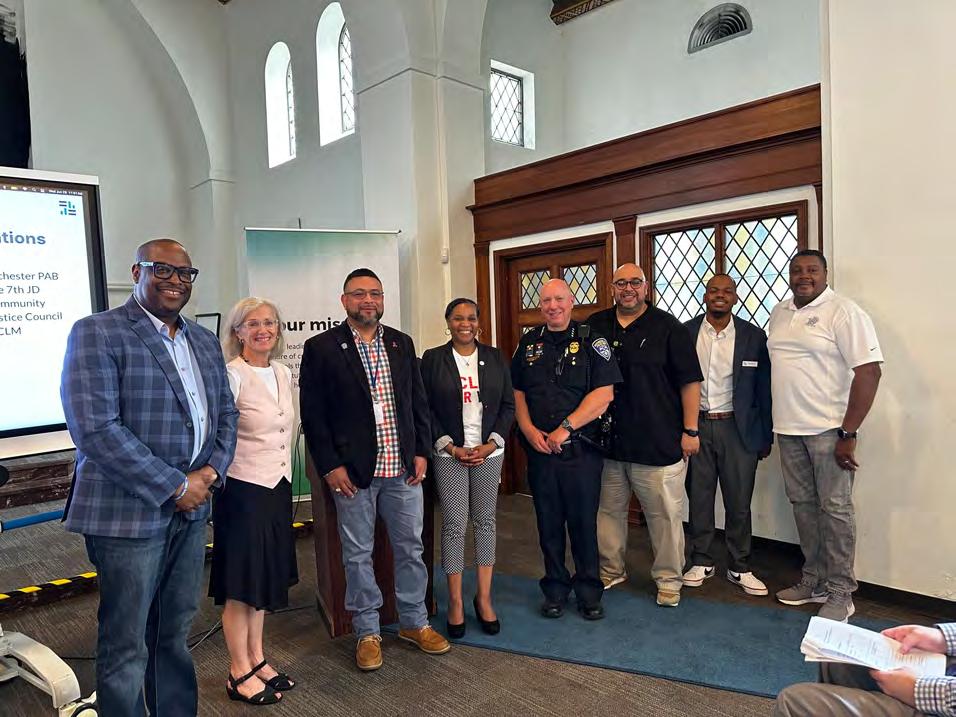
We spent years working with policing experts and community members developing the country’s first national set of performance measures for police departments. This year, we guided the Rochester Police Department (RPD) and the community it serves to put those measures to use. We walked them through a series of steps to improve their data, convene a Community Advisory Board (CAB), and work together to make their data available and actionable. The result was seeing RPD’s data on a Commons that gives the community direct access to information on crime trends, calls for service, use of force, officer wellness, community engagement, and fiscal resource allocation. The platform also tracks progress against a policy goal the CAB and RPD set together: reducing median police response times to four minutes for certain calls.
MFJ with members of the Rochester Community and Rochester Police Department.
Thurston County, WA:
MFJ also supported the Thurston County Prosecuting Attorney’s Office in launching a public Commons in collaboration with community leaders. The work resulted in a shared policy goal to reduce the amount of time between arraignment and case closure by 10% that can be tracked alongside multiple other data trends.
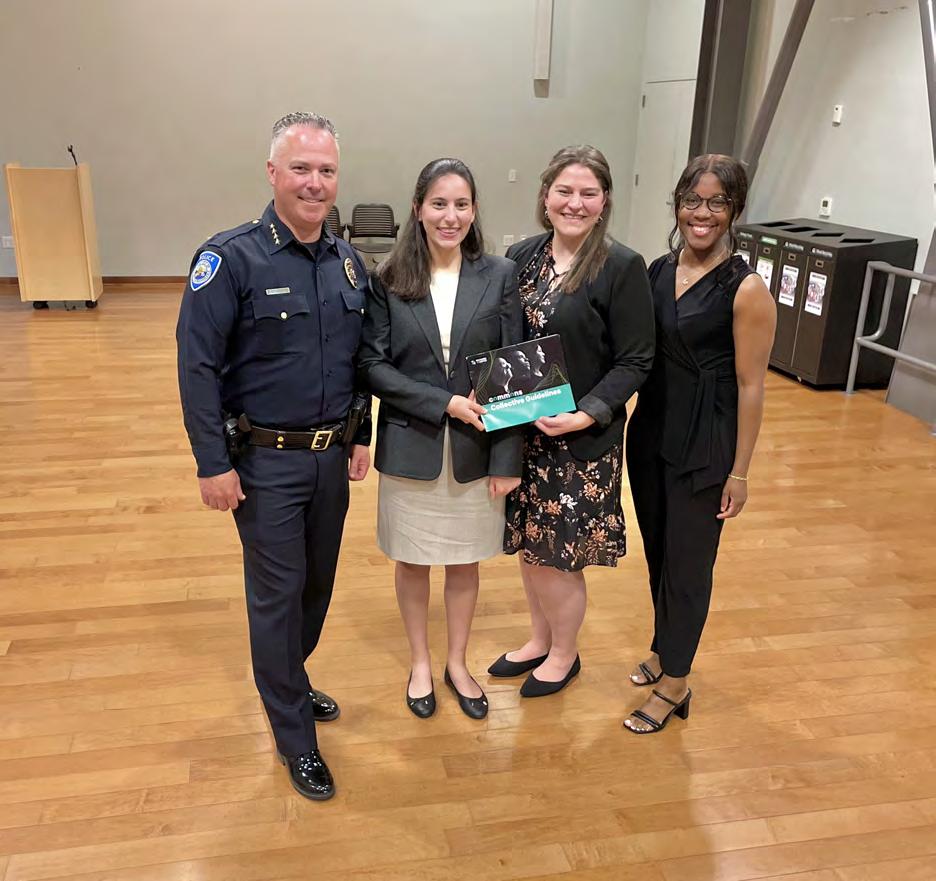
participating in the Thurston County Commons community launch event - Thurston County, WA
West Sacramento, CA
We offered the same guidance to the West Sacramento Police Department (WSPD) and their community this year; we helped them convene a new CAB, improve their data, and work together to set a public policy goal. The resulting Commons is tailored to local concerns and enables residents to monitor progress on their policy goal to improve median response times.
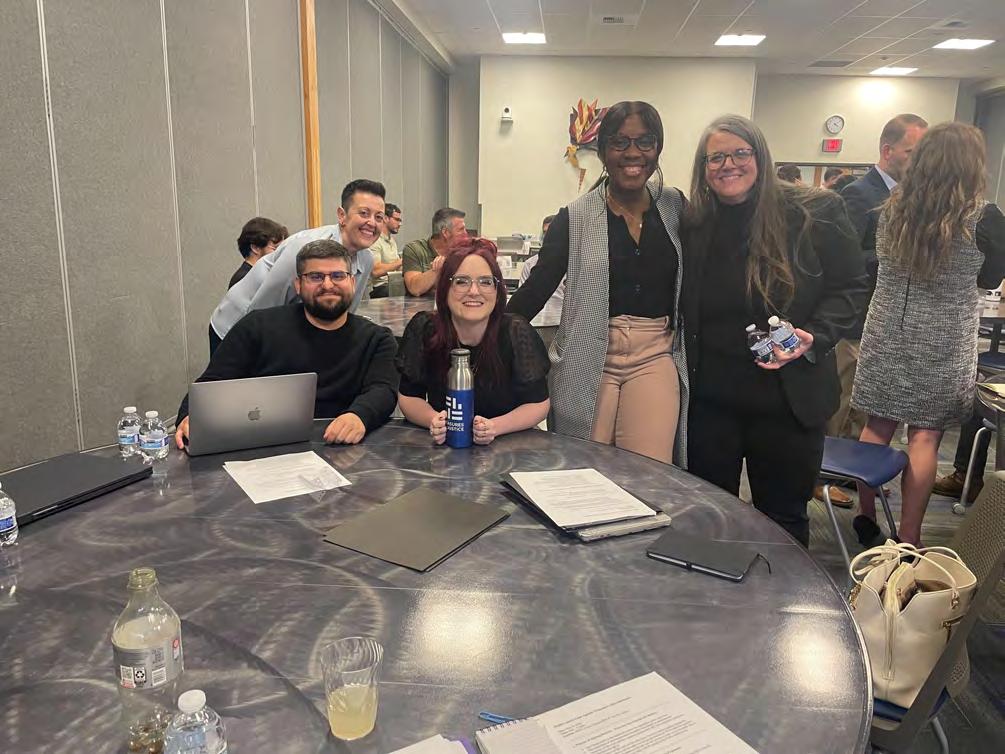
MFJ participating in the West Sacramento Commons community launch event - West Sacramento, CA
MFJ
Data Changes Lives.
Throughout the year, we saw how helping communities center data in their change efforts can improve lives. We watched how residents, advocates, and business owners in Rochester, NY, used their data to participate meaningfully in shaping public safety priorities at the neighborhood level.
More intimate, still, we saw how good data can change policy, which can be the determining factor between a positive and inspired life full of opportunity, or its alternative. Thanks to our data and community work with the Yolo, CA, District Attorney’s Office, we were able to guide them towards setting shared policy goals based on high-quality data, among them increasing diversion rates. As a result, we met Li, who told us a story about second chances we won’t soon forget.
I went from almost having a record to being able to go through a restorative justice program, to working for that program and helping people like me, to now having an article written about it. Who knows where else this will go?” -Li
For us, data is ultimately about people and their ability to effect change, knowing that every improvement–from data infrastructure to better policy–can have a huge impact on people’s lives.
Community Engagement as a Means to “Readiness.”
This year, we continued to expand our network of data-interested community leaders–The MFJ Collective–based on our belief that “readiness” shapes what becomes possible in critical moments.
By “readiness,” we mean a state of preparedness to use information well, under pressure, in public, and across disagreement. “Readiness” means people share a basic understanding of how the justice system functions, trust the information used to describe what is happening, and have relationships strong enough to support honest dialogue across
differences. Readiness is built over time through learning, relationship-building, and shared narrative, and it helps determine whether moments of public attention lead to reaction or to reasoned action.
With this framework in mind, we worked closely this year with CABs in West Sacramento, Thurston, and Rochester. And we began to get the MFJ Collective off the ground, creating a digital space for members to connect and learn.
Read more about our approach to this critical piece of our mission.
How do we communicate with and educate our community? That is an important conversation to have.”
– Dr. Candice Lucas, Senior Vice President for Equity and Advocacy with the Urban League of Rochester
Technical Assistance.
Diagnosing data problems and making recommendations that help agencies improve their data quality and infrastructure is a critical step towards safer and more equitable communities. But it cannot be the last step. Agencies need a lot of support implementing recommendations and thinking through the best ways to optimize the use of their data. Often, they do not have the internal resources to devote to this work; they are overloaded as is. This is why this year we built out our Technical Assistance offering to ensure we aren’t just making recommendations but helping agencies embrace them. We’ve developed a three-part service model that:
01 _ Assesses agency data for accuracy, completeness, and usability; identifies gaps, inefficiencies, and missed opportunities; provides clear, reliable insights for confident decision-making.
02 _ Builds skills and trains staff to improve data processes; builds confidence and capability to manage data systems; reduces bottlenecks and costs.
03 _ Offers hands-on, on-the-ground support to help agencies integrate data-driven practices into daily operations, streamline workflows, and build sustainable, trust-building systems.
Our goal is to meet agencies where they are on the path to a more efficient and effective system and help them get there.
Media Recognition and National Impact.
Our work gained broad media coverage in 2025, reflecting the growing national dialogue around data transparency and justice reform:
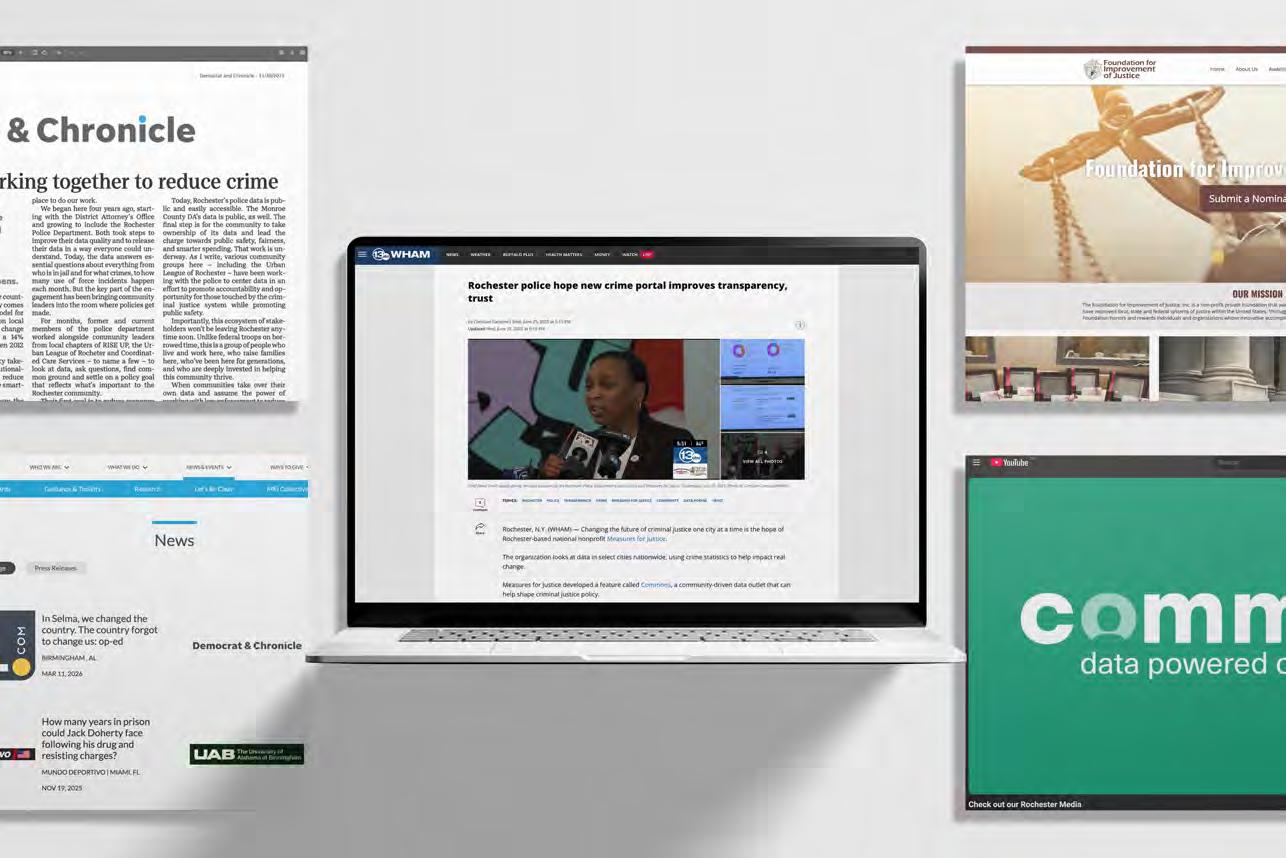
In Rochester, local outlets such as the Democrat & Chronicle and ABC affiliate 13 WHAM covered the launch of the police department rolling out its public data platform, noting its potential to improve transparency and trust between the department and residents.
Regional news in Washington State documented the rollout of the Thurston County Prosecuting Attorney’s public data platform, highlighting community engagement and trust-building efforts.
Coverage in multiple outlets underscored our role as a trusted partner and innovator in the criminal justice data space, demonstrating that data-driven solutions can be adopted by any community, in any county.
We were also especially pleased to be honored with the Paul H. Chapman Award from the Foundation for Improvement of Justice for our work advancing police transparency through data.
Looking Ahead: Our Commitment to Help Agencies and Communities Move Forward Together.
As we look into 2026 and beyond, we think less about infrastructure than the impact better data infrastructure can make on people’s lives. Every state government, local agency, and community-based organization we help center high-quality data in their change e orts, gets all of us one step closer to a system that is safer, more e cient, and fair. A system that responds to community needs and lives up to its promises.
To these ends, we will continue to o er our guidance and services to help agencies improve the quality of their data and make it available, while helping communities engage with that data and their criminal justice leaders to set shared policy goals.
With new partnerships and technological innovation, we will continue to help states and counties use data to inform, empower, guide, and unite communities and their criminal justice leaders in pursuit of a safer and equitable future.
Total Expenses for 2025 = $13,332,257
Fundraising for 2025 = $1,187,420 Admin for 2025 = $399,968 Mission for 2025 = $11,744,869
*unaudited nancials
Supporters.
Measures for Justice is deeply grateful for the generous support of those who make our work possible. We are profoundly thankful to the individuals and organizations whose major contributions in 2025 strengthened Measures for Justice and moved us closer to a justice system that is safer, more fair and e ective.