If you would like this publication in an alternative format, such as large print, or another language, please email communications@midandeastantrim.gov.uk
2020/21
Mid and East Antrim Borough Council 1-29 Bridge Street Ballymena BT43 5EJ
T: 0300 1245 000
E: enquiries@midandeastantrim.gov.uk
W: www.midandeastantrim.gov.uk
www.midandeastantrim.gov.uk

1.0
2.0 Arrangements to Secure Continuous Improvement

3.0
• Update on previous Performance Improvement Plan Objectives
Part 12 of the Local Government Act (Northern Ireland) 2014 (The Act) put in place a framework to support continuous improvement in the delivery of council services within the context of strategic objectives and issues that are important to those who receive those services.
The Act specifies that Council must make arrangements for the publication of:
a) Its assessment of its performance during a financial year:
• In discharging its duty to make arrangements to secure continuous improvement.
• In meeting its improvement objectives which are applicable to that year.
• By reference to the statutory performance indicators and self-imposed indicators which are applicable to that year.
b) Its assessment of its performance in exercising its functions during a financial year as compared with:
• Its performance in previous financial years.
• So far as is reasonably practicable, the performance during that and previous financial years of other councils.
The purpose of this Self-Assessment Report is to provide an overview of Mid and East Antrim Borough Council’s assessment of its performance for the year 2020/21.
www.midandeastantrim.gov.uk | 3 2 | Performance Self-Assessment Report 2020/21 Contents
Introduction
Assessment of Performance 2020/21
• Performance Improvement Objectives 2020/21
• Statutory Performance Indicators
Audits
Performance Improvement Plan 2021/22
• Self-Imposed Performance Indicators • Benchmarking • Performance
4.0
5.0 Overall Assessment of Performance
6.0 Conclusions Appendices 1.0 Introduction
2.0 Arrangements to Secure Continuous Improvement
2.1 Performance Management Framework
Mid and East Antrim Borough Council introduced a Performance Management Framework during 2017/18 to drive performance management and continuous improvement within the organisation.
The Framework diagram was revised during the development of Council’s new Corporate Plan for 2019-2023, and is provided below.
The diagram illustrates that performance is measured and managed at all levels within the organisation. The framework links directly to the corporate planning processes in place within Mid and East Antrim Borough Council. It demonstrates how strategic objectives within the Community Plan and Corporate Plan are cascaded through annual business plans and
ultimately to every employee’s work objectives. Council’s Performance Planning Cycle is outlined in the table in Appendix 1, which describes the timelines for managing performance throughout the year.
The ongoing review and reporting schedule for the various plans is discussed within the Performance Management Framework document. A copy of the Framework is available on request.
Community Plan | 15-year strategic plan
Corporate Plan | 4-year strategic plan
Performance Improvement Plan | Annual improvement plan
Plan Purpose
Community Plan
The Community Plan was launched on 1 April 2017 and sets a 15-year vision for Mid and East Antrim Borough. The Community Plan is led by Council in partnership with the public, voluntary and private sectors.
Corporate Plan
Performance Improvement Plan
Annual Business Plans
A new Corporate Plan for the 2019-2023 period was launched in July 2019 and includes six strategic themes that are aligned with the Community Plan.
A Performance Improvement Plan is produced annually and includes improvement objectives that align with the key priorities of both the Community Plan and Corporate Plan.
Annual Business Plans are developed to set the direction for all Directorates. They define outcomes for the year and include key performance indicators to monitor and drive performance improvement.
Annual Business Plans
Employee Personal Development Plan
Annual plan linked to work objectives & learning & development needs
Mid and East Antrim Borough Council - Performance Management Framework
Employee Personal Development Plans
Personal Development Planning (PDP) ensures that all staff objectives and development activities are fully aligned with Business Plans, and ultimately the Corporate Plan and Community Plan.
The table above provides a brief summary of the plans illustrated within the Performance Management Framework
4 | Performance Self-Assessment Report 2020/21 www.midandeastantrim.gov.uk | 5
2.2 Governance Arrangements
Within Mid and East Antrim Borough Council, the following governance arrangements were established to manage performance during 2020/21 for the Corporate Plan, the Performance Improvement Plan and Annual Business Plans.
2.3 Mid and East Antrim Borough Council’s Audit & Scrutiny Committee
The Terms of Reference for Mid and East Antrim Borough Council’s Audit & Scrutiny Committee sets out the Committee’s overall purpose and objectives.
The Committee has two key functions of ‘Audit’ and ‘Scrutiny’. The area of performance improvement falls within the ‘Scrutiny’ function, and includes the monitoring, assessment and review of the following:
• Business Plan performance
• Service Risk Registers
• Business Improvement & Efficiency Strategy progression
• Performance Improvement Plan performance
• Council Transformation
The Committee met four times throughout the financial year of 2020/21, in August, September, December and February.
Meetings scheduled for April and June 2020 were cancelled due to the COVID-19 pandemic.
These governance arrangements facilitate and support transparency, accountability and improvement across the Council. Timescales were adjusted to take account of the COVID-19 pandemic.
6 | Performance Self-Assessment Report 2020/21
Corporate Plan SMT 6-monthly Council 6-monthly Performance Improvement Plan SMT Quarterly Audit & Scrutiny Quarterly Directorate Business Plans SMT Quarterly Audit & Scrutiny 6-monthly Plan Council / Commitee Reporting Cycle
www.midandeastantrim.gov.uk | 7
2.4 The Performance Improvement Plan
We demonstrate our commitment to continuous improvement in the delivery of our services through our Performance Improvement Plan. On 30 June each year, Council publishes a new plan, which sets out how we will deliver improvement in at least one of the seven improvement areas stipulated in the Local Government Act (Northern Ireland) 2014:

The Performance Improvement Plan sets out our improvement objectives for the year, outlining what we hope to achieve, how we plan to do it and how our citizens will be better off as a result.
The plan does not detail every improvement we intend to deliver, but focuses on the key areas identified for improvement through Community and Corporate Planning processes, stakeholder engagement and research analysis.
After a period of consultation, Council agreed five improvement objectives for 2020/21.
Section 3 of this Self-Assessment Report details our objectives for the year 2020/21, and the progress made against these.
It also looks back at previous objectives that were not fully completed, and provides updates on the progress made.
Update reports were scrutinised by the Audit & Scrutiny Committee. The yearend progress report was scrutinised on 17 August 2021, and can be viewed at www. midandeastantrim.gov.uk/PIP
Strategic effectiveness Service quality Service availability Efficiency Fairness Sustainability Innovation
8 | Performance Self-Assessment Report 2020/21 www.midandeastantrim.gov.uk | 9
COVID-19 Response and Arrangements
In March 2020, following the announcement of measures by the UK Government to tackle the COVID-19 virus, Mid and East Antrim Borough Council invoked its Emergency Plan.
While a number of Council services were closed with immediate effect, through the use of innovative processes, and by adopting a ‘digital first’ approach, many Council services were able to operate as normal.
Additionally, we quickly introduced a number of vital new services, including the establishment of the Remote Call Centre, an online booking system for Sullatober HRC and live broadcasts of Council and Committee meetings.
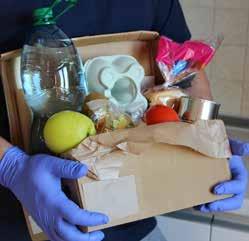
To support our local communities, we distributed over 6,000 food parcels and awarded over £130,000 through the Community Support Grant Scheme during the first few months of the pandemic.
We also expanded our business support programmes, providing vital advice and support to local businesses impacted by the COVID pandemic.
As we look towards recovery, Council staff continue to work tirelessly to support the residents and businesses of Mid and East Antrim.
Our ‘COVID Confidence’ initiative has been designed to support local businesses towards economic recovery, whilst at the same time respecting public health controls.

Council is fully engaged and working in collaboration with various Government Departments to deliver the Department for Communities-led COVID-19 Revitalisation Recovery Programme.
We continually monitor and adjust our approach to combating the pandemic, at all times following the advice and guidance of the Public Health Agency.
To mitigate the impact of the COVID-19 pandemic on delivery of our Performance Improvement Objectives for 2020/21, we adopted a dynamic and flexible approach.
Further details on some of the services that Council has delivered during the last year can be found on the opposite page.
£130,000 Awarded through various grant support schemes
5,580+ Hours of virtual business mentoring delivered
6,000 Food parcels distributed to those most in need
125 ‘Teenage Mental Health’ boxes distributed £
9 Awards secured and maintained
28,460 Supplier invoices paid
45 ‘Every Body Active’ virtual classes shared on Council’s social media
38,200+ Calls received to the Remote Call Centre
54 ‘Virtual Summer Scheme’ videos produced and shared on social media
Dubai Duty Free Irish Open and NI Open successfully held
858 Volunteer Recognition Certificates awarded by Mid & East Antrim Mayor
Successful launch of #RediscoverMEA to bring tourism & trade back to the borough
125+ Residents took part in a number of outdoor events
3 Thank You NHS Flowerbeds Created
3,000+ rural households visited and supported through the Rural Door to Door Scheme
168 Slow cookers distributed across the Borough
10 | Performance Self-Assessment Report 2020/21
3.0 Assessment of Performance 2020/21
3.1.1 Year-end Performance Review for 2020/21 Summary
Outcomes
The outcomes are statements of what we want to achieve for our citizens. 16 outcomes were defined against the five improvement objectives. 15 of these were due for completion by March 2021, of which:
3.1 Performance Improvement Objectives 2020/21
Mid and East Antrim Borough Council identified improvement objectives in the following seven areas as the focus of the Performance Improvement Plan for 2020/21:
Indicators
100% of outcomes were achieved (15 of 15).
The key performance indicators are the means by which we measure progress towards achieving our outcomes. 19 indicators were defined within the 5 objectives, 16 of which were due for completion by March 2021.
69% were on track / achieved (11 of 16).
25% were delayed but progressing (4 of 16).
The plan was based on the strategic priorities agreed by Council in the Corporate Plan 2019-2023.
Five improvement objectives were identified for 2020/21:
1. Grow the economy and create jobs.
2. Support the communities within the historic conservation area of Carrickfergus, contributing to the sustainability of the local economy.
3. Encourage people to value our natural environment through the promotion of the Green Dog Walkers scheme.
4. Improve customer engagement and service delivery by enhancing our use of information technology.
5. Autism Friendly Mid and East Antrim.
A series of outcomes and indicators were developed to support the monitoring and reporting of performance. These are outlined within Project Initiation Documents (PIDs) for each objectives, and progress is reported on a quarterly basis.
Further detail can be found on Council’s website at www.midandeastantrim.gov.uk/PIP
6% were not achieved (1 of 16).
11 of the 16 indicators (69%) due for completion in March 2021 are either completed or on track.
A quarter were delayed but still progressing, including rental income generated at the Ecos Innovation Centre (page 15), and three indicators relating to the
Green Dog Walkers objective (page 19).
One indicator was not achieved, relating to the statutory indicator for the average processing times of major planning applications (page 30).
12 | Performance Self-Assessment Report 2020/21 www.midandeastantrim.gov.uk | 13 Strategic effectiveness Service quality Service availability Efficiency Fairness Sustainability Innovation
Grow the economy and create jobs within
Mid and East Antrim Borough
Our aim What did we deliver?
The promotion of new jobs in the borough by successfully delivering the ‘Go for It’ Programme.
Council continues to successfully deliver the ‘Go for It’ Programme, with 94 jobs promoted up to the end of March 2021, against a target of 85. 153 business plans were approved during the year. 29 jobs have been promoted up to the 30 June in the 2021/22 year.

Why?
Who is responsible?
• You told us that ‘investment to grow the economy, create jobs and attract tourists’ was one of the most important forms of investment for Council (Household Survey 2018).
• There were approximately 1,300 jobs lost in Mid and East Antrim during 2019.
The growth of new industry sectors by being a Centre of Excellence for start-ups, spin-outs and social-economy businesses within the Ecos Innovation Centre.
Outcomes
What you will see
Delivery of an effective and efficient Planning Service to maximise economic development.
• Director of Development
85 jobs promoted through the ‘Go for It’ Programme by March 2021.
125 knowledge-economy jobs created in Ecos Innovation Centre by March 2022.
£95,000 in rental income from Ecos Innovation Centre by March 2021.
Indicators
How we will measure progress
This section details the progress made against our 2020/21 Improvement Objectives, illustrating our progress as follows:
Our Integrated Property Programme, which aims to create ‘Grade A’ office accommodation, continues to progress despite the difficulties currently being faced due to the COVID-19 pandemic. 7 companies are now located at the Ecos Innovation Centre. The Centre offers an ideal location for start-up businesses to innovate and grow, creating jobs and wealth in Mid and East Antrim.
Council did not meet the statutory target for major planning applications during 2020/21. The difficulty in achieving this target is due to environmental complexities, which require careful consideration by a number of statutory consultees.
However, we remain well above target for both the processing of local planning applications and enforcement conclusion times.
The draft Local Development Plan Strategy was submitted to the Department for Infrastructure in March 2021. The Planning Appeals Commission have now commenced the Independent Examination process.
94 jobs promoted through the ‘Go for It’ Programme.
121 knowledge-economy jobs were created at the Ecos Innovation Centre up to 31 March 2021, this had increased to 134 by the end of June 2021.
Two companies availed of rent deferral, which is scheduled to be recouped during 2021/22.
Major Planning applications processed within an average of 30 weeks by March 2021. 39.2 weeks
Local Planning applications processed within an average of 15 weeks by March 2021. 10.4 weeks
70% of planning enforcement cases concluded within 39 weeks by March 2021.
82.6%
?
www.midandeastantrim.gov.uk | 15
Green | Achieved /
Amber | Delayed
Red | Not achieved
Grey | Not due yet / not
14 | Performance Self-Assessment Report 2020/21
on track
but progressing
/ stopped
available
Carrickfergus Townscape Heritage Initiative
Support the communities within the historic conservation area of Carrickfergus, contributing to the sustainability of the local economy
Up to 10 buildings of historical and architectural interest restored (including 3 existing awarded schemes), through the Townscape Heritage Initiative, with Council and National Lottery Heritage Fund grant assistance, by March 2022 or beyond.
Outcomes
What you will see
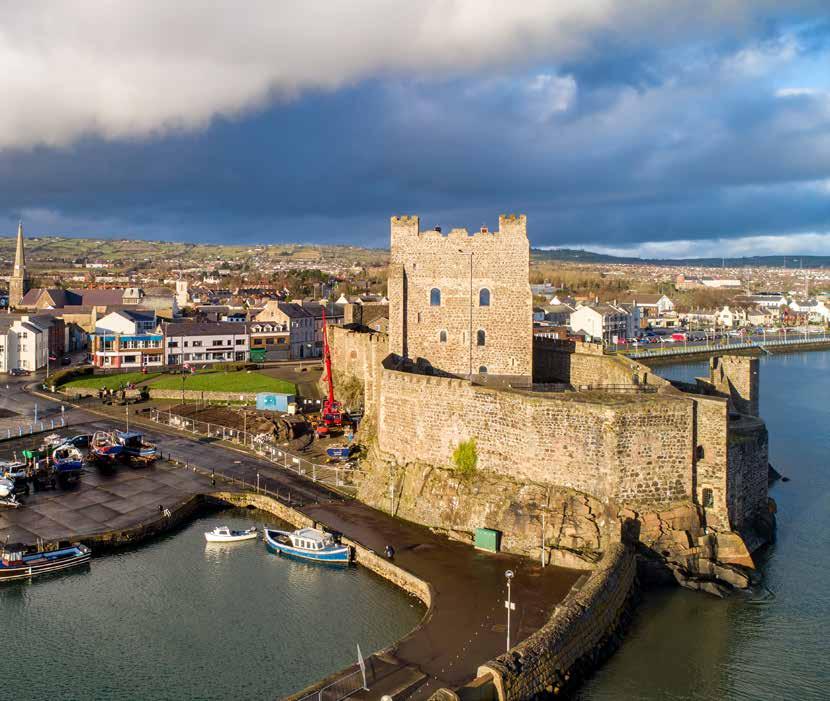
• Carrickfergus Castle is a key landmark and popular visitor attraction.
The local community will have a better understanding of built heritage.
8 eligible properties have received Letters of Offer. 3 buildings are successfully complete, the restoration of a further 5 is underway.
In May 2021, the National Lottery Heritage Fund approved a request for additional funding to support the restoration of two further buildings.
Council are currently working with two property owners to complete their applications.
The Townscape Heritage Initiative (THI) participated in a virtual event to celebrate European Heritage Open Days (EHOD) 2020, by producing a short film which featured clips of THI capital projects and a new publication called “Carrickfergus Across the Centuries”. The film was distributed by the organisers of EHOD on social media channels to heritage audiences.
The project to digitise Carrickfergus Town Records 1600-1800s has been completed. Records are now freely accessible online for people to research family and building records.
Why?
Who is responsible?
• Significant factory closures, changes in buying habits and proximity to Belfast have led to a decline in Carrickfergus’ traditional town centre economy.
Increased inward investment and local employment opportunities related both directly and indirectly to heritage and tourism growth.
• Director of Development
Indicators
Up to 7 new grants awarded by March 2022 or beyond, to be measured in line with revised programme timescales.*²
Education Programme completed by December 2020.
Increased town centre footfall by March 2022 or beyond.*³
Lower levels of town centre vacancy by March 2022 or beyond.*³
At least 25 construction jobs have been supported to date on the Townscape Heritage Initiative schemes. The number of jobs created on completion of projects will be evaluated at programme closure.
8 grants have been awarded to date, and 2 applications are in development.
The Education Programme was extended into 2021, allowing for the successful delivery of 3 Education Programmes.
Footfall counters are in place and will be evaluated at the end of the project.
Town centre occupancy will be evaluated at the end of the project.
Increased floor space for retail, commercial or residential use by March 2022 or beyond.*³
*¹ The full impact of COVID 19 on the overall programme and budget is as yet unknown. There are anticipated delays in programme arising from the management of construction projects within safe distancing guidelines. Programme delays are likely to incur additional project costs, bringing additional pressure on THI budget and the availability of grant across THI properties.
*² The principal funder, National Lottery Heritage Fund, have further offered
To date, the total vacant floorspace restored and converted for reuse is 249m² - 195m² for retail/commercial use and 54m² for museum/culture space.
10 new residential apartments will be delivered between now and March 2022 or beyond.
flexibility over the proposed new grant expiry date of March 2022 during this period of uncertainty.
*³ A full evaluation will take place at the end of the project and will inform future town centre regeneration initiatives. Indicator will be measured in line with revised programme timescales.
Our aim What did we deliver?
*³
*¹
measure progress
How we will
?
| 17
16 | Performance Self-Assessment Report 2020/21
Responsible dog ownership through increased participation and support of the Green Dog Walkers Scheme.*⁴
?
Why?
Who is responsible?
• Dog fouling is one of the top perceived problems in our local areas with 31% of residents considering it to be an issue (Household Survey 2018).
• We received 111 dog fouling complaints during 2019/20 (April 2019 - March 2020).
• We want to have a borough that is clean and not just cleaned.
A marketing and promotional campaign to challenge attitudes and change behaviours.
Following the successful and continued roll-out of the Green Dog Walkers marketing and promotional campaign, pledge numbers reached 1,160 in April 2021. This is a 13.5% increase from a baseline of 1,022 in April 2020.
Despite difficulties faced due to COVID-19, campaigning continued to make a positive impact throughout the borough in relation to dog foul in 2020/21. Due to lockdown restrictions, campaign activities were restricted to social media and press, including coverage in regional papers, such as the Newsletter and BBC Radio Ulster. Council were unable to host road shows with partners such as the Dog’s Trust over this period.
Enforcement Officers continued to encourage active participation through their routine patrols.
Outcomes
What you will see
• Director of Community
A cleaner borough.
Substantiated dog fouling complaints received by Council fell by 7% in 2020/21, with 104 complaints recorded compared to 111 during 2019/20.
Given the unprecedented year, which Council has faced due to the COVID-19 pandemic, and a substantial increase in dog walkers throughout the borough, a reduction is quite an achievement.
There was an increased number of complaints received during October to December 2020, which was linked to both the darker evenings and the reintroduction of a more stringent lockdown. Council’s ‘Dark Nights No Excuse’ campaign ran during the winter months, resulting in a reduction in complaints during January to March 2021.
The ‘Reportable’ App continues to be promoted as a means to report environmental matters to the Council, including dog foul. This has contributed to an increase in the number of reports received.
At least 1,500 active Green Dog Walker Pledges by March 2021.

A 10% reduction in the number of dog fouling complaints by March 2021.
Indicators
A further two organisations committed to taking action by March 2021.
A reduction in the number of residents perceiving dog fouling to be an issue in our local areas.
1,160 Green Dog Walker pledges are currently active.
7% reduction in the number of dog fouling complaints.
9 community groups are committed to taking action. Bespoke ‘Green Dog Walker’ banners have been erected on the grounds of 3 locations: Larne RFC, Millbrook Community Association and Ahoghill Thistle FC.
Existing pledge holders were scheduled to be contacted in July 2020; however, the survey was delayed due to the impact of the COVID-19 pandemic. A refocus on contacting these pledge holders is currently under consideration.
*⁴ The Green Dog Walkers Scheme is an innovative approach to dog fouling. Responsible dog owners and dog walkers support the scheme by signing a pledge to clean up after their pets, and to encourage other owners to do the same by giving them bags.
www.midandeastantrim.gov.uk | 19
Our aim What did we deliver?
we will measure progress
How
18 | Performance Improvement Plan 2020/21 Year End Review
Encourage people to value our natural environment through the promotion of the Green Dog Walkers scheme
Improve customer engagement and service delivery by enhancing our use of information technology.
• Our services will be more effective and efficient, providing greater satisfaction and value for money for ratepayers.
• Digital Transformation will lead to improved management reporting and will support better and more informed decision-making.

Implementation of our Digital Transformation Strategy, to include:
A redesign of the Council website developed from user experience feedback.
The project delivery team have completed a scoping exercise to identify Council requirements and the procurement process is underway. This project has now progressed to Phase Two and will be taken forward into 2021/22.
Transformation of Council’s telephony services.
Council have purchased and successfully implemented software that allows Council officers to receive telephone calls made to their landlines remotely through their laptops. The system has been implemented for departments previously utilising the bespoke ‘Remote Call Centre’, which was established during the early stages of lockdown. The system is currently being rolled out.
Outcomes
What you will see
Why?
Who is responsible?
• In our recent Household Survey (2018), 39% of residents said they would like to be able to report a problem online, 37% would like to book activities, 27% would like to buy tickets and 22% would like to pay bills.
Conversion of additional services to citizen text alert system.
A new text notification service went live in April 2021 to reduce the level of administration involved in the Wellbeing Funds application process. The system will send text reminders to applicants to submit relevant documentation.
The following customer facing services have been digitally transformed:
Digital transformation of at least one customer facing service.
• Online Waste Booking System at Sullatober Waste depot.
• Establishment of Council’s Remote Call Centre.
• Live broadcast of Council and Committee meetings.
Wi-Fi surveys have been completed at over 70 Council locations to identify requirements.
• Director of Corporate Services
Indicators
How we will measure progress
Additional Wi-Fi Points (Phase Three).
The installation of Wi-Fi points was delayed due to closure of some Council buildings during the COVID-19 pandemic. However, all Wi-Fi points have now been installed.
A minimum of five digital projects completed by March 2021*⁵. All projects have been successfully delivered.
*⁵ Timescales may be subject to variation as a result of the COVID-19 pandemic.
www.midandeastantrim.gov.uk | 21
?
Our aim What did we deliver?
20 | Performance Self-Assessment Report 2020/21
Autism Friendly Mid and East Antrim
• Autism is lifelong and affects the development of social and communication skills. It can affect the way an individual relates to people, situations and the environment.*⁶
• In Northern Ireland, 1 in 24 children have a diagnosis of autism (2020, Prevalence of Autism in School aged children, DHSSPS)*⁶
Our aim What did we deliver?
A bespoke, free of charge, training and awareness raising package has been developed by the project steering group. Certificates, pin badges and window stickers have been designed for training participants.
An awareness-raising programme to develop the borough as an autism friendly place.
Why?
Who is responsible?
• Improving people’s health and wellbeing (and reducing health inequalities) is one of residents’ top five priorities for making the local area a good place to live (Household Survey 2018).
Outcomes
What you will see
• Director of Community
We will secure ‘Autism Friendly’ organisation status as a potential model for other Community Planning Partners.
5 training sessions have been completed up to the end of June 2021. These included an online training session to Elected Members, Carnlough Spar, Raglan Development Project, Tesco’s Community Champions and Libraries NI Community Planning Leads.
‘Just A Minute’ (JAM) Awareness Training commenced in June 2021, with 140 staff members completing it successfully so far. This initiative is another positive step in the right direction in our journey to become an Autism Friendly Borough.
As a result of COVID-19 restrictions, sessions were adapted and delivered virtually.
In June 2021, 6 venues received the ‘Autism Impact Award’ in recognition for going ‘above and beyond to create accessible and autism-friendly’ environments, including Carrickfergus Amphitheatre, Larne Leisure Centre, Seven Towers Leisure Centre, Carnfunnock Country Park, The Gobbins and The People’s Park. The prestigious achievement involved staff training and a number of adjustments to improve accessibility and overall customer experience, including pre-visit guides and ‘quiet spaces’ at a number of venues.
The promotion of Council’s activities is ongoing, both online and in the press, including a dedicated page on our website.
3 Council leisure centres accredited with the Autism NI Impact Award.*⁷

6 Council locations have been accredited with the Autism NI Impact Award.
9 staff members trained as ‘Autism Champions’.
Indicators
How we will measure progress
3 ‘Autism Friendly’ public awareness sessions held for businesses and the local community, with at least 70% of attendees reporting that their knowledge of autism has increased following training.
Up to the end of June 2021, a total of 41 people had attended IMPACT Training, 16 of whom received the accreditation and are now Autism Champions. Of the three Elected Members targeted, one received the accreditation and became an Autism Champion; the other two completed Awareness-Raising training. It is unlikely they will have the opportunity to complete the accreditation.
5 sessions have been held up to 30 June 2021.
Following the training, 95% of attendees reported that the sessions were insightful and informative and that their knowledge of autism has increased.
A further session is scheduled for September 2021.
www.midandeastantrim.gov.uk | 23
Objective: ?
*⁶ www.autismni.org/statistics-1 *⁷ Timescale may be subject to variation as a result of the COVID 19 pandemic. 22 | Performance Improvement Plan 2020/21 Year End Review
3.1.2 Review of outstanding actions from previous years’ Improvement Objectives
The table opposite provides an update on previous improvement objectives that were not carried forward to the subsequent years’ plans. Some were not fully completed in the financial years in which they related.
2020/21
Objective
Outcome Status
2019-20
Improve customer engagement and service delivery by enhancing our use of information technology
A Customer Complaints & Contact System.
This project has been carried forward into 2021/22. Online Building Control Certificates.
This project has been fully completed. The system now allows digital submission of applications and issuing of certificates that was previously a manual paper-based system.
You can view previous Performance Improvement Plans at www.midandeastantrim.gov.uk/ performance

www.midandeastantrim.gov.uk | 25
24 | Performance Self-Assessment Report 2020/21
Complete To be complete
3.2 Statutory Performance Indicators
The Local Government (Performance Indicators and Standards) Order (Northern Ireland) 2015 sets out statutory performance indicators and standards for each Council in Northern Ireland. For 2020/21, these were set in the functional areas of Economic Development, Planning and Waste Management.
The information is currently collated by the Department for the Economy, Department for Infrastructure and Department for Agriculture, Environment and Rural Affairs (DAERA) respectively and published on their websites. Once released to Council, this information is published for citizens and other stakeholders to assess Council’s performance in these areas.
Mid and East Antrim Borough Council’s 2020/21 performance against these indicators is outlined in the tables which follow.
Performance is analysed using R/A/G status
Status Trend
Achieved / On track Performance has improved since the previous year
Delayed but progressing
Performance is similar to the previous year
Not achieved / Stopped Performance has declined significantly since the previous year
26 | Performance Self-Assessment Report 2020/21 www.midandeastantrim.gov.uk | 27
3.2.1 Economic Development
Mid and East Antrim Borough Council have exceeded the Business Start-Up Job Promotion target every year since 2015/16.
The Covid-19 pandemic significantly impacted ‘Go for it’ participation rates across Northern Ireland during the April – June 2020 period, which coincided with the first national Lockdown.
The programme partners quickly adapted to virtual delivery, enabling clients to meet their Business Advisors online and activity recovered well. Locally, particularly strong performance was recorded during the final quarter of January to March 2021, ensuring that we exceeded our statutory jobs target.
Council continues to be one of the top performers in the region for this indicator, as illustrated in the chart opposite.
The average achievement against the statutory target for NI Councils was 88%. Mid and East Antrim Borough Council achieved 111%, placing Council in 4th position.
During 2020/21, 153 business plans were completed and 94 jobs promoted through the programme.
A suite of business support programmes has been developed under Amplify, the integrated economic strategy for the borough. The programmes encourage entrepreneurship, provide guidance at the pre-enterprise stage and raise awareness of the support in place through the NI Business Support Programme.
Council officers are working very closely with Enterprise NI and local delivery agencies to ensure that job targets and business start numbers continue to grow and exceed the statutory target, building a dynamic small business base in the borough.
Jobs promoted by Councils 2020/21 (actual vs. target)
28 | Performance Self-Assessment Report 2020/21 www.midandeastantrim.gov.uk | 29
2018/19 2019/20 2020/21 Ref Statutory Indicator Yearend result Yearend result Standard Yearend result Ranking against other councils % against target NI average Status Trend ED1 The number of jobs promoted through business start-up activity 124 122 85 94 4 111% 88%
Antrim&NewtownabbeyArds&NorthDown Armagh,Banbridge&Craigavon Belfast CausewayCoast&GlensDerry&StrabaneFermanagh&OmaghLisburn&CastlereaghMid&EastAntrimMidUlster NewryMourne&Down Target Jobs Created in year 0 50 100 150 200 250 300 350 Number of Jobs Target No of jobs promoted through business start-up activity Achieved 0 100 200 300 15-16 16-17 17-18 18-19 148 193 140 124 19-20 122 20-21 94 Jobs created 85
3.2.2 Planning
P1: The average processing time of major planning applications
The statutory target set for Councils in Northern Ireland for the processing of major development planning applications is an average of 30 weeks (from date valid to decision or withdrawal).
No Council in Northern Ireland met the target in 2020/21. The average across all councils was 61.4 weeks, almost double the standard, and up from 52.8 weeks in the same period last year.
Mid and East Antrim Borough Council achieved an average of 39.2 weeks, a 3 week improvement on last year.
We last met the target in 2017/18, but a number of complicated applications has meant that Council has not met the target since, despite having the quickest average processing time this year.
For Council, the difficulty in achieving the target this year is related to complex environmental issues, which require careful consideration by a number of statutory consultees.
Our comparative performance is illustrated in the chart opposite.
https://www.infrastructure-ni.gov.uk/publications/northernireland-planning-statistics-april-2020-march-2021
30 | Performance Self-Assessment Report 2020/21 www.midandeastantrim.gov.uk | 31
2018/19 2019/20 2020/21 Ref Statutory Indicator Yearend result Yearend result Standard Yearend result NI average Ranking against other councils Status Trend P1 The average processing time of major planning applications. 43.2 weeks 42.4 weeks 30 Weeks 39.2 weeks 61.4 weeks 1 P2 The average processing time of local planning applications. 7.8 weeks 7.6 weeks 15 Weeks 10.4 weeks 17.8 weeks 1 P3 The percentage of enforcement cases processed within 39 weeks. 88.2% 89% 70% 82.6% 69.9% 4
2020/21 30 wks 2019/20 Antrim & Newtownabbey Ards & North Down Armagh City, Banbridge & Craigavon Belfast Causeway Coast & Glens Derry City & Strabane Fermanagh & Omagh Lisburn & Castlereagh Mid & East Antrim Mid Ulster Newry, Mourne & Down 0 20 40 60 80 100 120
processing time of major planning applications by Council
Average
Average processing time of major planning applications Achieved Target 0 20 40 60 15-16 16-17 17-18 18-19 19-20 20-21 30 80 36.8 67.9 29 43.2 42.4 39.2 Weeks Weeks
P2: The average processing time of local planning applications
In each of the past six years, we have outperformed the target set for the processing time for local planning applications of 15 weeks.
Mid and East Antrim Borough Council have consistently been a top performer for this indicator, ranking first in the region again this year.
Three Northern Ireland Councils reached the target in 2020/21, as illustrated in the chart overleaf.
Average processing time of local planning applications by Council
https://www.infrastructure-ni.gov.uk/ articles/planning-activity-statistics
P3: The percentage of enforcement cases processed within 39 weeks
Performance remained well above the 70% target in 2020/21 at 82.6%. We have performed relatively consistently and above target since 2015/16.
Across Northern Ireland Councils, 69.9% of enforcement cases were concluded within 39 weeks during the year, a significant decrease from 81.4% in 2019/20.
Despite a slower average processing time for local planning applications, Council remains well below the regional average of 17.8 weeks, a 3.8 weeks increase from the previous financial year. It should be noted that Planning activity and processing performance in 2020/21 were impacted by the restrictions put in place due to the coronavirus pandemic. Achieved
Six Councils met the 70% target compared to 10 last year. Mid and East Antrim was placed in fourth position, as illustrated in the chart opposite. Processing times were again impacted by the pandemic.
The percentage of enforcement cases processed within 39 weeks by Council
Antrim & Newtownabbey
Ards & North Down
Armagh City, Banbridge & Craigavon
Lisburn
https://www.infrastructure-ni.gov.uk/publications/northernireland-planning-statistics-april-2020-march-2021
www.midandeastantrim.gov.uk | 33
Target
Achieved Target 2020/21 2019/20
Belfast Causeway Coast & Glens
City & Strabane
& Omagh
Derry
Fermanagh
& Castlereagh
& East Antrim Mid Ulster Newry, Mourne & Down 70% 0 20 40 60 80 100 2020/21 2019/20 Antrim & Newtownabbey Ards & North Down Armagh City, Banbridge & Craigavon Belfast Causeway Coast & Glens Derry City & Strabane Fermanagh & Omagh Lisburn & Castlereagh Mid & East Antrim Mid Ulster Newry, Mourne & Down 15 wks 0 5 10 15 20 25 30
Mid
0 5 10 15 15-16 16-17 17-18 18-19 19-20 20-21 15 20 14.2 9 9.6 7.8 7.6 10.4 Weeks 0 20 40 60 15-16 16-17 17-18 18-19 19-20 20-21 80 100 Percentage 85.9 88.1 88.2 89 82.6 70 86 32 | Performance Self-Assessment Report 2020/21 Weeks Percentage
3.2.3 Waste
W1: Percentage of household waste collected by Council that is sent for recycling (including waste prepared for reuse) *8
The 2020/21 results for the three statutory waste management indicators will be audited and verified by the Northern Ireland Environment Agency (NIEA) in December 2021. However, on the basis of draft year-end figures, Mid and East Antrim Borough Council has met all three targets.
For the percentage of household waste that is sent to recycling, Mid and East Antrim have maintained seventh position regionally, exceeding the target for the fourth year running, at 50.8%. Despite a decrease of 0.6% from last year, Council remains above the statutory target of 50%.
Throughout the year, we continued to adapt to the COVID-19 pandemic. Council increased engagement with our residents by delivering coronavirus-specific communication campaigns to keep people safe and maintain service delivery. This was supported by waste reduction and recycling communications delivered through social media, local press releases, information posted on our website and our Bin-Ovation application.
W1: Percentage of household waste collected by Council that is sent for recycling (including waste prepared for reuse) *8 *9
*8 The final Waste figures for 2020/21 will be audited and publicly released by the Northern Ireland Environment Agency (NIEA) in December 2021. They can be used as a strong indicator of performance and are unlikely to change, but cannot be published anywhere in advance of their release by the NIEA.
*9 The data contained within this chart is the household figure, which is the statutory indicator.
34 | Performance Self-Assessment Report 2020/21
2018/19 2019/20 2020/21 Ref Statutory Indicator Yearend result Yearend result Standard Year-end result NI average Ranking against other Councils Status Trend W1 The percentage of household waste collected by councils that is sent for recycling 52% 51.4% 50% by 2021 50.8%*8 51% 7 W2 The amount of biodegradable Local Authority Collected Municipal Waste that is landfilled 14,444 tonnes 13,684 tonnes 16,387 tonnes (2020/21) 14,508 tonnes*8 N/A N/A W3 The amount (tonnage) of Local Authority Collected Municipal Waste arisings 73,032 tonnes 73,797 tonnes No standard 78,986 tonnes*8 N/A N/A www.midandeastantrim.gov.uk | 35
Antrim & Newtownabbey Ards & North Down Armagh, Banbridge & Craigavon Belfast Causeway Coast & Glens Derry & Strabane Fermanagh & Omagh Lisburn & Castlereagh Mid & East Antrim Mid Ulster Newry Mourne & Down 0 10 20 30 40 50 60 2018/19 2019/20 Target 2020/21
Achieved Target 0 20 40 60 15-16 16-17 17-18 18-19 19-20 20-21 Percentage 42.9 45.3 52.4 51.4 50.8 50 52.8 Percentage
Notes
W2: The amount of biodegradable Local Authority Collected Municipal waste that is landfilled (tonnage) *8
W3: The amount of Local Authority Collected Municipal Waste arisings (tonnage) *8
We have remained well below the target set for waste that is sent to landfill. In 2020/21, Council saw a 6% increase in the amount of biodegradable waste that was sent to landfill compared to the previous year.
In the last six years, we have collected less than the allowance set by the Northern Ireland Landfill Allowance’s scheme (NILAS). Council used 88.5% of our allocated landfill allowance during the 2020/21 year compared to 83.5% in 2019/20.
In 2020/21, the amount of collected municipal waste arisings increased to its highest figure since 2015/16, with a 7% increase from 73,797 tonnes for 2019/20 to 78,986 tonnes. This is due to the COVID-19 pandemic. The increase
No statutory target is set for this indicator.
in collected waste may be explained due to greater numbers of people spending more time at home because of COVID-19 restrictions and advice pertaining during the period.
Summary
Council remains within target for all three indicators, despite the challenges presented as a result of the COVID-19 pandemic. We have invested in increased communication and engagement with our residents to reduce waste and increase recyling to ensure we can continue to meet our commitments.
www.midandeastantrim.gov.uk | 37 36 | Performance Self-Assessment Report 2020/21 0 6,000 12,000 18,000 15-16 16-17 17-18 18-19 19-20 20-21 22,000 20,115 19,563 18,515 17,451 16,387 16,387 19,009 19,161 14,221 14,444 13,684 14,508 Tonnage Achieved Target
0 50,000 60,000 70,000 80,000 90,000 Achieved 15-16 16-17 17-18 18-19 19-20 Tonnage 75,541 75,188 72,404 73,032 73,797 20-21 78,986
3.3 Self-Imposed Performance Indicators
In addition to the seven statutory indicators discussed section 3.2, Mid and East Antrim Borough Council measured its performance using a range of self-imposed indicators in 2020/21, as outlined below.
3.3.1 Corporate Plan 2019-2023
A new Corporate Plan was launched in July 2019 to guide Council for the 2019-2023 period. The Plan was developed following extensive consultation. It aligns with the Borough’s Community Plan and seeks to achieve our vision of “Mid and East Antrim will be a strong, vibrant, safe and inclusive community where people work together to improve the quality of life for all”.
As the diagram illustrates, the Plan is based upon six strategic themes:
1. Sustainable Jobs and Tourism;
2. Our Environment;
3. Community Safety and Cohesion;
4. Learning for Life;
5. Good Health and Wellbeing; and,
6. High Performing Council.
The Chief Executive works with Elected Members to continue towards fulfilling the vision for the Borough through the delivery of the Corporate Plan. Members are provided with an opportunity to review progress on a six-monthly basis. Corporate Plan progress reports were brought to Council in January and July 2021. These can be viewed on our website:
www.midandeastantrim.gov.uk/corporateplan
To ensure full delivery of the Corporate Plan, 25 corporate objectives have been developed to underpin the six strategic themes. In addition to the statutory indicators, we use a suite of 20
3.3.2 Self-imposed performance indicators 2020/21
Of the 20 self-imposed performance indicators:
11 (55%) indicators showed performance was achieved/on track;
7 (35%) indicators showed that performance was delayed but progressing;
1 (5%) indicator showed that performance was not achieved/stopped;
1 (5%) indicator was not due at the time of reporting.
The red indicator relates to:
Number of anti-social behaviour incidents - 5308 incidents were recorded against a target of 3745. See page 45 for more details.
The 7 amber indicators relate to:
1. “Keep Northern Ireland Beautiful” Cleanliness Index - a score of 69% was achieved against a target of 70% (NI average 67%).
have only been slight changes in the gap in life expectancy for both male and female.
self-imposed indicators to ensure that progress is continually monitored and measured , and that appropriate and timely action is taken.
2. Percentage of people reporting that fear of crime has a minimal impact on their quality of life - the most recent performance recorded was 71% during 2019/20, a slight reduction from the 74% recorded in 2018/19.
3. Number of days per employee spent on training - on average a total of 1.14 days were spent on training versus a target of 3 days.
4. Number of apprenticeship/work placement/work experience opportunities delivered by Council - the impact of the COVID-19 pandemic meant that Council was unable to meet this target. However, one student was hosted remotely.
5. Gap in life expectancy between the most deprived areas in the borough and the borough as a whole - since 2013/15 there
6. Percentage of available Grant Support Scheme funding awarded - 58% of available funding was awarded during 2020/21. The COVID-19 pandemic had a significant impact on the number of applications received.
7. Net cost of council services per head of population - costs increased from £307 in 2018/19 to £320 in 2019/20.
The tables that follow illustrate some of the key actions that have been progressed by Council over the last year, and include an update on the Corporate Plan Performance indicators. The achievements do not cover everything that Council has delivered, but highlight a selection of the significant actions.
www.midandeastantrim.gov.uk | 39 38 | Performance Self-Assessment Report 2020/21
Mid and East Antrim will be a strong, vibrant, safe & inclusive community, where people work together to improve quality of life for all. licnuoCgnimrofrePhgiH HighPerf ormi n g C o u n c i l licnuoCgnimrofrePhgiH High Perform ng Council H i g h Performing Council Sustainable Jobs & Tourism Community Safety & Cohesion Learning for Life Good Health & Wellbeing Our Environment £
and Corporate Indicators. On track and progressing as planned Progressing but may be delayed Not progressing / stopped / not achieved Target not yet defined / data not yet available
The following R/A/G status was used to analyse progress with the Corporate Objectives
Sustainable Jobs & Tourism
Objectives: What we will do by 2023
1. Grow, support and sustain new and existing businesses through council and other initiatives.
2. Position MEA as a dynamic, outward-looking region which welcomes and supports inward investment.
3. Enable entrepreneurs to deliver economic growth through partnership and other supports.
4. Attract more visitors to stay longer and spend more through the delivery of our tourism strategy.
5. Create a compelling tourism and economic proposition by developing and investing in our unique heritage and assets.
Key achievements
• Council supported 3,544 local businesses during 2020/21, providing over 5,500 hours of oneto-one bespoke mentoring.
• Over 130 SMEs have now registered on the BuySupplyNI portal which was developed by Mid and East Antrim’s “Manufacturing Task Force”, a group of companies and stakeholders, including Council, who are working collaboratively to drive sustained productivity and growth in the manufacturing sector. Throughout the course of the year, 11 new companies engaged with the Manufacturing Task Force.
• Council’s Tourism, Arts and Culture team were successful in securing funding from the UlsterScots Agency the interpretation of two projects: Andrew Jackson Cottage (secured £50k funding) and the Upper Path at The Gobbins (secured £30k funding). Funding of £50,000 was also secured from the Department for Environment, Agriculture and Rural Affairs for the delivery of the Tourism Experience Collaboration Programme in Whitehead/Islandmagee and
Nicola Rowles Director of Development

Performance Summary:
Key Performance Indicators
Number of businesses engaged across business support programmes
We have engaged with an additional 3,544 businesses between April 2020 and March 2021.
3,544 businesses engaged
This includes participants on our Amplify Business Escalator, NIBSUP, Exploring Enterprise, Stride, Jobmatch, Verve, Kickstart, Yes you Can, Enterprising Women and Inspiring Communities programmes.
13 targets achieved/on track. 4 delayed but progressing.
Number of jobs promoted through business start-up activity
Carnlough/Glenarm.
• #RediscoverMEA was successfully launched to to bring tourism and trade back to the Borough.
• Council developed a comprehensive COVID-19 Revitalisation Recovery Programme which secured £1.41m in funding from central government departments.
• As a result of venues being closed throughout 2020/21, Council adapted to deliver a successful virtual Arts & Culture programme via Council’s Facebook and Instagram platforms, as well as on Larne Museum & Arts Centre’s Facebook page and The Braid’s Facebook page. Regular programme slotsHeritage Tuesdays, Thursday arts workshops, Friday Night Almost Live, Saturday morning children’s activities – reached over 100,000 people. Over 24,000 people watched the online Christmas Lights switch on and over 9,000 people viewed the online St Patrick’s Day broadcast.
• The Town Centre Recovery Group was established to support local businesses throughout the challenging times brought on by the pandemic. Businesses were provided with COVID-19 support packs, and “COVID Confidence Stickers” were provided to those that passed inspection by Council Environmental Health Officers. The group continues to work towards rejuvenating town centres and developing initiatives to aid town centre recovery.
• Outline Business Cases (OBCs) have been finalised in order to secure over £62m in funding for our three Belfast Region City Deal projects. These include repositioning and rebranding of the historic town of Carrickfergus, the addition of infrastructure and ‘Welcome hub’ facility at the Gobbins; and, the development of the i4C Innovation centre to host and support local SME’s and industry innovation activity. The OBCs are scheduled to be brought forward for appraisal casework during summer 2021.
We promoted 94 jobs through the Business Start Up programme between April 2020 and March 2021.
Despite challenges due to Covid-19, we exceeded the target of 85 for the period.
Visitors at strategic tourist attractions
This indicator counts the number of visitors at The Gobbins, Carrickfergus Castle, Arthur Cottage, Andrew Jackson Cottage and US Rangers Museum.
We recorded 5,016 visitors between April 2020 and March 2021 against a target of 5,000. This target was exceeded despite all attractions being closed for extended periods throughout the year in line with government guidance.
5,016 ticket sales
40 | Performance Self-Assessment Report 2020/21
www.midandeastantrim.gov.uk | 41
Achieved Target 0 100 200 300 16-17 17-18 18-19 15-16 148 193 140 124 Jobs created 122 94 19-20 20-21 85
Our Environment
Objectives: What we will do by 2023
1. Deliver high quality places where people want to live, work and invest, using the Local Development Plan, regeneration and excellence in leadership.
2. Improve and sustainably manage our environment, protecting it for future generations.
3. Encourage people to value our natural environment and built heritage, by enhancing responsible access to it and promoting the benefits it offers for our health and wellbeing.
4. Lead by example and reduce the impact of council services on the environment.
Key achievements
• Council continue to be accredited to ISO 14001:2015 International Environmental Management Standard across all services. This ensures that Council reduces the impact of its services on the environment and improves its performance year on year.
• The Parks Team reduced herbicide usage by 15% in 2020/21, with 3 sites now herbicide-free.
• Through the MEA4Trees initiative, Council have now planted 34,106 trees in partnership with the Woodland Trust.
• Council added to a growing list of local nature reserves, having added Chaine’s Wood this year, bringing the total to 7.
• Council has partnered with 93 businesses across the borough who have signed up to the NI Water Refillution programme, reducing the use of single-use plastics by offering free water refills. Council has submitted a ‘Plastic Pledge’ to Keep Northern Ireland Beautiful to reduce its use of single-use plastics. Council has secured funding to install water
Philip Thompson Director of Operations
Performance Summary:
Key Performance Indicators
Major awards secured and maintained
In 2020/21, we monitored the achievement of the following environmental awards: ISO 14001; Green Flags; NI Environmental Benchmarking, and Seaside Awards.
9/9
13 targets achieved/on track.
11 delayed but progressing.
1 target not achieved
We achieved 4 Green Flag awards in July 2020 at Carnfunnock Country Park, The People’s Park, Ecos Nature Park and Larne Cemetery. In May 2020, 3 Seaside Awards at Carnlough, Ballygally and Browns Bay were retained. ISO 14001 accreditation was maintained across all services. Council achieved Gold Status in the NI Environmental Benchmarking Survey at the Awards in November 2020, at which we were the highest scoring Council.
Level of external investment secured per annum for regeneration projects

fountains at various points across the Borough including Ballygally beach, Blackhead Path, Portmuck beach and Carnfunnock Country Park.
• Council have undertaken a ‘firstin-the-world’ Deposit Return Scheme pilot Reward4Waste in partnership with Bryson Recycling and Cryptocycle in Whitehead. Residents can use an app to scan pre-labelled bottles and containers they are recycling from home, which generates a financial reward to be used in the local shop or donated to charity.
• Phase 1 of the Play Investment Framework was completed, with enhanced play facilities installed at Millbrook and replacement play parks installed at Ballygally, Ballykeel and Legg Park. Phase 2 of the People’s Park Play Area was completed, bringing much needed inclusive play facilities to one of our destination parks.
• Almost £294,000 Access and Inclusion Funding was awarded to make our parks, open spaces and leisure facilities more accessible and inclusive for all.
• The Green Dog Walkers Scheme is an innovative approach to dog fouling where responsible dog owners and dog walkers support the scheme by signing a pledge to clean up after their pets and to encourage other owners to do the same. The Scheme has been very successful with 1,160 pledges and a 7% decrease in dog foul complaints during 2020/21. This reduction in complaints is a significant achievement given the increase of dog walking during the pandemic, with the majority of other Councils reporting an increase in complaints received.
• Council are working in partnership with Climate NI to identify and prioritise actions for Council in-line with the Adaption Planning Cycle. An MEA All-Party Working Group for Climate Change has been established to identify what we as a Council can do to reduce our carbon emissions. Council has now identified our vulnerabilities and are producing a risk register to identify key actions required.
£
The Lower Mill Street public realm works are now complete, for which £360K funding was secured from the Department for Communities. £360,000 investment
‘Keep Northern Ireland Beautiful’ Cleanliness Index
Scores closer to 100% indicate better performance and 66% is the point at which performance is considered acceptable.
69% score (72% 2019)
Council scored 69% for the period between April 2020 and March 2021 against a target of 70%. This is a 3% decline on last year due to the challenges of the COVID-19 pandemic and increased footfall on the streets, but still above the NI average of 67%.
42 | Performance Self-Assessment Report 2020/21
www.midandeastantrim.gov.uk | 43
Community Safety & Cohesion

Objectives:
What we will do by 2023
1. Encourage good relations by creating vibrant, shared, and cohesive communities within the borough.
2. Improve community safety and confidence to enable people to feel safe and have a sense of belonging to their area.
3. Build the capacity of local communities to become resilient and self-sustainable.
4. Work with partners to provide support to vulnerable people who need it.
Key achievements
• In response to the COVID-19 pandemic, Council’s Community Planning Partnership supported a wide range of interventions for the most vulnerable and isolated residents throughout the Borough. This included looking at more sustainable responses to addressing food poverty and the negative impact of COVID-19 on our communities. The Community COVID Response Grant scheme was also set up to support local groups and food banks.
• Environmental Health led a Rural Door to Door Scheme for residents living in rural communities, This scheme was organised by Council and supported by the DAERA, NIHE, Northern Area Community Network, the Sports sector, Volunteer Now and the Community and Voluntary Sector. In total over 3,000 households were visited. Outcomes included provision of 6,000 food parcels, onward referrals to MEACAS, and other advice and support where appropriate.
• Almost 2,300 texts were sent by the Text Alert Scheme organised by Mid and East Antrim Agewell Partnership. These included COVID-19 updates, details of available support and assistance during the pandemic,
Katrina Morgan Director of Community
Performance Summary:
Key Performance Indicators
Number of anti-social behaviour incidents
These figures are based on annual data published by the PSNI.
The number of anti-social behaviour incidents had been trending downwards since 2006/07. However, the introduction of Covid-19 lockdown measures on
23 March 2020 led to an increase in the number of incidents across all eleven policing districts in Northern Ireland. Incidents were substantially higher in April and May 2020, and March 2021. Mid and East Antrim Borough Council noted 1708 more incidents over the year, a 47% increase. The Policing and Community Safety Partnership Working Group continues to meet regularly, with a key focus on mapping anti-social behaviour hotspots and putting direct interventions in place.
and general health and wellbeing support.
• Throughout the pandemic, Council facilitated a number of community planning meetings with the Mid and East Antrim Support Hub, and the Policing and Community Safety Partnership met monthly. Council also worked with the Inter Ethnic Forum Mid and East Antrim to ensure minority ethnic communities were informed and kept up to date with ongoing issues.
• Council’s community centres were utilised for a variety of activities to support the community during the pandemic, including food box distribution hubs and to provide childcare for key workers.
• Council undertook a Christmas Toy Container project in December 2020 where we invited residents from the borough to drop in preloved or unwanted toys to Council’s five household recycling centres in the run up to Christmas. We were overwhelmed by the generosity of donations made. We worked in partnership with Restore Larne and Habitat for Humanity in Ballymena who were able to sell the toys at very reasonable prices, generating money for their charities. We also worked in partnership with
3 targets achieved/on track.
1 delayed but progressing.
1 target not achieved
Number of incidents recorded with a hate crime motivation
Carrickfergus Community Forum and Larne Community Centre who gifted the toys to local families in need at this time of year. In total, we diverted 2 tonnes of toys from landfill and brought a little happiness to families in our borough.
• Council successfully delivered upon both the 2020/21 District Councils’ Good Relations Action Plan and the Policing and Community Safety Partnership Action Plan. The action plans included events and programmes under the following themes, Our Safe Community, Our Shared Community, Addressing Domestic Abuse & Sexual Crime, Addressing Anti-Social Behaviour, Addressing Drugs & Alcohol and Improving Community Confidence in Policing.
• Emergency Planning staff continued to work at both a local and regional level and on a multi-agency basis to support Council in its response to the COVID-19 pandemic, as well as monitoring the risk of concurrent emergencies. Council continues to provide support, advice and guidance to shoppers, visitors and businesses across the borough with the introduction of the Covid Confidence Scheme and Covid Support Officers.
These figures are based on annual data published by the PSNI.
Over the last five years, the number of incidents rose to a high of 167 in the year 2018/19, falling to a low of 123 in 2020/21. This may be partially accredited to the ‘No Hate Here!’ initiative delivered in partnership with Council, PSNI and the Inter Ethnic Forum to raise awareness of the impact of hate crime.
% of people reporting that fear of crime has a minimal impact on their quality of life
83% 70% 69% 74% 71%
2015/16 2016/17 2017/18 2018/19 2019/20
% of people with a sense of belonging to their area
86.3% 2014-16 89.2% 2015-17
88.7% 2016-18 93.1% 2017-19
The figures are based on annual data published by the Department of Justice via the Northern Ireland Safe Community Survey (previously known as the Northern Ireland Crime Survey). The percentage reporting a minimal impact on their quality of life was at the highest level in 2015/16, however this fell to a low of 69% in 2017/18. By 2019/20 this figure had improved to 71%. This may be partly a result of the ‘safer places planning’ and ‘paramilitary activity’ actions which have commenced through community planning; although it is still too early in the community planning process to directly attribute improvement to these actions.
The figures are based on annual data published by ARK via the Northern Ireland Life and Times Survey. The percentage of people in Mid and East Antrim who feel a sense of belonging to their neighbourhood has steadily increased since 2014-16 from 86.3% to a high of 93.1% in 2017-19, despite a slight drop in 2016-18.
44 | Performance Self-Assessment Report 2020/21
0 50 100 150 200 2016/17 2017/18 2018/19 2019/20 160 156 167 124
0 1,000 2,000 3,000 4,000 5,000 6,000 2015/16 3,842 2016/17 4,179 2017/18 3,857 2018/19 3,745 2019/20 3,600 2020/21 5308 2020/21 123
www.midandeastantrim.gov.uk | 45
Learning for life
Objectives: What we will do by 2023
1. Work in partnership with the private and community sector to develop the skills needed to support sustained economic development in the borough.
2. Encourage our people to realise their potential through awareness, training and lifelong learning.
3. Develop a joined-up approach to the delivery of education and training programmes in schools and in the wider community.
4. Enhance opportunities for volunteering, work experience and apprenticeship programmes to develop social and employment skills.
Key achievements
• Council organised 53 webinars to provide support and guidance to local businesses affected by COVID-19 pandemic, which were attended by over 1,700 participants. Examples included: Working through coronavirus –Manufacturing Focus; Bid2Win Intro to Tendering; Social Media – Developing an Online Presence; Recovering Post Covid-19: Business Finance and Delivering Online Services.
• 76 Employability Programme participants successfully secured employment and a further 30 participants progressed onto further education.
• Getting outdoors was never more important than it was during the COVID-19 pandemic. In recognition of this, Council delivered a range of programmes which utilised and celebrated the outdoors whilst developing new skills and knowledge for participants. Examples of such programmes included, Open Water Swimming, Biodiversity University, Growing in Small Spaces, Gardening for Wildlife, Creating Urban Wildlife Meadows,
Anne Donaghy Chief Executive

Key Performance Indicators
Performance Summary:
Number of participants securing employment as a result of employability programmes
76 participants
Council supported 4 European Social Fund Employability Programmes helping the unemployed and most vulnerable to receive personal and skills development support and assistance to enter the workplace. A total of 76 participants have secured employment as a result of employability programmes against a target of 40 for the year.
Number of days per employee spent on training
2 targets achieved/on track. 3 delayed but progressing.
On average a total of 1.14 days were spent on training versus the annual target of 3 days. Due to the COVID-19 pandemic, an increased focus was placed on mental health and employee wellbeing rather than formal training.
1.14 days
Foraging, Wildlife & Geology Walks and Understanding Wildlife.
• As a result of the number of Council staff required to work remotely due to the pandemic, we took advantage of digital resources and provided staff with additional training to support them in adapting to their new working environments. Working from Home’ and ‘Mental Health E-Learning’ modules were rolled out across the organisation.
• In conjunction with Northern Healthy Lifestyles Partnership, Council developed a Slow Cooker Programme. 168 kits were distributed which included a slow cooker, cookbook, store cupboard basics and a chopping board. The programme was initially developed to assist those who were shielding during the pandemic. Council are now taking the project forward as part of the Performance Improvement Plan for 2021/22 in order to reduce the impact of poverty across the borough.
• The Eco School Education programme continued to deliver the Tackling Plastic Initiative,
Wrigley Litterless Campaign, and Translink Travel Challenge. An Eco newsletter was developed and issued on a monthly basis to all schools. Throughout December 2020 a Christmas recycling poster competition was held in primary schools. Council also facilitated the MEA Schools Robot competition, to which over 300 entries were received.
• As a result of pandemic restrictions, Council’s Waste Education Officer could no longer visit schools in person. An online platform was developed to ensure continued engagement with schools on important topics, including educating the children on recycling, composting, littering, plastic waste, climate change and sustainability.
• Council established a dedicated COVID-19 digital hub on Council’s website. A Coronavirus Support and Information page provides advice and directs residents to local community groups and organisations who could provide support. On average, this section alone attracts more than 10,000 views per month.
Number of apprenticeship/work placement/work experience opportunities delivered
by Council Delayed due to COVID-19
The impact of the COVID-19 pandemic meant that Council were unable to provide the target number of apprenticeships, work experience and work placement opportunities across the year. However, during a trial of Council’s Corporate Volunteering programme, one student from Queens University Belfast was hosted remotely. This student was able to complete research into sustainable food networks. This objective will be taken forward into 2021/22.
Number of education and training programmes delivered by Council
In 2020/21 we monitored the delivery of 20 education and training programmes.
23 programmes delivered
Despite delays caused by COVID-19, the target of 20 programmes was exceeded between April 2020 and March 2021, with 23 education and training programmes delivered. These included programmes for businesses and schools, as well as sessions on how to make face masks and slow cooker demonstrations. Once again, highlighting the diversity of the educational programmes run by Council.
46 | Performance Self-Assessment Report 2020/21
www.midandeastantrim.gov.uk | 47
Good Health & Wellbeing
Objectives: What we will do by 2023
1. Deliver a joined-up approach to improve physical and emotional health and wellbeing.
2. Play our part in enabling people to live longer and healthier lives, reducing health inequalities and social isolation.
3. Enable older people to be active, respected and supported in their community.
4. Lead by example to ensure that our workplaces are for health as well as wealth.
Key achievements
• Mid and East Antrim Borough Council led the way in setting up Council’s Community Hub. The Hub was initially established to work in partnership with various partners including DfC, PHA and NHSCT, to provide essential services to isolated and vulnerable members of the community, including those who had been issued with a shielding letter. Services provided included the delivery of food parcels and collection of groceries, enabling local shops to respond to their customer base who no longer could freely access shops and provisions, prescription collections, provision of fuel and befriending services.
• Three funding packages from the Department for Communities were secured to assist Council with ongoing COVID-19 issues that are affecting the most vulnerable in our communities. Projects developed included:
- The Community Support Programme, totalling £337.4k, to support residents on low incomes at risk of financial stress, access to food for those most in need and connectivity to those living in rural areas;
Key Performance Indicators
Performance Summary:
Employee attendance
Absenteeism has continued to drop since 2016/17. This is due to the implementation of the Attendance policy, some staff furloughed and staff working from home. Initiatives have been rolled out to support staff, particularly with their mental health and wellbeing. This has resulted in a reduction from an average of 10.64 days in 2019/20, to a low of 5.28 days in 2020/21.
- Food and Essential Supplies Fund, £137.9k, to support with food and everyday items. The fund will also build the capacity of community food providers and implement more sustainable responses to food insecurity; and
- Volunteering Support Fund, £34.4k, to provide vital support for volunteering in recognition of the crucial role volunteers have played throughout the pandemic.
• The MEActive App was launched which allows leisure centre members to book and pay for classes, and to set up and pay memberships. The MEActive App has been downloaded over 4,500 times.
• The Every Body Active coaches developed a programme of virtual exercise classes for all ages and abilities to encourage our residents to continue to exercise throughout the lockdown and the ongoing pandemic restrictions.
• As the highly popular summer scheme was unable to take place in our leisure centres, a “Virtual Summer Scheme” was developed. 54 videos were produced and shared across Council social media channels achieving a ‘Reach’ figure
4
of over 100,000.
• Council organised a number of outdoor events, including, Introduction to Open Water Swimming Course, Stand-Up Paddle Boarding, Kayaking Taster Session, Guided Hills Walking Tours and Lowland Walk Leader Training. These events attracted over 125 participants.
• Throughout 2020/21, the Public Protection, Health and Wellbeing team dealt with 8,784 service requests, a 36% increase on the previous year.
• In November 2020 the Community Health and Wellbeing Team launched a quarterly E-Zine outlining their support services available and those of other agencies. Circulation includes community groups, health partners and housing associations as well as the PSNI and NIFRS.
• December 2020 saw the roll out of the COVID-19 Vaccination Programme and Seven Towers Leisure Centre became a designated Vaccination Centre Centre staff worked with the NHSCT to first establish the Vaccination Centre and then to facilitate its operation.
Gap in life expectancy between the most deprived areas in the borough and the borough as a whole
Since 2013/15 there have only been slight changes in the life expectancy gap for both males and females. The gap in life expectancy for males is currently 4.4 years and for females at 3.6 years.
% of available Grant Support Scheme funding awarded
The nature of applications changed dramatically in the 2020/21 year due to the COVID-19 pandemic. Many applicants refrained from applying to the Grants Support Scheme for eventbased activities. Council received 263 applications between April 2020 and March 2021, and 58.04% of the available Grant Support Scheme funding for 2020/21 was awarded. Some projects that were supported included environmental projects in the villages of Broughshane, Ahoghill, Whitehead and Gracehill; village Christmas Lights to brighten villages over the festive season, training & development projects, and equipment grants, as sports clubs reacted to the COVID-19 pandemic.
48 | Performance Self-Assessment Report 2020/21
0 5 10 15 20 2016/17 18.32 2017/18 17.08 2018/19 14.05 2019/20 10.64 2020/21 5.28 Average days absent 0 5 2013-15 Gap 2014-16 2015-17 2016-18 2017-19 Male Female
Katrina Morgan Director of Community
58.04%
www.midandeastantrim.gov.uk | 49
targets achieved/on track. 4 delayed but progressing.
High Performing Council
Objectives:
What we will do by 2023
1. Take the lead on delivering both the Community Plan and the Local Development Plan, working effectively with our partners.
2. Increase customer satisfaction with our services by being a listening and responsive council.
3. Be recognised as a leading council, delivering excellent services and facilities through collaborative working, innovation and continuous improvement.
4. Embed our values to ensure that our employees feel supported and motivated to realise their potential.
Key achievements
• Following the initial impact of the COVID-19 pandemic, Council fasttracked the digital transformation of a number of Council systems to ensure that services were as accessible as possible for both citizens and staff. For example, Council introduced a new automated call system in our Waste Department. To date, a quarter of all calls have been successfully managed by the system, including two thirds of ‘Chatbot’ queries. New areas for rollout are being explored.
• In December, Council agreed an Agile Framework policy. In response to the pandemic, Council required an agile approach to the challenges both internally and externally, and to be prepared to activate recovery plans at speed. The response to the pandemic has presented an opportunity to ensure Council is prepared for new ways of working and to shape transformation across the three pillars of Agile People Agile Places and Agile Delivery An Agile Delivery Team has been established and a roadmap of projects identified.
Louise Kennedy Director of Corporate Services

Performance Summary:
Key Performance Indicators
Average escalation rate of complaints
Our aim is to resolve any complaints received at the earliest point of contact in line with good practice.
We exceeded our target of resolving at least 70% of complaints informally in 2020/21.
Net cost of council services per head of population
35 targets achieved/on track.
9 delayed but progressing.
1 target not achieved
2 targets not due yet.
This indicator is reported annually to the Association of Public Sector Excellence.
£320
2019/20 figure
The costs increased slightly for 2019/20 from the previous year. The increased costs were due to a pay award and increased landfill costs, which are both outside of Council’s control. The figure for 2020/21 will be reported to Council when figures have been audited.
• As a result of the pandemic, the Department for Communities announced that there was no requirement for Councils to publish an annual Performance Improvement Plan for 2020/21. However, Council decided to proceed and were the only Council in Northern Ireland to publish a plan for 2020/21, with the Improvement Objectives being successfully delivered.
• In response to the pandemic, Council set up a Remote Call Centre. The key function was to provide ratepayers with a dedicated and trusted helpline that could answer general queries, respond to concerns or complaints, and signpost or transfer individuals to responsible teams and external bodies. Over 38,000 calls were dealt with throughout 2020/21.
• Council achieved 4 Green Flag Awards in 2020/21 for Carnfunnock Country Park, The People’s Park, Ecos Nature Park and Larne Cemetery.
• Council retained 3 Seaside Awards for Browns Bay, Ballygally and Carnlough.
• Blue flags were awarded to Carrickfergus, Portglenone and
Glenarm marinas. Carrickfergus also retained a 5 Gold Anchor rating in the Gold Anchor Award Scheme.
• Council were shortlisted for 6 APSE awards including, Overall Council of the Year, We were the only Council from Northern Ireland to be shortlisted. We won the award for Best Innovation/Demand Management Initiative for our Economic Fightback plan. Council activated its Rapid Redundancy Response due to significant job losses in the Borough over the last few years.
• Council submitted the Local Development Plan draft Plan Strategy to the Department for Infrastructure for an Independent Examination.
• Council won an award in the AllIreland category of the EPIC Awards, for an Arts project funded and delivered in Ballymena, in partnership with Ballymena Church Members Forum. 600 people participated in the large-scale community arts programme called Care for Creation’ that celebrated the environment through artistic displays.
Customer Satisfaction
In Autumn 2018, Council carried out a comprehensive survey of 775 local householders.
88% residents satisfied
88% of residents said that they were satisfied with Council. We are considering cost-effective ways of effectively measuring customer satisfaction in the future.
Staff satisfaction
Council commissioned Investors in People to run an online staff engagement survey in Spring 2018. Follow up survey due October 2021 , subject to the implications from the COVID-19 pandemic
An action plan was put in place by the staff-led ACHIEVE team to address the issues identified in the 2018 survey.
50 | Performance Self-Assessment Report 2020/21
% resolved 0 50 100 Informal stage Formal internal stage External stage 70 82 20 20 10 6 Target Actual www.midandeastantrim.gov.uk | 51
3.3.3 Performance Improvement Plan Corporate and Directorate Plan indicators
Self-imposed performance indicators are also defined against each of our Improvement Objectives within the Performance Improvement Plan for 2020/21, as outlined within each Objective’s Project Initiation Document.
Progress has been made against each of the Objectives and indicators, as discussed in section 3.1.
3.3.4 Business Planning and Performance Management System
During 2020/21, self-imposed performance indicators were defined within Directorate and Department Business Plans across each service area, and were used to drive continuous improvement in all areas.
A Performance Management Framework was introduced in 2017, within which a business planning process was developed to guide directorate and department business planning. The process for the 2020/21 year was slightly delayed as a result of the pandemic. Business plans were finalised and went ‘live’ by September 2020, at which point progress updates were provided against the performance indicators.
Since 1 April 2019, all business plans are held within the electronic performance management system. This ensures that all plans are held centrally and outcomes have defined performance indicators. The system enables clear progress monitoring throughout the year.
Each Directorate Business Plan was approved by the Chief Executive and scrutinised by the Audit & Scrutiny Committee during the year. Department Business Plans were approved by the relevant Director.
Progress is reviewed against the defined outcomes and self-imposed indicators at least every six months using R/A/G status updates in order to provide a clear picture of performance. During 2020/21, and despite the challenges of the Covid 19 pandemic, significant progress was made in all areas, as outlined in the diagram overleaf.
The chart below summarises the progress made against the 27 corporate KPIs, including the statutory KPIs, and the corporate objectives defined at a strategic level within Directors’ business plans.
Of the 107 objectives and indicators monitored during 2020/21, the majority are either achieved or on track. The results are as follows:
Overall summary of performance
70 targets achieved/on track 32 delayed but progressing 3 targets not achieved 2 targets not due yet
52 | Performance Self-Assessment Report 2020/21
3.3.5 Household Survey
In Autumn 2018, Council commissioned a household survey to inform the new Corporate Plan and determine residents’ satisfaction levels. A representative sample of 775 people across the Borough were interviewed and the headline results are summarised below.
88%
of residents are satisfied with Mid and East Antrim Borough Council.
82%
believe that the council helps to make the borough a good place to live.
90%
of residents are satisfied with their local area as a place to live.
The survey results provide valuable baseline data for monitoring our performance over the life of the Corporate Plan (2019-2023). We are considering cost-effective ways of running another survey in the future.
75%
feel Council treats people fairly.
76%
75%
think Council shows good leadership.
73% trust Council.
said that Council provides good value for money.
54 | Performance Self-Assessment Report 2020/21 www.midandeastantrim.gov.uk | 55
3.4 Benchmarking
3.4.1 Absenteeism
Absenteeism in Mid and East Antrim has continued on a downward trend after Council experienced the highest rate in Northern Ireland during the two years 2016/17 and 2017/18.
In 2020/21, Council experienced a low of 5.28 days absenteeism per employee. Many factors contributed to this, including the introduction of a new Attendance Policy in 2018/19, the implementation of working from home and furlough during 2020/21, and the increased focus on mental health and well-being support for staff.
Absenteeism benchmarking
3.4.2 Prompt payments
Council implemented an Electronic Purchase Ordering system in late 2017 to enable the processing of payments as quickly as possible, in line with guidance from the Department for Communities. Back then, Council was paying 34% of all invoices within 10 working days and 84% within 30 calendar days. In 2018/19, performance had improved to 45% of all invoices within 10 working days, and we maintained the 30 day percentage.
Council’s payment processing times have continued to improve with the introduction of an alert system in April 2019, providing notifications when an order requires action, and experience gained from using the system. In 2020/21, we exceeded the target of 50% of invoices paid within 10 working days, at 57%, up 7% on last year. 84% of invoices were paid within 30 days.
Percentage of payments within 30 days across the last three years
Source: Unaudited data from NIAO Annual Audit Letters
Mid and East Antrim Borough Councilyear on year tracking of prompt payments
Source: Unaudited data from Department for Communities quarterly publications
56 | Performance Self-Assessment Report 2020/21 www.midandeastantrim.gov.uk | 57 Antrim & Newtownabbey Ards & North Down Armagh, Banbridge & Craigavon Belfast Causeway Coast & Glens Derry & Strabane Fermanagh & Omagh Lisburn & Castlereagh Mid & East Antrim Mid Ulster Newry Mourne & Down 2017-18 2018-19 2017-18 average 2016-17 2019-20 2020-21 Days 0 5 10 15 20 13.9 days
Within 10 days Within 30 days (but more than 10 days) Outside 30 days 18/19 19/20 20/21 17/18 16/17 0% 20% 40% 60% 80% 100%
0% 20% 40% 60% 80% 100% Antrim & Newtownabbey Borough Council 2018/19 Ards and North Down Borough Council Armagh City, Banbridge and Craigavon Borough Council Belfast City Council Causeway Coast and Glens Borough Council Derry City and Strabane District Council Fermanagh and Omagh District Council Lisburn and Castlereagh City Council Mid and East Antrim Borough Council Mid Ulster District Council Newry, Mourne and Down District Council 2019/20 2020/21
3.4.3 Association for Public Service Excellence (APSE)
Mid and East Antrim Borough Council participates in the APSE ‘NI Benchmarking Project’, alongside a number of other Northern Ireland Councils.
Benchmarking supports the development of a culture of continuous improvement, and allows us to compare our performance with other Councils within Northern Ireland and throughout the UK.
Data collection templates have been developed for 11 service areas:
• Arts and Heritage
• Building Control
• Cemetery and Crematorium Services
• Community Development
• Corporate Services (OD/HR, ICT, Registration Services, Training & Learning, Finance & Financial Services, Legal Services, Democratic Services, Complaints and Cost of Services)
• Economic Development
• Environmental Health
• Parks, Open Spaces and Horticultural Services
• Planning
• Refuse Collection
• Street Cleansing
The APSE NI Benchmarking Project commenced in 2015/16 and is now in its sixth year, however, there have been several amendments to the agreed indicators over that time. As the project develops and the indicators stabilise, the data will become more useful for year on year trend analysis and benchmarking against other Councils. The latest data available is for the 2019/20 year, when there were 133 performance indicators in the APSE benchmarking framework, of which Mid and East Antrim submitted data for 93 indicators.
Detailed analysis was completed internally by Council and included comparisons between figures submitted for the Borough and the NI average, and identified any improvement or deterioration from 2018/19 (where data was available).
For the purpose of analysis of the 2019/20 data, 80 comparable indicators were considered:
• In 61% (40) of indicators there was an improvement since 2018/19;
• In 49% (39) of indicators, Council were categorised as either the best performing council or better than the NI average;
• In 38% (30) of indicators, Council performed below the NI average but not the worst across participating councils; and
• For 14% (11) of indicators, Mid and East Antrim performed worst across all participating councils.
Mid and East Antrim Borough Council performed best in Northern Ireland on 17% (13) of all the comparable indicators submitted by Council.
We identified 39% (26) comparable indicators in which performance had worsened from the previous year. This was due to a number of factors, including staff absence.
3.4.4 Benchmarking (Internal)
As well as benchmarking with external bodies, Mid and East Antrim Borough Council also carry out internal year-on-year benchmarking.
These comparisons are carried out for the Corporate Plan indicators detailed in section 3.3, however, further comparisons are conducted by individual service areas and are used to inform improvements. An example is provided below, as used by our Health and Safety Department.
Health and Safety accidents
3.4.5 Best Practice Research
Council Officers and Elected Members traditionally participate in a range of best practice visits with other Councils and external organisations. This takes place across a range of service areas, and is in addition to the APSE NI Benchmarking Project. Due to COVID-19 restrictions, Council were unable to take part in as many best practice visits, as in previous years.
Some of the visits that took place include:
• Periodic meetings by the Council’s Communications Team and the NI Public Sector Communications Forum to share experiences and knowledge.
• Quarterly meetings by the Council’s Procurement Team and the Grants Forum to discuss the management of Grants Support Schemes within NI councils.
• Council’s Communications representatives met the Stormont Executive’s Communications team each week, to share key learnings and ensure a joined-up approach for COVID communications.
For a full comprehensive list of our best practice visits, please see Appendix 5.
58 | Performance Self-Assessment Report 2020/21 www.midandeastantrim.gov.uk | 59
0 1 0 2 0 3 0 4 0 5 0 6 0 1 6/ 17 17/18 18/19 19/20 20/21 Number of accidents
and safety accidents
Health
3.5 Performance Audits
3.5.1 Northern Ireland Audit Office – External Audit 2020
Council’s approach to continuous improvement is subject to statutory external audit by the Northern Ireland Audit Office (NIAO).

In prior years, the NIAO audited Council’s assessment of its performance for the previous year, and its current year Performance Improvement Plan. This was in accordance with section 93 of the Local Government Act (Northern Ireland) 2014 and the Code of Audit Practice for local government bodies.
Due to the COVID-19 pandemic, the scope of last year’s audit was confined to a review of Council’s Self-Assessment Report, issued
in September 2020. An Audit Assessment Tool was issued by the NIAO, and Council submitted all requested information to facilitate the review.
The Local Government Auditor has not yet informed Council of the outcome of the 2020/21 audit.
An update on previous NIAO audit recommendations is included at Appendix 2.
3.5.2 Internal Audit
Mid and East Antrim Borough Council appointed ASM to conduct an internal audit review of Performance Improvement in June 2017.
Council initiated an audit of our performance improvement arrangements in June 2017 to provide an independent opinion on the adequacy and effectiveness of the control framework established by Council. The audit report, dated September 2017, gave a ‘limited’ assurance rating and presented 13 recommendations for improvement.
The outcome of a follow-up review was reported in June 2019. The report stated that of the 13 recommendations, 12 were fully implemented and one partially implemented. The partially implemented recommendation related to the timing of the approval process for business plans, and as of the 2021/22 financial year, is now fully implemented.
A further internal audit was conducted during 2019/20, which specifically focused on the data collection processes operating within Council and the validation of the data collected. A sample of seven key performance indicators were assessed, six from the Corporate Plan and one from the Performance Improvement Plan. In the audit report dated January 2020, a ‘Satisfactory’ level of assurance was given and three recommendations for improvement. These were assessed as being fully implemented in a follow-up review report dated April 2021.
A more detailed account of previous internal audits can be found in Appendix 3.
www.midandeastantrim.gov.uk | 61 60 | Performance Self-Assessment Report 2020/21
4.0 Performance Improvement Plan 2021/22
The consultation process undertaken for the Performance Improvement Plan 2021/22 is outlined below:
• Discussions were undertaken with the Senior Management Team to identify key performance improvement areas for the 2021-2022 year.
• The draft Plan was developed with reference to our Community Plan and Corporate Plan, as well as our Residents’ Survey (2018) that identified investment and improvement priorities for Council. This consisted of face-to-face interviews with a representative sample of 775 residents from across the Borough.
• Following approval from Council, a public consultation on the draft Performance Improvement Plan was held over an eleven-week period from 2 March 2021 to 21 May 2021, including:
- An online survey published on Council’s website.
- Emails to local businesses and community groups who engage with Council.
- Email from our Chief Executive to Elected Members requesting their views via the survey.
- Promotion through Council’s social media platforms.
- Local press coverage.
Survey Response
• 51 people responded to our online survey.
• Significant support was given for the majority of the proposed objectives.
• Of particular note were ‘Grow the Economy and Create Jobs’, ‘Improve customer engagement and service delivery by enhancing our use of information technology’ and an ‘Autism friendly Mid and East Antrim’. Each of these objectives received around 70% support from those surveyed.
• Support for the ‘Development of Sullatober Household Recycling Centre’ was 57%; with 14% stating ‘no’ and 30% ‘don’t know’.
• Results were similar for the ‘Support the communities within the historic conservation area of Carrickfergus, contributing to the sustainability of the local economy’ objective, at 58% ‘yes’, 20% ‘no’ and 22% ‘don’t know’.

• The objective receiving the least support from the survey results was ‘Reduce the impact of poverty through the delivery of a Slow Cooker programme’, with 36% stating ‘yes’, 34% ‘don’t know’ and 30% ‘no’. The main points raised were tackling the root cause of poverty and the potential for the programme to make a difference.
The results are illustrated in the chart below
Grow the economy and create jobs
Support the communities within the historic conservation area of Carrickfergus, contributing to the sustainability of the local economy
Reduce the impact of poverty through the delivery of a Slow Cooker programme
Improve customer engagement and service delivery by enhancing our use of information technology
Development of Sullatober Household Recycling Centre
Autism Friendly Mid and East Antrim
Yes No Don’t know
Following the consultation process, all six Improvement Objectives were taken forward for delivery during 2021/22.
www.midandeastantrim.gov.uk | 63
Review
0 20 40 60 80 100
4.1 Publication of Performance Improvement Plan
The draft Performance Improvement Plan for 2021/2022 was agreed by Council on 7 June 2021 and subsequently published on the Council website. The agreed improvement objectives for the 2021/22 year are summarised below.
Improvement Objective
Grow the economy and create jobs
What you will see
• The promotion of new jobs in the borough by successfully delivering the ‘Go for It’ Programme.
• The growth of new industry sectors by being a Centre of Excellence for start-ups, spin-outs and social-economy businesses within the Ecos Innovation Centre.
• Delivery of an effective and efficient Planning Service to maximise economic development.
Support the communities within the historic conservation area of Carrickfergus, contributing to the sustainability of the local economy
Reduce the impact of poverty through the delivery of a Slow Cooker programme
Improve customer engagement and service delivery by enhancing our use of information technology
Development of Sullatober Household Recycling Centre
Autism Friendly Mid and East Antrim
• Up to 10 buildings of historical and architectural interest restored (including 8 existing awarded schemes), through the Townscape Heritage Initiative, with Council and Heritage Lottery grant assistance, by March 2022 or beyond.
• The local community will have a better understanding of built heritage.
• Increased inward investment and local employment opportunities related both directly and indirectly to heritage and tourism growth.
By when*10
March 2022
March 2022
• A “Slow Energy Efficient” cookbook for households to prepare low cost, enjoyable and nutritious meals.
• Delivery of free slow cookers to vulnerable households.
• A series of fun and interactive virtual demonstration sessions for using a slow cooker.
• Further implementation of our Digital Transformation Strategy through delivery of a number of citizen-focused projects to include:
• A redesign of the Council website developed from user experience feedback (Phase two).
• Automated Customer Call System
• Digital transformation of at least one customer facing service.
• Deliver ‘Community Centre Digital Connectivity’ via Full Fibre NI.
• Council Procurement Portal.
• A more effective and efficient service with increased customer satisfaction and value for money for ratepayers.
• A larger site with improved infrastructure and accessibility to maximise re-use and recycling.
• Financial savings by compacting waste and reduction in fuel consumption.
• An awareness-raising programme to develop the borough as an autism friendly place.
• We will secure ‘Autism Friendly’ organisation status as a potential model for other Community Planning Partners.
• Commitment to become a JAM friendly organisation, as this will allow people with a learning difficulty, autism or communication barrier to tell others they need ‘Just A Minute’ discreetly and easily.
• Development and launch of sensory garden and sensory trail at Ecos.
*10 Timelines are subject to change as a result of the COVID-19 pandemic.
March 2022
March 2022
March 2022
March 2022
64 | Performance Self-Assessment Report 2020/21
www.midandeastantrim.gov.uk | 65
5.0 Overall Performance Assessment
Area Strengths
Arrangements to secure continuous improvement
• Mid and East Antrim Borough Council’s Performance Management Framework was modified to take account of the implications of the COVID-19 pandemic. To mitigate the impact on the delivery of our Performance Improvement Plan for 2020/21, we adopted a dynamic and flexible approach during this challenging year.
• The Personal Development Planning (PDP) process was amended in 2020/21 to focus on employee health & wellbeing. 86% completion was achieved during the year, similar to the two previous years. This is a significant achievement, with many staff working remotely, facilities being closed and changes to working practices during the pandemic. Council’s ACHIEVE Team reviewed and improved the PDP process during the year, and have relaunched the process for 2021/22.
• Council’s Performance Management System continues to support the clear and timely monitoring, reporting and management of performance. Quarterly update reports from the system are provided to all directorates to facilitate this. Business plans were delayed as a result of the COVID-19 pandemic, and went live on the system during September 2020 for all service areas. An assurance system has been developed to improve the validation of data collated within the system.
• Governance arrangements are in place to enable transparency, accountability and improvement across Council. Both Council and the Audit & Scrutiny Committee continue to receive regular progress updates on the Performance Improvement Objectives and overall performance delivery. The reporting timescales were adjusted during 2020/21 due to the pandemic, with normal business expected to resume in the 2021/22 year.
Areas for improvement
• With the introduction of Council’s revised Personal Development Planning (PDP) process, we will continue to strive to improve PDP completion rates in the 2021/22 year.
• Work is currently underway with the providers of the performance management system to enable the data validation assurance statements to be completed electronically.
Area Strengths Areas for improvement
Arrangements to secure continuous improvement (continued)
• To maintain momentum and build on previous progress, Council published a Performance Improvement Plan in 2020/21, despite the Department for Communities (DfC) issuing guidance that a Plan was not required for the year due to the pandemic.
• Council have continued to use the internal audit function to ensure that our performance improvement arrangements are adequate and effective. All recommendations have been fully implemented.
66 | Performance Self-Assessment Report 2020/21 www.midandeastantrim.gov.uk | 67
Area Strengths Areas for improvement
Assessment of Performance:
• Improvement Objectives
• Statutory indicators
• Self-imposed indicators
• The Performance Improvement Plan Objectives progressed well during the year. 100% of the outcomes due for completion by March 2021 were achieved, as were 69% of indicators. 25% of the indicators were progressing with a slight delay.
• Six of the seven statutory key performance targets were achieved, with Council continuing to be a top performer for two Planning indicators.
• Delivery of Council’s 20 Corporate Plan self-imposed performance indicators continues to progress, with 55% of indicators showing performance was achieved/on track, with a further 35% in progress.
• Director-level business plans are scrutinised by Audit & Scrutiny Committee every six months. Of the 107 objectives and indicators that were monitored throughout the year, 95% were either fully achieved or progressing.
• Outstanding actions from previous Performance Improvement Plans were either completed or carried forward into 2021/22.
• A wide range of measures have been implemented from both internal audit recommendations and the Northern Ireland Audit Offices (NIAO) proposals for improvement, as outlined in Appendices 2 and 3.

• The delivery of some of our Objectives and performance indicators has been impacted by the COVID-19 pandemic. Council has had to be dynamic and flexible in its approach to delivering services. The focus for 2021/22 is on recovery from the pandemic as well as improving performance. We continue to be agile and learn lessons from the pandemic to transform the way Council works for the future.
• An innovative and very successful objective from our 2020/21 Improvement Plan, the Green Dog Walkers Scheme, will continue to be progressed by Council in the 2021/22 year. Council will strive to fully achieve all the outcomes outlined for this objective.
Area Strengths Areas for improvement
Comparisons:
• To previous financial years
• With other Councils
• Benchmarking is an important part of performance improvement arrangements, both internally and externally, year on year and with other councils.
• Mid and East Antrim Borough Council consistently remains one of the top performing Councils for the statutory key performance indicators in the areas of Planning and Economic Development.
• Where possible, Council’s corporate indicators have baselines and targets to provide trend analysis. This has strengthened as the years have progressed.
• Absenteeism in Council has continued on a downward trend, falling to a low of 5.28 days in 2020/21. Many factors have contributed to this result, including the introduction of a new Attendance Policy in 2018/19 and an increased focus on staff well-being and mental health support, as well as the introduction of homeworking and furlough in 2020/21.
• Council continues to take part in the APSE NI Benchmarking project, which last year allowed for the analysis of 80 comparable indicators with other NI Councils, as well as internal benchmarking against previous years. Council performed best in Northern Ireland on 17% of comparable indicators.
• Despite the pandemic, Council has continued to seek opportunities to learn from best practice, as provided in detail within Appendix 5.
• The APSE NI Benchmarking Project continues to be reviewed and improved each financial year, working alongside other local Councils.
• The corporate approach to benchmarking will be developed in line with recommendations from the Local Government Performance Improvement Working Group, in conjunction with the Department for Communities and the NIAO, through a wider review of the Local Government (Northern Ireland) Act 2014.
www.midandeastantrim.gov.uk | 69 68 | Performance Self-Assessment Report 2020/21
6.0 Conclusions
Part 12 of the Local Government Act (Northern Ireland) 2014 (The Act) requires Council to make arrangements for the publication of its assessment of its performance.
Councils are required to publish a SelfAssessment Report on performance by 30 September each year in order to fulfil statutory requirements. This is the fifth year that Councils have been required to do so.
The Performance Self-Assessment Report for Mid and East Antrim Borough Council covers the following areas:
• Arrangements to secure continuous improvement
• Assessment of performance during
2020/21
• Performance Improvement Plan
2021/22
• Overall Performance Assessment
In March 2020, a global pandemic was declared and the UK Government announced measures to tackle the COVID-19 virus. Council invoked its Emergency Plan and a large number of Council sites and facilities were closed with immediate effect. Through innovative processes and by adopting a ‘digital first’ approach, many services were able to operate as normal.
Year on year, Council continues to embed our Performance Management Framework and we remain a high performing Council in all areas of service delivery. During 2020/21, an agile approach to our arrangements was necessary because of the pandemic.
To maintain momentum and build on previous progress, Council delivered a successful Performance Improvement Plan
in 2020/21, despite the Department for Communities (DfC) issuing guidance stating that a Plan was not required for the year.
We have continued to strengthen our governance arrangements over the years to enable transparency, accountability and improvement across Council, and have fulfilled our internal and external audit recommendations for improvement. Our electronic management system has proven to be a success in facilitating the clear and timely monitoring, reporting and management of performance.
The COVID-19 pandemic did impact the delivery of some of our objectives and performance indicators; however, of the corporate objectives monitored during the year, almost all were either fully achieved or progressing.
Council has had to be dynamic and flexible in our approach to delivering services. The focus for 2021/22 is on recovering from the pandemic, as well as improving performance.
We continue to be agile and learn lessons to transform the way Council works for the future. Some areas for improvement have been identified following this process of self-assessment, particularly in relation to benchmarking.
Council is committed to the continuous improvement of our services and the performance management arrangements behind them.
Abbreviations:
APSE Association for Public Service Excellence
DAERA Department of Agriculture, Environment and Rural Affairs
DfC Department for Communities
NIAO Northern Ireland Audit Office
NIEA Northern Ireland Environment Agency
NHSCT Northern Health and Social Care Trust
NIHE Northern Ireland Housing Executive
OMT Operational Management Team
PHA Public Health Agency
SMT Senior Management Team
Appendices:
Appendix 1 Annual Planning Cycle
Appendix 2 Management Response to NIAO recommendations
Appendix 3 Management Response to internal audit recommendations
Appendix 4 Internal and external benchmarking
Appendix 5 Best practice benchmarking visits by MEA staff and/or Elected Members
www.midandeastantrim.gov.uk | 71 70 | Performance Self-Assessment Report 2020/21
Appendix
1
Mid and East Antrim Borough Council Performance Planning Cycle
The table below illustrates the typical annual cycle for planning and review (excluding the Community Plan) for key elements within the Performance Management Framework. The exact dates may vary depending on operational circumstances. The COVID-19 pandemic has impacted on some of these dates for 2020/21 reports.
Milestone Who When
Appendix 2
Management Response to NIAO recommendations for improvement - updated August 2021
A) Proposals for Improvement (2019-20)
NIAO have raised one proposal for improvement.
Issue Proposal for Improvement Management Comment
1.0 One of the key outcomes relating to the Carrickfergus Townscape Heritage Initiative performance objective was the restoration of up to 18 properties by December 2020. The target of restoring up to 18 properties has been revised to the restoration of up to 10 properties by December 2020 in the 2019/20 Performance Improvement Plan and a further extension has now been granted until March 2021. The Council and the THI Project Board has encountered various owner / proposer difficulties which left many of them unwilling or uncertain in the take-up of grants and the proposed original target has therefore proven difficult to achieve.
At the time of audit, 2 properties were completed and the revised target of restoring up to 10 properties may be seen to be ambitious.
2.0 A number of Proposals for Improvement from prior years are still in progress and have not been fully implemented.
Council should consider in detail all relevant issues that could impact on the achievement of this revised target of restoring up to 10 properties, given the continued economic problems and town centre vacancy with little or no return on investment, which could impinge heavily on the third party investors needed for this scheme to proceed.
As a result of the COVID-19 pandemic, the principle funder, the National Lottery Heritage Fund, have offered flexibility over the proposed new grant expiry date of March 2022 and beyond, during this period of uncertainty. The full impact of the pandemic on the programme and budget is not yet known.
The restoration of up to ten buildings by March 2022, or beyond, is included as an objective in the Performance Improvement Plan for 2021/22. This target is considered realistic, as well as remaining ambitious for the regeneration of the town. Eight grants have been awarded to date and two applications are currently in development.
The Council should prioritise prior year Proposals for Improvement and take steps to address them.
Council have, and will continue to actively work towards the full implementation of prior year proposals for improvement, as outlined in the table below.
72 | Performance Self-Assessment Report 2020/21 www.midandeastantrim.gov.uk | 73
Review of Corporate Plan Council January and July Review of Performance Improvement Plan Audit and Scrutiny Committee Quarterly Business Planning process issued Corporate Performance and & Improvement Department December Directorate and Department Business Plans drafted (including Team Planning days) SMT/OMT November – January Draft Performance Improvement Plan launched for consultation Corporate Performance & Improvement Department March Department Business Plans to Director OMT February Directorate Business Plan to Chief Executive SMT March PDPs agreed(draft) PDPs reviewed Line Managers/ Employees April – June Six-monthly Performance Improvement Plan published on website Corporate Performance & Improvement Department 30 June Annual self-assessment report Corporate Performance & Improvement Department 30 September Updates on Annual Business Plans SMT Quarterly
B) Prior year Proposals for Improvement (2016-2018)
For the purpose of this report, only those Proposals which are still in progress are noted below.
2016-2017 Proposal for Improvement Action taken by Council
2.0 Governance Arrangements (continued)
2016-2017 Proposal for Improvement Action taken by Council
1.0 General Duty to Improve Cascade the framework (or policy) and performance improvement responsibilities directly to all employees.
The Performance Management Framework is reviewed regularly to ensure it remains fit for purpose. The framework is communicated to employees by the Performance team at relevant events and has been cascaded to all employees.
The Personal Development Planning (PDP) process is a key element within our Performance Management Framework and is now embedded within our operational management systems.
86% of PDPs were completed during 2020/21, similar to the previous year. This is a good achievement in light of the impact of the COVID-19 pandemic.
Using the internal audit function to provide assurance on the integrity and operation of the Council’s performance improvement processes (continued).
Internal audit were also engaged to complete work on the validation of data used for measuring Performance Improvement.
The audit considered the adequacy and effectiveness of the data collection processes operating across Council’s directorates and to validate a sample of data reported by Council in the Performance Improvement Plan for the following indicators:
1. Number of businesses engaged across business support programmes.
2. Level of external investment secured per annum for regeneration projects.
3. Number of participants securing employment as a result of employability programmes.
4. Employee attendance.
5. Percentage of available Grant Support Scheme funding awarded.
6. Net cost of council services per head of population.
2.0 Governance Arrangements
Using the internal audit function to provide assurance on the integrity and operation of the Council’s performance improvement processes.
In September 2017, Council’s internal auditors reported on our performance improvement arrangements and issued a ‘limited’ rating.
A follow-up review report was issued in June 2019, which stated that all but one of the 13 recommendations had been fully implemented.
The partially implemented recommendation highlighted that Business Plans for 2019/20 were developed, approved and input into the new electronic Performance Management system by 1 April, in line with the required business planning process. However, evidence relating to the approvals was gathered after this date.
The business planning process for 2020/21 included a requirement that evidence of approvals must be sent to the Performance team before the plans went live on the performance management system.
Director and Department business plans were developed within the required timescales for 2020/21; however, due to the COVID-19 pandemic, business plans were amended to refocus on Councils recovery. Therefore, the business planning process did not proceed as normal during the 2020/21 financial year.
However, the remaining recommendation is now fully implemented. Business plan approvals were received by the Performance Team before uploading onto the performance management system in the 2021/22 year.
7. Number of dog fouling complaints.
The findings were presented in a report dated January 2020, and a ‘satisfactory’ assurance rating was given. Three recommendations for improvement were noted:
• The introduction of an Assurance Statement regime which requires relevant Heads of Service and Directors to confirm that they have validated the data which is reported by them within the quarterly performance reports.
• Evidence of the Corporate Performance Team’s review of the annual APSE return is retained to allow for a sufficient audit trail.
• Given the “live” nature of the grants system, we recommend that the Council ensure that there is sufficient documentation retained supporting the figures reported within its annual Self-Assessment Report.
These recommendations were accepted and were noted as being ‘fully implemented’ in a follow up review report dated April 2021.
74 | Performance Self-Assessment Report 2020/21 www.midandeastantrim.gov.uk | 75
2018 Proposal for Improvement Action taken by Council
1.0 Improvement Objectives
The Council should ensure that each improvement objective and its underlying projects are focused on outcomes for citizens in relation to improved functions and/or services. The outcome(s) should always be clearly stated so that citizens can understand how they will benefit.
All Performance Improvement Plans are now drafted in line with this proposal for improvement. All objectives are aligned with the Community Plan and the Corporate Plan, and have clearly defined outcomes for citizens.
2.0 Performance Objectives
The Council should continue working with other councils and the Department to agree a suite of self-imposed indicators and standards. This will enable meaningful comparisons to be made and published in line with its statutory responsibility.
Through SOLACE, our Chief Executive chaired the Performance Improvement Working Group (PIWG), which brings together Performance Officers, the Department for Communities (DFC) and the NIAO. The Group has been working to ensure a consistent approach to performance and has identified a need to clarify benchmarking requirements.
An initial meeting was held with the Department for Communities in December 2019 and a number of actions were agreed. However, the impacts of COVID-19 have delayed the delivery of these actions.

The longer-term approach to benchmarking will continue to be further developed by the working group, in conjunction with the Department for Communities once normal business resumes.
DfC have stated that there will be a wider review of the Local Government (Northern Ireland) Act 2014 that will likely include Performance. DfC have committed to working with local Councils as part of this review process.
76 | Performance Self-Assessment Report 2020/21
www.midandeastantrim.gov.uk | 77
Appendix 3
Internal Audit Performance Improvement Monitoring – Follow-up Review – June 2019.
One recommendation remained, and is now fully implemented, as discussed below.
Validation of Data – Internal audit - February 2020.
A follow-up review of this audit has been undertaken. In a report dated April 2021, the auditors found that all three recommendations are now fully implemented.
report reference Priority Recommendations as at September 2017
B4 2 We recommend that the Department level Business Plans should be approved by the relevant Director before the start of the year to which they relate.
findings as at June 2019 Management comment
Partially implemented
During our review, we selected the 4 Department Level Business Plans as noted above for review. Our discussions with the Council’s Business Planning & Performance Manager indicated that all Business Plans had received approval prior to their upload to the online Performance Management System on 1 April 2019. We note, however, that evidence showing these approvals was only recorded retrospectively in April and June. Going forward, these approvals should be recorded prior to the start of the year to which they relate.
The business planning process for 2020/21 included a requirement that evidence of approvals must be sent to the Performance team before the plans went live on the performance management system. Director and Department business plans were developed within the required timescales for 2020/21; however, due to the COVID-19 pandemic, business plans were amended to refocus on Councils recovery. Therefore, the business planning process did not proceed as normal during the 2020/21 financial year. Normal business resumed in the 2021/22 year, with business plan approvals received before uploading onto the performance management system.
This recommendation is now fully implemented.
A5 2 We recommend that the Council introduce as Assurance Statement regime, which requires relevant Heads of Service and Directors to confirm that they have validated the data, which is reported by them within the quarterly performance reports.
An Assurance Statement regime will be implemented for the validation of quarterly performance reports during 2020/21.
The audit review report identified that an assurance statement regime has now been established which requires relevant Heads of Service and Directors to review and validate the information presented within the quarterly performance reports.
The auditors selected a sample of two quarters during 2020/21 and confirmed that the process was operating effectively.
This recommendation is now fully implemented.
A6 2 We recommend that evidence of the Corporate Performance Team’s review of the annual APSE return is retained to allow for a sufficient audit trail.
Evidence of the Corporate Performance team’s review of the annual APSE return will be retained.
The audit review identified that the Corporate Performance Team’s review of the annual APSE return is now clearly documented.
During the review, the auditors were able to confirm that the annual APSE return for 2019/20 had been subject to adequate review by the Corporate Performance Team.
This recommendation is now fully implemented.
B4 3 Given the “live” nature of the grants system, we recommend that the Council ensure that there is sufficient documentation retained supporting the figures reported within its annual Self-Assessment Report.
Council will maintain supporting documentation at the point at which the % of available Grant Support Scheme funding awarded is published.
The audit review identified that supporting documentation relating to the level of grant support scheme funding awarded by the Council is now retained.
During the review, the auditors selected a sample of two quarters during 2020/21 and were provided with back up documentation to support the figures presented in the quarterly performance reports from Council’s performance management system.
This recommendation is now fully implemented.
78 | Performance Self-Assessment Report 2020/21 www.midandeastantrim.gov.uk | 79
ASM
ASM
Priority
comment as at
Action Taken by Council
ASM report reference
Recommendation as at February 2020 Management
February 2020
Appendix 4
Internal and External Benchmarking
ACTIVITY - Internal ACTIVITY – External
• Annual Business Plan
• Annual Carbon Footprint Report
• Chargeable Time Recovery Data
• Climate and Sustainability Strategy and Action Plan
• Continual review and monitoring of external communications and public image
• Continual review of internal procurement guidelines
• Customer Satisfaction Survey within Sullatober Household Recycling Centre
• Engagement and registration figures from online webinars
• Facebook Visitor Attraction Reviews
• Household Recycling Centre performance monitoring
• Household Survey 2018
• In-house Performance Monitoring System
• Internal Audit Practitioner Group
• Internal review of Strategic Communications Plan
• ISO14001:2015 International Environment Management System
• Monitoring and reporting against i4C Innovation Centre proposals
• Monitoring and tracking of BuySupplyNI subscribers
• Monthly Absence Reports
• Monthly Capital Plan reporting
• Performance Self-Assessment Report
• Regular monitoring and reviewing of stakeholder engagement
• Review of the Core Function Action Plan
• Service Reviews and Transformation
• Social Media Analytics
• Tascomi System
• TripAdvisor Reviews
• Visitor Numbers
• APSE Annual Benchmarking Survey across 11 Service Areas
• APSE Network Query participation
• Arc21 Steering Group
• Belfast Region City Deal Communications Forum
• Business in the Community NI, Environmental Benchmarking Survey
• COVID-19 Tourism and Hospitality Recovery Group
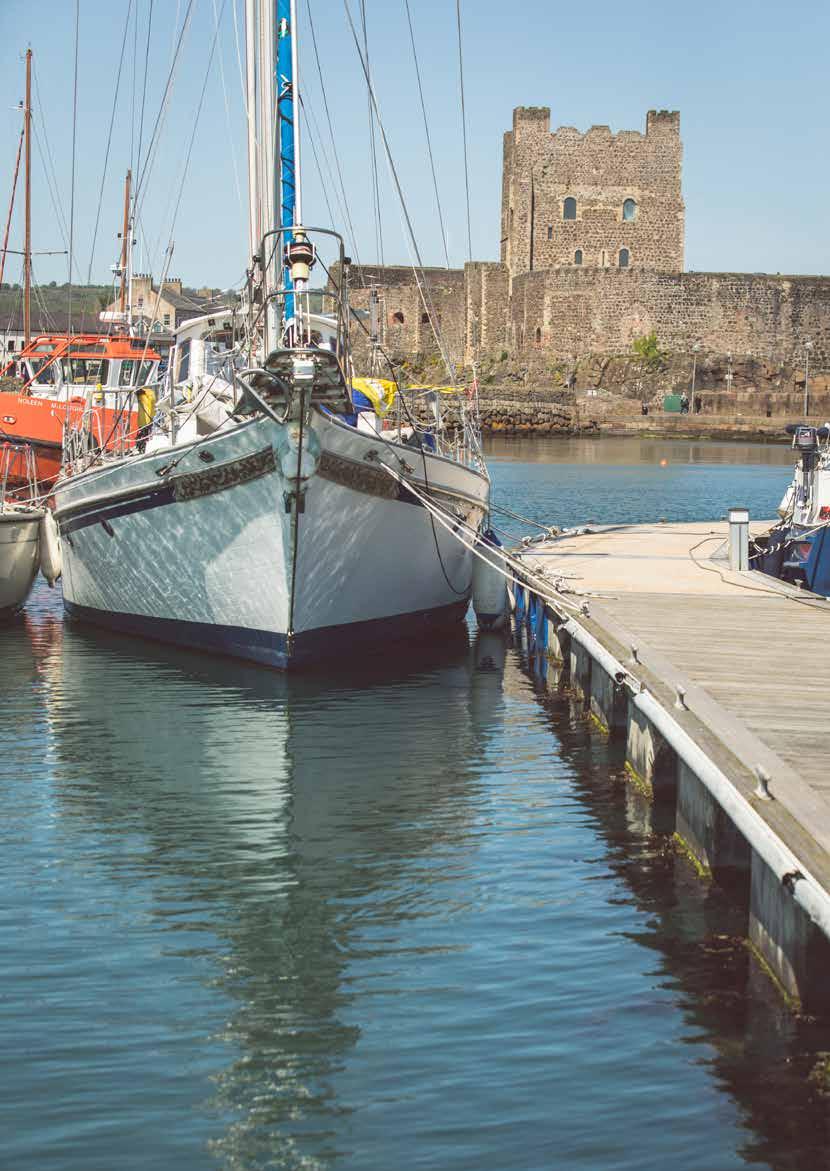
• COVID-19 Town Centre Recovery Group
• DAERA Annual comparisons of dog fouling complaints across councils
• DAERA Audit Policy and Procedures (Rural Development and TRPSI)
• DAERA NI Landfill Allowance Scheme
• Engagement with Stormont and UK Government campaigns teams for effective activation of the key national messages
• Freeports Working Group
• ICT Managers Working Group
• Keep Northern Ireland Beautiful – Cleanliness Index, BIG Spring Clean, Live Here Love Here Small Grants Scheme, Eco Schools (Green Flag assessment)
• Local Government Performance Improvement Working Group
• MEA Cloth Nappy Scheme Survey (June 2021)
• Member of Climate NI
• Member of National Communications Advisory Panel (NCAP)
• Member of NI Council’s Electric Vehicle consortium group
• Member of NI Council’s Recycling Officers Forum
• Member of Waste Resources Action Programme (WRAP) Forum Group
• Membership of APSE Energy
• Membership of key communications bodies in NI, inc. CIPR and CIM
• Membership of Sustainable NI Forum Group
• Membership of the regional Environmental Health NI including subgroups.
80 | Performance Self-Assessment Report 2020/21
www.midandeastantrim.gov.uk | 81
Appendix 5
Visits by MEA Staff / Elected Members in relation to Benchmarking / Best Practice
Location / Council Dates Department Area of Service
/ Purpose of Visit
Location / Council Dates Department Area of Service / Purpose of Visit
Follow up from visit / lessons learnt / actions taken
Mid and East Antrim – Stormont Executive
Follow up from visit / lessons learnt / actions taken
Northern Ireland Public Sector Communications Forum
Ongoing Communications Communications representatives from both Stormont Executive and Mid and East Antrim Borough Council met on a weekly basis to share key learnings and to ensure a joined-up approach for the delivery of COVID-19 related communications.
Ongoing Communications This is a body made up of communications managers from across the public sector in Northern Ireland.
Shared learning, collaborative approach to Communications. Signposting of Council staff to key resources, which are beneficial to the fulfilment of their duties.
COVID-19 communication plans were consolidated across councils to provide a more efficient delivery.
Key messages were delivered simultaneously to maximise impact.
Meetings take place periodically and all staff have learned best practice from experienced, respected communications experts. We have implemented learning into day-to-day roles and built good relationships with industry colleagues.
Town Centre Taskforce Ongoing Various Regular meetings with relevant stakeholders to jointly drive the local economy, by delivering customer and business improvements in town centres and campaigns to drive further footfall and spend.
Tourism Taskforce Ongoing Various Regular meetings with relevant stakeholders to jointly drive the local economy, by delivering a collaborative approach to attract tourists and drive spend in the borough.
Causeway Coast and Glens Borough Council
External Emergency Plan Exercise
December 2020 Communications External Emergency Plan Exercise - Mutual Energy Pipelines and Gas Networks Ireland.
Training exercise with key partners, including NIFRS, HSENI and PSNI.
Opportunity to follow an EPG media and Emergency Plan with a simulated gas pipeline emergency. Strengths and weaknesses identified to allow for future process improvements.
Emergency Preparedness Group
Ongoing Various This body includes NIO, councils, PSNI, Fire and Rescue and a range of other statutory bodies.
APSE March 2021 Various
Performance Improvement Working Group
Ongoing Corporate Performance
Grants Forum Quarterly Corporate Services
APSE working groups to review indicators for comparisons within NI Benchmarking project.
The group is acting on behalf of SOLACE NI and is made up of all Performance officers within Councils.
Best practice sharing on management of Grants Support Schemes within councils.
Belfast Region City Deal Ongoing Communications Regular meetings to discuss and plan communications around the Belfast Region City Deal proposals.
Shared learning opportunities on how best to respond in an emergency.
Agreement with other NI Councils on performance indicators that can be benchmarked.
The group meet regularly to review and improve performance matters across the region.
Discussions on Council Grant Schemes and application systems.
Shared learning and networking opportunities have been key to establish strong relationships with key public sector colleagues.
Regular engagement, balanced representation from key sectors, shared learning and collaboration to drive cut-through in campaign delivery.
Regular engagement, balanced representation from key sectors, shared learning and collaboration to drive cut-through in campaign delivery.
June 2020 Digital Innovation Scoping exercise for online booking systems. Implementation of bespoke online booking system for Sullatober Household Recycling Centre (July 2020).
Amazon January 2021 AWS – Connect Customer Service System
Demo for customer voice and chat system. Scoping exercise to view functions transferability, requirements & benefits to service.
Implemented new phone/chat BOT system for waste (May 2021).
Ards & North Down Borough Council
June 2021 Environmental Services Scoping ‘in-cab’ technology, trade waste and finance systems.
Follow-up visit planned for ’in-cab’ demonstration, along with ‘Train the Trainer’ sessions.
Mid Ulster Borough Council June 2021 Environmental Services Scoping trade waste/ finance systems Council’s Finance team will implement the Trade module within the new Technology One system.
North Channel Partnership Ongoing Various The NCP is attended by the Chief Executive, Elected Members and officers of both MEA and Dumfries and Galloway Council. The group focus on progressing projects of common interest to improve economic development and tourism in both regions.
The NCP will continue to meet regularly to review progress, share knowledge and develop future plans.
82 | Performance Self-Assessment Report 2020/21 www.midandeastantrim.gov.uk | 83