Minnedosa Tribune
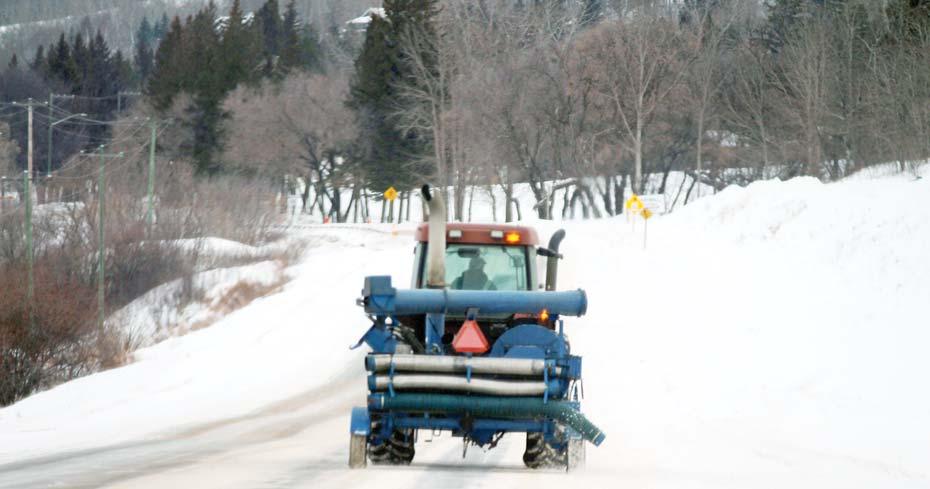
From this viewpoint, it may seem this tractor operator is travelling on a rural gravel road. Actually its Provincial Road 262 located between downtown Minnedosa and Minnedosa Lake, known for its reduced speed limit, curves, and sights. PR 262, 76 kilometres long, serves as a loop route off of Highway 10, connecting Tremaine with Onanole on the south side of Riding Mountain National Park via Minnedosa.
It’s “one boat, one lake” this summer as Parks Canada will be allowing boats back into Clear Lake as part of an innovative aquatic invasive species (AIS) prevention program.
This approach requires that each boat be restricted to a sin-
gle lake for the entire season. For boaters, this means choosing a lake and ensuring that their craft is thoroughly decontaminated and inspected by AIS specialists before being launched elsewhere.
The importance of this program comes on the heels of significant findings regarding zebra mussels in Clear Lake. Late in
2024, hundreds of live juvenile zebra mussels were discovered attached to docks and structures, indicating that this invasive species is spreading beyond the initial Boat Cove area. This prompted serious reconsideration by Parks Canada, who consulted with Indigenous advisors, the Province of Manitoba, and a range of scientific experts. Ulti-
mately, they concluded that eradicating zebra mussels from Clear Lake is not feasible, but managing their impact is crucial for the health of the local environment and the economy.
The presence of zebra mussels is alarming and pose a danger not just to Clear Lake, but also to downstream waterways utilized by five First Nations and serve
vital roles in agriculture and recreation, providing drinking water to thousands. As stated in a recent news release from Parks Canada, “We are committed to managing the impacts of zebra mussels on the natural environment and to the vitality of the local tourism economy.”