
TheMassachusettsDailyCollegian SPECIALTHEELECTION ISSUE
EDITOR’SLETTER

On Tuesday, Nov. 5, millions of Americans will head to the polls to cast their ballots for one of the most consequential presidential elections in the history of the United States. The country has faced unprecedented turbulence over the last few years, and no matter which party line you prefer, it can be difficult to know when that light at the end of the tunnel will suddenly appear.
There are many issues at the forefront of this election, like women’s reproductive rights, healthcare, immigration, the economy, climate crisis, housing, LGBTQIA+ legislation, gun control, even democracy.
These concerns are on the minds of young people across the country. For many UMass students, and staff at The Massachusetts Daily Collegian, this is the first time we are voting in a presidential election. We’ve seen not only how our parents, grandparents and family members have voted in the past, but how they’ve been affected by the policies our public servants sign off on.
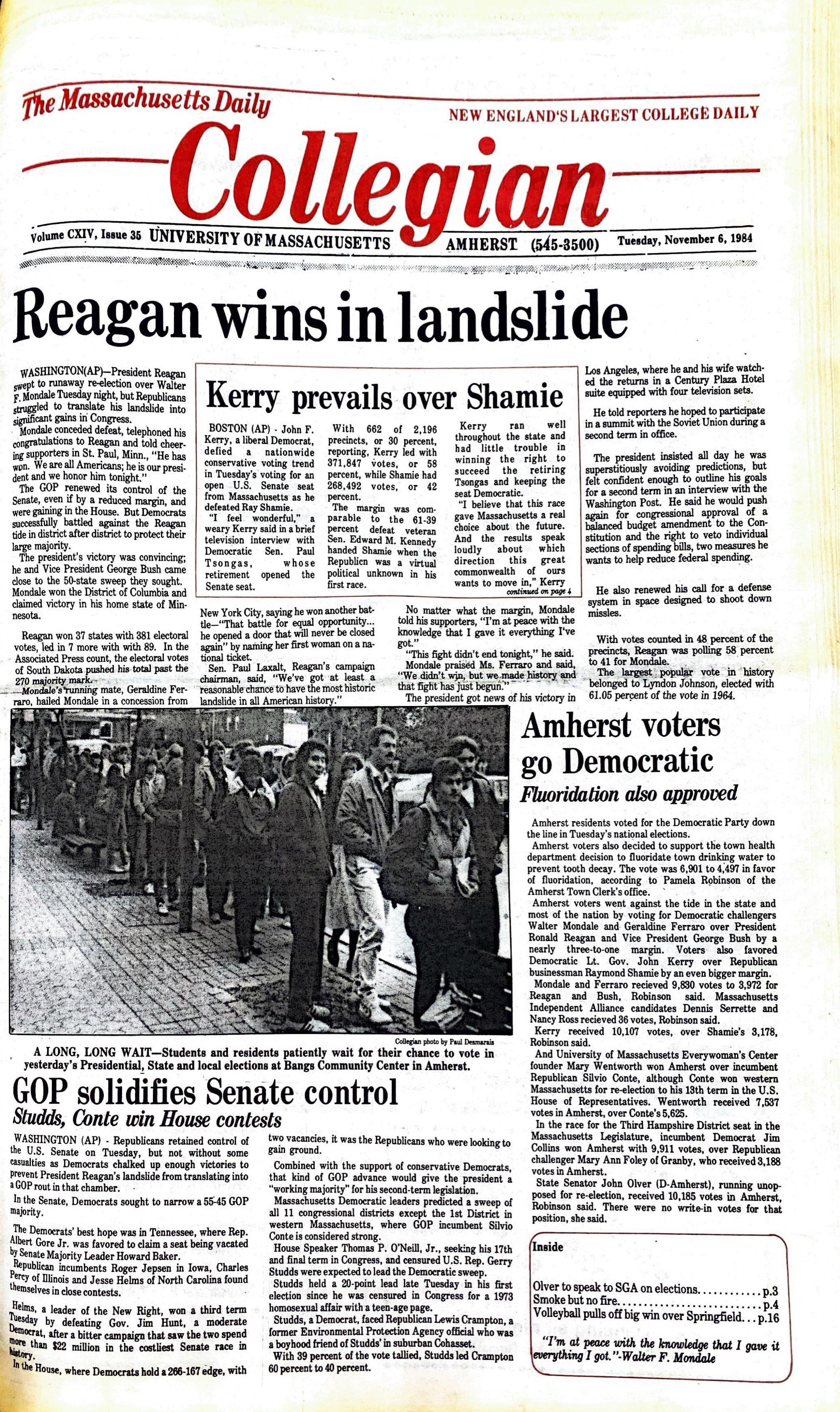
Since its establishment in 1890, the Collegian has covered statewide to national politics through the lens of students. Now, in an age of social media and rampant disinformation, truth can feel hard to find. In this paper-wide special issue, we strive to highlight a variety of voices. From local pre-election events and ballot questions, to robust opinion pieces and past coverage of some historic races, it’s our duty to educate UMass and the greater Amherst community on what’s at stake.
Do your research and go vote. Ensure that you play a part in deciding the future of our country. It’s in the DNA of UMass students to make your voice heard and help shape a better world.
Thank you for reading and enjoy the magazine.
Signed,
Caitlin Reardon, Editor-in-Chief
Johnny Depin, Managing Editor

Senate candidates spar in Springfield

UMass Reacts: Kamala Harris’s virality and its effect on the election The five Massachusetts ballot questions explained All


Tara Setmayer Speaks about the Importance of Women Voting in the 2024 election An antidote to doomerism
A Christian nationalist, Nazi and Islamophobe walk into a presidential campaign The state of polarization in the U.S.
Vice President Kamala Harris and ‘brat,’ explained
How the Commanders and Bears will likely decide this year’s election results
As Puerto Rico prepares for its gubernatorial elections, Bad Bunny is ensuring Puerto Ricans are heard
Taylor Swift’s dive into the political pool
Executive Board
Caitlin Reardon, Editor-in-Chief
Johnny Depin, Managing Editor
Shannon Moore, Creative Director
Bobby Gleeson, Business Manager
Design Coordinators
Ally Black, Assistant Graphics Editor
Dylan Nguyen
Zach Leach
Copy Editors Asha Baron
Manas Pandit





SenatecandidateS SparinSpringfield
On Oct. 17, NEPM and WGBH cohosted the second and last US Senate debate between Democratic Senator Elizabeth Warren, seeking her third term, and Republican nominee John Deaton, a former marine, personal injury attorney and cryptocurrency advocate, in Springfield. Candidates discussed topics including immigration, abortion, East-West rail and housing, while Deaton accused Warren of a felony and Warren tried to tie Deaton to Trump. Warren is considered a heavy favorite for a third term, and an Oct. 16 poll released by the UMass Poll gave her with a 22 point advantage. In the same survey, Warren polled better on every issue inquired.
Deaton is attempting to run as a moderate Republican who does not support former President Donald Trump and one who would break with the party on issues like abortion. Warren, however, constantly tried to tie Deaton’s proposals to Trump’s throughout the night. Warren continued to defend her vote against the failed bipartisan border bill, saying that the bill was dead due to Trump’s involvement by the time.
“We are in a crisis on immigration, but that means we need serious people proposing serious solutions,” Warren said. “We know what we need on immigration reform, but instead what we are doing is blaming the immigrants.”
“I have to say, my opponent, [Deaton] does this over and over again,” Warren continued. “If it is healthcare, blame the immigrants. If it is housing, blame the immigrants. Crime, blame the immigrants. That is not enough to address both the problems and the solutions that we have in this state.”
Deaton pointed to his experience as a Judge Advocate with the Marines in Arizona giving him expertise on the southern border. “Senator Warren has the same exact position as [Trump]. Do nothing,” Deaton said. “I’d like to see more. I want to see legal immigration expanded more and have a zero tolerance for illegal immigration.”

aniel

Several questions were asked about Western Massachusetts, and both candidates signaled their support for the expansion of East-West passenger rail lines that would expand the rail lines from Boston to Western Massachusetts. “I am all in on East to West rail,” Warren said. “I think it will fundamentally transform, not just the economy in western Mass but for every for every part of Massachusetts” Warren pointed to her work with Congressman Richard Neal to lay the foundation for planning to begin but said the “significant investment” it would take would not be possible in a Senate controlled by Republicans.
Deaton connected the issue back to housing. “People are being priced out of the economy … We are now the second most expensive state to live in for working families,” Deaton said. “I see incorporating Western Mass as a way to alleviate that.” The candidates also disagreed on the proper approach to fix rising housing costs.
“The Warren plan is a plan to build more housing and bring down costs,” Warren said. “Mr. Deaton’s plan is to say, ‘let the private market fix it,’ like it’s fixed it for the last 40 years.” “Listen, the fundamental difference between Senator Warren and I is that she believes that the government is the solution to all problems in society,” Deaton said. “… The bottom line is, the government is the problem most of the time.”
Deaton supports reducing red tape and giving tax credits to builders to lower housing costs. Deaton is a well-known cryptocurrency advocate, and was involved in a lawsuit against the SEC that, in the now appealed initial ruling, could limit the SEC’s ability to regulate cryptocurrency. Many cryptocurrency figures are now backing Deaton in the race.

“I think it’s a problem when any candidate receives 90 percent of the funding for their campaign from one industry, whether it’s the crypto industry, the oil industry, the pharmaceutical industry,” Warren said, referencing the Commonwealth Unity Fund PAC that has received more than double what individual donors have given to Deaton’s campaign. Warren also said that regulating cryptocurrency could be a way to curb cartel’s ability to conduct transactions.
Deaton, in turn, accused Warren of being corrupt by coordinating before a hearing with Gary Gensler, the chair of the SEC who has been criticized for being perceived as being anti-crypto. “I prosecuted as a federal prosecutor … suborning perjury cases and I could convict Senator Warren just like that,” Deaton said, snapping for effect. This allegation has not been confirmed and may have originated from right-wing billionaire David Sacks, who claimed a secret anti-crypto alliance had been established between Warren and Gensler. “Mr. Deaton is just spinning this whole fantasy story,” Warren said.
Warren introduced the Digital Asset Anti-Money Laundering Act of 2023 last year, an act Deaton previously said was a reason he entered the race. Deaton also reaffirmed his support for the current abortion law in Massachusetts and placed the blame for the overturning of Roe on Warren. “Listen, there are six people who are responsible for the overturning of Roe: Donald Trump, Brett Kavanaugh, Amy Coney Barrett; Neil Gorsuch, Harry Reid and Senator Elizabeth Warren,” Deaton said, alleging that Warren’s push to eliminate the filibuster for judicial nominations when Democrats controlled the Senate resulted in anti-abortion justices being appointed when Republicans took control. “Her fingerprints are all over this Roe decision.”

Warren pointed out that Deaton said he would have voted to approve the nomination of Neil Gorsuch, even after Gorsuch authored the lower court decision on Hobby Lobby Stores, Inc. v. Sebelius, which limited contraception access. “And now John Deaton gives us the big defense of the filibuster,” Warren said.
“The filibuster that keeps us from making Roe v. Wade the law of the land … We can’t pass it with 52 votes because the Republicans filibuster us.”
“With Republicans control of the Senate, we will have no bill to codify Roe v. Wade, and that means when they’re coming for us in Massachusetts, we have no defense.” When asked, Warren said that if she was reelected, she would serve her full term and not take a cabinet post or run for president. “It’s the six-year term here in Massachusetts that I want to serve,” Warren said. “The reason for that is I have work that I am doing for the people of Massachusetts, and this is my opportunity to get more of it done.”
The debate finished with a series of lightning round questions. Warren said she supported Question 4, which would legalize psychedelics, but said there would need to be a transition period to get it right, while Deaton said he did not support it but would support psychedelic use for medical purposes.
Warren said she will be handing out Mounds and Almond Joy, if she can find it, for Halloween, while Deaton said he would hand out Reese’s Cups “unless I eat them all.” When asked after the debate what he would say to young voters who feel disillusioned by a state that has largely been politically uncompetitive, Deaton described Massachusetts as a state with “one-party rule,” and said he would tell young conservatives to “not get caught up caught up in the division within the party.”
“We’ve got Republicans who want to kick me out because I’m too independent for them,” Deaton said. “And I think what we need to do to young [people] is say, listen, if you see a candidate that gives you 75 percent of what you like, are you going to focus on the 25 percent that you don’t like, or are you going to focus on the 75 percent that you like?… I think they need to start focusing on what they agree on more than what they disagree on.”
ALLPOLITICS
Ask a friend or classmate if they are going to vote. Somewhat frequently, the response will be a resounding “No.” Amongst the dozens of reasons, one stands out: young adults do not feel like their government works for them. We are losing trust in our government and falling victim to widespread cynicism. According to the Institute for Citizens and Scholars, 35 percent of young adults do not feel informed enough to participate, only 48 percent intend to vote in the upcoming election and 57 percent are dissatisfied with the government.
THE “BIG DIG”
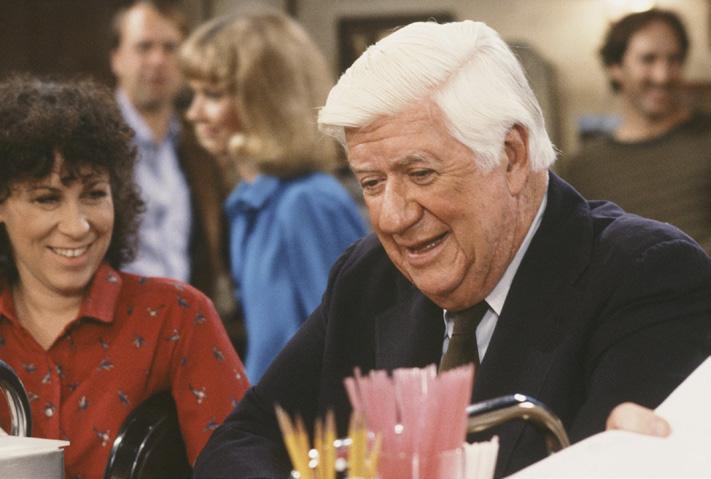
As you drive south on I-93 in Boston, you are led under the city through the Thomas “Tip” O’Neill tunnel. Tip, standing at six feet four inches, was a bear of a man. He was the larger-than-life Speaker of the House from 1977 to 1987 and a Congressman from Massachusetts from 1953 until 1987. He was known as Regan’s foil in Congress, the “tax and spend” liberal tamping down the “Reagan Revolution” that had taken hold across the country.
The son of an Irish bricklayer, O’Neill grew up in a working-class Cambridge neighborhood. While O’Neill was a student at Boston College, he ran for city council in Cambridge, and lost. When Tip spoke to a longtime neighbor on Election Day, she expressed her dismay that he had not asked for her vote.
Tip had forgotten his roots and neglected his neighborhood. This was the last election he lost, because he never forgot the adage that he came to popularize, “All politics is local.”
BySamuelCavalheiro
The Tip O’Neil tunnel is a testament to this philosophy. Before its construction, the Central Artery cut through the middle of the city, polluting neighborhoods and jamming up traffic for miles. The “Big Dig,” as it is known today, proposed demolishing the Central Artery and moving I-93 underground and expanding I-90 to the airport through an underground tunnel. This engineering marvel was one of the most challenging and expensive infrastructure projects in American history, totaling over 24 billion dollars.
When the state came to O’Neill for support and necessary federal funding, his primary concern was the residents of East Boston. One single angry phone call would derail the entire project. Just one, angry east Boston resident possessed enough power to derail a multi-billion-dollar project.
THE DIRTY WORK
It is hard to convey just how important constituent feedback should be to our legislators, given the current climate. In past summers, I have had the privilege of working with my local legislators as an intern, working alongside the constituent service director. It was there where I was exposed to the arduous work of legislating. There were countless phone calls and emails from angry constituents about issues as small as trash collection, to issues as big as war in the Middle East. The office also hosted office hours at local senior centers, where any constituent could come in and discuss any issue regarding the state.

POLITICSISLOCAL
Governmentaldistrustprevails amongstyoungpeople,but participationshouldnot
“One single angry phone call would derail the entire project. Just one, angry east Boston resident possessed enough power to derail a multi-billion-dollar project.”
Constituents would bring any issue they could to us. On one occasion, a man sought our help in suing the state for the closure of his business twenty years ago. It was two hours of my life I would never get back, but he left with a smile. On another occasion, a couple came in to advocate for their daughter who had certain developmental disabilities. After a fruitful conversation, I was tasked with researching their concerns and the viability of the policy they were advocating for. This became a bill that passed, and expanded wheelchair warranty protections. What started as a simple conversation with a concerned constituent became a law protecting people with disabilities across the Commonwealth.


EMPTY ROOMS AND AVON PERFUME
In high school, I worked for the City Clerk’s office in my hometown. Amongst my responsibilities was working the polls on election day. During the municipal elections in 2021, we had contested both school committee and city council races but most importantly, our long-time mayor was facing a rare opponent. Expectations were high and we were bracing for a busy day at the polls, but I should’ve prepared for 14 slow hours of torture instead. My day started at 6 A.M, assisting the clerk at the six separate polling places around the city. Voting would begin at 7 A.M and finish at 8 P.M. I grabbed my warden book and waited for people to come in, yet no one came. The odd straggler would come in occasionally, but my day was occupied by conversations with retired ladies and the smell of strong Avon perfume. The few voters who did come in were almost all over the age of 65 and overwhelmingly white. In a city with a significant number of non-white residents and young people, not a single voter in the municipal election represented that large cohort.
Thomas “Tip” O’Neill. Photo courtesy of Wikimedia Commons.

This is not an isolated case. In 2021, Boston Mayor Michelle Wu was elected in a historic first for the city, but only 30 percent of voters participated. In 2023, the City of Worcester claimed “strong” voter turnout during that year’s municipal election, yet turnout was only 22 percent. To put things into perspective, Massachusetts voters have voted at around 75 percent during presidential elections and 60 percent during midterm elections.
In towns, the situation is only more dire. Massachusetts towns are structured under the traditional town meeting form of government, where local citizens meet and form the legislative body of their local towns. According to research published in the New England Journal of Political Science, residents who attend town meetings were older white homeowners who represented, on average, just 1.2 percent of a town’s population. Can we call this a democracy, when one percent of the population controls an entire local government?
This only deepens the inequalities young people are most affected by. Young adults today are leaving this state in droves, citing housing as the main cause. Massachusetts has some of the highest home prices in the nation, and yet it is a problem that could be fixed at the local level, through these town meetings. Zoning laws, building permits and subsidies are all issues that are dealt with at the local level. If more housing is to be built, cities and towns must adapt their regulations to encourage development. But when older, white and wealthy homeowners are the only people reaching out to their legislators, voting in elections and attending town meetings, they are the only ones with a voice in these big decisions. These residents tend to oppose housing development, and they make sure their legislators and town executives are aware of this opposition.
WHAT SHOULD I DO?
If I were to ask who your state representative is, would you know? What about your state senator? Who represents you on your city council or select board? Who is your mayor or town manager?
Find out and when you do, reach out! Have an issue with the state? Call your state representative or state senator. Is there a pothole in your road? Call your city councilor or selectman and let them know. Are you worried about the direction your town is headed in? Attend your town meetings, attend city council meetings, join local boards and commissions, have your voice be heard where it is most impactful.
We have a functional and healthy representative democracy: don’t fall victim to the easy cynicism that is so readily available these days. Citizens are allowed to yell, complain and ask questions to the people they elected. Your legislators are accountable to you, so use that power. If one phone call could have stopped a 20-billion-dollar highway project, imagine what else you can do.


YOURTOWN
YOUR CITY



The five Massachusetts ballot questions, explained
Question 1: State Auditor
A yes vote supports allowing the State Auditor to review the legislature’s performance to increase transparency. This would not be a review of finances or legislation, but instead have to focus on if the legislature is following state regulations like employee training and procedural rules.


Question 2: Removal of MCAS requirement
A yes vote supports removing the 10th grade MCAS as a standard high school graduation requirement. Instead, districts would be able to choose their own graduation standards. Massachusetts would be one of only a few states without a standard graduation requirement.

Question 3: Rideshare Union
A yes vote supports creating a way for rideshare drivers to unionize as a sector, allowing independent contractors to negotiate as a group if they choose to. Called “sector-based bargaining,” the proposal seeks to increase work conditions and could serve as a model for other gig economies.




Question 4: Psychedelic Drugs
A yes vote supports legalizing some psychedelics, allowing them to be grown and shared in private settings and prescribed. It would not allow psychedelics to be sold in stores, and all drugs that would be legalized are still illegal at the federal level.

Question 5: Minimum Wage tipped workers
A yes vote supports adjusting the minimum wage for tipped workers, which is currently $6.75 as long as tips bring the take-home pay to $15. Instead, employers would have to pay employees $15, and although tips to servers would still be allowed, restaurants could choose to pool them with backroom staff.

UMass reacts: Kamala Harris’s virality and its effects on the election
By Daniella Pikman





Half a year ago, many were bracing for another presidential race between former President Donald Trump and Joe Biden. A number of UMass Amherst students expressed dissatisfaction with both candidates, feeling like their votes would have little impact in a majority blue state.
That changed this summer when President Biden dropped out of the 2024 campaign and Vice President Kamala Harris rose to be the Democratic candidate. As the 2024 election draws near, Harris’s viral moments on social media have reshaped public opinion, signaling a shift from the dynamics of 2020. UMass students and professors weighed in on this evolving political landscape. Harris’s image has been shaped by the way she is portrayed on social media. Her image started to shift when a speech she gave in May 2023 resurfaced on TikTok early in her campaign.
Harris was sharing something her mother used to say to her and her siblings, “You think you just fell out of a coconut tree? You exist in the context of all in which you live and what came before you.” TikTok users found the “coconut tree” comment hilarious and latched onto it, producing video edits of Harris’s speech that quickly racked up millions of views. Harris was even dubbed “brat” by TikTok, inspired by Charli XCX’s brat summer, and Kamala HQ started embracing these trends in their own advertising. Videos like these have drawn more attention to Harris from the younger generation.

UMass communications Professor Weiai
Xu pointed out that the Harris campaign is the top spender for digital advertising, and explained that even though TikTok is the most popular social media platform right now, “…what’s popular on TikTok does not necessarily translate into the virality, in the reality on the ground.”
Xu says his research shows social media platforms other than TikTok that used to be more popular, like Twitter, have changed drastically since 2020. Xu further described the far right as having its “own kind of ecosystems of influencers of this widespread distrust of mainstream medias and institutions, which allow this group to grow independently and become echo chambers.”
UMass communications Professor Erica Scharrer noted that a lot of people already know exactly how they’re going to vote, so they may not be as affected by these trends. “For some people, it doesn’t matter what’s going viral, right?” Scharrer said.
“How are questions of virality landing in [swing states] that are so close on the cusp of which way they’re [going to] go? That’s the million dollar question,” Scharrer said.
Scharrer noted, “Even though it’s true that 18 to 25-year-olds are less likely to vote than older audiences, they’re more likely to vote than they have been in the past.”
AJ Rubel, sophomore political science student at UMass, says Harris’s memes are a great way to reach out to young people in general. “I find it funny, there’s probably a lot of people my age [finding] it funny, and I think it’s smart for her campaign,” Rubel said, “I feel more relatable to it than I do to like, Trump’s campaign.”
“You think you just fell out of a coconut tree?”
In contrast to Harris’s campaign, Rubel described Trump’s social media campaign as “a lot of fearmongering” and pointed out that Trump uses his own private social media platform, Truth Social, for a lot of content, which does not reach far outside the very devoted community.
“Trump will just talk himself like, no filter, no advisors. It’s definitely very unprecedented,” said Rubel.
Emmi Caunitis, a physics major, said she was nervous about the high tensions the race between Trump and Biden was foreshadowing. Now that Harris took over in Biden’s place, she says she feels much more stability, communication and respect in terms of the race.
Caunitis noted that social media has made the election more digestible for young people. “Certain parts of the memes, like, they all held truth,” she said. “They had certain policies that a lot of people, like college students, definitely believe in.”
When the presidential race was beginning in December, Biden was receiving a lot of criticism, explained Scharrer, “I think a lot of Democrats were worried about his viability as a candidate, even though, historically, there’s usually quite a big incumbent advantage.”
In July, after Biden dropped out and Harris entered, people were still not entirely familiar with her character and policies. But over the past few months, Harris has become more of a “familiar” persona, said Scharrer.
New voting trends could be tied to social media, as younger people are more likely to use social media and rely on it for their news. According to Pew Research Center, “Twothirds of teens report using TikTok, followed by roughly [60 percent] who say they use Instagram.”
Xu highlighted another perspective: that the Harris campaign’s focus on social media and younger voters may be causing people to overlook the importance of swing voters, such as ethnic minorities.
“This election, it might be about younger voter turnout,” Xu said. “It might also be about the mobilizations of ethnic minorities. This is especially in the swing states.”
Xu emphasized that smaller, marginalized communities are “playing vital keys in this election,” and pointed out that political discourse is unfolding not just on TikTok but also on smaller platforms, such as Telegram, that may go unnoticed by mainstream media.
After Biden’s drop from the election, the democratic campaign has momentum and a renewed sense of energy with Harris’s strategies, bringing a different dynamic to the race.
“Harris has really infused some excitement into the race and some freshness into the race,” Scharrer said. “And I just think she’s brought a lot of new energy, new ideas and [is] kind of mixing things up.”

“This election, it might be about younger voter turnout”





The future may or may not suck, but here’s what you should do about it
An antidote to doomerism
Collegian’s News team, over my rather depressing, or “doomer” take on the Presidential debate between Kamala Harris and Donald Trump. I argued that neither had really won, because our elections are decided not by discerning voters analyzing debate answers and reading policy briefs to arrive at educated conclusions, but largely by quadri-annual vibes enthusiasts in Pennsylvania for whom there is never enough information, and who are sure only of one thing: that they never are.
Looking back, this take was somewhat ill-advised; Harris received a significant bump in polling numbers after her performance, especially with undecided voters. Though I’ve ceded the point now – much to Collegian Head News Editor Daniel Frank’s delight – I’m quite stubborn, and so I held out for a long time. Every accusation of cynical pessimism rung hollow, as I thought I had the accurate measure of our national pulse. It wasn’t until I was accused of
I see it quite frequently in our generation. And don’t kid yourselves, so do you.
The numbers bear out my thesis: the younger generation has a bleaker and more cynical outlook on the future than ever before. They view political participation as seemingly pointless and largely ineffective. So, what now? What is to be done about this epidemic of political depressives? What is the antidote to doomerism?
Sadly, every conversation around this subject exemplifies the worst aspects of our political media and public discourse. Google “doomerism,” pick out an article and blindly scroll to a random paragraph. You will be greeted by one of three incisive, biting and positively scintillating analyses: the kids are “doomer” because woke – and no, there’s no defining terms going on here, you’re simply supposed to read into the word whatever the right wing’s flavor of the month wedge
This list isn’t exhaustive, but it’s pretty good. Sure, sometimes, in particularly daring moments of true intellectual fortitude and near Spartan bravery, the Centre-left types will say the kids are “doomer” because of social media and “woke.” Sometimes conservatives will feel they’re due for citing a statistic for the month and will mention social media usage rates.
Regardless, I’ve given you a fair picture of what our public discussion around “doomerism” looks like. It’s really quite useless, and I don’t wish to rehash it in this column. Nor do I want to get into a discussion of whether the world does suck enough to warrant “doomerism.” I and any competent leftist could trade insults back and forth on this subject until the heat death of the universe, and while that would be quite fun for us, it isn’t productive and mostly just annoys everyone else in the friend group.
I want to focus specifically on one kind of “doomerism” and what we can do about it. By the time this magazine is in your hands, dear reader, the nation will be at polling stations, voting for our next president. On that same day, the share of young Americans not exercising their right to vote will also be at a concerning high water mark.
The urgency of the moment is apparent, and the forthcoming articles will hopefully serve only to bolster that point. We face an xistential choice in this election and loathe as I am to sound like an annoying “#Resist Lib,” democracy itself is on the ballot. Non-voting doomerism is a problem, and we need to do esomething about it.
But what can be done about a problem as seemingly vast as this one? I am not under the delusion that one – albeit long-winded – campus newspaper column will be the silver bullet that cheers up a generation and increases turnout. But I think that that search for a silver bullet is exactly the problem.
“It wasn’t until I was accused of ‘doomerism,’ that I began to question if maybe it wasn’t everyone else who was wrong.”
Our political media has failed us on this and countless other issues. They search in vain for highly intellectualized explanations of why younger voters don’t vote and generally disregard the system. But people do not act because of complex life philosophies where each action is the result of logical reasoning from premises; they act based on how they feel. And a huge part of how we feel is the company we keep. Once again, the numbers bear this out: voters were much more likely to have other voters in their close friends and family, and vice-versa for non-voters.
The answer is almost too simple, so our genius commentariat has decided conveniently to ignore it. We tend to surround ourselves with likeminded people, and to act similarly to them. If we’re surrounded by people who consider the system a failure and decide that voting is a useless activity, we are more likely to believe that too.
When I was called out for “doomerism,” it was quite a novel experience for me. I’m pretty bullish on the United States, and I’m not one for political cynicism. Perhaps it’s the fact that I’m an immigrant that gives me a different perspective, but I think the U.S. is a pretty great place, all things considered. All of this to say, I’m not one for “doomerism.” And yet, my opinion on the debate was quite out of line with what you would expect given my politics.
I spent some time considering why this was the case, and in a moment of ironic hypocrisy, fell prey to the same overintellectualizing tendency I just lambasted the media for. I was watching the debate with some more “doomer” friends of mine. That was it. Their opinions colored mine, because that’s how humans form opinions. We do not reason from premises, nor do we exist in vacuums of logic. We exist alongside our friends and loved ones; we influence them, and they influence us.
You want to solve doomerism? Get out of the ivory tower reasoning chamber and start talking about the importance of voting. All of us have friends who might be more cynical and jaded as far as politics go. Talk to those friends. Make your opinions heard. Talk about just how crucial it is to vote in this election, and how much you personally believe it counts. Don’t expect everyone to immediately cede the point and don a Harris-Walz 2024 trucker hat, but don’t expect to be hit with immediate nihilism either. Your friends are not robots operating from on Nietzschean philosophical principles; they are humans existing among other humans, making it up as they go along.
DID YOU
American’s satisfaction with their personal life has ranged from 73 to 90 percent since 1979. At the same time, every other indicator (faith in government, faith in institutions, trust in the economy, etc.) all plummeted.
Source: Gallup

Tara Setmayer speaks about the importance of women voting in the 2024 election
On Sept. 30, the Democracy in Troubled Times speaker series featured Tana Setmayer, discussing the importance of mobilizing women voters to a crowd of over 80 people at Old Chapel Great Hall.
“As we looked at the [political] landscape this year, we said women are going to make the difference,” Setmayer said.
Setmayer is a former CNN commentator and former GOP communications director. She co-founded and is the chief executive officer of the Seneca Project, “a bipartisan superPAC, led by women, dedicated to mobilizing women voters in key swing states in support of Kamala Harris’ election,” according to their website.

“Our motto is: galvanized women save democracy. Because this is really all about freedom. Either you trust women to make their own decisions, or you don’t,” Setmayer said.
By Alexandra Hill
The 2024 election will be the first election since Roe v. Wade was overturned in 2022.
“Since Roe was overturned, the political landscape really has shifted,” Setmayer said, “it was a tectonic shift in politics for women. The stakes became incredibly high, literally, life or death, and it really transcends party lines.” The topic of abortion is on many ballots in different states in the 2024 election.
“We were inspired to start Seneca and felt that what we were doing could move voters, especially in the swing states, because we all know that that’s where this election is going to be decided,” Setmayer said.
Setmayer reflected on the increasing rate of infant deaths in states like Texas, where abortion bans came into existence after Roe v. Wade’s reversal.
“[Roe v. Wade has] forced women to have to pay attention to [abortion issues] in a way that I don’t think they ever did before, particularly for suburban Republican women,” Setmayer said.
“Looking at this election, it’s bigger than just abortion”
The Seneca Project produces campaign ads and videos to target “moderate women in swing states.” Using digital targeting and Setmayer’s background as a political communicator, the Seneca Project attempts to draw people in and spark conversations about women’s rights.
Several videos produced by the Seneca project were shown during the talk, including a recently released campaign ad focused on recent remarks made by former president Trump regarding women.
Setmayer was a Republican for 27 years until Nov. 5, 2020 when she came to see the Republican party as “an existential threat to democracy.”
“So many people who were sanctimonious Republicans … acquiesced to Donald Trump when they thought that that was going to be politically expedient for them and look at the mess that we’re in, it was shocking to me,” Setmayer said.
Setmayer said she had “become a preeminent Never Trump Republican” and was in shock after he was elected. Now she declares herself an Independent, fighting for women’s rights.
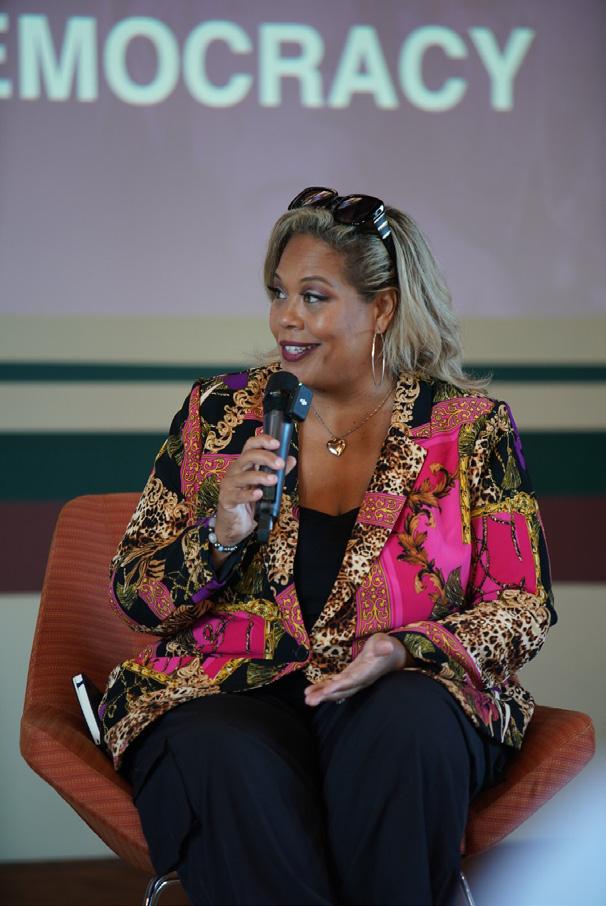
Photo by Jonathan Shi
“When people ask, was there anything positive that came out of the Trump administration? And I’m like, yes, people being shaken into getting involved, particularly the younger generation, which gives me hope,” Setmayer said, noting the increase in voter turnout for ages 18 to 29.
Parikshith Hebbar, freshman political science and legal studies major, attended the event saying, “I agree with [Setmayer], that prioritizing our democracy, securing it and protecting it comes first before anything else.”
“We want to provide students, faculty, staff and our community opportunities to hear how democracy works in all kinds of ways,” Kathy Roberts Forde, a journalism professor at UMass said.
“It is a time for choosing,” Setmayer said, “if we as a country, want to still have a free society … that we were founded on, and what our founding documents talk about, then we have to be involved and vote.”
The state of polarization in A conversation UMass
professor Alexander Theodoridis
To understand the current state of polarization in the U.S., all one would have to do is watch a few clips of the recent presidential debate between Vice President Kamala Harris and former President Donald Trump.
The two candidates vary widely not just on solutions, but also on what the issues actually are. For many, it seems as though the U.S. has entered a new world of extreme political polarization. But how valid is this fear and what does polarization really look like in the country?
University of Massachusetts Amherst political science Professor Alexander Theodoridis does research that looks specifically at political polarization. He believes that U.S. politics are polarized around the level of the Civil War along party lines.
With such a large divide between the parties, Theodoridis says that many voters feel like every election is “existential.”
“Both Democrats and Republicans are more concerned if the other side wins [than if their side wins],” Theodoridis said. He also noted there’s great fear of violence in both


He also believes polarization is natural. “If you have two parties, it makes sense that people are going to migrate to the ones that align with the way they think.”
So instead of trying to prevent polarization, Theodoridis thinks we should learn how to function as a democracy with polarization.
Polarization has changed in many ways. U.S. political parties have always disagreed on key issues -- but there seemed to be a general agreement on what those major issues were. Americans now disagree largely on what the key issues actually are.
in the U.S.
Theodoridis
By Ethan Walz
A survey by Pew Research Center looked specifically at what Americans think are the key issues for the upcoming election. It found disparities on almost every issue when comparing political parties. For example, 62 percent of Democrats think climate change is “very important,” compared to 11 percent of Republicans.
On the economy, 93 percent of Trump supporters say it is very important compared to 68 percent of Democrats. Immigration stands at 82 percent of Republicans to 39 percent of Democrats, and abortion comes in at 67 percent of Democrats and 35 percent of Republicans.
Again, the divide is crystal clear when watching the most recent presidential debate, in which Trump tried to draw the conversation back to immigration while Harris attempted to pull it towards abortion.


As a public university, UMass should in theory be a place full of differing ideas and heated debates. Theodoridis believes people of both political parties can speak out at UMass. But he also worries there isn’t a bigger number of conservative students. “The question is, is there a critical mass of people with conservative views so that they feel comfortable expressing those views.”
Students need to hear views that disagree with them, he offered. “I think it’s useful for all students in this kind of environment to get to hear views that sometimes might make them feel a little bit uncomfortable,” Theodoridis said.
“So many of us live in bubbles where we just can’t understand people on the other side. Going on, [we end up] ascribing to them all sorts of horrible motives and stereotypes,” he explained as a challenge with polarization.

Most of the time people engage in “bonding social capital,” he said. This means we spend time with people who are like us, closing off those social bubbles even more. Theodoridis believes student organizations should engage in “bridging social capital,” interacting with groups that are different from theirs. For example, the Republican club could host an event with the Democratic club, forcing the members to engage with those of different opinions.
Young people are actually less polarized than older generations. Carnegie Endowment for International Peace found that “[Polarization] is also growing most swiftly among Americans over sixty-five years old, a demographic that uses the internet less, but watches television and listens to talk radio far more, than younger age groups who are less polarized.”
Overall, Americans are a lot less different than they really think. A 2021 study by Populace found that Americans actually agree on most issues, and they believe they disagree much more than they actually do. Carnegie also found this “misperception is greatest for the most politically engaged people.”
In the Populace study, climate change was ranked as the third most important issue by respondents. But respondents ranked it 33rd on how important they thought it was to others. The study also found that disagreements on a few issues fueled a feeling of large polarization. So, intense disagreement on something such as immigration makes people feel as if there is disagreement on a wide variety of issues. Many want less polarization, but simultaneously believes that the other side is completely different from them.
A Christian nationalist, Nazi and Islamophobe walk into a presidential campaign
The Republican Party looks much different than it did eight years ago. The party of family values and freedom has become focused on tearing apart the family and your freedoms. At the center of it all is the billionaire presidential nominee Donald Trump. Trump, by far, has become the most polarizing figure in politics. His radical and incoherent ideas about the country seek to divide at a time when we’ve never been further apart. However, he doesn’t work alone.
Throughout Trump’s 2024 campaign, we’ve seen him assemble an echo chamber of alt-right extremists who are even more radical than him. From a 9/11 conspiracy theorist to a self-proclaimed “black Nazi,” those who the former president has chosen to align himself with spell out danger for not only the Republican Party, but for all of democracy.
How Trump’s radical affiliates plan to end the Republican Party as we know it


By Felipe Sathler
People such as Mark Robinson and Laura Loomer are suddenly famous Republican figures. Recent news articles have shed light on controversial statements both have made in the past. Robinson, for instance, has been linked to an account that left numerous comments on a pornography website’s message board from 2008 until 2012, including statements such as “I’m a black nazi” and pro-slavery comments. Robinson, who is currently running to be governor of North Carolina, has been endorsed by Trump on several occasions, and Trump has even gone as far as to say Robinson is “Martin Luther King on steroids.”
Somehow Loomer, the alt-right activist who has been seen by Trump’s side numerous times, including being flown in Trump’s private jet, isn’t any better than Robinson. Loomer kept a relatively low profile until recently, when news of her travels with Trump came to light. She has come under fire for a myriad of controversial statements, ranging from describing Islam as a “cancer” to saying the White House will “smell like curry” if Kamala Harris were to win. Loomer has even gone as far as to identify herself as a “white advocate.” It’s gotten to the point where super MAGA congresswoman Marjorie Taylor Greene has criticized her for not aligning with the true values of the Republican Party. While Trump has tried to distance himself from her radical claims, he still aligns himself with her, claiming they share a common goal in stopping the “radical left.”


Sadly, this isn’t all of Trump’s radical affiliates. Other prominent radical figures include Turning Point USA founder Charlie Kirk, who has gone on record multiple times opposing the separation of church and state. Kirk has also voiced opposition to the Civil Rights Act, claiming it as an “anti-white weapon.” Elon Musk has also become very vocal about his support for Trump and hopes to work alongside Trump in his cabinet. Musk’s support for Trump is more tangible than most, with his lobbying group giving individuals $47 for every swing state voter they can get on Trump’s side.
However, the member of Trump’s team who highlights this shift is the man he chose as vice president: JD Vance, a senator from Ohio who perfectly shows the potential troubles of a second Trump term.
Vance is almost the complete opposite of Trump’s previous running mate, Mike Pence. Pence was already an established Republican figure, serving as a U.S. Representative for Indiana from 2001 to 2013 and as governor of Indiana from 2013 to 2017. Trump was an inexperienced figure in the political world and choosing someone with deep congressional ties and experience, like Pence, was a no-brainer. Vance on the other hand has almost no experience. He was elected to the U.S. Senate in 2022 and can be best described as a Trump

Trump’s plan to surround himself with yes-men doesn’t end with Vance. He plans to increase presidential control of the Department of Justice and go after his political enemies. Vance has pushed the idea of firing the thousands of federal civil servants who work across various agencies and replacing them with “our people.” An executive branch strictly made up of Trump loyalists is not only unheard of, but incredibly dangerous. This will provide Trump the ability to affect policy in ways no other president has been able to before.
“His
radical and incoherent ideas about the country seek to divide at a time when we’ve never been further apart. However, he doesn’t work alone.”
A second Trump term spells a grotesque and radical shift in the Republican Party. With a cabinet, executive agencies and other political offices filled with appointees who will do his bidding, presidential overreach and abuse of power is inevitable. The president can’t do much on his own, and Trump knows that. By weaponizing the DOJ and aligning himself with other far-right activists and political leaders, the strength of the presidency will quickly increase well beyond what we’ve seen previously. While it’s good to have supporters, an unhealthy number of blind followers can make one irritable and thirsty for power, which is exactly what will happen if Trump is elected president in November.


Vice President Kamala Harris and ‘brat’
Social media and pop culture heavily influence the world around us, considering that a vast majority of the younger generation use different forms of social media on a day-to-day basis. But could this social presence be enough to influence a presidential election?
First, we must look at the past. For decades now, music is used by politicians to try to inspire momentum in campaigns through campaign soundtracks and theme songs.
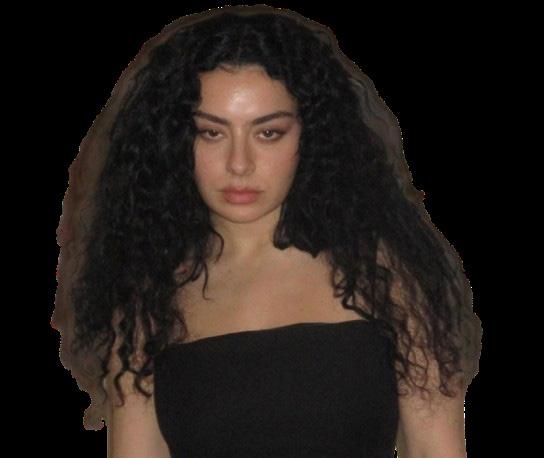
The connection between Harris and “brat” started with Charli XCX, the iconic British popstar and singer-songwriter who released “brat” this past summer, before tweeting, “kamala IS brat.” This tweet, which was posted to X on July 21, sparked Harris’ team to change the @KamalaHQ account’s photo to a new bright green background and blurry text of Charli’s album cover. For Gen Z, this was a culture shock.
This November, Harris can make history by becoming the first female U.S. president. That would be a major victory for feminists across the country – and catering to the youth to secure the coveted seat in the Oval Office is an important strategy to get there. But for former President Donald Trump, that’s a tactic he and his team have not used very effectively.
“brat” and Charli XCX have taken over social media since its release on June 7. For Gen Z, it has certainly been a “brat summer,” with songs from the album all over social media, and many young people embodying what it means to be “brat.” Charli described being a “brat” as embracing one’s own messiness, humanity and authenticity. By earning this label from Charli herself and using it for the Harris-Walz campaign, Harris is becoming more relatable to the younger generation.
By Ava Hebenstreit
Harris has widened her voting audience by becoming more relatable to the younger generation through social media
Sometimes, presidents and politicians don’t always appeal to the average American. By embracing this “brat” title, Harris is proving her own authenticity. She is willing to emphasize her empowerment as a woman to strengthen her campaign. For a Gen Z audience that craves real vulnerability and human messiness, this makes her more human.
“I believe that Harris’ campaign is genius. She is appealing mainly towards Gen Z, who most of them are in their first election where they can actually vote. This young generation [coming up] is who will be running the country in the years to come,” junior education major Courtney Kelley said. “She can only communicate with them effectively if she can speak their language. That language happens to be BRAT summer.”
In an age of misinformation, some can find it hard to know what is fact and what is not. On social media, filters and the use of AI make it difficult to embrace truth. Gen Z, while sometimes engaging in these behaviors, are also trying to break them. For many, the “brat” aesthetic embodies authenticity.
Regardless of what you think of Kamala Harris, you can’t deny that this marketing strategy is effective in reaching Gen Z voters. In the words of freshman communications major Megan McFayden, “She IS brat.”


How the Commanders and Bears will likely decide this year’s election results
Washington’s victory or defeat could be the difference in deciding a tight race
When the Washington Commanders and Chicago Bears face off in Landover, Maryland on Oct. 27, much of the attention will be paid to the matchups on the field. Jayden Daniels and Caleb Williams, the number one and number two picks in this past year’s draft, headline those storylines, but their Offensive Rookie of the Year campaigns shouldn’t be the race fans pay the most attention to that night. Instead, they should be more concerned about how the result will impact the impending election between Kamala Harris and Donald Trump.
The Commander’s Rule states that when Washington wins its last home game before the election, the party of the incumbent party will retain the presidency. When the teams lose that game, the opposition party will win the election. This year, if the Commanders win against the Bears, Kamala Harris will (presumably) win the election and the Democrats will keep the presidency. If the Bears win, Donald Trump and the Republican party will take over.
From 1940 to 1996, this rule held true for every election. Prior to the 2000 election, Steve Hirdt of the Elias Sports Bureau noticed this trend and convinced Don Ohlmeyer, producer of Monday Night Football, to create a graphic to share this information during the broadcast. Viewers took interest in Hirdt’s findings, and after Washington’s loss to the Tennessee Titans correctly corresponded with Republican George W. Bush’s victory over Democrat Al Gore, the rule became a fixture in election coverage.
In 2004, the Commanders lost to the Green Bay Packers. According to the Commander’s Rule, this would signify that Bush, the incumbent, would lose to Democrat John Kerry. Instead, Bush won re-election and seemingly ended Hirdt’s rule. This led to a revision, the Commander’s Rule 2.0, which stipulates that when the winner of the popular vote does not win the election, the impact of the Commander’s Rule gets flipped.
With this modification in mind, the 2004 result was also correctly predicted by Washington’s loss. Bush lost the popular vote in 2000, flipping the rule and forecasting an incumbent win with a Washington defeat.
Even with the introduction of Hirdt’s Commander’s Rule 2.0 in 2004, this version has not been accurate for every presidential election. Bush won the popular vote in 2004, so Democrat Barack Obama’s victory matched Washington’s loss to the Pittsburgh Steelers in 2008 according to the original Commanders’ Rule. In 2012, however, Washington lost to the Carolina Panthers, meaning Obama should have lost the election outright or lost the popular vote and won via the Electoral College. Obama won both, marking the first time no version of the Commander’s Rule held true. Hillary Clinton lost in 2016 despite winning the popular vote, conflicting with Washington’s win over the Eagles and creating consecutive instances of the rule being incorrect.
The 2020 election ended this streak of inconsistencies, with the Commander’s victory over the Cowboys predicting a win for Joe Biden, which was accurate.
Biden won the popular vote in 2020, so the rule is back to its original iteration, with the Democrats hoping for a Commanders win and Republicans pining for a Chicago shellacking. With the NFC East being one of the most competitive divisions in football this season, this game may end up having playoff implications come January, but its most important repercussions will likely be felt on Nov. 5.
By James Rust


As Puerto Rico prepares for its gubernatorial elections,
Bad Bunny ensures his community is heard
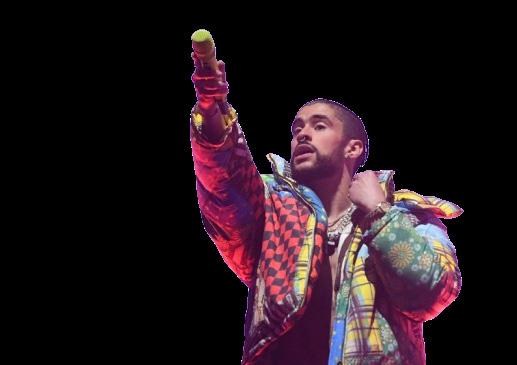
For the upcoming U.S. presidential election, celebrity endorsements have been a central persuasion tool for voters. Celebrities help convey the importance of a candidate and make them more appealing to the public. The question of Puerto Rican rapper and singer Bad Bunny’s endorsement is not absent from this conversation. But amid a crucial Puerto Rican referendum and continuing intermittent blackouts on the island, the musician’s focus is on his community and the political circus surrounding the presidential campaigns.
There is a misdirected focus on whether Bad Bunny will endorse a presidential candidate for the 2024 elections, rather than looking at the on-going political situation in Puerto Rico that have necessitated his frontline involvement in the island’s upcoming gubernatorial elections.
Delayed disaster relief and struggles to get FEMA aid prolonged the inability for Puerto Rico to rebuild. It was noted that Puerto Rico received disproportionate FEMA aid in comparison to mainland hurricane relief efforts, alongside billions of dollars in aid delayed by then-President Trump and his administration. Prior to the release of recovery funding, Puerto Rico’s case received an unusual extra review of disaster funds. According to a Guardian article, such extra step of a review had never happened before. Trump engaged in contentious sparring with Puerto Rican leaders over the release of government funds for recovery efforts. Trump blamed Puerto Rico for the state it was in after Hurricane Maria rather than taking the necessary steps to ensure allocated disaster funds reached the island within an appropriate timeline.
Investigations into the Trump administration found that disaster relief aid to Puerto Rico was intentionally stalled. The American Civil Liberties Union (ACLU) even argued Trump’s response was rooted in approaching Puerto Rico as “second class” citizens. As the 2020 elections drew near, Trump gave $13 billion to Puerto Rico to repair its electrical grid and schools.
Hurricane Maria exacerbated ongoing problems the island struggled with. Unemployment worsened, Puerto Ricans faced increased financial difficulties and a worsened housing crisis. Due to Hurricane Maria, an increasing number of Puerto Ricans, specifically young people, are leaving the territory. It’s causing brain drain and exposing the economic downturns of the island.
Fast forward to 2024, a referendum on Puerto Rico’s independence or possible statehood is on the ballot in the middle of ongoing outages. The status of Puerto Rico seems to be a fixture for the U.S., but for the Puerto Rican people still affected by the fallout of Hurricane Maria, stabilization is their focus.


As Puerto Rico struggled with getting federal aid, political corruption brewed in the territory’s government. Former Governor Ricardo Rosselló was involved in a political scandal and financial corruption surrounding members of his administration. Among the scandalous acts: demeaning hurricane survivors in a series of texts. Revelations of the former Governor’s messages, which also included sexist and homophobic language, led to national outcry for Rosselló’s resignation. For two weeks, Puerto Ricans mobilized mass protests that shutdown a highway and protested in front of the Governor’s residence. Some protesters were met with aggressive responses from police. During the protests, though in the middle of a European tour, Bad Bunny returned to Puerto Rico to participate in protests against Rosselló.
By Suzanne Bagia
Shock over Bad Bunny’s involvement in the upcoming Puerto Rican elections overlook the political crises that have led to the singer’s increased political engagement
Bad Bunny has been outspoken throughout his music career about the political state of Puerto Rico. Along with protesting against political corruption, he teamed up with other Puerto Rican artists to soundtrack music (“Afilando los Cuchillos”) for the protests, calling for Rosselló’s resignation. The musician’s involvement in the upcoming Puerto Rican elections is rooted in advocating for a Puerto Rico that has not fully recovered from Hurricane Maria, coupled with economic stagnation. Like many Puerto Ricans, Bad Bunny, or Benito Antonio Martínez Ocasio is focused on ensuring the government works on stability and is in the favor of Puerto Ricans.
University of Puerto Rico, Río Piedras Professor Mayra Vélez Serrano [CR1] considers Bad Bunny to be a part of the “crisis generation.” This would be considered millennials and older Gen-Z Puerto Ricans who have largely experienced Puerto Rico’s economic decline, which leaves some of them having to seek out better opportunities on the U.S. mainland. Martínez Ocasio is well aware of this matter.
A year after Hurricane Maria, Bad Bunny released “Estamos Bien” to honor the victims of the hurricane. “Estamos Bien” was the first song he performed during his U.S. television debut on “The Tonight Show Starring Jimmy Fallon.” He also used the performance to call out Donald Trump’s denial that thousands of people had died due to Hurricane Maria. “El Apagón” is the 16th song and a single off Bad Bunny’s globally acclaimed and Grammy-nominated album, “Un Verano Sin Ti.” The song’s title translates to “The Power Outage,” specifically addressing the state of intermittent blackouts the island lives with. The song discusses not wanting to leave Puerto Rico because it’s home, listing what makes Puerto Rico great while incorporating sound and allusions of blackouts on the island.

Votar
PNP Es Votar Por La Corrupción
Quien Vota PNP No Ama A Puerto Rico
Most recently, the singer released “Una Velita,” which explores the response of the Puerto Rican people to tropical storms in the aftermath of Hurricane Maria. Lyrically, the song breaks down the instability of the infrastructure and how the Puerto Rican people can no longer depend on the government for aid due to issues related to corruption. In this aftermath, Bad Bunny depicts how Puerto Ricans depend on each other for support and building community relationships to aid each other in the event of another natural disaster.
On Sept. 24, 2024, Bad Bunny shared photos of billboards that read, “Votar PNP Es Votar Por Luma,” “Votar PNP Es Votar Por La Corrupción” and “Quien Vota PNP No Ama A Puerto Rico,” which translate to, “To vote for PNP is to vote for corruption,” “To vote for PNP is to vote for LUMA” and “Whoever votes for PNP doesn’t love Puerto Rico.” Though the sentiments expressed on the billboards weren’t unfounded, it was unclear who paid for the billboards.
The PNP is the Partido Nuevo Progresista (New Progressive Party), which is one of two major political parties in Puerto Rico, while the other is Partido Popular Democrático (Popular Democratic Party). PNP was the party of Ricardo Rosselló. The PNP’s political platform is Puerto Rican statehood, an issue that has characterized the relationship between Puerto Rico and mainland U.S. But over the last couple of years, PNP has also become the face of corruption issues in the Puerto Rican government. During Rosselló’s administration, there were documented mishandlings of money. The shadows of corruption issues in PNP, who have held power since 2017, continue to follow the party.
In recent years, the Puerto Rican government privatized the island’s power grid and later started a contract with LUMA Energy to better Puerto Rico’s power grid. The intention was that Luma would reduce blackouts and blackout lengths. The contract was met with backlash from the public then, and outrage has only increased. LUMA’s handling of Puerto Rico’s power grid has led to more frequent blackouts that at some points last for days. Under the private LUMA contract, some households are facing $200 energy bills per month, while LUMA executives earn six-figure salaries. Oversights by LUMA have not been appropriately handled by the government despite protests from Puerto Ricans to cancel LUMA’s contract.
PNP’s current candidate for governor, Jenniffer González-Colón, has not called for canceling the contract but rather more oversight to mitigate ongoing problems. González-Colón, who aligns herself with the Republican Party, is Puerto Rico’s current resident commissioner, which makes her Puerto Rico’s sole U.S. Congressional representative. In this role, she’s led efforts to increase opportunity zones in Puerto Rico. But according to Centro de Periodismo Investigativo (Puerto Rico’s Center for Investigative Journalism) many lobbyists for opportunity zones in Puerto Rico are also González-Colón’s political donors. GonzálezColón has denied knowledge of consorted lobbying efforts. She’s also been behind getting Puerto Rico Medicaid funding and advocating for hurricane relief in Congress.
González-Colón’s party was swift to condemn the billboards that called out PNP, eventually an official complaint the same day. The complaint was filed on the grounds that it was unclear who was promoting the messaging of the billboards. Soon after, Bad Bunny tweeted: “El PNP utilizando su poder para tratar de callarme. ¿Qué está pasando con la democracia?” (Translated: “PNP is using their power to try to silence me. What is happening with democracy?). To clarify his role in billboards he followed up with another tweet: “Anuncio pagado por Benito Antonio Martínez Ocasio…Un puertorriqueño que si ama a Puerto Rico.” (Translated: “A message paid for by Benito Antonio Martínez Ocasio…A Puerto Rican that loves Puerto Rico”). In the past, there has been contention between Rep. González-Colón and Bad Bunny. The musician has called GonzálezColón and her previous competitor, Puerto Rican Governor Pedro Pierluisi’s election campaigns a joke. González-Colón has also responded to Bad Bunny by calling the artist’s past attacks on the PNP as engaging in violence.
There have been difficulties in registering to vote in Puerto Rico. Puerto Rico’s digital platform to register has complications in submitting verification documents, sometimes even freezing or crashing. This poses a barrier for students studying abroad or people unable to register in person due to other commitments. A lack of trust in the Puerto Rican government has led to lowered voter turnout in Puerto Rican elections.
Bad Bunny has spoken out against low voter registration as the gubernatorial elections grow closer. He called voting a tool to protest against government leaders that have led Puerto Rico into its current political state. This is not the first time Bad Bunny has encouraged Puerto Ricans to vote. For his Most Wanted Tour, concertgoers could win free tickets if they showed a voter ID. New data showed that only 25 percent of eligible voters under the age of 21 were registered to vote, but after Bad Bunny’s comments, 300 students registered to vote, despite ongoing power outages at the University of Puerto Rico.
By being present in the 2024 Puerto Rican elections, Bad Bunny is encouraging the Puerto Rican people to vote for candidates and policies that will benefit the island. His positionality displays his hope for a Puerto Rico that is able to move forward and challenge the status quo of election politics in Puerto Rico. The impacts of Hurricane Maria haven’t been remediated and Bad Bunny’s election advocacy centers these concerns. He wants Puerto Ricans to recognize they can use voting to hold government officials who aren’t advocating for the island’s people accountable. Bad Bunny’s engagement is not a passive action of endorsements, but active participation in the election process.
Following the recent Presidential debate, one Instagram post caught the attention of millions from around the world – Taylor Swift endorsing Kamala Harris and Tim Walz for the 2024 election. “We can accomplish so much more in this country if we are led by calm and not chaos,” Swift wrote. Reaching over one million likes in less than one hour, the message spread to not only Swifties, but news outlets as well.
While some may be shocked hearing Swift’s position, this is not the first time she has stated her liberal political opinions. Anybody who has seen Swift’s “Miss Americana” documentary knows her involvement in politics began in 2018 when she publicly her opposition for Republican Tennessee Senate candidate Marsha Blackburn. “If I get bad press for saying, ‘Don’t put a homophobic racist in office,’ then I get bad press for that,” Swift said. Prior to her engagement in the 2018 midterm election, many Republicans believed Taylor Swift to be a conservative, having been a country singer originating in Tennessee.
After the singer publicly backed Democrats Phil Bredesen and Jim Cooper, more than 160,000 people registered to vote. Although Blackburn won the election in 2018, Swift undoubtedly had a significant impact on the results; young voter turnout spiked because of her, demonstrating the monumental impact that a celebrity as influential as Swift can have on politics and voting habits.
Now, in 2024, more than 300,000 people visited the voting site Swift linked less than 24 hours after her post. Having someone of Swift’s status endorse Vice President Harris can certainly have a major impact on the election. However, the one demographic that Swift’s post will not attract as much is the male population. It is well known that the majority of her fan base of women and younger adults (particularly Millennials), two groups which Harris is leading in the polls. The male demographic is the one major group that Harris is lacking, and that may result in a very close election.

TAYLOR SWIFT’S DIVE INTO THE POLITICAL POOL

TAYLOR SWIFT’S INTO POLITICAL
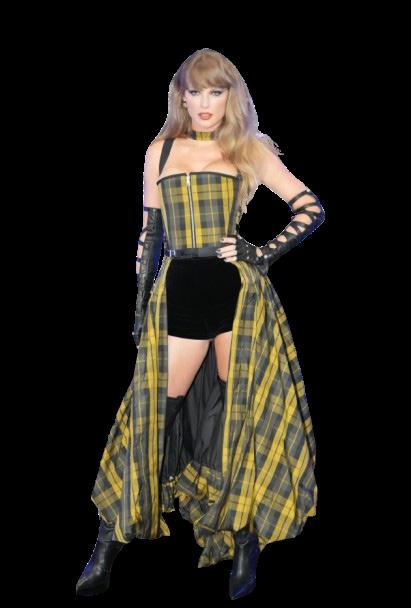
Swift speaks up about her position in the 2024 presidential election
By Lindsay Morrison
In her post, Swift signed off as “childless cat lady,” a dig at Republican vicepresidential nominee Senator JD Vance. In 2021, Vance criticized Democrats, stating the country is being run by “childless cat ladies who are miserable at their own lives and the choices that they’ve made, and so they want to make the rest of the country miserable, too.” This comment caused a wave of backlash from women, Democrats and celebrities. Swift owned the title and threw the quote back in Vance’s face.

Swift is undoubtedly one of the most influential singers of this century, not only by voicing her opinions but also by connecting people through her music. She gives people a voice that is otherwise silenced. One of her main reasons for voting for Harris and Walz is their continued advocacy for “LGBTQ+ rights, IVF, and a woman’s right to her own body.” Swift has been a strong advocate for these issues for years.
Swift hasn’t shied away from politics in her songs, either. Her song “The Man” is a fight for equality and feminism, while perhaps her most politically influential song “Only The Young” discusses the difficulties youth face in the world today.
Only time will tell whether Taylor Swift’s endorsement will lead to Harris’ win. However, it is clear that the United States is already feeling the “Swift Pull” of the election.