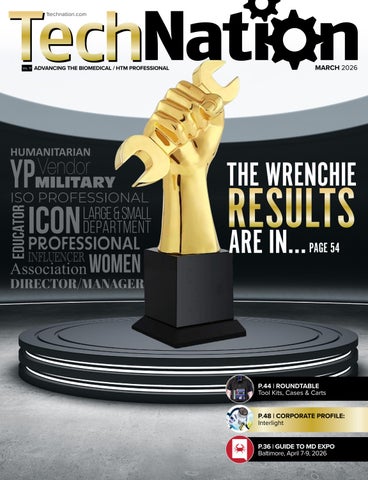
TechNation March 2026

Page 1


P.12 SPOTLIGHT

p.12 Professional of the Month: Brian Gore

p.14 Department of the Month: Orlando VA Healthcare System

HTM Department

p.16 Next Gen: Jacob Hanson

p.18 Association of the Month: Florida Biomedical Society (FBS)

p.20 BC Group’s Ken O’Day Retires

P.22 INDUSTRY UPDATES

p.22 News & Notes

p.27 TechNation Pulse

p.29 Welcome to TechNation

p.31 Ribbon Cutting: Rytex Industries

p.32 AAMI Update

p.34 ECRI Update

p.36 Guide to MD Expo Baltimore

2026 CELEBRATING EXCELLENCE Tech Choice Awards 54

P.38 THE BENCH

p.38 Biomed 101

p.40 Webinar Wednesday

p.42 Tools of the Trade

P.44 FEATURE ARTICLES

p.44 Roundtable: Tool Kits, Cases & Carts

p.48 CORPORATE PROFILE: Interlight

p.54 Cover Story: Celebrating Excellence 2026 Tech Choice Awards

P.70 EXPERT ADVICE

p.70 The Future

p.72 MedWrench Guru

p.76 The Massey Method

p.78 Networking Notes

p.80 Cybersecurity

p.82 Right to Repair

PUBLISHER John M. Krieg

VICE PRESIDENT Kristin Leavoy

VICE PRESIDENT Jayme McKelvey BUSINESS DEVELOPMENT

EDITORIAL John Wallace

CONTRIBUTORS

K. Richard Douglas

Joie Marhefka

Steven J. Yelton

Garrett Seeley

Nathan Proctor

Carol Davis-Smith

Eric Massey

Gay Gordon-Byrne

Dave Francoeur

Andrew Whyte

James Linton

Christopher Walters

ACCOUNT Megan Cabot

EXECUTIVE

ART DEPARTMENT Karlee Gower

Taylor Hayes

Alicia Brown

DIGITAL SERVICES Cindy Galindo

Kennedy Krieg

Haley Harris

EVENTS Kristin Leavoy

Sydney Krieg

WEBINARS Linda Hasluem

HTMJOBS.COM Sydney Krieg

ACCOUNTING Diane Costea

CIRCULATION Stephanie Cote

EDITORIAL BOARD

Rob Bundick, Director HTM & Biomedical Engineering, ProHealth Care

Carol Davis-Smith, CCE, FACCE, AAMIF, Owner/ President of Carol Davis-Smith & Associates, LLC

Nadia ElKaissi, CHTM, Biomedical Engineer, HTM, VA Central Office (19HTM)

Bryant Hawkins Sr., Site Manager, Children’s Hospital of New Orleans

Earl Morris Jr., BMET, Director of Clinical Engineering, Harrison County Hospital

Leticia Reynolds, Clinical Engineering Operations Manager at UCHealth Parkview Medical Center

P.84 BREAKROOM

p.84 Word Search p.84 [Contest] What’s on Your Bench?

p.85 Biomed Brainbuster

p.86 It’s Showtime p.92 Service Index

p.95 Alphabetical Index

p.96 Preferred Vendors

Healthcare organizations rely on properly maintaine d medical equipment every day. CBET’s Business Training Solutions give employers confidence that their staff are prepared to keep operations running efficiently, safely, and in compliance with industr y standards.

Our programs combine flexible online learning with hands-on lab training at nationally recognized facilities. This approach ensures staff gain both t he technical knowledge and the real-world practice they need to succeed.

PROFESSIONAL OF THE MONTH Brian Gore

For every biomed who decided early in a technical school or in the military what they wanted to do as a career, there is another biomed who took a more indirect route to healthcare technology management (HTM).

One HTM professional who took a more circuitous route is Brian Gore, an engineering specialist in cardiovascular services at Duke University Health System. Gore had planned to help patients in the nursing profession after working as a heavy equipment operator.

“Honestly, I did not know that this field existed. It was never mentioned as a career option in high school. Growing up, I didn’t know anyone in the field. As a heavy machine operator, I decided to continue my education and pursue another trade. Registering for college, I chose nursing as my major because I wanted to help people and my friends and family had always reminded me of my caring nature,” he says.

Gore remembers going to a friendly gathering and someone who was attending college, and in the biomed program, introduced him to field.

“He told me that I’ll be in healthcare and I get to fix things. These are the two things that fit me perfectly; fixing stuff and helping people. I changed my major the following Monday,” he says.

He graduated with an A.A.S. in biomedical equipment technology and networking certified at Caldwell Community College & Technical Institute (CCC&TI).

“I am currently pursuing my B.S. in biological and biomedical sciences at North Carolina Central University (NCCU),” Gore says.

He has spent his entire 13-year biomed career at Duke University Health System.

“Over the years, I have been part of multiple teams across the clinical engineering department. Mostly, spent as a biomedical equipment specialist in the OR setting. I am now

the engineering specialist for the heart center in the catheterization and electrophysiology labs,” Gore says.

HUMANITARIAN FOCUS

Challenges for a biomed can come with big projects or vexing repair problems, but also life events that have nothing to do with work.

“Challenges come in different shapes and sizes. They are not always work related to affect your work. I suffered and recovered from a stroke (in 2016). By the grace of God, my major motor skills were not affected. Just a slurred speech. My memory was also affected. Reading aloud and reading comprehension exercises helped me tremendously. The deaths of my mother (2017) and my wife (2015) were big challenges. Yes, these are events that are not related to my career, but they impacted my ability to provide high quality service that I am known for. A good support system, and having someone to talk to, helped me navigate through these challenges,” Gore says.

He says that society has a stigma that a man showing vulnerability is a sign of weakness.

“I believed this until I learned how stress can affect your body’s physiology more than anything else. Suppressing your emotions and feelings are never good. From a man to another man, talk to someone; anyone,” he says.

Gore is also

involved in providing healthcare in underprivileged countries.

“I have been on seven missions to Kampala, Uganda and Tegucigalpa, Honduras. In these trips, I am the engineer for the traveling team. I will work with the biomed team in the country to collaborate and teach the staff. The mission is to provide a service to fulfill a need in a community and to teach them the skills so they could become self-sustainable,” he says.

While Duke University is known for its exceptional academic and athletic programs, it also gives back to the community locally and globally.

“I am involved in an initiative called ‘REMEDY at Duke.’ REMEDY at Duke University is an all-volunteer program run by Duke staff and students who have an interest in global health, environmental sustainability and community service. It reduces waste and promotes resource sustainability through the recovery and recycling of usable surplus medical supplies, reduces disparities in global health care through the donation of medical supplies to areas of need, and promotes awareness of global health issues within the Duke and greater Durham community. As of 2025, REMEDY at Duke has made over 300 donations to 50 different countries,” Gore says.

He has been nominated twice for TechNation’s Humanitarian of the Year (2024, 2025) and is a Marquis Who’s Who Honorary Listee (2024).

In addition to volunteer work off the job, Gore enjoys reading, fishing, camping and hiking.

“I draft and build things. I have a townhome. Currently, I have drawn up a mirror/medicine cabinet for my bathroom and shelving for my pantry closet. I am also renovating my townhome myself. There are things outside of my toolbox that I have to hire professionals for – plumbing; I don’t do plumbing LOL – but it’s me for the most part. I dab a little in photography,” he says.

Gore describes himself as an “genuine individual” who tries to treat everyone the same.

“What drives me is the human side of biomedical technology. Behind every device or system is a patient, a clinician, or a family member, and I try to keep that front and center in the work I do. I care deeply about the science, but I care just as much about the people affected by it,” he says.

He is driven by two things: advancing biomedical technology and serving the community.

“I see them as connected. When we understand community needs, we provide better, more meaningful healthcare solutions. My goal is to provide a service that clinicians trust and patients never have to think twice about. I try to approach biomedical technology with a service mindset – building tools that improve care while also staying connected to the communities affected by them. That balance keeps my work purposeful and grounded. At the end of the day, I’m just someone who cares about using biomedical technology to help people. If it makes healthcare a little better, or a little more human, I feel like I’m doing something right,” Gore says.

It’s the human element that Gore brings to the job and to volunteering that betters the lives of those he comes in contact with.

BIOMETRICS

FAVORITE BOOK:

“Things Fall Apart” by Chinua Achebe

FAVORITE MOVIE:

“Forrest Gump”

FAVORITE FOOD: Cake

HIDDEN TALENT:

I can pat my head and rub my belly (and vice versa).

FAVORITE PART OF BEING A BIOMED?

The gratification of fixing something. That moment when you’re diligently working on something and you turn it on to see if you fixed it, then it lights up and works as it should. Pure bliss.

WHY DO YOU READ TECHNATION?

I read TechNation to stay up-to-date and in the know of new technologies, concepts, and ideals in the HTM industry. Sciences advance so quickly that if you don’t stay read up on things you’ll get left behind.

DEPARTMENT OF THE MONTH Orlando VA Healthcare System HTM Department

It’s a safe bet that some veterans retired to Florida over the years, either after a career in the military or after retiring from active duty and then retiring from a civilian career. For those who live in the Northeast and Midwest, Florida is a popular destination to avoid long winters.

One option in the Sunshine State is Orlando. Veterans can have their healthcare needs met at the Orlando VA Medical Center.

The facility’s competent group of HTM professionals comprises the Orlando VA Healthcare System Healthcare Technology Management (HTM) Department.

The team includes Supervisory Biomedical Engineer Paola Rivera; three lead biomedical equipment support specialists in Edward Reyes, MHA; Brian Whitaker; and Xavier Betts. The three staff biomedical engineers are Arael Monroe, Christine Motz and Stephanie Vazquez Hernandez.

“HTM supports the Orlando VA Medical Center at Lake Nona, which serves as the flagship hospital of the Orlando VA Healthcare System. This is a major VA facility providing inpatient, outpatient, emergency and specialty services to veterans in Central Florida,” Reyes says.

He says that the facility includes advanced diagnostic and treatment areas, outpatient clinics, a 120-bed community living center, mental health programs and more, such as MEAV of more than $141 million, with six MRIs, eight CT scanners, two LINACs, multiple new da Vinci robots and much more HTHC equipment.

The team also supports three outpatient clinics with full radiology, lab and pharmacy services, seven small community clinics and three vet centers throughout Central Florida.

Reyes says that the HTM department has one networkbiomedical equipment support specialist who manages the servers and network modalities for the medical equipment.

MULTIPLE CHALLENGES ADDRESSED

The biomed team has been involved in a number of projects in recent years including the installation of equipment at a new facility and the custom interface testing of advanced imaging systems.

“In 2024, HTM was crucial in the relocation and opening of a new outpatient clinic in Daytona Beach. The previous facility was more than 20 years old and did not meet the needs of the growing patient community. The opening of the new clinic expanded services in the following departments: radiology,

sterile processing, eye clinic, cardiology, audiology, and physical therapy,” Reyes says.

He adds that HTM managed the de-installation, relocation and re-installation of existing equipment as well as installation of multiple new technologies, some of which were new to the national VA hospital system.

The team faced the challenge with talent and dedication.

“When our HTM team managed the de-installation, relocation and new installation of equipment, there were several significant technical and logistical hurdles,” Reyes says.

Those challenges included coordination across multiple trades and departments.

“ We worked closely with facilities engineering, IT, radiology, nursing leadership and external vendors to sequence work so clinical operations could continue with minimal disruption. That meant planning shutdown windows, staging equipment and confirming connections for power, data, gases and room integration systems before any physical moves started,” Reyes says.

Another challenge was dealing with new technology that was unfamiliar to the VA system.

“Some of the technologies being introduced were new to the national VA hospital system. This meant we had to develop detailed procedures from scratch rather than following existing VA playbooks. For example, advanced imaging systems and integration with our operating-room visualization/networking platforms required custom interface testing. Installation of new OR middleware systems that bring multiple video feeds and clinical data into one user interface,” Reyes adds.

Another project involved real-time location systems (RTLS) for asset tracking and wayfinding across the campus.

“For each of these, a key challenge was understanding vendor requirements, coordinating site readiness – power, structural, network – and validating that they worked within VA security and compliance standards,” Reyes says.

He says that the Orlando VA campus spans buildings of different ages and configurations. Integrating new systems into older electrical, network and physical spaces has required creative workarounds.

“We often had to source custom adapters, verify grounding and safety in older conduits, and patch systems so modern equipment could operate without interruption,” Reyes says.

There is also the challenge of moving large diagnostic equipment like CTs or MRI scanners; a task that isn’t as simple as unplugging and re-plugging.

“Each piece is sensitive to vibration, requires recalibration after relocation, and must be certified before clinical use. Our team planned detailed lifts, used specialized transport gear and coordinated final placement with imaging physics teams,” Reyes says.

The team also needed to move a large imaging suite while the hospital was still fully operational.

“We needed to relocate a CT unit into a newly renovated space, but during the prep phase, we discovered outdated wiring and room framing that didn’t meet the vendor’s requirements for noise, grounding and power quality. Power panels needed re-evaluation and upgrades. Shielding requirements weren’t met in the renovation design. There was no room for additional electrical conduits without impacting adjacent clinical areas,” Reyes says.

The department stood up multiple cross-discipline planning meetings with facilities and construction to redesign the room layout.

“ Worked with the electrical team to bring in a temporary power solution so the rest of the department remained unaffected while upgrades were completed. Coordinated with the vendor’s engineers to adjust shielding specifications and certify performance once installed. Despite a compressed schedule, we delivered a fully operational imaging suite that met all clinical performance and safety standards. Because we rehearsed each step with stakeholders before execution, we avoided major downtime and kept patient care flowing,” Reyes says.

The team has successfully completed other special projects.

“HTM at the Orlando VA Medical Center isn’t just about fixing broken gear. We’re problem-solvers who navigate complex technical installs, cross-discipline coordination, compliance requirements and mission-critical service continuity. The innovations happening here push us to adapt and grow our skills constantly. And as technology changes, so do we,” Reyes says.

Veterans in Orlando are well served by the Department of Veterans Affairs in Orlando and patients can be confident that a sharp group of HTM professionals has their back.

Left: Members of the Orlando VA Healthcare System HTM Department celebrate the opening of the Daytona Beach VA Outpaitent Clinic in Volusia County, Florida. Right, A special outing to Tony Roma’s provided an amazing team building experience.

NEXT GEN POWERED BY YP AT MD

Jacob Hanson

OSF St. Katherine Biomedical Tech 3 Jacob Calhoun recently nominated Biomed Tech 1 Jacob Hanson for TechNation magazine’s Next Gen feature.

“Jacob is an upcoming technician that is proving he has what it takes to be a great technician. He just was promoted to a level 1 after spending time as an intern. I’ve known him for 3 months and have looked forward to training him daily at the new to us hospital,” Calhoun wrote in an email. “I have already trained him well to do resuscitation units on GE Panda incubator beds, IV pumps, insufflators, ESUs and blanket warmers. Next month, he will be working in lab. While he was an intern at another location, he was the guy that did all the adult beds. So, he came into this location with a great amount of knowledge for what we have had to deal with in that aspect.”

TechNation discovered more about this rising star in a recent Q&A

Q: WHERE DID YOU GROW UP?

A: Dekalb, IL

Q: WHERE DID YOU RECEIVE YOUR HTM TRAINING/ EDUCATION?

A: Internship with OSF Healthcare and ongoing cross training with my coworker, Jacob Calhoun.

Q: HOW DID YOU FIRST DISCOVER HTM?

A: Found out about it in college at NIU.

Q: WHY (OR HOW) DID YOU CHOOSE TO GET INTO THIS FIELD?

A: I was a CNA in a nursing home setting before college, I was going for a math degree and came across engineering classes.

Q: WHAT DO YOU LIKE MOST ABOUT YOUR POSITION?

A: I enjoy doing my part to help improve the medical field by working on and repairing equipment.

Q: WHAT INTERESTS YOU THE MOST ABOUT HTM?

A: I enjoy learning more about how medical equipment works with my engineering degree.

Q: WHAT HAS BEEN YOUR GREATEST ACCOMPLISHMENT IN YOUR FIELD THUS FAR?

A: Being able to quickly learn about testing equipment and repairing equipment. I am also proud of my engineering degree.

Q: WHAT GOALS DO YOU HAVE FOR YOURSELF IN THE NEXT 5 YEARS?

A: I hope in the next 5 years, I will have much more knowledge on more equipment, especially ventilators and anesthesia machines.

FUN FACTS

FAVORITE HOBBY: Bowling

FAVORITE SHOW OR MOVIE: “Avengers Endgame”

FAVORITE MEAL: Smoked brisket

WHAT WOULD YOUR SUPERPOWER BE? Super speed

1 THING ON YOUR BUCKET LIST? Travel to Utah Beach

SOMETHING YOUR CO-WORKERS DON’T KNOW ABOUT YOU: That I love math equations.

ASSOCIATION OF THE MONTH

FLORIDA BIOMEDICAL SOCIETY (FBS)

The Sunshine State has attracted tourists and transplants to its sunny climate for decades. In addition to a sunny climate, the state offers a variety of beaches along its coasts along with nationally known destinations like Universal Orlando, Disney World and the Kennedy Space Center.

The sun and surf attract biomeds, along with other transplants, who join the state’s native population of HTM professionals. Those biomeds can be found everywhere from Miami to Pensacola and all points in-between.

Uniting the HTM community in Florida is the state’s biomed society. The Florida Biomedical Society (FBS) was established in 1985, according to its President Mark Lopez, CBET. The statewide group includes five chapters and was awarded Tech Choice Award for Association of the Year in 2024.

Lopez says that Lou Katchis, BSEE, MSEE, MBA, CCE, now retired and a former biomed specialist at Baptist Health South Florida, Coral Gables, Florida, is a founding member of the organization. Katchis currently serves as the

association’s treasurer.

“During the 1980s, biomedical engineering was starting to exert its influence onto national perception as medical equipment developed more into the forefront of healthcare. At this time, more biomedical societies were forming to provide guidance and professional growth in the ever-expanding equipment environment; Florida was no exception, with two societies already operating in the state; one in the south region (SFAMI) and one in the northeast (NEFAMI),” Lopez says.

He says that as more biomedical societies formed around Florida, [they] struggled to sustain quality content, leadership, professional development and membership participation. It was with this in mind that several of these groups started to discuss the formation of a united statewide society that could provide mutual support for all the local groups.

In a meeting to assure biomed attendance at an American Society for Healthcare Engineering (ASHE) meeting in Florida, some of the founding members organized the first meeting for what would become the FBS in October of 1985. A constitution for the new organization was drafted. Shortly thereafter, a statewide organization was incorporated and bylaws were created.

“Today FBS consists of five chapters representing the majority of the state’s geography: the Gulf Coast Biomedical

Society (GCBS), the Bay Area Association of Medical Instrumentation (BAAMI), the North East Florida Association of Medical Instrumentation (NEFAMI), the Central Florida Biomedical Instrumentation Society (CFBIS) and the South Florida Association for Medical Instrumentation (SFAMI). FBS is approaching 40 years of service and considered by many in the community as one of the best societies in the nation.

Lopez says that the organization’s five chapters currently operate independently, holding meetings throughout the year at their discretion, with some meetings simulcast online.

“The FBS Board meets quarterly and maintains consistent communication year-round to ensure our annual symposium is the best possible experience. In non-symposium years, we actively support and collaborate with MD Expo when it returns to Florida every three years,” he adds. MD Expo will be in Orlando, Florida this October.

Lopez says that the local chapters maintain strong relationships with local biomedical technical schools, high schools and middle schools to promote the HTM career field and the Florida Biomedical Society.

“FBS offers several scholarships for students, as well as scholarship opportunities for HTM professionals pursuing CBET certification. In addition, FBS recognizes excellence through awards that honor outstanding individual professional achievement with the BMET of the Year Award, as well as HTM organizations and vendors/OEMs that demonstrate professional leadership within the state of Florida through the President’s Award,” Lopez says.

SUPER BOWL OF SYMPOSIUMS

The organization is lucky to be located somewhere that offers many potential venues for events and conferences. The locale also allows for exceptional symposiums.

“Recently celebrating our 40-year anniversary and 20 years of hosting events at Walt Disney World Resort properties, FBS has built a strong legacy of excellence. The annual December FBS Symposium at Walt Disney

World is widely recognized for its comprehensive educational opportunities, outstanding social events, and extensive, highly engaging vendor exhibits. Often referred to as the ‘Super Bowl of symposiums,’ we take great pride in delivering an exceptional experience that supports and celebrates our profession,” Lopez says.

He adds that the group’s symposium offers technical and management classes covering imaging, service, best practices, safety, healthcare IT and regulatory updates.

“It is not uncommon to see managers and senior technicians learning alongside instructors who trained them 20-30 years ago, bringing the experience full circle and highlighting how this career field continually gives back to its own,” Lopez says.

He says that beyond the classroom, vendor receptions, exhibitor hall social hours, group dinners, and a signature EPCOT event, help the FBS symposium create meaningful connections between professionals, vendors, recruiters and new technicians fostering a strong social and networking environment rarely found in the workplace. The annual golf tournament further encourages relaxed and engaging interactions where lasting professional relationships are formed.

“In 2026, FBS is excited to join forces with the always spectacular MD Expo, coming to Orlando’s Rosen Shingle Creek from October 13-15. Our very own president, Wolney Linhares from the South Florida Chapter, will proudly represent FBS, while I’ll be leading background and recruitment efforts to ensure we make the most of this incredible opportunity to connect, collaborate and showcase the strength of our HTM community,” Lopez says.

In a diverse state with several major population centers, the FBS unites HTM professionals from coast to coast in one of the country’s preeminent statewide biomed organizations.

For more information about FBS, visit FBSonline.net. For more information about MD Expo, visit MDExpoShow.com.

Bill Hascup, second from left, was recently presented with the FBS Lifetime Achievement Award.

BC Group’s Ken O’Day Retires

Finally Working That “One Extra Day”

“Ken is among the best liked and most respected sales executives the HTM industry has ever known.”

It’s official … BC Group International’s Ken O’Day retired after 31 years supporting one of the leading providers of test and measurement equipment for the worldwide technical services marketplace.

However, O’Day began to fine tune his negotiation skills before BC Group was even founded.

“My first paying gig was when I was 4 years old and was asked to be the ring bearer for my uncle’s wedding. It was supposed to be a volunteer job, but I kept threatening to throw the pillow with the ring,” O’Day shares. “My dad said I would get a dollar if I delivered the ring without incident. I did my duty and immediately requested my pay while still on the altar. The twin 5-year-old flower girls immediately negotiated a dollar each with their dad, starting off my career as a labor leader and negotiator.”

After high school, O’Day attended and graduated from University of Missouri in 1969 with a degree in business administration. He went to work at a local branch of the St. Louis YMCA where he earned certification as a cardiac rehab tech.

“As a result of that experience, I was offered a sales position with a locally owned medical company, selling ECGs, Holter monitors, stress test equipment and lab equipment,” he says.

After seven years, he started a medical distribution company in the St. Louis area in 1981. “Out of necessity, I learned how to calibrate and repair the items that I was selling as support for my customers. I had my own business from 1981 until 1995,” he says.

When he saw an ad that said the family-owned BC Group was looking for a salesman to sell biomedical test equipment and

calibration services, O’Day applied.

“I started working for BC Group as their first salesman, allowing the owner to focus on the business and the expansion of the depot and onsite calibration business,” he recalls.

BC Group was originally a Bio-Tek dealer and Owner Bill Collier decided he wanted the business to be a one-stop shop for biomeds and, eventually, go worldwide.

At the time, BC Group only sold used test equipment and distributed other companies’ products but continued to add products to enhance its offerings, O’Day says.

“Around 2002 we decided BC Group would start offering test equipment under our own name,” he says. “Several test equipment manufacturers agreed to provide their products for us, giving birth to the green labeled BC Biomedical product line. This worked for several years, but many of those companies were bought out or merged, leaving BC without a reliable source for our BC product line.”

A chance meeting between Bill Collier and the owner of a local engineering company turned out to be the salvation for the BC Biomedical product line.

Mel Roche, the owner of the family-owned engineering company (JPC Controls) provided BC with the design and manufacturing capability for BC Biomedical devices from that point on.

Fast-forward about 20 years and O’Day was ready to retire. However, the COVID-19 pandemic changed lots of plans that year.

“It was not a good time to hire a replacement and do training. As it turned out, we hired Tim Welby, my replacement as vice president of sales and marketing, in 2021. I spent several months getting things transitioned. I was now working part time,

attending tradeshows and working on small projects for the company. It has finally got to the point where it is time to move on to full retirement,” O’Day says.

Except, if you know Ken then you know there is a story to go with his new retirement date.

“I did have a shaky start with BC Group that might have cost me my job on the first day,” O’Day recalls. “I was supposed to start BC Group the first of the year in 1995, but since January 1 was a Sunday, I assumed we would be off on January 2 since the holiday was on a Sunday.”

“I showed up on the third of January,” he continues. “No one said a word until I overheard an employee talking about a customer conversation from the day before. I asked if we were open on the second, followed by, ‘Yes, and we didn’t think you planned to take the job after all.’ I apologized and promised that I would work one extra day after I finally retire. That was 31 years ago, so I guess they didn’t hold it against me. I still owe the company one day beyond my retirement date.”

“I know the company is in good hands and I can focus on the thing that makes me the happiest, my marriage and my 5 grandkids. Now that I have more time, maybe my kids will want to have more grandkids to make me even happier (or not),” O’Day adds.

Bob Jakubczak, a former system director of HTM, was a longtime customer and remembers that O’Day was always “dedicated to his customers.” He also looked out for his customers.

“We took on a hospital that was in need of HTM,” Jakubczak says. “They had no test equipment that was working. Ken and his team loaned us equipment and sent over his team the next day to repair the test equipment. His legacy is how he was dedicated to the advancement of HTM.”

BC Group President Mel Roche applauds O’Day on an amazing career.

“Ken worked for me for 20 years and never ceased to amaze me with his depth of industry knowledge and people, along with his willingness to share and help. We design and manufacture our own products,” Roche says. “Ken has always been a key factor in the determination of what we make and how it functions, always with an eye towards the end user. He never quit pushing for our products to be upgradable, so the user didn’t need to just get rid of them and buy new ones but had a path to keep them at the cutting edge with upgrades if they so choose. His focus has always been on how we can make products that help make things better and safer for our industry and the people we serve.”

Roche believes O’Day’s legacy is one of shared knowledge.

“Ken has always been a teacher by nature. You can never help but learn something new with almost every conversation,” he says. “He has a depth of knowledge from years of experience, but as importantly he always takes the time to share that knowledge with everyone he works with. His legacy will be the hundreds of people he has helped to be a little happier, a little smarter and a little better and the work they will continue to do based on what he has shared with them and the example he has set for them.”

BC Group Senior Account Manager Tom Sweeney summed up the career of his colleague with simple but true words.

“Ken is among the best liked and most respected sales executives the HTM industry has ever known,” Sweeney shares. “Playing an integral role in helping build BC Group International into one of the most successful and most respected companies in the HTM universe.”

NEWS & NOTES

Updates from the HTM Industry

RIGHT TO REPAIR SURVEY PARTICIPANTS NEEDED

Right to Repair is based on a simple premise: If you own something, you should be able to maintain and repair it how you see fit, without restrictions by manufacturers that steer you towards buying a new product or using only their brandcontrolled service technicians.

Right to Repair reforms require manufacturers to allow product owners and independent servicers to access the parts, tools and information required to repair things at fair and reasonable costs. Right to Repair legislation has been proposed in all 50 states, and it has passed in 10, covering all sorts of things from agricultural equipment to consumer electronics such as phones. Manufacturers such as Apple and Google have even started to support some of this legislation for consumer electronics – showing that manufacturers can come to the table and support these reforms.

However, there is still no legislation that ensures the Right to Repair for medical equipment other than powered wheelchairs, despite a lot of attempts at engagement, collaboration and compromise. In the view of U.S. PIRG, a Right to Repair for medical equipment is crucial because it reduces equipment downtime and equipment maintenance costs. Less downtime for equipment also improves patient care.

The U.S. PIRG position is that those who provide the care to the patient should be able to choose for themselves what the best course of action is for medical device repair – whether they choose the original equipment manufacturer (OEM), their own in-house technicians or an independent service organization (ISO) – and that whoever services that equipment

should be able to access the necessary repair materials.

During the COVID pandemic, PIRG’s 2020 Hospital Repair Restrictions (tinyurl.com/mr2ah4tv) report showed how manufacturers restrict repair through software locks, refusing to provide service manuals, denying access to spare parts and limiting access to  training. The report found that this conduct undermined patient safety under the stress of the pandemic, including frustrating the servicing of ventilators.

Five years later, the challenges facing medical device repair have evolved, and U.S. PIRG wants to make sure lawmakers know the latest issues. U.S. PIRG is relaunching efforts to engage key stakeholders in the BMET/HTM industry –including ISOs, hospitals and OEMs.

As a grassroots-funded nonprofit that works to promote the public interest, it’s critical to have the latest information and perspectives. Data has been vital in the development of Right to Repair. For example, through extensive work by the FDA, ECRI Institute, and others, we know that repair of medical equipment by ISOs, in-house teams and OEMs all offer safe, effective servicing and are critical to functioning of our health care system.

To shed light on the issue, U.S. PIRG is updating its 2020 report on the state of medical Right to Repair. TechNation readers can help by taking a survey and sharing it with others, or by connecting with U.S. PIRG and sharing your perspective. tinyurl.com/4p9hazp3

For questions, email Henry Welch at henry.welch@pirg.org

TRI-IMAGING, DIRECTMED MERGER CREATES SCALED IMAGING SOLUTIONS PLATFORM

DirectMed Imaging, a portfolio company of Frazier Healthcare Partners, has acquired Tri-Imaging Solutions. DirectMed and Tri-Imaging will be combined into a single, integrated provider of aftermarket diagnostic imaging parts, systems, service and technical training. It will operate under the Tri-Imaging name.

The combined organization will be led by the current Tri-Imaging leadership team, with Eric Wright as CEO, and bring together two complementary imaging platforms serving healthcare networks, independent service organizations and equipment manufacturers.

DirectMed is a leading global provider of aftermarket diagnostic imaging parts, systems and repair services across MRI, CT and X-ray modalities, with LBN in Denmark and ScanMed in Omaha, Nebraska as complimentary business, according to a news release.

“Tri-Imaging provides customer-focused data analytics, replacement parts, on-site service, technical support and industry-recognized training programs for medical imaging professionals. It supports customers nationwide across major OEMs and modalities,” the release adds.

Together, the combined Tri-Imaging platform offers customers a scaled partner focused on maximizing imaging uptime,

extending equipment life and lowering total cost of ownership.

The combination strengthens Tri-Imaging’s ability to support customers through:

• Broader and deeper inventory of multi-modality imaging parts across all major OEMs

• Expanded service capabilities, including depot repair, field service and technical support

• Enhanced training and education programs for engineering teams

“DirectMed and Tri-Imaging share a common purpose of keeping critical imaging equipment up and running so providers can focus on patient care,” said Eric Wright, CEO of Tri-Imaging.

“Bringing our teams together under the Tri-Imaging name strengthens and expands our ability to globally support customers with the parts, service and training they need across imaging modalities.”

“Supporting DirectMed as it builds a scaled, global imaging platform has been a key focus for Frazier,” said Kent Berkley, a partner at Frazier Healthcare Partners. “Adding Tri-Imaging’s highly regarded service, parts and technology platform capabilities is a natural next step in that strategy and aligns with our goal of creating a best-in-class imaging solutions provider.”

Integrity Biomedical Services is the recipient of the 2025 Florida Biomedical Society President’s Award! Owner Michele Shahbandeh was recently presented with the award at the annual FBS Symposium.

Integrity Biomedical Services is ISO 9001-2015 certified and believes in accountability and quality with a quality management system (QMS) in place. Quality and cost are key factors in the daily processes of the company that supports Nihon Kohden, Spacelabs and ELO patient monitors. It also offers OEM equivalent accessories.

Integrity Biomedical Services celebrated its 15th anniversary in 2025 and ended the year on a high note!

“Our 50,000th order happened on December 31, 2025, which was the same year as our 15th year anniversary,” Integrity Biomedical Services Business Development Manager Jon Shahbandeh shared.

The company is also seeking ISO 13485:2016 certification to go with its ISO 9001-2015 certification.

Integrity Biomedical Services provides the highest quality products and services that meet the customers’ expectations as well as any other applicable requirements. Features of the company include:

• Experienced Technicians

• ISO Certified

• Woman/Native Owned

• Quality & Customer Driven

• Cross-Trained Employees

• Free Tech Support

• Factory-Trained Technicians

• Systems Integration

• Component-Level Repair

INDUSTRY UPDATES

FSI DELIVERS NEW COMPLIANCE SOLUTION FOR 2026 JOINT COMMISSION CHANGES

FSI, a leading computerized maintenance management system (CMMS), recently announced the first compliance solution designed to help healthcare facilities and HTM teams prepare for the Joint Commission’s sweeping accreditation updates that went into effect January 1, 2026.

In June 2025, The Joint Commission unveiled major changes to its national accreditation standards, consolidating environment of care (EC) and life safety (LS) requirements and introducing a new physical environment (PE) structure aligned with CMS Conditions of Participation. While the underlying compliance work remains unchanged, the updates significantly alter how regulatory information must be organized and reported during surveys.

FSI’s healthcare-specific focus uniquely positions the company to interpret regulatory changes, understand the real operational challenges customers face during transitions, and productize solutions that directly address them. The company’s new compliance solution is purpose-built for this shift –enabling healthcare organizations to adapt confidently without adding administrative burden.

“The Joint Commission didn’t change what healthcare organizations need to do – but it fundamentally changed how they must demonstrate compliance,” said Zachary Seely, CEO of FSI. “FSI is proud to be the only solution that aligns CMMS

workflows to the new Physical Environment structure, so our customers can walk into 2026 surveys confident, prepared and inspection-ready without adding complexity to their teams’ day-to-day work.”

Key features of the solution include a new Joint Commission code library reflecting consolidated standards, centralized management of regulatory elements, enhanced procedure configuration with multi-code referencing, and expanded eBinder capabilities that clearly link documentation to applicable standards and asset categories. Existing customer configurations will be migrated where applicable to align with the new PE structure, minimizing disruption.

“Everything about this update was designed with our customers in mind,” said Mike Zimmer, director of customer solutions at FSI. “Facilities and HTM teams told us they needed a clearer, more intuitive way to present compliance during surveys. By restructuring how standards, documentation, and assets are connected in the CMMS, we’re helping teams be survey-ready without adding reporting work or disrupting how they already operate.”

By restructuring how compliance data is managed within the CMMS – rather than changing the work itself – FSI enables facilities teams to prepare for 2026 Joint Commission surveys while maintaining operational efficiency.

TRIMEDX-AIQ ADDS AGENTIC AI CAPITAL PLANNING & INVENTORY OPTIMIZATION CAPABILITIES

TRIMEDX has added agentic AI capital planning and inventory optimization capabilities to TRIMEDX-AIQ, its AI-native clinical asset intelligence offering. This new functionality “empowers health systems to make faster, more informed capital and operating expense decisions,” according to a press release.

The press releases states that most medical equipment is utilized only 40-50% of the time and approximately 25% of capital budgets are allocated to clinical assets. The release states that health systems face significant risk of overpurchasing, early replacement and underutilized inventory. “Traditional capital planning processes – often manual, static and based on incomplete data – limit healthcare leaders’ ability to confidently validate purchase requests, adapt plans as conditions change, or identify opportunities to defer or avoid unnecessary spend,” according to the release.

Built on the industry’s most extensive repository of medical device data, TRIMEDX-AIQ’s new agentic AI capabilities address these challenges by enabling health systems to dynamically optimize capital inventory decisions

through AI-native analysis and scenario planning, TRIMEDX states in the release.

“Early modeling indicates that organizations leveraging agentic capital planning and inventory optimization within TRIMEDX-AIQ can achieve: 25-35% capital expense avoidance or deferral; 10-20% operating expense savings; and more flexible, maturity-aligned capital plans that evolve as clinical, operational and financial priorities change,” the release states.

REPORT: MEDTECH & HEALTHCARE IT FACE RAPID DIGITAL TRANSFORMATION

The global medtech and healthcare IT industry is undergoing rapid digital transformation, integrating advanced technologies such as electronic health records (EHRs), telemedicine and AI-driven clinical decision support systems to enhance care quality and operational efficiency worldwide. The latest BCC Research report “Global MedTech Healthcare IT Industry Competitive Landscape,” analyzes the competitive dynamics of medical devices, in-vitro diagnostics (IVD) and healthcare IT. The report highlights market trends, innovations, and strategic moves shaping the future of patient-centric care.

The report highlights the global medtech and healthcare IT market, focusing on major companies, their innovations and regulatory updates across the U.S., Europe and Japan. MedTech encompasses technologies and devices that diagnose, treat and improve health ranging from simple tools like thermometers to advanced devices such as pacemakers and insulin pumps as well as in-vitro diagnostics. Healthcare IT involves digital solutions for managing patient data, streamlining operations and enhancing care delivery including EHRs and software systems.

The report is relevant because it captures the rapid digital transformation of global healthcare systems. It offers insights into leading players, emerging technologies and strategic moves like mergers and acquisitions driven by the growing need for cost-effective care, integrated EHR systems, and adoption of AI, telehealth, and cloud analytics. With healthcare shifting toward value-based patient-centric models, IT solutions are critical for improving decisionmaking, efficiency and outcomes.

The factors driving the market’s growth include:

• Rising healthcare expenditures: Healthcare spending is increasing globally as governments, private sectors, and individuals allocate more resources to improve medical infrastructure, adopt advanced technologies and enhance patient care. This surge in investment fuels demand for innovative healthcare IT solutions that optimize operations and reduce costs.

• Increasing prevalence of chronic diseases: Chronic conditions such as diabetes, cardiovascular diseases and cancer are becoming more widespread because of lifestyle changes and aging populations. Managing these diseases requires continuous monitoring, data-driven decisionmaking, and integrated care systems, which significantly boost the adoption of healthcare IT platforms.

• Aging population: The global population is aging rapidly, leading to higher healthcare needs and long-term care requirements. Older adults often require frequent medical attention and personalized treatment plans, driving demand for digital health tools, telemedicine and electronic health records to ensure efficient and accessible care.

Solutions is a customer service based parts provider that specializes in all imaging modalities and manufacturers.

to offer hospitals and ISO’s a cost effective and time saving solution for ordering imaging replacement parts, equipment moves, ultrasound probe repair, and onsite service.

INDUSTRY UPDATES

BAYCARE UNVEILS VISION FOR NEW CHILDREN’S HOSPITAL

BayCare recently revealed the latest rendering of the future Pagidipati Children’s Hospital at St. Joseph’s, a freestanding, state-of-the-art facility scheduled to open in 2030. Designed to succeed the current St. Joseph’s Children’s Hospital – Tampa Bay’s largest provider of pediatric health care – the new hospital will deliver world-class care in a vibrant, welcoming environment that inspires hope and healing for generations to come.

The new facility is part of BayCare’s strategic commitment to expand access to high-quality, specialized pediatric care across West Central Florida. Reinforcing BayCare’s position as the region’s leading pediatric healthcare provider, BayCare Kids and St. Joseph’s Children’s Hospital provide comprehensive inpatient and outpatient services to thousands of children and families each year.

“Pagidipati Children’s Hospital at St. Joseph’s will transform pediatric health care across our region – pairing innovation with the compassionate, family-centered care our community has come to expect from BayCare,” said BayCare President and CEO Stephanie Conners. “The new hospital will build on St. Joseph’s Children’s Hospital’s legacy and ensure children and families receive the highest quality care for generations – right here in our backyard.”

“Our vision for the new hospital is to elevate every aspect of care – blending state-of-the-art, child-focused design with advanced clinical programs across a wide

ROBERT COHEN CHAIRS ADVAMED BOARD

AdvaMed, a medtech association, has announced that Robert Cohen, vice president, innovation and technology, orthopaedic group at Stryker, will be the next chair of the AdvaMed Digital Health Tech Board of Directors. He succeeds Dr. Taha Kass-Hout, global chief science and technology officer at GE HealthCare, who served as the inaugural chair of the board overseeing the then-newly created division.

“Policy conversations in our nation’s capital increasingly center on digital health tech,” said Scott Whitaker, AdvaMed president and CEO. “In Congress and the executive branch, policymakers and regulators see technology as a solution for personalized care, better patient outcomes, reaching under-served patients and increasing health care affordability. We’re fortunate to have leaders of the Digital Health Tech division board who

range of pediatric specialties – to dramatically improve the experience for children and families,” said Sarah Naumowich, president of St. Joseph’s Children’s and St. Joseph’s Women’s hospitals. “We are committed to expert, compassionate care and look forward to delivering it in a warm, thoughtfully designed environment that inspires comfort and reassurance – giving every child we serve the opportunity for brighter tomorrows.”

St. Joseph’s Children’s Hospital Foundation is currently partnering with the Pagidipati family and other local philanthropists to accelerate the project, drive innovation and pursue the greatest impact for future generations.

are expertly equipped to explain the continuously iterating tech innovations available to serve patients. Thank you to Taha, for two years of exemplary service as our first-ever DHT board chair, and to Robert for his willingness to serve. I’m looking forward to a transformational two years.”

“We’re thrilled to have Robert Cohen as our new board chair,” said Shaye Mandle, executive director of the AdvaMed Digital Health Tech division. “Robert’s leadership and expertise in digital health will be critical to the success of our members as we continue to shape the policy landscape for access and adoption of the most innovative digital health technologies. We also want to celebrate Taha Kass-Hout for his service as the inaugural DHT board chair. Taha’s leadership has been invaluable to the DHT division, AdvaMed and the success of our members.”

The latest news and events from TechNation

ROUNDTABLE WEBINAR SERIES CELEBRATES SUCCESSFUL LAUNCH

In January, TechNation marked a major milestone with the successful debut of its first-ever Webinar Wednesday Roundtable, bringing together healthcare technology management (HTM) professionals for an engaging and informative discussion focused on patient monitors.

The inaugural roundtable drew strong participation from across the HTM community, highlighting the demand for interactive, peer-driven conversations around critical healthcare technologies. Attendees gained practical insights into patient monitor management, including common challenges, maintenance strategies, technology advancements, alarm management, cybersecurity considerations and the evolving role of patient monitoring in clinical care.

The Webinar Wednesday Roundtable format emphasized open dialogue and real-world experience sharing among panelists and attendees. This approach fostered candid discussion, meaningful questions and actionable takeaways that participants could immediately apply within their own organizations.

“The response to our first Webinar Wednesday exceeded expectations,” said TechNation Editor John Wallace, who moderated the webinar. “It reinforced the value of creating a collaborative space where HTM professionals can learn from one another, share best practices and discuss challenges in real time.”

The patient monitors roundtable also underscored the growing importance of interdisciplinary collaboration between HTM, clinical teams and hospital leadership to ensure patient safety, equipment reliability and operational efficiency.

Following the success of the launch event, TechNation plans to continue Webinar Wednesday Roundtables throughout the year, covering a range of timely topics relevant to HTM professionals, imaging leaders and healthcare technology stakeholders.

Details on upcoming Webinar Wednesday sessions and access to future educational opportunities is online at WebinarWednesday.live.

TECHNATION SEEKS HTM 40 UNDER 40 NOMINATIONS

TechNation is accepting nominations for its prestigious 2026 40 Under 40 awards program, which recognizes the next generation of leaders making a powerful impact across healthcare technology management (HTM).

The annual 40 Under 40 program honors outstanding professionals under the age of 40 who demonstrate exceptional leadership, innovation, dedication, and influence within their organizations and the broader HTM community. Honorees represent a wide range of roles, including clinical engineering, biomedical equipment services, imaging, IT, cybersecurity, education and industry support.

Eligible candidates must be under the age of 40 at the time of nomination and actively working in healthcare technology-related roles. Nominees may come from hospitals, health systems, OEMs, independent service organizations, academic institutions or affiliated healthcare organizations.

Nominations are open to peers, supervisors, colleagues and industry leaders. Self-nominations are also encouraged.

Honorees will be recognized in TechNation magazine and celebrated as part of the 2026 40 Under 40 class.

Now is the time to spotlight the innovators, problemsolvers, and leaders who are shaping the future of healthcare technology. Nominate a deserving colleague – or yourself – today.

To submit a nomination: visit 1technation.com/2026-40-under-40/

NETWORK & EARN CE CREDITS AT HTM MIXERS

MD Publishing is excited for the 2026 HTM Mixers, a series of top-flight regional events bringing together healthcare technology management (HTM), biomed and clinical engineering professionals for networking, continuing education and industry engagement. Supported by leading HTM and biomed associations, the HTM Mixers offer valuable opportunities to connect with peers, explore cutting-edge solutions and earn continuing education credits.

The 2026 HTM Mixer schedule includes:

• HTM Mixer Arizona: May 7-8, 2026, at the DoubleTree Resort by Hilton Hotel Paradise Valley in Scottsdale, Arizona. Supported by the Arizona Healthcare Technology Management Association (AZHTM), this two-day event features CE-approved education, exhibit hall access and networking receptions.

• HTM Mixer Northwest: July 31-August 1, 2026, at the Hyatt Regency Bellevue in Bellevue, Washington. Proudly supported by the Washington State Biomedical Association (WSBA) and the Oregon Biomedical Association (OBA), this regional HTM Mixer delivers hands-on learning, peer interaction and vendor showcases.

Each HTM Mixer is designed to provide a relaxed yet productive environment where HTM professionals can:

• Earn continuing education credits to support career growth

• Discover new technologies and solutions in the exhibit hall

• Network with colleagues, industry partners and association leaders

The Mixers are celebrated for fostering professional community, promoting best practices and delivering educational value in accessible regional settings.

REGISTER TODAY

Registration is open for both 2026 HTM Mixers. HTM professionals are encouraged to secure their spots early, as past events have drawn strong interest. Visit HTMMixer.com for full event details, pricing, hotel information and registration. Detailed agendas and additional supporting associations will be announced in the coming weeks.

Don’t miss your chance to be part of the 2026 HTM Mixers – where education meets community in the heart of the HTM profession.

High Performance Gas Flow Analyzers

WELCOME TO THE TECHNATION COMMUNITY!

Q: WHAT PRODUCT, SERVICE OR SOLUTIONS DOES YOUR COMPANY PROVIDE TO THE INDUSTRY?

We provide Professional Healthcare Scales - Befour is a privately-owned, ISO 13485-Certified Small Business, designing and manufacturing American-made, precision digital scales since 1979.

Q: TELL US WHAT DIFFERENTIATES YOUR ORGANIZATION FROM THE COMPETITION?

Befour scales have a life expectancy of 20 years in the field and our unmatched customer service offers support for as long as you own the scale. We use one standard display console across the entire product line so operation is simple and maintenance is minimal. We offer features above and beyond other brands including cast iron and aluminum construction, Opti-Height technology, automatic BMI, 3-year warranty and an exceptionally long battery life of 100,000+ weight readings.

Q: WHY DID YOU CHOOSE TECHNATION FOR ADVERTISING?

Befour wanted to start advertising in TechNation because the biomedical staff are both influencers and decision makers when sourcing medical equipment and we want them to know who we are and why our scales should be considered. Befour scales were designed from the ground up with biomed in mind, requiring minimal maintenance and ease of use. We feel TechNation can help us better reach this market and share our story.

For more information, visit befour.com.

Kariann Thon, President, Befour

RIBBON CUTTING

Rytex Industries Inc. is a trusted provider of X-ray equipment sales, rentals, service and imaging parts in Florida and nationwide. Based in Largo, Florida, Rytex Industries proudly supports hospitals, imaging centers, urgent care clinics and private practices with reliable diagnostic imaging solutions, fast response times and dedicated customer support.

With over 13 years of industry experience, Rytex Industries specializes in new and pre-owned imaging equipment, including systems from Siemens, Philips, Toshiba/Canon, GE HealthCare, Shimadzu, Carestream, Del Medical, Villa, Vieworks and Universal. As an authorized UMG/DEL Medical dealer, Rytex Industries offers advanced radiographic systems known for their durability, performance and ease of use.

In addition to sales and service, Rytex Industries provides short- and long-term imaging equipment rentals, including C-arms, DR systems and portables. Its rental solutions cover the entire state of Florida – with delivery, setup and full service included.

“At Rytex Industries, our mission is to deliver dependable imaging equipment, rentals and service across Florida and beyond, ensuring your facility runs smoothly and patients receive the best care possible,” the company website states.

TechNation recently found out more about Rytex Industries via a Q&A with Project Manager Melanie Hewitt.

Q: WHAT ARE SOME OF THE SERVICES AND PRODUCTS YOU OFFER? IS THERE A SPECIFIC OR NEW ONE YOU ARE EXCITED ABOUT RIGHT NOW?

A: Rytex Industries supports healthcare facilities with new

and used OEM imaging parts and equipment, professional installs and deinstalls, and medical imaging equipment rentals. We help customers keep their departments running efficiently, even during downtime or transitions. Right now, we’re especially excited about expanding our rental fleet, including X-ray portables and C-arms, to better serve facilities with urgent imaging needs.

Q: HOW DOES RYTEX INDUSTRIES STAND OUT IN THE MEDICAL EQUIPMENT FIELD?

A: With 13 years in business, Better Business Bureau (BBB) accreditation and a team of factory-trained engineers, Rytex Industries has built a strong reputation for reliability, professionalism and responsive customer service. In medical imaging, uptime matters, so we focus on solving problems quickly, communicating clearly and delivering dependable solutions our customers can trust. Our team brings a service-first approach to every rental, install and parts request.

Q: WHAT IS ON THE HORIZON FOR RYTEX INDUSTRIES? DO YOU HAVE ANY GOALS YOU WOULD LIKE TO ACHIEVE IN THE NEAR FUTURE?

A: Our focus is continued growth while maintaining the high level of service we’re known for. We plan to expand our rental equipment inventory, strengthen our parts availability and grow our capacity to support customers with install and deinstall projects.

Q: IS THERE ANYTHING ELSE YOU WOULD LIKE OUR READERS TO KNOW?

A: At Rytex Industries, we understand medical imaging is critical to patient care. We take pride in being a dependable partner to imaging facilities by delivering solutions that reduce downtime, support clinical teams and keep operations moving forward.

For more information, visit RytexIndustries.com

AAMI UPDATE

When Infusions Fail but Pumps Pass: Understanding the Gap Between Bench and Bedside

It’s 8:15 a.m. on a Monday when the phone rings again. After nursing rounds, you’re told that four more infusions ran slow over the weekend. The nurses had to scramble to catch up dosing and documentation, and the “problem pumps” are waiting for you in a storage closet – each tagged for testing.

When you bring them to the bench though, every pump checks out perfectly within specifications. It’s the same pattern that’s been playing out for weeks: repeated reports of under-infusion, but

COMMON IFU REQUIREMENTS VS. BEDSIDE REALITY

Level of fluid intended for delivery hung at specified height ± 2 in. above pump midline

If infusing a secondary medication, meet the above requirement while the primary bag is lowered a sufficient height

Pump midline level with patient’s right atrium

Fluids similar in viscosity to saline

Precisely controlled

no reproducible failures under controlled test conditions. The frustration is understandable, yet also predictable. The Instructions for Use (IFU) for the most common linear peristaltic infusion pumps specify setup conditions that are rarely achievable at the bedside.1,2 This can be due to both physical limitations (e.g., small bed spaces or lack of IV poles) and/or workflow constraints (e.g., understaffing, high-acuity multi-patient assignments). Running your infusion pumps in less-than-ideal conditions can result in clinically meaningful flow-rate inaccuracy, even though the device itself may be functioning (and testing) exactly as designed with ±5 % accuracy. 3,4 What does this look like in the wild?

Standard 18 G needle connected to the distal end of the tubing

Precisely controlled

Precisely controlled to be level with collection vessel

Saline or equivalent

Controlled

Minimal connectors

Single needle-free site

Many pumps mounted on a single pole with varying distances between each pump and their corresponding bag.

Management of both variables is rarely aligned with the IFU, the secondary bag may not be hung at the appropriate distance above the pump and/or the primary infusion bag is not lowered sufficiently.

Bed position and pump placement on the pole often vary with care activities and space considerations for other equipment.

Infused solutions may be higher viscosity (e.g., solutions containing dextrose, blood).

Catheter of varying sizes and extension sets alter backpressure. Not to mention the patient who had an inner elbow access point and has their arm bent just enough to partly occlude but not throw a downstream occlusion alarm, or the patient who rolls over in bed on top of their tubing, or whose venous access device is up against a valve or…

Manifolds, filters, microbore extensions, and valves multiply flow resistance, especially when multiple devices are used in concert.

INVESTIGATING BEFORE YOU TEST

Before launching into calibration checks, ask how the pump was actually used.

Medication & Delivery Context

• What medication or fluid was running? (Viscosity matters.)

• Programmed flow rate?

• Primary or secondary setup?

• Was the bag pharmacy-prepared (no overfill, unless your pharmacy starts overfilling to account for priming volume) or was it a premix/admixture (which could see a possible 5–10% overfill once mixed)?

• If you know the bags are likely to exhibit overfill, is the completion delay consistent with expected overfill?

Access & Setup Factors

• What was the venous access type (central vs. peripheral, and what site) and gauge/French size?

• Pump height relative to patient’s right atrium.

• Use of manifolds, filters, antisiphon valves, or microbore tubing

• Any tubing extensions or atypical accessories

If staff can’t retrospectively answer these questions, consider developing a simple intake checklist for pumps returned for evaluation. Many clinicians are unaware that these factors materially affect flow performance 5 and therefore will not always know proactively that this information should be included in an incident report.

WHY THIS MATTERS

Investigating infusion-accuracy complaints means more than proving a pump “passes.” It requires understanding why under-delivery occurred in the clinical context. IFUbased bench testing often bears little resemblance to real-world conditions. Without bridging that gap, we risk undermining trust: when nurses see an infusion run slow but are told the pump is “fine,” it can perpetuate underreporting, mistrust and frustration on both sides.

WHAT CAN HTM DO ABOUT IT

Let’s expand our concept of customer service and solve the right problem. While it’s tempting to jump immediately into a performance test, we’re helping our nursing colleagues get their jobs done, building trust, and delivering much better overall support if we first pause and take a wider view of the situation. An under-delivering pump isn’t always (or even usually) a broken pump, but instead a symptom of larger challenges that are taking your nursing colleagues away from clinical care. And *that* is an incredibly useful challenge to solve.

While we’ve focused on sources of under-delivery in this article, consider just how many commonly reported pump situations might hint at larger systemic problems:

• Suspected under- or over-delivery

• Too many air in line alarms

• Too many high-pressure/occlusion alarms

Get interested in how these reports might be signaling larger systemic issues, it’s helpful to reframe the question from “is the pump broken?” (or worse, “why do my nurses keep sending me no-fault-found pumps?”) to “what could be going on here?” Get curious, go up on the floors, develop rapport with the nurses, ask how often these problems are being observed and not reported, sit in on nursing rounds … generally see what you can find. This curious mindset will help clinical engineers and HTM professionals turn repeated “no-fault-found” events into meaningful safety learning.

References

– Erin Sparnon, MEng CSSBB AAMIF is a longtime safety researcher and an Artificial Intelligence Business Integration Strategists at ICA Inc.

– Jeannine Blake, PhD, RN, is an Assistant Professor at the Elaine Marieb College of Nursing at the University of Massachusetts Amherst.

1. Alaris B. BD AlarisTM System with GuardrailsTM Suite MX User Manual. Product Image. 2023:1-684. Accessed February 19, 2019. https:// www.bd.com/en-us/offerings/brands/alaris

2. Baxter. Operators Manual Spectrum IQ Infusion System. 2018:1-341. Accessed February 19, 2019. http://pacificmedicalsupply.com/sigmaspectrum-infusion-pump/

3. Blake JW, Meade K, Giuliano KK. Intravenous Smart Pumps: A Review of the Safety Implications for the Most Ubiquitous Technology in US Acute Care. Critical Care Nurse Clinics. 2025:1-21. doi:10.1016/j.cnc.2025.01.004

4. Blake JWC. Intravenous Pump Flow Accuracy: A Systematic Review. J Infus Nurs. Jan-Feb 01 2025;48(1):44-52. doi:10.107/ NAN.0000000000000576

5. Giuliano KK, Blake JW. Nurse and Pharmacist Knowledge of Intravenous Smart Pump System Setup Requirements. Biomedical Instrumentation & Technology. 2021; Opinions of the authors are their own.

ECRI UPDATE

Capital

Equipment Planning:

Healthcare Leaders’ Hidden Lever for Resilience

Healthcare leaders face a landscape defined by volatility and transformation. They are under pressure to deliver sustainable growth, manage risk and drive innovation – all while maintaining operational excellence. Capital equipment planning is one of the most consequential levers at their disposal, serving as both a financial foundation and a strategic engine for organizational success.

Every leader depends on capital planning to achieve their goals, including the chief executive officer (CEO) driving vision, the chief financial officer safeguarding fiscal health, the chief operating officer ensuring operational efficiency, and the chief risk and compliance officers mitigating exposure. Chief information and technology officers also rely on it to futureproof infrastructure and accelerate digital transformation.

When done correctly, capital planning empowers leaders to:

• Protect financial health and optimize life-cycle costs

• Align investments with long-term strategy

• Mitigate operational and compliance risks

• Maximize technology return on investment (ROI) for future readiness

• Support workforce efficiency and well-being

FINANCIAL HEALTH: A SMARTER WAY TO PROTECT THE BOTTOM LINE

Capital equipment planning directly impacts financial

sustainability. When equipment fails unexpectedly, hospitals are forced into reactive purchasing, often at a 15% to 20%

premium. These emergency purchases disrupt revenuegenerating procedures and strain budgets.

Without a proactive capital strategy, organizations risk overspending, underutilizing assets and missing opportunities to optimize life-cycle costs. The C-suite must ask:

• Are we forecasting equipment needs based on real-world data?

• How often do emergency purchases disrupt our financial plans?

• Are we leveraging vendor consolidation to reduce long-term costs?

STRATEGIC PLANNING: ALIGNING CAPITAL WITH ORGANIZATIONAL VISION

Capital decisions must support long-term strategic goals. Whether expanding service lines, upgrading facilities, or preparing for mergers and acquisitions, capital investments should reflect the organization’s growth trajectory, not departmental politics.

Too often, capital budgets are shaped by the loudest voices rather than the most strategic needs. To avoid this, executive leaders should ensure that:

• Stakeholder input is built into the planning process

• Capital priorities align with service line growth and patient trends

• Investments support transformation and scalability

RISK MANAGEMENT: REDUCING OPERATIONAL AND COMPLIANCE EXPOSURE

Outdated or unreliable equipment poses serious risks, from reputational damage to compliance violations. When critical devices fail, the consequences go beyond inconvenience; they impact patient safety, clinical outcomes and regulatory standing.

Cybersecurity adds another layer of risk. Many devices purchased just a few years ago no longer meet modern standards, exposing organizations to data breaches and IT disruptions.

KEY QUESTIONS FOR THE C-SUITE INCLUDE:

• Are we proactively replacing high-risk equipment before failure?

• Do we assess cybersecurity and compliance risks in our capital equipment planning?

TECHNOLOGY INVESTMENT: MAXIMIZING ROI AND FUTURE-PROOFING INFRASTRUCTURE

Digital transformation is a top priority, but technology investments must be financially sound and operationally relevant. Overbuying technology with unused features leads to inflated costs and underutilized assets.

CAPITAL EQUIPMENT PLANNING SHOULD EVALUATE:

• Integration capabilities (e.g., electronic health record compatibility)

• Wireless functionality and interoperability

• Actual usage patterns and performance data

Every dollar spent on technology upgrades should deliver measurable value, whether through improved care delivery, reduced training costs or enhanced workflow efficiency.

WORKFORCE IMPACT: SUPPORTING EFFICIENCY AND STAFF WELL-BEING

Capital planning affects more than budgets; it impacts people. Without a streamlined process, internal teams face burnout from managing complex inventories and reactive purchasing cycles.

Standardizing equipment simplifies training and maintenance, reduces cognitive load and improves workflow efficiency. This contributes to a healthier organizational culture and supports retention, both of which are key concerns for CEOs and human resources leaders.

Ask yourself:

• Are we overburdening staff with manual capital equipment planning tasks?

• Could standardization improve efficiency and reduce costs?

• How does our capital strategy support workforce well-being?

A Smarter Way Forward

If your capital equipment planning process feels reactive, political or unclear, it’s time to rethink it. Start by asking better questions, listening to every department and building a roadmap that reflects your organization’s true priorities.

A well-designed capital planning roadmap helps C-suite leaders move from short-term fixes to long-term strategy. It should outline clear phases – from data gathering and stakeholder alignment to prioritization, budgeting and execution – ensuring that every investment supports financial resilience, operational efficiency and strategic growth.

Capital equipment planning is complex, resource-intensive work. That’s why many leading health systems are turning to ECRI’s Predictive Replacement Planning (PRP), a data-driven methodology that transforms capital equipment planning from a pain point into a strategic advantage. PRP helps healthcare leaders avoid costly missteps, uncover savings opportunities and build a capital strategy that’s fair, defensible and ready for what’s next.

M BALTIMORE

APRIL 7-9, 2026

GUIDE TO MD EXPO BALTIMORE

Hands-On Education, Networking Take Center Stage

D Expo Baltimore, a premier conference for HTM professionals, will take place April 7-9, 2026, at the Hilton Baltimore Inner Harbor. MD Expo Baltimore brings together biomedical and clinical engineering professionals from across the country for three days of education, hands-on training and networking.

Designed specifically for HTM professionals, MD Expo offers a personalized conference experience focused on practical education, peer connection and real-world solutions. Attendees include biomedical equipment technicians, clinical engineers, HTM directors as well as procurement

and asset management leaders responsible for medical technology operations.

A popular new feature of MD Expo is its H.O.T. (Hands-On Training) Workshops, offered April 7. H.O.T. Workshops provide technicians with in-depth, instructor-led training on servicing medical equipment. Baltimore workshops include sessions on patient monitors and portable ultrasound systems. H.O.T. workshops require an additional registration fee and are offered in limited-capacity sessions. Sign up early to reserve a spot.

The conference also features a robust education program. Sessions cover imaging fundamentals, alternative equipment maintenance (AEM), capital planning, cybersecurity, compliance, workforce development and emerging HTM leadership strategies. Educational sessions are led by respected industry experts representing

healthcare systems and service organizations.

Networking opportunities are integrated throughout the event, including a Welcome Reception, Lunch & Learn sessions, the Exhibit Hall Grand Opening, and the Grand Slam Celebration Party, hosted just outside the Hilton with views of Camden Yards. The exhibit hall will feature more than 100 vendors showcasing products, services and solutions supporting HTM professionals.

Attendees at the 2025 MD Expo in Dallas spoke highly of the event in a survey seeking feedback. Attendees were asked, “How would you describe MD Expo to a colleague?”

• “MD Expo is a place of community, education and renewal. It is where you go to see old friends and meet new ones, learn about new technologies and career opportunities in the industry. It is a place where you can see what your next move should be.”

• “A great biomed industry event twice a year, and an additional event or alternative to the annual AAMI conference, used for networking, learning, sharing and making contacts with industry colleagues and vendors.”

• “MD Expo provides an outstanding environment with numerous opportunities for learning and knowledge sharing. I consistently leave with valuable ideas and actionable information.”

• “A great networking and educational opportunity for HTM professionals!”

• “Very informative and great opportunity to connect with potential clients and peers.”

• “A get together with likeminded people, CE credit and a showcase of the newest and greatest.”

• “Gets all the best vendors in one spot, great place to expand knowledge and gain valuable connections.”

Exhibitors also shared feedback via a survey that asked them to “describe your overall experience at MD Expo.”

• “The overall attendance of the expo was outstanding and supported the success made in networking. The education classes we attended were beneficial in supporting our team.”

• “We were able to reach several of our key anticipated contributors.”

• “Good attendance and foot traffic at the vendor fair.”

• “The booth traffic was sensational.”

MD Expo Baltimore will also host the 2026 Tech Choice Awards, also known as the “Wrenchies,” recognizing excellence and dedication within the HTM community. The awards presentation will take place Wednesday, April 8.

Registration is free for hospital-employed HTM professionals, active military and students. Non-hospital registration is available for a fee. Additional details, including registration, hotel information and the full conference schedule, are available at mdexposhow.com.

AT A GLANCE

What: MD Expo Baltimore

When: April 7-9

Where: Hilton Baltimore Inner Harbor, Baltimore, Md.

Who Should Attend: Biomedical equipment technicians, clinical engineers, HTM managers and directors, imaging and equipment specialists, and healthcare technology leaders

Highlights:

• H.O.T. (Hands-On Training) Workshops

• Educational sessions led by HTM industry experts

• Exhibit hall with more than 100 vendors

• Tech Choice Awards (“The Wrenchies”)

• Networking events, including the Welcome Reception and Grand Slam Celebration Party

Website: mdexposhow.com

O BIOMED 101

Reimagining HTM Through a Connected Technology Ecosystem

ver the past decade, HTM has evolved from a reactive, service-centric function into a highly data-driven discipline that demands agility, cybersecurity maturity and system-wide visibility. As health systems grow more complex and the margin for operational error tightens, the next era of HTM will be defined by how well organizations can bring together data, people, processes and intelligence into a single, cohesive ecosystem.

This shift is not just a technology project, but an operational transformation and, as healthcare systems evaluate their

needs and potential providers, this should be the key consideration.

FROM INDIVIDUAL TOOLS TO AN ECOSYSTEM

Many health systems today rely on a patchwork of disconnected tools: one for work orders, another for capital planning, another for cybersecurity, another for tracking mobile equipment. Individually, they add value. Together, they create fragmentation, making it harder for technicians to troubleshoot, leaders to make decisions and IT teams to manage security risk.

HTM providers have an opportunity to bring forward solutions that unify these traditionally separate capabilities into a connected ecosystem centered around a mission control platform. For example, the Intelas teamCHAMPS application brings integrated modules for a variety of needs such as cybersecurity monitoring and threat mitigation, and

clinician-facing request tools and communication channels. Each component delivers value on its own, but the real power comes from how they work together, sharing data, eliminating manual steps and creating a clearer picture of the patient care environment.

DATA AS THE NEW DIAGNOSTIC TOOL

Asset management used to rely on historical performance alone. Today, HTM can combine real-time device behavior, service history, utilization trends and environmental factors to identify issues earlier and respond faster.

The objective is not to replace technician expertise, but to enhance it. When data and people work together, HTM sees higher uptime, faster repairs and a more proactive approach to maintenance.

RISE OF MOBILE-FIRST HTM

Technicians are no longer tied to a workstation for information. Mobile apps now allow them to communicate with clinical staff in real time, validate clean and ready equipment, and access service history, manuals and task guidance from the field.

This shift has significantly reduced downtime and improved operational transparency across departments.

CYBERSECURITY AS A CORE PILLAR

As cyber threats continue to grow, medical devices remain one of the most vulnerable entry points within a hospital

network. Integrating device security data into service workflows through platforms like cyberHUB allows HTM and security teams to work from a common source of truth, accelerating vulnerability tracking, patch validation and incident response.

Security can no longer operate in isolation. It must be embedded into the HTM workflow, not bolted onto it.

WHY THIS MATTERS FOR THE FUTURE OF HTM

As the HTM profession continues to expand its scope – from managing imaging suites to guiding enterprise technology strategy – the ability to orchestrate data and workflows across systems will define the winners in this space.

We are only at the beginning of what intelligent HTM can become. With emerging AI capabilities, broader integration standards, and more interconnected clinical systems, HTM will continue to see the boundaries of the field expand.

But as new tools emerge, the central question remains the same: How do we help hospitals provide safer, more reliable care?

For me, the answer is clear: build systems that work together.

Dan Miles is the vice president of IT for Intelas.

CLICK. WATCH. EARN.

Watch these webinars on-demand

WEBINAR DEMYSTIFIES ULTRASOUND PROBE USE, CARE & REPAIR

The first Tools of the Trade Live Demo webinar of 2026 was “Ultrasound Probes In-Depth: Use, Care and Repair.” It was sponsored by Advanced Ultrasound Systems (AUS) and is eligible for 1 CE credit from the ACI.

More than 300 healthcare professionals visited the registration page for the webinar with almost 100 logged in for the live presentation. A recording of the webinar is available for on-demand viewing and eligible for 1 CE credit from the ACI at WebinarWednesday.live.

AUS Director of Service and Training Jim Rickner guided attendees through the comprehensive world of diagnostic ultrasound probes. He began with the fundamentals, explaining probe uses, types, and how frequency selection impacts imaging depth and resolution. Then, he detailed specific ultrasound probes and their clinical applications.

Importantly, the webinar also dedicated significant time to best practices for probe care, covering a step-by-step cleaning process and the critical differences between low-level and high-level disinfection protocols.

Rickner shared vital safety procedures. In addition, he took attendees on an in-depth look at the internal construction of probes, examining the membrane, case, cable and connector. Rickner, in addition, provided practical guidance on common repair issues and the professional repair process, offering valuable insights to extend the operational life of this valuable equipment. The webinar enhanced each attendees’ technical knowledge and promoted the safe, effective use of probes.

The question-and-answer session at the end of the webinar included additional information. Rickner also confirmed that AUS will follow up and answer additional questions via email.

Josh Moffett, a biomedical equipment technician with the Kansas City Orthopaedic Institute, won a Swiss Force Meister Multi-Tool for correctly answering a trivia question during the webinar. He was not the only winner based on feedback from attendees.

In a post-webinar survey, attendees gave the session high marks. One question asked was, “What was your single biggest takeaway from today’s product demo?”

“Review of the basics of diagnostic ultrasound technology,” said David Banister, a field service tech with Clinical Engineering Services.

“Good presentation for troubleshooting,” said Neda Darvish, a biomedical technician with Block Imaging.

Christus Trinity Mother Frances BMET 3 Kyle Kelley said, “Great explanations of different types of probes and how they function.”

“Importance of probe inspections during PM,” said Victor Wong Chong, a clinical engineering consultant with Medical Instrumentation Technical Services LLC.

“Got overall user and maintenance ideas/points to maintain USG systems. Thanks to Mr. Jim Rickner for such a nice presentation,” said Manas Sengupta, a consultant with Nistarini Enterprise.

Visit WebinarWednesday.live for information about upcoming webinars.

INAUGURAL ROUNDTABLE WEBINAR A HIT

Webinar Wednesday’s first ever roundtable webinar provided expert insights regarding patient monitor troubleshooting, service and parts. It is eligible for 1 CE credit from the ACI.

The panelists included three subject matter experts who participated in TechNation’s January Roundtable article on patient monitors. The trio of experts who shared additional insights in the webinar were: Elite Biomedical Solutions Chief Service Officer Glenn Schneider; Integrity Biomedical Services Business Development Manager Jon Shahbandeh; and PartsSource Vice President of Inside Sales Mike Wade.

A recording of the webinar is available for on-demand viewing at WebinarWednesday.live.

The panelists answered six questions about patient monitors before taking questions from attendees. A few of the questions answered were:

• How are HTM teams deciding when to repair in-house versus when to use a flat-rate depot model for telemetry and bedside monitors like the Philips MX40?

• What makes your company a long-term partner instead of just a repair shop?

• What patient monitoring devices are the most problematic to support?

Almost 100 HTM professionals registered for the webinar with 60 logged in for the live presentation. Rita Vitela, a clinical engineering technician with Orlando Health in Florida, won a Swiss Force Meister Multi-Tool for correctly answering a trivia question during the webinar.

Attendees provided feedback in a post-webinar survey that asked, “What was your single biggest takeaway from today’s roundtable?”

“The most valuable takeaway was understanding current trends and challenges in patient monitor standardization, interoperability and maintaining device uptime while reducing service costs,” said Maryna Starodubtseva, a biomedical technician at DHMC.

“Developing a relationship with a vendor for long-term benefits,” said David Banister, with Clinical Engineering Services.

“Vendors/presenters pretty much on the same page in offering quality repairs with minimal downtime for the customer,” said UAB BMET III Larry Thompson.

“The drive towards using analysis of historical data (CMMS), etc. to inform maintenance strategies and maximize monitoring equipment availability,” said Joshua Lowe, director of biomedical technology with Project CURE.

LIVE DEMO: MARCH 4 at 2 PM ET

Registration on WebinarWednesday.live

Eligible for 1 CE credit from the ACI.

TOOLS OF THE TRADE

PartsSource PRO

In this demo, viewers will see how PartsSource PRO helps HTM teams simplify parts procurement while improving efficiency, cost control and quality. The walkthrough begins with a real-world technician scenario, showing how users can quickly search for a part, compare OEM and highquality alternatives and place an order in just a few clicks using real-time pricing, availability and lead-time data. Viewers will see how PRO integrates with CMMS and ERP systems to reduce manual data entry and ensure accurate, consistent purchasing workflows. The demo then highlights the HTM Command Center, a centralized dashboard that

provides real-time visibility into open orders, approvals, returns and sourcing activity – eliminating email backand-forth and enabling teams to manage by exception. Depending on the focus, viewers will also see Visual Analytics in action, revealing insights into spend, savings opportunities, supplier performance and quality metrics such as return rates. By the end of the demo, viewers will understand how PartsSource PRO combines technology, data and curated supplier networks to drive faster workflows, measurable savings and higher confidence in every part ordered.

Flexible Inspection Scope Partnership in Every Pixel

Ready for a borescope that offers partnership in every pixel?

Scan to get started.

The Flexible Inspection Scope brings clarity to every channel & support at every step

From capturing detailed lumen images to building complete inspection workflows, Healthmark stands with you every step of the way. The Flexible Inspection Scope pairs precision optics with a full network of support—including a team that customizes implementation and training to ensure your success. Because when it comes to borescopes, it’s more than pixels that matter—it’s partnership.

Join us March 11 for the Roundtable webinar! webinarwednesday.live

ROUNDTABLE

Tool Kits, Cases & Carts

This month, TechNation magazine asked HTM insiders to share their expertise regarding tool kits, cases and carts. These are often overlooked pieces of equipment that can play an important role when it comes to the efficient maintenance and repair of medical devices.

Participants for this discussion are:

• BC Group International Director of Business Development Justin Barbour;

• Pronk Vice President of Business Development Greg Alkire; and

• Southeastern Biomedical Co-Owner Boyd Campbell CBET, CRES, CHTM.

Q: HOW SHOULD HTM PROFESSIONALS EVALUATE DURABILITY, ERGONOMICS AND INFECTION-CONTROL CONSIDERATIONS WHEN SELECTING TOOL CASES OR MOBILE SERVICE CARTS FOR CLINICAL ENVIRONMENTS?

Barbour: The most important requirements of a technician’s cart are functionality, mobility and cleanability. Most modern carts are constructed from polymer materials, which reduce overall

weight and provide superior resistance to harsh hospital grade disinfectants. Carts should be equipped with large diameter casters and either two-way or four-way swivel/locking casters to allow for safe and controlled movement across varied floor surfaces. To maintain infection control compliance, carts should be kept free of clutter and should not contain non-sanitizable tape, stickers, labels or adhesives that can harbor contaminants. Care should also be taken to prevent carts from becoming top heavy, which can create stability and tip over hazards. If power strips are installed, they should be inspected regularly.

Alkire: When selecting equipment, HTM professionals should require proven durability, such as drop-test verification, and the security of a multi-year warranty. Pronk meets these needs by providing high-quality, rugged solutions that have been drop tested and backed by a standard 4-year warranty. Beyond durability, our products feature a minimized footprint to limit pathogen exposure and an intuitive interface designed specifically to make a biomedical engineer’s job easier.

Campbell: As with any device – whether a hand tool or a piece of test equipment – quality is the primary consideration, and quality is not always reflected in the lowest initial cost. All of the factors discussed above contribute to what defines a quality device. First, consider the expected life expectancy, which is largely determined by the materials used in its construction. Second, do your research. Reach out to colleagues and ask for their opinions on the tools they use. Ask how the tool performs, how it feels in their hands, whether it assists them in completing their tasks, and if it ultimately makes their work easier and more efficient. When evaluating a tool kit, also consider whether the entire kit can be properly disinfected, which again is determined by the materials used.

Q: HOW CAN STANDARDIZED TOOL KITS AND CARTS HELP HTM DEPARTMENTS IMPROVE CONSISTENCY, TRAINING AND ONBOARDING ACROSS IN-HOUSE TEAMS, THIRD-PARTY SERVICE PROVIDERS AND ISOS?

Barbour: Technicians who work on the same types of equipment should generally have similar tools and test equipment. This helps keep work consistent, improves efficiency and makes training easier. Using one universal tool kit or cart for every team is not a good practice. A patient monitoring team has very different needs than a medical imaging, laboratory or surgical maintenance team. Each group supports different devices, performs different tests and follows different procedures. Trying to make one cart fit everyone usually leads to extra weight, clutter, slower workflows and a higher chance of not having the right tools when they are needed. Tool carts and equipment setups should be built around the type of equipment being serviced and the testing requirements for that area rather than using a one size fits all approach.

Alkire: Standardization is the bedrock of scalability. When every technician opens their case to find the exact same set of compact, multi-functional tools, you eliminate variables in the service process. But hardware is only half the battle – true consistency comes from standardizing the workflow as well. The Pronk Mobilize Wireless App solution provides advanced test equipment automation with step-by-step procedures that

standardize testing and service reporting to a CMMS. This transforms a tool kit from a bag of individual devices into a guided, automated tool kit solution, ensuring the service is completed with greater efficiency.

Campbell: Standardization will always make the onboarding process quicker and easier. When a technician can look at a tool kit and immediately know where everything belongs, it not only speeds up the repair process but also makes it easier to quickly determine if a tool is missing. This consistency reduces delays, improves efficiency and supports better overall workflow.

Q: WHAT COMMON MISTAKES DO HTM ORGANIZATIONS MAKE WHEN SELECTING OR DEPLOYING TOOL KITS, CASES OR CARTS – AND HOW CAN THOSE PITFALLS BE AVOIDED?

Barbour: One of the biggest mistakes management can make is giving new technicians a collection of leftover or unwanted tools. Doing so sets them up for frustration, slows their learning and can impact the quality and safety of their work. There should be at least an annual review of shop tools and test equipment to make sure every technician has what they need to support the current workload as well as the expected needs for the coming year. This helps keep teams effective, improves morale and ensures the shop remains prepared as equipment, procedures and technology continue to change.

Alkire: The most common mistake is “over-carting,” particularly when servicing large healthcare facilities or traveling to sites as it limits mobility and convenience. Investing in tool kits that are both portable and functional – able to accommodate test tools, required cabling/accessories and a laptop/tablet – will allow a technician to have everything they need readily and save time traveling between service locations.

Campbell: In my experience, the biggest mistake is failing to thoroughly evaluate a tool kit to ensure it is truly suited for its intended use. Tool kits can be purchased from many different sources, and they often differ greatly – particularly in terms of durability. Taking the time to compare materials, construction and overall build quality can prevent premature failure and ensure the tools perform reliably in real-world conditions.

Q: HOW ARE VENDORS INCORPORATING TECHNICIAN FEEDBACK INTO THE DEVELOPMENT OF NEXT-GENERATION TOOL STORAGE, ORGANIZATION AND MOBILITY SOLUTIONS?

Barbour: While they can cost more up front, custom fit tool storage solutions make it much easier to see when a tool is missing and help protect tools from unnecessary damage. Having a predictable tool load out and consistent storage locations improves efficiency,

reduces wasted time searching for tools and helps minimize downtime.

Alkire: In a field where every minute counts, an HTM professional must have their tool kit equipped and ready for a service call. Tool kits should provide flexible configurations to include everything that could be needed. This is our focus in our product offerings whether the need is a single or multi-product tailored portable tool kit or our signature BMET Pack – which organizes all your Pronk gear into a single, sub-18-pound Pack – a customer can tailor their tool kit to include the right products and all the accessories needed.

Campbell: When Southeastern Biomedical began developing tool kits, it was out of necessity. We were looking for a solution to meet the needs of our own technicians. After a few customers saw the kits being used in the field, we were repeatedly asked, “How do I get one of those?” At that point, we sent the tool kit to six different biomedical shops to gather their input. We then refined the design by listening closely to what our customers told us. When purchasing any tool or tool kit, it’s important to ask about the manufacturer’s development process and whether the voice of the customer was incorporated into the design. Tools developed with real-world feedback are far more likely to meet the demands of daily clinical use.

Q: LOOKING AHEAD, WHAT INNOVATIONS

OR TRENDS DO YOU EXPECT WILL MOST INFLUENCE HOW HTM PROFESSIONALS EQUIP THEMSELVES OVER THE NEXT THREE TO FIVE YEARS?

Barbour: Multi-tools and multi-use tools have made technicians more capable while carrying less clutter and weight. As expectations continue to rise, technicians are being asked to work faster and more efficiently than ever before. The days of the giant, overfilled tool bag are quickly fading. Modular tool systems such as the Milwaukee Pack Out have made it easier to tailor each response to the situation. Consumables and specialty tools can be selected as needed, organized effectively and stored until they are required, improving both readiness and productivity.

Alkire: We anticipate a continued trend towards test equipment solutions featuring advanced, user-customizable automation with seamless CMMS integration that includes

live data capture directly from work orders. These solutions eliminate manual entry and reclaim critical technician time. Complementing this are portable tool kit systems that prioritize functionality and flexibility over simple tool storage, including additional support tools such as rechargeable power banks that power the test equipment and smart devices, miniaturized hand tools and interface cables.

Campbell: While hand tools will always be a staple for the biomedical technician, the most significant innovation lies in the test devices used in conjunction with those traditional tools. Companies that offer a full, integrated range of test equipment – such as testing devices designed to work together with a unified software platform – provide a clear advantage. As biomedical technicians continue to be in high demand, these types of tools will play a critical role in helping technicians perform preventive maintenance faster, more accurately and with greater consistency. Standardization across devices and testing procedures also shortens the learning curve, allowing technicians to become productive more quickly while maintaining a high level of quality and compliance.

Justin Barbour BC Group International
Greg Alkire Pronk
Boyd Campbell Southeastern Biomedical

Keeping Critical Healthcare Technology Lit, Powered & Operational

In healthcare technology management (HTM), equipment uptime is more than a performance metric. It is a patient care imperative. From surgical suites and imaging rooms to telemetry units and laboratories, even the smallest component failure can cascade into canceled procedures, delayed diagnoses, compliance concerns and rising costs. For HTM professionals tasked with maintaining increasingly complex systems well beyond their original life cycles, reliable access to specialty parts has never been more essential.

That is where Interlight has built its reputation.

Founded to address the challenge of sourcing hard-to-find lighting and power components, Interlight has evolved into a trusted aftermarket partner for HTM teams nationwide, according to Jeff Van Etten, director of sales.

“Interlight was founded to solve a fundamental challenge shared across many industries: reliable access to specialty lighting and power components that are critical to daily operations,” Van Etten says. “Originally focused on hard-tosource specialty bulbs and batteries dating back to early television tube technology, Interlight has continuously evolved alongside advancing technologies.”

Over time, that evolution led the company into highly regulated, mission-critical markets, including healthcare, where component availability can directly affect patient care.

Interlight’s strategy has remained consistent: prioritize deep inventory, quality assurance, fast fulfillment and long-term customer trust.

“Downtime is not an option in environments like hospitals and laboratories,” Van Etten adds. “Many of these environments rely on components that are discontinued, backordered or difficult to source through traditional OEM channels. Interlight was created to serve as a dependable partner customers could rely on for fast access to trusted, OEM-compatible products without sacrificing quality or performance.”

FILLING THE GAP LEFT BY OEMS

As OEMs narrow product lines, discontinue legacy parts, or bundle components into costly assemblies, HTM departments are increasingly left with limited options. Capital replacement is often not feasible, yet equipment must remain operational.

That gap is where Interlight has deliberately positioned itself.

Inventory depth has become one of the company’s strongest differentiators, particularly as hospitals push equipment well past original manufacturer support timelines.

“HTM teams are being asked to support aging equipment well beyond OEM life cycles,” Van Etten says. “When OEMs discontinue spare parts and accessories, hospitals are often left with limited options. At Interlight, we continue producing and supporting aftermarket parts to keep legacy equipment operational.”

This approach gives biomeds flexibility and helps preserve control over service decisions. Instead of being forced into premature capital purchases, HTM teams can extend equipment life while maintaining uptime and managing costs.

“Deep inventory ensures continuity of care and long-term cost control,” Van Etten says.

A DAILY REALITY FOR HTM TEAMS

Those challenges are not theoretical. According to Interlight, customers contact the company every day after exhausting OEM channels.

“Many customers reach out after being told a part is discontinued, unavailable or only offered as part of a costly assembly,” Van Etten says. “The conversations usually involve frustration and urgency. Equipment is down, procedures are impacted and replacement isn’t an option.”

Interlight steps in as a true aftermarket partner, supplying OEM-compatible parts and accessories across laboratory, telemetry, dialysis, imaging, microscopy and other clinical areas. In many cases, the right part shipped at the right time prevents extended downtime or unnecessary replacement.

Van Etten points to a recent example involving an Olympus CLV-190 light source. When lumen output dropped due to a failing xenon bulb, the device was at risk of being taken out of service. Replacement bulbs were no longer readily available through OEM channels.

“Xenon bulbs are always a stocked item for Interlight,” he says. “We were able to ship the correct bulb the same day, allowing the physician to be back up and running in less than 24 hours.”

For HTM professionals, those outcomes underscore the real-world impact of inventory availability.

SUPPORTING HTM WHERE IT MATTERS MOST

Today, Interlight supplies mission-critical specialty lighting, medical-grade batteries, cables, sensors and related components across a wide range of applications. With more than one million bulbs and batteries in stock, the company supports operating rooms, imaging suites, laboratories, patient monitoring systems and healthcare facilities worldwide.

Interlight reports same-day shipping on 99% of orders and minimal backorders, a critical advantage when equipment failures threaten clinical schedules or patient throughput.

Reputation plays a central role in the company’s approach.

“Interlight’s mission is to deliver fast, dependable access to high-quality specialty light bulbs, batteries, and biomedical replacement components, backed by expert support and exceptional customer service,” Van Etten says. “Our vision is to remain the industry’s most trusted one-stop resource by combining deep inventory, technical expertise and digital tools that simplify sourcing for healthcare and HTM professionals.”

CORPORATE PROFILE

A ONE-STOP AFTERMARKET RESOURCE

Interlight differentiates itself by offering a consolidated sourcing model for specialty lighting, batteries and biomedical replacement parts. Instead of managing multiple vendors for legacy components, HTM teams can streamline procurement through a single partner.

Its biomedical portfolio includes components for surgical and diagnostic lighting, patient monitoring systems, telemetry, dialysis equipment, imaging platforms and laboratory instrumentation. All biomedical parts are carefully sourced, tested and cross-referenced to meet or exceed OEM specifications.

As healthcare systems face tighter budgets and increasing scrutiny over capital expenditures, this aftermarket support model has become increasingly valuable.

“Without dependable aftermarket support, biomeds risk losing control over service decisions and being forced into replacements instead of repairs,” Van Etten says.

HUMAN EXPERTISE IN A DIGITAL WORLD

While Interlight continues to invest in digital tools that simplify ordering and cross-referencing, the company emphasizes that technology does not replace human expertise.

Customers work directly with trained specialists who understand HTM workflows and the pressures of clinical environments. This blend of digital access and human support allows Interlight to function as an extension of the HTM team rather than just a parts supplier.

The company recently launched a dedicated biomedical webpage that includes a Medical Lighting Resource Center, expanded product catalogs, cross-reference tools and educational content designed specifically for HTM professionals.

LOOKING AHEAD

Over the next five years, Interlight expects to see continued parts obsolescence, OEM consolidation, longer lead times and mounting pressure to justify capital spending as major challenges for HTM departments.

“HTM teams will need dependable partners who can extend the life of existing equipment through continued aftermarket production and reliable inventory,” Van Etten says. “Without that support, maintaining uptime becomes increasingly difficult.”

Interlight plans to continue expanding its biomedical portfolio, deepening inventory and investing in both technology and people. The company also maintains an active presence at biomedical conferences and trade shows and supports organizations such as Elevate HTM and the Ohm’s Law Foundation.

At a time when equipment uptime directly impacts patient care, Interlight’s role is clear: keep critical healthcare technology lit, powered and operational, so HTM professionals can focus on what matters most.

For more details, visit interlightus.com.

ICON of the Year Ray Dalton Congratulations

Founded in 1999 by entrepreneurs Ray and Jan Dalton, the Dalton Foundation has spent 25 years strengthening global healthcare. From hospital construction and oxygen generation to biomedical training and mental health programs, their work spans Haiti, Guatemala, India, and Africa. By prioritizing strategic planning and disciplined execution, the Foundation ensures every initiative delivers sustainable, long-term impact. Today, they continue to invest in vital systems to improve health outcomes for underserved communities worldwide.

Global Biomedical Solutions, a Dalton Foundation initiative, bridges the gap between U.S. biomedical expertise and global mission hospitals. By uniting HTM professionals and educators, the program provides technical training, leadership development, and equipment maintenance to ensure sustainable hospital capacity. This vital work relies on strategic collaboration; special thanks to the College of Biomedical Equipment Technology (CBET), EZ-Biz Portal, and Skillnet for their essential roles in making this impactful mission a reality.

reLink Medical streamlines the medical equipment lifecycle for healthcare providers, from acquisition to retirement. Specializing in equipment disposition, reLink utilizes advanced technology and logistics to safely and profitably repurpose surplus devices. Through reLinkOnline, providers can invest in dependable, cost-effective tools that support patient healing while maintaining transparency. By managing out-of-service assets efficiently, reLink ensures that hospitals maximize value and focus on their core mission: providing exceptional care.

Tech Choice Awards

2026 CELEBRATING EXCELLENCE

Vikrant Massey, a well-known actor in India, once stated: “Recognition is a reward in itself. Any form of appreciation, even a small word, is important.”

Massey’s insight reflects an international truth that transcends cultures.

Professional recognition among peers is widely considered a vital component of career satisfaction and retention. Peer recognition significantly boosts job satisfaction by increasing engagement, motivation, and a sense of value, fostering stronger team bonds, reducing burnout, and improving overall well-being, making employees feel seen, appreciated and more connected to their career field.

It acts as a powerful intrinsic motivator, reinforcing positive behaviors and creating a positive, supportive culture where people feel acknowledged for their contributions, leading to higher retention and productivity.

Within any career field, there can be appreciation for those who are willing to lend a helping hand, departments who work beneficially as a team, leaders who care about their people and groups that give back to the profession.

In HTM, appreciation fosters a sense of belonging and validates the essential role that HTM professionals play in patient safety and healthcare efficiency.

TechNation magazine is once again shining a spotlight on the dedicated professionals who power the healthcare technology management (HTM) industry. Now in its third annual iteration, the Tech Choice Awards – informally known as the “Wrenchies”–serve as a premier platform to honor the outstanding individuals who constitute this critical profession.

A community-driven honor, the 2026 Tech Choice Awards are uniquely significant because they are the “people’s choice award” for the HTM community. In a field that requires deep technical expertise and relentless dedication, being recognized by one’s peers and co-workers carries a special weight.

TechNation serves as a resource for over 12,000 medical equipment service professionals, including biomedical, imaging and IT specialists. For these professionals, the Wrenchies offer a rare moment of visibility.

Being nominated by a colleague signifies that one’s hard work, so often performed behind the scenes, has not gone unnoticed by those who truly understand the complexities of the job. Because the winners are determined 100 percent by the number of votes received from the community, the award represents a pure consensus of professional respect.

For that reason, finalists are honored to be nominated and a part of a distinguished group.

The enthusiasm for the 2026 awards has been unprecedented. HTM professionals across the country generated over 1,500 nominations, resulting in the selection of the top five finalists for each of the 14 categories.

We asked some of the finalists in the ICON, Professional of the

Year, Influencer, Educator and ISO Professional categories to reflect upon what their nominations mean to them and how the recognition might have a bearing on their careers.

TELLING THE BIOMED STORY

In an era where communication can be more widespread and instantaneous than ever before, influencers have reached large audiences with information that can change lives. The Internet has provided one avenue for achieving this end alongside more traditional outlets like books. The influencer award pays tribute to these talented individuals.

“Being nominated for Industry Influencer of the Year is deeply meaningful to me because it comes from my peers. People who understand the work, the challenges and the heart behind it. I don’t do this work for recognition, so to be seen and nominated by colleagues in the HTM community is incredibly humbling,” says Jennifer Chester, senior project manager.

She says that it affirms that the stories she is telling, the programs she is building through NextJenn TechMom’s Mobile Discovery Museum, and the character of Bella the Biomed, are resonating in ways that matter.

“I’m truly grateful to everyone who has supported, encouraged and believed in this journey along the way,” Chester says.

She says that winning would be an honor, but more than that, it would be a shared victory.

“It would represent the collective belief of this community in the importance of visibility, education and storytelling within HTM. It would shine a light on the idea that our industry isn’t just about equipment; it’s about people, impact and the next generation. If even one young person sees this and thinks, ‘There’s a place for me here,’ then the win means something far bigger than a title,” Chester says.

She added that advancing as a finalist validates her goals.

“Being named a finalist, and potentially winning, reinforces my commitment to continue bridging the gap between healthcare technology and the communities we serve.

COVER STORY

Representation matters. This recognition sends a powerful message that diverse voices, creative approaches and nontraditional paths belong in this field. For the remainder of my career, it fuels my responsibility to keep showing up, mentoring, and creating opportunities so that the next generation, especially little girls who may not yet see themselves reflected in HTM, know that their ideas, their voices and their contributions will matter too,” Chester says.

While Chester has made her mark as an author and creator of a mobile tech museum for kids, Justin Barbour, director of business development, created a YouTube channel and website to tell the biomed story.

“I am honored for all the support the industry has given me over the past seven and a half years of producing clinical engineering content,” Barbour says.

“Winning Influencer of the Year [would be] another reflection that my efforts are paying off. My brand and mission are growing fast and more people are learning about clinical engineering around the world,” he says.

How does being named as a finalist impact one’s career? Barbour shared his perspective.

“I have invested much into the Better Biomed YouTube channel and the growth has often outpaced my time or ability to produce the content that I want to make. I am more motivated than ever to make 2026 an exceptional year with larger channel partnerships, more giveaways, and better videos focusing on equipment repair,” Barbour adds.

GIVING BACK

The ICON category says much in a single word. The word isn’t prone to interpretation; it means someone is an icon. This is a person worthy of veneration. In this case; someone who has achieved this stature within HTM.

HTM veteran Mike Busdicker, MBA, CHTM, AAMIF, FACHE, is an HTM professional with 43 years of experience. He shared his thoughts on being nominated.

“It is truly an honor to be nominated for the ICON award. This type of recognition is not a result of individual work and accomplishments. It is a reflection of the encouragement, collaboration, inspiration and mentoring of so many individuals in the HTM industry. Also, to have my name included among such talented and dedicated peers is humbling,” says Busdicker.

He says that winning the ICON Award would be an honor, but more importantly it would be a reminder of the journey, the sacrifices, and the countless people who believed in him

“Recognition

“It would be evidence that the work completed, the risk taken, the stories told, and the barriers broken, have made a difference,” Busdicker says.

He says that one of the mentors he had during his 40-plus years in healthcare, discussed with his team the difference in leaving a “legacy” and leaving an “impression.”

“A legacy is individual achievement in a career, while leaving an impression impacts the entire industry and those involved in the field. Therefore, winning the ICON award would represent leaving a lasting impression on the industry and paving the way for those to come. This would mean much more to me than leaving a legacy and would prove that the work time, volunteer time, study time, and other items outside the work environment were worth the effort,” Busdicker adds.

Busdicker has many achievements in HTM and said being named as a finalist for a Wrenchie motivates him to do more.

“Winning this award or just being nominated as a finalist is not the last step in my career. This nomination provides motivation to continue striving for excellence, to push boundaries, and to make contributions in moving the healthcare industry, and specifically the HTM field, into the future. In my mind this recognition supports the fact that icons are not born – they develop through passion, perseverance and purpose,” Busdicker adds.

Another ICON nominee, like Busdicker, comes out of a career of HTM leadership.

Sheila O’Donnell, retired senior vice president of the Technical Resource Group at Intelas, shared how she found out about her nomination.

“I learned the news shortly after my retirement while I was at the beach, quietly working on a puzzle. The nomination came as a complete and unexpected surprise,” says O’Donnell.

“Over the years, I have been fortunate to know Steve Cannon and his legacy, Ed Sloan, Ray Dalton and Mike Busdicker. This group of nominees brings different talents to the table and has made rich contributions to HTM by building businesses, strengthening teams, and teaching and mentoring others. What a group,” O’Donnell says

She says to be nominated by her peers and recognized by the HTM community is humbling and deeply meaningful. It feels like recognition of the relationships and shared passion for HTM that have defined her career.

O’Donnell says that if she were to win she hopes it encourages others in HTM to accept a challenge and push themselves to do more.

“If winning helps encourage someone to take a risk – to finish a degree, write an HTM article, advocate for Right to Repair, or

from peers in the HTM community means more to me than any individual achievement. It reflects the collective work of the teams I’ve been fortunate to support, along with the mentors, technicians and leaders who have shaped my perspective over the years. To be acknowledged by people who understand the challenges and responsibility of this field is an honor I don’t take lightly,” says Eric Massey.

speak at an MD Expo, AAMI conference, or IAMERS meeting – then it would mean a great deal to me,” O’Donnell says.

She says that taking those kinds of steps helped her overcome her own fears, build confidence and experience opportunities she never imagined.

“If my journey can inspire someone else to take that next step; that would be the real reward,” O’Donnell says.

“This chapter of my career is about stewardship – helping sustain the values, people, and sense of purpose that make this industry strong, while trusting the next generation to carry it forward. This is something my father was always great at doing and I feel that I am carrying on his work,” O’Donnell says.

She says that through her role as a board member of the AAMI Foundation, she remains committed to “advance the development of health technology professionals and the safe use of technology to improve health.”

“Being named a finalist or winner would strengthen my resolve to remain accessible, supportive and focused on the future of this very special HTM community,” O’Donnell says.

ADMIRABLY REPRESENTING THE PROFESSION

The professional category represents in-house biomeds and support personnel who have been recognized by their colleagues for their dedication and value to the team.

TechNation asked, “What did it mean to you to be nominated for this award?”

“Being nominated for the Professional of the Year Award is a profound honor. I often remind my students and teams that you never know who is watching, so lead with respect, grace and integrity in every interaction. This recognition reinforces that principle – it’s a testament that our actions matter, and that the way we treat others leaves a lasting impact. It reminds me that excellence isn’t just about what we achieve, but how we inspire and uplift those around us,” says Allison Woolford, CBET, operations manager.

She says that winning this award would signify that her fellow HTM professionals believe in her vision and commitment to advancing and growing the HTM profession.

“It would affirm that together, we can elevate this field and inspire the next generation to see its value and impact,” Woolford says.

“Being named a finalist for the Professional of the Year Award is more than an honor – it’s a powerful reminder that passion and perseverance truly make a difference. It shows me that the long hours, the commitment, and the drive to excel are not only worthwhile but recognized by those I respect most. Winning this award would be a catalyst, fueling my determination to keep pushing boundaries and raising the bar. My vision goes beyond personal success – I want to inspire future generations to see this career as a path of purpose and impact. My goal is to see it discussed in high schools and households as often as professions like engineering, medicine and law,” Woolford adds.

Eight hundred and 30 miles south of Woolford is another professional finalist.

“Being nominated was incredibly meaningful and emotional for me. It felt like a moment where years of hard work, dedication and perseverance were truly seen and valued. This recognition is deeply inspiring and reminds me why I am passionate about what I do. I am extremely grateful for the nomination and for the people who believed in my journey,” says Mayra Becerra, CBET.

She says that winning this award would represent much more than a personal achievement.

“It would reflect the support, encouragement and guidance I have received from so many people along the way. I know I have not accomplished this on my own, and this recognition would belong to everyone who has supported me, believed in me, and pushed me to keep going. If I were to win, I would dedicate this honor to every person who stood by me and supported me from the very beginning,” Becerra says.

“It would validate my efforts and inspire me to continue moving forward. Winning this award would open another door on my path to creating a meaningful impact through the work I have yet to do. I am humbled and honored and, more than anything, I hope it inspires others to follow their dreams and believe that all things are possible,” Becerra adds.

“This recognition sends a powerful message that diverse voices, creative approaches and nontraditional paths belong in this field.” - Jennifer Chester
“Being named a finalist or winner would strengthen my resolve to remain accessible, supportive and focused on the future of this very special HTM community,” - Sheila O’Donnell

IMPORTANCE OF EDUCATION

Educating the next generation of HTM professionals or providing on-going training for existing biomeds puts the spotlight on the importance of education. The Educator of the Year Award recognizes that effort.

“It truly is an honor to be nominated, especially since it comes from within the HTM field. This recognition is particularly meaningful because of the incredible group of finalists I’m alongside. The accomplishments and impact of each of them are inspiring, and I’m grateful to be considered in such outstanding company,” says Joie Nicole Marhefka, Ph.D.

She says that winning would be a great honor.

“I also think it reflects the many wonderful students that I’ve had the opportunity to teach over the years and the great colleagues that I work alongside,” Marhefka adds.

She adds being a Wrenchie finalist is inspiring.

“It motivates me to keep working to do the best job I can to educate my students and to help prepare the next generation of HTM professionals,” Marhefka says.

Todd Boyland from RSTI says being among the finalists for the Educator of the Year Wrenchie “is incredibly meaningful and humbling.”

“This field is filled with experienced, hardworking professionals who understand what it takes to build and sustain technical excellence. To be recognized by those colleagues tells me that the work we are doing in the classroom truly matters,” Boyland says. “This nomination is truly a team nomination, as I feel this nomination is reflective of RSTI’s commitment to delivering high-quality, hands-on education and the collective efforts of our entire instructor team. If anything, it reinforces that investing in students and strengthening their technical foundation ultimately strengthens our entire industry.”

He later said, “The most rewarding part of teaching is watching students build confidence, master complex systems and leave RSTI ready to contribute immediately as service professionals. Knowing that our graduates are strengthening healthcare teams across the industry is what makes this work so fulfilling.”

He adds that being a finalist keeps his desire to support and grow HTM grow stronger.

“The greatest impact of this nomination is the opportunity it creates to further advocate for strong, practical technical education within HTM. It reinforces the importance of preparing students not just to pass a course, but to succeed confidently in the field long after graduation,” Boyland says. “Any recognition I receive helps elevate the work RSTI does every day and shines a light on the instructors who are equally dedicated to developing skilled, capable engineers. A win for me is really a win for RSTI, our students, and the employers who depend on their technical readiness.”

RECOGNIZING ISO PROFESSIONALS

The contribution to HTM by independent service providers is

invaluable. It is a vital component of the profession that is reflected in the ISO Professional Award.

“Being nominated was genuinely humbling. Recognition from peers in the HTM community means more to me than any individual achievement. It reflects the collective work of the teams I’ve been fortunate to support, along with the mentors, technicians, and leaders who have shaped my perspective over the years. To be acknowledged by people who understand the challenges and responsibility of this field is an honor I don’t take lightly,” says Eric Massey, regional director of operations at Intelas.

Massey says that winning would be a meaningful affirmation of the values he strives to lead by: service, accountability and developing others.

“It wouldn’t represent a finish line, but rather encouragement to continue raising the bar in how we support our hospitals, our teams and, ultimately, patient care. I would view it as recognition of the work being done across the organizations and people I represent, not just myself,” Massey says.

Massey was asked how this experience will impact his future.

“Being named a finalist reinforces a responsibility I already feel: to continue investing in people and advancing the profession. Whether I win or not, this recognition motivates me to keep mentoring future leaders, advocating for the value of HTM, and pursuing thoughtful innovation in how we deliver service. If it opens doors to broader conversations about leadership in HTM, I would see that as an opportunity to give back to a field that has given so much to me,” Massey adds.

Another finalist from the ISO world reflects on being nominated.

“It honestly took me by surprise. I have spent my career trying to be a voice for our patients and advocating for what is right, and to see others believe and support me in that is just a very humbling experience,” says Brandi Caton.

“Winning to me would just be confirmation that the things that I am passionate about, that I am a proponent for, matter; it would mean that I am having a positive impact on the industry that I love,” Caton says.

“I think this award brings visibility to the nominees/winners and that it creates a platform/stage to bring awareness to the efforts and impacts that the nominees/winners are trying to make on the field. I love this field and if I have a platform to inspire, lead, guide, and empower others in the industry, it will make every tough moment of my career worthwhile,” Caton adds.

The 2026 Tech Choice Awards are more than just trophies; they are a testament to the collective strength and excellence of the healthcare technology community.

Winners are announced in this issue. Following the announcement, a live award ceremony is planned for the MD Expo Baltimore in April, where the winners will be celebrated in person by their friends, family and industry colleagues.

WRENCHIE WINNERS

2026 WRENCHIES

TO OUR SPONSORS

College

of Biomedical Equipment Technology

Thank you to our incredible sponsors for making the 2026 TechNation Wrenchies possible. Your commitment to our community and continued investment in the HTM industry plays a vital role in honoring those who make a difference every day.

ICON of the Year

“Being named a recipient of the 2026 ICON Award is both an honor and a responsibility. My career began in medical imaging device repair in the Air Force in 1975, followed by the launch of my own imaging repair business in 1982. Since then, I’ve had the privilege of working alongside thousands of forward-thinking customers and entrepreneurial teams across the healthcare ecosystem.”

“Throughout that journey, I’ve seen the full lifecycle of medical equipment— from service, to depot repair, to parts, to disposition, to capital recovery, and ultimately to nonprofit impact. Leading in an emerging market requires collaboration, commitment, and flexibility, along with a constant cycle of thinking, doing, measuring, and improving.”

“Building and growing new ventures is about more than ideas—it’s about telling the story with passion and surrounding yourself with the right team. Having started, and led, a number of successful companies, I’ve learned that success depends on alignment across leadership, employees, and—most importantly—customers. I simply call it Delivering on the Promise.”

DEPARTMENT of the Year

LARGE DEPARTMENT

Phoebe Putney Memorial Hospital Trimedx-Led Biomedical Engineering Team

Wrenchie Award in my hands, and the first thing I noticed was its weight. It immediately resonated with me – not just physically, but symbolically – as a representation of excellence, discipline, and pride in the HTM profession. From that moment, bringing this level of recognition back to the hospital became both a personal and professional goal. While I did not expect it to happen so quickly, I am truly honored that our team was able to achieve this milestone just one year later.”

“Our formula for maintaining quality, consistency, and morale is simple, good habits lead to good results. We hold structured monthly kickoff meetings with meals, where we provide training, collaboratively plan PM and repair strategies, and reinforce daily execution habits. Morale is strengthened through team-driven buy-in, charitable events, and formal recognition programs like Biomed of the Month.”

SMALL DEPARTMENT

ProHealth Care Biomedical Engineering Department

“We are grateful for the nomination of Department of the Year and would like to thank our peers in the industry for recognizing the hard work and great service our department provides. Our in-house team effectively manages the full lifecycle of medical devices so that our clinical team can focus on patient care. It is an honor to be recognized as an industry leader for the results we deliver.”

“Our technicians share strong professional and personal relationships built around common interests like motorcycles, sports and other hobbies. These close bonds foster a collaborative work environment where ideas are shared freely and team members frequently offer to help one another with technical challenges.”

DIRECTOR/MANAGER of the Year

Healthcare

Baylor University Medical Center

The Heart Hospital–Dallas

MR/CT Field Service Team

Anesthesia Field Service Team

“I’m truly honored and humbled to even be nominated, especially knowing it comes from the people I serve and support every day. I never do this work for recognition, but it means so much to know that so many people — especially the BSWH staff — believe in me enough to cast their votes.”

“What excites me most as a leader is watching the technicians I mentor grow, mature, and step into their roles as the next generation of HTM leaders. Being part of their development and seeing their potential unfold is one of the most rewarding parts of what I do.”

SPONSORED BY:

ASSOCIATION of the Year

New England Society of Clinical Engineering (NESCE)

“Being nominated — and ultimately named HTM Association of the Year — is an incredible honor and a true reflection of the dedication, collaboration, and impact of our NESCE executive board, active members and industry partners. This recognition reinforces our shared commitment to advancing the HTM profession and supporting one another in meaningful ways.”

“The New England Society of Clinical Engineering is defined by a strong sense of camaraderie and community, where HTM professionals support each other, share their expertise and reach out to inspire the next generation. This collaborative spirit strengthens our connections and drives our shared commitment to excellence in clinical engineering.”

SPONSORED BY:

ISO Professional of the Year

To be named ISO Professional of the Year is incredibly validating to my years of dedication to the HTM field. It confirms that integrity and a refusal to compromise on quality are not just personal standards, but benchmarks for patient safety and success in the industry.

I find my passion in the “chaos coordination” of the field. Being a mom has taught me that the best leaders can pivot quickly, advocate fiercely, and bring little comforts to a whirlwind day. I guide new technicians to ask the right questions amidst all the noise, empowering them to use their knowledge, resources, and sometimes luck to bring a device back to life.

“I’m incredibly honored and grateful for this recognition. This award reflects the teams, mentors, and colleagues I’ve been fortunate to work alongside, and the shared commitment we have to building strong, sustainable HTM programs that truly support patient care.”

“My passion for HTM comes from building programs that empower technicians, develop future leaders and create clarity in complex healthcare environments. I’m driven by delivering high quality service where equipment uptime, fast turnarounds and reliability directly support clinicians, protect patients and give teams pride in their work.”

EDUCATOR of the Year

Todd Boyland CEO, RSTI Training

Professional of the Year

Allison Woolford Operations Manager, Clinical Engineering, Duke University Health System

“Being nominated for the Professional of the Year award is a true honor. I often remind my students and teams to lead with respect, grace, and integrity because our actions always leave an impression. Winning this award reinforces that excellence is not only about what we achieve but also about how we uplift and inspire others along the way.”

“I am incredibly honored to receive this award, and especially grateful just to be nominated. This recognition is truly a team achievement and reflects the expertise and dedication of the outstanding instructors at RSTI who help make complex concepts easily understood for more than 800 trained engineers each year. I learned a long time ago that everyone learns differently, and at different rates. I work hard to put myself in the student shoes and look at learning from their perspective. I feel this approach is a necessary litmus test that helps evaluate what knowledge students needs, and to deliver the skills they need to succeed in their career.”

“I’ve always had a passion for learning and continuous improvement, and I enjoy breaking down complex topics into clear, practical lessons. Seeing a student reach that ‘lightbulb moment’ where everything clicks is what continues to motivate me as an educator.”

SPONSORED BY:

“My passion for HTM comes from wanting to help others. I’ve always aimed to work in the medical field, and this role lets me support my community in a meaningful way. Even though I’m not directly caring for patients, I know my work helps clinicians provide lifesaving care. I also love sharing this field with students and visitors — it’s rewarding to introduce them to a profession they never knew existed.”

SPONSORED BY:

Humanitarian of the Year

“I am very grateful for being nominated for this award. I see this award as a fruit of my and all other HTM colleagues dedication to our work and patient safely. And this is an encouragement to my HTM colleagues all around the world that we are seen and our hard work behind the curtains are noticed so we should keep on to do our good work and do it good as unto God and not unto man.”

“I am passionate about the HTM profession because it is an important part of patient safety and I can contribute to saving lives with my skills.”

INFLUENCER OF THE YEAR

JENNIFER CHESTER

Senior

Intelas

“Being nominated was already an honor, so winning truly feels surreal. I’m deeply grateful to everyone who believed in my voice, shared my work, and reminded me that showing up authentically actually matters. My passion is rooted in visibility. I want young people, especially girls and kids who don’t see themselves reflected in traditional tech spaces, to know that HTM exists and that they belong here. If I can make healthcare technology feel human, approachable, and a little magical, then I’ve done my job.”

SPONSORED BY:

SPONSORED BY:

VENDOR of the Year

PartsSource

“It is our privilege to serve the HTM heroes working tirelessly to ensure healthcare is always on. We thank the incredible HTM community and MD Publishing for this award, as it reinforces the trust the industry has placed in PartsSource to deliver transformative solutions that support mission-critical clinical operations. We take great pride in earning this honor every day through strategic partnership, breakthrough solutions, and a relentless focus on raising the quality, availability, and affordability of patient care,” says Philip Settimi, MD, MSE, President and CEO of PartsSource

PartsSource is an enterprise platform for healthcare technology management, designed to keep mission-critical assets available, resilient and cost-effective across their entire lifecycle. By unifying parts, service, contracts, asset intelligence, and workforce capacity in a single cloud-based system, powered by decades of evidence and data, PartsSource helps health systems move from reactive repair to

YP of the Year

Jason Garcia System Manager, Biomedical Engineering, HonorHealth

“I am honored to have been nominated and deeply grateful to receive this award. As a young professional in a management role, feeling a level of imposter syndrome or having moments of self-doubt is a part of the journey; however, the support behind this recognition has been profoundly validating, and I am committed to exceeding the trust and expectations placed in me. Several mentors had a profound impact on my development, starting with Troy Webster and Rick Chavez, who went above and beyond early in my HTM career to invest in my growth. I am also grateful to HTM leaders Ben Lewis, Lynn Holland, and Mark Yoder, who believed in me and entrusted me with the opportunity to lead.”

SPONSORED BY:

WOMEN IN LEADERSHIP

“This recognition is especially meaningful to me, not only as a personal milestone, but as a reflection of the time I have spent in this industry alongside so many exceptional professionals. Together, we work every day to improve patient outcomes and advance the healthcare technology management landscape. I am grateful to be part of such a dedicated community and proud of the impact we continue to make. Never give up. Work hard. Keep learning.”

MILITARY BMET OF THE YEAR

Lynnsei Leach

CBET, Biomedical Equipment Support Specialist-Imaging

SPONSORED BY:

Lt. Col. Luke J. Weathers, Jr., Memphis VA Medical Center

“After transitioning from the Army and selecting biomedical as my degree field, I never anticipated being nominated, let alone winning, two awards of recognition in this profession. This achievement feels surreal, especially since TechNation is among the most prestigious industry-wide awards. Working in biomedical imaging at the Memphis VA enables me to directly support all veterans receiving care, as imaging is essential for diagnosis, monitoring, real-time procedural guidance, and ongoing treatment. I am honored to contribute to such an impactful field.”

SPONSORED BY:

THE FUTURE

Beyond the Bench: Building Your HTM Community

Before digging into the meat of my column, I want to take a moment to welcome Carol Davis-Smith to “The Future.” I really look forward to reading Carol’s columns this year, as well as to reading another year of Steve Yelton’s insights. Carol and Steve are two of the many professional contacts I’ve made over the past 10 years teaching in HTM. Making connections and maintaining a professional network is the topic of my column this month.

Time and time again I hear that it’s who you know, not what you know, that will get you a job. While I don’t completely agree – in a field like HTM, what you know is certainly important – the people that you know may very well be instrumental in helping you get that next job. This is a point I try to emphasize with my students. Obviously, I spend much of my time in class teaching

students the skills they need to have to enter the HTM workforce while giving them opportunities to practice technical and soft skills. However, I also try to help them build their professional networks and understand how to continue to build those networks as they go through school and become professionals. Here are just a few ways that I encourage my students to establish professional connections – and a few methods I use to build my own network.

• College: Classmates, professors, coworkers and supervisors can provide a good start for a professional network. These are people you generally get to know in your daily life who can provide job advice, opportunities and recommendations. I encourage my students to keep in touch with me, their other instructors and each other after they graduate. I often share job opportunities with my students and alumni and am generally happy to provide a recommendation for those who ask. As students graduate and enter the HTM field, I know they often share opportunities with each other.

It’s also a good idea to reach out to connections regularly, not just when you are looking for a new job.

• Mentors: In addition to the folks mentioned above, mentors can be invaluable when looking for a new position or making a career change. I pair each of my students with an alumni mentor during their first semester of school. I encourage them to stay in touch as they go through the program, graduate and start their careers. Mentors can provide advice and answer questions throughout the job search process. I have benefited from having strong mentors as I have progressed through my career and strive to be a good mentor to others.

• Social Media: LinkedIn is another valuable resource when building and maintaining a professional network. It is a great way to keep up with professional contacts and to seek out new contacts. I am fairly active on LinkedIn, mostly promoting the things that our students and faculty at Penn State New Kensington are doing (check it out if you have the time and feel free to connect), but also as a way to keep up with contacts in the field. Our students were required to set up a LinkedIn profile this year and encouraged to connect with others in HTM. Several recent graduates of our program have told me that LinkedIn has helped them to find a new opportunity.

• HTM Groups & Events: Finally, joining professional societies and attending conferences are excellent ways to expand your network. I have met numerous wonderful people in the HTM field by attending conferences including AAMI eXchange, MD Expo and the HTMA-OH conference. Attending these sorts of events on a regular basis allows me to catch up with folks in person. This year, students are joining me at these conferences, giving them an opportunity to practice their networking stills and make valuable connections as they prepare to start their careers. The professional organizations that I belong to and volunteer with, including AAMI, Society of Women Engineers (SWE) and Women In Bio (WIB), have also given me the chance to connect with various professionals. I always encourage my students to join professional organizations, especially those which students can join for free or reduced rates.

Having a strong professional network offers many benefits beyond job searching. My professional network has given me access to opportunities, such as speaking at conferences, helped me to stay current in the field and been instrumental in solving problems that I’ve encountered. I hope that this column has given you some ideas about how to grow and maintain a professional network.

Periodic Equipment Maintenance

W

e work in an environment where the result of not doing our job can lead to patients being injured; a doctor or facility facing a lawsuit; or a facility losing its accreditation and insurance coverage.

I have been a biomed for over 2 decades. I started at 15, helping to work on Puritan Bennet 7200s at a hospital in Brooklyn. Thirty-two years later, which included college, I’ve seen a lot working at five hospitals, two manufacturers and five third-party or ISOs. I’ve seen quite a bit from multiple perspectives and MedWrench remains a valuable tool for me and my team.

Some of the issues I’ve seen are technicians skipping device testing; overlooking accessories and consumables that are damaged, failing or expired; lack of test equipment; wrong test equipment being used; and no or poor, documentation.

I’ve watched coworkers follow every step of a service manual’s periodic maintenance instructions. I’ve watched

coworkers stare at a device, turn it on/off, slap a sticker on it and call it a day. I’ve witnessed everything in between those two extremes. Sometimes the skipping of steps or tests was because of a lack of test equipment, lack of training or just lack of integrity.

Another aspect to properly inspecting devices is to uncover problems with the device or it’s accessories before the device might fail while in use. A service technician, doing their job, prevents downtime and generates extra revenue for their employer. He or she uncovers expired pads, expired or failing batteries and damaged accessories such as lead wires. If a device fails to work during a case, the case can now take longer and that increases the possibility of harm to the patient. A user must locate a replacement device or stop/cancel the case. This costs money and puts an undue hardship on the patient. They now have to take more time off work to come back for the surgery, exam, etc. Now imagine if instead of an operating room or exam room, this failure happens in the emergency room. Such an event could be catastrophic. Would you want your wife/husband, son/ daughter, mother/father, etc. to be fighting for their life in that scenario? I’ve been there and I absolutely do not want to have that result.

Some of those companies and biomed shops haven’t had the specific test equipment or accessories and we’ve

either made our own (test rigs from expired pads, ESU REM cables, etc.). When specific test equipment wasn’t available, the device became electrical safety only. I’ve also witnessed techs using the wrong test equipment (like an O2 analyzer on a neopuff – a respiratory pressure device for newborns). Bringing this up to the tech, led to my getting canned but the backstabbing and office politics are a story for another time.

So, what do each of you do when you don’t have the proper test equipment, accessories, training, etc.?

I’ve learned many things in my time, not just in this career but a few other career fields I’ve worked in. Of those, I was taught to fully document what I do and to test as far as I can, and to seek out advice, or assistance when needed. These days I find myself as the one giving out the assistance and knowledge.

Without proper documentation, any work you’ve done counts for nothing. Now, a work order should tell a clear, easy-to-follow story. Something a user, inspector or lawyer can easily read and understand. We need to take

technicians not documenting properly, or at all. I’ve also looked over other people’s work orders. If I have to go on a service call, I want as much information as possible as I can get. The information means that I show up prepared. After all the 6 Ps (Proper Preparation Prevents Piss Poor Performance) applies every day. It also means I can spend less time on a call and not necessarily have to worry about having to return.

I was also taught to treat every device as if a family member could be using it one day. As a single parent to a special-needs child, I’ve experienced my son needing several different medical devices. Some that I have not tested and some that I have. We have many devices in our home and because of my career, I’m able to understand and adjust them as necessary. This has become particularly useful when in a PICU. I’m able to have equipment added to or removed from my child’s care, and train/instruct staff on its use. I’ve checked for current PM labels, visual inspection of devices, etc. And this has made a difference in his care and current quality

Equipment reliability should never depend on chance

MultiMedical Systems delivers structured, proactive PM programs designed to reduce unexpected downtime, extend asset life, and support clinical teams before issues arise Our experienced technicians follow rigorous protocols, manufacturer guidelines and regulatory standards to identify risks early and address them before they impact patient care

When it comes to patient safety and operational continuity, luck isn’t a strategy – preventative maintenance is.

BEN C. CONTEST!

Ben C. turns 11 on March 17! To celebrate, we’re hosting a birthday contest, and 11 winners will be announced on social media.

CONTEST RUNS

MARCH 1MARCH 16

All winners will receive a $45 Amazon gift card. Tune in to Facebook or LinkedIn to see who will win! SCAN THIS QR CODE TO WIN!

Announced

The Massey Method Time Mastery for HTM Leaders:

Owning Your Day Instead of Reacting to

It

In healthcare technology management, time is the one resource no leader ever seems to have enough of. Between service escalations, compliance requirements, staffing challenges, vendor issues and customer demands, most HTM leaders spend their days reacting instead of leading. The problem is not workload. The problem is how time is structured and protected.

Over the years, I’ve observed a clear difference between HTM leaders who feel constantly overwhelmed and those who consistently stay ahead. The difference is not

intelligence, experience or effort. It is time mastery – the ability to intentionally design the day around priorities instead of interruptions.

Time mastery is not about doing more. It is about doing the right work at the right time with discipline.

TIME MASTERY IS A LEADERSHIP SKILL

Most HTM leaders are promoted because they are dependable problem-solvers. The unintended consequence is that they become the default solution for everything. Every question, every issue, every escalation lands on their desk.

Without structure, leadership turns into firefighting.

True leadership requires space – space to think, plan, coach and anticipate. Time mastery creates that space. Without it, even the most talented leaders burn out or plateau.

1. PROTECT THE MORNING WORK BLOCK

The most effective HTM leaders I work with all share one non-negotiable habit: a protected morning work block.

Morning is when cognitive energy is highest and interruptions are lowest. That time should never be sacrificed to email triage or reactive meetings.

A strong morning block is used for:

• Strategic planning

• Reviewing key metrics and priorities

• Preparing for critical conversations

• Addressing high-impact work before the day fragments

Email, instant messages and meetings can wait. Leadership work cannot.

One simple rule many leaders adopt: No email, no meetings and no reactive tasks until the morning block is complete.

This single discipline often creates more clarity than any productivity tool.

2. PRIORITIZE OUTCOMES, NOT ACTIVITIES

4. ELIMINATE DISTRACTIONS RUTHLESSLY

Distractions are the silent killers of leadership effectiveness. Common time drains in HTM leadership include:

• Constant email monitoring

• Unscheduled drop-ins

• Notifications from multiple platforms

• Attending meetings without a clear purpose

Effective leaders set boundaries:

• Scheduled check-in times instead of open availability

• Clear agendas for meetings – or declining them

• Muted notifications during focus periods

This is not avoidance. It is respect – for time, focus and leadership responsibility.

“Time is already passing. The question is whether you are leading it or letting it lead you.”

HTM leaders are busy because they confuse motion with progress. A disciplined leader defines success by outcomes, not task lists. At the start of each day, identify:

• The one outcome that matters most today

• The two secondary outcomes that support it

If those three outcomes are achieved, the day is a win –regardless of how many emails remain unanswered. This approach shifts leadership from reactive to intentional and prevents low-value tasks from consuming high-value time.

3. DESIGN THE DAY AROUND ENERGY, NOT AVAILABILITY

Most leaders schedule their day based on availability instead of effectiveness. High-performing HTM leaders align tasks with energy:

• Strategic thinking and problem-solving during highenergy windows

• Administrative work during lower-energy periods

• Meetings clustered together instead of scattered

This prevents cognitive fatigue and improves decision quality. Time mastery is not about squeezing more into the day. It is about matching the work to the leader’s mental capacity.

5. BUILD MARGIN FOR THE UNEXPECTED

HTM will always be unpredictable. Equipment will fail. Escalations will occur. That reality cannot be eliminated – but it can be planned for. Leaders who master time intentionally leave margin in their schedules:

• Buffer time between meetings

• Open space later in the day for escalations

• Flexibility built into the weekly plan

When leaders overschedule themselves, every disruption feels like a crisis. When margin exists, leaders stay calm, decisive, and effective.

FINAL THOUGHT

Time mastery is not about control _ it is about leadership maturity. When HTM leaders own their time, they:

• Think more clearly

• Communicate more effectively

• Develop their teams instead of rescuing them

• Lead proactively instead of reactively

The best leaders in our industry are not the busiest ones. They are the ones who protect their focus, honor their priorities and design their days with intention.

Time is already passing. The question is whether you are leading it or letting it lead you.

Eric Massey is the regional director of operations with Intelas and founder of The Massey Method.

NETWORKING NOTES

Reflecting on 2025: Networking and the Future of HTM

The end of 2025 was a time to reflect on the year and to look ahead to the future. This seems particularly apt as 2026 marks significant developments in HTM. In previous articles, I’ve discussed the technical aspects of computer networking. However, networking has another, equally important dimension: professional networking. In 2025, I attended the MD Expo in Dallas, one of the premier events for those in the HTM field. If you missed it, you missed one of my favorite opportunities to connect and network with other professionals.

THE NEED FOR A CLEARER PATH INTO HTM

One of the standout points made at the MD Expo in Dallas was the pressing need for a more structured path into our career field for the next generation. It’s a topic that resonated deeply with me, having spent decades trying to mentor and guide newcomers. It was heartening to see major organizations like AAMI and MD Expo actively partnering to address this issue.

To address the training gap, AAMI has introduced a remarkable initiative: the AAMI BMET Apprenticeship program. This program aims to provide a comprehensive educational path into biomed and IT fundamentals, offering certifications such as CABT and CBET. The apprenticeship integrates academic learning with hands-on job experience, often referred to as an externship. The role is paid, allowing students to earn while they learn. This mix of structured coursework and 6,000 hours of on-the-job training culminates in national certification, offering a new solution to the shortage of training programs across the United States.

Having worked in technical education at the college level for nearly 20 years, I believe this approach could finally bridge the gap between academic learning and practical experience. I urge employers struggling to find qualified technicians to consider this apprenticeship as a viable talent pipeline. While I strongly support traditional technical education, it’s clear that current programs are not meeting the demand for new technicians. For more information, you can reference the detailed article by TechNation at 1technation.com/?p=61500

EXPANDING HORIZONS:

ENGAGING HIGH SCHOOL STUDENTS

Another notable initiative at the MD Expo in Dallas was the inclusion of high school students interested in the HTM field. Traditionally, such exposure was limited to local college students. By opening the expo hall to high school students accompanied by a parent, MD Expo provided a unique opportunity for these young individuals to explore HTM as a career path. It’s an innovative approach that could help spark interest at an earlier stage.

As a friend and supporter of my previous work, Brian Smith, once said, “Biomed is not sexy.” He’s right; our field lacks the glamour of some other professions. Many people are unaware of our existence until they encounter a malfunctioning piece of medical equipment. It is to our credit that most hospital patients never notice our struggle to keep everything running smoothly.

However, this anonymity is a double-edged sword. The lack of visibility means that many young people don’t consider HTM as a viable career option. This situation needs to change, and inviting high school students to conferences is a brilliant step in the right direction. By doing so, we can introduce them to the benefits of a career in HTM, such as steady work, improving pay, health benefits, and the opportunity to contribute meaningfully to society.

THE IRREPLACEABLE HUMAN ELEMENT IN HTM

Addressing the younger generation’s concerns about artificial intelligence (AI) replacing human jobs, I can confidently say that our profession will always need human expertise. Medical equipment repair requires adaptive, critical thinkers to ensure things run smoothly. AI can assist but cannot replace the human intuition and problem-solving abilities essential in this field.

PUBLIC SERVICE AS A GATEWAY TO HTM

Looking back, I found my way into HTM through military service, an excellent pathway for those looking to earn while they learn. HTM professionals are often stationed in hospital settings within the military, receiving top-notch training. During a recent tour of a military biomed school, I was impressed by the extensive training facilities, which far exceed what local technical schools offer. Military training is condensed, focusing on imparting essential skills in a matter of months rather than years. The downside is the selective nature of the military service entrance process and the limited slots available for entry-level technicians.

However, the National Guard also offers biomed positions, which, although fewer in number, are more secure than regular military service slots. This was my entry point into the field, and I believe it’s a viable option for the next generation as well.

EMBRACING NON-TRADITIONAL PATHS

One key insight regarding members of the current generation (Gen Z) is their willingness to explore nontraditional career paths. This open-minded approach aligns well with the evolving landscape of HTM training, such as apprenticeships and increased openness within our field. As a profession, we can leverage this mindset by advocating for and supporting these new training avenues. Those of us with decades of experience can play a crucial role in raising awareness and guiding newcomers.

In conclusion, elevating the next generation of technicians is in everyone’s best interest. After all, as we retire, we’ll want to ensure that there are qualified professionals ready to maintain and repair the medical equipment we rely on. By being vocal about the benefits of our field and the opportunities available, we can inspire the next wave of HTM professionals. Let’s work together to ensure a bright future for our industry and the talented individuals who will carry it forward.

Garrett Seeley is a Biomedical Equipment Support SpecialistImaging with VISN 17: VA North Texas Health Care System, U.S. Department of Veterans Affairs.

CYBERSECURITY

From Alert to Action: A Healthcare Cybersecurity Story

Picture this: It’s a routine October morning at the office and suddenly you see an alert in your email. It is a security bulletin referencing the RohanRush (RR) load balancer followed by an emergency notice from CISA! Within minutes, HTM leaders, security leaders, network engineers and infrastructure teams are all asking the same question.

“Do we have any of these systems in our environment – and if so, where?”

For HTM, the focus was more “Which clinical systems depend on RohanRush and what will happen if they go down?”

WHY THIS HIT HEALTHCARE DIFFERENTLY

Hospitals often rely on load balancers in places that are typically invisible to clinicians but critical to care delivery:

load balancing for secure application delivery for imaging systems, patient portals, telehealth platform, and remote access for vendors and support staff.

When RR disclosed a security incident involving unauthorized access to internal systems and sensitive product information, the risk extended beyond known CVEs. Organizations had to assume attackers potentially gained deeper insight into more detailed information such as product architecture and exploit paths. That reality compressed response windows and raised the stakes for all that relied on RR devices. CISA’s involvement reinforced the message that this is not just an IT issue but is also an operational risk with patient safety implications.

Phase One: Asset Inventory Under Pressure

The first step was immediate but one of the more difficult things to accomplish quickly – identify all RR assets. In practice, this required HTM to:

1. Validate the medical device records that may be incomplete or outdated.

2. Scan networks for RR instances deployed.

3. Identify any cloud-based RR appliances.

Many healthcare organizations discovered the RR appliances had been deployed years earlier to support specific applications and never fully documented in a centralized inventory. Others found instanced embedded in vendor-managed solutions, where ownership and patch responsibility were unclear.

Phase Two: Assessing Exposure

Once the assets were identified, HTM had to answer a harder question: What breaks if we touch this?” For this, teams assessed:

• Whether management interfaces were reachable from the Internet

• Which clinical workflows depended on each RR instance

• Whether downtime could disrupt patient care, scheduling, imaging and/or medication workflow.

Unlike other industries, healthcare cannot always patch immediately without coordination. Maintenance windows must align with clinical operations, and even short outages can have cascading effects. This phase required risk-based decision-making and balancing cybersecurity urgency against continuity of care.

Phase Three: Coordinating Across Clinical, IT & Vendors

Effective response depended on coordination. HTM acted as translators between:

• Security teams focused on threat mitigation

• Clinical teams focused on stability and uptime

• Vendors responsible for clinical applications and device integrations

Clear communication was essential. Who owned the RR instance? Who applied the patch? Who validated functionality afterward? In many cases, this required contract review, vendor escalation and rapid coordination with clinical and leadership. Organizations with established vendor relationships and escalation paths moved faster and with less friction.

Phase Four: Tracking Remediation to Completion

In healthcare, “patched” is not sufficient. Verified and documented is the standard.

Teams tracked:

• Patch status by system and clinical impact

• Post-update validation with application owners

• Exceptions where immediate patching was not feasible, including compensating controls

This documentation supported internal governance, external audits and

leadership assurance that patient-facing systems remained protected.

LESSONS LEARNED

The RR incident reinforced a critical reality: cybersecurity events increasingly intersect with patient care.

Healthcare organizations that responded most effectively had already invested in:

• Accurate and continuously updated inventories

• Clear ownership models between IT, HTM and vendors

• Patch policies that prioritize edge and access infrastructure

• Segmentation and restricted management access by default

These practices didn’t eliminate risk, but they reduced uncertainty when decisions mattered most.

PREPARING FOR THE NEXT ADVISORY

There will be another alert. Another vendor. Another urgent directive.

HTM can prepare by:

• Maintaining a living inventory of infrastructure supporting clinical systems

• Understanding dependencies between network components and patient care workflows

• Establishing pre-approved emergency patch pathways

• Regularly reviewing vendor responsibilities for security updates

When the next 9:02 a.m. alert arrives, preparedness will determine whether the response feels like a crisis or a controlled operation. In healthcare, cybersecurity readiness is no longer just about protecting data. It’s about protecting care delivery itself.

Nadia ElKaissi, CHTM, is a biomedical engineer in healthcare technology management with the VA Central Office (19HTM).

In healthcare, cybersecurity readiness is no longer just about protecting data. It’s about protecting care delivery itself. “

RIGHT TO REPAIR

What HTM Professionals Should Know –2025 Collaborative Snapshot

Over the coming year, multiple industry stakeholders will continue contributing perspectives and updates related to the evolving Right to Repair (RTR) discussion. The medical equipment service community – including OEMs, HTM teams, and independent service providers – is collectively navigating a period of significant change.

Healthcare organizations are facing growing complexity in maintaining safe, compliant and reliable medical equipment that supports clinical teams and patient care. At the same time, the industry is experiencing a welldocumented workforce challenge. OEM service teams, independent service organizations (ISOs) and in-house HTM departments are all contending with limited availability of experienced technical resources.

The professionals who have long ensured equipment uptime, patient safety and regulatory compliance – often under challenging conditions – are approaching wellearned retirement. Replacing that level of expertise remains a shared concern across the industry, as new talent is entering the field at a slower pace and requires time to develop advanced competencies.

CURRENT STATE OF RIGHT TO REPAIR IN HEALTHCARE

Right to Repair continues to gain national attention. However, its application to healthcare technology remains more nuanced than in consumer or automotive sectors because of the unique safety, regulatory and cybersecurity responsibilities associated with medical devices.

At a high level:

• State-Level Activity: Several states have enacted digital Right to Repair laws focused primarily on consumer electronics, appliances and automotive equipment. These laws typically address access to parts, tools, service documentation and diagnostic software.

• Medical Device Considerations: Most state RTR statutes exclude medical devices, except for states which include coverage for powered wheelchairs. These exemptions point to the reality that repair rules for medical devices are distinct, and include considerations for patient safety, FDA oversight and cybersecurity protections. As a result, hospitals and HTM teams are not currently covered under these laws.

• Federal Dialogue: Federal agencies and policymakers continue to examine issues related to competition, service access and total cost of ownership. Ongoing discussions include:

o Appropriate access to service documentation and software

o Cybersecurity safeguards and software controls

Right to Repair is influencing important conversations about transparency, access and sustainability in medical device service.

o Long-term sustainability of OEM service models

o Guidance around what constitutes remanufacturing

To date, no comprehensive legislation has been enacted

• FDA Perspective: The FDA has reaffirmed that safe, effective third-party servicing – when performed in accordance with applicable standards – does not inherently increase patient risk. This position underscores the importance of qualified service providers, strong quality systems and proper documentation across all service models.

• OEM Evolution: Many OEMs are actively adapting to changing customer needs and operational realities. Examples include:

o Expanded or tiered service offerings

o Selective access to diagnostic tools or technical documentation

o Policy adjustments driven by customer feedback, workforce constraints and uptime expectations

WHAT THIS MEANS FOR HTM PROFESSIONALS TODAY

• Right to Repair should be viewed as an ongoing dialogue, not a single legislative outcome.

• Service access decisions must balance safety, cybersecurity, compliance and operational efficiency.

• Incremental progress and pilot approaches are more likely than abrupt change.

• Strong collaboration, standardized processes, cybersecurity discipline, and demonstrated service quality will be essential to building trust across stakeholders.

BOTTOM LINE

Right to Repair is influencing important conversations about transparency, access and sustainability in medical device service. For HTM, progress will continue to be measured and collaborative, shaped by regulation, workforce realities and shared responsibility for patient safety.

From a long-standing industry perspective, one principle remains clear: OEMs, non-OEM service providers and in-house HTM teams are mutually dependent. No single group can meet the demands of modern healthcare alone. Sustainable success will require continued partnership, open communication and a shared commitment to safe, effective patient care.

“Dave” Francoeur is an experienced HTM professionals with more than 30 years of industry experience.

WORD SEARCH

The words can appear horizontally, vertically, diagonally, and may be spelled forwards or backwards.

1. Multimedical Systems 2. Healthmark 3. MW Imaging 4. Innovative Radiology

5. Prescott’s

6. CBET (College of Biomedical Equipment Technology)

7. RENOVO SOLUTIONS

8. Soma Tech Intl

9. Avante Health Solutions

10. Pronk Technologies

11. Maull Biomedical

12. USOC Medical

13. MedWrench

WHAT’S ON Y UR BENCH?

Christian Clay

Biomedical Engineer II, Phoebe Putney Memorial Hospital

• Pronk Bag

• Laptop

• Alaris Pump

• Rubix Cube

• Water Bottle

• Biomed of the Month Trophy

• Electronic Photo Reel

• MX40

Submit your bench to be featured in TechNation at 1technation.com/my-bench/. You could win a $25 Amazon gift card via the “What’s On Your Bench” Contest!

BIOMED BRAINBUSTER

Showtime! IT’S

MD EXPO BALTIMORE

BALTIMORE

(FLIP UPSIDE DOWN FOR ANSWERS)

1. West Baltimore's McCulloh Homes is a housing project that was used as a filming site for scenes with the Barksdale crew on what acclaimed HBO series?

A. Breaking Bad

B. The Wire

C. Succession

D. We Own The City

2. What is the name of the famous Baltimore sandwich, a combination of crabmeat, mayonnaise, and spices, served on white bread?

A. Old Bay Roll

B. The Crab Cake Sandwich

C. Maryland Softie

D. Coastal Classic Hoagie

3. What former University of Louisville star and Heisman Trophy winner plays quarterback for Baltimore Ravens?

A. Joe Flacco

B. Derrick Henry

C. Cooper Rush

D. Lamar Jackson

4. What famous author, known for his works like "The Raven" and "The Tell-Tale Heart," was born in Baltimore?

A. Edgar Allen Poe

B. Nathaniel Hawthorne

C. Charles Baudelaire

D. Ray Bradbury

5. What is the name of the famous Baltimore market that is known for its seafood, produce, and unique shops?

A. Findlay Market

B. Chelsea Market

C. Lexington Market

D. Pike Place Market

Grand Slam Celebration

1 2

HIT THE INNER HARBOR

This waterfront oasis is home to amazing attractions and lined with fantastic restaurants! (seafood especially!)

PARTY LIKE A PIRATE

The British Navy called Baltimore a "Nest of Pirates," and the Fells Point neighborhood still likes to let its pirate flag fly. Join an actual pirate ship with Urban Pirates!

3

4 5

EXPLORE AFRICAN-AMERICAN HERITAGE & CULTURE

At the Reginald F. Lewis Museum of Maryland African American History & Culture tour 400 years of art and culture.

CATCH AN ORIOLES GAME

Camden Yards—the best stadium in baseball—fills with friends and families as the Orioles rule the roost.

ART LOVERS GALORE

In Baltimore, art is everywhere, but these 3 amazing museums take things to another level:

• Walters Art Museum

• Baltimore Museum of Art

• American Visionary Art Museum

6

FINTASTIC FUN

The giant National Aquarium is one of the most influential aquariums in the world.

CLICK. WATCH. EARN!

ON-DEMAND LIVE WEBINARS

MARCH 4

SPONSORED BY

TOOLS OF THE TRADE

Save the date for this live webinar. Participation is eligible for 1 CE credit from the ACI.

MARCH 11

ROUNDTABLE WEBINAR Toolkits, Cases, & Carts

MARCH 25

SPONSORED BY

SPONSORED BY

TOOLS OF THE TRADE PartsSource Pro Service

ROUNDTABLE ON RTLS

SPONSORED BY

HTM AI-READINESS Building the Data Foundation

All webinars, podcast, and product demos are eligible for 1 CE credit from the ACI.

BC

Labratory

Ozark Biomedical ozarkbiomedical.com • 800-457-7576

Monitors/CRTs

Diagnostic Solutions

Innovatus Imaging innovatusimaging.com

Metropolis International, LLC Metropolismedical.com • 718-371-6026

Neurodiagnostics

Admar Neuro admarneuro.com • 728-900-3969

Nuclear Medicine

Diagnostic Solutions diagnostic-solutions.com • 330-296-9729

Online Resource

PartsSource, Inc. partssource.com • 877-497-6412

Oxygen Blender Tenacore LLC tenacore.com • 800-297-2241

Patient Monitors

AIV aiv-inc.com • 888-587-6759

BC Group International, Inc BCGroupStore.com • 314-638-3800

Befour, Inc. befour.com • 800-367-7109

PM Biomedical pmbiomedical.com • 800-777-6474

Pronk Technologies, Inc. pronktech.com • 800-609-9802 2,30,95,98 P

Southeastern Biomedical, Inc sebiomedical.com/ • 828-396-6010

Tenacore LLC tenacore.com • 800-297-2241

USOC Medical usocmedical.com • 855-888-8762

Refurbish

Admar Neuro admarneuro.com • 728-900-3969

AMX Solutions

www.amxsolutionsinc.com • 866-630-2697 98

General Anesthetic Services generalanestheticservices.com • 800-717-5955 7

Innovatus Imaging innovatusimaging.com • 844-687-5100 8

Rental/Leasing

General Anesthetic Services generalanestheticservices.com • 800-717-5955 7

J2S Medical

www.j2smedical.com • 844-342-5527 97

Admar Neuro admarneuro.com • 728-900-3969

• 888-587-6759

AMX Solutions

www.amxsolutionsinc.com • 866-630-2697 98

BC Group International, Inc BCGroupStore.com • 314-638-3800 96,100

CM Parts Plus cmpartsplus.com • 877-267-2784

General Anesthetic Services generalanestheticservices.com • 800-717-5955 7

Innovatus Imaging innovatusimaging.com • 844-687-5100 8

PM Biomedical pmbiomedical.com • 800-777-6474

Rytex Industries rytexindustries.com • 727-557-7450 31,97

Soma Tech Intl somatechnology.com •

General

J2S Medical

www.j2smedical.com • 844-342-5527

ALPHABETICAL INDEX

Admar Neuro admarneuro.com • 728-900-3969

AMX Solutions amxsolutionsinc.com • 866-630-2697

BC Group bcgroupstore.com.com • 314-638-3800

Befour befour.com • 800-367-7109

Interlight interlightus.com • 800-743-0005

J2S Medical j2smedical.com • 844.DIAL.J2S

Metropolis International metropolismedical.com • 718-371-6026

PM Biomedical pmbiomedical.com • 800-777-6474

Pronk Technologies, Inc. pronktech.com • 800-609-9802

Rytex Industries rytexindustries.com • 727-557-7450

Soma Tech Intl. somatechnologies.com • 800-438-7662

PREFERRED VENDORS

Turn static files into dynamic content formats.

Create a flipbook