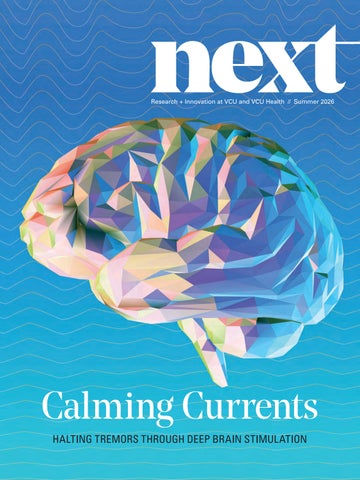
Research + Innovation at VCU and VCU Health // Summer 2026
Calming Currents HALTING TREMORS THROUGH DEEP BRAIN STIMULATION
Miracle Wisp Two VCU innovators are poised to make a global impact through their collaborative research developing a noninvasive method to deliver lifesaving medicine to premature infants struggling to breathe. Worth Longest, Ph.D. (left), and Michael Hindle, Ph.D., have been working together for more than a decade to design a shelf-stable surfactant dry powder and an inhaler device that aerosolizes the medication while safely and effectively delivering it to the underdeveloped lungs of newborns in respiratory distress. “The inhaler is basically the complexity of a rocket engine without combustion,” said Dr. Longest, the Alice T. and William H. Goodwin Jr. Distinguished Professor in the Department of Mechanical and Nuclear Engineering at the VCU College of Engineering. “And we’ve embedded that into a device simple enough to squeeze by hand.” Last year, the duo published results of their proof-of-concept study in the Journal of Aerosol Medicine and Pulmonary Drug Delivery. Their system outperformed the current clinical standards in testing, and they are working on moving this solution forward to the clinic. “The stability of our powder formulation at room temperature removes one of the biggest barriers to global access,” said Dr. Hindle, the Peter R. Byron Distinguished Professor in the Department of Pharmaceutics at the VCU School of Pharmacy. “Hopefully, within a few years, we could get this into babies and actually save some lives.” Photo: Will Rummel
M C V F O U N DAT I O N
1
The Heated Pursuit of Discovery BOARD OF TRUSTEES
Dear Friends,
Nupa Agarwal
Each issue of NEXT offers a window into the discoveries and innovations transforming patient care at VCU Health and VCU Health Sciences, and this issue is no exception. It is a testament to what’s possible when curiosity, expertise and philanthropy converge in service of improving lives. Our cover story explores the promise of deep brain stimulation, a procedure that is reshaping how complex neurological conditions are treated and restoring hope for patients and families. We also hear from an early-career allergy researcher who is working to help better understand immune responses that cause allergies and working to discover potential treatments that can offer more effective, personalized treatments for millions, especially in the Richmond area. This issue also highlights the work of the VCU Medicines for All Institute and its success in lowering costs and improving production efficiency for lenacapavir, a critical breakthrough vaccine that could help end the AIDS pandemic as we know it. In addition, you’ll read about a promising clinical trial for a new cancer therapy invented by one of the incredible researchers at VCU Massey Comprehensive Cancer Center. These stories are powerful on their own. But what’s more powerful is how donor support continues to fuel discovery, empower clinicians and scientists and accelerate healthcare from problem to solution. Thank you for making this work possible. We hope this issue inspires you and reminds you of the extraordinary difference you help create every day.
Hon. Danny T.K. Avula, M.D., M.P.H. Wyatt S. Beazley IV Turner Bredrup J. Abbott Byrd III, M.D. Robert C. Canfield Diana F. Cantor Alex W. Cecil I. Lee Chapman IV Clay Coleman Heidi Schlicher Cook Sheila A. Corcoran Paul W. Croston D. Oscarlyn Elder Robert L. Findling, M.D. Jennifer F. Flinchum Louis N. Formica, D.D.S. Moses W. Foster Jr. Stephen J. Gaidos Sheryl L. Garland, M.H.A. John V. Hager Darius A. Johnson Susan G. Kornstein, M.D. Susan Learned, M.D., Pharm.D., Ph.D. Marlon F. Levy, M.D. H. Frederick T. Moore Ghulam D. Qureshi, M.D. Kee Tilghman Rabb Michael Rao, Ph.D.
With gratitude,
W. Taylor Reveley III Michele A. Romano, M.D. Arturo P. Saavedra, M.D., Ph.D. Ernesto Sampson Liza Jarvis Scott Hina B. Shah, M.P.H. Louise Woltz Smith Jennifer Wold Rachel L. Yost
2
SUMMER 2026
Brian S. Thomas
Stephen J. Gaidos
INTERIM PRESIDENT AND CEO
BOARD CHAIR
SUMMER 2026
FEATURES
10
Orphaned No More A global clinical trial has entered Phase 2a and is bringing a novel treatment created by a Massey researcher to patients with a rare cancer type.
24
Engineering Access From a Richmond lab bench to global impact, the VCU Medicines for All Institute is reengineering lifesaving drugs to be more affordable and accessible, transforming the future for millions worldwide.
DEPARTMENTS
04
Abstracts A roundup of research and innovation news from the MCV Campus.
COVER STORY
Calming Currents
14
06 Office Hours:
Unpacking Allergy Enigmas
Advancements in deep brain stimulation at
22
VCU Health are changing the way patients
VCU researcher Becca Martin, Ph.D., studies why
with Parkinson’s disease and other movement
our immune systems declare war on harmless
disorders live their lives.
things so she can help pursue novel treatments.
Patient Perspective For David Lane, living with Parkinson’s disease
30
Follow-ups: Holding Fast
meant taking medications every 90 minutes.
A VCU innovator’s sticky solution is changing what
Thanks to deep brain stimulation at VCU Health,
surgeons can do with damaged nerves.
his life has changed.
M C V F O U N DAT I O N
3
By the Numbers $568 million record-setting sponsored funding and research on campus
Top 10% among all universities for research expenditures (NSF HERD Survey)
Top 50 #46 in the country for research funding among public universities
FY25 MCV CAMPUS RESEARCH FUNDING BY UNIT (in millions) College of Health Professions
$6.12 M
School of Dentistry
$7.42 M
School of Medicine
$316.9 M
School of Nursing
$5.37 M
School of Pharmacy
$10.15 M
School of Public Health
$7.45 M
Massey Comprehensive Cancer Center
$143.05 M
Pauley Heart Center
$2.16 M
INNOVATION ACCOLADES
Top 100 for university patents
#1 in Virginia for revenue and royalty licenses for startups
4
SUMMER 2026
Receiving Accolades Twenty-three VCU Health Sciences schools and departments rank in Top 50 for NIH research funding among public institutions. Eleven VCU Health Sciences schools and departments rank in the top 25 for National Institutes of Health research funding in their fields among public institutions, according to new rankings for fiscal year 2025 from the Blue Ridge Institute for Medical Research. Overall, six VCU Health Sciences schools/colleges and 17 departments placed in the top 50 among public institutions. The institute is an independent, nonprofit organization that compiles annual rankings of NIH research funding to individual researchers and academic institutions. In fiscal year 2025, VCU received $568 million in sponsored research funding – well on its way to the university’s new goal of $1 billion – and was recently ranked 46th in research funding among public institutions by the National Science Foundation.
“Securing a top-tier position in the Blue Ridge Institute for Medical Research rankings, the primary national benchmark for NIH funding, reflects VCU’s unwavering commitment to life-changing research and clinical innovation,” said P. Srirama Rao, Ph.D., vice president for research and innovation. “This milestone is more than just a number; it represents the competitive success of our faculty in securing the federal grants that drive breakthroughs. It is the tireless pursuit of knowledge by our faculty and students to solve the most pressing health challenges of our time. I am incredibly proud of our research community for fostering an environment where curiosity consistently leads to breakthrough solutions.” – Madeline Reinsel VCU News
The Gene Machine precision medicine and rare disease research. It is the only device of its kind at any private or public university in Virginia.
A Score for FIB-4 Photo: Dean Hoffmeyer, VCU
Thanks to a new partnership between VCU and Virginia Tech, the first NovaSeq X Plus machine has arrived on the MCV Campus. This device is transformative for the university’s genomics research core and will allow researchers to move beyond cookie-cutter commercial models of genetic sequencing to tailored, expert scientific collaboration. This supercharged tool can generate up to 16 terabytes of data and sequence the equivalent of more than 200 human genomes in one instrument run. Rather than relying on corporate partners, researchers at VCU and Virginia Tech will be able to use it solely for research that advances
Getting ‘Ruff’ on Lyme Disease
Photo: Arda Athman, VCU School of Medicine
At VCU, the impact of health sciences research reaches every corner of the care environment, including the therapy dogs who support patients and staff. Recently, the therapy dogs in VCU Health’s Dogs on Call program received donated Lyme disease vaccines. The vaccine provides up to 10 years of broad protection for the pups and was developed by VCU’s Richard T. Marconi, Ph.D., a leading
national expert in developing vaccines and diagnostic tools for tick-borne diseases. Since 2016, the federally approved vaccine for dogs has been produced and distributed by global animal health company Zoetis. This summer marked 25 years of the Dogs on Call therapy dogs program. Operated by the VCU School of Medicine’s Center for Human-Animal Interaction, the program was established to enhance the well-being of patients, visitors, team members and students across VCU Health and VCU’s campuses. These furry friends also provide opportunities for researchers to study the mental health benefits of animal companionship. In the last five years, the Dogs on Call pack of 65 handler-dog teams has brought more than 300,000 smiles and meaningful interactions to VCU.
Twenty years ago, Richard K. Sterling, M.D., was frustrated with the lack of good noninvasive ways to assess scarring in the liver. “The only thing worse than doing a liver biopsy is either teaching someone else how to do it or having one done on yourself,” Dr. Sterling reflected in a recent paper celebrating the 20th anniversary of the solution he invented. Dr. Sterling, the associate chair for research in the Division of Gastroenterology, Hepatology and Nutrition at the VCU School of Medicine and chief clinical officer at the VCU Stravitz-Sanyal Institute for Liver Disease and Metabolic Health, was determined to develop a better tool that didn’t require the invasive difficulty of carefully inserting a large needle into an organ with delicate vascular qualities. What he ultimately developed became known as the FIB-4 index and is now widely recognized as a global standard for assessing risk or advanced scarring of the liver. And while new tests are being developed, it still reigns supreme as a noninvasive diagnostic tool. Nearly every month, Dr. Sterling reflected, another international journal publishes research findings using FIB-4. M C V F O U N DAT I O N
5
office hours
Unpacking Allergy Enigmas Interview by Paul Brockwell Jr. | Photos by Daniel Sangjib Min VCU School of Medicine researcher Becca Martin, Ph.D., studies why our immune systems declare war on harmless things. An associate professor in the Department of Microbiology and Immunology, she is using her findings to pursue novel treatments that could help put an end to misery for many Richmonders who call the city, one of the country’s top allergy capitals, home. Allergy rates have been climbing for years – around a third of Americans have some sort of allergic condition. Why is that happening? A big driver is pollution. We used to see higher allergy rates in the U.S. and fewer in less industrialized countries. But as industrialization has spread, so has pollution and rising allergy rates. That connection is especially strong when it comes to aeroallergens, which are anything you inhale, like pollen, that causes a reaction like allergic rhinitis or asthma. All of that mucus in your nose and airways is aeroallergens at work. Most people think of allergies as a nuisance. What would you want the average person to understand about how serious allergic disease can be? Allergic disease can be fatal. People with food allergies or allergies to insect stings or medications can have an anaphylactic response when they encounter their allergen that can be potentially life-threatening. Asthma still causes around 4,000 deaths a year. Allergic asthma kills in a slower, more insidious way. Every asthmatic episode causes changes to the lungs over time. If it goes uncontrolled, patients can develop mucus blockages in their airways. It is a very serious disease.
Can you walk us through what happens in the body when someone becomes allergic to something? Scientifically, the process is called sensitization. Your immune cells encounter something like pollen or pet dander or certain foods and decide this harmless thing is actually a threat. Your body mounts an immune response and produces a specific antibody class called immunoglobulin-E, or IgE, that’s tailored to that allergen. Once you have that allergen-specific IgE, you’re armed. Every future exposure triggers immune cells to rapidly respond and sound the alarm. That’s why allergies are described as demonstrating immediate hypersensitivity – the reaction happens so fast. Since the pandemic, most of us have a better understanding of antibodies generally. IgE is just an antibody with a slightly different structure that causes it to behave differently in the body. Is there a persistent myth about allergies you’d love to put to rest?
Environmental Allergens Common allergens include pollens, fungal spores, house-dust mites and animal epithelial materials, but can also include drugs, biologic products and insect venoms. Source: National Institute of Environmental Health Sciences
Avoidance of a potential food allergen in infancy does not prevent allergies. I still have students in my class who don’t fully grasp this. Introducing foods to babies containing potential allergens actually significantly reduces the risk of developing an allergy to them.
Becca Martin, Ph.D., is an associate professor in the Department of Microbiology and Immunology at the VCU School of Medicine, where she runs a popular lab on the MCV Campus conducting allergy research. M C V F O U N DAT I O N
7
office hours You’re at VCU in Richmond, a city that regularly makes the list of worst allergy and asthma capitals in the country. Does that hit close to home for you personally? It’s a great place to have a job in allergy research! I have seasonal allergies and cat allergies myself. Richmond’s ranking comes down to a few factors: terrible pollen, environmental pollution and access to care. I’ve actually watched us drop off and come back onto those top cities lists primarily based on improvements in whether people are getting the care they need. What’s your worst allergy?
Helminth Infections This photo of a helminth illustrates a surprising connection between parasites and allergies. One theory is that immune systems evolved to fight off parasites like this one and that the molecular similarities between parasites and top allergens might be triggering the body’s immune response to harmless allergens. Photo: Becca Martin, Ph.D.
8
SUMMER 2026
If I could cut down every Bradford pear tree in this city, I would. They are absolutely miserable. How has our understanding of sensitization changed the way doctors advise parents about feeding their kids potentially allergenic foods? It’s been a dramatic shift. For one example, the original recommendation was to avoid feeding infants peanut butter for the first two years of life. What we eventually realized is that approach was actually causing more food allergies. Now the recommendation is early exposure because eating something is actually anti-allergic. The route matters a lot here. Exposure through the skin, especially if a child has eczema or a rash, can cause sensitization. But eating it helps train your body not to react. There are now products
on the market specifically designed to expose young children to the top 10 allergens early, and they can help dramatically reduce allergic disease. I do want to clarify, if someone is showing signs of an allergy, exposure to that allergen should be avoided, and they should see a physician for a diagnosis. Your lab focuses on the mechanisms behind sensitization. What are you trying to build toward? We’re looking at the pathways involved in sensitization and trying to find novel drug targets within those mechanisms that might give us ways to desensitize people faster and more durably. Think about allergy shots: That treatment is continuous allergen exposure until your body induces an anti-allergic response. We’d like to work toward developing medicine that makes that immunotherapy faster and the results more lasting. Our lab has identified two targets that have shown real promise in both asthma and atopic dermatitis, and we’re pursuing drugs for those targets now. You’ve done work connecting parasitic infections and allergies, which sounds surprising. What’s the link? There’s a body of epidemiological research showing that in areas where helminth infections are endemic – these are gut parasites found in poorly sanitized water or soil – allergy rates are remarkably low, even though helminths induce many of the same
Becca Martin, Ph.D. (right), discusses the work of her lab with Madison Isbell, M.S., a graduate student and shared resource manager. Dr. Martin is an associate professor in the Department of Microbiology and Immunology, and her lab is exploring potential solutions to help patients with allergies find quicker and longer-lasting relief.
immune mechanisms as allergens. The two seem to inhibit each other. There’s also a fascinating study showing that the top 300 allergens share a high degree of molecular similarity with proteins found in various parasites. The theory is that our immune system evolved to fight off parasites – all those responses we associate with allergies, the mucus, the gut cramps, the IgE antibody – they were actually designed to expel worms. But parasites also evolved to suppress that response, inducing tolerance so they could survive in the host. Now that we don’t have helminths, we still carry that immune machinery, and it may be misfiring at pollen or peanuts that happen to molecularly resemble parasite proteins.
What’s the biggest unanswered question in allergy research – the thing that keeps you up at night? Why does one person become allergic and another doesn’t? It’s not purely genetic – there are components that increase predisposition, but it’s not deterministic. It seems to be more environmental, possibly epigenetic. We know early life exposures matter enormously: Children exposed to farm animals or pet dander before age 3 have significantly lower allergy rates, but that window closes. We know where you live and what pollution you’re exposed to matters. But the precise mechanism of why one immune system misfires and another doesn’t – that’s the central mystery.
You took an unconventional path to get here. You dropped out of college, returned and did your undergrad, Ph.D. and postdoc all at VCU. Then you became one of six people in the country who received one of the NIH’s most competitive early-career grants. What does that arc mean to you? Getting that NIH award was a real validation that the path I chose, for the reasons I chose it, was the right one. You don’t always have to follow the traditional route to make an impact in science. That’s the message I try to carry into the mentorship work I do now, training the next generation of researchers.
M C V F O U N DAT I O N
9
ORPHANED NO MORE A global clinical trial has entered Phase 2a and is bringing a novel treatment co-invented by a Massey researcher to patients with a rare cancer type. By Holly Prestidge, MCV Foundation Photos by Daniel Sangjib Min, MCV Foundation
A breakthrough clinical trial underway at VCU Massey Comprehensive Cancer Center could have global implications for the treatment of a rare blood disease often misdiagnosed because symptoms look like commonly known chronic skin conditions such as psoriasis or eczema. Nearly a year ago, Massey became the first U.S.-based site to activate a global Phase 2a clinical trial for the treatment of cutaneous T-cell lymphoma (CTCL), a rare, slow-growing non-Hodgkin lymphoma that presents as itchy, scaly red rashes, plaques or lesions on the skin, typically on areas not exposed to the sun – the chest, groin, hips and buttocks. Since Massey’s launch, several other U.S. sites have opened, along with sites in Australia and Europe. The therapy, called PTX-100, was co-developed by Saïd Sebti, Ph.D., Massey’s associate director for basic research and the Lacy Family Chair in Cancer Research, and a professor in the Department of Pharmacology and Toxicology at the VCU School of Medicine. He is the scientific founder of Prescient Therapeutics, which is sponsoring the trial. CTCL occurs when white blood cells – part of the body’s germ-fighting immune system – become cancerous and attack the skin. The disease progresses slowly, and while there’s no cure, those diagnosed early, during stages I and II, have a more than 90% chance of a 10-year survival rate, often living with the disease for many years. In advanced stages, however, particularly in stage IV, CTCL and its various subtypes can cause tumors or ulcers and attack lymph nodes, blood and internal organs. That median overall five-year survival rate drops significantly for those with stage IV CTCL. PTX-100 effectively targets the cancer-promoting functions of certain proteins in cells. Within cancer biology, geranylgeranyltransferase type 1, or GGT-1, is a protein that is required for cancer-causing activity of proteins called GTPases. The GGT-1 inhibitor therapy, developed by Dr. Sebti and colleagues, blocks these cancer-causing proteins from doing their job, which stops cancer growth. “Our research focused on how certain proteins promote cancer within cells,” Dr. Sebti said. “With this novel PTX-100 drug, we are able to shut down the essential functions of GGT-1, intercepting signals that allow tumors to progress.” TREATING AN ORPHAN DISEASE Chances are most people have never heard of CTCL. The Cutaneous Lymphoma Foundation estimates annual diagnoses at roughly eight people out of 1 million in the U.S., and one in 10 million globally. Because of its low numbers relative to other cancers, it’s been designated as an orphan disease by the FDA. There are more than 7,000 orphan diseases, which are classified as those that affect fewer than 200,000 people annually. Pharmaceutical companies typically don’t pursue treatments for orphan diseases because the costs of research and development of therapies for such a limited population outweigh profits. “The importance of treating orphan diseases cannot be understated,” Dr. Sebti said. “Every cancer researcher’s dream is to develop therapies that offer cancer patients better outcomes and make a difference in their lives,” he added. “What’s amazing is that, here at Massey, we are making great progress toward this goal.”
There are more than 7,000 orphan diseases, which are classified as those that affect fewer than 200,000 people annually.
TERMS CTCL: Cutaneous T-cell lymphoma, a slow-growing non-Hodgkin lymphoma. GGT-1: Geranylgeranyltransferase type 1, a protein required for cancer-causing activity of proteins called GTPases. PTX-100: GGT-1 inhibitor therapy that essentially shuts down the functions of this cancer-causing protein.
M C V F O U N DAT I O N
11
Saïd Sebti, Ph.D., is the co-inventor of PTX-100, a therapy showing promising results in clinical trials for cutaneous T-cell lymphoma, a rare and slow-growing nonHodgkin lymphoma that causes chronic skin issues.
12 S U M M E R 2 0 2 6
For Dr. Sebti and his colleagues, decades of research are paying off. Following successful Phase 1 human studies that showed PTX-100 was safe, they conducted a basket trial to test efficacy. Basket trials combine patients with different diseases that could respond to the therapy, to see which, if any, do. In this case, patients with pancreatic and gastric cancers, multiple myeloma and T-cell lymphoma were treated. The best response came from patients with T-cell lymphoma. The Phase 2a clinical trial has an immediate goal to treat 40 people, though ultimately the goal is to reach 115 people with CTCL. Currently, Massey has two patients accrued to the trial. Many other CTCL patients have been accrued in the Australian sites, and more are anticipated to be accrued in other U.S. sites as well as European sites. Long-term remission and better symptom management are the goals. Patients with CTCL often respond to medications in early stages, then begin relapsing after three to four months when their skin conditions worsen. Though the patient numbers within the Phase 1 clinical trial were very small, Dr. Sebti said that preliminary data indicates PTX-100 is safe and successfully shrunk or eliminated tumors in 40% of patients with advanced TCL who had already failed multiple previous therapies. For patients with CTCL, the drug kept the disease from worsening for a median of 13.6 months.
“These early results are impressive considering that current chemotherapy treatments for this aggressive cancer typically see tumors shrink in only 20% to 30% of patients, and usually stop the disease from worsening for just three to five months,” said Bruce Hough, M.D., Massey’s principal investigator of the Phase 2 clinical trial and assistant professor of Hematology/Oncology in the VCU School of Medicine. “Our hope moving this into Phase 2a trial is that PTX-100 will significantly increase the percentage of CTCL patients who see their tumors shrunk or completely eliminated compared to what we expect from standard care,” Dr. Hough said. He explained that patients with this aggressive cancer have faced limited treatment options and poor outcomes for a long time. “By expanding this research, the team hopes that this novel therapy can keep the disease under control and from worsening for a much longer time period than traditional chemotherapy, giving these cancer patients better outcomes,” Dr. Hough said. “This is big for Massey, but it’s even bigger for the community and for our patients,” Dr. Sebti said. “We are dedicated to developing innovative drugs that have a profound impact on the lives of cancer patients.”
“We are dedicated to developing innovative drugs that have a profound impact on the lives of cancer patients.” Saïd Sebti, Ph.D. Associate Director for Basic Research
If you are interested in supporting Massey Comprehensive Cancer Center, please contact Jasmine Davis, executive director of development, at 804-828-1452 or jjdavis3@vcu.edu.
Lacy Family Chair in Cancer Research VCU Massey Comprehensive Cancer Center
Early results from the clinical trials of PTX-100 show that it has shrunk or eliminated tumors in 40% of patients and halted the disease from progressing for more than a year on average, a significant improvement over current chemotherapy treatment.
M C V F O U N DAT I O N
13
Calming Currents
ADVANCEMENTS IN DEEP BRAIN STIMULATION AT VCU HEALTH ARE CHANGING THE WAY PATIENTS WITH PARKINSON’S DISEASE AND OTHER MOVEMENT DISORDERS LIVE THEIR LIVES. By Holly Prestidge, MCV Foundation
M C V F O U N DAT I O N
15
“One of the things that makes doing this work so fun is that patients love their DBS. It sounds strange to have happy brain surgery customers, but we’re offering a better quality of life.” Joseph Bell IV, M.D., Ph.D. Assistant Professor of Neurosurgery VCU School of Medicine
Movement Disorders An estimated 42 million people in the U.S. live with some kind of movement disorder.
16
SUMMER 2026
For people living with Parkinson’s disease, essential tremor or dystonia, uncontrollable movements can turn even the simplest tasks into daily obstacles. On the best days, the symptoms are frustrating. On the worst, they can strip away independence, limiting a person’s ability to work, eat, write, or even take a walk or hold a loved one’s hand. But the tiniest spark of electricity can give people who are suffering from these conditions their lives back. Through a procedure known as deep brain stimulation, a return to a more comforting and fulfilling everyday life is just a switch away. It starts with a pulse generator – a mini circuit breaker no bigger than a Post-it note – that has been surgically implanted under the skin near the collarbone. Lives change when a wireless controller switches on the pulse generator, sending mild electrical currents – ranging from 1 to 5 volts and typically 130 to 180 pulses per second – through wires to electrodes in the brain’s subthalamic nucleus, globus pallidus or thalamus, areas that regulate motor skills. These pulses have a singular mission: to interrupt the faulty neurological circuitry that is causing irregular signals. The frequency, intensity and duration of the electrical pulses are controlled and adjusted wirelessly based on the patient’s comfort and response to treatment levels. As the electrical pulses override the irregular synapses, the body responds. A matter of moments can change what has often been years of living with a debilitating disease.
1 million About how many people live with Parkinson’s, which is associated with tremors while individuals are resting.
“It’s like turning on a light switch,” said Joseph Bell IV, M.D., Ph.D., assistant professor of neurosurgery at the VCU School of Medicine. Patients experience fewer tremors. Stiff muscles relax. Walking becomes easier. “One of the things that makes doing this work so fun is that patients love their DBS.” Dr. Bell said. “It sounds strange to have happy brain surgery customers, but we’re offering a better quality of life.” VCU Health and the VCU School of Medicine have been advancing DBS research and technology for decades. An estimated 42 million people in the U.S. live with some kind of movement disorder. About 1 million people live with Parkinson’s, which is associated with tremors while individuals are resting. They also experience stiff muscles and problems walking or with their balance. Many more people – an estimated 7 to 10 million – are diagnosed with essential tremor, which is marked by shaking during active moments like eating or writing. Dystonia, the third most common movement disorder and one that affects roughly 250,000 people, causes involuntary, erratic muscle contractions in which the muscles are twisted or pulled in an abnormal way. One common thread for all of them is that they’re related to abnormal electrical rhythms in the brain. And that is where DBS comes in. Joseph Bell IV, M.D., Ph.D., assistant professor of neurosurgery at the VCU School of Medicine, said technological advances in deep brain stimulation have dramatically improved the lives of people with neurological diseases. Photo: Daniel Sangjib Min
7 to 10 million
250,000
Estimated number of people who are diagnosed with essential tremor, which is marked by shaking during active moments like eating or writing.
Estimated number of people who are affected by dystonia, which causes involuntary, erratic muscle contractions in which the muscles are twisted or pulled in an abnormal way.
M C V F O U N DAT I O N
17
DBS is an increasingly popular therapy for people with movement disorders if other treatments, including medication, stop working to control each disorder’s motor symptoms. The process starts with the surgery to implant the electrodes, called leads, in the brain at very specific locations. A second surgery follows weeks later to implant the pulse generator and connect the leads. After a week or two of recovery, the pulse generator is turned on. The pulse generator’s settings are adjustable, so if the patient’s motor symptoms worsen over time, the stimulation can be recalibrated and fine-tuned to continue treating the symptoms. The device can also be turned off or removed if needed. Rechargeable batteries can last up to 15 years when maintained by patients with weekly charging, which is as simple as wrapping a soft battery pack around their shoulders so the charging mechanism rests against the pulse generator. When the batteries do need replacing, it’s a 30-minute outpatient surgery. DBS PIONEERS Deep brain stimulation isn’t new. It’s been around for decades. In fact, VCU’s own Kathryn Holloway, M.D., is a pioneer in the field whose early DBS studies showed its effectiveness in treating Parkinson’s disease. She helped develop techniques that reduced infections, one of the biggest risks of surgery, so that VCU Health’s rate today falls well below national averages. She also pioneered a frameless technique that doesn’t require the patient’s head to be immobilized in the rigid, stereotactic head frames that were used for decades during DBS surgery. “VCU has a wide array of tools that many other places just don’t have,” she said. For years, the gold standard for treatment of movement disorders involved burning lesions on the brain in the area where those abnormalities were happening. But that procedure wasn’t reversible, and as the disease progressed, the burns remained but became ineffective. “DBS was developed to solve both of those problems,” Dr. Bell said. “DBS acts like a lesion that we can turn on and off by turning the electricity on and off.”
18
SUMMER 2026
Kathryn Holloway, M.D., addresses the audience at an MCV Foundation Discovery Series event in 2017. She and her team conduct research at VCU Health and the Richmond VA Medical Center in deep brain stimulation to treat Parkinson’s disease, essential tremor and other neurological disorders. Photo: Skip Rowland
DBS does not slow the progression of Parkinson’s but does provide for better, more consistent symptom control throughout the day. And there’s a new application for DBS that has promising implications. It’s called closed-loop stimulation, in which the pulse generator automatically senses abnormalities in brain waves and adjusts accordingly. Based on what it’s learning, the device automatically adjusts the patients’ settings. Currently, the devices must be adjusted by the care team in the clinic. Because of its advanced abilities, closed-loop stimulation is fast becoming a popular upgrade, Dr. Bell said, explaining that patients who’ve had the implant for several years can get the new adaptive version as easily as upgrading their cellphone. The upload occurs when a doctor holds a wand over the device in the patient’s body. No additional surgeries are needed.
Dr. Holloway said the technology has become available only in the last one to two years, and VCU Health was among the first health systems to use it. “VCU has the knowledge base to do things differently and advance the field,” she said. “The rest of the world learns from us.” Dr. Bell said DBS is already widely used as a treatment for epilepsy and is being studied as a treatment for disorders within the field of mental health. Researchers and doctors are exploring whether changes in brain waves can lead to treating depression and other conditions through DBS. “There’s a big push right now to better understand the electrical networks that underlie depression and other psychiatric diseases,” Dr. Bell said. “As an academic medical center, we’re not just practitioners of DBS, we’re constantly working to make it better and expand its application to treat a wider array of conditions.”
“VCU has the knowledge base to do things differently and advance the field. The rest of the world learns from us.” Kathryn Holloway, M.D. Professor, Department of Neurosurgery VCU School of Medicine
Electrode Implantation for Deep Brain Stimulation The lead for deep brain stimulation is implanted in either the subthalamic nucleus or the internal segment of the globus pallidus. The lead passes through a burr hole in the skull. Attached to the lead is a connecting wire, which is tunneled under the skin of the scalp and neck to the anterior chest wall, where it is connected to a pulse generator.
M C V F O U N DAT I O N
19
What makes VCU Health and the VCU Parkinson’s and Movement Disorders Center different from other centers that offer DBS is the multidisciplinary approach to each patient’s case. Joseph Bell IV, M.D., Ph.D. Assistant Professor of Neurosurgery VCU School of Medicine
A NOVEL APPROACH What makes VCU Health and the VCU Parkinson’s and Movement Disorders Center different from other centers that offer deep brain simulation, Dr. Bell said, is the multidisciplinary approach to each patient’s case. A care team made up of neurosurgeons like Dr. Bell and neurologists, as well as speech pathologists, physical therapists, neuropsychologists and more, collaborate on cases. This summer, VCU Health is adding a director of device therapeutics to the team. The PMDC was only an idea 15 years ago. Today, faculty experts, with the help of energetic philanthropic support, have shaped it into Virginia’s only Parkinson’s Foundation Center of Excellence – and one of only 40 in the U.S. “We’re all pulling up the images, we’re looking at the patient’s test results and talking about what they want out of therapy,” he said. “Think about the benefits of having eight experts all in the same room laser-focused on your treatment.” Every patient has different needs, and VCU Health shines because it tailors DBS to address those needs. A Parkinson’s patient may need stimulation around the clock. Someone with essential tremor, however, may not be affected by tremors at night. The device can be programmed to turn off during nighttime hours. Dr. Bell cited a patient who played piano. Two programs were created for that individual, one for normal days and another for when they were playing. Dr. Bell emphasized that patients should consider DBS when they start noticing that their medications aren’t as effective as they used to be.
20 S U M M E R 2 0 2 6
Many Parkinson’s patients respond well to medication early in the disease. Over time, however, as the disease progresses, the therapeutic range gets narrower and the medication stops working. Conversely, long-term side effects from Parkinson’s medication can lead to dyskinesia, or jerky, uncontrollable muscle movements. “DBS is not a treatment of last resort,” Dr. Bell said. “This is a quality-of-life treatment, and when patients start to be dissatisfied with how well their medications are working, that’s when they should reach out. “There’s a big period of time between early stages and advanced stages where you can choose to live with bothersome symptoms, or you can choose a tool that reduces them.” Compared to other treatment centers, he said, “VCU has a much bigger DBS menu, and we can use our expertise and advancements to tailor treatment to a patient’s individual needs.” If you would like to support deep brain stimulation research in the VCU School of Medicine, please contact Bernadette O’Shea, senior director of development for neurosciences, at osheab@vcu.edu.
Photo: Julia Rendleman
Patient Advocacy Builds Excellence VCU’s multidisciplinary Parkinson’s and Movement Disorders Center brings together clinical expertise and scientific innovation to deliver care that directly reflects the latest advances in the field. For individuals navigating the challenges of movement disorders, the VCU Parkinson’s and Movement Disorders Center offers a place anchored in community strength and long-standing advocacy. From the beginning, the PMDC has been supported by dedicated champions whose commitment helped shape its foundation and future. The center took root in 2011 after the Movers and Shakers – a Richmond-based patient group cofounded by Charles F. Bryan Jr., Ph.D., and the late David C. Reynolds and Margaret Bemiss – rallied around the idea of a unified clinical and research hub. Today, 15 years later, the PMDC has earned recognition from multiple national organizations: It is one of only 46 centers in the U.S. and 59 worldwide designated by the Parkinson’s Foundation as a Center of Excellence, and it has also been designated a Center of Excellence by the Huntington’s Disease Society of America, the National Ataxia Foundation, the Lewy Body Dementia Association, Mission MSA and CurePSP. Achieving these designations in a relatively short span underscores the center’s rapid progress and the remarkable work of its clinicians, researchers and community partners.
“The overarching goal of the PMDC is to positively impact the lives of people affected by Parkinson’s disease and other movement disorders.” Brian Berman, M.D. Bemiss Endowed Chair and Director VCU Parkinson’s and Movement Disorders Center “The overarching goal of the PMDC is to positively impact the lives of people affected by Parkinson’s disease and other movement disorders,” said Brian Berman, M.D., the Bemiss Endowed Chair and director of the center. “Simultaneously, through our research, we are striving to develop better treatments and cures that will have a major impact on generations to come.”
Learn more about the Parkinson’s and Movement Disorders Center at parkinsons.vcu.edu.
M C V F O U N DAT I O N
21
PATIENT PERSPECTIVE
Stopping Tremors in Their Tracks For David Lane, living with Parkinson’s disease meant taking medications every 90 minutes to reduce his tremors. Thanks to deep brain stimulation at VCU Health, his life changed. Esther Lane’s eyes widened in anticipation. Her husband of 36 years, David Lane, was sitting next to her in a VCU Health exam room last spring. Sitting, but not still. David, 58, was diagnosed with Parkinson’s disease in 2014. Fresh scars traced the top of his head from his recent deep brain stimulation surgery, when surgeons implanted electrodes in the brain circuits responsible for his tremor and connected them to a pulse generator in his chest. As they sat, Alex Feria, a representative from Medtronic, the device’s manufacturer, monitored the system on a tablet before activating it for the first time. A moment later, Feria turned on David’s pulse generator. The change was subtle at first. But little by little, Esther watched her husband’s body slowly relax. His jerking movements softened. His hands, usually twitching, slowly steadied and came to rest on his legs. His head was still. His clenched hands loosened their grip just a little.
22 S U M M E R 2 0 2 6
She nearly cried. The last few years have been hard. Medication initially worked for David, as it does for many people in the early stages of Parkinson’s disease. But as the disease progressed, the medication stopped working even as the dosages increased. The tremors and other symptoms of Parkinson’s interrupted every part of daily life. Bradykinesia – a symptom that causes slowness in physical actions and trouble initiating those actions – was one of the most limiting. Muscle stiffness compounded it all, making David’s limbs feel rigid and resistant. At times, David said, his feet felt like they were stuck to the floor, unable to propel him forward. He couldn’t make a sandwich or pour a drink because his hands shook. He had to stop driving. An insulation installation technician for many years, he stopped working in the field a few years ago. He ultimately retired in February 2025. Before his DBS surgery, he was taking medication every 90 minutes.
Esther Lane watched her husband’s body slowly relax. His jerking movements softened. His hands, usually twitching, slowly steadied and came to rest on his legs. David said he’d been putting off deep brain stimulation – a proven method to treat the symptoms of Parkinson’s disease, as well as essential tremor and dystonia – for as long as he could. He was scared, he said, but the results for him and his wife have been life changing. “I feel better than I have in 10 or 12 years,” he said earlier this year at a follow-up appointment about two weeks after the clinic visit where his pulse generator was turned on. Patients can adjust the settings on their device while at home and even turn it on and off. If they need help between scheduled clinic appointments, Medtronic representatives make house calls. David Lane said he likes to walk up and down his driveway when he’s having phone conversations. He hasn’t been able to do that in recent years, but now his neighbors are back to seeing him moving, talking and reconnecting with the world outside.
“I can make sandwiches without knocking them on the floor,” he said, grinning. “All those things that most people take for granted.” It’s not perfect. He still has tremors, particularly when his medication begins to wear off. The DBS is helping to curb those fluctuations, though it will need to be monitored for the rest of his life. For now, one of the immediate goals is to reduce how many medications David needs. Esther joyfully acknowledged that he’s already off one, and she clapped softly when doctors talked about reducing his complex medication regimen even more. “It’s just so amazing,” she said. Now, regular trips to Georgia to see their five grandbabies don’t seem so challenging for “Papa and Cricket,” as their grandchildren call them. David said life before DBS was bleak, but his outlook has changed. “For a while, I was feeling depressed and discouraged,” he said. “But now, I feel like I’m young again. I have some hope.”
Mechanicsville residents Esther and David Lane met with VCU Health neurosurgeon Joseph Bell IV, M.D., Ph.D., as David’s deep brain stimulation pulse generator was turned on for the first time. Photos: Will Rummel
M C V F O U N DAT I O N
23
Engineering Access From a Richmond lab bench to global impact, the VCU Medicines for All Institute is reengineering lifesaving drugs to be more affordable and accessible, transforming the future for millions worldwide.
By Caitlin Hanbury, MCV Foundation Photos by Daniel Sangjib Min and Tyler Trumbo, MCV Foundation A drug that could end a pandemic only matters if everyone who needs it can actually afford to get it. In public health, this is known as the “last mile,” the critical final step in delivering health innovations to the communities that need them most. That challenge lies at the heart of the VCU Medicines for All Institute (M4All), which is reengineering drug manufacturing processes to make essential medicines easier and less costly to produce. Founded at VCU in 2017 with support from the Gates Foundation, the institute has become, among other things, a vital leader in the fight against HIV. Most recently, M4All has been advancing one of the biggest breakthroughs in the decades-long pursuit of HIV prevention, making lenacapavir – a longacting injectable drug that prevents infection with 99% effectiveness – affordable and accessible in low- and middle-income countries, while serving as the indispensable last-mile partner the world relies on to design open, freely accessible manufacturing playbooks that turn high-impact science into equitable, affordable supply. Developed by U.S.-based biopharmaceutical company Gilead Sciences Inc., lenacapavir achieves its high effectiveness for HIV prevention with just two shots per year. Another injectable option is also available, but it requires more frequent dosing. Pre-exposure prophylaxis (PrEP) for HIV prevention has largely relied on daily pills, which could provide strong protection if taken consistently. However, the hurdles and responsibilities of daily living, coupled with the social stigma surrounding HIV prevention, can inhibit consistent use, reducing the drug’s effectiveness. Lenacapavir changes that. Unlike daily oral PrEP pills, which depend on strict adherence, this long-acting injection works for six months at a time. It’s an engineering triumph at the molecular level and a logistical victory for public health. Yet such potential means little if the price is out of reach.
Founded in 2017 with support from the Gates Foundation, the VCU Medicines for All Institute has become a vital leader in the fight against HIV.
At the VCU Medicines for All Institute, a team of chemists and engineers rework the mechanics of drug manufacturing for essential medicines so affordability stands on equal footing with efficiency.
A COORDINATED GLOBAL EFFORT The branded version of lenacapavir for HIV prevention was initially priced for the U.S. market at around $28,218 per person per year, putting it beyond the reach of countries hardest hit by the HIV pandemic. But in the span of just one year, a series of coordinated global efforts by governments, health funders, research institutes and pharmaceutical partners has transformed lenacapavir from a promising innovation into an affordable HIV prevention option for millions.
M C V F O U N DAT I O N
25
Founded in 2017 by chemical engineer Frank Gupton, Ph.D. (below), the VCU Medicines for All Institute redesigns drug manufacturing to make lifesaving medicines more affordable and accessible worldwide.
In 2024 the drug’s innovator, Gilead Sciences Inc., led efforts to expand access to lenacapavir by licensing six generic manufacturers to produce and distribute the drug in low- and middle-income countries, while pledging to supply it at cost and optimizing the manufacturing processes their facilities can deliver. The following year, global donors helped turn these plans into reality by funding large-scale purchases and supporting M4All’s ongoing work to further reduce the cost of the generic version’s complex active ingredient. This effort is being driven by a broad coalition of partners, including the Gates Foundation, the Global Fund, the President’s Emergency Plan for AIDS Relief, the Children’s Investment Fund Foundation, Clinton Health Access Initiative Inc., Unitaid, Wits Reproductive Health and HIV Institute, and the World Health Organization, working together to make lenacapavir available to low- and middle-income countries at about $40 per patient per year. M4All’s new low-cost process builds on these efforts, demonstrating production efficiency that can reduce prices and remove access barriers, ensuring lenacapavir’s promise can be realized worldwide. “We are here not only to save the cost. We are here to do something to save people’s lives,” said Li-Mei Jin, Ph.D., associate director of process development at M4All, who led the project in its early stages. HOW MEDICINES FOR ALL BEGAN M4All was founded by Frank Gupton, Ph.D., a chemical engineer who spent three decades in the industry developing and commercializing chemical processes for pharmaceuticals and agriculture. Over his career, he saw how drug production, from waste to labor to inefficient batch processes, drove up prices. Determined to do things differently, he returned to his alma mater, VCU, for a second career in academia to focus on one of the industry’s toughest challenges: the high cost of making medicines. Here, he’s built a team of scientists devoted to rethinking how medicines are made, making cost and efficiency central to every step of the process. “What we’re trying to do here is increase access to essential medicines around the world. And we’ve been fortunate because one of the most important things you can do when you’re doing research and development is to identify a good problem to work on,” Dr. Gupton said. “So, once that problem is identified, we provide the solutions all centered around ensuring that we’re able to provide access to these drugs in ways that haven’t been done in the past.” The institute’s 40-person team includes process and analytical chemists, engineers, facilities administrators and safety experts. Together, they work to redesign the synthetic routes that produce the world’s essential drugs,
26 S U M M E R 2 0 2 6
finding ways to make established recipes for lifesaving medicines with fewer steps, less waste and no compromise on quality. SCALING THE SCIENCE M4All’s work starts on gram scales, in glass beakers no bigger than a coffee mug, using the synthesis route developed by the drug’s original manufacturer – the established step-bystep process that combines chemicals in a certain order, under specific conditions, to produce the final medicine. Their chemists explore more affordable ingredients, tweak reaction steps, fine-tune conditions aimed at boosting yields and look for opportunities in the process to reduce byproduct waste, which can be both harmful and expensive to dispose of safely. The institute’s efforts to improve the way essential medicines are made have markedly improved patient access, driving steep reductions in retail manufacturing of COVID-19 drugs and tuberculosis treatments. Work on lenacapavir began with chemists analyzing the three main core fragments of the molecule, known as fragments A, B and C, and exploring how to make each from the ground up, taking cost and raw materials into account. “This is the most complicated molecule I’ve ever worked on in my entire life,” Dr. Gupton explained. “We took the molecule apart, and we confirmed that we knew what the starting materials were. And then we figured out how to make each one of those starting materials more cost efficient. And we spent the first year doing that. And each one of these starting materials is probably equivalent in complexity to any drug that’s out there. I mean, this is a beast of a molecule.” This detailed, fragment-by-fragment analysis led to success. By redesigning the synthesis and refining each step for efficiency, the M4All team laid the groundwork for a process that is more efficient and more affordable. Once the chemistry performs reliably in those few grams, scientists turn to scaling up, making sure a process that fits on a lab bench can run just as reliably on a manufacturing line anywhere in the world. As the work advanced, the results became clear – their new process reduced the raw material cost by about one-third. “What we’re basically seeing is somewhere around a 30% reduction in overall costs from raw materials inputs,” Dr. Gupton said. “Part of it comes from the key building blocks that we started out working on. Assembling these represented about 80% of the steps to make the medicine. And then part of it comes from the strategy that we used to assemble those key building blocks into the active ingredient. We’ve got a lot of really smart people, and they’ve looked at these processes differently than maybe a big pharma company would.”
The VCU Medicines for All Institute’s 40-person team embodies mission-driven biopharmaceutical innovation, treating affordability as an engineering challenge and combining technical rigor with social purpose, uniquely positioning the institute to expand global access to essential medicines.
“We are here not only to save the cost. We are here to do something to save people’s lives.” Li-Mei Jin, Ph.D. Associate Director of Process Development VCU Medicines for All Institute
M C V F O U N DAT I O N
27
“There is so much potential I’ve seen firsthand in lowerand middle-income countries. We want to give people the agency and autonomy to take charge of their lives.” Tishina Rasulallah, Ph.D., M.P.P. Senior Manager for Partnerships in Global Health VCU Medicines for All Institute
FROM PROCESS TO IMPACT Building on four decades of HIV drug innovation, from the first antiretrovirals in the 1980s to once-daily PrEP pills in the 2010s, lenacapavir ushers in a new phase of long-acting, low-burden prevention. And M4All’s contribution ensures that innovation doesn’t stop at the lab bench but reaches the clinics and populations where prevention is most needed. Inside M4All’s laboratories, the work appears deceptively simple: pipettes ferrying liquids into vials, magnetic stir bars spinning in flasks, scientists recording precise measurements. Behind these unassuming routines is a push to rework the mechanics of drug manufacturing so affordability stands on equal footing with efficiency. Of course, developing lower-cost, more efficient and access-driven chemistry is only the first step. “For so long, the knowledge and the power have been concentrated in what we call the global North or Western countries,” said Tishina Rasulallah, Ph.D., M.P.P., senior manager for partnerships in global health at M4All. “There is so much potential I’ve seen firsthand in lower- and middle-income countries. We want to give people the agency and autonomy to take charge of their lives.” By rethinking how lenacapavir’s components are combined, M4All lowered production costs while making manufacturing safer and more sustainable. Reduced chemical waste protects lab workers, lessens environmental impacts and makes it feasible for more manufacturers in more locations to produce the drug safely and efficiently. M4All has a hand in actively applying these improvements beyond the lab by advising prospective manufacturers and partnering with global health organizations to ensure that process improvements reach the places and people where access is most critical. “Being able to transfer that knowledge that Medicines for All has developed for free to countries really can give them a leg up to be able to develop the drugs locally, to help build economies, to train people and scientists to be able to produce those drugs,” Dr. Rasulallah said. “And we don’t know what other impacts it can have. In many ways, lenacapavir has become a case study for how upstream engineering decisions ripple through the entire global health ecosystem.” BEYOND ONE DRUG M4All’s work on lenacapavir is part of a broader portfolio that also includes work on malaria treatments, tuberculosis drugs, hypertension medications, neglected tropical diseases and pandemic-preparedness antivirals. Each project applies the same principle: Better chemistry leads to better access. It’s also changing how scientists and engineers approach their work. “I think it’s reshaping how people think about how we do things, what our processes look like,” said Justina Burns, Ph.D., associate director of analytical chemistry for M4All. “The accepted way, or the way it’s always been done, is not necessarily what has to happen going forward. The change is possible.” Virginia has taken notice. In 2023, the state committed $90 million to connect the University of Virginia Manning Institute for Biotechnology, Virginia Tech’s Fralin Biomedical Research Institute and the VCU Medicines for All Institute.
28 S U M M E R 2 0 2 6
The VCU Medicines for All Institute extends its impact beyond the lab, freely sharing process innovations with manufacturers and global health partners, empowering countries to produce drugs locally and expand access where it’s most critical.
The initiative not only speeds up biomedical research and strengthens drug supply chains, reducing the risk of shortages in the U.S., but also positions M4All at the forefront of Virginia’s effort to grow local manufacturing and attract new pharmaceutical investment. Students – undergraduate, graduate and postdoctoral – play a role in this work, gaining firsthand experience in mission-driven biopharmaceutical innovation and learning to treat affordability as an engineering problem, not just a policy challenge. That combination of technical rigor and social purpose is what makes the institute unique. The focus on mission over metrics drives how the institute approaches the challenge of access. “We truly are here to do our mission,” Dr. Burns said. “We are what our mission statement says. We’re here to help everybody find easier access to medicines, because nobody really should have to make the decision: Can I afford my medicine?” If you are interested in helping the VCU Medicines for All Institute improve access to critical medications in the U.S. and around the globe, contact Brian Campbell, senior advisor for external affairs, at 804-828-1475 or becampbell@vcu.edu.
M C V F O U N DAT I O N
29
Checking in with researchers on their latest developments
Jonathan Isaacs, M.D., the Herman M. and Vera H. Nachman Distinguished Research Professor at the VCU School of Medicine and chair of the Division of Hand Surgery at VCU Health, invented NerveTape, which has rapidly changed how clinicians approach complicated nerve repairs. Photo: Daniel Sangjib Min
Holding Fast A VCU innovator’s sticky solution is changing what surgeons can do with damaged nerves. When a nerve is cut, the clock starts ticking. Sensation and movement are lost immediately, and surgeons have only a limited window to reconnect the delicate fibers before movement and sensation are lost forever. For decades, the only option was painstaking microsuturing, a delicate process that tests even the most skilled and experienced surgeons. That reality drove Jonathan Isaacs, M.D., VCU School of Medicine professor and chair of the Division of Hand Surgery at VCU Health, to invent NerveTape. The concept is elegant – microscopic hooks embedded in a flexible strip that latch onto each nerve end and draw them into precise alignment, providing mechanical repair strength equal to or greater than standard microsurgical suture repairs. Surgeons report that the tape creates a faster, more consistent repair process without altering the underlying biology of nerve regeneration.
30 S U M M E R 2 0 2 6
Since its approval, NerveTape has moved rapidly into operating rooms across the country. It is now used in onethird of all Level I trauma centers in the United States, with 12,000 implantations to date. That trajectory, Dr. Isaacs said, has “scaled faster than the company would have predicted, and our overall success rate has been remarkable.” After securing a licensing agreement with support from VCU TechTransfer and Ventures, Dr. Isaacs partnered with BioCircuit Technologies to bring NerveTape to market. BioCircuit describes NerveTape as “sticky,” referring not to the product’s microhooks but to surgeons’ behavior toward the device itself. Once a surgeon uses it, they tend to use it again. That high level of continued use is one of the strongest indicators that NerveTape is filling a real clinical need. Nerve repair is one of the most technically demanding tasks in surgery. Traditional microsuturing is slow, delicate and difficult to perform, especially when precision
determines whether a nerve will recover. NerveTape shortens the repair process while preserving alignment and strength, giving surgeons a simpler, more reliable way to handle a notoriously complex procedure. In the two years since NerveTape’s commercialization, the scientific literature has begun to reflect what surgeons have been reporting. Clinical outcomes appear comparable to suturing, but surgeons consistently describe easier repairs completed in less time. One recently published paper highlights its use in breast reconstruction and neurotization – the process of connecting nerves to transplanted tissue to restore sensation. A forthcoming longitudinal study in animal specimens shows definitive improvements in nerve regeneration. As the early evidence accumulates, a second story is coming into focus: NerveTape is gaining traction in procedures beyond those for which it was originally intended. Dr. Isaacs designed it for extremity nerve reconstruction, the standard technique of reconnecting two ends of a severed nerve so it can regrow. But surgeons have rapidly adopted it in breast neurotization, as noted. “I never envisioned the rapid adoption of NerveTape in the breast neurotization market, which accounts for about half of sales of NerveTape,” Dr. Isaacs said. Surgeons have continued to find new applications for NerveTape, sometimes through creative modification. Cable grafting is one such example. When a nerve defect spans several millimeters, surgeons bridge the gap using an autograft, often a thin nerve from the foot or leg. Because these donor nerves are only 2 mm to 3 mm in width, multiple strands must be combined to match the diameter of the injured nerve. Traditionally, each strand is individually sutured, a painstaking and time-consuming process. With NerveTape, surgeons can place the large nerve stump on the microhooks, lay individual graft strands onto the opposite side, and allow the hooks to self-assemble the strands into a unified cable graft. The time savings, surgeons report, is enormous. Other teams are exploring additional possibilities, from using NerveTape to deliver targeted drugs that support nerve regeneration to adapting the platform for tendon repair and lymphatic-duct reconstruction. Meanwhile, Dr. Isaacs is focused on how NerveTape can improve the repair of nerve gaps across different sizes.
Backed by $4.5 million in funding from the U.S. Department of Defense, he is developing a longer version of the device that acts as a 10 mm to 15 mm conduit for bridging small gaps in nerves. He is also studying how NerveTape performs in larger 1 cm to 2 cm defects, where the tension across the nerve gap can make healing difficult. He is examining whether dissipating that tension across many small grab points could create a more stable environment for the nerve to heal. Despite the rapid adoption of NerveTape, its early success and the new lines of investigation underway, Dr. Isaacs emphasizes that growth is not his primary objective. “Just because we’ve had early success doesn’t mean we aren’t still looking at the device critically,” he said. “Ultimately, our goal is to improve the surgeon experience and patient experience and outcomes.” This commitment to thoughtful innovation is one reason Dr. Isaacs received the inaugural VCU Annual Research Impact Award for excellence in research optimizing health – a recognition not only of NerveTape’s impact, but also of his deliberate approach to advancing a technology that is reshaping the future of nerve repair. – Caitlin Hanbury, MCV Foundation
Jonathan Isaacs, M.D. (center), received the inaugural VCU Annual Research Impact Award for excellence in research optimizing health. Pictured with him are (L to R): P. Srirama Rao, vice president for research and innovation; Art Saavedra, M.D., Ph.D., VCU provost and executive vice president; Lisa Ballance, associate vice president for research; and John Ryan, Ph.D., associate vice president for research development. Photo: Dean Hoffmeyer, VCU
M C V F O U N DAT I O N
31
ABOUT NEXT MAGAZINE
NEXT is published by the MCV Foundation to share the latest breakthroughs at VCU Health and VCU Health Sciences, and to highlight the positive impact these exciting innovations have on patient care. To learn more, visit: www.mcvfoundation.org INTERIM PRESIDENT AND CEO
Brian S. Thomas VICE PRESIDENT OF MARKETING AND CHIEF COMMUNICATIONS OFFICER
Eric M. Peters EDITOR
Paul Brockwell Jr. GRAPHIC DESIGN
Big River Advertising CONTRIBUTORS
Caitlin Hanbury, Holly Prestidge, Zaynah Qutubuddin, Madeline Reinsel PHOTOGRAPHERS
Arda Athman, Dean Hoffmeyer, Daniel Sangjib Min, Skip Rowland, Julia Rendleman, Will Rummel, Tyler Trumbo SCIENTIFIC ADVISORY PANEL
Joseph T. DiPiro, Pharm.D. Susan G. Kornstein, M.D. F. Gerard Moeller, M.D. Patricia J. Sime, M.D. CONTACT US
Please address comments or subscription requests to: MCV Foundation Attention: Communications Department 1021 E. Cary St., Suite 1100 Richmond, VA 23219 info@mcvfoundation.org
About the MCV Foundation The MCV Foundation supports and fosters VCU Health and VCU Health Sciences through philanthropy, stewardship, innovation, communications and collaboration. Established in 1949, the MCV Foundation ensures VCU Health and VCU Health Sciences remain at the forefront of excellence and innovation in patient care, research and education. Together, they make up one of the top academic health systems on the East Coast. Through more than 2,000 funds, the MCV Foundation provides critical support for scholarships, professorships, research and programs that fuel lifesaving work at VCU Health and VCU Health Sciences every day. The MCV Foundation’s campus partners include the VCU College of Health Professions, VCU School of Dentistry, VCU School of Medicine, VCU School of Nursing, VCU School of Pharmacy, VCU School of Public Health, VCU Health Pauley Heart Center, VCU Massey Comprehensive Cancer Center and VCU Medical Center.
At VCU and VCU Health, advanced medical research is shaping the future of care. Martin Safo, Ph.D., is just one example. An internationally recognized expert at the VCU School of Pharmacy, he is developing new treatments for patients living with sickle cell disease. Philanthropy makes breakthroughs like this possible. When you support research and care, you’re helping build a healthier future for your family, your community and the world.
Research needs champions now. Give today.
NONPROFIT ORGANIZATION U.S. POSTAGE PAID PERMIT NO. 1182 RICHMOND, VA 1021 E. Cary St., Suite 1100 Richmond, VA 23219
A P U B L I C AT I O N O F T H E M C V F O U N DAT I O N