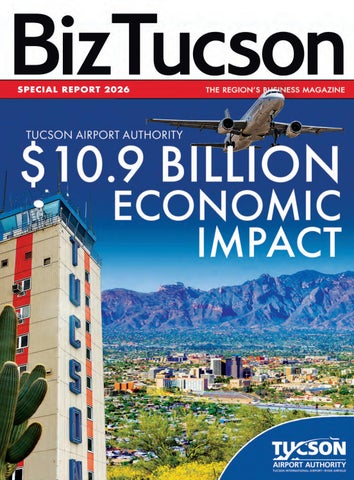
SPECIAL REPORT 2026
www.BizTucson.com
Winter 2026 > > > BizTucson 57
58 BizTucson < < < Winter 2026
www.BizTucson.com
www.BizTucson.com
Winter 2026 > > > BizTucson 59
Danette Bewley
PHOTO: BRENT G. MATHIS
President & CEO Tucson Airport Authority
60 BizTucson < < < Winter 2026
www.BizTucson.com
BizEXPANSION
Tucson Airport Authority $10.9 Billion Economic Impact, Potential to Soar Higher By Loni Nannini Tucson Airport Authority (TAA) is flying high with a $10.9 billion annual economic impact across Southern Arizona and a reach that extends to every aspect of the regional economic infrastructure. It’s a testament to the local airport system that continues to prove its outsized value alongside Davis-Monthan Air Force Base/Ft. Huachuca, the University of Arizona, Raytheon and other major stakeholders. “The Tucson Airport Authority airport system is an economic engine for the region. It demonstrates that a community with a thriving airport usually has a thriving economy: Airports are synergistic with the local region because people rely on transportation for jobs, recreation, education, and government,” said Danette Bewley, TAA president and CEO. “All elements of the community rely on us having a healthy, thriving airport, just as we rely on those elements to provide healthy and thriving services. The airport is a vital mechanism in that entire ecosystem.” A 2024 economic impact report by Elliott D. Pollack & Company found that TAA—a nonprofit created by community leaders over 75 years ago to oversee Tucson International Airport (TUS) and Ryan Airfield (RYN) www.BizTucson.com
south of Tucson—supported more than 42,000 jobs with $2.9 billion in wages. It helped to facilitate visitor spending of $936.9 million annually and generated a conservative estimated tax revenue of $115 million statewide and more than $110 million locally. Bewley emphasized that wages and tax revenues earned because of the existence of the airport system create a “multiplier effect,” further fueling other sectors of the regional economy. At the core of TAA’s vision for continued growth is the positioning of TUS as an easy-to-use airport that emphasizes convenience, customer service, safety and security. “Bigger doesn’t mean better: It just means bigger. We compete and do the same things as larger airports, but at a different scale, and sometimes we do things better,” said Bewley. “When you are a smaller airport, you have the opportunity to be more connected to all aspects of the business enterprise and operation. We tend to focus on being entrepreneurial, creative and innovative, which allows us to function at a higher level. That is what makes being at a smaller airport so much fun.” Branding TUS One of more than 500 commercial airports in the country, TUS ranks
within the top 100 airports in passenger volume and is among the largest nationwide by land area with 8,200 acres. The airport is also home to the Arizona Air National Guard’s 162nd Wing, the premier F-16 fighter pilot training unit. Through two concourses and 19 gates, TUS currently serves seven airlines—Alaska, American, Delta, Frontier, Southwest, Sun Country, and United. These carriers offer one-stop connections to nearly 500 cities globally and non-stop routes to 19 destinations. TAA has adopted a growth mindset regarding air service development, amenities, and customer service and infrastructure. “Ultimately, our goal is to set the airport up for the future, providing customers and airlines with a much more modernized product. . .we are always planning 10 and 20 years in the future because if we are not, we are falling behind,” said Bewley. The philosophy is paying off: More than 3.8 million passengers flew through TUS in 2024, marking a 3.9% increase over the previous year. If projections are correct, it is anticipated that TUS will see over 4 million passengers in 2025. In 2024, TUS ranked first among the top 30 western airports in the U.S. for seat capacity growth with a 16.8% yearcontinued on page 62 >>> Winter 2026 > > > BizTucson 61
BizEXPANSION
continued from page 61 over-year growth rate during the Thanksgiving holiday period. “We are outperforming our West Coast peer airports in seat capacity growth, which speaks to the growing profile of our airport. When you look at West Coast airports, we are at the top of the pack,” said Austin Wright, chief communications officer for TAA. A new marketing campaign, “Fly Tucson First,” seeks to promote TUS as an effective hub not only for consumers, but as the premier choice for business travelers. “We can be a niche airport that offers a unique and pleasant user experience. We are functionally easier to use and sophisticated,” said Bewley. TAA as Enterprise With a $52 million annual budget for operations and maintenance, TAA is also distinguishing itself as a powerful and innovative business enterprise. Recently, it was the recipient of a $57 million grant through the Federal Aviation Administration Airport Improvement Program. “We received the largest grant in the United States for work we are doing on Airfield Safety Enhancement Program. Our infrastructure is such an important element for the success of our airport enterprise and we are grateful for the partnership and the financial support from the FAA in this critical project. . .and receiving a grant of this size and magnitude speaks volumes,” Bewley said. To date, TAA has been awarded $300 million in grants, totaling 75% of the $400 million projected for TAA’s Airfield Safety Enhancement Program. The project, which includes demolition and reconstruction of runways, taxiways and other improvements, is slated for completion by 2028 or 2029 depending on federal funding.
“In short, we are modernizing our airfield to meet current safety standards and this will take us far into the future,” said Bewley. TAA is also conducting a $1.5 million-plus aesthetic refresh of some elements in the TUS terminal and is in the design phase for a modernized Checked Baggage Inspection System. Long-term goals include planning for a future terminal to meet customer expectations and accommodate expanded airline carrier service. For now, Bewley said TAA continues to pursue and “maximize grants to narrow the gap further” and effectively minimize airline costs for flights through TUS. With aeronautical revenue comprising 65% of total revenue, TAA is also working to diversify and increase non-aeronautical revenues (from tenants, parking, rental cars, etc.). TUS currently has a competitive—and very appealing—cost per enplaned passenger (CPE) of just under $10. In comparison, the CPE at Seattle is $30 and San Francisco’s CPE is upwards of $40. “There are many data points that airlines look at, and if you get too high on any data points, you might be passed over so, we are very cognizant of costs,” said Bewley. “We are competitive with our low-cost structure and operate the airport in a cost-conscious manner, so we remain attractive to the air carriers.” Ultimately, Bewley said that building relationships with stakeholders now will position TUS to soar into the future. “We come to work every day trying to make the community better by running the airport system efficiently and effectively and having positive relationships with airline stakeholders, tenants and customers. Because of that approach, we will benefit, which means in turn, the community benefits.”
Biz
Danette Bewley with TAA Board Chair Mike Hammond 62 BizTucson < < < Winter 2026
www.BizTucson.com
www.BizTucson.com
Winter 2026 > > > BizTucson 63
BizEXPANSION
64 BizTucson < < < Winter 2026
www.BizTucson.com
www.BizTucson.com
Winter 2026 > > > BizTucson 65
BizEXPANSION
Bruce Goetz Executive VP & COO Tucson Airport Authority
Easy, Enhanced
New Signage, Carpeting, Lighting Bring By Loni Nannini Established in 1948, TAA has a legacy as a municipal stronghold. Decades later, with a $52 million annual operating budget and $70 million in capital improvements, It’s cementing TUS’ reputation as a modern, easy-to-use airport that offers Southern Arizonans a convenient, enjoyable and relaxed experience. “We love our airport and want to make sure it is modern, relevant and a pleasant experience for travelers. Our emphasis is to offer a nice facility that people love to come to,” said Bruce Goetz, executive VP and COO of Tucson Airport Authority. Elevating the Traveler Experience In keeping with that vision, the TAA is overseeing a $5 million refresh that prioritizes comfort, convenience and safety.
66 BizTucson < < < Winter 2026
Refurbishments are many. They include new carpeting with additional, upgraded seating throughout the terminal; a new airport entrance sign and road improvements leading into the airport; a signage master plan with way-finding; new queuing stanchions at security checkpoints; and other projects to improve the traveler experience. “Basically within the existing shell of the airport, we are looking at modernizing the look and feel to make a more convenient, easier, modern, and fresh experience for the traveler,” said Austin Wright, chief communications officer for TAA. A dark blue color palette is replacing desert-toned hues. New blue carpeting and seating bring a clean and contemporary aesthetic to the terminal, while upgraded lighting complements the sleek look.
“It is amazing how much brighter it is when you walk through the terminal. It is just a very different vibe,” Goetz said. Other enhancements include modernizations to seating areas and self-service kiosks “to improve timeliness and ease” for patrons of food/beverage and gift concessions provided by Delaware North and Hudson. Enhancing Traveler Safety In addition to comfort, the nuts, bolts and mechanics of TUS air travel remain at the forefront. “From the time you enter our property at the airport until the time you are airborne, it is a complete passenger journey. ven once you board the airplane, there is a component that involves taxiing and takeoff to various destinations. We always think a lot about the entire journey,” said Goetz.
www.BizTucson.com
“
Spencer Losinski American Airlines General Manager at TUS
TUS continues to elevate the customer experience, while maintaining a cost conscious approach to operations, making TUS highly competitive for future airline growth opportunities.
”
– Mike Hammond
Board Chair Tucson Airport Authority
Airport Experience Behind the scenes, TAA is spearheading a $400 million Airfield Safety Enhancement Program involving major infrastructure changes to meet current federal safety standards. Infrastructure highlights include the demolition, relocation and construction of a new 11,000-foot parallel runway. “We have demolished a runway used by small general aviation, relocated the runway, and are in the process of constructing the new parallel runway. Beyond the safety aspects of this project, the new runway will also provide the capacity for operational growth in the long-term,” said Goetz. Other infrastructure and amenity improvements include replacement of jet bridges; state-of-the-art units to cool airplanes; airline baggage slides; replacement of baggage belts; and a redesigned Checked Baggage Inspection System. www.BizTucson.com
Long-term infrastructure plans also include the planning of a modernized concourse, with a timeline dependent on economic conditions, passenger growth, airline input, and funding options available to the TAA. Airlines as Partners Ultimately, Goetz said these upgrades, along with a cost conscious approach, make TUS more attractive to airlines. He emphasized that the TAA prides itself on ensuring airlines, like travelers, enjoy optimal ease-of-use and safety. “We love our airlines. . .our mantra is that we exist and have jobs because there is good air service here, so these are important relationships to foster,” said Goetz. Fostering relationships includes marketing Tucson to airlines as a growing destination for businesses—and as a tourism draw for 7 million inbound
tourists annually—that can fill flights, enabling airlines to realize fare premiums and maximize profits. “We are not just selling TUS, we are selling Tucson as a region. Airlines are financially- and metric-driven and we are focused on maintaining a reasonable cost structure so they can make a profit here. We have created a great product for them,” said Goetz. As Tucson’s largest airline, American Airlines is grateful for the investment in amenities to improve the airport experience for team members and customers, according to Spencer Losinski, American Airlines general manager at TUS Operations. “We appreciate the long-term partnership with the airport and community that continues making American the region’s top choice for air travel, with easy connections from Tucson to more than 350 destinations globally.” Biz Winter 2026 > > > BizTucson 67
PHOTOS: BRENT G. MATHIS
Modernization in Motion to TUS
BizEXPANSION
68 BizTucson < < < Winter 2026
www.BizTucson.com
www.BizTucson.com
Winter 2026 > > > BizTucson 69
BizEXPANSION
Fly Tucson First Heading to Phoenix for a Flight? Think Again By Loni Nannini
With a new business-to-business campaign called “Fly Tucson First,” TAA is issuing a rallying cry for the corporate community to invest in Southern Arizona’s transportation ecosystem. “TUS is an important economic driver among other industries in the region, but the beauty of our business is that the community can help us become even stronger,” said Brian Kidd, deputy chief of marketing, strategic communications, and air service development at TAA. Fly Tucson First is dedicated to capturing “leakage” travelers who fly from Phoenix. In return for a commitment to fly TUS exclusively, charter members receive exclusive benefits such as premium parking, a dedicated check-in point with expedited security and more. “TUS is already easy to use, and we want to make it absolutely as easy as possible for employees of these companies. In business, time is money, so we are constantly asking, ‘What is your time worth? Is it worth it to drive to Phoenix to avoid a connection? Isn’t the drive like a one-stop already? At the end of the day, what are the real benefits of going to Phoenix?’” said Kidd. The campaign highlights drawbacks, including the additional time, gas and mileage needed to drive to and from Sky Harbor on Interstate 10 (and variables such as mechanical issues and traffic problems); the possibility of flight delays while already en route; and the inconvenience of negotiating parking and traffic in and around Sky Harbor Airport as compared to less expensive and more convenient parking at TUS. Kidd also points out that driving to Phoenix for a non-stop flight “is already one stop,” so it’s virtually no different 70 BizTucson < < < Winter 2026
than connecting through another city on a flight from TUS. Additionally, he wants to dispel the idea that TUS can be difficult to access since it’s not a major hub. “To or from TUS you can reach nearly 500 destinations all over the world with just one stop. Many people assume you can’t really get to Tucson from their local airport and that is a misconception,” said Kidd. He emphasized that with a bit of adjustment and flexibility, most travelers can find a connecting flight through TUS that accommodates desired time constraints. “We hear sometimes that TUS only has one non-stop flight to a destination, but we probably have a dozen other ways to get to where you want to go at the time you want to go there. Throughout the course of the day, we have many options for key destinations,” said Kidd. Recapturing Revenue for the Region For those who support “shopping local,” the rubber hits the runway at TUS, and Fly Tucson First is on a mission to capture lost revenue. “In the aggregate, we lose over a third of our local air travel customers to Phoenix, and one of our key goals is to reduce that,” said Kidd. He emphasized that flying from Phoenix actually exports economic activity from the region, impacting multiple sectors of industry while at the same time boosting Sky Harbor’s ability to attract additional air service. “If you fly out of Phoenix, you are helping the business case for Sky Harbor to the detriment of the business case for Tucson International Air-
port. The only way we can get more air service is for people to fly from TUS. Airlines add flights where people take flights, and they are especially interested in business customers because they tend to pay more and are not as price sensitive,” said Kidd. Bob Hoffman, president of the Tucson Roadrunners, is a frequent TUS business flyer who recognizes these intricacies and promotes the value proposition of TUS to other businesses. Typically traveling with 30 to 40 people and up to 100 bags—including hockey equipment—Hoffman said that analysis consistently demonstrates that TUS is the best choice for Roadrunner team travel. “The ease of use to be able to go just a couple miles down the road from where we house at the convention center is just so prevalent for us,” he said. Cost analysis has also found TUS generally superior. “We are extremely budget-driven. If it was significantly economically better to make the trip to Phoenix, we would look at that, but all of our data evaluation shows that economically—and for convenience—Tucson is worth it for us,” said Hoffman. Hoffman also believes that flying local is the right long-term choice for business development. “Our very accessible and well-run airport—from both a financial standpoint and ease of use—is important to drawing new businesses. The more we do to support the airport and all of its projects and programs, the more it helps with the big picture and showcasing Tucson as a great destination market.”
Biz www.BizTucson.com
INSET PHOTO: COURTESY TUCSON AIRPORT AUTHORIT Y
www.BizTucson.com
PHOTO: BRENT G. MATHIS
Brian Kidd
Deputy Chief of Marketing, Strategic Communications & Air Service Development Tucson Airport Authority Winter 2026 > > > BizTucson 71
BizEXPANSION
Bear Down Bound
New Partnership Encourages Wildcats to Travel from TUS By Loni Nannini A strategic partnership between University of Arizona and TAA is encouraging Wildcats to take off from TUS. “The goal of the partnership is to further cement the importance the University of Arizona holds to the Tucson International Airport. One of the strategic imperatives of the University is engagement that strengthens the community and this is a living, breathing demonstration of that strategic imperative where we want to be an active contributor to the economic success of the region,” said Courtney Spector, director of strategic partnerships at U of A. “From the University of Arizona side, we know the health of the airport strengthens all of us..and we want to be the tailwind behind them.” Launched in the summer of 2024, the initiative promotes “Fly Tucson First,” touting the convenience and proximity of TUS to U of A students and their families, along with faculty and staff. Spearheaded by the TAA in partnership with U of A central marketing, the campaign has extended campus-wide to campus tours; new student services; parent and family programs; fraternity and sorority programs; housing and residential life; alumni engagement and more. Recently, it has focused on prospective students prior to their first campus visits. “We have this beautiful and convenient airport that is eight miles away from campus. . .and we want to create almost a muscle memory for future students so when they enroll at the University of Arizona, TUS is the airport of 72 BizTucson < < < Winter 2026
choice every single time,” said Spector. That choice is made easier by the partnership’s complimentary airport Lyft service to and from campus (a NetID is required). “We wanted to eliminate potential barriers of transportation and parking, and create a more convenient way to get to the airport for students, faculty, and staff. The Lyft rides are a big hit and a huge benefit,” said Spector. The partnership also promotes TUS during back-to-school, family weekend, homecoming, holidays, commencement, and other high-travel periods. Back-to-school travel through TUS increased 7% year-over-year from 2024 to 2025, and the goal is to build on that momentum, according to Austin Wright, TAA’s chief communications officer. Future plans include airport messaging from U of A administrators and athletics and increased promotion of U of A special events. “The University of Arizona has had an interest in deepening our relationship with the Tucson Airport Authority for many years. It is a relationship that is not transactional, but a true partnership in that, together, we can make each other better,” said Spector. “That is at the basis of this partnership. We know we can both strengthen the Tucson community we serve by working more collaboratively, and we think the sky is the limit.”
Biz www.BizTucson.com
INSET PHOTO: COURTESY THE UNIVERSIT Y OF ARIZONA PHOTO: BRENT G. MATHIS
Austin Wright
Chief Communications Officer Tucson Airport Authority
Courtney Spector
Director of Strategic Partnerships University of Arizona Winter 2026 > > > BizTucson 73
BizEXPANSION
74 BizTucson < < < Winter 2026
www.BizTucson.com
www.BizTucson.com
Winter 2026 > > > BizTucson 75
76 BizTucson < < < Winter 2026
www.BizTucson.com