MC Students Expand their Network at Career Fair
From business to education to engineering, students met with recruiters and industry professionals at the Career Fair on Tuesday, February 21st in the Kelly Commons. ALYSSA NEALON/COURTESY


From business to education to engineering, students met with recruiters and industry professionals at the Career Fair on Tuesday, February 21st in the Kelly Commons. ALYSSA NEALON/COURTESY
Sophomore Dominique Whyte is making a name for herself in the chemical engineering department at Manhattan College. An international student from Jamaica, Whyte took a leap of faith moving thousands of miles away from home, but has already contributed to important research at MC.
Whyte told The Quadrangle that she didn’t know engineering was a possible career field until she was in high school. Growing up in Jamaica, she said, the main “successful” careers you heard about
According to the New York City Department of Sanitation (DSNY), colleges and schools in the five boroughs are supposed to recycle metal, glass, cartons, paper and cardboard in separate bins. Hazardous waste is to be disposed of separately.
The process of recycling at Manhattan College starts with students, then becomes the responsibility of Aramark, which handles dining and facilities services at the college, and finally gets finished by the DSNY.
Aramark handles the beginning of the process when it comes to getting rid of waste at the college but handles waste from food services on campus separately than from other college facilities.
Richard McKeown is in charge of technical waste management at the college and described how the recycling process is supposed to work.
were being a doctor, a lawyer, a teacher or a police officer.
Her mother wanted her to be a doctor and Whyte adopted that aspiration initially. However, when she took biology in high school, she realized that it wasn’t the right fit for her.
“I think for me, it was just remembering all the scientific names and I just didn’t find it appealing. [But], I love math, I love chemistry, and I can definitely tolerate physics,” Whyte said.
When her electrical and electronics technology teacher told Whyte to consider a career in engineering, she jumped at the idea. Whyte told The Quadrangle that she began to research engineering, and realized there were so many
possibilities until she settled on chemical engineering.
“ I said, ‘I think this is the one, I’m going to try this one,’ and honestly, I think that’s the best decision I’ve ever made,” Whyte said.
Whyte applied to universities and colleges all over the world as she finished up high school, receiving scholarships from schools in Russia, China and the United States. As the U.S. felt closer to home and Whyte had some family members in New York City, she was able to narrow down her choices.
After receiving a scholarship to Manhattan College,
CONTINUED ON PAGE 3
He said that the college sorts each type of waste by providing different colored garbage bags for each type of trash. Black is for regular garbage, blue is for glass and clear is for paper and cardboard.
After trash gets thrown in the corresponding bags, they are taken to one of the three large dumpsters by the parking garage. Like the colored bags, each dumpster is designated specifically for a certain kind of trash.
Dart Westphal, an adjunct professor of urban studies, told The Quadrangle that there actually is a fourth bin near the garage that is specifically for plastics. It was placed there so the school could start sorting out plastics before they went to the sanitation department, so

it would be ensured that they would get recycled.
The problem is that there is no official process for recycling plastics at the college, so they just don’t get recycled.
“They just haven’t figured out how to fill [the white dumpster] up,” Westphal said.
Because of this, Westphal feels that the school not successfully recycling plastics doesn’t fall on the students or community because there is no process for recycling them anyway.
“If they [the MC community] were source separating perfectly, it still wouldn’t get recycled because it all goes in the same bin,” Westphal said. “So it’s minorly on the students in my opinion.”
When it comes to food services, a third-party company called Waste Management comes to the college three times a week to collect waste sorted by Aramark.
According to Edward Gomez, a general manager of dining facilities at the college who is an employee of Aramark, “Dining recycles metal cans, glass and plastic containers, cardboard and paper.”
McKeow ensures materials that include waste with mercury will be recycled. This includes fluorescent lamps, batteries, computers, printers and more. He oversees that all of these materials are shipped in boxes to a separate company.
From there, McKeown says that they receive confirmation that the materials have been, “dismantled and redistributed back into industry, so the materials can be reused again, and they don’t go into landfills.”
McKeown also mentioned that metals get recycled, and that the college has recently
CONTINUED ON PAGE 3

Jocelyn Visnov Editor-in-Chief
Kyla Guilfoil Managing Editor
Angelina Persaud News Editor
Angelica Niedermeyer Features Editor
Karen Flores
Arts & Entertainment Editor


Kyla Guilfoil Sports Editor
Adrianne Hutto Production Editor
Rebecca Kranich Social Media Editor
Zoe DeFazio
Angelina Perez Web Editors
Lauren Raziano Multimedia Editor
Grace Cardinal Asst. News Editor
Brianna Coppola
Asst. Features Editor

Mack Olmsted Asst. Arts & Entertainment Editor
Andrew Mannion Isaiah Rosario Asst. Sports Editors
Mack Olmsted
Maisey Swift Asst. Production Editors
Mary Haley Asst. Social Media Editor
Nicholas Gilewicz Faculty Advisor
A tradition since 1924, The Quadrangle is a news organization run by the students of Manhattan College. We strive to cover news around campus and the greater community, publishing weekly in print and daily online. Our goal is always accuracy, relevancy and professionalism.

The opinions expressed in The Quadrangle are those of the individual writer and do not necessarily reflect the views of the Editorial Board, the College or the student body.
The Quadrangle’s staff holds weekly open meetings on Tuesdays at 4 p.m. in Kelly Commons Room 412. All are welcome to come and join the club.
Hello and welcome to Issue 6!
This week The Quad continues to highlight the hard work of students in their academic and extracurricular endeavors featuring research by Dominique Whyte in news and a discussion on microaggressions with Alixandria James in features.
If your club or organization has an upcoming event you would like to see covered by The Quad, please feel free to reach out to us at thequad@manhattan.edu, or contact me personally at jvisnov01@manhattan.edu. We’re always looking for more ways to better feature and represent all the various opportunities offered here at MC.
As we approach midterm exam season, I wanted to remind students of various resources available to help you succeed. The Center for Academic Success (CAS) is located in Thomas 3.10. The CAS offers a variety of services including one-on-one tutoring, Writing Consultants for helping you improve your papers and academic writing skills as well as Student Success Mentors, all of which want to help you achieve your academic goals.
In addition, the Specialized Resource Center offers support for individuals with disabilities or specific academic needs. While I know it’s easy to be fueled by endless amounts of coffee from the Kelly Starbucks, remember to get enough food, water and rest between study sessions to maintain your mental wellbeing during midterms. You can make an appointment with the Counseling Center by contacting counselingcenter@manhattan.edu if you need some extra emotional support in times of stress.
If you’re feeling sick (who isn’t a little under the weather this time of year?) you can visit Health Services, which is now located in Alumni Hall due to the Horan renovations.
That’s all from me for now. Thank you for reading this week’s issue of The Quad. Stay well and study hard. Until next week.
Sincerely,
Jocelyn VisnovEditor-in-ChiefCONTINUED FROM PAGE 1
had excess of the material to recycle due to construction occurring on campus.
“[Metals] are picked up and they’re shipped out either to a scrap yard, or at some point they may go out from the contractor who’s doing a particular job on campus and that’s part of their scope of work,” McKeown said.

When it comes to more common, everyday waste, students, faculty, staff and anyone else in the college’s buildings are asked to throw certain kinds of garbage into the correct bin in order for it to get re-
cycled. Sanitation and facilities workers at MC, McKeown said, are not going through each bag of trash to ensure it is properly sorted.
Raymond Martinez, facilities director of non-technical services, spoke about the duty for students and staff to properly recycle materials in the correct bins.
“We rely heavily on the students and staff to separate [trash] before it goes into each one of the individual containers,” Martinez said. “Once it goes into those containers, that’s the end of the sorting process. Our staff brings it down here … [and] we’ll put it in the associated bin for the [New York City] sanitation de-
partment to collect.”
The only type of trash not mentioned in the recycling process for facilities is plastics as there is no colored bag specifically meant for them, even though there are garbage cans labeled “plastic” in various spots on campus. McKeown says he is “not 100 percent sure” of whether or not the New York City Department of Sanitation is sorting out the plastic items within the three large dumpsters. Like the colored bags, there is no specific dumpster being used specifically for plastic waste at the moment.

CONTINUED FROM PAGE 1
Whyte had made her decision.
Barely making it to campus on time to start in August 2021 due to the process of obtaining a visa, Whyte had to hit the ground running. But, she didn’t let the rush slow her down. Instead, Whyte dove into her studies and became involved in the chemical engineering department.
By the end of her freshman year, Whyte had been offered an undergraduate research position on a project at MC. She worked on the project over the summer of 2022.
Coming into college, Whyte said that she had an interest in finding alternative energy sources and trying to limit the negative effects of energy us-
age.
Alexandre Pinto, Ph.D., associate professor of chemistry, and Mahbuboor Choudhury, Ph.D., professor of civil and environmental engineering, were leading a project based on the development of materials to decrease sulfur content in fuels. As Whyte felt this related to her environmental interests, she was excited to join the team.
Pinto told The Quadrangle that he and Choudhury have been working together since they were both hired as professors at MC in 2019.
“Usually, our research projects are motivated by applying chemistry, engineering, and nanotechnology concepts to solve environmental problems. For instance, wastewater remediation,” Pinto said.
The idea behind the sulfur content project, which Whyte
contributed to, began during the fall 2020 semester. Pinto and Choudhury were awarded a grant from the American Chemical Society’s Petroleum Research Fund in 2021, which allowed the pair to develop the project and hire student researchers for summer 2022. According to manhattan.edu, the grant included $55,000 in funds.
Pinto told The Quadrangle that 10 student researchers were hired onto the project with different students focusing on different aspects of the work.
“Dominique has been a specialist in preparing the nanomaterials that we are applying in the sulfur mitigation from the simulated fuels,” Pinto said. “These materials are graphene oxide and titanium oxide. She learned and mastered how to prepare these materials using solution chemistry methods and a simple apparatus. She learned very well all the steps in the preparation process of both nanomaterials, which makes her skilled in preparing these materials in a reproducible and reliable way.”
Pinto added that research opportunities allow students to learn techniques not included in their regular coursework and to gain confidence and independence in performing lab procedures.
Following her work on this project, Whyte will be taking on an internship with Clean Air Products after she wraps up her sophomore year. Whyte told The Quadrangle she is still deciding on which particular role she will take within the company but that she is fo-

cused on working with environmental issues.
Whyte said that she is looking forward to learning more about being an engineer in the field.
“I’m hoping that when I get there, I’ll be able to have a better idea of what I want to do moving forward,” Whyte said. “Clean Air Products is a big company, and I’ve heard good things about it, so I’m looking forward to being in that environment, just knowing what it is to be an engineer.”
Regardless of where she ends up after graduation, Whyte said that she is hoping to continue to focus on environmental issues. Specifically, Whyte said that she is interested in finding ways to reduce unsanitary water and in finding cleaner energy sources.
“It’s going to take a lot and it’s going to take more than
me, but it’s the small steps that count,” Whyte said. “So I’m hoping that I’m able to find people that are like-minded to me, and that we could be on a team and try to make some positive changes in the world”
Whyte added that she hopes to encourage other women, especially women of color and Jamaican women, not to limit themselves and to recognize the opportunities available to them.
Whyte said that she believes there is more space for women of color in engineering now, and that she has had a positive experience so far at Manhattan in terms of having access to opportunities. She said she hopes to carry on that feeling.
“I want to create or replicate that atmosphere, that same atmosphere that I’m in, so that somebody else can feel welcomed,” Whyte said.
The Manhattan College Senate gathered for their first meeting of the spring semester to discuss a revamped academic integrity policy, new mental health resources on campus and an upcoming name change for the School of Education and Health.

The meeting began with a short report from speaker Richard Gustavson, Ph.D. regarding the election of a new second deputy speaker and the expectations of the Senate moving forward.
“The Senate held a virtual election meeting to elect a new second deputy speaker, Jesse Riley,” Gustavson said. “I’d like all senators to continue to report on the actions of the Senate to their constituencies.”
One of the most major items discussed at the meeting regarded changes to the college’s academic integrity policy. ChatGBT and OpenAI are both chatbots that can be used by students to create essays and complete other assignments. The academic integrity policy currently covers unauthorized use of these chatbots on a general scope, but the Senate hopes to add specific word-
ing to the policies regarding these bots specifically.
William Clyde, member of the educational affairs committee, spoke about changing the wording of the academic integrity policy to include specifics against chatbots for academic purposes.

“Our academic integrity policy already does cover unauthorized use of ChatGBT to complete an assignment because it already has language that is general enough that covers it,” Clyde said. “We are going to specifically look at our academic integrity policy and probably add some specific wording, calling out some of the new technologies that are available to make it crystal clear and add to the overall education of everybody.”
The college is also considering changing the name of the School of Education and Health to the School of Health Professions as a way to encompass more programs, some of which may be coming in the near future. The education program will remain in the school, despite its new name.
“It’s our plan to change the name to signal a place where we are making a lot more investment and growing programs in the health professions area,” Clyde said. “We’re talking about adding nursing.
We’ve got a great exercise science and kinesiology area that flows into physical therapy pretty easily. There are a lot of the graduates from that program who go into PT programs, and there are other areas that we’re exploring as possibilities, and they will be taking place in this building.”
Wider access to mental health resources will be provided to all students. Currently, a variety of student groups have created a QR code that is being distributed around campus. The code links students to many on and off campus resources for mental health and well-being. A major step in making these resources accessible to every student is coming in the fall of 2023 through the addition of prevention hotlines on the back of every student’s ID.
Esmilda Abreu-Hornbostel, member of the campus life commission, clarified the details of the hotline numbers for the new semester.
“The other thing that it [the QR code] does is makes sure that they [students] have the suicide prevention number, the national number, as well as our campus safety and the sexual assault number should students need it,” Abreu-Hornbostel said.
MC is working to enhance security to support the safety of every student on campus, especially those dorming. Chrysostom and Jasper halls will gain new security desks in the fall of 2023 and will be staffed at all times, just as the safety desks in Horan and Lee.
“We [the Campus Life Commission] were able to meet briefly and got a chance to discuss residence life and some of the new wellness and safety needs that we noticed we had,” Abreu-Hornbostel said. “Chrysostom and Jasper are going to be receiving a public
safety desk in the fall, there will be public safety present. And that’s important…we wanted to make sure that everyone’s feeling safe.”
In the spirit of Ash Wednesday and Lent beginning, the Dining Committee has been working closely with Aramark to ensure there are enough appropriate foods available for everyone’s religious needs.
“The Dining Committee has been tasked to look for halal meals on campus as well as appropriate and enough options for Lent,” Abreu-Hornbostel said. “Aramark confirmed that more options and appropriate meals will be provided for every Friday in March as well as Ash Wednesday. Halal foods and kosher foods should be, if they’re needed, flagged and you’d have to be able to tell dining services that meat is there and then they can have pre packed meals.”
Jasper Wellness Day was
another main topic of discussion at the meeting. The event is to take place on March 22 and all students are encouraged to take part in it. This is the second annual wellness day being sponsored by the Wellness and Flourishing Council; however, new changes this year include classes being canceled from 10am to 3pm.
“The unique quality of this year is that the Provost and the faculty have agreed to allow for class classes to be canceled from 10am to 3pm on that day. Supplemental instruction will be available during that time so that students can participate in the day’s events,” Abreu-Hornbostel said.
The day will include activities such as wellness walks, music, yoga, and more. Students can expect an email with more information about the day to come out early this week.

After Q-Pid’s second annual visit to Manhattan College, students responded with their experiences, successes and suggestions for next year’s Valentine’s Day’s celebration. The Quadrangle’s Q-pid matchmaker has been an on-going tradition for years, but originally focused on connecting students looking for romance.
However, this year, Q-Pid expanded its scope and included matching those looking for friends. Across genders, ages and majors, all 86 individuals were matched, closing the month of love successfully.

Joseph Kennedy, a sophomore political science major shares his experience with The Quad.
“I think individuals participate in something like The Quad’s Q-Pid because it offers the prospect of potentially meeting a new person who you may not have had the opportunity to cross paths with yet in our shared college experience,” said Kennedy
Upon first impressions, Kennedy was intrigued by the matchmaking skills of The Quad and the whole concept of Q-Pid.
“My initial reaction was interest,” said Kennedy. “I wanted to see what The Quad had up its sleeve.”
A major reason for hosting
this event was to connect students with new faces on campus, especially freshmen who still may need a helping hand.
Gabriel Haynes, first-year mechanical engineering major, stated that while he or his match did not reach out to each other, events like Q-Pid can help students expand outside their friend groups.
“Entering something like this could be beneficial for students who might be closed off to the idea of meeting new people,” Haynes said. “Even with campus being so compact, I still feel like not a lot of people know how to interact with others. You’re always with the same people, why not try something different.”
Emma Troise, a sophomore and English major, only had good things to say about her Q-Pid experience. Initially, Troise and her friends were attracted to the advertisements hung up around campus.
“I saw it on The Quad’s Instagram story,” said Troise. “I really liked the poster’s design, so I showed it to my friends while we were all hanging out and we stopped whatever we were doing to split up and take it.”
It turns out fate was in Troise’s favor. She ended up being paired with her best friend. While Q-Pid’s main goal was to create new friendships, for Troise, it confirmed her soulmate.
“We were laughing so hard when we got our results because we didn’t do the quiz together at all,” said Troise. “We truly wanted different people, but we still got matched. That
Posters were hung around campus to advertise the matching service to students with a QR code for easy access.
just shows that we’re besties.” Triose’s match, sophomore english major Ava Gaspari, of-
ANGELINA PEREZ/COURTESYfered an additional event Q-Pid could host next year.
“I feel like a meet up in per-
son would be cool,” said Gaspari. “Like maybe you don’t know who your matches are until you get there. It shouldn’t be a requirement to meet up, but an option. That way there’s more of a chance that you meet someone new.”
Similarly, Kennedy offered constructive criticism, suggesting that contact between Q-Pid and the applicants could be altered in order to make sure individuals see the matches.
“I think Q-Pid should definitely continue, the notification of a match kind of got lost in my email,” Kennedy explained, “So, if there was some way to change the notification process that would be cool.”
With another successful event in the books, Q-Pid is ready to come back next year with new changes and surprises.
XOXO, Q-PIDCaitilin Duggan is breaking the stigma around imposter syndrome for women in the workplace while offering solutions to create a healthier mindset during Friday’s discussion in Kelly.

The event was coordinated by several women empowerment-focused groups on campus including the Society of Women Engineers (SWE), Her Campus at Manhattan, Women in Business (WiB) and The Lasallian Women and Gender Resource Center (LWGRC).
Duggan, a senior talent acquisition specialist at IBM, explained the core concepts surrounding imposter syndrome and how the majority of people who experience it are women. She defines it as, “The persistent inability to believe one’s success is deserved or legitimately theirs.”
Prior to the presentation, she told The Quadrangle why she felt it was necessary to have an open discussion about imposter syndrome. She spoke about her first job as an executive headhunter for an architecture firm where she realized how pervasive imposter syndrome can be, especially for women in the workplace.

“I didn’t know a thing about architecture and I spent all day talking to people who had worked their entire career in architecture,” Duggan said. “That overwhelming feeling of
not being good enough or not knowing enough to be in those rooms is something…women face multiple times throughout their career and personal lives. I feel like the experiences I have had over the course of my career and my background have made me really passionate about talking about this topic.”
She also highlighted the gender gap between women and men who face imposter syndrome, noting that working mothers in particular are prone to experience the stigma.
“Working moms have a higher focus on work and personal life due to feelings of guilt,” Duggan said. “There are these societal expectations of what it’s supposed to look like to be a mom, and if you’re not living up to those expectations, you’re an impostor.”
However, she acknowledges that both men and women can experience the internal and external pressures that induce feelings of imposter syndrome.
“As women, society expects you to be nice at work and have everyone on your team like you. But when men are not liked at work, they are deserving of respect,” Duggan said. “It’s important to recognize that men can experience imposter syndrome as well, but I do think that we, as women, feel it more acutely…because of how society treats men and women.”
Duggan explained the correlation between racial microaggression in the workplace and how it can culminate into feelings of being an imposter.
“I don’t think I’ve known a single woman of color at work that I haven’t witnessed something we said to them that came in the form of a microaggressive statement,” Duggan said. “And unfortunately, most of them are in situations where they don’t get to react the way that they deserve to or where their reaction has so much weight on their future success and their livelihood. It gets even harder for women of color, who don’t even have women of color mentors to see themselves in the positions of leadership and companies.”
Part of the presentation highlighted the importance of imposter syndrome and how it takes a toll on a person’s performance in the workplace, their mental health and relationships. Duggan focused on the idea of, “burnout and inability to balance personal relationships” as two major outcomes of the syndrome.
Duggan gave solutions for people who experience imposter syndrome and the ways they can create a healthier lifestyle around it.
“Take that time to work on yourself and work on how you respond to situations and processes that you’ve been
through are going to help you grow and develop as a person,” Duggan said. “In general, learning to frame challenges and failures that we face as a learning opportunity I think helps to alleviate a lot of anxiety and helps us to stop taking everything so seriously.”
Another significant solution she posed was creating a “feedback-rich environment” where people can learn from each other and find ways to accept criticism without inducing imposter feelings.
“Nobody likes being told ‘you did this wrong’,” Duggan said. “But then you’re gonna feel really relieved because in the moment when you made a mistake, they told you. No matter what level of experience you’re at, you have the ability and the knowledge and experience to help somebody else.”
Kineret Ortega, a sophomore computer engineering major, spoke about the key takeaways she learned from the presentation.
“I like that she gave us personal experiences. She was taking us through experiences for life where we know how to handle ourselves in the future in terms of entering the career field,” Ortega said.
Julia Antonicelli, a senior civil engineering major and board member of SWE, also highlighted some key aspects of the presentation that resonated with her.
“During my time in school, I’ve been in many male dominated environments, classes and internships,” Antonicelli said. “I’ve been like the only woman on a construction site. I think when she explains adjusting your mindset, I think it’s really helpful to understand that feedback is always important to have a good mindset for.”
Duggan’s presentation laid out the issues of imposter syndrome while interlacing it with her own personal experiences. She gives hope to victims of the syndrome and provides steps to improve one’s lifestyle and cope.
“I think that it’s a two fold approach of both checking in with yourself and knowing mentally where you’re at and understanding impostor syndrome,” Duggan said. “It’s about taking the active steps like seeking out feedback to help to close the loop when it happens.”
James Patterson ‘69, bestselling author and philanthropist, awarded twenty Manhattan College $5,000 scholarships based on essay submissions highlighting their plans after graduation.
This is the 11th consecutive year that Patterson has provided support to “10 juniors and 10 seniors who have demonstrated academic excellence and involvement in activities tied to the College’s Lasallian mission,” according to the Manhattan College website. The scholarship is also awarded based on student needs.
Cory Blad, dean of the school of Liberal Arts, is the chair of the Patterson scholarship committee. The committee consists of the chair and the deans of all the schools on campus. Blad explained to The Quadrangle that the selection process begins at the end of the spring semester.
Students are chosen across all schools based on GPA criteria and financial needs. They then receive email invitations to submit a short essay in which they talk about themselves and their future career plans.
Once the committee receives the essays, they are categorized based on financial need and those who fall under that category are prioritized. Following this, the deans come together to read all the essays and they rank them based on the quality of the essay. Students are then selected based on the quality of the essay in relation to financial need if the overall criteria is met.
Blad also explained that students go through an editing process that was recently integrated in order to aid in polishing their essays.
“We’ve only been doing this for two years, but it’s work-
ing quite well. I’m very happy about working with Dr. Dominika Wrozynski from the English department.” Blad said. “She’s an award-winning poet and an excellent professor of writing. She has a series of writing workshops, where she just introduces various ideas and makes different suggestions about how to improve essays and students take their initial essay, and kind of rework and revise it.”
Anika Wahid, a senior chemical engineering major, moved to the United States from Bangladesh at the age of six. She shared that during the editing process, the recipients had read each other’s papers and doing that made her feel like she was part of a community.
“During the editing process, all the scholarship recipients actually got together and we got to read each other’s essays which was really nice,” said Wahid. “It was also therapeutic in a way because we were all just sharing our life stories and career goals. There’s this sense of solidarity and understanding.”
Rosalia Cefalu, a senior
business analytics major, is a recipient of the scholarship. She believes that being named a James Patterson scholar is a big achievement and that it will continue to play a significant role in her life.


“It is not only all the help and the money that you’re getting from the scholarship, but also the weight and significance that comes with being a James Patterson scholar,” expressed Cefalu. “People know about this and they write articles about it. This is an achievement that I really wanted to have. I think I noticed the scholarship in my freshman year, and I always thought, ‘Oh, that’d be really cool.’”
Ireland Walker, a junior childhood/special education major with a concentration in psychology, is a commuter student. She expressed that she is honored to have received the scholarship as well as grateful for the financial relief that it has provided her with.

“I commute two hours to Manhattan College,” Walker said. “After some time, commuting takes a toll on your body and your mental aspect. I drive two hours to and from school and I also work. I’m very grateful for James Patterson. It was a weight lifted off the gas money and other expenses that come with going to college. I feel I have the support to continue doing what I can to be successful and hopefully make an impact as he did down the line when I go into my career.”
Daniel Angel, a junior civil engineering major, is grateful that the scholarship included students from all majors as he feels that despite having different fields of study, most students can relate to each other in different aspects.
“That kind of generosity that he not only includes students who have more similar backgrounds to him, but to be able to include everyone, I think is something that was very thoughtful of him,” ex-
pressed Angel. “I only know the struggles of an engineering major. I don’t know the struggles of other majors, but I know that one thing we have in common is that we would definitely love and appreciate any kind of help we can get especially if it’s for college.”
Quinten Murphy, a senior civil engineering major also agrees that making the scholarship include all majors was a great idea.

“I honestly originally thought that it was just for English majors,” Murphy said. “When I got the email was the first time I heard that it was for everyone. So, I really did think it’s a great opportunity to open it up to everyone. I’m very grateful that I got it from James Patterson because obviously the last few years were hard, especially financially.”
Blad opens up about his gratitude to be a part of the scholarship committee and to get to know the Patterson
scholars.
“The opportunity I’ve had to really work with Dr. Wrozynski and the Patterson students who have come through the program, it’s been really enjoyable,” Blad said. “Students are very appreciative and it’s exciting for them to have the opportunity to present their lives and their work to such a prolific author like James Patterson.”
The call for the next round of Patterson scholarships and essays will go out within the next two months. Blad encourages the students who receive an email to submit their essays to be considered for the scholarship.
“We will be sending out a call for the next round of Paterson scholarships and essays, probably in the next month or two,” said Blad. “If anybody receives the [email] invitation, please consider submitting an essay and being considered for what we think is a very prestigious scholarship.”
Alixandria James partnered with the school of education to talk about the impact of Racial Battle Fatigue on people of color at predominantly white institutions and how it can contribute to different stress-related diseases on Thursday, February 23.
James is a public health major with a concentration in healthcare administration and a management minor. She began her research in 2021 and officially began this research project when she became a Lasallian Women and Gender Resource Center (LWGRC) summer research fellow.
“I’ve always been interested in campus climate work and microaggressions and discrimination. I’ve been doing that type of research since I was a sophomore in 2021 and I officially started doing this research project around last May,” explained James.
James’ correlational hypothesis consisted of three parts: different races experience varying microaggression frequency, microaggression frequency will be correlated with RBF (Racial Battle Fatigue) score and multiple minority identities will worsen RBF symptoms, increasing the RBF score.
The research was centered around a survey sent out to students asking them questions ranging from microaggression frequency to which symptoms of RBF they felt when facing microaggressions. It was found that the survey participants were primarily white, female and between the ages of 18-24.
In the PowerPoint presentation created by James, one of the conclusions found after analyzing the data was that “compared to white individuals, the frequency at which racial/ ethnic minorities are recipients of microaggressions is significantly higher.” James also found that “different ethnicities are recipients of microaggressions at different frequencies.”
James’ initial hypothesis on the correlation between RBF score and microaggression frequency was proven right when she found that “the strongest correlation between microaggression frequency and RBF score was present in ‘Black” participants.” James pointed out different areas within her research that would need fur-
ther investigation and also pointed out that “small sample sizes may have impacted the magnitude of specific correlations.”
The presentation ended with James listing a number of resources in which students could report instances of microaggressions and discrimination on campus, and was followed by a Q&A session.
One of the main reasons why James decided to conduct this research on microaggressions is because of her experiences being in a predominantly white school as a minority.
“I’ve gone to predominantly white schools like my entire life,” explained James.
“People would make a lot of backhanded compliments like, ‘Oh, you’re so smart for a black person’ or ‘Are you sure you’re not white’. You could tell the person meant well and wasn’t being racist, but it still always made me feel excluded like why can’t black people be
smart? It wasn’t until college when I started to look into it that I was like, ‘Oh, wow, I’m not the only person that feels like this.’ This is a real issue.”
Emily Gianni, a junior childhood/special education and English major, said that the presentation informed her about the different ways in which students could report incidents of microaggressions or discrimination anonymously which is a very helpful thing to know.

“I definitely learned that you can report different people anonymously online, through a website,” said Gianni. “I think that is something that most teachers should be spreading and not a lot of teachers are spreading that. She also gives a bunch of resources for other people to go and contact, especially around campus as it’s not like a widely known source of information.”
Karen Nicholson, Ph.D., the dean of the school of education and health, attended the
presentation and said she is a big advocate of the Jasper Summer Research Program. She emphasized that the program allows students like James to teach and involve their peers in work they are genuinely interested in. She encourages students to take part in research as they continue to learn.
“I would like to see more students doing research,” expressed Nicholson. “I would like to see more forums like this where we bring people together. This brought people together in ways because it’s a topic that concerns all of us. It’s different when it comes to students. It’s not like you’re getting lectured by one of your professors or something. I think student research has that level of authenticity, that that makes us stop and think and know that you as students can make a difference.”
James hopes that students understand the importance of educating themselves as a way
to make sure we can communicate with others respectfully and in a way that allows for understanding.
“I think the biggest takeaway with microaggressions is that it’s very quick to not do research on them or not properly address them because we like to say, ‘Oh, well, the person didn’t mean it, and they didn’t do better,” said James. “But it’s not about what the person meant. It’s about how the person feels. We can educate ourselves and then if we can and feel comfortable educating other people, we should. We are entitled to be here as students, and we’re entitled to feel safe and not being or feeling repressed is definitely a form of safety.”
To access information about reporting instances of discrimination or bias related to protected classes, go to the Bias Education and Response webpage on the Manhattan College website.
Mental Health at Manhattan College, a new club on campus, hosted a panel led by The Hidden Opponent (THO). Several organizations contributed, with members discussing resources available for anyone struggling with an eating disorder and how to help people who may not know they’re struggling.

Advocates in the organizations, including Manhattan College students, spoke on their struggles with eating disorders while they were in college, as the panel was geared towards showing support for college students and student athletes.
THO is an accredited non-profit and advocacy group whose focus is to raise awareness of student athletes’ mental health and address the stigma of mental health issues within sports culture, according to their website thehiddenopponent.org.
Southern Smash, a program within the National Alliance for Eating Disorders, was also present on the panel. The program’s founder, McCall Dempsey, was on the panel, and said that she came up with the idea in hopes to take clinical perspectives and mix them
with real life stories.
Both leaders and advocates from the organizations present, as well as current MC students, contributed to the panel’s discourse regarding eating disorders.
Colleen Werner, a mental health counselor, spoke on the livestream about her personal story with anorexia in college.
“I didn’t think there was anything wrong with my relationship with food or what I was doing with food [...] Food and my relationship with my body really consumed so much of my life,” Werner said. “I was just like, ‘Oh, this is just what life is, this is just all it is.’”
Werner recounted her experience in college with an eating disorder, and how being a dance major and a model reinforced a hurtful cycle because of the stress of being involved in two body focused industries. In the dance and modeling world, constant dieting and unhealthy habits are used by people in order to conform to the beauty standard they are expected to fit into. Werner explained that many people did not see any problems with her unhealthy habits and even encouraged her eating disorder when people would praise her for losing weight.
“The disorder was never satisfied,” Werner said. “There was never a point where what I was doing to my body was ever enough. There was never a number that was like ‘Oh I’ve checked that off, everything is just great.’”
In her experience living with an eating disorder came a point where it was too overwhelming to keep struggling for Werner. The summer before her sophomore year of college she recognized feeling anxious “24/7” and being “totally consumed” by her eating disorder.
Werner shared a time she overheard her friends talking about their eating disorders and how she remembered experiencing those same feelings. As a result, Werner quickly started to go to therapy to heal her relationship with food and her body image.
As a college athlete on the panel, Patrick Devenny, opened up about his eating disorder struggles in college when playing on the University of Colorado football team.
As a man, Devenney makes up the 33% percent of “males who have used unhealthy behaviors as an attempt to alter their weight.” Devenny said this point in order to show that eating disorders do not discriminate, and they do not pertain only to women as the media often portrays.
“[Eating disorders] really [are] something that need to be discussed more and even beyond seeing them exclusively male or female or athletes in general,” Devanney said.

Devenney also received the same praise on his body as Werner did when they were both severely struggling with their bodies. Especially as a division one football player, Devenney opened up about the quick physical transition he was expected to make when he was switched from quarterback to tight end at the end of his freshman year at the University of Colorado.
This switch called for more supervision by Devenny’s coaches on his weight and physical stature. In order to be in the correct shape for his coaches’ expectations, Devenney fell into disordered habits.
“Strength coaches and athletic departments had [me] step on the scale every single day,” Devenny said. “I would literally stuff two and a half
Students were welcomed to learn and discuss eating disorders and other mental health issues. NATIONALEATINGDISORDERS.ORG/COURTESY
pound weights … somewhere that the coaches couldn’t see and make weight. Otherwise you’re penalized and or forced to sit there and eat something or drink something to hit a black and white number which obviously is not a very healthy approach.”
In order to encourage more open conversation among college athletes on eating disorders and mental health in general, Mental Health at MC spoke with The Quadrangle on their initiative to provide a support group for any athletes or students in general who are struggling with their mental health.
“I kind of wanted to be the driving force that I didn’t have when I was at my worst,” said Nicolette Caneda, a senior at MC, when asked why she started the club. “I think working through recovery and talking about what I’m learning and what’s helping me and becoming an outlet for other students is like my number one priority.”
Mental Health at MC is aiming to end the stigma around mental health by starting an athlete support group, where injured athletes can go to have conversations about mental health and so they know they are not alone.
“We have a plan to start once a month, meet with all the injured athletes, just to make sure they’re being checked in on, making sure they’re working towards their recovery and doing everything they’re supposed to, in and out of the training room,” Caneda said. “And also just making sure that they’re still just as much of a part of the team as anybody else, on and off the field.”
Mental Health at MC is also open to non student athletes. Because of their connection to THO and Southern Smash, many resources are available to any students struggling with their mental health.
“Whenever we have panels
like this, or in a month we don’t have a panel that one of our organizations is offering, we definitely want to just have an open conversation,” Caneda said. “Just a night that any athlete or really anybody on campus just wants to kind of just talk to anybody else that is struggling with other mental health issues, and have an open room to have that happen.”
Mental Health at MC conducts much of their information and support through their instagram account. Nikki Scaglione, secretary of the club, spoke with The Quad about why online exposure to this information is so important.
“I noticed there wasn’t any mental health Instagram account … and there wasn’t really anything like obviously spreading this information,” Scaglione said. “So, I think it’s important that we’re using our Instagram account and obviously trying to also use the meetings to spread this kind of information because [spreading the information] for some reason didn’t exist before this.”
When asked about what this club means to the group of athletes on E-board, Katy Holly, vice president of the club, spoke on the change this club hopes to make in the Manhattan College community.
“On a broader scale, over the past year, maybe two years, there’s been an uptick in student athlete suicides across the country and it’s been really eye opening I think for alot of people,” Holly said. “[The club] is important because as such a small school we don’t have nearly enough mental health resources … and I think just like trying to spearhead it from a student perspective is super beneficial and important.”
Editor’s note: Kyla Guilfoil, who is Managing Editor & Sports Editor for The Quadrangle, contributed to this story.
MC website and finding the scholarship.
Every year Manhattan College’s Performing Arts department gives performing arts scholarships to incoming freshmen and progressing students who are recommended by faculty from the department. The scholarship is one of the many talent scholarships offered by the college.
The scholarship is $2,000 a semester and is renewable for up to eight semesters. It is mainly offered to incoming freshmen who establish talent in the performing arts, whether that be singing or playing an instrument. Freshmen must also go through an application and audition process to be considered for the scholarship.
Andrew Bauer, P.h.D, is the director of music and coordinator of performing arts. He spoke with The Quadrangle about his role as coordinator and how he assigns certain recipients to different musical ensembles to fulfill their scholarship requirements.
“[Recipients] must maintain active membership in at least two performing arts ensembles,” Bauer said. “For example, if you’re a saxophone player, you might be assigned to jazz band and pep band. If you’re a singer, you can be assigned to the Music Ministry and Manhattan College Singers.”
Recipients are expected to be in attendance for every practice of the ensemble they are a part of and participate in all concerts and performances that their ensemble organizes. Recipients are also expected to take on leadership within their ensembles as they progress and gain more experience.
Luis Chavez, a senior sounds studies major with minors in theater and music, is a performance arts scholar and is assigned to Manhattan College Singers, as well as being a pianist for the Jazz Band. He is a Peruvian immigrant and he recalls looking through the
“I took two years off after high school to work full time.” Chavez noted. “So I could help my parents with the green card application, with [expenses] for my brother and sister’s schools and rent. I applied to colleges and I was scouring the website for scholarships and I found [the performing arts scholarship] one and I applied coming into my freshman year.”
Chavez talked about the different opportunities and projects he has gotten into due to his involvement in the performing arts. Chavez was able to orchestrate a song that is now being performed by the choir. He has been able to experiment with music and has even learned the violin in his career at Manhattan to further examine music and dive creatively into the process of composing music.
“Over last year, I’ve gotten into arrangement, orchestration and composition, which has been really, really exciting for me, taking up a lot of my free time, which is really exciting,” Chavez said. “[Orchestra] has helped me learn a lot about how to write for [choir], and it’s helped me learn how orchestra reversals are conducted… it also opened my mind to the possibilities of what this instrument can do.”
The scholarship requirements call for the recipients to be part of two musical groups on campus. Chavez said this taught him time management as well as discipline.
“It teaches you discipline and time management. And you know, showing dedication to something,” said Chavez. “I need to find a balance of times when I can dedicate to my work and keep my grades up so I can keep my academic scholarship but also keep my responsibilities and my attendance and my concentration on rehearsals for my art scholarship. It’s about balance.”
Although the scholarship is only advertised towards freshmen, sometimes when current students are very in-
volved in performing arts and show versed talent, exceptions can be made.
Matt Regalado, a sophomore biochemistry major, is a guitarist. He explained his involvement in performing arts and how he got the scholarship later on.
“I sort of got involved [with performing arts] at the end of my first semester and then I kind of involved myself in different groups and then Andy saw that I played guitar and I sort of cultivated a relationship with him,” Regalado said. “Through that, he saw me as a fit candidate for the scholarship, which I’m eternally grateful for.”
Regalado, just like Chavez, explained that performing arts scholars put a lot of time and effort into their musical work as well as their academic work.
“It’s a lot of things to do all at once. It’s keeping up with an 18 credits semester… and looking for internships, and
a bunch of labs, homework, independent research and resume building,” Regalado said. “On top of that, it’s music and the groups that I have commitments towards, and I do work study for Andy. So I try to keep up my hours and do my part too.”
Sarah Rosen, a senior mathematics major with a minor in physics and a concentration in theoretical physics, wrote via email about the opportunities that the performing arts scholarship gave her and the sense of community they have experienced while being in performing arts.
“Personally, this opened up the opportunity, financially, for me to register for summer classes.” Rosen said. “Coming to rehearsal is an escape from the stress of classes while at the same time, I have learned and improved many skills like reading music, arranging pieces, singing, and playing flute. The Performing Arts program
as a whole has given me the opportunity to connect with students across many different disciplines.”
Students like Regalado are grateful to be part of these groups on campus. He believes that this scholarship provides more than just monetary aid as it allows students to dive deeper into their passion for music and share it with others.
“The scholarship is money for my financial future and professional career. But [in these musical groups] everyone is so nice and everyone treats each other like family,” expressed Regalado. “Andy cultivates an environment of peace, friendship and order. It’s just serenity when all else fails. It is very comfortable and the ideal place to make music, because to make music is to be vulnerable. And, you know, the vibes in that environment, it lends itself to good music.”

me so much more than I have given it.
This week’s Jasper Jams is all about the seniors of The Quadrangle. As graduation looms over our heads, it’s great to get a chance to reflect on these past four years before it ends. Some seniors chose music that reminds them of the amazing friendships that began here while others shared their favorite song of the week.

Music for me is like a time capsule. It allows me to transport myself across years and remind me of different versions of myself. It’s such a central part of my life that I have been able to pinpoint a soundtrack to almost every year of my life. As I reach the end of senior year, my soundtrack allows me to tie myself down to Manhattan College, a place that has given
Everlong - Foo Fighters: This song was the soundtrack to my junior year. My roommate played this song as she needed it to survive. It reminds me of my best friends and I getting ready to enjoy our weekend after a tough week. It’s the perfect song to jump around your room and scream at the top of your lungs.
Seventeen- Sjowgren Since we were freshmen when COVID hit, music was a lifeline. In the midst of my heartbreak that we were sent home early I made a playlist called “Quarantined Dreams” which was full of music that made me feel like I was in a coming-of-age movie. Listening to this song brings me back to being in my childhood bedroom
navigating online classes while trying to keep in touch with the new friends I had made.

Surface Tension - Genevieve Stokes
This song played on repeat last semester. Stokes is such a talented vocalist and her songwriting is incredible. Her voice is hauntingly beautiful.
Feels Like - Gracie Abrams
Suggested by Megan LaCreta
This song was introduced to Megan by her little sister who told her that the song is “about finding your best friends.” This is a great song. Abrams’ vocals really make this sound feel like your own internal monologue. I love that this song is ambiguous in regard to who it’s addressing. Megan shared that “this song is what it feels like to
stay up past your bedtime with your roommates even though we’re all adults and don’t have bedtimes anymore.”
Upside Down - Jack Johnson
Suggested by Maddie Mulkigian
I was so excited to see this song suggested. Like Maddie, this song immediately reminds me of Curious George. It’s nostalgic for so many. This has been Maddie’s go-to song to put a smile on her face and it’s understandable. The upbeat rhythm is bright and just makes any listener feel good.
Vienna- Billy Joel
Suggested by Nicole Fitzsimmons
Honestly, I think it would be a crime if Vienna was not on the list. This song can push anyone to tears. Nicole suggested this
song for its great description of heat growing up is like and I couldn’t agree more. There’s a reason that this song trended on TikTok and is in countless film soundtracks. When I listen to this it feels like Billy Joel is sitting me down and talking directly to me. The lyrics are both comforting and heart-wrenching as a senior.
Levitating by Dua Lipa
Suggested by Jilleen Barrett
This playlist would not be complete without a college party song. For Jileen, Levitating is her favorite. Dua Lipa has really had a hold on our college years. Her popularity has only grown, making her a fixture at every party. This song just makes you want to dance. The bubbly beat and energetic lyrics Her popularity and fame are well deserved.
Anna Woods Senior WriterThe track season is roaring up for a pivotal part of the year. While the team is gearing up for the MAAC, two student-athletes got MAAC weekly honor titles during the Metropolitan Championships held on Friday, Feb. 3.
One of the two athletes is graduate student Johnelle Joe for winning the 800m race, finishing the race in 1:53.76 to win by four-tenths of a second against his opponent. Joe has been a part of the program since the fall and is from Wilmington, Delaware, where he began his running career in the
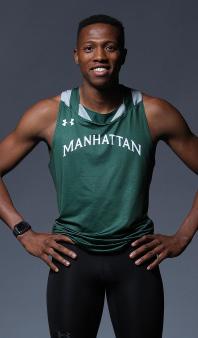
seventh grade. He was also a part of the track and field team at the University of Oklahoma. There he competed for three years and then chose to attend Manhattan College.
Joe explained how he challenged himself internally and also what he believes he improved on over the course of the indoor season.
“It was a very interesting race going in,” Joe said. “I wasn’t really expecting much, just trying to run better than I was starting off the season. I wasn’t doing that well, mentally. I know I was there physically but mentally I wasn’t ready and prepared for myself to compete … I just had to reassess why I’m here and why I want to compete, to be better.”
Joe also expressed what he hopes the future of the season holds for him and what he hopes to accomplish within the rest of the season.
“Just trying to continue that foundation and progress, get better and hopefully see where I want to be at and yet, hopefully sometime in the next few weeks, maybe we could see a couple more of those runners of the week [awards],” Joe said.
Another student-athlete who was recognized for his accomplishment was junior thrower, RJ Decker. He has been throwing since his junior year of high school and has been improving ever since. In his second year with the program, Decker was recognized for his weight throw.
According to GoJaspers, Decker took first place in the event, with a best of 20.39 meters which flew clear past the 2.65 meters of second place. This performance meant Decker now owned the best two marks in the weight throw this season, GoJaspers reported. The win scored Decker a IC4A qualifying standard, which Joe had also met in his own event.

Decker’s goal going in was to help his team succeed, and he explained how he felt going into the Metropolitan Championship.
“I knew it was gonna be tough to try to come off an intense week and have a little bit more competition,” Decker said. “Going into that was kind of something where I felt like I wanted to help my team get to how we won first place. So it was mostly just me trying to get the win to help my team more or less.”
Decker explained to The Quadrangle what goes through his head before he throws.
“I’m very optimistic when I go to the meets,” Decker said. “Nothing’s ever guaranteed.
For example, last year at Milrose. I was on a great streak and my indoor season and that bill rose hit and I threw six fouls in a row at a competition and then the next week we had backs and I hit my PR that way. That every bit is guaranteed. So I usually go with just try-
ing to relax, stay focused and just do what I know, not try to do anything extra or anything more.”
Decker explained how he felt about winning the weight throw and how he felt about his performance at the Metropolitan Championship overall.
“It was good,” Decker said. “It was fun. It was nice to go back to Ocean Breeze [the athletic complex] again. I saw a lot of people that I haven’t seen in a while. And it was just a really good intense environment. You know, you have a lot of people cheering you on … I just want-
ed to chase that feeling, chase some technical cues and I felt really good on the day and was happy with technically how I threw.”
As of now, the team is preparing for the end of the indoor season preparing for the IC4A and the NCAA championships, with the hopes to improve as a team.
is ‘attitude, intention, effort’,” Cannizzo said. “Going into the meet with attitude, intention, effort, I knew I could be positive.”
ing of this accomplishment and how it came as a surprise to her.
Manhattan College’s women’s and men’s track and field teams have earned the spotlight for their performance at the MAAC with awards being granted to players and personal records broken.
The women’s team had some key performances in the long-distance running & shot put areas. Many of the athletes were able to surpass their previous records while sharpening their skills on the track.
Freshman distance runner Isabella Cannizzo qualified for the 3000m alongside Andria Scaglione and crossed the finish line 10 seconds faster than her previous personal record.
She credits the supportive mantra from her coaches as the guiding force behind her performance.
“A big theme that we’ve been working on all year that my coaches said so many times
Cannizzo also explained the ways she’s adjusted to collegiate athletic life and how she relies on the support from her teammates.
“I wasn’t really a serious runner before I came into Manhattan,” Cannizzo said. “It wasn’t really a priority “Coming off cross country this whole year, I’ve been taking everything more seriously and giving everything I have really to the sport. I had to adjust to college training, so I overcame that and just tried to stay positive and know I was improving because I was putting in the work.”
More notable achievements from the women’s team included shot put and weight thrower Kristen Stickdorn, earning a silver medal for most outstanding field performer at the meet. Stickdorn spoke about the feel-

“I didn’t expect that,” Stickdorn said. “I know I performed pretty well. It was an interesting competition. The girl before me threw pretty close to me. She had a personal record. And then I was like, ‘okay, she threw far, I have to throw farther.”
Stickdorn has competed in back-to-back competitions over the course of the season and spoke about the impact it has had on her. She highlights her love for competing and how she leans on her teammates for support.
“I was competing every weekend, but it’s really fun,” Stickdorn said. “I love competing. It can become a lot sometimes. It’s not only physically but mentally demanding. You really have to not beat yourself up if you’re having a bad day. You just need to keep it cool.”
Stickdorn’s current record for weight throw this season
Manhattan College’s women’s and men’s track and field teams have earned the spotlight for their performance at the MAAC with awards being granted to players and personal records broken.
stands at 17.74m.
Freshman distance runner Nicole Kelch had some significant progress in the 4x800 relay. She spoke about the collective support she’s experienced from the team and how she admires the leadership within the team.
“The girls’ distance team has become a really strong team bonding-wise,” Kelch said. “We definitely have really strong leaders on the team. Everyone’s become really close and kinda developed the same goals.”
Kelch’s performance at the MAAC allowed her to set a record for her eighth best time with 10:48.76 minutes.
On the men’s side, senior sprinter Kaya Simpson was making waves in the hurdles and 60 meter dash.
Simpson took fourth place in both events earning the team four and five points respectively. He was .08 seconds away from a MC record in the hurdles with a finishing time of 6.85 seconds. Simpson currently holds the title for fifth fastest time for the 60 meter dash at the MAAC.

Being in his senior year, he spoke about the impact his running career has had on him and the growth he’s experienced both on and off the field.
“Within the first year of running, myself now compared to last year, I’m much more of a runner. I’m more confident,” Simpson said. “I’m more eager to push the boundaries. I’m more eager to step up at the race.”
He also spoke about the development of the team as a whole and how they’ve progressed throughout the season. He also highlighted the impact his teammates have had on him and how they continuously uplift each other.
“I always tell my team don’t get sappy, but ‘you guys right here are my favorite team’,” Simpson said. “We might not be the number one spot but we’re always gonna make ourselves known and we’re always going to be that team that strikes and takes advantage of opportunities in front of us. We definitely have some heavy hitters hitting scores on our team and some people are gonna make some really big impacts in our season.”
Both the men’s and women’s teams have made significant gains throughout the season with all athletes echoing the sentiment of the hard work they put into their performances.

much as possible, and we are all constantly rooting for one another.”
The men’s and women’s swim and dive teams wrapped up the MAAC Championships in Buffalo on Feb. 11. The men’s team placed eighth and the women’s team placed ninth with students breaking several school records.
According to GoJaspers, Abbey Mink started off the second day of the championship by finishing the 50-yard freestyle with a prelim time of 24.06, scoring the highest prelim placement of the day for the Jaspers while also setting a new school record.
This was Mink’s first time participating in the MAAC Championship and also her first season back in the water after graduating from high school. Mink wrote to the Quad about her experience at the competition.
“I had become so burnt out in the past, I really needed the break for both my mental and physical health,” Mink wrote. “Being able to come back and start over from scratch, and build my way back up, made the accomplishments I achieved this past weekend even sweeter.”
Mink also set a new school record for the 100 freestyle finishing with a time of 52.21.
Senior swimmer Mackenzie Tuttle was the previous record holder for the 100-yard freestyle. She wrote that having records allows for healthy competition and was excited about Mink’s achievement.
“It is always so exciting to see my teammates break school records,” Tuttle wrote. “[A record] that stands out to me this weekend is Abbey breaking the 100 freestyle record because prior to that, that was one of the records I held. Records are meant to be broken, and that kind of energy provides such healthy competition for us to see how many times we can go back and forth while holding that record. The goal is always to lower the school records as
The women’s team broke a school record during the 200-yard medley relay with a finishing time of 1:48.13, the members being Kyla Guilfoil, Mackenzie Tuttle, Abbey Mink and Shayna Millard. The same cohort broke a school record for the 400 freestyle relay with a finishing time of 3:33.06, and the 800 freestyle relay with a final time of 7:50.25.
Tuttle told The Quadrangle that being a senior and seeing the team get faster over the last few years has been incredible.
“The coolest part about the relays, being a senior on this team, is that I have been on these relays since freshman year, lowering school records,” Tuttle wrote. “Every time it happens, you think “there’s no way we can go even faster,” so for us to be able to continuously lower the relay records is incredibly exciting.”
According to the Jasper swim team’s Instagram, Guilfoil is now the fastest female backstroker in Jasper Swimming and Diving history. During the MAAC Championships, she completed the Trifecta in the 50, 100 and 200 backstroke and is now the record holder for all three.
Joe Brennan, a member of the men’s swim team finished the 100-yard breaststroke with a time of 55.80 breaking a school record. This also allowed him to qualify for the finals where he placed in eighth place. He wrote that despite being nervous about the meet, as it progressed he felt more confident and was extremely proud of the accomplishments of both swim teams.
“I ended up breaking the school record for the 100 breast, while also achieving best times in the 200 breast and 50 free,” Brennan wrote. “I was feeling extremely nervous and putting myself under a lot of pressure before the meet, but as the meet went on I began to feel more comfortable and confident.”
Both teams trained all year with the goal of performing well in the MAACs. During the winter break, the swim team took a one-week training trip to Miami, Florida where they swam twice a day, every day, and also did weight training every other day to prepare for the competition. They intensely trained for close to two weeks before they began to taper down, which meant lowering their yardage each day to rest their bodies, prior to the competition.
Mink wrote that one of the hardest parts of preparing for the competition was resting and recovering from training both physically and mentally.
“Being able to handle the stress and pressure of compet-
ing in up to 10 races over the course of 4 days, is not an easy task,” Mink wrote. “The hardest part of the training was allowing myself to rest for the 2 weeks leading up to the competition. It can be hard when you are resting so much because it feels like you are allowing yourself to lose all of the progress that you have been working towards. Your body needs that rest in order to perform at that high level for the full 4 days of competition, even if it doesn’t feel like it.”
The members of the swim team are very proud of each other for their performance in the MAACs and hope that the team members will be able to motivate others to continue to work hard.
JR. / Courtesy
“I am proud of myself and it goes to show that the hard work leading up to the competition was worth it,” Brennan wrote. “As a member of the swim team, watching other people break records makes me even prouder. It is a great sign that the team is made up of dedicated and talented swimmers who are constantly trying to perform at their best. It also means that the team is currently headed in the right direction. These achievements can help motivate and inspire the rest of the team to continue working hard.”
Editor’s note: Kyla Guilfoil, who is mentioned in this article, is Managing Editor and Sports Editor of The Quadrangle.
nior season strong.
Grace Cardinal Asst. News EditorSenior softball player Lauren Rende and senior lacrosse player Andrea Liotta have been named All-MAAC preseason players. Both Rende and Liotta came off of incredible junior seasons, with Rende having been named a 2022 MAAC All-Academic Team member and Liotta being named MAAC Defensive Player of the Year.
Last season, Rende started in 42 of the team’s 44 games. According to GoJaspers.com, she scored 26 times and drove in 14 runs, in addition to registering a team-best 12-game hitting streak. This season is especially important to Rende as she is currently recovering from an injury, and is looking to come back and finish her se-

“It’s [the award] honestly an honor because it shows not only the hard work we put in on the field when everybody’s watching but the hard work that we put in behind the scenes,” Rende said. “A lot of people don’t see that. It’s important to me specifically because I’m coming back from an injury now. I’ve been regarded at a high standard and I want to live up to that and continue doing work behind the scenes in order to get back up to that expectation.”
In addition to achieving MAAC Defensive Player of the Year, Liotta was named first-team All-MAAC on defense. She started in each of the team’s 19 games last season and proved to be a powerhouse, leading the Jaspers in ground balls and forcing turn-
overs in every game but one. According to gojaspers.com, Liotta was one of two unanimous selections to the Preseason AllMAAC Team.

Jenna Dingler, head coach of the women’s lacrosse team, spoke highly of Liotta’s abilities and described her as an asset to the team.
“Andrea leads by example each time she steps on the field,” Dingler said. “She attacks every opportunity to the best of her ability. Andrea is constantly making her teammates [work harder] and is a huge asset to our defense. We are excited for her to continue to excel this season.”
Liotta says that receiving the honor has motivated her to push harder for the upcoming season.
“I think that it provided a good push going forward into the season,” Liotta said. “Especially it being the last season it’s kind of like okay, they think you’re gonna have a good season, now it’s time to prove them right and have that good season that follows with the title of being selected for the team.”
While this is both players’ senior year, Rende plans to return for her grad season next spring. She said that the team is a special group, and highlighted the group of incoming freshman players.
“ It makes receiving an award such as this all the more special because I want to be able to accomplish winning a championship with this group of girls specifically. I think that they’re a very phenomenal group of girls and I want to be able to share that with them,” Rende said.
Rende shared the heartwarming reaction of her mother and explained that the award meant something important not just for her team, but for her family too.
“My mom doesn’t use social media much so when she saw the article, she screenshots and she sends it to me with a
bunch of heart emojis and kissy-face emojis and then like the arm emoji,” said Rende. “Honestly, I feel like everything I do is for her and for my family so to receive a recognition such as that, I’m glad that she sees how hard I’m working and that I can show off the effort that she’s made me the person that I am to receive an award such as this.”
Liotta credits the COVID-19 pandemic for giving the women’s lacrosse team a new outlook and appreciation of each season they’re able to play.
“The fact that freshman year our season got cut short because of COVID made every year after that like you can’t take it for granted,” said Liotta. “You need to put in 110% because you never know if one day something is gonna happen and it’s just gonna be over. That was a motivational factor for wanting to do good. I think that it’s always about working 1% harder every single day to try to get to where we want to be.”
Rende concurred that COVID had a significant effect on the way the softball team plays after having a season cut short. The pandemic and its after-effects left the team ready
to fight their way to the top.
“When we won the MAAC in my sophomore year, the year after COVID, we bounced back,” said Rende. “Freshman year, as Andrea said, got cut short. Last year was an adjustment period where our head coach left and our assistant coach kind of took up the mantle. Now that everything’s set, I really think we’re gonna hit the ground running and again.”
Rende says the softball team plans to emphasize the mental health of players in the upcoming season.
“We’ve been doing a lot of mental health training for this season,” Rende said. “Things like mental health aren’t regarded as important sometimes, so we really want to make that a key component in our play this year.”
Rende said a strong mentality and consistent attitudes will help the team in the upcoming season.
“All of those small things, even though you may not think it’s that big of a deal, they really are the breaking point between winning and losing. It’s gonna make a big change this season and I’m excited to see how far we take it,” Rende said.
The Metro Atlantic Athletic Conference (MAAC) decided last month to outsource the onair and streamed production of their basketball championship series to Linacre Media, taking away the opportunity for in-conference teams to produce the games.
“Costs for the school-produced productions have ballooned over the years which have led us to utilize a third-party professional production company at a comparable cost and higher production standards,” said Valerie McQuade, the associate commissioner of marketing and broadcasting at the MAAC in an email to MAAC schools.
The decision came as a shock to the Manhattan College Sports Media Production team, which was expected to produce the majority of games at this year’s championship.
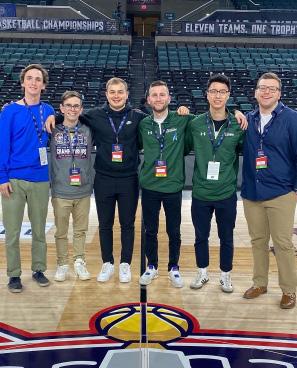
“Don’t discredit your schools like that,” said Joe Ruggiero, the former MAAC Director of New Media/Video and current Producer/Director for ESPN productions at Manhattan College. “If you [the MAAC] think we’re just vendors, then this whole educational experience that we’re trying to give our students doesn’t mean anything, right?.”
Ruggiero said the cost of in-conference productions versus the price of Linacre media could not really be comparable, and without the camaraderie of MAAC production teams working together to produce this series, Linacre will lose some of the nuanced-details and necessary communication in their coverage.
“I think [Linacre will} do a great job production wise, don’t get me wrong. But I think that the relationships that myself and other people in this league have with each other outweigh what this guy might be able to do,” Ruggiero said.
Manhattan asked for the standard $10,000 to rent their production truck, which has been established in previous
years. Their bid continued to ask for $250 per game for Ruggiero and two engineers, Raz and Jeff. Raz was previously employed by the MAAC in 2021 for that same compensation. In total, Manhattan’s bid requested approximately $22,000 to produce all 14 games of the tournament.
According to Joya Caskey, managing producer at ESPN, typical freelance prices for college-level basketball productions range from $300-700 for some positions, with producers and directors being paid between $500-3,000. This puts Ruggiero’s bid well-below average.
Richard Ensor Esq., the MAAC Commissioner, did not disclose the cost of Linacre’s services, stating he did not want to discuss “nitty gritty details,” but estimated the total cost of a school-produced tournament - including games, press conferences and the awards show - to be slightly over $60,000.
“I could get a professional one-stop-shop come in and not have to worry about managing a lot of additional people or have to worry about liability issues,” said Ensor, who will be stepping down as commissioner this year. “This is a company [Linacre} that does this all the time at this building.”
Manhattan was initially approached by the MAAC to produce the press conferences at the tournament while Rider University was requested to produce the games.
“I said okay, well, obviously there’s no value there. Because it’s for me, it’s there’s got to be value for our students,” Ruggiero said. “There’s got to be value for our program. And there has to just be proper compensation because nobody in this world should ever work for free anymore.”
After conversations with the MAAC, Ruggiero and the conference determined that Rider’s program, led by 2022 graduate Anthony Corbi, would not be able to handle the production of all 14 games alone.
Ruggiero negotiated terms for Manhattan to produce the
games while Rider handled press conferences, allowing Rider students to assist.
“We don’t normally negotiate with vendors on what they want to do,” Ensor said. “This whole thing of who does the award show, who does the press conferences, who does the games…It was just more noise in the system than we probably need in a time when we’re really really busy trying to run that championship.”
The final decision, as announced in the email from McQuade, stated that Linacre media will only be producing the 14 games of the series and Rider University will be producing and compensated for the press conferences and awards show coverage.
“[In-conference production] is a lot of additional work and as I transition out as commissioner, I’m trying to clean up a few things for my successor,” Ensor said.
All eleven MAAC member institutions were equipped to produce regular season games for ESPN from their home courts as of 2019. In doing so, ESPN pays the school $1,500 per game, up to 30 games. The 30-game cap stands for all sports, meaning if 24 basketball games are produced for ESPN that year, only six other sports can be produced on ESPN’s dime.
At Manhattan College, this means the majority of that $45,000 goes directly back into their budget, as Ruggiero’s Sports Media Concentration is taught at these games, eliminating the need to hire freelance workers. By the time the MAAC tournament comes around in March, his students have the unique experience of having produced over twenty games.
Outsourcing the production of this game eliminates the additional $10,000 Manhattan’s media production budget was expecting for their work at the tournament. More importantly, according to Joe, his students are missing out on the opportunity to learn and network in Atlantic City.
“I always tell them it’s a
chance to network,” Ruggiero said. “That’s another big thing I love about the student experience is you’re meeting students from the other schools, you’re meeting the admins - everybody from the other school.”
In previous years, the MAAC hired students for $50 per game. Students also received rooms, some meals and were able to expense things like road tolls to the tournament. Senior Claire Ganguin was expected to travel with Manhattan and is extremely disappointed in this missed opportunity.
“We follow our teams throughout this season, and having the opportunity to go and follow them to Atlantic City is something that we also look forward to as almost a reward for all of our hard work and effort in producing and helping with these games,” Ganguin said.
Ganguin was given the opportunity to travel to Orlando, Florida in November as a student assistant for the Women’s Volleyball Championship.
RUGGERIO/COURTESYGanguin said the experience solidified her career goals and gave her insight into how a live production operates outside of working at Manhattan’s production truck.
“Getting to go to Orlando, Florida was an experience that I wish more of my fellow co-workers may have,” Ganguin said. “But unfortunately, that opportunity has been taken away because the MAAC has replaced the student run crews with a professional group.”
Ensor said the future of student-produced games is uncertain, but students are still welcome to be hired as production assistants, produce features on schools and players, and do background stories.
“From my perspective as Commissioner, I liked having the students involved, but I recognize that it was a lot more burden on the full-time staff at the MAAC to manage that,” Ensor said.”It wasn’t such a significant savings any longer that it justified all the additional work.”