Laili Shahrestani and Barbara Vasquez Editors-in-Chief Maddie Rosado Managing Editor
Leyla Mercado Features Editor
Sarah Rolka Asst. Features Editor
Zeke Jazwinski Sports Editor
Emmamuel Sofillas Asst. Sports Editor
Leyla Mercado & Elaina Batista Asst. Social Media Editors
Maddie Rosado News Editor
Zendrah Bonnick Asst. News Editor
Maria Castaño Arts & Entertainment Editor
Joshua Reichard Asst. Arts & Entertainment Editor
Amy Forster Production Editor
Misha Jabal-Abadi Asst. Production Editor
Alba Kortoci Web Editor
About The Quadrangle
A tradition since 1924, The Quadrangle is a news organization run by the students of Manhattan University. We strive to cover news around campus and the greater community, publishing weekly in print and daily online. Our goal is always accuracy, relevancy and professionalism.
The opinions expressed in The Quadrangle are those of the individual writer and do not necessarily reflect the views of the Editorial Board, the University or the student body.
Join The Quadrangle
The Quadrangle’s staff holds weekly open meetings on Tuesdays at 4 p.m. in Kelly Commons. All are welcome to come and join the club. If interested, please email thequad@manhattan.edu!
LETTER from the EDITOR
Hello readers!
Long time no see! Welcome to issue 11 of The Quadrangle - I hope everyone had a great Easter break last week, and is mentally prepared to get back to a full official week of classes.
Before we begin, I’d like to share some exciting news: in just two weeks, we will be publishing our second print issue of the semester, our special issue! Our spring special issue is super beloved among the campus community, as it not only encompasses our wonderful writing, but also features our Quad 10 which highlights deserving and influential seniors around the school. This issue is exciting for so many people on campus, but we need our readers’ help in order to make it come to fruition: if you’d like to help out, please consider donating to our GoFundMe page. Your support and viewership means more than you know!
Lois Boateng Social Media Editor Thom Gencarelli Faculty Advisor Editor-in-Chief
Connect with The Quadrangle mcquad.org @mu_quad @mu_quad mcquad
Now, this week’s issue is hefty, with a few major news stories. First, our breaking one: Springfest is bringing rapper Jadakiss to Manhattan! He will headline our Springfest concert, which is this weekend, April 18 - get ready for a good show! Next, we cover the OMSB’ Annual Innovation Challenge, which saw three student group winners, as well as the new public history minor to be offered beginning next semester. Following that, we speak to Lawrence Udeigwe, Ph.D., about his recent position appointment with the ARCH Initiative, and admissions covering the first Accepted Students Day of the semester. Ending off, read our Manhattan Caucus to learn more about the recent Iran ceasefire agreement.
In features, we cover the Asian Student Association’s matcha and onigiri fundraiser, and their continued efforts to share their cultures with the student body through these cultural-food based fundraisers. To end off the section, we have a quick Quad-Staff Q&A; it’s been a while since we’ve had one of these columns in our issue, so be sure to give it a read and gain some insight on some of the writers behind your favorite stories!
In A&E, we cover two exhibitions at MU: first, Sanctus Artem hosted “The MET MU” showcase, where the entire student body was invited to submit their work and have it displayed for the show. Next, O’Malley Library has filled its exhibition space with new works, these ones from artist Marcel Roux. This exhibition was done in collaboration with the Holocaust, Genocide and Interfaith Center, and will be on display until this Friday, April 17. Be sure to stop by the library to check it out.
Ending off with sports, read about men’s volleyball’s inaugural season, ending off on a good note and certainly cementing themselves as a known force around the school. Finally, catch up with our sports teams with our games of the week column.
That’s all for this week. Thank you for reading!
JadakisstoHeadlineSpringfest
CONTINUED FROM PAGE 1
Springfest back into its kind of former glory,” Parson said. Beyond Jadakiss’s performance, students can expect a packed late afternoon and evening of activities and plenty of food options designed with their feedback in mind. Parson said the planning team is focused on bringing back favorites while keeping the overall experience grounded in what students actually enjoy.
“When it comes to the activities and things like that, we’ve been throwing a lot of options out there,” Parson said. “I know students really liked the mechanical bull [from last year’s Springfest]. They liked the bounce houses and obstacle courses and things like that, as well as the food options. We’ve gotten a lot of good feedback.”
The student body is still waiting on an official schedule of the special day from student engagement, but in the caption of their
Instagram post announcing the date, they made clear that “all students must bring student ID or present glance app upon entrance. No outside guests will be permitted.”
Parson is excited for this Springfest and what it means for the future of the university culture.
“Being able to give food that the students will like, activities that they’ll actually like, and performers that we feel like can resonate with them makes it more of a student-centered event, and
not so much of just an event that we have to do for the
TheOMSBHostsAnnual“InnovationChallenge”atMU
CONTINUED FROM PAGE 1
major, David Kema, a senior management information systems and supply chain management major at Rutgers University and Bryce Knight all serve as part of the Zoner team. Okunonke, who first spearheaded the company, spoke a bit more in depth about what drove her to do so.
“Every state, town and even certain parts of neighborhoods have different zoning patterns, zoning laws and new infrastructure parts that are coming to the area,” Okunonke said. “We take that all into account to tell if you’re interested in things like commercial real estate, luxury apartments, affordable housing … So it’s a very personal platform at the end of the day.”
As Zoner placed first in the competition, Kema gave extra insight as to what made the team’s presentation stand out to the judges during the Innovation Challenge, ultimately leading Zoner to victory.
“There were a couple of teams that also had competition traction… one team had $100,000 in capital already, but they weren’t able to answer a couple of questions from the judges,” Kema said. “However, we did these interviews for the purpose of trying to make Zoner better for the coaches and for the understanding of our consumers. And I think that has been a big contributing factor to our victory.”
Going forward, Okunonke expressed that she hopes to take Zoner to the global stage, and is striving for it to develop
into a household name. With a grand prize of $5,000, Okunonke spoke more in depth about how she and the team will utilize this money.
“This is just the beginning,” Okunonke said. “We’re really trying to become a household name. When you think of Zillow, I want you to also be thinking of Zoner as well… We have a business account already, so the check is going straight into that. And we got into the Web Summit, it’s an international exhibition in Portugal… we’re going to bring Zoner to the global stage.”
In addition to Zoner, second-place in the competition went to Anthony DeCastro with “Rest and Dress,” an AI powered smart closet designed to make the process of choosing what to wear easier and more timeefficient. DeCastro is a junior marketing and management major, and presented his idea to the judges as a solo project — the only solo project within the challenge.
“I was really proud of placing second, and honestly I didn’t even realize I was the only solo project at the time,” DeCastro wrote in an email to The Quadrangle. “That made the recognition even more meaningful and motivating for me.”
When it comes to the future goals of Rest and Dress, DeCastro plans on continuing to develop his innovation, as a way to keep allowing people to have more ease in their day-to-day lives, through the usage of modernday technology.
“I definitely plan to continue developing Rest and Dress,” DeCastro wrote in an
email to The Quadrangle. “I hope it can eventually help people save time, reduce decision fatigue and make getting ready each day more efficient and personalized.”
The third-place win was given to Wave to Energy Breakwater. This team consisted of the three individuals present at the Challenge: Manahill Gohar, a senior mechanical engineering major, Augustus Calamari, a senior business management major and Isaiah Merisier, a senior electrical engineering major. Other team members who were not present at the event yet helped behind-thescenes were Steven Aquino, Eze Barrah, Kevin-Loha Pillco and Tenoch-Velazquez Maceda, all under the advisory of Bahareh Estejab, Ph.D, associate professor of mechanical engineering.
Gohar gave a brief description of her team’s innovation, and how it previously stemmed from the work of Estejab.
“Our advisor, Estejab, had worked on this competition [The Marine Energy Collegiate Competition or MECC] for a year or two now,” Gohar said. “We basically refined her idea… But it’s four barrels that come together and rotate like a water wheel, and use the rotational motion of the barrel to power a generator, which can then be used to provide electricity in a reliable and cost efficient manner… converting salt water into fresh water.”
With the team placing third in the competition, many on the Wave to Energy Breakwater team expressed
that they were filled with joy once the results were announced.
“I was over the moon, because I’ve personally never won anything before,” Calamari said.
With a $3,000 prize, Calamari shared what the money will go towards for his team.
“We decided to divide up the money, so half of it will go towards the mechanical engineering department, and to our advisor, Dr. Estejab,” Calamari said. “And because there’s six of us, we decided that we’re also going to split half of the winnings amongst ourselves.”
With each team showcasing their own creative innovations and portraying a sense of entrepreneurship, Guirguis shared that the Innovation Challenge this
year left him thoroughly impressed.
“As dean, I was proud and impressed by the creativity, thoughtfulness and confidence students showed throughout the competition,” Guirguis wrote in an email to The Quadrangle. “The winning teams stood out for combining strong ideas with clear execution: Team Zoner used data analytics to simplify real-estate decisions, Team Helical [Wave to Energy Breakwater] focused on building a practical and efficient water turbine and Team Rest and Dress applied AI to everyday fashion choices. Together, they reflected the seriousness, innovation and real-world focus students brought to this year’s challenge.”
school,” Parson said.
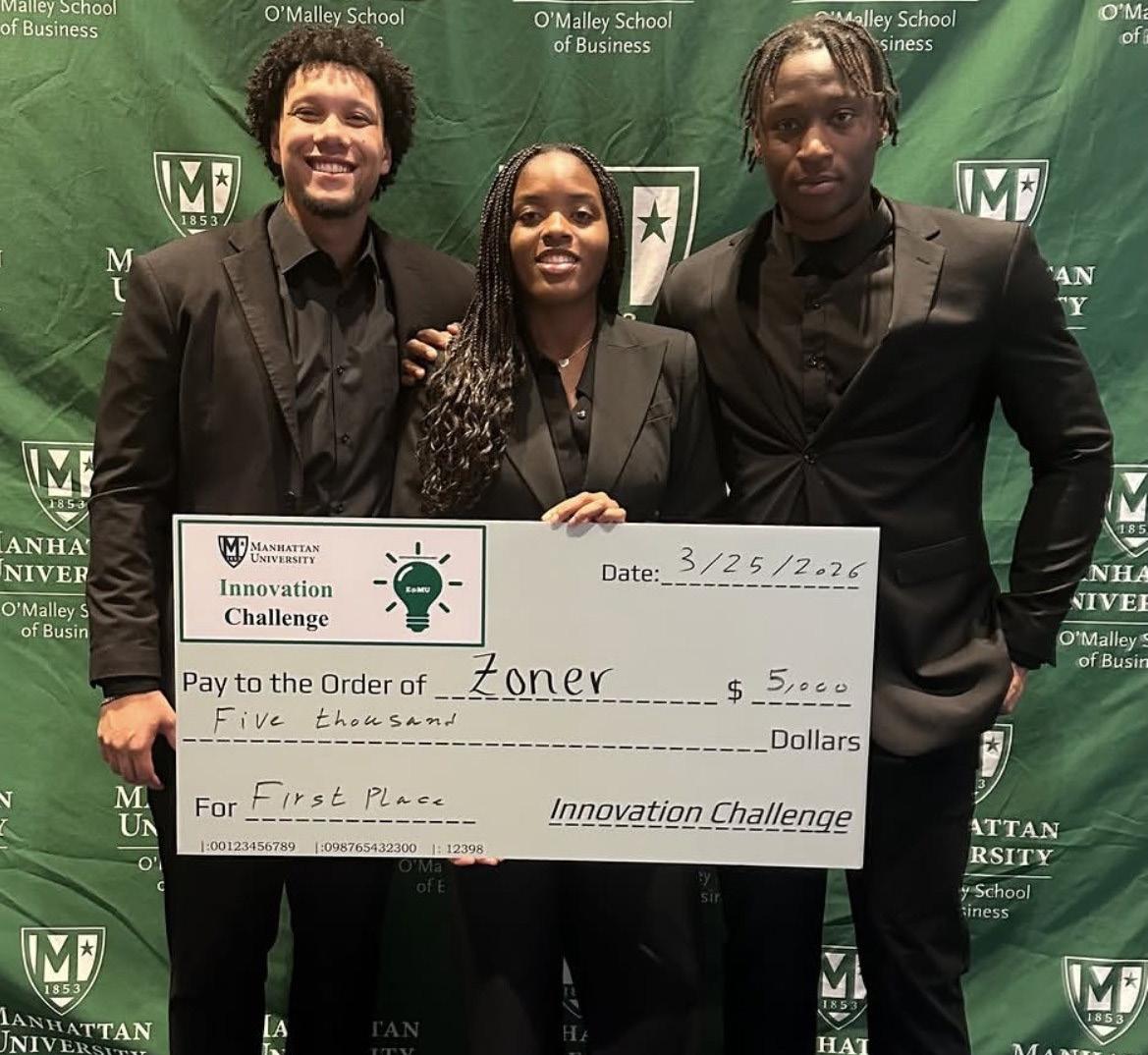
The Zoner Team places first
MU Offers New Public History Minor, Come Fall 2026
Barbara Vasquez Editor-in-Chief
Manhattan University (MU) has recently introduced its new public history minor to the history, political science and international studies department at the university. It is now the second minor offered in the history sector of the program.
The minor “introduces students to museum studies, archival practices, digital presentations, and other forms of applied history,” according to the course description on manhattanedu. “It trains them in how and why history content is presented to the public, whether in museums, through professional and social media, and in public spaces, in person and online.”
The minor was developed largely in part with Lydia Crafts, Ph.D., history professor at MU, who will be teaching the first courses for the minor to be offered in the fall. According to Crafts, the minor was developed due to the abundance of opportunity it could provide students.
“We wanted to connect students to opportunities to
make use of the city, and to connect their work to the city,” Crafts said. “There are a lot of students, we noticed, who had an interest in working in museums, or archives, or these different cultural institutions, so providing a pathway for them, through their education, to develop the skills that are needed to work in these institutions [was of interest].”
The coursework for this class emphasized offering internships and hands-on, practical experience for students, found through alumni connections and university affiliations with different cultural institutions. This minor was designed with the intention of providing students who are interested in working in public history the experience needed to be more “marketable” for employers.
“We’ve noticed our students typically go into careers in education or law, but there’s a growing number of students who are interested in working in museums,” Crafts said. “So to provide more opportunities for those students to develop those interests, and put students more on the right career pathway as well.”
Molly Gilmartin, a junior history major, is just one student who is currently deciding on
Crafts,
pursuing public history studies at the university. She serves as the current president of the history club at MU, attesting to her interest and commitment to the discipline. For Gilmartin, the announcement of the new
was behind some of the development of the public history minor. MANHATTAN.EDU / COURTESY
minor was quite exciting.
“I was ecstatic to hear about the public history minor,” Gilmartin wrote in an email to The Quadrangle. “I was especially excited because my goal after graduation is to go into museum studies, and try to work in the public history sphere. I am most excited for the opportunities for internships students may be able to achieve with this line of study.”
For Gilmartin, the public history minor offers a deeper way for students to look at history.
“Public history is another way to approach the pursuit of historical knowledge, but outside the traditional classroom norm,” Gilmartin wrote in an email to The Quadrangle. “It comes in all forms ranging from museums, archives, national parks, or even historical films. Providing students with the opportunity to study public history adds another way of looking at
history as a whole.”
The first class offered for the minor, History in Public, will cover a variety of subjects within public history, including how history is represented in public spaces, archiving materials, family history, history of the internet and oral history, according to Crafts. This class, and pairing minor, are not limited to only history students.
“We hope it won’t just be history students, but other students from different disciplines who might be interested in getting experience working in museums or these cultural institutions,” Crafts said. “Or even the learning skills of digital literacy in relation to the humanities, or archival work, whatever it may be. I think there’s a lot of transferable skills in some sense.”
Lydia
Ph.D.
Lawrence Udeigwe, Ph.D. Named Director of Integrative Programs for ARCH Initiative
Emmanouel Sofillas
Asst. Sports Editor
Manhattan University (MU) has appointed Lawrence Udeigwe, Ph.D. as Director of Integrative Programs under the ARCH Innovation Exchange, a campus-wide initiative aimed at reshaping how students learn, collaborate and prepare for careers in an increasingly complex world.
ARCH, which stands for Analytics, Research, Creativity and Humanity, is a campuswide approach to learning that combines the foundations from the university’s three schools — the Kakos School of Arts and Sciences, the O’Malley School of Business, and the School of Engineering. Launched in the fall of 2025, the initiative fosters problemsolving, leadership and innovation through a dynamic ecosystem of design-based learning, entrepreneurship and cross-sector partnerships
In his new role, Udeigwe will provide academic leadership and coordination for interdisciplinary degree programs and initiatives administered through ARCH, working closely with faculty, department chairs and deans to support the development, oversight and assessment of interdisciplinary majors, minors and other credentials.
Udeigwe said the role is a natural extension of how he has always approached his professional life — without boundaries between disciplines.
“I was trained as a mathematician, but then I work with neuroscientists, with biologists, with medical doctors,” Udeigwe said. “And I’m also a musician. When I’m
on stage, they don’t even know that I’m a professor. They just see me as a musician. I don’t see a boundary when it comes to discipline.”
That philosophy, he said, is precisely what ARCH is trying to instill in students. Udeigwe described five core objectives the initiative is working toward: selfdesigned certifications such as minors, micro-credentials or concentrations; crossdisciplinary student projects that go beyond classroom assignments; universitywide artificial intelligence integration; real-world industry connections through speakers and partnerships around New York City; and the creation and strengthening of new interdisciplinary majors.
On the question of AI, Udeigwe was particularly emphatic. He said ARCH aims to move AI beyond being a novelty tool and integrate it into everything students do at the university.
“AI is here to stay,” Udeigwe said. “AI becomes a tool to help solve problems, to help guide us through problems, and to help prevent problems.”
Udeigwe also detailed two new interdisciplinary majors he has been deeply involved in building. The first is computational neuroscience, which draws on biology, psychology, mathematics, electrical engineering and computer science to allow students to model the dynamics of the nervous system. The second is data science, which applies computation, mathematics and statistics to address data-related challenges that are reshaping industry and society.
Describing the day-today reality of the director role, Udeigwe said it requires the mindset of an architect
— constantly designing and building something still taking shape.
“Each day I wake up, I have to think of what’s the best way to move this initiative forward,” Udeigwe said. “Each weekend, I spend some Saturdays, maybe five hours just brainstorming, what do we do next week to make ARCH move forward?”
As a professor of mathematics at MU and a research affiliate in brain and cognitive sciences at MIT, Udeigwe’s work exemplifies the spirit of the ARCH Innovation Exchange. His interdisciplinary research spans differential equations, dynamical systems and computational neuroscience, with a focus on mathematical models of learning, perception and neural systems and their connections to machine learning and artificial intelligence. He is also an accomplished jazz musician
whose creative practice explores the relationships among mathematics, perception and artistic expression.
For students on campus, the arrival of ARCH has already sparked curiosity.
Lukas Koch, a freshman mechanical engineering major, said the program’s emphasis on breaking down barriers between fields is something he wishes had existed sooner.
“Engineering can feel really siloed sometimes,” Koch said. “The idea that I could work on a project with someone in psychology or business, and that it actually counts toward something, that’s the kind of education I was hoping for when I came here.”
Evan Saraiva, a freshman civil engineering student, said ARCH’s focus on AI integration stood out to him in particular.
“Every industry is going to
be touched by AI,” Saraiva said. “The fact that MU is trying to make sure we’re not just aware of it, but actually using it across all our classes, feels like the right move.”
Udeigwe said his path to the directorship began in 2023, when he started advocating for a data science program and later pitched a computational neuroscience major to Provost Bridget Chuck, who encouraged both efforts. When Chuck introduced the broader ARCH concept, he said it immediately felt like a mission he had already been living.
“When the administration mentioned to me, ‘This is ARCH, this is what we’re trying to do,’ I said, ‘Wow, this is the life I’ve been living,’” Udeigwe said. “So I would like to work on it here.”
Photo of Dr. Udeigwe MANHATTAN.EDU / COURTESY
MU Hosts Its First Accepted Students Day of 2026
Leyla J. Mercado
Features Editor / Asst. Social Media Editor
On March 28, Manhattan University’s (MU) Admissions office held its first Accepted Students Day (ASD) event of the year. The day consisted of a collection of different campus experiences in order to engage accepted students to make their enrollments if they hadn’t yet.
The general schedule started at 8:30 a.m, consisting of check-in at Smith Auditorium and Squieri Hall, which was followed by the Jasper Welcome, an official greeting to prospect students, at the Chapel of de La Salle and His Brothers from 9:30 a.m to 10:15 a.m.
Admissions and financial aid meetings were held from 10 a.m to 3 p.m., while simultaneously from 11:30 a.m to 3 p.m., admissions ambassadors held campus tours departing from the lower forecourt.
Noon to 3 p.m. further consisted of the golf simulator experience at the Jerome C. Wood ‘75 Golf Simulation Center in Jasper Hall, and was followed by lunch: “a taste of New York” in the lower forecourt with a variety of food trucks to choose from.
Anissa Latif, assistant director of communication, events and technology, spoke to The Quadrangle further expanding on the initiative MU’s Admissions office took in introducing food trucks as a
new element to this year’s ASD event.
“The food trucks this year were a new addition to ASD. They are the perfect example of, [what] we’re always talking about, we have everything on campus, but we are also a school in New York City,” Latif said. “It’s a taste of the campus but also a taste of the city.”
Evelyn Orellana, director of admission strategy and communication, further discussed what goes into organizing an event of this scale.
“For this event, there’s a lot of coordination and connecting with different areas of our campus community,” Orellana said. “The biggest challenge was the weather. And yes, although it was windy and cold, I feel like we were able to bring the warmth.”
Orellana shared with The Quadrangle what her main goal was when it came to planning this year’s ASD event.
“I feel like ASD is important because students are coming to campus to meet our community,” Orellana said. “They’re also coming to campus to reaffirm that MU is the place for them.”
Orellana then discussed what she hopes students and families take away from their experience on campus.
“I think our community is extremely family oriented, because while the day is about students, we’re also celebrating parents because it’s their kid,” Orellana said. “They’re stepping into a different era. They’re even entering a time where their life is about to
change. I think it’s really nice that we can also honor them in that way.”
Latif further spoke to why ASD is such an important event for MU and how it fits into the school’s broader admissions strategy.
“This is an extremely important event, because it’s bringing our students who have already been admitted to campus,” Latif said. “This is their opportunity to meet with the Jasper community that we’re always raving about. It’s really important that they meet with various members of the community and get that feel for campus.”
Latif, who also shared that they have an “open door policy” in the admissions office to let students know they’re always there, made it clear that their goal in planning – for students to have the time to come back and visit MU before their commitment to the institution.
Leah Romanowski, admissions counselor, experienced her first ASD event. Reflecting on her experience, she spoke to The Quadrangle about what was most memorable.
“My first ASD as an admissions counselor at MU was wonderful,” Romanowski said. “It was really nice to see how the students all showed up and we’re ready to go from start to finish… Even though it was a chillier day, we had a great showing of prospective students and the faculty and staff too. Just being so willing to show up was also really surprising, but great to see.”
Romanowski continued to share her definition of the “true college experience” while providing further insight in sharing what she thinks makes a student feel welcomed and comfortable on campus.
Together, their perspectives point to a shared goal, ensuring that ASD offers not just a glimpse into campus life, but a meaningful sense of belonging for both prospective students and their families.
“Every parent wants to know that their kid is going to be okay, that they’re going to be welcomed, that they’re going to make friends, that they’re going to be people out there that really that care about them… [this event] is the perfect time for us to make sure that even the parent goes up there and gets to celebrate,” Latif said.
“The professors, staff, and students all showed up ready to engage and share what it’s like to be a MU student,” Romanowski shared. “That energy and enthusiasm really sticks with prospective students and gives them a real sense of campus life.”
President Donald Trump announced a two week ceasefire with Iran on Tuesday, April 7, and agreed to a ceasefire 90 minutes before the deadline where he threatened “a whole civilization will die tonight”.
Trump took to Truth Social and stated, “Based on conversations with Prime Minister Shehbaz Sharif and Field Marshal Asim Munir, of Pakistan, and wherein they requested that I hold off the destructive force being sent tonight to Iran, and subject to the Islamic Republic of Iran agreeing to the COMPLETE, IMMEDIATE, and SAFE
OPENING of the Strait of Hormuz, I agree to suspend the bombing and attack of Iran for a period of two weeks.”
The two-week ceasefire is contingent upon Iran reopening the strait of Hormuz according to Trump. Prior to Trump agreeing to the ceasefire, Tehran’s representative at the U.N., Amir-Saeid Iravani, said the threats “constitute incitement to war crimes and potentially genocide.” Later adding Iran would “take immediate and proportionate reciprocal measures” if Trump launches devastating strikes.
On April 9, Israel’s military launched attacks on Lebanon, bombing 100 sites in 10 minutes in the residential areas in central Beirut. Israel’s prime minister, Benjamin Netanyahu, said
that he gave the order for his administration to begin direct negotiations with Lebanon with the goal of disarming the militant Lebanese organization Hezbollah. However, hours later, he insisted that “there is no cease-fire in Lebanon.”
The U.S.-Iranian cease-fire was mediated by Pakistan, and its prime minister, Shehbaz Sharif, stated that the agreement addressed the conflict in Lebanon. Abbas Araghchi, Iran’s foreign minister, concurred. However, the White House and Israel have stated that Lebanon is not covered by the cease-fire.
At least 254 deaths have been reported across Lebanon. In a statement, Hezbollah called Israeli attacks on people throughout Lebanon war
crimes.
President Trump has accused Iran of violating the cease fire by “doing a very poor job” of opening the Strait of Hormuz. Claiming only a handful of ships have made it through the waterway since the agreement. Iran has stated that it maintains the right to charge a fee for passage and has insisted that ships wishing to pass through the strait obtain its approval.
Vice President JD Vance headed to Pakistan on Friday, April 10, for peace talks with Iran. Before departing for Islamabad he told reporters, “We’re looking forward to the negotiation…I think it’s going to be positive.” Along with Vice President Vance is President Trump’s special envoy, his
son-in-law, Jared Kushner, and Steve Witkoff.
As Iran’s parliament speaker, Mohammad Bagher Ghalibaf, arrived to the Islamabad airport he told Iran’s state media, “We have goodwill, but we do not trust” then continued to say that if the U.S. is “ready for a genuine agreemnet.” then Iran could be as well.
According to a CNN regional source, the meeting between the U.S. and Iran will be both indirect and direct. The two sides are likely to meet an agenda for talks through Pakistani mediators then expected to meet face to face later in the day.
Features
ASA Brings Culture and Community to Campus Through Matcha Fundraiser
Leyla J. Mercado
Features Editor / Asst. Social Media Editor
The Asian Student Association (ASA) at Manhattan University is making their mark by hosting a two-day matcha fundraiser on Tuesday and Wednesday, April 7 and 8 on Kelly Commons’ first floor. From 12 to 4 p.m., ASA’s E-board sold strawberry and cookies and cream flavored matcha with spicy crab flavored ornigiri.
According to akimatcha. com, matcha is a high-grade, finely powdered green tea that’s made from shade-grown Camellia sinensis leaves, which began in ancient China before finding its home in Japan. Onigiri, Japanese rice balls, are a portable, seasoned rice snack typically shaped into triangles or rounds and wrapped in seaweed (nori).
With that being said, deciding on matcha, a drink of Asian culture, was a no-brainer when choosing what to utilize as the heart of their fundraiser.
Shu Amanuma, founder and president of the ASA and a junior majoring in international studies with a concentration in global affairs spoke to The Quadrangle about what exactly inspired a matcha fundraiser specifically.
“It is one of the most well known and popular Asian drinks, and we thought it would be a big hit and we also heard from students that they missed the Starbucks matcha,” Amanuma said.
“Our fundraisers are part of ASA’s initiatives in branching out our cultures to the larger student body through the means of food and drinks. It also supports our fun event activities.”
Many club members also come by and support
the ASA as much as they can, making it a socializing point to catch up and converse with other members. The sense of community created within their atmosphere has been a vital part of the club’s success.
Amanuma further went on to walk The Quadrangle through an attendee’s experience at the fundraiser.
“They would be greeted with a welcoming atmosphere at our table in Kelly, followed by some introductions of the club and the board … Once purchased, the attendee is able to watch the process of their drinks being made right in front of them,” Amanuma said. “I hope that the larger student body takes away the cultural aspect, because we choose our drinks so that there is always something new every time … The fundraiser being something centered around a popular drink was something I always had in mind, I just didn’t expect this much success!”
The ASA’s attention to involving the student body within the favorite parts of their culture has led them to become even more creative with their fundraising, setting the stage for future events that continue to celebrate and share Asian culture with the Manhattan University community.
Gabriella Dimalanta, a junior biology major, is the ASA’s event coordinator. Dimalanta spoke to her role in helping plan the matcha fundraiser.
“I helped organize the stand, prepared the food [making the onigiris] that were sold in the fundraiser and made the matcha for those buying them,” Dimalanta said.
“We all collaborated together to determine which flavors of matcha we should do for the fundraiser, worked the night before to prepare food for the next day and saw who was
available to run the fundraiser throughout the day.”
Dimalanta also shared what part of the fundraiser she was most looking forward to and believed a matcha-themed fundraiser was a good idea for the ASA.
“I was excited about students trying our unique flavors of matcha and just sharing our love of food with everyone,” Dimalanta said.
“I think it represents a well known drink that is popular that originates from Japan, and
due to its popularity it was able to give us a chance to share more about Asia and the culture behind it to the Manhattan University community.”
This fundraiser means more than just building funds for the club, but building community amongst Jaspers of all different ethnicities and backgrounds.
“For the Asian students, I want them to feel that there is a community on campus where they are safe to explore their cultural backgrounds,” Amanuma said.“Furthermore,
for the larger student body, I hope our club serves as a door to trying something new, or engaging with another culture, or possibly an interest in visiting one of the Asian countries eventually.”
The ASA will continue to host different events and fundraisers that you can keep up with on their Instagram account: @asa_manhattan.
AQ&AWithTheQuadStaff!
Laili Shahrestani Editor-in-Chief
The Quadrangle consists of 14 hardworking members of masthead, all who share a common passion for storytelling and journalism. Each and every member has their own background, story and personalized feelings when it comes to how they got in their position today, and what this publication has done for them.
For myself, The Quadrangle has shaped me in ways that I could have ever imagined. Transferring to Manhattan University at the beginning of last year, I immediately found myself drawn to this publication. By being a part of a journalism concentration that was extremely small, and had little to no students other than myself in it,The Quadrangle quickly became where I found my sense of belonging.
Going from a contributor, to a staff writer, then the features editor and finally editor-in-chief in just the span of 16 months, it has taken nothing short of hard work, dedication and most of all passion. It is my passion for journalism that keeps my work ethic strong. This publication has taught me that in my eyes, there is nothing more important than the role of a journalist. Keeping audiences informed, holding people accountable and explaining “what’s going on,” all reveal just a glimpse of what we do here at The Quadrangle.
While my experience
is unique to me, many other members here at The Quadrangle have their own insight to share from their own individualized perspectives.
Barbara Vasquez ‘27, communication major with a concentration in integrated marketing communications, editor-in-chief
The Quadrangle: What do you enjoy most about being a part of The Quadrangle?
Barbara Vasquez: My favorite part about being a part of The Quadrangle is how connected I feel to the campus community because of it. When I was coming into college, I was an extremely timid person, and The Quad has allowed me to experience so many different opportunities and meet so many people that I may have never crossed paths with, had it not been for the paper. I also just find The Quad really fun in general! Our meetings can be super fun — especially when our staff gets the ball rolling during open pitch — and as a former production editor, I have grown to love using Adobe InDesign and the entire production process!
TQ: What skills have you developed through working within this publication?
BV: From my time with The Quadrangle, I have truly developed as a person. My confidence in myself, my work and my overall ability has increased immensely, and I don’t think I would be who I am without the paper. This publication has shaped my college career, and I am so grateful that I took the leap my freshman year to join. Everything I do with The Quad is out of sheer love for the paper — I owe it that much!
TQ: Where do you see yourself moving forward in the future career wise?
BV: I would love to go into magazine publishing in the future! This is actually something The Quad has really helped me lean into — I discovered that I, for some reason, love copyediting, as well as the design, production and even advertising processes that magazine publishing can encompass.
Maddie
concentration in journalism,
managing and news editor
TQ: Can you walk me through a snippet of what this publication means to you?
MR: During my time at MU, I feel like I’ve lived many different lives. It wasn’t until I became a staff writer for The Quadrangle that I truly found my place on campus. Being a part of The Quadrangle has given me a voice and an outlet to be heard. I take pride in being a storyteller, and I truly care about each and every article I’ve ever written. During my interviews, I always try to genuinely connect with the person so they know how much I appreciate them trusting me with their story and allowing me to put it on the record.
TQ: Where would you say your passion for journalism stems from?
MR: My passion for journalism goes deeper than politics. The way I see it, I use my voice to amplify the voices of others and tell the stories that need to be heard. Journalism is not just about what you’re reporting on, it’s about the people. And while I’ve been a part of The Quadrangle, I feel that I’ve truly been able to fulfill that goal.
TQ: What has been the most fulfilling part about working at The Quadrangle?
MR: I’m so incredibly grateful for the people I’ve met who are a part of the staff, but I’m also so grateful for the new people I get to talk to every day when I take on a new pitch. There’s always something new, and I think that’s the beauty of this work. My passion burns for this newspaper, and honestly, I don’t know what I would do without it.
Maria Castaño ‘28, double-major in English and Spanish, A&E editor
The Quadrangle: What do you enjoy most about being a part of The Quadrangle?
have learned a lot from some of the people I have interviewed, and it’s really fun to see things from the perspective of other people and try to do their opinions and experiences justice in an article. It’s equal parts challenging and rewarding.
TQ: What skills have you developed through working within this publication?
MC: I feel like I have become a better writer thanks to being a part of The Quadrangle. I get to practice my writing skills very consistently by writing articles weekly or editing them. It helps me identify mistakes or areas of improvement in my own writing a lot faster, which, as an English major, are invaluable skills that I have definitely seen work in my favor recently.
TQ: What motivated you to join The Quadrangle in the first place?
MC: At first, I only joined because it seemed like the best club for an English major to join, and I wanted to practice my writing skills, as mentioned before. But after a while, it became much more than that. I enjoyed being updated on
what was going on on campus; it made me feel a lot closer to the Jasper community, and as a freshman, I just really appreciated being able to feel part of something where I was contributing positively to the university, while also actively working to better myself and my future. It has been a very rewarding opportunity, and I find the process in and of itself quite enjoyable.
TQ: What do you want to see in the Quad’s future?
MC: I hope more people who are passionate about journalism and writing join, so we can uphold the legacy that others created of The Quad as a reliable source of information on campus. I also want it to be even more enjoyable to read; whenever I read an article written by someone who I know put a lot of effort into researching it or who appreciates the topic, I can notice it, and the reading experience becomes a lot better. So for the future, I want the people who join to involve themselves in what we do and put an honest effort, since I think that if the writer truly cares, then the readers will notice it.
Rosado
‘27, communication major with a
Maria Castaño: The part I enjoy the most is definitely doing interviews. While I am mostly an introvert, talking to people about things that matter to them or affect them personally is always something I look forward to. I feel like I
Barbara Vasquez, editor-in-chief
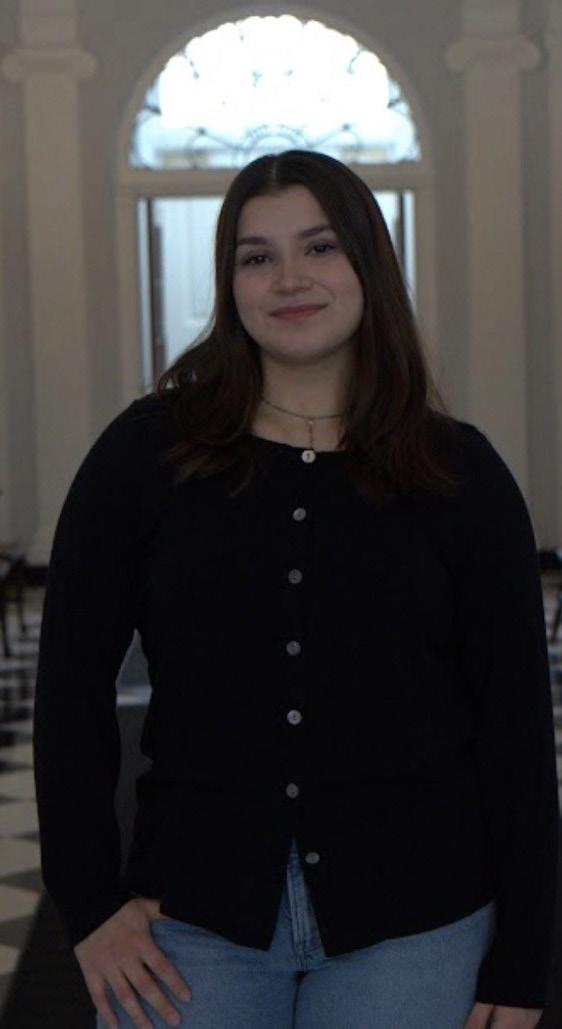
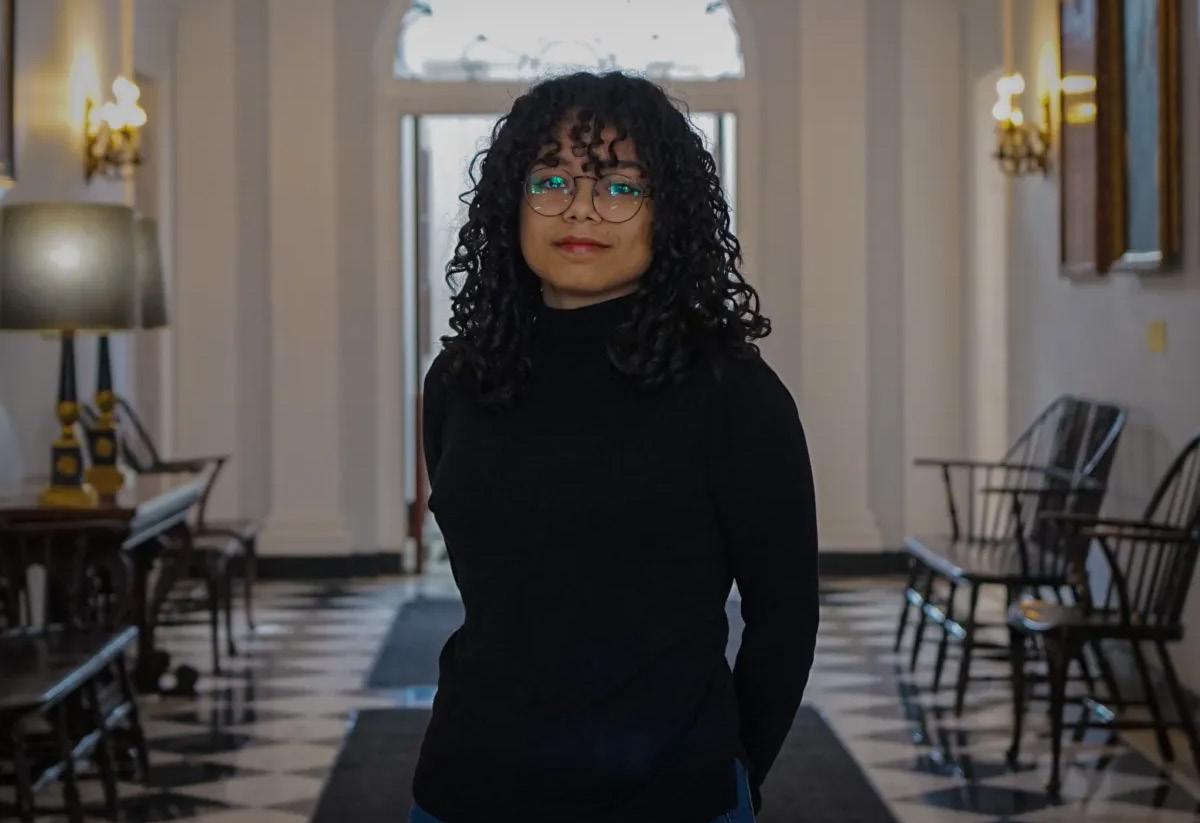
BARBARA VASQUEZ / THE QUADRANGLE
Maddie Rosado, managing and news editor MADDIE ROSADO / THE QUADRANGLE
Maria Castaño, A&E editor MARIA CASTAÑO / THE QUADRANGLE
arts and entertainment
Sanctus Artem Hosts “The MET MU” Art Exhibition
Editor-in-Chief
Manhattan University’s (MU) Sanctus Artem club recently held an art exhibition on April 9, located in Smith Auditorium, where students and alumni were able to showcase their artwork in a gallery that emulated the same “high-end” environment as the Metropolitan Museum of Art. “The MET MU” provided Jaspers with an opportunity to have the ultimate museum experience, without traveling 163 streets downtown on the 1 train.
Whether it be 2D or 3D art, paintings or sculptures, acrylic or digital media, the exhibition is planned to showcase all types of artwork from various media.
Prior to the event, Lucas Haas, a senior environmental studies major and president of Sanctus Artem, spoke with The Quadrangle about what attendees can expect from the event.
“We’re going to be dressed up nice, and make it kind of a formal event,” Haas said. “We’ll have some light refreshments that we will be serving. And you could walk around, have some finger foods, and look at all the art. You can also expect to chat with all the artists and talk about the meaning behind all the artwork.”
While Sanctus Artem has previously hosted art shows dating back to 2017, Haas emphasized that this year’s event will be different. This time around, the exhibition was being revamped to become “bigger than ever.”
The purpose behind the event stems from a variety of factors; one of the most prevalent being to place the spotlight on many Jaspers who possess a high level of artistic abilities. While MU is labeled as a liberal arts institution, Haas claims that the majority of recognition is usually given to those in the School of Engineering or in the O’Malley School of Business. Haas shared that the art exhibition is especially important, as it not only showcases a gallery
of art but also provides the well-deserved recognition to student artists who may have been previously overlooked.
“I think that here at MU, there’s not a ton of arts programs, or the ones that we have are not super widespread or highly shown off at the school … So we want to be able to showcase everyone’s work, ability and talent … It’s important to show the arts and culture of the school, not just things in business and engineering.”
The event received a high number of student attendees and over 12 artists who came in to showcase their work. A majority of the planning for the exhibition was carried out with the help of the events coordinator for Sanctus Artem, sophomore Aine Kolpa. Kolpa expressed how she and the rest of the team put in a lot of thought and behind-the-scenes work into revamping it this year.
“I think early February is when we started discussing our plans for the art show,” Kolpa said. “We got it [the planning] done pretty fast … And I believe there were 12 people, including myself, showcasing their art. I think that’s a pretty good turnout.”
Sienna Gallus, a junior psychology major, was one of the many student artists showcasing her work. She shared a bit about what she chose to present and where each of her pieces came from.
“I have a mix of everything I’ve done creatively at Manhattan University so far,” Gallus said. “So I have LOTUS Magazine shoots that I designed for, and sometimes modeled in. I have two different zines that I’ve created … and then I have 36 pages of poetry that are all published or going to be published within the next few months.”
Gallus went on to express how she has been a part of the creative field ever since she was a kid. While she joined fashion-related clubs such as LOTUS Magazine in college, she has still had experiences in sewing and writing from a young age.
“I’ve been doing fashion
oriented things since the beginning of college,” Gallus said. “I learned how to sew when I was a kid, and it just came to fruition here. And then for writing, I would say some of these pieces are probably from high school, and the poems have been built up, because I studied literary arts in high school.”
While Gallus had a number of different pieces on her table, she gave insight as to which piece is most meaningful to her.
“I think this zine is really powerful, because it contains a lot of different people from all over campus, and it’s very political, so there’s a lot of statements about the world in here,” Gallus said.
Another student artist, Ivon Guzman, a freshman psychology major, also showcased her work at The MET MU. However, rather than through poetry or zines, Guzman expressed her artistic abilities through acrylic and
tempura paintings. Each of her pieces had their own unique twist, yet were all classified under the same theme: “uncanny” and “dreamscape.”
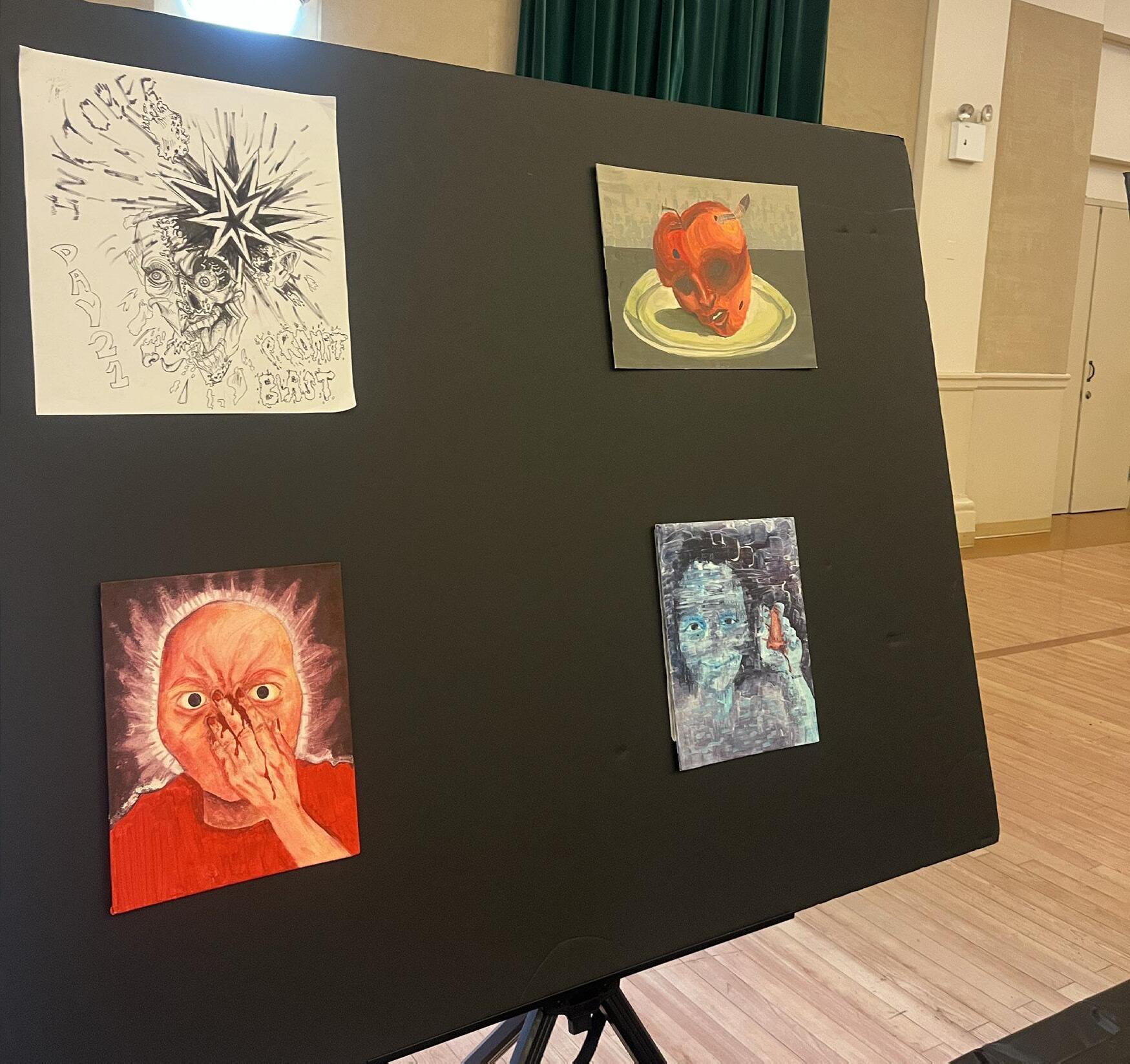
“This piece is an apple with a face on it and a worm coming out,” Guzman said. “I really wanted to do something ‘dreamscape’ esque, like something that you’d see in one of your dreams or a nightmare … I wanted to make it uncanny. I like to make a lot of my works uncanny. It’s just more fun.”
Guzman emphasized her interest in making “uncanny” style art, as it appears to be a style that is unique in nature, and out-of-the-box. She spoke about two of her other paintings, which were “pair” pieces, meaning they told a story together.
“My last two are pair drawings,” Guzman said. The title is, ‘Got your nose,’ and you can see there is a part one and a part two, so it tells a story.”
The painting on the left
demonstrated a nightmarish, pale face, with bulging eyes and a bloody hand that appears to be covering the nose area. The second photo, to its right, is of a blue, shadow-like face, grinning eerily while holding what appears to be the nose of the figure in the left painting. These pair paintings were a physical representation of the phrase “got your nose,” but with an uncanny twist.
Sanctus Artem has high hopes in continuing these types of exhibitions going forward. While Haas is graduating this spring, he is sure that the rest of his board members will carry on the tradition in the years to come.
“All of our current E-board members are highly interested in being on the E-board again next year, so I’m sure that they’re going to take the reins and continue this next year,” Haas said. “Maybe making it even bigger and better than this time.”
Guzman’s “Got Your Nose” pair paintings pictured on the bottom row. LAILI SHAHRESTANI / THE QUADRANGLE
Laili Shahrestani
arts and entertainment
Lost Stories of the Holocaust Exhibit Opens at Manhattan University
unable to attend the opening. The couple eventually donated the sketches to the university’s development office, which connected them with Afridi.
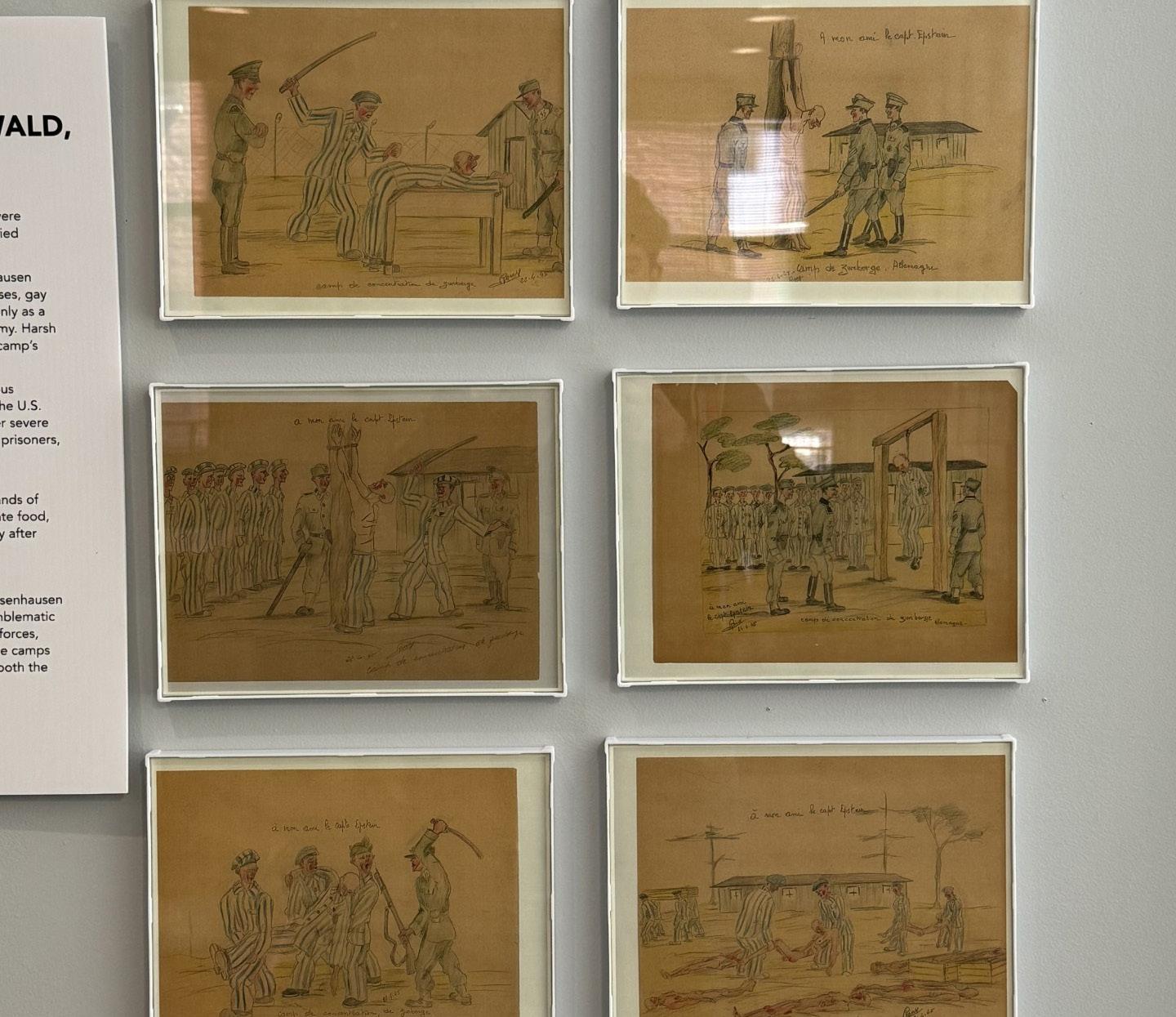
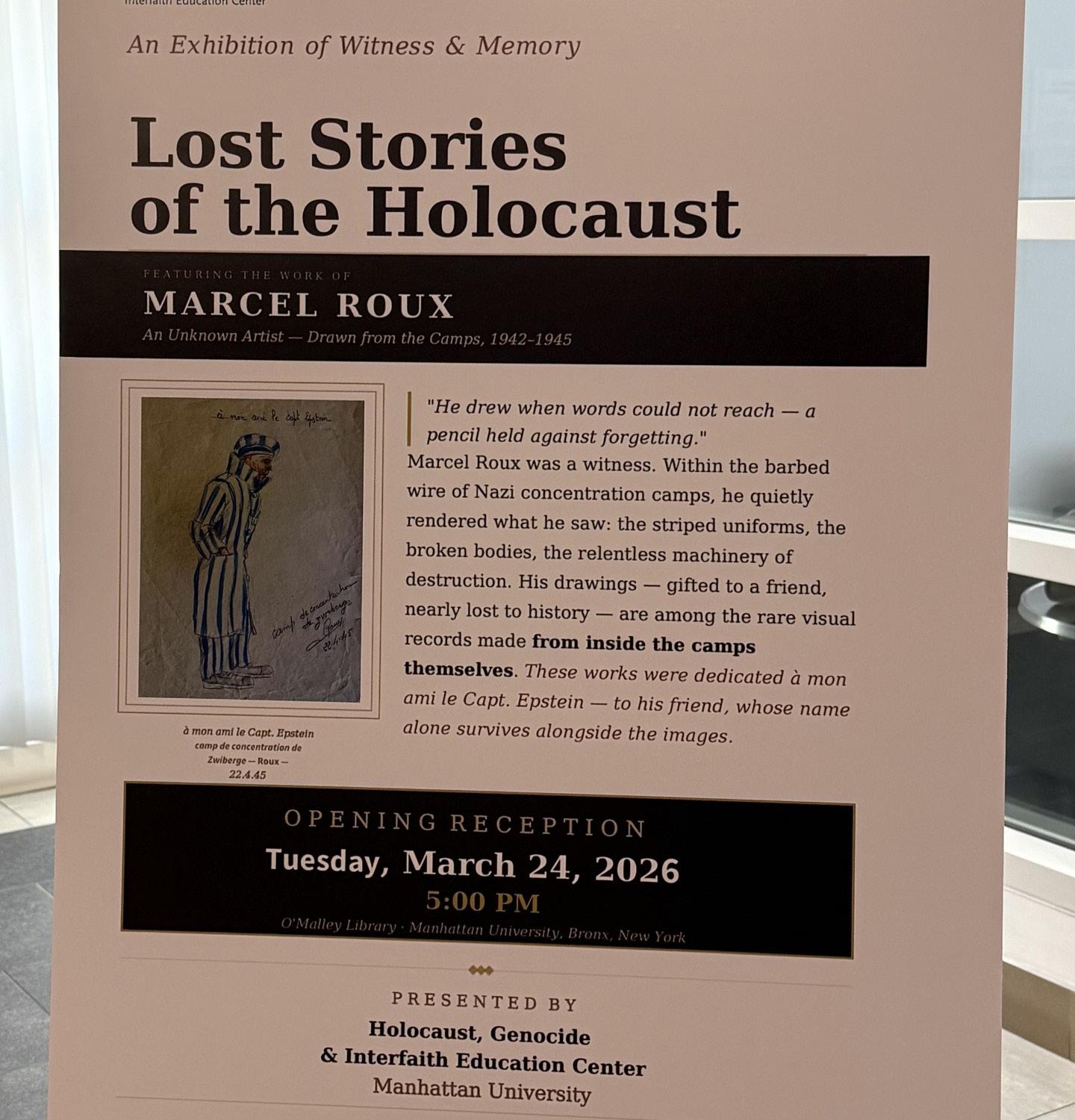
A new art exhibit at the entrance of O’Malley Library is bringing a largely unknown chapter of Holocaust history to the Manhattan University (MU) campus, featuring over 20 graphic sketches by Marcel Roux, a member of the French Resistance who was imprisoned in concentration camps during World War II.
The exhibit, titled “Lost Stories of the Holocaust,” was curated by Mehnaz Afridi, Ph.D., director of the Holocaust, Genocide and Interfaith Education Center at MU. It opened March 24 and will remain on display through April 17.
The story behind the sketches is as remarkable as the artwork itself. Helene Orce and her husband discovered the drawings preserved in a satchel inside a closet of their Westchester County home after moving in over 30 years ago. The sketches bore the inscription “To my dear friend, Captain Epstein,” written in French — a dedication to Dr. William Epstein, a U.S. Army field hospital captain who helped liberate Roux from the Langenstein-Zwieberge concentration camp.
Orce’s husband, Ken, a MU alumnus and retired lawyer, is now living with Alzheimer’s disease and was
“What’s specifically really unique about Roux is how quickly he did this in such a short time,” Afridi said.
Afridi said she was immediately drawn to the story when she first encountered the sketches. She was particularly struck by Roux’s identity as a non-Jewish victim of the Holocaust — a Protestant French resistance fighter — and by the bond between Roux and his American liberator.
“I think it’s more important that non-Jews learn this story, and that they understand that not only Jews were victims,” Afridi said.
While curating the exhibit, Afridi said she discovered a sequential narrative running through the sketches. Arranged along the right side of the exhibit space, the drawings walk viewers through the daily experience of camp life — from the Appell, or morning roll call, to forced labor, to the brutal consequences faced by those too weak to work.
“I noticed a sequence in his sketches,” Afridi said. “It starts with one, which is the Appell — that’s the roll call they used to have in most camps. And then the second one is they used to get fed. And then the third one is they were taken to labor. And then it shows how, if you weren’t doing labor, you were
tired or weak, you were actually beaten and sometimes hung to death.”
Afridi also placed reflection questions on the walls of the exhibit, inviting students to think critically about the issues the sketches raise.
For some students on campus, the exhibit has already made an impression.
Ian Cortez, a freshman finance major, said walking past the display on his way into the library stopped him in his tracks.
“I didn’t know much about the Holocaust beyond what I learned in high school,” Cortez said. “Seeing it shown through someone’s actual drawings makes it feel real in a way that reading about it doesn’t.”
Leighton Barton, a freshman civil engineering student, said the exhibit reminded him why history classes matter.
“It’s easy to think of historical events as distant,” Barton said. “But these sketches were made
by a person who actually lived through it. That’s a completely different kind of learning.”
Afridi said the exhibit is also meant to challenge common misconceptions about the Holocaust — chief among them, that it was solely a Jewish tragedy. While six million Jews were murdered, Afridi emphasized that approximately five million additional victims, many of them political prisoners, resistance fighters and others targeted for opposing fascism, are far less discussed.
She also pointed to the role of the United States in the story as a deliberate choice. Captain Epstein’s presence in the narrative, she said, is a reminder of American democratic values at a time when those values feel increasingly fraught.
“We were once the liberators and not the oppressors,” Afridi said. “I think that’s an important message — that we need to maintain our democracy, our democratic human rights values as we hopefully progress
and not regress.”
Afridi said the exhibit has drawn significant attention since its opening, including coverage by The New York Times. She is also continuing to research Roux’s story and has been contacted by individuals with personal connections to the same field hospital where Epstein served, including a woman whose father also possessed a sketch by Roux.
“There’s all these different stories coming out,” Afridi said. “It’s almost like I’m starting this whole process of actually making it more of a historical site for people to understand.”
Students interested in visiting the exhibit can find it at the entrance of O’Malley Library before it closes April 17. Additional information about Roux and the exhibit, including footage from the opening and the New York Times article, is available at HGImanhattan.com.
A placard for the exhibit.
EMMANOUEL SOFILLAS / THE QUADRANGLE
Emmanouel Sofillas
Asst. Sports Editor
Photos of the exhibit.
arts and entertainment
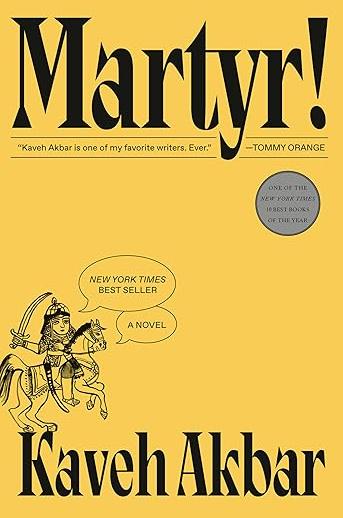
Book Nook: “Martyr!”, by Kaveh Akbar
In 2024, Kaveh Akbar published his debut novel, “Martyr!” Akbar is an Iranian writer with extensive experience writing poetry and is known for “Calling a Wolf a Wolf and Pilgrim Bell. Martyr!” is a tragic yet beautiful and lively story of a human search for meaning, dealing with difficult subject matters of substance abuse, suicide, war, and violence.
“Martyr!” is a thoughtprovoking novel that brilliantly depicts human struggles with the often oversimplified reality of grief and depression, as not only a period of gray over the mind, but an experience, with moments of sadness, laughter, guilt and forgetting that do not undermine the significance of the pain but speak to its humanity.
The work of fiction follows primarily the perspective of the main character Cyrus Shams, a queer man and a firstgeneration Iranian immigrant who moved to rural Indiana with his father, Ali Shams, shortly after the death of his mother Roya Shams on July 3, 1988.
Roya Shams was killed by the United States Navy after they shot down a commercial airliner on which she was a passenger, flying from Tehran to Dubai. Inspired by the real events of Iran Air Flight 655, which was shot down by the United States Navy warship USS Vincennes on the same name and date as in the novel.
The fictional Cyrus Shams has perpetually questioned the significance of 290 deaths rather than 289, reckoning with why his mother had to die, developing a lifelong obsession
with the idea of lives and deaths with meaning, specifically the concept of martyrdom.
Cyrus Shams is a poet who works as a medical actor, performing sickness and injury for medical students to practice on. Cyrus also struggles with alcoholism and drug addiction, misusing fentanyl on multiple occasions. In addition to this, Cyrus has chronic suicidal ideations, only moving towards sobriety after an incident when he attempted to light himself on fire while drunk in the bathtub of his apartment, only stopping when he realized others would be affected by the fire.
The novel explores the significance of being marginalized in a place that treats you as the “other.”
In his battle to maintain his sobriety, Cyrus is in attendance at an Alcoholics Anonymous meeting when another person wrongly diagnoses his identity as irrelevant to his addiction. However, as anyone who has ever felt eyes on them for simply walking into a room or had their presences in said room be challenged due to the observation that they are in some way different can attest to. Identity in itself is not the cause of suffering, but the world’s response to that identity regardless of how harmless, innate and arbitrary impacts not only how you are treated in life but how you go through life.
In Cyrus’ case, following his mother’s death, his family was compensated with $150,000, the compensation the United States gave for families who lost women and children, half of what those who lost working men received. Even while granting compensation, the United States refused to claim responsibility for its actions, saying it was selfdefense, and stating, “Action is defended.” 290 people died on the commercial flight, primarily women and children, and the action was justified as self-defense in both the novel and reality by the United States Navy.
In childhood, Cyrus suffered from nightmares, eventually finding the only thing to help him sleep would be writing stories in his mind of what people and characters he liked would say to each other if they ever met. Years later, he would rely on narcotics to sleep, only returning to this dream game in sobriety. During
“Martyr!”, Cover art by Linda Huang, published 2024. AMAZON.COM / COURTESY
his adulthood, Cyrus travels to meet an artist who is part of an art exhibit at the Museum of Modern Art, Orkideh, who is dying, is part of the piece “DEATH-SPEAKS,” and Cyrus wants to speak to Orkideh about dying with meaning. Cyrus’ mother was on the way to visit her brother Arash in Dubai when she was killed. He had long been struggling mentally after being drafted into the war with Iraq. In the Iran-Iraq war, he had a unique role. After battles, he would ride in on horseback with a long coat and flashlight
so dying soldiers could pass more peacefully and would be dissuaded from suicide; he was to be their angel.
From Arash’s perspective, he saw illuminated mass death and suffering. Earlier in the novel, Cyrus recalls that during the war, in the city of Isfahan, soldiers would come to the doors of women and mockingly declare, “Congratulations, your sons have been martyred,” while the women tried not to cry.
Even in sobriety, Cyrus’ obsession with martyrs is often paralleled by the reminders of Sham’s fixation on deaths
having meanings. The macabre expression of his own ideation and desire for his own death having meaning, is repeatedly demonstrated through the novel in many ways, in his own words to a dying artist, Cyrus says, “I’ve been about dying… dying soon.”
There is so much more to this story than this review describes, and for those who find this analysis interesting and the subject matter is not too painful, reading this novel is a beautiful experience.
Zendrah Bonnick Asst. News Editor
sports
Manhattan’s Inaugural VolleyballMen’s Team Is JustStartedGetting
Zeke Jazwinski Sports Editor
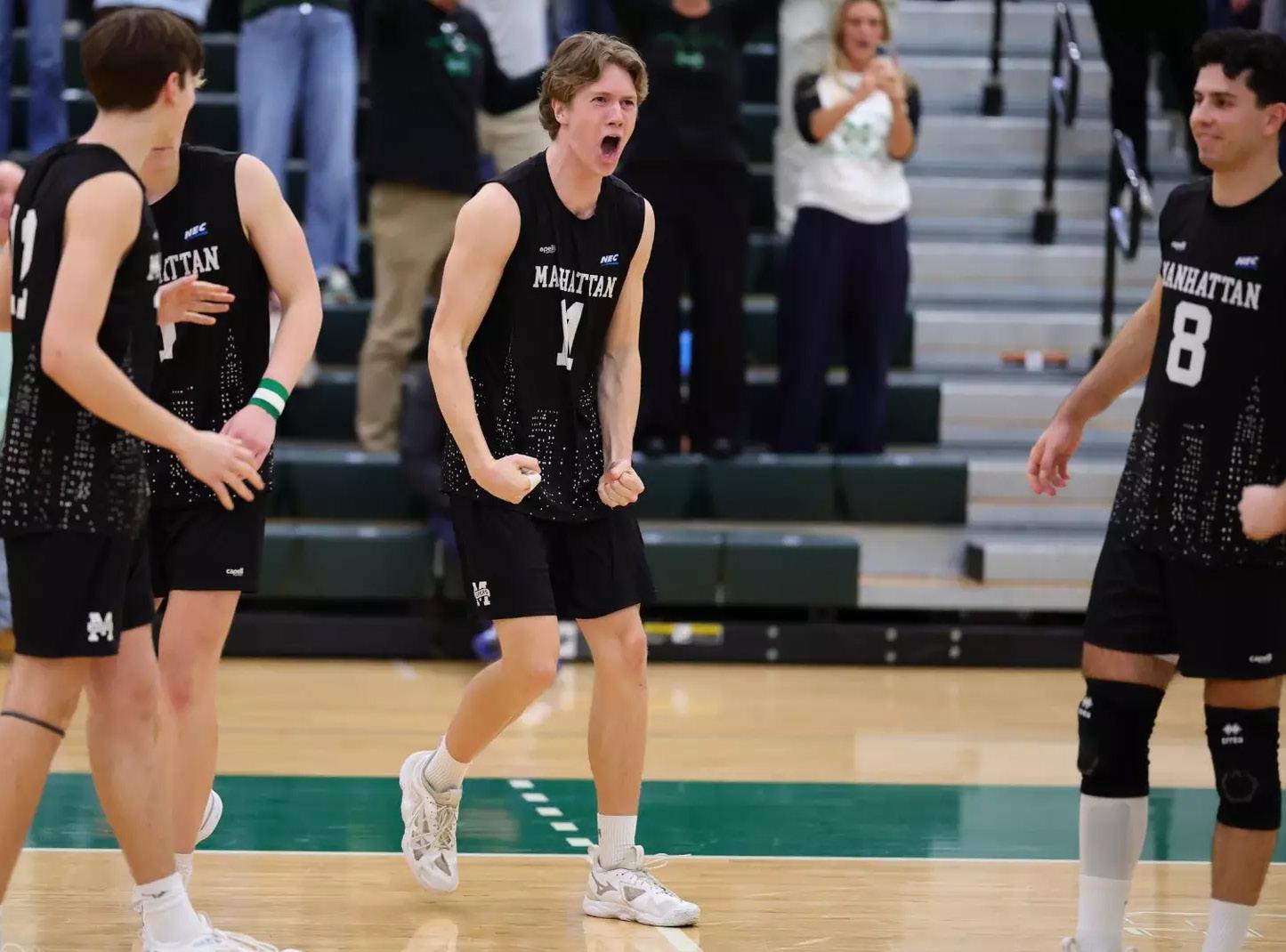
Manhattan University’s men’s volleyball has had a strong finish to their first inaugural regular season. This has been a solid first season for the Jaspers - after a shaky start, they picked up steam by sweeping FDU and D’Youville. These wins helped to steer the ship in the right direction. Starting a new sports program can be challenging, and picking up wins against programs that have been around are a huge help to establishing the team. The Jaspers hope to use this as momentum to keep on building from this season and be even more successful in years to come.
Men’s volleyball has been one of the fastest growing sports, according to the American Volleyball Coaches Association. “For the 202425 academic year, the NFHS reports 95,972 total boys volleyball players participated in high school volleyball. This amount is up 10,717 from last year for a 12.57% growth.”
It’s no surprise with Manhattan University looking to grow and compete, that men’s volleyball would be introduced to the university. The talent and interest are apparent, and so this was a great job by the university to seize the opportunity with the sport. The Jaspers have been traveling all around the country, competing in their first season. As the sport continues to grow, the Jaspers will be able to host more games at home in Draddy Gymnasium.
The Jaspers looked to close out their last home game with a win against Saint Francis on Saturday. According to GoJaspers, “The Red Flash shrank its deficit to as little as
Manhattan looks to use this win as momentum going into playoffs. GOJASPERS.COM / COURTESY
two. Still, a service error and a kill from Patchell were the deciding factors for the Green and White securing a muchneeded victory and snapping a three-match losing skid in conference play.”
Wins like the one against St. Francis can really help build the program. The Red Flash were one of the top teams in the conference, so to see the Jaspers be able to compete and win against them helps build recognition for the program’s efforts. The Jaspers get to let this win soak in as they have a two-week break before
they play the Red Hawks of the University of MarylandEastern Shore. The Jaspers will hope to keep that momentum rolling in that game and carry it over to the NEC Men’s Volleyball Championship later this month.
The Jaspers currently sit in third place, only trailing St. Francis and FDU, two teams the Jaspers have previously beaten. A big reason for the success is the rookies. According to NEC Sports, “Freshmen Xander Horst recorded 7 total blocks (2.33 blocks per set) and also added 5 kills (1.67 kills per set)
while hitting .333 in a 2-0 week for the Jaspers.” The Jaspers may be a team built with young players who have, for the most part, never stepped onto a collegiate volleyball court before, but they are making noise in the conference. The step up in speed and strength hasn’t been too much for the young guys to handle. The Jaspers have proven throughout the season that they can battle with the top teams, and they are getting hot at the right time.
Games of the Week
Brooke Della Rocco Senior Writer
With a series of very close games throughout last week, the Manhattan Jaspers pushed forward to tackle new competitors.
Women’s Lacrosse
Manhattan University’s women’s lacrosse team lost their match against Sacred Heart University last Wednesday. Despite a strong offense throughout the entire game, scoring a goal in each quarter, it ultimately was not enough as they finished 9-8.
Freshman Ella Brunette was a standout in the match, with three goals scored, adding the game to her six other games with three or more goals. Additionally, Brunette tallied the first assist in her collegiate career.
In the ending half of the first quarter, Brunette and sophomore Meghan Wendler scored goals just 30 seconds apart from each other, overtaking a 3-1 lead.
In the second half, Sacred Heart’s Pioneers scored four consecutive goals, making the score 3-5. Brunette’s third goal was made in the final quarter, but was not enough to tie up the score, 9-8.
Freshman Logan Pillon had a fantastic game with three assists, a new career high, which makes her the player with the highest total assists for this season. Junior goalkeeper Sophie Pasnak also was a standout, with nine total saves across the full 60 minutes.
Manhattan’s men’s lacrosse team also suffered a loss to Merrimack on Friday morning. With a score of 11-9, the
game started off with strong aggression from the Jaspers, scoring three goals early on.
As the game went on, Merrimack overtook control, scoring four goals within the last 11 minutes.
Sophomore Thomas White was a clear standout, scoring three of the nine points from Manhattan.
Baseball
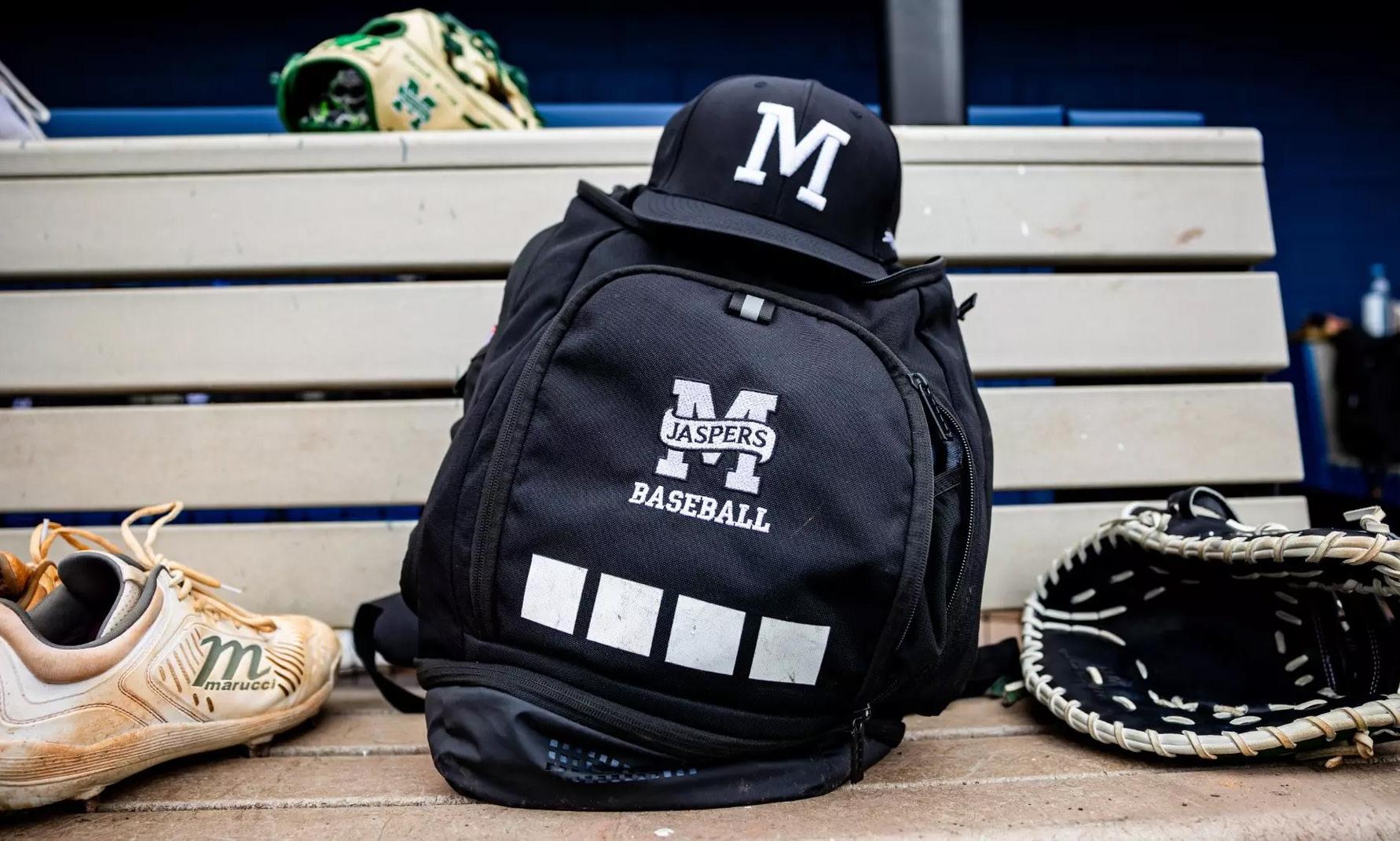
Manhattan’s baseball team had a busy week with three games, one of which was a slim loss. Their Wednesday away game against the Lafayette Leopards was a close one, with a final score of 6-5.
The first inning proved to be a strong start, with three runs scored. An RBI single sent into right field by Andreaus Lewis pushed Jeremy Sosa across home plate, and Vincent Samuel scored the second run off of Trevor Hansen’s sacrifice fly. With two Jaspers on second and third base, Dylan Mayer sent a base hit down center to bring in the third run.
The Leopards hit two runs across three innings, and the Jaspers hit their stride in the fifth inning again. Both teams were tied up 8-8 heading into the final inning, where the Leopards took it, scoring one more run to end the game.
While a devastating loss, Mayer proved to be a strong asset to the team with a total of three hits across the game, the most out of his teammates.
On Friday, the Jaspers began their three-game conference series against Sacred Heart University.
Both games on Friday were losses, with scores of 7-8 and 7-22. The Jaspers fell behind pretty early in game one with the Pioneers scoring six runs. Senior Trevor Hansen showed out in the early innings, hitting a two-run home run while also
events and scoring points in two others.
putting up a double in the ninth inning. Ultimately it was not enough to claim the win, as the Jaspers turned their focus to game two.
Game two was an aggressive battle, with the Pioneers remaining on top. Hansen continued his successful afternoon by securing three hits for the Jaspers, with junior Josiah Brown entering the game as a pinch hitter to secure a ground-rule double down the right field line. The Pioneers
purely had a higher amount of hits by the end of the game to win it.
Track and Field
Manhattan’s women’s and men’s track teams took on the Metropolitan Outdoor Championship on Friday, with more details coming soon.
On the women’s side, Camryn Daley, Oliviah Hussey, SaRae Kennard and Tranira Booker took home first place for the 4x100-meter relay race, with a time of 47.75 seconds.
Freshman Kayla Darius proved to be a standout by finishing second place in the women’s triple jump with a mark of 11.55 meters.
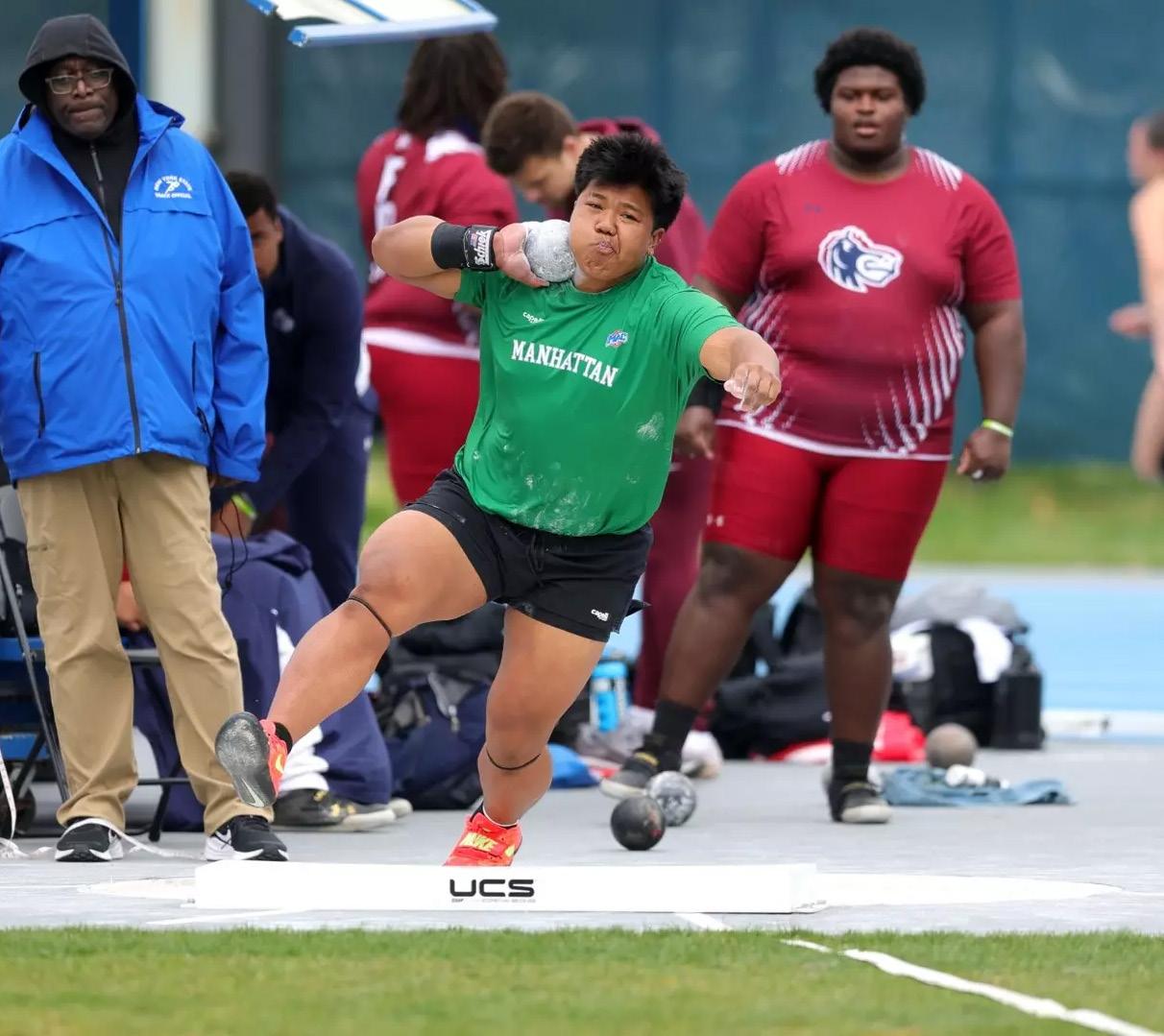
For the men, Myron Corpuz captured first place in the men’s hammer throw with a mark of 53.57 meters. Corpuz didn’t stop there, winning the men’s shot put with 14.66 meters and finishing in eighth place for the men’s javelin throw.
Softball
Manhattan’s women’s softball played Quinnipiac twice on Friday afternoon, unfortunately bringing home losses.
In game one, Quinnipiac came out strong, scoring quickly while Manhattan secured two singles from Samantha Kelly and Lainey Brown, even though they were both caught stealing second. The most offensive momentum
from the Jaspers was seen in the fourth and fifth innings where two straight singles were hit.
Game one ended 6-0, with the Jaspers unable to secure a run.
In game two, Manhattan was determined to make a comeback after their loss. The Bobcats used a similar strategy as game one, scoring early on. Freshman Kaitlyn Moody secured the first hit for the Jaspers in the second inning. In the top of the fifth, Angelina Gencarelli hit a oneout single. Then, Kelly hit a groundout which shoved Gencarelli across home plate to score the first run for Manhattan.
The game ended 10-1.
Myron Corpuz was a stand-out athlete at the Metropolitan Championships, winning two