the Quadrangle
Volume CXI, Issue 2
NEW YORK, JANUARY 28, 2025

MUGreenClubHarvestsFrom HydroponicFarm
HerbsfromthefarmareusedbythechefsinLocke’sLoftandaremaintainedby student volunteers.
@MANHATTANUEATS / INSTAGRAM

Volume CXI, Issue 2
NEW YORK, JANUARY 28, 2025
HerbsfromthefarmareusedbythechefsinLocke’sLoftandaremaintainedby student volunteers.
@MANHATTANUEATS / INSTAGRAM
Mary Haley
Asst. Features Editor & Marketing Chair
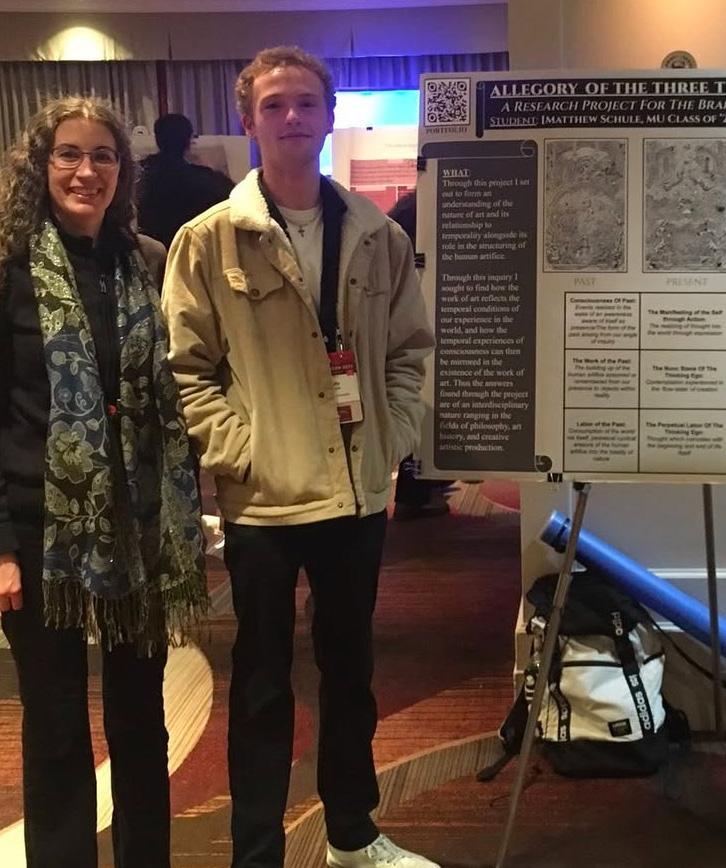
Manhattan University senior, Matthew Schule, got the chance to present his eleven-month long research at the American Philosophical Association’s (APA) annual conference of their eastern division in Manhattan from Jan. 8-11.
Schule’s research project, “Allegory of the Three Temporal Ekstasis,” was inspired by the ideas of Hannah Arendt and Jean-Paul Sartre, two prominent philosophers who were best known for their ideas of totalitarianism and existentialism.
After taking a roots philosophy class with Sarah Scott, Ph.D., and learning more about of the ideas of Arendt and Sartre, Schule felt especially inspired to submit a proposal
Wafa Elmannai Voted as Department Chair pg. 4
for research to the Branigan Scholars Grant, which aims to, “promote undergraduate research in the humanities by awarding several grants per year in excess of $3000 each for student-initiated projects,” according to manhattan.edu.
Brian Chalk, Ph.D., along with five other faculty members, is on the committee of the Branigan Grant. He and the other members review these proposals and award students with the grant according to specific guidelines.
“We look for a researchable question, meaning a question that the student is asking needs to be sufficiently attuned to what’s going on in their chosen field,” Chalk said. “This is to make the contribution part of a scholarly conversation that’s taking place, while also being a unique contribution in that discourse.”
Schule’s research explores the relationship between
art, reality and time, using a triptych format to represent past, present and future. He was particularly interested in Arendt’s idea of “the life of the mind” and Sartre’s take on nothingness. Fusing them together, he created the basis of his proposal.
“She [Arendt] calls it the realm of the thinking ego, when you’re sort of in your head, you’re pretty much nowhere,” Schule said. “Like when you’re lost in thought, you’re not really anywhere. It’s sort of this timeless place. Using that infusion with Sartre’s ideas of nothingness and how, pretty much self consciousness is a nothingness, I was seeing how there were parallels between the two authors.”
In order to get this idea across, Schule took a somewhat unconventional route. As an art history minor and an artist
CONTINUED ON PAGE 3
range of work environments,” Patterson said.
Due to a large grant from Masterclass and a partnership with the James Patterson Honors program, students and employees received a year’s membership in the Masterclass streaming platform. The membership expires on Jan. 30, 2026.
Masterclass is a streaming service that gives students and faculty members access to video lessons from some of the biggest names across multiple industries. Some categories include acting and performing arts, business, music, health and wellness, writing and more.
Associate Provost Bridget Chalk mentioned that after the announcement of the James Patterson Honors Program at Manhattan University, Masterclass reached out to Patterson about its desire to honor MU with a grant, as Patterson was one of the founding talents at the company. His creative writing course is known as one of their signature products.
In a statement to the Associated Press, Patterson spoke about his goals for the new honors program and what he sees this program doing in the future.
“Our goal in this leadership program is to provide a solid foundation in the critical areas of writing and creative problem solving coupled with a robust professional preparation and exposure to leaders in a wide
Chalk believes that this grant aligns greatly with the university’s mission as Masterclass courses are aimed to facilitate a spirit of lifelong learning.
“To take a master class course, you don’t need to be enrolled necessarily in a program here or anywhere,” Chalk said. “You can be a high school student, you can be a retiree, or anywhere in between, and you can learn through masterclass … I think that the desire to be a life model learner is something we seek to instill in our students at Manhattan College [University] as part of our mission and I think Masterclass as a concept is aligned with that.”
Chalk also discussed how she believes these goals and objectives align with the James Patterson Honors program, specifically, the speaker series the program will offer.
“One of the signature elements of this program is going to be a speaker series with the same sorts of elite leaders across industry and society coming to speak to the students at Manhattan University, not just those in the Honors Program, but all of our whole community,” Chalk said. “In some ways, Masterclass is an extension of that concept. These leaders are coming to further instruct students and the larger community in whatever their career paths have looked like.”
CONTINUED ON PAGE 3
Guest Speaker Gives Lecture on the Armenian Genocide pg. 6

MU Players Collab with Media Network for New Project pg. 8
Will Sydnor Snags MAAC Rookie of the Week pg.
Volume CXI, Issue 2
JANUARY 28, 2025
The Editorial Board
Grace Cardinal Editor-in-Chief
Emmanouel Sofillas Managing Editor
Brooke Della Rocco News Editor
Laili Shahrestani Features Editor Mary Haley Asst. Features Editor
Leyla Mercado Arts & Entertainment Editor
Andrew Mannion Sports Editor
Dear Readers,
Hello, and welcome back to another week of journalism!
Asst. Sports Editor
Barbara Vasquez Production Editor
Mary Haley Marketing Chair
Ivy Jaep Production Editor
Editor
Faculty Advisor
About The Quadrangle

A tradition since 1924, The Quadrangle is a news organization run by the students of Manhattan University. We strive to cover news around campus and the greater community, publishing weekly in print and daily online. Our goal is always accuracy, relevancy and professionalism.
The opinions expressed in The Quadrangle are those of the individual writer and do not necessarily reflect the views of the Editorial Board, the University or the student body.
Join The Quadrangle
The Quadrangle’s staff holds weekly open meetings on Tuesdays at 4 p.m. in Kelly Commons Room 4.12. All are welcome to come and join the club.
Connect with The Quadrangle mcquad.org @mu_quad @mu_quad mcquad




I hope all of you on campus are settling into the year nicely and have found your groove, balancing work and the things that reenergize you. I know it certainly took me some time, but I’m back to divvying up my days between the things that both need my attention and help me the most (an easier task said than done).
Speaking of getting back into the groove of things, I want to give a quick reminder for you all to follow us on social media and sign up for our weekly newsletter, the JasperJist, if you have not already. Our socials are where you’ll find featured content (as well as some bonus announcements!) and JasperJist sends all of our stories directly to your inbox each Thursday. We can be found on Instagram and X @mu_quad, and you can sign up for our weekly newsletter here. We promise, it’s worth it! On this same note, if you ever want to contact us, our email is thequad@manhattan.edu. We check it regularly and are always happy to connect with our readers.
Issue 2 has some truly great stories in store for you this week. While editing, I have to admit that the outstanding achievements and projects our students are completing motivated me to push myself just a little harder in the things I do each day. In news, we discuss MU’s generous grant from Masterclass, senior student Matthew Schule presenting research at the annual APA conference and the new chair of the Department of Electrical and Computer Engineering. In features, we cover a first-year student vision board event, alongside the HGI center on campus hosting a lecture on the Armenian genocide. In A&E this week, we cover a very exciting collaboration between Manhattan Media Network and Players, provide an update about all that’s new with performing arts, and bring you a brand new Book Nook review for those of you who are trying to do some more reading in the new year. Lastly, in sports, we cover Thursday night’s men’s basketball game against Fairfield and Will Sydnor’s third MAAC Rookie of the Week title. We hope you’ll check it all out!
Until next time,
Editor-in-Chief
CONTINUED FROM PAGE 1

Images of various speakers who are available on the Masterclass streaming service.
William Walters, executive director at the O’Malley Library was approached about the idea of making Masterclass available on the library webpage. Walters was completely open to the idea as it is an aid for information research. He wanted to make sure that it was available to students in an easy, seamless way.
Walters praised the information technology department for allowing Masterclass to use single signon for students. The original idea was for students and faculty to each get an email on how to sign in, which would include a unique link for the specific person. The single sign-on feature to Masterclass could play a tremendous role in making the program more accessible for students and making sure that students are
aware of the seminars available.
“We are trying to make sure everyone knows about it,” Walters said. “We’re going to highlight it on the library webpage. We’re gonna put it on our social media. Marketing and Communication have their plans as well for their social media. We’re gonna work together on advertising it in terms of making good use of it. I like it in terms of how students can use it to help in their classes.”
Based on the data that the associate provost’s office will receive in about six months, they can ask Masterclass for an extension. There have been requests made by alumni to be able to have access to Masterclass as well. With this addition of Masterclass, the brand of MU will continue to grow.
“Masterclass has pretty
great name recognition, and I think the fact that they’re partnering with us shows that we, too, are growing our brand,” Chalk said. “We have a well-established brand in our region, but Masterclass is not only a nationwide but a worldwide brand. Manhattan University is also looking to expand our footprint and our reach. I think that Masterclass is a way of showing the beginning of that expansion.”
CONTINUED FROM PAGE 1
himself, Schule used his usual medium of pen and paper to convey his ideas rather than the traditional essay that is written for a research project. From there, he was able to settle on the idea of time.
“I kind of knew that I wanted to do a triptych, which is three works of art connected as one,” Schule said. “From
there, I just went into thinking about different sets of three. And I kind of settled on things like past, present [and] future. I was just very interested in time and how art relates to [the parallels].”
The triptych features three pieces of art, with a chart on the bottom further conveying the points that each drawing is

making.
As for the APA meeting, Schule explained to The Quadrangle that presenting his work to a group of professional philosophers was a validating experience to his project.
“Some professors at the APA didn’t even read the paper, but just from talking with me and looking at my poster, they were able to ask questions that were so in depth that gave me the chance to really talk about the project,” Schule said. “In a way that was like, ‘Oh my gosh. This [project] wasn’t just a waste of time.’”
Scott explained in an email to The Quadrangle how this reflects the caliber of MU’s philosophical studies.
“In terms of the impact of the presentation on our reputation, this helps to give the sense that MU is among the better places to study philosophy in the country,” Scott wrote. “[It] isn’t just about the number of prestige or professors but more about our care for students and support of undergraduate research versus larger places that focus only on graduate research.”
Mack Olmsted Senior Writer
Over the winter break, it was announced that Wafa Elmannai, Ph.D., will be taking over as the new chair of the Department of Electrical and Computer Engineering. Professor Robert Mauro, Ph.D., announced through an email to the department that he would be stepping down as chair and return to full-time teaching for the current spring semester.
“Hope you all had a wonderful winter break and are looking forward to a successful Spring semester,” Mauro wrote in an email to the electrical and computer engineering department. “I am writing to inform you that I will be stepping down as Chair of the Electrical and Computer Engineering Department and will be returning to fulltime teaching starting in the Spring 2025 semester. For your information, Dr. Elmannai will be taking over as the new Chair of our department.”
According to manhattan. edu, Elmannai joined the
department of electrical and computer engineering at Manhattan University in 2018.
After receiving her doctorate in computer science and engineering from the University of Bridgeport in Connecticut, she started out as an assistant professor. Elmannai’s main research interests include mobile communications, wireless sensor networks, design of mobile applications, computer vision and health assistive devices.
Adjunct professor Angelo Devito spoke to The Quadrangle and explained Mauro’s decision to step down. Devito mentioned that Mauro has helped benefit the department in his time as chair, and how the department voted unanimously for his successor, Elmannai.
“We went through a nomination process, and I believe it was unanimous that she was at the top of the list,” Devito said.
Moving forward, Elmannai will be in charge of running and managing the department. This includes dealing with faculty and student situations as well as being involved in everyday aspects of the department, answering to the dean and
participating in the different responsibilities set forth by the vote-in.
Devito explained how he has been with the department for many years and how he has always been satisfied by the past chair’s treatment of the faculty. He explained how he feels very confident that Elmannai will do an excellent job and manage her role smoothly.
“I believe she will consider everything,” Devito said. “So I think she’s very open-minded. And I think the future of the department is headed in the right direction with her taking over as chair.”
Professor Mahmoud Amin, Ph.D., values Elmannai’s new role and explained to The Quadrangle the strength of the relationship between faculty.
“This transition will be seamless, and I am confident that the department will continue to thrive under the leadership of Dr. Elmannai,” Amin said. “She gets to be the new chair. It’s something I feel every one of us here [in the department] appreciates. We are all one family, and she’s one of the good faculty here…It’s good that she gets to lead the department at the current time, and we are happy to have her as

Wafa Elmannai, Ph.D. is the new chair of the Department of Electrical & Computer Engineering as of the start of the current semester. MANHATTAN.EDU / COURTESY
our chair. I’m looking forward to collaborating altogether to bring the department to another level.”
*Editor’s Note: Wafa Elmannai did not respond to requests for comment by the time of publication.

Kayla Werth Contributor
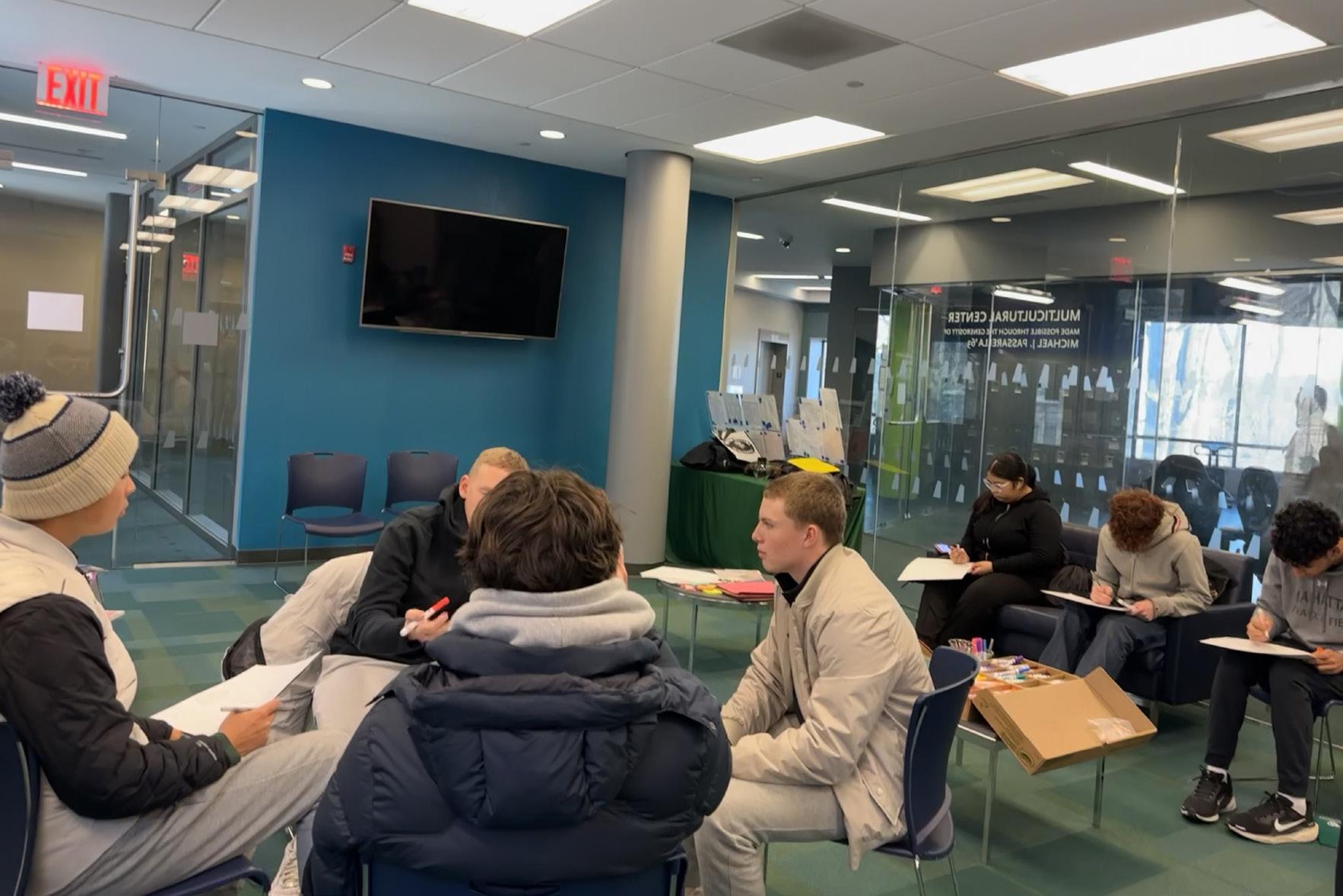
Manhattan University’s Office of Student Engagement provided first-year students with an opportunity to visually map out their goals for this spring semester. Melinda Wilson, Ph.D., recently joined the first-year experience administrative committee and led a vision board workshop on Jan. 23 in Kelly Commons.
During the workshop, Wilson emphasized the importance of setting goals and staying organized academically as well as in students’ personal lives. As part of the event, students received complimentary branded planners to assist with their organizational efforts. They were encouraged to take five minutes and to write down three to five concrete goals for
the semester. These written goals served as a foundation for their vision board.
Before students began designing their boards, Wilson shared the overall reasoning of why people create vision boards.
“It helps you to clarify your goals,” Wilson said. “When you have to represent them visually, it forces you to clarify them. It also increases your motivation and focus, because it is something you are going to see regularly.”
Wilson spoke with The Quadrangle about her thoughts behind organizing this event that aims to help students successfully plan for the semester.
“I think there are a few different elements that play into my decision to make it a vision board event,” Wilson said. “One is that I’m an incredibly visual person, and if you come into my office, I have a big cork board with lots
of visuals, like stickers and quotes and bookmarks. I just find when I go into my office every morning it’s something that feels positive to look at.”
Students used a variety of materials to create their own vision board, including photos from various magazines, markers, crayons and colored pencils. They were encouraged to keep building on their vision boards over the next few days and weeks as they settled back into life at MU. As crafting began, so did the conversations among one another about their goals. Wilson observed and remarked on the progress of the boards, making sure to interact with students and ask what some of their goals were for the semester.
Natalia Socha, a freshman majoring in mechanical engineering, spoke about her thoughts on having set goals.
“It definitely keeps you motivated,” Socha said. “I’m trying to make my vision board
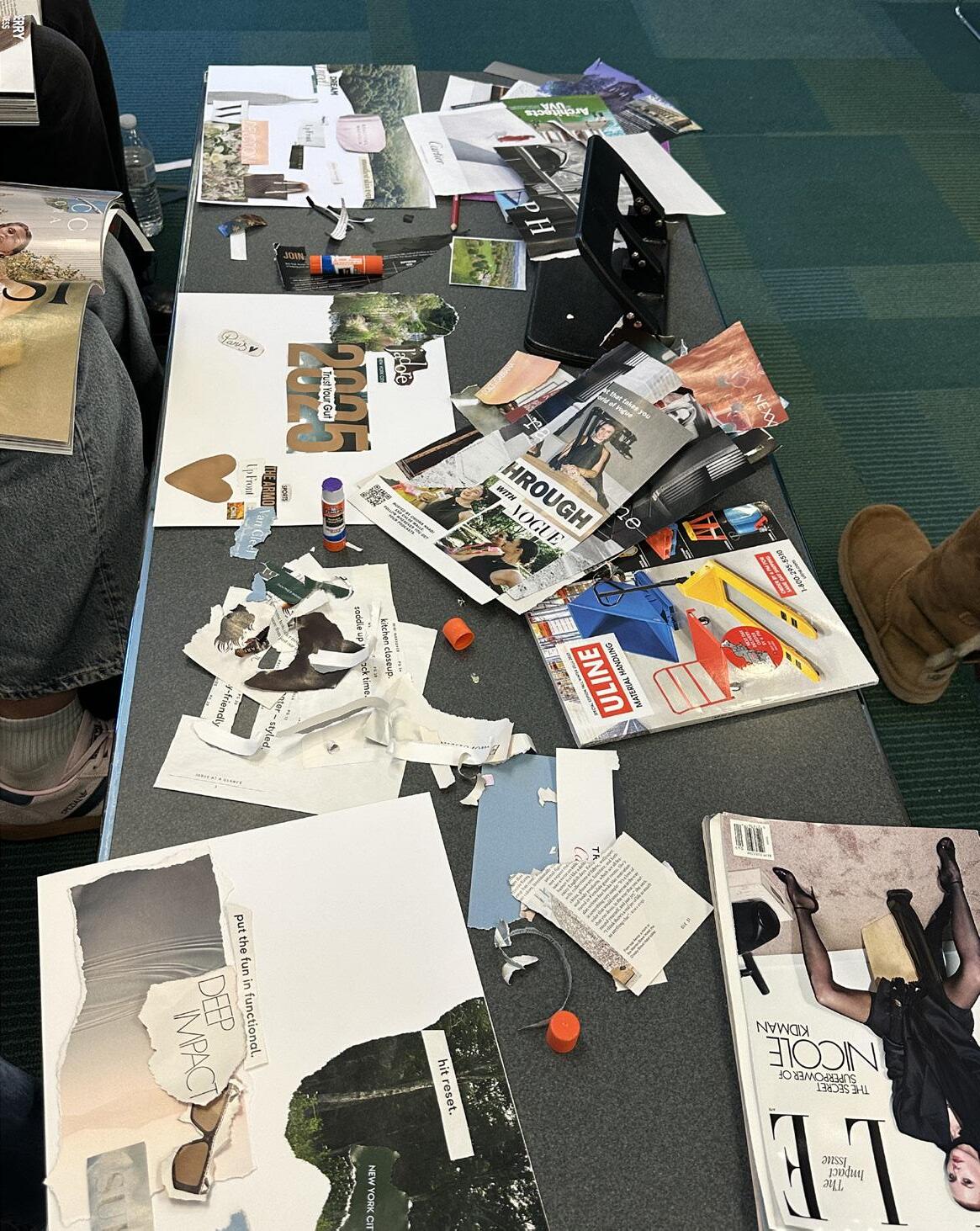
Magazines and supplies used to create and inspire vision boards.
KAYLA WERTH / THE QUADRANGLE
very pretty and appealing to look at, so that it keeps reminding me. I’m putting this up on my wall as soon as I get home.”
Every student had their own goals they wanted to achieve throughout the spring semester. These goals ranged from performing well academically to developing a better sleep schedule.
Aaron Huang, a freshman majoring in finance, shared his vision board goals with The Quadrangle.
“Have good health, play more golf, have a good career and maintain good grades,” Huang said.
Wilson wrapped up the event by speaking about her plans to continue hosting more
events aimed at helping firstyear students succeed during their time at MU.
“I’m really open to getting feedback and feeling out what other sorts of organizational activities like this one might be useful for success planning,” Wilson said.

Karen Flores Senior Writer
The Manhattan University Holocaust, Genocide and Interfaith Education Center welcomed guest speaker Asya Darbinyan, Ph.D., to lead a lecture about the Armenian genocide and the history behind it on Thursday, Jan. 23.
According to Britannica, the Armenian genocide was a campaign led by the Young Turk government which included the mass killing and deportation of Armenians within the Ottoman Empire during World War I.
Menhaz Afridi, Ph.D., a religious studies professor at Manhattan University and director of the Holocaust, Genocide and Interfaith Education Center, spoke with The Quadrangle about why she decided to host this event.
“This year marks the 110th anniversary of the Armenian genocide and I asked her [Darbinyan] if she would like to come and do something, and she said that she’d love to,” Afridi said. “She is from Armenia, and is part of a consortium that I was the cofounder of in 2017.”
Afridi teaches a course on religion and the Holocaust. She mentioned that during this class, her students look into various topics related to genocides throughout history.
“We’re covering the Armenian genocide, and we start with looking at what genocide is, then we look to Armenia, then we look to the Holocaust and also issues regarding race and religion,” Afridi said. “I wanted someone from the outside to come in and talk about how genocide is defined, because there’s so much on social media about this in terms of the Middle East.”
Pashka Durgaj, a senior mechanical engineering
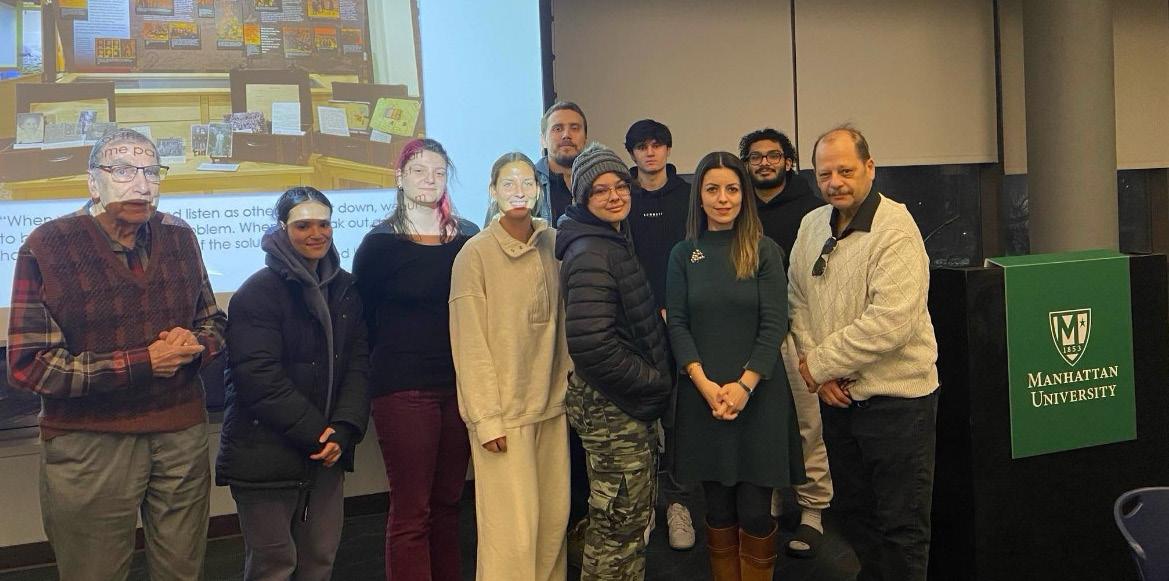
Speaker Asya Darbinyan, Ph.D. visits Manhattan University to lead a lecture on the Armenian Genocide in honor of the 110th year anniversary of the tragedy. ASYA DARBINYAN / LINKEDIN.COM
major, attended the event and reflected on aspects that resonated with her.
“The word genocide, the person who coined it, was inspired to find that word because of the Armenian genocide in particular,” Durgaj said. “I feel like this one is kind of swept under the rug, especially with the perpetrators not having a reporting of the correct amount of people that were actually killed. It starts with knowing the smaller things, and being able to recognize that those things makes us better equipped to stop it before it gets to the extreme point.”
Durgaj also mentioned that awareness is key when it comes to historical events such as these genocides.
“Awareness is very important, because it teaches people what behaviors not to repeat, [and] things that should be taken into account when mentioning the subject,” Durgaj said.
Afridi emphasized that these kinds of events are important for students to be
able to learn how to have their own thoughts and opinions.
“We’re a Catholic institution, we do a lot of peace work and interfaith work, but we also want to educate students with our own faculty with expertise,” Afridi said. “It’s an opportunity for my students to grow and to enrich themselves and to have their own minds and their own thinking about how they feel about a certain issue or topic.”
Durgaj said that having the chance to be educated about these devastating events is impactful, as it also showcases the resilience of those affected.
“A lot of people hear about such devastating tragedies, and such inhumane violence, so people may act very discouraged and think how there’s so much evil in the world, and little that they can do about it,” Durgaj said. “But being able to be educated, to have survivors and family members of survivors, along with people who become scholars that can fill the education gap about these places is a very impactful thing.”
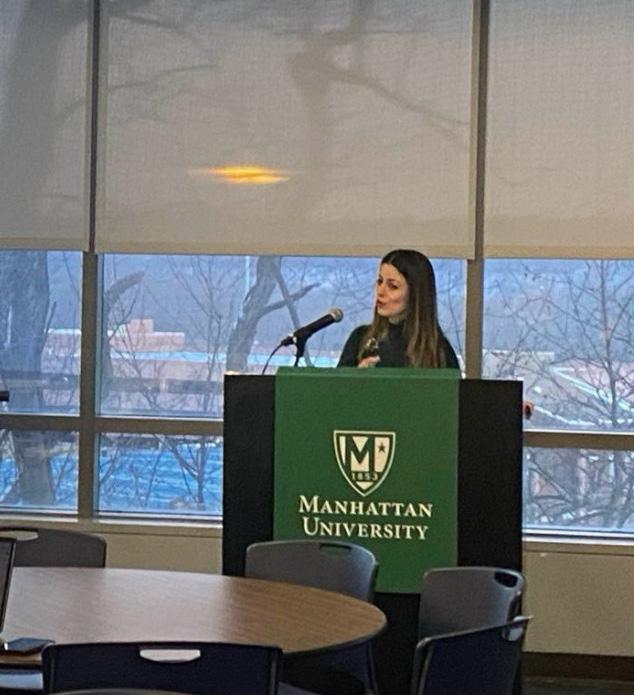
Speaker Asya Darbinyan, Ph.D. at the podium. ASYA DARBINYAN / LINKEDIN.COM
Flynn Myers
Contributor
The Clementine Complex, a fictional novel written by author Bob Mortimer, demonstrates that dry humor woven into a murder-romance makes for a fun read. For readers who enjoy blunt humor, awkward situations and a good mystery, this is the novel for you. The story follows Gary Thorn, a legal assistant in London, believed to be unremarkable, unwitty and nothing but a nobody. Though Gary proves to have an ordinary life, he is thrown into a rather frightening spin of romance and murder.
The first scene is set with Gary meeting his friend Brendan at a pub, Gary notices a beautiful woman across the bar sending him flirtatious looks while listening to Brendan ramble about work and his funky socks. Brendan leaves the pub to catch up on work, slipping a mysterious note into Gary’s pocket as he goes. Gary continues his night at the pub and makes a move on the woman. While it is revealed to readers that her name is Emily, Gary is left in the dark.
The mix between caustic humor from Brendan and the ominous behavior from Emily creates a very uncomfortable scene. I found that the mix between opposing behaviors helped develop the book and
made it more of an enjoyable read.
After Gary awkwardly makes his way across the bar, he sits in front of the woman and they both start to chat. Emily and Gary create an awkward buzzing banter about a book she has with her and her obnoxious bike outside. Their conversation is cut short when Gary leaves for the men’s room. Emily leaves the pub before he returns, leaving behind her book. Following his conversation with Emily, Gary decides he is in love with her.
Gary’s character contradicts itself often, displaying uncertainty and the need for balance, while also claiming recklessly that he knows that Emily is the one for him. The author writes Gary as a comic relief, who also has feelings and wants to fight for his new life, even being stuck in the past. Gary is a very easy character to connect with and is very realistic to me. I appreciated the focus of watching him grow as a character while also not changing the foundation of who he is.
The next day, Gary finds out from two individuals posing as cops that his friend Brendan had been murdered. To Gary’s displeasure, it is thrusted upon him to investigate his friend’s death and discover the killer, since he was in fact the last person to see Brendan. Gary attempts to set the record straight on his whereabouts, but is stopped by multiple barriers, such as fake cops, a
girl and a squirrel.
Brendan’s death serves as a great mystery and was intense while also comical. I was taken on many twists and turns while following along in the novel, which allowed more suspense and surprise. I was entertained by the way Gary viewed the mystery. He was reluctant to be the one figuring out his friend’s death because he himself couldn’t believe it, but all the while, he was also trying to clear his name which was very fun to read.
Throughout the novel, Gary shares light-hearted conversations with local squirrels in his town, while also walking his favorite neighbor’s dog. The author utilizes these conversations to present thought-provoking comments which I personally enjoyed. The squirrels are definitely an element worth highlighting in the novel that helped to build the murder case, but also illuminated Gary’s awkward sense of humor and unique life that he was creating.
The romantic part of the book, though not the main focus of the novel, spoke heavily on the two main characters, Gary and Emily - Emily being witty and running from her past and Gary’s unrelenting need for everything to stay just as it is. Throughout the story, readers see these two unlikely characters find commonalities through their awkward humor.
As Gary continues his pursuit of Emily and uncovering the mystery of

Brendan’s death, he is faced with his cowardly personality and his shortcomings. Gary gains acceptance of himself through daring moves, which brought the book to life for me.
The Clementine Complex was very funny while also threading in suspense. I appreciated the different elements as they wove together throughout.
The remainder of the novel is filled with dry
humor, mystery and fun. The novel itself offers many twists and turns, filled with a lightheartedness that was rather remarkable considering the subject matter. I would absolutely recommend The Clementine Complex to anyone looking for a light-hearted romance/mystery mix.

Victoria Schiller Senior Writer
Manhattan Media Network will work in collaboration with the MU Players this spring as they set the stage for their upcoming musical comedy, The Addams Family. The Quadrangle sat down with members from both Players and Media Network to discuss their upcoming idea of creating a trailer for the musical.
Sage Clarke, a senior majoring in communication is secretary and treasurer of Manhattan Media Network. She told The Quadrangle about how this collaboration came to life and what to look forward to in coming weeks.
“We got involved with them [Players] by pitching the idea of making a trailer,” Clarke said. “We were just really grateful to be able to collaborate with any other clubs and help the Players be able to showcase their creative works. As a new club, our goal is to gain more exposure and be able to collaborate, because I feel like that’s where a lot of our projects come from. Combining different areas and creating a video together to bring exposure to both our clubs, showcasing what they have going on this semester. The trailer is going to be introducing Players and we’re [Media Network] going to be facilitating the recording.”
Clarke went on to mention the role of Manhattan Media Network’s president and cofounder, Billy Walker, in this specific collaboration. Walker, a junior communication major with a concentration in media production and a minor in theater, is also an active member of the Players production team. He told The Quadrangle about the initial decision to create a trailer.
Walker revealed that a class discussion with the Players director, Martin Marchitto, inspired the process because of a past showing of The Addams Family that also had a trailer.
“We’re still figuring it out,” Walker said. “In any other class, you go around and introduce yourself. I said I was a media production concentration and he [Marchitto] asked if I meant camera work. I said “yes, and I also edit and have experience with trailers for when the album class did Abbey Road two years ago.” That same day we [Media Network] were having our club meeting and I put it [the trailer idea] in our list of things to go over. We have an entire team of people now who could help make this a thing and that’s how it happened.”
Walker further discussed what he was most looking forward to with this new project, as well as what’s to come from this partnership.
“I’m just excited to bring a new type of marketing that Players hasn’t done yet,” Walker said. “I think the trailer will be a lot more effective and interesting to see if people talk about it around campus. That’s what I’m most excited to see, the reviews of it and how many people it reaches. We’re entering a new digital age and everyone is still heavily relying on posters, but I don’t think they’re the most effective way of getting points across or making awareness about a certain club.”
Manhattan Media Network’s other co-founder, Colin Ratner, a senior studying communication with a concentration in media production and a minor in marketing, shared his excitement for the new club, its collaborations and events that are in the works.
“I’m so excited to see everyone do more,” Ratner said. “We had our first meeting last week and the amount of excitement and ideas were

The logos for MU Players and Manhattan Media Network. BILLY WALKER / COURTESY
flowing left and right. We have so much on this campus now that we can film and it’s up to us to take advantage of it.”
Ratner continued on to discuss how the club plans to use social media to its advantage in the coming months.
“That’s what I’m most looking forward to, seeing where everyone goes and how high we can reach,” Ratner said.
“I’m excited to see if we can go viral too, Instagram reels are our main focus. That’s where colleges are able to connect with students and characters. If we can create a brand that is an embodiment of a bunch of authentic students, we can get as many eyes on Manhattan
in the most authentic and real way.”
Ratner also elaborated on his intent for this specific Players collaboration.
“My goal at the end of this is to get more people to see Players,” Ratner said. “I know how much effort and time and how fulfilling Players is, so I want people to know that this is a fun club…It’s one of those opportunities where we have the resources, let’s use them. Worst comes to worst, then we scrap it and we build from there.”
The Media Network’s trailer for The Addams Family is currently in the works and has a planned release date
closer to the performance.

Manhattan University’s Singers, Players and Scatterbomb have high hopes for the spring semester, and have planned a variety of new ideas to integrate into their programs. These three groups are key contributors to the performing arts scene on campus, showcasing the acting and musical skills of Jaspers.
Singers is known to be a choral group composed of a variety of students who have a passion for performing in either soprano, alto, tenor or bass voice types. This semester, vocalists within the group have spoken out about the new themes that will be presented within their musical performances, and how these additions will reflect the wide range of new skills that they have been working on.
Landen Scofield, a senior and the vice president of Singers, mentioned how the choral group is planning to take the stage on April 27 for their spring concert. The performance will consist of a higher difficulty and variety compared to previous years.
“This semester we are going to keep trying to up the challenge and exceed expectations,” Scofield said.
We want to have a concert full of an eclectic bunch of songs that all fit together thematically, but are very rigorous and show more of our range than what we’ve shown in the past two years entirely.”
Members of Singers also mentioned that the group will be incorporating songs that will be performed in different languages this semester. While a majority of the vocalists are not currently fluent in these other languages, they are working toward familiarizing themselves with them through lots of practice.
Layla Luciano, a junior and a member of Singers spoke to The Quadrangle about how singing in different languages can highlight the range and talent of the group, but also take a lot of repetition and practice to carry out efficiently.
“We are beginning to sing in a lot of French, Latin and Spanish but recently we have spent most of our rehearsals practicing the pronunciation,” Luciano said. “With the different languages, we have to make sure we pronounce everything correctly, or else it won’t sound right.”
Luciano went on to express how this new addition to the choir was influenced by their director, Andrew Bauer, who influenced the vocalists to expand their musical ability by singing in various languages,
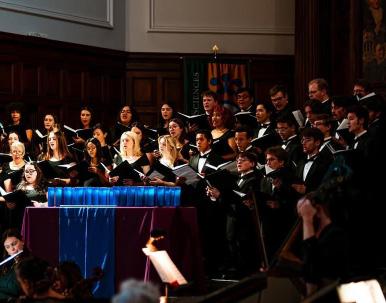
due to the fact that it can elevate the harmonies of the group.
“Andy [Bauer] likes to select new music that sounds really nice when sung in the chapel, especially with a big group together,” Luciano said. “He always looks for harmonies, he’s a big fan of doing that.”
In addition to Singers, Players also has big ideas for this semester. The acting group is planning on having a number of events within the coming weeks and months ranging from karaoke nights to short productions and finally to their spring musical, which will be a rendition of The Addams Family.
Players is hoping to kickoff the year with a production known as V-Day, which will be a theatrical rally that is centered around violence and assault prevention towards women. This performance will strive to serve as a global activist movement that will commemorate women who have had experiences with these matters.
Following this production, the group is hoping to incorporate more student-run events this semester, where members of Players will be able to write the script for a play by themselves.
Olivia Bailey, a junior and the producer of Players, spoke about how a student-run play will be an exciting addition to the group, considering the fact that it has never been done before, in terms of a full production.
“We have a super exciting play coming up, which is our student-slot,” Bailey said. “The last time we had anything student-run it was for a one act, which is only a 10-minute performance, but this is for a full play so it’s going to be really exciting.”
Scatterbomb, MU’s improv troupe, has also brainstormed new ideas to incorporate for the rest of the school year. Scatterbomb is known for their ability to come up with comedic or humorous improv performances on the spot in front of an audience, and oftentimes encourages audience engagement as well.
In regard to spring semester plans, Scatterbomb is hoping to upkeep their quick and spontaneous acting scene by incorporating games into their shows.
“We always work together as a group,” Bopp said. “We all band together and throw out some ideas on the board. Like, we experimented a little with throwing in some of the games that we practice into the show, and it worked out really well.”
While this is Bopp’s first year on Scatterbomb, she mentioned that the environment of the group is very uplifting, and that members involved are highly supportive of one another, which overall pushes everyone to perform better.
“I really do love the group that we have,” Bopp said. “Everybody is so friendly to each other, and it doesn’t feel like I’m going to a school club. It feels like I’m just hanging out with my friends. There’s no negative space in the group, just an open space for all our ideas to share.”
Kristina Bopp, a freshman and a member of Scatterbomb, expressed how thinking as a group is a vital part of coming up with new ideas for the group to succeed, and how integrating games into their performances has helped keep them lively.
Andrew Mannion Sports Editor
Last Thursday, Jan. 23, the Jaspers men’s basketball team fell to the Fairfield Stags 87-84. Led by Wesley Robinson’s 20 points and nine rebounds, the Jaspers fell just short of a win against a main MAAC rival.
Both teams came into Draddy desperate for a win.
The Jaspers were coming off a recent win against Niagara in comfortable fashion, 7265, which ended their threegame losing skid and brought the team back to .500. As for the Stags, they hadn’t seen consecutive wins since Dec. 4, 2024. With a loss to Canisius in their last game, the Stags needed to find a way to get back on track.
The game started off with a closely contested match. Fairfield found itself leading by a slight margin throughout the first 10 minutes of the game. Turnovers started out costly for the Jaspers, as Fairfield started to out score them 7-0 in points off turnovers.
After Fairfield took their first timeout, they were able to extend their lead to seven. Layups from Kyle Jenkins and Deon Perry led to the Stags holding a 29-22 lead. The Jaspers then found their groove on offense, and were able to cut the lead to one at halftime.
A key statistic between the teams was how they closed out their games. Fairfield came in 6-1 when leading at the end of the halftime, with their only loss to a strong Columbia team. MU found themselves at 5-1 when leading at half, which made the one-point halftime differential important.
As the second half started, Fairfield and MU were trading points. The game remained close until a Fairfield run put them up by seven points with about 10 minutes to go in the game - this wouldn’t be enough to hold the Jaspers, though.
The Jaspers battled back to get the game still within reach.
Shaquil Bender hit a big threepointer to cut the Stag lead to
just three points. After another stop by MU, Devin Dinkins pulled a 3-pointer, which he was fouled on. Given three free throws, he didn’t flinch on any of them. He drained all three, and tied the game at 72-72. The score would stand as the clock hit triple zeros, sending the game to overtime.
As the game went into overtime, Fairfield came out red hot. They scored seven unanswered points to give them a 79-72 lead with 2:30 left on the clock. The Jaspers, yet again, battled right back to the final minute. Dinkins scored seven points in the overtime period, and brought the game to 85-84 in the dying seconds.
Two free-throws from Stag forward Prophet Johnson extended Fairfield’s lead to 8784, putting the Jaspers into a tough situation to tie the game. A Jasper miss from beyond the arc would seal the game for Fairfield.
One major factor that contributed to Fairfield’s win was their ability to create second-chance opportunities for their offense. The team finished with 17 offensive rebounds, several of which led to crucial points in the second half. Jaspers forward, Wesley Johnson, spoke on Fairfield’s aggressive play.
“Going into the game, we knew they were going to play physical and crash hard,” Johnson said. “We just weren’t able to keep them off the glass. I think something we built on is we’ve been able to score the ball really well. So going into Mt. Saint Mary’s, we just have to make the adjustment.”
Johnson’s performance was not overlooked, however. With 20 points and nine rebounds on great efficiency, he drew the praise of Jaspers’ head coach, John Gallagher.
“[Wesley’s] just so clutch, so key,” Gallagher said. “He’s just all around really becoming a great asset to the program. So we’re getting better, and the result time didn’t go our way, but I like our toughness.”
Looking ahead to Mount St. Mary’s, the Jaspers aim to turn around a five-game skid where they find themselves at 1-4. Jaspers guard, Devin Dinkins, talked about what this next
game means for the team.
“We’re really just looking to get back on track and get the win,” Dinkins said. “We lost to them earlier, so we got to come out, fight and play
hard.”
The Jaspers fall to now 3-5 against the MAAC, and will have a match against Mt. Saint Mary’s Saturday, Jan 25 at 4 p.m.
*Editor’s Note: By the time
of publication, the next Jasper men’s basketball game will be Friday, Jan. 31 at 7 p.m. against Iona.


Karen Flores Senior Writer
For the third time this season, Jaspers forward Will Sydnor claimed the MAAC Rookie of the Week award.
The Bronx native is a freshman finance major and has had quite the debut season for the Jaspers. He told The Quadrangle that the reason he decided to commit to Manhattan University was due to the coaching staff and the sense of family he felt with the team.
“I decided to come to Manhattan [University] because of the coaching staff, everyone made it feel like it was a family,” Sydnor said. “I knew that the team would push me to be better no matter what because they see the best in me.”
Head coach of the men’s basketball team, John Gallagher, recalled the first time he watched Sydnor play basketball.
“It was during the first week of January last year when I went into the gym in the Patrick School in New Jersey,” Gallagher said. “I loved his shooting ability, his skills, his versatility. It just jumped off. And we were very excited from the beginning about having him on the team.”
Gallagher said that when trying to help young student athletes transition from a high school team to a collegiate level team, collaboration and consistency are key.
“It’s really the consistency of doing instead of just knowing that is important and that is how we can help
them,” Gallagher said. “That’s the collaborative process, embracing the process and focusing on that, not the result while staying consistent.”
Anthony Doran, assistant coach for the men’s basketball team, emphasized the importance of the players being like sponges and absorbing all the knowledge around them. He explained that this is key for making a smooth transition.
“We tell them to just be a sponge, be someone that wants to learn from the older guys, listen to the coaches,” Doran said. “A lot of freshmen when they come into college basketball, it’s a culture shock. They are starting all over again, learning new offenses, learning new coaches. So it’s just trying to be a sponge and learn from the older guys and learn from everyone else.”
Sydnor said that while the transition has at some points been hard for him, what he has learned so far from his experience is to take his team into account and ask for help if he needs it.
“One of the things I learned fast was to not do it for you, but do it for your teammate, the person next to you, and do it for your coaches,” Sydnor said. “If I feel stressed, I talk to my family a lot, pray a lot and talk to my coaches a lot. Whenever I have an issue or I don’t know what to do or I’m questioning things, I’ll just make sure to go to somebody, speak to somebody who knows more than me and just learn.”
Sydnor mentioned that his upperclassman teammates have played a pivotal role in his ability to grow on the team.
“They tell me that no matter what, if there’s a bad practice, a bad game, keep going,” Sydnor said. “It’s gonna get better, no


Sydnor is named MAAC Rookie of the week for the third time. WENDELL CRUZ / COURTESY
matter what. It’s gonna be tough, but my teammates, my vets, always tell me not to stress about the bad things, because the good things are coming.”
Doran said he can see the growth in Sydnor and that with consistency, he can continue to get stronger.
“He works hard and wants to be good,” Doran said. “There’s some stuff he needs to clean up but he deserves it. If he pushes to be more consistent, instead of
him winning three, [he] may win six. But it’s a great honor for him to get and he just needs to keep pushing.” Gallagher shared similar sentiments and said that Sydnor has adapted well into the team.
“His transitions have been unbelievable,” Gallagher said.
“He’s really grown, and he’s growing every day, and that’s why each moment we have to embrace everything. That’s the growth mindset. There’s
no losing, there’s just learning. That is something we work on with him and the others. [The recognition is] just a sign of how good he is and the talent he has, and how lucky the Jaspers are to have him.”