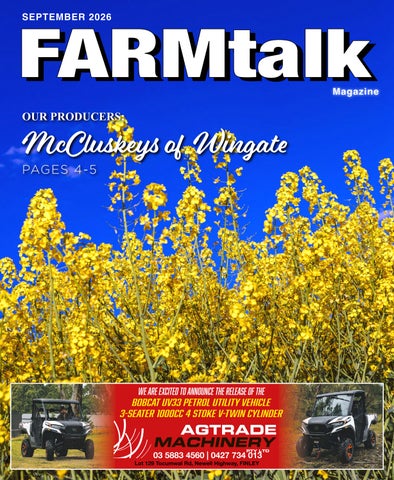
SEPTEMBER 2026
Magazine
OUR PRODUCERS:
McCluskeys of Wingate PAGES 4-5
We are excited to announce the release of the Bobcat UV33 Petrol Utility Vehicle 3-Seater 1000CC 4 Stoke V-Twin Cylinder
03 5883 4560 | 0427 734 013
Lot 129 Tocumwal Rd, Newell Highway, FINLEY
NORTH DENI STEEL SEPTEMBER SPECIALS
PTY LTD
GAL RHS 50 x 50 x 2mm Gal RHS (8.000m Lengths).... $82.00 Each
100 x 50 x 2mm Gal RHS(8.000m Lengths).. $125.00 Each
150 x 50 x 2mm Gal RHS (8.000m Lengths) $168.00 Each
89 x 89 x 2mm Gal RHS (9.000 m Lengths) $167.00 Each 100 x 100 x 2mm Gal RHS (9.000 m Length) $179.00 Each
50 x 50 x 3mm Gal RHS (8.000m Lengths)... $118.00 Each
BLACK STRAINER POST MEDIUM WALL 100nb Medium Black Strainer - 3.000 M ......... $50.00 Each (114.3 OD x 4.5mm) 36.57 kg each
GAL END ASSEMBLIES CATTLE RAIL 115 x 42 x 2.0 Galv Cattle Rail 6.100 M Lengths .............. ......................................................................... $73.00 Each
PURLINS C10015 (6.100 M Length)................................ $57.00 Each
C15015 (6.100 M Length)................................ $74.00 Each
Complete Set ......................................................... $220.00 100nb Medium Gal Strainer - 2.400 M ............ $82.98 Each
80nb Medium Gal Backing Post - 2.400 M ...... $57.09 Each
50nb Medium Gal Stay - 3.250 M .................... $49.49 Each 16mm Round Galvanised 1 x 3.000 M ............ $30.44 Each
GARDEN EDGING 100x3 Flat Bar (4.000 M Length) .............................. $33.00
C20015 (8.000 M Length).............................. $115.00 Each
150x3 Flat Bar (4.000 M Length) .............................. $52.00
RIGI FLOOR
STUMP ADJUSTERS
Rigi - Floor (Plastic Flooring) ........................... $38.50 Each
Stump Top ‘L’ Adjustable .......................................... $40.00
400 x 1200 x 40 mm High
Post Piers Stump Top
345-351 Augustus St, Deniliquin (Off Conargo Rd) Phone 5881 6688 Email - admin@northdenisteel.com.au
CONARGO, NSW
Youngster Archie Sleigh enjoyed looking at the all different sheep gathered for the Riverina Wool and Sheep Expo at Conargo.
SEPTEMBER 2026
FARMtalk • 3
Kelsa Horne from Calga Dohne and Sandra Ireson from the Hay Rural Education Program.
The flock gathers at Conargo The Riverina Sheep and Wool Expo again proved a popular fixture on the region’s agricultural calendar in August, drawing a strong crowd to the Conargo Recreation Reserve for the second consecutive year.
P
roducers, stud breeders, industry representatives and service providers travelled from across the Riverina and beyond to attend the event, with some making the journey from as far away as Coonamble. Organisers estimate more than 300 people passed through the gates throughout the day. Hosted by Riverina Merino and supported by Elders, Nutrien, Australian Wool Network and a range of other sponsors, the expo continues to build on the legacy of the former Elders Riverina Sheep Expo while expanding its industry reach and appeal. A major attraction was the stud sheep display, featuring 10 Riverina host studs alongside 19 guest studs from across Australia. The lineup included nine first-time exhibitors and showcased a diverse range of Merino and wool sheep genetics, giving attendees the opportunity to compare breeding programs and discuss industry trends firsthand.
More than 28 trade sites complemented the livestock displays, with exhibitors showcasing animal health products, feed solutions, livestock services, animal husbandry equipment and a variety of other innovations aimed at improving on-farm productivity. Expo co-convenor David Wilson said the event came at an important time for the industry. With favourable seasonal conditions across many parts of the region, coupled with high commodity and feed prices, he said the expo provided a valuable opportunity for producers to connect, share ideas and assess the latest developments in the sheep and wool sector. The guest speaker program was another highlight, attracting strong interest from producers looking for practical information they could apply within their own enterprises. Australian Merino Production Trial representative Craig Wilson shared insights from the nation’s largest
Power your business with AmpolCard • Welcome at all Purtill Group locations in Deniliquin, Mathoura, Moama, Finley, Jerilderie, Tocumwal, Hay and Griffith. • Can also be used at over 1800 locations Australia-wide. • Receive a monthly detailed statement with itemised vehicle expenses - great for tracking fleet expenses.
Apply online today at: purtillgroup.com.au/ampolcard
Tap & PIN
7 071 3 4 0 0 8 02 021 1 2 54 0 B USINESS BUSINESS U SIN E S S NAME NAME Y OUR YOUR O U R NAME NAME A BCabc ABCabc B0C7 ab1c 3 4 0 0 8 0 0 4/22 4/2 2 7 02 2 1 2 54 0 04/22 B U SIN E S S N A ME BUSINESS NAME AM
Y YOUR OUR N NAM AME Rear of 162 Hardinge St (Cruizin Diner), Deniliquin A ABCabc B Cab c 1300 PURTIL (1300 787 845) | www.purtillgroup.com.au
0 4/2 2
independent research project into Merino genetics, outlining how producers can use objective data and performance information to make more informed breeding decisions. Meanwhile, Hayley Pattison of Pattison Pastoral Butchery, Deniliquin, drew a keen crowd during her live home lamb butchering demonstration, offering practical tips and techniques for producers and consumers alike. The event also maintained its strong community focus. Students from Conargo Public School were on hand selling raffle tickets while taking the opportunity to learn more about the sheep and wool industry. Visitors could also browse a range of food, beverage and wool accessory stalls throughout the day. Formal proceedings were once again guided by master of ceremonies Ian Evans.
SEPTEMBER 2026
4 • FARMtalk
OUR PRODUCERS:
McCluskey’s of Westgate Peter McCluskey has been farming with family in Mathoura for about 40 years, alongside wife Donna. The pair have recently been joined by their son Tom and his partner Jess to grow crops across their 1700 hectares.
“Canola is quite dependent on nitrogen, and legumes put a lot of nitrogen back into the soil. With the fava beans factor on dry country, canola as a break grain works well with rotation.” TOM MCCLUSKEY
MATHOURA, NSW
Tom McCluskey and his partner Jess in the family’s canola crop at Mathoura in early September.
B
ut even after four decades, farming still brings the unexpected. This year, that’s been a surprisingly good canola season. They have 480ha of 44Y9CL sown on their ‘Westgate’ property. As well as canola, the McCluskeys grow a mixture of grain and legume crops – wheat, barley and vetch legumes for hay. They have also grown fava beans in the past. Opting for more canola and no fava beans this year was largely driven by rainfall forecasts, Peter explained. “Ahead of planting, we thought it would be a dry season but it’s been fairly wet. We would have had enough water to push through without, but canola is a bit higher value crop so we thought it was probably worth irrigation. It has been a pretty good season. We haven’t needed any irrigation apart from what was required to get it started.” Contrary to expectation, Mathoura received aboveaverage rainfall for winter. Paired with earlier rainfall in the year, Peter said it has set the crops up well for the immediate future. “We had above-average rainfall events, particularly in late February and in August to keep things ticking over, which means the moisture in the soil has been quite good. We won’t need a lot to keep pushing through and with the allocation, we should have enough water. “For harvest everything is looking really good, and hopefully, we get average rainfall in spring.” Other factors considered when looking at how much canola to plant included nitrogen inputs and urea prices. This is where the McCluskeys’ previous paddock allocations to fava beans came in handy.
SEPTEMBER 2026
FARMtalk • 5
Nutrien graduate agronomists Georgia Moody and Ada WinterIrving in the McCluskeys’ canola crop in August.
“Canola is quite dependent on nitrogen, and legumes put a lot of nitrogen back into the soil. With the fava beans factor on dry country, canola as a break grain works well with rotation. “Most of it is on the dry country, and with the nitrogen required and urea prices as they are, it is good you don’t need quite as much having grown the legumes. “Overall it’d be nice to recover the cost of inputs with a good yield.” The price of canola has been bouncing around a little, Peter said. In August it reached $800 per tonne, but has already dropped back to $785/t in early September. While the climate conditions have worked out for the McCluskeys at Mathoura, Nutrien Deniliquin branch manager Matt Tubb said canola was not as widespread as some springs because of the early forecasts. But he confirmed that those with crops across the country are experiencing a bumper season so far. “It has been one of those years when we didn’t expect canola to do particularly well, but those who have put it in have been looked after,” he said. “Due to lower than expected rainfall and higher expected temperatures around March to June, weren’t planning to put a lot in. Canola requires higher amounts of urea (for nitrogen) and due to high costs of urea, we only did a few paddocks. “It was also very warm in the year, so there’s been no handbrake. “Due to rising costs following Donald (Trump) throwing the toys out of the cot, it pushed prices up and inputs were a higher requirement for irrigators.
“So unless they were on rotation with legumes, canola planting came back a bit. But a few guys put in for rotational early crops.” Before the war between the US and Iran broke out in late February, urea exports in Australia cost a little over $800/t. The market peaked at around $1450/t in April, and eased back to about $800/t in July. With canola having a high nitrogen demand of about 80kg of nitrogen per tonne of grain produced, it put a lot of pressure on producers. Matt said the weather had played a key role in producer positivity, however. Overall temperatures have seen canola crops flowering slightly earlier, with final yield and harvest dependent on September conditions. “That earlier flowering crop can act as a bit of a lie detector that tells us whether the results are full-blown or a bit of a Mickey Mouse result, depending on the frosts. “In a super El Niño cycle, rain wise, to get the rain we’ve had in August is pretty rare.” The McCluskey canola crop is one of several that have been inspected by Nutrien graduate agronomists Georgia Moody (Deniliquin) and Ada Winter-Irving (Echuca) over the season. Ada said it has been pleasing to note there are no signs of large-scale fungicide use across the district, despite Blackleg being slightly more prevalent due to the aboveaverage rainfall. She said while farmers would like a little more rain to finish off their crops, the amount received to date has already yielded some positive results. “A good harvest can be expected if severe frost or a hot pinch and increase in temperatures is avoided,” she said.
Calling all Southern Riverina and Mid Murray primary producers! FARMtalk magazine is looking for local producers to feature in an ongoing ‘Our Producers’ article series, sharing the stories behind the people, properties and enterprises that make our region’s agricultural industry so diverse and resilient. Whether you’re growing, breeding, innovating or taking your farm in a new direction, we’d love to hear your story. The feature will highlight your journey, your operation, the challenges and successes along the way, and what makes your business unique. If you’d like to be part of a future edition, get in touch with the FARMtalk team. See page 19 for contact details.
Call now and book your harvest check up
FOR ALL YOUR EARTHMOVING NEEDS GREAT & SMALL
JERILDERIE G.D. & J.A. WILLIAMS PTY LIMITED
EARTHMOVING
Huge fleet with endless applications available for hire. JER
ILDE
Large range of agriculture tyres available. Mobile service, we come to you! With on farm service and 24/7 call out.
Call Les on (03) 5881 2261 or 0428 796 607 249-257 Barham Road, Deniliquin.
Ray White Real Estate Rural
JE
RI
JE
RI
JE
RI
LD
ER
IE
LD
JE ER
RI
IE
LD
EA
R
ER
IE
Gary Williams Mobile 0428 845 780 Phone (03) 5886 1765 EA
R
LD
EA
ER
RT
IE
HM
EA
OV
RT
HM
OV
IN
G
IN
G
Hamish Thomson 0419 532 259
Perfect Season = Perfect time to sell or Lease • Strong demand and multiple buyers waiting across all sectors - Grazing I Cropping I Irrigation • Lease opportunities across all sectors Ray White is a 100% family-owned and operated business, the largest and most trusted Rural Real Estate Partner in Australia, with proven results, superior advertising, and more buyers. If you want the best result - the choice is easy. Ray White Deniliquin - Leaders in Real Estate
Ray White Deniliquin I 173 Cressy Street I (03) 5881 1000
raywhitedeniliquin.com
RIE
EA
BARHAM, NSW
Graeme Kruger and Laurie Arthur with their rice awards.
SEPTEMBER 2026
FARMtalk • 7
Kate, Chris, James and Chloe Morshead.
Awards celebrate rice excellence At opposite ends of their rice industry journeys, a pioneering young farming family and one of the sector’s most respected leaders were recognised at the Rice Connect conference in Barham in August.
C
hris and Kate Morshead of Amberley Pastoral Co, near Yenda, were named the 2026 SunRice Grower of the Year, while long-time industry advocate Laurie Arthur received the Grower Contribution to Industry Award for more than three decades of service to Australian ricegrowers. Former Ricegrowers Association of Australia (RGA) executive director Graeme Kruger was also honoured with an Honorary Councillor Award. For the Morsheads, the Grower of the Year Award recognised a relentless focus on innovation, sustainability and water efficiency. The third-generation family business, which includes Chris’s parents, Harry and Anne, operates a 1200ha irrigated enterprise in the Murrumbidgee Irrigation Area. Judges highlighted the farm’s commitment to research, precision agriculture and continuous improvement, particularly its work advancing aerobic rice production systems. The business achieved an average rice yield of 10.85 tonnes per hectare, with Matilda varieties averaging 12.78t/ha, while earning a PaddyVision quality score of 9.5. Independent lead judge Iva Quarisa described the operation as being “at the absolute cutting edge of aerobic rice production”, praising its ability to improve water productivity while maintaining strong yields and profitability. The Morsheads said the award reflected the support of family, staff, advisers and researchers and highlighted the rice industry’s culture of innovation and knowledge sharing. Their prize includes $10,000 in cash, professional
development opportunities and nomination for the Australian Farmer of the Year Awards. While the Morsheads represent the future of the industry, Laurie Arthur’s award recognised a lifetime spent helping shape it. Mr Arthur grew his first rice crop at Moulamein in 1980 and was first drawn into industry advocacy through a local landholder group more than 30 years ago. That path eventually led to leadership roles with the Ricegrowers Association of Australia and SunRice, where he served as chairman for more than a decade before retiring last year. SunRice chair John Bradford said few people had contributed across as many levels of the industry as Mr Arthur. “His willingness to step forward, take on leadership roles and dedicate countless hours to serving the industry has helped shape the success and resilience of Australian rice for generations,” Mr Bradford said. Mr Arthur used the occasion to encourage younger growers to become involved in industry representation, saying farmers could successfully balance advocacy with running a business. Despite expressing concern about water policy and the challenges facing irrigators, he remained optimistic about the industry’s future, describing Australian rice production as world-class and driven by passionate growers. The conference also recognised Graeme Kruger for his leadership of the RGA, where he oversaw significant governance reforms, strategic reviews and industry development initiatives, including the establishment of
Perin Davey will take over at Ricegrowers Association of Australia executive director.
Rice Breeding Australia. His work helped strengthen the association’s influence and advocacy on behalf of ricegrowers. The conference also triggered a handover from Mr Kruger to his successor as executive director, Perin Davey from Deniliquin.
SEPTEMBER 2026
8 • FARMtalk
Riding into a wool career Rose Nevinson was still learning to ride a motorbike when she started turning up to the yards at her family’s Booroorban property, tagging along behind her father as he mustered sheep.
Rose Nevinson started working with AWN in June of 2026.
SEPTEMBER 2026
FARMtalk • 9
S
he is not entirely sure, looking back, whether she was actually helping or simply underfoot. “I don’t know if we were in the way and helping, or it was just a nuisance,” she said. “But we were there.” Nearly two-and-a-half decades later, that early apprenticeship of sorts in the yards has carried her into a career as a sheep and wool specialist with AWN in Deniliquin. She is one of the newest members of a team that services private wool buying, brokerage and shed visits for clients across the district. Rose started with AWN on the first of June and describes the role in plain terms. There is a private wool buying store based in Deniliquin, private wool sales, and brokerage work that takes her out to properties for shed visits before the wool is sold in Melbourne at auction, or through the company’s other selling systems. “Yeah, loving it,” she said of the job so far. “It’s been very busy.” AWN itself is a familiar name in wool and livestock circles. Founded in 1999 and privately owned, the company has grown into one of Australia’s larger agribusiness networks. The company offers wool, livestock and rural property services through representatives based across the country, including a long-standing wool buying presence in Deniliquin. Asked what shaped her more, her family upbringing or her time going through the Hay Inc rural education program, Rose said it was not really a choice between the two. “A bit of both,” she said. She grew up at Booroorban, spending every hour outside of school on the farm doing sheep work alongside her father, her grandfather and her uncle. “I grew up with some really cool mentors,” she said, along with others outside her immediate family who taught her along the way. Hay Inc, she said, broadened her horizons in a different way, by putting her alongside people running very different operations to her own family’s. “You’re learning from so many different people,” she said. “Everyone has a different operation, obviously, and you learn a lot that way.” Hay Inc Rural Education Program has been running out of Hay since 2014, built by a group of local agricultural volunteers who wanted to give young adults hands-on training, mentoring and industry networks in a real farm setting. The program was designed in part for people without a traditional farming background. It has since grown to send graduates into agricultural careers across the country, with strong support from Australian Wool Innovation and the local Hay community.
For Rose, the value of the program was less about the technical skills and more about the doors it opened. “I think the opportunities Hay Inc gave me is how I got to where I am now,” she said. Through the program, she landed a 12-month posting at Warwillah, working with the East Loddon Merino stud, before eventually returning to East Loddon last year, where she met the AWN team and was offered her current job. “I think a lot of the time it’s the people you know,” she said. At the property, she worked across all station duties, but her focus was on the livestock handling side, drafting and classing ewes and rams for sale through the Merino stud. “It was quite labour intensive on the sheep side, so mainly livestock based, which was good,” she said. “And then, yeah, just the general running of a farm, really. There wasn’t a job I didn’t do.” Rose is 28, and reflects on the changing face of the industry with the perspective of someone who has watched it shift within her own working life. Asked whether more young women coming into agriculture was a recent trend or something that had always been there, she did not hesitate. “I definitely think it’s on the rise,” she said. Rose remembers finishing school and coming home to contract herself out doing livestock work around Booroorban, in a district with almost no other young people working the land at the time. Now, she said, there are young people on every property she goes to. She credits Hay Inc with playing a real part in that shift, alongside a broader generational return to the family farm. “I think there was a big generational change there a little while ago, that Hay Inc’s done very well to fill,” she said. The trend she is describing shows up in the national data too. ABARES, the federal government’s agricultural research and statistics agency, has reported a gradual but steady increase in the number of women and young people joining Australia’s agricultural workforce in recent years, describing it as a reflection of broader changes both within the industry and across the Australian workforce as a whole. Rose is the middle of three children, with an older brother, Aaron, and a younger brother, Luke. Her parents, David and Kerry, still run the family property at Booroorban, where Rose still keeps her own small flock of sheep, something she calls her passion project. “I do spend a lot of time on the farm, but I love doing that,” she said. “It doesn’t feel like work being out there.” Booroorban itself comes up often and warmly in conversation with Rose. She
Hay Inc graduate Rose Nevinson at the 2026 Hay Wool Show.
remembers a childhood built around a shared school bus run, cousins nearby, and a tight group of friends close in age. Community life revolved around the district’s small, steady rituals: tennis days and cricket matches held behind the local pub, Christmas gatherings, and Friday nights spent playing Auskick in Hay before the whole group headed back to the pub to watch the footy together. “Our childhood, we spent lots of time together, which was nice, with friends and family,” she said. Asked if that upbringing shaped who she is today, she answered simply. “Definitely.” School for Rose meant primary years in Hay, catching the bus in from Booroorban with a small group of friends, before moving on to Yanco Agricultural High School from Year 7 through to Year 12. Yanco, one of only four government agricultural high schools in New South Wales, is unusual even among boarding schools in that it has no day students at all. Every student, drawn mainly from southern New South Wales and Victoria, lives on site for the length of term, on a rural property along the Murrumbidgee River that includes working sheep and cattle studs alongside the classrooms. “I don’t think I’d ever call myself a true academic,” Rose said, “but I loved the practical side of Yanco, and getting out on the farm.” She also found her footing in sport, eventually becoming a sporting house captain.
Leaving home for boarding school suited her more than she might have expected. “I loved having my own independence,” she said, recalling weekends spent travelling to sheep and cattle shows with other students. “We weren’t always stuck at school.” These days, Rose is based in Deniliquin, splitting her time between the AWN office, the family farm at Booroorban, and a local netball competition that keeps her busy outside of work. She has a partner in Deniliquin, and much of her downtime in the warmer months is spent fishing or playing golf, or catching up with a close friendship group in town. Looking ahead, Rose sees her future firmly within AWN and the broader wool and sheep industry. Alongside her current wool broking and shed visit work, she is hoping to move further into the AuctionsPlus side of the business, along with ram selection and buying for clients. She is already travelling to Melbourne most weeks to help prepare catalogues for the wool auctions. “I think this is my long-term career, I hope,” she said. “I think I’m finally settled into a bit of a career, in a way.” For a young woman who once tagged along to the yards on a motorbike she could not yet properly ride, it is a career that, in her own telling, was never really in doubt. It was simply a matter of finding her way back to it.
UPCOMING STUD RAM SALES
elders.com.au
Riverina Area
FRI 11TH SEPT
ALMONDVALE POLL & WHITE SUFFOLK SALE
URANA
ELDERS JERILDERIE
THU 17TH SEPT
WUNNAMURRA POLL DORSET ANNUAL RAM SALE
JERILDERIE
ELDERS JERILDERIE
MON 21ST SEPT
WOODPARK POLL MERINO RAM SALE
CONARGO
ELDERS JERILDERIE
TUE 22ND SEPT
POOGINOOK MERINO & POLL MERINO RAM SALE
JERILDERIE
ELDERS JERILDERIE
WED 23RD SEPT
WILLANDRA MERINO RAM SALE
JERILDERIE
ELDERS JERILDERIE
THU 24TH SEPT
THE YANKO MERINO RAM SALE
JERILDERIE
ELDERS JERILDERIE
FRI 25TH SEPT
SABER SHEEP POLL DORSET RAM SALE
DENILIQUIN
ELDERS FINLEY
FRI 25TH SEPT
ONE OAK POLL MERINO ANNUAL RAM SALE
JERILDERIE
ELDERS JERILDERIE
THU 8TH OCT
WATTLE PARK WHITE SUFFOLK & EDITHVALE MERINO SALE
FINLEY
ELDERS FINLEY
Wattle Park White Suffolks On Property Ram Sale
NO
BE
R
20
25
TO BE R 20 25
SE PT EM BE R 20 25
PA
G Magazine
ad
e un
til
u
se
e th
is
PAGES 2-3 w
ne
sy
st
Contact us today! k 03 5881 2322
em
5
d, wire and bed Toilets, 4 er plum ers, Hot wat Fully 12 show sins, y to go. dba 4 han ice. Read serv
yo
PRE-SEASON DEALS ON THE ENTIRE NEW RANGE OF KUHN HAY EQUIPMENT
e
gr
ga zin
t up
Ma
4-
no
5T $2 + GS
• Do
ne
e
rgo
ock In stnow
ES
Mixed dairy outlo ok amid cost pressures
a zi
in
AG
ag
az
. 3. 60 01 45 734 83 58 0427 03 ey IFFE Finl UL McA
AN
vin S gs Y pe S r ye T EM ar pe r un
RS WE MO
TR 9 Tocu rn IO mwa 03 in g l ve L rti I Rd, Ne5we883 ca E lm T ll Hi 4 ixi ng S gh 56 on H its I way, FINL0 he FT ad EY • $3 R 5- O $7 5k N fu IC el sa
Tu
o
fi we in nds r far Co roo m na ts P ff Am Bu er ilt ic . an
t 12
M
M ag
Fl
Tu
Lo
, 2713 0 ey, NSW 3 456 , Finl 03 588 ell Hwy New 129
Rams available for viewing from 9am - BBQ Lunch provided
M
DECEMBE R 2025
it
‘Wattle Park’ Broughans Rd, Finley. Ph John Jamieson 0427 500 676.
VE
n for flock n catioiry 12M X 3M/ r u ER wds Cro o’s retu n ed in daG ES 4 -5 TOSHILEOWT BLOCK PA expES 4- 5 A K
n
ca e W
! help
SE
MN3V & brucellosis free
Want to promote your business or sale? m Fro 250 $7, GST +
100 White Suffolk Rams
JERILDERIE 3 Oaklands St, Jerilderie P: 03 5886 2001 E: jerilderie@elders.com.au
OC
Thursday, October 8 - 1pm
FINLEY 214-216 Murray St, Finley P: 03 5890 6000 E: finley@elders.com.au
Lot 129 Tocumwal Rd, Newell Hwy, Finley Ph: 03 5883 4560 Mob: 0427 734 013, Fax: 03 5883 4570 Email: agtrade@bigpond.co m
Seed your visibility in the Riverina
RamsWi th: -Length&DepthofBody -El i teLambpl anASBVs -Cl eanHeads&Poi nts -FastGr owth -TopI ntraMuscul arFat Cont actAndr ewGi l l et t 0429660584
FOR HIRE Call Wes 0421 216 806 147 Napier St, Deniliquin TORO MINI LOADER
Comfortable conversations about the uncomfortable stuff.
+ attachments
Succession. Big Decisions. Relationships. Retirement. The conversations most families put off longest are the ones that matter most. PFC makes them easier.
ALL TERRAIN SCISSOR LIFTS 1.7 & 2.7 EXCAVATORS
+ attachments
TRAILER MOUNTED BOOM LIFT
Brian McCleary & Co ACCOUNTANTS FRIENDLY, ACCESSIBLE, CONFIDENTIAL SERVICE • Income Tax Returns • GST & BAS • Business start up • Audits • Cloud accounting software • Establish a SMSF • Single Touch Payroll ready solutions
Call Rob Brown - 03 5877 7011 peppinfamilyconsulting.com.au
For all your Windscreens needs
Registered Tax Agents Registered Company Auditors SMSF Administration •
Windscreen Repair and Replacement • Windscreen Replacement • Windscreen Chip Repair* • Cal-Tech ADAS Recalibration*
Offices located in Deniliquin, Barham, Hay, Echuca, and Rochester.
• Side Window Replacement • Rear Window Replacement • Truck and Bus Glass* • Windscreen Wipers
126 End Street, Deniliquin
Phone 5881 7999
admin@brianmccleary.com.au
152 Napier St, Deniliquin - Ph 5881 5521
Servicing Deniliquin anD surrounDs
SEPTEMBER 2026
FARMtalk • 13
Benign footrot can cause dermatitis between the toes, but rarely leads to severe ‘under-running’ of the hoof
Virulent Footrot with under-running of the sole.
Be on the lookout for lame sheep Spring has started after a wet winter, with dense feed on the ground on many farms.
W
hen it is damp underfoot, it is common to see some lameness occurring in sheep. It is important to investigate the cause of lameness quickly. There are many different causes of lameness, some infectious and some due to environmental conditions. Lameness is more likely to be an issue when feet are wet for a prolonged period. This is particularly likely on dense pasture such as clover, especially if it has been irrigated or after rain. Ovine Interdigital Dermatitis (OID) occurs when sheep’s feet have been damaged by water over a period of time. This leads to an overgrowth of normal skin bacteria, causing the skin of the foot to become red and sweaty. OID can look like the early stages of footrot, but these are different conditions with different causes. OID will resolve once the feet are able to dry out. This can happen just from a change in environment or if the sheep are footbathed. There will be no under-running of the hard hoof with OID; it only affects the skin. You might hear people using the term ‘scald’ to describe lame sheep. While some people use this term to refer to OID, others will use it to mean benign footrot.
Footrot spreads in wet, warm conditions. Both benign and virulent footrot are caused by the bacteria *D. nodosus*. Benign footrot does less damage to fewer sheep in a mob due to the bacteria producing lower amounts of the enzyme that damages the hard horn of the hoof. Virulent footrot is the more severe condition, causing more damage to the feet of more sheep. Footrot is notifiable in NSW. Foot abscesses can also occur in wet conditions. This is an infection deeper in the foot, usually infecting the joint. It often leads to particularly bad lameness in the affected foot, with the joint being visibly swollen and hot to the touch in the initial stages. The earlier you recognise the cause of lameness, the more likely you are to be able to control the issue, leading to happier sheep that gain or maintain condition. If you are yarding all your sheep, for example, at shearing, it is good practice to look for signs of lameness in the flock in the paddock first. Lame mobs should be examined to determine the cause of lameness and should be yarded last to avoid the possibility of spreading contagious causes of lameness to unaffected mobs.
If possible, avoid yarding sheep while the yards are wet. If unavoidable, consider running sheep through a zinc sulphate footbath on the way out of the yards. This can help reduce the risk of sheep developing foot abscesses. If you would like lame sheep examined or would like more information on the causes of lameness, please contact your nearest Local Land Services animal health staff.
Linda Searle (pictured) is a district veterinarian with Murray Local Land Services.
DENILIQUIN TREE SERVICE
- TREE HEALTH & HAZARD ASSESSMENT - PEST & DISEASE IDENTIFICATION & MANAGEMENT - REMOTE AREA / TRAVEL SPECIALIST - 24 HOUR EMERGENCY TREE SERVICE
- TREE REMOVAL - TREE MAINTENANCE & TRIMMING - STUMP REMOVAL & GRINDING - MULCHING - AERIAL RIGGING / LIMITED ACCESS
FREE QUOTES / FULLY INSURED 0418 572 787 admin@deniliquintreeservice.com
JIM MUIRHEAD EARTHMOVING TREE REMOVAL AND CHAINSAW WORK
Buyers of all metal products Including: Steel & Cars, Copper, Brass, Aluminium, Ally Cans, Batteries, Lead
BEST prices paid call to find your price!
All channel cleaning, dam cleaning, laying all concrete and black brute structures for farmer’s farm plans. Small slashing jobs. Servicing the Southern Riverina and Northern Victoria.
25-35 Hammersley Rd, Corowa - Ph 02 6033 5372
Deni’s new local accountant Seymour Accounting is a newly established local Chartered Accountant and Tax Agent.
Owner operator Jim Muirhead 0429 576 599
Proudly supporting our farmers, our communities and the environment.
James Seymour is experienced in helping local people, businesses and farmers prosper and is currently welcoming new clients.
Call James 0409 226 726 Pop in to 48 Hardinge Street, Deniliquin seymouraccounting.com.au
murrayirrigation.com.au 1300 138 265
SEPTEMBER 2026
FARMtalk • 15
Interpreting soil moisture probes Soil moisture probes can be a useful tool to show how much water is in the soil profile, water infiltration patterns, the depth at which plant roots are active and where potential constraints might be present, such as an acid layer. Soil moisture probe weather station at Farming Forecaster site.
H
aving this information can help plan fertiliser applications, grain marketing, target soil investigations and plan grazing management. However, to use probe data, you need to understand how to interpret it, which isn’t always easy. When looking at the graphs, the trick is to focus on the patterns of the sensor lines, rather than the actual figures, as shown in the graph above. Each line on the graph represents a probe sensor at a different depth. The graph provided has eight lines for an 80cm probe, with each sensor 10cm apart, starting just below the soil surface.
In pasture soil moisture probe and pasture cage.
The key patterns on the graph to look out for are: • Spikes – these indicate infiltration and subsoil recharge from either rainfall or irrigation. The first circle above highlights a rainfall event that raised soil moisture down to 70cm. • Rippling – the small ups and downs (ripples) in the horizontal lines show plant root activity. Dips show moisture withdrawals during the day, while rises are the small refills as plant activity reduces overnight. • Drawdown – while plants are actively growing, they withdraw moisture, gradually drying the profile. This is represented by the downward trend of the line. In the third circle, drawdown can be seen in the first 40cm of the soil. The 50cm sensor line remains flat, meaning the plant roots aren’t accessing this moisture. Looking at drawdown patterns over time, you can identify moisture availability and how deep roots are drawing from. In wet conditions, roots access water from closer to the surface, using the path of least resistance, and draw from deeper in the profile as soil moisture depletes. Although, it’s worth noting that if roots consistently halt at a specific depth year-on-year, there may be a physical or
chemical barrier limiting root growth and the size of the soil moisture ‘bucket’. In this case, it may be worth further investigation, and amelioration may be required.
Contributed by Kimberley Beer (pictured above), local lands officer - mixed farming with Murray Local Land Services.
Soil moisture probe graph showing the distribution of water in the soil profile from the surface to 80cm deep.
SEPTEMBER 2026
16 • FARMtalk
$73.5 million boost to local Restoring Murray Waterways project Murray Irrigation’s Restoring Murray Waterways Project (RMW) is undergoing a major expansion, with the Australian Government fully funding the next phase of this up to $73.5 million environmental watering initiative dedicated to improving the health of rivers, wetlands and floodplains in the southern NSW Murray.
R
ecognised as a Sustainable Diversion Limit Adjustment Mechanism (SDLAM) measure, the project builds on the success of the company’s recent pilot and focuses on the Edward/Kolety-Wakool river system and extending benefits across the Murray-Darling system. RMW has been developed and tested over several years in collaboration with local landholders, First Nations groups and NSW and Australian Environmental Water Managers. The pilot program, completed earlier this year, involved the construction and upgrade of Murray Irrigation
“A powerful example of what we can achieve when we all work together.” RON MCCALMAN
infrastructure to connect around 300 km of creeks and 2,680 ha of wetlands. This next phase, which is being delivered in partnership with the Australian and NSW Governments, will enable more efficient delivery of environmental flows across a further 320 km of creeks and 6,482 ha of wetlands by upgrading Murray Irrigation’s gravity-fed irrigation network, including the removal of barriers to natural flows.
Making smart use of existing infrastructure By leveraging the Murray Irrigation water supply network, the project will deliver more water to areas that typically only receive flows during high Murray River events. This will help improve the health of rivers, floodplains and ecosystems while reducing the need for additional water recovery measures, supporting SDLAM outcomes and the broader goals of the Murray-Daring Basin Plan. Federal Minister for Environment and Water, Murray Watt, said the Albanese Government remains committed to delivering the Murray−Darling Basin Plan in a way that
balances the needs of communities, industries and our environment. “In a climate where every drop counts, Australians deserve to have confidence their systems can reliably and efficiently deliver water,” he said. “Our investment in SDLAM projects delivers the best of both worlds – similar or improved ecological outcomes while leaving more water in the consumptive pool.” NSW Minister for Water Rose Jackson said while there is no single solution to restoring our rivers, making smarter use of existing infrastructure is a proven way to return more water to the environment while reducing reliance on buybacks. “This investment is about finding practical, balanced solutions that work for communities and for the environment, improving the way water moves through the system so we can deliver better outcomes with the water we already have,” she said. “It’s also a reflection of the strong partnerships behind this work. Landholders, Aboriginal communities and local stakeholders have helped shape these projects, ensuring they deliver real benefits on the ground while protecting the waterways the Edward–Wakool community depends on.”
SEPTEMBER 2026
FARMtalk • 17
Burraboi farmer Hayley Pattison.
Collaboration in action According to Murray Irrigation CEO Ron McCalman, RMW is an outstanding outcome of collaboration between governments, First Nations and local landholders – and “a powerful example of what we can achieve when we all work together.” “Murray Irrigation is proud to be contributing to solutions in this space,” Mr McCalman said. “We look forward to seeing the outcomes of the latest stage of the project and exploring future potential opportunities.” Key infrastructure upgrades to be completed during the current expansion phase include: Upgrades to existing escapes and channels within the Murray Irrigation network Improvements to creek crossings and fencing on private land Construction of additional escape structures to distribute water to new creeks and wetland areas
Installation of fish-friendly crossings. The project is also delivering practical benefits for landholders by improving access across creeks during watering events while supporting both agricultural productivity and environmental outcomes.
Reaping the benefits Burraboi farmer Hayley Pattison (pictured at right) is one of 45 local landholders to collaborate with Murray Irrigation as part of the pilot RMW program, and is overjoyed to see water flowing again in the Jimaringle Creek, which crosses through her property. “We’ve seen the benefits that environmental water flows have played to this creek,” Ms Pattison said. “The birdlife, the insect life, the frog life ... the landscape is just healthier. “It really does add value to our operation and to the landscape.” This latest stage of RMW is on track for completion as required by 31 December 2026. The SDLAM program is part of the Murray-Darling Basin Plan and is designed to achieve improved environmental outcomes for rivers, wetlands and wildlife using less water.
Contact us! ADVERTISING: DENILIQUIN OFFICE: Sam Wake or Amber King, Advertising Consultants
Cotton is both a food and fibre crop..
P: 03 5881 2322 E: farmtalk@denipt.com.au
One 227kg bale of cotton can produce 1200 T-shirts, 215 pairs of jeans, 250 single bed sheets, or even 680,000 cotton balls, showcasing its incredible versatility in everyday products.
SOUTHERN RIVERINA OFFICE: Sarah Bain, Advertising Consultant P: 03 5883 1033 E: sarah.bain@ southernriverinanews.com.au EDITORIAL: Zoe McMaugh, Content Manager P: 03 5881 2322 E: zoe.mcmaugh@denipt.com.au
FARMtalk welcomes community contributions from farmers, experts and professionals who make their living and life on the land. If you would like to contribute, there are several ways to do so.
STORY TIP OR IDEA?
Advertising and Editorial Deadlines
•
Get in touch and give us a tip of a great story idea.
•
Contribute an article: If you are an expert in your field then contributing once off, or regularly, is a great way to get started in our FARMtalk magazine. Contact Zoe McMaugh at farmtalk@denipt.com.au or 03 5881 2322.
Advertising bookings and editorial requests for each edition of FARMtalk close on the third Friday of the month preceding publication.
•
Become an author: FARMtalk is open to occasional contributors who are experts in their field or authorities on a subject or area. Once you have contributed an article, and the editorial team have approved you, we can set you up with a regular column to contribute. We would love to hear from you. Contact Zoe McMaugh at farmtalk@denipt.com.au or 03 5881 2322.
•
Have a fascinating farm in mind for us to showcase? Tell us! We would love to hear from you. Contact Zoe McMaugh at farmtalk@denipt.com.au or 03 5881 2322.
Nigel Lutton
GENERAL MANAGER
Zoe McMaugh
CONTENT MANAGER
Rebecca Flisher CREATIVE MANAGER
Amber King
Sam Wake
Sarah Bain
Rowan Frazer
Eamon Kurta
Kayla McAuliffe
ADVERTISING
CADET JOURNALIST
ADVERTISING
CADET JOURNALIST
ADVERTISING
OFFICE MANAGER
Information contained in this magazine is presented only after being carefully researched. However, there are differences in state and regional regulations and conditions. Farmers are asked to check with their own advisors. FARMtalk can assume no responsibility for the contents.
2026 | SOUTHERN RIVERINA SEPTEMBER SALE CALENDAR DATE
EVENT
LOCATION
AGENT
Friday 4th
Ballatherie Poll Merino Ram Sale
Hillston
Geoff McDougall
Friday 4th
Caroonboon Merino Ram Sale
Wanganella
Bill O’Brien
Monday 7th
Hillston Store Sheep Sale
Hillston
Geoff McDougall
Wednesday 16th
Wanganella & Poll Boonoke Merino Ram Sale
Conargo
Bill O’Brien
Thursday 17th
Wunnamurra Poll Dorset Ram Sale
Jerilderie
Marc Braybon
Friday 18th
Hay Store Sheep Sale
Hay
Geoff McDougall
Monday 21st
Woodpark Poll Merino Ram Sale
Conargo
Marc Braybon
Tuesday 22nd
Pooginook Poll Merino Ram Sale
Jerilderie
Marc Braybon
Wednesday 23rd
Willandra Merino Ram Sale
Jerilderie
Marc Braybon
Thursday 24th
The Yanko Merino Ram Sale
Jerilderie
Marc Braybon
Friday 25th
One Oak Poll Merino Ram Sale
Jerilderie
Marc Braybon
Friday 25th
Saber Poll Dorset Ram Sale
Deniliquin
Bill O’Brien
The livestock market continues to provide plenty of confidence for producers across the region, with lamb and mutton prices holding up well. With higher-than-average lambing percentages and an influx of numbers expected, we expect to see some movement in prices as supply increases, making it an important time to stay informed and consider your marketing options. The cattle market continues to go from strength to strength. A much wetter start to spring than expected has provided excellent seasonal conditions and plenty of optimism heading into the months ahead. For sheep producers, there is plenty happening across the market. With numerous stud sales coming up, now is the time to start planning your requirements for commercial ewes and rams. There are also plenty of store lambs coming forward on AuctionsPlus, with demand remaining exceptionally strong and quality lines continuing to attract excellent results. With sheep and cattle sales operating fortnightly, the team at Nutrien are here to help you make the most of the current market and plan ahead for the season. Whether you’re looking to sell, buy, or simply keep up with the market — contact your local Nutrien store today. Nutrien Deniliquin | (03) 5881 1777 Nutrien Finley | (03) 5883 1733 Nutrien Corowa | (02) 6033 3833
SHEET & PLATE • RURAL PRODUCTS • GAL & REINFORCING MESH • TUBING • MERCHANT BAR • STRUCTURAL • PURLINS • SHS & RHS • COLUMNS, BEAMS & TRUSSES • FENCING PRODUCTS • ALUMINIUM FLATS & ROUNDS
STEEL SUPPLIES DENILIQUIN Cnr Wakool Road & Kelly Street P 03 5881 5541 E sales@steelsuppliesdeni.com.au
steelsupplies.com.au
nofliesrural.com.au