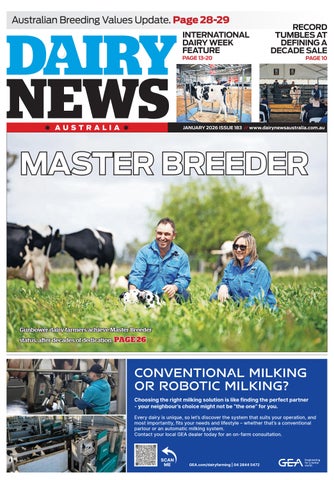
Australian Breeding Values Update. Page 28-29 INTERNATIONAL DAIRY WEEK FEATURE
PAGE 13-20
RECORD TUMBLES AT DEFINING A DECADE SALE PAGE 10
JANUARY 2026 ISSUE 183 // www.dairynewsaustralia.com.au
MASTER BREEDER
Gunbower dairy farmers achieve Master Breeder status, after decades of dedication. PAGE 26
CONVENTIONAL MILKING OR ROBOTIC MILKING? Choosing the right milking solution is like finding the perfect partner - your neighbour’s choice might not be “the one” for you. Every dairy is unique, so let’s discover the system that suits your operation, and most importantly, fits your needs and lifestyle – whether that’s a conventional parlour or an automatic milking system. Contact your local GEA dealer today for an on-farm consultation.
SCAN ME
GEA.com/dairyfarming | 04 2844 5472
DAIRY FEED
At Ridley, we care about your dairy cows as much as you do, from early growth to peak production. Our Barastoc® feed solutions are developed to deliver the nutrition your herd needs, through every season and every stage. That’s why Barastoc is truly Made for Milk.
Visit www.ridley.com.au or get in touch with your local Ridley representative to learn more about Barastoc Dairy Feed.
BROUGHT TO YOU BY
CONTACT US ON 1300 666 657
OR SALES@RIDLEY.COM.AU FOR
BULK FEED DIRECT TO FARM All rights reserved, © 2026. Barastoc is a registered trademark of Ridley Agriproducts Pty Ltd.
DAIRY NEWS AUSTRALIA JANUARY 2026
NEWS // 3
Mixed outlook amid cost pressures A MIXED OUTLOOK IS on the horizon this
Family moves on from processor collapse. PG.22
National Breeding Objectives changes. PG 29
NEWS .............................3-10 AND 22-27 INTERNATIONAL DAIRY WEEK FEATURE .......................................... 13-20 ANIMAL HEALTH ...............................30 MACHINERY.......................................... 31
YOU R VM S ™ YOU R WAY
Australian milk production - year to date changes 4.0%
3.0%
2.0%
1.0%
Per cent change
Turning plans into production. PG 7
season for Australia’s dairy industry. Dairy Australia’s latest Situation and Outlook report reveals a season of contrasts for the nation’s dairy industry, as strong retail demand and higher farm gate milk prices offer some relief against rising costs and climate uncertainty. Strong local retail demand and a higher farm gate milk price are helping to support farmers, but global price shifts, unpredictable weather and elevated input costs continue to weigh on margins. Dairy products continue to perform well in supermarkets. Over the past year, milk sales rose 1.1 per cent, cheese climbed 3.8 per cent, and yoghurt surged 8.4 per cent, led by Greek yoghurt with 15 per cent growth. More shoppers opt for private-label products amid cost-of-living pressures, and consumers no longer view these products as lower quality. This season’s challenging weather conditions and the difficult farm-level decisions that needed to be made in response have seen year-todate milk production down 2.3 per cent (July– October 2025 versus the same period last year), with declines across Victoria, South Australia and Western Australia. Water availability pressures are mounting in southern regions, while farm exits have further constrained output. In contrast, Queensland, NSW and Tasmania have recorded gains thanks to improved seasonal conditions. Despite these regional improvements, ongoing cost pressures and a smaller national herd overall are expected to keep production subdued for the remainder of the season. Looking ahead, Dairy Australia forecasts a two per cent easing in milk production for the 202526 season, down to about 8.149 billion litres. Input costs are a key challenge. Temporary water prices in northern Victoria and Murray Irrigation have reached their highest levels in five years, while many southern water storage sites remain below the five-year average. Feed costs have eased from July highs, but hay prices remain elevated across most dairying regions. Wheat prices have softened as offshore demand declined, and global fertiliser values have begun to ease as exports from key regions
0.0%
-1.0%
-2.0%
-3.0%
-4.0%
-5.0%
resume. Even so, water and fodder costs continue to be a major challenge. Profitability trends reflect these pressures. Data from the Dairy Farm Monitor Project shows dry weather in Victoria, South Australia, and Tasmania drove higher feed costs and reduced returns, while NSW and Queensland recorded marginal improvements supported by strong milk prices. Western Australia saw improved profitability after a difficult 2023-24 season, largely due to better seasonal conditions and stronger livestock trading returns. With feed costs making up the greatest share of on-farm production costs, volatility in fodder markets continue to weigh on farm margins. Global markets add further complexity. After a strong start to the year for Australian dairy exports, recent price movements have shifted the competitive landscape. Increased milk production in the US and European Union has pushed down key commodity prices, leaving Australian butter, cheddar, and SMP priced above other major exporters. Although Australian export prices have softened in line with global trends, constrained milk supply has kept prices relatively high. Demand has stabilised in key markets, with
Greater China recording a modest 0.4 per cent increase over 12 months to July, following three years of decline. South-east Asia import volumes held steady, while growth in the Middle East and North Africa has begun to ease. The industry has demonstrated resilience through steady retail growth and early-season export gains, but the outlook remains complex. Global price shifts, climate uncertainty, and elevated input costs will continue to test profitability. A higher farm gate milk price may provide some relief, but sustained improvements in seasonal conditions and cost management will be critical to stabilising production. † NielsenIQ Homescan based on a continuous panel of 10,000 households; excludes non-private dwellings and businesses, non-permanently occupied households and out-of-home/impulse purchasing. Dairy Australia calculation based in part on data reported by NielsenIQ through its Homescan Service for the dairy category for the 52-week periods ending July 13, 2025 and October 5, 2025, for the total Australia market, according to the NielsenIQ standard product hierarchy. Copyright 2025, Nielsen Consumer LLC. Figure 1: Australian milk production - year to date changes
“ We struggled to recruit, so something had to change. If we didn’t have the milking robots now, we would not be milking cows.” Francis Creed | 350 cows on 6 VMS™ V300
Let’s discover your way. To find out more about how VMS™ can work your way, visit delaval.com or call your local DeLaval representative on 1800 817 199.
Individual results may differ; information does not constitute warranty/guarantee of service or performance.
DAIRY NEWS AUSTRALIA JANUARY 2026
4 // NEWS
Price of water traded is October 2025 average compared to October last year (LY) and five-year (5Y) average. Details can be found in the monthly Production Inputs Monitor report.
Global exports to key markets. Graphs and tables: Dairy Australia.
Key metrics from 2024-25 Dairy Farm Monitor Project by region.
Milk production declines amid rising water costs BY DJEMBE ARCHIBALD
DAIRY PRODUCERS across Victoria are fac-
ing a tightening operating environment, with declining milk flows and escalating water and fodder costs, according to the Dairy Australia Situation and Outlook Year-end 2025 report. Milk production in northern Victoria has slipped 3.2 per cent year-to-date, reflecting the combined impact of dry conditions, high feed costs and mounting irrigation pressures. After a stronger first half last season, much of the region has dried out, with farmers reporting reduced pasture growth and greater reliance on purchased feed. Irrigation constraints are emerging as a
critical factor, with water levels in several monitored storage sites now sitting below this time last year. Water affordability has deteriorated sharply. Monthly average temporary water prices in northern Victoria have climbed to their highest levels in five years. The report shows northern Victoria water trading at an average of $294/ML in October 2025, a rise of 150 per cent on the previous year and 201 per cent above the five-year average. In the Murray Irrigation system, prices reached $252/ML, up 127 per cent year-onyear and 338 per cent above the five-year benchmark. These increases are expected to further
squeeze farm profitability through summer. Feed markets are also tightening. In the Goulburn/Murray Valley, cereal hay reached $386/t in October 2025, up 16 per cent on the previous year, while regional stockfeed wheat edged slightly lower to $333/t. Although some feed costs have eased nationally, fodder in key Victorian irrigation districts remains elevated, reflecting the impact of prolonged dry conditions and reduced local supply. The broader seasonal challenges are reflected in the report’s analysis of Victorian dairy regions, where milk production declines are evident across all major zones. The report notes that irrigation pressures in northern Victoria are now a significant
constraint on production recovery, contributing to overall declines across the state. Despite improved farmgate milk prices, the report warns that persistent high input costs — particularly water and fodder — will remain a major challenge for dairy businesses in northern Victoria throughout the 2025-26 season. Nationally, Dairy Australia is forecasting a two per cent fall in milk production for the season, with regional irrigation districts expected to carry a disproportionate share of the impact. For producers across these interconnected valleys and irrigation systems, the year ahead will hinge heavily on rainfall and water availability.
DAIRY NEWS AUSTRALIA JANUARY 2026
NEWS // 5
Calls for long-term planning THE SOUTH Australian Dairyfarmers’ Association has welcomed amendments passed in the Legislative Council to strengthen protections for farmers from long-term mining and energy exploration on agricultural land, but says the “make it up as you go along” approach relating to farmland in the state needs to be abandoned. Amendments to the Statutes Amendment (Energy and Mining Reforms) Bill 2025, moved by the opposition, reduced the South Australian Government’s original proposal to allow five-year extensions to 18-year exploration leases. Under the amended bill, any extension will now be capped at a maximum of two years. The amendments also introduced mandatory independent agricultural impact assessments and require direct consultation with affected landowners before any extension can be granted. Under Plan to Farm, a farmer’s voice will be heard at the start of the process, not the end. SADA chief executive Andrew Curtis said improvements to the bill were a necessary step in protecting high-value agricultural land, but the situation highlighted a deeper, ongoing problem. “These safeguards are critical for farmers, food producers and regional communities,” Mr Curtis said. “But the fact that parliament has had to fix this at the eleventh hour tells the real story — agriculture is still an afterthought in policy development. “Farming shouldn’t come last.” SADA argues the policy-on-the-run approach to land management in South Australia is unsustainable and reinforces the need for its recently released Plan to Farm policy framework. Plan to Farm proposes clear planning principles that ensure the protection of South
South Australian Dairyfarmers’ Association president Rob Brokenshire.
Australia’s food production is front of mind when managing mining, housing and growth demands. SADA believes planning decisions must consider not only economic development, but the long-term security of food supply and the viability of farming communities. “South Australians depend on the land
that feeds them,” Mr Curtis said. “Plan to Farm is about making sure governments weigh the consequences of every land-use decision — from exploration to urban expansion — before irreversible damage is done.” The amended Statutes Amendment (Energy and Mining Reforms) Bill 2025 now
returns to the House of Assembly for final approval. SADA is calling on all members of parliament to support the amendments and to commit to co-ordinated, long-term agricultural land-use planning to avoid ongoing uncertainty for farmers and regional South Australia.
leaders, and both hold or have formerly held the position of president with their respective state dairy farming organisations in WA and Victoria, and both sit on ADF’s National Council. “It is positive for ADF to have director positions contested by such high-calibre leaders from their respective states, and we look forward to both Ian and Paul’s continued involvement in ADF at the board and national council level.
The ADF board now comprises: 2 Ben Bennett, Victoria (chair, business director) 2 Matthew Trace, Queensland (business director) 2 Heath Cook, NSW (business director) 2 Ian Noakes, Western Australia (business director) 2 David Beca, Victoria (independent director)
NEW BOARD DIRECTOR FOR ADF AUSTRALIAN DAIRY Farmers held its annu-
al general meeting in November, which included the announcement of election results for one vacant board director position. The position was contested by two candidates, Western Australian dairy farmer Ian Noakes and Gippsland dairy farmer Paul Mumford. Mr Noakes was ultimately elected to the position.
In announcing the election results, ADF chief executive Stephen Sheridan thanked both candidates for nominating and expressing their interest in applying for the board position. “I would like to congratulate Ian Noakes on his successful election and appointment to the board, while also thanking Paul Mumford for nominating to contest the position,” Mr Sheridan said. “Both Ian and Paul are well-respected
Bio-Defender ® Animal Husbandry (BDAH) BDAH) A biological fly, odour and disease management solution. Imagine RELIEF from flies and odour in dairies, yards, barns and calf sheds. Because our natural, biotech SOLUTION transforms the environment. What if COMFORT could be simple, cost-effective, and set-and-forget? We’ve put the technology in — you get the FLIES out. BDAH came highly recommended. I’ll be honest—I was sceptical at first. Now, two years on, I wouldn’t run the farm without it. Fly pressure is right down, pink-eye cases have dropped off, and both cows and staff
are far more comfortable. For what it costs, it’s one of the smartest decisions a dairy can make.
Fly and odour relief starts here. Call Jon Reynolds: +61 (0)423 008 495
AUSTRALIAN MADE & OWNED
DAIRY NEWS AUSTRALIA JANUARY 2026
6 // NEWS
US study looks at lameness A JOINT research project by the US-based
Council on Dairy Cattle Breeding and the University of Minnesota presented new findings on the genetic basis of lameness in dairy cows at the World Dairy Expo 2025 in Wisconsin. The results confirm lameness is not just a management challenge — it is also heritable to a meaningful degree, indicating targeted breeding strategies could reduce it over time. These new insights have been enabled through the use of large, consistent datasets collected via AI-based CattleEye video system, distributed globally by GEA. For the first time, researchers have access to millions of objective, daily mobility assessments — a data volume and precision that traditional manual scoring systems could never economically provide. Terry Canning, senior director at GEA and founder of CattleEye, said “we’re looking at breeding cows that simply don’t get lame as often”. “This isn’t about treating lameness better or catching it earlier,” he said. “It’s about creating herds where the problem largely doesn’t occur. That’s transformational — for both animal welfare and farm economics.”
New genetic traits in development The findings presented at the World Dairy Expo highlight two potential new genetic traits currently under development: 2 hoof health — based on lesion data collected by professional hoof trimmers. 2 mobility — a novel trait derived from AI-generated mobility scores collected via CattleEye’s video analytics platform. While the heritability of hoof disorders has been known for years, this study is the first to combine daily, objective mobility data at this scale with genomic information. It opens the possibility to quantify the heritability of mobility itself — a direct measure of how smoothly an animal walks. Preliminary analysis by the CDCB suggests heritability between 10 and 30 per cent, providing a strong foundation for breeding more resilient herds over time. Maximilian Jacobi, senior director market and product management at GEA, said the combination of big data, artificial intelligence and genetics was transforming the understanding of animal health. “Our customers see CattleEye not only as a diagnostic tool, but as a data platform that empowers them to actively breed for healthier, more durable herds,” he said.
The camera of the CattleEye system captures each cow as it exits the milking parlour, and the dedicated software analyses its movement pattern and detects possible lameness as well as a body condition score.
Milestone for animal welfare Lameness remains one of the most significant economic and welfare challenges in dairy production worldwide. Depending on region, herd size, lameness severity and management conditions, the annual costs for dairy farms can be substantial. Beyond direct treatment costs, lameness affects milk yield, fertility and the lifespan of the animals. Modelling studies and review articles suggest costs per affected cow average around $530 to $710 per year, with variations depending on country, housing system and disease prevalence.
Early detection to healthy herd The GEA CattleEye solution provides daily,
objective mobility data that not only enables early detection, but can also serve as the foundation for genetic selection in the near future. Javier Buchard, chief innovation officer at CDCB, said this collaborative research was a prime example of pairing existing information — hoof trimmer records, with novel insights and camera data — to address high-impact issues on dairy farms. “Genetic solutions are a powerful tool to drive cumulative and permanent improvements in herd health, beyond environmental factors,” he said. Within three to five years, farmers could select breeding stock with substantially lower lameness risk. Their daughters can potentially stay healthier, produce more milk, conceive faster and last longer in the herd. By integrating CattleEye data into national
breeding programs, the project is creating the first closed data loop between barn, science and breeding organisations. For dairy producers, this means: 2 early detection of lameness through automated AI monitoring. 2 genetic selection for cows with greater mobility resilience. 2 healthier, longer-living herds that produce more milk and require fewer interventions. “For our customers, this means lameness can not only be better managed — but that we can also make a genetic contribution to reducing it over time,” Mr Jacobi said. “The project shows the added potential that emerges when AI, big data and genetics come together.” The CDCB-UMN project began in July 2021 and is partly funded by the Foundation for Food and Agriculture Research.
FOR SERVICE THAT FEEDS SUCCESS Feeding Smarter, Farming Stronger with KEENAN diet feeders
Contact us today Donal Blackwell - 0408 377 304 | dblackwell@alltech.com Alltechlienert.com.au/keenan
DAIRY NEWS AUSTRALIA JANUARY 2026
NEWS // 7
Turning plans into production BY SOPHIE BALDWIN
IT HAS been a busy 18 months for Todd
Brown and Alicia Billinghurst. The couple started milking 60 cows on their Stanhope property last July and they have some grand plans for the future. Todd grew up on a dairy farm in Queensland and moved to northern Victoria in 2019. He bought a 38ha farm in 2021, but continued to work and share farm for other people. In October 2023, the couple decided it was time to resurrect the defunct dairy, and by June the following year, the eight-aside was up and running. During the transition period, the couple parked the herd, and when they returned home, they were disappointed with their condition. “We had to work hard to get the cows back, so we started out with lower production than expected and our dairy renovation went over budget, but the accountant did say we ended up breaking even, so we were happy with that for our first year,” Todd said. They are currently milking 95 cows and hope to be up around 120 over the next year or two. The herd is a mixed — mostly Jersey with some Holstein, Brown Swiss and some recently purchased Red Holsteins. “We didn’t have any Red Holsteins so we started with them last year,” Alicia said. The Holsteins are registered under the prefix Sundar, while the Jersey’s and Brown Swiss are under Grand Dream. “We like different breeds for different reasons, and we are happy to do a bit of cross breeding as well,” Alicia said. They recently put Allflex collars on their cows. “I toyed with the idea of collars for years, but they were just too expensive. “Allflex now runs a subscription, which has made it affordable for us — we were looking at a $40,000 outlay initially,” Todd said. “We are only small, so we have to be efficient with everything we do, and the collars will play a major role in delivering efficiencies,” Alicia said. Alongside the home farm, the couple leases an additional 42ha across the road, which will be used to grow additional fodder. They didn’t get off to a great start with the block across the road either. “The land hadn’t been worked for a long time, and when the contractor came in to rip it up, he couldn’t get the discs in because the ground was so hard. “We had to wait for rain, and of course it didn’t rain until June, so we were pretty late getting something in the ground,” Todd said. The couple are totally reliant on the temporary water market and plan to capitalise on spring and autumn growth as they move forward. “We will graze pasture in spring and autumn and feed hay and silage over summer to lessen the temporary water market risk. “We have a lot of brown paddocks at the moment and we are busy feeding hay and silage,” Todd said. In years to come, the couple hopes to run a small family farm milking 200 cows. “I would love to work toward some sort of barn system in the future,” Todd said. Unlike Todd, Alicia didn’t grow up around cows. She comes from a horse background. She said in some ways working with horses and cows is similar. “I do love working with cows, even though I was thrown into the deep end,”
Todd Brown, Alicia, Harry and Dusty Billinghurst are looking to build a future in the dairy industry.
Todd with last years IDW Reserve Senior Champion Brown Swiss Sundar Total Shadow. Photos: Sophie Baldwin
she laughed. Todd said his love of cows, and particularly Jerseys, began when he was eight. “My grandad had a Holstein herd which he transitioned across from Jersey, I found some old photos of some Jerseys, and I said to him that was what I liked — three weeks later, there were some Jerseys in the herd again.” Todd said his love of showing started in the early 2000s when he led a bull at one of the local shows. “I got bitten by the bug,” he said. The couple, along with children Harry and Dusty, will be attending International Dairy Week — their first time as a family with the boys in tow. Todd said he would be traveling backwards and forwards to the farm to milk and do a few jobs, while Alicia and the boys will stay at Tatura. The family is taking six head to the show, and Harry who has turned nine, will be able to participate in the youth events for the first time. Dusty will have to be content with participating in the fancy dress class. ɋ To read more about the family, please see story on page 18 of our IDW feature.
Harry and Dusty are looking forward to IDW this year.
DAIRY NEWS AUSTRALIA JANUARY 2026
8 // NEWS
Virtual fencing given the nod VICTORIAN Government has approved the use of virtual fencing and virtual herding, although it will be next year before the equipment can be approved for use. The announcement has been welcomed by the VFF, which it says will enable farmers to better manage livestock, improve productivity and aid in managing livestock health. Virtual fencing uses GPS systems and wireless technologies to remotely map and control livestock grazing behaviour without the use of fixed fences. Victorian manufacturers can now apply to Agriculture Victoria for their virtual fencing technology to be approved, with the first products expected to be approved in early February 2026. The approval conditions will include requirements for record keeping and reporting. Farmers adopting this technology, which uses collars with GPS and wireless technology to control livestock without physical fences, will need to comply with certain requirements — using approved technologies, completing manufacturer training, maintaining a physical boundary fence or barrier and ensuring collars are checked regularly. VFF president Brett Hosking said the long-awaited decision was set to transform farm management, animal welfare and industry sustainability in one of Australia’s largest livestock sectors. “This is a huge step forward that will deliver real, on-farm productivity and welfare THE
Cows grazing with virtual fencing collars in an Ellinbank trial.
benefits for dairy and livestock farmers across Victoria,” he said. “We’ve been working hard to get to this decision from the very beginning. Victoria’s livestock and dairy sector is poised to see productivity gains in excess of tens of millions of dollars and is now ready to step into
the future. “This announcement is the culmination of years of behind the scenes work and we thank Minister for Agriculture Ros Spence for backing this technology and working with us to get it done.” United Dairyfarmers of Victoria president
Bernie Free said the green-lighting of the technology would help ensure Victoria’s dairy industry had certainty it needed to innovate and remain globally competitive. “Virtual fencing technology is an absolute game-changer for Victorian dairy farmers. It allows farmers to rotate pastures more efficiently, protect environmentally sensitive areas, improve animal health outcomes and provides a safer work environment,” he said. “Victoria is already Australia’s dairy industry powerhouse. This move is set to reinforce that mantle and set the platform for the potential of huge growth in our local sector.” Ms Spence announced the new regulations under the Prevention of Cruelty to Animals Act 1986, giving farmers access to virtual fencing and herding technology. The new regulations were developed following engagement with industry, manufacturers, researchers and animal welfare groups on virtual fencing to better understand the impacts of this technology on animal welfare. A demonstration of virtual fencing technology took place at Agriculture Victoria’s Ellinbank SmartFarm in Gippsland between July 2024 and May 2025 — giving farmers a better understanding close to home. Dairy cattle were fitted with solar-powered smart collars that use audio, vibration and electronic cues to contain animals within a virtual fence and guide them to areas of the farm via a mobile phone app. The system also allowed farm staff to monitor the cows’ location, health and reproductive status.
Power Systems Australia are the Australian AKSA distributor for a large range of Diesel, Gas & Hybrid generators for stand-by and prime applications. No matter what style or size of generator you are looking for, Power Systems Australia are your Generator specialists.
CONTACT US TODAY FOR A FREE QUOTATION
Power Systems Australia Pty Ltd 1300 453 054 3 Holcourt Road Laverton North Victoria 3026 www.powersystemsaustralia.com.au sales@powersystemsaustralia.com.au
DAIRY NEWS AUSTRALIA JANUARY 2026
NEWS // 9
Value adding to the bottom line BY JEANETTE SEVERS
THERE IS a value-added part to the calf
rearing enterprise at Wandilla Holsteins, in Leongatha North. Wagyu and red Akaushi genetics are used in 10 and sometimes up to 20 per cent of the Holstein herd, to breed meat for butcher shops owned by Glen Calder. Like the Wagyu genetics, the Akaushi cattle were bred in Japan to grow an animal with high marbling meat. Glenn imports the Akaushi semen from Japan and uses it in Holstein cows from the Wandilla herd and Wagyu cows from his own beef herd. In 2024, Glenn bought butcher shops in Inverloch (South Gippsland) and Balnarring (Mornington Peninsular) and invested in a providore in Prahran, Melbourne. “Our target aim is to use all surplus calves, converting them to meat,” he said. He began by steadily building up the supply and demand for Wagyu-bred meat in the butcher shop, before bringing red Akaushi genetics into the cross-breeding program. The first Akaushi-Holstein calves were on the ground at Wandilla Holsteins dairy farm in spring 2024. Glenn said he was using another farm, at Inverloch, to raise 60 full-blood Wagyu cows, bred from imported genetics. These would be used to breed more full-blood Wagyu and F1 cattle.
Glenn Calder is using Wandilla Holstein cows joined with Wagyu and Akaushi semen to produce cross-bred calves that grow out with high marbling carcases.
The cross-bred high marbling meat enterprise is part of a paddock-to-plate experience under the banner of Wandilla Gippsland and Viridian Financial Group.
Wandilla Gippsland-branded outlets champion the best meat, wine, dairy, horticulture and other food products from Gippsland.
Wandilla Gippsland branded burgers and sausages.
Subscribe to Australia’s most popular dairy publication — FREE DAI RY
NEW
4 //
-30
& Hay
6 es 2 Pag ture. e fea Silag
ING AY H VER DELI E WITH HOP
S AUS
TRA
LIA AUG UST 202
NEW S
DA
5
Deliv ering hay
E MOR FORGO TO: . WW RIES BYW RICK IA. STO TRALBAYUNE
SAUS M.A WHCO EN YNEW get out THE goin DAIR g gets and
IR
YN
EW
S AU 22 ST RA // LI A AU NE GU ST 20 WS 25
Le l and h y laun ope ch es ne wA str on au t LE
LY
milk H digi ing AS ta solu rele tio as do thei tough, Bo l re Swan r some Max th th silienc ns an ed tw farmers admits Marsh dairbit to help. da o bu e As e. A5 y farm new new ild hardest the past 4 a da milkin on tronau two yea er Jaso tool au n Smi stopped of his farm ta rs g ro the t PAGE for tomat Le sa su A5 him from ing career, have been th bo on a hug mee ly sa fety de t, w cces Next the -fa ic but e rm Victoria delivery of helping to that hasn’t farm t th ys th vice hile th s of and As Fo hay reli . co-ordin r ic anim ing, e evol ese so for fa e ne the As tron As Sim ef to milk the au south-w ate vi pson tr rm w m lu As al w ident, and Dist est “Ast wel ith a ng ne tions ers. Lely onau t pr anua filte tron Jason Hub t rict Lion are Feed con helped oces l an r au aut, ro fare stro ed ar d re tom is bilit desi naut and ng fo s of e desi Fi s. the regi voy of alm to facilitat s Club pres petit at the ad gn m fa M e the gn sibl nally y ost 40 cu on on od futu in ed rm ax Need s ive es th de truc.au er ed July 12. He’s for ks cow e to a , to m rout e la d au Lely re-p thei to pr and er proson im n da to teer worsomehow man a.com full of hay to ine st re tom part iden larger ake CEO roof r dair ovid Astron peri prov iry ali k aged arou in th mai at“F e str au during ing of tific to fit gr auto aund trying ita urth Andr tom y op farm aut ty. the ws e m ning dro to kee in the volu l As our Lelyation thoup of famatic m Aftene iry ilkin p his farm esse serv ermor é va atic eratio ers w A5 N nr bein ught. da m n ic ex w. tr tim ’s he roug rm ilkin g forc g ith Cur afloat e, ilk ns Tr im ntia es t o ed to // ww cris e staff due pr on with oost ing and staalth h Ea ers w g ac to rent na lay off tio ovin l. Lely to the 178 is, Jaso the or ce ly, 18 rt the said solu offe po u his two UE ns fina g n H tr As t rtfo ag ID ldwid sAs seve tio has ncia and digi ub farm in . fulln day been ns,” r w ol ro tron tron Ma 25 ISS lio is no e, workingl impact of the tal supp , da crea As . ith om au au He can s a week. the ST, 20 4am to inte safe orts ta se in w 500 and t m t M x ’t affo tr Th break, ty se It 10p ilk AUGU rnet o m, curi digbetw our but seei rd to slow eral supp to 11 is ther ing ax ca Astr e mos na .” horizon ng som down een farm ty is air, need orts 00 co efor robo n conn com onau t si ut A e relief ers or take teer con was worth ts Le e th w cl suita in ec com tran ea s su e ro s. ly so by a A every tributio syst plet t A5 gnifi 5 minute e over the convoy to ch Ne bo sp ni “I’ve ble one t up lun. rem em thely ne the cant of his of alm Astr ort. ng w as ts in for conx and pro never felt volu ost w ch As at ot cl t at va fa n40 so up ea on er, rm cu all B-doub leased date e assi impr and fu tronauange into Camud as when emotional s and ning aut M ud um thei le truc farm stan oves tu I wat and than der , co r pe perd Ba s. ks carr re t A5 from “We’ve at Swans trib udde proc ax ce The truc own on ched the ce kful ying with ckw care mpr riph Mar truc and servic -proof Nex Satu more th ks bro ard worth shor uting r care esses ntralis “I wen all gone thro sh. an $50 A5 tha ught abo rday nigh ks come and esse over eabi op t is th e $50 an co ugh to Nex nA5 te t,” he north, t through ut 200 a sa cons d st es th -the lity erat e It was 0,000 from 00 to0,0m milk d said M ni the mill droughts,” but thro t. Se 0 up pawor in inde ilkin ng of fe w umab orag e milk he said acce at ss fodd demand n’t enough northern bales of hay ennial cisiJasoco ugh gr tibilith of free -air throug g has NSW. hay so on nnd vive the pend g an labour orking les, e for ing ly, tried a ade to ty en er at all of those, drought . of roll h fted sure and s, but it was to solve the s teamer to parts an warinto d th a reas a up ferstheandro bit of ce ab we cou of regi d hi eno al milk ently clea rout envi e la cleani d d ughro ona som bring e Cam on’s feed ng e be ev ryth les fa —t he’s evert perd in the com ugh More tottbe visi t bo ng in ronm tter ki this time. the country; no-ble rate fromld still Que bstoan of ni ease the or arm sold aining Th en own g on er parkon co mun ro Sat each ng ca es. surer surCamper than 200 is ensland . n one has othJapeo cows featto rm visi ed w ity toge e wpres- ofst“It’s ent conatith e ry urday, bee capa sign during bo the th ar ur n and dow , s at bec Jo ts any “So and bi ther Sun the ot an m July r es sent ause he into towso n afte thing ple me ifica se lit let . indu my farm co shin hard ca he be pe la d m e Coast of cows cityhav en’t couldn’ ygo es n, with rar thetFar celebrated rvic n re r,12. ing care est 18 mon oftwose “I’m ofperd r an in them -timbi the full nes ly inhay t afford PrCam dairy in appBecause of Le aren.’t in anthad er.” e an mai which rform Lions hay con ths-two Sm n voy is tou doing everyth d e wor own, Sim tocopay Clu creasinc kers demand Th years a reas conditi de Mayn op mea ed lica gh. I nev “Thebank orb ia Ove ly w’stheicar m pr emembers rolled e Le ing for se roboand Huon to get on who It’s a from thei er Vin ct eve er es. au relative tions, sou and teat wag r Ellin Jaso epso ly 4am star er do und on my own at r ns more up sell.t Giv com th-w n said eleth off the s to ly sma As b tom thrybo s.whi a, munity Colac orga from grat e yedy.” er tim cleaingionthan week,” . t and tron farm ll amo est farm nc nisi ch farmJaso 400 efully “Thva W atn is abo came e an ning 10pm 120 hours a he arut was ers is dro au accepted unts of s, to star Astr hen goo finish, togetherng. s, ed an week. an to emp “All the said. d md . it ad t A5 hay — received affects ught doe seven . d bo enloy t calving ,” plieNeed for Fee d farm money the ha staf ilk sn’t just data onau worki but it ey that eve Nex days a end is goin os of ncin fdiaga and will s to arra d is hop was gi in,ers “Everyw ryone. ng affect t. ab t g into feed. I’mwould have gtun tisedandhacan “You ting the farmers hav here we Le ou or Ve w and it “Becau nge anothering to access feed. The theyouthenel, albe — procave insee a ligh e just plod gone to im ly H t th ctor ith Le turn gave but you know more going. convoy we cou se we had t at ellb it farm prov ub e co , va ly ’vewgot longcrtun supding alon staff is goin mon’ve “It was everyone ed, people es I ea find fr so to ldn’ got exp ’s goo ei mon ses got no the regi man w sinel. a bit of om es would ri solu it don t get of that if g it pret g suc ngly room. op ngd of e.” oncom on. help, a boo man Le the fers s and ous se tions ey I keep and have to into calv feed, and enses ty thin enough hayy people app er All the h a great now Jason there atiobecthaus , but it moving, ing in The cow keep ly, and pull it ns , we had atmosp st. agemly ro safe a de the such eire theiing, are said r was poo ns off, and Lions club ro or cien s I can Le wor bo her di coyou . only got to spre ple of ty r con absolut cies,” about “I’ve get dition ries. about ws ’ve as a ly H ent pl ts an an cate bots s colle as we eve s were so e in the ad times milked ely ama join d . d time, ub “I’m goinhe said. cows er sh and ene n had borrow dug a deep ct pro zing,” but thei because Jaso once a day Drough ing.” ield is atformd Hor secu devi four peo ud to hole ’s ing rgy g deb into in , like mos lack of defi-ag com be r a this don money izon rity ce th one has ts are not ple ask feed, production n didn’t hav cou- ing t and still nee spring with ed to tw stal . been extr hing new at so , Le of and puter een led is dow have to ation gives keep the cowt farmers, that I e the A fifth to Jaso at in silaJason plan it wasn’t a can see ding hay, but a hangover n due ly’s data eme. me an th buy som or m s -gen th goin “Th n, big ted e to the on extra my way ge and but this of ern Vict there eration “It take ere’s g, so issue data ethi ito mobile robo e farm week is a feel still for them thin spent annuals for out tilis red before it’s mor s a littl ng else. ts progres oria, he grewdairy farm . unt k I’m goin a long roa . good-q e bit I of ers, only to $100,000 er from by phon and , serv e abo sed g of d to up uali il you rain ut the from have them on lim ahead. Lely e, th the end his own pre be able nor at ty . and e fa ing farm at owning 30 Gunbower, th- pro get from the mental ssure off, . “To save of Septem to breathe I don’t fail due e and fer Watchin ferperty.” health and Ironical is m rmHor and cow truck ber or to the properl your to thin g them ground kick that ly, that field in 201 s to buy an com lack earl the dry men Jaso y k, it’s stru ing into add ing n 0. farm going not goin tal health, y October. chased has been It’s gree ed to his ggle to get was sold prices, weather and Th your to g to you’ve stre feeding e out of n now with this grow — becaus becaus on it from Cobargo As mon Simpso with Jason escalating the how arerain, the gras got , but ss. rice stra e e of . to mak tron wat moving ito n in 201 and s isn’ is low it’s too cold it’s not “If you we goin some w e rin au to a leaser and feed . Four 3. just and the really gro lucerne it palatabl pouring molMpur g to dea t F t M g sc come years ed farm agai e One pos win soil tem ax good hope that eve reen l ago, he suassePs ® Fstoc in for n a long wayand clover for the cow . and itive peratureg bad, it moved for gets hard you’re not rything is goin $700 away and hay from s p po eek,d though was good grou th to his a mFin and ready “It’s e Le er to g to TryingSu the dam landing current He has tonne. for it ley, rt ru ly toporga s are stillndwater for on his ain going such a dan cope. staying er-quali been mix the to farmtainat them ce with sam plenise the ing the ty stuf months, be feeling me Need fornot full. time was min creditor f with coute. ene h this at but Fee tou s. the che expensive, In n has nsi e leas thank We’re d event gh, but come aper fille highc- re “I’ve bee goodne t for ano st alth t pro wor in. the ss a dec ther 18 r. In as stories n edoin vid th every that“They’ve upp nt g it realan ent e I’ve d ly cre are hearu price e tou ed it heam without rd ilk Sp rtbr when ogh, p but s as any it, they because the ing,” Jaso fa talkingtimsomHeM e e m meak en of T ɋ thing.” weren’t y real t to farm fee ak w n iz B For p said ised m e ers a manother going . ro ilk din it to hav du milkto: http story fat icro es://w e g st h yo cti thio bia ww.dai on the hay new fa u re s/ha o rate r N n a t syy-delive lp n rynewsaus convoy, go sp rs-h rod tralia.c on sp nth in gy ovu eope om.au/ in / eight se a s u o e
RT SMA ES MOV ES PAG
14 &
15
Pu t
Mo re Fa t in
th eV at
— !“ W ger FLEC ith han KV&IE c pre me c 600 cows using inFler visit NreB ,oA rt of ousis. Baca highly Int m Hti sen el er rn T Kilk pro n USTyR ckvie ovu ES a ga ta come lks ov Au ked bio
h imsipro lig ws n a e tein trit A by w mi nt. tive EPT e co re tim and be io ’SN vaila SpE R LI ily no t. Th s fertotili om ef valuecve bee d e fam mfor spend mo y str rodC E n progOraVUS eble, dry ent n co to witho aty, FIND gth ucti T “It‘s njamin Vaunggits, wh. os ort and husma ut sa to leen ed me herd.” Nu OUT po m. xpe arn , lon o crificin ge allow n vit our WH w rt MO
nnay at Bo Vagg min Jersey 600 Benja son over ril. king since Ap their and been mil ts rdon e 0 uni ia, Go toria hav ot R950 r Silv ob Vic Farme s Dairy, A DairyR Jersey ng 8 GE usi s cow
s In gi tern ste atio red na in th l, In e c. Al Unite l rig d St hts at rese es an rved d ot he . 165564
OUT MONTHLY
tri tio n.
y, fitne gmmilk Y FLEC r Be ise d ing ST MI 500 cow comf edom ha future of ore pro t giv THE ss farme bot R9 , it er fo are t fre abou MOST LKED BR KVIEH IS ’s a Ro e the Says a duction rm . It’s nce in the Dairy st benefits — and tha e they’r EED . TH bou USED tru , ation us de GEA nt t th ste help SEME IN THE WOE SECO bigge y wa als, beca t automand confi ND Baye e ro d to ing N IN “The y er the RL t abou rn-Ge evPol Catog anim THE to ol ’t jus e, flexibilit un 111 ® when 1st NETH D AND le of lact (S. , 75% Fle500 isn to sourc netik-Aus our yo ERLA MF For TM he BG Hex st: tim t R9 ckvieh e for with tralia moMre ad NDS! lp P® doing rs mo einfo Georg Robo Hex Germ yo of rma tte ) an iry 52.3 ur F M e ma Da an Fle No1 Litres Cassa ore d tion ee at M Email: . GEA after is a FP arcontac dS ckvie karova r on The rs back wh erations t 130 day tra655 e h u . fleck 02 de tra op s in her p 0 ir ails me de Fol vieh@ mar 766 ple far low m re det Bayer k of ar1 of the ks me n Genet us on Fac gmail. for mo 2 No of future ebook: com vu No n dealer 445 47 ik We A s Fle vu t in b: bay Inte s ckvieh 28 al GE rnat Inte ern-ge r loc g | 04 yo ionarnat ct you netik.c Australia ur farmin iona iry l, Conta om.au Inc. l, om/da ©2 Inc., GEA.c 02 SCAN 5 Noand ME vu are re
Contact us to request your free subscription – production@dairynewsaustralia.com.au
r co
un
tries
.
DAIRY NEWS AUSTRALIA JANUARY 2026
10 // NEWS
Record tumbles at Defining a Decade sale BY SOPHIE BALDWIN
THE RECENT Defining a Decade sale was record-breaking for Lightning Ridge Genetics, with four-year-old View Fort Jagger Satin selling for $54,000. The price was an Australian All Breeds record. Jagger Satin is the current All Australian winning three-year-old, and she sold to the syndicate of Gold Class Genetics. Jade Sieben from Brindabella Holsteins is part of the syndicate and said it was a dream to purchase such an amazing cow. “Jagger is the complete package,” Jade said. “She is hard on top, has a great udder and is so well-balanced. “She has so much rib and she doesn’t stop eating, no matter if its 10 degrees or 40 degrees.” Jade said when she heard Jagger was going to be in the sale she rounded up some mates. “We had a budget, but honestly, we didn’t think we would be able to afford her,” she said. The syndicate is planning on taking Jagger to IDW. Next top priced lot was Lightning Ridge WSMR CMD Avenger Baz (Imp.ET). The four-month-old calf sold for $35,000 to John Tarpey of Ireland. She is from Jacobs Lambda Baz, EX 92 who sold earlier this year for $320,000 in the United States. The same buyer also purchased Lightning Ridge CMD Jagger Baby, a classy Aprilborn heifer from the same maternal line at $18,000. Weventure Farming from NSW paid $28,000 for the pick of unborn calves due in July by Victorious from the current World Dairy Expo and Royal Winter Fair Reserve Grand Champion GMBV. The 2025 Sydney Royal World Conference Champion Rivendell Gentry Toffee, EX 92 completing six gens of EX, sold for next best price of $25,000 to the Syndicate of T and L Smethurst, C Trimby and V Mathews. Her four-month-old Victorious calf sold at $14,000 to Goode Farming of Poowong. The very correct show winning heifer Lightning Ridge MB Victorious Eloise (Imp.ET), a daughter of former WDE & All American Grand Champion Rivendale VIP Eloise, EX 94 sold at $17,000 to Kings Veldt Genetics of Glen Alvie, these buyers also purchased the one Guernsey in the sale Kalaso LR Missile Jazzy a granddaughter of the WDE Grand Champion Springhill Mentor Jazzy, EX 95 at $10,000. Lawwal Holsteins in New Zealand were at the sale and selected the exceptional July born heifer Lightning Ridge Alpha Apple 2-Red backed by 9 gens of EX dams at $18,000. Lightning Ridge principal Declan Patten said it was an incredible sale. “I must say a massive thank you to our entire team — none of this happens without your work, your commitment, and your belief in what we’re building,” Declan said. “To everyone who supported, travelled, bid and followed along, thank you. “I am so proud of the cattle, proud of the
Some of the Gold Class Genetics syndicate (pictured right) with the Lightning Ridge team (left).
The team working behind-the-scenes at the sale.
people and proud of the result.” Selling agents Dairy Livestock Services reported 10 Jerseys averaged $12,550, one Guernsey $10,000, 43 Holsteins $9209 and two embryo packages averaged $5000 ($1110 per embryo). Buyers from the UK, Ireland and New Zealand joined buyers from Victoria, NSW, South Australia and Tasmania. The sale grossed $541,500 across 56 lots and averaged $9670. Record breaking four-year-old View Fort Jagger Satin who sold for $54,000 at Lightning Ridge Genetics Defining a Decade sale.
Australia’s HIGHEST PERFORMING ITALIAN RYEGRASSES #1
#1
Diploid ITALIAN RYEGRASS
ITALIAN RYEGRASS FVI 2025*
FVI 2025*
Tempo
Arise
Diploid Italian Ryegrass
Tetraploid Italian Ryegrass
Strong autumn and summer performance
Exceptional forage yield
Long-history of trial high-performance
Quick establishment for early feed
Suitable for grazing, hay or silage
Tetraploid high-quality feed
” After years of trialling the best Italian cultivars in the Australian market, both Arise and Tempo rise to the top for dependable performance. It’s pleasing to see both Barenbrug varieties atop the Dairy Australia FVI tables for 2025*, demonstrating the strength of our breeding program.” Damien Adcock Southern Research Agronomist
Freecall: 1800 007 333 www.barenbrug.com.au *Arise is ranked the highest overall Italian ryegrass for the 2025 Dairy Australia Forage Value Index (FVI). *Tempo is ranked the #1 Diploid Italian ryegrass in the 2025 Dairy Australia Forage Value Index (FVI).
LEARN MORE
INTERNATIONAL DAIRY WEEK 2026 Saturday 17 - Thursday 22 January Tatura Park, Tatura VIC
Head to the website for all Event information, schedules, results, tickets and more!
Declan Patten Director Declan@idwaus.com 0499 949 292
Emmelie Nijskens Events Coordinator Events@idwaus.com 0458 602 103
idwaus.com @International Dairy Week @International Dairy Week
DAIRY NEWS AUSTRALIA JANUARY 2026
INTERNATIONAL DAIRY WEEK // 13
International judging team BY SOPHIE BALDWIN
FOR THE first time, this year’s IDW judging
panel will feature a team of all international judges.
Red and White show
Tanner Schmaling is the owner and operator of Maple-Leigh Futures in Delavan, Wisconsin. He began his career travelling across North America as a professional cattle fitter, gaining invaluable experience and industry insight. He returned to his roots at Schmaling Farm — a 120-cow Registered Holstein and crop farm he runs with wife, Madeline, daughters, Haisey and Hollyn, and parents, John and Jill. In 2017, the family launched Maple-Leigh Futures, a specialised facility housing 100 head of elite cattle focusing on high genomic and high-type animals. The Maple-Leigh Futures team has managed and exhibited numerous grand champions and earned over 65 All-American, Junior All-American and All-Canadian nominations in just eight years.
Steven Fraser.
Mark Nutsford. Tanner Schmaling.
Holstein Show
Mark Nutsford is a highly respected dairy breeder and international cattle judge, based in the heart of Cheshire, England. Alongside his wife, Susan, and daughter, Jodie, Mark runs the renowned Riverdane herd, a 240-strong milking Holstein operation. The Riverdane prefix is synonymous with elite genetics and excellence in the show ring, with over 80 All-Britain nominations and more than 60 cows achieving maximum classification scores. Mark is also the owner and operator of Celltech Embryo Transfer, a leading business in reproductive technology. A keen showman and passionate promoter of the breed, Mark has achieved numerous national titles and accolades, including ownership of five cows scored EX-97 — two of which were bred at Riverdane. Mark has officiated at most major shows in the UK and internationally.
Jersey Show
Ryan Krohlow resides in Poynette, Wisconsin with his wife, Haley, and their four children, Callie, Conway, Cooper and Case. Together, they operate under the HammerTime prefix on their 40-acre farmette, managing eight to 10 show heifers annually. Over the past 12 years, this small but elite program has produced numerous All-American nominations. In recent years, Ryan launched HammerTime Auctions, a registered dairy cattle auction service selling multiple All-American nominees over the past three years. In addition to his own ventures, Ryan farms in partnership with his father-in-law at MellView Holsteins. Ryan has worked as a dairy cattle fitter and a professional hoof trimmer. He has prepared 17 grand champions at World Dairy Expo and 10 grand champions at the Royal Winter Fair. He served as the official judge for the 2024 International Jersey Show at World Dairy Expo.
Brown Swiss
Jordan Siemers grew up on his family’s renowned operation, Siemers Holsteins, in Newton, Wisconsin. The Siemers prefix is synonymous with elite, homebred Holstein genetics, and Jordan has played a pivotal role in that legacy. Over the past decade, he has served as the genomic and genetic manager for the herd,
Rob Kite.
Lee Kohler.
earning multiple Junior All-American and AllAmerican honours. Siemers Holsteins was named the 2025 National Dairy Shrine Distinguished Cattle Breeder and the 2024 Holstein Association USA Elite Breeder. The herd currently boasts a rolling herd average of nearly 15,400 litres, with 4.39 per cent butterfat and 3.13 per cent protein. A graduate of Cornell University, Jordan now works as a Holstein Sire Analyst for Select Sires, overseeing 28 US states and the eastern half of Canada.
and well recognised in the show ring, with highlights such as Premier Breeder titles at the Ontario Spring and Summer Shows, and exhibiting the 2022 All American Senior Group of Three and Produce of Dam. Judging at International Dairy Week holds special meaning for Steve, as he spent many years in the early 2000s fitting cattle. A highlight was co-owning Fairvale Jed Bonnie 94 EX with Leslie Farms, who was Champion Holstein at IDW in both 2005 and 2007. He is looking forward to returning to Australia and working with the next generation of dairy youth.
Illawarra Show
Rob Kite is a dedicated dairy farmer and cattle breeder from Staffordshire, England, working alongside his father, Bob, his wife, Kate, and their daughters, Lilly and Rose, on the family’s 300-acre farm near Stone. The farm is run entirely on grass pasture and is home to the Cotonhall herd, established in 2008 when the family transitioned to a pedigree breeding program. Rob’s breeding philosophy centres on producing high-type cattle, with outstanding success both in the show ring and through genetics sold worldwide. Animals bred at Cotonhall have gone on to major show victories, including the Royal Welsh Show in 2025, where one of their animals was crowned overall interbreed champion. As a respected judge, Rob has officiated at numerous national and international shows around the world.
All Breeds Youth Show
Steven Fraser farms with his wife, Jacqueline, and daughter, Scarlett, just outside Fergus, Ontario. They operate Fraeland Farms, a purebred Holstein operation milking 100 cows on two robots and cropping 500 acres. Steven also serves on the board of directors for Semex. Fraeland Farms is a Master Breeder herd
Ryan Krohlow.
Ayrshire Show
David Hanson grew up immersed in the dairy industry on his family’s registered Ayrshire farm, Good-Vue, located in Goodridge, Minnesota. Alongside his parents, Mike and Linda, and brothers, Matthew and Steven, David remains actively involved in the family operation, where they milk 140 Registered Ayrshires and Holsteins and farm approximately 2700 acres of cropland. A 2013 graduate of the University of Minnesota with a degree in animal science, David was also a member of the university’s dairy judging team, an experience that helped shape his keen eye for quality cattle and his passion for judging. Today, David resides in Nicollet, Minnesota, with his wife, Dr Ashley Swenson, where they work full-time on her family’s farm, ForestLawn Holsteins, home to 270 Registered Holsteins, Brown Swiss and Ayrshires. In addition to impressive judging achievement, David remains an active exhibitor, continuing to breed and show cattle at state and national events, with several of his animals earning All-American nominations.
Guernsey Show
From Baltimore, Ohio, Lee Kohler grew up on Marodore Farm, which was founded by his
Jordan Siemers.
parents, Mary and Theodore. Lee majored in agricultural economics, taking all of his electives in dairy science. He was a member of the dairy judging team and placed among the top 10 individuals in the national contest. Following graduation, Lee spent five years working in agribusiness. Eventually, he and his wife, Becky, purchased the Marodore Farm herd and relocated to Baltimore, Ohio, where they have proudly continued developing their Guernsey herd for more than 45 years. Over the decades, Marodore Farm cattle have been successfully shown at the county, district, state and national levels. The herd has achieved more than 65 All-American and junior All-American nominations and placed over 20 bulls into stud, including Aaron’s Levi, Lightning and Vengeance. Lee has devoted significant time to youth development and dairy judging.
DAIRY NEWS AUSTRALIA JANUARY 2026
14 // INTERNATIONAL DAIRY WEEK
Combining innovative bolus technology with precise data and AI, smaXtec gives farmers unrivalled insights. Photo: Brad Hanson
Vital early detection for healthy cows HEALTHY, PRODUCTIVE cows are the
GA 2026 Highlights from the 2026 Conference program include: Stephanie Bullen, Dairy Australia – Conference MC Ray Kitchen, Kitchen Farms Sarah Carney, Microsoft ANZ Simon Falkiner, Murdeduke Angus PJ Budler, Trans Ova Genetics Alison Van Eenennaam, University of California Dean McKenna, Midfield Meats
17-18TH MARCH 2026
GMHBA STADIUM, GEELONG
SCAN FOR MORE INFO
backbone of every successful dairy farm ,and Australian farmers know better than most how quickly subtle health issues can turn into costly problems. With rising input costs, pressure to reduce antibiotics and increasing expectations around animal welfare, early and reliable health detection has never been more important. This is where smaXtec steps in. By combining innovative bolus technology with precise data and AI, smaXtec gives farmers unrivalled insights into what is happening inside their cows, long before visible signs appear. The system continuously measures essential vital parameters directly in the reticulum: internal body temperature, water intake and drinking behaviour, rumination and activity. These insights help farmers stay one step ahead of emerging health issues, ensuring healthier cows, higher productivity and a more sustainable way of managing the herd. Many diseases that challenge dairy herds — from metabolic disorders to fertility problems and udder infections — begin with small changes in body temperature. Mastitis, in particular, remains one of the most expensive conditions, driving up treatment costs, reducing production and contributing to premature culling. Early detection can dramatically reduce these losses. Body temperature: The first sign something’s wrong smaXtec’s bolus technology measures internal body temperature with unmatched precision (±0.01°C), allowing farmers to spot abnormalities up to five days before clinical symptoms or behavioural changes occur. This early window for intervention opens the door to simple, non-prescription treatments, often preventing mastitis from progressing to a stage where antibiotics are required. In the first months of use, farms typically see a 55 per cent reduction in antibiotic treatments for mastitis — and long-term smaXtec users achieve reductions of up to 70 per cent. For dairy farmers navigating a demanding and rapidly evolving industry, this shift from reactive treatment to proactive, data-driven health management represents a powerful opportunity: healthier cows, less labour pressure, fewer antibiotics and stronger overall performance. For more information, contact Lallemand Animal Nutrition Australia on (07) 5451 0125.
DAIRY NEWS AUSTRALIA JANUARY 2026
INTERNATIONAL DAIRY WEEK // 15
Young farmer’s global vision BY JEANETTE SEVERS
HARRY DODD is one of a new generation
of young dairy farmers who are taking on farming with passion, dedication and a global perspective. He also has his own cows in his family’s Master Breeder’s Starcrest Holsteins herd. Harry grew up on the dairy farm of his parents, Danielle and Hayden, at Jindivick, Victoria. He left school in 2025, after completing Certificate II in Agriculture at TAFE Gippsland during Year 10, then the Certificate III in Dairy Production. He also took up a school-based apprenticeship while he was still at school, working on the family farm for two days a week for two years. “Now that I’ve finished school, I’ll be working full-time on the farm,” Harry said. “I feel like there’s something every day for you to do, and you can never get bored of it. “They can be long days, but they’re always an enjoyable day. “I like working with my cows and watching them improve over generations of breeding, and I like the challenge of having to pick out what bulls I want to use on my cows.” Harry has his own registered Holstein herd under the prefix ‘HL Starcrest’. Harry and his sister, Violet, own their own Holstein cows among the milking herd. “I have 40 milkers and 30 dry heifers under my own prefix,” he said. “My first heifer was out of one of mum’s and dad’s great cows, Starcrest Roy Petal, she was an All-Australian five-year-old cow. “We were each given a daughter from her. “A few years ago we both started making our own mating decisions.” Harry and Violet have achieved significant success in showing cattle. In 2024, Violet bred and exhibited a junior champion at the IDW Youth Show and won the All-Australian Youth Calf class. Harry won the senior two-year-old class at the Victorian Winter Fair and was successful at the Gippsland All Breeds Dairy Youth Show. “I love working with cows,” Harry said. “There’s the challenge of working with the cows to just see how good you can get
them — like, the transformation from when you first pick them out in the paddock to when they parade at the show.” The family shows cattle at IDW at the start of the year, then their local Berwick show, the Gippsland Dairy Youth Show and the Victorian Winter Fair. “Showing at IDW is a great way to exhibit your cows to the world, and everyone gets to see what you have and the families you’re working with. “It’s a great way to see what everyone else is working with, and how different bulls have worked for other people. “You also learn a lot going to IDW and watching how people get their cows ready.” Harry travelled in spring 2025 to the United Kingdom as a scholar for Holstein Australia’s Australia-UK youth exchange program. Harry began his tour at UK Dairy Day, one of the largest organised shows in the country. He attended the All Breeds All Britain Calf Show and the National Holstein Show. Holstein Young Breeders organise the ABAB Calf Show to showcase the skills of young dairy breeders showing their calves. “The exchange program was a really good experience to see all the different dairy operations and how they operate. “The calf show had to be prepared entirely by youth. I thought we need to try and get a show like that in Australia, of that scale.” Harry travelled to Scotland and Northern Ireland to visit herds on farms, then the dairy show held at the Royal Bath and West Showground. “At Slatabogie Holsteins in County Derry, Northern Ireland, I stayed with the Paul family, and I got to work with some of their sale heifers. “In Scotland, I was working with a herd called Blythbridge Holsteins and it was quite a busy time of year for them, making silage and getting ready for a show in November called AgriScot.” In the UK, Harry was hosted by Daniel Weaver, from Staffordshire. Daniel was recently selected as the UK scholar for the Holstein Young Breeders Australian Exchange, and will attend IDW, the Dairy Youth Camp and visit Australian dairy farms.
Harry Dodd from Jindivick was the 2025 Holstein Australia-UK youth exchange scholar, has his own registered Holstein cows and enjoys selecting the best for showing and breeding. Photos: Jeanette Severs
TODAY IS YOUR OPPORTUNITY BUILD THE TOMORROW YOU WANT. At Trans Ova Genetics, we’re empowering breeders to build a tomorrow that exceeds expectations. We provide the complete toolbox of services you need to create a legacy of excellence. Today’s choices shape tomorrow’s success. Choose Trans Ova Genetics and leave a lasting legacy for the next generation. For more information, visit www.transova.com
GO IN THE DRAW TO WIN $2000 OF IVF SERVICES Harry preparing cattle for the show ring.
Scan the QR code and fill in your details to win. Drawn at IDW 2026.
PHONE (03) 5593 2016
DAIRY NEWS AUSTRALIA JANUARY 2026
16 // INTERNATIONAL DAIRY WEEK
Provico Rural is 100 per cent Australian-owned and is the only manufacturer with an integrated supply chain, sourcing raw milk from Australian farmers.
Provico works for farmers PROVICO RURAL is Australia’s only
milk replacer manufacturer with an integrated supply chain, sourcing raw milk from Australian farmers. All Provico Rural milk replacers are manufactured at our fully accredited Victorian facility, allowing quality and production teams to ensure consistent quality and supply. Our Profelac range of nutritional milk powders are scientifically formulated and packaged in food grade, heat sealed, recyclable bags, to best preserve the highly digestible fats and proteins that are part of every formulation. Our Profelac range helps thousands of animals grow up healthier and stronger and our specialised range of animal health supplements and calf-rearing products have been carefully developed to compliment the Profelac range and to support our Prostart Program. We support our farmers in Australia and New Zealand with an experienced team of nutritionists, vets, calf rearers and dedicated territory managers. These experts provide knowledge and guidance for our complete range of products and the Prostart Program. Our advisory services include the design and supply of milk mixing systems to deliver direct labour savings on farms supporting the Profelac range. Provico Rural is 100 per cent Australian owned and an intergenerational family business. We are proud to employ over 50 people in our manufacturing, quality and supply chain teams and we are proud to stand behind our products and the results they offer for every farmer.
24/7 DATA AT YOUR FINGERTIPS You’ve got all you need in the palm of your hands with the CowManager app. Precise conventional and sexed semen use with the insemination window, early health alerts for mastitis and pneumonia - 24/7 herd insights. We help you stay ahead of the herd with more accurate and earlier alerts.
KNOW MORE
Scan the QR code or go to www.cowmanager.com/australia World Wide Sires Australia 0447 047 425 pquinlan@wwsaustralia.com www.wwsaustralia.com
DAIRY NEWS AUSTRALIA JANUARY 2026
INTERNATIONAL DAIRY WEEK // 17
Smart barn design for future FREESTALL BARNS are becoming valu-
able infrastructure for Australian dairies, with smarter land use, improved labour efficiency and increased milk production strengthening the profitability and sustainability of dairy operations. Many forward-thinking dairy farmers are beginning their journey by using an Action loafing barn as a stepping stone to a freestall setup — providing immediate value from a loafing barn while keeping options open for the future. Markus Lang of Lang Dairies uses his Action loafing barn to complement his grazing system, protecting paddocks and improving cow comfort without committing to fully contained housing. For Markus, the barn is an important management tool to reduce the impact of weather events on milk yields. “We can do something about it, and it makes sense to do things about it,” Markus said. Compared to a freestall barn, a loafing barn offers a lower initial capital cost, making it an attractive option for farmers looking to scale gradually, spread risk and manage cash flow. In many cases, preparing a loafing barn for a future freestall fitout is a relatively lowcost exercise. Jason Stone, building consultant at Action Steel, says with a few strategic decisions now, you can future-proof your barn infrastructure and unlock additional longer-term
A well-planned loafing barn provides excellent value now and lays the groundwork for future expansion. Photo: ActionSi
value. “A freestall barn offers a lower cost per head than a loafing barn because a freestall barn can accommodate more cows than
a loafing barn of the same size — in some cases as much as 60 per cent more cows,” Jason says. If you are considering installing a loafing
barn and converting it to a freestall barn down the track, early planning is essential for a smooth transition. Action Steel has developed a four-step process to set your project up for success, starting with engaging consultants early and communicating your long-term goals in the initial discussions. The second step is smart site selection and planning. “Your choice will influence almost every aspect of your barn’s performance, from airflow and effluent management to future expansion,” Jason said. A freestall barn may also require additional permits or environmental approvals, so Action recommends anticipating permit requirements now, even if you aren’t building the barn yet. As registered builders, Action Steel staff can guide you through this process and submit council building and planning permit applications on your behalf. Finally, you will need to factor in the width and bay spacings required for the freestall fit out. For example, Action’s standard 40-metre span width with 10m bay spacings is a proven, functional and cost-effective configuration. Start with a clear long-term strategy and involve the right people early — talk to the team at Action on 1800 687 888. You can also meet the team at International Dairy Week and the Australian Dairy Conference.
Milk Powder Solutions At ProviCo Rural, we’re Australia’s only milk replacer manufacturer, sourcing premium milk from local dairy farmers. Our range of high-quality Australian milk powders delivers optimal protein for infant animals, giving them the best start in life. Explore Australia’s leading Calf Milk Replacer range, ProfeLAC, with solutions tailored for all your needs.
1300 380 343
181712
admin@provicorural.com.au | www.provicorural.com.au
DAIRY NEWS AUSTRALIA JANUARY 2026
18 // INTERNATIONAL DAIRY WEEK
Excitement builds for showings BY SOPHIE BALDWIN
THERE IS a fair bit of excitement going on at the Brown farm at Stanhope as Harry, 9, and Dusty, 6, get their animals prepared for International Dairy Week. The boys have been in preparation for a few months now, honing their skills across quite a few shows including Nathalia, Shepparton, Kyabram, Rochester and Elmore. This is the first year Harry will head out into the big ring, while Dusty will have to wait a bit longer, although he will participate in the fancy dress section with his much loved calf Baby June. Dusty was given Sundar Holsteins Baby June for his birthday and the pair have been inseparable ever since. Mum Alicia said Dusty has been diagnosed with ADHD and having Baby June to care for has been a game changer. “He just loves animals and he has poured his heart into Baby June — she is bomb proof and looks so tired all the time because Dusty is always working and playing with her. “It has helped Dusty with his concentration as well,” she said. Harry has had to change calves and he will be working with Grand Dream Ghostly Lovelies. “The original calf he had was getting a bit too big and I thought if Harry is going to be in a class with 40 other kids, I thought he would need a smaller animal he can handle
This is Harry’s first year competing at IDW and he has been working hard to hone his skills.
Alicia and Todd’s favourite cow Grand Dream Viral Fantasy will line up at IDW.
better,” Alicia said. The grown ups won’t be missing out either, with the family expecting to take six animals to IDW – one Brown Swiss, four Jerseys and a Red Holstein. Unfortunately, IDW Reserve Senior Champion for 2025, Sundar Total Shadow
ACCURATE MIX CONTROL
(Brown Swiss), won’t be making the trip to IDW this year, however, Alicia and Todd’s favourite cow, Grand Dream Viral Fantasy, is. “She is pretty, makes good milk and is good to work with, although she is not a fan
of being clipped,” Alicia said. “We are all looking forward to the event, and this is the first time we will all be there, as we don’t have babysitters for the boys this year.”
WITH IMPROVED PRODUCTIVITY
KEENAN machines are proven, farmer-tough, and ready for whatever work lies ahead.
The trusted combination of unique algorithms + nutrition advice ensures the exact formulations, mixing order, speed and rotations. Invest in equipment that works as hard as you do. Donal Blackwell 0408 377 304 dblackwell@alltech.com Alltechlienert.com.au/keenan
Dusty was given Sundar Holsteins Baby June for his birthday and the pair have been inseparable ever since. Photos: Sophie Baldwin
FUTURE-PROOF YOUR DAIRY FARM! HEALTH � inner body temperature (± 0.01 °C) � drinking cycles and water intake with TruDrinking™ � rumination with TruRumi™
REPRODUCTION � heat detection including insemination window � abort detection � calving prediction (~15h in advance)
FEEDING � feeding tool with ration groups � optional: pHmeasurement
For more profitability AND a healthier herd!
Thanks to smaXtec‘s unique bolus technology and precise data from inside the cow!
CONTACT US FOR MORE! Lallemand Animal Nutrition · Phone: (07) 5451 0125 · Email: LAN-Aus@lallemand.com
DAIRY NEWS AUSTRALIA JANUARY 2026
20 // INTERNATIONAL DAIRY WEEK
GENEX stepping up in Aus GENEX DAIRY is stepping up its presence in
Australia, bringing the full strength of its global genetics program and data-driven breeding philosophy to local herds. The GENEX brand was officially launched in Australia in November as part of Genetics Australia’s joint venture with URUS. The December proof release will mark the next phase of GENEX’s Australian growth, with a clear focus on genetics and technology designed for commercial herds.
Newly appointed GENEX dairy program lead, Mat Dennis, said it was the first time GENEX products would be distributed in Australia under their own name. GENEX is a co-operative owned by dairy and beef producers across the United States. Backed by the URUS Peak Program, GENEX combines global innovation with Australian experience to deliver cows that are efficient, fertile and built to last. “This isn’t a new arrival but it’s a global
powerhouse taking a bigger role in Australia,” Mr Dennis said. “Farmers here want cows that thrive in all dairy systems, get back in calf easily and perform year after year. “Bulls like Excitement, Valentine and Doubs deliver exactly that.” Excitement is described as having moderate stature, positive chest width, moderate milk and strong components; an efficient, right-sized Holstein for balanced production, while Valentine
IDEXX Livestock, Poultry and Dairy (LPD) IDEXX is a global trusted leader in pet healthcare & livestock disease diagnostics, and water quality testing. Since 1985 more than 1.7 billion IDEXX LPD test have been used across 175 countries. IDEXX serve laboratories, producers and veterinarians.
IDEXX accurately identifies open cows at 28 days The IDEXX Alertys pregnancy test is a fast and reliable tool designed to identify open cows, reducing open days and addressing health issues that impact pregnancy. This helps maximize milk production and improve profitability for your herd.
Earlier Test at 28 days post mating
Proven
Simple
Practical
Responsible
99% accuracy in identifying pregnant cows
Take milk or serum sample to test
No extra handling of cows
Better animal welfare and less stress for both you and the cows
Alertys is highly specific for glycoproteins (PAGs), only produced in the presence of an embryo or fetus.
Detecting open cows throughout lactation Start of mating
28 days Early detection of open cows for rebreeding decisions
5 steps from sample to results
78-110 days
Before dry-off
Confirmatory test to identify any embryo losses
To make an informed and strategic dry off management decision
Explore more IDEXX products +
Dairy SNAP test kits Rapid antibiotic residue testing in milk
+
BVDV/Pesti testing
+
PCR for Mastitis Complete 16 Panel
Visit idexx.com or contact:
Vincent Heeran | Account Manager
LPD Lab Services - ANZ m. +61 432 749 750 | vincent-heeran@idexx.com
Got questions? Contact us directly or visit us on stand 24 at International Dairy Week
is a standout for production, fertility and survival. Doubs is a polled Jersey outcross adding teat length and fertility for functionality in Australian dairies. Mr Dennis said GENEX was recognised as a world leader in dairy innovation. It has been the driving force behind the ICC index for Holstein and Jersey breeds, the modern udder index, and the introduction of calving ease into the proofs. Alongside genetics, GENEX Herd Monitor continues to expand its footprint, offering real-time heat detection, rumination tracking and health alerts to support better on-farm decision making. GENEX Herd Monitor lead Jon Down said its strength was how genetics and technology worked together. “Herd Monitor gives farmers the visibility to make better breeding and health decisions every day — improving heat detection, conception and overall performance,” Mr Dennis said. “GENEX’s growth represents a commitment to delivering global genetics leadership locally — combining science, data and service to build herds ready for the future.” GENEX Dairy is stepping up its presence in Australia, bringing the full strength of its global genetics program and data-driven breeding philosophy to local herds. The GENEX brand was officially launched in Australia at the end of November as part of Genetics Australia’s joint venture with URUS. The December proof release will mark the next phase of GENEX’s Australian growth, with a clear focus on genetics and technology designed for commercial herds. Newly appointed GENEX Dairy Program lead, Mat Dennis, said it was the first time GENEX products would be distributed in Australia under their own name. GENEX is a cooperative owned by dairy and beef producers across the USA. Backed by the URUS Peak Program, GENEX combines global innovation with Australian experience to deliver cows that are efficient, fertile and built to last. “This isn’t a new arrival but it’s a global powerhouse taking a bigger role in Australia,” Mr Dennis said. “Farmers here want cows that thrive in all dairy systems, get back in calf easily and perform year after year. “Bulls like Excitement, Valentine and Doubs deliver exactly that.” Excitement is described as having moderate stature, positive chest width, moderate milk and strong components; an efficient, rightsized Holstein for balanced production, while Valentine is a standout for production, fertility and survival. Doubs is a polled Jersey outcross adding teat length and fertility for functionality in Australian dairies. Mr Dennis said GENEX was recognised as a world leader in dairy innovation. It has been the driving force behind the ICC index for Holstein and Jersey breeds, the modern udder index, and the introduction of calving ease into the proofs Alongside genetics, GENEX Herd Monitor continues to expand its footprint, offering real-time heat detection, rumination tracking and health alerts to support better on-farm decision-making. GENEX Herd Monitor lead Jon Down said our strength is how genetics and technology work together. “Herd Monitor gives farmers the visibility to make better breeding and health decisions every day — improving heat detection, conception and overall performance.” “GENEX’s growth represents a commitment to delivering global genetics leadership locally — combining science, data and service to build herds ready for the future,” Mr Dennis added.
DAIRY NEWS AUSTRALIA JANUARY 2026
22 // NEWS
Family moves on from milk processor collapse BY RICK BAYNE
MOUNT GAMBIER dairy farmer John
Hunt hopes changes will be made to ensure dairy farmers don’t lose out if there’s another collapse similar to Beston Global Food Company’s closure a year ago. Beston’s collapse left 41 suppliers owed a combined $10 million when the milk processor ceased operations in December 2024. John, who farms with his wife Karen, milking 450 cross-breds, and son Daniel and his wife Sam, milking 300, lost $700,000, and is still hurting financially and mentally. “It has taken its toll, especially mentally, because it feels as though they lied to us and that hurts,” he said. “It’s one thing to lose money; another to be lied to when they tell you it will be all right, but when it goes under, you can’t get hold of anyone.” South Australia Dairy Association is also calling for legislative changes and wants dairy farmers to be recognised as secured creditors in any future collapses. John said impacted farmers wanted to put the collapse behind them, but they wanted to make sure it didn’t happen again. “The industry needs to change,” he said. “If banks know that a business is failing, it should be standard that administrators come in earlier. “You need as many eyes to look over the business as you can to give it the best chance to survive. “At the moment, by the time the liquidators get there, all the money goes to the secured creditors and liquidators, not to the farmer suppliers. “I know they were seeking advice from administrators, but at the time didn’t have to go into administration. “If they had gone in early and said they had a plan to get out, we would have all stayed with them, but I guess we’ve got to take some of the blame because we were a bit deaf to the noise.” John said farmers remained annoyed about the dispersal of products. “There was $8-9 million worth of product still sitting in the warehouse, and we didn’t get paid for it, but it went to paying the bank and other secured creditors,” he said “The banks were good, but I believe that if they can’t get funding or see a problem, they should bring in administrators. “We complained about it, and they said it was just the law. Well, the law needs a bit of a tweak.” John also believes there needs to be more accountability for directors and CEOs. “If directors go to court and can’t trade again or go on a board, that doesn’t mean much to them. “By the time Beston really got in the hole, if we left, we would have lost a lot of money. “They had promised us they had a sale on the books and if we left, it would have hurt everyone, so you felt a loyalty to stay and ride out the process. “We did, but it ended up costing us hundreds of thousands of dollars. “I’d probably still do the same because you don’t want to do anything to jeopardise other farmers. “That’s who farmers are, but I can’t understand how that product was ours, because we hadn’t been paid for it, but it gets given to other
John and Karen Hunt have been collateral damage in the collapse of Bestons, with the company owing the family $700,000 in unpaid milk.
people.” John said the refund from the South Australian Government helped, but he didn’t expect to get any more money from the ongoing liquidation process. Despite it being the worst financial hit in his dairying career, John is now looking ahead and enjoying a good relationship with new processor Bega, and says the good season is lifting spirits. “We had tougher times when floods hit in New Zealand and we lost cows,” John said. “You love your livestock, and if your animals are suffering, that’s the worst thing that can happen. “We’ve learned to be more efficient, we’re getting paid straight from the vat and splitting payments to get paid twice a month.” SADA president Robert Brokenshire said farmers would struggle for a long time as a
South Australian Dairyfarmers’ Association president Rob Brokenshire.
result of the losses. “No family farming business recovers easily from losing hundreds of thousands,” Robert said.
Farmers are still very hurt, and so they should be. It has been incredibly stressful for them and an enormous strain on their overdrafts” He said the $3 million SADA got from the government to help affected farmers helped their cash flow, but they deserve all their money. Robert said there could be opportunities for a class action to try to reclaim the lost money. “Those farmers are still entitled to that money and need that money,” he said. SADA is considering a campaign to the government to ensure dairy farmers become secured creditors. “It’s still going through liquidation, but there could be a possibility of going to government and saying surely dairy farmers should become secured creditors,” Robert said. “That processor wouldn’t have had a business without the farmers’ milk.”
DAIRY NEWS AUSTRALIA JANUARY 2026
NEWS // 23
New CEO steps on board at DataGene DATAGENE HAS appointed Emily Piper as its chief executive officer. She will return to Australia having spent almost 10 years in the US with Zoetis, most recently heading its business process and strategic programs for its Precision Animal Health group. DataGene chair Tim Jelbart said the board was excited about the appointment. “Emily’s technical expertise, commercial experience and deep understanding of cattle and genetics — both in Australia and internationally — make her exceptionally well suited to lead
DataGene into its next phase,” Tim said. Emily started her career as a pioneer in the commercial delivery of genomics in Australia. With a PhD in veterinary science, she went on to lead the Animal Genetics Laboratory at the University of Queensland, providing parentage verification and other genotyping services. “Emily has demonstrated a passion for turning science into practical tools that deliver real value on farm. “That alignment with DataGene’s purpose was clear to the board,” Tim said.
DataGene CEO Emily Piper.
A dairy solution with purpose & profit
Reduce Methane & Enhance Profitability 4.1%
Increased Fat & Protein Corrected Milk
Improve dairy production
Agolin Facts
9.5% Less Methane Emissions
Advance climate action
• Natural plant extract • Added to feed or water • Modifies rumen function • Globally backed
03 5429 2411 info@feedworks.com.au
85%
of Carbon Credit Direct to Farmers
Increase farm profits
Green Lending & Preferential Rates
Reduce methane
• Fully compliant • Reduces methane emissions • Scientifically proven • Carbon credits & bank incentives
Interested in Agolin? For expert advice on Agolin, methane reduction, and farm profits, connect with our team to help you get started.
DAIRY NEWS AUSTRALIA JANUARY 2026
24 // NEWS
Dairy automation is continuing to grow, particularly in western Victoria.
DeLaval open day was well attended in Carlisle River.
DeLaval hosts open day THE FARMING community flocked to
DeLaval Australia’s VMS open day at the Lucas family dairy in Carlisle River, Western Victoria. The event showcased Nick and Janine Lucas transition from their long-serving 40-bale rotary to a DeLaval Voluntary Milking System, marking a significant step forward for their 330-cow, pasture-based operation. About 100 people attended. The Lucas family milk across 222 hectares acres in the foothills of the Otways, and their shift to automation reflects both the scale of their business and their focus on long-term sustainability, labour efficiency and herd performance. Their farm provided an ideal setting for farmers to see a modern automated dairy, operating within a traditional Western Victorian grazing system. Interest levels remained high throughout the day, with many producers engaging in detailed conversations about labour savings, cow flow and how robotics can integrate into their own operations. A key highlight of the open day was the strong DeLaval presence, with both sales and technical teams on hand to answer questions and guide farmers through the system. Attendees consistently commented on the depth of knowledge from the technical group, whose clear explanations helped demystify the technology and build confidence among those considering future investment. The open day also underscored the strategic importance of Western Victoria for DeLaval, a region where demand for automation continues to grow. The event was delivered in partnership with local dealer Rhys Evans and Westpac, whose combined support helped drive attendance and create a professional, engaging
The DeLaval and Rhy Evans Team, including Max Winter (Rhys Evans), Brian Monteith, Anthony Croft, Ben Foster, Tom Hastings, Jim Hare and Trent Lawrence — all from Delaval.
environment for farmers. The open day demonstrated the value of bringing farmers on-farm to see technology working in real conditions. It also reinforced the momentum around automated milking in Western Victoria, where producers are increasingly exploring solutions that support labour management, herd health insights and overall operational resilience.
Andrew Currie from Delaval explains the VMS 300 Robotic milking system.
DAIRY NEWS AUSTRALIA JANUARY 2026
NEWS // 25
Jake, Melissa, Max, Zoe and Lucy Hinkley have eight milking ELLIS-PP daughters in their herd.
Consistency counts in rankings ABS GLOBAL is excited to announce key updates in sire rankings in this December Sire Summary. ɋ Staying strong: Jeronimo and Rubels Red prove consistency still pays. ɋ Polled position: ABS holds 70 per cent of Australia’s top PP genomic Holsteins. ɋ Jersey depth: High health traits complement good production ABS Australia bulls have cemented their place at the top of the nation’s Holstein genetics once again — proof in a season of shifting goalposts, consistency still counts. The staying power of Jeronimo P and Hoogerhorst Dg Rubels Red comes despite a major shake-up to the National Breeding Objective — and a reshuffle of Australian Breeding Values. Red sire Rubels Red sits at number three on the proven ABV rankings, continuing as one of ABS’s biggest sellers with a balance of production, type and strength. Long-time heavyweight Jeronimo P sits in fourth spot, extending an extraordinary run that has never seen him fall outside the top five since becoming proven in August 2021. With 2634 milking daughters and exceptional health traits, he continues to return profit to farmers across Australia. ABS Australia business operations manager Bruce Ronalds said consistency was what dairy farmers want because it
delivered profit. “Bulls come and go, but the ones that keep delivering year after year are the ones that farmers can confidently build herds around,” he said. “You couldn’t ask for a tougher test than a recalculation of the ABVs, it shows that many in the ABS stable are genuinely strong, balanced and profitable animals.” One bull to benefit from these changes has been Flowrider — a former high genomic sire — he’s been elevated to sixth on the ABV proven rankings due to high high health traits.
Genomic gems
On the cusp of becoming a proven Australia sire, Ttm Ellis-PP — now with 120 milking daughters in his proof in more 18 herds — sits at 618 Balanced Performance Index (BPI). Exceeding his genomic prediction, the polled sire’s now 110 on type, 104 on udders, 109 mastitis resistance and one of the breed leaders for somatic cell count. Jake and Melissa Hinkley have eight Ellis-PP daughters in their 240 herd at Carpendeit, Victoria. Ellis-PP was selected because of his polled and A2 genetics, with Jake and Melissa seeking productive, but low maintenance animals. “I want to run the farm by myself, not
have staff, so I want to minimise jobs — such as dehorning — to make life easier for myself,” Jake said. “Ellis fits that requirement, he delivers nice sound cows that do everything right.” The Genomic list, again, showcased ABS’ dominance in the PP or homozygous polled ABV genomic rankings. ABS has the top seven genomic PP Holstein bulls and 14 of the top 20 to 70 per cent of Australia’s top Holstein PP genomic bulls. The highest ranked PP bull is Denovo 23176 Highfert PP and sits at number 11 on the ABV genomic rankings.
Jerseys for every system On the Jersey front, big-production sire Forest Glen Craze Tripp re-enters the top echelon of the proven list because of the new breeding priorities — sitting high for ASI at 380 and the highest milk bull in the proven list. This comes as Cal-Mart Dino, in the ABS genomic Jersey offering has remained a staple at the pointy-end of the rankings, sitting at number 10. Dino is winning favour fast, thanks to his 105 daughter fertility, 109 mastitis resistance and valuable outcross bloodlines
that breeders are keen to tap into. His son Daytona sits at 12 with positive type, improved mastitis resistance and 104 daughter fertility, while Kaarmona Jeronimo Brady continues to punch above his weight, holding at 17 and retaining his status as one of the most in-demand Jersey sires of his era. Breeders rate him for his overall type at 114 and udders 113 — and his ASI of 364. This is all underpinned by the success of his dam. Also among the breeds’ best is Miami Heathstar at 402 BPI. With outstanding type, udders and 107 daughter fertility, he continues to be a popular choice for Jersey breeders.
Reds on the rise
Norway’s heavy-hitter NR Skoienhas muscled into the Australian genomic list at 16, and at 382 BPI, he’s quickly becoming a bull to watch. ABS picked him up early, and with daughters milking on both sides of the world, his strength in health and production is showing up where it counts — in the vat. In the proven rankings, big production bull Sausvatn PP continues his run at the top end of the nation’s red genetics, sitting at three at 330 BPI which creating 100 per cent polled progeny.
DAIRY NEWS AUSTRALIA JANUARY 2026
26 // MASTER BREEDER
From small beginnings to earning master status BY SOPHIE BALDWIN
A TRIP to a dispersal sale was a pivotal moment
for Rob Gundry from Gunwilla Park Holsteins, Gunbower. The sale was back in the early 1980s, and Rob had scraped together $1500 to buy a couple of young cows from Ron Crossman. “I paid $750 for each of them, and it was a lot of money back then, but they were good cows, and I couldn’t believe how tall and dairy they were,” Rob said. At the time, Rob was milking with his dad Winston, and the herd was a mixed bag of crossbreeds, with Guernsey herd bulls bought from a local farmer. “When I think back now, Ron and his cows were ahead of their time,” ROb said. “Ron was using a lot of American and Canadian genetics, and I just thought to myself, I want more cows like that, and really, I was hooked from that moment on.” Rob soon put a call into Holstein Australia and began the journey of registering his own herd via the appendix system. He also became involved with the North West Sub-Branch at the same time. Whenever he had any spare money (or even if he didn’t), Rob would purchase cows from subbranch sales, International Dairy Week and then later on, on-farm sales at Clydevale, Gorbro and Elmar. Rob loves a good type cow and has targeted a few cow families over the years that have performed well for him in his own herd, including the Barbies, Randells and Lilly’s. He purchased Woodlawn Fever Randell from Flannigans in Finley about 10 years ago. “She has been a great family for us — not a big cow, but full of dairy strength, which is what we are targeting.” Another great purchase has been Atwood Lilly Pilly, her Jagger daughter is currently featured in the National Herd sire catalogue. The famous Barbie family has also delivered for Rob, and he now has quite a few lines developed within his own herd. While Rob has bought in cow families, his own Gunwilla cows have also had some success. Gunwilla Fredia Medallion, who came through the appendix system, with Jersey in her linage way back, was Rob’s first cow to classify excellent. She also came first in the four-year-old subbranch on-farm challenge around 2015, and went on to come second in Victoria that same year. Rob has a granddaughter coming though now who is looking pretty good — she featured in this year’s on-farm challenge team. Rob said he had learnt a lot over the years about confirmation and classification, and has been surprised by the quality of his own genetics. “I come from a commercial background, and like most people, we just used to put the cups on and milk the cows,” Rob said. “It wasn’t until I started to get my own cows classified and classifiers were pointing out things I couldn’t see, that I really started to learn. “Adam Dee was a great help to me in those early years, along with people like Jeff Harrower and Richard Anderson, who were always willing to share their knowledge.” Rob said receiving Master Breeder this year was a bit of a shock and a lovely surprise.
Maddie, Rob, Bronte, Suz and Sheridan Gundry.
Rob Gundry has been breeding Holstein cows for over 40 years.
Master breeders Rob and Suz Gundry from Gunwilla Park Holsteins. Photos: Kelsie Hore.
“Everyone knew about it except for me, but it is a great recognition for a lifetime of dedication to breeding.” While he was a bit sceptical at the start, Rob is now dipping his toe into genomics. He is about to start genomic testing his calves and embark on a genomic mating program with Jo Holloway from Semex. “I am hoping it will help when it comes time to sell our young stock because we always have too many of them running around.” Rob has been selling 50 or so in-calf heifers to
farmers over the last 12 months. Rob, along with his wife Suz, are milking 530 cows across 810 hectares of owned and leased land. He has no intention of increasing numbers any further in the future and is happy with where herd numbers are currently sitting. Rob said he had been lucky over the years to have purchased additional land, with high security water shares, which has enabled him to expand his dairy business to where it sits today. “Building the rotary was a big game changer
for us, and enabled us to manage our workload without hours spent in the shed — although I would much rather spend time working with cows than be sitting on a tractor.” Rob is unsure where his love of cows comes from, but it is something that has remained with him from the very start. “I was 17 when I first got my AI ticket, and I have been interested in breeding ever since. “There is nothing more rewarding than watching cows you have bred and looked after, find their way into the herd.”
More than Milk Building Trust, Value & Legacy
$
11-13 February 2026
Melbourne Convention and Exhibition Centre
australiandairyconference.com.au
DAIRY NEWS AUSTRALIA JANUARY 2026
28 // NEWS
New breeders join ABV’s top list SYSTEM CHANGES in this release have seen some new breeders enter the top lists. Congratulations to: • Webb Nicholas Family Trust of Mt Gambier for breeding “5711,” the number one BPI heifer at 846 BPI and the number one HWI heifer at 843. • David Boyd – RH Boyd and Son, Worrigee, NSW for breeding the top Sustainability Index heifer, Congla 36964 (SI of 1037). • Alistair Grant of Balnageith Jerseys, Warragul South, Victoria for breeding the number two Jersey cow Balnageith Jenny 317 BPI 736. She is also the number two Sustainability Index Jersey. • Skeeta Verhey, Koondrook, Victoria for breeding “4512,” the top Sustainability Index Jersey heifer (SI of 654). • WJ Gallagher of Eureka, NSW who own the number one HWI Australian Red, Moyola Xena 44 (HWI 483) • Frank and Marianne Kelly of Tragowel, Victoria for breeding “4926,” top BPI Australian Red genomic heifer at 595 BPI. Holsteins • Wilara Almamater Collie VG86 is the new equal number one ABV cow owned by the Henry family ofTinamba, Victoria. She has a BPI of 863. Collie also ranks in the top 10 for Sustainability Index. • Carenda Flashback Valerie VG85 bred by Kitchen Farms, Boyanup, WA is the other top BPI Holstein at 863 BPI. Valerie is the mother of Carenda HeyHey, the number 3 BPI Holstein bull, owned and marketed by Genetics Australia. • The 3rd ranked BPI Holstein is also the number one HWI cow. Jelbart Diamond Barbe 16916 GP81 has a BPI of 850 and a HWI of 841. She was bred by the Jelbart family of Leongatha South, Victoria and was purchased by the Henty Dairy Co of Mead, Victoria at International Dairy Week in 2024. • Wilara Calister B Nickie GP83 was the number one BPI cow last run and is now the number one Sustainability Index Holstein. Sired by the polled bull TLGBOLTI, this young cow also carries the polled gene. Nickie is owned jointly by the Henry family and Craig Lister of Calivil, Victoria. Nicki is the dam of Wilara Nougat at Genetics Australia. Genomic heifers • “5711” is a daughter of 0200HO12321 (Pattern) and is the number one BPI heifer at 846 BPI and the number one HWI heifer with a HWI of 843. She is owned by the Webb Nicholas Family Trust of Mt Gambier. • The top Sustainability Index heifer is owned by David Boyd – RH Boyd and Son, Worrigee, NSW. Congla 36964 is a 7HO16071 (Sahara) daughter with a SI of 1037. Jerseys • Even with all of the system changes this run, the number one Jersey BPI cow is again Araluen Park Jiggy Sandra EX-90. Sandra was bred by Trevor Saunders and Anthea Day of Shady Creek, Victoria. She has a BPI of 767. Jiggy Sandra is also the Jersey breed’s top Sustainability Index cow at 1100 SI. • In second spot with a BPI of 736 is Balnageith Jenny 317. Owned by Alistair Grant of Balnageith Jerseys, Warragul South, Victoria, she is a daughter 14JE00754 (Grant). Jenny 317 is also the number two Sustainability Index Jersey. • The leading HWI Jersey is Beulah Gislev H Bouy 83. Owned by Daryl and Lani
Hoey, Wonthaggi, Victoria, she is a daughter of the Viking bull Vikjgislev. She has a HWI of 637. Genomic heifers • 7JE01726 (Starlord) dominates the top end of the young Jersey female ABV list. Eight out of the top 10heifers for BPI are sired by Starlord! • One of the Jersey world’s most revered herds, Bushlea, is the home of the number one Jersey BPI heifer. At BPI 565, Bushlea Star Bonita 6224 was bred by Wayne and Lisa Kuhne. A pair of sisters bred by Daryl and Lani Hoey are the number 2 and 3 BPI Jerseys and the number one and two HWI Jersey heifers. Beulah Star D Fairy 2 has a BPI of 554 and a HWI of 542. She is the 7JE01726 (Starlord) daughter of the former number one BPI heifer Beulah Dougg T2 Fairy. Her sister Beulah Star D Fairy is the number 3 BPI heifer BPI 546 and the number two HWI heifer at 541 HWI. • “4512” owned by Skeeta Verhey, Koondrook, Victoria is the top Sustainability Index Jersey heifer. She has a SI of 654 and is sired by the Viking bull VIKJDANKA. Australian Reds • A newcomer from Australian Red stalwarts, Graham and Michelle Hamilton of Mt Gambier is the number one BPI Australian Red cow. Cluain 4925 Tasman B with a BPI of 647 is a daughter of the Viking bull VIKRVILJAR. Tasman B is also the number 2 HWI cow. • The former number one BPI Australian Red cow is a VIKRTOKYO daughter Barleydew Tokyo Bek, owned by Paul Cocksedge of Tarwin, Victoria holds down second position with a BPI of 634. Bek is the top Sustainability Index Aussie Red with a SI of 991. • WJ Gallagher of Eureka, NSW owns the number one HWI Australian Red. Moyola Xena 44 is a daughter of Vikrviolin and has a HWI of 483. • “4926,” a daughter of Vikrvesty is the top BPI Genomic heifer at 595 BPI. She is owned by Frank and Marianne Kelly of Tragowel, Victoria.
Top herds
Holstein • The Emu Banks herd of Bryan and Jo Dickson has retained top spot with
an average BPI of 420. They are also the highest herd for the Sustainability Index (SI) at 514 and number one for the Health Weighted Index HWI at 298. • Securing second position is Rohan and Graeme Sprunt’s Kaarmona herd, Karimba, Victoria with an average BPI of 372. • George Wagner’s Rengaw herd holds down third position with an average BPI of 357. Jersey • The prolific White Star owned by Con and Michelle Glennen of Noorat, Victoria, retains top spot in the Jersey herds with am average BPI of 277. They are also the number one Sustainability Index herd with an average SI of 377 and the top HWI herd with an average HWI of 178. Red breeds Australian Reds: Ron and Sam Graham of Numbaa, NSW, have the top Australian Red herd for all three key indices. Illawarra: The Hamiltons Run herd of Graeme and Michelle Hamilton, Mt Gambier, SA is the number one Illawarra herd for all three key indices. Ayrshire: Trevor Saunders and Anthea Day of Shady Creek, Victoria have the top BPI and Sustainability Index Ayrshire herd. Brown Swiss: P. and S. Balfour of Kanoona, NSW have the top Brown Swiss herd for BPI, HWI and SI. Guernsey: The Cleggett family of Glencoe, South Australia are the leading Guernsey herd for BPI and SI, while Ian Gallus of Strathmerton, Victoria has the top HWI Guernsey herd.
About the top bulls
The Good Bulls Guide includes more than 700 bulls. Holstein Australian-proven sires • VH Ascari (Vikhascari) from Viking Genetics is the new number one ABV daughter-proven Holstein. Vikhascari has 537 daughters in 47 herds and is the top BPI 651, HWI 669 and SI 802 Holstein. 0200HO11385 – Westcoast River from Semex holds down second spot for BPI at 628 while the ABS bull 29HO1749 (Rubels Red) comes in third with a BPI of 593. Genomic bulls • The WWS bull 14HO16091 Sandy Valley McGraw is the new number one genomic Holstein for BPI and Sustainability Index. 14HO16091 has a limited number
of daughters milking in Australia and his strong ratings for production have helped propel him up the rankings. • In second position for BPI is Agrdynasty. From the powerhouse US breeding herd of Kings Ransom, Agrdynasty has outstanding ABVs for production and type traits and is available from AgriGene. • Another WWS bull, 14HO15445 – Massey, is the breed’s top HWI bull at 831. As you would expect,14HO15445 – Massey has outstanding ABVs for Fertility, Mastitis Resistance and Survival that contribute to his exceptional HWI ranking. Jersey Australian-proven sires • The Viking Jersey, Vikjgislev, is again on top of the Jersey daughter proven list with a BPI of 615. With 293 daughters in 36 herds, Vikjgislev is also a clear leader for HWI and SI among the daughter-proven Jerseys. • 250JE01834 – Sturgis is the new number 2 daughter-proven Jersey with a BPI of 422 and more than 500 milking daughters. 250JE01834 – Sturgis is available from World Wide Sires. • The perennial Douggan, now with more than 1200 milking daughters, occupies 3rd position with a BPI of 391. Genomic bulls • Combining genomic data and daughter performance, Vikjgislev leads all lists in the BPI stakes, a rare feat for a bull with milking daughters. • The extreme production bull from LIC, Nzgberkly is the highest genomic Jersey without Australian milking daughters. With 74kgs of combined fat and protein, Nzgberkly has an ASI of 495 to go with his BPI of 558. • The Brookbora herd of the Bacon family continues to turn out world class bulls, the latest Normbrook, is available from WWS. Normbrook has a BPI of 551. • Miami Elstar – Altaelstar, bred by Mark and Phillipa Flemming of Cobrico, Victoria is the leading HWI 575 Jersey due to his extreme daughter fertility ABV and other health attributes. Australian Reds • Viking Genetics holds the top three positions for Australian Red genomic sires and the top spot for daughter-proven Australian Reds. • Vikrvesty is the new top BPI Australian Red sire with a BPI of 593. This newcomer has more than 2500 daughters milking in Scandinavia and is also the leading Sustainability Index Aussie Red with an SI of 878. • Vikrvesty is followed by Vikrvimo 563 BPI and the polled sire Vikrvincip 558 BPI. • The top Health Weighted Index Australian Red is 252NR12073 – Alme with a HWI of 450. He is available from ABS.
Other breeds
Ayrshire: The leading Ayrshire sire is Nzgsupasonic - Iwa Super Sonic with a BPI of 565. He is available from LIC. Illawarras: Mashmax – Mash Max Performance is the leading Illawarra sire for BPI, HWI and SI. Guernsey: The top Guernsey bull is Bliceman, Brookleigh MCD Iceman (twin) at 331 BPI. In second spot is Leytonet, Brookleigh Novak Leyton ET Imp at 306 BPI. Both were bred by the Cleggett family of Glencoe, South Australia. Brown Swiss: GGIVIP – VIP is the leading Brown Swiss bull at 367 BPI. 93SBJ03 — Hercules is in second spot with a BPI of 365. Both bulls are available from GGI - Australia.
DAIRY NEWS AUSTRALIA JANUARY 2026
NEWS // 29
Breeding objective changes IMPLEMENTING RECOMMENDATIONS from the review of the National
Breeding Objective has delivered an enhanced genetic evaluation system.
Points to note:
ɋ A general drop in ABVs due to the base update ɋ Higher values for BPI, HWI, SI (plus ranking changes) ɋ Higher values for overall type and mammary (Holstein and Jersey) ɋ Lower values for fertility ABV (Holsteins) ɋ Big drop in milk litres ABV in Jerseys ɋ Optimum breeding values identified for type traits with intermediate optimums ɋ New model for survival ABV Enhanced genetic evaluation system.
Enhanced genetic evaluation system Changes have resulted in an enhanced genetic evaluation system. Milk payments are more reflective of current and future payment systems. The base update means ABVs are based on comparison with a more relevant population (animals born in 2020 now instead of 2011). The Health Weighted Index is more suited to seasonal producers, with the inclusion of calving ease and gestation length. Farmer and industry feedback and preferences were considered when formulating the updated indices.
Lower ABV values for most traits When the base is updated without any other changes, ABV values would be expected to be lower. Animal rankings are not affected by a base update. However, updating the base was one of several changes implemented in December 2025 so the values of ABVs and indices and animal rankings are influenced by the combined changes.
Higher values for BPI, HWI, SI The magnitude of indices has increased slightly in all breeds. In particular, BPI values have increased, mainly due to increase weightings of milk price; from $6.18 per kg of milk solids to $8.43. Individual bull rankings for BPI, HWI and SI have changed, but in general, high-ranking bulls continue to rank well, albeit with some reshuffling. Changes in BPI rankings are mostly due to the changes in milk prices, particularly the change in balance of protein to fat, as well as updated feed, input and labour.
Overall type and mammary ABVs (Holsteins and Jerseys)
In Holsteins and Jerseys, the ABV values for overall type and mammary have increased noticeably. This is because the base group for type evaluation has been expanded to provide a more representative group of animals for comparison. Now, all animals entering the genetic evaluation system are used, providing a better estimate of the type merit of the population used in the base. The upshot is bulls and cows are now compared to a more representative group of animals.
The result for Holsteins and Jerseys in particular is their overall type and mammary system ABVs have risen.
Photo: Rob Morton, photographer
Type traits with intermediate optimums
Fertility ABV (Holsteins)
DataGene has enhanced the expression of type traits with intermediate optimums to make it easier for people to identify animals that are close to the optimum. Animal that are close to the optimum carry an O beside their breeding value. There is no change to in the way the type breeding values are calculated.
Milk litres ABV (Jerseys)
New model for Survival ABV
In Holsteins, the Fertility ABV has decreased by six points – due to the base update. This reflects exceptional genetic improvement for fertility over the past 10 years, which means the merit of the base group has improved dramatically (since the previous base update). In Jerseys, Milk Litres ABVs have dropped on average by more than 200 litres.
National Breeding Objective Australia’s NBO is aimed at increasing net farm profit. It is expressed through the three breeding indices – Balanced Performance Index, Health Weighted Index and Sustainability Index. The NBO is reviewed every five years, to ensure it keeps pace with the evolving needs of dairy businesses, new knowledge and breeding technologies.
DataGene is now using a new model for Survival ABV. It combines both early and late survival to give a better prediction of productive life. About two thirds of Holstein bulls changed by less than plus or minus five ABV points for survival. Extreme changes were plus or minus eight ABV points (less than one per cent of the population). The impact was slightly greater in Jerseys. As survival is included in the three indices (BPI, HWI, SI), the new model Survival ABV had a small flow on effect to the BPI, HWI and SI.
ABV UPDATES RESHAPE BULL RANKINGS THE RECENT release of Australian Breeding Values has seen significant movements in dairy bull rankings, as a result of enhancements to DataGene’s genetic evaluation system. DataGene stakeholder relations specialist Peter Thurn, said the enhancements brought the system closer in line with the evolving needs of dairy businesses, new knowledge and breeding technologies. “We listened and acted on the farmer preferences and industry feedback we received during five-yearly review of the National Breeding Objective, Peter said. “The enhancements enable dairy farmers to breed the herds that meet the future needs of the industry.” Peter said while individual bull rankings had changed, high genetic merit animals continued to rank well with some reshuffling on the ladders for Balanced Performance Index, Health Weighted Index and Sustainability Index. “About half of the top 25 Holstein bulls for BPI in August are still in the top 25, but they now have some different neighbours.” Peter said the three main enhancements to the system involved: ɋ Updating milk prices to better reflect current and future payment systems. ɋ Updating the base so breeding values are compared to a more relevant population of animals.
ɋ Including calving ease and gestation length in the Health Weighted Index to better suit seasonal calving herds. He outlined the main impacts people may notice in this week’s ABV release. Firstly, breeding values for most traits have dropped as a result of updating the base. “While updating the base changes the absolute values of ABVs, animal rankings are not affected,” Peter said. Secondly, the magnitude of indices (BPI, HWI and SI) has increased, with bigger numbers for BPI in particular. “This is mainly due to the increase in weightings for milk price, the balance of protein to fat as well as updated feed, input and labour costs,” he said. “Generally, when you update the base, the lower ABV values flow through into the indices. “But in this case, the updated milk prices and input costs have offset this.” Thirdly, Holstein and Jersey breeders may notice a big increase in the values for Overall Type ABV and Mammary ABV. “This is because the base group for the type evaluation has been expanded so that we are now comparing bulls and cows to a more representative group,” Peter said. Fertility ABVs for Holsteins and Milk Litres for
ABVs have been updated.
Jerseys have both dropped due to the updated base. “This is actually good news, because the drop reflects exceptional genetic improvement for these traits over the past 10 years.
“The fact that the base or average population has improved dramatically translates to lower breeding values.” DataGene also introduced two additional changes with the December ABV release: enhanced expression of type traits with intermediate optimums and a new model for the Survival ABV. Type traits with intermediate optimums now carry a letter beside their ABV value with ‘O’ indicating optimum. “There’s no change to the way these ABVs are calculated. We have just enhanced the way they are reported to make it easier to identify animals that are close to the optimum.” The new model for Survival ABV combines early and late survival data, giving a better prediction of productive life. Some re-ranking of animals for Survival ABV has occurred with the implementation of the new model. “While there have been significant movements in bull rankings this release, we are confident the adjusted models will enable farmers to breed herds that better meet their future needs,” Peter said. For more information, phone DataGene on 1800 841 848, email enquiries@datagene.com. au or www.datagene.com.au
DAIRY NEWS AUSTRALIA JANUARY 2026
30 // ANIMAL HEALTH
Making the best decisions KEEPING COWS healthy, productive and easy to manage can sometimes feel like juggling in the wind. That’s why more and more farmers are turning to cow monitoring technology — and according to Terang farmer Trevor Uebergang, it’s one of the best decisions he’s ever made. Trevor milks 210 cows and has been using CowManager since 2022. “The main reason is I don’t like the idea of putting things around a cow’s neck. And I find that ear tags are easier to put in and out,” Trevor says. For him, it’s all about keeping things simple and comfortable for the cows — and for himself. “It’s just more ease of management. “We like using it and we will continue to use it and it wasn’t too expensive, I don’t think. “I’m 51 now and as we get older, why not make it a little bit easier for yourself?” Before buying, he asked around. “I got some feedback from other people who use it (CowManager), and it was exactly the same. Once you put it in, you will never regret it.” Trevor says CowManager is now part of his daily routine, checking the system first thing in the morning. “What cows are cycling, if there’s any health issues. Whether we need to check a cow for mastitis, which is normally the first instance. It tells you exactly what a cow is doing.” And here’s the real bonus: you don’t even have to be at the farm to be able to keep an eye
Investing in CowManager is one of the best decisions Trevor Uebergang has made.
on the herd. “If one of us happens to go away, you can still monitor everything, from wherever you happen to be. “We went on a trip to New Zealand and we could still tell what was going on back on the farm, which was quite nice.” For Trevor, that’s been a game-changer along with the wins in reproductive management. “With CowManager, it was a lot easier to pick up empty cows. Any cows that were still
PRODAIRY.
WE’VE GOT YOU COVERED. Designed for Dairy Farmers. Delivered by Dairy Vets.
PROACTIVE BIOSECURITY PLANS TO MITIGATE THE RISK OF NEW DISEASES ENTERING YOUR HERD. ProDairy can assist you with the development of a tailored plan:
• On-farm visit by a ProDairy veterinarian. • Review of the current biosecurity principles, the major risks and actions taken to reduce those risks.
• Development of a customised biosecurity plan. Visit prodairy.com.au for more information.
SCAN TO FIND OUT MORE.
PRODAIRY.COM.AU
cycling when they shouldn’t have been, they should’ve been all in calf.” He has also been able to ditch some of the more time-consuming old-school methods, including tail painting. “I always used to jump up and check each individual cow for heat, now I just look at the app.” The app’s accuracy has even changed how he uses sexed semen. “CowManager gives you that optimal time
of using sexed semen and I’ve used that a lot.” Trevor has CowManager linked with Easy Dairy. “We use the system with Easy Dairy, so there’s a touch screen at the front of the pit, which is all linked to CowManager, as well as our phones. “Now I can auto draft or just punch them up into the computer and draft them that way.” This means less running around and more time doing the important stuff. “If there is a cow that’s not doing so well, an alert will come up on my phone, and I find that really, really good. “When the health alert comes up, one of the things I always do check is what is the temperature doing? “Has she got a stomach-ache, or has she got something else wrong with her?” And when it comes to mastitis, CowManager’s speed is a lifesaver. “It’s definitely saved us. It picks up mastitis a whole lot earlier.” Trevor’s pretty clear on where he stands — once you put it in, you will never regret it. Cow monitoring technology like CowManager isn’t just about making farming easier, it’s about keeping your herd healthier, catching problems before they cost you, and freeing up your time. And in Trevor’s case, it’s also about being able to go on family trips while being able to still keep an eye on the cows. For him, the only regret is not getting the system sooner.
DAIRY NEWS AUSTRALIA JANUARY 2026
MACHINERY & PRODUCTS // 31
Finding a place FARMGARD AUSTRALIA continues to
strengthen its position as a leading supplier of world-class agricultural machinery, built on one simple philosophy: farmers need uptime, reliability and results they can count on every single day. As Farmgard’s founder once said, “In the agricultural machinery game, there are two things that matter — the machines, and the people behind them.” Abbey’s mixer wagons continue to gain traction across the Australian dairy sector. Available in single, twin and triple auger configurations, these wagons are engineered to handle high-roughage rations with ease. Their patented auger and tub geometry delivers fast, consistent mixing and a uniform ration every time, helping reduce feed refusals and support improved herd performance. With robust planetary gearboxes, bolt-on knives for easy maintenance, accurate weighscale systems and multiple discharge options, Abbey mixers deliver the reliability and simplicity producers depend on. Abbey is equally respected for its slurry tankers. Built with thick-gauge steel barrels, fully welded seams and high-capacity vacuum pumps, the tankers offer long service life and quick filling and emptying cycles. Farmers can choose from splash plates, dribble bars or trailing shoe applicators, enabling precise nutrient placement and reducing reliance on synthetic fertilisers. With input costs rising, this level of nutrient efficiency is becoming more important
Abbey mixer wagons are gaining traction across the Australian dairy sector.
than ever. For handling solid waste, muck spreaders provide wide, even coverage thanks to their robust design and consistent material flow. They manage manure, compost and semi-solid waste with ease, making them suitable for dairy, beef and mixed-farming operations. Heavy-duty driveline components and durable floor systems help deliver a reliable spreading pattern and improved pasture utilisation. With Farmgard’s strong national dealer network, rapid parts availability and customer-first support team, Abbey machinery is backed by a level of service Australian farmers need to stay productive. Strengthened by the close partnership between Farmgard and Abbey management, farmers can depend on machinery that is world-class, well-supported and ready to deliver results every day. Call us on 1800 327 624 or email sales@ farmgard.com.au to speak with the Farmgard team.
LABOUR SAVING McIntosh Multi Bale Feeders IF YOU ARE A LARGE HERD OWNER AND DO MULTIPAL TRIPS FEEDING YOUR HERDS, THEN THE McINTOSH MULTI 4 OR MULTI 5 BALE FEEDER IS THE MACHINE FOR YOU.
These award winning bale feeders have been carefully designed to handle all types of Round bale silage and hay, without fuss. With it’s bale capacity, clever design and rugged construction, that makes the Multi bale feeder simple and easy to operate.
To find your nearest dealer, please contact:
www.tracmac.com.au 03 5625 1522
Put More Fat in the Vat — With Intelligent Nutrition. MFP® Feed Supplement provides HMTBa methionine in a highly bioavailable, dry powder form, helping to support rumen health and optimize milk fat synthesis. Backed by NOVUS expertise, it’s a trusted tool to help maintain consistent milk fat production as part of your nutrition program. Increase rumen microbial production Increase milk fat response & milk protein production Speak with your Novus representative today to learn more about the role of MFP® Feed Supplement in your feeding strategy or visit Novusint.com For more info scan the code
Novus Nutrition Pty Ltd | info@novusint.com +61 472 599 247
and MFP are trademarks of Novus International, Inc., and are registered in the United States and other countries. ® TM Made of More is a trademark of Novus International, Inc. ©2025 Novus International, Inc. All rights reserved.