Friday, September 5, 2025 l Vol. 50, Number 36
SERVING TRAVIS AIR FORCE BASE AND THE MILITARY COMMUNITY OF SOLANO COUNTY
DLE SERIES Page 2
AMISTAD 2025 Page 4
375TH MEDICAL GROUP Page 8
TAILWIND
TRAVIS
A product of Daily Republic
A CLOSER
LOOK
Staff Sgt. Joshua Hastings/U.S. Air Force file
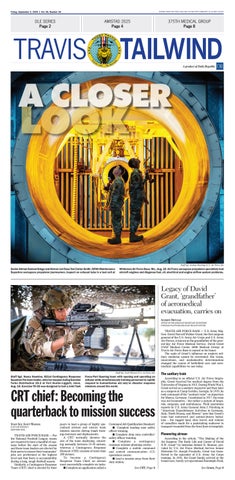
Senior Airman Samuel Griego and Airman 1st Class Tavi Carter-Smith, 509th Maintenance Squadron aerospace propulsion journeymen, inspect an exhaust tube in a test cell at
Whiteman Air Force Base, Mo., Aug. 20. Air Force aerospace propulsion specialists test aircraft engines and diagnose fuel, oil, electrical and engine airflow system problems.
Legacy of David Grant, ‘grandfather’ of aeromedical evacuation, carries on Andrew Ortuzar
OFFICE OF THE ASSISTANT SECRETARY OF DEFENSE FOR HEALTH AFFAIRS/MILITARY HEALTH SYSTEM
TRAVIS AIR FORCE BASE — U.S. Army Maj. Gen. David Norvell Walker Grant, the first surgeon general of the U.S. Army Air Corps and U.S. Army Air Forces, is known as the grandfather of the present-day Air Force Medical Service. David Grant USAF Medical Center (60th Medical Group) at Travis Air Force Base is named in his honor. The scale of Grant’s influence on modern military medicine cannot be overstated: His vision, innovations, and unshakeable determination changed the course of battlefield care and aeromedical capabilities we use today. Staff Sgt. Scott Warner/U.S. Air Force file
Staff Sgt. Nancy Hawkins, 821st Contingency Response Squadron fire team leader, aims her weapon during Exercise Turbo Distribution 25-2 at Fort Hunter-Liggett, Jolon, Aug. 18. Exercise TD-25 was designed to test a Joint Task
Force-Port Opening team with opening and operating an airbase while simultaneously training personnel to rapidly respond to humanitarian aid and/or disaster response missions around the world.
CRT chief: Becoming the quarterback to mission success Staff Sgt. Scott Warner 621ST CONTINGENCY RESPONSE WING
TRAVIS AIR FORCE BASE — For the National Football League, teams are required to have a handful of captains before the start of the season and these team leaders are elected by their peers to ensure their teammates’ jobs are performed at the highest level and that there is accountability during a long, tough football season. Similarly, a Contingency Response Team (CRT) chief is elected by their
peers to lead a group of highly specialized airmen and ensure team mission success during tough training exercises and deployments. A CRT normally denotes the size of the team deploying, consisting normally between 15-25 airmen, whereas a Contingency Response Element (CRE) consists of more than 100 airmen. To become a Contingency Response Team Chief, an airmen must successfully complete six tasks: n Complete an application called a
Command Job Qualification Standard. n Complete landing zone safety officer training. n Complete drop zone controller/ safety officer training. n Complete a contingency response mission planning course. n Complete a mobile command and control communication (C3) operations course. n Lead a mission away from their duty station. See CRT, Page 6
The sanitary train According to an official U.S. Air Force biography, Grant received his medical degree from the University of Virginia in 1915. During World War I, Grant served as a sanitary inspector and then later as a surgeon at Camp Gordon, Georgia. In 1919, he took command of the “sanitary train” on departure for Mayen, Germany. Constituted in 1917, the train was not locomotive – but rather a system of hospitals, surgeons, and ambulances. Field operations reports by U.S. Army General John J. Pershing in “American Expeditionary Activities in Germany, Italy, North Russia, and Siberia” note that Grant’s train had motorized and animal-drawn battalions – the rugged land, slow travel, and volume of casualties made for a painstaking endeavor to transport wounded from the front lines to hospitals.
Pioneering airman According to the article, “The Making of the Air Surgeon: The Early Life and Career of David N.W. Grant” by historian Robert E. Skinner, provided by U.S. Air Force Medical Service Senior Historian Dr. Joseph Frechette, Grant was transferred to the epicenter of U.S. Army Air Corps training. In 1931, the Grant family arrived at the brand-new, barely-yet operational Randolph Field, See Grant, Page 8