Friday, November 14, 2025 l Vol. 50, Number xx
SERVING TRAVIS AIR FORCE BASE AND THE MILITARY COMMUNITY OF SOLANO COUNTY
GRAND MARSHAL ALDRIDGE Page 2
MINUTEMAN III TESTING Page 4
TRAVIS
SOUTH CHINA SEA TASK FORCE Page 5
TAILWIND A product of Daily Republic
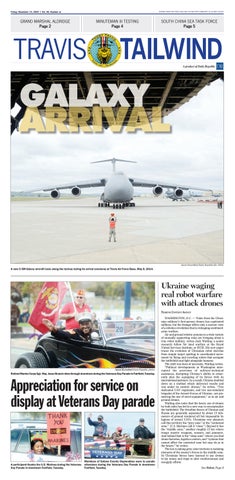
GALAXY
ARRIVAL
Aaron Rosenblatt/Daily Republic file (2014)
A new C-5M Galaxy aircraft taxis along the tarmac during its arrival ceremony at Travis Air Force Base, May 8, 2014.
Ukraine waging real robot warfare with attack drones Tribune Content Agency
Aaron Rosenblatt/Daily Republic photos
Retired Marine Corps Sgt. Maj. Jesse Branch rides through downtown during the Veterans Day Parade in Fairfield, Tuesday.
Appreciation for service on display at Veterans Day parade
A participant thanks the U.S. Marines during the Veterans Day Parade in downtown Fairfield, Tuesday.
Members of Solano County Deplorables wave to parade attendees during the Veterans Day Parade in downtown Fairfield, Tuesday.
WASHINGTON, D.C. — Video from the Ukrainian military’s first-person drones has captivated millions, but the footage offers only a narrow view of a robotics revolution that is reshaping combinedarms warfare. Air and ground robotic systems in a wide variety of mutually supporting roles are bringing about a true robot military, writes Jack Watling, a senior research fellow for land warfare at the Royal United Services Institute, or RUSI. His new paper traces the evolution of Ukrainian robot doctrine from simple target spotting to coordinated movements by flying and crawling robots that navigate the battlefield and fight alongside humans. The shift was born of necessity, Watling writes. “Political developments in Washington interrupted the provision of military-technical assistance, disrupting Ukraine’s ability to coherently plan the equipping of its forces with its international partners. As a result, Ukraine doubled down on a method which delivered results and was under its control: drones,” he writes. “Two dedicated UAV regiments, and two non-standard brigades of the Armed Forces of Ukraine...are pioneering the use of novel equipment,” as in air and ground drones. Watling also notes that the heavy use of drones by both sides has led to a new way to conceptualize the battlefield. The frontline forces of Ukraine and Russia are generally separated by about 15 kilometers of ground rendered all but impassable by legions of armed UAVs. Ukrainian war planners call this territory the “grey zone” or the “contested zone.” (U.S. Marines call it “close.”) Beyond it lies the “middle zone,” another roughly 15 km where troops muster weapons, sensors, and jammers. And behind that is the “deep zone” where you find drone factories, logistics centers, and “systems that cannot affect the contested zone but may do so in the future,” he writes. The key to taking grey-zone territory is isolating elements of the enemy’s forces in the middle zone. So Ukrainian forces have learned to use drones to lay mines and traps to slow reinforcement and resupply efforts. See Robot, Page 3