TRAVIS TAILWIND

the probes May
and began installing them on the first of two

Senior m ASter Sgt megAn cruSher
USAFE-AFAFRICA
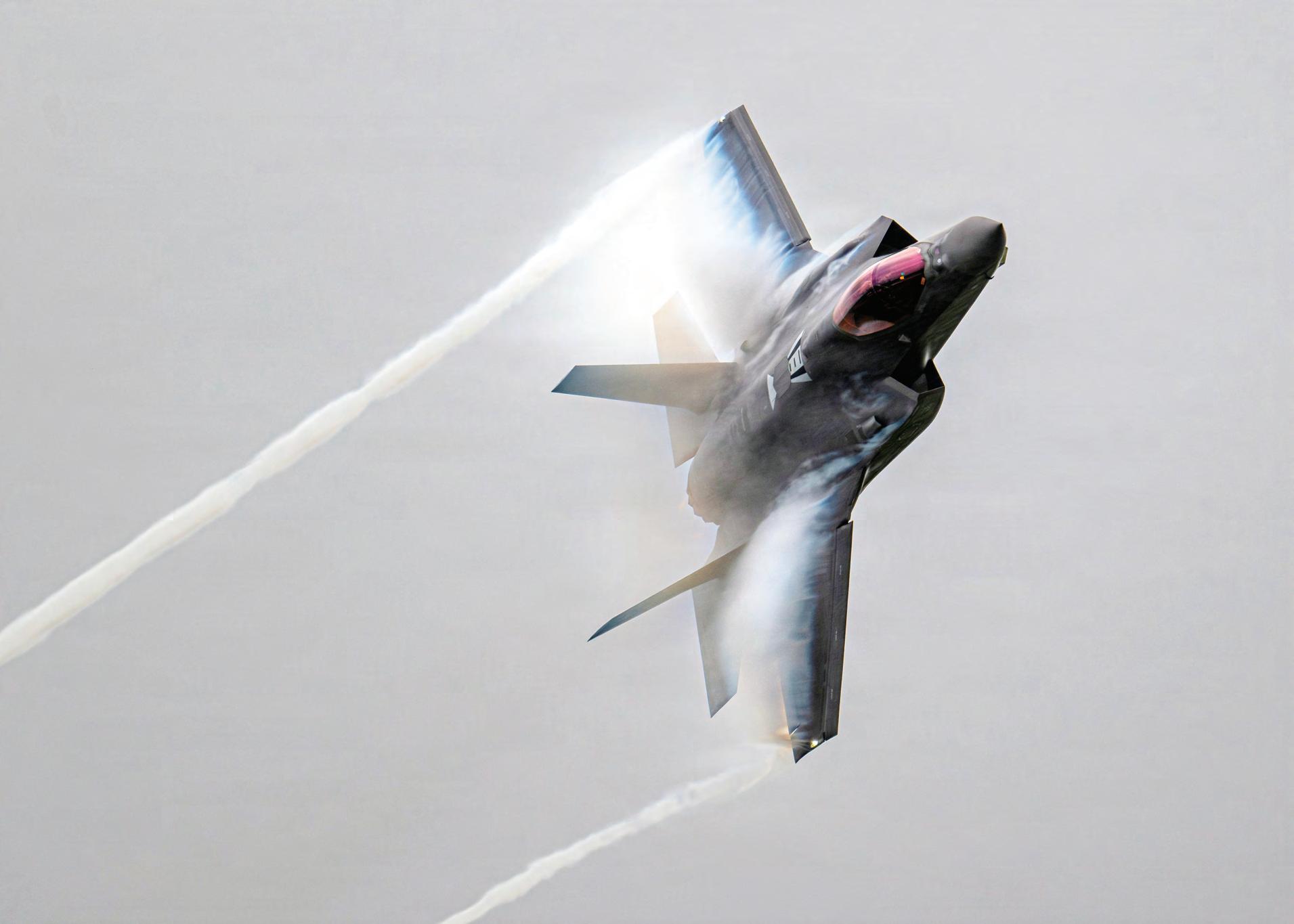
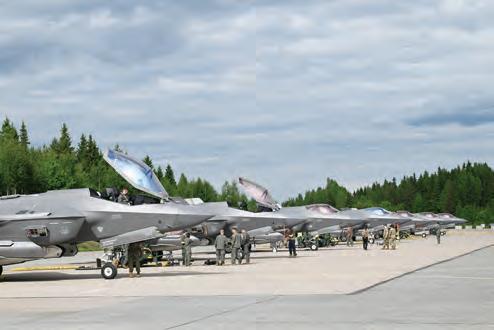
RAF LAKENHEATH, England — U.S. Air Force airmen and F-35A Lightning II aircraft from the 48th Fighter Wing, RAF Lakenheath, England, arrived in Pirkkala, Finland, for NATO Allied Air Command’s (AIRCOM’s) Ramstein Flag 2026 (RAFL26) executing from June 8-19. The large-scale, multi-domain exercise is in its third year and will see allied air forces conduct combined air operations in northern and southern Europe.
This year is the first time NATO AIRCOM took the lead, with CAOC BODO as a lead CAOC, to plan and execute the exercise which will have more than 200 aircraft from 18 nations generating over 150 sorties per day across more than 20 locations throughout Europe. These high-level operations will provide challenging combat scenarios that include realistic problem sets in a complex operational environment.
To further assist in the exercise, U.S. airmen and a KC-135 Stratotanker from the 100th Air Refueling Wing, RAF Mildenhall, England, will provide aerial refueling and fly out of Ørland, Norway. Aerial refueling is critical to sustaining high-tempo operations and serves as
a vital force multiplier by extending the reach, endurance, and rapidresponse capabilities of combat aircraft.
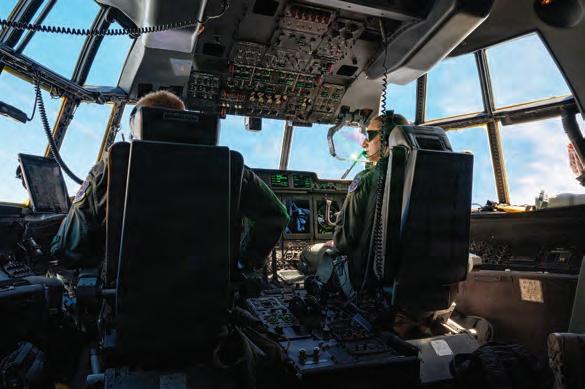
The U.S. Air National Guard’s 123rd Airlift Wing will provide airmen and C-130J Super Hercules aircraft to provide tactical airlift support to the exercise and bolster the unit’s wartime readiness.
RAFL26 will bring together the most advanced military air forces demonstrating the alliance’s strength, unity and highlighting the commitment to defend our people and our shared values. Fully committed to these values and the broader mission, the multinational collaboration highlights the alliance’s capabilities to ensure stability across the Euro-Atlantic area.
The U.S. collaborates closely with European allies and partners to enhance early warning systems, share intelligence, and coordinate responses to emerging threats, building a layered and resilient defense that extends our security perimeter far from American shores. By prioritizing the defense of the homeland, projecting decisive combat power when and where needed, and positioning the alliance to deter and defend, we safeguard U.S. interests in Europe and around the world.


A
TRAVIS AIR FORCE
BASE — The Travis Exchange will honor the Army’s 251st birthday with weeklong deals, offering military members and their families discounts on electronics, apparel, tactical gear, home essentials and more. From June 12 through June 18, the Exchange is delivering exclusive offers on top brands, including Apple, LG, Levi’s and American Eagle, helping military shoppers celebrate while maximizing their taxfree benefit. Shoppers can find more details on this sale at https://www. shopmyexchange.com/cp/ static-pages/weekly-ads.
Special savings will be available in-store and at ShopMyExchange.com.
Shoppers can save:
n Up to $250 on Apple MacBooks, $50 on select Beats wireless audio and up to $1400 on LG UHD, QNED and OLED TVs.
n 20% on tactical gear and accessories from Rocky, ESS, Elite Survival and Black Diamond.
n An extra 20% on American Eagle and Levi’s clothing and 20% on Mercury and Flying Circle bags.
n Up to $50 on Chard and Even Embers grills and up to 15% on DeWalt power tools and outdoor equipment.
Military Star cardmembers can also access exclusive benefits, including:
n Double points on in-store Military Star purchases on June 14.
n Savings on Exchange services including $10 off $25 concessions, 15% off food purchases at
THE DAILY REPUBLIC DELIVERS. CALL 707-427-6989.

participating restaurants and 10 cents off fuel on June 14.
“The Army’s birthday is a reminder of the courage, commitment and unwavering spirit of our soldiers – past and present,” Travis Exchange General Manager Cathie Byrns said. “We’re proud to support our military communities by delivering meaningful savings and value that strengthen their quality of life.”
Department of War and Coast Guard civilians with a Common Access Card are also eligible to shop at the Exchange both in store and online. These shoppers can visit https:// publicaffairs-sme.com/ Community/dodcac benefits for more info.
Honorably discharged veterans are eligible to shop online at ShopMyExchange.







Tech.
NORTH LAS VEGAS,
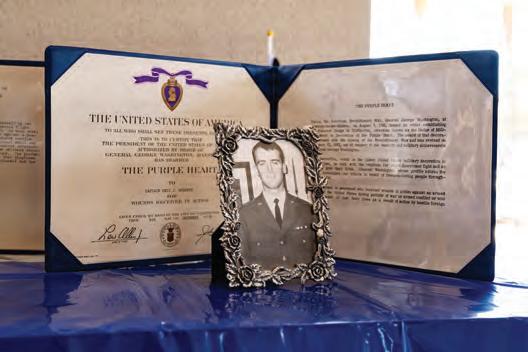
Nev. — Hidden for decades beneath the soil of a Cambodian knoll, a small, weathered metal disc silently held the weight of half a century of grief, love and unanswered questions. For 56 years, the word “missing” hung heavy and undefined in the lives of the Huberth family. It was a void left by a son and brother. May 13, exactly 56 years to the day since his aircraft vanished during a combat mission, a tangible piece of U.S. Air Force Capt. Eric “Rick” Huberth finally came home.
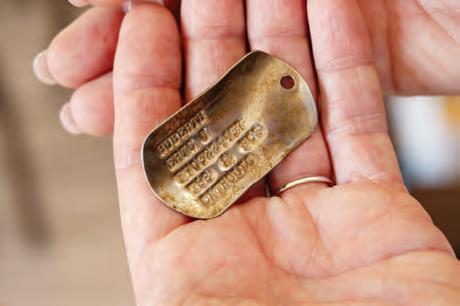
Lt. Col. Brittany Lee, 99th Force Support Squadron commander, presented Capt. Huberth’s recovered ID tags to his surviving sisters during a solemn ceremony, offering a long-awaited physical connection to a hero they never forgot.
As an F-4D Phantom II weapon systems officer, Capt. Huberth was declared missing in action May 13, 1970. Since then, Capt. Huberth’s family – his mother and four sisters – have anxiously awaited news of their loved one.
Decades of search and 11 excavations of the crash site by recovery teams, including the Defense POW/MIA Accounting Agency and Ohio Valley Archaeology, INC., finally led to the poignant discovery of his ID tags, commonly known as dog tags.
To the Air Force, he was a dedicated aviator and officer. To his family, he was simply Rick. He was the young man who bought his sisters their first cars, quietly paid his mother’s utility bills and served as a loving role model. He was, as his sister Lorraine Larson remembers, the glue that held them together.
“He was our father figure,” Larson said. “I mean, I’m not saying that he wasn’t a pain in the neck, but he did a lot of things he didn’t have to do. And I know for a fact that if there is some way that he could have made
more money, on different missions and whatever he was doing, he would have done it for my mom.”
Leading up to that fateful afternoon in 1970, Capt. Huberth had flown 55 missions in six weeks. During his last flight, then-1st Lt. Huberth and his pilot, Capt. Alan R. Trent, were on an interdiction mission to destroy a bridge along the Ho Chi Minh Trail in Cambodia.
After the lead aircraft missed the target, Capt. Huberth and Trent’s F-4D was hit by enemy ground fire. Trent attempted to abruptly pull the aircraft up before impacting a knoll and two ridgelines.
Both men were listed as missing in action.
For the families left behind, the uncertainty was a unique and terrible burden.
“He was the backbone of the family,” Larson said. “And then, all of the sudden it’s like the rug was pulled out from under us. I’m 16 years old and he’s missing. It would have been easier for our family if we were told he was killed. At the time, it was like, ‘Oh, if he is missing, that means he’s just missing. He’s coming home.’ ... I honestly didn’t really embrace it because he’s always been around. I never doubted for one minute that he wasn’t coming home.”
The decades that followed were filled with waiting and anguish. Initial searches yielded little. Only in April did an excavation finally reveal not just a personal possession, but a form of identification that would have been physically carried by Capt. Huberth.
“The desire to know and be known has always been a deeply human characteristic,” said Jim Flook, historian for the 99th Air Base Wing. “When one’s life was at risk, the desire becomes more poignant. The familiar standardization came about in World War II: a rounded rectangle with a notch, bearing name, rank, service number, blood type, and the optional religious identification. While the style changed See MIA, Page 4
A
TRAVIS AIR FORCE
BASE — It’s the Army’s 251 st birthday, but these gifts are for military shoppers. The Travis Exchange is rolling out an Army birthday sweepstakes, with 176 prizes totaling nearly $7,700.
From June 12 through July 18, eligible Travis Exchange shoppers can visit ShopMyExchange. com/sweepstakes, to enter. Prizes include:
n Rocky RKC050 tactical military boots (one of five). $199 value each.
n ESS Rollbar ballistic sunglasses (one of three). $127 value each.
n Police Security Skylar rechargeable flashlight with power bank (one of six). $109.99 value each.
n Rite in the Rain weatherproof mechanical pencil pack (one of 25). $25.95 value each.
n Outdoor Element Fire Escape multitool carabiner (1 of 25). $26.95 value each.
n Mechanix Wear Cold-












K aren Petitt 375TH AIR MOBILITY WING PUBLIC AFFAIRS
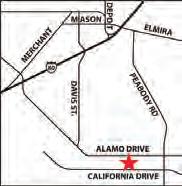
SCOTT AIR FORCE BASE, Ill. — A new chapter in global mobility launched, May 29, with the official opening of the Joint Operations and Mission Planning Center, a facility designed to centralize the military’s most critical transportation and flight planning operations under one roof.
Completed after five years of construction at a cost of $110 million, the JOMPC consolidates nearly 1,000 personnel into a high-tech nerve center.
The two-story, four-acre building streamlines the complex coordination required to move troops, fuel, and patients across the globe by co-housing U.S. Transportation Command’s Force Flow element, the 618th Air Operations Center, and key elements of Air Mobility Command, including its Air Intelligence Squadron.
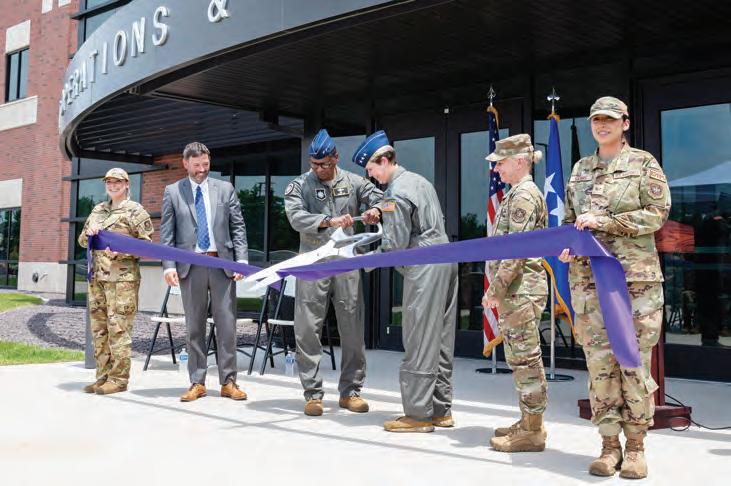
Leaders from these organizations, along with the U.S. Army Corps of Engineers Louisville District who oversaw the construction and turnover of the facility, participated in a ribbon cutting ceremony today to celebrate the successful completion and partnership of the effort.
Located in the building is USTRANSCOM’s Force Flow element, which serves as the strategic architect for the Department of War’s global transportation requirements. Whether by land, sea, or air, they determine what assets are required and the sequence in which they must arrive. This includes deconflicting crowded airfields, prioritizing time-critical aeromedical evacuations, and calculating the massive aerial refueling requirements needed to project combat power.
However, the largest footprint within the JOMPC belongs to the
Center. If the Force Flow element is the master architect, the 618th AOC serves as its 24/7 dispatch center, directing a fleet of nearly 1,100 aircraft and delivering strategic airlift, air refueling, aeromedical evacuation and global air mobility support for operations around the world.
Brig. Gen. Michele Lo Bianco, 618th AOC commander, shared, “Our mission to execute rapid global mobility never stops. We have a critical responsibility to command and control the deployment of air power to delivery lethality, hope, and freedom. The JOMPC will foster greater collaboration and improve our mission capabilities.”
During the ceremony, Lt. Gen. Rebecca Sonkiss, AMC interim commander, underscored the sheer magnitude of their operations.
“AMC is the maneuver for the Joint Force,” she said. “No unit understands this better than the 618th Air Operations Center. As the largest and busiest AOC in the Department of War, the 618th executes major combat operations across the globe. This team actively controls decisive mobility operations for over 1,000 aircraft across
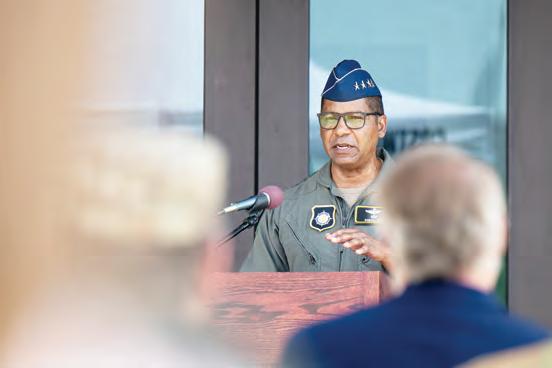
all seven continents. The AOC requires every single one of these advancements to properly plan, task, execute and assess global air mobility operation.”
To bring this facility to life, the U.S. Army Corps of Engineers, base civil engineers, and cyber specialists worked in lockstep to ensure the building met strict operational and security requirements.
Nolan Robben, USACE project engineer and contracting officer’s representative, said, “One of the things we are most proud of isn’t a single visible feature, but the collective attention to detail that went into constructing a facility capable of supporting the warfighter’s mission. Much of the work that enables that mission – secure spaces, communications infrastructure, and the integration of complex building systems – will never be seen by the public, but it is essential to how the building operates.”
He also explained how this project required their team to navigate numerous technical challenges, evolving mission requirements, and significant design modifications during construction. Although the changes required careful coordination and some rework, he said the strong partnership among all stakeholders allowed the team to address the issue.
“The result is a fully compliant, secure facility that meets the updated mission requirements. Standing on site . . . and seeing the finished facility –knowing the challenges the team had worked through together – was an incredibly satisfying moment. More importantly, it represented the successful


of a
From Page 3
[over time], the intent remained steadfast. The dog tag is the desire to be known. The dog tag is our nation’s commitment to our service members to leave none behind.”
For Larson and her sister, Suzanne Huberth, receiving the tag is a moment of profound, if incomplete, healing. As the remaining surviving family members, it validates their 56-year fight to honor his memory and provides a sense of peace that has long been elusive.
“This is such an incredible moment for our family to have closure,” Larson said. “It is closure. It’s not complete closure. But for me personally, it’s something
more than we’ve ever had in 56 years.” The search for complete closure continues. With one final excavation of the crash site scheduled for January 2027, Larson and Ms. Huberth hold onto the hope of bringing their brother home. Their ultimate goal is to recover Capt. Huberth’s remains and honor his life, service, and sacrifice with a proper burial at Arlington National Cemetery, Virginia. The return of Capt. Huberth’s ID tags is a testament to the Air Force’s unwavering commitment to its people, ensuring the passage of time does not erase the sacrifices of those who served.
“Leave no airman behind” is far more than just a motto. It is a sacred, enduring promise that does not expire. Not even

























Debora Henley
HURLBURT FIELD, Fla. — Highlighting the critical partnership between Air Combat Command and Air Force Special Operations Command, Gen. Adrian Spain, commander of ACC, and Chief Master Sgt. David Unterseher, ACC command chief, visited Hurlburt Field last month to meet with the AFSOC command team before conducting an in-depth immersion with the 505th Command and Control Wing.
The partnership between ACC and AFSOC is a powerful example of how major commands integrate overlapping capabilities, assets, and personnel to present a full range of warfighting options to the Joint Force.
Following their engagement with AFSOC leadership, the ACC command team turned their focus to the 505th CCW.
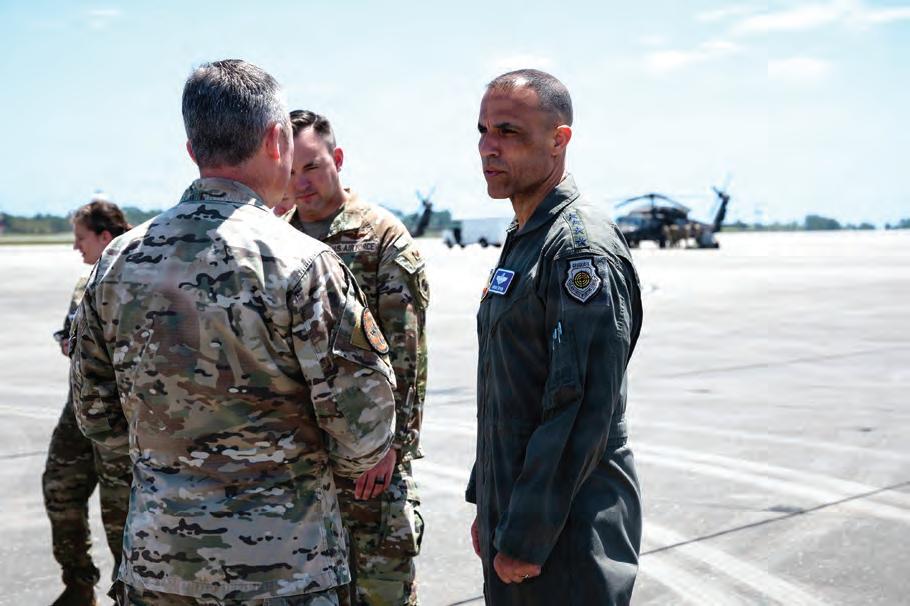
The immersion provided Spain and Unterseher with a comprehensive look at how the 505th CCW directly supports ACC’s command priorities through a unique portfolio of integrated experimentation, testing, training, and tactics development. “The innovation I witnessed at the 505th is exactly how we achieve decision advantage,”
said Spain. “This wing is building the command and control ecosystem that will seamlessly integrate our kinetic fires with
effects across the electromagnetic spectrum. That level of information dominance is what allows us to outpace threats,
buys down risk for our operators, and ensures our ability to deter, defend, and win decisively when called upon.”
Throughout the day, the command team engaged directly with airmen from across the wing, diving into the complexities of operational-level C2. Through a series of deep-dive mission briefs, they examined the advanced simulation and synthetic environment platforms used to train the force, test new capabilities, and drive rapid experimentation. These discussions showcased how the 505th is actively improving and accelerating long-range kill chains and developing the advanced tactics that will give the U.S. and its allies a decisive advantage in any contest.
“The level of technical expertise our enlisted airmen bring to the C2 fight is simply astounding,” said Unterseher. “They are the engine that runs this enterprise, turning strategic concepts into tactical reality. The professionalism and dedication I saw at the 505th gives me full confidence that our C2 force is ready to meet any challenge, any time.”

welcome to Discover, Develop, and Demonstrate a relationship with God.
We invite you to join us for Sunday service at 10:30 a.m.
2207 Union Avenue, Fairfield, CA www.1ag .com





Christ Exalted, Lives Transformed 3777 Vaca Valley Pkwy Ste.F, Vacaville, 95688
Email: o ce@northhillsvv.org
Website: www.northhillsvv.org
Service Times: Sunday morning 10 a.m., Wednesday evening 6:30 p.m. Phone: 707-449-8977




Vacaville Church of Christ 401 Fir St., Vacaville, CA 95688 (707) 448-5085
Minister: Elliott Williams
Sunday Morning Bible Study 9:30 AM
Sunday Morning Worship 10:30 AM
Sunday Evening Worship 5:00 PM
Wednesday Evening Bible Study 6:00 PM vacavillecoc.com 401 Fir St.,






Spc. RichaRd MoRgan
U.S. SOUTHERN COMMAND
CRISTÓBAL COLÓN,
Panama — U.S. Air Force
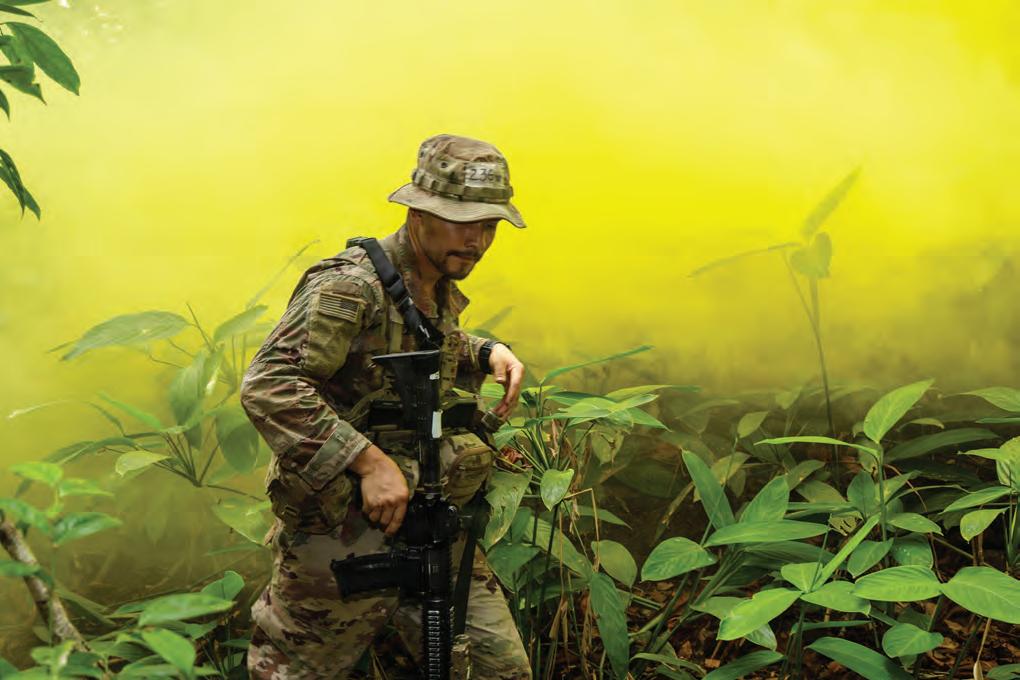
Staff Sgt. Duchaine Paul, assigned to the 824th Base Defense Squadron at Moody Air Force Base, Georgia, earned the jungle tab from the Jungle Operations Training Course – Panama class 26-5, May 15, and has become the first airman to graduate from the JOTC-P.
Before attending the course, Paul had spent time building strong partnerships with Panamanian personnel through joint training with the Servicio de Protección Institucional, Panama’s presidential security force.
“Fortunately, I’ve been very blessed to train with other partners like SPI, which is presidential security over here in Panama,” Paul said. “And we got to train with them over at Cerro Tigre. And it’s been some great partnership and just building a relationship with the Panamanians.”
Those experiences laid the foundation for his next challenge. Building on the relationships and familiarity he had already developed with his Panamanian counterparts, Paul completed the rigorous 18-day Jungle Operations Training Course – Panama here at Base Aeronaval Cristóbal Colón from April 27 to May 15.
The course immerses jungle students in one of the world’s most unforgiving environments. Deep within the dense Panamanian jungle, students battle oppressive heat and humidity, relentless tropical rains that turn the ground into thick, sinking
mud, swarms of insects, venomous wildlife, and nearly impenetrable vegetation. Navigation through the tangled undergrowth demands constant vigilance; while the survival skills, small-unit tactics, and waterborne operations test every ounce of physical endurance and mental resilience the jungle students possess.
Paul stressed how mental toughness was the key factor that carried him through his toughest challenges. Quickly adding that seeing his classmates struggle alongside him became a powerful motivator.
“Those difficult moments of the course is what kept me going through every single day… I look over to one of my friends, they would be struggling just as much. I just knew I couldn’t let up … You’re struggling. You see your buddy just barely making it. It’s a good option to just laugh at each other like, ‘Yeah, I cannot believe we’re here right now.’ You just keep pushing.”
The language barrier introduced another challenge for Paul, yet he approached it as an opportunity rather than an obstacle. He explained it was a great way to become what some jungle students referred to as “tactically bilingual.”
“It was very interesting. Of course, there’s a language barrier, but it’s more getting the opportunity to learn a different language and refine those skills,” he explained. “So, it’s a very challenging time for me to learn Spanish, and also a very beneficial time as well.”

Paul’s leadership has spoken at length about their choice to ultimately send him through the course, expecting to not just survive the jungle, but to thrive in it.
“Our mission in Panama is centered on training by, with, and through our Panamanian partners to strengthen interoperability, build enduring relationships, and reinforce regional security cooperation,” said U.S. Air Force 1st Lt. Jeanna Daessleer, 474th Air Expeditionary Group, Detachment 1, mission commander.
“Staff Sergeant Paul embodied that mission every day in country. While several members were medically and physically qualified to attend the course, he distinguished himself through his professionalism, teamwork, and the relationships he built with our partner force. He has a unique ability to connect with people, foster trust, and positively represent both the 824th Base Defense Squadron and the United States Air Force. He was absolutely the right airman for this opportunity and excelled throughout the course.”
While proud to be the first Air Force graduate this iteration, Paul emphasized that the milestone represented something much larger than himself.
“But to me, it wasn’t really about being the very first Air Force graduate to come through this. It was about knowing that I am just an image of the 824th BDS. So I’m not just representing myself, but my fellow partners, my colleagues that are down there waiting to come to
the next class.”
Paul strongly encouraged other service members to take advantage of the training, explaining the amount of things he learned not just from the jungle instructors, but jungle students as well.
“I would definitely recommend this course to anybody who can come here, because it’s an amazing opportunity to build relationships with the Panamanians.”
When asking his leadership, Daessleer reassures that Paul was the first, and certainly won’t be the last Airmen to go through the jungle course and have their chance to earn the jungle tab.
“Looking ahead, we absolutely intend to continue sending airmen through JOTC-P. The 824th BDS already has two additional Airmen identified and prepared for upcoming iterations. Additionally, through the partnership established during this course, we have strengthened coordination with the JOTC-P leadership and anticipate continued opportunities for Base Defense Group airmen to attend future classes,” Daessleer said.
Paul’s graduation not only marks a historic first for the U.S. Air Force but also underscores the growing interoperability between U.S. and Panamanian partners. Through shared training experiences like this, both nations are strengthening their ability to operate seamlessly in one of the world’s most demanding environments, reinforcing military partnerships that bolster security and stability across the region.

From Page 1
Installation typically takes approximately four hours to complete, though the team faced challenges during the process.
“We did encounter an issue while installing the modified mount bolts that caused the nut plates to cross-thread, leading to the removal of the refueling receptacle, costing us several hours,” Vargas said.
Air Force Tech. Sgt. Wesley Zell, an A-10 refueling probe installer assigned to Davis-Monthan Air Force Base, Arizona, worked alongside Moody’s maintainers to complete the installation. Although the installation process is generally straightforward, removing existing aircraft hardware and correctly installing the mounting components proved to be one of the most difficult parts of the modification.
“There’s been a lot of issues getting these bolts removed so we can put the probe on,” Zell said. “These screws and bolts hardly ever come out anyway, so doing this is the time-consuming part of it. Once we get that part up, the install of the probe is very simple.”
Following the installation, pilots assigned to the 74th Fighter Squadron conducted familiarization flights with the new capability. For Air Force Capt. Ron Wayman, the flight marked a milestone for Moody’s A-10 community.
“It was a cool experience; something we’ve never done before,” Wayman said. “Getting to do it with the HC-130s from Moody was a pretty cool experience.”
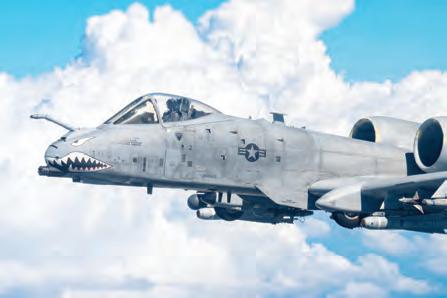
The new refueling capability enables A-10s to receive fuel below 10,000 feet from HC-130J Combat King II aircraft, keeping pilots aligned with combat search and rescue operations while improving mission efficiency. The system also allows two A-10s to refuel simultaneously, unlike traditional refueling methods with KC-135 Stratotanker aircraft.
“It gives the A-10 a different way of being able to
refuel with the HC-130s,” Zell said. “Now they can go low-level – below 10,000 feet – refuel with the HC-130 and stay in the [combat search and rescue] mission.”
Wayman said the added capability provides aircrews with greater operational flexibility for future missions and deployments.
“It’s a good capability for us,” he said. “It’ll give us more options when we’re in future fights and during things as simple as moving across country or transoceanic crossings; it’s another capability that can help us.”
The installation effort also demonstrated the technical expertise and adaptability of Moody Air Force Base’s maintainers, who executed the modification at the flight line level.
“It highlights our talents at the functional level, relying entirely on high-level capabilities of flight line maintainers, rather than specialized depot-level facilities,” Vargas said, adding that subject matter experts from Davis-Monthan Air Force Base also demonstrated how to implement the modular pack-out kits provided, to sustain the new capability downrange and reduce reliance on traditional supply chains.
The effort reflects a broader push across the Air Force to rapidly integrate emerging capabilities and prepare airmen to operate in evolving environments. Building on previous integrations completed downrange and at other A-10 units, teams collaborated to familiarize maintainers with the installation process and improve operational readiness.
The addition of the refueling probe marks a significant step forward in Moody Air Force Base’s combat capability – expanding the A-10C Thunderbolt II’s ability to support combat search and rescue and close-air support operations. By integrating the system before deployment, Moody airmen increased operational flexibility, extended mission endurance and reinforced the Air Force’s commitment to rapidly adapting combat capabilities for future fights.









senior A irm An De’QuAn simmons
375TH
SCOTT AIR FORCE
BASE, Ill. — Chief Master
Sgt. of the Air Force
David Wolfe visited Scott Air Force Base, May 21.
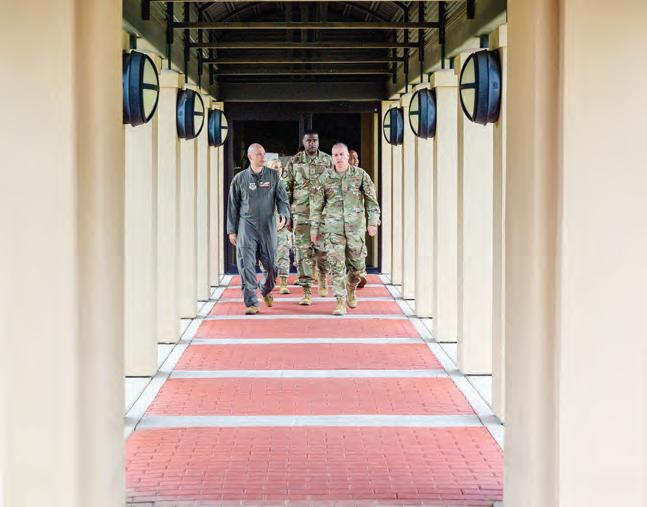
Wolfe engaged with senior Team Scott leadership, held a discussion with CMSAF Bud Andrews Airman Leadership School instructors, and hosted an all-call at the Scott Community Center focused on Air Force priorities and enlisted leadership during the visit.
Wolfe continued, explaining that readiness extends beyond job qualifications and training requirements, and emphasized professional growth, skill development, and financial preparedness. He also highlighted innovation as a key part of modernization, encouraging airmen to bring forward new ideas and leaders to remain open to new approaches. He further stressed the importance of supporting airmen and their families by identifying challenges and
advocating for solutions on their behalf.
The senior leader connected those three priorities to the importance of effective leadership at every level. These priorities also remained a focus during discussions with instructors at the CMSAF Bud Andrews Airman Leadership School and remarks delivered during the all-call.
“In professional military education, we’re not trying to teach you what to think,” he said during the all-call. “We’re trying to teach you how to think, to have that discernment in your leadership style, and how you interact with your fellow airmen so you can be ultra-effective as a supervisor.”
Building on that message, Wolfe emphasized the lasting impact supervisors can have on the airmen they lead throughout their careers.
“I had a great first supervisor, I was super lucky,” Wolfe said. “Your job is to get ready in your leadership school to go be somebody’s first supervisor, and I hope that you’re planning on being a dang good one.”
From Page 5
The command team’s immersion highlighted the 505th’s pivotal and wide-ranging impact across the command.
The mission briefs demonstrated that the wing’s efforts are integral to nearly all of ACC’s strategic priorities, from organizing, training, and equipping the C2 operators who orchestrate the Joint Force’s combat power, to driving modernization efforts and developing the future leaders who will guarantee America’s air and space superiority.
Col. Ryan Hayde, commander of the 505th CCW, emphasized how the visit allowed the wing to showcase its direct contribution to the major command’s strategic vision.
“It was an honor to host General Spain and Chief Unterseher for their first visit and brief
From Page 3
them on how the 505th is operationalizing ACC’s priorities,” said Hayde.
“We demonstrated how our airmen are solving the Air Force’s toughest C2 challenges, from developing tactics for the Air Operations Center of the future to designing the synthetic environments used to train warfighters to execute complex kill chains in contested operations. Our mission touches every ACC priority, and we are committed to providing the combatready forces and superior C2 capabilities that guarantee absolute mission dominance.”
From the foundational AOC formal training and advanced joint and coalition exercises to the cutting-edge experimentation with LRKCs and the rigorous testing of full-spectrum C2 systems, the deep dive provided the ACC command team with a comprehensive understanding of the wing’s vital contribution, across all its squadrons, to generating air and space superiority.
of 20). $22.95 value each. Winners will be selected on or around July 31. The sweepstakes is open to all authorized Travis Exchange customers 18 years or older. No purchase is necessary to win. Department of Defense and Coast Guard civilians and retirees and honorably discharged veterans who have confirmed their eligibility to shop online may also enter. Veterans can visit https://aafes.media/ paveterans to learn more about their shopping benefit. DoD civilians can visit https://aafes.media/ cacbenefitspa.
DAVIS-MONTHAN
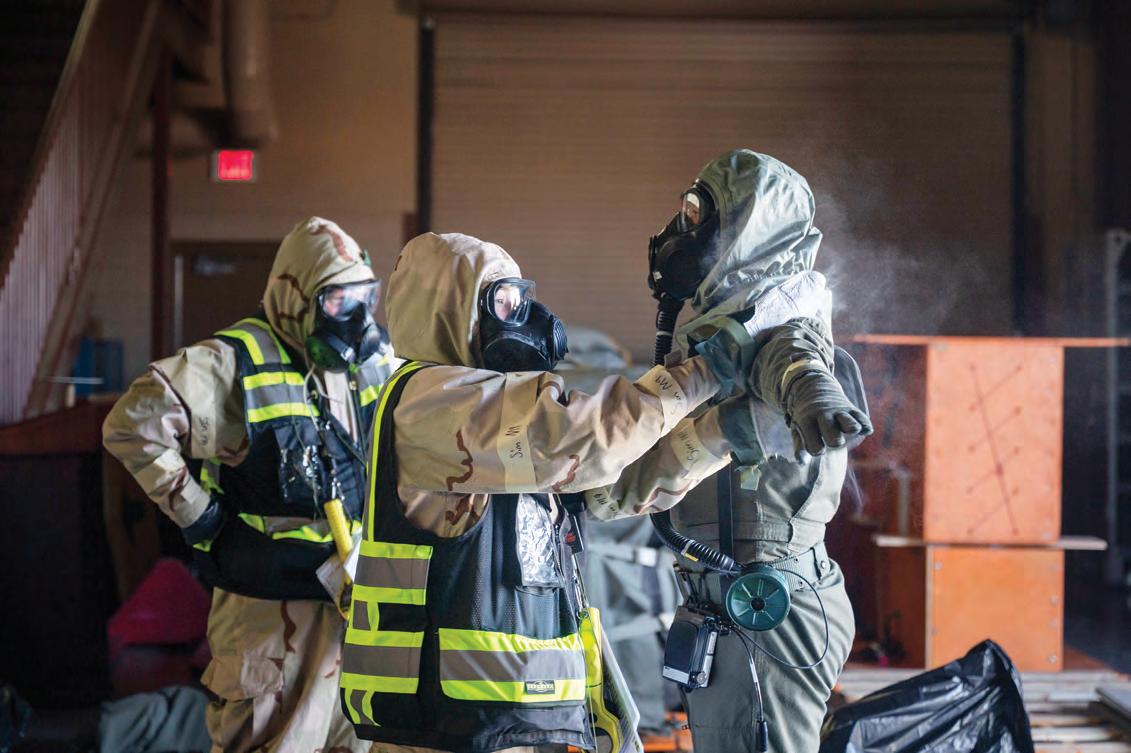
AIR FORCE BASE, Ariz. — Airmen across the Davis-Monthan Air Force Base installation enhanced mission readiness through Chemical, Biological, Radiological, Nuclear, Explosives (CBRNE) response training during some of the most complex contingency scenarios featured in exercise Mosaic Lightning 26-2, May 7-15.
Exercise Mosaic Lightning is a combat readiness exercise developed to strengthen airmen’s ability to deploy, sustain operations and project combat power in contested environments. Through realistic and demanding scenarios, the exercise builds the skills, resilience and confidence airmen need to succeed in future conflicts.
“CBRNE was incorporated into exercise Mosaic Lightning to teach personnel how to survive an attack you cannot see,” said Tech Sgt. Samantha Lavandier, 355th Civil Engineering Squadron emergency management training member. “We want our troops to come home.”
CBRNE refers to the procedures, equipment and specialized training used to detect, protect against and respond to hazardous materials and unconventional threats while continuing mission operations. CBRNE preparedness ensures service members can survive in dangerous environments and maintain combat effectiveness under pressure.
CBRNE concepts were integrated throughout the exercise through a series of realistic training scenarios, including a fentanyl attack delivered by unmanned aerial systems, explosive hazards, simulated missile strike warnings and the establishment of a decontamination (decon) line. These events required responders to repeatedly don Mission-Oriented Protective Posture (MOPP) gear – specialized masks, gloves, overgarments and boots designed to protect airmen from chemical, biological and radiological hazards – and conduct simulated decontamination procedures. Together, the scenarios reflected the evolving threats military installations may face in today’s operational environment and reinforced the importance of being prepared to operate effectively in contaminated and high-threat conditions.
While wearing the protective equipment, participants identified hazardous substances, secured the affected area,
protected personnel and coordinated decontamination efforts. The inclusion of explosive hazards added another layer of complexity, forcing responders to adapt quickly and operate effectively in a dynamic, high-threat environment.
“Many facets were mixed during Mosaic Lightning,” said U.S. Air Force Airman 1st Class Lydia Schubert, 355th Civil Engineering Squadron emergency management technician. “It tested the response of different participating entities and the installation’s ability to augment together.”
Schubert participated
in the exercise as an emergency support function representative in the Emergency Operations Center, where she helped coordinate communication and resource management among agencies involved in the response. The scenario brought together a wide range of organizations, including Security Forces, Fire Protection, emergency management specialists, medical personnel and support agencies. Each team contributed unique capabilities, from securing the scene and identifying hazards to treating casualties and restoring essential operations. Exercises such as Mosaic Lightning 26-2 are vital to ensuring CBRNE training remains current, realistic and effective across the installation. They validate procedures, strengthen interagency coordination and build confidence in the ability to respond to real-world crises. By preparing airmen to operate through chemical, biological, radiological, nuclear and explosive threats, the 355th Wing reinforces its commitment to being ready in every domain and resilient in every fight.