TRAVIS TAILWIND

AFMEDCOM’s inter-command transfer underway for 4th time
A ir ForCe surgeon gener Al
PubliC A FFAirs
FALLS CHURCH,
Va.
— The Air Force Medical Command began its fourth inter-command transfer, June 29, realigning medical airmen currently under Air Force Global Strike Command to the 359th Medical Wing, Medical Readiness Command-Alpha.
The Department of Air Force established AFMEDCOM in August 2024 to create a centralized command structure for Air Force medicine, specifically designed to prioritize operational medical readiness and support to the warfighter.
The 359th MDW ICT is the fourth in a series of 12 ICTs designed to realign Air Force medical personnel to AFMEDCOM, the DAF’s newest direct reporting unit. In the three preceding ICTs, approximately 5,600 medical airmen transferred from Air Force District of Washington and the Air Education and Training Command to AFMEDCOM.
“This realignment is a critical step in modernizing the Department of Air Force’s medical readiness and ensuring medical airmen are postured to support the joint force,” said Maj. Gen. (Dr.) Robert Bogart, MRC-A commander. “By centralizing medical airmen under Medical Readiness Command-Alpha, we enhance
our operational agility and streamline our medical enterprise to better meet the demands of future pacing challenges.”
During the 359th MDW ICT, more than 1,500 medical airmen assigned to eight installations – Barksdale, Dyess, Ellsworth, F. E. Warren, Kirtland, Malmstrom, Minot, and Whiteman Air Force Bases – will realign under the MDW, located at Joint Base San Antonio, Texas. According to Bogart, this realignment will consolidate medical readiness functions and improve Air Force medical readiness to support Air Force Force Generation, Space Force Generation, and the joint force.
He added that the transfer of personnel represents a significant logistical and administrative effort noting that each ICT is deliberately planned and coordinated to ensure a seamless transition with zero disruption to patient care or installation support. For months leading to execution, planners within Headquarters AFMEDCOM and AFGSC have held regular meetings, including a tabletop exercise in preparation for the transfer.
Col. Betty Venth, 359th MDW commander, said that while the command structure will change, the medical personnel will continue to provide critical health and readiness
See Transfer, Page 3

A-plus deals: Travis Exchange shoppers save even more during sales tax holidays
A rmy & A ir ForCe
exChAnge serviCe
PubliC A FFAirs
TRAVIS AIR FORCE
BASE — The Travis Exchange is turning backto-school supply shopping into A-plus deals. Shoppers can get double the savings at the Department of War’s largest retailer during tax-free holidays in more than 15 states.
Military shoppers in states with sales tax holidays can use their Exchange benefit to save even more, receiving an
in-store discount equal to their local sales tax rate.
“The Exchange delivers everyday value for military families, and sales tax holidays stretch those savings even further,” Travis Exchange General Manager Cathie Byrns said. “In addition to double savings, back-to-school shoppers can enjoy the Exchange’s everyday military-exclusive pricing and tax-free savings.”
Sales tax holidays start in Mississippi and continue in 17 states through Aug. 22.
Travis AFB launches inaugural First Term Officer Course
BASE — For years, Travis Air Force Base has successfully transitioned newly enlisted airmen into the operational force through deliberate onboarding. Now, the base is applying that same targeted approach to its newest leaders with the launch of its inaugural First Term Officer Course, held June 15-17.
The three-day course was designed to accelerate the development of recently commissioned company grade officers, replacing the traditional trial-and-error approach of navigating a new operational environment with a structured blueprint for success.
“Newly commissioned officers are often dropped directly into their flights and expected to lead immediately, with only their commissioning source as their training,” said U.S. Air Force Master
Sgt. Krystle R. Ball, 60th Force Support Squadron career advisor. “This course bridges that critical gap. It helps ease the shift into an operational mindset and ensures our company grade officers are strategically aligned and mission ready.”
Bringing the curriculum to life required a unique partnership between the base’s Development Advisors and the Company Grade Officer Investment Council. The team combined the deep institutional experience of senior noncommissioned officers with the lived, operational insights of seasoned CGOs. Together, they built a program that introduces broad support systems while addressing real-world challenges.
Therapeutics Squadron clinical nurse, the early intervention provided clarity during a transitional time.
definitely helped fill some of the initial gaps of this base and new position.”
cesses, enabling them to advocate for their airmen from day one.

TRAVIS TAILWIND
For 2nd Lt. Lindsey Allen, 60th Inpatient
Relief
From Page 1
the host nations air traffic control, airfield management, and cargo handling.
“The ability of our Contingency Response airmen to quickly adapt to their environment and inject the order needed to move aid is nothing short of amazing, which the entire joint force and interagency immediately recognized.” said Col. Joseph Michaels, 621st Contingency Response Group commander. By stepping in to help
“Honestly, there is a combination of information overload paired with wanting to provide the best information for the team at all times,” Allen said. “I always try to remind myself ‘you don’t know what you don’t know,’ and this program
manage tower and ground operations, the airmen are clearing logistical bottlenecks. This critical infrastructure support ensures that vital supplies, heavy equipment, and relief personnel reach the front lines of the disaster zone as quickly and safely as possible.
“I am immensely proud of our Griffins and their selfless service in supporting the Venezuelan people,” said Lt. Col. Jessica Foster, 321st Contingency Response Squadron commander. “During any crisis, international cooperation is essential, but it
Throughout the course, new officers gained practical leadership tools, connected with base agencies and learned how to leverage resources to support their personnel. For many non-prior service officers, the course also provided vital insight into formal promotion and recognition pro-
is the incredible tenacity and profound care for humanity our airmen have showcased that is truly awe-inspiring. It is a privilege to lead such an impressive and inspiring team.”
Executing rapid mobility operations in the wake of natural disasters is a cornerstone of the 621st Contingency Response Wing’s mission. Known as the “Devil Raiders,” the wing has built a proven history of delivering critical humanitarian assistance and disaster relief on a global scale.
When a devastating earthquake struck
“FTOC was a great opportunity to introduce others going through similar situations, as well as hear the successes and failures from highly respected Air Force personnel,” Allen added. “It was empowering to connect with such experienced leaders in a more personal setting.” Ultimately, the goal is to shift new officers’ focus away from administrative survival and toward their primary mission: leading and mentoring airmen. Base leadership envisions FTOC becoming a permanent staple and an expected milestone for every arriving CGO. As the program matures, organizers hope the officers sitting in the seats today will return as the mentors and guest speakers of tomorrow, creating a self-sustaining cycle of leadership development.
Haiti in 2010, the wing provided vital airfield operations expertise in the immediate aftermath. That same year, they managed complex logistical flows to support relief efforts during the massive floods in Pakistan. Their agility was tested again in 2017 as they navigated the overlapping devastation of Hurricanes Harvey, Irma, and Maria across the Southern United States and the Caribbean. Whether responding to combat contingencies or humanitarian crises, the CRW remains ready to open airfields and deliver hope – anytime, anywhere.
Brian Collett/U.S. Air Force file photos
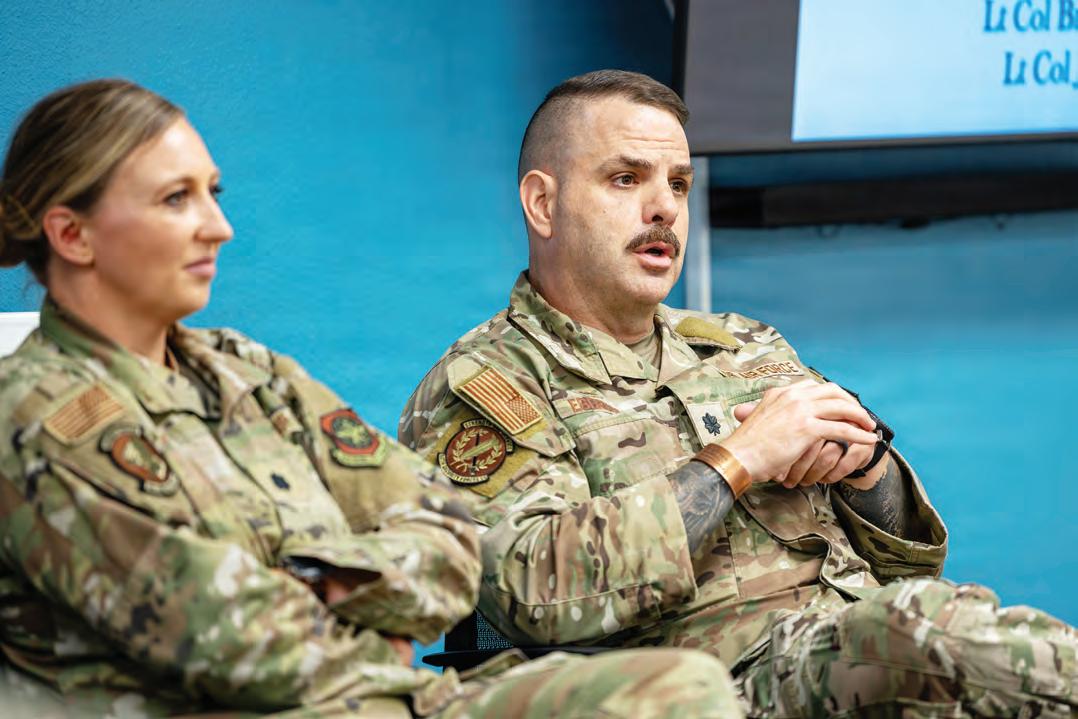
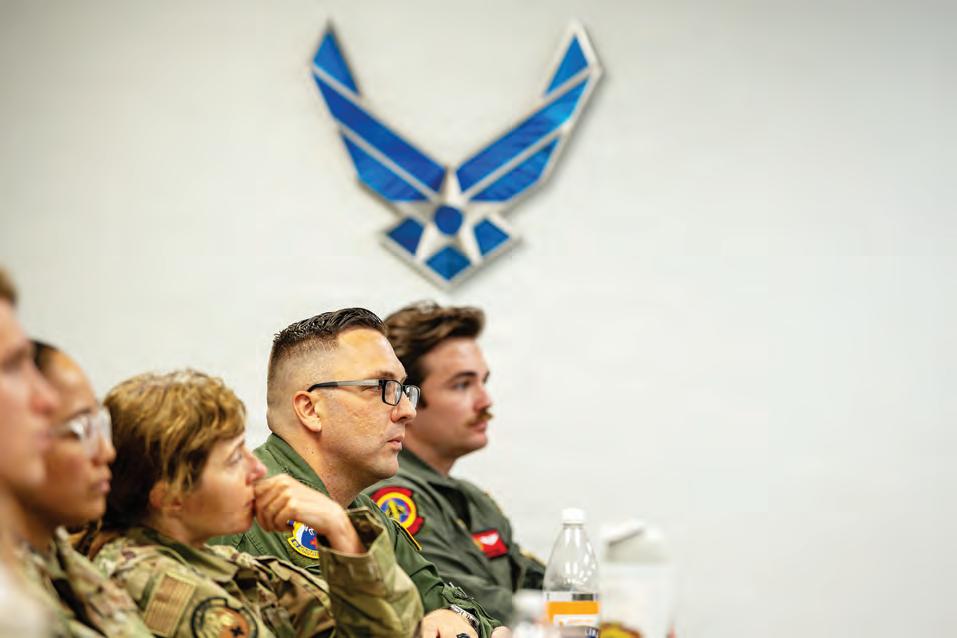
Lt. Col. Kevin Eberhart, 60th Security Forces Squadron commander, speaks to First Term Officer Course students at Travis AFB, June 17. FTOC is a professional development
Air Force officers assigned to various units attend a First Term Officer Course at Travis Air Force Base, June 17.
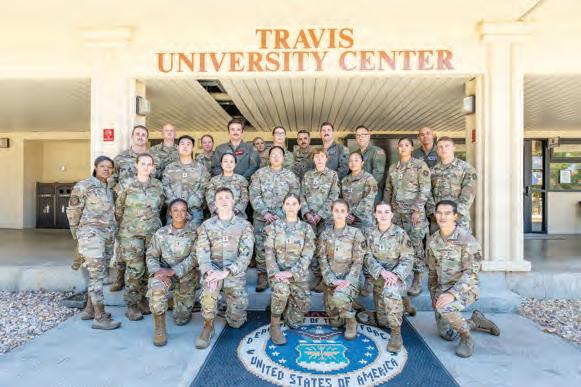
First Term Officer Course students and instructors pose for a group photograph at Travis Air Force Base, June 17.
818th MSAS builds future force during Exercise Fold’Em
capt. Michael hong 621ST CONTINGENCY RESPONSE WING
JOINT BASE
MCGUIRE-DIX-LAKEHURST, N.J. — U.S. Air Force airmen assigned to the 818th Mobility Support Advisory Squadron, 621st Contingency Response Wing, tested the adaptability expected of air advisors during Exercise Fold’Em, June 15-26.
The two-week exercise linked air movements, ground reception and follow-on transportation across multiple austere locations. The training tested the unit’s ability to execute recovery procedures, implement emergency action plans, conduct rapid exfiltration and complete airfield assessment tasks amid changing conditions.
“The amount of coordination that it took, with all the players coming together, stood out,” said U.S. Air Force Lt. Col. Christina Norbygaard, 818th MSAS commander.
“Everyone was prepared and adapted, which goes to show you how air advisors can really bring everyone together.”
For the Silverbacks of the 818th MSAS, the exercise carried additional significance. As the squadron moves toward inactivation, Exercise Fold’Em served as one of its final major operational milestones while supporting the certification or upgrade of eight advanced advisors and four team sergeants.
The exercise challenged airmen to apply mission-essential tasks across a scenario built around uncertainty and changing conditions. Events included simulated chemical, biological, radiological and nuclear conditions, airfield assessment tasks
and other scenario injects designed to require airmen to interpret evolving information and apply appropriate tactics, techniques and procedures.
“Recoveries aren’t necessarily always smooth,” said Staff Sgt. James Orr, an 818th MSAS survival, evasion, resistance and escape specialist and one of the exercise coordinators.
“There are a lot of things that happen and a lot of variables that change.”
Orr said the scenario was designed to replicate the “gray zone” in which air advising missions can unfold, requiring airmen from different functional specialties to coordinate, adapt and sustain the mission. The exercise also evaluated how MSAS capabilities could contribute to the broader contingency response mission.
“We wanted to test MSAS capability within the [621st] Contingency Response Wing, and also air advising as a whole,” Orr said. At one of the exercise’s receiving locations, Tech. Sgt. Garrett Wyatt, 818th MSAS vehicle maintenance noncommissioned officer in charge, helped connect air operations with ground transportation. Acting as part of the ground reception element, Wyatt authenticated arriving personnel and coordinated their follow-on movement through staged vehicles and drivers.
For Wyatt, the scenario highlighted the logistical planning required to move personnel through a recovery operation.
“For me, it’s mostly the logistical aspect – getting the drivers and vehicles staged in certain locations and figuring out how See 818th, Page 4
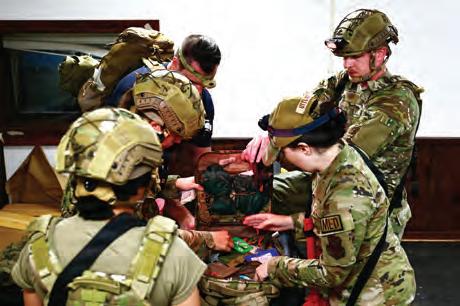
Maxwell Cunningham/U.S. Air Force file Airmen assigned to the 2nd Healthcare Operations Squadron pack their bags during training for Tactical Combat Casualty Care at Barksdale AFB, La., April 27.
From Page 2
support to the strategic deterrence mission at their respective AFGSC installations.
“Our focus prioritizes taking care of our personnel and our warfighting mission,” she said. “The medical groups are committed to the installations they support and will remain partners at their host installations.”
She reinforced that beneficiaries at Global Strike installations will experience no changes or interruptions to their local healthcare services during this administrative transition.
AFGSC, JIATF-401 complete counter-drone qualification
Staff Sgt Michael a. RichMond
90TH MISSILE WING PUBLIC AFFAIRS
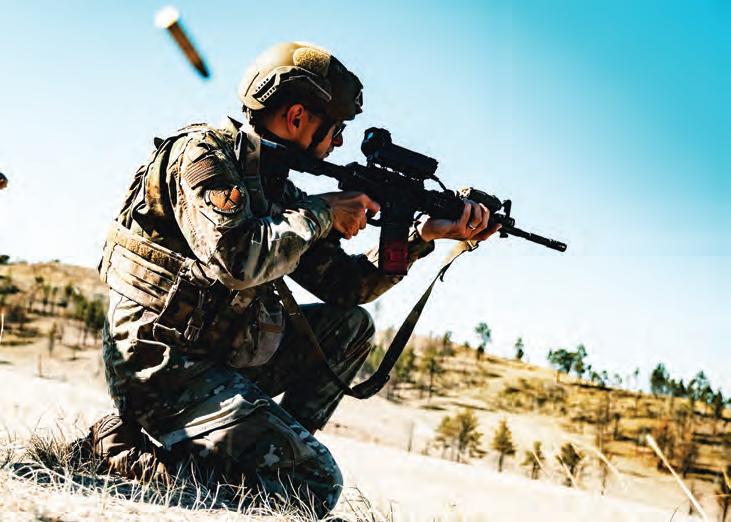
CAMP GUERNSEY JOINT TRAINING CENTER, Wyo. — Airmen from the 90th Missile Wing joined personnel from Air Force Global Strike Command, Air Combat Command, U.S. Strategic Command and the Air National Guard for a counter-small unmanned aircraft systems firing qualification conducted in partnership with Joint Interagency Task Force 401, May 14-15.
As the battlefield continues to evolve, tactics, techniques and procedures must adapt alongside emerging threats. One of the most rapidly developing areas is the C-sUAS environment, where technology, training and operational requirements are evolving quickly.
In August 2025, the Department of War established JIATF-401 as the department’s lead organization for synchronizing efforts to rapidly deliver C-sUAS capabilities at scale to defend the homeland, protect U.S. and allied forces, defend critical infrastructure and assist federal agencies. JIATF-401 has one measure of effectiveness: rapidly delivering state-of-the-art C-sUAS capabilities to warfighters at home and abroad.
grateful for the part-
nership with the 90th Missile Wing, Air Combat Command, and Air Force Global Strike Command that is enhancing C-sUAS training to keep our warfighters, installations and critical assets safe from drone threats.”
Beyond supporting department-level C-sUAS objectives, the qualification also provided 90th MW personnel with hands-on experience using emerging capabilities that support AFGSC’s broader modernization efforts and strengthen the wing’s national security mission.
Mobility Multipurpose Wheeled Vehicles, commonly known as Humvees, to Joint Light Tactical Vehicles, and the replacement of UH-1N Hueys with MH-139A Grey Wolf helicopters, the command is adapting its capabilities to meet current and future security demands. C-sUAS training represents another layer of that modernization, preparing defenders to counter emerging unmanned threats to critical assets, personnel and the intercontinental ballistic missile mission.
a commander. That confidence born from having the best tools and training, translates directly into a more lethal and decisive force on the ground. This isn’t just about fielding new technology; it’s a direct investment from our major command in our most critical weapon system: the individual defender. We are sharpening the spear at every level, and this is what it looks like.”
“Air Force Global Strike Command relies on the unwavering health and readiness of its force to provide combat capability that is always available,” said Col. Erich Schroeder, AFGSC command surgeon. “We are committed to sustaining responsive, engaged medical services and capitalizing on the medical readiness enhancement this historic transition will provide to our strikers and installations.”
The two-day firing qualification tested and enhanced operators’ ability to engage ground and aerial targets at varying distances using technologically advanced small arms target acquisition systems.
The fourth inter-command transfer marks another milestone in AFMEDCOM’s ongoing effort to build a more resilient, responsive and unified operational medical capability.
The C-sUAS qualification comes as AFGSC continues to modernize the tools and platforms that support missile field security and nuclear deterrence. With the transition from Up-Armored High
“The system is a game changer,” said Col. Jeremy Sheppard, 90th Security Forces Group commander.
“When you hear one of our young defenders say they feel more confident and prepared, that’s the metric that matters most to me as
For the airmen who participated, the qualification offered direct experience with systems designed to counter emerging threats and improve defender readiness in operational environments.
“This training makes me more effective by giving me hands-on experience with systems
“Protecting our power projection platforms is a critical component of enhancing warfighter lethality,” said Brig. Gen. Matt Ross, director of JIATF-401. “I am









Staff Sgt. Michael A. Richmond/U.S. Air Force file photos
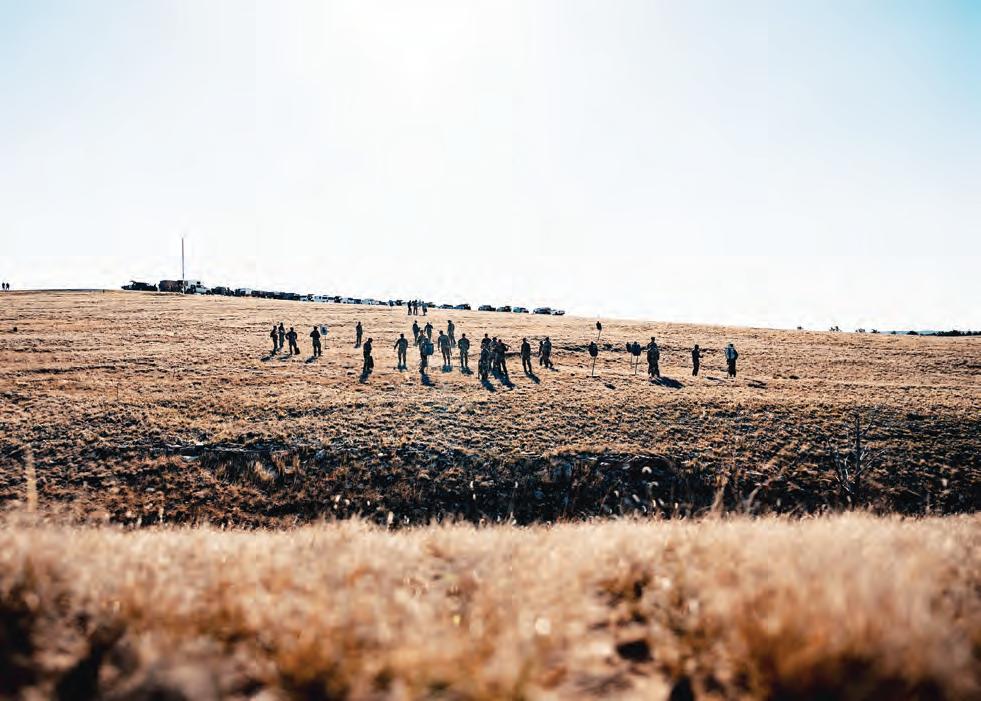
Global Strike Command, U.S. Strategic Command, Air Combat Command and Air National Guard airmen set up targets during an X4 and Smash 2000L Systems Firing Qualification at Camp Guernsey Joint Training Center, Wyo.,
May 15. The multi-command qualification strengthened counter-small unmanned aircraft systems readiness by giving defenders hands-on experience engaging ground and aerial targets.
A 91st Missile Security Operations Squadron defender engages targets during an X4 and Smash 2000L Systems Firing Qualification at Camp Guernsey Joint Training Center, Wyo., May 15. The qualification tested defenders’ ability to employ emerging C-sUAS capabilities against simulated ground and aerial threats.
See AFGSC, Page 7
Airman
McConnell completes Nuclear Operational Readiness Inspection
MCCONNELL
FORCE BASE, Kan. —
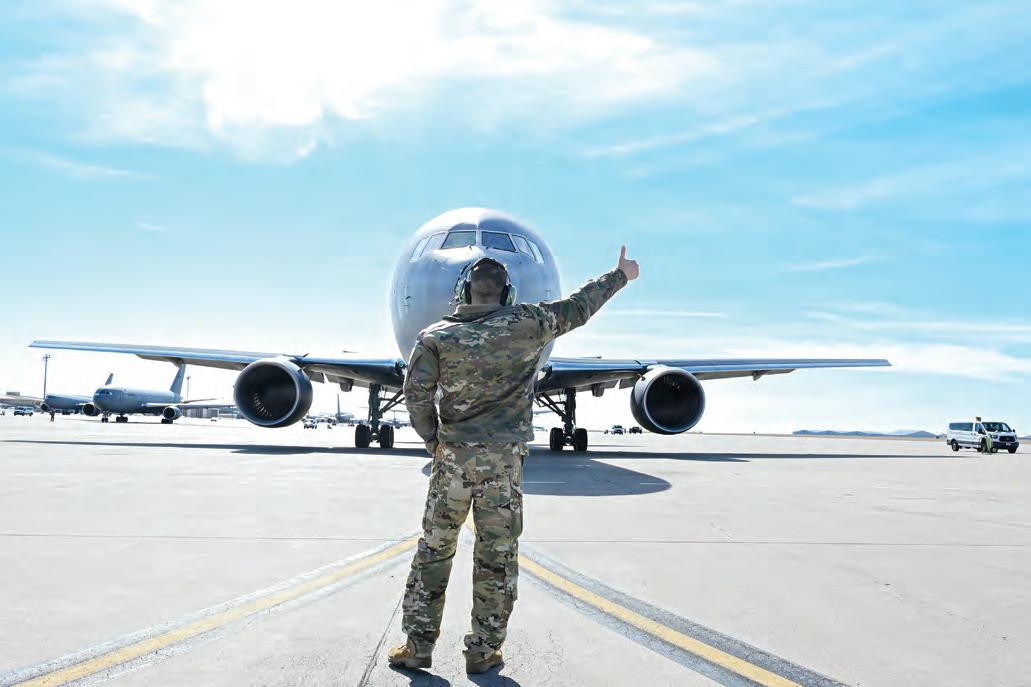
The 22nd Air Refueling Wing conducted a Nuclear Operational Readiness Inspection (NORI) at McConnell Air Force Base, Kansas, May 13-20. Inspectors from Air Mobility Command, Air Force Reserve Command, U.S. Strategic Command and McConnell evaluated the 22nd Air Refueling Wing and its Reserve associate unit, the 931st Air Refueling Wing, on every aspect associated with the readiness of the KC-46A Pegasus to support the nuclear mission.
That mission is, when directed, to generate and provide air refueling aircraft and aircrews to conduct air refueling of U.S. Strategic Commandassigned strategic bomber and command-and-control aircraft.
“Our single most important priority is supporting the nuclear mission. Strategic deterrence is delivered through our air refueling capabilities,” said Col. Joe Wall, 22nd ARW commander.
This is hardly the first Nuclear Operational Readiness Inspection (NORI) to hit McConnell AFB or other AMC tanker bases.
For decades, the KC-135 Stratotanker has been the backbone of AMC’s air refueling capabilities, extending global reach and global strike for conventional missions, and being prepared for the
nuclear mission.
McConnell became the first operational base to receive KC-46s in 2019. It has been a dualtanker base ever since, juggling the demands and taskings levied on its KC-135 fleet while simultaneously leveraging that KC-135 expertise to grow the operational capabilities of the KC-46 cadre and fleet from scratch.
The base has been supporting nuclear readiness with its KC-135 fleet for decades and has leveraged that knowledge and skill set to train and prepare its growing KC-46 fleet to support all of its rapid global mobility, global reach and global strike mission sets, to include the nuclear mission.
“You are a welloiled machine, and everyone here is a part
of that machine,” Wall told the wing prior to the NORI. “So as we’ve done for the past several years, you’re going to break new ground with the KC-46. It is rare during one’s operational career to bring a new weapons system online, and you’re making history during this NORI as we continue building the KC-46 enterprise.”
The inspection had two parts, starting with a Combat Readiness Inspection (CRI) before fully diving into the NORI portion. The CRI was a rigorous evaluation of the wing’s ability to prepare the force for deployment, run personnel and cargo deployment functions, meet all readiness, training and other requirements for deployment, and deploy the force to perform its wartime missions.

818th
From Page 3
we’re going to transport people to the next spot,” Wyatt said. He said the scenario reflected the embassy coordination air advisors may encounter during real-world missions. “We work pretty directly with the embassy on most of our missions,” Wyatt said. “Being picked up by somebody from the embassy would probably be a likely scenario for us.”
Norbygaard said the exercise’s focus on recovery operations, emergency action plan implementation, rapid exfiltration, airfield assessment and CBRN injects reflected the range of environments air advisors may encounter.
“We never know the environments we may deploy to, so it’s good to be ready for everything,” Norbygaard said. “Our air advisor schoolhouse focuses a lot on armed
equipment too. That’s the modern reality of air advisors now that we’re not focused on the Global War on Terrorism.”
Though the squadron is preparing for inactivation, Norbygaard said maintaining a strong pool of qualified and experienced advisors remains important to the Air Force.
“The formal structure of an air advisor squadron may be gone, but the mission will keep going,” Norbygaard said. “The Air Force will need a strong bench to pull from, and having experienced team leaders like ours will be key.”
Norbygaard said the Silverbacks’ adaptability and ability to integrate with allies and partners are among the qualities that should continue within the broader air advisor enterprise.
“We will never be able to fight and win a war without our allies and partners,” Norbygaard said. “We are force multipliers. Not by technology or equipment, but by leveraging the military’s most important asset,
After that, the focus shifted fully to the NORI portion. Inspectors evaluated every aspect of how the wings do command and control, operations, maintenance, servicing, documentation, security, airmen compliance and nuclear operations support capability with its KC-46s. They also checked compliance with the unwavering security, safety and reliability standards of the nuclear mission.
The nuclear triad is foundational to national strategic deterrence, underwriting diplomacy and global military operations. Air Mobility Command tankers are essential to the nuclear mission, and the KC-46 fleet will further strengthen these capabilities.





Senior Airman Amelio Brown/U.S. Air Force file photos
McConnell airmen marshal a KC-46 Pegasus during a nuclear operational response exercise at McConnell Air Force Base, Kan., Feb. 7. Exercise members simulated taxi and take off procedures while aboard the aircraft.
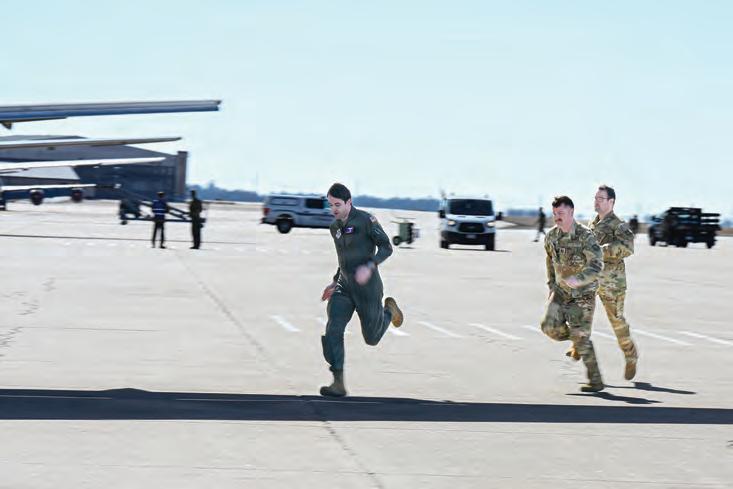
Airmen rush from an alert van to an aircraft during a nuclear operational response exercise at McConnell Air Force Base, Kan., Feb. 7.
Capt. Michael Hong/U.S. Air Force file
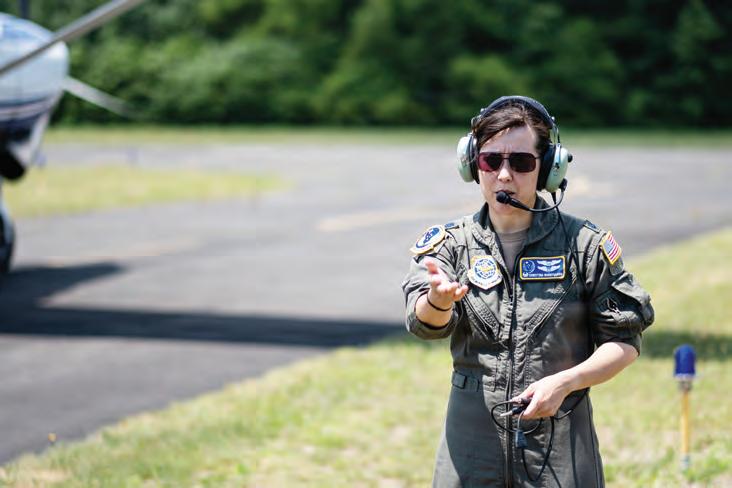
Lt. Col. Christina Norbygaard, 818th Mobility Support Advisory Squadron commander, signals aircrew and air advisors to board a C-208 Caravan aircraft at Lakewood Airport, N.J., June 25. The rapid tactical boarding was executed during Exercise Fold’Em, a two-week validation exercise designed to test the unit’s ability to execute emergency action plans, rapid exfiltrations, and austere airfield assessments.
US, Peru advance strategic air partnership, F-16 integration during bilateral talks
Staff Sgt a bbey RieveS
PUBLIC AFFAIRS DAVIS-MONTHAN AIR FORCE BASE, Ariz. — Twelfth Air Force, Air Forces Southern (AFSOUTH), interfaced with the Peruvian air force (FAP) during the United States and Peru airmanto-airman staff talks, hosted at Davis-Monthan Air Force Base, Ariz., June 15-17.
Throughout the threeday summit, bilateral leaders met to discuss operational frameworks focusing on cyber defense, aircraft maintenance, logistics, and resource planning while discussing future areas of cooperation between the two air forces.
“The United States remains committed to Peru as a trusted partner of choice,” said U.S. Air Force Brig. Gen. Henry Jeffress III, AFSOUTH deputy commander. “This is more than two nations that share a hemisphere – this is a shared neighborhood. We are bound by our democratic values, mutual respect for sovereignty, and collective responsibility to protect
our populations.” Building on a shared commitment to regional security and defense, the discussions focused on strengthening the long-
standing partnership between the U.S. and Peruvian air forces while identifying opportunities to enhance integration, cooperation and collective security efforts in the air domain.
“My biggest take-away from this event is the reinforcement that our air forces are aligned in our objectives to counter transnational criminal organizations,” said Lt. Col. Allen Snyder, AFSOUTH plans, programs and assessments, chief of theater security cooperation. “With Peru, we have a willing and able partner that is increasing its military capabilities in the air domain through the purchases of F-16s. That will help us cooperate together and strengthen integration throughout the Western Hemisphere.” This milestone aircraft procurement follows highly visible joint engagements. In April, the U.S. Air Force F-16 Viper
See Peru, Page 7
First Assembly is a place where all are welcome to Discover, Develop, and Demonstrate a relationship with God.
We invite you to join us for Sunday service at 10:30 a.m.
2207 Union Avenue, Fairfield, CA www.1ag .com





Christ Exalted, Lives Transformed 3777 Vaca Valley Pkwy Ste.F, Vacaville, 95688
Email: o ce@northhillsvv.org
Website: www.northhillsvv.org
Service Times: Sunday morning 10 a.m., Wednesday evening 6:30 p.m. Phone: 707-449-8977




Vacaville Church of Christ 401 Fir St., Vacaville, CA 95688 (707) 448-5085
Minister: Elliott Williams
Sunday Morning Bible Study 9:30 AM
Sunday Morning Worship 10:30 AM
Sunday Evening Worship 5:00 PM
Wednesday Evening Bible Study 6:00 PM vacavillecoc.com 401 Fir St.,






NA ZARENE
Staff Sgt. Abbey Rieves/U.S. Air Force file
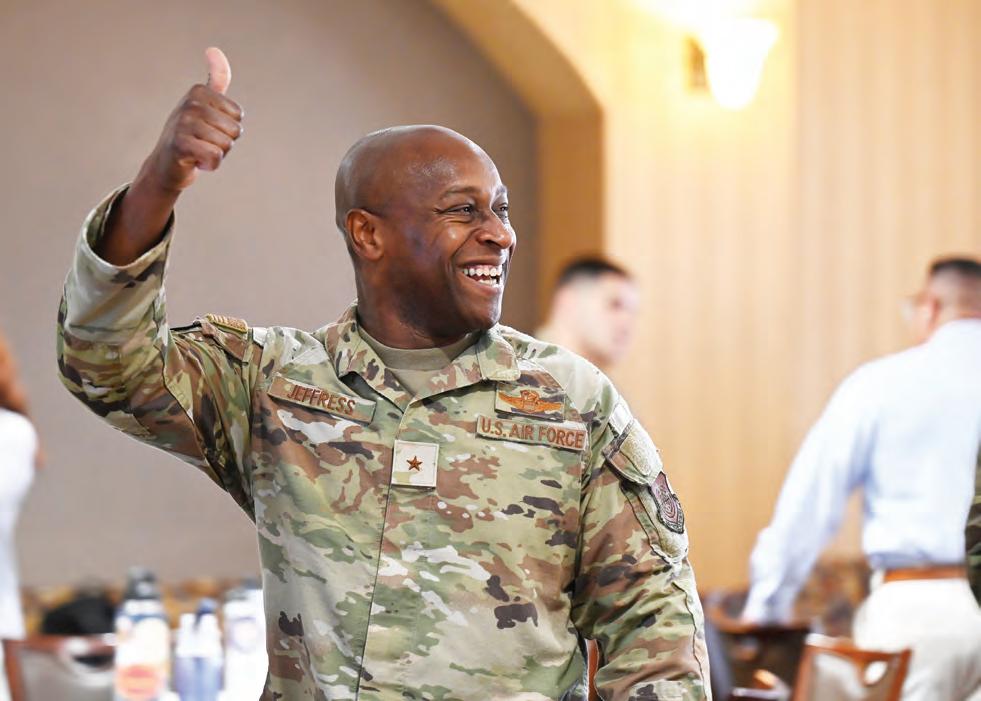
Brig. Gen. Henry Jeffress III, 12th Air Force, Air Forces Southern deputy commander, thanks the Peruvian air
force for attending the United States and Peru airman-toairman staff talks at Davis-Monthan AFB, Ariz., June 15.
First AETC pilots qualify on T-7A Red Hawk
Benjamin Faske
19TH
JOINT BASE SAN ANTONIO-RANDOLPH, Texas — In a historic milestone for future fifth- and sixth-generation fighter and bomber pilot production, two leaders from the 99th Flying Training Squadron have unlocked the unit’s operational independence by becoming the first Air Education and Training Command pilots qualified on the T-7A Red Hawk. As the Air Force transitions to the T-7A – ushering in a modern era of pilot training with advanced avionics and systems – the team at the 99th FTS is leading the charge toward achieving initial squadron stand-up and overall Initial Operational Capability, or IOC, by building the first cadre of T-7A instructor pilots.
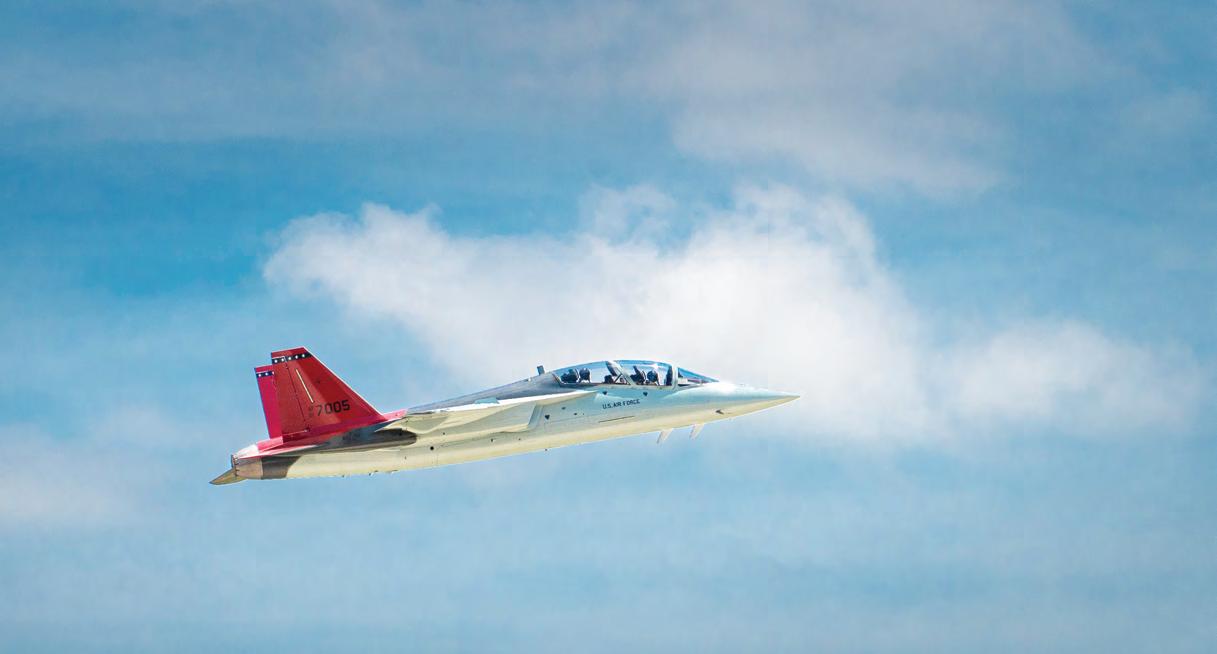
Benjamin Faske/U.S. Air Force file
A T-7A Red Hawk takes off from Joint Base San Antonio-Randolph, Texas, May 15. The 99th Flying Training Squadron is the first Air Education and Training Command unit to fly the T-7A, which will replace the T-38C Talon as the service’s advanced jet trainer.
These initial flights, known as Type 1 sorties, are crucial for building the first cadre of instructor pilots who will train the next generation of aviators.
“As the first T-7A squadron in the Air Force, this moment marks a critical step in the overall process of fielding the new trainer fleet,” said Lt. Col. Michael Trott, 99th FTS commander, who is also one of the first two T-7A-qualified pilots. “This milestone permits us to fly the aircraft on our own without a T-7 instructor pilot from Boeing or Developmental Test, allowing us to build the instructor cadre vital to producing the highly capable aviators needed for tomorrow’s highend fight.”
For Trott and Lt. Col. Phillip Bourquin, 99th FTS director of operations, who also qualified on the T-7A, the path to qualification relied heavily on “Type1” sorties. These specific flights are the foundation for the T-7 initial cadre aircrew.
According to Trott,
Type-1 sorties are dedicated to the initial training and qualification of pilots in a brand-new airframe. Unlike standard training missions, they focus intensely on the fundamentals of the new aircraft: takeoffs, landings, enroute navigation, instrument approaches and overall system familiarization. This rigorous process ensures the first generation of instructors intimately understands the aircraft’s handling and capabilities before teaching others.
As members of the initial cadre for a new aircraft, the two are also now the first T-7A AETC instructor pilots. However, they plan to build their experience before passing on their knowledge.
“We do intend to fly some seasoning sorties before instructing others,”
Trott added.
For Trott, this achievement represents far more than personal qualification; it is a testament to the hard work of the entire 99th FTS as they build the foundation for the T-7A program.
“We are looking forward to getting the rest of our initial cadre flying,” Trott said. “They have been putting in enormous amounts of work and effort into the T-7 program, and we are excited to have them qualified in the aircraft as soon as possible.”
While the squadron awaits its next T-7A delivery in August, the current aircraft will remain highly active.
The 99th FTS aims to fly the jet regularly each month, sharing the aircraft in coordination with Type 1 maintenance training demands, ensuring ground crews become just as profi-

cient as the pilots.
For Trott and Bourquin, these flights will serve as currency sorties while simultaneously getting the next group of initial cadre aircrew into the cockpit.
While the initial cadre is actively flying, standard T-7 Pilot Instructor Training is still on the horizon.
The 99th FTS does not plan to instruct standard PIT until the squadron achieves IOC, which is targeted for August 2027, Trott said. Training new 99th FTS IPs who are outside of the initial cadre will require the completion of a dedicated T-7 PIT syllabus.
Currently in its draft phase and expected to be finalized this fall, the syllabus is anticipated to take approximately four months to complete.
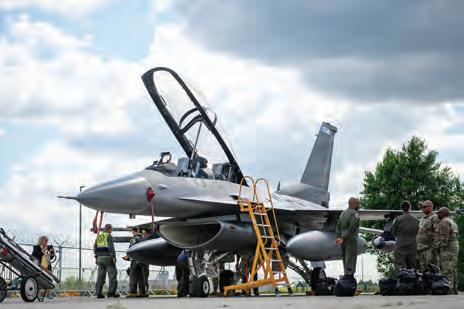
U.S. Air Force and German military crew members conduct post-flight checks on an F-16D Fighting Falcon assigned to the 31st Fighter Wing before the ILA Berlin Air Show at Berlin-Brandenburg Airport, Germany, June 9.
US participation at ILA Berlin shows allied commitment
senior a irman
BERLIN, Germany —
U.S. Air Forces in Europe – Air Forces Africa led the U.S. military’s presence at the 2026 International Aerospace Exhibition (ILA) Berlin Air Show, emphasizing U.S. airpower, innovation and a commitment to strengthening partnerships with allies and partners.
Held June 10-14, ILA Berlin brings the global aerospace industry to the heart of Europe. The event highlighted current and future technologies, including manned aircraft, unmanned aerial systems and artificial intelligence-supported solutions.
Throughout the week, U.S. service members engaged with government officials, allies and partners, and the aviation industry to strengthen relationships and demonstrate the capabilities that enable collective










defense across Europe and around the world.
“Our presence here shows how important our partnerships are and how committed we remain to strengthening alliances,” said Lt. Col. Heather Corless, 2026 ILA Berlin Air Show air boss.
“Despite our operational commitments around the world, we wanted to be here because we value these relationships.”
The U.S. Air Force’s presence featured a range of aircraft representing the flexibility, reach and readiness of U.S. airpower. Airmen from multiple commands supported static displays and engagements throughout the event, showcasing capabilities that contribute to deterrence and regional security.
U.S. Air Force aircraft displayed at the 2026 ILA Berlin Air Show include: n F-35A Lightning II, 48th Fighter Wing, RAF Lakenheath, United Kingdom . n F-16D Fighting Senior Airman Demi M.
See Berlin, Page 7


Ebert/U.S. Air Force file
AFGSC
From Page 3
designed to counter hostile drones,” said Senior Airman Preston Reiger, 90th Missile Security Operations Squadron
sUAS/C-sUAS specialist. “It shows the wing is taking C-sUAS seriously and actively building another layer of defense to protect our mission,
assets and personnel.”
The C-sUAS firing qualification provided practical experience with capabilities designed to meet an evolving threat environment. Through continued collaboration with C-sUAS organizations like JIATF-401, the 90th MW is strengthening its ability to defend the nation’s ICBM mission today while preparing for the security challenges of tomorrow.
Berlin
From Page 6
Falcon, 31st Fighter Wing, Aviano Air Base, Italy.
n C-130J Super Hercules, 136th Airlift Wing, Fort Worth, Texas Air National Guard.
The U.S. participation at ILA Berlin 2026 underscored the commitment to advancing aerospace innovation alongside allies and partners. Through collaboration, capability demonstrations and professional exchanges, the event reinforced the shared resolve to maintain peace, security and stability throughout Europe and beyond.
Air Force honors B-52 crew at Edwards Air Force Base
Tech. SgT. RobeRT cloyS 412TH TEST WING PUBLIC AFFAIRS
EDWARDS AIR
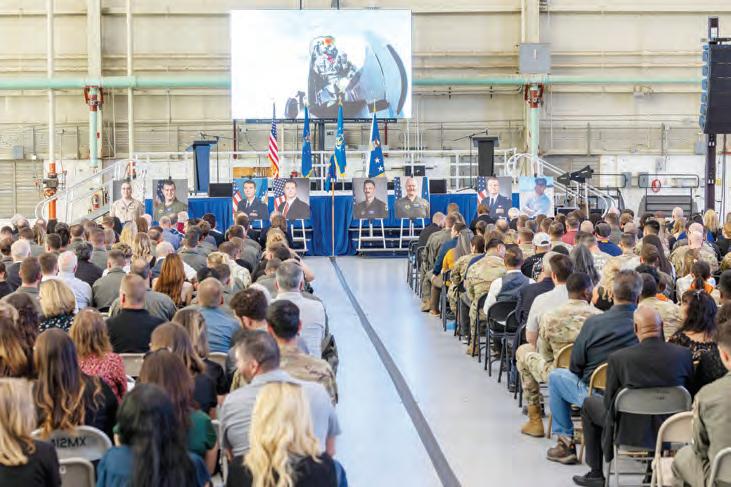
FORCE BASE — The air fell quiet the evening of June 29 as families, teammates and senior Air Force leaders gathered beneath the high ceiling of an aircraft hangar to honor the eight members of the B-52 Stratofortress crew lost in a crash at Edwards Air Force Base two weeks earlier.
Peru
From Page 5
Demonstration Team performed at the 2026 Peruvian Airshow at Las Palmas Air Base. Following the event, the Peruvian air force finalized an agreement to purchase F-16 Fighting Falcon aircraft. The deal marks a major modernization of Peru’s air defense capabilities and binds the nation to longterm U.S. training and maintenance programs. Representing the FAP in cyber operations, Lt. Col. Iván M. Vargas Guevara emphasized the strategic timing of the summit.
“As Peru modernizes its air force with the acquisition of new fighter aircraft, these staff talks are vital,” Vargas Guevara said. “They provide us a unique opportunity to exchange tactical knowledge, learn alongside our U.S. counterparts, and ensure our forces are fully integrated for future joint operations.”
The staff talks reinforced the longstanding defense partnership between the United States and Peru. Together, AFSOUTH and the FAP continue to advance shared objectives through sustained cooperation in support of a safer, more secure Western Hemisphere.

The June 15 crash claimed the lives of Col. Gregory “Evil” Watson, Lt. Col. Gabriel “Journee” Estrella, retired Lt. Col. Miles “Vicky” Middleton, Maj. Alexander “SMO” Davis, Maj. Robert “Bolton” Dee, Maj. Brad “Slate” Hovey, Jeromy “Bobby” Smith and Christopher “Hustler” Rischar. The aircraft crashed shortly after takeoff during a routine test mission. The cause remains under investigation.
The memorial service brought together the families of the fallen, members of Team Edwards, local civic leaders and senior Air Force officials, including Air Force Chief of Staff Gen. Ken Wilsbach and Chief Master Sgt. of the Air Force David Wolfe. Lt. Gen. Linda Hurry, commander of Air Force Materiel Command, Maj. Gen. Scott Cain, commander of the Air Force Test Center, Brig. Gen. Mark Massaro, incoming AFTC commander, and Chief Master Sgt. Sevin Balkuvvar, AFTC command chief, also attended.
For Edwards AFB, the loss reached beyond a single squadron. The crew represented the blended nature of flight test: activeduty airmen, Air Force civilians and contractors working together inside one of the Air Force’s most demanding missions.
Col. Tom Tauer, 412th Test Wing commander, told families the first words of the evening belonged to them.
“The tragedy that occurred here two weeks ago today resonates far beyond the boundaries of this installation,” Tauer said. “The ripples of grief touch our local community and extend across a grateful nation.”
The service opened with a presentation of colors, the national anthem and an invocation. Speakers then reflected on the lives of the crew and the mission they shared before the evening moved into a moment of silence, wreath placement and taps.
Lt. Col. James McDonald, commander of the 419th Flight Test Squadron, spoke not first about the aircraft, the mission or the investigation, but about names.
“There are no words
equal to this moment,” McDonald said. “But there are names. And behind each of those names is a story.”
He described Watson as a mentor who invested in future leaders; Estrella as a humble professional whose example shaped the B-52 and operational test communities; Middleton as a veteran test pilot with an infectious smile; Davis as a technical leader whose humor carried others through hard days; Dee as a pilot who pushed to improve broken processes; Hovey as a standout test pilot whose excellence was matched by his ability to bring people together; Smith as a flight test engineer whose passion for the bomber mission was contagious; and Rischar as a hardworking flight test leader whose quiet confidence made difficult work look easy.
The 419th FLTS is part of the 412th Test Wing, the Air Force’s premier flight test organization at Edwards AFB. By planning, conducting, analyzing, and reporting on flight and ground testing of aircraft, weapon systems, software and components before fielding them to operational forces, the wing fulfills what Tauer described to attendees as its core mission: sharpening American airpower. That mission gives Edwards AFB a particular understanding of risk. Flight test is designed to reduce uncertainty for the warfighter, but it is carried out by people who accept danger in order to make future operations safer and more effective.
Tauer connected that responsibility directly to the crew.
“Military aviation is inherently dangerous, but the flight test enterprise bears a unique responsibility,” Tauer said. “We willingly place ourselves above the safety of this Earth so that American warfighters may enter combat with absolute certainty and confidence in
the tools we provide.”
Wilsbach widened the moment beyond Edwards AFB, saying the loss of the B-52 crew had been felt across the Air Force and by sister services, allies and partners around the world. He framed the crew not only as members of a test mission, but as airmen and teammates whose service reflected the knowledge, skill, character and credibility demanded of those trusted with the nation’s airpower.
Speaking to the families, Wilsbach acknowledged that the Air Force could not remove the grief, would continue to support them, and would keep the names of their loved ones tied to the legacy of the B-52 community and the Air Force they served.
The B-52H Stratofortress remains one of the Air Force’s most enduring aircraft. A long-range, heavy bomber, it can perform a range of missions and carry nuclear or precision-guided conventional ordnance. The B-52 test mission at Edwards AFB supports modernization work intended to keep the bomber relevant for future operations.
That strategic context was present June 29th, but it did not overshadow the grief in the room. The service centered on the lives behind the mission: husbands, fathers, mentors, pilots, weapon systems officers, engineers and teammates whose absence will be felt in squadron spaces, test planning rooms and cockpits across the bomber community.
“Grief is not something we solve,” said Col. Matthew Guasco, commander of Detachment 5, Air Force Operational Test and Evaluation Center. “It is something we learn to carry together.”
Guasco said the empty chairs, familiar voices and instinct to look for someone who is no longer there would remain. Over time, he said, those moments would become reminders
not only of what was lost, but of what the crew gave to the people around them. Their stories, he said, would continue through the next generation of aviators, engineers and maintainers who may never know the crew personally but will come to understand the standard they left behind: mentors who made time to teach, teammates who brought laughter to hard days, leaders who refused to settle for good enough and fathers whose greatest pride waited for them at home.
As the ceremony moved toward its close, families and distinguished visitors transitioned to the flightline. Attendees followed afterward, carrying the silence of the hangar into the open desert air. The memorial concluded with a final airborne tribute over the base where the crew and aircraft had served. This poignant farewell featured B-52s from Minot AFB, North Dakota, and Barksdale AFB, Louisiana, units Watson and other crew members had proudly flown with during their careers. For a community built around flight, the gesture carried a language of its own. It marked grief, respect and continuity. It acknowledged the cost of the mission without trying to soften it. And it offered Team Edwards a moment to look upward together. McDonald told the families their loved ones would remain part of the squadron’s identity.
“They are woven into this team,” he said. “Into this wing. Into this mission. Into each of us.”
Tauer closed his remarks with an image familiar to generations of aviators, recalling the freedom of flight and the “laughter-silvered wings” of John Gillespie Magee Jr.’s poem “High Flight.”
“We will carry on the mission,” Tauer said, “and we will forever honor
the crew of Torch 11.”
Lindsey Gordon/U.S. Air Force file
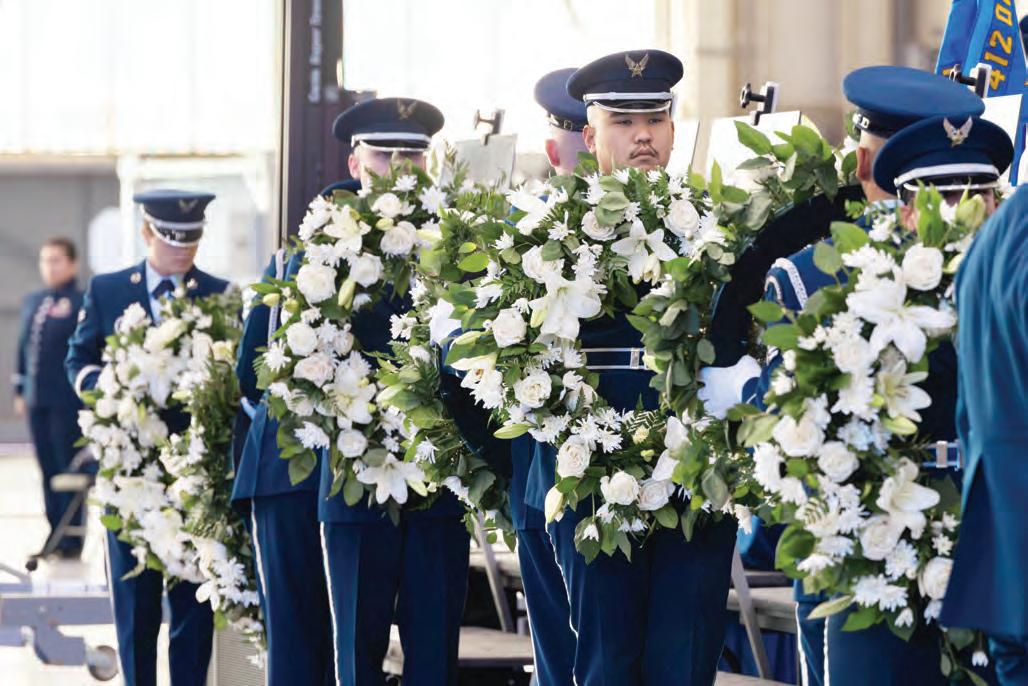
Airmen of the Blue Eagles Honor Guard, on behalf of “Torch
One One” family members, prepare to attach wreaths to
easels holding the images of the fallen B-52 aircrew at Edwards Air Force Base, June 29.
Blaine Torres/U.S. Air Force file
Family, friends, local civic officials and senior Air Force leadership attend a memorial service for eight fallen B-52 crewmembers at Edwards Air Force Base, June 29.
Senior Airman Demi M. Ebert/U.S. Air Force file
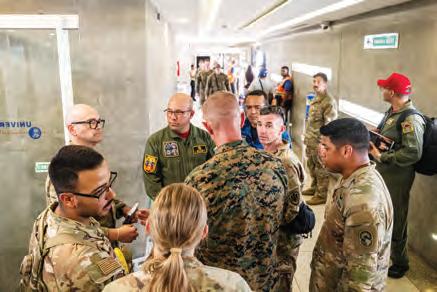
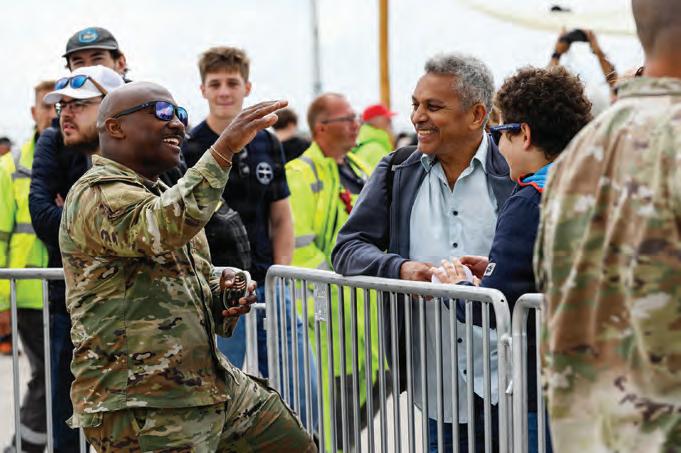
Master Sgt. Julius Paster, Air Force Installation Mission Support Center/Detachment 4 manager of the operations branch, left, speaks with visitors during the ILA Berlin Air Show at Berlin-Brandenburg Airport, Germany, June 13.
Staff Sgt. Michael A. Richmond/U.S. Air Force file
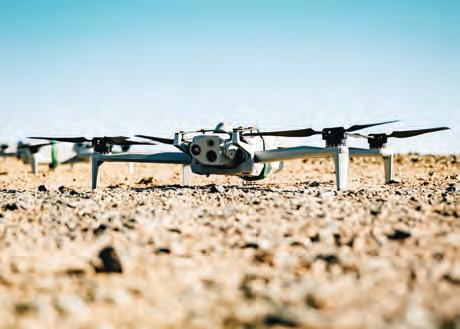
A drone sits on the ground before being flown during an X4 and Smash 2000L Systems Firing Qualification at Camp Guernsey Joint Training Center, Wyo., May 15. The drone was used to carry aerial targets, allowing defenders to simulate counter-drone engagements during the qualification.